Automotive Wheel Market Size, Growth, Share and Forecast 2032

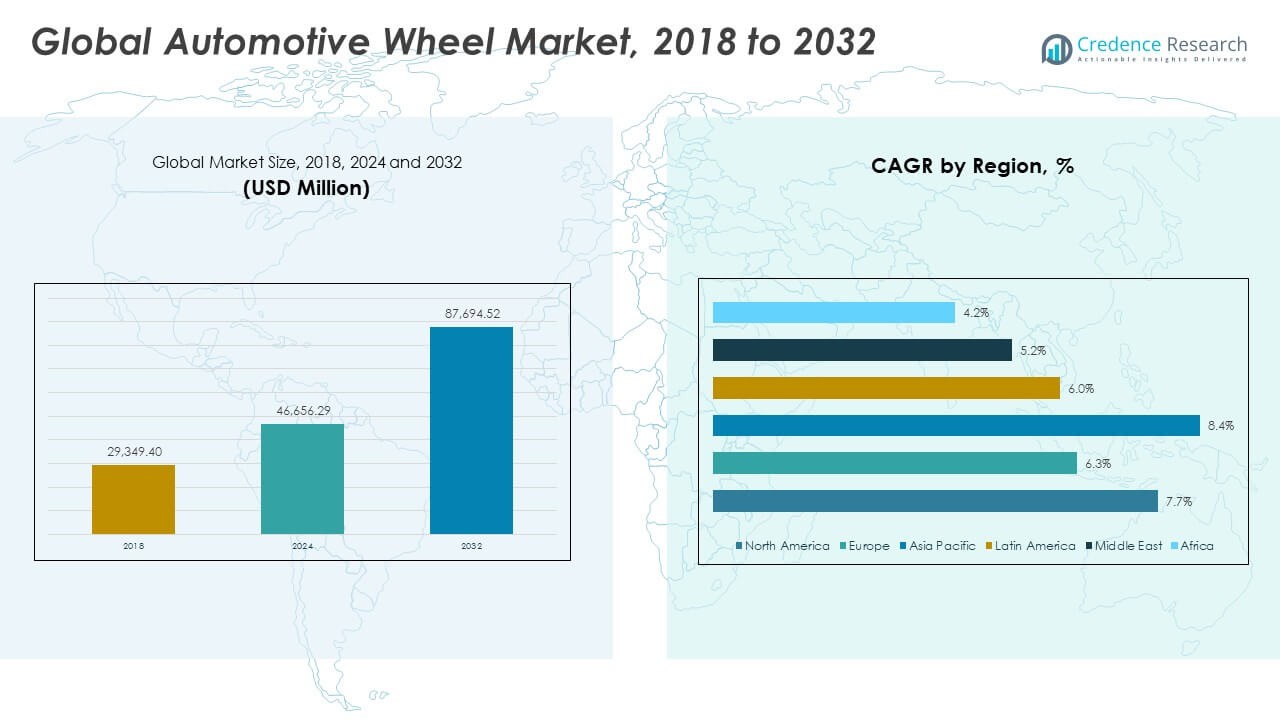
Automotive Wheel market size was valued at USD 46,656.29 million in 2024 and is projected to reach USD 87,694.52 million by 2032.

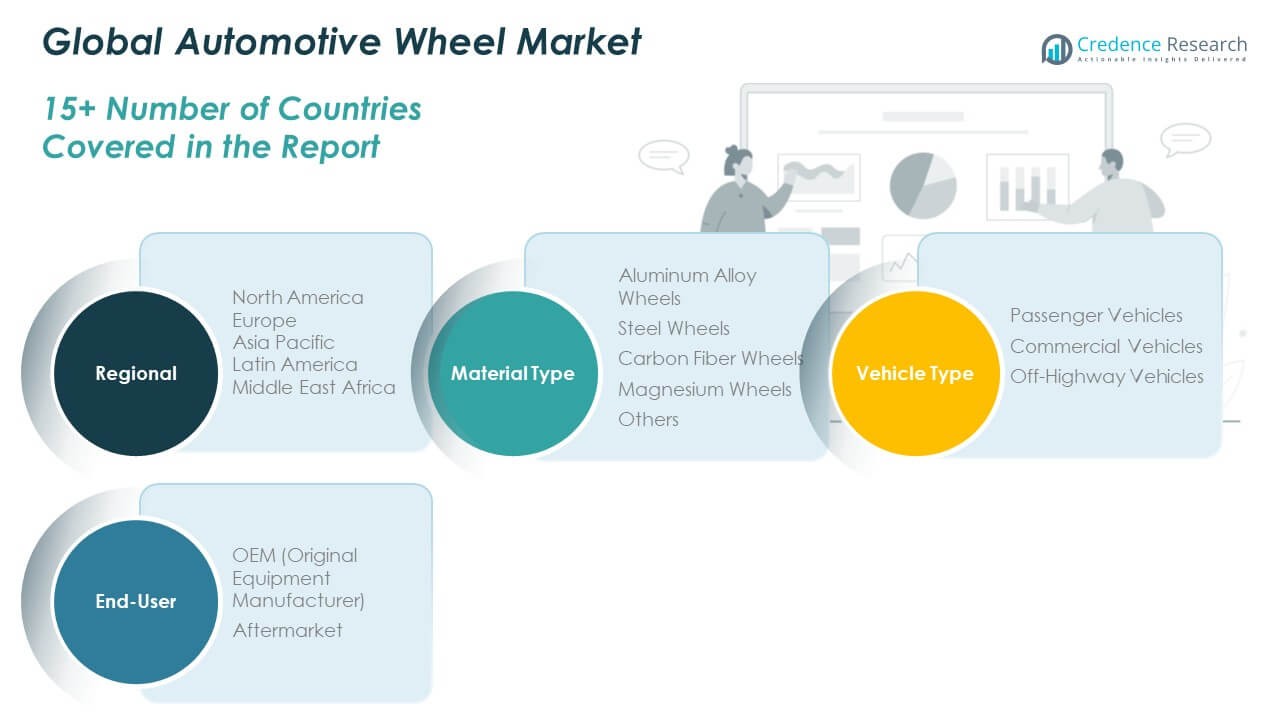
Automotive Wheel Market By Product Type (Drawstring Trash Bags, Flat-Sealed Bags, Star-Sealed Bottom Bags, Scented Bags, Compostable Bags); By Material Type (High-Density Polyethylene (HDPE), Low-Density Polyethylene (LDPE), Linear Low-Density Polyethylene (LLDPE), Biodegradable (Polylactic Acid, Polyhydroxyalkanoates, Oxo-biodegradable), Recycled Plastics); By End-User (Residential, Commercial, Industrial, Healthcare); By Region – Growth, Share, Opportunities & Competitive Analysis, 2024 – 2032

SKU: CR21108Report Pages: 250Category: Automotive & TransportationReport Format: PDF, ExcelLast Updated: Nov 14Author: Ganesh ChandwadePreferred on

Market Report Metrics

Revenue, 2024 -
USD 46,656.29 million
Forecast Year -
2032
CAGR (2024–2032)
7.64%
Report Coverage
Global

Market Overview:

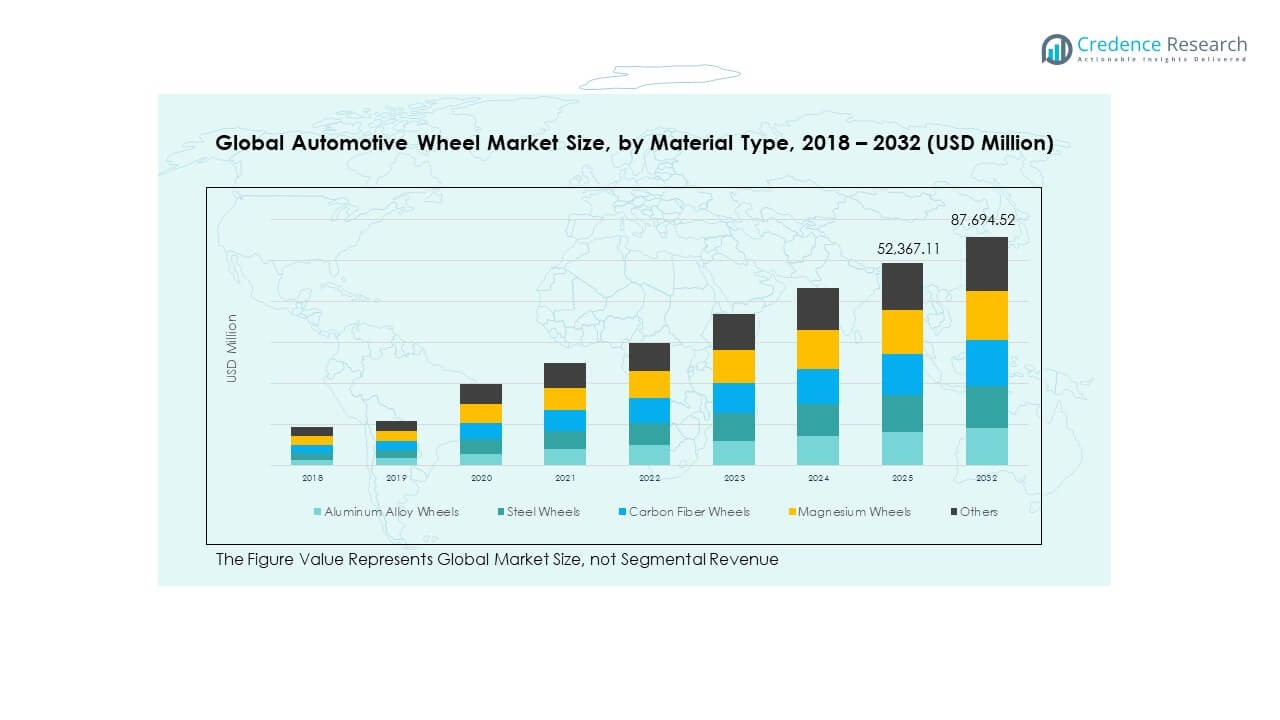
The Global Automotive Wheel Market size was valued at USD 29,349.40 million in 2018 to USD 46,656.29 million in 2024 and is anticipated to reach USD 87,694.52 million by 2032, at a CAGR of 7.64% during the forecast period.

REPORT ATTRIBUTE DETAILS
Historical Period 2020-2023
Base Year 2024
Forecast Period 2025-2032
Automotive Wheel Market Size 2024 USD 46,656.29 Million
Automotive Wheel Market, CAGR 7.64%
Automotive Wheel Market Size 2032 USD 87,694.52 Million
 

The market growth is driven by rising vehicle production, lightweight wheel innovations, and demand for enhanced fuel efficiency. Automakers increasingly adopt aluminum and alloy wheels to reduce vehicle weight and improve performance. Growing consumer preference for aesthetic customization and premium vehicles further fuels the adoption of advanced wheel materials and designs. Expanding electric vehicle (EV) adoption also supports market growth as manufacturers focus on aerodynamic and lightweight wheel solutions to extend driving range.

Asia Pacific dominates the global automotive wheel market due to large-scale vehicle manufacturing in China, Japan, and India. Europe follows with demand for high-performance and luxury vehicle wheels, supported by established automakers and innovation in alloy technologies. North America shows steady growth driven by aftermarket customization and truck segment expansion, while emerging economies in Latin America and the Middle East & Africa experience rising demand due to increasing vehicle ownership and infrastructure development.

Market Insights:

  • The Global Automotive Wheel Market was valued at USD 29,349.40 million in 2018, reached USD 46,656.29 million in 2024, and is projected to attain USD 87,694.52 million by 2032, growing at a CAGR of 7.64% during the forecast period.
  • Asia Pacific (46%), North America (28%), and Europe (17%) collectively dominate the market due to strong automotive manufacturing bases, high vehicle ownership, and continuous R&D investments in lightweight alloy technologies.
  • Asia Pacific remains the fastest-growing region, driven by rapid vehicle production in China and India, expansion of EV infrastructure, and rising disposable income supporting premium vehicle adoption.
  • Aluminum alloy wheels account for about 42% of the material share, maintaining leadership for their lightweight, cost-effective, and fuel-efficient characteristics.
  • Steel wheels represent approximately 30% of the share, sustaining steady demand in commercial and low-cost vehicle categories due to durability and affordability.

Automotive Wheel Market Size

Market Drivers:

Rising Demand for Lightweight and Fuel-Efficient Vehicle Components

The growing focus on vehicle efficiency and emission reduction drives the demand for lightweight wheels. Manufacturers increasingly adopt aluminum and alloy materials to reduce vehicle weight while maintaining strength and durability. The Global Automotive Wheel Market benefits from innovations in casting and forging techniques improving performance and fuel economy. Carmakers emphasize lightweight designs to meet regulatory targets for emissions and efficiency. The push toward electric mobility also fuels the need for lighter wheels that enhance battery range. Consumers prefer vehicles offering better handling and reduced fuel costs. Automakers integrate advanced alloys that balance cost and performance. It reflects a shift toward engineering precision and sustainable manufacturing methods.

  • For instance, RONAL GROUP now manufactures wheels from 100% secondary aluminium for BMW’s MINI Cooper SE Convertible, cutting CO₂e emissions by up to 75% in production. Manufacturers increasingly adopt aluminum and alloy materials to reduce vehicle weight while maintaining strength and durability.

Expanding Passenger and Commercial Vehicle Production Worldwide

Rising vehicle production across developed and emerging markets boosts wheel demand significantly. Increasing disposable income and urbanization accelerate passenger car sales globally. The commercial segment grows with logistics and construction industry expansion. The Global Automotive Wheel Market experiences rising OEM demand due to continuous model launches and upgrades. Tier-1 suppliers expand capacity to meet automaker requirements for design diversity and performance. Governments encourage domestic manufacturing through policy support and infrastructure investment. Global trade recovery strengthens supply chains supporting production stability. It aligns industrial growth with consumer-driven automotive expansion across multiple regions.

  • For instance, ENKEI’s “H Cross Spoke” design targets strength and light-weight for diverse vehicle types. Tier-1 suppliers expand capacity to meet automaker requirements for design diversity and performance. Governments encourage domestic manufacturing through policy support and infrastructure investment.

Technological Advancements and Material Innovations in Wheel Manufacturing

Material innovation plays a crucial role in improving wheel strength, performance, and aesthetics. Manufacturers invest in carbon fiber, magnesium, and hybrid materials to achieve lighter yet durable structures. The Global Automotive Wheel Market sees continuous R&D investment to enhance safety and corrosion resistance. Companies introduce flow-forming and precision forging methods for improved load-bearing efficiency. Automation and robotics improve consistency in mass production. Custom design capabilities and digital simulation help optimize aerodynamics and visual appeal. Automakers collaborate with suppliers for tailored solutions meeting diverse vehicle specifications. It enhances competitiveness through high-performance, technology-integrated wheel designs.

Rising Demand for Vehicle Customization and Premium Aesthetics

Consumer preferences shift toward vehicles that reflect individuality and premium appeal. Demand for chrome, dual-tone, and diamond-cut finishes increases across both OEM and aftermarket segments. The Global Automotive Wheel Market expands through luxury and sports vehicle sales supporting style-focused demand. Automakers integrate customizable wheel options in product lines to attract diverse customers. Growing aftermarket services further stimulate replacement and design innovation. Premium wheel brands focus on distinctive patterns and advanced coatings. Lifestyle trends influence aesthetic design preferences, especially in urban centers. It strengthens market differentiation and brand positioning across value segments.

Automotive Wheel Market Share

Market Trends:

Growing Adoption of Electric Vehicle-Compatible Wheel Designs

The accelerating electric vehicle transition encourages specialized wheel designs to improve aerodynamics and efficiency. Lightweight alloys reduce drag and support longer driving ranges. The Global Automotive Wheel Market responds with products designed for reduced rolling resistance and optimized airflow. Manufacturers develop EV-specific wheels that accommodate unique torque and weight distribution. Integration of noise-reduction technology enhances driving comfort. Sustainability goals drive demand for recyclable and low-emission production materials. Partnerships between automakers and wheel manufacturers expand innovation capacity. It supports alignment between mobility electrification and advanced component design.

  • For example, the consortium ACRIM II progressed to low-cost all-composite EV wheels. Manufacturers develop EV-specific wheels that accommodate unique torque and weight distribution. Integration of noise-reduction technology enhances driving comfort. Sustainability goals drive demand for recyclable and low-emission production materials

Integration of Smart Manufacturing and Digital Design Technologies

Smart manufacturing reshapes wheel production by improving precision and efficiency. Use of AI, CAD simulation, and digital twins enhances design flexibility. The Global Automotive Wheel Market adopts automation for better consistency and reduced production time. Robotics-driven inspection ensures superior quality and defect detection. Cloud-based monitoring systems streamline workflow and inventory management. Integration of 3D printing shortens prototyping cycles. Collaboration platforms allow real-time design modifications between automakers and suppliers. It creates a more responsive, cost-efficient production ecosystem supporting innovation.

  • ENKEI, for example, leverages CAD simulation and extensive design data to identify areas of minimal stress and reduce material use. Use of AI, CAD simulation and digital twins enhances design flexibility. The market adopts automation for better consistency and reduced production time — flow-forming and forging lines benefit from process optimisation and robotics.

Rising Focus on Sustainability and Circular Economy Practices

Sustainability drives wheel producers to adopt eco-friendly materials and recycling methods. Manufacturers replace conventional alloys with low-carbon alternatives sourced responsibly. The Global Automotive Wheel Market reflects industry-wide focus on green manufacturing and waste reduction. Companies invest in closed-loop recycling to recover metals efficiently. Energy-efficient furnaces and water reuse systems reduce environmental impact. Governments incentivize sustainable production through tax benefits and standards. Eco-conscious consumers increasingly prefer brands emphasizing environmental responsibility. It redefines production ethics and enhances long-term competitiveness.

Growth in Aftermarket and Customization-Oriented Wheel Sales

Aftermarket expansion creates diverse opportunities for wheel manufacturers. Consumers upgrade wheels for style, performance, and safety improvements. The Global Automotive Wheel Market benefits from e-commerce growth enabling online sales and design configurators. Manufacturers introduce modular designs compatible across multiple vehicle types. Brand partnerships with tuning specialists enhance reach in performance segments. Urban consumers seek larger wheel sizes to enhance aesthetics and handling. Digital marketing channels expand product awareness globally. It strengthens customer engagement and drives higher replacement cycles.

Market Challenges Analysis:

High Raw Material Costs and Supply Chain Vulnerabilities Affecting Production Stability

Volatile prices of aluminum, magnesium, and steel continue to pressure profit margins across the Global Automotive Wheel Market. Manufacturers face fluctuations due to trade disruptions and energy cost spikes. Supply chain interruptions delay production schedules, affecting OEM deliveries. Dependence on imported alloys increases vulnerability to currency changes and tariffs. Smaller suppliers struggle to absorb price volatility, impacting industry competitiveness. Inflationary pressures raise overall production and logistics costs. Companies invest in inventory optimization to maintain balance between supply and demand. It highlights the critical need for resilient sourcing strategies and long-term supplier partnerships.

Stringent Safety Regulations and Intense Market Competition Restricting Margins

Compliance with evolving safety standards adds complexity and cost to wheel manufacturing. Testing for fatigue, corrosion, and impact resistance demands significant investment. The Global Automotive Wheel Market faces competition from low-cost regional producers offering affordable alternatives. Established brands must balance quality with affordability to maintain market share. Rapid innovation cycles shorten product lifespans, increasing R&D expenditure. OEM partnerships require continuous customization that limits economies of scale. High entry barriers discourage small manufacturers from expansion. It forces the industry to pursue operational efficiency while maintaining compliance and performance standards.

Market Opportunities:

Expansion of Electric and Autonomous Mobility Infrastructure Creating Product Demand

The growing shift toward electric and autonomous vehicles generates strong opportunities for specialized wheel solutions. Automakers seek lightweight, aerodynamic designs enhancing efficiency and sensor integration. The Global Automotive Wheel Market benefits from partnerships focusing on EV wheel optimization and connected systems. Advanced alloys and composite materials reduce unsprung weight improving handling. Smart wheel concepts integrating sensors and pressure monitoring systems gain traction. Urban mobility growth accelerates adoption of compact and energy-efficient wheel types. It encourages technology-driven innovation aligning with next-generation vehicle design.

Rising Demand in Developing Economies and Aftermarket Customization Potential

Emerging markets in Asia, Latin America, and Africa offer expansion opportunities through increasing vehicle ownership. Rapid industrialization and infrastructure development strengthen mobility demand. The Global Automotive Wheel Market sees rising aftermarket activity catering to aesthetic and performance upgrades. Local manufacturing incentives attract global investors establishing regional hubs. Growing online distribution platforms support accessibility and customer reach. Brand collaborations with vehicle modifiers build loyal consumer bases. It positions the market for sustained growth driven by affordability, personalization, and accessibility.

Automotive Wheel Market Segmentation

Market Segmentation Analysis:

By Product Type

The Global Automotive Wheel Market demonstrates a diverse product structure catering to functionality and aesthetics. Drawstring trash bags remain dominant due to user convenience and secure closure systems suitable for residential use. Flat-sealed bags hold steady demand for industrial and commercial applications requiring strength and leak prevention. Star-sealed bottom bags offer superior load-bearing capacity, gaining preference in institutional and healthcare sectors. Scented bags appeal to households and hospitality environments for odor control and hygiene. Compostable bags expand rapidly with sustainability goals and government support for biodegradable waste management solutions. It benefits from ongoing innovation in design flexibility and performance.

  • For instance, Maxion Wheels introduced its “Reduced Rim Technology (RRT)” aluminium light-vehicle wheels with a rim thickness of only 2.15 mm, delivering weight savings without compromising durability. Drawstring trash bags remain dominant due to user convenience and secure closure systems suitable for residential use.

By Material Type

Material selection significantly influences durability, flexibility, and environmental compatibility. High-density polyethylene (HDPE) dominates due to its puncture resistance and low cost. Low-density polyethylene (LDPE) provides flexibility for lightweight waste applications. Linear low-density polyethylene (LLDPE) delivers balance between elasticity and strength, ideal for heavy-duty usage. Biodegradable variants, including polylactic acid and polyhydroxyalkanoates, show strong potential in eco-conscious markets. Recycled plastics gain momentum as circular economy principles shape procurement and production. It underscores manufacturers’ commitment to sustainability while maintaining product efficiency.

  • For instance, Maxion Wheels reported its aluminium wheel line achieved an 8 % weight reduction compared to earlier cast alloy designs, supporting improved fuel efficiency. High-density polyethylene (HDPE) dominates due to its puncture resistance and low cost. Low-density polyethylene (LDPE) provides flexibility for lightweight waste applications. Linear low-density polyethylene (LLDPE) delivers a balance between elasticity and strength, ideal for heavy-duty usage.

By End-User

End-user demand varies by functionality and waste volume requirements. Residential users favor convenient and affordable packaging solutions supporting hygiene. Commercial facilities, including offices and retail centers, prefer durable, aesthetically suitable options. Industrial sectors require heavy-duty materials with tear resistance for bulk waste handling. Healthcare facilities prioritize odor-proof and contamination-resistant designs for safety compliance. The Global Automotive Wheel Market benefits from diverse end-user adoption supported by evolving lifestyle, environmental, and regulatory trends. It reflects balanced growth across all user categories.

Segmentation:

By Product Type:

  • Drawstring Trash Bags
  • Flat-Sealed Bags
  • Star-Sealed Bottom Bags
  • Scented Bags
  • Compostable Bags

By Material Type:

  • High-Density Polyethylene (HDPE)
  • Low-Density Polyethylene (LDPE)
  • Linear Low-Density Polyethylene (LLDPE)
  • Biodegradable (Polylactic Acid, Polyhydroxyalkanoates, Oxo-biodegradable)
  • Recycled Plastics

By End-User:

  • Residential
  • Commercial
  • Industrial
  • Healthcare

By Region:

  • North America
    • U.S.
    • Canada
    • Mexico
  • Europe
    • Germany
    • France
    • U.K.
    • Italy
    • Spain
    • Rest of Europe
  • Asia Pacific
    • China
    • Japan
    • India
    • South Korea
    • South-east Asia
    • Rest of Asia Pacific
  • Latin America
    • Brazil
    • Argentina
    • Rest of Latin America
  • Middle East & Africa
    • GCC Countries
    • South Africa
    • Rest of the Middle East and Africa

Regional Analysis:

North America

The North America Automotive Wheel Market size was valued at USD 8,602.98 million in 2018 to USD 13,464.44 million in 2024 and is anticipated to reach USD 25,412.82 million by 2032, at a CAGR of 7.7% during the forecast period. North America accounts for nearly 28% of the global market share in 2024. The region’s growth is driven by strong automotive manufacturing in the U.S. and Mexico. Rising demand for premium vehicles and off-road models fuels wheel replacement and customization. Automakers focus on advanced alloy and forged wheels to improve performance and efficiency. Lightweight wheel innovations align with emission-reduction targets across the region. Aftermarket expansion supports sales through diverse customization options. Increasing adoption of electric vehicles further boosts demand for aerodynamic wheel designs. It strengthens the region’s leadership through technological and consumer-driven growth momentum.

Europe

The Europe Automotive Wheel Market size was valued at USD 5,204.99 million in 2018 to USD 7,797.12 million in 2024 and is anticipated to reach USD 13,252.24 million by 2032, at a CAGR of 6.3% during the forecast period. Europe holds approximately 17% of the global share in 2024. Growth is supported by established automakers emphasizing quality and design innovation. Demand for lightweight alloy and magnesium wheels rises with stringent CO₂ regulations. Germany leads production with advanced R&D and strong OEM partnerships. The luxury vehicle segment drives high-margin opportunities for wheel manufacturers. Sustainability initiatives encourage recycled material integration in wheel production. Electric mobility adoption also strengthens high-performance wheel demand. It continues evolving with a focus on safety, precision, and eco-friendly manufacturing standards.

Asia Pacific

The Asia Pacific Automotive Wheel Market size was valued at USD 12,982.56 million in 2018 to USD 21,390.97 million in 2024 and is anticipated to reach USD 42,630.06 million by 2032, at a CAGR of 8.4% during the forecast period. Asia Pacific dominates with nearly 46% of the global market share in 2024. Rapid vehicle production in China, India, and Japan drives regional leadership. Expanding middle-class populations increase demand for passenger and electric vehicles. Automakers invest heavily in manufacturing capacity and design innovation. Government incentives for lightweight materials accelerate alloy wheel adoption. Local suppliers strengthen export potential through cost-efficient production. Rising infrastructure development supports commercial vehicle sales. It benefits from strong domestic consumption and international trade expansion.

Latin America

The Latin America Automotive Wheel Market size was valued at USD 1,386.30 million in 2018 to USD 2,176.39 million in 2024 and is anticipated to reach USD 3,620.67 million by 2032, at a CAGR of 6.0% during the forecast period. The region contributes around 5% of the global market share in 2024. Recovery in automotive manufacturing and rising consumer affordability drive moderate growth. Brazil remains the largest market supported by expanding vehicle production. Demand for cost-effective steel and aluminum wheels grows in mid-range vehicles. Increasing urbanization stimulates aftermarket sales. Local production partnerships improve distribution efficiency across key markets. Sustainable manufacturing practices gradually gain traction through policy support. It continues to develop with improving economic stability and industry modernization.

Middle East

The Middle East Automotive Wheel Market size was valued at USD 769.97 million in 2018 to USD 1,111.73 million in 2024 and is anticipated to reach USD 1,738.81 million by 2032, at a CAGR of 5.2% during the forecast period. The region holds nearly 3% of the global market share in 2024. Growth is supported by rising vehicle ownership and luxury car imports. GCC nations, especially Saudi Arabia and the UAE, show increasing demand for premium wheels. Off-road and performance vehicles drive steady aftermarket expansion. Local distributors strengthen ties with global wheel brands. Economic diversification supports automotive investments in industrial zones. Advances in road infrastructure further boost vehicle sales. It leverages urban growth and lifestyle-driven consumer demand to maintain steady expansion.

Africa

The Africa Automotive Wheel Market size was valued at USD 402.60 million in 2018 to USD 715.64 million in 2024 and is anticipated to reach USD 1,039.92 million by 2032, at a CAGR of 4.2% during the forecast period. Africa represents around 2% of the global market share in 2024. The region witnesses gradual growth supported by rising automotive imports and assembly projects. South Africa leads with established automotive infrastructure and aftermarket activity. Expansion of road networks increases demand for durable steel and alloy wheels. Affordability remains key, driving preference for cost-efficient materials. Governments encourage local manufacturing through trade incentives. Increasing awareness of vehicle safety also supports modernization of wheel designs. It continues evolving toward long-term industrial growth and regional integration.

Key Player Analysis:

  • Berry Global, Inc.
  • Novolex
  • Sealed Air Corporation
  • SC Johnson
  • Clorox Company
  • Inteplast Group
  • Advance Packaging
  • Plastic Film Corporation
  • Suncast Corporation
  • Hilex Poly

Competitive Analysis:

The Global Automotive Wheel Market remains highly competitive with a blend of global manufacturers and regional suppliers. Companies focus on lightweight material innovation, advanced alloys, and aerodynamic designs to enhance performance and aesthetics. Leading players strengthen their portfolios through partnerships, capacity expansions, and sustainable manufacturing investments. Intense rivalry drives continuous technological improvements and cost optimization. Strategic collaborations with automakers improve integration and customization options. Aftermarket competition remains strong with a focus on premium finishes and customization trends. It continues to evolve through product differentiation, regional expansion, and innovation-driven market strategies.

Recent Developments:

  • Sealed Air - In February 2025, Sealed Air reported Q4 and full year 2024 results, with the company completing a full reorganization into two market-focused business units. The company promoted Dustin Semach to Chief Executive Officer and announced its strategy to accelerate momentum in food packaging by expanding into higher-growth end-markets with case-ready and fluids solutions while continuing to stabilize its protective packaging segment, targeting growth and margin expansion throughout 2025.
  • Clorox Company - The Clorox Company announced in March 2025 that it and Procter & Gamble have jointly decided to wind down their Glad® bags and wraps joint venture, effective January 31, 2026. As part of this transition, Clorox intends to acquire P&G's 20 percent interest in the venture at fair market value as established by predetermined contractual valuation procedures as of the expiration date. This strategic move positions Clorox to have full control of the Glad® bags and wraps brand.
  • SC Johnson - In addition to its sustainability initiatives, SC Johnson announced in November 2025 that it met its 2025 Ellen MacArthur Foundation plastic commitments ahead of schedule, positioning the company to launch its 2030 plastic reduction agenda focused on further reducing virgin plastic use and expanding the use of recycled content across its global product portfolio.

Report Coverage:

The research report offers an in-depth analysis based on Product Type and End-User Segment. It details leading market players, providing an overview of their business, product offerings, investments, revenue streams, and key applications. Additionally, the report includes insights into the competitive environment, SWOT analysis, current market trends, as well as the primary drivers and constraints. Furthermore, it discusses various factors that have driven market expansion in recent years. The report also explores market dynamics, regulatory scenarios, and technological advancements that are shaping the industry. It assesses the impact of external factors and global economic changes on market growth. Lastly, it provides strategic recommendations for new entrants and established companies to navigate the complexities of the market.

Future Outlook:

  • Lightweight and sustainable wheel materials will remain the core focus for manufacturers.
  • Growing EV adoption will accelerate the demand for aerodynamic and efficient wheel designs.
  • Smart wheels with integrated sensors will gain traction in connected vehicle systems.
  • Automation and digital design tools will enhance production precision and scalability.
  • Expanding aftermarket customization will support premium wheel sales globally.
  • Strategic collaborations will strengthen R&D and design innovation capacity.
  • Asia Pacific will continue to dominate due to strong automotive manufacturing growth.
  • Green manufacturing and recycling practices will shape future supply chain models.
  • Rising luxury vehicle demand will drive high-performance alloy wheel development.
  • It is set to evolve toward technology-led, sustainable, and design-focused competitiveness.
Automotive Wheel Market Size, Growth, Share and Forecast 2032
Report Attribute Details
Details
Historical Period
-
Base Year
2024
Forecast Period
2024–2032
Automotive Wheel Size 2024
USD 46,656.29 million
Automotive Wheel CAGR
7.64%
Automotive Wheel Size 2032
USD 87,694.52 million

Request a Free Sample

Fill in your details and we'll send you a free sample report.

  • Sample data tables & charts
  • Research methodology

Need a Custom Version of This Report?

Tailor the scope, geography, or segments to your exact requirements.

  • Custom geography or segment scope
  • Direct access to our analyst team

Frequently Asked Questions

What is the current market size for Global Automotive Wheel Market, and what is its projected size in 2032?
The Global Automotive Wheel Market was valued at USD 46,656.29 million in 2024 and is projected to reach USD 87,694.52 million by 2032. Growth is driven by increasing vehicle production, lightweight material adoption, and design innovation.
At what Compound Annual Growth Rate is the Global Automotive Wheel Market projected to grow between 2025 and 2032?
The market is projected to grow at a CAGR of 7.64% between 2025 and 2032. It reflects rising demand for high-performance and energy-efficient wheels across both passenger and commercial vehicles.
Which Global Automotive Wheel Market segment held the largest share in 2024?
The alloy wheel segment held the largest share in 2024 due to its superior strength, lightweight properties, and aesthetic appeal, making it the preferred choice for both OEM and aftermarket applications.
What are the primary factors fueling the growth of the Global Automotive Wheel Market?
Growth is fueled by increasing vehicle sales, electric vehicle adoption, and advancements in lightweight materials. Rising customization trends and sustainability initiatives also contribute to strong market momentum.
Who are the leading companies in the Global Automotive Wheel Market?
Key players include Ronal Group, Enkei Corporation, Borbet GmbH, BBS Japan, Maxion Wheels, and Superior Industries. They focus on R&D, new material development, and expanding global production capacities.
Which region commanded the largest share of the Global Automotive Wheel Market in 2024?
Asia Pacific led the market in 2024, accounting for the largest share due to high vehicle production, growing consumer demand, and government incentives supporting advanced manufacturing technologies.

Table of Content

Chapter 1. Report Introduction

  • 1.1 Report Description & Purpose
    • 1.1.1 Report Title & Market Definition
    • 1.1.2 Unique Selling Propositions (USP) & Key Differentiators
    • 1.1.3 Value Proposition for Stakeholders
  • 1.2 Research Objectives
    • 1.2.1 Market Sizing Objectives (Volume & Revenue)
    • 1.2.2 Segmentation Objectives
    • 1.2.3 Competitive Intelligence Objectives
    • 1.2.4 Forecast & Scenario Objectives
  • 1.3 Report Scope
    • 1.3.1 Automotive Wheel Scope – Types & Subtypes Covered
    • 1.3.2 Geographic Scope – Regions & Countries Covered
    • 1.3.3 Historical Period, Base Year & Forecast Period (2024; forecast to 2032)
    • 1.3.4 Inclusions & Exclusions
  • 1.4 HS Code & Classification Framework
  • 1.5 Currency, Units & Pricing Basis
  • 1.6 Target Stakeholders
  • 1.7 Limitations & Assumptions

Chapter 2. Executive Summary

  • 2.1 Global Automotive Wheel Market Snapshot
    • 2.1.1 Market Size – Historical (2024) & Forecast (2024-2032) (2024: USD 46,656.29 million → 2032: USD 87,694.52 million)
    • 2.1.2 Volume & Revenue – Global Totals
    • 2.1.3 Key Market Highlights – Top Five Facts
  • 2.2 Automotive Wheel Market Segmentation Snapshot
    • 2.2.1 Market Split by Region – 2024 vs. 2032
  • 2.3 Competitive Snapshot
    • 2.3.1 Top 10 Players by Revenue Share – 2024
    • 2.3.2 Top 10 Players by Volume Share – 2024
    • 2.3.3 Recent Strategic Developments (18-Month Summary)
  • 2.4 Key Investment Highlights & Strategic Conclusions

Chapter 3. Automotive Wheel Market Dynamics & Industry Analysis

  • 3.1 Market Overview & Context
    • 3.1.1 Automotive Wheel Market Position in the Broader Automotive Value Chain
    • 3.1.2 OEM vs. Replacement Market Dynamics
    • 3.1.3 Market Maturity & Development Stage by Region
  • 3.2 Automotive Wheel Market Drivers
  • 3.3 Automotive Wheel Market Restraints & Challenges
  • 3.4 Automotive Wheel Market Opportunities
  • 3.5 Porter's Five Forces Analysis
    • 3.5.1 Threat of New Entrants
    • 3.5.2 Bargaining Power of Suppliers
    • 3.5.3 Bargaining Power of Buyers
    • 3.5.4 Threat of Substitutes
    • 3.5.5 Competitive Rivalry – Intensity Assessment
  • 3.6 Automotive Wheel Value Chain Analysis
    • 3.6.1 Upstream – Raw Material/Input Suppliers
      • 3.6.1.1 Raw Material/Input 1
      • 3.6.1.2 Raw Material/Input 2
      • 3.6.1.3 Raw Material/Input 3
    • 3.6.2 Midstream – Production/Manufacturing/Service Delivery
      • 3.6.2.1 Production/Process Overview
      • 3.6.2.2 Key Facility Locations & Capacity by Manufacturer
    • 3.6.3 Downstream – Distribution & End Consumer
      • 3.6.3.1 Primary Channel – B2B/OEM
      • 3.6.3.2 Secondary Channels – Dealer, Retail, Online, Direct
    • 3.6.4 Value Chain Profitability Analysis
  • 3.7 PESTEL Analysis
    • 3.7.1 Political Factors
    • 3.7.2 Economic Factors
    • 3.7.3 Social Factors
    • 3.7.4 Technological Factors
    • 3.7.5 Environmental Factors
    • 3.7.6 Legal Factors
  • 3.8 Automotive Wheel Supply Chain Analysis
    • 3.8.1 Raw Material/Input Supply Risk Assessment
    • 3.8.2 Manufacturing Concentration Risk (Geographic Exposure)
    • 3.8.3 Trade Disruption Impact Analysis
  • 3.9 Regulatory & Policy Landscape

Note: The regulatory and policy landscape section covers regulations based on their applicability to the market, Automotive Wheel category, geography, and scope of the study. Only regulatory frameworks with a material impact on operations, compliance, trade, sustainability, or market access are analyzed in detail.

Chapter 4. Key Investment Pockets & Opportunity Analysis

  • 4.1 Automotive Wheel Market Attractiveness Analysis
    • 4.1.1 By Region – Investment Attractiveness Matrix (Volume × CAGR)
  • 4.2 Absolute Revenue Growth Opportunity
    • 4.2.1 By Region – Absolute USD Growth Through 2032
  • 4.3 Incremental Volume Opportunity
    • 4.3.1 By Region – Incremental Volume Through 2032
    • 4.3.2 Segment – Incremental Volume
  • 4.4 Emerging Submarket Opportunity Deep Dive (Subject to Applicability)
  • 4.5 Emerging Market Opportunity Scorecards
    • 4.5.1 United States
    • 4.5.2 Europe
    • 4.5.3 Asia
    • 4.5.4 Middle East & Africa

Note: Emerging Market Opportunity Scorecards will be included based on relevance and strategic importance. Regions listed are indicative and may vary depending on data availability and market dynamics.

Chapter 5. Automotive Wheel Import-Export Analysis & Trade Flows

  • 5.1 Global Trade Overview
    • 5.1.1 Global Export Value by Country (2024)
    • 5.1.2 Global Export Volume by Country (2024)
    • 5.1.3 Global Import Value by Country (2024)
    • 5.1.4 Global Import Volume by Country (2024)
    • 5.1.5 Net Trade Balance by Country (2024)
  • 5.2 Export Analysis – Segment
    • 5.2.1 Type 1 (HS Code)
    • 5.2.2 Type 2 (HS Code)
    • 5.2.3 Type 3 (HS Code)
    • 5.2.4 Type 4 (HS Code)
    • 5.2.5 Type 5 (HS Code)
  • 5.3 Import Analysis – Segment
    • 5.3.1 Type 1 (HS Code)
    • 5.3.2 Type 2 (HS Code)
    • 5.3.3 Type 3 (HS Code)
    • 5.3.4 Type 4 (HS Code)
    • 5.3.5 Type 5 (HS Code)
  • 5.4 Average Unit Trade Prices
    • 5.4.1 Average Export Price – Segment & Country
    • 5.4.2 Average Import Price – Segment & Source Country
    • 5.4.3 Price Trends (2024)
  • 5.5 Key Trade Route Analysis
    • 5.5.1 Trade Route 1
    • 5.5.2 Trade Route 2
    • 5.5.3 Trade Route 3
    • 5.5.4 Trade Route 4
    • 5.5.5 Trade Route 5
  • 5.6 Trade Policy Impact Assessment
    • 5.6.1 US Anti-Dumping & Section 301 Tariffs
    • 5.6.2 EU Customs Union Impact
    • 5.6.3 Major Free Trade Agreements
    • 5.6.4 USMCA Rules of Origin

Note: Trade policy analysis will be included only where relevant to the Automotive Wheel market.

Chapter 6. Competitive Landscape & Company Benchmarking

  • 6.1 Automotive Wheel Market Concentration & Structure
    • 6.1.1 Herfindahl-Hirschman Index (HHI) – vs. 2024
    • 6.1.2 Tier 1, Tier 2 & Tier 3 Market Structure
    • 6.1.3 Global, Regional & Local Player Dynamics
  • 6.2 Automotive Wheel Market Share Analysis – 2024
    • 6.2.1 Global Revenue Share by Company
    • 6.2.2 Global Volume Share by Company
    • 6.2.3 Regional Revenue Share
    • 6.2.4 Market Share Evolution ( vs. 2024)
    • 6.2.5 OEM Segment Share by Company
    • 6.2.6 Replacement Segment Share by Company
  • 6.3 Production/Delivery Capacity & Facility Analysis
    • 6.3.1 Global Installed Capacity
    • 6.3.2 Capacity Utilization Rates
    • 6.3.3 Production/Output Volume
    • 6.3.4 Facility Locations & Capacity Map
    • 6.3.5 Planned Capacity Additions
  • 6.4 Automotive Wheel Competitive Benchmarking Matrix
    • 6.4.1 Revenue, Volume, CAGR & Profitability Comparison
    • 6.4.2 Channel Revenue Mix
    • 6.4.3 Geographic Revenue Exposure
    • 6.4.4 R&D Intensity
    • 6.4.5 Sustainability Maturity
  • 6.5 Strategic Developments in Automotive Wheel (Last 24 Months)
    • 6.5.1 Mergers, Acquisitions & Divestments
    • 6.5.2 New Automotive Wheel Launches
    • 6.5.3 Facility Expansions
    • 6.5.4 Strategic Alliances, Joint Ventures & Partnerships
    • 6.5.5 Distribution Expansion & Market Entry
    • 6.5.6 Sustainability & ESG Initiatives
  • 6.6 Competitive Strategy Mapping
    • 6.6.1 Leader, Challenger, Follower & Niche Classification
    • 6.6.2 Pricing Strategy Comparison
    • 6.6.3 Channel Strategy Matrix

Note: Strategic developments are included based on their materiality and the availability of reliable information.

Chapter 7. Global Automotive Wheel Market – By Distribution Channel

  • 7.1 Segment Overview
    • 7.1.1 Volume & Revenue Split by Channel (2024 & 2032)
    • 7.1.2 Channel Mix Evolution (2024-2032)

Chapter 8. Regional Market Analysis – Global Overview

  • 8.1 Global Regional Overview
    • 8.1.1 Regional Volume Share
    • 8.1.2 Regional Revenue Share
    • 8.1.3 Regional Volume by Region
    • 8.1.4 Regional Revenue by Region
    • 8.1.5 Regional Forecast Through 2032
  • 8.2 Cross-Regional Segment Analysis
    • 8.2.1 By Distribution Channel
    • 8.2.2 By Brand/Price Tier

Chapter 9. North America Automotive Wheel Market

  • 9.1 United States
  • 9.2 Canada
  • 9.3 Mexico

Chapter 10. Europe Automotive Wheel Market

  • 10.1 Germany
  • 10.2 France
  • 10.3 Italy
  • 10.4 United Kingdom
  • 10.5 Spain
  • 10.6 Poland
  • 10.7 Russia
  • 10.8 Netherlands
  • 10.9 Belgium
  • 10.10 Sweden
  • 10.11 Denmark
  • 10.12 Norway
  • 10.13 Rest of Europe

Chapter 11. Asia Pacific Automotive Wheel Market

  • 11.1 China
  • 11.2 India
  • 11.3 Japan
  • 11.4 South Korea
  • 11.5 Thailand
  • 11.6 Indonesia
  • 11.7 Vietnam
  • 11.8 Malaysia
  • 11.9 Australia
  • 11.10 Rest of Asia Pacific

Chapter 12. Latin America Automotive Wheel Market

  • 12.1 Brazil
  • 12.2 Argentina
  • 12.3 Colombia
  • 12.4 Chile
  • 12.5 Rest of Latin America

Chapter 13. Middle East Automotive Wheel Market

  • 13.1 Saudi Arabia
  • 13.2 United Arab Emirates
  • 13.3 Turkey
  • 13.4 Israel
  • 13.5 Iran
  • 13.6 Rest of the Middle East

Chapter 14. Africa Automotive Wheel Market

  • 14.1 South Africa
  • 14.2 Egypt
  • 14.3 Nigeria
  • 14.4 Morocco
  • 14.5 Rest of Africa

Chapter 15. Automotive Wheel Company Profiles

  • 15.1 [Company 01]
    • 15.1.1 Company Overview
    • 15.1.2 Key Management Personnel
    • 15.1.3 Products & Services Portfolio
    • 15.1.4 Financial Performance
    • 15.1.5 Key Market Focus & Geographic Presence
    • 15.1.6 Recent Developments & Strategic Initiatives

Note: The company profile list is preliminary and may change based on research findings, market developments, data availability, and client requirements.

Chapter 16. Appendices

  • Appendix A – List of Abbreviations & Acronyms
  • Appendix B – Industry Classification Code Reference – Full Series
  • Appendix C – Production & Capacity Data Tables
  • Appendix D – End-Use & Demand Base Tables
  • Appendix E – Consumption & Replacement Rate Assumptions
  • Appendix F – ASP Reference Tables
  • Appendix G – Manufacturing & Facility Database
  • Appendix H – Import-Export Data Tables
  • Appendix I – Regulatory Summary Tables
  • Appendix J – Primary Research Participant List (Anonymized)
  • Appendix K – Primary Research Questionnaire Framework
  • Appendix L – Data Sources & Bibliography
  • Appendix M – Market Size Divergence & Source Comparison

Chapter 17. Research Methodology

  • 17.1 Research Framework & Philosophy
  • 17.2 Secondary Research – Sources, Hierarchy & Data Extraction
  • 17.3 Data Modeling – Bottom-Up & Top-Down Market Sizing
  • 17.4 Primary Research – Stakeholder Framework, LOI & Sample Sizes
  • 17.5 Forecast Methodology – Regression, Scenario & Sensitivity Analysis
  • 17.6 Quality Control – Four-Layer Validation Framework
  • 17.7 Limitations & Standard Assumptions
  • 17.8 Disclaimer

Methodology

Meet the Team

Ganesh Chandwade
Ganesh Chandwade

Senior Industry Consultant

Ganesh is a senior industry consultant specializing in heavy industries and advanced materials.

Related Topics

Railroad Tie Market Size, Growth, Share and Forecast 2032

The global railroad tie market was valued at USD 5,704.16 million in 2024 and is projected to reach USD 7,866.79 million by 2032, expanding at a CAGR of 4.1% during the forecast period, according to Credence Research.

Railway Aftermarket Market Size, Share, Growth & Forecast 2032

The global railway aftermarket market was valued at USD 88,979.7 million in 2024 and is projected to reach USD 140,753.31 million by 2032, expanding at a CAGR of 5.9% during the forecast period

Cargo Handling Equipment Market Size, Growth and Forecast 2032

The global cargo handling equipment market was valued at USD 27,016 million in 2024 and is expected to reach USD 35,328.01 million by 2032.

Railway Management System Market Size, Share and Forecast 2032

Global Railway Management System market size stood at USD 60,989.5 million in 2024 and is projected to reach USD 121,614.62 million by 2032.

Railway Maintenance Machinery Market Size and Forecast 2032

Global Railway Maintenance Machinery market size stood at USD 5,567.71 million in 2024 and is projected to reach USD 8,609.7 million by 2032.

Indonesia Sustainable Tourism Market Size, Growth and Forecast 2032

Indonesia’s sustainable tourism market was valued at USD 17,393 million in 2024 and is projected to reach USD 118,449.7 million by 2032, expanding at a robust CAGR of 27.1% during the forecast period.