
| REPORT ATTRIBUTE | DETAILS |
|---|---|
| Historical Period | 2020-2023 |
| Base Year | 2024 |
| Forecast Period | 2025-2032 |
| Banana Flakes Market Size 2024 | USD 600.64 Million |
| Banana Flakes Market, CAGR | 4.79% |
| Banana Flakes Market Size 2032 | USD 896.98 Million |
Market Overview
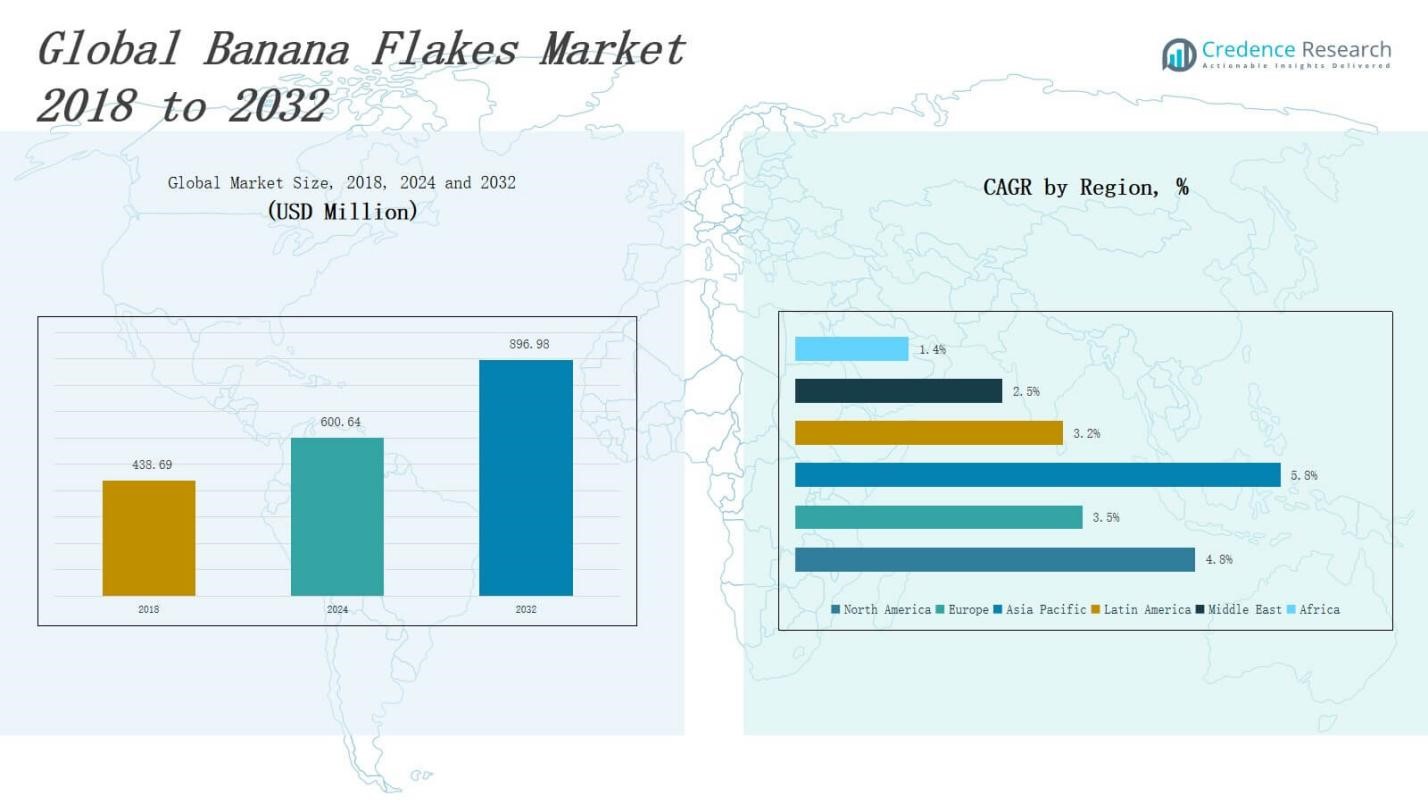
The Banana Flakes Market size was valued at USD 438.69 million in 2018 to USD 600.64 million in 2024 and is anticipated to reach USD 896.98 million by 2032, at a CAGR of 4.79% during the forecast period.
The Banana Flakes Market is driven by rising consumer demand for convenient, nutritious, and natural food ingredients, particularly in the breakfast cereal, bakery, and infant nutrition segments. Banana flakes offer a long shelf life, easy rehydration, and high potassium and fiber content, making them ideal for health-conscious consumers. Growing awareness of clean-label and gluten-free diets is accelerating their adoption across developed markets, while expanding food processing industries in emerging economies further boost demand. In parallel, trends such as the rising popularity of plant-based diets and sustainable sourcing practices are shaping product innovation. Manufacturers are increasingly leveraging organic certifications and eco-friendly processing methods to meet evolving consumer expectations. Technological advancements in drying and preservation techniques have also enhanced product quality and consistency, supporting broader application in functional foods and dietary supplements. The integration of banana flakes into on-the-go snack formulations and their use as natural sweeteners in energy bars and smoothies further amplify market growth.
The Banana Flakes Market spans key regions including North America, Europe, Asia Pacific, Latin America, the Middle East, and Africa. North America leads in market share, followed by rapid growth in Asia Pacific, driven by high production and increasing demand for natural ingredients. Europe shows steady expansion due to rising clean-label food trends, while Latin America leverages strong banana cultivation for both local use and export. The Middle East and Africa represent emerging markets with growing interest in processed fruit products. Key players shaping the competitive landscape include Kanegrade Limited, Döhler Group, Van Drunen Farms, Nestlé, Bunge Limited, SVZ International B.V., Dr. Oetker, General Mills, and Kellogg’s. These companies focus on sustainable sourcing, technological advancement, and strategic partnerships to enhance their global reach and meet diverse application demands across regions.
Market Insights
- The Banana Flakes Market was valued at USD 438.69 million in 2018, reached USD 600.64 million in 2024, and is projected to hit USD 896.98 million by 2032, growing at a CAGR of 4.79%.
- Demand is rising due to consumer preference for convenient, natural, and nutritious ingredients, especially in cereals, bakery, and infant food applications.
- Clean-label, gluten-free, and plant-based trends are boosting banana flake adoption in developed markets, while emerging markets benefit from expanding food processing sectors.
- Innovations in drying technology and sustainable sourcing enhance quality, reduce energy use, and support eco-conscious consumer expectations.
- North America leads the market with 33% share, followed by fast-growing Asia Pacific, while Europe shows steady growth due to organic product demand.
- Key players such as Kanegrade Limited, Döhler Group, Van Drunen Farms, Nestlé, and General Mills focus on sustainability, technology, and regional expansion.
- Supply chain challenges, raw material price volatility, and limited consumer awareness in parts of Africa and rural Asia still restrict market penetration.
Market Drivers
Rising Demand for Natural and Nutritious Ingredients
The Banana Flakes Market is gaining traction due to increasing consumer preference for natural, clean-label food ingredients with functional health benefits. Banana flakes are rich in potassium, dietary fiber, and essential vitamins, making them attractive to health-conscious consumers seeking minimally processed products. It aligns well with ongoing efforts to reduce synthetic additives in packaged foods. The demand for organic and non-GMO variants is also accelerating product adoption. Food manufacturers are incorporating banana flakes into cereals, snacks, and infant formulas to meet evolving consumer expectations. The functional and nutritional profile of banana flakes strengthens their value in daily diets.
Expansion of Processed Food and Beverage Industry
The Banana Flakes Market benefits significantly from the expanding global processed food industry, especially in emerging markets. Rising urbanization, higher disposable incomes, and changing dietary habits have fueled demand for ready-to-eat and shelf-stable food products. It supports the inclusion of banana flakes in breakfast cereals, bakery items, and health drinks. The long shelf life and convenience of banana flakes make them an efficient choice for food manufacturers. Their stability under various storage conditions also enhances supply chain efficiencies. These characteristics drive consistent integration into mainstream packaged food formulations.
- For instance, Kellogg’s has introduced breakfast cereals and snack bars in several markets featuring banana flakes as a natural ingredient, leveraging their fiber and nutrient content for health-focused consumers.
Increased Application in Infant and Geriatric Nutrition
The Banana Flakes Market is supported by the growing demand for age-specific nutrition solutions, particularly for infants and older adults. Banana flakes offer easy digestibility, natural sweetness, and a soft texture, making them ideal for both demographics. It helps meet nutritional requirements while minimizing reliance on artificial ingredients. Health-focused parents and caregivers increasingly opt for banana-based weaning foods and supplements. The use of banana flakes in powdered baby foods and nutrition blends continues to rise. These applications contribute to a stable and growing customer base across healthcare-related food sectors.
- For instance, Gerber uses banana puree containing 0.21g carbohydrates, 0.88 calories, and 3.3mg potassium per ml, aiding neonatal nutrition and safe oral feeding.
Sustainability and Technological Advancements in Processing
The Banana Flakes Market is experiencing positive momentum from technological improvements in drying and preservation processes. Enhanced drying techniques now retain more nutrients and improve flake texture and consistency. It also reduces energy use and waste during production, aligning with sustainability goals. Manufacturers increasingly market banana flakes as eco-friendly and responsibly sourced. Sustainable farming practices and reduced reliance on artificial preservatives resonate with ethical consumer preferences. These developments improve brand positioning and create differentiation in a competitive natural ingredient space. Environmental concerns and innovation jointly reinforce market growth.
Market Trends
Integration into Functional and Plant-Based Food Products
The Banana Flakes Market is witnessing a strong trend toward inclusion in plant-based and functional food applications. Growing health awareness and preference for plant-derived ingredients have led manufacturers to use banana flakes in smoothies, protein bars, vegan snacks, and nutritional supplements. It provides a clean-label alternative to artificial additives while adding natural sweetness and fiber. The shift toward plant-based eating continues to create opportunities for product diversification. Banana flakes help meet the demand for convenient, nutrient-dense formulations in vegan and fitness-focused diets. Their compatibility with other superfoods enhances product appeal across consumer segments.
Increased Demand for Organic and Non-GMO Product Lines
Organic and non-GMO banana flakes are gaining attention from both manufacturers and consumers in the Banana Flakes Market. Rising health concerns and demand for chemical-free, sustainably sourced ingredients are prompting companies to reformulate product lines. It supports transparent labeling and certification processes that help strengthen brand loyalty. Producers are investing in organic farming and traceable supply chains to meet this growing demand. The presence of organic banana flakes in baby food and clean-label bakery categories continues to expand. These product lines appeal to consumers seeking purity and authenticity in their food choices.
- For instance, Dole Organic sources pesticide-free bananas for its organic banana flakes line, ensuring compliance with rigorous certification standards to appeal to clean-label and baby food manufacturers.
Growing Focus on Sustainable Sourcing and Ethical Production
The Banana Flakes Market is increasingly influenced by sustainability and ethical production trends. Manufacturers are adopting eco-conscious practices, including fair-trade sourcing, reduced food waste, and energy-efficient processing. It aligns with corporate sustainability goals and appeals to environmentally aware consumers. Brands emphasize transparency in supply chains and promote farmer-friendly partnerships. Packaging innovations that reduce environmental impact further support brand differentiation. Sustainability has become a competitive advantage, encouraging long-term consumer trust. Ethical sourcing stories are now part of brand communication strategies, influencing purchase decisions across multiple regions.
Technological Innovation in Dehydration and Packaging Methods
Ongoing advancements in drying and packaging technologies are shaping product quality and efficiency in the Banana Flakes Market. Vacuum drying, drum drying, and freeze-drying techniques are being optimized to retain nutrients, texture, and flavor. It enables banana flakes to maintain consistency across large-scale production batches. Innovations in moisture barrier packaging improve shelf life and reduce spoilage, benefiting both retailers and consumers. These technical upgrades increase production scalability while minimizing costs. The integration of smart packaging solutions also enhances traceability and storage control. This trend strengthens the role of banana flakes in both retail and industrial supply chains.
- For instance, Symrise AG employs advanced drum drying technology that consistently preserves the natural taste and color of banana flakes across high-volume batches, as documented in their ingredient product sheets.
Market Challenges Analysis
Volatility in Raw Material Supply and Pricing
The Banana Flakes Market faces challenges linked to fluctuating banana production due to weather variability, disease outbreaks, and inconsistent agricultural practices. These factors affect both the quality and availability of raw materials, disrupting production cycles and increasing procurement costs. It creates supply chain instability, especially for large-scale food processors requiring consistent inputs. Price volatility in global banana markets also impacts profit margins for manufacturers. Export restrictions and trade barriers in key producing countries further complicate sourcing strategies. Ensuring reliable supply under these conditions demands robust supplier partnerships and diversified sourcing networks.
Limited Consumer Awareness and Market Penetration in Some Regions
Despite growing demand for natural food ingredients, the Banana Flakes Market still encounters low product awareness in certain regions. Limited exposure to banana-based processed ingredients reduces consumer interest and slows adoption across retail and foodservice channels. It affects product movement in untapped markets such as parts of Africa, Eastern Europe, and rural Asia. Distribution challenges, lack of targeted marketing, and limited shelf presence restrict brand visibility. Companies must invest in consumer education, promotional campaigns, and regional distribution strategies to overcome these hurdles. Expanding beyond core regions requires strategic collaboration with local partners.
Market Opportunities
Rising Demand in Functional and On-the-Go Nutrition Segments
The Banana Flakes Market presents strong opportunities in the growing functional foods and on-the-go nutrition categories. Consumers are actively seeking convenient, nutrient-dense products that support active lifestyles and health goals. It creates demand for banana flakes in snack bars, protein shakes, instant breakfast bowls, and trail mixes. Their natural sweetness, fiber content, and ease of use make them ideal for clean-label formulations. Companies that focus on product innovation and targeted health claims can expand their presence in this evolving space. The alignment of banana flakes with wellness-driven consumer behavior strengthens market expansion potential.
Expansion into Emerging Markets with Evolving Dietary Preferences
Emerging economies offer significant growth opportunities for the Banana Flakes Market due to changing dietary patterns, urbanization, and rising disposable income. A growing middle class is showing interest in healthy, processed food options that are affordable and accessible. It enables banana flakes to enter new product lines in local cereals, bakery mixes, and nutritional supplements. Governments and local industries are also supporting fruit processing as part of food security and agri-value chain development. Companies that localize sourcing and tailor products to regional tastes can gain competitive advantages. Strategic partnerships with local distributors will further accelerate market reach.
Market Segmentation Analysis:
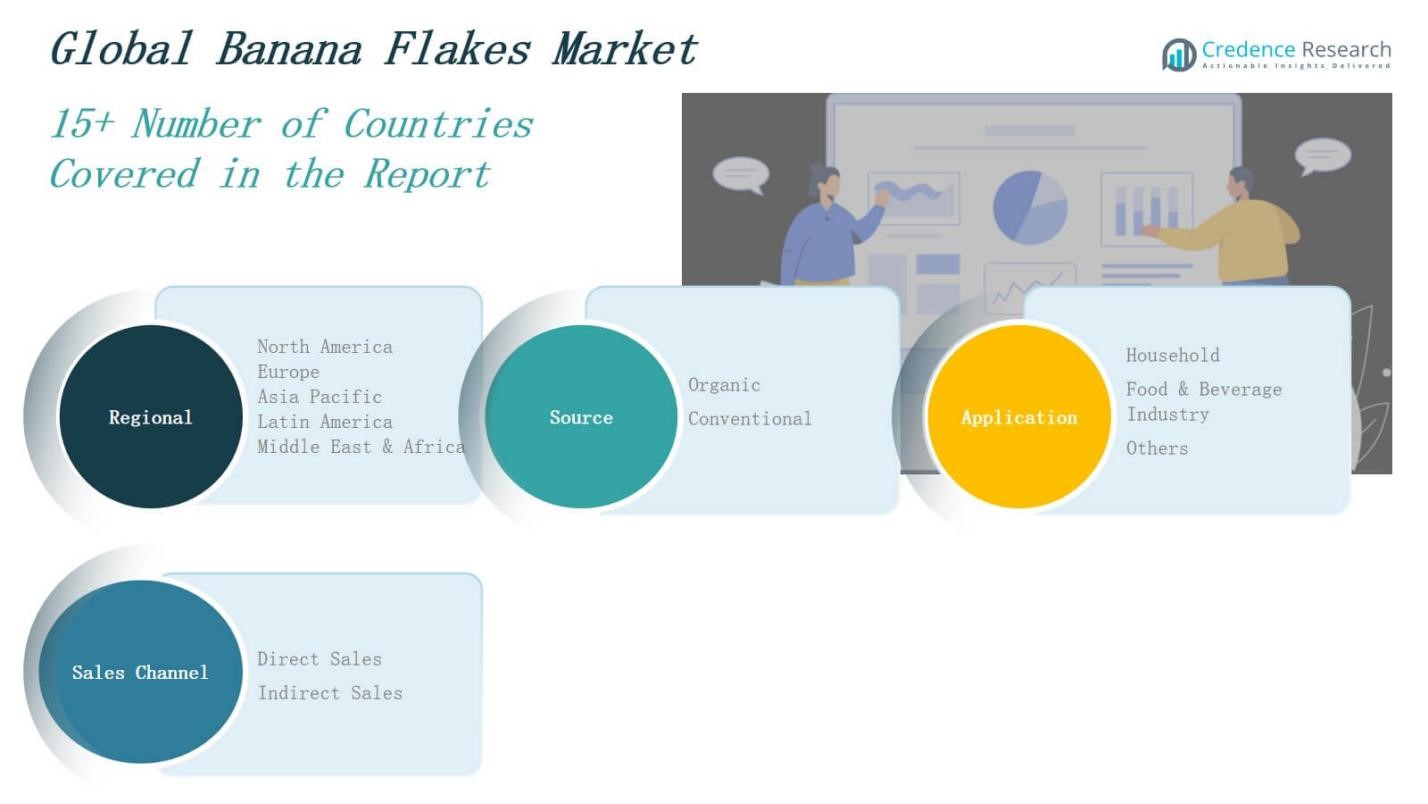
By Source
The Banana Flakes Market is segmented by source into organic and conventional categories. Organic banana flakes are gaining traction due to rising demand for chemical-free, sustainably farmed ingredients. It appeals strongly to health-conscious and eco-aware consumers, particularly in North America and Europe. Conventional banana flakes continue to hold a significant share due to their affordability and wide availability. Food manufacturers often favor conventional variants for large-scale production. Both segments are expected to grow, driven by distinct buyer preferences and supply dynamics.
By Application
The Banana Flakes Market serves diverse application areas, primarily household, food & beverage industry, and others. Household consumption is rising steadily, supported by growing awareness of natural fruit-based nutrition. It finds regular use in home baking, breakfast mixes, and infant foods. The food & beverage industry dominates overall demand due to the widespread use of banana flakes in cereals, snacks, desserts, and baby food products. The “others” category includes nutritional supplement manufacturers and institutional buyers seeking cost-effective, high-fiber fruit ingredients.
- For instance, Orchard Valley Foods Limited launched a new line of organic banana flakes aimed at bakery and health snack sectors, addressing rising consumer interest in traceable, additive-free fruit products.
By Sales Channel
The Banana Flakes Market is distributed through direct and indirect sales channels. Direct sales are preferred by bulk buyers such as food processors and industrial clients seeking large volumes with consistent quality. It supports closer supplier relationships and greater pricing flexibility. Indirect sales, including retail, e-commerce, and distributors, play a key role in reaching individual and small-scale buyers. The indirect segment continues to grow due to increasing consumer demand for healthy pantry staples through online and specialty stores.
- For instance, Van Drunen Farms supplies freeze-dried and drum-dried banana flakes directly to food manufacturers for use in a wide range of products, including infant foods, cereals, and baked goods.
Segments:
Based on Source
- Organic
- Conventional
Based on Application
- Household
- Food & Beverage Industry
- Others
Based on Sales Channel
- Direct Sales
- Indirect Sales
Based on Region
North America
- U.S.
- Canada
- Mexico
Europe
- UK
- France
- Germany
- Italy
- Spain
- Russia
- Rest of Europe
Asia Pacific
- China
- Japan
- South Korea
- India
- Australia
- Southeast Asia
- Rest of Asia Pacific
Latin America
- Brazil
- Argentina
- Rest of Latin America
Middle East
- GCC Countries
- Israel
- Turkey
- Rest of Middle East
Africa
- South Africa
- Egypt
- Rest of Africa
Regional Analysis
North America
The North America Banana Flakes Market size was valued at USD 185.67 million in 2018 to USD 251.48 million in 2024 and is anticipated to reach USD 376.64 million by 2032, at a CAGR of 4.8% during the forecast period. North America holds the largest market share, accounting for approximately 33% of global revenue. The region benefits from high demand for clean-label, fruit-based ingredients in cereals, infant foods, and health snacks. It sees strong consumption across both household and food processing sectors. The U.S. leads the region, driven by consumer preference for convenient, shelf-stable nutrition. The growth of organic banana flakes is notable, supported by stringent food quality standards and rising demand for natural additives.
Europe
The Europe Banana Flakes Market size was valued at USD 77.36 million in 2018 to USD 99.78 million in 2024 and is anticipated to reach USD 134.65 million by 2032, at a CAGR of 3.5% during the forecast period. Europe holds around 13% of the global Banana Flakes Market share. Strong demand stems from applications in breakfast products, gluten-free bakery items, and infant food. It is supported by rising awareness of natural nutrition and regulatory emphasis on organic labeling. Germany, the UK, and France are key contributors, with a growing preference for sustainable, ethically sourced ingredients. Retail and health-focused product launches continue to support market expansion in this region.
Asia Pacific
The Asia Pacific Banana Flakes Market size was valued at USD 136.53 million in 2018 to USD 196.63 million in 2024 and is anticipated to reach USD 318.43 million by 2032, at a CAGR of 5.8% during the forecast period. Asia Pacific accounts for nearly 27% of the global Banana Flakes Market share and is the fastest-growing region. High banana production and expanding food processing capabilities drive supply-side growth. It sees rising domestic demand for banana-based products across India, China, and Southeast Asia due to increasing urbanization and income levels. The region benefits from growing health awareness and demand for cost-effective fruit ingredients. It is also becoming a major exporter of banana flakes to North America and Europe.
Latin America
The Latin America Banana Flakes Market size was valued at USD 21.21 million in 2018 to USD 28.68 million in 2024 and is anticipated to reach USD 38.03 million by 2032, at a CAGR of 3.2% during the forecast period. Latin America holds about 4% of the global market share. The region benefits from abundant banana cultivation, particularly in countries like Ecuador, Colombia, and Brazil. It serves as both a supplier and a growing consumer market. Domestic use of banana flakes in breakfast mixes, infant nutrition, and bakery products is rising gradually. Market growth is supported by government initiatives in agricultural value addition and exports. However, infrastructure and distribution challenges slightly hinder penetration.
Middle East
The Middle East Banana Flakes Market size was valued at USD 11.99 million in 2018 to USD 14.98 million in 2024 and is anticipated to reach USD 18.78 million by 2032, at a CAGR of 2.5% during the forecast period. The Middle East contributes around 2% to the global Banana Flakes Market. Regional growth is led by demand for processed foods, influenced by changing dietary patterns and a growing expatriate population. It sees consistent import-based supply for banana flakes, mainly from Asia and Latin America. The market is gradually expanding in health-conscious urban segments and premium retail channels. Consumer interest in clean-label and natural snacks is beginning to shape product offerings in the region.
Africa
The Africa Banana Flakes Market size was valued at USD 5.93 million in 2018 to USD 9.09 million in 2024 and is anticipated to reach USD 10.46 million by 2032, at a CAGR of 1.4% during the forecast period. Africa accounts for less than 2% of the global market share. The region shows limited but emerging demand, with banana flakes being used primarily in institutional feeding programs, infant food, and bakery mixes. It benefits from rich banana cultivation but lacks large-scale processing infrastructure. Countries such as Kenya, Nigeria, and South Africa are gradually entering the commercial banana flakes segment. It faces challenges around affordability and product accessibility in rural areas. Growing urban demand offers potential for future expansion.
Key Player Analysis
- Kanegrade Limited
- Döhler Group
- Van Drunen Farms
- Nestlé
- Bunge Limited
- SVZ International B.V.
- Oetker
- General Mills
- Kellogg’s
Competitive Analysis
The Banana Flakes Market features a moderately competitive landscape, with key players focusing on product quality, supply chain efficiency, and organic certifications to gain market share. Leading companies such as Kanegrade Limited, Döhler Group, Van Drunen Farms, and Nestlé invest in advanced drying technologies and sustainable sourcing to meet global demand. It is witnessing increased participation from regional processors aiming to supply cost-effective banana flakes to food and beverage industries. Strategic collaborations, product innovation, and regional expansion remain central to market positioning. Players also emphasize traceability and clean-label packaging to align with evolving consumer expectations. Market consolidation is limited, but competitive intensity is rising as companies enhance capacity and diversify product offerings across application sectors. The Banana Flakes Market is driven by a balance of multinational brands and agile mid-sized firms, each leveraging their strengths in either global reach or local sourcing expertise. Pricing strategies and logistics capabilities play a critical role in long-term competitiveness.
Recent Developments
- In June 2025, Diana Group (Symrise AG) introduced new banana flake variants with improved texture and flavor for food manufacturers.
- In June 2025, Futurcorp S.A. expanded banana flake production capacity and launched fortified banana flakes with added vitamins.
- In June 2025, Johs. Thoms GmbH & Co. KG developed a new line of organic-certified banana flakes for the European health food market.
- In 2024, Diana Group (diana food™ brand) expanded operations in Ecuador to strengthen its presence in the banana flakes market.
Market Concentration & Characteristics
The Banana Flakes Market exhibits moderate market concentration, with a mix of global food giants and specialized ingredient manufacturers competing across regions. It is characterized by a strong emphasis on quality, sustainability, and clean-label compliance. Large players such as Nestlé, Döhler Group, and Kellogg’s benefit from global distribution networks and diversified product portfolios. Mid-sized firms like Kanegrade Limited and Van Drunen Farms focus on supply chain agility and customized formulations for industrial clients. The market favors players with access to consistent banana supply, advanced drying technologies, and certifications like organic or non-GMO. It remains highly responsive to consumer trends such as plant-based diets, natural nutrition, and ethical sourcing. Competitive differentiation depends on pricing strategy, processing innovation, and regional adaptability. While product substitution risk is low, raw material sourcing challenges and limited awareness in developing regions influence growth potential. The Banana Flakes Market continues to attract new entrants through niche application development and value-added processing capabilities.
Report Coverage
The research report offers an in-depth analysis based on Source, Application, Sales Channel, and Region. It details leading market players, providing an overview of their business, product offerings, investments, revenue streams, and key applications. Additionally, the report includes insights into the competitive environment, SWOT analysis, current market trends, as well as the primary drivers and constraints. Furthermore, it discusses various factors that have driven market expansion in recent years. The report also explores market dynamics, regulatory scenarios, and technological advancements that are shaping the industry. It assesses the impact of external factors and global economic changes on market growth. Lastly, it provides strategic recommendations for new entrants and established companies to navigate the complexities of the market.
Future Outlook
- Demand for banana flakes will rise due to increased use in health-conscious breakfast and snack products.
- Food manufacturers will expand applications in infant nutrition, bakery mixes, and functional beverages.
- Organic and non-GMO banana flakes will gain more shelf space in developed retail markets.
- Growth in Asia Pacific will accelerate with improved processing infrastructure and export capabilities.
- Companies will invest in sustainable sourcing and environmentally friendly production methods.
- Direct sales to industrial food processors will remain strong, driven by bulk demand and quality requirements.
- E-commerce and specialty health food stores will increase visibility of banana flake-based products.
- Technological advancements in drying and packaging will improve shelf stability and nutritional retention.
- Strategic partnerships and regional collaborations will support market entry in untapped areas.
- Awareness campaigns will play a key role in boosting consumption in Africa and the Middle East.
Request a Free Sample
Fill in your details and we'll send you a free sample report.
- Sample data tables & charts
- Research methodology
Need a Custom Version of This Report?
Tailor the scope, geography, or segments to your exact requirements.
- Custom geography or segment scope
- Direct access to our analyst team
Frequently Asked Questions
What is the current size of the Consumer Electronics ASIC Market?
What factors are driving the growth of the Consumer Electronics ASIC Market?
What are the key segments within the Consumer Electronics ASIC Market?
What are some challenges faced by the Consumer Electronics ASIC Market?
Who are the major players in the Consumer Electronics ASIC Market?
Table of Content
Chapter 1. Report Introduction
- 1.1 Report Description & Purpose
- 1.1.1 Report Title & Market Definition
- 1.1.2 Unique Selling Propositions (USP) & Key Differentiators
- 1.1.3 Value Proposition for Stakeholders
- 1.2 Research Objectives
- 1.2.1 Market Sizing Objectives (Volume & Revenue)
- 1.2.2 Segmentation Objectives
- 1.2.3 Competitive Intelligence Objectives
- 1.2.4 Forecast & Scenario Objectives
- 1.3 Report Scope
- 1.3.1 Banana Flakes Scope – Types & Subtypes Covered
- 1.3.2 Geographic Scope – Regions & Countries Covered
- 1.3.3 Historical Period, Base Year & Forecast Period (2024; forecast to the forecast period)
- 1.3.4 Inclusions & Exclusions
- 1.4 HS Code & Classification Framework
- 1.5 Currency, Units & Pricing Basis
- 1.6 Target Stakeholders
- 1.7 Limitations & Assumptions
Chapter 2. Executive Summary
- 2.1 Global Banana Flakes Market Snapshot
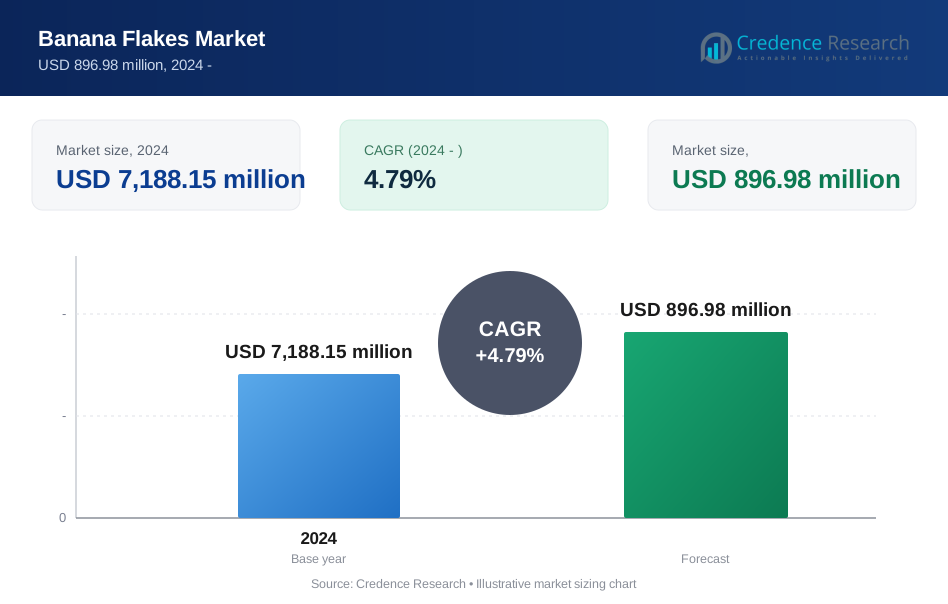
- 2.1.1 Market Size – Historical (2024) & Forecast (the forecast period) (2024: USD 7,188.15 million → forecast year: USD 896.98 million)
- 2.1.2 Volume & Revenue – Global Totals
- 2.1.3 Key Market Highlights – Top Five Facts
- 2.2 Banana Flakes Market Segmentation Snapshot
- 2.2.1 Market Split by Region – 2024 vs.
- 2.3 Competitive Snapshot
- 2.3.1 Top 10 Players by Revenue Share – 2024
- 2.3.2 Top 10 Players by Volume Share – 2024
- 2.3.3 Recent Strategic Developments (18-Month Summary)
- 2.4 Key Investment Highlights & Strategic Conclusions
Chapter 3. Banana Flakes Market Dynamics & Industry Analysis
- 3.1 Market Overview & Context
- 3.1.1 Banana Flakes Market Position in the Broader Automotive Value Chain
- 3.1.2 OEM vs. Replacement Market Dynamics
- 3.1.3 Market Maturity & Development Stage by Region
- 3.2 Banana Flakes Market Drivers
- 3.3 Banana Flakes Market Restraints & Challenges
- 3.4 Banana Flakes Market Opportunities
- 3.5 Porter's Five Forces Analysis
- 3.5.1 Threat of New Entrants
- 3.5.2 Bargaining Power of Suppliers
- 3.5.3 Bargaining Power of Buyers
- 3.5.4 Threat of Substitutes
- 3.5.5 Competitive Rivalry – Intensity Assessment
- 3.6 Banana Flakes Value Chain Analysis
- 3.6.1 Upstream – Raw Material/Input Suppliers
- 3.6.1.1 Raw Material/Input 1
- 3.6.1.2 Raw Material/Input 2
- 3.6.1.3 Raw Material/Input 3
- 3.6.2 Midstream – Production/Manufacturing/Service Delivery
- 3.6.2.1 Production/Process Overview
- 3.6.2.2 Key Facility Locations & Capacity by Manufacturer
- 3.6.3 Downstream – Distribution & End Consumer
- 3.6.3.1 Primary Channel – B2B/OEM
- 3.6.3.2 Secondary Channels – Dealer, Retail, Online, Direct
- 3.6.4 Value Chain Profitability Analysis
- 3.6.1 Upstream – Raw Material/Input Suppliers
- 3.7 PESTEL Analysis
- 3.7.1 Political Factors
- 3.7.2 Economic Factors
- 3.7.3 Social Factors
- 3.7.4 Technological Factors
- 3.7.5 Environmental Factors
- 3.7.6 Legal Factors
- 3.8 Banana Flakes Supply Chain Analysis
- 3.8.1 Raw Material/Input Supply Risk Assessment
- 3.8.2 Manufacturing Concentration Risk (Geographic Exposure)
- 3.8.3 Trade Disruption Impact Analysis
- 3.9 Regulatory & Policy Landscape
Note: The regulatory and policy landscape section covers regulations based on their applicability to the market, Banana Flakes category, geography, and scope of the study. Only regulatory frameworks with a material impact on operations, compliance, trade, sustainability, or market access are analyzed in detail.
Chapter 4. Key Investment Pockets & Opportunity Analysis
- 4.1 Banana Flakes Market Attractiveness Analysis
- 4.1.1 By Region – Investment Attractiveness Matrix (Volume × CAGR)
- 4.2 Absolute Revenue Growth Opportunity
- 4.2.1 By Region – Absolute USD Growth Through the forecast period
- 4.3 Incremental Volume Opportunity
- 4.3.1 By Region – Incremental Volume Through the forecast period
- 4.3.2 Segment – Incremental Volume
- 4.4 Emerging Submarket Opportunity Deep Dive (Subject to Applicability)
- 4.5 Emerging Market Opportunity Scorecards
- 4.5.1 United States
- 4.5.2 Europe
- 4.5.3 Asia
- 4.5.4 Middle East & Africa
Note: Emerging Market Opportunity Scorecards will be included based on relevance and strategic importance. Regions listed are indicative and may vary depending on data availability and market dynamics.
Chapter 5. Banana Flakes Import-Export Analysis & Trade Flows
- 5.1 Global Trade Overview
- 5.1.1 Global Export Value by Country (2024)
- 5.1.2 Global Export Volume by Country (2024)
- 5.1.3 Global Import Value by Country (2024)
- 5.1.4 Global Import Volume by Country (2024)
- 5.1.5 Net Trade Balance by Country (2024)
- 5.2 Export Analysis – Segment
- 5.2.1 Type 1 (HS Code)
- 5.2.2 Type 2 (HS Code)
- 5.2.3 Type 3 (HS Code)
- 5.2.4 Type 4 (HS Code)
- 5.2.5 Type 5 (HS Code)
- 5.3 Import Analysis – Segment
- 5.3.1 Type 1 (HS Code)
- 5.3.2 Type 2 (HS Code)
- 5.3.3 Type 3 (HS Code)
- 5.3.4 Type 4 (HS Code)
- 5.3.5 Type 5 (HS Code)
- 5.4 Average Unit Trade Prices
- 5.4.1 Average Export Price – Segment & Country
- 5.4.2 Average Import Price – Segment & Source Country
- 5.4.3 Price Trends (2024)
- 5.5 Key Trade Route Analysis
- 5.5.1 Trade Route 1
- 5.5.2 Trade Route 2
- 5.5.3 Trade Route 3
- 5.5.4 Trade Route 4
- 5.5.5 Trade Route 5
- 5.6 Trade Policy Impact Assessment
- 5.6.1 US Anti-Dumping & Section 301 Tariffs
- 5.6.2 EU Customs Union Impact
- 5.6.3 Major Free Trade Agreements
- 5.6.4 USMCA Rules of Origin
Note: Trade policy analysis will be included only where relevant to the Banana Flakes market.
Chapter 6. Competitive Landscape & Company Benchmarking
- 6.1 Banana Flakes Market Concentration & Structure
- 6.1.1 Herfindahl-Hirschman Index (HHI) – vs. 2024
- 6.1.2 Tier 1, Tier 2 & Tier 3 Market Structure
- 6.1.3 Global, Regional & Local Player Dynamics
- 6.2 Banana Flakes Market Share Analysis – 2024
- 6.2.1 Global Revenue Share by Company
- 6.2.2 Global Volume Share by Company
- 6.2.3 Regional Revenue Share
- 6.2.4 Market Share Evolution ( vs. 2024)
- 6.2.5 OEM Segment Share by Company
- 6.2.6 Replacement Segment Share by Company
- 6.3 Production/Delivery Capacity & Facility Analysis
- 6.3.1 Global Installed Capacity
- 6.3.2 Capacity Utilization Rates
- 6.3.3 Production/Output Volume
- 6.3.4 Facility Locations & Capacity Map
- 6.3.5 Planned Capacity Additions
- 6.4 Banana Flakes Competitive Benchmarking Matrix
- 6.4.1 Revenue, Volume, CAGR & Profitability Comparison
- 6.4.2 Channel Revenue Mix
- 6.4.3 Geographic Revenue Exposure
- 6.4.4 R&D Intensity
- 6.4.5 Sustainability Maturity
- 6.5 Strategic Developments in Banana Flakes (Last 24 Months)
- 6.5.1 Mergers, Acquisitions & Divestments
- 6.5.2 New Banana Flakes Launches
- 6.5.3 Facility Expansions
- 6.5.4 Strategic Alliances, Joint Ventures & Partnerships
- 6.5.5 Distribution Expansion & Market Entry
- 6.5.6 Sustainability & ESG Initiatives
- 6.6 Competitive Strategy Mapping
- 6.6.1 Leader, Challenger, Follower & Niche Classification
- 6.6.2 Pricing Strategy Comparison
- 6.6.3 Channel Strategy Matrix
Note: Strategic developments are included based on their materiality and the availability of reliable information.
Chapter 7. Global Banana Flakes Market – By Distribution Channel
- 7.1 Segment Overview
- 7.1.1 Volume & Revenue Split by Channel (2024 & )
- 7.1.2 Channel Mix Evolution (the forecast period)
Chapter 8. Regional Market Analysis – Global Overview
- 8.1 Global Regional Overview
- 8.1.1 Regional Volume Share
- 8.1.2 Regional Revenue Share
- 8.1.3 Regional Volume by Region
- 8.1.4 Regional Revenue by Region
- 8.1.5 Regional Forecast Through the forecast period
- 8.2 Cross-Regional Segment Analysis
- 8.2.1 By Distribution Channel
- 8.2.2 By Brand/Price Tier
Chapter 9. North America Banana Flakes Market
- 9.1 United States
- 9.2 Canada
- 9.3 Mexico
Chapter 10. Europe Banana Flakes Market
- 10.1 Germany
- 10.2 France
- 10.3 Italy
- 10.4 United Kingdom
- 10.5 Spain
- 10.6 Poland
- 10.7 Russia
- 10.8 Netherlands
- 10.9 Belgium
- 10.10 Sweden
- 10.11 Denmark
- 10.12 Norway
- 10.13 Rest of Europe
Chapter 11. Asia Pacific Banana Flakes Market
- 11.1 China
- 11.2 India
- 11.3 Japan
- 11.4 South Korea
- 11.5 Thailand
- 11.6 Indonesia
- 11.7 Vietnam
- 11.8 Malaysia
- 11.9 Australia
- 11.10 Rest of Asia Pacific
Chapter 12. Latin America Banana Flakes Market
- 12.1 Brazil
- 12.2 Argentina
- 12.3 Colombia
- 12.4 Chile
- 12.5 Rest of Latin America
Chapter 13. Middle East Banana Flakes Market
- 13.1 Saudi Arabia
- 13.2 United Arab Emirates
- 13.3 Turkey
- 13.4 Israel
- 13.5 Iran
- 13.6 Rest of the Middle East
Chapter 14. Africa Banana Flakes Market
- 14.1 South Africa
- 14.2 Egypt
- 14.3 Nigeria
- 14.4 Morocco
- 14.5 Rest of Africa
Chapter 15. Banana Flakes Company Profiles
- 15.1 [Company 01]
- 15.1.1 Company Overview
- 15.1.2 Key Management Personnel
- 15.1.3 Products & Services Portfolio
- 15.1.4 Financial Performance
- 15.1.5 Key Market Focus & Geographic Presence
- 15.1.6 Recent Developments & Strategic Initiatives
Note: The company profile list is preliminary and may change based on research findings, market developments, data availability, and client requirements.
Chapter 16. Appendices
- Appendix A – List of Abbreviations & Acronyms
- Appendix B – Industry Classification Code Reference – Full Series
- Appendix C – Production & Capacity Data Tables
- Appendix D – End-Use & Demand Base Tables
- Appendix E – Consumption & Replacement Rate Assumptions
- Appendix F – ASP Reference Tables
- Appendix G – Manufacturing & Facility Database
- Appendix H – Import-Export Data Tables
- Appendix I – Regulatory Summary Tables
- Appendix J – Primary Research Participant List (Anonymized)
- Appendix K – Primary Research Questionnaire Framework
- Appendix L – Data Sources & Bibliography
- Appendix M – Market Size Divergence & Source Comparison
Chapter 17. Research Methodology
- 17.1 Research Framework & Philosophy
- 17.2 Secondary Research – Sources, Hierarchy & Data Extraction
- 17.3 Data Modeling – Bottom-Up & Top-Down Market Sizing
- 17.4 Primary Research – Stakeholder Framework, LOI & Sample Sizes
- 17.5 Forecast Methodology – Regression, Scenario & Sensitivity Analysis
- 17.6 Quality Control – Four-Layer Validation Framework
- 17.7 Limitations & Standard Assumptions
- 17.8 Disclaimer
