
Market Overview:
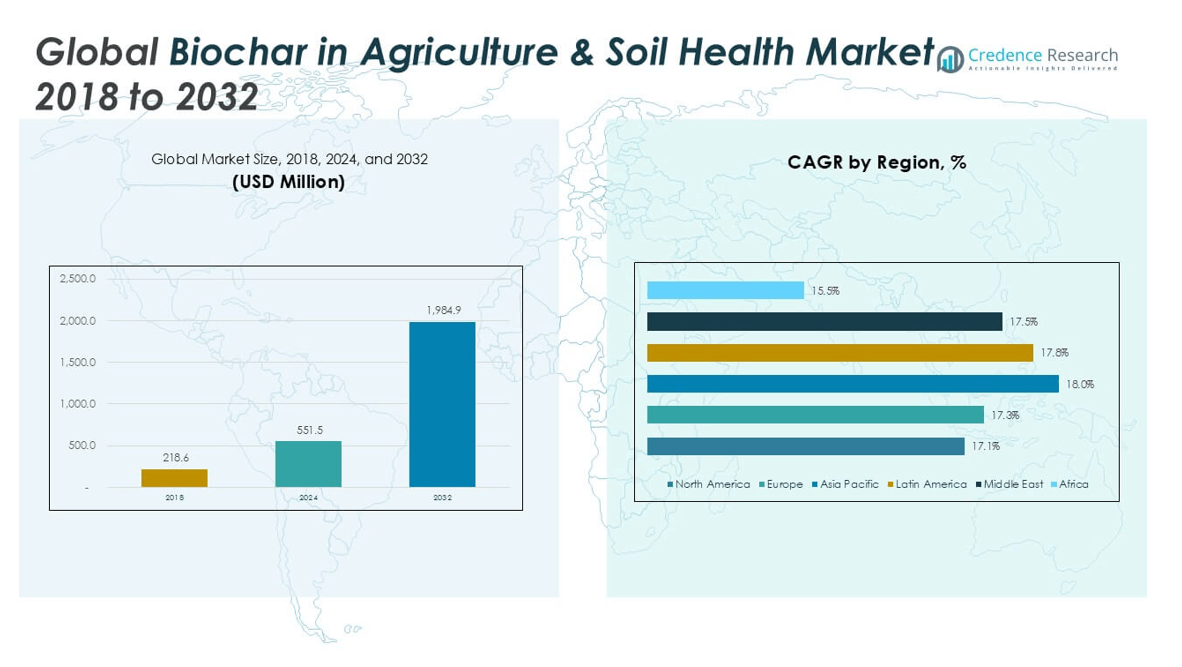
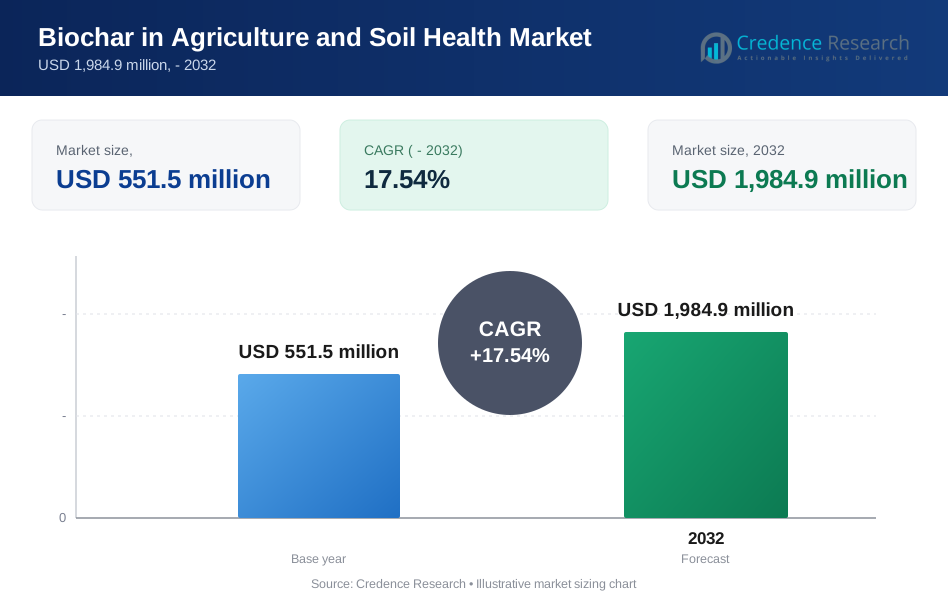
The Global Biochar in Agriculture & Soil Health Market size was valued at USD 218.6 million in 2018 to USD 551.5 million in 2024 and is anticipated to reach USD 1,984.9 million by 2032, at a CAGR of 17.54% during the forecast period.
| REPORT ATTRIBUTE | DETAILS |
|---|---|
| Historical Period | 2020-2023 |
| Base Year | 2024 |
| Forecast Period | 2025-2032 |
| Biochar in Agriculture & Soil Health Market Size 2024 | USD 551.5 million |
| Biochar in Agriculture & Soil Health Market, CAGR | 17.54% |
| Biochar in Agriculture & Soil Health Market Size 2032 | USD 1,984.9 million |
Key drivers supporting this market include the growing focus on soil restoration, increasing awareness of carbon sequestration benefits, and government initiatives promoting climate-smart agriculture. Stringent regulations on chemical fertilizers and the rising cost of conventional soil amendments are further accelerating biochar utilization. In addition, expanding research on advanced pyrolysis technologies and the use of biochar in integrated nutrient management systems is creating new opportunities for market participants.
Regionally, North America dominates the Biochar in Agriculture & Soil Health Market, supported by robust investments in sustainable farming and strong policy support. Europe and Asia Pacific are witnessing rapid growth, fueled by growing adoption in organic farming and large-scale government programs to restore degraded soils and promote regenerative agriculture practices. The increasing collaboration between research institutions and agritech companies is further advancing biochar innovation and accelerating commercial adoption worldwide.
Market Insights:
- The Global Biochar in Agriculture & Soil Health Market is projected to grow at a CAGR of 17.54%, reaching USD 1,984.9 million by 2032.
- Rising demand for soil restoration and climate-smart agriculture drives strong market momentum across all regions.
- Strict regulations on chemical fertilizers and higher amendment costs accelerate biochar adoption among commercial and smallholder farmers.
- North America leads the market with a 23% share, supported by advanced farming practices and policy incentives, while Asia Pacific and Europe rapidly expand.
- Lack of standardized product quality and high production costs remain persistent barriers to broader commercial adoption.
- Collaborative R&D and advanced pyrolysis technologies unlock new applications, from precision agriculture to integrated nutrient management.
- Market participants benefit from government support, increased awareness of carbon sequestration, and growing investment in sustainable land management worldwide.
Market Drivers:
Rising Emphasis on Sustainable Agriculture and Soil Regeneration
The growing focus on sustainable agriculture and soil regeneration is a primary driver for the Global Biochar in Agriculture & Soil Health Market. Farmers, agribusinesses, and policymakers increasingly recognize the importance of soil health for long-term productivity. Biochar’s ability to improve soil structure, enhance water retention, and boost nutrient availability makes it a preferred choice for those aiming to optimize yields while minimizing environmental impact. Support from government programs and sustainability certifications encourages broader adoption of biochar in modern farming systems.
- For instance, a two-year field trial on a banana plantation in Tamil Nadu, India, demonstrated that applying rice husk biochar at 10t/ha significantly improved soil fertility and moisture content, with notable increases in phosphorus, potassium, sodium, magnesium, carbon, and nitrogen concentrations in the soil.
Regulatory Pressure and Shift from Synthetic Soil Amendments
Stringent regulations on chemical fertilizers and pesticides are transforming the soil amendment industry. The Global Biochar in Agriculture & Soil Health Market is gaining traction as governments tighten controls on synthetic agrochemicals to combat soil degradation and water contamination. Rising costs and environmental concerns are prompting farmers to transition toward natural alternatives. Biochar stands out due to its proven ability to restore soil fertility, support organic farming, and comply with environmental standards.
Growing Recognition of Carbon Sequestration and Climate Mitigation Benefits
The drive to address climate change is another major catalyst for biochar adoption. Biochar serves as a long-term carbon sink, enabling effective carbon sequestration in soils. The Global Biochar in Agriculture & Soil Health Market benefits from carbon credit initiatives and policies that incentivize greenhouse gas reduction. It helps producers achieve sustainability targets while enhancing crop resilience.
- For instance, Carbofex’s facility in Finland has captured 9,800,000 kilograms of CO₂ since 2017 using advanced pyrolysis technology.
Technological Innovation and Industry Collaboration Fuel Market Expansion
Rapid advancements in pyrolysis technology and process efficiency are making biochar production more scalable and affordable. Industry collaboration among research bodies, agri-tech companies, and farmers is unlocking new biochar applications, from precision agriculture to integrated nutrient management. This collaborative innovation is expanding biochar’s role in global agricultural transformation.
Market Trends:
Expansion of Commercial-Scale Production and Application in Precision Agriculture
Commercial-scale production of biochar is rapidly expanding, driven by technological advancements in pyrolysis systems and growing industry investment. The Global Biochar in Agriculture & Soil Health Market is witnessing the integration of biochar into large-scale precision agriculture operations, supported by digital tools and data-driven soil management. Producers are optimizing feedstock choices and refining processing techniques to achieve consistent quality and tailored biochar products for various soil types. Strategic collaborations between biochar manufacturers, agricultural technology providers, and research institutions are accelerating innovation and validating the agronomic benefits of biochar at scale. It is now increasingly applied in high-value crops, horticulture, and controlled environment agriculture, further enhancing market visibility and acceptance. Large agribusinesses are incorporating biochar into sustainability initiatives to meet both environmental and productivity targets. Increased government funding for industrial-scale biochar facilities is supporting capacity expansion, while certification schemes for carbon removal are strengthening the commercial viability of biochar projects.
- For instance, the American Farmland Trust’s Soil Health Demonstration Trial is implementing biochar on 34 farms across eight U.S. states to measure soil health, water dynamics, and climate benefits in different agricultural systems.
Rising Focus on Circular Economy and Regenerative Farming Models
Adoption of circular economy principles and regenerative farming practices is a defining trend in the Global Biochar in Agriculture & Soil Health Market. Industry participants are utilizing agricultural and forestry residues as biochar feedstock, creating value from waste and reducing environmental footprint. It supports closed-loop nutrient cycling, soil carbon enhancement, and reduction of farm-level emissions. The market is benefiting from policies and incentives promoting bio-based products and sustainable land management. Increased awareness among growers about soil microbiome health and climate resilience drives demand for biochar-based amendments. Companies are launching certified, traceable biochar products, responding to consumer and regulatory demands for transparency and sustainability throughout the agri-food value chain. The expansion of international sustainability standards is driving export opportunities, while successful pilot projects in degraded lands are paving the way for large-scale deployment.
- For instance, Trong Duc Cocoa Company in Vietnam implemented a biochar production initiative that cut cocoa bean drying time during the rainy season from 15days to 7days—directly improving efficiency and product quality, while converting cocoa pod waste into valuable soil amendments and clean heat energy.
Market Challenges Analysis:
Limited Standardization and Uncertainty in Product Quality
The Global Biochar in Agriculture & Soil Health Market faces challenges due to the lack of standardized quality benchmarks and uniform guidelines. Product characteristics can vary widely depending on feedstock type, pyrolysis conditions, and processing techniques, creating uncertainty for end-users. It complicates product selection and integration into existing agricultural practices. Inconsistent biochar quality may lead to unpredictable field performance and diminished user confidence. Industry stakeholders are working to develop testing protocols and certification systems, but progress remains fragmented. The absence of universally accepted standards restricts broader market acceptance and adoption.
Economic Viability and Scalability Concerns
Economic and scalability barriers present persistent challenges for the Global Biochar in Agriculture & Soil Health Market. High initial investment in pyrolysis equipment, supply chain logistics, and operational costs can limit access for small and medium-sized farms. It often requires education and technical support to demonstrate clear return on investment for growers. Market participants face difficulties in establishing cost-effective distribution networks, especially in developing regions. Uncertain policy support and limited access to carbon credit schemes may further constrain growth. Addressing these challenges will be crucial for realizing the market’s long-term potential.
Market Opportunities:
Integration into Climate-Smart Agriculture and Carbon Markets
The Global Biochar in Agriculture & Soil Health Market has significant opportunities in the expanding climate-smart agriculture sector and carbon markets. Governments and international organizations are promoting biochar as a viable solution for soil carbon sequestration and greenhouse gas mitigation. It can qualify for carbon credits and sustainability certifications, creating new revenue streams for producers and growers. Strong policy support and funding for climate initiatives drive investments in biochar projects worldwide. Integration into voluntary and compliance carbon markets enables broader adoption, particularly in regions seeking to meet climate targets. Stakeholders can leverage these opportunities to scale production and demonstrate the measurable environmental benefits of biochar.
Expansion through Technological Innovation and Value-Added Applications
Advancements in pyrolysis technology and biochar formulation open new possibilities for tailored soil health solutions. The Global Biochar in Agriculture & Soil Health Market can capitalize on value-added applications such as biostimulants, soil conditioners, and crop-specific amendments. It benefits from growing partnerships between research institutes, agritech companies, and agricultural cooperatives. Developing specialized products for horticulture, organic farming, and degraded land reclamation drives diversification. Market participants can expand their footprint by addressing niche applications and responding to evolving sustainability requirements within the agri-food industry.
Market Segmentation Analysis:
By Type
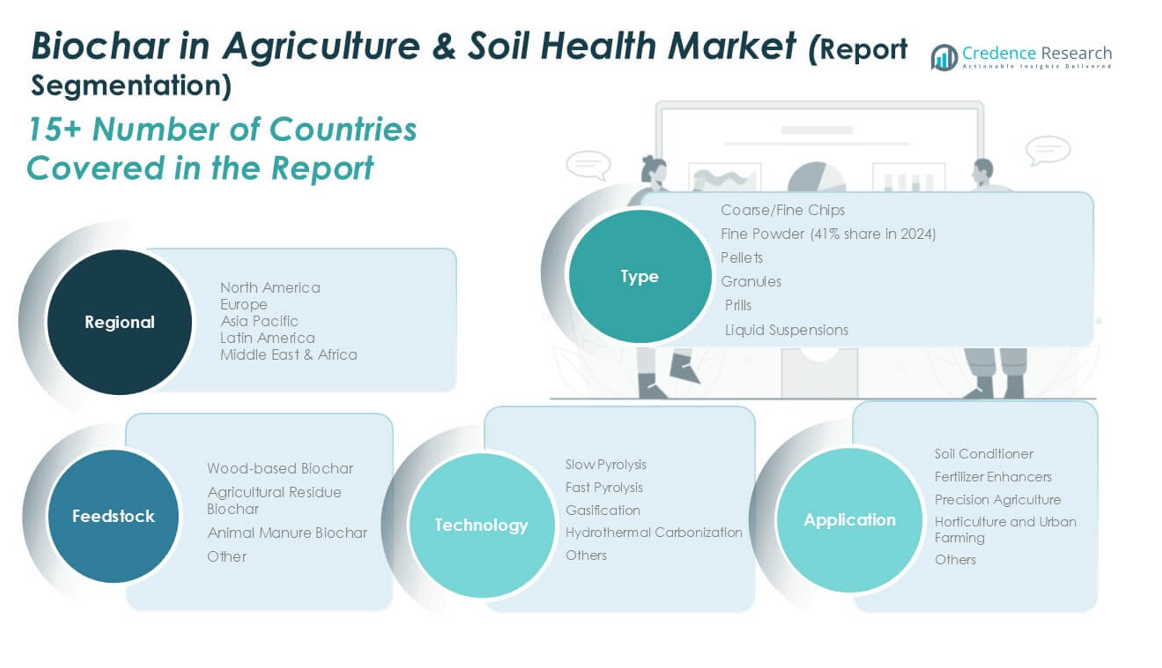
The Global Biochar in Agriculture & Soil Health Market is primarily driven by fine powder biochar, favored for its ease of incorporation into soil and its high efficiency in enhancing soil health. Coarse/fine chips, pellets, granules, and prills cater to specific agricultural needs, with pellets and granules being particularly popular in precision farming systems for controlled nutrient delivery. These different forms enable growers to choose the most suitable biochar based on their application methods and crop requirements, ensuring optimal soil enhancement.
- For instance, Cool Planet’s Engineered Biocarbon technology controls particle size and porosity to match soil and crop needs, and has been awarded more than 35 U.S. patents for its enhanced biochar products.
By Feedstock
Wood-based biochar leads the market, primarily due to its widespread availability and strong agronomic performance across various soil types. Agricultural residue biochar is gaining traction, reflecting a growing trend towards sustainability and waste reduction in agriculture. Animal manure biochar is increasingly utilized for its rich nutrient content, making it an attractive option for organic and regenerative agriculture. Other specialized feedstocks are also employed to address specific soil improvement needs, enabling tailored solutions for diverse agricultural practices.
By Technology
Slow pyrolysis is the dominant technology in the biochar market, producing stable, carbon-rich biochar that is ideal for soil health improvement. Fast pyrolysis and gasification technologies are attracting interest from producers seeking efficient processes and versatile by-products, such as bio-oil and syngas. Hydrothermal carbonization is emerging as a promising technology for processing wet biomass, driving innovation in feedstock utilization and further enhancing biochar's potential in modern agricultural practices.
- For instance, Renewable Oil International utilizes fast pyrolysis in Oregon to convert biomass and yields 12–20kg of biochar and up to 65kg of bio-oil per 100kg of feedstock per batch.
Segmentations:
By Type:
- Coarse/Fine Chips
- Fine Powder (41% share in 2024)
- Pellets
- Granules
- Prills
By Feedstock:
- Wood-based Biochar
- Agricultural Residue Biochar
- Animal Manure Biochar
- Other
By Technology:
- Slow Pyrolysis
- Fast Pyrolysis
- Gasification
- Hydrothermal Carbonization
- Others
By Application Industry:
- Soil Conditioner
- Fertilizer Enhancers
- Precision Agriculture
- Horticulture and Urban Farming
- Others
By Region:
- North America
- U.S.
- Canada
- Mexico
- Europe
- Germany
- France
- U.K.
- Italy
- Spain
- Rest of Europe
- Asia Pacific
- China
- Japan
- India
- South Korea
- South-east Asia
- Rest of Asia Pacific
- Latin America
- Brazil
- Argentina
- Rest of Latin America
- Middle East & Africa
- GCC Countries
- South Africa
- Rest of the Middle East and Africa
Regional Analysis:
North America
The North America Biochar in Agriculture & Soil Health size was valued at USD 51.73 million in 2018, rising to USD 127.76 million in 2024, and is projected to reach USD 446.59 million by 2032, with a CAGR of 17.1% during the forecast period. North America captures 23% of the global market, benefiting from advanced agricultural practices and supportive policies for climate-smart farming. The U.S. and Canada are leading adopters, integrating biochar across commercial farming and soil restoration initiatives.
Europe
The Europe Biochar in Agriculture & Soil Health size was USD 60.47 million in 2018, increasing to USD 150.74 million in 2024, and anticipated to reach USD 533.73 million by 2032, at a CAGR of 17.3%. Europe commands a 27% market share, underpinned by strict environmental standards and well-established organic farming sectors. Major economies including Germany, France, and the UK spearhead regional growth with strong policy support and research funding.
Asia Pacific
The Asia Pacific Biochar in Agriculture & Soil Health size was USD 77.96 million in 2018, growing to USD 201.95 million in 2024, and forecast to reach USD 752.06 million by 2032, with the highest CAGR of 18.0%. Asia Pacific holds a dominant 33% share, propelled by widespread adoption in China, India, and Southeast Asia. Large-scale restoration of degraded soils and government-backed research initiatives are core drivers. It emphasizes cost-effective biochar solutions using abundant crop residues and agricultural by-products.
Latin America
The Latin America Biochar in Agriculture & Soil Health size was USD 16.28 million in 2018, reaching USD 41.60 million in 2024, and projected to hit USD 152.24 million by 2032, at a CAGR of 17.8%. Latin America accounts for 7% of the global market, led by Brazil, Argentina, and Chile. It benefits from vast biomass resources and a growing focus on land restoration. National policies and international funding support adoption for organic export crops and carbon sequestration projects.
Middle East
The Middle East Biochar in Agriculture & Soil Health size was USD 7.06 million in 2018, expanding to USD 17.76 million in 2024, and expected to reach USD 63.71 million by 2032, at a CAGR of 17.5%. The Middle East holds 3% of the market, with rising interest in biochar’s role in water conservation and desert reclamation. Regional governments and research bodies invest in demonstration projects to support adoption.
Africa
The Africa Biochar in Agriculture & Soil Health size was USD 5.05 million in 2018, reaching USD 11.63 million in 2024, and projected at USD 36.52 million by 2032, with a CAGR of 15.5%. Africa captures 2% of the global market, with key adoption in Kenya, South Africa, and Ghana. Development agencies and NGOs play a vital role in promoting biochar among smallholders through training and pilot projects. It supports sustainable food production and agroforestry systems across diverse agro-ecological zones.
Key Player Analysis:
- Cool Planet Energy Systems Inc.
- Biochar Supreme
- Pacific Biochar Benefit Corporation
- Biochar Now, LLC
- The Biochar Company (TBC) / Soil Reef
- CharGrow LLC
- Carbon Gold Ltd.
- Airex Energy
- Aries Clean Energy
- Swiss Biochar GmbH
- Arsta Eco / ECOSUS
- Cookswell Jikos
- Oregon Biochar Solutions
- Hubei Jinri Ecology-Energy
- Liaoning Jinhefu Group
Competitive Analysis:
The Global Biochar in Agriculture & Soil Health Market is characterized by strong competition among established manufacturers and emerging players. Leading companies focus on expanding production capacity, developing premium and specialized biochar products, and forging strategic partnerships with agritech firms and research institutes. It sees robust investment in R&D to enhance product performance, certification, and scalability for various soil and crop needs. Market participants differentiate through feedstock innovation, advanced pyrolysis technologies, and tailored solutions for precision agriculture and sustainable land management. The sector also experiences active consolidation, with mergers and acquisitions aimed at strengthening supply chains and global presence. Companies compete on pricing, distribution reach, and the ability to deliver traceable, high-quality biochar that meets evolving regulatory and environmental standards. The Global Biochar in Agriculture & Soil Health Market remains dynamic, with innovation and sustainability as key drivers of competitive advantage.
Recent Developments:
- In October 2024, Cool Planet Technologies announced the completion of a €23.7million Series A2 funding round with participation from Taranis Carbon Ventures, CRH Ventures, and BlueScopeX, aiming to scale up membrane-based carbon capture and the construction of a manufacturing facility at Holcim’s Höver cement plant in Germany.
- In June 2024, Biochar Now awarded a contract worth approximately $600,000 to Strategic Environmental & Energy Resources (SEER) for the manufacture of 33 kilns as part of its global and U.S. expansion effort.
- In March 2024, Oregon Biochar Solutions (OBS) formed a partnership with Oka, The Carbon Insurance Company, to offer the world’s first "invalidation-insured" biochar carbon credits for the voluntary carbon market.
Market Concentration & Characteristics:
The Global Biochar in Agriculture & Soil Health Market demonstrates moderate market concentration, with a mix of established international companies and regional specialists. It features a diverse landscape, where leading players control significant market share through technological expertise, broad distribution networks, and comprehensive product portfolios. Smaller and emerging firms target niche applications and local markets, often focusing on specific feedstocks or innovative technologies. The market is characterized by active R&D, frequent product launches, and increasing collaboration between manufacturers, research organizations, and agricultural cooperatives. Regulatory compliance, quality certification, and sustainability credentials are key characteristics shaping competition and driving market evolution.
Report Coverage:
The research report offers an in-depth analysis based on Type, Feedstock, Technology, Application Industry and Region. It details leading market players, providing an overview of their business, product offerings, investments, revenue streams, and key applications. Additionally, the report includes insights into the competitive environment, SWOT analysis, current market trends, as well as the primary drivers and constraints. Furthermore, it discusses various factors that have driven market expansion in recent years. The report also explores market dynamics, regulatory scenarios, and technological advancements that are shaping the industry. It assesses the impact of external factors and global economic changes on market growth. Lastly, it provides strategic recommendations for new entrants and established companies to navigate the complexities of the market.
Future Outlook:
- Biochar becomes widely adopted in climate-smart agriculture strategies, aligning with sustainability and carbon sequestration goals.
- Increased integration with precision farming platforms enables targeted application and measurement of efficacy.
- Development of standardized quality certification boosts grower confidence and drives product consistency.
- Expansion into carbon credit schemes offers additional revenue streams for producers and agribusinesses.
- Technological advances in pyrolysis and hydrothermal processes lower production costs and broaden feedstock compatibility.
- Product innovation drives new forms and formulations, including seed coatings, soil biostimulants, and packaged blends for specific crops.
- Research collaboration between universities, agritech firms, and growers accelerates agronomic validation and field trials.
- Digital traceability and blockchain platforms enhance transparency, supporting supply chain integrity and consumer trust.
- Niche applications such as horticulture, urban farming, and degraded land remediation present new market segments.
- Regional expansion in developing economies sees adoption through capacity-building, government programs, and pilot-scale demonstrations.
Request a Free Sample
Fill in your details and we'll send you a free sample report.
- Sample data tables & charts
- Research methodology
Need a Custom Version of This Report?
Tailor the scope, geography, or segments to your exact requirements.
- Custom geography or segment scope
- Direct access to our analyst team
Frequently Asked Questions
What is the current size of the Global Biochar in Agriculture & Soil Health Market?
What are the key segments within the Global Biochar in Agriculture & Soil Health Market?
Who are the major players in the Global Biochar in Agriculture & Soil Health Market?
Which segment is leading the market share?
Table of Content
Chapter 1. Report Introduction
- 1.1 Report Description & Purpose
- 1.1.1 Report Title & Market Definition
- 1.1.2 Unique Selling Propositions (USP) & Key Differentiators
- 1.1.3 Value Proposition for Stakeholders
- 1.2 Research Objectives
- 1.2.1 Market Sizing Objectives (Volume & Revenue)
- 1.2.2 Segmentation Objectives
- 1.2.3 Competitive Intelligence Objectives
- 1.2.4 Forecast & Scenario Objectives
- 1.3 Report Scope
- 1.3.1 Biochar in Agriculture and Soil Health Scope – Types & Subtypes Covered
- 1.3.2 Geographic Scope – Regions & Countries Covered
- 1.3.3 Historical Period, Base Year & Forecast Period (the historical period; forecast to 2032)
- 1.3.4 Inclusions & Exclusions
- 1.4 HS Code & Classification Framework
- 1.5 Currency, Units & Pricing Basis
- 1.6 Target Stakeholders
- 1.7 Limitations & Assumptions
Chapter 2. Executive Summary
- 2.1 Global Biochar in Agriculture and Soil Health Market Snapshot
- 2.1.1 Market Size – Historical (the historical period) & Forecast (2032) (base year: USD 551.5 million → 2032: USD 1,984.9 million)
- 2.1.2 Volume & Revenue – Global Totals
- 2.1.3 Key Market Highlights – Top Five Facts
- 2.2 Biochar in Agriculture and Soil Health Market Segmentation Snapshot
- 2.2.1 Market Split by Region – vs. 2032
- 2.3 Competitive Snapshot
- 2.3.1 Top 10 Players by Revenue Share –
- 2.3.2 Top 10 Players by Volume Share –
- 2.3.3 Recent Strategic Developments (18-Month Summary)
- 2.4 Key Investment Highlights & Strategic Conclusions
Chapter 3. Biochar in Agriculture and Soil Health Market Dynamics & Industry Analysis
- 3.1 Market Overview & Context
- 3.1.1 Biochar in Agriculture and Soil Health Market Position in the Broader Automotive Value Chain
- 3.1.2 OEM vs. Replacement Market Dynamics
- 3.1.3 Market Maturity & Development Stage by Region
- 3.2 Biochar in Agriculture and Soil Health Market Drivers
- 3.3 Biochar in Agriculture and Soil Health Market Restraints & Challenges
- 3.4 Biochar in Agriculture and Soil Health Market Opportunities
- 3.5 Porter's Five Forces Analysis
- 3.5.1 Threat of New Entrants
- 3.5.2 Bargaining Power of Suppliers
- 3.5.3 Bargaining Power of Buyers
- 3.5.4 Threat of Substitutes
- 3.5.5 Competitive Rivalry – Intensity Assessment
- 3.6 Biochar in Agriculture and Soil Health Value Chain Analysis
- 3.6.1 Upstream – Raw Material/Input Suppliers
- 3.6.1.1 Raw Material/Input 1
- 3.6.1.2 Raw Material/Input 2
- 3.6.1.3 Raw Material/Input 3
- 3.6.2 Midstream – Production/Manufacturing/Service Delivery
- 3.6.2.1 Production/Process Overview
- 3.6.2.2 Key Facility Locations & Capacity by Manufacturer
- 3.6.3 Downstream – Distribution & End Consumer
- 3.6.3.1 Primary Channel – B2B/OEM
- 3.6.3.2 Secondary Channels – Dealer, Retail, Online, Direct
- 3.6.4 Value Chain Profitability Analysis
- 3.6.1 Upstream – Raw Material/Input Suppliers
- 3.7 PESTEL Analysis
- 3.7.1 Political Factors
- 3.7.2 Economic Factors
- 3.7.3 Social Factors
- 3.7.4 Technological Factors
- 3.7.5 Environmental Factors
- 3.7.6 Legal Factors
- 3.8 Biochar in Agriculture and Soil Health Supply Chain Analysis
- 3.8.1 Raw Material/Input Supply Risk Assessment
- 3.8.2 Manufacturing Concentration Risk (Geographic Exposure)
- 3.8.3 Trade Disruption Impact Analysis
- 3.9 Regulatory & Policy Landscape
Note: The regulatory and policy landscape section covers regulations based on their applicability to the market, Biochar in Agriculture and Soil Health category, geography, and scope of the study. Only regulatory frameworks with a material impact on operations, compliance, trade, sustainability, or market access are analyzed in detail.
Chapter 4. Key Investment Pockets & Opportunity Analysis
- 4.1 Biochar in Agriculture and Soil Health Market Attractiveness Analysis
- 4.1.1 By Region – Investment Attractiveness Matrix (Volume × CAGR)
- 4.2 Absolute Revenue Growth Opportunity
- 4.2.1 By Region – Absolute USD Growth Through 2032
- 4.3 Incremental Volume Opportunity
- 4.3.1 By Region – Incremental Volume Through 2032
- 4.3.2 Segment – Incremental Volume
- 4.4 Emerging Submarket Opportunity Deep Dive (Subject to Applicability)
- 4.5 Emerging Market Opportunity Scorecards
- 4.5.1 United States
- 4.5.2 Europe
- 4.5.3 Asia
- 4.5.4 Middle East & Africa
Note: Emerging Market Opportunity Scorecards will be included based on relevance and strategic importance. Regions listed are indicative and may vary depending on data availability and market dynamics.
Chapter 5. Biochar in Agriculture and Soil Health Import-Export Analysis & Trade Flows
- 5.1 Global Trade Overview
- 5.1.1 Global Export Value by Country (the historical period)
- 5.1.2 Global Export Volume by Country (the historical period)
- 5.1.3 Global Import Value by Country (the historical period)
- 5.1.4 Global Import Volume by Country (the historical period)
- 5.1.5 Net Trade Balance by Country (the historical period)
- 5.2 Export Analysis – Segment
- 5.2.1 Type 1 (HS Code)
- 5.2.2 Type 2 (HS Code)
- 5.2.3 Type 3 (HS Code)
- 5.2.4 Type 4 (HS Code)
- 5.2.5 Type 5 (HS Code)
- 5.3 Import Analysis – Segment
- 5.3.1 Type 1 (HS Code)
- 5.3.2 Type 2 (HS Code)
- 5.3.3 Type 3 (HS Code)
- 5.3.4 Type 4 (HS Code)
- 5.3.5 Type 5 (HS Code)
- 5.4 Average Unit Trade Prices
- 5.4.1 Average Export Price – Segment & Country
- 5.4.2 Average Import Price – Segment & Source Country
- 5.4.3 Price Trends (the historical period)
- 5.5 Key Trade Route Analysis
- 5.5.1 Trade Route 1
- 5.5.2 Trade Route 2
- 5.5.3 Trade Route 3
- 5.5.4 Trade Route 4
- 5.5.5 Trade Route 5
- 5.6 Trade Policy Impact Assessment
- 5.6.1 US Anti-Dumping & Section 301 Tariffs
- 5.6.2 EU Customs Union Impact
- 5.6.3 Major Free Trade Agreements
- 5.6.4 USMCA Rules of Origin
Note: Trade policy analysis will be included only where relevant to the Biochar in Agriculture and Soil Health market.
Chapter 6. Competitive Landscape & Company Benchmarking
- 6.1 Biochar in Agriculture and Soil Health Market Concentration & Structure
- 6.1.1 Herfindahl-Hirschman Index (HHI) – vs.
- 6.1.2 Tier 1, Tier 2 & Tier 3 Market Structure
- 6.1.3 Global, Regional & Local Player Dynamics
- 6.2 Biochar in Agriculture and Soil Health Market Share Analysis –
- 6.2.1 Global Revenue Share by Company
- 6.2.2 Global Volume Share by Company
- 6.2.3 Regional Revenue Share
- 6.2.4 Market Share Evolution ( vs. )
- 6.2.5 OEM Segment Share by Company
- 6.2.6 Replacement Segment Share by Company
- 6.3 Production/Delivery Capacity & Facility Analysis
- 6.3.1 Global Installed Capacity
- 6.3.2 Capacity Utilization Rates
- 6.3.3 Production/Output Volume
- 6.3.4 Facility Locations & Capacity Map
- 6.3.5 Planned Capacity Additions
- 6.4 Biochar in Agriculture and Soil Health Competitive Benchmarking Matrix
- 6.4.1 Revenue, Volume, CAGR & Profitability Comparison
- 6.4.2 Channel Revenue Mix
- 6.4.3 Geographic Revenue Exposure
- 6.4.4 R&D Intensity
- 6.4.5 Sustainability Maturity
- 6.5 Strategic Developments in Biochar in Agriculture and Soil Health (Last 24 Months)
- 6.5.1 Mergers, Acquisitions & Divestments
- 6.5.2 New Biochar in Agriculture and Soil Health Launches
- 6.5.3 Facility Expansions
- 6.5.4 Strategic Alliances, Joint Ventures & Partnerships
- 6.5.5 Distribution Expansion & Market Entry
- 6.5.6 Sustainability & ESG Initiatives
- 6.6 Competitive Strategy Mapping
- 6.6.1 Leader, Challenger, Follower & Niche Classification
- 6.6.2 Pricing Strategy Comparison
- 6.6.3 Channel Strategy Matrix
Note: Strategic developments are included based on their materiality and the availability of reliable information.
Chapter 7. Global Biochar in Agriculture and Soil Health Market – By Distribution Channel
- 7.1 Segment Overview
- 7.1.1 Volume & Revenue Split by Channel ( & 2032)
- 7.1.2 Channel Mix Evolution (2032)
Chapter 8. Regional Market Analysis – Global Overview
- 8.1 Global Regional Overview
- 8.1.1 Regional Volume Share
- 8.1.2 Regional Revenue Share
- 8.1.3 Regional Volume by Region
- 8.1.4 Regional Revenue by Region
- 8.1.5 Regional Forecast Through 2032
- 8.2 Cross-Regional Segment Analysis
- 8.2.1 By Distribution Channel
- 8.2.2 By Brand/Price Tier
Chapter 9. North America Biochar in Agriculture and Soil Health Market
- 9.1 United States
- 9.2 Canada
- 9.3 Mexico
Chapter 10. Europe Biochar in Agriculture and Soil Health Market
- 10.1 Germany
- 10.2 France
- 10.3 Italy
- 10.4 United Kingdom
- 10.5 Spain
- 10.6 Poland
- 10.7 Russia
- 10.8 Netherlands
- 10.9 Belgium
- 10.10 Sweden
- 10.11 Denmark
- 10.12 Norway
- 10.13 Rest of Europe
Chapter 11. Asia Pacific Biochar in Agriculture and Soil Health Market
- 11.1 China
- 11.2 India
- 11.3 Japan
- 11.4 South Korea
- 11.5 Thailand
- 11.6 Indonesia
- 11.7 Vietnam
- 11.8 Malaysia
- 11.9 Australia
- 11.10 Rest of Asia Pacific
Chapter 12. Latin America Biochar in Agriculture and Soil Health Market
- 12.1 Brazil
- 12.2 Argentina
- 12.3 Colombia
- 12.4 Chile
- 12.5 Rest of Latin America
Chapter 13. Middle East Biochar in Agriculture and Soil Health Market
- 13.1 Saudi Arabia
- 13.2 United Arab Emirates
- 13.3 Turkey
- 13.4 Israel
- 13.5 Iran
- 13.6 Rest of the Middle East
Chapter 14. Africa Biochar in Agriculture and Soil Health Market
- 14.1 South Africa
- 14.2 Egypt
- 14.3 Nigeria
- 14.4 Morocco
- 14.5 Rest of Africa
Chapter 15. Biochar in Agriculture and Soil Health Company Profiles
- 15.1 [Company 01]
- 15.1.1 Company Overview
- 15.1.2 Key Management Personnel
- 15.1.3 Products & Services Portfolio
- 15.1.4 Financial Performance
- 15.1.5 Key Market Focus & Geographic Presence
- 15.1.6 Recent Developments & Strategic Initiatives
Note: The company profile list is preliminary and may change based on research findings, market developments, data availability, and client requirements.
Chapter 16. Appendices
- Appendix A – List of Abbreviations & Acronyms
- Appendix B – Industry Classification Code Reference – Full Series
- Appendix C – Production & Capacity Data Tables
- Appendix D – End-Use & Demand Base Tables
- Appendix E – Consumption & Replacement Rate Assumptions
- Appendix F – ASP Reference Tables
- Appendix G – Manufacturing & Facility Database
- Appendix H – Import-Export Data Tables
- Appendix I – Regulatory Summary Tables
- Appendix J – Primary Research Participant List (Anonymized)
- Appendix K – Primary Research Questionnaire Framework
- Appendix L – Data Sources & Bibliography
- Appendix M – Market Size Divergence & Source Comparison
Chapter 17. Research Methodology
- 17.1 Research Framework & Philosophy
- 17.2 Secondary Research – Sources, Hierarchy & Data Extraction
- 17.3 Data Modeling – Bottom-Up & Top-Down Market Sizing
- 17.4 Primary Research – Stakeholder Framework, LOI & Sample Sizes
- 17.5 Forecast Methodology – Regression, Scenario & Sensitivity Analysis
- 17.6 Quality Control – Four-Layer Validation Framework
- 17.7 Limitations & Standard Assumptions
- 17.8 Disclaimer
