
Advanced Farming Market Overview:
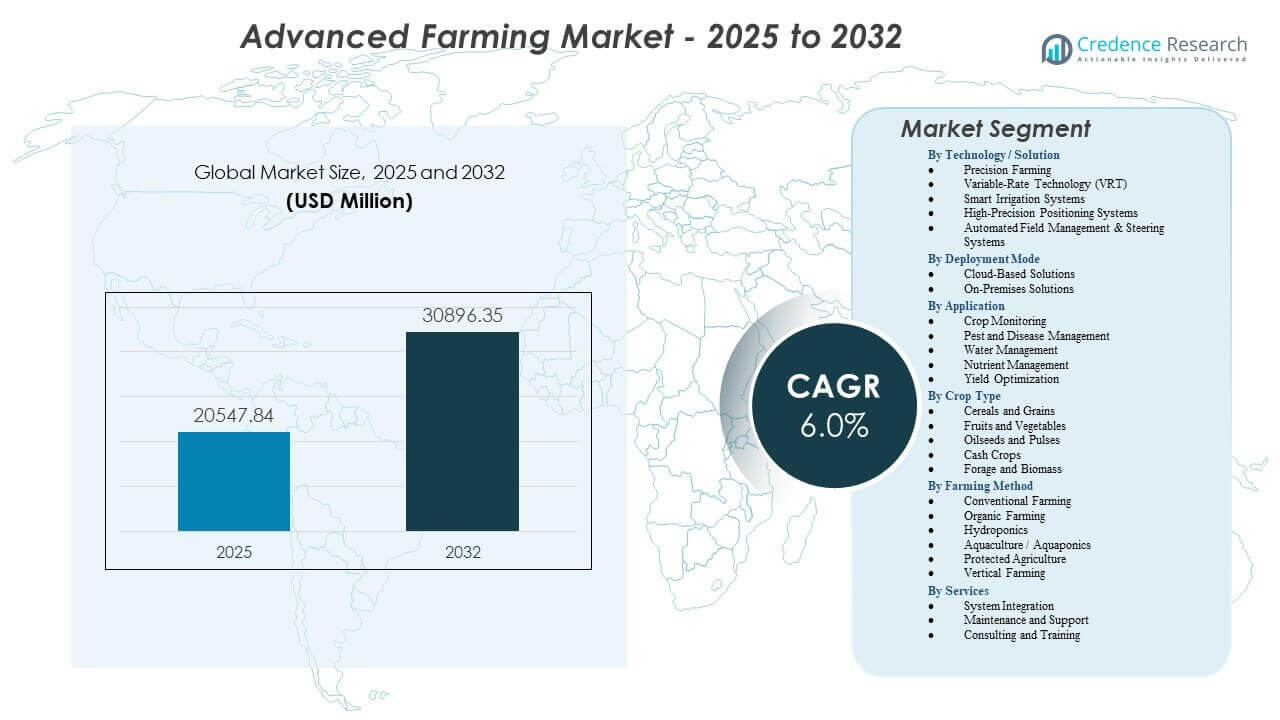
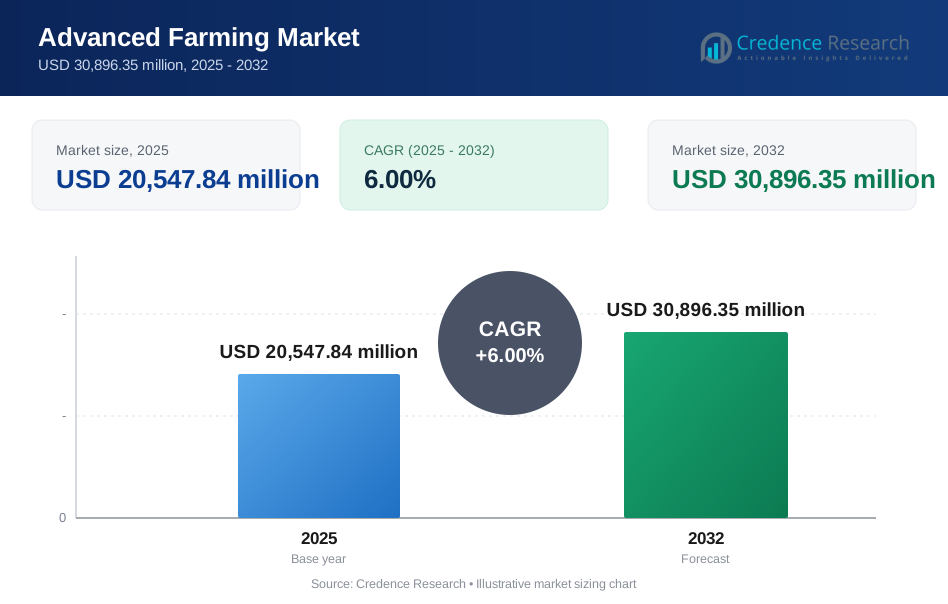
The Advanced Farming Market is projected to grow from USD 20,547.84 million in 2025 to an estimated USD 30,896.35 million by 2032, with a compound annual growth rate (CAGR) of 6.0% from 2025 to 2032.
| REPORT ATTRIBUTE | DETAILS |
|---|---|
| Historical Period | 2020-2023 |
| Base Year | 2024 |
| Forecast Period | 2025-2032 |
| Advanced Farming Market Size 2025 | USD 20,547.84 million |
| Advanced Farming Market, CAGR | 6.0% |
| Advanced Farming Market Size 2032 | USD 30,896.35 million |
Key drivers include the growing need for higher crop productivity, increasing labor shortages, and stronger demand for real-time field intelligence. Farmers depend on automated machinery, AI-enabled decision platforms, and connected sensors to improve accuracy and reduce manual workload. Smart irrigation supports better water control during climate stress, while drones and remote sensing tools provide early insights into crop health. Adoption grows as farms seek predictable performance, efficient input use, and scalable technologies that support diverse production environments.
North America leads the market due to rapid adoption of automation, strong digital infrastructure, and widespread use of precision technologies. Europe follows with strict sustainability rules that push growers toward efficient monitoring and resource management systems. Asia Pacific emerges as the fastest-growing region due to large farming bases, modernization programs, and rising acceptance of digital tools by small and mid-size farms. Latin America strengthens adoption in high-value crops, while the Middle East and Africa expand smart irrigation and controlled-environment farming due to water and climate constraints.
Advanced Farming Market Insights:
- The Advanced Farming Market is projected to increase from USD 20,547.84 million in 2025 to USD 30,896.35 million by 2032, supported by a steady 6.0% CAGR.
- Rising demand for higher yield output, automation, and real-time field intelligence strengthens adoption of precision tools and smart irrigation systems.
- Limited digital skills, high upfront costs, and uneven connectivity across rural regions continue to restrain wider technology penetration.
- North America leads due to strong digital readiness, while Europe advances through sustainability-driven policies that encourage efficient resource use.
- Asia Pacific grows rapidly as large farming economies modernize operations and adopt scalable digital and automated solutions across expanding farm networks.
Advanced Farming Market Drivers
Growing Need For Higher Yield Output And Efficient Resource Use Across Large And Small Farms
Farmers face rising pressure to raise yields while reducing the use of water, fertilizers, and pesticides, and the Advanced Farming Market responds to this shift. Demand grows because farms target higher output with fewer inputs. Precision tools give farmers the ability to adjust field plans with better accuracy. AI platforms support early crop alerts and help reduce field losses. Remote sensing helps identify nutrient gaps in different zones. Soil mapping tools support targeted input plans for each acre. Farmers boost production when they adopt these tools. Strong industry support encourages many growers to move toward digital practices.
- For instance:The Climate Corporation (Bayer) utilized its FieldView platform to enable corn growers in the U.S. to achieve an average yield increase of 2 bushels per acre through the use of scripted, variable-rate seeding and nitrogen applications based on high-resolution satellite imagery.
Rapid Expansion Of Sensor-Driven Field Management And Real-Time Decision Platforms
Smart sensors allow farmers to track soil moisture, nutrient levels, and weather patterns with greater clarity, and the Advanced Farming Market gains strong momentum from this trend. Real-time insights help farms reduce waste during peak seasons. Data platforms help workers act at the right moment and avoid delays. Predictive tools support quick risk control before crop loss develops. Drones give farmers new reach across wide fields. Remote platforms reduce the need for manual checks. Advanced guidance systems help operators plan each pass with better accuracy. These upgrades raise overall field efficiency across many regions.
Increasing Automation In Machinery To Reduce Labor Burden And Improve Operational Continuity
Labor shortages push farmers to consider autonomous tractors, robotic harvesters, and automated spraying units, and the Advanced Farming Market strengthens due to this gap. Growers depend on reliable machines that support long work hours. Robotics limit field delays during peak cycles. Automated platforms help workers manage more acres with less effort. High-precision controls help reduce overlap and input waste. Machine guidance reduces operator fatigue during long runs. Fuel savings grow when routes stay optimized. This shift raises interest in automation across many farm zones.
Government Programs Promoting Digital Tools, Sustainability Compliance, And Modern Farm Infrastructure
Policy support raises confidence among growers who plan long-term upgrades, and the Advanced Farming Market benefits from these efforts. Subsidy schemes help small farms access new tools. Training centers support farmers who need digital skills. Sustainability rules push growers toward more efficient practices. Smart irrigation programs help reduce groundwater pressure. Incentives help expand drone use across large regions. National food security goals increase focus on modern farm plans. This policy direction expands adoption across both developed and emerging markets.
- For instance:Under the European Union’s Common Agricultural Policy (CAP), the "SmartAgriHubs" initiative successfully connected over 140 Digital Innovation Hubs, facilitating a transition that helped participating precision-tech farms reduce greenhouse gas emissions by 10% to 15% through optimized fertilizer application and fuel-efficient machinery routing.
Advanced Farming Market Trends
Rising Adoption Of AI-Driven Predictive Platforms For Crop Forecasting And Field Optimization
AI tools support crop modeling, disease prediction, and growing condition alerts, and the Advanced Farming Market advances due to strong digital uptake. Farmers rely on clear forecasts to manage risk. AI scans weather data to detect early issues. Platforms support faster decision cycles during high-pressure weeks. Disease alerts help growers act before spread occurs. Crop models help workers plan yield strategy with better accuracy. Digital tools support smarter nutrient schedules. Predictive engines enter new regional markets with strong interest from growers.
Integration Of Robotics, Autonomous Mobility, And Vision Technology Into Core Farm Operations
Robotics expand across planting, soil care, and harvest tasks, and the Advanced Farming Market integrates these systems at a steady pace. Vision tools guide robots through narrow rows. Machine learning helps robotic units handle varied crop conditions. Autonomous tractors run long hours without operator fatigue. Robots reduce the physical load placed on workers. Harvest robots support consistent output across long cycles. Mobility platforms handle complex field layouts. These systems enter mid-size farms that seek reliable productivity.
- For instance:Carbon Robotics developed the LaserWeeder, an autonomous platform that leverages thermal energy and sophisticated vision technology to identify and eliminate weeds; the machine can destroy up to 100,000 weeds per hour across 15 to 20 acres per day without disturbing the soil or utilizing manual labor.
Increasing Use Of Satellite Imagery And Drone-Based Surveillance For Field Intelligence
High-resolution images give farmers clear visibility across large areas, and the Advanced Farming Market benefits from more accurate field intelligence. Satellite tools support long-range monitoring. Drones detect plant stress early in growth cycles. Imaging helps workers point equipment toward priority zones. Field maps support variable-rate plans with more precision. Early detection lowers the risk of major field loss. Growers adopt more aerial tools each season. Data layers help advisors guide farm teams with stronger insight.
Expansion Of Connected Farm Ecosystems Through IoT Platforms And Unified Data Management
IoT tools link tractors, sensors, irrigation systems, and weather stations, and the Advanced Farming Market grows with this stronger network approach. Unified dashboards help operators view all systems in one place. Data links help detect faults before breakdown occurs. Connectivity supports remote adjustments during peak hours. Smart irrigation responds to live sensor alerts. Weather-triggered inputs help farms avoid waste. Multi-device links support long-term planning. More regions adopt these systems due to rising digital maturity.
- For instance:Trimble Agriculture integrated its Connected Farm solution with TFX data management, allowing growers to synchronize real-time data across mixed fleets; this connectivity has been shown to reduce "idle time" and overlapping passes by 10%, which directly translates to a significant decrease in fuel consumption and machine wear-and-tear.
Advanced Farming Market Challenges Analysis
High Cost Of Digital Tools, Skill Gaps, And Limited Access To Rural Connectivity Networks
Many growers struggle with upfront investment for sensors, drones, and autonomous units, and the Advanced Farming Market faces a barrier due to this cost. Small farms hesitate when financial risk appears high. Rural areas often lack stable internet. This gap limits adoption in many regions. Farmers face a shortage of trained operators for advanced tools. Maintenance requires skilled technicians. Many regions lack strong support networks. These issues limit long-term progress across several markets.
Data Fragmentation, Integration Complexity, And Concerns Linked To Vendor Interoperability
Data flows from many devices, yet platforms rarely sync with ease, and the Advanced Farming Market must overcome this hurdle. Growers struggle with isolated dashboards. Fragmented data reduces decision accuracy. Integration work raises operational delays. Vendors often use closed systems. Farms worry about system lock-in. Migration to new tools becomes slow. These concerns lower confidence among many producers.
Advanced Farming Market Opportunities
Rising Scope For AI Advisory Engines, Farm Automation Suites, And Scalable Digital Platforms Across Growing Regions
Demand grows for smarter tools that support faster decision cycles, and the Advanced Farming Market gains strong room for expansion. AI advisory engines help farms plan more accurately. Automation raises output for large farms. Scalable platforms attract small growers who seek reliable tools. Cloud-based plans reduce the need for large hardware. Robotics open new zones for high-value crops. Wider training support helps new users gain skills. Policymakers encourage digital growth in food-producing regions.
Expansion Potential Across Emerging Markets With Strong Need For Productivity Gains And Modern Irrigation Systems
Emerging regions seek higher output due to rising population needs, and the Advanced Farming Market holds major opportunity here. Smart irrigation helps reduce water pressure. Affordable sensor units enter new markets. Local dealers expand support centers. Training programs help farmers adopt new tools. Governments promote digital farming models. Growers shift toward precision to protect soil health. New product launches target small and mid-size farms with strong interest.
Advanced Farming Market Segmentation Analysis:
By Technology / Solution
The Advanced Farming Market gains strong traction from rapid expansion in precision farming, VRT, smart irrigation, and high-precision positioning systems. Farmers use automated field management tools and steering systems to reduce manual errors and improve field accuracy. Remote sensing and drones help operators monitor large fields with stronger clarity. Integrated electronic platforms link machines, sensors, and data in real time. AI, IoT, and robotics raise operational efficiency across varied farms. Technology adoption strengthens yield output and reduces waste. It improves planning, supports sustainability goals, and helps growers respond to changing field needs.
- For instance:Topcon Agriculture integrated its Apollo ECU (Electronic Control Unit) with Variable Rate Technology (VRT), allowing air seeders to manage up to 8 separate products simultaneously with section control that reduces seed and fertilizer overlap by up to 10% across irregular field boundaries.
By Deployment Mode
Cloud-based and on-premises solutions shape the way the Advanced Farming Market adopts software-driven capabilities. Cloud platforms support wide data access, quick updates, and remote control of field systems. On-premises setups serve farms that need localized, secure environments. Each model offers scalable features that support precision tasks. Cloud adoption grows due to its flexibility. On-premises systems remain stable in areas with low connectivity. It gives operators controlled environments for sensitive operations. This mix supports digital farming across all farm sizes.
By Application
Strong demand in the Advanced Farming Market comes from crop monitoring, pest and disease control, and water and nutrient management. These applications help farms limit waste and maintain crop health. Yield optimization tools guide growers in critical growth stages. Fleet management improves machine efficiency across large areas. Livestock, forest, aqua, and horticulture operations use digital tools to refine daily tasks. Each application pushes farms toward data-led decision cycles. It raises productivity and supports long-term field stability.
- For instance:Yara International, through its Atfarm nitrogen monitoring tool, utilizes N-Sensor satellite algorithms to create variable-rate application maps; growers using this application have documented yield increases of 5% while simultaneously reducing nitrogen leaching and overall fertilizer usage by 7%.
By Crop Type
The Advanced Farming Market supports cereals, grains, fruits, vegetables, oilseeds, pulses, cash crops, and biomass operations. Farmers adapt digital tools to handle varied crop needs. Monitoring platforms track crop conditions across wide zones. Nutrient and irrigation tools adjust plans for each crop group. Cash crop growers adopt automation to protect high-value output. Biomass and forage producers use sensors to manage growth cycles. It helps maintain uniform quality and reduces field-level uncertainty.
By Farming Method
The Advanced Farming Market includes conventional, organic, hydroponic, aquaculture, protected, and vertical farming models. These methods benefit from tools that improve accuracy and reduce manual effort. Conventional and organic farms use monitoring systems to support healthier soil cycles. Hydroponic and aquaponic units depend on sensors for water and nutrient control. Protected agriculture gains from automation that maintains controlled environments. Vertical farming uses AI and robotics to optimize growth. It drives efficiency across diverse production styles.
By Services
Service expansion strengthens the Advanced Farming Market through integration, maintenance, and consulting support. Integration services help farms connect sensors, machines, and data into unified workflows. Maintenance ensures stable field operations with minimal downtime. Consulting and training guide farmers through digital adoption. These services help reduce skill gaps across regions. Strong service networks improve user confidence. Well-supported tools remain active for longer cycles. It creates stable gains for farms adopting advanced systems.
Advanced Farming Market Segmentation:
By Technology / Solution
- Precision Farming
- Variable-Rate Technology (VRT)
- Smart Irrigation Systems
- High-Precision Positioning Systems
- Automated Field Management & Steering Systems
- Remote Sensing and Agricultural Drones
- Integrated Electronic Communication Platforms
- Advanced Technologies (AI, IoT, Robotics)
By Deployment Mode
- Cloud-Based Solutions
- On-Premises Solutions
By Application
- Crop Monitoring
- Pest and Disease Management
- Water Management
- Nutrient Management
- Yield Optimization
- Fleet Management
- Livestock Farming
- Forest Farming
- Aqua Farming
- Horticulture Operations
By Crop Type
- Cereals and Grains
- Fruits and Vegetables
- Oilseeds and Pulses
- Cash Crops
- Forage and Biomass
By Farming Method
- Conventional Farming
- Organic Farming
- Hydroponics
- Aquaculture / Aquaponics
- Protected Agriculture
- Vertical Farming
By Services
- System Integration
- Maintenance and Support
- Consulting and Training
By Regional
- North America
- U.S.
- Canada
- Mexico
- Europe
- Germany
- France
- U.K.
- Italy
- Spain
- Rest of Europe
- Asia Pacific
- China
- Japan
- India
- South Korea
- South-east Asia
- Rest of Asia Pacific
- Latin America
- Brazil
- Argentina
- Rest of Latin America
- Middle East & Africa
- GCC Countries
- South Africa
- Rest of the Middle East and Africa
Regional Analysis:
North America leads the Advanced Farming Market, holding nearly 38% market share due to strong adoption of precision tools, autonomous machinery, and integrated digital platforms. Farmers invest in data-driven systems that improve yield stability and reduce input waste. Strong broadband coverage supports rapid use of cloud platforms and remote sensing tools. High labor shortages push growers toward automation across major crop zones. Government programs support sustainable farming methods and digital expansion. It strengthens the region’s position and keeps adoption levels high across large farms.
Europe follows with nearly 28% market share, driven by strict sustainability rules, rapid precision farming uptake, and established manufacturing strength in smart farming equipment. Countries integrate advanced irrigation systems, crop monitoring tools, and robotics to support environmental goals. Growers use digital systems to reduce chemical inputs and comply with regulatory targets. High focus on soil health and carbon reduction moves farms toward modern technologies. Regional research investments speed innovation in autonomous solutions. It keeps Europe competitive in advanced field operations.
Asia Pacific remains the fastest-growing region and commands nearly 24% market share, driven by large agricultural bases, rising food demand, and rapid mechanization. Countries deploy drones, IoT platforms, and smart irrigation systems to manage climate pressure and water scarcity. Government-led modernization drives digital adoption across small and mid-size farms. Strong expansion in India, China, and Southeast Asia supports long-term market momentum. Local manufacturing improves system affordability for emerging farm clusters. It lifts adoption levels across diverse production systems.
Key Player Analysis:
- John Deere
- AGCO Corporation
- CNH Industrial
- Trimble Inc.
- Raven Industries, Inc.
- AG Leader Technology
- Kubota Corporation
- Yanmar Co. Ltd.
- Corteva Agriscience
- Bayer AG
- Valmont Industries
- Hexagon Agriculture
Competitive Analysis:
The Advanced Farming Market features a concentrated group of global leaders that shape technology standards and digital adoption patterns. Companies such as John Deere, AGCO, CNH Industrial, Trimble, and Raven Industries push automation, connected machinery, and precision guidance tools into mainstream farming. Strong portfolios in sensors, drones, AI, and software platforms help these firms control major revenue share. Competitors invest in partnerships to expand digital ecosystems and integrate cloud platforms with field equipment. Agricultural chemical and seed leaders like Bayer and Corteva strengthen their roles through digital agronomy tools. It encourages wider adoption of integrated farm management systems across large and mid-size farms. Growing competition leads to rapid innovation and race for scalable precision solutions that support diverse crop environments.
Recent Developments:
- In January 2026, BASF acquired AgBiTech, a bio-control company focused on insect management solutions like lepidoptera caterpillar control. Expected to close in early 2026 pending approvals, this bolsters BASF's biological product lineup in Brazil's growing biologicals market while aligning with its sustainable agriculture strategy.
- In September 2025, CropX Technologies acquired Acclym (formerly Agritask), an agricultural intelligence firm serving global food brands. The deal expands CropX's digital agronomic platform with enterprise tools for sustainability monitoring, regenerative agriculture, and supply chain verification across millions of hectares.
- In April 2025, CNH Industrial acquired the intellectual property and assets of Advanced Farm, a robotics startup specializing in apple-picking technology. This move integrates Advanced Farm's robotic harvesting solutions into CNH's portfolio to tackle labor shortages and boost orchard efficiency, with key team members joining CNH's innovation divisions.
Report Coverage:
The research report offers an in-depth analysis based on Technology / Solution, Deployment Mode, Application, Crop Type, Farming Method, and Services. It details leading market players, providing an overview of their business, product offerings, investments, revenue streams, and key applications. Additionally, the report includes insights into the competitive environment, SWOT analysis, current market trends, as well as the primary drivers and constraints. Furthermore, it discusses various factors that have driven market expansion in recent years. The report also explores market dynamics, regulatory scenarios, and technological advancements that are shaping the industry. It assesses the impact of external factors and global economic changes on market growth. Lastly, it provides strategic recommendations for new entrants and established companies to navigate the complexities of the market.
Future Outlook:
- Growing demand for precision tools will push farmers toward wider adoption of data-led systems within the Advanced Farming Market.
- Rising use of automation will support stronger operational continuity across large and mid-size farms.
- AI advisory platforms will improve decision accuracy and help optimize field activities.
- Wider integration of drones and remote sensing tools will strengthen real-time monitoring capabilities.
- Smart irrigation systems will expand due to rising pressure on water resources in key farming regions.
- Vertical and protected farming models will gain momentum due to urban expansion and limited arable land.
- Cloud-based platforms will grow faster than on-premises systems due to flexible deployment needs.
- Service demand will rise as farms rely more on integration, maintenance, and training support.
- Emerging regions will accelerate adoption due to modernization efforts and strong food production needs.
- Collaboration between equipment makers and digital platform providers will shape long-term innovation cycles.
Request a Free Sample
Fill in your details and we'll send you a free sample report.
- Sample data tables & charts
- Research methodology
Need a Custom Version of This Report?
Tailor the scope, geography, or segments to your exact requirements.
- Custom geography or segment scope
- Direct access to our analyst team
Frequently Asked Questions
What is the current market size for the Advanced Farming Market, and what is its projected size in 2032?
At what Compound Annual Growth Rate is the Advanced Farming Market projected to grow between 2025 and 2032?
Which Advanced Farming Market segment held the largest share in 2025?
What are the primary factors fueling the growth of the Advanced Farming Market?
Who are the leading companies in the Advanced Farming Market?
Which region commanded the largest share of the Advanced Farming Market in 2025?
Table of Content
Chapter 1. Report Introduction
- 1.1 Report Description & Purpose
- 1.1.1 Report Title & Market Definition
- 1.1.2 Unique Selling Propositions (USP) & Key Differentiators
- 1.1.3 Value Proposition for Stakeholders
- 1.2 Research Objectives
- 1.2.1 Market Sizing Objectives (Volume & Revenue)
- 1.2.2 Segmentation Objectives
- 1.2.3 Competitive Intelligence Objectives
- 1.2.4 Forecast & Scenario Objectives
- 1.3 Report Scope
- 1.3.1 Advanced Farming Scope – Types & Subtypes Covered
- 1.3.2 Geographic Scope – Regions & Countries Covered
- 1.3.3 Historical Period, Base Year & Forecast Period (2025; forecast to 2032)
- 1.3.4 Inclusions & Exclusions
- 1.4 HS Code & Classification Framework
- 1.5 Currency, Units & Pricing Basis
- 1.6 Target Stakeholders
- 1.7 Limitations & Assumptions
Chapter 2. Executive Summary
- 2.1 Global Advanced Farming Market Snapshot
- 2.1.1 Market Size – Historical (2025) & Forecast (2025-2032) (2025: USD 20,547.84 million → 2032: USD 30,896.35 million)
- 2.1.2 Volume & Revenue – Global Totals
- 2.1.3 Key Market Highlights – Top Five Facts
- 2.2 Advanced Farming Market Segmentation Snapshot
- 2.2.1 Market Split by Region – 2025 vs. 2032
- 2.3 Competitive Snapshot
- 2.3.1 Top 10 Players by Revenue Share – 2025
- 2.3.2 Top 10 Players by Volume Share – 2025
- 2.3.3 Recent Strategic Developments (18-Month Summary)
- 2.4 Key Investment Highlights & Strategic Conclusions
Chapter 3. Advanced Farming Market Dynamics & Industry Analysis
- 3.1 Market Overview & Context
- 3.1.1 Advanced Farming Market Position in the Broader Automotive Value Chain
- 3.1.2 OEM vs. Replacement Market Dynamics
- 3.1.3 Market Maturity & Development Stage by Region
- 3.2 Advanced Farming Market Drivers
- 3.3 Advanced Farming Market Restraints & Challenges
- 3.4 Advanced Farming Market Opportunities
- 3.5 Porter's Five Forces Analysis
- 3.5.1 Threat of New Entrants
- 3.5.2 Bargaining Power of Suppliers
- 3.5.3 Bargaining Power of Buyers
- 3.5.4 Threat of Substitutes
- 3.5.5 Competitive Rivalry – Intensity Assessment
- 3.6 Advanced Farming Value Chain Analysis
- 3.6.1 Upstream – Raw Material/Input Suppliers
- 3.6.1.1 Raw Material/Input 1
- 3.6.1.2 Raw Material/Input 2
- 3.6.1.3 Raw Material/Input 3
- 3.6.2 Midstream – Production/Manufacturing/Service Delivery
- 3.6.2.1 Production/Process Overview
- 3.6.2.2 Key Facility Locations & Capacity by Manufacturer
- 3.6.3 Downstream – Distribution & End Consumer
- 3.6.3.1 Primary Channel – B2B/OEM
- 3.6.3.2 Secondary Channels – Dealer, Retail, Online, Direct
- 3.6.4 Value Chain Profitability Analysis
- 3.6.1 Upstream – Raw Material/Input Suppliers
- 3.7 PESTEL Analysis
- 3.7.1 Political Factors
- 3.7.2 Economic Factors
- 3.7.3 Social Factors
- 3.7.4 Technological Factors
- 3.7.5 Environmental Factors
- 3.7.6 Legal Factors
- 3.8 Advanced Farming Supply Chain Analysis
- 3.8.1 Raw Material/Input Supply Risk Assessment
- 3.8.2 Manufacturing Concentration Risk (Geographic Exposure)
- 3.8.3 Trade Disruption Impact Analysis
- 3.9 Regulatory & Policy Landscape
Note: The regulatory and policy landscape section covers regulations based on their applicability to the market, Advanced Farming category, geography, and scope of the study. Only regulatory frameworks with a material impact on operations, compliance, trade, sustainability, or market access are analyzed in detail.
Chapter 4. Key Investment Pockets & Opportunity Analysis
- 4.1 Advanced Farming Market Attractiveness Analysis
- 4.1.1 By Region – Investment Attractiveness Matrix (Volume × CAGR)
- 4.2 Absolute Revenue Growth Opportunity
- 4.2.1 By Region – Absolute USD Growth Through 2032
- 4.3 Incremental Volume Opportunity
- 4.3.1 By Region – Incremental Volume Through 2032
- 4.3.2 Segment – Incremental Volume
- 4.4 Emerging Submarket Opportunity Deep Dive (Subject to Applicability)
- 4.5 Emerging Market Opportunity Scorecards
- 4.5.1 United States
- 4.5.2 Europe
- 4.5.3 Asia
- 4.5.4 Middle East & Africa
Note: Emerging Market Opportunity Scorecards will be included based on relevance and strategic importance. Regions listed are indicative and may vary depending on data availability and market dynamics.
Chapter 5. Advanced Farming Import-Export Analysis & Trade Flows
- 5.1 Global Trade Overview
- 5.1.1 Global Export Value by Country (2025)
- 5.1.2 Global Export Volume by Country (2025)
- 5.1.3 Global Import Value by Country (2025)
- 5.1.4 Global Import Volume by Country (2025)
- 5.1.5 Net Trade Balance by Country (2025)
- 5.2 Export Analysis – Segment
- 5.2.1 Type 1 (HS Code)
- 5.2.2 Type 2 (HS Code)
- 5.2.3 Type 3 (HS Code)
- 5.2.4 Type 4 (HS Code)
- 5.2.5 Type 5 (HS Code)
- 5.3 Import Analysis – Segment
- 5.3.1 Type 1 (HS Code)
- 5.3.2 Type 2 (HS Code)
- 5.3.3 Type 3 (HS Code)
- 5.3.4 Type 4 (HS Code)
- 5.3.5 Type 5 (HS Code)
- 5.4 Average Unit Trade Prices
- 5.4.1 Average Export Price – Segment & Country
- 5.4.2 Average Import Price – Segment & Source Country
- 5.4.3 Price Trends (2025)
- 5.5 Key Trade Route Analysis
- 5.5.1 Trade Route 1
- 5.5.2 Trade Route 2
- 5.5.3 Trade Route 3
- 5.5.4 Trade Route 4
- 5.5.5 Trade Route 5
- 5.6 Trade Policy Impact Assessment
- 5.6.1 US Anti-Dumping & Section 301 Tariffs
- 5.6.2 EU Customs Union Impact
- 5.6.3 Major Free Trade Agreements
- 5.6.4 USMCA Rules of Origin
Note: Trade policy analysis will be included only where relevant to the Advanced Farming market.
Chapter 6. Competitive Landscape & Company Benchmarking
- 6.1 Advanced Farming Market Concentration & Structure
- 6.1.1 Herfindahl-Hirschman Index (HHI) – vs. 2025
- 6.1.2 Tier 1, Tier 2 & Tier 3 Market Structure
- 6.1.3 Global, Regional & Local Player Dynamics
- 6.2 Advanced Farming Market Share Analysis – 2025
- 6.2.1 Global Revenue Share by Company
- 6.2.2 Global Volume Share by Company
- 6.2.3 Regional Revenue Share
- 6.2.4 Market Share Evolution ( vs. 2025)
- 6.2.5 OEM Segment Share by Company
- 6.2.6 Replacement Segment Share by Company
- 6.3 Production/Delivery Capacity & Facility Analysis
- 6.3.1 Global Installed Capacity
- 6.3.2 Capacity Utilization Rates
- 6.3.3 Production/Output Volume
- 6.3.4 Facility Locations & Capacity Map
- 6.3.5 Planned Capacity Additions
- 6.4 Advanced Farming Competitive Benchmarking Matrix
- 6.4.1 Revenue, Volume, CAGR & Profitability Comparison
- 6.4.2 Channel Revenue Mix
- 6.4.3 Geographic Revenue Exposure
- 6.4.4 R&D Intensity
- 6.4.5 Sustainability Maturity
- 6.5 Strategic Developments in Advanced Farming (Last 24 Months)
- 6.5.1 Mergers, Acquisitions & Divestments
- 6.5.2 New Advanced Farming Launches
- 6.5.3 Facility Expansions
- 6.5.4 Strategic Alliances, Joint Ventures & Partnerships
- 6.5.5 Distribution Expansion & Market Entry
- 6.5.6 Sustainability & ESG Initiatives
- 6.6 Competitive Strategy Mapping
- 6.6.1 Leader, Challenger, Follower & Niche Classification
- 6.6.2 Pricing Strategy Comparison
- 6.6.3 Channel Strategy Matrix
Note: Strategic developments are included based on their materiality and the availability of reliable information.
Chapter 7. Global Advanced Farming Market – By Distribution Channel
- 7.1 Segment Overview
- 7.1.1 Volume & Revenue Split by Channel (2025 & 2032)
- 7.1.2 Channel Mix Evolution (2025-2032)
Chapter 8. Regional Market Analysis – Global Overview
- 8.1 Global Regional Overview
- 8.1.1 Regional Volume Share
- 8.1.2 Regional Revenue Share
- 8.1.3 Regional Volume by Region
- 8.1.4 Regional Revenue by Region
- 8.1.5 Regional Forecast Through 2032
- 8.2 Cross-Regional Segment Analysis
- 8.2.1 By Distribution Channel
- 8.2.2 By Brand/Price Tier
Chapter 9. North America Advanced Farming Market
- 9.1 United States
- 9.2 Canada
- 9.3 Mexico
Chapter 10. Europe Advanced Farming Market
- 10.1 Germany
- 10.2 France
- 10.3 Italy
- 10.4 United Kingdom
- 10.5 Spain
- 10.6 Poland
- 10.7 Russia
- 10.8 Netherlands
- 10.9 Belgium
- 10.10 Sweden
- 10.11 Denmark
- 10.12 Norway
- 10.13 Rest of Europe
Chapter 11. Asia Pacific Advanced Farming Market
- 11.1 China
- 11.2 India
- 11.3 Japan
- 11.4 South Korea
- 11.5 Thailand
- 11.6 Indonesia
- 11.7 Vietnam
- 11.8 Malaysia
- 11.9 Australia
- 11.10 Rest of Asia Pacific
Chapter 12. Latin America Advanced Farming Market
- 12.1 Brazil
- 12.2 Argentina
- 12.3 Colombia
- 12.4 Chile
- 12.5 Rest of Latin America
Chapter 13. Middle East Advanced Farming Market
- 13.1 Saudi Arabia
- 13.2 United Arab Emirates
- 13.3 Turkey
- 13.4 Israel
- 13.5 Iran
- 13.6 Rest of the Middle East
Chapter 14. Africa Advanced Farming Market
- 14.1 South Africa
- 14.2 Egypt
- 14.3 Nigeria
- 14.4 Morocco
- 14.5 Rest of Africa
Chapter 15. Advanced Farming Company Profiles
- 15.1 [Company 01]
- 15.1.1 Company Overview
- 15.1.2 Key Management Personnel
- 15.1.3 Products & Services Portfolio
- 15.1.4 Financial Performance
- 15.1.5 Key Market Focus & Geographic Presence
- 15.1.6 Recent Developments & Strategic Initiatives
Note: The company profile list is preliminary and may change based on research findings, market developments, data availability, and client requirements.
Chapter 16. Appendices
- Appendix A – List of Abbreviations & Acronyms
- Appendix B – Industry Classification Code Reference – Full Series
- Appendix C – Production & Capacity Data Tables
- Appendix D – End-Use & Demand Base Tables
- Appendix E – Consumption & Replacement Rate Assumptions
- Appendix F – ASP Reference Tables
- Appendix G – Manufacturing & Facility Database
- Appendix H – Import-Export Data Tables
- Appendix I – Regulatory Summary Tables
- Appendix J – Primary Research Participant List (Anonymized)
- Appendix K – Primary Research Questionnaire Framework
- Appendix L – Data Sources & Bibliography
- Appendix M – Market Size Divergence & Source Comparison
Chapter 17. Research Methodology
- 17.1 Research Framework & Philosophy
- 17.2 Secondary Research – Sources, Hierarchy & Data Extraction
- 17.3 Data Modeling – Bottom-Up & Top-Down Market Sizing
- 17.4 Primary Research – Stakeholder Framework, LOI & Sample Sizes
- 17.5 Forecast Methodology – Regression, Scenario & Sensitivity Analysis
- 17.6 Quality Control – Four-Layer Validation Framework
- 17.7 Limitations & Standard Assumptions
- 17.8 Disclaimer
