
Poultry localization reshapes Saudi feed demand
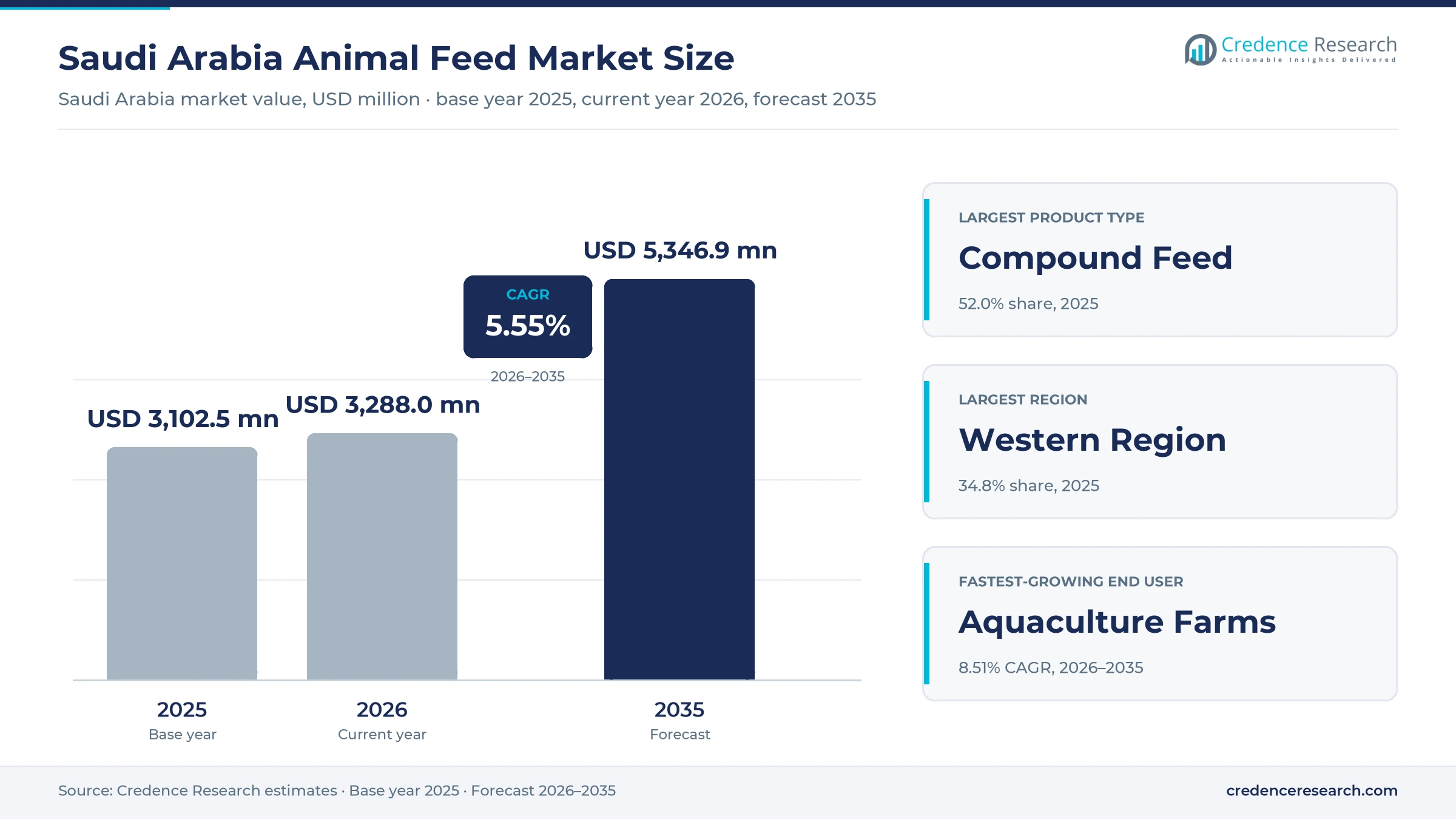
The Saudi Arabia animal feed market was valued at USD 3.10 billion in 2025 and is projected to increase from USD 3.29 billion in 2026 to USD 5.35 billion by 2035, registering a CAGR of 5.55% during 2026–2035. Demand comes from broiler and layer integrators adding flocks under the national poultry self-sufficiency plan, from dairy herds that rely on imported grain and hay, and from sheep, goat and camel owners who are moving from loose barley toward pelleted complete feed. The Western Region held the largest regional share, 34.8% in 2025, because the Makkah area hosts large layer farms and new feed mill capacity close to the busiest consumer markets. Qassim and Hail is the fastest-growing region at 6.73% a year, as broiler production there expands from a smaller feed-sales base. The regulatory side has also changed, because the Saudi Food and Drug Authority now handles feed product registration through its electronic platform. As a result, new premixes and specialty rations reach farms faster than before.
What does the estimate count, from pellets to premixes?
The estimate measures the value of animal feed sold in Saudi Arabia, including compound feed, feed grains sold for direct feeding, processed forage and fiber products, and feed additives and premixes. It covers sales to poultry, dairy, cattle, sheep, goat, camel and aquaculture farms through mill contracts, distributors, feed markets and delivery services.
The estimate excludes pet food, veterinary drugs sold outside feed, exports of finished feed and grain bought for flour milling or strategic reserves. The value chain runs from grain importers and port silos through feed mills and premix plants to distributors, cooperatives and the farms that feed the animals.
Saudi Arabia Animal Feed Market Insights
- The Saudi Arabia animal feed market was valued at USD 3.10 billion in 2025 and is projected to reach USD 5.35 billion by 2035, registering a CAGR of 5.55% during 2026–2035.
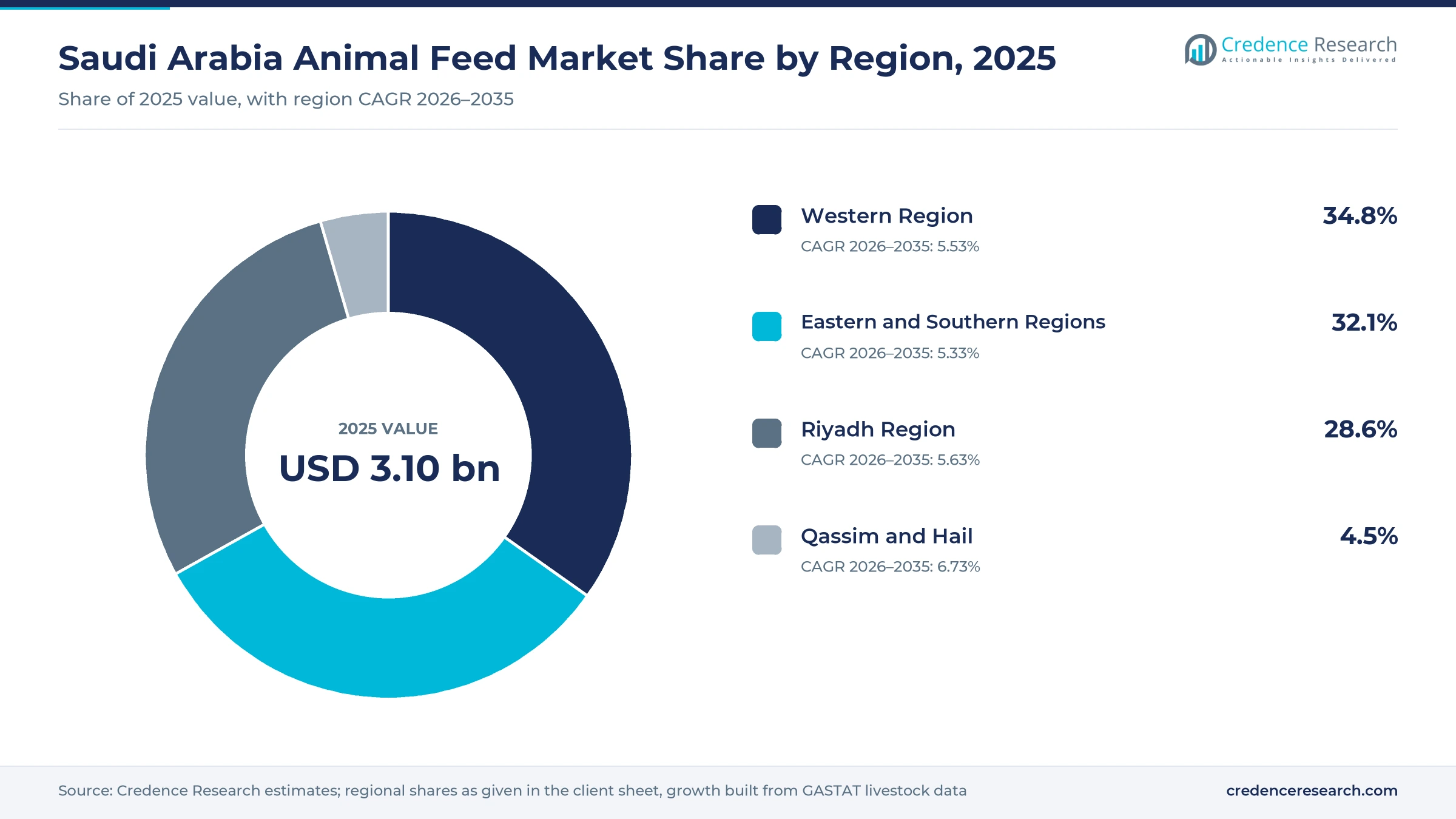
- The Western Region held a 34.8% share of 2025 value, because the Makkah area hosts large layer farms, new feed mill capacity and dense consumer markets.
- Compound feed led with 52.0% of 2025 value, because integrated poultry and dairy producers buy complete pelleted rations under mill contracts.
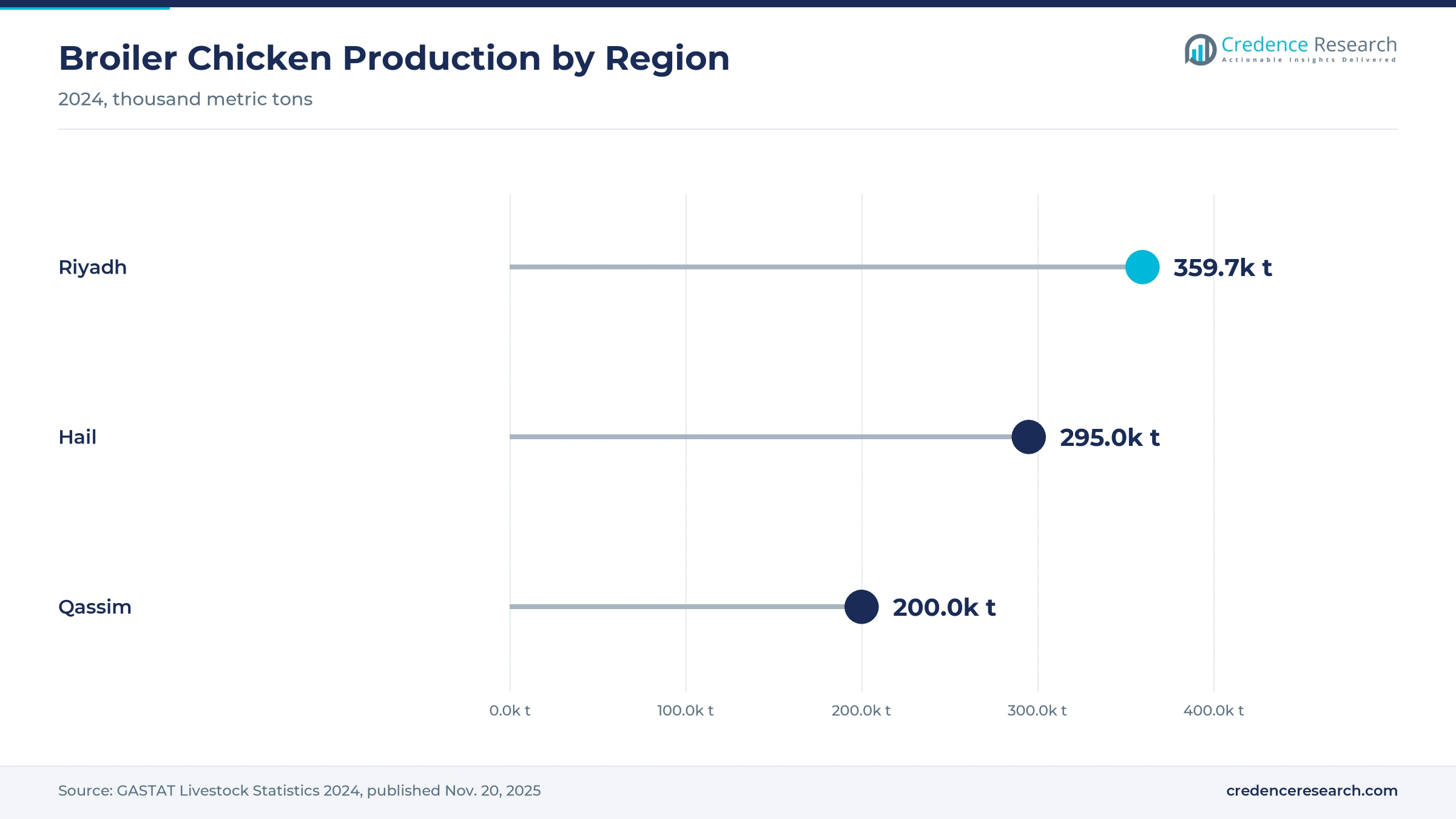
- GASTAT reported broiler chicken production of 1.3 million metric tons in 2024, up 12.9% from 2023, with Riyadh, Hail and Qassim the largest producing regions.
- In March 2025, Modern Mills signed a supply agreement for a SAR 150 million feed mill at Al-Jumum with capacity of 422,000 metric tons a year.
Compound feed leads as aquaculture rations grow fastest
Why does compound feed carry the largest share of value?
Based on product type, the market is categorized into compound feed, feed grains, forage and fibers, and feed additives. Compound Feed led with 52.0% of 2025 value, because poultry integrators and dairy groups buy complete pelleted rations under mill contracts. Feed Additives grow fastest at 6.40% a year, as mills add enzymes, vitamins and minerals to raise feed conversion in broilers.
How do poultry, ruminant and fish farms split demand?
Based on end user, the market is categorized into poultry farms, dairy and cattle farms, sheep, goat and camel farms, and aquaculture farms. Poultry Farms led with 44.0% of 2025 value, because broiler integrators buy complete starter, grower and finisher rations for every flock they place. Aquaculture Farms grow fastest at 8.51% a year, as new fish and shrimp farms need formulated floating and sinking feed.
Which processing methods shape feed quality on Saudi farms?
Based on technology, the market is categorized into pelleting and crumbling, extrusion, mash and meal processing, and precision formulation. Pelleting and Crumbling led with 46.0% of 2025 value, because broiler and ruminant pellets dominate mill output. Extrusion grows fastest at 7.46% a year, as fish and shrimp farms need floating and sinking extruded pellets that most older mills cannot produce.
How does feed move from mills to Saudi farms?
Based on distribution channel, the market is categorized into direct mill contracts, agricultural distributors, cooperative and feed markets, and digital and farm-delivery. Direct Mill Contracts led with 45.0% of 2025 value, because large poultry and dairy groups contract feed in bulk. Digital and Farm-Delivery grows fastest at 8.47% a year, as small livestock owners order bagged feed for delivery.
| Segment Group | Leading Sub-segment | Share, 2025 | Fastest-growing Sub-segment | CAGR, 2026–2035 |
|---|---|---|---|---|
| By Product Type | Compound Feed | 52.0% | Feed Additives | 6.40% |
| By End User | Poultry Farms | 44.0% | Aquaculture Farms | 8.51% |
| By Technology | Pelleting and Crumbling | 46.0% | Extrusion | 7.46% |
| By Distribution Channel | Direct Mill Contracts | 45.0% | Digital and Farm-Delivery | 8.47% |
Request a Free Sample
Fill in your details and we'll send you a free sample report.
- Sample data tables & charts
- Research methodology
Broiler growth, barley substitution and faster registration
How is poultry localization lifting compound feed volumes?
The national push to replace imported chicken with local production is the largest source of new feed demand, because every additional broiler flock needs complete pelleted rations from day one. Broiler chicken production reached 1.3 million metric tons in 2024, up 12.9% from 2023, and table egg output passed 8.4 billion eggs, according to GASTAT livestock statistics. The Ministry of Environment, Water and Agriculture said in May 2024 that poultry self-sufficiency had reached 70%, with targets of 80% by 2025 and 90% by 2030, as reported by Argaam. Almarai planned to raise poultry output by 35% in 2025, according to AGBI. As a result, poultry farms hold 44.0% of 2025 feed value, which also supports local meat production.
Why are herd owners moving from barley to complete feed?
Sheep, goat and camel owners have long fed whole barley, but water policy and subsidy reform are pushing them toward balanced pelleted rations that use grain more efficiently. The Kingdom banned green fodder cultivation from Nov. 5, 2018, to save water, and the ministry expected dairy firms to import 1.1 million metric tons of fodder, according to Argaam. Barley imports for the 2026/27 marketing year are forecast at 5 million metric tons, about 12% above average, because of feed demand, according to the FAO GIEWS country brief. ARASCO produces almost 100,000 metric tons a month of sheep, goat and camel feed, an executive told S&P Global in October 2024. In turn, compound feed leads by product type with 52.0% of 2025 value.
How does digital registration speed new feed products to farms?
Faster approval of feed products widens the range of premixes, additives and specialty rations that mills and distributors can sell, which lifts value per metric ton. The number of feed products available in the Kingdom reached about 5,022 in the first half of 2025, up from 3,141 a year earlier, after all stakeholders adopted the GHAD electronic platform, according to the Saudi Food and Drug Authority. The authority also simplified registration and reduced requirements while keeping safety checks. The Feed System approved by Royal Decree M/60 in 2014 restricts growth-promoting medicines and additives to licensed establishments. As a result, vitamin and mineral premixes gain listings, and feed additives grow fastest by product type at 6.40% a year.
Why do dairy herds and fish farms add steady feed demand?
Dairy and aquaculture producers add a second layer of demand, because both rely on formulated feed rather than grazing. Specialized cattle projects produced about 2.7 billion liters of raw milk in 2024 from about 233,000 dairy cows, mostly in Riyadh and the Eastern Region, based on GASTAT data. The Ministry of Environment, Water and Agriculture aims to produce 600,000 metric tons of seafood through aquaculture by 2030, as reported by Milling Middle East and Africa. ARASCO already exports some specialty feed, such as fish feed, an executive told S&P Global in October 2024. In turn, aquaculture farms grow fastest by end user at 8.51% a year, while dairy and cattle farms provide a large, stable base.
New mills, listed producers and grain logistics set the pace
How are new mills shifting capacity toward the west and center?
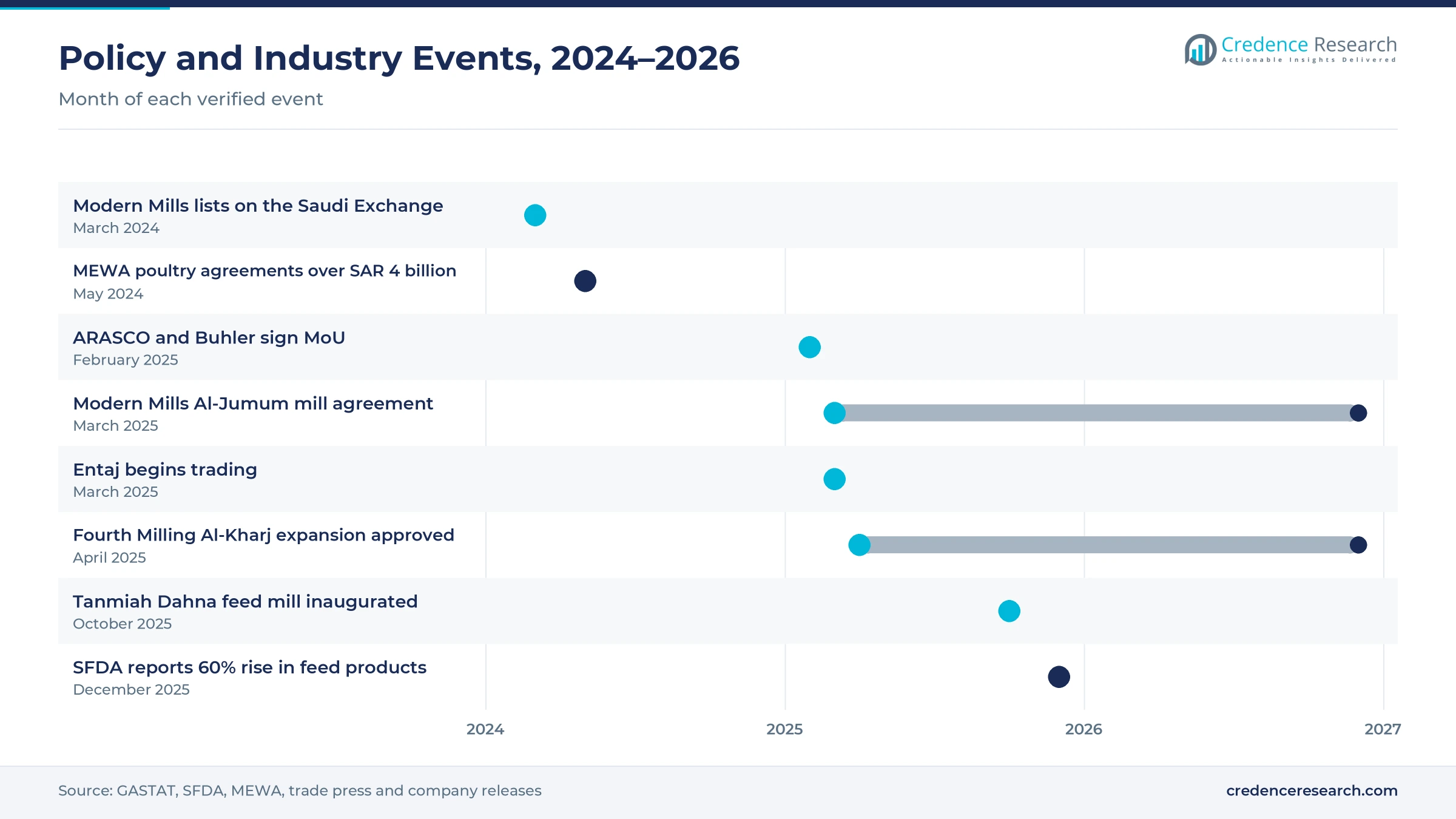
Feed producers are adding capacity close to growing poultry clusters rather than relying only on large port mills, which shortens delivery routes and cuts moisture losses. Modern Mills signed a supply agreement on March 17, 2025, for production lines at a SAR 150 million feed mill in Al-Jumum with capacity of 422,000 metric tons a year, according to Milling Middle East and Africa. Fourth Milling approved a SAR 265 million Al-Kharj expansion on April 30, 2025, including a 240-ton-per-day feed plant due in the second half of 2026. Tanmiah inaugurated a 40-ton-per-hour automated feed mill in Dahna in October 2025, according to Feed and Additive Magazine. As a result, pelleting and crumbling lead by technology with 46.0% of 2025 value.
Why is the rise of listed feed and poultry groups notable?
Public listings are giving feed and poultry producers new capital for mills, farms and processing plants, which strengthens integrated buyers of compound feed. Modern Mills listed on the Saudi Exchange on March 27, 2024, after an offering that was covered about 127 times by institutions, as reported by Milling Middle East and Africa. Entaj, the poultry arm of ARASCO, began trading on March 17, 2025, at SAR 50 a share, with ARASCO keeping a 65.10% stake, according to Argaam. Tanmiah said it had invested over SAR 1.5 billion in the Kingdom over two years, as reported in October 2025. In turn, direct mill contracts lead by channel with 45.0% of 2025 value.
Can aquaculture feed become a high-value opening for mills?
Fish and shrimp farms pay more per ton than livestock buyers, so mills with extruders that make floating and sinking pellets can earn higher margins. The Kingdom targets 600,000 metric tons of fish output by 2030 and aims to raise fish consumption to 13 kg per person a year, according to Daleel. Farmed species include Nile tilapia, sea bass, sea bream and shrimp, each needing different protein and pellet sizes. ARASCO built a Dammam plant with Buhler that makes fish, poultry and camel feed, as reported by Aquafeed. As a result, extrusion grows fastest by technology at 7.46% a year, and aquaculture diets gain a larger share of mill output.
Is automation in grain handling an opening for feed makers?
Imported corn loses value as it dries between port and mill, so automated handling and conditioning lines can recover margin that older plants give away. ARASCO and Buhler signed a memorandum of understanding on Feb. 26, 2025, in Al-Kharj to raise feed production efficiency, as reported by Milling Middle East and Africa. ARASCO said a one-point drop in corn moisture can mean a financial loss of about 7% to 8%, in an October 2024 interview with S&P Global. Its 20-year rail agreement moves 850,000 metric tons of grain a year from Dammam to Al-Kharj. In turn, precision formulation gains share as mills match rations to the grain they actually receive.
Import reliance, grain prices and water limits test margins
How does import reliance expose mills to grain price swings?
Saudi feed mills import almost all their corn and most of their barley, so world grain prices and freight rates flow straight into feed costs. USDA projects corn imports of 4.66 million metric tons in the 2026/27 marketing year and barley imports of 4.5 million metric tons. As a result, mills hedge through forward buying, and ARASCO says it secures grain about six months ahead, which protects supply but locks in prices when world markets fall. Larger mills also own port silos and ships to spread freight costs.
Why do water limits keep forage supply tight?
The ban on green fodder cultivation saves water, but it leaves dairy and livestock farms dependent on imported hay and processed forage. The ministry estimated that the ban would cut green fodder output by 65% and save 9 billion cubic meters of water a year. In turn, forage prices follow overseas harvests and freight, so dairy groups source hay abroad, and buyers of alfalfa hay face higher landed costs.
Why does dairy demand limit growth in cattle feed?
Dairy herds are large but no longer growing quickly, which caps feed volume growth in the cattle segment. Raw milk from specialized cattle projects fell 3.5% in 2024 to about 2.7 billion liters, based on GASTAT data. As a result, dairy and cattle farms grow more slowly than other end users, and mills serving them compete on ration efficiency and forage substitution rather than volume. Mills that blend by-products and protein meals into dairy rations defend margins better than plain grain sellers.
How do price-sensitive herd owners slow the switch to pellets?
Many sheep, goat and camel owners still compare pellet prices with loose barley in local feed markets, which slows the move to complete rations. Barley remains easy to store and trade, and herd owners often feed it alongside pellets. In turn, mills rely on smaller bags, dealer credit and farm delivery to convert these buyers, while cooperative and feed markets grow slowest by channel. Producers that show lower cost per kilogram of weight gain convert herd owners faster.
Western region leads while Qassim and Hail grow fastest
| Region | Value, 2025 (USD billion) | Share, 2025 | CAGR, 2026–2035 |
|---|---|---|---|
| Western Region | 1.08 | 34.8% | 5.53% |
| Eastern and Southern Regions | 1.00 | 32.1% | 5.33% |
| Riyadh Region | 0.89 | 28.6% | 5.63% |
| Qassim and Hail | 0.14 | 4.5% | 6.73% |
Why do layer farms and western mills keep the western region first?
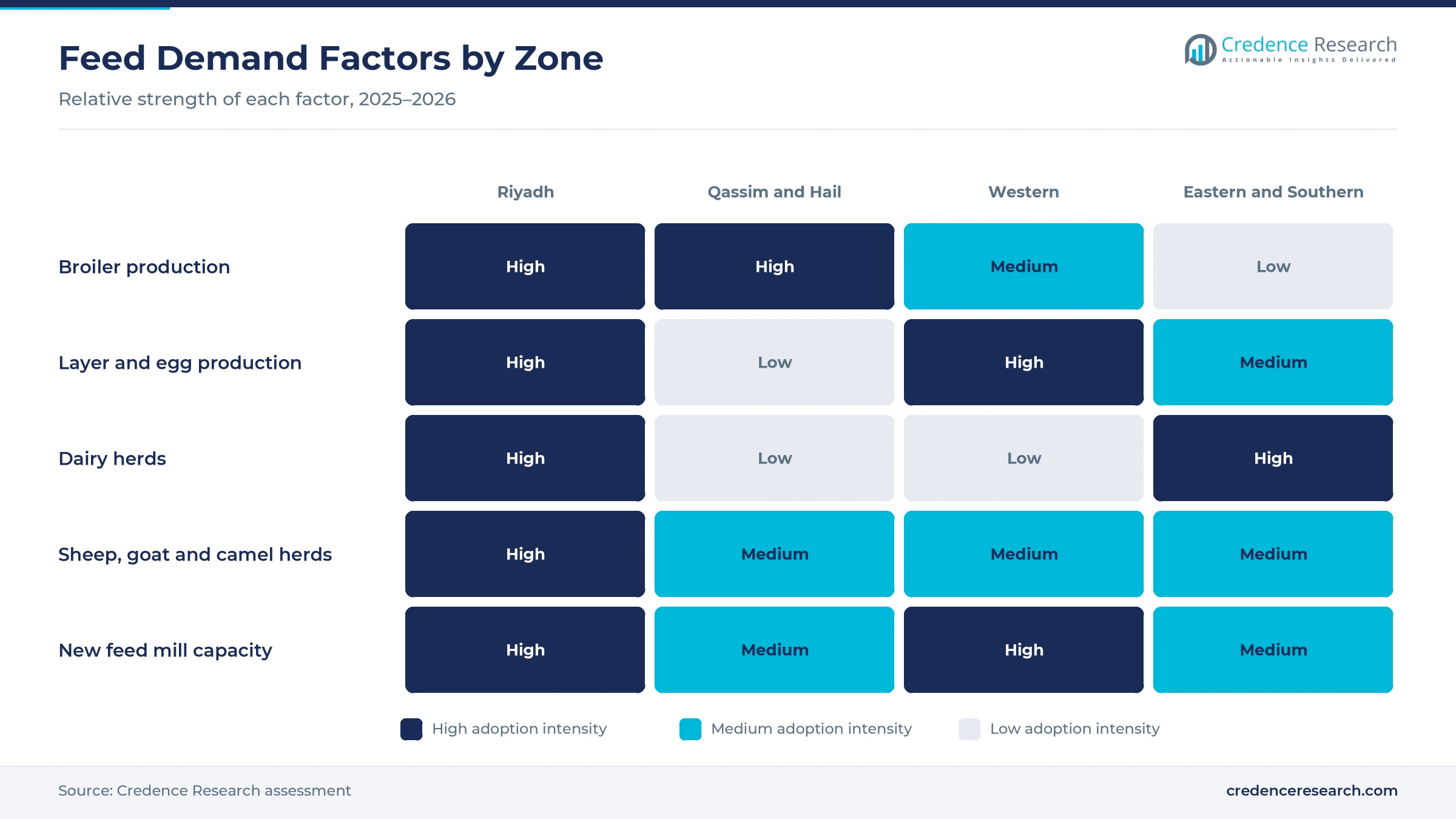
The Makkah area hosts large layer farms, milling sites and the biggest consumer markets, so the Western Region held 34.8% of 2025 value and grows at 5.53% a year. Makkah produced about 1.5 billion table eggs in 2024, the second-largest regional total, based on GASTAT data. Modern Mills is building a new poultry and livestock feed mill at Al-Jumum in Makkah, with commercial production expected in the fourth quarter of 2026. As a result, western poultry farms will source more pellets from nearby mills.
How do port mills and dairies anchor the Eastern and Southern Regions?
Dammam port mills and large dairy herds give the Eastern and Southern Regions 32.1% of 2025 value, and the zones grow at 5.33% a year. ARASCO runs two feed mills in Dammam and a 500,000-ton storage facility at the port, an executive told S&P Global. The Eastern Region produced about 1.1 billion liters of raw milk and 1.1 billion table eggs in 2024, based on GASTAT data. In turn, ruminant and dairy rations form a large share of zone sales.
How do broiler farms and dairies shape Riyadh region demand?
Riyadh Region held 28.6% of 2025 value and grows at 5.63% a year, because it leads in broilers, eggs and milk at once. Riyadh produced 359.7 thousand metric tons of broiler meat, about 3.2 billion eggs and about 1.6 billion liters of raw milk in 2024, based on GASTAT data. Fourth Milling plans a 240-ton-per-day feed plant at Al-Kharj, and Tanmiah opened its Dahna feed mill in central Saudi Arabia in October 2025. As a result, local mill capacity is rising alongside farm output.
Why are Qassim and Hail growing fastest from a small base?
Hail produced 295 thousand metric tons of broiler meat in 2024 and Qassim produced 200 thousand metric tons, based on GASTAT data, yet the zone held only 4.5% of 2025 feed value. This gap arises because much of the feed used on farms there is milled and sold by groups based in Riyadh and Al-Kharj, so value is booked where the feed is sold. However, the zone grows fastest at 6.73% a year as local broiler farms add flocks. NAF Feed Company makes compound feed for cattle, camels and poultry in the First Industrial City of Ar Rass, according to its GulfBase profile.
Mill expansions, listings and approvals, 2024–2026
| Development | Status and market relevance |
|---|---|
| In February 2025, ARASCO signed a memorandum of understanding with Buhler in Al-Kharj to raise feed production efficiency. | Targets automation in grain handling and milling |
| In March 2025, Modern Mills signed a supply agreement for a 422,000-ton-a-year feed mill at Al-Jumum in Makkah. | Commercial production expected in the fourth quarter of 2026 |
| In March 2025, Entaj, the poultry company of ARASCO, began trading on the Saudi Exchange at SAR 50 a share. | Adds capital for integrated poultry and feed demand |
| In April 2025, Fourth Milling approved a SAR 265 million Al-Kharj expansion that includes a 240-ton-per-day feed plant. | Feed plant due in the second half of 2026 |
| In October 2025, Tanmiah inaugurated a 40-ton-per-hour automated feed mill in Dahna alongside a new processing plant. | Feed mill in production trial phase |
Pellet mills, extruders and automated lines spread
- Pellet mills press mash into dense pellets and crumbles, which cuts waste and sorting by broilers and sheep.
- Extruders cook and expand feed into floating or sinking pellets, which fish and shrimp farms need for controlled feeding.
- Automated batching weighs grain, protein meals and premixes by recipe, which reduces errors and labor in large mills.
- Grain moisture control tracks and conditions corn between port and mill, which limits value lost as grain dries.
- Least-cost formulation software rebalances rations when grain prices change, which helps mills hold nutrient levels at lower cost.
Need a Custom Version of This Report?
Tailor the scope, geography, or segments to your exact requirements.
- Custom geography or segment scope
- Direct access to our analyst team
Integrated poultry groups and grain logistics set ranks
Competition centers on grain buying power, mill location, poultry integration and product registration, because large buyers want steady supply at the lowest cost per kilogram of meat, milk or eggs. ARASCO is a leading feed miller, with four mills near Riyadh and in Dammam and its own port storage and rail link. Modern Mills and Fourth Milling combine flour and feed milling and are expanding feed capacity in Makkah and Al-Kharj. Tanmiah Food Company feeds its own poultry operations and added a new automated mill in Dahna in 2025. NAF Feed Company serves cattle, camel and poultry farms from Ar Rass in Qassim. Integrated poultry groups such as Almarai also shape demand, because their expansion plans set much of the volume that mills compete for. Premix and additive suppliers compete through product registration on the SFDA platform and technical service to farms.
Companies profiled and their roles in this market
| Company | Type | Role in the market |
|---|---|---|
| Arabian Agricultural Services Company (ARASCO Feed) | Feed miller and grain importer | Four mills near Riyadh and in Dammam; Buhler MoU in 2025 |
| Modern Mills for Food Products Company | Flour and feed miller | 422,000-ton feed mill at Al-Jumum due in 2026 |
| Fourth Milling Company | Flour and feed miller | 240-ton-per-day feed plant at Al-Kharj due in 2026 |
| Tanmiah Food Company | Integrated poultry producer | Automated Dahna feed mill opened in October 2025 |
| NAF Feed Company | Compound feed maker | Cattle, camel and poultry feed from Ar Rass, Qassim |
Mill location and grain cost will decide feed share
Credence Research's view is that the Saudi Arabia animal feed market will grow steadily, because poultry localization, aquaculture targets and the move from loose barley to complete rations all add demand for processed feed. Compound feed keeps most of the value, while additives, extruded aquafeed and precision formulation gain share from smaller bases. The Western Region should stay the largest zone, while Qassim and Hail grow fastest as broiler farms expand. Mills that secure grain supply, cut handling losses and register new products quickly should gain the most share through the forecast period.
Official statistics, filings and grain data anchor the model
The report uses 2025 as the base year on a calendar basis, and market values come from the Credence Research model. That model combines GASTAT livestock statistics, FAO and USDA grain import estimates, Saudi Food and Drug Authority releases, and company filings and announcements. Segment splits, zone shares and zone growth rates are Credence Research estimates built from GASTAT livestock output and mill capacity data. Sources used are government statistics, international agencies, trade press and company releases, and no interviews or surveys were used.
Poultry, aquaculture and complete feed carry growth
Animal feed sales in Saudi Arabia are expected to reach USD 5.35 billion by 2035, a 5.55% CAGR during 2026–2035, as poultry farms add flocks, aquaculture scales up and herd owners buy more pelleted rations. Growth should stay strongest while the Kingdom works toward its 2030 poultry and fish targets. After that, efficiency gains from better formulation, automated mills and grain handling will set the pace. Lower world grain prices would widen mill margins, while a spike in freight or grain costs would slow the shift away from barley. Aquaculture farms are expected to gain the most share through 2035.
Frequently Asked Questions
How big is the Saudi Arabia animal feed market?
Which product type leads the Saudi feed market?
Which region leads feed demand in Saudi Arabia?
How much broiler meat does Saudi Arabia produce?
Why are herd owners moving away from loose barley?
How has feed product registration changed in Saudi Arabia?
Who are the leading feed producers in Saudi Arabia?
What are the main challenges for Saudi feed makers?
Table of Content
Chapter 1 Market Segmentation
- 1.1 Segmentation Framework
- 1.1.1 Product and Service Classification
- 1.1.2 Application and End-Use Classification
- 1.1.3 Technology and Solution Classification
- 1.1.4 Customer and Distribution Channel Classification
- 1.1.5 Geographic Segmentation
- 1.1.6 Market Segment Definitions and Boundaries
- 1.2 By Product Type
- 1.2.1 Compound Feed
- 1.2.2 Feed Grains
- 1.2.3 Forage and Fibers
- 1.2.4 Feed Additives
- 1.3 By End User
- 1.3.1 Poultry Farms
- 1.3.2 Dairy and Cattle Farms
- 1.3.3 Sheep, Goat and Camel Farms
- 1.3.4 Aquaculture Farms
- 1.4 By Technology
- 1.4.1 Pelleting and Crumbling
- 1.4.2 Extrusion
- 1.4.3 Mash and Meal Processing
- 1.4.4 Precision Formulation
Chapter 2 Introduction
- 2.1 Report Objectives and Scope
- 2.2 Product Definition and Industry Terminology
- 2.3 Market Inclusions and Exclusions
- 2.4 Research Process
- 2.4.1 Primary Research and Expert Interviews
- 2.4.2 Secondary Research and Source Review
- 2.4.3 Top-Down and Bottom-Up Estimation
- 2.4.4 Data Triangulation and Verification
- 2.5 Market Size Measurement Basis
- 2.5.1 2025: USD 3.10 billion → 2035: USD 5.35 billion
- 2.6 Historical and Forecast Reference Periods
- 2.6.1 Historical Period: 2018-2025
- 2.6.2 Base Year: 2025
- 2.6.3 Forecast Period: 2025-2035
- 2.7 Research Assumptions and Limitations
Chapter 3 Executive Summary
- 3.1 Market Snapshot and Key Findings
- 3.2 Base-Year Market Size, 2025
- 3.3 Forecast Market Size, 2035
- 3.4 Revenue and Volume Growth Outlook
- 3.5 Key Demand and Supply Indicators
- 3.6 Leading Market Segments
- 3.7 Fastest-Growing Market Opportunities
- 3.8 Regional Performance Highlights
- 3.9 Technology and Industry Transformation
- 3.10 Competitive Landscape Summary
- 3.11 Analyst View and Strategic Implications
Chapter 4 Saudi Arabia Animal Feed Market Trends and Developments
- 4.1 Historical Industry Development, 2018-2025
- 4.2 Recent Market Trends and Developments
- 4.3 Demand and Customer Behavior Trends
- 4.4 Technology and Product Innovation
- 4.5 Artificial Intelligence, Automation and Digitalization
- 4.6 Local Manufacturing and Supply Chain Realignment
- 4.7 Industry Partnerships, Mergers and Acquisitions
- 4.8 Sustainability and Circular Economy Developments
- 4.9 Government and Private Sector Investment Trends
- 4.10 Emerging Business Models and Commercialization
- 4.11 Industry Developments and Announcements
Chapter 5 Saudi Arabia Animal Feed Market Production, Supply and Demand Analysis
- 5.1 Demand Trend and Consumption Analysis, 2018-2025
- 5.2 Demand Forecast, 2025-2035
- 5.3 Production and Output Trend, 2018-2025
- 5.4 Production and Output Forecast, 2025-2035
- 5.5 Installed Capacity and Capacity Utilization
- 5.6 Company-Wise Production Plants and Statistics
- 5.6.1 Installed Production Capacity
- 5.6.2 Actual Production
- 5.6.3 Planned Capacity and Expansion Targets
- 5.7 Supply Chain Structure and Procurement Trends
- 5.8 Supply-Demand Gap and Bottlenecks
- 5.9 Import Dependence and Sourcing Structure
- 5.10 Contract Manufacturing and Outsourcing
- 5.11 Regional Supply and Demand Concentration
Chapter 6 Saudi Arabia Animal Feed Market Pricing Analysis
- 6.1 Pricing Structure and Measurement
- 6.2 Historical Pricing Trends, 2018-2025
- 6.3 Pricing Outlook, 2025-2035
- 6.4 Average Selling Price and Unit Economics
- 6.5 Pricing by Product and Market Segment
- 6.6 Geographic Pricing Differences
- 6.7 Key Input, Energy, Labor and Logistics Costs
- 6.8 Contract Pricing and Purchasing Models
- 6.9 Pricing Sensitivity and Competitive Positioning
- 6.10 Price, Margin and Profitability Implications
Chapter 7 Saudi Arabia Animal Feed Market Dynamics
- 7.1 Market Growth Drivers
- 7.1.1 Demand-Side Drivers
- 7.1.2 Technology and Innovation Drivers
- 7.1.3 Infrastructure and Investment Drivers
- 7.1.4 Regulatory and Policy Drivers
- 7.2 Market Restraints
- 7.2.1 Cost and Affordability Constraints
- 7.2.2 Technology and Adoption Barriers
- 7.2.3 Supply Chain and Operational Constraints
- 7.3 Market Challenges
- 7.3.1 Competitive Pressure and Margin Erosion
- 7.3.2 Skills, Infrastructure and Implementation Gaps
- 7.4 Emerging Market Opportunities
- 7.5 Market Dynamics Impact and Time-Horizon Assessment
Chapter 8 Saudi Arabia Animal Feed Value Chain Analysis
- 8.1 Industry Value Chain Overview
- 8.2 Upstream Suppliers and Critical Inputs
- 8.3 Technology and Component Providers
- 8.4 Manufacturing or Service Delivery
- 8.5 Distribution, Channel Partners and Integrators
- 8.6 Downstream Applications and End Users
- 8.7 Value Addition and Profit Pools
- 8.8 Vertical Integration and Outsourcing
- 8.9 Supplier Concentration and Risk
- 8.10 Supply Chain Localization and Resilience
Chapter 9 Saudi Arabia Animal Feed Market Regulations and Policies
- 9.1 Relevant Laws, Standards and Compliance Frameworks
- 9.2 Product, Service, Safety and Quality Requirements
- 9.3 Government Policies, Incentives and Subsidies
- 9.4 Imports, Exports and Trade Barriers
- 9.5 Public Procurement and Local Content Requirements
- 9.6 Environmental and Sustainability Compliance
- 9.7 Upcoming Policy Changes and Market Implications
Chapter 10 Saudi Arabia Animal Feed Market Hotspots and Opportunities
- 10.1 Market Opportunity Mapping and Growth Hotspots
- 10.2 High-Growth Applications and Customer Groups
- 10.3 Underserved Markets and White-Space Opportunities
- 10.4 Emerging Technology and Product Opportunities
- 10.5 New Capacity and Investment Hotspots
- 10.6 Market Entry and Expansion Opportunities
- 10.7 Distribution and Partnership Opportunities
- 10.8 Near-Term and Long-Term Commercial Potential
- 10.9 Opportunity Attractiveness and Execution Risks
Chapter 11 Saudi Arabia Animal Feed Market Outlook, 2025-2035
- 11.1 Market Size and Analysis
- 11.1.1 Revenue (Market Measurement: 2025: USD 3.10 billion → 2035: USD 5.35 billion)
- 11.1.2 Market Volume and Quantity Sold
- 11.1.3 Historical Market Size, 2018-2025
- 11.1.4 Base-Year Market Size, 2025
- 11.2 Market Forecast, 2025-2035
- 11.2.1 Revenue Forecast to 2035
- 11.2.2 Volume Forecast to 2035
- 11.2.3 CAGR and Year-on-Year Growth
- 11.2.4 Incremental Revenue Opportunity
- 11.3 Forecast Assumptions and Scenario Analysis
- 11.3.1 Base-Case Forecast
- 11.3.2 Optimistic and Conservative Scenarios
- 11.3.3 Technology, Pricing and Policy Sensitivities
- 11.4 Market Attractiveness and Growth Outlook
Chapter 12 Saudi Arabia Animal Feed Market Segmentation and Outlook
- 12.1 Segmentation Summary and Market Shares, 2025
- 12.2 Largest and Fastest-Growing Segments
- 12.3 By Product Type - Market Size and Forecast, 2025-2035
- 12.3.1 Segment Definition and Scope
- 12.3.2 Historical Market Size, 2018-2025
- 12.3.3 Revenue Forecast, 2025-2035
- 12.3.4 Volume Forecast, 2025-2035
- 12.3.5 Base-Year Market Share, 2025
- 12.3.6 Segment CAGR and Growth Drivers
- 12.3.7 Subsegment Market Size and Forecast
- 12.3.7.1 Compound Feed
- 12.3.7.2 Feed Grains
- 12.3.7.3 Forage and Fibers
- 12.3.7.4 Feed Additives
- 12.3.8 Subsegment Pricing and Adoption Trends
- 12.3.9 Leading Suppliers and Competition
- 12.3.10 Regional Demand and Opportunities
- 12.4 By End User - Market Size and Forecast, 2025-2035
- 12.4.1 Segment Definition and Scope
- 12.4.2 Historical Market Size, 2018-2025
- 12.4.3 Revenue Forecast, 2025-2035
- 12.4.4 Volume Forecast, 2025-2035
- 12.4.5 Base-Year Market Share, 2025
- 12.4.6 Segment CAGR and Growth Drivers
- 12.4.7 Subsegment Market Size and Forecast
- 12.4.7.1 Poultry Farms
- 12.4.7.2 Dairy and Cattle Farms
- 12.4.7.3 Sheep, Goat and Camel Farms
- 12.4.7.4 Aquaculture Farms
- 12.4.8 Subsegment Pricing and Adoption Trends
- 12.4.9 Leading Suppliers and Competition
- 12.4.10 Regional Demand and Opportunities
- 12.5 By Technology - Market Size and Forecast, 2025-2035
- 12.5.1 Segment Definition and Scope
- 12.5.2 Historical Market Size, 2018-2025
- 12.5.3 Revenue Forecast, 2025-2035
- 12.5.4 Volume Forecast, 2025-2035
- 12.5.5 Base-Year Market Share, 2025
- 12.5.6 Segment CAGR and Growth Drivers
- 12.5.7 Subsegment Market Size and Forecast
- 12.5.7.1 Pelleting and Crumbling
- 12.5.7.2 Extrusion
- 12.5.7.3 Mash and Meal Processing
- 12.5.7.4 Precision Formulation
- 12.5.8 Subsegment Pricing and Adoption Trends
- 12.5.9 Leading Suppliers and Competition
- 12.5.10 Regional Demand and Opportunities
- 12.6 Segment Growth Comparison
- 12.7 Segment Attractiveness and Priority Matrix
Chapter 13 Saudi Arabia Animal Feed End-Use and Application Market Outlook
- 13.1 End-Use Industry and Customer Demand Structure
- 13.2 Leading Applications and Customer Groups
- 13.3 End-Use Market Size, Share and Forecast
- 13.4 Major End-Use Industry Deep Dives
- 13.4.1 Customer Requirements and Use Cases
- 13.4.2 Demand and Replacement Cycles
- 13.4.3 Technical and Regulatory Considerations
- 13.4.4 Purchasing and Procurement Models
- 13.4.5 Leading Vendors and Distribution Channels
- 13.4.6 Forecast and Commercial Opportunities
- 13.5 Emerging Applications and Cross-Segment Demand
- 13.6 End-Use Industry Investment Priorities
Chapter 14 Saudi Arabia Animal Feed Geographic Market Outlook, 2025-2035
- 14.1 Domestic Market Distribution and Demand Clusters
- 14.2 State- or Province-Wise Market Size and Forecast, 2025-2035
- 14.3 City and Metropolitan Market Outlook
- 14.4 Industrial, Manufacturing and Commercial Clusters
- 14.5 Geographic Concentration of Key End Users
- 14.6 Local Pricing and Purchasing Differences
- 14.7 Domestic Production Facilities and Capacity Map
- 14.8 Local Infrastructure and Project Pipeline
- 14.9 State-Level Policy and Incentive Differences
- 14.10 Subnational Investment Hotspots and Opportunities
- 14.11 Distribution and Logistics Networks
- 14.12 Domestic Competitive Footprint
Chapter 15 Saudi Arabia Animal Feed Technology, Innovation and Sustainability Outlook
- 15.1 Technology Landscape and Maturity
- 15.2 Product, Process and Service Innovation
- 15.3 AI, Automation and Digital Tools in the Industry
- 15.4 Technology Adoption and Performance Benchmarking
- 15.5 Innovation Pipeline and R&D Investment
- 15.6 Patent and Intellectual Property Trends
- 15.7 Energy Efficiency and Resource Management
- 15.8 Sustainability, Recycling and Circularity
- 15.9 Technology Roadmap, 2025-2035
- 15.10 Risks of Obsolescence and Technology Substitution
Chapter 16 Saudi Arabia Animal Feed Market Key Strategic Imperatives
- 16.1 Growth and Market Entry Priorities
- 16.2 High-Return Products and Segments
- 16.3 Pricing, Profitability and Cost Optimization
- 16.4 Technology Investment and Product Differentiation
- 16.5 Supply Chain Localization and Resilience
- 16.6 Distribution and Customer Acquisition
- 16.7 Partnership, Acquisition and Capacity Strategy
- 16.8 Regional Expansion Priorities
- 16.9 Short-, Medium- and Long-Term Actions
Chapter 17 Competition Outlook
- 17.1 Industry Competition Characteristics
- 17.2 Market Structure and Concentration
- 17.3 Market Share and Competitive Positioning, 2025
- 17.4 Company-Wise Revenue and Product Benchmarking
- 17.5 Production and Service Capacity Benchmarking
- 17.6 Technology, Pricing and Differentiation
- 17.7 Regional Footprint and Distribution Strength
- 17.8 Mergers, Acquisitions and Strategic Alliances
- 17.9 New Entrants and Competitive Threats
- 17.10 Porter's Five Forces and Industry Attractiveness
- 17.11 Competitive Outlook, 2025-2035
Chapter 18 Company Profiles
- 18.1 Company Coverage and Selection Criteria
- 18.2 Arabian Agricultural Services Company (ARASCO Feed)
- 18.2.1 Business Description
- 18.2.2 Company Ownership and Geographic Presence
- 18.2.3 Product and Service Portfolio
- 18.2.4 Manufacturing and Operating Footprint
- 18.2.5 Production Capacity and Expansion Plans
- 18.2.6 Financial Performance and Investment
- 18.2.7 Market Share and Competitive Position
- 18.2.8 Technology and Innovation Capabilities
- 18.2.9 Strategic Alliances or Partnerships
- 18.2.10 Recent Developments
- 18.2.11 Growth Strategy and Outlook
- 18.3 Maram Feed Factory
- 18.4 United Feed Manufacturing Company
- 18.5 FEEDCO Investment Company
- 18.6 Tanmiah Food Company
- 18.7 Modern Mills for Food Products Company
- 18.8 Fourth Milling Company
- 18.9 Nafa Feeds
- 18.10 NAF Feed Company
- 18.11 Saudi Feed Premixes Company (Saudi Mix)
- 18.12 Other Relevant Market Participants
Note: Every listed company is profiled on the structure shown under the first company. The company list is preliminary and may change based on research findings, market developments, data availability and client requirements.
Chapter 19 Disclaimer
- 19.1 Research and Forecast Disclaimer
- 19.2 Data Source and Estimation Limitations
Note: The depth of individual sections depends on data availability for this market. Volume, capacity, trade and other unit-based metrics are included where applicable.

