
Market Overview
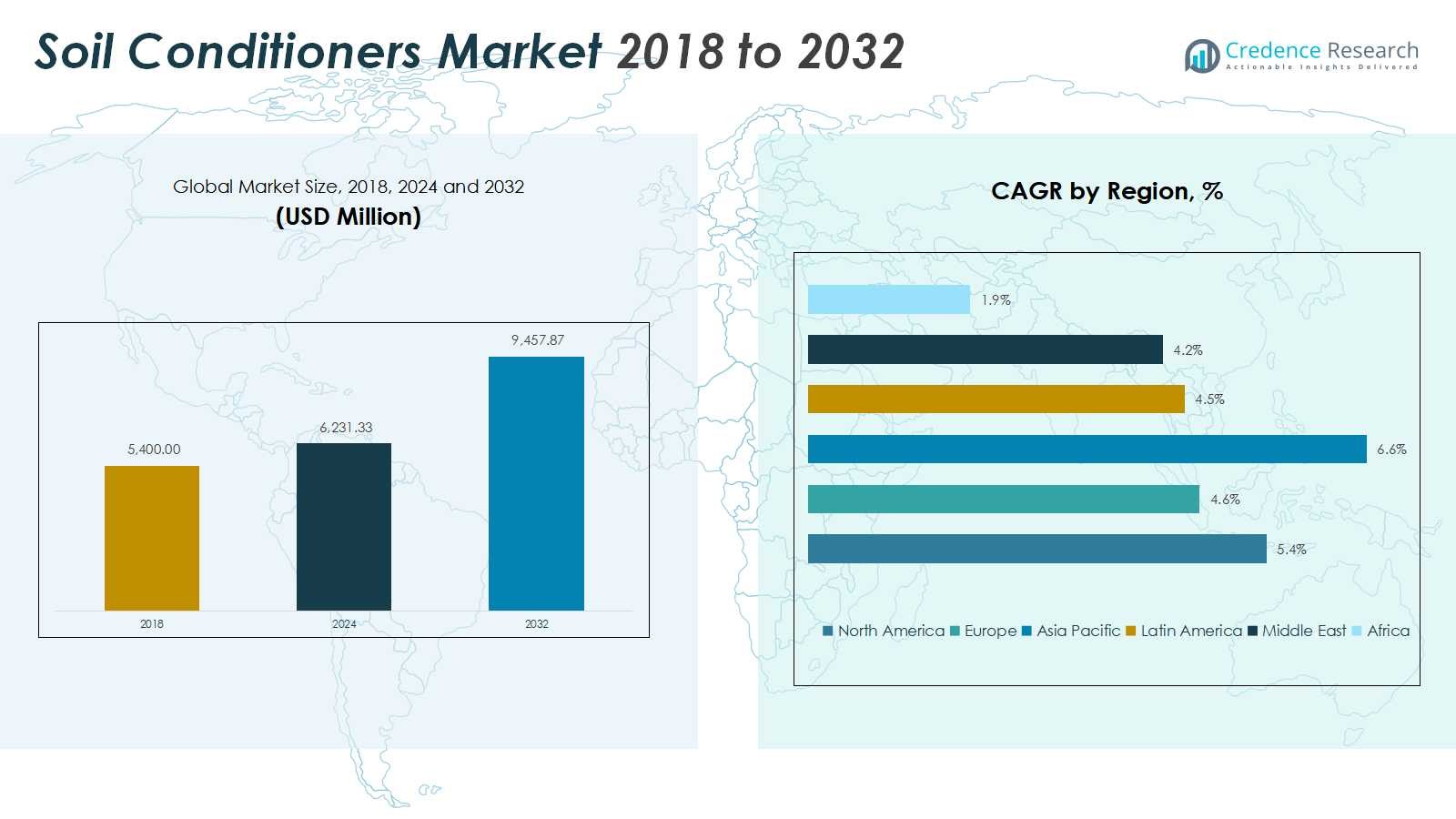
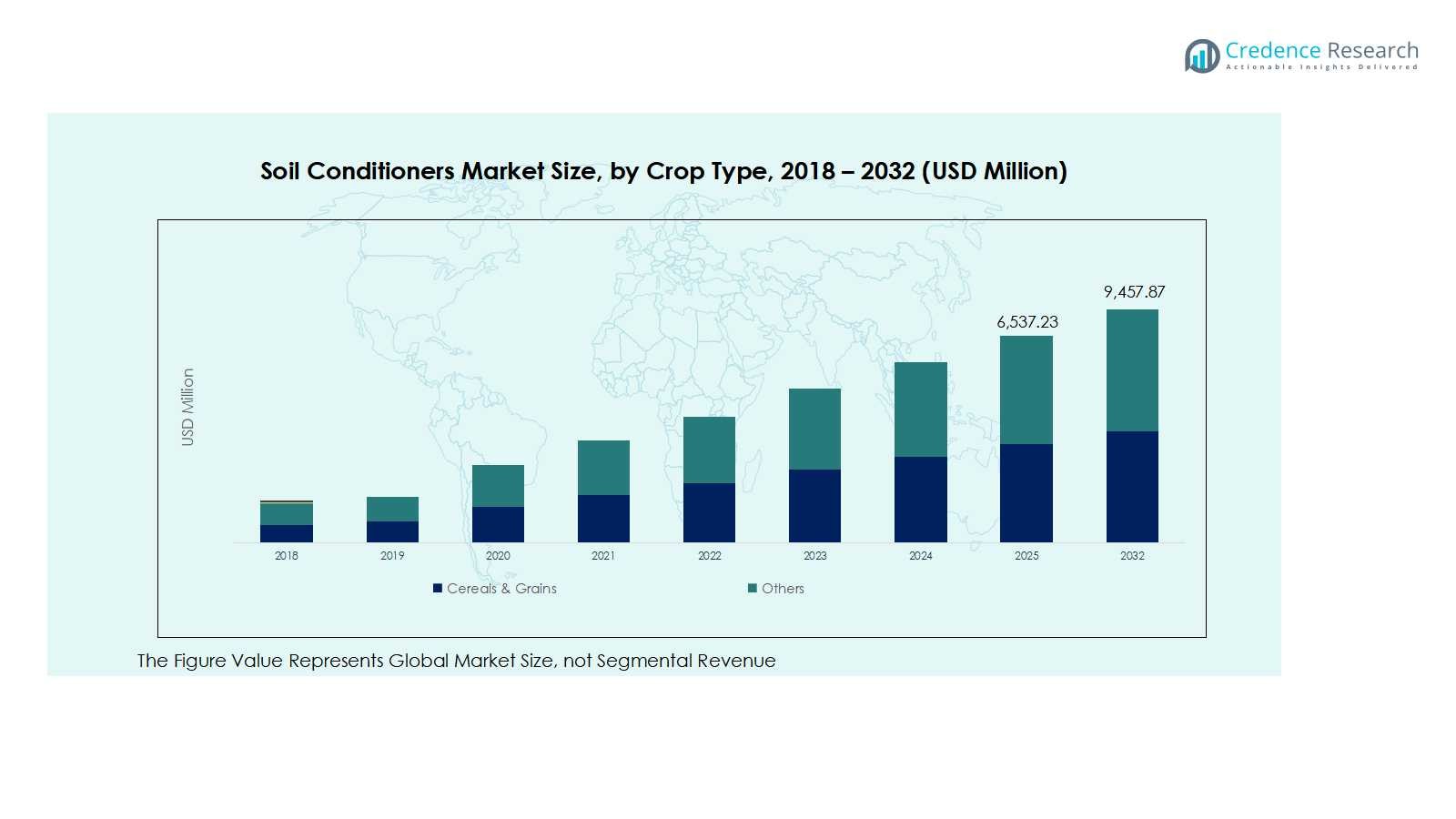
Soil Conditioners Market size was valued at USD 5,400.00 Million in 2018, USD 6,231.33 Million in 2024, and is anticipated to reach USD 9,457.87 Million by 2032, at a CAGR of 5.42% during the forecast period.
| REPORT ATTRIBUTE | DETAILS |
|---|---|
| Historical Period | 2020-2023 |
| Base Year | 2024 |
| Forecast Period | 2025-2032 |
| Soil Conditioners Market Size 2024 | USD 6,231.33 Million |
| Soil Conditioners Market, CAGR | 5.42% |
| Soil Conditioners Market Size 2032 | USD 9,457.87 Million |
The Soil Conditioners Market is highly competitive, led by key players such as Haifa Chemicals Ltd., SQM S.A., The Scotts Miracle-Gro Company, Helena Agri-Enterprises LLC, BASF SE, Yara International ASA, and Coromandel International Limited. These companies focus on product innovation, strategic partnerships, and geographic expansion to strengthen their market positions. North America is the leading region, commanding approximately 32% of the global market share, driven by advanced agricultural practices, high adoption of organic and synthetic soil conditioners, and strong regulatory support. Europe follows with a 22% share, supported by stringent environmental regulations and growing awareness of soil sustainability. Asia Pacific, holding around 28% of the market, is the fastest-growing region due to government initiatives, agricultural intensification, and rising adoption in India, China, and Southeast Asia. Together, these regions and key players shape the global market dynamics and competitive landscape.
Market Insights
- The Soil Conditioners Market was valued at USD 6,231.33 Million in 2024 and is projected to reach USD 9,457.87 Million by 2032, growing at a CAGR of 5.42%.
- Rising demand for sustainable agriculture and organic farming is driving market growth, supported by government initiatives and increasing awareness of soil health and fertility.
- Market trends include a shift toward organic and bio-based soil conditioners, integration with precision agriculture, and the adoption of controlled-release and technologically advanced formulations to improve crop yield and efficiency.
- The market is highly competitive with key players such as Haifa Chemicals Ltd., SQM S.A., The Scotts Miracle-Gro Company, BASF SE, and Yara International ASA focusing on product innovation, partnerships, and regional expansion. High costs of advanced soil conditioners and stringent environmental regulations act as restraints.
- North America leads with a 32% share, Europe holds 22%, and Asia Pacific contributes 28%, while agriculture is the dominant application segment at 50%, followed by horticulture at 25%.
Market Segmentation Analysis:
By Type:
Organic soil conditioners dominate the market, accounting for approximately 45% of the global share. Driven by rising consumer demand for sustainable farming practices and eco-friendly crop enhancement, these conditioners improve soil fertility, water retention, and nutrient availability. Inorganic soil conditioners hold around 30% of the market, mainly due to their effectiveness in pH regulation and soil structure improvement. Synthetic soil conditioners contribute the remaining 25%, supported by their high efficiency in enhancing specific soil properties. Overall, the growth in organic agriculture and government incentives for sustainable farming are key drivers across all types.
- For instance, DewEco, a synthetic conditioner applied with nitrogen fertilizer on sandy soil, improved soil porosity, water-holding capacity, and nutrient status, resulting in better maize growth with enhanced water and nitrogen use efficiencies.
By Application:
The agriculture segment leads the market with a 50% share, fueled by the need to boost crop yields and soil health for food security. Horticulture follows with 25%, driven by the expansion of urban landscaping and ornamental plant cultivation. Landscaping applications account for 15% of the market, supported by rising commercial and residential development projects. Other specialty applications, including sports turf and golf courses, contribute around 10%. Increasing focus on sustainable land management, precision farming, and soil restoration practices are primary growth drivers across applications.
- For instance, ScottsMiracle-Gro partnered with the City of Phoenix and Project EverGreen to increase green spaces and shade in urban areas by planting trees and overseeding grass at parks, aiming to reduce the urban heat island effect and improve community wellness through enhanced landscaping initiatives.
By Form:
Granular soil conditioners dominate the market with a 40% share, valued for their ease of handling, uniform application, and prolonged soil nutrient release. Liquid forms hold 35% of the market, benefiting from rapid absorption, compatibility with irrigation systems, and effectiveness in foliar applications. Powder forms account for 25% of the market, mainly used in niche applications requiring precise soil treatment. Rising adoption of precision agriculture techniques, efficient nutrient management practices, and mechanized application methods drive growth across all forms, with granules being preferred for large-scale farming operations.
Key Growth Drivers
Rising Demand for Sustainable Agriculture
Increasing awareness of sustainable farming practices is driving the adoption of soil conditioners. Organic and eco-friendly soil conditioners enhance soil fertility, water retention, and nutrient availability, supporting higher crop yields without harming the environment. Government initiatives and subsidies for sustainable agriculture are further accelerating market growth. Farmers are increasingly adopting these conditioners to improve soil health and meet global food demand, making sustainability a core factor fueling the widespread acceptance of soil conditioners across both developed and emerging markets.
- For instance, microbial-based soil conditioners are gaining traction, with companies like Novozymes developing microbial enhancers that promote nutrient cycling and reduce the need for chemical fertilizers.
Expansion of Horticulture and Landscaping Activities
The growth of urban landscaping, ornamental plant cultivation, and horticulture is boosting soil conditioner demand. These applications require soil improvement solutions to support plant growth, maintain aesthetic value, and enhance soil moisture retention. The rise of commercial and residential construction projects globally is driving demand for specialized soil conditioners tailored for horticulture and landscaping. This expansion has encouraged manufacturers to develop innovative formulations, strengthening the adoption of soil conditioners in non-agricultural sectors and contributing significantly to overall market growth.
- For instance, Eclipse Soils offers an AS4454 compliant soil conditioner rich in composted mulch fines and peat, significantly improving water and nutrient holding capacity in native sandy soils, crucial for urban landscaping.
Technological Advancements in Soil Conditioners
Advancements in formulation technologies are enhancing the efficiency and effectiveness of soil conditioners. Innovations such as controlled-release conditioners, bio-based additives, and blends with micronutrients provide tailored solutions for specific soil types. These improvements allow faster nutrient absorption, improved soil structure, and higher crop yields, making soil conditioners more attractive to farmers and landscapers. Continuous R&D and mechanized application solutions are enabling easier integration into existing farming practices, further driving global adoption and contributing to sustained market expansion over the forecast period.
Key Trends & Opportunities
Growing Preference for Organic Products
The rising consumer shift toward organic food and sustainable agriculture is creating opportunities for organic soil conditioners. These products are perceived as safer and environmentally friendly, increasing demand in both agriculture and horticulture sectors. Manufacturers are capitalizing on this trend by introducing certified organic formulations, enhancing market credibility. This preference not only supports premium pricing but also encourages long-term adoption among farmers and landscapers seeking sustainable soil management solutions, representing a significant growth opportunity for market players.
- For instance, Omya, a company specializing in natural mineral soil conditioners, offers formulations that correct soil acidity and improve crop yields by maintaining optimal soil pH enhancing sustainability in farming practices.
Integration with Precision Agriculture Practices
Soil conditioners are increasingly being integrated into precision farming systems to optimize soil health and nutrient management. Combining conditioners with soil sensors and automated irrigation ensures precise application, reduces wastage, and enhances crop yield. This integration supports sustainable farming and reduces operational costs, presenting a lucrative opportunity for soil conditioner manufacturers to develop technology-driven products. With precision agriculture gaining traction globally, this trend is likely to expand the market’s scope and create innovative growth pathways for both agricultural and non-agricultural applications.
- For instance, Musim Mas employs precision soil surveys to identify sandy soils in plantations and applies dried decanter solids and palm fibers as conditioners to improve water retention and nutrient availability, supporting sustainability and zero-waste initiatives.
Key Challenges
High Cost of Advanced Soil Conditioners
The premium pricing of technologically advanced soil conditioners, particularly synthetic and bio-based formulations, poses a challenge for widespread adoption. Small-scale farmers in developing regions may find the cost prohibitive, limiting market penetration. Despite the long-term benefits, the initial investment required can discourage adoption, slowing overall growth. Market players must focus on cost optimization, localized production, and education programs to demonstrate value, ensuring these innovative products reach a broader customer base and support global market expansion.
Regulatory and Environmental Constraints
Stringent regulations on chemical-based soil conditioners and environmental concerns around excessive use of inorganic additives are restricting market growth in certain regions. Compliance with local and international standards increases production costs and limits product formulations. Environmental monitoring and soil health preservation initiatives further constrain unrestricted usage. Manufacturers must invest in research for eco-friendly alternatives and sustainable formulations while navigating complex regulatory frameworks, balancing compliance and market demand to sustain growth in both developed and emerging economies.
Regional Analysis
North America
North America held a dominant position in the soil conditioners market in 2018, valued at USD 1,981.80 million, and is projected to reach USD 3,424.71 million by 2032 at a CAGR of 5.4%. The region accounts for approximately 32% of the global market share, driven by advanced agricultural practices, technological adoption, and strong regulatory support for sustainable farming. Growing demand for high-yield crops and increased use of organic and synthetic soil conditioners in large-scale farms are supporting market expansion. The U.S. and Canada remain key contributors, with continued investments in precision agriculture and soil health improvement.
Europe
Europe accounted for USD 1,339.20 million in 2018 and is expected to reach USD 2,116.22 million by 2032, growing at a CAGR of 4.6%. Representing around 22% of the global market share, the region benefits from strict environmental regulations and growing awareness of soil sustainability. Organic and eco-friendly soil conditioners are increasingly adopted across Western Europe, particularly in Germany, France, and the UK. Expansion of horticulture and landscaping activities, coupled with government incentives for sustainable agriculture, are driving market growth. Advanced soil testing and precision application technologies further reinforce the region’s steady market performance.
Asia Pacific
Asia Pacific is the fastest-growing region, valued at USD 1,447.20 million in 2018 and projected to reach USD 2,887.50 million by 2032, with a CAGR of 6.6%. The region holds approximately 28% of the global market share, driven by increasing agricultural intensification, government initiatives for sustainable farming, and rising adoption of soil conditioners in India, China, and Southeast Asia. Expansion of horticulture, floriculture, and large-scale crop cultivation supports steady demand. Favorable climatic conditions and the need for soil fertility improvement further encourage adoption, making Asia Pacific a critical growth engine for global soil conditioner manufacturers.
Latin America
Latin America was valued at USD 340.20 million in 2018 and is expected to grow to USD 547.33 million by 2032 at a CAGR of 4.5%. Representing around 5% of the global market share, the region benefits from fertile agricultural land and government programs promoting soil management practices. Brazil and Argentina are major contributors, driven by commercial crop production and increasing use of organic and inorganic soil conditioners. Growing awareness of soil degradation, expansion of high-value crops, and adoption of advanced soil improvement technologies support market growth across the region, providing opportunities for both domestic and international suppliers.
Middle East
The Middle East market was valued at USD 221.40 million in 2018 and is projected to reach USD 332.02 million by 2032 at a CAGR of 4.2%. Accounting for roughly 3% of the global market share, the region is driven by arid soil conditions and the need to enhance agricultural productivity. Countries such as Saudi Arabia, UAE, and Iran are adopting advanced soil conditioners, particularly organic and synthetic types, to improve soil moisture retention and fertility. Government initiatives supporting sustainable agriculture and the adoption of water-efficient irrigation systems are expected to sustain steady market growth over the forecast period.
Africa
Africa held a market value of USD 70.20 million in 2018 and is anticipated to reach USD 150.09 million by 2032, growing at a CAGR of 1.9%. Despite its modest 1% share of the global market, growth is supported by increasing awareness of soil fertility management and government programs promoting sustainable agriculture. South Africa, Kenya, and Nigeria are key contributors, focusing on small-scale and commercial farming improvements. Challenges such as limited infrastructure and high cost of advanced soil conditioners slow adoption. However, gradual investments in agricultural modernization and soil restoration projects are expected to support moderate market growth.
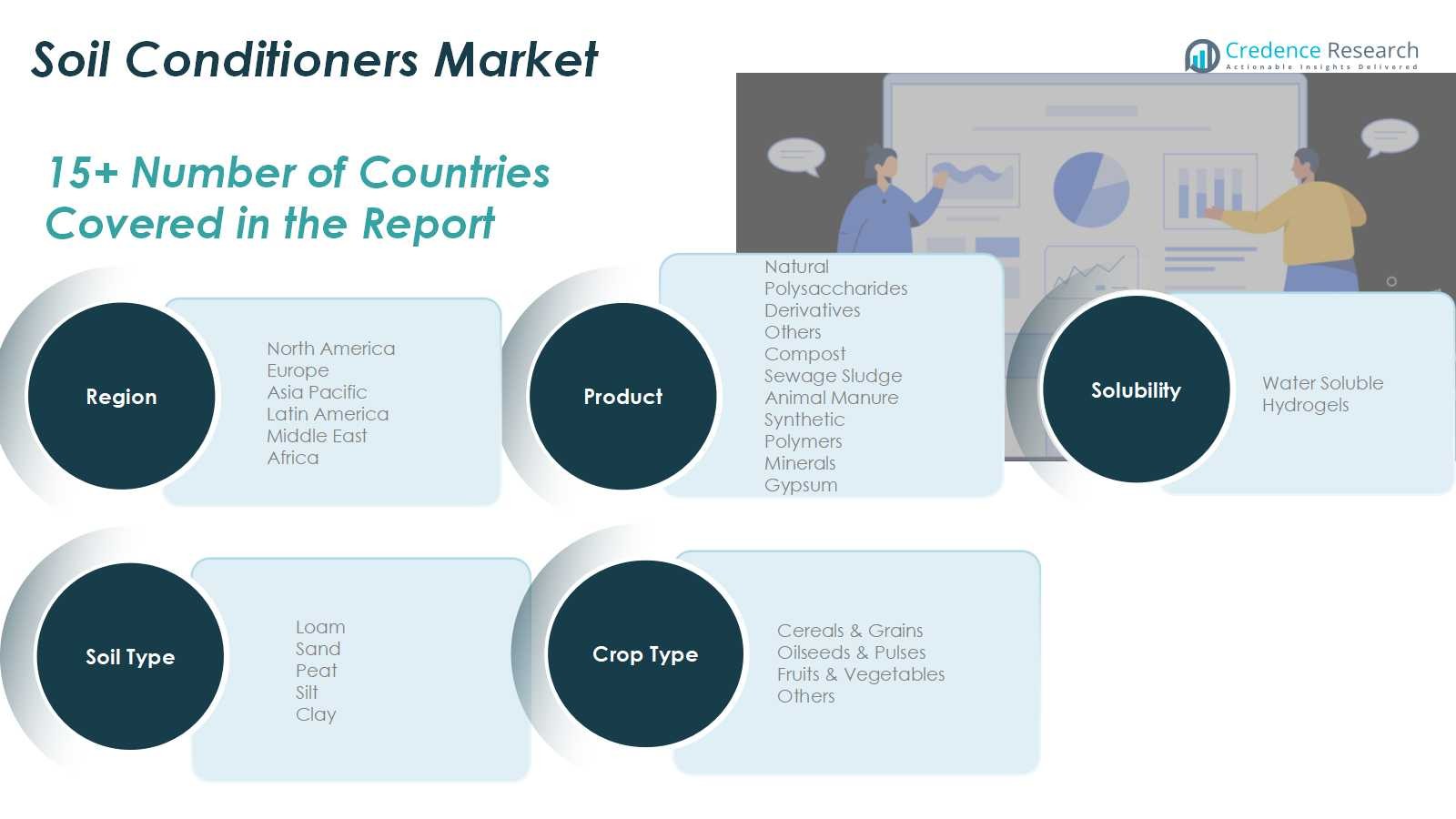
Market Segmentations:
By Type:
- Organic Soil Conditioner
- Inorganic Soil Conditioners
- Synthetic Soil Conditioners
By Application:
- Agriculture
- Horticulture
- Landscaping
- Other Specialty Applications
By Form:
- Granular
- Liquid
- Powder
By Region
- North America
- U.S.
- Canada
- Mexico
- Europe
- Germany
- France
- U.K.
- Italy
- Spain
- Rest of Europe
- Asia Pacific
- China
- Japan
- India
- South Korea
- South-east Asia
- Rest of Asia Pacific
- Latin America
- Brazil
- Argentina
- Rest of Latin America
- Middle East & Africa
- GCC Countries
- South Africa
- Rest of the Middle East and Africa
Competitive Landscape
The competitive landscape of the soil conditioners market is characterized by the presence of major players such as Haifa Chemicals Ltd., SQM S.A., The Scotts Miracle-Gro Company, Helena Agri-Enterprises LLC, BASF SE, Yara International ASA, and Coromandel International Limited. These companies are leveraging strategic initiatives including product innovation, mergers and acquisitions, partnerships, and geographic expansion to strengthen their market position. The market is highly fragmented, with players focusing on developing advanced organic, inorganic, and synthetic soil conditioners to meet evolving agricultural and horticultural demands. Emphasis on research and development has led to innovative formulations that enhance soil fertility, water retention, and crop yield. Regional expansion and collaborations with distributors and agricultural cooperatives allow companies to penetrate emerging markets. Competitive pricing strategies, coupled with sustainable and eco-friendly product offerings, are driving adoption across both developed and developing regions, intensifying competition and shaping market dynamics.
Key Player Analysis
- Haifa Chemicals Ltd.
- SQM S.A.
- The Scotts Miracle-Gro Company
- Helena Agri-Enterprises LLC
- BASF SE
- Yara International ASA
- Coromandel International Limited
- UPL Limited
- R. Simplot Company
- Tessenderlo Group
Recent Developments
- In October 2025, Neova Group launched NeoTerra Aquafix™ and NeoTerra Organic-C™ soil conditioners. These products have received positive feedback from customers in five countries, with the first commercial order shipped to Spain in September 2025.
- In February 2024, Huma® Inc. acquired Gro-Power, Inc., a global granular fertilizer company. This acquisition expands Huma®'s product portfolio and manufacturing capabilities in the soil conditioner market.
- In December 2024, UPL launched NIMAXXA in Brazil and the U.S., a product combining nematode control with root development promotion to improve soil health and crop yield.
- In May 2024, Loam Bio developed CarbonBuilder, a seed treatment using microscopic fungi to capture carbon from the air and deposit it into soil, boosting crop yield and soil carbon levels.
Report Coverage
The research report offers an in-depth analysis based on Type, Application, Form and Region. It details leading market players, providing an overview of their business, product offerings, investments, revenue streams, and key applications. Additionally, the report includes insights into the competitive environment, SWOT analysis, current market trends, as well as the primary drivers and constraints. Furthermore, it discusses various factors that have driven market expansion in recent years. The report also explores market dynamics, regulatory scenarios, and technological advancements that are shaping the industry. It assesses the impact of external factors and global economic changes on market growth. Lastly, it provides strategic recommendations for new entrants and established companies to navigate the complexities of the market.
Future Outlook
- The market is expected to grow steadily due to rising demand for sustainable and organic farming practices.
- Adoption of advanced soil conditioners will increase across agriculture, horticulture, and landscaping sectors.
- Technological innovations in controlled-release and bio-based soil conditioners will drive efficiency and productivity.
- Precision agriculture integration will enhance soil management and encourage widespread use of conditioners.
- Emerging economies in Asia Pacific and Latin America will offer significant growth opportunities.
- Expansion of horticulture and urban landscaping will support market diversification.
- Manufacturers will focus on eco-friendly and biodegradable formulations to meet environmental regulations.
- Strategic partnerships and collaborations will strengthen global distribution networks.
- Increasing awareness of soil fertility and crop yield optimization will boost adoption.
- Continuous research and development will lead to new formulations and application methods, supporting long-term market growth.

Request a Free Sample
Fill in your details and we'll send you a free sample report.
- Sample data tables & charts
- Research methodology
Market Dynamics
Shift Toward Sustainable and Organic Farming
Growing consumer and regulatory emphasis on sustainable agriculture is driving adoption of organic and eco-friendly soil conditioners, which improve soil fertility and water retention without environmental harm. Government incentives and consumer demand for organic produce are accelerating this trend.
Expansion of Horticulture and Urban Landscaping
The rise in urban landscaping, ornamental plant cultivation, and commercial/residential development projects is increasing demand for soil conditioners that enhance soil structure and moisture retention, supporting plant health and aesthetic value in non-agricultural settings.
Technological Advancements in Soil Conditioner Formulations
Innovations such as controlled-release, bio-based additives, and micronutrient blends are making soil conditioners more efficient and tailored to specific soil needs, improving crop yields and enabling easier integration with modern farming practices.
Integration with Precision Agriculture
The adoption of precision agriculture technologies, including soil sensors and automated irrigation, is enabling more targeted and efficient use of soil conditioners, reducing waste and maximizing crop productivity, which encourages broader market adoption.
Government Initiatives and Regulatory Support
Policies and subsidies promoting sustainable land management and soil health, especially in major agricultural economies, are incentivizing farmers to adopt soil conditioners, further fueling market growth.
Need a Custom Version of This Report?
Tailor the scope, geography, or segments to your exact requirements.
- Custom geography or segment scope
- Direct access to our analyst team
Frequently Asked Questions
What is the current market size for Soil Conditioners Market, and what is its projected size in 2032?
At what Compound Annual Growth Rate is the Soil Conditioners Market projected to grow between 2025 and 2032?
Which Soil Conditioners Market segment held the largest share in 2024?
What are the primary factors fueling the growth of the Soil Conditioners Market?
Who are the leading companies in the Soil Conditioners Market?
Which region commanded the largest share of the Soil Conditioners Market in 2024?
Table of Content
Chapter 1 Market Segmentation
- 1.1 Segmentation Framework
- 1.1.1 Product and Service Classification
- 1.1.2 Application and End-Use Classification
- 1.1.3 Technology and Solution Classification
- 1.1.4 Customer and Distribution Channel Classification
- 1.1.5 Geographic Segmentation
- 1.1.6 Market Segment Definitions and Boundaries
- 1.2 By Form
- 1.2.1 Granular
- 1.2.2 Liquid
- 1.2.3 Powder
- 1.3 By Type
- 1.3.1 Organic Soil Conditioner
- 1.3.2 Inorganic Soil Conditioners
- 1.3.3 Synthetic Soil Conditioners
- 1.4 By Application
- 1.4.1 Agriculture
- 1.4.2 Horticulture
- 1.4.3 Landscaping
- 1.4.4 Other Specialty Applications
Chapter 2 Introduction
- 2.1 Report Objectives and Scope
- 2.2 Product Definition and Industry Terminology
- 2.3 Market Inclusions and Exclusions
- 2.4 Research Process
- 2.4.1 Primary Research and Expert Interviews
- 2.4.2 Secondary Research and Source Review
- 2.4.3 Top-Down and Bottom-Up Estimation
- 2.4.4 Data Triangulation and Verification
- 2.5 Market Size Measurement Basis
- 2.5.1 2024: USD 6,231.33 Million → 2032: USD 9,457.87 Million
- 2.6 Historical and Forecast Reference Periods
- 2.6.1 Base Year: 2024
- 2.6.2 Forecast Period: 2024-2032
- 2.7 Research Assumptions and Limitations
Chapter 3 Executive Summary
- 3.1 Market Snapshot and Key Findings
- 3.2 Base-Year Market Size, 2024
- 3.3 Forecast Market Size, 2032
- 3.4 Revenue and Volume Growth Outlook
- 3.5 Key Demand and Supply Indicators
- 3.6 Leading Market Segments
- 3.7 Fastest-Growing Market Opportunities
- 3.8 Regional Performance Highlights
- 3.9 Technology and Industry Transformation
- 3.10 Competitive Landscape Summary
- 3.11 Analyst View and Strategic Implications
Chapter 4 Global Soil Conditioners Market Trends and Developments
- 4.1 Historical Industry Development
- 4.2 Recent Market Trends and Developments
- 4.3 Demand and Customer Behavior Trends
- 4.4 Technology and Product Innovation
- 4.5 Artificial Intelligence, Automation and Digitalization
- 4.6 Local Manufacturing and Supply Chain Realignment
- 4.7 Industry Partnerships, Mergers and Acquisitions
- 4.8 Sustainability and Circular Economy Developments
- 4.9 Government and Private Sector Investment Trends
- 4.10 Emerging Business Models and Commercialization
- 4.11 Industry Developments and Announcements
Chapter 5 Global Soil Conditioners Market Production, Supply and Demand Analysis
- 5.1 Demand Trend and Consumption Analysis
- 5.2 Demand Forecast, 2024-2032
- 5.3 Production and Output Trend
- 5.4 Production and Output Forecast, 2024-2032
- 5.5 Installed Capacity and Capacity Utilization
- 5.6 Company-Wise Production Plants and Statistics
- 5.6.1 Installed Production Capacity
- 5.6.2 Actual Production
- 5.6.3 Planned Capacity and Expansion Targets
- 5.7 Supply Chain Structure and Procurement Trends
- 5.8 Supply-Demand Gap and Bottlenecks
- 5.9 Import Dependence and Sourcing Structure
- 5.10 Contract Manufacturing and Outsourcing
- 5.11 Regional Supply and Demand Concentration
Chapter 6 Global Soil Conditioners Market Pricing Analysis
- 6.1 Pricing Structure and Measurement
- 6.2 Historical Pricing Trends
- 6.3 Pricing Outlook, 2024-2032
- 6.4 Average Selling Price and Unit Economics
- 6.5 Pricing by Product and Market Segment
- 6.6 Geographic Pricing Differences
- 6.7 Key Input, Energy, Labor and Logistics Costs
- 6.8 Contract Pricing and Purchasing Models
- 6.9 Pricing Sensitivity and Competitive Positioning
- 6.10 Price, Margin and Profitability Implications
Chapter 7 Global Soil Conditioners Market Dynamics
- 7.1 Market Growth Drivers
- 7.1.1 Demand-Side Drivers
- 7.1.2 Technology and Innovation Drivers
- 7.1.3 Infrastructure and Investment Drivers
- 7.1.4 Regulatory and Policy Drivers
- 7.2 Market Restraints
- 7.2.1 Cost and Affordability Constraints
- 7.2.2 Technology and Adoption Barriers
- 7.2.3 Supply Chain and Operational Constraints
- 7.3 Market Challenges
- 7.3.1 Competitive Pressure and Margin Erosion
- 7.3.2 Skills, Infrastructure and Implementation Gaps
- 7.4 Emerging Market Opportunities
- 7.5 Market Dynamics Impact and Time-Horizon Assessment
Chapter 8 Global Soil Conditioners Value Chain Analysis
- 8.1 Industry Value Chain Overview
- 8.2 Upstream Suppliers and Critical Inputs
- 8.3 Technology and Component Providers
- 8.4 Manufacturing or Service Delivery
- 8.5 Distribution, Channel Partners and Integrators
- 8.6 Downstream Applications and End Users
- 8.7 Value Addition and Profit Pools
- 8.8 Vertical Integration and Outsourcing
- 8.9 Supplier Concentration and Risk
- 8.10 Supply Chain Localization and Resilience
Chapter 9 Global Soil Conditioners Market Regulations and Policies
- 9.1 Relevant Laws, Standards and Compliance Frameworks
- 9.2 Product, Service, Safety and Quality Requirements
- 9.3 Government Policies, Incentives and Subsidies
- 9.4 Imports, Exports and Trade Barriers
- 9.5 Public Procurement and Local Content Requirements
- 9.6 Environmental and Sustainability Compliance
- 9.7 Upcoming Policy Changes and Market Implications
Chapter 10 Global Soil Conditioners Market Hotspots and Opportunities
- 10.1 Market Opportunity Mapping and Growth Hotspots
- 10.2 High-Growth Applications and Customer Groups
- 10.3 Underserved Markets and White-Space Opportunities
- 10.4 Emerging Technology and Product Opportunities
- 10.5 New Capacity and Investment Hotspots
- 10.6 Market Entry and Expansion Opportunities
- 10.7 Distribution and Partnership Opportunities
- 10.8 Near-Term and Long-Term Commercial Potential
- 10.9 Opportunity Attractiveness and Execution Risks
Chapter 11 Global Soil Conditioners Market Outlook, 2024-2032
- 11.1 Market Size and Analysis
- 11.1.1 Revenue (Market Measurement: 2024: USD 6,231.33 Million → 2032: USD 9,457.87 Million)
- 11.1.2 Market Volume and Quantity Sold
- 11.1.3 Historical Market Size
- 11.1.4 Base-Year Market Size, 2024
- 11.2 Market Forecast, 2024-2032
- 11.2.1 Revenue Forecast to 2032
- 11.2.2 Volume Forecast to 2032
- 11.2.3 CAGR and Year-on-Year Growth
- 11.2.4 Incremental Revenue Opportunity
- 11.3 Forecast Assumptions and Scenario Analysis
- 11.3.1 Base-Case Forecast
- 11.3.2 Optimistic and Conservative Scenarios
- 11.3.3 Technology, Pricing and Policy Sensitivities
- 11.4 Market Attractiveness and Growth Outlook
Chapter 12 Global Soil Conditioners Market Segmentation and Outlook
- 12.1 Segmentation Summary and Market Shares, 2024
- 12.2 Largest and Fastest-Growing Segments
- 12.3 By Form - Market Size and Forecast, 2024-2032
- 12.3.1 Segment Definition and Scope
- 12.3.2 Historical Market Size
- 12.3.3 Revenue Forecast, 2024-2032
- 12.3.4 Volume Forecast, 2024-2032
- 12.3.5 Base-Year Market Share, 2024
- 12.3.6 Segment CAGR and Growth Drivers
- 12.3.7 Subsegment Market Size and Forecast
- 12.3.7.1 Granular
- 12.3.7.2 Liquid
- 12.3.7.3 Powder
- 12.3.8 Subsegment Pricing and Adoption Trends
- 12.3.9 Leading Suppliers and Competition
- 12.3.10 Regional Demand and Opportunities
- 12.4 By Type - Market Size and Forecast, 2024-2032
- 12.4.1 Segment Definition and Scope
- 12.4.2 Historical Market Size
- 12.4.3 Revenue Forecast, 2024-2032
- 12.4.4 Volume Forecast, 2024-2032
- 12.4.5 Base-Year Market Share, 2024
- 12.4.6 Segment CAGR and Growth Drivers
- 12.4.7 Subsegment Market Size and Forecast
- 12.4.7.1 Organic Soil Conditioner
- 12.4.7.2 Inorganic Soil Conditioners
- 12.4.7.3 Synthetic Soil Conditioners
- 12.4.8 Subsegment Pricing and Adoption Trends
- 12.4.9 Leading Suppliers and Competition
- 12.4.10 Regional Demand and Opportunities
- 12.5 By Application - Market Size and Forecast, 2024-2032
- 12.5.1 Segment Definition and Scope
- 12.5.2 Historical Market Size
- 12.5.3 Revenue Forecast, 2024-2032
- 12.5.4 Volume Forecast, 2024-2032
- 12.5.5 Base-Year Market Share, 2024
- 12.5.6 Segment CAGR and Growth Drivers
- 12.5.7 Subsegment Market Size and Forecast
- 12.5.7.1 Agriculture
- 12.5.7.2 Horticulture
- 12.5.7.3 Landscaping
- 12.5.7.4 Other Specialty Applications
- 12.5.8 Subsegment Pricing and Adoption Trends
- 12.5.9 Leading Suppliers and Competition
- 12.5.10 Regional Demand and Opportunities
- 12.6 Segment Growth Comparison
- 12.7 Segment Attractiveness and Priority Matrix
Chapter 13 Global Soil Conditioners End-Use and Application Market Outlook
- 13.1 End-Use Industry and Customer Demand Structure
- 13.2 Leading Applications and Customer Groups
- 13.3 End-Use Market Size, Share and Forecast
- 13.4 Major End-Use Industry Deep Dives
- 13.4.1 Customer Requirements and Use Cases
- 13.4.2 Demand and Replacement Cycles
- 13.4.3 Technical and Regulatory Considerations
- 13.4.4 Purchasing and Procurement Models
- 13.4.5 Leading Vendors and Distribution Channels
- 13.4.6 Forecast and Commercial Opportunities
- 13.5 Emerging Applications and Cross-Segment Demand
- 13.6 End-Use Industry Investment Priorities
Chapter 14 Global Soil Conditioners Geographic Market Outlook, 2024-2032
- 14.1 Regional Market Size and Share, 2024
- 14.2 Regional Market Forecast, 2024-2032
- 14.3 Regional Pricing, Production and Demand Differences
- 14.4 North America
- 14.4.1 United States
- 14.4.2 Canada
- 14.4.3 Mexico
- 14.5 Europe
- 14.5.1 Germany
- 14.5.2 France
- 14.5.3 Italy
- 14.5.4 United Kingdom
- 14.5.5 Spain
- 14.5.6 Poland
- 14.5.7 Russia
- 14.5.8 Netherlands
- 14.5.9 Belgium
- 14.5.10 Sweden
- 14.5.11 Denmark
- 14.5.12 Norway
- 14.5.13 Rest of Europe
- 14.6 Asia Pacific
- 14.6.1 China
- 14.6.2 India
- 14.6.3 Japan
- 14.6.4 South Korea
- 14.6.5 Thailand
- 14.6.6 Indonesia
- 14.6.7 Vietnam
- 14.6.8 Malaysia
- 14.6.9 Australia
- 14.6.10 Rest of Asia Pacific
- 14.7 Latin America
- 14.7.1 Brazil
- 14.7.2 Argentina
- 14.7.3 Colombia
- 14.7.4 Chile
- 14.7.5 Rest of Latin America
- 14.8 Middle East
- 14.8.1 Saudi Arabia
- 14.8.2 United Arab Emirates
- 14.8.3 Turkey
- 14.8.4 Israel
- 14.8.5 Iran
- 14.8.6 Rest of the Middle East
- 14.9 Africa
- 14.9.1 South Africa
- 14.9.2 Egypt
- 14.9.3 Nigeria
- 14.9.4 Morocco
- 14.9.5 Rest of Africa
- 14.10 Regional Investment, Policy and Supply Chain Differences
- 14.11 Regional Competitive Landscape
- 14.12 Geographic Growth Hotspots
Chapter 15 Global Soil Conditioners Technology, Innovation and Sustainability Outlook
- 15.1 Technology Landscape and Maturity
- 15.2 Product, Process and Service Innovation
- 15.3 AI, Automation and Digital Tools in the Industry
- 15.4 Technology Adoption and Performance Benchmarking
- 15.5 Innovation Pipeline and R&D Investment
- 15.6 Patent and Intellectual Property Trends
- 15.7 Energy Efficiency and Resource Management
- 15.8 Sustainability, Recycling and Circularity
- 15.9 Technology Roadmap, 2024-2032
- 15.10 Risks of Obsolescence and Technology Substitution
Chapter 16 Global Soil Conditioners Market Key Strategic Imperatives
- 16.1 Growth and Market Entry Priorities
- 16.2 High-Return Products and Segments
- 16.3 Pricing, Profitability and Cost Optimization
- 16.4 Technology Investment and Product Differentiation
- 16.5 Supply Chain Localization and Resilience
- 16.6 Distribution and Customer Acquisition
- 16.7 Partnership, Acquisition and Capacity Strategy
- 16.8 Regional Expansion Priorities
- 16.9 Short-, Medium- and Long-Term Actions
Chapter 17 Competition Outlook
- 17.1 Industry Competition Characteristics
- 17.2 Market Structure and Concentration
- 17.3 Market Share and Competitive Positioning, 2024
- 17.4 Company-Wise Revenue and Product Benchmarking
- 17.5 Production and Service Capacity Benchmarking
- 17.6 Technology, Pricing and Differentiation
- 17.7 Regional Footprint and Distribution Strength
- 17.8 Mergers, Acquisitions and Strategic Alliances
- 17.9 New Entrants and Competitive Threats
- 17.10 Porter's Five Forces and Industry Attractiveness
- 17.11 Competitive Outlook, 2024-2032
Chapter 18 Company Profiles
- 18.1 Company Coverage and Selection Criteria
- 18.2 Haifa Chemicals Ltd.
- 18.2.1 Business Description
- 18.2.2 Company Ownership and Geographic Presence
- 18.2.3 Product and Service Portfolio
- 18.2.4 Manufacturing and Operating Footprint
- 18.2.5 Production Capacity and Expansion Plans
- 18.2.6 Financial Performance and Investment
- 18.2.7 Market Share and Competitive Position
- 18.2.8 Technology and Innovation Capabilities
- 18.2.9 Strategic Alliances or Partnerships
- 18.2.10 Recent Developments
- 18.2.11 Growth Strategy and Outlook
- 18.3 SQM S.A.
- 18.4 The Scotts Miracle-Gro Company
- 18.5 Helena Agri-Enterprises LLC
- 18.6 BASF SE
- 18.7 Yara International ASA
- 18.8 Coromandel International Limited
- 18.9 UPL Limited
- 18.10 J. R. Simplot Company
- 18.11 Tessenderlo Group
- 18.12 Other Relevant Market Participants
Note: Every listed company is profiled on the structure shown under the first company. The company list is preliminary and may change based on research findings, market developments, data availability and client requirements.
Chapter 19 Disclaimer
- 19.1 Research and Forecast Disclaimer
- 19.2 Data Source and Estimation Limitations
Note: The depth of individual sections depends on data availability for this market. Volume, capacity, trade and other unit-based metrics are included where applicable.

