
| REPORT ATTRIBUTE | DETAILS |
|---|---|
| Historical Period | 2020-2023 |
| Base Year | 2024 |
| Forecast Period | 2025-2032 |
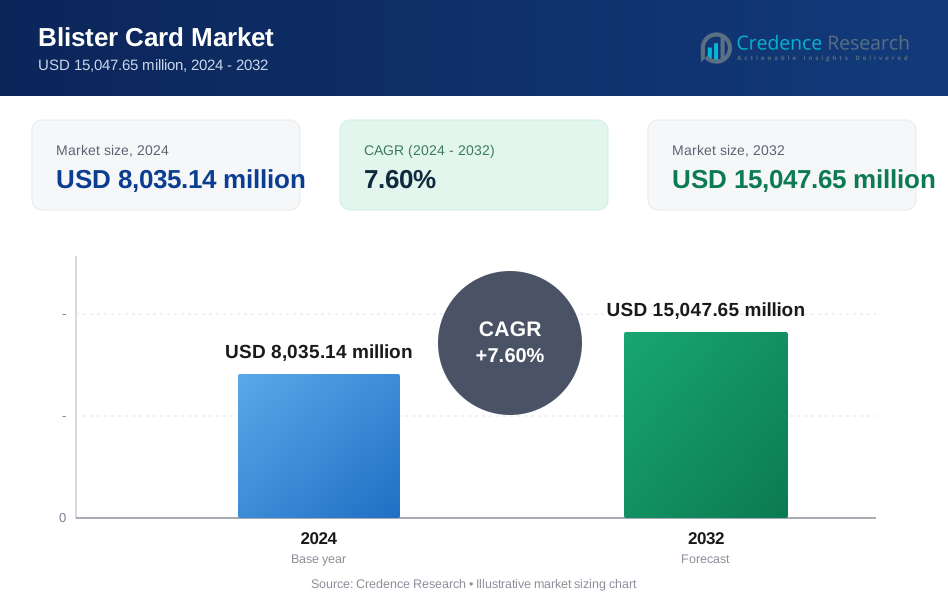
| Blister Card Market Size 2024 | USD 8,035.14 million |
| Blister Card Market, CAGR | 7.60% |
| Blister Card Market Size 2032 | USD 15,047.65 million |
Market Overview:
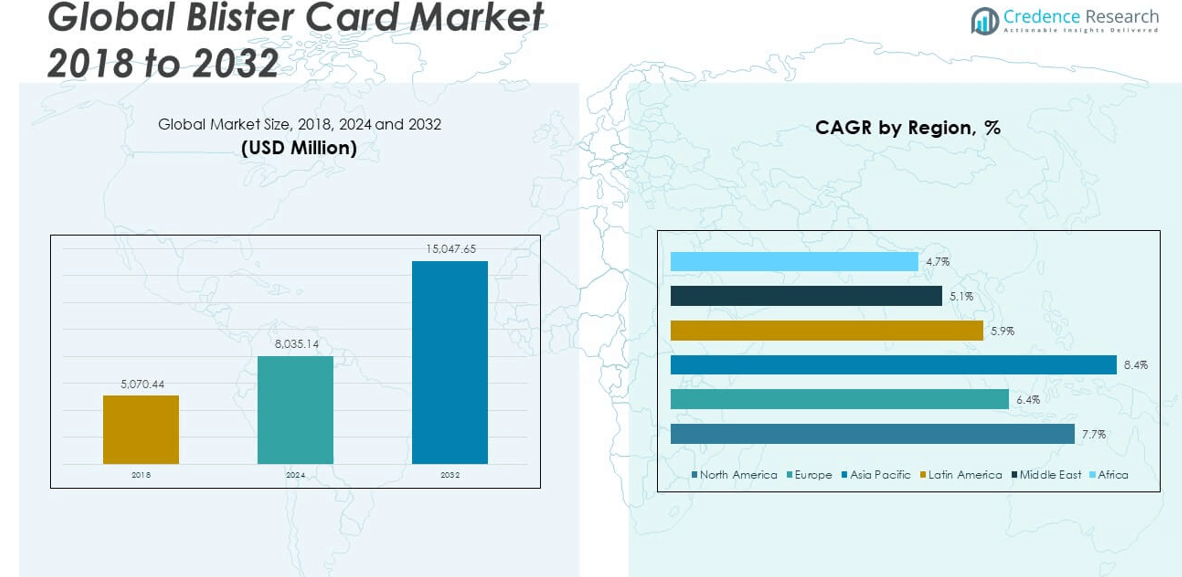
The Global Blister Card Market size was valued at USD 5,070.44 million in 2018 to USD 8,035.14 million in 2024 and is anticipated to reach USD 15,047.65 million by 2032, at a CAGR of 7.60% during the forecast period.
Key factors driving the growth of the blister card market include increasing demand in the pharmaceutical and healthcare sectors, where unit-dose and tamper-evident packaging are essential for safety and compliance. Blister cards also enhance consumer convenience through easy access and portability, while offering clear product visibility that strengthens retail shelf appeal. Rising consumer preference for compact, eco-friendly packaging has pushed manufacturers to adopt recyclable materials such as PET films and biodegradable cardboard. In addition, advancements in thermoforming technologies, automated packaging lines, and integration of RFID or NFC for product authentication have improved the functional and security attributes of blister cards. The shift toward sustainable and smart packaging solutions has further reinforced their adoption across multiple industries, including personal care, nutraceuticals, and electronics.
Regionally, Asia-Pacific dominates the global blister card market, driven by rapid industrialization, increasing healthcare expenditure, and expansion of pharmaceutical manufacturing hubs, particularly in China and India. The region benefits from a large population base, rising consumer goods demand, and favorable government initiatives supporting local production. North America holds a significant market share, backed by a mature pharmaceutical industry, advanced regulatory standards for drug packaging, and strong consumer demand for over-the-counter products. Europe follows closely, with blister cards widely used in pharmaceutical packaging due to stringent EU regulations and high adoption of sustainable formats. Meanwhile, Latin America, the Middle East, and Africa represent emerging markets with growing healthcare infrastructure and retail modernization, offering new opportunities for blister card adoption in the coming years.
Market Insights:
- The Global Blister Card Market reached USD 8,035.14 million in 2024 and is projected to grow to USD 15,047.65 million by 2032, registering a CAGR of 7.60%.
- Growing demand for tamper-evident and unit-dose packaging in the pharmaceutical and healthcare sectors continues to drive significant adoption of blister cards.
- Consumer preference for portable, easy-to-open, and visually clear packaging formats fuels demand across retail segments such as personal care and electronics.
- Sustainability trends push manufacturers to adopt recyclable PET films and biodegradable paperboard, reinforcing eco-friendly packaging innovations.
- Technological advancements like digital printing, RFID/NFC integration, and smart traceability solutions elevate the functional value of blister cards.
- Environmental regulations and complex recycling challenges associated with multi-material formats constrain growth and increase compliance costs.
- Asia-Pacific leads the global market, driven by rapid industrialization and expanding pharmaceutical production, followed by strong demand in North America and Europe.\
Market Drivers:
Increasing Pharmaceutical Demand and Regulatory Requirements Propel Blister Card Adoption
The growing pharmaceutical industry continues to be a primary driver for the Global Blister Card Market. Rising chronic disease prevalence, aging populations, and expanded healthcare access in developing nations are fueling drug demand globally. Blister cards are essential for unit-dose packaging of tablets and capsules, offering protection, tamper evidence, and patient compliance support. Regulatory bodies such as the FDA and EMA mandate stringent packaging standards that favor blister cards for safety and traceability. It enables clear labeling and barcoding, streamlining pharmaceutical distribution and reducing medication errors. The healthcare sector's shift toward secure, sustainable packaging further solidifies blister cards’ relevance across developed and emerging markets.
- In February 2024, Sanofi Consumer Healthcare joined PA Consulting and PulPac’s Blister Pack Collective, committing to develop fiber-based (Dry Molded Fiber) blister packs fully recyclable in the paper stream. This initiative aims to eliminate PVC and other plastic components from pharmaceutical packaging and enable recycling through standard paper waste channels.
Surging Demand for Consumer Convenience and Shelf Visibility in Retail Packaging
Brands across personal care, electronics, and hardware sectors are prioritizing packaging that enhances consumer convenience and visual appeal. The Global Blister Card Market benefits from this trend by offering transparent blister visibility and custom-designed printed backings that support brand differentiation. Consumers prefer packaging that allows easy identification and access, especially in on-the-go formats. It improves the retail experience and encourages impulse buying by showcasing product features at the point of sale. Blister cards also support secure packaging of small, high-theft items without sacrificing display clarity. Their format aligns with modern retail and e-commerce trends, where visual presentation significantly influences purchasing decisions.
- For example, AAA and AA batteries are now routinely sold in blister packs with clear plastic and printed cardboard backings, offering both theft deterrence and easy product identification.
Cost Optimization and Packaging Efficiency Support Widespread Industry Integration
Blister card packaging offers material efficiency, reduced shipping volume, and lower production costs compared to traditional rigid packaging. These cost advantages make it an attractive solution across industries facing margin pressures and competitive pricing dynamics. It uses thermoformed plastic and paperboard—both of which are available in recyclable forms—reducing overall environmental impact and aligning with corporate sustainability goals. Blister cards also support automation in high-speed packaging lines, improving operational throughput and consistency. Their structure allows stacking, hanging, or standing in retail environments, optimizing storage and display logistics. The growing focus on reducing carbon footprints across supply chains further encourages blister card adoption.
Technological Advancements and Smart Packaging Integration Enhance Market Value
Packaging innovation plays a pivotal role in shaping the future of the Global Blister Card Market. Developments in high-barrier films, biodegradable substrates, and digital printing techniques allow manufacturers to enhance both product protection and branding potential. It enables the use of interactive features such as QR codes, NFC chips, or holographic elements for consumer engagement and anti-counterfeiting. Smart packaging capabilities are increasingly important in pharmaceuticals and high-value electronics, where authentication and traceability are critical. Blister cards now integrate with track-and-trace systems, enabling real-time inventory and compliance management. These technological enhancements elevate the functional and strategic role of blister cards in global supply chains.
Market Trends:
Sustainability-Focused Material Innovations Are Redefining Packaging Norms
Manufacturers are rapidly transitioning to sustainable materials to align with global environmental targets and consumer expectations. In the Global Blister Card Market, companies are replacing traditional PVC with recyclable PET, bio-based plastics, and biodegradable paperboard. It reflects a broader shift toward packaging solutions that minimize environmental impact without compromising product protection. Brands are adopting compostable and FSC-certified materials to meet regulatory requirements and improve their eco-profile. The trend has prompted significant R&D investment into alternative substrates and water-based inks to support greener manufacturing. It also enhances brand image, especially in regions where eco-conscious purchasing behavior influences retail preferences.
Personalization and Short-Run Packaging Gain Traction in Brand Marketing Strategies
The growing demand for personalized consumer experiences is driving interest in short-run, customized blister card production. The Global Blister Card Market is seeing an increase in digital printing technologies that allow brands to create unique graphics, variable data, and seasonal designs with minimal lead time. It enables companies to launch limited-edition products, regional variations, and influencer collaborations with greater flexibility. Personalized blister cards help foster stronger customer engagement, especially in health, beauty, and promotional goods. Brands can test new product formats quickly while maintaining consistent packaging quality. This agility supports competitive differentiation and strengthens brand loyalty in dynamic retail environments.
- For instance, Origin Pharma Packaging’s SmartXwallet incorporates a patented child-resistant and tamper-evident mechanism that elevates the child resistance value from F8 to F1 (the highest standard), depending on blister pack criteria. The design includes a visible tab and an automatic re-closing feature to remind users to secure the pack, combining safety with user-friendly design and customizable branding surfaces.
Integration of Tamper-Evident Features with Aesthetic Appeal Boosts Packaging Value
Tamper-evident packaging is evolving beyond security into a tool for consumer trust and visual impact. In the Global Blister Card Market, manufacturers are designing seals, perforations, and locking features that enhance safety while maintaining an attractive presentation. It allows end users to verify product integrity without sacrificing user experience or shelf appeal. Transparent overlays, color-coded indicators, and peel-off verification tabs are being integrated seamlessly into packaging design. This combination of safety and visual refinement helps brands address regulatory compliance and consumer expectations simultaneously. The trend is particularly relevant in OTC healthcare, electronics, and high-value retail categories.
- For example, Sealed Airintroduced the Secure Blister Card, integrating multiple tamper-evident features such as security perforations and holographic labels. These features not only provide visible proof of tampering but also enhance the visual appeal of the packaging, supporting both regulatory compliance and brand differentiation.
E-commerce Optimization Shapes Blister Card Design and Supply Chain Efficiency
The continued rise of e-commerce is influencing blister card design with a focus on durability, compactness, and shipment-ready formats. The Global Blister Card Market is adapting to online retail by offering packaging that protects products through last-mile delivery while maintaining brand aesthetics. It involves the use of impact-resistant materials, tamper-evident seals, and tamper-resistant hang tabs suited for fulfillment centers. Brands are streamlining secondary packaging by ensuring blister cards meet shipping regulations without extra boxing or cushioning. This shift supports cost reduction, faster turnaround, and better inventory management across distribution networks. It also strengthens customer satisfaction by delivering intact, retail-quality products directly to consumers.
Market Challenges Analysis:
Stringent Environmental Regulations and Waste Management Concerns Restrain Market Expansion
The Global Blister Card Market faces growing scrutiny from regulatory bodies and environmental groups over the use of plastic components and non-recyclable laminates. Blister cards typically combine plastic and paperboard, which complicates recycling and contributes to landfill accumulation. Governments in Europe, North America, and parts of Asia are implementing stricter policies that limit single-use plastics and demand greater packaging sustainability. It forces manufacturers to redesign blister formats, which may raise production costs and disrupt established supply chains. Small and mid-sized players struggle to invest in compliant, sustainable alternatives while maintaining price competitiveness. These regulatory pressures introduce uncertainties and slow market penetration, especially in regions with aggressive environmental mandates.
Volatile Raw Material Prices and Supply Chain Disruptions Challenge Profitability
Fluctuating prices of key raw materials such as PET, PVC, aluminum foil, and coated paperboard affect the cost structure of the Global Blister Card Market. Price instability, driven by geopolitical tensions, trade policies, and energy crises, directly impacts production margins and long-term contracts. It also complicates inventory planning and procurement for manufacturers reliant on global supply networks. The COVID-19 pandemic and subsequent logistics disruptions exposed vulnerabilities in sourcing and delivery, particularly for custom packaging components. Delays in obtaining specialized films or adhesives extend lead times and reduce operational efficiency. Managing these risks while ensuring consistent product quality remains a critical challenge for blister card suppliers.
Market Opportunities:
Expansion in Emerging Economies Creates New Avenues for Blister Card Packaging
Rapid urbanization, rising disposable incomes, and growing healthcare access in emerging markets are creating significant opportunities for the Global Blister Card Market. Countries such as India, Brazil, Indonesia, and South Africa are witnessing increased demand for pharmaceuticals, personal care products, and consumer electronics. It supports the adoption of cost-effective and tamper-evident packaging solutions like blister cards. Local manufacturers are expanding production capacity and forming partnerships with multinational brands to meet regional demand. Investments in infrastructure and regulatory improvements are enhancing supply chain efficiency. These dynamics position emerging economies as high-growth zones for blister card suppliers seeking geographic diversification.
Innovation in Eco-Friendly and Functional Packaging Enhances Market Appeal
The shift toward sustainable packaging creates room for innovation in recyclable and biodegradable blister card solutions. The Global Blister Card Market can capitalize on this trend by offering environmentally responsible alternatives that meet evolving consumer and regulatory expectations. It opens doors for collaboration between material scientists, converters, and brand owners. Development of mono-material blister formats and compostable components can attract companies with aggressive sustainability goals. The demand for intelligent packaging features such as QR codes and anti-counterfeit measures adds functional value. These innovations expand the application scope of blister cards across pharmaceuticals, retail, and e-commerce channels.
Market Segmentation Analysis:
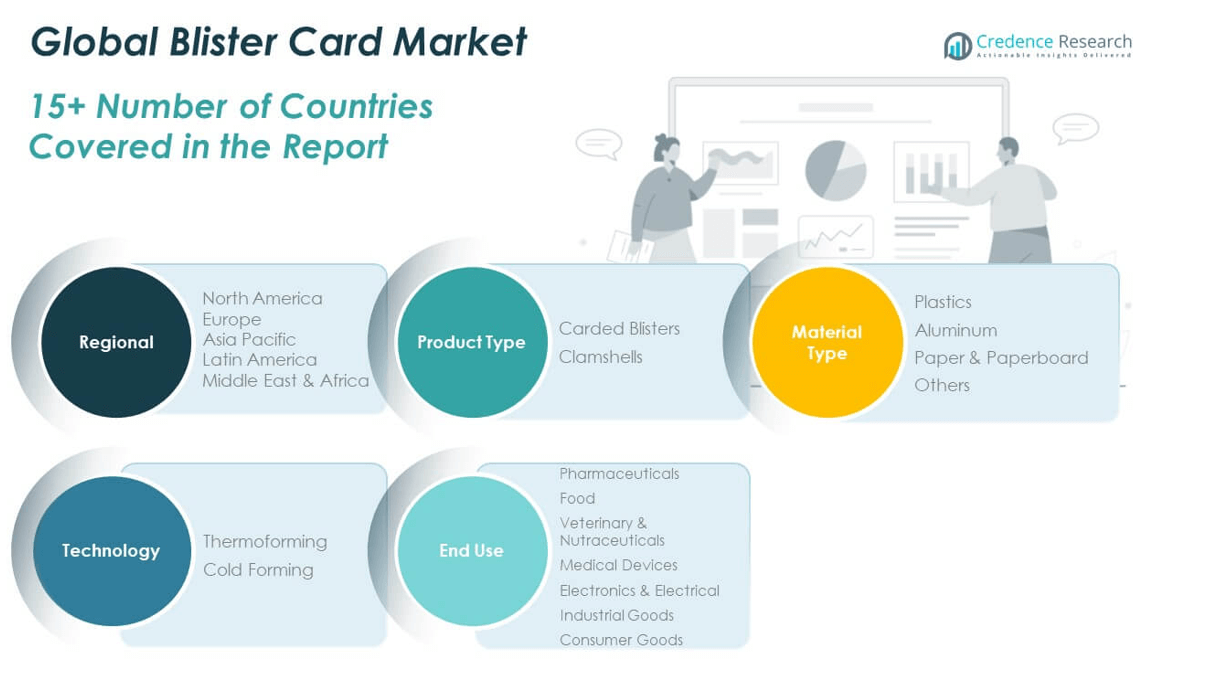
The Global Blister Card Market is segmented by product type, material type, technology, and end use, each contributing distinctly to its growth.
By product type, carded blisters dominate due to their cost-effectiveness, versatility, and wide adoption across pharmaceuticals and retail packaging. Clamshells follow, offering enhanced product visibility and protection, particularly in electronics and consumer goods.
- For example, Pfizer’s Advil and Bayer’s Aleveutilize carded blister packs for over-the-counter pharmaceuticals. These packs combine a thermoformed plastic cavity with a printed paperboard backing, offering cost-effective, tamper-evident, and unit-dose packaging.
By material type, plastics lead the market for their durability, formability, and clarity, supporting both thermoforming and cold forming applications. Paper & paperboard gain traction as eco-friendly alternatives, aligning with sustainable packaging goals. Aluminum remains critical for barrier protection in pharmaceutical applications, while other materials such as biodegradable polymers are emerging in niche segments.
- For instance, Sanofi’s partnership with PulPacdeveloped dry-molded fiber (paperboard) blisters for over-the-counter medications, enabling recyclability in standard paper streams and reducing plastic use. These are FSC-certified and designed for easy consumer recycling.
By Technology, thermoforming represents the dominant technology due to its cost efficiency and suitability for high-volume production. Cold forming finds strong use in pharmaceutical packaging where high barrier properties are essential.
By end use, pharmaceuticals account for the largest market share, driven by rising demand for unit-dose packaging. Food, veterinary, and nutraceutical sectors adopt blister cards for portion control and safety. Medical devices and electronics use blister formats for tamper resistance and product protection. Industrial and consumer goods sectors rely on blister cards for retail appeal and theft deterrence.
Segmentation:
By Product Type
- Carded Blisters
- Clamshells
By Material Type
- Plastics
- Aluminum
- Paper & Paperboard
- Others
By Technology
- Thermoforming
- Cold Forming
By End Use
- Pharmaceuticals
- Food
- Veterinary & Nutraceuticals
- Medical Devices
- Electronics & Electrical
- Industrial Goods
- Consumer Goods
By Region
- North America
- U.S.
- Canada
- Mexico
- Europe
- Germany
- France
- U.K.
- Italy
- Spain
- Rest of Europe
- Asia Pacific
- China
- Japan
- India
- South Korea
- South-east Asia
- Rest of Asia Pacific
- Latin America
- Brazil
- Argentina
- Rest of Latin America
- Middle East & Africa
- GCC Countries
- South Africa
- Rest of the Middle East and Africa
Regional Analysis:
North America
The North America Blister Card Market size was valued at USD 1,513.27 million in 2018 to USD 2,361.65 million in 2024 and is anticipated to reach USD 4,440.79 million by 2032, at a CAGR of 7.7% during the forecast period. North America accounts for 18.0% of the Global Blister Card Market, driven by a strong pharmaceutical industry and advanced healthcare infrastructure. The region enforces stringent packaging regulations that prioritize tamper-evident and unit-dose solutions, favoring blister card adoption. It benefits from widespread use of over-the-counter drugs and consumer healthcare products packaged in single-use formats. Retailers and pharmaceutical companies increasingly demand sustainable, compliant, and visually effective packaging, which supports innovation in recyclable blister cards. The presence of leading packaging manufacturers and robust investment in automation technologies also enhance production efficiency.
Europe
The Europe Blister Card Market size was valued at USD 1,000.63 million in 2018 to USD 1,503.52 million in 2024 and is anticipated to reach USD 2,574.92 million by 2032, at a CAGR of 6.4% during the forecast period. Europe holds a 11.5% share of the Global Blister Card Market, led by high adoption of blister formats in oral solid dosage packaging. The European Union promotes strict environmental and pharmaceutical packaging regulations, pushing companies to adopt recyclable materials and eco-friendly production practices. It supports growth through high consumer awareness and increasing demand for safe, traceable, and visually appealing packaging. Germany, France, and the UK remain key markets, with strong pharmaceutical exports and innovation in sustainable packaging formats. The trend toward biodegradable and mono-material blister card solutions is gaining momentum across the region.
Asia Pacific
The Asia Pacific Blister Card Market size was valued at USD 2,105.98 million in 2018 to USD 3,467.00 million in 2024 and is anticipated to reach USD 6,908.68 million by 2032, at a CAGR of 8.4% during the forecast period. Asia Pacific commands the largest share—over 38.0%—of the Global Blister Card Market. High pharmaceutical output in India and China, expanding healthcare access, and rising consumption of consumer goods fuel regional growth. It also benefits from low-cost manufacturing and a growing middle-class population seeking packaged retail and personal care products. Local manufacturers are increasing capacity and export capabilities, supported by government initiatives and private investment. Rapid urbanization and e-commerce expansion further reinforce demand for visually secure and retail-ready blister cards.
Latin America
The Latin America Blister Card Market size was valued at USD 234.43 million in 2018 to USD 366.78 million in 2024 and is anticipated to reach USD 606.22 million by 2032, at a CAGR of 5.9% during the forecast period. Latin America contributes around 4.5% to the Global Blister Card Market, with growing pharmaceutical imports and retail modernization shaping market dynamics. Brazil and Mexico lead regional consumption due to strong domestic markets and expanding healthcare services. It supports increased adoption of blister cards in over-the-counter medications, supplements, and personal care products. Retail chains and pharmacies are driving demand for unit-dose and tamper-evident formats. Investment in packaging automation and regulatory alignment with international standards are supporting long-term growth.
Middle East
The Middle East Blister Card Market size was valued at USD 133.58 million in 2018 to USD 192.35 million in 2024 and is anticipated to reach USD 300.03 million by 2032, at a CAGR of 5.1% during the forecast period. The region represents 2.9% of the Global Blister Card Market, supported by expanding pharmaceutical imports and health infrastructure projects. Countries such as the UAE and Saudi Arabia are investing in local pharmaceutical manufacturing, increasing the need for advanced packaging formats. It benefits from rising consumer interest in packaged healthcare and personal care products. The growing number of retail outlets and pharmacy chains contributes to wider blister card adoption. Regional players are partnering with international firms to enhance packaging quality and comply with evolving standards.
Africa
The Africa Blister Card Market size was valued at USD 82.55 million in 2018 to USD 143.85 million in 2024 and is anticipated to reach USD 217.02 million by 2032, at a CAGR of 4.7% during the forecast period. Africa holds a 1.7% share of the Global Blister Card Market, with growth fueled by gradual improvements in healthcare systems and pharmaceutical accessibility. Governments and NGOs are promoting generic drug availability, which often requires blister-based packaging. It also sees demand rising in urban centers for affordable, unit-dose consumer products. Infrastructure limitations and high material costs challenge regional production, leading to reliance on imports. However, growing investment in local manufacturing and distribution channels is expected to increase regional self-sufficiency over time.
Key Player Analysis:
- Klöckner Pentaplast Group
- Amcor plc
- Constantia Flexibles GmbH
- Honeywell International
- Sonoco Products Company
- Tekni-Plex, Inc.
- Uflex Ltd
- Rohrer Corporation
- R-Pharm Germany GmbH
Competitive Analysis:
The Global Blister Card Market remains highly competitive, with key players focusing on material innovation, sustainable packaging, and regional expansion to strengthen market presence. Major companies such as Amcor plc, Constantia Flexibles, Sonoco Products Company, Klöckner Pentaplast, and WestRock Company lead in developing recyclable and barrier-enhanced blister card formats. It drives competition through advancements in digital printing, high-speed thermoforming, and integration of smart packaging elements. Firms are investing in eco-friendly substrates and lightweight designs to align with evolving regulatory requirements and consumer preferences. Strategic collaborations with pharmaceutical and FMCG brands help manufacturers secure long-term contracts and increase production scalability. Regional players are entering the market with cost-effective solutions tailored to local demands, intensifying competition in emerging economies. The emphasis on sustainability, customization, and operational efficiency continues to shape competitive strategies across all tiers of the market.
Recent Developments:
- In May 2025, Constantia Flexibles introduced REGULA CIRC, a new cold‑form foil designed for sustainable pharmaceutical blister packaging. This innovative material replaces PVC with polyethylene and uses higher aluminum content to support better recycling and circular use of materials. It maintains full barrier protection for medications while enhancing material recovery and offering compliance with anticipated environmental standards
- In March 2025, Constantia Flexibles successfully completed the acquisition of a majority stake in Aluflexpack AG, a leading European producer of custom flexible packaging. This partnership strengthens Constantia’s leadership in product innovation and sustainability, expanding its ability to serve the food and pharmaceutical sectors with a broader range of solutions.
Market Concentration & Characteristics:
The Global Blister Card Market exhibits moderate to high market concentration, with a few multinational players accounting for a significant share of global revenues. It is characterized by the presence of vertically integrated firms with strong capabilities in raw material sourcing, printing technologies, and thermoforming operations. The market favors manufacturers that offer sustainable, customizable, and regulatory-compliant packaging solutions across healthcare, consumer goods, and electronics sectors. Product differentiation, material innovation, and regional adaptability remain key competitive attributes. Entry barriers include capital-intensive production setups, strict quality certifications, and long-term supply contracts. While global players dominate mature markets, regional firms are gaining ground in Asia Pacific, Latin America, and Africa by offering cost-effective, localized solutions.
Report Coverage:
The research report offers an in-depth analysis based on product type, material type, technology, and end use. It details leading market players, providing an overview of their business, product offerings, investments, revenue streams, and key applications. Additionally, the report includes insights into the competitive environment, SWOT analysis, current market trends, as well as the primary drivers and constraints. Furthermore, it discusses various factors that have driven market expansion in recent years. The report also explores market dynamics, regulatory scenarios, and technological advancements that are shaping the industry. It assesses the impact of external factors and global economic changes on market growth. Lastly, it provides strategic recommendations for new entrants and established companies to navigate the complexities of the market.
Future Outlook:
- Demand for eco-friendly blister card materials will increase as sustainability regulations tighten globally.
- Pharmaceutical sector expansion will remain a key driver, especially in emerging healthcare markets.
- Technological integration such as QR codes and RFID tags will enhance functionality and traceability.
- E-commerce growth will influence packaging design, emphasizing durability and compact formats.
- Asia Pacific will maintain its lead due to manufacturing scale, rising consumption, and regional investment.
- Short-run digital printing will gain traction, supporting personalized and seasonal packaging campaigns.
- Automation in packaging lines will improve production efficiency and reduce operational costs.
- Use of mono-material blister cards will grow to meet recyclability and material separation mandates.
- Strategic partnerships between converters and brand owners will strengthen long-term market presence.
- Investment in R&D will focus on biodegradable films and advanced barrier coatings to meet future packaging needs.
Request a Free Sample
Fill in your details and we'll send you a free sample report.
- Sample data tables & charts
- Research methodology
Need a Custom Version of This Report?
Tailor the scope, geography, or segments to your exact requirements.
- Custom geography or segment scope
- Direct access to our analyst team
Frequently Asked Questions
What is the current size of the Global Blister Card Market?
What are the key segments within the Global Blister Card Market?
What are some challenges faced by the Global Blister Card Market?
Who are the major players in the Global Blister Card Market?
Table of Content
Chapter 1. Report Introduction
- 1.1 Report Description & Purpose
- 1.1.1 Report Title & Market Definition
- 1.1.2 Unique Selling Propositions (USP) & Key Differentiators
- 1.1.3 Value Proposition for Stakeholders
- 1.2 Research Objectives
- 1.2.1 Market Sizing Objectives (Volume & Revenue)
- 1.2.2 Segmentation Objectives
- 1.2.3 Competitive Intelligence Objectives
- 1.2.4 Forecast & Scenario Objectives
- 1.3 Report Scope
- 1.3.1 Blister Card Scope – Types & Subtypes Covered
- 1.3.2 Geographic Scope – Regions & Countries Covered
- 1.3.3 Historical Period, Base Year & Forecast Period (2024; forecast to 2032)
- 1.3.4 Inclusions & Exclusions
- 1.4 HS Code & Classification Framework
- 1.5 Currency, Units & Pricing Basis
- 1.6 Target Stakeholders
- 1.7 Limitations & Assumptions
Chapter 2. Executive Summary
- 2.1 Global Blister Card Market Snapshot
- 2.1.1 Market Size – Historical (2024) & Forecast (2024-2032) (2024: USD 8,035.14 million → 2032: USD 15,047.65 million)
- 2.1.2 Volume & Revenue – Global Totals
- 2.1.3 Key Market Highlights – Top Five Facts
- 2.2 Blister Card Market Segmentation Snapshot
- 2.2.1 Market Split by Region – 2024 vs. 2032
- 2.3 Competitive Snapshot
- 2.3.1 Top 10 Players by Revenue Share – 2024
- 2.3.2 Top 10 Players by Volume Share – 2024
- 2.3.3 Recent Strategic Developments (18-Month Summary)
- 2.4 Key Investment Highlights & Strategic Conclusions
Chapter 3. Blister Card Market Dynamics & Industry Analysis
- 3.1 Market Overview & Context
- 3.1.1 Blister Card Market Position in the Broader Automotive Value Chain
- 3.1.2 OEM vs. Replacement Market Dynamics
- 3.1.3 Market Maturity & Development Stage by Region
- 3.2 Blister Card Market Drivers
- 3.3 Blister Card Market Restraints & Challenges
- 3.4 Blister Card Market Opportunities
- 3.5 Porter's Five Forces Analysis
- 3.5.1 Threat of New Entrants
- 3.5.2 Bargaining Power of Suppliers
- 3.5.3 Bargaining Power of Buyers
- 3.5.4 Threat of Substitutes
- 3.5.5 Competitive Rivalry – Intensity Assessment
- 3.6 Blister Card Value Chain Analysis
- 3.6.1 Upstream – Raw Material/Input Suppliers
- 3.6.1.1 Raw Material/Input 1
- 3.6.1.2 Raw Material/Input 2
- 3.6.1.3 Raw Material/Input 3
- 3.6.2 Midstream – Production/Manufacturing/Service Delivery
- 3.6.2.1 Production/Process Overview
- 3.6.2.2 Key Facility Locations & Capacity by Manufacturer
- 3.6.3 Downstream – Distribution & End Consumer
- 3.6.3.1 Primary Channel – B2B/OEM
- 3.6.3.2 Secondary Channels – Dealer, Retail, Online, Direct
- 3.6.4 Value Chain Profitability Analysis
- 3.6.1 Upstream – Raw Material/Input Suppliers
- 3.7 PESTEL Analysis
- 3.7.1 Political Factors
- 3.7.2 Economic Factors
- 3.7.3 Social Factors
- 3.7.4 Technological Factors
- 3.7.5 Environmental Factors
- 3.7.6 Legal Factors
- 3.8 Blister Card Supply Chain Analysis
- 3.8.1 Raw Material/Input Supply Risk Assessment
- 3.8.2 Manufacturing Concentration Risk (Geographic Exposure)
- 3.8.3 Trade Disruption Impact Analysis
- 3.9 Regulatory & Policy Landscape
Note: The regulatory and policy landscape section covers regulations based on their applicability to the market, Blister Card category, geography, and scope of the study. Only regulatory frameworks with a material impact on operations, compliance, trade, sustainability, or market access are analyzed in detail.
Chapter 4. Key Investment Pockets & Opportunity Analysis
- 4.1 Blister Card Market Attractiveness Analysis
- 4.1.1 By Region – Investment Attractiveness Matrix (Volume × CAGR)
- 4.2 Absolute Revenue Growth Opportunity
- 4.2.1 By Region – Absolute USD Growth Through 2032
- 4.3 Incremental Volume Opportunity
- 4.3.1 By Region – Incremental Volume Through 2032
- 4.3.2 Segment – Incremental Volume
- 4.4 Emerging Submarket Opportunity Deep Dive (Subject to Applicability)
- 4.5 Emerging Market Opportunity Scorecards
- 4.5.1 United States
- 4.5.2 Europe
- 4.5.3 Asia
- 4.5.4 Middle East & Africa
Note: Emerging Market Opportunity Scorecards will be included based on relevance and strategic importance. Regions listed are indicative and may vary depending on data availability and market dynamics.
Chapter 5. Blister Card Import-Export Analysis & Trade Flows
- 5.1 Global Trade Overview
- 5.1.1 Global Export Value by Country (2024)
- 5.1.2 Global Export Volume by Country (2024)
- 5.1.3 Global Import Value by Country (2024)
- 5.1.4 Global Import Volume by Country (2024)
- 5.1.5 Net Trade Balance by Country (2024)
- 5.2 Export Analysis – Segment
- 5.2.1 Type 1 (HS Code)
- 5.2.2 Type 2 (HS Code)
- 5.2.3 Type 3 (HS Code)
- 5.2.4 Type 4 (HS Code)
- 5.2.5 Type 5 (HS Code)
- 5.3 Import Analysis – Segment
- 5.3.1 Type 1 (HS Code)
- 5.3.2 Type 2 (HS Code)
- 5.3.3 Type 3 (HS Code)
- 5.3.4 Type 4 (HS Code)
- 5.3.5 Type 5 (HS Code)
- 5.4 Average Unit Trade Prices
- 5.4.1 Average Export Price – Segment & Country
- 5.4.2 Average Import Price – Segment & Source Country
- 5.4.3 Price Trends (2024)
- 5.5 Key Trade Route Analysis
- 5.5.1 Trade Route 1
- 5.5.2 Trade Route 2
- 5.5.3 Trade Route 3
- 5.5.4 Trade Route 4
- 5.5.5 Trade Route 5
- 5.6 Trade Policy Impact Assessment
- 5.6.1 US Anti-Dumping & Section 301 Tariffs
- 5.6.2 EU Customs Union Impact
- 5.6.3 Major Free Trade Agreements
- 5.6.4 USMCA Rules of Origin
Note: Trade policy analysis will be included only where relevant to the Blister Card market.
Chapter 6. Competitive Landscape & Company Benchmarking
- 6.1 Blister Card Market Concentration & Structure
- 6.1.1 Herfindahl-Hirschman Index (HHI) – vs. 2024
- 6.1.2 Tier 1, Tier 2 & Tier 3 Market Structure
- 6.1.3 Global, Regional & Local Player Dynamics
- 6.2 Blister Card Market Share Analysis – 2024
- 6.2.1 Global Revenue Share by Company
- 6.2.2 Global Volume Share by Company
- 6.2.3 Regional Revenue Share
- 6.2.4 Market Share Evolution ( vs. 2024)
- 6.2.5 OEM Segment Share by Company
- 6.2.6 Replacement Segment Share by Company
- 6.3 Production/Delivery Capacity & Facility Analysis
- 6.3.1 Global Installed Capacity
- 6.3.2 Capacity Utilization Rates
- 6.3.3 Production/Output Volume
- 6.3.4 Facility Locations & Capacity Map
- 6.3.5 Planned Capacity Additions
- 6.4 Blister Card Competitive Benchmarking Matrix
- 6.4.1 Revenue, Volume, CAGR & Profitability Comparison
- 6.4.2 Channel Revenue Mix
- 6.4.3 Geographic Revenue Exposure
- 6.4.4 R&D Intensity
- 6.4.5 Sustainability Maturity
- 6.5 Strategic Developments in Blister Card (Last 24 Months)
- 6.5.1 Mergers, Acquisitions & Divestments
- 6.5.2 New Blister Card Launches
- 6.5.3 Facility Expansions
- 6.5.4 Strategic Alliances, Joint Ventures & Partnerships
- 6.5.5 Distribution Expansion & Market Entry
- 6.5.6 Sustainability & ESG Initiatives
- 6.6 Competitive Strategy Mapping
- 6.6.1 Leader, Challenger, Follower & Niche Classification
- 6.6.2 Pricing Strategy Comparison
- 6.6.3 Channel Strategy Matrix
Note: Strategic developments are included based on their materiality and the availability of reliable information.
Chapter 7. Global Blister Card Market – By Distribution Channel
- 7.1 Segment Overview
- 7.1.1 Volume & Revenue Split by Channel (2024 & 2032)
- 7.1.2 Channel Mix Evolution (2024-2032)
Chapter 8. Regional Market Analysis – Global Overview
- 8.1 Global Regional Overview
- 8.1.1 Regional Volume Share
- 8.1.2 Regional Revenue Share
- 8.1.3 Regional Volume by Region
- 8.1.4 Regional Revenue by Region
- 8.1.5 Regional Forecast Through 2032
- 8.2 Cross-Regional Segment Analysis
- 8.2.1 By Distribution Channel
- 8.2.2 By Brand/Price Tier
Chapter 9. North America Blister Card Market
- 9.1 United States
- 9.2 Canada
- 9.3 Mexico
Chapter 10. Europe Blister Card Market
- 10.1 Germany
- 10.2 France
- 10.3 Italy
- 10.4 United Kingdom
- 10.5 Spain
- 10.6 Poland
- 10.7 Russia
- 10.8 Netherlands
- 10.9 Belgium
- 10.10 Sweden
- 10.11 Denmark
- 10.12 Norway
- 10.13 Rest of Europe
Chapter 11. Asia Pacific Blister Card Market
- 11.1 China
- 11.2 India
- 11.3 Japan
- 11.4 South Korea
- 11.5 Thailand
- 11.6 Indonesia
- 11.7 Vietnam
- 11.8 Malaysia
- 11.9 Australia
- 11.10 Rest of Asia Pacific
Chapter 12. Latin America Blister Card Market
- 12.1 Brazil
- 12.2 Argentina
- 12.3 Colombia
- 12.4 Chile
- 12.5 Rest of Latin America
Chapter 13. Middle East Blister Card Market
- 13.1 Saudi Arabia
- 13.2 United Arab Emirates
- 13.3 Turkey
- 13.4 Israel
- 13.5 Iran
- 13.6 Rest of the Middle East
Chapter 14. Africa Blister Card Market
- 14.1 South Africa
- 14.2 Egypt
- 14.3 Nigeria
- 14.4 Morocco
- 14.5 Rest of Africa
Chapter 15. Blister Card Company Profiles
- 15.1 [Company 01]
- 15.1.1 Company Overview
- 15.1.2 Key Management Personnel
- 15.1.3 Products & Services Portfolio
- 15.1.4 Financial Performance
- 15.1.5 Key Market Focus & Geographic Presence
- 15.1.6 Recent Developments & Strategic Initiatives
Note: The company profile list is preliminary and may change based on research findings, market developments, data availability, and client requirements.
Chapter 16. Appendices
- Appendix A – List of Abbreviations & Acronyms
- Appendix B – Industry Classification Code Reference – Full Series
- Appendix C – Production & Capacity Data Tables
- Appendix D – End-Use & Demand Base Tables
- Appendix E – Consumption & Replacement Rate Assumptions
- Appendix F – ASP Reference Tables
- Appendix G – Manufacturing & Facility Database
- Appendix H – Import-Export Data Tables
- Appendix I – Regulatory Summary Tables
- Appendix J – Primary Research Participant List (Anonymized)
- Appendix K – Primary Research Questionnaire Framework
- Appendix L – Data Sources & Bibliography
- Appendix M – Market Size Divergence & Source Comparison
Chapter 17. Research Methodology
- 17.1 Research Framework & Philosophy
- 17.2 Secondary Research – Sources, Hierarchy & Data Extraction
- 17.3 Data Modeling – Bottom-Up & Top-Down Market Sizing
- 17.4 Primary Research – Stakeholder Framework, LOI & Sample Sizes
- 17.5 Forecast Methodology – Regression, Scenario & Sensitivity Analysis
- 17.6 Quality Control – Four-Layer Validation Framework
- 17.7 Limitations & Standard Assumptions
- 17.8 Disclaimer
