
| REPORT ATTRIBUTE | DETAILS |
|---|---|
| Historical Period | 2020-2023 |
| Base Year | 2024 |
| Forecast Period | 2025-2032 |
| Bomb Disposal Suit Market Size 2024 | USD 1,403.34 million |
| Bomb Disposal Suit Market, CAGR | 4.79% |
| Bomb Disposal Suit Market Size 2032 | USD 2,095.70 million |
Market Overview:
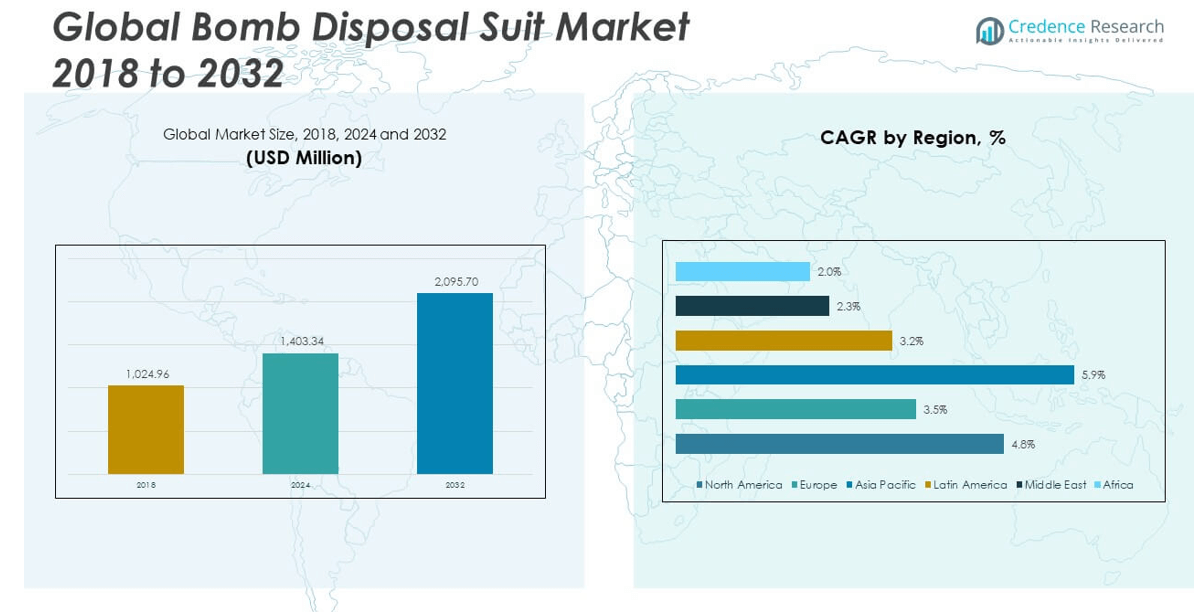
The Global Bomb Disposal Suit Market size was valued at USD 1,024.96 million in 2018 to USD 1,403.34 million in 2024 and is anticipated to reach USD 2,095.70 million by 2032, at a CAGR of 4.79% during the forecast period.
The growth of the bomb disposal suit market is strongly influenced by multiple interrelated drivers. A primary factor is the escalating threat of terrorism, insurgencies, and internal conflicts, which has prompted national governments and law enforcement agencies to enhance their counter-terrorism capabilities. The increasing frequency of bomb threats and IED incidents worldwide has led to a surge in demand for high-performance protective gear, particularly among military and paramilitary units. Governments are allocating higher budgets toward defense and public safety infrastructure, leading to bulk procurement of advanced bomb suits. Additionally, ongoing advancements in materials science and wearable technologies have significantly improved the safety, mobility, and comfort of modern bomb suits. Moreover, evolving defense procurement standards and regulatory mandates for personnel safety are compelling agencies to upgrade legacy protective systems with advanced solutions, thereby sustaining market momentum.
Regionally, North America leads the global bomb disposal suit market, largely due to the United States’ high defense spending and advanced homeland security initiatives. The presence of leading manufacturers, government support for R&D, and continuous training programs for EOD units in the region are contributing to the strong demand. Europe also holds a substantial share, driven by increasing investment in security modernization across countries like the UK, Germany, and France, where anti-terrorism protocols and NATO compliance standards continue to elevate the demand for cutting-edge protective gear. In contrast, the Asia-Pacific region is witnessing the fastest growth in this market, fueled by rising geopolitical tensions, border disputes, and internal security challenges. Meanwhile, the Middle East and Africa, along with Latin America, are emerging as potential growth regions, with increased focus on counter-terrorism efforts, law enforcement modernization, and foreign military assistance programs creating fresh opportunities for bomb suit deployments.
Market Insights:
- The Global Bomb Disposal Suit Market is projected to grow from USD 1,403.34 million in 2024 to USD 2,095.70 million by 2032, at a CAGR of 4.79%.
- Escalating global terrorism and frequent IED incidents are significantly increasing demand for advanced bomb disposal suits.
- Higher defense and homeland security budgets in the U.S., China, India, and EU nations are driving large-scale procurement.
- Lightweight materials, wearable tech, and modular suit designs are improving safety, mobility, and operational efficiency.
- NATO and IMAS regulations are pushing agencies toward standardized, certified suits, influencing vendor competition.
- High production costs and limited budgets in developing countries pose a challenge to widespread suit adoption.
- North America holds over 37% of the market share, while Asia-Pacific is the fastest-growing region due to rising security threats and modernization efforts.
Market Drivers:
Increasing Global Threat of Terrorism and Improvised Explosive Devices (IEDs) Is Escalating Demand for Protective Gear
The rising frequency of global terrorist activities and the widespread use of improvised explosive devices (IEDs) have intensified the demand for advanced bomb disposal suits. Military and law enforcement agencies are under pressure to safeguard personnel involved in explosive ordnance disposal (EOD) operations. The Global Bomb Disposal Suit Market is being propelled by this ongoing security threat, prompting governments to upgrade protective equipment and invest in sophisticated EOD technologies. Many urban areas face elevated bomb threat levels, requiring rapid deployment of EOD teams equipped with reliable suits. High-profile incidents in conflict-prone zones are increasing public and political pressure to enhance counter-IED capabilities. The market is responding with the development of advanced suits that offer superior blast protection and mobility in high-risk environments.
- For example, the 3DX-EOD Bomb Disposal Suit, launched by 3DX-Ray Ltd., is certified to NATO STANAG 2920 standards and is currently deployed by armed forces in over 30 countries.
Rising Defense and Homeland Security Budgets Across Nations Are Driving Procurement
Government spending on national security continues to rise across developed and developing economies, directly impacting demand for bomb disposal suits. Countries are scaling up defense budgets to address both conventional and unconventional threats, including domestic terrorism. In the United States, China, India, and several EU countries, homeland security departments have initiated modernization programs for EOD units. This budgetary expansion is supporting large-scale procurement of next-generation suits designed to meet international protection standards. It is also encouraging strategic partnerships between defense ministries and private manufacturers to produce locally adapted solutions. These government-backed initiatives are ensuring steady market growth and fostering technological upgrades across the supply chain.
- The US Army, for instance, awarded Qinetiq an $84 million contract to deliver 700 Next Generation Advanced Bomb Suits (NGABS) over five years. These suits offer 360-degree ballistic protection, significant weight reduction compared to legacy systems, and a modular sensor suite with low-light and thermal imaging capabilities.
Technological Innovation in Protective Materials and Suit Design Enhances Operational Efficiency
Rapid advancements in materials science and wearable technologies are revolutionizing the design and functionality of bomb disposal suits. The market is shifting toward lightweight, ergonomically designed suits that enhance flexibility without compromising safety. New materials such as aramid fibers, advanced ceramics, and blast-resistant composites are improving the survivability of EOD personnel in high-pressure scenarios. Suit designs now incorporate modular systems, cooling mechanisms, and integrated communication tools, improving situational awareness and reducing operator fatigue. These innovations are aligning with the operational needs of modern militaries, which prioritize both protection and maneuverability. The integration of real-time data systems and sensory feedback into suit architecture is becoming a standard expectation in procurement programs.
Regulatory Mandates and Standardization Protocols Are Reinforcing Suit Adoption
Global security agencies are under increasing pressure to comply with international safety regulations, driving the adoption of standardized bomb disposal suits. Regulatory bodies such as NATO and the International Mine Action Standards (IMAS) have introduced rigorous guidelines for EOD equipment performance. Compliance with these protocols requires consistent upgrades and testing, incentivizing organizations to adopt certified suits. It is creating a favorable environment for vendors offering compliant and tested products. These mandates are particularly influential in procurement decisions across government defense agencies and peacekeeping forces. Regulatory adherence is not only ensuring safety but also supporting structured competition among manufacturers committed to quality assurance.
Market Trends:
Integration of Smart Technologies and Real-Time Monitoring Systems Is Reshaping Product Capabilities
Manufacturers are increasingly incorporating smart technologies into bomb disposal suits, enabling real-time monitoring of the wearer’s vital signs and environmental conditions. Embedded sensors track metrics such as heart rate, temperature, and external pressure, enhancing situational awareness and decision-making in high-risk operations. These systems can transmit data to command centers, allowing supervisors to monitor operator health and performance. The Global Bomb Disposal Suit Market is experiencing a shift from passive protective gear to active, intelligent systems. This trend is improving safety protocols and mission outcomes for military and police bomb squads. Manufacturers are leveraging IoT and wireless communication platforms to meet the growing need for data integration and operator feedback loops.
- For example, NP Aerospace’s 4030 ELITE Bomb Disposal Suitexemplifies the integration of advanced smart technologies. The suit features a modular sensor suite capable of real-time monitoring of vital signs and environmental conditions.
Demand for Modular and Mission-Customizable Suit Configurations Is Rising
End-users are seeking bomb disposal suits with modular designs that allow for mission-specific customization. This trend reflects the operational requirement to adapt suits based on threat levels, mobility needs, and environmental factors. Interchangeable components such as visors, chest plates, and limb protectors are becoming standard across premium product lines. The market is witnessing growing interest in suits that can be quickly modified or upgraded without complete replacement. It is driving innovation in flexible armor systems and detachable modules that maintain performance while reducing logistical burdens. The Global Bomb Disposal Suit Market is aligning product development with user-centric, adaptive design philosophies.
- For example, Med-Eng’s EOD 9 and EOD 10 Bomb Suitsare designed with direct input from bomb disposal technicians, offering modular protection and operational flexibility. The EOD 9 platform allows for field configuration by EOD or IEDD technicians, including the addition or removal of components such as visors, chest plates, and limb protectors based on mission-specific requirements or the suspected presence of CBRN agents.
Adoption of Lightweight, Ergonomic Designs to Improve Operator Agility and Comfort
The traditional perception of bomb suits as bulky and restrictive is evolving with the introduction of lightweight, ergonomic models. Military and law enforcement agencies are emphasizing operator agility, especially in urban and tactical environments where mobility is crucial. Manufacturers are responding by using advanced materials that reduce suit weight without compromising ballistic protection. Improved ventilation, joint articulation, and adjustable fitting mechanisms are now prioritized in design standards. The market is gradually moving toward user-friendly gear that enhances comfort during extended missions. The Global Bomb Disposal Suit Market is benefiting from this transition toward enhanced wearability and operator-centered engineering.
Focus on Sustainability and Eco-Friendly Manufacturing Practices Is Gaining Traction
Sustainability is emerging as a notable trend in the defense textiles sector, influencing how bomb disposal suits are developed and produced. Manufacturers are investing in recyclable materials, low-emission manufacturing processes, and energy-efficient operations. Demand for environmentally responsible procurement is increasing among defense agencies with green policy mandates. It is pushing suppliers to incorporate sustainable practices while meeting rigorous safety standards. The Global Bomb Disposal Suit Market is beginning to reflect broader ESG trends within the defense industry. Brands promoting sustainable innovations are likely to gain competitive advantage in future government tenders and international partnerships.
Market Challenges Analysis:
High Manufacturing Costs and Budget Constraints Are Limiting Large-Scale Procurement
Bomb disposal suits require advanced ballistic materials, rigorous testing, and specialized engineering, which significantly raise production costs. These suits must comply with stringent international safety standards, leading to high expenses in both design and certification phases. Many developing countries face budgetary constraints that restrict widespread adoption of high-end protective gear. Even in developed nations, defense and law enforcement agencies often prioritize weapon systems and surveillance technologies over EOD suits. The Global Bomb Disposal Suit Market must address these cost challenges to expand its footprint across lower-income and resource-constrained regions. Price sensitivity in government tenders often favors lower-cost alternatives, even if they offer limited features or reduced protection levels.
Limited Product Innovation Cycles and Lengthy Procurement Processes Are Hindering Market Agility
Innovation in bomb disposal suits tends to progress slowly due to complex design requirements and extended approval timelines. New technologies must undergo exhaustive field testing and validation before receiving operational clearance, which delays market entry. Lengthy procurement cycles, bureaucratic procedures, and strict compliance protocols further restrict the pace of product adoption. The market often struggles to align with the rapid evolution of threats, such as novel IEDs or improvised explosive technologies. The Global Bomb Disposal Suit Market needs to overcome institutional inertia and accelerate collaboration between military R&D agencies and private manufacturers. Without improved agility in development and procurement, the industry risks falling behind emerging security threats.
Market Opportunities:
Expansion of Urban Policing and Counter-Terrorism Units Creates New Avenues for Deployment
The rise in urban security threats and asymmetric warfare has led to the formation of specialized bomb disposal and counter-terrorism units within city police departments. These units require high-performance suits tailored to dense, unpredictable environments. The Global Bomb Disposal Suit Market can capitalize on this demand by offering compact, agile, and mission-adaptable suits. Governments are allocating separate budgets for urban safety programs, creating a parallel procurement stream beyond traditional military demand. This shift opens opportunities for companies to develop city-specific EOD gear optimized for rapid deployment and high mobility. Vendors that address these urban operational needs will gain a competitive edge in regional and municipal tenders.
Defense Modernization and Localization Initiatives in Emerging Economies Boost Procurement Potential
Emerging economies are actively restructuring their defense procurement policies to prioritize self-reliance and localized production. Countries across Asia-Pacific, Latin America, and the Middle East are establishing joint ventures and licensing agreements to build bomb suits domestically. The Global Bomb Disposal Suit Market is well positioned to benefit from these shifts by engaging in technology transfers and regional collaborations. Manufacturers that offer scalable production and customization for local threat scenarios can secure long-term supply contracts. Growing political emphasis on national defense capabilities will sustain consistent procurement over the coming years. These developments create room for new entrants and partnerships in untapped and underpenetrated markets.
Market Segmentation Analysis:
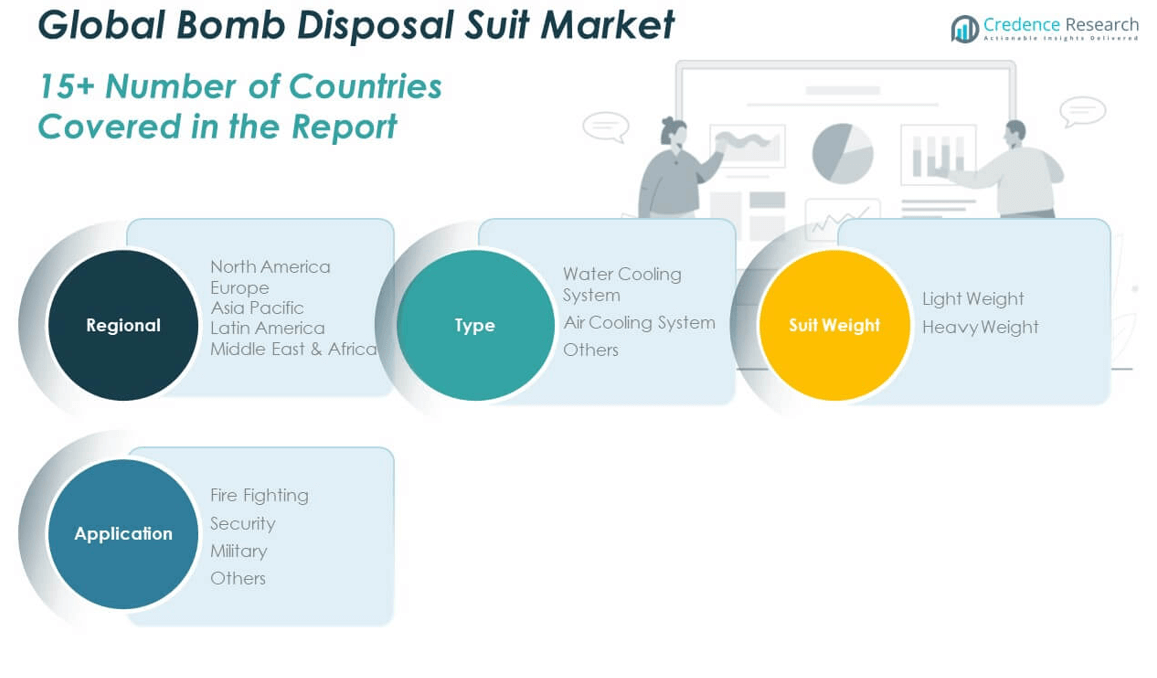
The Global Bomb Disposal Suit Market is segmented by type, suit weight, and application, reflecting diverse operational needs and user preferences.
By type, the market includes water cooling systems, air cooling systems, and others. Water cooling systems lead in high-temperature environments where thermal stress can impair performance, while air cooling systems are preferred for their portability and ease of integration in moderate climates. The “others” segment includes suits without active cooling, used in cost-sensitive or lower-risk scenarios.
- For example, the 3DX-EOD Bomb Disposal Suit is available in a standard configuration without any active cooling system. This variant is selected by agencies in regions with moderate climates or for budget-sensitive procurement, such as certain municipal police bomb squads, where the risk of thermal stress is lower and cost efficiency is prioritized.
By suit weight, the market divides into lightweight and heavyweight categories. Lightweight bomb disposal suits are gaining traction due to their superior mobility and reduced fatigue during extended missions. Heavyweight suits continue to dominate in high-threat zones where maximum blast protection is critical, especially in military and tactical operations.
By application, the Global Bomb Disposal Suit Market serves firefighting, security, military, and other segments. Military remains the largest application segment due to continuous EOD deployments and procurement by defense agencies. Security agencies and bomb squads contribute steadily to market demand, while firefighting applications are more specialized, involving explosive hazard mitigation in industrial settings. The market reflects the evolving need for protective solutions tailored to threat intensity and mission type.
- For example, the Med-Eng EOD 10 suit has been adopted by specialized firefighting units in the petrochemical industry, such as those responding to explosive hazards in oil refineries. Its flame-retardant outer shell and compatibility with breathing apparatus make it suitable for explosive hazard mitigation in industrial settings.
Segmentation:
By Type:
- Water Cooling System
- Air Cooling System
- Others
By Suit Weight:
- Light Weight
- Heavy Weight
By Application:
- Fire Fighting
- Security
- Military
- Others
By Region:
- North America
- U.S.
- Canada
- Mexico
- Europe
- Germany
- France
- U.K.
- Italy
- Spain
- Rest of Europe
- Asia Pacific
- China
- Japan
- India
- South Korea
- South-east Asia
- Rest of Asia Pacific
- Latin America
- Brazil
- Argentina
- Rest of Latin America
- Middle East & Africa
- GCC Countries
- South Africa
- Rest of the Middle East and Africa
Regional Analysis:
The North America Bomb Disposal Suit Market size was valued at USD 428.89 million in 2018 to USD 580.86 million in 2024 and is anticipated to reach USD 869.96 million by 2032, at a CAGR of 4.8% during the forecast period. North America holds the largest share of the Global Bomb Disposal Suit Market, accounting for approximately 35% of the total revenue in 2024. It is driven by high defense expenditure, advanced EOD training infrastructure, and consistent procurement by federal and local agencies. The United States Department of Defense and Homeland Security continue to invest heavily in protective technologies for counter-terrorism and anti-explosive missions. The presence of leading manufacturers and R&D centers also contributes to regional dominance. Canada’s ongoing security modernization efforts further support steady demand across the continent. It maintains leadership through innovation and large-scale deployment across military and law enforcement units.
The Europe Bomb Disposal Suit Market size was valued at USD 192.02 million in 2018 to USD 248.55 million in 2024 and is anticipated to reach USD 337.64 million by 2032, at a CAGR of 3.5% during the forecast period. Europe accounts for roughly 15% of the Global Bomb Disposal Suit Market in 2024, with growing emphasis on standardization and NATO-compliant protective gear. Countries such as the United Kingdom, Germany, and France are actively upgrading bomb squads in response to internal threats and international peacekeeping duties. It benefits from a structured procurement framework, enabling uniform adoption across defense and paramilitary organizations. Regional policies promoting interoperability and training under NATO guidelines are influencing product specifications. Emerging Eastern European economies are gradually increasing investments in EOD capabilities. The European market remains stable, supported by balanced growth across both Western and Eastern regions.
The Asia Pacific Bomb Disposal Suit Market size was valued at USD 312.96 million in 2018 to USD 451.14 million in 2024 and is anticipated to reach USD 731.64 million by 2032, at a CAGR of 5.9% during the forecast period. Asia Pacific represents the fastest-growing region, holding approximately 27% of the market share in 2024. Rising geopolitical tensions, insurgencies, and border disputes across China, India, and Southeast Asia are fueling demand for advanced EOD protection. It is driven by defense modernization programs, localized production, and an expanding military-industrial base. Governments are prioritizing domestic capability development while importing high-spec suits for elite forces. The region also benefits from rapid urbanization, which increases the need for tactical response units in major cities. Asia Pacific is expected to play a larger role in shaping future market dynamics through scale and innovation.
The Latin America Bomb Disposal Suit Market size was valued at USD 48.41 million in 2018 to USD 65.46 million in 2024 and is anticipated to reach USD 86.52 million by 2032, at a CAGR of 3.2% during the forecast period. Latin America contributes nearly 4% to the Global Bomb Disposal Suit Market, with steady demand from countries facing narcotics-driven violence and internal security threats. Brazil, Mexico, and Colombia are key markets investing in bomb detection and disposal infrastructure. It remains reliant on foreign suppliers, but there is growing interest in regional customization and long-term procurement planning. Urban law enforcement agencies are forming specialized units for handling explosive threats in civilian environments. Cross-border training initiatives and defense collaborations with North America are creating new opportunities. The region continues to progress at a moderate pace amid political and economic fluctuations.
The Middle East Bomb Disposal Suit Market size was valued at USD 25.86 million in 2018 to USD 32.03 million in 2024 and is anticipated to reach USD 39.45 million by 2032, at a CAGR of 2.3% during the forecast period. The Middle East accounts for around 2% of the global market, with demand driven by persistent regional conflicts and the need to secure critical infrastructure. Countries such as Saudi Arabia, Israel, and the UAE are investing in EOD technologies to strengthen military and border control capabilities. It is influenced by high operational risks in both urban and remote environments. The market sees a preference for internationally certified suits with superior blast resistance. Peacekeeping missions and anti-insurgency operations continue to shape procurement trends. While growth remains modest, long-term stability initiatives may expand investment in the coming years.
The Africa Bomb Disposal Suit Market size was valued at USD 16.82 million in 2018 to USD 25.30 million in 2024 and is anticipated to reach USD 30.49 million by 2032, at a CAGR of 2.0% during the forecast period. Africa holds less than 2% of the Global Bomb Disposal Suit Market, with limited procurement due to constrained defense budgets. Select nations such as Nigeria, Egypt, and South Africa are gradually adopting EOD capabilities to combat terrorism and internal conflicts. It is primarily dependent on international aid and surplus equipment from developed markets. Multinational training programs and peacekeeping missions are introducing modern bomb suits to local forces. The market remains fragmented, with sporadic purchases driven by immediate threat scenarios. Broader adoption will depend on funding, regional stability, and international cooperation in the future.
Key Player Analysis:
- Med-Eng
- NP Aerospace
- KEJO Body Armor
- Safe-Pro USA LLC
- Security Pro USA
- SAE Manufacturing Specialties Corp
- T. Ruddock Co.
- Mil-Spec Industries
- Royal Arms International, Inc.
- RRDS, Inc.
Competitive Analysis:
The Global Bomb Disposal Suit Market is moderately consolidated, with a mix of established defense contractors and specialized protective gear manufacturers competing for government and military contracts. Leading companies focus on innovation, certification compliance, and product reliability to secure procurement deals across regions. It is marked by strong competition in terms of product durability, ergonomic design, and integration of smart features. Key players invest in R&D to enhance suit performance and reduce weight without compromising safety standards. Strategic partnerships with defense agencies and local distributors are helping firms expand geographic reach and meet country-specific requirements. The market also sees a rising trend of customization, with vendors offering modular configurations to cater to varied mission profiles. Long procurement cycles and stringent testing protocols create high entry barriers, giving an advantage to companies with proven field performance and regulatory approvals. Competitive positioning depends on pricing, performance, and adherence to evolving defense procurement standards.
Recent Developments:
- In May 2025, Safe-Pro USA LLC, a division of Safe Pro Group, received an order for its American-made EOD protective gear from a U.S. government contractor operating in the Asia-Pacific region. This order also includes the evaluation of Safe Pro’s SpotlightAI™ drone imagery analysis platform for humanitarian and government-funded demining programs. This development marks a strategic expansion of Safe-Pro’s operational footprint in international demining and threat detection technologies.
- In June 2024, NP Aerospace made a significant acquisition by purchasing key assets from Jankel Armouring Ltd, a move that integrates Jankel’s tactical vehicles, armoured vehicle technologies, and support services into NP Aerospace’s portfolio. Following this acquisition, in September 2024, NP Aerospace secured multiple contracts with the UK Ministry of Defence, further strengthening its presence in the defense sector and expanding its capabilities in the bomb disposal and armored vehicle markets.
Market Concentration & Characteristics:
The Global Bomb Disposal Suit Market exhibits moderate market concentration, dominated by a few international players with strong defense portfolios and global distribution networks. It features high entry barriers due to strict safety regulations, complex testing standards, and the need for military-grade certifications. The market emphasizes durability, modularity, and advanced material integration, reflecting the specialized nature of end-user demands. It is driven by government procurement cycles, with buyers prioritizing reliability, compliance, and operational performance over cost. The competitive landscape favors firms that can deliver tailored solutions and provide long-term support for maintenance and upgrades. Emerging players often enter through niche innovations or regional contracts, but face challenges in scaling globally. The market is characterized by low purchase frequency, high unit costs, and long product lifecycles.
Report Coverage:
The research report offers an in-depth analysis based on Type, Suit Weight and Application. It details leading market players, providing an overview of their business, product offerings, investments, revenue streams, and key applications. Additionally, the report includes insights into the competitive environment, SWOT analysis, current market trends, as well as the primary drivers and constraints. Furthermore, it discusses various factors that have driven market expansion in recent years. The report also explores market dynamics, regulatory scenarios, and technological advancements that are shaping the industry. It assesses the impact of external factors and global economic changes on market growth. Lastly, it provides strategic recommendations for new entrants and established companies to navigate the complexities of the market.
Future Outlook:
- Rising geopolitical tensions will continue to drive defense spending on advanced protective gear.
- Increased focus on soldier survivability will push adoption of lightweight and ergonomic suits.
- Integration of biometric sensors and real-time monitoring will become standard in next-gen suits.
- Governments in Asia-Pacific and the Middle East will expand procurement as security priorities shift.
- Adoption of modular designs will allow greater mission flexibility and cost-effective upgrades.
- Public-private R&D partnerships will accelerate innovation in blast-resistant materials.
- Demand for certified, regulation-compliant products will shape vendor selection in government contracts.
- Growth in homeland security and urban counter-terrorism units will support consistent market demand.
- Manufacturers that align with sustainability and ESG goals will gain preference in international tenders.
- Technological convergence with robotics and AI systems will open new application avenues for EOD gear.

Request a Free Sample
Fill in your details and we'll send you a free sample report.
- Sample data tables & charts
- Research methodology
Market Dynamics
Escalating Global Terrorism and IED Threats
The increasing frequency of terrorist attacks and the widespread use of improvised explosive devices (IEDs) are compelling governments and security agencies to invest in advanced bomb disposal suits to protect EOD personnel, driving market demand.
Rising Defense and Homeland Security Budgets
Countries such as the U.S., China, India, and EU nations are allocating higher budgets for defense and public safety, enabling large-scale procurement of next-generation bomb disposal suits and supporting sustained market growth.
Technological Advancements in Materials and Wearable Tech
Innovations in lightweight, blast-resistant materials and the integration of smart technologies like biometric sensors and real-time monitoring are enhancing suit performance, safety, and operator comfort, making modern suits more attractive to buyers.
Regulatory Mandates and Standardization
International safety standards and procurement protocols from organizations like NATO and IMAS are pushing agencies to adopt certified, regulation-compliant bomb suits, increasing replacement cycles and driving competition among vendors.
Expansion of Urban Policing and Counter-Terrorism Units
The formation of specialized bomb disposal units within urban police and security agencies, driven by rising urban security threats, is creating new avenues for deployment and procurement of mission-adaptable bomb suits.
Need a Custom Version of This Report?
Tailor the scope, geography, or segments to your exact requirements.
- Custom geography or segment scope
- Direct access to our analyst team
Frequently Asked Questions
What is the current size of the Global Bomb Disposal Suit Market?
What are the key segments within the Global Bomb Disposal Suit Market?
What are some challenges faced by the Global Bomb Disposal Suit Market?
Who are the major players in the Global Bomb Disposal Suit Market?
Table of Content
Chapter 1 Market Segmentation
- 1.1 Segmentation Framework
- 1.1.1 Product and Service Classification
- 1.1.2 Application and End-Use Classification
- 1.1.3 Technology and Solution Classification
- 1.1.4 Customer and Distribution Channel Classification
- 1.1.5 Geographic Segmentation
- 1.1.6 Market Segment Definitions and Boundaries
- 1.2 By Type
- 1.2.1 Water Cooling System
- 1.2.2 Air Cooling System
- 1.2.3 Others
- 1.3 By Application
- 1.3.1 Fire Fighting
- 1.3.2 Security
- 1.3.3 Military
- 1.3.4 Others
- 1.4 By Suit Weight
- 1.4.1 Light Weight
- 1.4.2 Heavy Weight
Chapter 2 Introduction
- 2.1 Report Objectives and Scope
- 2.2 Product Definition and Industry Terminology
- 2.3 Market Inclusions and Exclusions
- 2.4 Research Process
- 2.4.1 Primary Research and Expert Interviews
- 2.4.2 Secondary Research and Source Review
- 2.4.3 Top-Down and Bottom-Up Estimation
- 2.4.4 Data Triangulation and Verification
- 2.5 Market Size Measurement Basis
- 2.5.1 2024: USD 1,403.34 million → 2032: USD 2,095.70 million
- 2.6 Historical and Forecast Reference Periods
- 2.6.1 Base Year: 2024
- 2.6.2 Forecast Period: 2024-2032
- 2.7 Research Assumptions and Limitations
Chapter 3 Executive Summary
- 3.1 Market Snapshot and Key Findings
- 3.2 Base-Year Market Size, 2024
- 3.3 Forecast Market Size, 2032
- 3.4 Revenue and Volume Growth Outlook
- 3.5 Key Demand and Supply Indicators
- 3.6 Leading Market Segments
- 3.7 Fastest-Growing Market Opportunities
- 3.8 Regional Performance Highlights
- 3.9 Technology and Industry Transformation
- 3.10 Competitive Landscape Summary
- 3.11 Analyst View and Strategic Implications
Chapter 4 Global Bomb Disposal Suit Market Trends and Developments
- 4.1 Historical Industry Development
- 4.2 Recent Market Trends and Developments
- 4.3 Demand and Customer Behavior Trends
- 4.4 Technology and Product Innovation
- 4.5 Artificial Intelligence, Automation and Digitalization
- 4.6 Local Manufacturing and Supply Chain Realignment
- 4.7 Industry Partnerships, Mergers and Acquisitions
- 4.8 Sustainability and Circular Economy Developments
- 4.9 Government and Private Sector Investment Trends
- 4.10 Emerging Business Models and Commercialization
- 4.11 Industry Developments and Announcements
Chapter 5 Global Bomb Disposal Suit Market Production, Supply and Demand Analysis
- 5.1 Demand Trend and Consumption Analysis
- 5.2 Demand Forecast, 2024-2032
- 5.3 Production and Output Trend
- 5.4 Production and Output Forecast, 2024-2032
- 5.5 Installed Capacity and Capacity Utilization
- 5.6 Company-Wise Production Plants and Statistics
- 5.6.1 Installed Production Capacity
- 5.6.2 Actual Production
- 5.6.3 Planned Capacity and Expansion Targets
- 5.7 Supply Chain Structure and Procurement Trends
- 5.8 Supply-Demand Gap and Bottlenecks
- 5.9 Import Dependence and Sourcing Structure
- 5.10 Contract Manufacturing and Outsourcing
- 5.11 Regional Supply and Demand Concentration
Chapter 6 Global Bomb Disposal Suit Market Pricing Analysis
- 6.1 Pricing Structure and Measurement
- 6.2 Historical Pricing Trends
- 6.3 Pricing Outlook, 2024-2032
- 6.4 Average Selling Price and Unit Economics
- 6.5 Pricing by Product and Market Segment
- 6.6 Geographic Pricing Differences
- 6.7 Key Input, Energy, Labor and Logistics Costs
- 6.8 Contract Pricing and Purchasing Models
- 6.9 Pricing Sensitivity and Competitive Positioning
- 6.10 Price, Margin and Profitability Implications
Chapter 7 Global Bomb Disposal Suit Market Dynamics
- 7.1 Market Growth Drivers
- 7.1.1 Demand-Side Drivers
- 7.1.2 Technology and Innovation Drivers
- 7.1.3 Infrastructure and Investment Drivers
- 7.1.4 Regulatory and Policy Drivers
- 7.2 Market Restraints
- 7.2.1 Cost and Affordability Constraints
- 7.2.2 Technology and Adoption Barriers
- 7.2.3 Supply Chain and Operational Constraints
- 7.3 Market Challenges
- 7.3.1 Competitive Pressure and Margin Erosion
- 7.3.2 Skills, Infrastructure and Implementation Gaps
- 7.4 Emerging Market Opportunities
- 7.5 Market Dynamics Impact and Time-Horizon Assessment
Chapter 8 Global Bomb Disposal Suit Value Chain Analysis
- 8.1 Industry Value Chain Overview
- 8.2 Upstream Suppliers and Critical Inputs
- 8.3 Technology and Component Providers
- 8.4 Manufacturing or Service Delivery
- 8.5 Distribution, Channel Partners and Integrators
- 8.6 Downstream Applications and End Users
- 8.7 Value Addition and Profit Pools
- 8.8 Vertical Integration and Outsourcing
- 8.9 Supplier Concentration and Risk
- 8.10 Supply Chain Localization and Resilience
Chapter 9 Global Bomb Disposal Suit Market Regulations and Policies
- 9.1 Relevant Laws, Standards and Compliance Frameworks
- 9.2 Product, Service, Safety and Quality Requirements
- 9.3 Government Policies, Incentives and Subsidies
- 9.4 Imports, Exports and Trade Barriers
- 9.5 Public Procurement and Local Content Requirements
- 9.6 Environmental and Sustainability Compliance
- 9.7 Upcoming Policy Changes and Market Implications
Chapter 10 Global Bomb Disposal Suit Market Hotspots and Opportunities
- 10.1 Market Opportunity Mapping and Growth Hotspots
- 10.2 High-Growth Applications and Customer Groups
- 10.3 Underserved Markets and White-Space Opportunities
- 10.4 Emerging Technology and Product Opportunities
- 10.5 New Capacity and Investment Hotspots
- 10.6 Market Entry and Expansion Opportunities
- 10.7 Distribution and Partnership Opportunities
- 10.8 Near-Term and Long-Term Commercial Potential
- 10.9 Opportunity Attractiveness and Execution Risks
Chapter 11 Global Bomb Disposal Suit Market Outlook, 2024-2032
- 11.1 Market Size and Analysis
- 11.1.1 Revenue (Market Measurement: 2024: USD 1,403.34 million → 2032: USD 2,095.70 million)
- 11.1.2 Market Volume and Quantity Sold
- 11.1.3 Historical Market Size
- 11.1.4 Base-Year Market Size, 2024
- 11.2 Market Forecast, 2024-2032
- 11.2.1 Revenue Forecast to 2032
- 11.2.2 Volume Forecast to 2032
- 11.2.3 CAGR and Year-on-Year Growth
- 11.2.4 Incremental Revenue Opportunity
- 11.3 Forecast Assumptions and Scenario Analysis
- 11.3.1 Base-Case Forecast
- 11.3.2 Optimistic and Conservative Scenarios
- 11.3.3 Technology, Pricing and Policy Sensitivities
- 11.4 Market Attractiveness and Growth Outlook
Chapter 12 Global Bomb Disposal Suit Market Segmentation and Outlook
- 12.1 Segmentation Summary and Market Shares, 2024
- 12.2 Largest and Fastest-Growing Segments
- 12.3 By Type - Market Size and Forecast, 2024-2032
- 12.3.1 Segment Definition and Scope
- 12.3.2 Historical Market Size
- 12.3.3 Revenue Forecast, 2024-2032
- 12.3.4 Volume Forecast, 2024-2032
- 12.3.5 Base-Year Market Share, 2024
- 12.3.6 Segment CAGR and Growth Drivers
- 12.3.7 Subsegment Market Size and Forecast
- 12.3.7.1 Water Cooling System
- 12.3.7.2 Air Cooling System
- 12.3.7.3 Others
- 12.3.8 Subsegment Pricing and Adoption Trends
- 12.3.9 Leading Suppliers and Competition
- 12.3.10 Regional Demand and Opportunities
- 12.4 By Application - Market Size and Forecast, 2024-2032
- 12.4.1 Segment Definition and Scope
- 12.4.2 Historical Market Size
- 12.4.3 Revenue Forecast, 2024-2032
- 12.4.4 Volume Forecast, 2024-2032
- 12.4.5 Base-Year Market Share, 2024
- 12.4.6 Segment CAGR and Growth Drivers
- 12.4.7 Subsegment Market Size and Forecast
- 12.4.7.1 Fire Fighting
- 12.4.7.2 Security
- 12.4.7.3 Military
- 12.4.7.4 Others
- 12.4.8 Subsegment Pricing and Adoption Trends
- 12.4.9 Leading Suppliers and Competition
- 12.4.10 Regional Demand and Opportunities
- 12.5 By Suit Weight - Market Size and Forecast, 2024-2032
- 12.5.1 Segment Definition and Scope
- 12.5.2 Historical Market Size
- 12.5.3 Revenue Forecast, 2024-2032
- 12.5.4 Volume Forecast, 2024-2032
- 12.5.5 Base-Year Market Share, 2024
- 12.5.6 Segment CAGR and Growth Drivers
- 12.5.7 Subsegment Market Size and Forecast
- 12.5.7.1 Light Weight
- 12.5.7.2 Heavy Weight
- 12.5.8 Subsegment Pricing and Adoption Trends
- 12.5.9 Leading Suppliers and Competition
- 12.5.10 Regional Demand and Opportunities
- 12.6 Segment Growth Comparison
- 12.7 Segment Attractiveness and Priority Matrix
Chapter 13 Global Bomb Disposal Suit End-Use and Application Market Outlook
- 13.1 End-Use Industry and Customer Demand Structure
- 13.2 Leading Applications and Customer Groups
- 13.3 End-Use Market Size, Share and Forecast
- 13.4 Major End-Use Industry Deep Dives
- 13.4.1 Customer Requirements and Use Cases
- 13.4.2 Demand and Replacement Cycles
- 13.4.3 Technical and Regulatory Considerations
- 13.4.4 Purchasing and Procurement Models
- 13.4.5 Leading Vendors and Distribution Channels
- 13.4.6 Forecast and Commercial Opportunities
- 13.5 Emerging Applications and Cross-Segment Demand
- 13.6 End-Use Industry Investment Priorities
Chapter 14 Global Bomb Disposal Suit Geographic Market Outlook, 2024-2032
- 14.1 Regional Market Size and Share, 2024
- 14.2 Regional Market Forecast, 2024-2032
- 14.3 Regional Pricing, Production and Demand Differences
- 14.4 North America
- 14.4.1 United States
- 14.4.2 Canada
- 14.4.3 Mexico
- 14.5 Europe
- 14.5.1 Germany
- 14.5.2 France
- 14.5.3 Italy
- 14.5.4 United Kingdom
- 14.5.5 Spain
- 14.5.6 Poland
- 14.5.7 Russia
- 14.5.8 Netherlands
- 14.5.9 Belgium
- 14.5.10 Sweden
- 14.5.11 Denmark
- 14.5.12 Norway
- 14.5.13 Rest of Europe
- 14.6 Asia Pacific
- 14.6.1 China
- 14.6.2 India
- 14.6.3 Japan
- 14.6.4 South Korea
- 14.6.5 Thailand
- 14.6.6 Indonesia
- 14.6.7 Vietnam
- 14.6.8 Malaysia
- 14.6.9 Australia
- 14.6.10 Rest of Asia Pacific
- 14.7 Latin America
- 14.7.1 Brazil
- 14.7.2 Argentina
- 14.7.3 Colombia
- 14.7.4 Chile
- 14.7.5 Rest of Latin America
- 14.8 Middle East
- 14.8.1 Saudi Arabia
- 14.8.2 United Arab Emirates
- 14.8.3 Turkey
- 14.8.4 Israel
- 14.8.5 Iran
- 14.8.6 Rest of the Middle East
- 14.9 Africa
- 14.9.1 South Africa
- 14.9.2 Egypt
- 14.9.3 Nigeria
- 14.9.4 Morocco
- 14.9.5 Rest of Africa
- 14.10 Regional Investment, Policy and Supply Chain Differences
- 14.11 Regional Competitive Landscape
- 14.12 Geographic Growth Hotspots
Chapter 15 Global Bomb Disposal Suit Technology, Innovation and Sustainability Outlook
- 15.1 Technology Landscape and Maturity
- 15.2 Product, Process and Service Innovation
- 15.3 AI, Automation and Digital Tools in the Industry
- 15.4 Technology Adoption and Performance Benchmarking
- 15.5 Innovation Pipeline and R&D Investment
- 15.6 Patent and Intellectual Property Trends
- 15.7 Energy Efficiency and Resource Management
- 15.8 Sustainability, Recycling and Circularity
- 15.9 Technology Roadmap, 2024-2032
- 15.10 Risks of Obsolescence and Technology Substitution
Chapter 16 Global Bomb Disposal Suit Market Key Strategic Imperatives
- 16.1 Growth and Market Entry Priorities
- 16.2 High-Return Products and Segments
- 16.3 Pricing, Profitability and Cost Optimization
- 16.4 Technology Investment and Product Differentiation
- 16.5 Supply Chain Localization and Resilience
- 16.6 Distribution and Customer Acquisition
- 16.7 Partnership, Acquisition and Capacity Strategy
- 16.8 Regional Expansion Priorities
- 16.9 Short-, Medium- and Long-Term Actions
Chapter 17 Competition Outlook
- 17.1 Industry Competition Characteristics
- 17.2 Market Structure and Concentration
- 17.3 Market Share and Competitive Positioning, 2024
- 17.4 Company-Wise Revenue and Product Benchmarking
- 17.5 Production and Service Capacity Benchmarking
- 17.6 Technology, Pricing and Differentiation
- 17.7 Regional Footprint and Distribution Strength
- 17.8 Mergers, Acquisitions and Strategic Alliances
- 17.9 New Entrants and Competitive Threats
- 17.10 Porter's Five Forces and Industry Attractiveness
- 17.11 Competitive Outlook, 2024-2032
Chapter 18 Company Profiles
- 18.1 Company Coverage and Selection Criteria
- 18.2 Med-Eng
- 18.2.1 Business Description
- 18.2.2 Company Ownership and Geographic Presence
- 18.2.3 Product and Service Portfolio
- 18.2.4 Manufacturing and Operating Footprint
- 18.2.5 Production Capacity and Expansion Plans
- 18.2.6 Financial Performance and Investment
- 18.2.7 Market Share and Competitive Position
- 18.2.8 Technology and Innovation Capabilities
- 18.2.9 Strategic Alliances or Partnerships
- 18.2.10 Recent Developments
- 18.2.11 Growth Strategy and Outlook
- 18.3 NP Aerospace
- 18.4 KEJO Body Armor
- 18.5 Safe-Pro USA LLC
- 18.6 Security Pro USA
- 18.7 SAE Manufacturing Specialties Corp
- 18.8 T. Ruddock Co.
- 18.9 Mil-Spec Industries
- 18.10 Royal Arms International, Inc.
- 18.11 RRDS, Inc.
- 18.12 Other Relevant Market Participants
Note: Every listed company is profiled on the structure shown under the first company. The company list is preliminary and may change based on research findings, market developments, data availability and client requirements.
Chapter 19 Disclaimer
- 19.1 Research and Forecast Disclaimer
- 19.2 Data Source and Estimation Limitations
Note: The depth of individual sections depends on data availability for this market. Volume, capacity, trade and other unit-based metrics are included where applicable.

