
| REPORT ATTRIBUTE | DETAILS |
|---|---|
| Historical Period | 2019-2022 |
| Base Year | 2023 |
| Forecast Period | 2024-2032 |
| Thermal Imaging Market Size 2023 | USD 3758.20 Million |
| Thermal Imaging Market, CAGR | 6.50% |
| Thermal Imaging Market Size 2032 | USD 6624.09 Million |
Market Insights
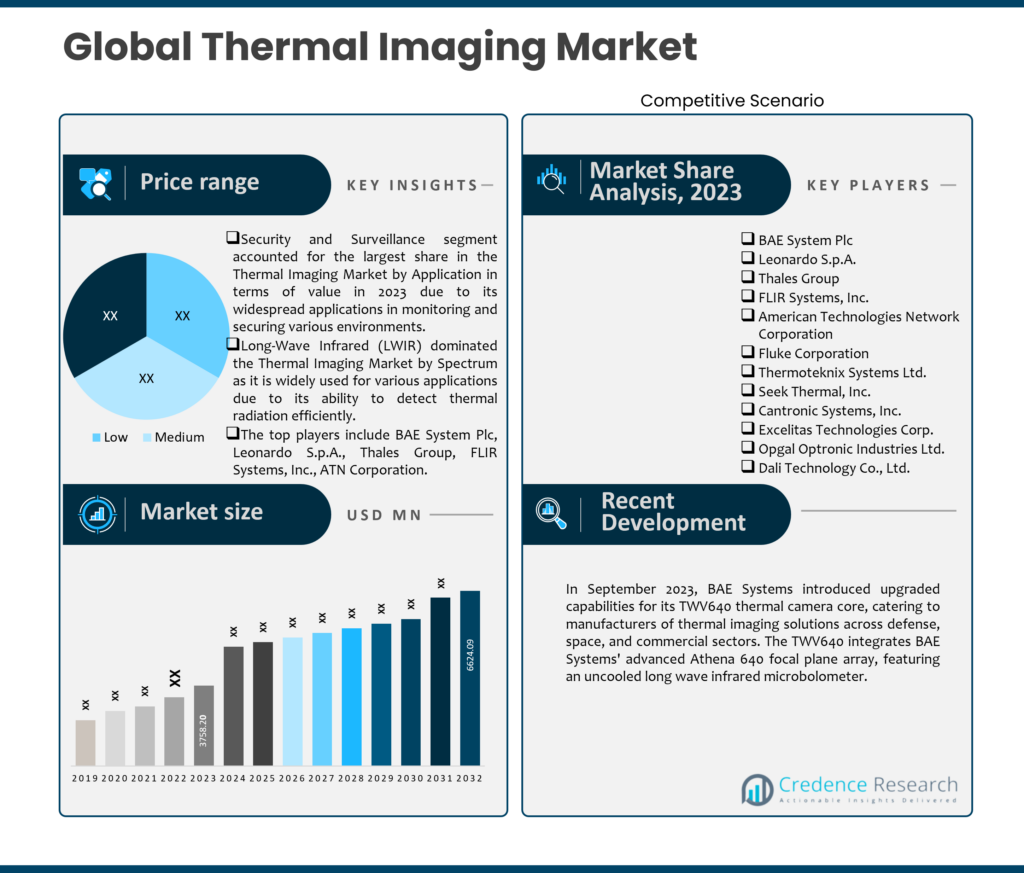
- The global demand for Thermal Imaging Solutions was valued at USD 3758.20 Million in 2023 and is expected to reach USD 6624.09 Million in 2032, growing at a CAGR of 6.50% between 2024 and 2032.
- The uncooled thermal imaging segment is the market leader by technology type, accounting for a major share of total value in 2023, while the Microbolometer Technology segment is expected to grow rapidly throughout the forecast period.
- The healthcare segment is predicted to grow fastest over the projection period in terms of application, while the security and surveillance segment had the major market share in 2023.
- Over the projection period, the short-wave infrared (SWIR) category is expected to expand at the highest rate, while the long-wave infrared (LWIR) category will dominate the market in 2023 with a significant share.
- The defense and security industry dominates the global need for thermal imaging solutions, accounting for the highest market share in 2023 and is predicted to expand at a moderate CAGR.
- North America is fueling the growth of the thermal imaging industry with the highest market share in 2023, while Asia Pacific showcased the highest growth potential over the forecasted period.
- Increasing government expenditure in the aerospace and defense sector and the rising adoption of thermal imaging in the automotive industry are boosting market growth.
Executive Summary
Market Definition
Thermal imaging is a technology that captures and visualizes the infrared radiation emitted by objects and environments, representing temperature variations as colorful images or videos. It is utilized across various industries for tasks such as predictive maintenance, building inspections, security and surveillance, and even consumer electronics such as smartphones. Thermal imaging works by detecting the heat signatures emitted by objects and converting them into visible images, allowing users to identify anomalies, detect hidden threats, and make informed decisions. Its advantages include the ability to operate in low-light conditions, adverse weather, and even total darkness, providing invaluable insights for improving efficiency, safety, and situational awareness.
Market Overview
The global thermal imaging market has witnessed steady growth in recent years and is expected to grow at a CAGR of 6.50% between 2024 and 2032. The market was valued at USD 3758.20 million in 2023 and is expected to reach USD 6624.09 million in 2032.
The global thermal imaging market is thriving due to the increasing demand for thermal imaging technology in the security and surveillance sector. Heightened security concerns globally necessitate advanced surveillance systems capable of detecting intruders and anomalies in various environments. This, in turn, is increasing the demand for thermal imaging solutions, as they excel in low-light conditions, effectively monitor large areas, and make them essential for security agencies, law enforcement, and military organizations.
Moreover, industries such as manufacturing, automotive, aerospace, and healthcare are driving significant demand for thermal imaging solutions. These sectors increasingly utilize thermal imaging for predictive maintenance, quality control, and process monitoring. Infrared cameras enable early equipment failure detection, defect identification, and production process optimization, enhancing operational efficiency and reducing downtime.
However, the high costs associated with the technology limit its adoption among small and medium-sized enterprises, restraining market growth. Additionally, regulatory restrictions in certain regions hinder market expansion by imposing limitations on thermal imaging device use, especially in sensitive areas.
On the other hand, the integration of Artificial Intelligence (AI) into thermal imaging is expected to create ample opportunities in the forecasted period. AI enhances thermal imaging technology capabilities, expanding its applications across various industries. Primarily used for image processing, analysis, and interpretation, AI provides more accurate and actionable insights.
Segmentation by Technology
- Uncooled Thermal Imaging emerges as the dominant segment, holding the major share in value, reflecting its widespread adoption and utilization within the market. This dominance is attributed to its cost-effectiveness, lower power consumption, and suitability for various applications, ranging from security and surveillance to automotive and industrial.
- Cooled Thermal Imaging represents another segment but holds a smaller share compared to Uncooled Thermal Imaging. Despite its superior performance in certain scenarios, the higher cost and complexity limit its widespread adoption.
- Microbolometer Technology is identified as the fastest-growing segment, indicating a notable increase in its market share over the forecast period. This growth can be attributed to advancements in microbolometer sensor technology, leading to improved resolution, sensitivity, and affordability, making it increasingly attractive for a wide range of applications.
Segmentation by Application
- Security and Surveillance emerge as the dominant segment, holding the major share in value, reflecting its widespread adoption and utilization within the market. This dominance is primarily driven by the increasing need for advanced security solutions in various sectors, including government, commercial, and residential, to enhance monitoring and threat detection capabilities.
- Industrial Inspection represents another significant segment but holds a smaller share compared to Security and Surveillance. Its importance lies in facilitating preventive maintenance, quality control, and troubleshooting in industrial settings, contributing to operational efficiency and safety.
- Healthcare is identified as the fastest-growing segment, indicating a notable increase in its market share over the forecast period. This growth is driven by the rising adoption of thermal imaging technology in medical applications such as fever screening, disease diagnosis, and monitoring patient conditions, particularly in response to global health crises and the demand for non-invasive screening methods.
- Automotive, Building Inspection, and Aerospace and Defense are additional segments in the thermal imaging market. Each caters to specific industry requirements and applications and has varying degrees of market share and growth potential.
Segmentation by Spectrum
- Long-wave infrared (LWIR) is the dominant segment, holding the major share in value within the market. This dominance is attributed to the widespread use and versatility of LWIR technology across various applications, including security, surveillance, industrial inspection, and healthcare, owing to its ability to detect heat signatures and thermal anomalies effectively.
- Mid-wave infrared (MWIR) represents another significant segment but holds a smaller share compared to LWIR. Its application is prevalent in certain specialized areas, such as military and defense, where MWIR technology offers enhanced performance for specific detection and targeting requirements.
- Short-wave infrared (SWIR) is the fastest-growing segment, indicating a notable increase in its market share over the forecast period. This growth is driven by advancements in SWIR sensor technology, which have improved sensitivity, resolution, and affordability, making it increasingly attractive for emerging applications such as hyperspectral imaging, semiconductor inspection, and agricultural monitoring.
Segmentation by End-Use Industry
- Defense and Security are the dominant segments, holding the major share in value within the market. This dominance is attributed to the critical role of thermal imaging technology in enhancing surveillance, reconnaissance, and threat detection capabilities for military and security applications.
- Industrial represents another significant segment but holds a smaller share compared to Defense and Security. Its importance lies in facilitating preventive maintenance, quality control, and process optimization in industrial settings, contributing to operational efficiency and safety.
- Healthcare and Life Sciences is identified as a growing segment, indicating increasing adoption and utilization of thermal imaging technology in medical diagnostics, research, and patient monitoring applications. This growth is driven by the demand for non-invasive and early detection methods, as well as advancements in thermal imaging technology for medical use.
- Automotive, Aerospace, and Construction and Building are additional segments in the thermal imaging market. Each caters to specific industry requirements and applications, albeit with varying degrees of market share and growth potential.
Segmentation by Region
- North America is fueling the growth of the thermal imaging industry with the highest share in 2023 due to the region's significant investments in R&D and widespread adoption across diverse sectors, including military, defense, and automotive.
- Asia Pacific is anticipated to showcase the highest CAGR in the forecasted period due to the increasing government initiatives to enhance border security and infrastructure development across emerging economies in the region.
- The rest of the world, including Latin America, the Middle East, and Africa, supplies the remaining demand for thermal imaging.
North America holds the major share of the global thermal imaging market and is expected to dominate the market throughout the forecast period. This is attributed to factors such as the growing use of thermal imaging solutions by the military for applications such as surveillance, reconnaissance, and target acquisition, as thermal imaging is highly effective in detecting objects, individuals, and activities even in low-light or adverse weather conditions. Moreover, the presence of regional market players such as American Technologies Network Corporation Teledyne FLIR LLC further fuels the growth of the thermal imaging market in the region. For instance, in May 2022, Teledyne FLIR announced that the company secured a five-year contract of 500.2 million to provide advanced thermal imaging systems for the U.S. Army.
The Asia Pacific is expected to be the fastest-growing region over the forecast period. One key factor fueling the expansion of the target market is the region's booming industrial sector. Asian countries are experiencing rapid industrial growth, leading to a rise in manufacturing facilities, power plants, and other infrastructure that require regular monitoring and inspection for preventive maintenance and safety purposes. Thermal imaging is ideal for these tasks as it can detect temperature variations that might indicate potential problems like overheating equipment or faulty electrical connections.
Key Highlights of the Report
The global thermal imaging market is segmented by technology, application, spectrum, end-use industry, and region. Uncooled Thermal Imaging solutions are the most popular, while security and surveillance are one of the primary segments. In addition, the long-wave infrared (LWIR) spectrum is the most commonly used category. However, the defense and security end-use industry dominates the market, with North America leading the market growth.
The growing need for advanced security surveillance systems worldwide is driving the demand for thermal imaging technology. These solutions excel in low-light conditions and are essential tools for security agencies and law enforcement.
Nonetheless, North America is anticipated to have the greatest share of the worldwide thermal imaging market because of its robust technological infrastructure, substantial investments in research and development, and high adoption rates across various sectors, such as military and defense, automotive, and industrial applications. Furthermore, the market is anticipated to expand at the highest rate in the Asia-Pacific (APAC) region due to rapid industrialization, increasing demand for surveillance and security solutions, and government initiatives to enhance border security and infrastructure development across emerging economies in the region.
What Are The Main Drivers Of The Global Thermal Imaging Market?
The global thermal imaging market is experiencing robust growth driven by several key factors, such as the increasing demand for thermal imaging technology in security and surveillance applications. With heightened security concerns worldwide, there is a growing need for advanced surveillance systems capable of detecting intruders and anomalies in various environments. Thermal imaging cameras offer superior visibility in low-light conditions and can effectively monitor large areas, making them indispensable for security agencies, law enforcement, and military organizations.
Moreover, the industrial and commercial sectors are driving substantial demand for thermal imaging solutions. Industries such as manufacturing, automotive, aerospace, and healthcare are increasingly leveraging thermal imaging technology for predictive maintenance, quality control, and process monitoring. Infrared cameras enable early detection of equipment failures, identification of defects, and optimization of production processes, thereby enhancing operational efficiency and reducing downtime. The versatility and reliability of thermal imaging systems make them invaluable tools across a wide range of industrial applications.
What Are The Major Challenges Faced By The Global Thermal Imaging Market?
The primary factors restraining the growth of the global thermal imaging market are the high costs associated with the technology, which limits its adoption among small and medium-sized enterprises. Furthermore, regulatory restrictions in certain regions hinder market growth by imposing limitations on the use of thermal imaging devices, especially in sensitive areas.
What Are The Growth Opportunities In The Global Thermal Imaging Market?
Artificial intelligence (AI) is revolutionizing thermal imaging technology by enhancing its capabilities and expanding its applications across various industries. AI is primarily used for image processing, analysis, and interpretation, leading to more accurate and actionable insights.
Market Drivers
Increasing Adoption of Thermal Imaging Solutions for Security and Defence Applications
The increasing adoption of thermal imaging solutions for security and defense applications is a key driver behind the robust growth of the global thermal imaging market. Heightened security concerns globally necessitate advanced surveillance systems capable of detecting intruders and anomalies in various environments. Thermal imaging cameras offer superior visibility in low-light conditions, making them indispensable for security agencies, law enforcement, and military organizations. This trend is evident in the rising demand for thermal imaging technology, driven by the need for enhanced security measures worldwide. These factors are increasing the adoption of thermal imaging solutions in the security and defense sectors globaly. In December 2023, the Indian Army announced plans to deploy approximately 10,000 new hand-held thermal imagers (HHTIs) for its troops stationed along borders and other operational zones.
Market Restraints
High Cost of Thermal Imaging Solutions
The high costs associated with thermal imaging technology present a significant barrier to its widespread adoption, particularly among small and medium-sized enterprises (SMEs). These businesses often operate on tighter budgets and may find it financially challenging to invest in advanced thermal imaging systems. As a result, their limited adoption of thermal imaging solutions acts as a primary restraint on the overall growth of the global thermal imaging market.
Opportunities
Integration of AI in Thermal Imaging Solutions
One key application of AI in thermal imaging is in object detection and recognition. AI algorithms can analyze thermal images to detect and identify objects, such as people, vehicles, or animals, even in challenging conditions such as low visibility or adverse weather. This capability is invaluable in security and surveillance, as well as in autonomous systems like drones or self-driving vehicles.
Furthermore, AI-powered thermal imaging systems enable predictive maintenance in industrial settings. By analyzing thermal data from equipment and machinery, AI algorithms can detect anomalies and predict potential failures before they occur. This proactive approach to maintenance helps reduce downtime, optimize asset performance, and minimize costly repairs.
AI also plays a crucial role in healthcare applications of thermal imaging, particularly in fever screening and disease detection. AI algorithms can analyze thermal images to identify patterns associated with specific health conditions, aiding in early diagnosis and treatment. During the COVID-19 pandemic, AI-powered thermal imaging systems were deployed for temperature screening in public places and healthcare facilities to help identify individuals with potential symptoms.
In addition, AI enables real-time analytics and decision-making based on thermal data. By integrating AI with thermal imaging systems, organizations can automate processes, improve situational awareness, and respond more effectively to events or emergencies.
Competitive Landscape
Key Players
The global thermal imaging market is highly competitive, with several key players. Some of the major players in the market and their market share are as follows:
- BAE System Plc
- Leonardo S.p.A.
- Thales Group
- FLIR Systems, Inc.
- American Technologies Network Corporation
- Fluke Corporation
- Thermoteknix Systems Ltd.
- Seek Thermal, Inc.
- Cantronic Systems, Inc.
- Excelitas Technologies Corp.
- Opgal Optronic Industries Ltd.
- Dali Technology Co., Ltd.
- Others
These organizations prioritize product innovation to stay competitive.
The global thermal imaging market's key players continually seek to stay ahead by offering new products and developments.
In September 2023, BAE Systems introduced upgraded capabilities for its TWV640 thermal camera core, catering to manufacturers of thermal imaging solutions across defense, space, and commercial sectors. The TWV640 integrates BAE Systems' advanced Athena 640 focal plane array, featuring an uncooled long-wave infrared microbolometer.
In October 2022, Thales introduced its next-generation MINERVA dual-band camera, featuring high-definition capabilities. MINERVA integrates state-of-the-art, uncooled Long Wave Infrared (LWIR) technology with an HD 1280x1024, 12-micron detector alongside a full HD visible module. The sensor of MINERVA outputs fully digital 60 Hz video (3G-SDI). At the same time, its low-latency and automatic image processing algorithms guarantee users swift situational awareness optimization without the need for manual adjustments, ensuring seamless operation.
How are Companies Performing in the Thermal Imaging Market?
The global thermal imaging market is highly competitive, with several key players.
Startup companies in the field of thermal imaging are revolutionizing the industry by leveraging cutting-edge technology to gather high-definition thermal data from space. These startups are attracting significant investment, making acquisitions, and securing contracts to advance thermal imaging capabilities. For example, a British startup, Satellite Vu, has raised substantial funding to develop a satellite constellation dedicated to monitoring thermal emissions globally. By focusing on measuring heat emissions from individual buildings, Satellite Vu aims to assist businesses and governments in implementing energy-efficient solutions. Additionally, startups such as Constellr, OroraTech, and Aistech Space are also making strides in providing thermal data for various applications, from tracking emissions to enhancing agricultural practices and firefighting efforts.
Summary of Key Findings
- The global thermal imaging market is driven by increased government spending in the aerospace and defense sector, as well as the expanding adoption of thermal imaging technology across various industries, including automotive and healthcare.
- Market segmented by technology application spectrum end-use industry and region.
- The uncooled thermal imaging segment dominated the market in 2023, constituting a significant portion of the total value. Meanwhile, the Microbolometer Technology segment is anticipated to exhibit rapid growth over the forecast period.
- In terms of applications, the healthcare segment is forecasted to experience the highest growth rate, while the security and surveillance segment held the largest market share in 2023.
- North America is leading market growth; the market is highly competitive with key players including BAE System Plc, Leonardo S.p.A., Thales Group FLIR Systems, Inc. American Technologies Network Corporation, Fluke Corporation, Thermoteknix Systems Ltd., Seek Thermal, Inc., Cantronic Systems, Inc., Excelitas Technologies Corp., Opgal Optronic Industries Ltd., Dali Technology Co., Ltd., and Others.
Future Outlook
- Positive outlook for the global thermal imaging market with significant growth potential in the Asia Pacific region
- One of the main factors promoting the market's expansion is the security and defense sectors' current reliance on thermal imaging.
- During the forecast period, the increasing usage of thermal imaging solutions in the automotive and healthcare industries is a significant factor projected to drive growth in the thermal imaging market
- Key firms must focus on product innovation, growing market reach, and maintaining competitive pricing to keep ahead of the competition.
How CXOs Can Benefit from the Credence Research Thermal Imaging Market Report
The Credence Research Thermal Imaging Report provides CXOs with a comprehensive overview of the market, including:
- Market size and growth forecast:The report provides detailed estimates of the global thermal imaging market size, segmented by technology, application, spectrum, end-use industry, and region. It also includes forecasts for the market through 2032 based on key trends and drivers.
- Market segmentation:The report segments the thermal imaging market by technology, application, spectrum, end-use industry, and region. This segmentation provides CXOs with a granular understanding of the market and the opportunities in each segment.
- Competitive Landscape:The report profiles the key players in the thermal imaging market and provides insights into their strategies, product offerings, and financial performance. This information can help CXOs to identify and assess their competition.
- Key trends and drivers:The report identifies and analyses the key trends and drivers shaping the thermal imaging market. This information can help CXOs make informed decisions about their investments and strategies.
CXOs can use the insights from the Credence Research Thermal Imaging Market Report to:
- Identify growth opportunities:The report can help CXOs identify new growth opportunities in the thermal imaging market. For example, the report identifies the growing demand for q thermal imaging from emerging markets such as Asia-Pacific, where infrastructural development and security concerns are driving adoption.
- Make informed investment decisions:The report can help CXOs make informed investment decisions about thermal imaging solutions. For example, it provides insights into the key factors to consider when evaluating and selecting thermal imaging providers.
- Develop competitive strategies:The report can help CXOs develop competitive strategies for their thermal imaging businesses. For example, the report identifies the key strategies that thermal imaging solution providers are using to differentiate themselves from their competitors.
- Track market developments:The report can help CXOs monitor market developments and stay ahead of the curve. For example, it provides insights into the latest trends and innovations in the Thermal Imaging Market.
Overall, the Credence Research Thermal Imaging Report is a valuable resource for CXOs who are looking to gain a deeper understanding of the market and identify opportunities for growth.
Segmentation
-
By Technology
- Cooled Thermal Imaging
- Uncooled Thermal Imaging
- Microbolometer Technology
-
By Application
- Security and Surveillance
- Industrial Inspection
- Healthcare
- Automotive
- Building Inspection
- Aerospace and Defense
-
By Spectrum
- Long-Wave Infrared (LWIR)
- Mid-Wave Infrared (MWIR)
- Short-Wave Infrared (SWIR)
-
By End-Use Industry
- Defense and Security
- Industrial
- Healthcare and Life Sciences
- Automotive
- Aerospace
- Construction and Building
-
By Region
- North America
- US
- Canada
- Mexico
- Europe
- Germany
- France
- UK.
- Italy
- Spain
- Rest of Europe
- Asia Pacific
- China
- Japan
- India
- South Korea
- South-east Asia
- Rest of Asia Pacific
- Latin America
- Brazil
- Argentina
- Rest of Latin America
- Middle East & Africa
- GCC Countries
- South Africa
- Rest of the Middle East and Africa
- North America
Adjacent Markets
In the Thermal imaging market, several adjacent markets have high revenue growth opportunities. The key adjacent markets for the Thermal imaging market -
Adjacent Markets |
||
| Infrared (IR) sensors and detectors market | Thermography services market | Night vision systems market |
| Predictive maintenance market | Building inspection and energy audit market | Automotive night vision systems market |
| The surveillance and security systems market | Smartphone thermal cameras market | UAV thermal cameras market |

Request a Free Sample
Fill in your details and we'll send you a free sample report.
- Sample data tables & charts
- Research methodology
Market Dynamics
Expansion of Security and Surveillance Needs
Heightened global security concerns are driving the adoption of advanced surveillance systems, with thermal imaging excelling in low-light and adverse weather conditions, making it indispensable for military, law enforcement, and critical infrastructure protection.
Growth in Industrial and Predictive Maintenance Applications
Manufacturing, energy, and industrial sectors are increasingly using thermal imaging for predictive maintenance, quality control, and process monitoring, enabling early detection of equipment failures and reducing operational downtime.
Rising Adoption in Healthcare and Life Sciences
Thermal imaging is being rapidly adopted in healthcare for non-invasive fever screening, disease diagnosis, and patient monitoring, especially in response to global health crises and the need for efficient, contactless screening methods.
Integration of Artificial Intelligence (AI)
The integration of AI with thermal imaging systems is enhancing image analysis, object detection, and predictive maintenance capabilities, expanding the technology's applications and improving actionable insights across industries.
Government Investments in Defense and Infrastructure
Increased government spending on defense, border security, and infrastructure development - particularly in North America and Asia Pacific - is fueling demand for advanced thermal imaging solutions for surveillance, reconnaissance, and safety monitoring.
Need a Custom Version of This Report?
Tailor the scope, geography, or segments to your exact requirements.
- Custom geography or segment scope
- Direct access to our analyst team
Frequently Asked Questions
What is the current size of the global thermal imaging market?
What is the expected growth rate of the thermal imaging market between 2024 and 2032?
Which segment is leading the market share in terms of technology?
Which segment is leading the market share in terms of Application?
Which segment has the highest market share in terms of spectrum?
Which region is fueling the growth of the thermal imaging market?
Who are the major players in the global thermal imaging market?
What are the major market drivers of the global thermal imaging market?
What are the major market restraints of the thermal imaging market?
What are the major market opportunities of the global thermal imaging market?
Table of Content
Chapter 1 Market Segmentation
- 1.1 Segmentation Framework
- 1.1.1 Product and Service Classification
- 1.1.2 Application and End-Use Classification
- 1.1.3 Technology and Solution Classification
- 1.1.4 Customer and Distribution Channel Classification
- 1.1.5 Geographic Segmentation
- 1.1.6 Market Segment Definitions and Boundaries
- 1.2 By Spectrum
- 1.2.1 Long-Wave Infrared (LWIR)
- 1.2.2 Mid-Wave Infrared (MWIR)
- 1.2.3 Short-Wave Infrared (SWIR)
- 1.3 By Technology
- 1.3.1 Cooled Thermal Imaging
- 1.3.2 Uncooled Thermal Imaging
- 1.3.3 Microbolometer Technology
- 1.4 By Application
- 1.4.1 Security and Surveillance
- 1.4.2 Industrial Inspection
- 1.4.3 Healthcare
- 1.4.4 Automotive
- 1.4.5 Building Inspection
- 1.4.6 Aerospace and Defense
- 1.5 By End-Use Industry
- 1.5.1 Defense and Security
- 1.5.2 Industrial
- 1.5.3 Healthcare and Life Sciences
- 1.5.4 Automotive
- 1.5.5 Aerospace
- 1.5.6 Construction and Building
Chapter 2 Introduction
- 2.1 Report Objectives and Scope
- 2.2 Product Definition and Industry Terminology
- 2.3 Market Inclusions and Exclusions
- 2.4 Research Process
- 2.4.1 Primary Research and Expert Interviews
- 2.4.2 Secondary Research and Source Review
- 2.4.3 Top-Down and Bottom-Up Estimation
- 2.4.4 Data Triangulation and Verification
- 2.5 Market Size Measurement Basis
- 2.5.1 2023: USD 3758.20 Million → 2032: USD 6,624.09 Million
- 2.6 Historical and Forecast Reference Periods
- 2.6.1 Base Year: 2023
- 2.6.2 Forecast Period: 2023-2032
- 2.7 Research Assumptions and Limitations
Chapter 3 Executive Summary
- 3.1 Market Snapshot and Key Findings
- 3.2 Base-Year Market Size, 2023
- 3.3 Forecast Market Size, 2032
- 3.4 Revenue and Volume Growth Outlook
- 3.5 Key Demand and Supply Indicators
- 3.6 Leading Market Segments
- 3.7 Fastest-Growing Market Opportunities
- 3.8 Regional Performance Highlights
- 3.9 Technology and Industry Transformation
- 3.10 Competitive Landscape Summary
- 3.11 Analyst View and Strategic Implications
Chapter 4 Global Thermal Imaging Market Trends and Developments
- 4.1 Historical Industry Development
- 4.2 Recent Market Trends and Developments
- 4.3 Demand and Customer Behavior Trends
- 4.4 Technology and Product Innovation
- 4.5 Artificial Intelligence, Automation and Digitalization
- 4.6 Local Manufacturing and Supply Chain Realignment
- 4.7 Industry Partnerships, Mergers and Acquisitions
- 4.8 Sustainability and Circular Economy Developments
- 4.9 Government and Private Sector Investment Trends
- 4.10 Emerging Business Models and Commercialization
- 4.11 Industry Developments and Announcements
Chapter 5 Global Thermal Imaging Market Production, Supply and Demand Analysis
- 5.1 Demand Trend and Consumption Analysis
- 5.2 Demand Forecast, 2023-2032
- 5.3 Production and Output Trend
- 5.4 Production and Output Forecast, 2023-2032
- 5.5 Installed Capacity and Capacity Utilization
- 5.6 Company-Wise Production Plants and Statistics
- 5.6.1 Installed Production Capacity
- 5.6.2 Actual Production
- 5.6.3 Planned Capacity and Expansion Targets
- 5.7 Supply Chain Structure and Procurement Trends
- 5.8 Supply-Demand Gap and Bottlenecks
- 5.9 Import Dependence and Sourcing Structure
- 5.10 Contract Manufacturing and Outsourcing
- 5.11 Regional Supply and Demand Concentration
Chapter 6 Global Thermal Imaging Market Pricing Analysis
- 6.1 Pricing Structure and Measurement
- 6.2 Historical Pricing Trends
- 6.3 Pricing Outlook, 2023-2032
- 6.4 Average Selling Price and Unit Economics
- 6.5 Pricing by Product and Market Segment
- 6.6 Geographic Pricing Differences
- 6.7 Key Input, Energy, Labor and Logistics Costs
- 6.8 Contract Pricing and Purchasing Models
- 6.9 Pricing Sensitivity and Competitive Positioning
- 6.10 Price, Margin and Profitability Implications
Chapter 7 Global Thermal Imaging Market Dynamics
- 7.1 Market Growth Drivers
- 7.1.1 Demand-Side Drivers
- 7.1.2 Technology and Innovation Drivers
- 7.1.3 Infrastructure and Investment Drivers
- 7.1.4 Regulatory and Policy Drivers
- 7.2 Market Restraints
- 7.2.1 Cost and Affordability Constraints
- 7.2.2 Technology and Adoption Barriers
- 7.2.3 Supply Chain and Operational Constraints
- 7.3 Market Challenges
- 7.3.1 Competitive Pressure and Margin Erosion
- 7.3.2 Skills, Infrastructure and Implementation Gaps
- 7.4 Emerging Market Opportunities
- 7.5 Market Dynamics Impact and Time-Horizon Assessment
Chapter 8 Global Thermal Imaging Value Chain Analysis
- 8.1 Industry Value Chain Overview
- 8.2 Upstream Suppliers and Critical Inputs
- 8.3 Technology and Component Providers
- 8.4 Manufacturing or Service Delivery
- 8.5 Distribution, Channel Partners and Integrators
- 8.6 Downstream Applications and End Users
- 8.7 Value Addition and Profit Pools
- 8.8 Vertical Integration and Outsourcing
- 8.9 Supplier Concentration and Risk
- 8.10 Supply Chain Localization and Resilience
Chapter 9 Global Thermal Imaging Market Regulations and Policies
- 9.1 Relevant Laws, Standards and Compliance Frameworks
- 9.2 Product, Service, Safety and Quality Requirements
- 9.3 Government Policies, Incentives and Subsidies
- 9.4 Imports, Exports and Trade Barriers
- 9.5 Public Procurement and Local Content Requirements
- 9.6 Environmental and Sustainability Compliance
- 9.7 Data Protection, AI and Cybersecurity Compliance
- 9.8 Upcoming Policy Changes and Market Implications
Chapter 10 Global Thermal Imaging Market Hotspots and Opportunities
- 10.1 Market Opportunity Mapping and Growth Hotspots
- 10.2 High-Growth Applications and Customer Groups
- 10.3 Underserved Markets and White-Space Opportunities
- 10.4 Emerging Technology and Product Opportunities
- 10.5 New Capacity and Investment Hotspots
- 10.6 Market Entry and Expansion Opportunities
- 10.7 Distribution and Partnership Opportunities
- 10.8 Near-Term and Long-Term Commercial Potential
- 10.9 Opportunity Attractiveness and Execution Risks
Chapter 11 Global Thermal Imaging Market Outlook, 2023-2032
- 11.1 Market Size and Analysis
- 11.1.1 Revenue (Market Measurement: 2023: USD 3758.20 Million → 2032: USD 6,624.09 Million)
- 11.1.2 Market Volume and Quantity Sold
- 11.1.3 Historical Market Size
- 11.1.4 Base-Year Market Size, 2023
- 11.2 Market Forecast, 2023-2032
- 11.2.1 Revenue Forecast to 2032
- 11.2.2 Volume Forecast to 2032
- 11.2.3 CAGR and Year-on-Year Growth
- 11.2.4 Incremental Revenue Opportunity
- 11.3 Forecast Assumptions and Scenario Analysis
- 11.3.1 Base-Case Forecast
- 11.3.2 Optimistic and Conservative Scenarios
- 11.3.3 Technology, Pricing and Policy Sensitivities
- 11.4 Market Attractiveness and Growth Outlook
Chapter 12 Global Thermal Imaging Market Segmentation and Outlook
- 12.1 Segmentation Summary and Market Shares, 2023
- 12.2 Largest and Fastest-Growing Segments
- 12.3 By Spectrum - Market Size and Forecast, 2023-2032
- 12.3.1 Segment Definition and Scope
- 12.3.2 Historical Market Size
- 12.3.3 Revenue Forecast, 2023-2032
- 12.3.4 Volume Forecast, 2023-2032
- 12.3.5 Base-Year Market Share, 2023
- 12.3.6 Segment CAGR and Growth Drivers
- 12.3.7 Subsegment Market Size and Forecast
- 12.3.7.1 Long-Wave Infrared (LWIR)
- 12.3.7.2 Mid-Wave Infrared (MWIR)
- 12.3.7.3 Short-Wave Infrared (SWIR)
- 12.3.8 Subsegment Pricing and Adoption Trends
- 12.3.9 Leading Suppliers and Competition
- 12.3.10 Regional Demand and Opportunities
- 12.4 By Technology - Market Size and Forecast, 2023-2032
- 12.4.1 Segment Definition and Scope
- 12.4.2 Historical Market Size
- 12.4.3 Revenue Forecast, 2023-2032
- 12.4.4 Volume Forecast, 2023-2032
- 12.4.5 Base-Year Market Share, 2023
- 12.4.6 Segment CAGR and Growth Drivers
- 12.4.7 Subsegment Market Size and Forecast
- 12.4.7.1 Cooled Thermal Imaging
- 12.4.7.2 Uncooled Thermal Imaging
- 12.4.7.3 Microbolometer Technology
- 12.4.8 Subsegment Pricing and Adoption Trends
- 12.4.9 Leading Suppliers and Competition
- 12.4.10 Regional Demand and Opportunities
- 12.5 By Application - Market Size and Forecast, 2023-2032
- 12.5.1 Segment Definition and Scope
- 12.5.2 Historical Market Size
- 12.5.3 Revenue Forecast, 2023-2032
- 12.5.4 Volume Forecast, 2023-2032
- 12.5.5 Base-Year Market Share, 2023
- 12.5.6 Segment CAGR and Growth Drivers
- 12.5.7 Subsegment Market Size and Forecast
- 12.5.7.1 Security and Surveillance
- 12.5.7.2 Industrial Inspection
- 12.5.7.3 Healthcare
- 12.5.7.4 Automotive
- 12.5.7.5 Building Inspection
- 12.5.7.6 Aerospace and Defense
- 12.5.8 Subsegment Pricing and Adoption Trends
- 12.5.9 Leading Suppliers and Competition
- 12.5.10 Regional Demand and Opportunities
- 12.6 By End-Use Industry - Market Size and Forecast, 2023-2032
- 12.6.1 Segment Definition and Scope
- 12.6.2 Historical Market Size
- 12.6.3 Revenue Forecast, 2023-2032
- 12.6.4 Volume Forecast, 2023-2032
- 12.6.5 Base-Year Market Share, 2023
- 12.6.6 Segment CAGR and Growth Drivers
- 12.6.7 Subsegment Market Size and Forecast
- 12.6.7.1 Defense and Security
- 12.6.7.2 Industrial
- 12.6.7.3 Healthcare and Life Sciences
- 12.6.7.4 Automotive
- 12.6.7.5 Aerospace
- 12.6.7.6 Construction and Building
- 12.6.8 Subsegment Pricing and Adoption Trends
- 12.6.9 Leading Suppliers and Competition
- 12.6.10 Regional Demand and Opportunities
- 12.7 Segment Growth Comparison
- 12.8 Segment Attractiveness and Priority Matrix
Chapter 13 Global Thermal Imaging End-Use and Application Market Outlook
- 13.1 End-Use Industry and Customer Demand Structure
- 13.2 Leading Applications and Customer Groups
- 13.3 End-Use Market Size, Share and Forecast
- 13.4 Major End-Use Industry Deep Dives
- 13.4.1 Customer Requirements and Use Cases
- 13.4.2 Demand and Replacement Cycles
- 13.4.3 Technical and Regulatory Considerations
- 13.4.4 Purchasing and Procurement Models
- 13.4.5 Leading Vendors and Distribution Channels
- 13.4.6 Forecast and Commercial Opportunities
- 13.5 Emerging Applications and Cross-Segment Demand
- 13.6 End-Use Industry Investment Priorities
Chapter 14 Global Thermal Imaging Geographic Market Outlook, 2023-2032
- 14.1 Regional Market Size and Share, 2023
- 14.2 Regional Market Forecast, 2023-2032
- 14.3 Regional Pricing, Production and Demand Differences
- 14.4 North America
- 14.4.1 United States
- 14.4.2 Canada
- 14.4.3 Mexico
- 14.5 Europe
- 14.5.1 Germany
- 14.5.2 France
- 14.5.3 Italy
- 14.5.4 United Kingdom
- 14.5.5 Spain
- 14.5.6 Poland
- 14.5.7 Russia
- 14.5.8 Netherlands
- 14.5.9 Belgium
- 14.5.10 Sweden
- 14.5.11 Denmark
- 14.5.12 Norway
- 14.5.13 Rest of Europe
- 14.6 Asia Pacific
- 14.6.1 China
- 14.6.2 India
- 14.6.3 Japan
- 14.6.4 South Korea
- 14.6.5 Thailand
- 14.6.6 Indonesia
- 14.6.7 Vietnam
- 14.6.8 Malaysia
- 14.6.9 Australia
- 14.6.10 Rest of Asia Pacific
- 14.7 Latin America
- 14.7.1 Brazil
- 14.7.2 Argentina
- 14.7.3 Colombia
- 14.7.4 Chile
- 14.7.5 Rest of Latin America
- 14.8 Middle East
- 14.8.1 Saudi Arabia
- 14.8.2 United Arab Emirates
- 14.8.3 Turkey
- 14.8.4 Israel
- 14.8.5 Iran
- 14.8.6 Rest of the Middle East
- 14.9 Africa
- 14.9.1 South Africa
- 14.9.2 Egypt
- 14.9.3 Nigeria
- 14.9.4 Morocco
- 14.9.5 Rest of Africa
- 14.10 Regional Investment, Policy and Supply Chain Differences
- 14.11 Regional Competitive Landscape
- 14.12 Geographic Growth Hotspots
Chapter 15 Global Thermal Imaging Technology, Innovation and Sustainability Outlook
- 15.1 Technology Landscape and Maturity
- 15.2 Product, Process and Service Innovation
- 15.3 AI, Automation and Digital Tools in the Industry
- 15.4 Technology Adoption and Performance Benchmarking
- 15.5 Innovation Pipeline and R&D Investment
- 15.6 Patent and Intellectual Property Trends
- 15.7 Energy Efficiency and Resource Management
- 15.8 Sustainability, Recycling and Circularity
- 15.9 Technology Roadmap, 2023-2032
- 15.10 Risks of Obsolescence and Technology Substitution
Chapter 16 Global Thermal Imaging Market Key Strategic Imperatives
- 16.1 Growth and Market Entry Priorities
- 16.2 High-Return Products and Segments
- 16.3 Pricing, Profitability and Cost Optimization
- 16.4 Technology Investment and Product Differentiation
- 16.5 Supply Chain Localization and Resilience
- 16.6 Distribution and Customer Acquisition
- 16.7 Partnership, Acquisition and Capacity Strategy
- 16.8 Regional Expansion Priorities
- 16.9 Short-, Medium- and Long-Term Actions
Chapter 17 Competition Outlook
- 17.1 Industry Competition Characteristics
- 17.2 Market Structure and Concentration
- 17.3 Market Share and Competitive Positioning, 2023
- 17.4 Company-Wise Revenue and Product Benchmarking
- 17.5 Production and Service Capacity Benchmarking
- 17.6 Technology, Pricing and Differentiation
- 17.7 Regional Footprint and Distribution Strength
- 17.8 Mergers, Acquisitions and Strategic Alliances
- 17.9 New Entrants and Competitive Threats
- 17.10 Porter's Five Forces and Industry Attractiveness
- 17.11 Competitive Outlook, 2023-2032
Chapter 18 Company Profiles
- 18.1 Company Coverage and Selection Criteria
- 18.2 BAE Systems Plc
- 18.2.1 Business Description
- 18.2.2 Company Ownership and Geographic Presence
- 18.2.3 Product and Service Portfolio
- 18.2.4 Manufacturing and Operating Footprint
- 18.2.5 Production Capacity and Expansion Plans
- 18.2.6 Financial Performance and Investment
- 18.2.7 Market Share and Competitive Position
- 18.2.8 Technology and Innovation Capabilities
- 18.2.9 Strategic Alliances or Partnerships
- 18.2.10 Recent Developments
- 18.2.11 Growth Strategy and Outlook
- 18.3 Leonardo S.p.A.
- 18.4 Thales Group
- 18.5 Teledyne FLIR LLC
- 18.6 American Technologies Network Corporation
- 18.7 Fluke Corporation
- 18.8 Thermoteknix Systems Ltd.
- 18.9 Seek Thermal, Inc.
- 18.10 Excelitas Technologies Corp.
- 18.11 Opgal Optronic Industries Ltd.
- 18.12 Other Relevant Market Participants
Note: Every listed company is profiled on the structure shown under the first company. The company list is preliminary and may change based on research findings, market developments, data availability and client requirements.
Chapter 19 Disclaimer
- 19.1 Research and Forecast Disclaimer
- 19.2 Data Source and Estimation Limitations
Note: The depth of individual sections depends on data availability for this market. Volume, capacity, trade and other unit-based metrics are included where applicable.

