
| REPORT ATTRIBUTE | DETAILS |
|---|---|
| Historical Period | 2019-2022 |
| Base Year | 2023 |
| Forecast Period | 2024-2032 |
| BOPA (Biaxially Oriented Polyamide) Films Market Size 2024 | USD 1,181.00 Million |
| BOPA (Biaxially Oriented Polyamide) Films Market, CAGR | 5.7% |
| BOPA (Biaxially Oriented Polyamide) Films Market Size 2032 | USD 1,840 Million |
Market Overview:
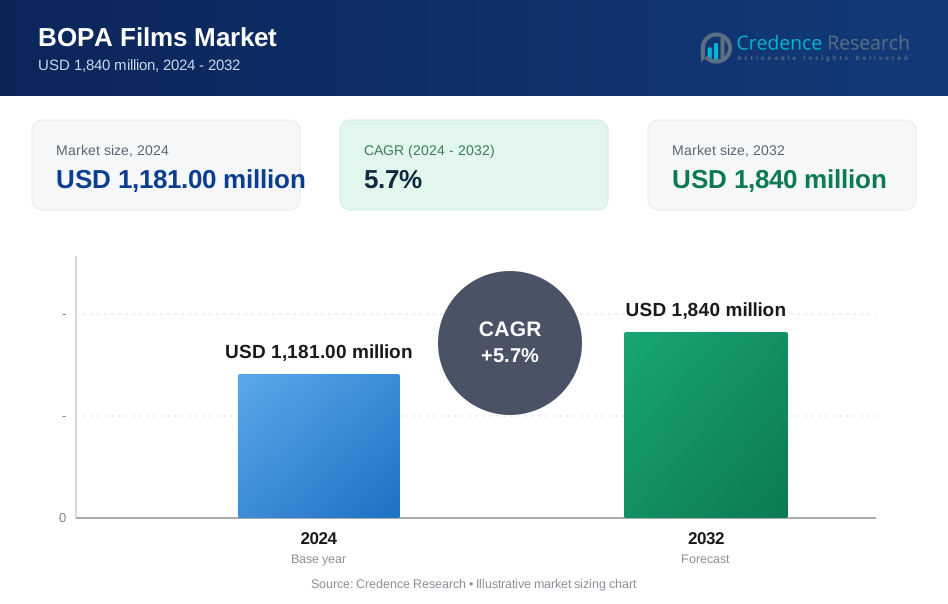
The BOPA (Biaxially Oriented Polyamide) Films Market size was valued at USD 1,181.00 million in 2024 and is anticipated to reach USD 1,840 million by 2032, at a CAGR of 5.7% during the forecast period (2024-2032).
The market is primarily driven by the rising demand for sustainable and high-barrier packaging materials, as consumers and regulatory bodies push for environmentally friendly solutions to reduce plastic waste. Governments worldwide are implementing stricter regulations on single-use plastics, encouraging the adoption of recyclable and biodegradable materials. This shift is prompting manufacturers to develop bio-based and recyclable BOPA films, which are gaining traction in various industries. The food packaging sector remains a key growth driver, as the need for extended shelf life, moisture resistance, and oxygen barrier properties continues to increase. BOPA films are widely used in vacuum-sealed packaging for meat, dairy, and frozen foods, ensuring product freshness and reducing food waste. Moreover, the electronics industry is incorporating BOPA films into protective layers and flexible circuit applications, capitalizing on their superior mechanical strength and resistance to chemicals. The industry is also witnessing significant advancements in co-extrusion and multi-layer film technologies, leading to improved film performance and broader application possibilities across multiple sectors.
From a regional standpoint, Asia-Pacific dominates the BOPA films market, driven by the expanding food packaging and pharmaceutical industries in China, India, and Japan. These countries are experiencing rapid urbanization and changing consumer lifestyles, leading to higher demand for packaged food products and pharmaceutical blister packaging, both of which rely heavily on BOPA films. North America and Europe are also witnessing consistent market growth, primarily fueled by the increasing preference for high-performance, eco-friendly packaging solutions. In these regions, stringent regulations promoting sustainable packaging and recyclability are encouraging companies to invest in advanced BOPA film production technologies. Meanwhile, Latin America and the Middle East & Africa present emerging opportunities due to their growing food retail sectors, rising disposable incomes, and increasing penetration of multinational food brands. The competitive landscape is intensifying, with key players focusing on technological innovation, production capacity expansion, and sustainability initiatives to gain a strategic edge in the global market.
Market Insights:
- The BOPA Films Market is projected to grow from USD 1,181.00 million in 2024 to USD 1,840 million by 2032, registering a CAGR of 5.7%, driven by rising demand for high-barrier and durable packaging materials.
- Increasing environmental concerns and regulatory restrictions on plastic waste are boosting the adoption of bio-based and recyclable BOPA films in various industries.
- The need for extended shelf life, superior oxygen barrier properties, and moisture resistance is driving BOPA film usage in vacuum-sealed and flexible food packaging.
- High production costs and volatility in raw material prices are limiting market expansion, while limited recyclability of multilayer films poses sustainability challenges.
- The region dominates the industry, with China, India, and Japan driving demand due to urbanization, changing consumer lifestyles, and food industry expansion.
- Strict packaging regulations and demand for eco-friendly solutions are driving steady growth in these regions, with key players investing in advanced production technologies.
- Market players are focusing on technological innovation, capacity expansion, and sustainability initiatives to strengthen their position and meet evolving packaging industry demands.
Market Drivers:
Increasing Demand for High-Barrier Packaging Solutions:
The demand for high-barrier packaging materials has been rising across various industries. For instance, Eurocast launched CRYSTA-LINE, a series of high-barrier mono-material films without an EVOH barrier layer, using transparent aluminum oxide coating technology to reduce raw materials usage. The food industry particularly benefits from these innovations, as global consumption of ultra-processed foods now contributes to 26-62% of daily energy needs. ProAmpac introduced the RP-1000HB, a high-barrier paper-based packaging system that protects against oxygen, moisture, and grease while being pre-H2R qualified for repurposing.
Expanding Electronics and Pharmaceutical Sectors:
The electronics and pharmaceutical industries are significantly contributing to the growing demand for durable and protective films. the pharmaceutical industry is expected to reach approximately USD 2 trillion by 2030, driving demand for high-performance packaging materials. For instance, nanocomposites like montmorillonite clays, kaolinite, carbon nanotubes, and graphene nanosheets are being used to develop eco-friendly high-tech solutions that protect products from moisture, oxygen, dust, and UV rays. Mariela packaging bag represents one of many novel innovations that rely on astute design and technology to minimize space while maximizing protective shielding.
Sustainability Regulations Driving Innovation:
Government policies and environmental regulations are playing a crucial role in shaping the future of the flexible packaging industry. For instance, the Ministry of Environment has introduced Extended Producer Responsibility (EPR) for Packaging Rules, 2024, requiring producers to manage the entire lifecycle of packaging materials starting April 2026. TOPPAN and TSF have launched GL-SP, a new sustainable barrier film using biaxially oriented polypropylene as the substrate, targeting markets in the Americas, Europe, India, and ASEAN. companies are expected to reduce conventional plastic usage by 2025, with increasing emphasis on biodegradable and compostable materials.
Rising Investments in Advanced Manufacturing Technologies:
Technological advancements in film extrusion and coating techniques have enhanced the performance and application range of BOPA films. For instance, new digital hot stamping systems have achieved production speeds of up to 18,000 sheets per hour, representing a 40% increase over traditional methods. Smart manufacturing integration has reduced setup times by 60% and material waste by 35%, while AI-powered quality control systems now detect defects with 99.8% accuracy. automation and advanced technologies have increased process optimization and productivity by up to 77%.
Market Trends:
Shift Toward Sustainable and Recyclable Packaging:
The global packaging industry is witnessing a significant transition toward sustainable and recyclable materials. Amcor's global portfolio of products designed to be recycled, reusable or compostable reached 90% by the end of FY23, with a goal of 100% by 2025. For instance, Nestlé has reduced its virgin plastic packaging by 10.5% since 2018 and cut the weight of its total product packaging by 200,000 tonnes in 2022, reducing greenhouse gas emissions by 280,000 tonnes. INEOS and partners have launched new premium quality snack packaging containing 50% recycled plastic that meets stringent food contact requirements.
Growing Adoption of High-Barrier Films in Pharmaceuticals:
With the pharmaceutical industry expanding rapidly, the need for high-barrier packaging solutions has increased. For instance, LOG Pharma has developed a new barrier eco line that reduces bottle weight by up to 30% while maintaining essential barrier properties and Water Vapor Transmission Rate (WVTR). nanotechnology is enabling the development of ultra-thin yet highly effective protective barriers against moisture, oxygen, and UV light, particularly crucial for pharmaceuticals where minimal exposure can degrade product integrity. smart packaging with temperature and humidity sensors embedded can monitor and display environmental data, ensuring product integrity from manufacturer to end-user.
Increased Demand for Advanced Food Packaging Solutions:
The food and beverage sector is driving demand for high-performance packaging films. For instance, nanoscale materials now offer advanced functionalities such as pathogen detection, oxygen and humidity regulation, and controlled release of preservatives to extend food shelf-life. interactive packaging with integrated sensors and status indicators can signal product freshness, helping prevent food waste by clearly indicating when a product is no longer fit for consumption. connected packaging can communicate with smart devices, providing information on provenance, nutritional composition, and recipe suggestions.
Technological Advancements in Flexible Packaging Manufacturing:
Technological innovation is playing a pivotal role in enhancing film performance, durability, and production efficiency. For instance, co-extrusion processes now utilize multiple extruders, each responsible for melting and extruding different materials with distinct properties such as color, strength, flexibility, or barrier characteristics. automation and robotics in packaging are becoming increasingly intelligent, with AI and advanced robotics streamlining production lines, increasing speed, and reducing human errors. flexible and modular packaging equipment can now easily adapt to different product sizes, container shapes, and cap types, offering greater flexibility for manufacturers.
Market Challenges Analysis:
Stringent Environmental Regulations and Compliance Costs:
Governments worldwide are tightening regulations on plastic waste management and recyclability, posing a significant challenge for BOPA film manufacturers. The European Union’s Single-Use Plastics Directive (SUPD) mandates that all plastic packaging must be 100% recyclable or reusable by 2030, increasing the pressure on companies to develop sustainable alternatives. Similarly, China’s National Development and Reform Commission (NDRC) has enforced a ban on non-biodegradable plastic packaging in major cities, leading to higher compliance costs for film producers. According to the United Nations Environment Programme (UNEP), plastic pollution control measures have raised global production costs by 18% for non-recyclable flexible films, affecting the profitability of manufacturers operating in regulated markets.
Volatility in Raw Material Prices and Supply Chain Disruptions:
The fluctuating costs of polyamide resins and petrochemical-based raw materials have significantly impacted the production costs of BOPA films. According to the International Energy Agency (IEA), crude oil prices surged by 22% in 2023, directly affecting the cost of petroleum-derived film materials. Supply chain disruptions, exacerbated by geopolitical tensions and trade restrictions, have further strained raw material availability. The World Trade Organization (WTO) reports that global supply chain bottlenecks have increased lead times for polymer procurement by 35% since 2022, delaying production schedules and increasing operational costs.
Intense Market Competition and Technological Barriers:
The BOPA films market is highly competitive, with companies facing pressure to enhance film properties while maintaining cost efficiency. Leading firms such as Toray Industries and Mitsubishi Chemical Corporation are investing in nanotechnology-based coatings, but the high cost of R&D and patenting new materials remains a challenge. According to the World Intellectual Property Organization (WIPO), global patent filings for high-performance packaging materials have increased by 19% annually, reflecting the competitive race for innovation. However, small and mid-sized manufacturers often struggle with the financial burden of adopting new technologies, limiting their market share growth.
Recycling and End-of-Life Challenges:
Despite advancements in flexible packaging sustainability, the recycling infrastructure for multi-layered BOPA films remains underdeveloped. According to the U.S. Environmental Protection Agency (EPA), only 9% of flexible plastic films are effectively recycled in North America, largely due to the difficulty in separating multiple polymer layers. The lack of standardized recycling protocols in emerging markets further complicates waste management efforts, making compliance with Extended Producer Responsibility (EPR) regulations costly and complex for film manufacturers.
Market Opportunities:
The increasing demand for sustainable and high-performance packaging presents a significant opportunity for BOPA film manufacturers. With governments and multinational corporations focusing on eco-friendly alternatives, there is a growing shift toward recyclable, bio-based, and biodegradable films. The European Union’s Circular Economy Action Plan (CEAP) and China’s National Green Development Strategy are pushing industries to adopt low-carbon, recyclable materials, creating opportunities for innovation in BOPA films with enhanced recyclability. Companies such as Amcor and Sealed Air have already launched sustainable packaging initiatives, with Amcor pledging to develop 100% recyclable or reusable packaging by 2025. The rising adoption of solvent-free lamination and bio-polymer coatings in flexible packaging also positions BOPA films as a key material in the transition toward sustainable packaging solutions.
The expanding pharmaceutical, electronics, and food industries in Asia-Pacific, Latin America, and the Middle East offer lucrative growth opportunities for BOPA film producers. With the International Federation of Pharmaceutical Manufacturers & Associations (IFPMA) estimating an 8.1% annual growth in pharmaceutical packaging, demand for high-barrier films in drug protection and medical applications is expected to surge. Additionally, the Semiconductor Industry Association (SIA) reports a 14% rise in flexible electronics production, driving the need for durable, moisture-resistant packaging materials. Governments in India and Brazil are also investing in food preservation technologies, fueling demand for advanced packaging solutions. These trends create a strong market outlook for BOPA films in global packaging innovations and industrial applications.
Market Segmentation Analysis:
By Grade
BOPA films are categorized into standard, specialty, and high-performance grades, depending on their mechanical strength, barrier properties, and application suitability. Standard-grade BOPA films are widely used in food packaging due to their high tensile strength and cost-effectiveness. Specialty and high-performance grades, offering superior oxygen and moisture barrier properties, are gaining traction in pharmaceutical and electronics packaging. According to the U.S. Food and Drug Administration (FDA), nearly 72% of pharmaceutical companies prefer high-performance flexible films to enhance drug protection and shelf stability.
By Thickness
BOPA films are available in various thickness levels, typically ranging from 10 to 50 microns, depending on application requirements. Thin films (10-20 microns) dominate food and medical packaging, offering lightweight, flexible solutions. Medium-thickness films (20-30 microns) are used in retort pouches and industrial packaging, while thicker films (above 30 microns) provide extra durability and puncture resistance, ideal for high-stress applications in flexible electronics and automotive components.
By End User
The key end-user industries include food and beverage, pharmaceuticals, electronics, and industrial sectors. The food industry remains the largest consumer, with companies like Nestlé and Unilever investing in extended shelf-life packaging solutions. The pharmaceutical sector is rapidly adopting BOPA films for blister packaging, while the electronics industry is integrating them into flexible printed circuits and protective layers. The growing demand across these sectors reinforces the market expansion of BOPA films globally.
Segmentations:
By Grade:
- Nylon 6
- Nylon 66
By Thickness:
- Up to 10 Micron
- 11 to 20 Microns
- 21 to 30 Microns
- Above 30 Micron
By End Use:
- Food
- Pharmaceuticals and Healthcare
- Electrical and Electronics
- Chemicals
- Others (Industrial Packaging)
By Region:
- North America
- The U.S.
- Canada
- Mexico
- Europe
- Germany
- France
- The U.K.
- Italy
- Spain
- Rest of Europe
- Asia Pacific
- China
- Japan
- India
- South Korea
- South-east Asia
- Rest of Asia Pacific
- Latin America
- Brazil
- Argentina
- Rest of Latin America
- Middle East & Africa
- GCC Countries
- South Africa
- Rest of the Middle East and Africa
Regional Analysis:
Asia-Pacific:
Asia-Pacific holds the largest share of the BOPA films market, accounting for 45% of global consumption, driven by high demand from the food, pharmaceutical, and electronics industries. The region benefits from rapid industrialization, growing middle-class populations, and increased packaged food consumption. For instance, according to the China Packaging Federation, 80% of flexible food packaging manufacturers in China have increased their investment in high-barrier films to meet rising consumer expectations for food safety and extended shelf life. Japan’s Flexible Packaging Association reported that 67% of electronics packaging manufacturers have switched to BOPA films due to their superior durability and moisture resistance, further driving market expansion. The presence of major packaging manufacturers like Toray Industries and UBE Corporation strengthens the regional market by expanding production capabilities and supply chains.
Europe:
Europe accounts for 22% of the global BOPA films market, supported by stringent sustainability regulations and increasing adoption of recyclable packaging materials. the European Green Deal and Circular Economy Action Plan (CEAP) have mandated that all plastic packaging must be 100% recyclable or reusable by 2030, encouraging companies to shift towards eco-friendly BOPA films. For instance, according to the European Bioplastics Association, nearly 40% of European flexible packaging manufacturers are actively investing in bio-based and recyclable alternatives to comply with extended producer responsibility (EPR) regulations. The German Federal Environment Agency reported that recyclable flexible packaging production increased by 21% in 2023, highlighting the region’s transition toward sustainable packaging materials.
North America:
North America holds 18% of the BOPA films market, primarily driven by expanding pharmaceutical and food packaging applications. the U.S. Food and Drug Administration (FDA) has set stringent guidelines for pharmaceutical and medical packaging, increasing the need for high-barrier films to ensure drug stability and protection. For instance, according to the Flexible Packaging Association (FPA), 68% of U.S. pharmaceutical companies have integrated multi-layered flexible packaging, including BOPA films, to enhance drug safety and compliance with regulatory standards. Canada’s Environmental Packaging Coalition has announced that more than 55% of packaging companies are transitioning to recyclable barrier films, reinforcing North America’s market expansion.
Latin America and Middle East & Africa:
Latin America and the Middle East & Africa (MEA) together account for 15% of the global BOPA films market, with increasing demand from the food processing, pharmaceutical, and retail sectors. according to the Brazilian Packaging Association (ABRE), the country’s flexible packaging industry has grown by 9.6% annually, with a strong emphasis on high-barrier films for dairy, meat, and snack packaging. For instance, in the Middle East & Africa, government initiatives such as Saudi Arabia’s Vision 2030 are encouraging investment in advanced packaging technologies, resulting in a 14% annual increase in high-barrier flexible packaging adoption. The South African Plastics Recycling Organisation (SAPRO) reported that biodegradable and flexible barrier packaging production increased by 17% in 2023, driven by retail expansion and e-commerce growth. The rise of modern retail infrastructure and e-commerce expansion is further accelerating demand for durable and protective packaging materials in these regions.
Key Player Analysis:
- Unitika Ltd.
- Mitsubishi Chemical Corporation
- Toray Advanced Film Co., Ltd.
- Winpak Ltd.
- Kolon Industries Inc.
- Hyosung Corporation
- Domo Chemicals
- Oben Holding Group S.A.C.
- A.J. Plast Public Company Limited
- Sojitz Plastics America Inc.
Competitive Analysis:
The BOPA Films Market is highly competitive, with key players focusing on technological advancements, sustainability initiatives, and regional expansion to strengthen their market position. Major companies such as Toray Industries, UBE Corporation, and Mitsubishi Chemical Corporation dominate the market by leveraging their strong R&D capabilities and extensive production networks. For instance, Toray Industries invested $120 million in 2023 to expand its high-barrier film production capacity in Asia-Pacific, addressing the rising demand for pharmaceutical and food packaging solutions. Meanwhile, UBE Corporation has developed bio-based BOPA films, aligning with global sustainability regulations, and reports a 14% increase in demand for eco-friendly alternatives. Competition is intensifying as regional players and new entrants focus on cost-effective solutions and recyclable multi-layer film innovations. Additionally, the Flexible Packaging Association (FPA) states that 68% of global flexible packaging manufacturers are integrating BOPA films into their production lines, driving further market expansion.
Recent Developments:
Toray Advanced Composites
August 2024: Toray Advanced Composites announced the expansion of its Morgan Hill campus in California, USA. This expansion is set to increase the company's production capacity by fifty percent, enhancing its ability to produce advanced thermoplastic and thermoset composite materials.
Winpak Ltd.
February 2024: Winpak reported its 2023 fourth quarter results, revealing that its biaxially oriented nylon (BOPA) product group volumes rebounded, approaching historically normal levels. This recovery followed a sharp drop in volumes during the fourth quarter of 2022.
Hyosung Corporation
2023: Hyosung Chemical, a part of Hyosung Corporation, expanded its nylon film activities with a second simultaneous production line. This expansion included the world's first 7.4m wide LISIM® technology line for BOPA film production, aimed at meeting various quality requirements of the markets.
Domo Chemicals
September 2024: Domo Chemicals announced its participation in Fakuma 2024, where it planned to showcase a range of sustainable innovations in polyamide solutions. The company also revealed its renewed EcoVadis Gold Medal, placing it in the top 2% of all companies evaluated. Additionally, Domo Chemicals obtained ISCC+ certification for its new plant in Haiyan, China, enabling the company to offer environmentally friendly versions of its DOMAMID® and TECHNYL® polyamide 6 and 66 products.
Market Concentration & Characteristics:
The BOPA Films Market exhibits a moderately concentrated structure, with a mix of global leaders and regional manufacturers competing to meet the growing demand for high-barrier, durable, and sustainable packaging materials. Large corporations such as Toray Industries, UBE Corporation, and Mitsubishi Chemical Corporation hold a significant share, leveraging advanced manufacturing capabilities and strong distribution networks. Toray Industries controls a notable portion of Asia-Pacific’s BOPA film supply, driven by its expansion into high-performance film applications. Meanwhile, regional players focus on cost-effective and customizable film solutions to cater to local packaging needs. The market is characterized by high research and development (R&D) investment, with companies actively developing recyclable and bio-based BOPA films in response to stringent environmental regulations. Additionally, automation in film production and the integration of multi-layer extrusion technologies are enhancing film quality, production efficiency, and sustainability compliance, shaping the competitive landscape.
Report Coverage:
The research report offers an in-depth analysis based on Grade, Thickness, End Use, and Region. It details leading market players, providing an overview of their business, product offerings, investments, revenue streams, and key applications. Additionally, the report includes insights into the competitive environment, SWOT analysis, current market trends, as well as the primary drivers and constraints. Furthermore, it discusses various factors that have driven market expansion in recent years. The report also explores market dynamics, regulatory scenarios, and technological advancements that are shaping the industry. It assesses the impact of external factors and global economic changes on market growth. Lastly, it provides strategic recommendations for new entrants and established companies to navigate the complexities of the market.
Future Outlook:
- The shift toward recyclable and biodegradable packaging materials is driving innovation in eco-friendly BOPA films, as companies aim to comply with global sustainability regulations.
- Manufacturers are investing in multi-layer co-extrusion, solvent-free lamination, and nanocoating technologies to enhance film strength, barrier properties, and recyclability.
- The increasing need for high-barrier films in pharmaceutical packaging is boosting demand, as regulatory bodies like the FDA and EMA enforce stricter drug safety standards.
- The rise of flexible printed circuit boards and moisture-resistant electronic components is accelerating the adoption of BOPA films with superior durability.
- Policies like the EU Circular Economy Action Plan and China’s plastic waste ban are pushing manufacturers to develop bio-based and sustainable alternatives.
- Companies are allocating more resources to enhancing film performance, recyclability, and application versatility to maintain a competitive edge.
- Latin America and the Middle East & Africa are witnessing increased adoption, driven by expanding food processing industries and modern retail growth.
- Key players are focusing on regional manufacturing expansions and strategic partnerships to mitigate supply chain disruptions.
- The integration of AI and automation in BOPA film manufacturing is improving efficiency, reducing waste, and optimizing production costs.
- The demand for lightweight, puncture-resistant, and extended-shelf-life packaging solutions is set to further drive BOPA film adoption across industries.
Request a Free Sample
Fill in your details and we'll send you a free sample report.
- Sample data tables & charts
- Research methodology
Market Dynamics
Sustainability Regulations and Eco-Friendly Packaging
Stricter global regulations on single-use plastics and increasing consumer demand for sustainable packaging are driving manufacturers to develop recyclable and bio-based BOPA films, accelerating market growth as companies seek compliance and competitive differentiation.
Growth in Food Packaging Applications
The need for extended shelf life, moisture resistance, and oxygen barrier properties in food packaging is fueling the adoption of BOPA films, especially for vacuum-sealed and flexible packaging of meat, dairy, and frozen foods, supporting both food safety and waste reduction.
Expansion of Pharmaceutical and Electronics Sectors
Rapid growth in the pharmaceutical and electronics industries is increasing demand for high-barrier, durable films to protect sensitive products, with BOPA films being favored for their superior mechanical strength and chemical resistance in blister packs and flexible circuits.
Technological Advancements in Film Manufacturing
Innovations in co-extrusion, multi-layer film technologies, and automation are enhancing the performance, efficiency, and application range of BOPA films, enabling manufacturers to meet evolving industry requirements and reduce production costs.
Emerging Markets and Urbanization
Rising disposable incomes, urbanization, and the expansion of modern retail infrastructure in Asia-Pacific, Latin America, and the Middle East & Africa are boosting demand for packaged foods and pharmaceuticals, thereby increasing the consumption of BOPA films in these regions.
Need a Custom Version of This Report?
Tailor the scope, geography, or segments to your exact requirements.
- Custom geography or segment scope
- Direct access to our analyst team
Frequently Asked Questions
What is the current size of the BOPA Films Market?
What factors are driving the growth of the BOPA Films Market?
What are some challenges faced by the BOPA Films Market?
Who are the major players in the BOPA Films Market?
Which segment is leading the market share?
Table of Content
Chapter 1 Market Segmentation
- 1.1 Segmentation Framework
- 1.1.1 Product and Service Classification
- 1.1.2 Application and End-Use Classification
- 1.1.3 Technology and Solution Classification
- 1.1.4 Customer and Distribution Channel Classification
- 1.1.5 Geographic Segmentation
- 1.1.6 Market Segment Definitions and Boundaries
- 1.2 By Grade
- 1.2.1 Nylon 6
- 1.2.2 Nylon 66
- 1.3 By End Use
- 1.3.1 Food
- 1.3.2 Pharmaceuticals and Healthcare
- 1.3.3 Electrical and Electronics
- 1.3.4 Chemicals
- 1.3.5 Others (Industrial Packaging)
- 1.4 By Thickness
- 1.4.1 Up to 10 Micron
- 1.4.2 11 to 20 Microns
- 1.4.3 21 to 30 Microns
- 1.4.4 Above 30 Micron
Chapter 2 Introduction
- 2.1 Report Objectives and Scope
- 2.2 Product Definition and Industry Terminology
- 2.3 Market Inclusions and Exclusions
- 2.4 Research Process
- 2.4.1 Primary Research and Expert Interviews
- 2.4.2 Secondary Research and Source Review
- 2.4.3 Top-Down and Bottom-Up Estimation
- 2.4.4 Data Triangulation and Verification
- 2.5 Market Size Measurement Basis
- 2.5.1 2024: USD 1,181.00 million → 2032: USD 1,840 million
- 2.6 Historical and Forecast Reference Periods
- 2.6.1 Base Year: 2024
- 2.6.2 Forecast Period: 2024-2032
- 2.7 Research Assumptions and Limitations
Chapter 3 Executive Summary
- 3.1 Market Snapshot and Key Findings
- 3.2 Base-Year Market Size, 2024
- 3.3 Forecast Market Size, 2032
- 3.4 Revenue and Volume Growth Outlook
- 3.5 Key Demand and Supply Indicators
- 3.6 Leading Market Segments
- 3.7 Fastest-Growing Market Opportunities
- 3.8 Regional Performance Highlights
- 3.9 Technology and Industry Transformation
- 3.10 Competitive Landscape Summary
- 3.11 Analyst View and Strategic Implications
Chapter 4 Global BOPA Films Market Trends and Developments
- 4.1 Historical Industry Development
- 4.2 Recent Market Trends and Developments
- 4.3 Demand and Customer Behavior Trends
- 4.4 Technology and Product Innovation
- 4.5 Artificial Intelligence, Automation and Digitalization
- 4.6 Local Manufacturing and Supply Chain Realignment
- 4.7 Industry Partnerships, Mergers and Acquisitions
- 4.8 Sustainability and Circular Economy Developments
- 4.9 Government and Private Sector Investment Trends
- 4.10 Emerging Business Models and Commercialization
- 4.11 Industry Developments and Announcements
Chapter 5 Global BOPA Films Market Production, Supply and Demand Analysis
- 5.1 Demand Trend and Consumption Analysis
- 5.2 Demand Forecast, 2024-2032
- 5.3 Production and Output Trend
- 5.4 Production and Output Forecast, 2024-2032
- 5.5 Installed Capacity and Capacity Utilization
- 5.6 Company-Wise Production Plants and Statistics
- 5.6.1 Installed Production Capacity
- 5.6.2 Actual Production
- 5.6.3 Planned Capacity and Expansion Targets
- 5.7 Supply Chain Structure and Procurement Trends
- 5.8 Supply-Demand Gap and Bottlenecks
- 5.9 Import Dependence and Sourcing Structure
- 5.10 Contract Manufacturing and Outsourcing
- 5.11 Regional Supply and Demand Concentration
Chapter 6 Global BOPA Films Market Pricing Analysis
- 6.1 Pricing Structure and Measurement
- 6.2 Historical Pricing Trends
- 6.3 Pricing Outlook, 2024-2032
- 6.4 Average Selling Price and Unit Economics
- 6.5 Pricing by Product and Market Segment
- 6.6 Geographic Pricing Differences
- 6.7 Key Input, Energy, Labor and Logistics Costs
- 6.8 Contract Pricing and Purchasing Models
- 6.9 Pricing Sensitivity and Competitive Positioning
- 6.10 Price, Margin and Profitability Implications
Chapter 7 Global BOPA Films Market Dynamics
- 7.1 Market Growth Drivers
- 7.1.1 Demand-Side Drivers
- 7.1.2 Technology and Innovation Drivers
- 7.1.3 Infrastructure and Investment Drivers
- 7.1.4 Regulatory and Policy Drivers
- 7.2 Market Restraints
- 7.2.1 Cost and Affordability Constraints
- 7.2.2 Technology and Adoption Barriers
- 7.2.3 Supply Chain and Operational Constraints
- 7.3 Market Challenges
- 7.3.1 Competitive Pressure and Margin Erosion
- 7.3.2 Skills, Infrastructure and Implementation Gaps
- 7.4 Emerging Market Opportunities
- 7.5 Market Dynamics Impact and Time-Horizon Assessment
Chapter 8 Global BOPA Films Value Chain Analysis
- 8.1 Industry Value Chain Overview
- 8.2 Upstream Suppliers and Critical Inputs
- 8.3 Technology and Component Providers
- 8.4 Manufacturing or Service Delivery
- 8.5 Distribution, Channel Partners and Integrators
- 8.6 Downstream Applications and End Users
- 8.7 Value Addition and Profit Pools
- 8.8 Vertical Integration and Outsourcing
- 8.9 Supplier Concentration and Risk
- 8.10 Supply Chain Localization and Resilience
Chapter 9 Global BOPA Films Market Regulations and Policies
- 9.1 Relevant Laws, Standards and Compliance Frameworks
- 9.2 Product, Service, Safety and Quality Requirements
- 9.3 Government Policies, Incentives and Subsidies
- 9.4 Imports, Exports and Trade Barriers
- 9.5 Public Procurement and Local Content Requirements
- 9.6 Environmental and Sustainability Compliance
- 9.7 Upcoming Policy Changes and Market Implications
Chapter 10 Global BOPA Films Market Hotspots and Opportunities
- 10.1 Market Opportunity Mapping and Growth Hotspots
- 10.2 High-Growth Applications and Customer Groups
- 10.3 Underserved Markets and White-Space Opportunities
- 10.4 Emerging Technology and Product Opportunities
- 10.5 New Capacity and Investment Hotspots
- 10.6 Market Entry and Expansion Opportunities
- 10.7 Distribution and Partnership Opportunities
- 10.8 Near-Term and Long-Term Commercial Potential
- 10.9 Opportunity Attractiveness and Execution Risks
Chapter 11 Global BOPA Films Market Outlook, 2024-2032
- 11.1 Market Size and Analysis
- 11.1.1 Revenue (Market Measurement: 2024: USD 1,181.00 million → 2032: USD 1,840 million)
- 11.1.2 Market Volume and Quantity Sold
- 11.1.3 Historical Market Size
- 11.1.4 Base-Year Market Size, 2024
- 11.2 Market Forecast, 2024-2032
- 11.2.1 Revenue Forecast to 2032
- 11.2.2 Volume Forecast to 2032
- 11.2.3 CAGR and Year-on-Year Growth
- 11.2.4 Incremental Revenue Opportunity
- 11.3 Forecast Assumptions and Scenario Analysis
- 11.3.1 Base-Case Forecast
- 11.3.2 Optimistic and Conservative Scenarios
- 11.3.3 Technology, Pricing and Policy Sensitivities
- 11.4 Market Attractiveness and Growth Outlook
Chapter 12 Global BOPA Films Market Segmentation and Outlook
- 12.1 Segmentation Summary and Market Shares, 2024
- 12.2 Largest and Fastest-Growing Segments
- 12.3 By Grade - Market Size and Forecast, 2024-2032
- 12.3.1 Segment Definition and Scope
- 12.3.2 Historical Market Size
- 12.3.3 Revenue Forecast, 2024-2032
- 12.3.4 Volume Forecast, 2024-2032
- 12.3.5 Base-Year Market Share, 2024
- 12.3.6 Segment CAGR and Growth Drivers
- 12.3.7 Subsegment Market Size and Forecast
- 12.3.7.1 Nylon 6
- 12.3.7.2 Nylon 66
- 12.3.8 Subsegment Pricing and Adoption Trends
- 12.3.9 Leading Suppliers and Competition
- 12.3.10 Regional Demand and Opportunities
- 12.4 By End Use - Market Size and Forecast, 2024-2032
- 12.4.1 Segment Definition and Scope
- 12.4.2 Historical Market Size
- 12.4.3 Revenue Forecast, 2024-2032
- 12.4.4 Volume Forecast, 2024-2032
- 12.4.5 Base-Year Market Share, 2024
- 12.4.6 Segment CAGR and Growth Drivers
- 12.4.7 Subsegment Market Size and Forecast
- 12.4.7.1 Food
- 12.4.7.2 Pharmaceuticals and Healthcare
- 12.4.7.3 Electrical and Electronics
- 12.4.7.4 Chemicals
- 12.4.7.5 Others (Industrial Packaging)
- 12.4.8 Subsegment Pricing and Adoption Trends
- 12.4.9 Leading Suppliers and Competition
- 12.4.10 Regional Demand and Opportunities
- 12.5 By Thickness - Market Size and Forecast, 2024-2032
- 12.5.1 Segment Definition and Scope
- 12.5.2 Historical Market Size
- 12.5.3 Revenue Forecast, 2024-2032
- 12.5.4 Volume Forecast, 2024-2032
- 12.5.5 Base-Year Market Share, 2024
- 12.5.6 Segment CAGR and Growth Drivers
- 12.5.7 Subsegment Market Size and Forecast
- 12.5.7.1 Up to 10 Micron
- 12.5.7.2 11 to 20 Microns
- 12.5.7.3 21 to 30 Microns
- 12.5.7.4 Above 30 Micron
- 12.5.8 Subsegment Pricing and Adoption Trends
- 12.5.9 Leading Suppliers and Competition
- 12.5.10 Regional Demand and Opportunities
- 12.6 Segment Growth Comparison
- 12.7 Segment Attractiveness and Priority Matrix
Chapter 13 Global BOPA Films End-Use and Application Market Outlook
- 13.1 End-Use Industry and Customer Demand Structure
- 13.2 Leading Applications and Customer Groups
- 13.3 End-Use Market Size, Share and Forecast
- 13.4 Major End-Use Industry Deep Dives
- 13.4.1 Customer Requirements and Use Cases
- 13.4.2 Demand and Replacement Cycles
- 13.4.3 Technical and Regulatory Considerations
- 13.4.4 Purchasing and Procurement Models
- 13.4.5 Leading Vendors and Distribution Channels
- 13.4.6 Forecast and Commercial Opportunities
- 13.5 Emerging Applications and Cross-Segment Demand
- 13.6 End-Use Industry Investment Priorities
Chapter 14 Global BOPA Films Geographic Market Outlook, 2024-2032
- 14.1 Regional Market Size and Share, 2024
- 14.2 Regional Market Forecast, 2024-2032
- 14.3 Regional Pricing, Production and Demand Differences
- 14.4 North America
- 14.4.1 United States
- 14.4.2 Canada
- 14.4.3 Mexico
- 14.5 Europe
- 14.5.1 Germany
- 14.5.2 France
- 14.5.3 Italy
- 14.5.4 United Kingdom
- 14.5.5 Spain
- 14.5.6 Poland
- 14.5.7 Russia
- 14.5.8 Netherlands
- 14.5.9 Belgium
- 14.5.10 Sweden
- 14.5.11 Denmark
- 14.5.12 Norway
- 14.5.13 Rest of Europe
- 14.6 Asia Pacific
- 14.6.1 China
- 14.6.2 India
- 14.6.3 Japan
- 14.6.4 South Korea
- 14.6.5 Thailand
- 14.6.6 Indonesia
- 14.6.7 Vietnam
- 14.6.8 Malaysia
- 14.6.9 Australia
- 14.6.10 Rest of Asia Pacific
- 14.7 Latin America
- 14.7.1 Brazil
- 14.7.2 Argentina
- 14.7.3 Colombia
- 14.7.4 Chile
- 14.7.5 Rest of Latin America
- 14.8 Middle East
- 14.8.1 Saudi Arabia
- 14.8.2 United Arab Emirates
- 14.8.3 Turkey
- 14.8.4 Israel
- 14.8.5 Iran
- 14.8.6 Rest of the Middle East
- 14.9 Africa
- 14.9.1 South Africa
- 14.9.2 Egypt
- 14.9.3 Nigeria
- 14.9.4 Morocco
- 14.9.5 Rest of Africa
- 14.10 Regional Investment, Policy and Supply Chain Differences
- 14.11 Regional Competitive Landscape
- 14.12 Geographic Growth Hotspots
Chapter 15 Global BOPA Films Technology, Innovation and Sustainability Outlook
- 15.1 Technology Landscape and Maturity
- 15.2 Product, Process and Service Innovation
- 15.3 AI, Automation and Digital Tools in the Industry
- 15.4 Technology Adoption and Performance Benchmarking
- 15.5 Innovation Pipeline and R&D Investment
- 15.6 Patent and Intellectual Property Trends
- 15.7 Energy Efficiency and Resource Management
- 15.8 Sustainability, Recycling and Circularity
- 15.9 Technology Roadmap, 2024-2032
- 15.10 Risks of Obsolescence and Technology Substitution
Chapter 16 Global BOPA Films Market Key Strategic Imperatives
- 16.1 Growth and Market Entry Priorities
- 16.2 High-Return Products and Segments
- 16.3 Pricing, Profitability and Cost Optimization
- 16.4 Technology Investment and Product Differentiation
- 16.5 Supply Chain Localization and Resilience
- 16.6 Distribution and Customer Acquisition
- 16.7 Partnership, Acquisition and Capacity Strategy
- 16.8 Regional Expansion Priorities
- 16.9 Short-, Medium- and Long-Term Actions
Chapter 17 Competition Outlook
- 17.1 Industry Competition Characteristics
- 17.2 Market Structure and Concentration
- 17.3 Market Share and Competitive Positioning, 2024
- 17.4 Company-Wise Revenue and Product Benchmarking
- 17.5 Production and Service Capacity Benchmarking
- 17.6 Technology, Pricing and Differentiation
- 17.7 Regional Footprint and Distribution Strength
- 17.8 Mergers, Acquisitions and Strategic Alliances
- 17.9 New Entrants and Competitive Threats
- 17.10 Porter's Five Forces and Industry Attractiveness
- 17.11 Competitive Outlook, 2024-2032
Chapter 18 Company Profiles
- 18.1 Company Coverage and Selection Criteria
- 18.2 Unitika Ltd.
- 18.2.1 Business Description
- 18.2.2 Company Ownership and Geographic Presence
- 18.2.3 Product and Service Portfolio
- 18.2.4 Manufacturing and Operating Footprint
- 18.2.5 Production Capacity and Expansion Plans
- 18.2.6 Financial Performance and Investment
- 18.2.7 Market Share and Competitive Position
- 18.2.8 Technology and Innovation Capabilities
- 18.2.9 Strategic Alliances or Partnerships
- 18.2.10 Recent Developments
- 18.2.11 Growth Strategy and Outlook
- 18.3 Mitsubishi Chemical Corporation
- 18.4 Toray Advanced Film Co., Ltd.
- 18.5 Winpak Ltd.
- 18.6 Kolon Industries Inc.
- 18.7 Hyosung Corporation
- 18.8 Domo Chemicals
- 18.9 Oben Holding Group S.A.C.
- 18.10 A.J. Plast Public Company Limited
- 18.11 Sojitz Plastics America Inc.
- 18.12 Other Relevant Market Participants
Note: Every listed company is profiled on the structure shown under the first company. The company list is preliminary and may change based on research findings, market developments, data availability and client requirements.
Chapter 19 Disclaimer
- 19.1 Research and Forecast Disclaimer
- 19.2 Data Source and Estimation Limitations
Note: The depth of individual sections depends on data availability for this market. Volume, capacity, trade and other unit-based metrics are included where applicable.

