Key Highlights of the Report
The global canine CRP immunoassay market is segmented by product type, technology, application, end-user, technology, and region. Kits & reagents hold the largest market share, driven by their widespread adoption in veterinary diagnostics. ELISA (Enzyme-Linked Immunosorbent Assay) technology dominates the market, capturing a significant share. Diagnosis is the primary application segment, while veterinary hospitals & clinics are the major end-users. North America leads the global market, followed closely by Europe, with the Asia-Pacific region emerging as a lucrative market.
Increasing awareness of the need for early identification and monitoring of canine inflammatory disorders, rising pet ownership, and the growing demand for accurate and reliable diagnostic tools for canine health are the primary drivers of market growth. Additionally, advancements in veterinary healthcare infrastructure, technological innovations in immunoassay methods, and the expanding veterinary diagnostics sector contribute to market expansion. However, the market also faces certain restraints, including stringent regulatory requirements, high costs associated with diagnostic procedures, and limited access to advanced diagnostic technologies in developing regions.
Nevertheless, the global canine CRP immunoassay market presents significant growth opportunities, such as developing point-of-care testing solutions for convenient and immediate results, expanding into emerging markets with growing pet populations, and integrating AI and ML in diagnostic technologies to enhance accuracy and efficiency.
What Are The Main Drivers Of The Global Canine CRP Immunoassay Market?
The growing awareness of the need for early identification and monitoring of canine inflammatory disorders, increasing pet ownership, and rising demand for accurate and reliable diagnostic tools for canine health are the primary drivers of the global canine CRP immunoassay market growth. Moreover, developments in veterinary healthcare infrastructure, technological advances in immunoassay methods, and the rising veterinary diagnostics sector are propelling the market forward.
What Are The Major Challenges The Global Canine CRP Immunoassay Market Faces?
The global canine CRP immunoassay market faces several challenges, including the high cost associated with immunoassay tests, limited accessibility to advanced veterinary diagnostic facilities in certain regions, and the need for continuous technological advancements to improve the accuracy and efficiency of canine CRP immunoassay tests. Furthermore, the lack of standardized techniques and variances in test findings between laboratories provide barriers to market expansion.
What Are The Growth Opportunities In The Global Canine CRP Immunoassay Market?
The increasing focus on pet healthcare and the rising adoption of preventive care practices for companion animals drive the demand for advanced diagnostic tools such as canine CRP immunoassays. Besides, the growing R&D activities in veterinary diagnostics, expanding veterinary healthcare infrastructure in emerging markets, and introducing point-of-care testing solutions offer significant growth opportunities for the global canine CRP immunoassay market.
Executive Summary
Overview of the Global Canine CRP Immunoassay Market
The canine CRP immunoassay market comprises diagnostic tests to measure C-reactive protein (CRP) levels in canine blood samples. Key players in the market offer a range of products that provide accurate and reliable results, contributing to improved canine healthcare outcomes. The market is driven by growing pet ownership, advancements in veterinary healthcare infrastructure, and technological innovations in immunoassay methods.
Market Definition
CRP is an acute-phase protein that increases in response to inflammation in the body. Canine CRP immunoassays utilize immunoassay methods to detect and quantify the levels of CRP, enabling veterinarians to identify and monitor inflammatory disorders in dogs. These immunoassays play a crucial role in veterinary diagnostics, allowing for early detection, targeted treatment, and monitoring of canine inflammatory conditions. The market includes various canine CRP immunoassay kits, reagents, instruments, and software used in veterinary clinics, research laboratories, and hospitals.
Market Insights
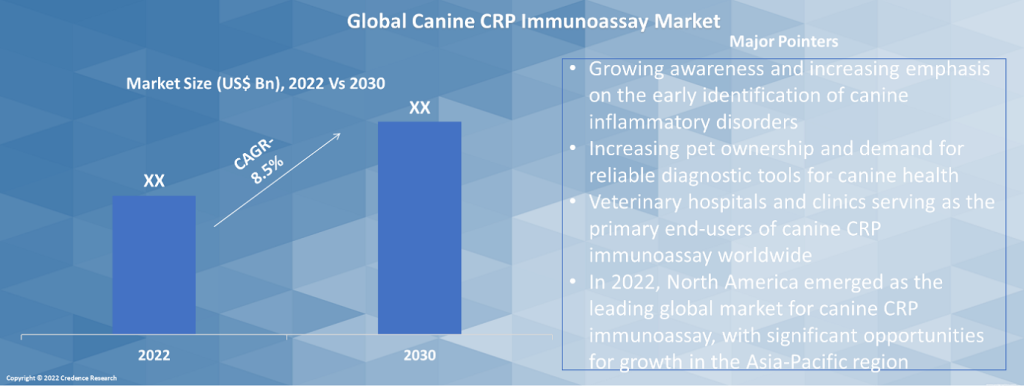
- The global demand for canine CRP immunoassay was valued at USD XX Billion in 2022 and is expected to reach USD XX Billion in 2030, growing at a CAGR of 8.5% between 2023 and 2030.
- Kits & Reagents are the leading product type segment, holding over 62% market share in 2022, while instruments are expected to experience the fastest market growth.
- ELISA (Enzyme-Linked Immunosorbent Assay) is the most widely adopted technology, accounting for a substantial market share of over 40% in 2022, and is anticipated to grow at a higher CAGR.
- The diagnosis application segment accounted for the largest share of 54% in the global canine CRP immunoassay market in 2022.
- Veterinary hospitals & clinics are the primary end-users, contributing to over 41% of the global market revenue share in 2022.
- North America leads the global market, commanding a market share of over 44% in 2022, while the Asia-Pacific region is emerging as a lucrative market for canine CRP immunoassay.
- The market is witnessing a trend towards point-of-care testing solutions, offering convenient and immediate results.
Market Overview
The global canine CRP immunoassay market has witnessed rapid growth in recent years and is estimated to grow at a CAGR of 8.5% between 2023 and 2030. The market was valued at USD XX billion in 2022 and is anticipated to reach USD XX billion in 2030.
Segmentation by Product Type
- The kits & reagents segment held over 62% market share in 2022, driven by their widespread usage and availability.
- The instruments segment is experiencing rapid growth and is expected to gain significant market traction in the coming years, fueled by technological advancements and increased adoption.
Segmentation by Technology
- The ELISA (Enzyme-Linked Immunosorbent Assay) segment dominated the market in 2022, capturing over 40% of the revenue, owing to its high sensitivity and specificity.
- The immunoturbidimetry segment is projected for high growth, attributed to its ability to provide quantitative results and its suitability for high-throughput testing.
Segmentation by Application
- The research segment is projected to have the highest CAGR in the forecast period, driven by increasing research activities and the demand for canine CRP immunoassay in preclinical and clinical studies.
- In 2022, the diagnosis segment held the largest market share, accounting for over 54% of the global revenue, as canine CRP immunoassay is widely used for the early detection and monitoring of inflammatory conditions in dogs.
Segmentation by End-User
- The veterinary hospitals & clinics segment dominated in 2022, contributing over 41% of the revenue, attributed to the high patient inflow and the growing need for accurate diagnostic tools in veterinary settings.
- The research institutes segment is expected to grow substantially, driven by ongoing research activities and collaborations in veterinary medicine.
Segmentation by Region
- North America held the largest market share in 2022, capturing 44% of the total revenue, driven by advanced healthcare infrastructure, high pet ownership, and increasing awareness about canine health.
- Europe is the second-largest market for canine CRP immunoassay, contributing significantly to the overall market share, owing to established veterinary healthcare systems and a growing pet population.
- The Asia-Pacific region is witnessing rapid adoption of canine CRP immunoassay, attributed to the increasing focus on pet healthcare, rising disposable income, and growing awareness about animal welfare.
- The rest of the world, including the Middle East, Latin America, and Africa, is swiftly adopting canine CRP immunoassay solutions fueled by improving veterinary infrastructure and the rising demand for advanced diagnostic tools.
The global canine CRP immunoassay market is driven by increasing pet ownership and the need for early disease detection in pets. However, limited awareness and access to advanced veterinary diagnostics in some regions and stringent regulatory processes pose challenges to market growth.
The United States is a major market for Canine CRP Immunoassay. It has a well-established veterinary healthcare system and a significant pet population. The country is highly aware of pet health and wellness, leading to a strong demand for accurate diagnostic tools. The U.S. is home to advanced medical technology companies and leading research institutes focused on veterinary medicine.
Germany is another key market for Canine CRP Immunoassay. The country has a strong veterinary healthcare infrastructure and a huge pet population. Germany is well-known for its emphasis on research and innovation in veterinary medicine. It is home to leading veterinary research facilities and colleges that conduct extensive animal health investigations. The availability of improved diagnostic methods and high awareness about pet healthcare fuel demand for Canine CRP Immunoassay in Germany.
Market Drivers
Several factors drive the global canine CRP immunoassay market. The following are the key drivers of the global canine CRP immunoassay market:
Increasing Pet Ownership and Humanization
The growing trend of pet humanization, where pets are considered family members, has led to an increased focus on their health and well-being. Pet owners are becoming more conscious of their pet’s health and are willing to invest in advanced diagnostic tools, including canine CRP immunoassay, for early disease detection and monitoring. This rise in pet ownership, coupled with the increasing willingness to spend on veterinary care, is a major driver for the global canine CRP immunoassay market growth.
Rising Prevalence of Canine Inflammatory Disorders
Canine inflammatory disorders, such as infections, arthritis, and autoimmune diseases, are becoming more common. These conditions can lead to severe health issues if not identified and treated promptly. Canine CRP immunoassay offers a reliable and rapid diagnostic solution to assess inflammatory responses, aiding in the early detection and management of these disorders. The escalating prevalence of such conditions propels the demand for canine CRP immunoassays worldwide.
Market Restraints
The global canine CRP immunoassay market faces challenges that may hinder its growth. These include the following:
Stringent Regulatory Approval Processes
The development and commercialization of veterinary diagnostic assays like Canine CRP Immunoassay require adherence to strict regulatory standards. Obtaining necessary approvals from regulatory authorities can take time and effort. This regulatory burden limits market entry for smaller companies and hinder overall market growth to a certain extent.
Opportunities
The global canine CRP immunoassay market offers significant growth opportunities. These include the following:
Advancements in Diagnostic Technology
Ongoing research and technological advancements in veterinary diagnostics present significant opportunities for canine CRP immunoassay. Improved assay sensitivity, portability, and integration with point-of-care testing platforms are some areas of opportunity that can enhance diagnostic accuracy and ease of use, expanding the market potential.
Competitive Landscape
Key Players
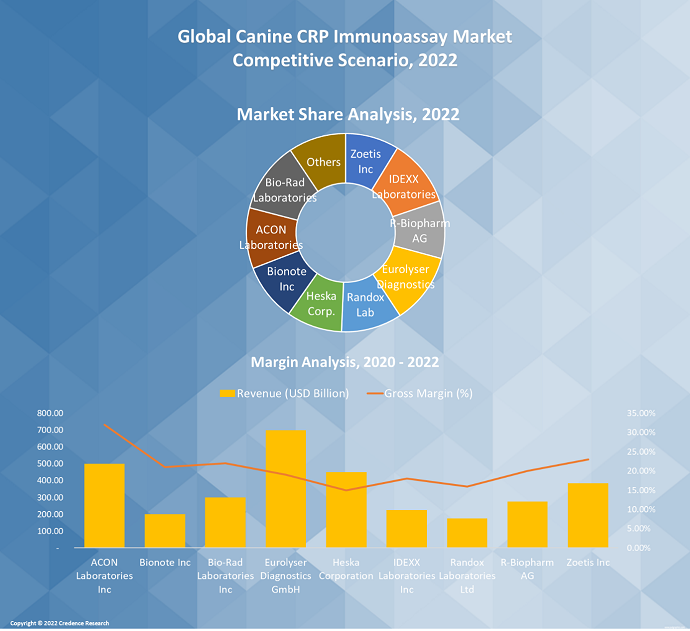
The global canine CRP immunoassay market is highly competitive, with several key players competing for market share. Some of the leading players in the global market and their market share are as follows:
- ACON Laboratories Inc
- Bionote Inc
- Bio-Rad Laboratories Inc
- Eurolyser Diagnostics GmbH
- Heska Corporation
- IDEXX Laboratories Inc
- Randox Laboratories Ltd
- R-Biopharm AG
- Zoetis Inc
These market companies focus on product development, technological advancements, and strategic collaborations to strengthen their global market position. Besides, investments in research and development activities, expansion into untapped markets, and marketing initiatives are key strategies market players adopt to gain a competitive edge. The competitive landscape is dynamic, with a mix of established players and emerging companies vying for market share and aiming to cater to the growing demand for accurate and reliable diagnostic solutions for canine health.
For example, in March 2021, Boditech Med began building a new research and development facility in Chuncheon, South Korea. It planned to finish the new structure by March 2022 after investing USD 6 million.
Summary of Key Findings
- The global canine CRP immunoassay market is experiencing steady growth owing to the increasing prevalence of inflammatory disorders in dogs and the rising demand for accurate diagnostic tools in veterinary healthcare.
- Market segmented by product type, technology, application, end-user, and region.
- ELISA (Enzyme-Linked Immunosorbent Assay) is the leading technology, while immunoturbidimetry shows high growth potential.
- North America and Europe are the leading markets for canine CRP immunoassay, attributed to well-established veterinary healthcare infrastructure and higher pet ownership rates.
- Technological advancements in immunoassay methods have improved the accuracy and reliability of canine CRP immunoassay tests.
Future Outlook
- Emerging research and development activities across the field of veterinary diagnostics are promoting the launch of new and enhanced canine CRP immunoassay products.
- Increasing focus on personalized medicine and tailored treatment options for canine inflammatory disorders will create avenues for market growth.
- The rising trend of pet insurance coverage and reimbursement for veterinary diagnostics will contribute to the wider adoption of canine CRP immunoassay by veterinary clinics and hospitals.
Segmentation
- By Product Type
- Kits & Reagents
- Instruments
- By Technology
- ELISA (Enzyme-Linked Immunosorbent Assay)
- Immunoturbidimetry
- Chemiluminescence Immunoassay
- Fluorescence Immunoassay
- By Application
- Diagnosis
- Research
- By End-User
- Veterinary Reference Laboratories
- Veterinary Hospitals & Clinics
- Research Institutes
- By Region
- North America
- The U.S.
- Canada
- Mexico
- Europe
- Germany
- France
- The U.K.
- Italy
- Spain
- Rest of Europe
- Asia Pacific
- China
- Japan
- India
- South Korea
- South-east Asia
- Rest of Asia Pacific
- Latin America
- Brazil
- Argentina
- Rest of Latin America
- Middle East & Africa
- GCC Countries
- South Africa
- Rest of the Middle East and Africa

Request a Free Sample
Fill in your details and we'll send you a free sample report.
- Sample data tables & charts
- Research methodology
Market Dynamics
Increasing Pet Ownership and Humanization
The growing trend of treating pets as family members has led to higher spending on veterinary care, including advanced diagnostics like canine CRP immunoassays, to ensure early disease detection and better health outcomes for dogs.
Rising Prevalence of Canine Inflammatory Disorders
The increasing incidence of inflammatory conditions such as infections, arthritis, and autoimmune diseases in dogs is driving demand for reliable diagnostic tools like CRP immunoassays, which enable early identification and effective management of these disorders.
Advancements in Veterinary Diagnostic Technology
Ongoing innovations in immunoassay methods, such as improved ELISA sensitivity and the development of point-of-care testing platforms, are making canine CRP immunoassays more accurate, accessible, and user-friendly, thus expanding their adoption.
Expansion of Veterinary Healthcare Infrastructure
The growth and modernization of veterinary clinics, hospitals, and reference laboratories - especially in emerging markets - are increasing the availability and use of advanced diagnostic solutions, including canine CRP immunoassays.
Growing Focus on Preventive and Personalized Veterinary Medicine
Veterinarians and pet owners are increasingly prioritizing preventive care and tailored treatment plans, which rely on precise diagnostic tools like CRP immunoassays to monitor inflammatory status and guide clinical decisions.
Need a Custom Version of This Report?
Tailor the scope, geography, or segments to your exact requirements.
- Custom geography or segment scope
- Direct access to our analyst team
Frequently Asked Questions
What is the current size of the global canine CRP immunoassay market?
What is the anticipated growth rate of the canine CRP immunoassay market between 2023 and 2030?
Which segment is leading the market share in terms of product type?
Which technology segment governs the global demand for canine CRP immunoassay?
Which application segment is estimated to post the highest CAGR during the forecast period?
Which region is fuelling the growth of the canine CRP immunoassay industry?
Who are the major global canine CRP immunoassay market players?
What are the major market drivers of the canine CRP immunoassay industry?
What are the major market restraints of the canine CRP immunoassay industry?
What are the major market opportunities of the canine CRP immunoassay industry?
Table of Content
Chapter 1 Market Segmentation
- 1.1 Segmentation Framework
- 1.1.1 Product and Service Classification
- 1.1.2 Application and End-Use Classification
- 1.1.3 Technology and Solution Classification
- 1.1.4 Customer and Distribution Channel Classification
- 1.1.5 Geographic Segmentation
- 1.1.6 Market Segment Definitions and Boundaries
- 1.2 By End-User
- 1.2.1 Veterinary Reference Laboratories
- 1.2.2 Veterinary Hospitals & Clinics
- 1.2.3 Research Institutes
- 1.3 By Technology
- 1.3.1 ELISA (Enzyme-Linked Immunosorbent Assay)
- 1.3.2 Immunoturbidimetry
- 1.3.3 Chemiluminescence Immunoassay
- 1.3.4 Fluorescence Immunoassay
- 1.4 By Application
- 1.4.1 Diagnosis
- 1.4.2 Research
- 1.5 By Product Type
- 1.5.1 Kits & Reagents
- 1.5.2 Instruments
Chapter 2 Introduction
- 2.1 Report Objectives and Scope
- 2.2 Product Definition and Industry Terminology
- 2.3 Market Inclusions and Exclusions
- 2.4 Research Process
- 2.4.1 Primary Research and Expert Interviews
- 2.4.2 Secondary Research and Source Review
- 2.4.3 Top-Down and Bottom-Up Estimation
- 2.4.4 Data Triangulation and Verification
- 2.5 Research Assumptions and Limitations
Chapter 3 Executive Summary
- 3.1 Market Snapshot and Key Findings
- 3.2 Base-Year Market Size
- 3.3 Forecast Market Size
- 3.4 Revenue and Volume Growth Outlook
- 3.5 Key Demand and Supply Indicators
- 3.6 Leading Market Segments
- 3.7 Fastest-Growing Market Opportunities
- 3.8 Regional Performance Highlights
- 3.9 Technology and Industry Transformation
- 3.10 Competitive Landscape Summary
- 3.11 Analyst View and Strategic Implications
Chapter 4 Global Canine CRP Immunoassay Market Trends and Developments
- 4.1 Historical Industry Development
- 4.2 Recent Market Trends and Developments
- 4.3 Demand and Customer Behavior Trends
- 4.4 Technology and Product Innovation
- 4.5 Artificial Intelligence, Automation and Digitalization
- 4.6 Local Manufacturing and Supply Chain Realignment
- 4.7 Industry Partnerships, Mergers and Acquisitions
- 4.8 Sustainability and Circular Economy Developments
- 4.9 Government and Private Sector Investment Trends
- 4.10 Emerging Business Models and Commercialization
- 4.11 Industry Developments and Announcements
Chapter 5 Global Canine CRP Immunoassay Market Production, Supply and Demand Analysis
- 5.1 Demand Trend and Consumption Analysis
- 5.2 Demand Forecast
- 5.3 Production and Output Trend
- 5.4 Production and Output Forecast
- 5.5 Installed Capacity and Capacity Utilization
- 5.6 Company-Wise Production Plants and Statistics
- 5.6.1 Installed Production Capacity
- 5.6.2 Actual Production
- 5.6.3 Planned Capacity and Expansion Targets
- 5.7 Supply Chain Structure and Procurement Trends
- 5.8 Supply-Demand Gap and Bottlenecks
- 5.9 Import Dependence and Sourcing Structure
- 5.10 Contract Manufacturing and Outsourcing
- 5.11 Regional Supply and Demand Concentration
Chapter 6 Global Canine CRP Immunoassay Market Pricing Analysis
- 6.1 Pricing Structure and Measurement
- 6.2 Historical Pricing Trends
- 6.3 Pricing Outlook
- 6.4 Average Selling Price and Unit Economics
- 6.5 Pricing by Product and Market Segment
- 6.6 Geographic Pricing Differences
- 6.7 Key Input, Energy, Labor and Logistics Costs
- 6.8 Contract Pricing and Purchasing Models
- 6.9 Pricing Sensitivity and Competitive Positioning
- 6.10 Price, Margin and Profitability Implications
Chapter 7 Global Canine CRP Immunoassay Market Dynamics
- 7.1 Market Growth Drivers
- 7.1.1 Demand-Side Drivers
- 7.1.2 Technology and Innovation Drivers
- 7.1.3 Infrastructure and Investment Drivers
- 7.1.4 Regulatory and Policy Drivers
- 7.2 Market Restraints
- 7.2.1 Cost and Affordability Constraints
- 7.2.2 Technology and Adoption Barriers
- 7.2.3 Supply Chain and Operational Constraints
- 7.3 Market Challenges
- 7.3.1 Competitive Pressure and Margin Erosion
- 7.3.2 Skills, Infrastructure and Implementation Gaps
- 7.4 Emerging Market Opportunities
- 7.5 Market Dynamics Impact and Time-Horizon Assessment
Chapter 8 Global Canine CRP Immunoassay Value Chain Analysis
- 8.1 Industry Value Chain Overview
- 8.2 Upstream Suppliers and Critical Inputs
- 8.3 Technology and Component Providers
- 8.4 Manufacturing or Service Delivery
- 8.5 Distribution, Channel Partners and Integrators
- 8.6 Downstream Applications and End Users
- 8.7 Value Addition and Profit Pools
- 8.8 Vertical Integration and Outsourcing
- 8.9 Supplier Concentration and Risk
- 8.10 Supply Chain Localization and Resilience
Chapter 9 Global Canine CRP Immunoassay Market Regulations and Policies
- 9.1 Relevant Laws, Standards and Compliance Frameworks
- 9.2 Product, Service, Safety and Quality Requirements
- 9.3 Government Policies, Incentives and Subsidies
- 9.4 Imports, Exports and Trade Barriers
- 9.5 Public Procurement and Local Content Requirements
- 9.6 Environmental and Sustainability Compliance
- 9.7 Upcoming Policy Changes and Market Implications
Chapter 10 Global Canine CRP Immunoassay Market Hotspots and Opportunities
- 10.1 Market Opportunity Mapping and Growth Hotspots
- 10.2 High-Growth Applications and Customer Groups
- 10.3 Underserved Markets and White-Space Opportunities
- 10.4 Emerging Technology and Product Opportunities
- 10.5 New Capacity and Investment Hotspots
- 10.6 Market Entry and Expansion Opportunities
- 10.7 Distribution and Partnership Opportunities
- 10.8 Near-Term and Long-Term Commercial Potential
- 10.9 Opportunity Attractiveness and Execution Risks
Chapter 11 Global Canine CRP Immunoassay Market Outlook
- 11.1 Market Size and Analysis
- 11.1.1 Revenue
- 11.1.2 Market Volume and Quantity Sold
- 11.1.3 Historical Market Size
- 11.1.4 Base-Year Market Size
- 11.2 Market Forecast
- 11.2.1 Revenue Forecast
- 11.2.2 Volume Forecast
- 11.2.3 CAGR and Year-on-Year Growth
- 11.2.4 Incremental Revenue Opportunity
- 11.3 Forecast Assumptions and Scenario Analysis
- 11.3.1 Base-Case Forecast
- 11.3.2 Optimistic and Conservative Scenarios
- 11.3.3 Technology, Pricing and Policy Sensitivities
- 11.4 Market Attractiveness and Growth Outlook
Chapter 12 Global Canine CRP Immunoassay Market Segmentation and Outlook
- 12.1 Segmentation Summary and Market Shares
- 12.2 Largest and Fastest-Growing Segments
- 12.3 By End-User - Market Size and Forecast
- 12.3.1 Segment Definition and Scope
- 12.3.2 Historical Market Size
- 12.3.3 Revenue Forecast
- 12.3.4 Volume Forecast
- 12.3.5 Base-Year Market Share
- 12.3.6 Segment CAGR and Growth Drivers
- 12.3.7 Subsegment Market Size and Forecast
- 12.3.7.1 Veterinary Reference Laboratories
- 12.3.7.2 Veterinary Hospitals & Clinics
- 12.3.7.3 Research Institutes
- 12.3.8 Subsegment Pricing and Adoption Trends
- 12.3.9 Leading Suppliers and Competition
- 12.3.10 Regional Demand and Opportunities
- 12.4 By Technology - Market Size and Forecast
- 12.4.1 Segment Definition and Scope
- 12.4.2 Historical Market Size
- 12.4.3 Revenue Forecast
- 12.4.4 Volume Forecast
- 12.4.5 Base-Year Market Share
- 12.4.6 Segment CAGR and Growth Drivers
- 12.4.7 Subsegment Market Size and Forecast
- 12.4.7.1 ELISA (Enzyme-Linked Immunosorbent Assay)
- 12.4.7.2 Immunoturbidimetry
- 12.4.7.3 Chemiluminescence Immunoassay
- 12.4.7.4 Fluorescence Immunoassay
- 12.4.8 Subsegment Pricing and Adoption Trends
- 12.4.9 Leading Suppliers and Competition
- 12.4.10 Regional Demand and Opportunities
- 12.5 By Application - Market Size and Forecast
- 12.5.1 Segment Definition and Scope
- 12.5.2 Historical Market Size
- 12.5.3 Revenue Forecast
- 12.5.4 Volume Forecast
- 12.5.5 Base-Year Market Share
- 12.5.6 Segment CAGR and Growth Drivers
- 12.5.7 Subsegment Market Size and Forecast
- 12.5.7.1 Diagnosis
- 12.5.7.2 Research
- 12.5.8 Subsegment Pricing and Adoption Trends
- 12.5.9 Leading Suppliers and Competition
- 12.5.10 Regional Demand and Opportunities
- 12.6 By Product Type - Market Size and Forecast
- 12.6.1 Segment Definition and Scope
- 12.6.2 Historical Market Size
- 12.6.3 Revenue Forecast
- 12.6.4 Volume Forecast
- 12.6.5 Base-Year Market Share
- 12.6.6 Segment CAGR and Growth Drivers
- 12.6.7 Subsegment Market Size and Forecast
- 12.6.7.1 Kits & Reagents
- 12.6.7.2 Instruments
- 12.6.8 Subsegment Pricing and Adoption Trends
- 12.6.9 Leading Suppliers and Competition
- 12.6.10 Regional Demand and Opportunities
- 12.7 Segment Growth Comparison
- 12.8 Segment Attractiveness and Priority Matrix
Chapter 13 Global Canine CRP Immunoassay End-Use and Application Market Outlook
- 13.1 End-Use Industry and Customer Demand Structure
- 13.2 Leading Applications and Customer Groups
- 13.3 End-Use Market Size, Share and Forecast
- 13.4 Major End-Use Industry Deep Dives
- 13.4.1 Customer Requirements and Use Cases
- 13.4.2 Demand and Replacement Cycles
- 13.4.3 Technical and Regulatory Considerations
- 13.4.4 Purchasing and Procurement Models
- 13.4.5 Leading Vendors and Distribution Channels
- 13.4.6 Forecast and Commercial Opportunities
- 13.5 Emerging Applications and Cross-Segment Demand
- 13.6 End-Use Industry Investment Priorities
Chapter 14 Global Canine CRP Immunoassay Geographic Market Outlook
- 14.1 Regional Market Size and Share
- 14.2 Regional Market Forecast
- 14.3 Regional Pricing, Production and Demand Differences
- 14.4 North America
- 14.4.1 United States
- 14.4.2 Canada
- 14.4.3 Mexico
- 14.5 Europe
- 14.5.1 Germany
- 14.5.2 France
- 14.5.3 Italy
- 14.5.4 United Kingdom
- 14.5.5 Spain
- 14.5.6 Poland
- 14.5.7 Russia
- 14.5.8 Netherlands
- 14.5.9 Belgium
- 14.5.10 Sweden
- 14.5.11 Denmark
- 14.5.12 Norway
- 14.5.13 Rest of Europe
- 14.6 Asia Pacific
- 14.6.1 China
- 14.6.2 India
- 14.6.3 Japan
- 14.6.4 South Korea
- 14.6.5 Thailand
- 14.6.6 Indonesia
- 14.6.7 Vietnam
- 14.6.8 Malaysia
- 14.6.9 Australia
- 14.6.10 Rest of Asia Pacific
- 14.7 Latin America
- 14.7.1 Brazil
- 14.7.2 Argentina
- 14.7.3 Colombia
- 14.7.4 Chile
- 14.7.5 Rest of Latin America
- 14.8 Middle East
- 14.8.1 Saudi Arabia
- 14.8.2 United Arab Emirates
- 14.8.3 Turkey
- 14.8.4 Israel
- 14.8.5 Iran
- 14.8.6 Rest of the Middle East
- 14.9 Africa
- 14.9.1 South Africa
- 14.9.2 Egypt
- 14.9.3 Nigeria
- 14.9.4 Morocco
- 14.9.5 Rest of Africa
- 14.10 Regional Investment, Policy and Supply Chain Differences
- 14.11 Regional Competitive Landscape
- 14.12 Geographic Growth Hotspots
Chapter 15 Global Canine CRP Immunoassay Technology, Innovation and Sustainability Outlook
- 15.1 Technology Landscape and Maturity
- 15.2 Product, Process and Service Innovation
- 15.3 AI, Automation and Digital Tools in the Industry
- 15.4 Technology Adoption and Performance Benchmarking
- 15.5 Innovation Pipeline and R&D Investment
- 15.6 Patent and Intellectual Property Trends
- 15.7 Energy Efficiency and Resource Management
- 15.8 Sustainability, Recycling and Circularity
- 15.9 Technology Roadmap
- 15.10 Risks of Obsolescence and Technology Substitution
Chapter 16 Global Canine CRP Immunoassay Market Key Strategic Imperatives
- 16.1 Growth and Market Entry Priorities
- 16.2 High-Return Products and Segments
- 16.3 Pricing, Profitability and Cost Optimization
- 16.4 Technology Investment and Product Differentiation
- 16.5 Supply Chain Localization and Resilience
- 16.6 Distribution and Customer Acquisition
- 16.7 Partnership, Acquisition and Capacity Strategy
- 16.8 Regional Expansion Priorities
- 16.9 Short-, Medium- and Long-Term Actions
Chapter 17 Competition Outlook
- 17.1 Industry Competition Characteristics
- 17.2 Market Structure and Concentration
- 17.3 Market Share and Competitive Positioning
- 17.4 Company-Wise Revenue and Product Benchmarking
- 17.5 Production and Service Capacity Benchmarking
- 17.6 Technology, Pricing and Differentiation
- 17.7 Regional Footprint and Distribution Strength
- 17.8 Mergers, Acquisitions and Strategic Alliances
- 17.9 New Entrants and Competitive Threats
- 17.10 Porter's Five Forces and Industry Attractiveness
- 17.11 Competitive Outlook
Chapter 18 Company Profiles
- 18.1 Company Coverage and Selection Criteria
- 18.2 IDEXX Laboratories Inc
- 18.2.1 Business Description
- 18.2.2 Company Ownership and Geographic Presence
- 18.2.3 Product and Service Portfolio
- 18.2.4 Manufacturing and Operating Footprint
- 18.2.5 Production Capacity and Expansion Plans
- 18.2.6 Financial Performance and Investment
- 18.2.7 Market Share and Competitive Position
- 18.2.8 Technology and Innovation Capabilities
- 18.2.9 Strategic Alliances or Partnerships
- 18.2.10 Recent Developments
- 18.2.11 Growth Strategy and Outlook
- 18.3 Zoetis Inc
- 18.4 Heska Corporation
- 18.5 Bionote Inc
- 18.6 Bio-Rad Laboratories Inc
- 18.7 Eurolyser Diagnostics GmbH
- 18.8 Randox Laboratories Ltd
- 18.9 R-Biopharm AG
- 18.10 ACON Laboratories Inc
- 18.11 Boditech Med
- 18.12 Other Relevant Market Participants
Note: Every listed company is profiled on the structure shown under the first company. The company list is preliminary and may change based on research findings, market developments, data availability and client requirements.
Chapter 19 Disclaimer
- 19.1 Research and Forecast Disclaimer
- 19.2 Data Source and Estimation Limitations
Note: The depth of individual sections depends on data availability for this market. Volume, capacity, trade and other unit-based metrics are included where applicable.