
Market Overview:
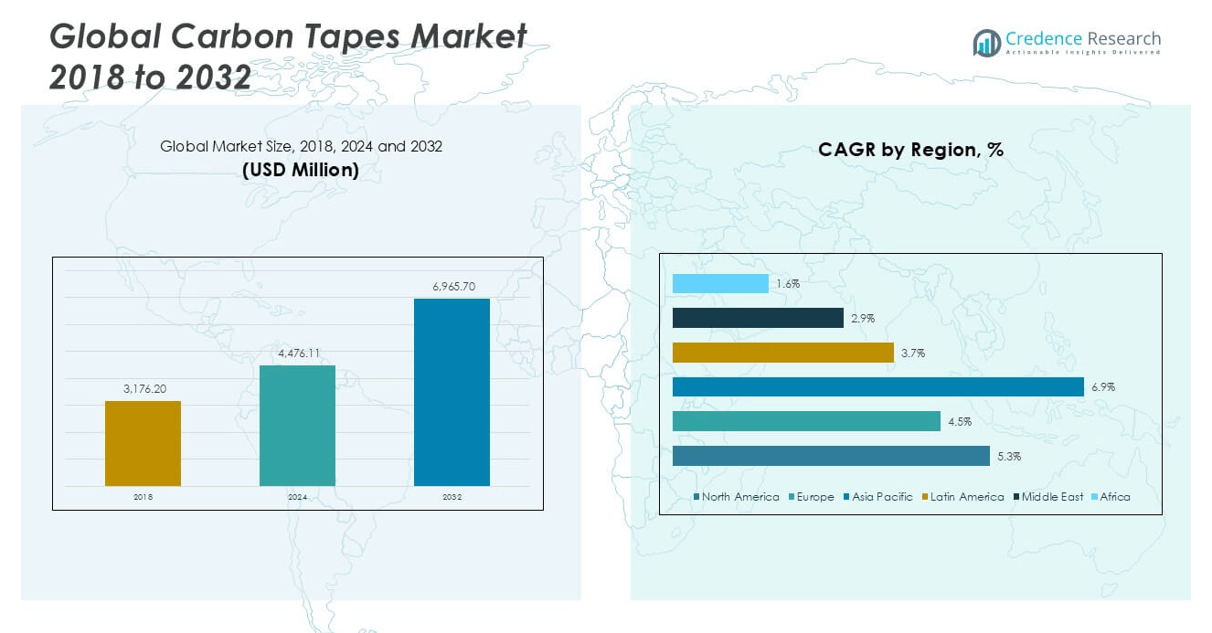
The Carbon Tapes market size was valued at USD 3,176.20 million in 2018, increased to USD 4,476.11 million in 2024, and is anticipated to reach USD 6,965.70 million by 2032, at a CAGR of 5.29% during the forecast period.
| REPORT ATTRIBUTE | DETAILS |
|---|---|
| Historical Period | 2020-2023 |
| Base Year | 2024 |
| Forecast Period | 2025-2032 |
| Carbon Tapes Market Size 2024 | USD 4,476.11 million |
| Carbon Tapes Market, CAGR | 5.29% |
| Carbon Tapes Market Size 2032 | USD 6,965.70 million |
The Carbon Tapes market is led by key players such as Hexcel Corporation, Toray Industries, Inc., Teijin Limited, SGL Carbon SE, Mitsubishi Chemical Holdings Corporation, DowAksa Advanced Composites, Solvay S.A., Zoltek Companies, Inc., Cytec Solvay Group, and Owens Corning. These companies maintain competitive advantages through robust R&D, diversified product portfolios, and strategic partnerships across high-growth sectors like aerospace, automotive, and construction. North America dominates the global Carbon Tapes market with a 42.7% share in 2024, driven by strong demand from the aerospace and defence industries, particularly in the United States. Europe and Asia Pacific follow, supported by increasing adoption of lightweight composite materials and advanced manufacturing capabilities. The leading players continue to invest in technological innovation and global expansion to capture emerging opportunities and reinforce their market positions.
Market Insights
- The Carbon Tapes market was valued at USD 4,476.11 million in 2024 and is projected to reach USD 6,965.70 million by 2032, growing at a CAGR of 5.29% during the forecast period.
- The market is driven by increasing demand from aerospace and defence sectors, where carbon tapes offer high strength-to-weight ratio and thermal stability, along with growing usage in automotive lightweighting to enhance fuel efficiency and reduce emissions.
- A notable trend is the rising adoption of prepreg tapes, which held around 65% of the form segment share in 2024, due to their superior quality control and compatibility with automated manufacturing processes.
- The competitive landscape features major players such as Hexcel Corporation, Toray Industries, and Teijin Limited, who are investing in R&D and regional expansions to maintain market leadership amid growing competition.
- North America led the market with a 42.7% share in 2024, followed by Europe at 27.7% and Asia Pacific at 21%, while high production costs remain a key restraint.
Market Segmentation Analysis:
By Resin Type
The epoxy resin segment held the dominant share in the Carbon Tapes market, accounting for over 40% of the total market in 2024. This dominance is driven by epoxy’s superior mechanical properties, high thermal resistance, and excellent adhesion characteristics, making it highly suitable for aerospace and automotive applications. Thermoplastic resins are also witnessing notable growth due to their recyclability and fast processing advantages. Polyamide and other resin types occupy smaller shares but serve niche applications in construction and industrial sectors where flexibility and chemical resistance are prioritized.
- For instance, Solvay’s CYCOM® 5320-1 epoxy prepreg system has demonstrated curing at 180°C with a glass transition temperature exceeding 200°C, providing superior performance in aerospace structural components.
By Form:
Prepreg tapes emerged as the leading form segment, capturing approximately 65% of the Carbon Tapes market share in 2024. Their dominance stems from high demand in high-performance industries such as aerospace and defense, where consistent quality and precision are critical. Pre-impregnated with resin, these tapes simplify the manufacturing process and enhance structural integrity. Dry tapes, while less dominant, are gaining traction for their ease of handling, cost-effectiveness, and flexibility in applications such as automotive components and repair structures, where post-impregnation processes are preferred.
- For instance, Hexcel’s unidirectional carbon prepreg tape, HexPly® M21, has been used in Airbus A350 XWB production with a fiber areal weight of 145 gsm and resin content of 35%, enabling high throughput and strength-to-weight optimization.
By End Use:
Aerospace & defence represented the largest end-use segment, contributing around 45% to the global Carbon Tapes market in 2024. The segment’s growth is driven by increasing use of lightweight, high-strength composite materials in aircraft components to improve fuel efficiency and performance. Automotive is the second-largest segment, propelled by the industry’s shift toward lightweight materials for emission reduction and enhanced vehicle dynamics. The marine and building & construction sectors are steadily adopting carbon tapes for structural reinforcement and corrosion resistance, while the “Others” category covers niche industrial applications requiring thermal and mechanical durability.
Market Overview
Rising Demand from Aerospace & Defence Sector
The aerospace and defence industry is a major growth driver for the carbon tapes market. Carbon tapes offer superior strength-to-weight ratio, corrosion resistance, and thermal stability, making them ideal for structural components in aircraft, satellites, and defence vehicles. As global air travel expands and defence modernization programs increase, the demand for advanced composite materials continues to rise. Additionally, the industry's emphasis on fuel efficiency and emissions reduction further supports the integration of carbon tapes in aircraft design, reinforcing their critical role in next-generation aerospace applications.
- For instance, Toray carbon tapes were integrated into Boeing 787 Dreamliner fuselage sections, which use 50% composite materials by weight, helping achieve a 20% reduction in fuel consumption compared to previous models.
Lightweighting Trends in the Automotive Industry
The automotive sector is increasingly adopting carbon tapes to meet strict fuel efficiency and emission norms. Carbon tapes provide excellent structural reinforcement while significantly reducing vehicle weight. Automakers are incorporating these materials in body panels, drive shafts, and interior parts to enhance performance without compromising safety. The shift towards electric vehicles (EVs) further amplifies this trend, as lightweight components are crucial for improving battery efficiency and vehicle range. This ongoing emphasis on lightweighting presents sustained growth opportunities for carbon tape manufacturers across global automotive markets.
- For instance, SGL Carbon developed a carbon tape-reinforced drive shaft for BMW 7 Series that reduced component weight by 50% compared to traditional steel shafts while maintaining equivalent torsional strength of 5000 Nm.
Advancements in Composite Manufacturing Technologies
echnological advancements in composite manufacturing, such as automated fiber placement (AFP) and resin transfer molding (RTM), are accelerating the adoption of carbon tapes. These technologies enable precise and efficient application of carbon tapes, improving production speed and material performance. Enhanced automation reduces labor costs and material waste, making carbon tape integration more cost-effective for large-scale applications. As industries seek innovative solutions to streamline production and meet high-performance demands, the synergy between advanced manufacturing techniques and carbon tape utility significantly boosts market growth.
Key Trends & Opportunities
Growing Use in Renewable Energy Applications
The expansion of renewable energy infrastructure presents new opportunities for carbon tapes, particularly in wind energy. Turbine blades require materials with high stiffness and fatigue resistance, and carbon tapes meet these criteria effectively. Their use in strengthening large composite blades contributes to longer service life and greater energy efficiency. As countries invest in decarbonization and sustainable power sources, the demand for high-performance materials like carbon tapes in wind turbine manufacturing is expected to rise, creating promising avenues for market expansion.
- For instance, Mitsubishi Chemical’s carbon fiber tapes were utilized in 80-meter rotor blades manufactured by LM Wind Power, which extended turbine capacity to 10 MW while withstanding tip speeds of up to 90 m/s.
Emerging Demand in Sports & Leisure Equipment
Carbon tapes are finding increasing applications in the sports and leisure industry due to their lightweight and high-strength properties. They are used in manufacturing performance-driven equipment such as bicycles, hockey sticks, fishing rods, and racquets. Consumers’ growing preference for durable and lightweight products, along with the premiumization trend in sports gear, drives demand. The industry’s emphasis on innovation and product differentiation further encourages manufacturers to incorporate carbon tapes for enhanced mechanical properties, opening niche but profitable growth segments.
- For instance, Teijin’s carbon fiber tapes were used in Trek’s Émonda SLR bicycles, enabling frame weight reduction to 698 grams while maintaining impact resistance over 120 J, significantly improving rider acceleration and durability.
Key Challenges
High Production and Material Costs
Despite their advantages, carbon tapes remain cost-prohibitive for many industries. The high cost of raw carbon fibers and advanced processing techniques limits adoption, especially in price-sensitive sectors. Manufacturing carbon tapes involves energy-intensive procedures and strict quality control, further driving up operational expenses. This cost barrier hinders mass-market penetration and confines usage to high-performance or luxury applications. Market growth could slow unless innovations in production techniques bring down costs and enhance affordability without compromising quality.
Limited Recycling and Environmental Concerns
The carbon tapes market faces challenges related to sustainability and end-of-life recycling. Most carbon fiber-reinforced materials are difficult to recycle due to their thermoset matrix compositions and complex fiber structures. As environmental regulations tighten, particularly in Europe and North America, manufacturers are under pressure to develop more sustainable and recyclable composite solutions. Failure to address these concerns may restrict usage across environmentally regulated sectors, prompting the need for eco-friendly alternatives and improved recycling technologies.
Skilled Workforce and Technical Barriers
Implementing carbon tapes in advanced applications requires specialized expertise in composite design, handling, and processing. The shortage of trained professionals and the complexity of working with carbon materials can hinder adoption in emerging markets or smaller manufacturing units. Additionally, improper application can lead to performance issues or product failure, raising concerns over safety and reliability. Overcoming this challenge will require investments in workforce training and the development of user-friendly application technologies to broaden market accessibility.
Regional Analysis
North America:
North America held the largest share in the global Carbon Tapes market in 2024, accounting for approximately 42.7% with a market value of USD 1,910.25 million, up from USD 1,369.89 million in 2018. The market is projected to reach USD 2,981.08 million by 2032, growing at a CAGR of 5.3% during the forecast period. This growth is driven by strong demand from aerospace and defence industries, along with automotive applications prioritizing lightweight and high-performance materials. Technological advancements and established composite manufacturing infrastructure further support regional dominance, particularly in the United States.
Europe:
Europe accounted for around 27.7% of the global Carbon Tapes market in 2024, with a market value of USD 1,240.39 million, up from USD 912.65 million in 2018. The region is expected to reach USD 1,818.83 million by 2032, expanding at a CAGR of 4.5%. Growth is supported by stringent emission regulations and a strong presence of automotive and aerospace OEMs, especially in Germany, France, and the UK. The increasing use of advanced composite materials in structural applications and government investments in sustainable technologies further bolster market growth across the region.
Asia Pacific:
Asia Pacific captured approximately 21% of the global Carbon Tapes market in 2024, with a value of USD 941.62 million, rising from USD 616.91 million in 2018. The market is projected to reach USD 1,657.87 million by 2032, at the highest regional CAGR of 6.9%. Rapid industrialization, growing aerospace and automotive production, and increasing adoption of composites in wind energy applications drive growth. China, Japan, and India are major contributors to regional expansion, supported by rising investments in infrastructure and local composite manufacturing capabilities.
Latin America:
Latin America held a modest 4.8% share of the global Carbon Tapes market in 2024, with a market value of USD 213.25 million, up from USD 153.19 million in 2018. The market is forecasted to reach USD 294.53 million by 2032, growing at a CAGR of 3.7%. Growth is primarily driven by expanding applications in the automotive and construction sectors in countries like Brazil and Mexico. While the market remains smaller compared to other regions, increasing foreign investments and gradual infrastructure modernization are expected to contribute to steady market development.
Middle East:
The Middle East accounted for about 2.4% of the global Carbon Tapes market in 2024, with a value of USD 106.65 million, rising from USD 83.32 million in 2018. The market is anticipated to reach USD 138.11 million by 2032, registering a CAGR of 2.9%. Demand is supported by construction and marine applications, particularly in Gulf Cooperation Council (GCC) countries. However, the market’s expansion is limited by low adoption of advanced composites in local industries. Government initiatives promoting industrial diversification could offer new opportunities for carbon tape usage in future infrastructure projects.
Africa:
Africa contributed a minimal 1.4% share to the global Carbon Tapes market in 2024, with a market size of USD 63.95 million, up from USD 40.23 million in 2018. The market is expected to reach USD 75.28 million by 2032, growing at a CAGR of 1.6%, the lowest among all regions. Limited industrial infrastructure and lower awareness of composite material benefits restrict market growth. Nonetheless, slow but steady developments in the construction and transportation sectors, along with regional efforts toward modernization, may gradually enhance demand for carbon tapes across select African economies.
Market Segmentations:
By Resin Type:
- Epoxy
- Thermoplastic
- Polyamide
- Others
By Form:
- Prepreg Tapes
- Dry Tapes
By End Use:
- Aerospace & Defence
- Automotive
- Marine
- Building & Construction
- Others
By Geography
- North America
- U.S.
- Canada
- Mexico
- Europe
- Germany
- France
- U.K.
- Italy
- Spain
- Rest of Europe
- Asia Pacific
- China
- Japan
- India
- South Korea
- South-east Asia
- Rest of Asia Pacific
- Latin America
- Brazil
- Argentina
- Rest of Latin America
- Middle East & Africa
- GCC Countries
- South Africa
- Rest of the Middle East and Africa
Competitive Landscape
The competitive landscape of the Carbon Tapes market is characterized by the presence of several prominent players focusing on technological advancements, strategic collaborations, and capacity expansions to strengthen their market positions. Key companies such as Hexcel Corporation, Toray Industries, Teijin Limited, and Mitsubishi Chemical Holdings dominate the market with comprehensive product portfolios and strong global distribution networks. These players invest heavily in research and development to enhance performance characteristics such as tensile strength, thermal stability, and lightweight properties to meet the evolving demands of aerospace, automotive, and industrial applications. Mergers and acquisitions are also common, aimed at expanding regional footprints and diversifying product offerings. Emerging players and regional manufacturers are entering the market with cost-effective and application-specific carbon tape solutions, intensifying competition. Additionally, companies are increasingly focusing on sustainable production and recyclable composites to align with environmental regulations and market demand for eco-friendly materials, thereby shaping future market dynamics.
Key Player Analysis
- Hexcel Corporation
- Toray Industries, Inc.
- Teijin Limited
- SGL Carbon SE
- Mitsubishi Chemical Holdings Corporation
- DowAksa Advanced Composites
- Solvay S.A.
- Zoltek Companies, Inc.
- Cytec Solvay Group
- Owens Corning
Recent Developments
- In June 2025, Hexcel highlighted its new HexPly M51 prepreg at the Paris Air Show, a rapid-curing material designed for faster aerospace part production using automated processes. This prepreg allows for quicker cure cycles, reduced tooling needs, and supports high-rate manufacturing while maintaining high mechanical performance.
- In March 2024, Hexcel, together with Arkema and European institutions, completed a demonstrator aeronautical structure using HexPly thermoplastic carbon fiber tape with PEKK resin and IM carbon fibers with in-situ welding under the HAICoPAS project.
- In July 2023, Toray announced a major carbon fiber capacity expansion, increasing production at its South Carolina (USA) and Gumi (South Korea) facilities. This expansion, slated to be completed by 2025, will boost annual production by over 20% to 35,000 tons, primarily to meet rising demand for clean energy and hydrogen storage solutions.
- In January 2022, TORAY INDUSTRIES INC developed a new analytical technique for multi-material structures using unidirectional adhesive tape.
Market Concentration & Characteristics
The Carbon Tapes Market exhibits a moderately concentrated structure, with a few key players accounting for a significant share of global revenue. Companies such as Hexcel Corporation, Toray Industries, Teijin Limited, and SGL Carbon SE hold strong positions due to their established manufacturing capabilities, advanced product offerings, and long-term supply agreements with aerospace and automotive OEMs. It demonstrates characteristics of a technology-driven industry, where product performance, precision, and compliance with end-use standards determine competitiveness. The market prioritizes quality and material consistency, particularly in high-performance sectors like aerospace and defence. Entry barriers remain high due to capital-intensive production processes, proprietary technologies, and strict industry certifications. Regional presence influences supplier preference, and companies with global distribution networks maintain a clear advantage. The market also reflects increasing end-user preference for lightweight, durable, and high-strength materials, pushing manufacturers to invest in R&D and automated production technologies. Innovation and cost-efficiency remain central to gaining and sustaining market share.
Report Coverage
The research report offers an in-depth analysis based on Resin Type, Form, End Use and Geography. It details leading market players, providing an overview of their business, product offerings, investments, revenue streams, and key applications. Additionally, the report includes insights into the competitive environment, SWOT analysis, current market trends, as well as the primary drivers and constraints. Furthermore, it discusses various factors that have driven market expansion in recent years. The report also explores market dynamics, regulatory scenarios, and technological advancements that are shaping the industry. It assesses the impact of external factors and global economic changes on market growth. Lastly, it provides strategic recommendations for new entrants and established companies to navigate the complexities of the market.
Future Outlook
- The demand for carbon tapes will continue to rise in aerospace applications due to the industry's focus on lightweight and high-performance materials.
- Automotive manufacturers will increasingly integrate carbon tapes to meet fuel efficiency and emission targets.
- Prepreg tapes will retain dominance owing to their consistent quality and compatibility with automated manufacturing.
- Asia Pacific will emerge as the fastest-growing region supported by expanding industrial and infrastructure sectors.
- Key players will invest more in R&D to enhance material performance and develop application-specific solutions.
- The market will see increased adoption in renewable energy, especially in wind turbine blade reinforcement.
- Cost reduction through scale-up of production and improved manufacturing processes will remain a priority.
- Sustainability concerns will drive innovations in recyclable carbon fiber composites and eco-friendly production methods.
- Strategic partnerships and mergers will shape competitive dynamics and accelerate global expansion.
- New applications in sports, leisure, and medical devices will open niche growth opportunities for manufacturers.

Request a Free Sample
Fill in your details and we'll send you a free sample report.
- Sample data tables & charts
- Research methodology
Market Dynamics
Aerospace & Defence Lightweighting
The aerospace and defence sectors are increasingly adopting carbon tapes for their superior strength-to-weight ratio, thermal stability, and corrosion resistance, enabling lighter and more fuel-efficient aircraft and vehicles. This demand is reinforced by modernization programs and the need to meet stringent performance and emission standards.
Automotive Emission Reduction
Automotive manufacturers are integrating carbon tapes to reduce vehicle weight, thereby improving fuel efficiency and lowering emissions. The shift toward electric vehicles further accelerates this trend, as lightweight materials are critical for maximizing battery range and overall vehicle performance.
Advancements in Composite Manufacturing
Technological progress in automated fiber placement (AFP) and resin transfer molding (RTM) has made the use of carbon tapes more efficient and cost-effective, supporting their adoption in high-volume and precision-critical applications across industries.
Growth in Renewable Energy Applications
The expansion of wind energy infrastructure is driving demand for carbon tapes, which are used to reinforce large turbine blades due to their high stiffness and fatigue resistance. As countries invest in sustainable energy, the need for advanced composite materials like carbon tapes continues to rise.
Rising Adoption in Sports & Leisure Equipment
Manufacturers of high-performance sports and leisure equipment are increasingly using carbon tapes to produce lighter, stronger, and more durable products. Consumer preference for premium, lightweight gear is opening new niche markets for carbon tape applications.
Need a Custom Version of This Report?
Tailor the scope, geography, or segments to your exact requirements.
- Custom geography or segment scope
- Direct access to our analyst team
Frequently Asked Questions
What is the current market size for Carbon Tapes, and what is its projected size in 2032?
Which Carbon Tapes market segment held the largest share in 2024?
Who are the leading companies in the Carbon Tapes market?
Which region commanded the largest share of the Carbon Tapes market in 2024?
Table of Content
Chapter 1 Market Segmentation
- 1.1 Segmentation Framework
- 1.1.1 Product and Service Classification
- 1.1.2 Application and End-Use Classification
- 1.1.3 Technology and Solution Classification
- 1.1.4 Customer and Distribution Channel Classification
- 1.1.5 Geographic Segmentation
- 1.1.6 Market Segment Definitions and Boundaries
- 1.2 By Form
- 1.2.1 Prepreg Tapes
- 1.2.2 Dry Tapes
- 1.3 By End Use
- 1.3.1 Aerospace & Defence
- 1.3.2 Automotive
- 1.3.3 Marine
- 1.3.4 Building & Construction
- 1.3.5 Others
- 1.4 By Resin Type
- 1.4.1 Epoxy
- 1.4.2 Thermoplastic
- 1.4.3 Polyamide
- 1.4.4 Others
Chapter 2 Introduction
- 2.1 Report Objectives and Scope
- 2.2 Product Definition and Industry Terminology
- 2.3 Market Inclusions and Exclusions
- 2.4 Research Process
- 2.4.1 Primary Research and Expert Interviews
- 2.4.2 Secondary Research and Source Review
- 2.4.3 Top-Down and Bottom-Up Estimation
- 2.4.4 Data Triangulation and Verification
- 2.5 Market Size Measurement Basis
- 2.5.1 2024: USD 4,476.11 million → 2032: USD 6,965.70 million
- 2.6 Historical and Forecast Reference Periods
- 2.6.1 Base Year: 2024
- 2.6.2 Forecast Period: 2024-2032
- 2.7 Research Assumptions and Limitations
Chapter 3 Executive Summary
- 3.1 Market Snapshot and Key Findings
- 3.2 Base-Year Market Size, 2024
- 3.3 Forecast Market Size, 2032
- 3.4 Revenue and Volume Growth Outlook
- 3.5 Key Demand and Supply Indicators
- 3.6 Leading Market Segments
- 3.7 Fastest-Growing Market Opportunities
- 3.8 Regional Performance Highlights
- 3.9 Technology and Industry Transformation
- 3.10 Competitive Landscape Summary
- 3.11 Analyst View and Strategic Implications
Chapter 4 Global Carbon Tapes Market Trends and Developments
- 4.1 Historical Industry Development
- 4.2 Recent Market Trends and Developments
- 4.3 Demand and Customer Behavior Trends
- 4.4 Technology and Product Innovation
- 4.5 Artificial Intelligence, Automation and Digitalization
- 4.6 Local Manufacturing and Supply Chain Realignment
- 4.7 Industry Partnerships, Mergers and Acquisitions
- 4.8 Sustainability and Circular Economy Developments
- 4.9 Government and Private Sector Investment Trends
- 4.10 Emerging Business Models and Commercialization
- 4.11 Industry Developments and Announcements
Chapter 5 Global Carbon Tapes Market Production, Supply and Demand Analysis
- 5.1 Demand Trend and Consumption Analysis
- 5.2 Demand Forecast, 2024-2032
- 5.3 Production and Output Trend
- 5.4 Production and Output Forecast, 2024-2032
- 5.5 Installed Capacity and Capacity Utilization
- 5.6 Company-Wise Production Plants and Statistics
- 5.6.1 Installed Production Capacity
- 5.6.2 Actual Production
- 5.6.3 Planned Capacity and Expansion Targets
- 5.7 Supply Chain Structure and Procurement Trends
- 5.8 Supply-Demand Gap and Bottlenecks
- 5.9 Import Dependence and Sourcing Structure
- 5.10 Contract Manufacturing and Outsourcing
- 5.11 Regional Supply and Demand Concentration
Chapter 6 Global Carbon Tapes Market Pricing Analysis
- 6.1 Pricing Structure and Measurement
- 6.2 Historical Pricing Trends
- 6.3 Pricing Outlook, 2024-2032
- 6.4 Average Selling Price and Unit Economics
- 6.5 Pricing by Product and Market Segment
- 6.6 Geographic Pricing Differences
- 6.7 Key Input, Energy, Labor and Logistics Costs
- 6.8 Contract Pricing and Purchasing Models
- 6.9 Pricing Sensitivity and Competitive Positioning
- 6.10 Price, Margin and Profitability Implications
Chapter 7 Global Carbon Tapes Market Dynamics
- 7.1 Market Growth Drivers
- 7.1.1 Demand-Side Drivers
- 7.1.2 Technology and Innovation Drivers
- 7.1.3 Infrastructure and Investment Drivers
- 7.1.4 Regulatory and Policy Drivers
- 7.2 Market Restraints
- 7.2.1 Cost and Affordability Constraints
- 7.2.2 Technology and Adoption Barriers
- 7.2.3 Supply Chain and Operational Constraints
- 7.3 Market Challenges
- 7.3.1 Competitive Pressure and Margin Erosion
- 7.3.2 Skills, Infrastructure and Implementation Gaps
- 7.4 Emerging Market Opportunities
- 7.5 Market Dynamics Impact and Time-Horizon Assessment
Chapter 8 Global Carbon Tapes Value Chain Analysis
- 8.1 Industry Value Chain Overview
- 8.2 Upstream Suppliers and Critical Inputs
- 8.3 Technology and Component Providers
- 8.4 Manufacturing or Service Delivery
- 8.5 Distribution, Channel Partners and Integrators
- 8.6 Downstream Applications and End Users
- 8.7 Value Addition and Profit Pools
- 8.8 Vertical Integration and Outsourcing
- 8.9 Supplier Concentration and Risk
- 8.10 Supply Chain Localization and Resilience
Chapter 9 Global Carbon Tapes Market Regulations and Policies
- 9.1 Relevant Laws, Standards and Compliance Frameworks
- 9.2 Product, Service, Safety and Quality Requirements
- 9.3 Government Policies, Incentives and Subsidies
- 9.4 Imports, Exports and Trade Barriers
- 9.5 Public Procurement and Local Content Requirements
- 9.6 Environmental and Sustainability Compliance
- 9.7 Upcoming Policy Changes and Market Implications
Chapter 10 Global Carbon Tapes Market Hotspots and Opportunities
- 10.1 Market Opportunity Mapping and Growth Hotspots
- 10.2 High-Growth Applications and Customer Groups
- 10.3 Underserved Markets and White-Space Opportunities
- 10.4 Emerging Technology and Product Opportunities
- 10.5 New Capacity and Investment Hotspots
- 10.6 Market Entry and Expansion Opportunities
- 10.7 Distribution and Partnership Opportunities
- 10.8 Near-Term and Long-Term Commercial Potential
- 10.9 Opportunity Attractiveness and Execution Risks
Chapter 11 Global Carbon Tapes Market Outlook, 2024-2032
- 11.1 Market Size and Analysis
- 11.1.1 Revenue (Market Measurement: 2024: USD 4,476.11 million → 2032: USD 6,965.70 million)
- 11.1.2 Market Volume and Quantity Sold
- 11.1.3 Historical Market Size
- 11.1.4 Base-Year Market Size, 2024
- 11.2 Market Forecast, 2024-2032
- 11.2.1 Revenue Forecast to 2032
- 11.2.2 Volume Forecast to 2032
- 11.2.3 CAGR and Year-on-Year Growth
- 11.2.4 Incremental Revenue Opportunity
- 11.3 Forecast Assumptions and Scenario Analysis
- 11.3.1 Base-Case Forecast
- 11.3.2 Optimistic and Conservative Scenarios
- 11.3.3 Technology, Pricing and Policy Sensitivities
- 11.4 Market Attractiveness and Growth Outlook
Chapter 12 Global Carbon Tapes Market Segmentation and Outlook
- 12.1 Segmentation Summary and Market Shares, 2024
- 12.2 Largest and Fastest-Growing Segments
- 12.3 By Form - Market Size and Forecast, 2024-2032
- 12.3.1 Segment Definition and Scope
- 12.3.2 Historical Market Size
- 12.3.3 Revenue Forecast, 2024-2032
- 12.3.4 Volume Forecast, 2024-2032
- 12.3.5 Base-Year Market Share, 2024
- 12.3.6 Segment CAGR and Growth Drivers
- 12.3.7 Subsegment Market Size and Forecast
- 12.3.7.1 Prepreg Tapes
- 12.3.7.2 Dry Tapes
- 12.3.8 Subsegment Pricing and Adoption Trends
- 12.3.9 Leading Suppliers and Competition
- 12.3.10 Regional Demand and Opportunities
- 12.4 By End Use - Market Size and Forecast, 2024-2032
- 12.4.1 Segment Definition and Scope
- 12.4.2 Historical Market Size
- 12.4.3 Revenue Forecast, 2024-2032
- 12.4.4 Volume Forecast, 2024-2032
- 12.4.5 Base-Year Market Share, 2024
- 12.4.6 Segment CAGR and Growth Drivers
- 12.4.7 Subsegment Market Size and Forecast
- 12.4.7.1 Aerospace & Defence
- 12.4.7.2 Automotive
- 12.4.7.3 Marine
- 12.4.7.4 Building & Construction
- 12.4.7.5 Others
- 12.4.8 Subsegment Pricing and Adoption Trends
- 12.4.9 Leading Suppliers and Competition
- 12.4.10 Regional Demand and Opportunities
- 12.5 By Resin Type - Market Size and Forecast, 2024-2032
- 12.5.1 Segment Definition and Scope
- 12.5.2 Historical Market Size
- 12.5.3 Revenue Forecast, 2024-2032
- 12.5.4 Volume Forecast, 2024-2032
- 12.5.5 Base-Year Market Share, 2024
- 12.5.6 Segment CAGR and Growth Drivers
- 12.5.7 Subsegment Market Size and Forecast
- 12.5.7.1 Epoxy
- 12.5.7.2 Thermoplastic
- 12.5.7.3 Polyamide
- 12.5.7.4 Others
- 12.5.8 Subsegment Pricing and Adoption Trends
- 12.5.9 Leading Suppliers and Competition
- 12.5.10 Regional Demand and Opportunities
- 12.6 Segment Growth Comparison
- 12.7 Segment Attractiveness and Priority Matrix
Chapter 13 Global Carbon Tapes End-Use and Application Market Outlook
- 13.1 End-Use Industry and Customer Demand Structure
- 13.2 Leading Applications and Customer Groups
- 13.3 End-Use Market Size, Share and Forecast
- 13.4 Major End-Use Industry Deep Dives
- 13.4.1 Customer Requirements and Use Cases
- 13.4.2 Demand and Replacement Cycles
- 13.4.3 Technical and Regulatory Considerations
- 13.4.4 Purchasing and Procurement Models
- 13.4.5 Leading Vendors and Distribution Channels
- 13.4.6 Forecast and Commercial Opportunities
- 13.5 Emerging Applications and Cross-Segment Demand
- 13.6 End-Use Industry Investment Priorities
Chapter 14 Global Carbon Tapes Geographic Market Outlook, 2024-2032
- 14.1 Regional Market Size and Share, 2024
- 14.2 Regional Market Forecast, 2024-2032
- 14.3 Regional Pricing, Production and Demand Differences
- 14.4 North America
- 14.4.1 United States
- 14.4.2 Canada
- 14.4.3 Mexico
- 14.5 Europe
- 14.5.1 Germany
- 14.5.2 France
- 14.5.3 Italy
- 14.5.4 United Kingdom
- 14.5.5 Spain
- 14.5.6 Poland
- 14.5.7 Russia
- 14.5.8 Netherlands
- 14.5.9 Belgium
- 14.5.10 Sweden
- 14.5.11 Denmark
- 14.5.12 Norway
- 14.5.13 Rest of Europe
- 14.6 Asia Pacific
- 14.6.1 China
- 14.6.2 India
- 14.6.3 Japan
- 14.6.4 South Korea
- 14.6.5 Thailand
- 14.6.6 Indonesia
- 14.6.7 Vietnam
- 14.6.8 Malaysia
- 14.6.9 Australia
- 14.6.10 Rest of Asia Pacific
- 14.7 Latin America
- 14.7.1 Brazil
- 14.7.2 Argentina
- 14.7.3 Colombia
- 14.7.4 Chile
- 14.7.5 Rest of Latin America
- 14.8 Middle East
- 14.8.1 Saudi Arabia
- 14.8.2 United Arab Emirates
- 14.8.3 Turkey
- 14.8.4 Israel
- 14.8.5 Iran
- 14.8.6 Rest of the Middle East
- 14.9 Africa
- 14.9.1 South Africa
- 14.9.2 Egypt
- 14.9.3 Nigeria
- 14.9.4 Morocco
- 14.9.5 Rest of Africa
- 14.10 Regional Investment, Policy and Supply Chain Differences
- 14.11 Regional Competitive Landscape
- 14.12 Geographic Growth Hotspots
Chapter 15 Global Carbon Tapes Technology, Innovation and Sustainability Outlook
- 15.1 Technology Landscape and Maturity
- 15.2 Product, Process and Service Innovation
- 15.3 AI, Automation and Digital Tools in the Industry
- 15.4 Technology Adoption and Performance Benchmarking
- 15.5 Innovation Pipeline and R&D Investment
- 15.6 Patent and Intellectual Property Trends
- 15.7 Energy Efficiency and Resource Management
- 15.8 Sustainability, Recycling and Circularity
- 15.9 Technology Roadmap, 2024-2032
- 15.10 Risks of Obsolescence and Technology Substitution
Chapter 16 Global Carbon Tapes Market Key Strategic Imperatives
- 16.1 Growth and Market Entry Priorities
- 16.2 High-Return Products and Segments
- 16.3 Pricing, Profitability and Cost Optimization
- 16.4 Technology Investment and Product Differentiation
- 16.5 Supply Chain Localization and Resilience
- 16.6 Distribution and Customer Acquisition
- 16.7 Partnership, Acquisition and Capacity Strategy
- 16.8 Regional Expansion Priorities
- 16.9 Short-, Medium- and Long-Term Actions
Chapter 17 Competition Outlook
- 17.1 Industry Competition Characteristics
- 17.2 Market Structure and Concentration
- 17.3 Market Share and Competitive Positioning, 2024
- 17.4 Company-Wise Revenue and Product Benchmarking
- 17.5 Production and Service Capacity Benchmarking
- 17.6 Technology, Pricing and Differentiation
- 17.7 Regional Footprint and Distribution Strength
- 17.8 Mergers, Acquisitions and Strategic Alliances
- 17.9 New Entrants and Competitive Threats
- 17.10 Porter's Five Forces and Industry Attractiveness
- 17.11 Competitive Outlook, 2024-2032
Chapter 18 Company Profiles
- 18.1 Company Coverage and Selection Criteria
- 18.2 Hexcel Corporation
- 18.2.1 Business Description
- 18.2.2 Company Ownership and Geographic Presence
- 18.2.3 Product and Service Portfolio
- 18.2.4 Manufacturing and Operating Footprint
- 18.2.5 Production Capacity and Expansion Plans
- 18.2.6 Financial Performance and Investment
- 18.2.7 Market Share and Competitive Position
- 18.2.8 Technology and Innovation Capabilities
- 18.2.9 Strategic Alliances or Partnerships
- 18.2.10 Recent Developments
- 18.2.11 Growth Strategy and Outlook
- 18.3 Toray Industries, Inc.
- 18.4 Teijin Limited
- 18.5 SGL Carbon SE
- 18.6 Mitsubishi Chemical Holdings Corporation
- 18.7 DowAksa Advanced Composites
- 18.8 Solvay S.A.
- 18.9 Zoltek Companies, Inc.
- 18.10 Cytec Solvay Group
- 18.11 Owens Corning
- 18.12 Other Relevant Market Participants
Note: Every listed company is profiled on the structure shown under the first company. The company list is preliminary and may change based on research findings, market developments, data availability and client requirements.
Chapter 19 Disclaimer
- 19.1 Research and Forecast Disclaimer
- 19.2 Data Source and Estimation Limitations
Note: The depth of individual sections depends on data availability for this market. Volume, capacity, trade and other unit-based metrics are included where applicable.

