
Market Overview
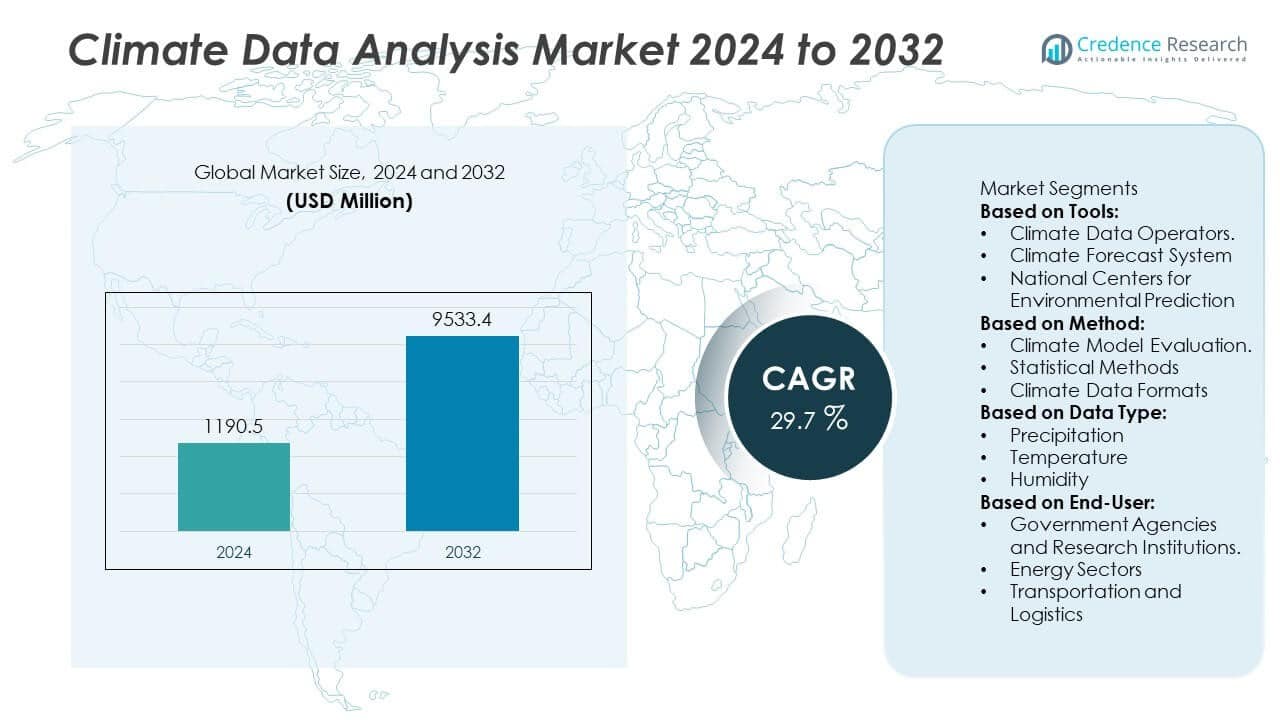
The Climate Data Analysis Market was valued at USD 1,190.5 million in 2024 and is projected to reach USD 9,533.4 million by 2032, registering a compound annual growth rate (CAGR) of 29.7% during the forecast period.
| REPORT ATTRIBUTE | DETAILS |
|---|---|
| Historical Period | 2020-2024 |
| Base Year | 2024 |
| Forecast Period | 2025-2032 |
| Climate Data Analysis Market Size 2024 | USD 1,190.5 Million |
| Climate Data Analysis Market, CAGR | 29.7% |
| Climate Data Analysis Market Size 2032 | USD 9,533.4 Million |
The Climate Data Analysis Market grows on the back of rising climate risks, stricter environmental regulations, and the increasing need for advanced predictive models across industries. Governments and enterprises rely on data-driven tools to optimize planning, strengthen resilience, and manage sustainability goals effectively.
Geographical analysis of the Climate Data Analysis Market highlights strong adoption across North America, Europe, Asia Pacific, Latin America, and the Middle East & Africa, with each region leveraging advanced climate intelligence to address distinct environmental and economic challenges. North America focuses on disaster preparedness, insurance modeling, and infrastructure resilience, while Europe emphasizes sustainability reporting and compliance with stringent climate policies. Asia Pacific sees increasing demand from agriculture, energy, and urban planning sectors, driven by rising climate variability and industrial growth. Latin America adopts climate data solutions for forestry, water management, and biodiversity protection, whereas the Middle East & Africa prioritize drought monitoring and resource optimization. Key players driving innovation in this landscape include Schneider Electric SE, AccuWeather Inc., and Environmental Systems Research Institute Inc., who provide cutting-edge solutions ranging from predictive analytics and real-time forecasting to geospatial mapping.
Market Insights
- The Climate Data Analysis Market was valued at USD 1,190.5 million in 2024 and is expected to reach USD 9,533.4 million by 2032, registering a CAGR of 29.7% during the forecast period.
- Growing concerns over climate risks and the urgent need for resilience planning are driving the market, as governments, insurers, and enterprises seek accurate insights to mitigate potential economic and environmental losses.
- Emerging trends highlight the integration of artificial intelligence, machine learning, and geospatial technologies, enabling real-time forecasting, predictive modeling, and precise risk assessments across multiple industries.
- Competitive analysis shows leading companies such as Schneider Electric SE, AccuWeather Inc., and Verisk Analytics Inc. focusing on advanced data platforms, innovative software tools, and partnerships to strengthen their presence in global markets.
- Limited access to high-quality datasets, high implementation costs, and the lack of standardized frameworks act as restraints, posing challenges for small and medium-sized enterprises in adopting climate data solutions.
- Regional analysis indicates North America leads adoption due to advanced infrastructure and strong policy frameworks, while Europe shows significant growth with sustainability and climate compliance initiatives. Asia Pacific is expanding rapidly, driven by rising climate risks in agriculture, energy, and urban planning, whereas Latin America and the Middle East & Africa demonstrate steady adoption in water, forestry, and drought management applications.
- Overall, the market reflects a growing demand for integrated solutions that support informed decision-making, enhance sustainability, and build resilience against escalating climate-related risks.
Market Drivers
Growing Need for Accurate Climate Risk Assessment
The Climate Data Analysis Market gains momentum from the demand for precise climate risk assessment across industries. Governments and private organizations focus on data-driven insights to evaluate vulnerabilities in infrastructure, agriculture, and energy systems. It helps stakeholders anticipate extreme weather events and reduce economic and environmental losses. The rising frequency of natural disasters reinforces the importance of data analytics for preparedness and resilience. Companies integrate climate datasets into operational planning to improve long-term sustainability. This focus on risk assessment drives consistent investment in advanced analytical platforms.
- For instance, Schneider Electric monitors over 10,000 nodes-including ports and critical supplier locations-to enhance speed of response and minimize business interruptions in its supply chain resilience framework
Rising Role of Regulatory Frameworks and Compliance
The Climate Data Analysis Market expands under the influence of strict environmental regulations and compliance standards. Policymakers require transparent reporting on emissions, carbon credits, and sustainability practices. It provides enterprises with tools to meet disclosure obligations and align with climate targets. Compliance with frameworks such as the Task Force on Climate-related Financial Disclosures (TCFD) accelerates adoption of analytical solutions. Industries facing regulatory scrutiny rely on data analytics to avoid penalties and improve accountability. The regulatory push strengthens the case for widespread market integration.
- For instance, Schneider Electric has collated data from over 64,000 employees to integrate key sustainability performance indicators-such as climate risks and opportunities.
Advancements in Artificial Intelligence and Big Data Integration
The Climate Data Analysis Market benefits from rapid progress in artificial intelligence, machine learning, and big data technologies. It enables efficient processing of massive climate datasets with higher accuracy and speed. Advanced models enhance prediction of temperature shifts, rainfall patterns, and disaster probabilities. Integration of real-time data from satellites and IoT sensors strengthens insights for businesses and policymakers. Companies invest heavily in AI-driven analytics platforms to improve decision-making in volatile environmental conditions. These advancements establish a strong foundation for market growth.
Increasing Focus on Renewable Energy Optimization and Sustainability Goals
The Climate Data Analysis Market supports the global transition toward renewable energy and sustainability initiatives. It assists energy providers in predicting solar and wind resource availability with greater reliability. Accurate forecasts help utilities optimize grid management and reduce reliance on fossil fuels. Businesses use climate data insights to align with net-zero commitments and long-term sustainability goals. Investors prioritize companies that demonstrate measurable climate resilience supported by data analytics. The emphasis on renewable energy optimization creates sustained opportunities for market expansion.
Market Trends
Integration of Climate Analytics into Corporate Strategy
The Climate Data Analysis Market reflects a trend where organizations embed climate analytics into broader corporate strategies. It helps firms evaluate long-term risks linked to supply chains, resource availability, and operational continuity. Businesses adopt climate scenario modeling to guide investments and manage exposure to extreme weather. Data-driven insights inform strategic planning for sustainability and resilience. Boards increasingly demand transparent reporting supported by analytical evidence. This trend positions climate analytics as a central element of business decision-making.
- For instance, MSCI's "Climate Data and Metrics" platform provides a comprehensive set of climate-related data, including over 2,250 climate-change metrics across nearly 20,000 issuers.
Expansion of Climate-Focused Financial Services
The Climate Data Analysis Market shows a trend toward integration within financial services and investment decisions. Banks and asset managers use climate datasets to assess portfolio risks and identify resilient opportunities. It supports evaluation of environmental, social, and governance (ESG) performance with measurable data. Financial institutions rely on advanced climate modeling to guide lending strategies and insurance pricing. The rise of green bonds and climate-linked financial instruments drives further demand for analytical platforms. This growing role in finance strengthens the strategic importance of climate data.
- For instance, S&P Global Sustainable1’s Climanomics® platform provides physical climate risk analytics across 7,000,000+ asset locations linked to ~70,000 companies, modeling 10 climate hazards with impact functions calibrated for 250+ asset types, using CMIP6 climate models.
Adoption of Advanced Satellite and Sensor Technologies
The Climate Data Analysis Market benefits from expanding use of satellites and IoT sensors that deliver real-time environmental data. It enables continuous monitoring of temperature, precipitation, and emission patterns. Integration of high-resolution imaging supports early detection of climate-related anomalies. Researchers and industries adopt these tools to improve forecasting accuracy and reduce uncertainties. Satellite-driven insights allow governments to implement evidence-based climate policies. This reliance on new technologies advances the quality and scale of climate analytics.
Increasing Role of Public-Private Partnerships in Data Sharing
The Climate Data Analysis Market experiences a trend of stronger collaboration between governments, research bodies, and private companies. It improves access to large datasets required for comprehensive climate modeling. Shared platforms accelerate innovation by combining academic expertise with enterprise-scale technology. Governments encourage open data policies to support climate adaptation projects and resilience planning. Businesses contribute proprietary analytics capabilities to enhance the reach of public initiatives. This trend underscores the importance of cooperative ecosystems in advancing climate data analysis.
Market Challenges Analysis
High Cost of Technology Deployment and Data Management Complexity
The Climate Data Analysis Market faces challenges linked to the high cost of deploying advanced analytics platforms and managing vast datasets. It requires significant investment in infrastructure, cloud computing, and skilled professionals, which limits accessibility for smaller organizations and developing economies. Integration of heterogeneous data sources such as satellite feeds, IoT sensors, and historical climate models adds further complexity. Companies struggle to harmonize data formats and ensure interoperability across platforms. The technical burden often delays adoption timelines and increases operational costs. These barriers restrict the scalability of climate data analytics solutions.
Concerns Over Data Accuracy, Standardization, and Policy Alignment
The Climate Data Analysis Market also contends with issues surrounding data accuracy and standardization. It depends on multiple inputs from varied geographies, often with inconsistent quality and missing parameters. Lack of unified frameworks for data collection and reporting weakens reliability in policy-making and corporate planning. Organizations encounter difficulties aligning analytical outputs with diverse regional and international climate policies. Concerns about uncertainty in predictive models undermine confidence among decision-makers. These factors highlight the urgent need for global standards and policy harmonization to strengthen the effectiveness of climate data analytics.
Market Opportunities
Rising Demand for Climate-Resilient Infrastructure and Urban Planning
The Climate Data Analysis Market presents opportunities in the growing push for climate-resilient infrastructure and smart urban planning. It supports city authorities in modeling heatwaves, floods, and storm impacts to design adaptive infrastructure. Governments seek advanced analytics to guide zoning decisions, optimize energy use, and safeguard water resources. Companies offering solutions that integrate predictive modeling with urban development tools will capture significant growth potential. It enables long-term planning that aligns with sustainability objectives and disaster preparedness. The emphasis on resilient cities creates strong prospects for analytics providers.
Expansion of Renewable Energy and Carbon Management Initiatives
The Climate Data Analysis Market also benefits from opportunities tied to renewable energy optimization and carbon management programs. It assists energy firms in forecasting solar, wind, and hydro resource variability with higher precision. Businesses use climate analytics to design effective carbon reduction strategies and achieve net-zero commitments. Emerging markets invest in renewable infrastructure that requires accurate climate projections to ensure efficiency and reliability. Solutions that combine emissions tracking with predictive analytics will gain significant adoption. The growing alignment of corporate strategies with global climate goals opens new avenues for market expansion.
Market Segmentation Analysis:
By Tools
The Climate Data Analysis Market demonstrates strong adoption of advanced tools such as geographic information systems (GIS), artificial intelligence platforms, and remote sensing technologies. These tools enable accurate modeling of climate variables and support real-time monitoring of environmental conditions. Organizations use GIS to map vulnerabilities in infrastructure and ecosystems, while AI platforms enhance predictive capabilities through machine learning algorithms. Remote sensing tools provide valuable satellite-based inputs for temperature, precipitation, and emission data. It helps decision-makers design adaptive strategies by combining multiple datasets into actionable insights. Demand for integrated platforms that consolidate these tools continues to increase across industries.
- For instance, ESRI’s ArcGIS Living Atlas integrates over 8,000 climate and environmental datasets, while its ArcGIS Pro platform processes more than 2 terabytes of geospatial climate data per month to support infrastructure vulnerability assessments for agencies such as FEMA.
By Method
The Climate Data Analysis Market applies diverse methods including statistical analysis, dynamic modeling, and risk assessment frameworks. Statistical approaches extract patterns from large datasets, while dynamic models simulate long-term climate scenarios under various assumptions. Risk assessment methods assist governments, insurers, and businesses in quantifying potential impacts of extreme weather events. It supports policy formulation, investment planning, and disaster preparedness with evidence-based insights. Hybrid methods that integrate scenario modeling with predictive analytics are gaining traction to improve accuracy. The emphasis on flexible methodologies drives continuous innovation within this segment.
- For instance, the UK Met Office’s UK Climate Projections (UKCP18) models generate probabilistic climate scenarios using 60 ensemble simulations, producing datasets with over 2.2 petabytes of high-resolution climate variables through to 2100.
By Data Type
The Climate Data Analysis Market leverages multiple data types such as historical climate records, real-time sensor outputs, and satellite-based observations. Historical data establishes baselines for long-term projections, while real-time sensor data captures rapid shifts in environmental conditions. Satellite data enhances spatial coverage, offering critical insights into land use, sea-level rise, and atmospheric composition. It provides stakeholders with a comprehensive view that blends temporal and spatial dimensions of climate patterns. Integration of structured and unstructured datasets remains a priority to strengthen forecasting accuracy. The reliance on diverse data sources expands opportunities for robust analytics solutions across industries.
Segments:
Based on Tools:
- Climate Data Operators.
- Climate Forecast System
- National Centers for Environmental Prediction
Based on Method:
- Climate Model Evaluation.
- Statistical Methods
- Climate Data Formats
Based on Data Type:
- Precipitation
- Temperature
- Humidity
Based on End-User:
- Government Agencies and Research Institutions.
- Energy Sectors
- Transportation and Logistics
Based on the Geography:
- North America
- U.S.
- Canada
- Mexico
- Europe
- UK
- France
- Germany
- Italy
- Spain
- Russia
- Belgium
- Netherlands
- Austria
- Sweden
- Poland
- Denmark
- Switzerland
- Rest of Europe
- Asia Pacific
- China
- Japan
- South Korea
- India
- Australia
- Thailand
- Indonesia
- Vietnam
- Malaysia
- Philippines
- Taiwan
- Rest of Asia Pacific
- Latin America
- Brazil
- Argentina
- Peru
- Chile
- Colombia
- Rest of Latin America
- Middle East
- UAE
- KSA
- Israel
- Turkey
- Iran
- Rest of Middle East
- Africa
- Egypt
- Nigeria
- Algeria
- Morocco
- Rest of Africa
Regional Analysis
North America
North America holds the largest share of the Climate Data Analysis Market, accounting for approximately 34.6% in 2024. The region benefits from advanced climate research infrastructure, significant government funding, and strong private sector participation. Agencies such as NASA, NOAA, and the U.S. Department of Energy drive extensive use of satellite monitoring, dynamic modeling, and predictive analytics. It integrates data from ground sensors, IoT devices, and advanced AI systems to generate actionable insights for industries and policymakers. The market also benefits from strict climate disclosure requirements and corporate sustainability commitments. It continues to lead through large-scale adoption of cutting-edge platforms and strong collaboration between public and private stakeholders.
Europe
Europe contributes nearly 25% of the global Climate Data Analysis Market and remains a pioneer in climate services and regulatory leadership. The European Union supports large-scale programs focused on resilience planning and emissions tracking. It drives adoption through stringent climate reporting standards and open access to satellite data from programs like Copernicus. European countries integrate climate data into city planning, renewable energy optimization, and environmental risk management. It benefits from consistent funding through national and regional initiatives that strengthen analytical capabilities. The region maintains a strong market position by emphasizing policy-driven climate adaptation and harmonized data frameworks.
Asia Pacific
Asia Pacific represents around 15.4% of the Climate Data Analysis Market and is one of the fastest-growing regions. Rapid urbanization, rising population density, and frequent climate-related disasters create strong demand for analytical solutions. Governments in China, India, Japan, and Australia invest heavily in AI-driven climate modeling, early warning systems, and real-time sensor networks. It plays a crucial role in supporting agriculture, coastal protection, and disaster risk reduction across diverse geographies. Private companies and public institutions collaborate to improve forecasting capabilities and enhance infrastructure resilience. The region strengthens its position through large-scale projects designed to address vulnerabilities in energy, water, and food security.
Latin America
Latin America accounts for approximately 5.8% of the Climate Data Analysis Market and faces unique challenges linked to deforestation, extreme rainfall, and resource management. Governments and research institutions focus on integrating climate data for agriculture, forestry, and water systems. It emphasizes the use of satellite data and local weather monitoring networks to enhance resilience. The region relies on international partnerships to expand technical capabilities and strengthen adaptation strategies. Adoption remains slower compared to North America and Europe due to limited funding and infrastructure gaps. It still presents opportunities for growth, particularly in sectors such as renewable energy and urban climate planning.
Middle East & Africa
The Middle East & Africa region represents about 3.8% of the Climate Data Analysis Market in 2024. It faces acute climate risks, including water scarcity, desertification, and rising temperatures, which create demand for climate intelligence tools. Governments increasingly use climate models, ground sensors, and satellite data to inform policy decisions. It supports projects in agriculture, energy, and resource management, though adoption remains gradual due to infrastructure limitations. International organizations and development banks play a critical role in funding climate analytics initiatives. The region holds long-term potential as awareness of climate risk grows and countries invest more in resilience strategies.
Key Player Analysis
- StormGeo
- AccuWeather Inc.
- Vaisala Corporation
- Schneider Electric SE
- MSCI Inc
- Meteo-France
- Verisk Analytics Inc
- Risk Management Solutions Inc.
- Environmental Systems Research Institute Inc.
- National Oceanic and Atmospheric Administration
Competitive Analysis
The Climate Data Analysis Market features strong competition among Schneider Electric SE, Verisk Analytics Inc., MSCI Inc., Risk Management Solutions Inc., Environmental Systems Research Institute Inc., Vaisala Corporation, Meteo-France, National Oceanic and Atmospheric Administration, AccuWeather Inc., and StormGeo, each driving innovation through advanced technologies and tailored solutions. Schneider Electric SE focuses on integrating climate intelligence into energy and sustainability management, while Verisk Analytics Inc. and Risk Management Solutions Inc. enhance insurance and financial risk modeling with climate-driven projections. MSCI Inc. supports institutional investors with ESG and climate-related financial disclosures, and Environmental Systems Research Institute Inc. advances GIS-based mapping for adaptation planning. Vaisala Corporation contributes precision instruments and meteorological systems, with NOAA and Meteo-France leading in large-scale datasets and forecasting. AccuWeather Inc. and StormGeo specialize in real-time weather intelligence for sectors including aviation, agriculture, and logistics. Collectively, these players strengthen the market by prioritizing accuracy, scalability, and actionable insights to address rising global climate challenges.
Recent Developments
- In July 2025, Schneider launched the Zeigo Hub, a platform to help companies track and manage supplier emissions for supply chain decarbonization.
- In July 2025, NOAA’s climate projections component (Volume 2) of its Atlas 15 extreme rainfall study was suspended, impacting infrastructure planning tools.
- In May 2025, StormGeo introduced its Hurricane Severity Index to enhance clarity on storm impact potential, and its Spring 2025 outlook revised Nordic electricity demand forecasts due to green hydrogen’s continued economic challenges.
Market Concentration & Characteristics
The Climate Data Analysis Market shows a moderately concentrated structure, shaped by the presence of global corporations and specialized regional players that dominate technology innovation and service delivery. Leading companies such as Schneider Electric SE, MSCI Inc., Verisk Analytics Inc., and Environmental Systems Research Institute Inc. hold strong positions due to their diversified portfolios and advanced analytical platforms. It benefits from a mix of government agencies like the National Oceanic and Atmospheric Administration and Meteo-France, which provide large-scale datasets that private companies integrate into commercial solutions. The market demonstrates high reliance on technological capabilities, including AI-driven modeling, satellite monitoring, and geospatial analytics. It is characterized by strong collaboration between public institutions and private firms to expand data accessibility and improve predictive accuracy. Competitive dynamics focus on strategic partnerships, acquisitions, and cloud-based delivery models, while regional organizations and niche providers strengthen local adaptation. This blend of global reach, technical expertise, and collaborative frameworks defines its overall market characteristics.
Report Coverage
The research report offers an in-depth analysis based on Tools, Method, Data Type, End-User and Geography. It details leading market players, providing an overview of their business, product offerings, investments, revenue streams, and key applications. Additionally, the report includes insights into the competitive environment, SWOT analysis, current market trends, as well as the primary drivers and constraints. Furthermore, it discusses various factors that have driven market expansion in recent years. The report also explores market dynamics, regulatory scenarios, and technological advancements that are shaping the industry. It assesses the impact of external factors and global economic changes on market growth. Lastly, it provides strategic recommendations for new entrants and established companies to navigate the complexities of the market.
Future Outlook
- The market will expand with rising demand for advanced climate risk modeling across industries.
- It will integrate more artificial intelligence and machine learning tools for accurate forecasting.
- Governments will strengthen policies that increase reliance on structured climate data solutions.
- Enterprises will invest in real-time monitoring systems to manage operational risks.
- Cloud-based platforms will gain wider adoption for scalable data processing and sharing.
- Partnerships between public agencies and private firms will accelerate innovation in climate analytics.
- Renewable energy sectors will adopt climate data solutions to optimize resource management.
- Insurance and financial services will depend heavily on climate data for risk assessment.
- Regional providers will grow in importance by delivering localized climate insights.
- It will remain a critical enabler of sustainability goals and long-term resilience planning.

Request a Free Sample
Fill in your details and we'll send you a free sample report.
- Sample data tables & charts
- Research methodology
Market Dynamics
Growing Need for Accurate Climate Risk Assessment
Industries and governments are increasingly relying on climate data analysis to evaluate vulnerabilities in infrastructure, agriculture, and energy systems, enabling them to anticipate extreme weather events and reduce economic and environmental losses.
Rising Role of Regulatory Frameworks and Compliance
Stricter environmental regulations and disclosure requirements, such as those from the TCFD, are pushing organizations to adopt advanced climate data analytics to meet compliance standards and improve transparency in sustainability reporting.
Advancements in Artificial Intelligence and Big Data Integration
Rapid progress in AI, machine learning, and big data technologies allows for efficient processing of massive climate datasets, enhancing the accuracy and speed of predictive models for temperature shifts, rainfall, and disaster probabilities.
Increasing Focus on Renewable Energy Optimization and Sustainability Goals
The transition toward renewable energy and net-zero commitments is driving demand for climate data analysis to optimize resource availability forecasts, grid management, and long-term sustainability planning.
Integration of Climate Analytics into Corporate Strategy
Organizations are embedding climate analytics into their strategic planning to manage supply chain risks, resource availability, and operational continuity, making data-driven insights central to business resilience and investment decisions.
Need a Custom Version of This Report?
Tailor the scope, geography, or segments to your exact requirements.
- Custom geography or segment scope
- Direct access to our analyst team
Frequently Asked Questions
What is the current market size for the Climate Data Analysis market, and what is its projected size in 2032?
At what Compound Annual Growth Rate is the Climate Data Analysis market projected to grow between 2025 and 2032?
Which Climate Data Analysis market segment held the largest share in 2024?
What are the primary factors fueling the growth of the Climate Data Analysis market?
Who are the leading companies in the Climate Data Analysis market?
Which region commanded the largest share of the Climate Data Analysis market in 2024?
Table of Content
Chapter 1 Market Segmentation
- 1.1 Segmentation Framework
- 1.1.1 Product and Service Classification
- 1.1.2 Application and End-Use Classification
- 1.1.3 Technology and Solution Classification
- 1.1.4 Customer and Distribution Channel Classification
- 1.1.5 Geographic Segmentation
- 1.1.6 Market Segment Definitions and Boundaries
- 1.2 By Tools
- 1.2.1 Climate Data Operators
- 1.2.2 Climate Forecast System
- 1.2.3 National Centers for Environmental Prediction
- 1.2.4 Geographic Information Systems (GIS)
- 1.2.5 Remote Sensing Technologies
- 1.3 By Method
- 1.3.1 Climate Model Evaluation
- 1.3.2 Statistical Methods
- 1.3.3 Climate Data Formats
- 1.3.4 Dynamic Modeling
- 1.3.5 Risk Assessment Frameworks
- 1.4 By End-User
- 1.4.1 Government Agencies and Research Institutions
- 1.4.2 Energy Sectors
- 1.4.3 Transportation and Logistics
- 1.4.4 Insurance and Financial Services
- 1.4.5 Urban Planning and Infrastructure
- 1.5 By Data Type
- 1.5.1 Precipitation
- 1.5.2 Temperature
- 1.5.3 Humidity
- 1.5.4 Historical Climate Records
- 1.5.5 Satellite-Based Observations
Chapter 2 Introduction
- 2.1 Report Objectives and Scope
- 2.2 Product Definition and Industry Terminology
- 2.3 Market Inclusions and Exclusions
- 2.4 Research Process
- 2.4.1 Primary Research and Expert Interviews
- 2.4.2 Secondary Research and Source Review
- 2.4.3 Top-Down and Bottom-Up Estimation
- 2.4.4 Data Triangulation and Verification
- 2.5 Market Size Measurement Basis
- 2.5.1 2024: USD 1,190.5 million → 2032: USD 9,533.4 million
- 2.6 Historical and Forecast Reference Periods
- 2.6.1 Base Year: 2024
- 2.6.2 Forecast Period: 2024-2032
- 2.7 Research Assumptions and Limitations
Chapter 3 Executive Summary
- 3.1 Market Snapshot and Key Findings
- 3.2 Base-Year Market Size, 2024
- 3.3 Forecast Market Size, 2032
- 3.4 Revenue and Volume Growth Outlook
- 3.5 Key Demand and Supply Indicators
- 3.6 Leading Market Segments
- 3.7 Fastest-Growing Market Opportunities
- 3.8 Regional Performance Highlights
- 3.9 Technology and Industry Transformation
- 3.10 Competitive Landscape Summary
- 3.11 Analyst View and Strategic Implications
Chapter 4 Global Climate Data Analysis Market Trends and Developments
- 4.1 Historical Industry Development
- 4.2 Recent Market Trends and Developments
- 4.3 Demand and Customer Behavior Trends
- 4.4 Technology and Product Innovation
- 4.5 Artificial Intelligence, Automation and Digitalization
- 4.6 Local Manufacturing and Supply Chain Realignment
- 4.7 Industry Partnerships, Mergers and Acquisitions
- 4.8 Sustainability and Circular Economy Developments
- 4.9 Government and Private Sector Investment Trends
- 4.10 Emerging Business Models and Commercialization
- 4.11 Industry Developments and Announcements
Chapter 5 Global Climate Data Analysis Market Production, Supply and Demand Analysis
- 5.1 Demand Trend and Consumption Analysis
- 5.2 Demand Forecast, 2024-2032
- 5.3 Production and Output Trend
- 5.4 Production and Output Forecast, 2024-2032
- 5.5 Installed Capacity and Capacity Utilization
- 5.6 Company-Wise Production Plants and Statistics
- 5.6.1 Installed Production Capacity
- 5.6.2 Actual Production
- 5.6.3 Planned Capacity and Expansion Targets
- 5.7 Supply Chain Structure and Procurement Trends
- 5.8 Supply-Demand Gap and Bottlenecks
- 5.9 Import Dependence and Sourcing Structure
- 5.10 Contract Manufacturing and Outsourcing
- 5.11 Regional Supply and Demand Concentration
Chapter 6 Global Climate Data Analysis Market Pricing Analysis
- 6.1 Pricing Structure and Measurement
- 6.2 Historical Pricing Trends
- 6.3 Pricing Outlook, 2024-2032
- 6.4 Average Selling Price and Unit Economics
- 6.5 Pricing by Product and Market Segment
- 6.6 Geographic Pricing Differences
- 6.7 Key Input, Energy, Labor and Logistics Costs
- 6.8 Contract Pricing and Purchasing Models
- 6.9 Pricing Sensitivity and Competitive Positioning
- 6.10 Price, Margin and Profitability Implications
Chapter 7 Global Climate Data Analysis Market Dynamics
- 7.1 Market Growth Drivers
- 7.1.1 Demand-Side Drivers
- 7.1.2 Technology and Innovation Drivers
- 7.1.3 Infrastructure and Investment Drivers
- 7.1.4 Regulatory and Policy Drivers
- 7.2 Market Restraints
- 7.2.1 Cost and Affordability Constraints
- 7.2.2 Technology and Adoption Barriers
- 7.2.3 Supply Chain and Operational Constraints
- 7.3 Market Challenges
- 7.3.1 Competitive Pressure and Margin Erosion
- 7.3.2 Skills, Infrastructure and Implementation Gaps
- 7.4 Emerging Market Opportunities
- 7.5 Market Dynamics Impact and Time-Horizon Assessment
Chapter 8 Global Climate Data Analysis Value Chain Analysis
- 8.1 Industry Value Chain Overview
- 8.2 Upstream Suppliers and Critical Inputs
- 8.3 Technology and Component Providers
- 8.4 Manufacturing or Service Delivery
- 8.5 Distribution, Channel Partners and Integrators
- 8.6 Downstream Applications and End Users
- 8.7 Value Addition and Profit Pools
- 8.8 Vertical Integration and Outsourcing
- 8.9 Supplier Concentration and Risk
- 8.10 Supply Chain Localization and Resilience
Chapter 9 Global Climate Data Analysis Market Regulations and Policies
- 9.1 Relevant Laws, Standards and Compliance Frameworks
- 9.2 Product, Service, Safety and Quality Requirements
- 9.3 Government Policies, Incentives and Subsidies
- 9.4 Imports, Exports and Trade Barriers
- 9.5 Public Procurement and Local Content Requirements
- 9.6 Environmental and Sustainability Compliance
- 9.7 Data Protection, AI and Cybersecurity Compliance
- 9.8 Upcoming Policy Changes and Market Implications
Chapter 10 Global Climate Data Analysis Market Hotspots and Opportunities
- 10.1 Market Opportunity Mapping and Growth Hotspots
- 10.2 High-Growth Applications and Customer Groups
- 10.3 Underserved Markets and White-Space Opportunities
- 10.4 Emerging Technology and Product Opportunities
- 10.5 New Capacity and Investment Hotspots
- 10.6 Market Entry and Expansion Opportunities
- 10.7 Distribution and Partnership Opportunities
- 10.8 Near-Term and Long-Term Commercial Potential
- 10.9 Opportunity Attractiveness and Execution Risks
Chapter 11 Global Climate Data Analysis Market Outlook, 2024-2032
- 11.1 Market Size and Analysis
- 11.1.1 Revenue (Market Measurement: 2024: USD 1,190.5 million → 2032: USD 9,533.4 million)
- 11.1.2 Market Volume and Quantity Sold
- 11.1.3 Historical Market Size
- 11.1.4 Base-Year Market Size, 2024
- 11.2 Market Forecast, 2024-2032
- 11.2.1 Revenue Forecast to 2032
- 11.2.2 Volume Forecast to 2032
- 11.2.3 CAGR and Year-on-Year Growth
- 11.2.4 Incremental Revenue Opportunity
- 11.3 Forecast Assumptions and Scenario Analysis
- 11.3.1 Base-Case Forecast
- 11.3.2 Optimistic and Conservative Scenarios
- 11.3.3 Technology, Pricing and Policy Sensitivities
- 11.4 Market Attractiveness and Growth Outlook
Chapter 12 Global Climate Data Analysis Market Segmentation and Outlook
- 12.1 Segmentation Summary and Market Shares, 2024
- 12.2 Largest and Fastest-Growing Segments
- 12.3 By Tools - Market Size and Forecast, 2024-2032
- 12.3.1 Segment Definition and Scope
- 12.3.2 Historical Market Size
- 12.3.3 Revenue Forecast, 2024-2032
- 12.3.4 Volume Forecast, 2024-2032
- 12.3.5 Base-Year Market Share, 2024
- 12.3.6 Segment CAGR and Growth Drivers
- 12.3.7 Subsegment Market Size and Forecast
- 12.3.7.1 Climate Data Operators
- 12.3.7.2 Climate Forecast System
- 12.3.7.3 National Centers for Environmental Prediction
- 12.3.7.4 Geographic Information Systems (GIS)
- 12.3.7.5 Remote Sensing Technologies
- 12.3.8 Subsegment Pricing and Adoption Trends
- 12.3.9 Leading Suppliers and Competition
- 12.3.10 Regional Demand and Opportunities
- 12.4 By Method - Market Size and Forecast, 2024-2032
- 12.4.1 Segment Definition and Scope
- 12.4.2 Historical Market Size
- 12.4.3 Revenue Forecast, 2024-2032
- 12.4.4 Volume Forecast, 2024-2032
- 12.4.5 Base-Year Market Share, 2024
- 12.4.6 Segment CAGR and Growth Drivers
- 12.4.7 Subsegment Market Size and Forecast
- 12.4.7.1 Climate Model Evaluation
- 12.4.7.2 Statistical Methods
- 12.4.7.3 Climate Data Formats
- 12.4.7.4 Dynamic Modeling
- 12.4.7.5 Risk Assessment Frameworks
- 12.4.8 Subsegment Pricing and Adoption Trends
- 12.4.9 Leading Suppliers and Competition
- 12.4.10 Regional Demand and Opportunities
- 12.5 By End-User - Market Size and Forecast, 2024-2032
- 12.5.1 Segment Definition and Scope
- 12.5.2 Historical Market Size
- 12.5.3 Revenue Forecast, 2024-2032
- 12.5.4 Volume Forecast, 2024-2032
- 12.5.5 Base-Year Market Share, 2024
- 12.5.6 Segment CAGR and Growth Drivers
- 12.5.7 Subsegment Market Size and Forecast
- 12.5.7.1 Government Agencies and Research Institutions
- 12.5.7.2 Energy Sectors
- 12.5.7.3 Transportation and Logistics
- 12.5.7.4 Insurance and Financial Services
- 12.5.7.5 Urban Planning and Infrastructure
- 12.5.8 Subsegment Pricing and Adoption Trends
- 12.5.9 Leading Suppliers and Competition
- 12.5.10 Regional Demand and Opportunities
- 12.6 By Data Type - Market Size and Forecast, 2024-2032
- 12.6.1 Segment Definition and Scope
- 12.6.2 Historical Market Size
- 12.6.3 Revenue Forecast, 2024-2032
- 12.6.4 Volume Forecast, 2024-2032
- 12.6.5 Base-Year Market Share, 2024
- 12.6.6 Segment CAGR and Growth Drivers
- 12.6.7 Subsegment Market Size and Forecast
- 12.6.7.1 Precipitation
- 12.6.7.2 Temperature
- 12.6.7.3 Humidity
- 12.6.7.4 Historical Climate Records
- 12.6.7.5 Satellite-Based Observations
- 12.6.8 Subsegment Pricing and Adoption Trends
- 12.6.9 Leading Suppliers and Competition
- 12.6.10 Regional Demand and Opportunities
- 12.7 Segment Growth Comparison
- 12.8 Segment Attractiveness and Priority Matrix
Chapter 13 Global Climate Data Analysis End-Use and Application Market Outlook
- 13.1 End-Use Industry and Customer Demand Structure
- 13.2 Leading Applications and Customer Groups
- 13.3 End-Use Market Size, Share and Forecast
- 13.4 Major End-Use Industry Deep Dives
- 13.4.1 Customer Requirements and Use Cases
- 13.4.2 Demand and Replacement Cycles
- 13.4.3 Technical and Regulatory Considerations
- 13.4.4 Purchasing and Procurement Models
- 13.4.5 Leading Vendors and Distribution Channels
- 13.4.6 Forecast and Commercial Opportunities
- 13.5 Emerging Applications and Cross-Segment Demand
- 13.6 End-Use Industry Investment Priorities
Chapter 14 Global Climate Data Analysis Geographic Market Outlook, 2024-2032
- 14.1 Regional Market Size and Share, 2024
- 14.2 Regional Market Forecast, 2024-2032
- 14.3 Regional Pricing, Production and Demand Differences
- 14.4 North America
- 14.4.1 United States
- 14.4.2 Canada
- 14.4.3 Mexico
- 14.5 Europe
- 14.5.1 Germany
- 14.5.2 France
- 14.5.3 Italy
- 14.5.4 United Kingdom
- 14.5.5 Spain
- 14.5.6 Poland
- 14.5.7 Russia
- 14.5.8 Netherlands
- 14.5.9 Belgium
- 14.5.10 Sweden
- 14.5.11 Denmark
- 14.5.12 Norway
- 14.5.13 Rest of Europe
- 14.6 Asia Pacific
- 14.6.1 China
- 14.6.2 India
- 14.6.3 Japan
- 14.6.4 South Korea
- 14.6.5 Thailand
- 14.6.6 Indonesia
- 14.6.7 Vietnam
- 14.6.8 Malaysia
- 14.6.9 Australia
- 14.6.10 Rest of Asia Pacific
- 14.7 Latin America
- 14.7.1 Brazil
- 14.7.2 Argentina
- 14.7.3 Colombia
- 14.7.4 Chile
- 14.7.5 Rest of Latin America
- 14.8 Middle East
- 14.8.1 Saudi Arabia
- 14.8.2 United Arab Emirates
- 14.8.3 Turkey
- 14.8.4 Israel
- 14.8.5 Iran
- 14.8.6 Rest of the Middle East
- 14.9 Africa
- 14.9.1 South Africa
- 14.9.2 Egypt
- 14.9.3 Nigeria
- 14.9.4 Morocco
- 14.9.5 Rest of Africa
- 14.10 Regional Investment, Policy and Supply Chain Differences
- 14.11 Regional Competitive Landscape
- 14.12 Geographic Growth Hotspots
Chapter 15 Global Climate Data Analysis Technology, Innovation and Sustainability Outlook
- 15.1 Technology Landscape and Maturity
- 15.2 Product, Process and Service Innovation
- 15.3 AI, Automation and Digital Tools in the Industry
- 15.4 Technology Adoption and Performance Benchmarking
- 15.5 Innovation Pipeline and R&D Investment
- 15.6 Patent and Intellectual Property Trends
- 15.7 Energy Efficiency and Resource Management
- 15.8 Sustainability, Recycling and Circularity
- 15.9 Technology Roadmap, 2024-2032
- 15.10 Risks of Obsolescence and Technology Substitution
Chapter 16 Global Climate Data Analysis Market Key Strategic Imperatives
- 16.1 Growth and Market Entry Priorities
- 16.2 High-Return Products and Segments
- 16.3 Pricing, Profitability and Cost Optimization
- 16.4 Technology Investment and Product Differentiation
- 16.5 Supply Chain Localization and Resilience
- 16.6 Distribution and Customer Acquisition
- 16.7 Partnership, Acquisition and Capacity Strategy
- 16.8 Regional Expansion Priorities
- 16.9 Short-, Medium- and Long-Term Actions
Chapter 17 Competition Outlook
- 17.1 Industry Competition Characteristics
- 17.2 Market Structure and Concentration
- 17.3 Market Share and Competitive Positioning, 2024
- 17.4 Company-Wise Revenue and Product Benchmarking
- 17.5 Production and Service Capacity Benchmarking
- 17.6 Technology, Pricing and Differentiation
- 17.7 Regional Footprint and Distribution Strength
- 17.8 Mergers, Acquisitions and Strategic Alliances
- 17.9 New Entrants and Competitive Threats
- 17.10 Porter's Five Forces and Industry Attractiveness
- 17.11 Competitive Outlook, 2024-2032
Chapter 18 Company Profiles
- 18.1 Company Coverage and Selection Criteria
- 18.2 Schneider Electric SE
- 18.2.1 Business Description
- 18.2.2 Company Ownership and Geographic Presence
- 18.2.3 Product and Service Portfolio
- 18.2.4 Manufacturing and Operating Footprint
- 18.2.5 Production Capacity and Expansion Plans
- 18.2.6 Financial Performance and Investment
- 18.2.7 Market Share and Competitive Position
- 18.2.8 Technology and Innovation Capabilities
- 18.2.9 Strategic Alliances or Partnerships
- 18.2.10 Recent Developments
- 18.2.11 Growth Strategy and Outlook
- 18.3 AccuWeather Inc.
- 18.4 Environmental Systems Research Institute Inc. (ESRI)
- 18.5 Verisk Analytics Inc.
- 18.6 MSCI Inc.
- 18.7 StormGeo
- 18.8 Vaisala Corporation
- 18.9 Risk Management Solutions Inc.
- 18.10 Meteo-France
- 18.11 National Oceanic and Atmospheric Administration (NOAA)
- 18.12 Other Relevant Market Participants
Note: Every listed company is profiled on the structure shown under the first company. The company list is preliminary and may change based on research findings, market developments, data availability and client requirements.
Chapter 19 Disclaimer
- 19.1 Research and Forecast Disclaimer
- 19.2 Data Source and Estimation Limitations
Note: The depth of individual sections depends on data availability for this market. Volume, capacity, trade and other unit-based metrics are included where applicable.

