
Market Overview
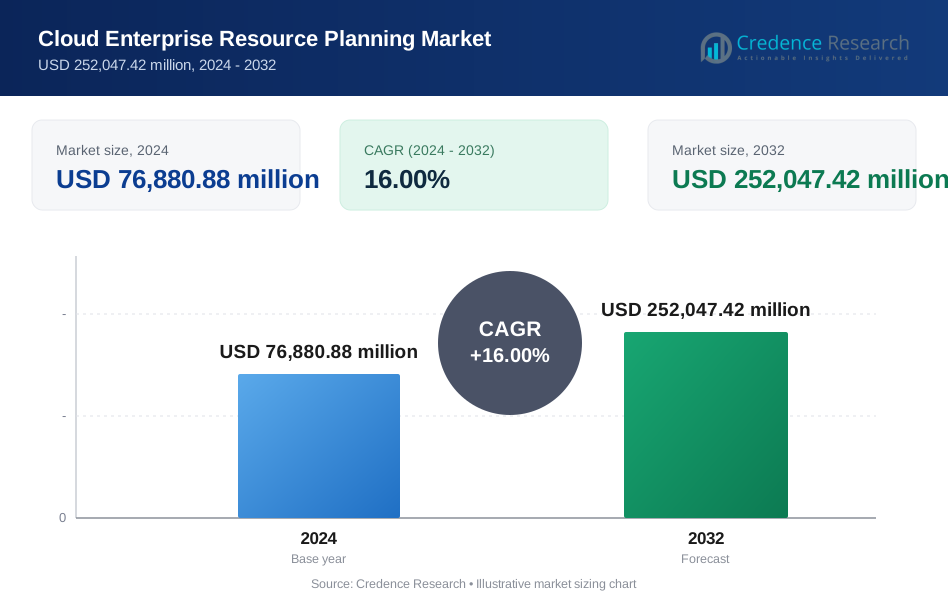
Cloud Enterprise Resource Planning (ERP) Market size was valued USD 76,880.88 million in 2024 and is anticipated to reach USD 252,047.42 million by 2032, at a CAGR of 16% during the forecast period.
| REPORT ATTRIBUTE | DETAILS |
|---|---|
| Historical Period | 2020-2023 |
| Base Year | 2024 |
| Forecast Period | 2025-2032 |
| Cloud Enterprise Resource Planning (ERP) Market Size 2024 | USD 76,880.88 Million |
| Cloud Enterprise Resource Planning (ERP) Market, CAGR | 16% |
| Cloud Enterprise Resource Planning (ERP) Market Size 2032 | USD 252,047.42 Million |
The Cloud Enterprise Resource Planning (ERP) market includes major players such as SAP SE, Oracle, Microsoft, Infor, Epicor, Sage Group plc, Ramco Systems, Acumatica, Deltek, and Syspro. These companies compete through scalable cloud platforms, real-time analytics, automation, and industry-specific ERP modules for manufacturing, BFSI, healthcare, retail, and government. Vendors strengthen market position through subscription pricing, hybrid deployment, and cybersecurity enhancements. North America leads the global market with a 38% share, driven by strong cloud adoption across enterprises and high investment in digital transformation. Europe and Asia Pacific follow, supported by Industry 4.0 initiatives, e-commerce expansion, and growing demand for scalable cloud-based business systems.
Market Insights
- The Cloud Enterprise Resource Planning (ERP) market was valued at USD 76,880.88 million in 2024 and will reach USD 252,047.42 million by 2032 at a 16% CAGR.
- Growing demand for real-time data visibility, automation, and lower IT costs drives rapid adoption of cloud-based ERP across manufacturing, BFSI, retail, healthcare, and government sectors.
- Major trends include AI-enabled analytics, low-code customization, hybrid cloud deployment, and industry-specific ERP suites, helping enterprises modernize legacy systems and improve decision-making.
- The market is highly competitive with vendors such as SAP SE, Oracle, Microsoft, Infor, and Epicor focusing on cybersecurity, multi-cloud support, and subscription pricing, while smaller providers expand through fast deployment and flexible modules.
- North America leads with 38% share, followed by Europe at 27% and Asia Pacific at 22%; on the functional side, the finance segment holds the largest share due to high demand for automated billing, compliance, and real-time reporting.
Market Segmentation Analysis:
By Deployment
The public cloud segment holds the dominant 58% market share, driven by scalability, reduced capital expenditure, and fast deployment cycles. Organizations prefer public cloud ERP to eliminate complex IT maintenance while benefiting from automatic updates and subscription pricing. Small and medium enterprises adopt public cloud platforms to gain real-time analytics and enhance workflow without heavy infrastructure. Private cloud accounts for about 27% share, gaining traction in sectors with strict compliance and security needs, while hybrid cloud holds around 15% share, rising as companies retain on-premise control for sensitive workloads while shifting other functions to the cloud.
- For instance, Unilever migrated to SAP S/4HANA Cloud, leveraging public cloud infrastructure to streamline supply chain operations across 190+ countries while reducing IT infrastructure costs through cloud-based management.
By Function
The finance segment remains the leading sub-segment with 34% market share, supported by strong adoption of cloud-based modules that streamline billing, forecasting, audit management, and risk control. Enterprises use these solutions to automate financial workflows and ensure regulatory compliance. The supply chain function follows with about 26% share as manufacturers and retailers implement cloud ERP for inventory optimization, procurement, and logistics tracking. HR modules represent nearly 18%, driven by the need for automated payroll and workforce analytics, while other functions including CRM, project management, and production planning collectively account for 22%.
- For instance, Amara Raja Energy & Mobility Limited implemented a Peer-to-Peer Vendor Invoice Management (P2P VIM) system that processed 79.27% of invoices through automation and semi-automation, achieving 89% of bill processing completed within 0-4 days demonstrating how cloud-based invoice management accelerates accounts payable operations.
By End-Use
Manufacturing dominates with nearly 31% market share, fueled by extensive adoption of cloud ERP for production planning, asset tracking, and quality control. Real-time dashboards and predictive analytics reduce downtime and improve operational efficiency. The BFSI sector follows with around 22%, using ERP for enhanced financial reporting and data management. Healthcare holds about 15% share, focusing on billing and procurement integration. Retail and e-commerce collectively represent 18%, leveraging ERP to streamline supply chains and enable omnichannel operations. The remaining 14% comes from government, aerospace, defense, IT, and telecom, where digital transformation and transparency initiatives drive uptake.
Key Growth Drivers
Rising Demand for Real-Time Data and Business Intelligence
Organizations want immediate visibility across finance, supply chain, HR, and operations. Cloud ERP gives a unified database that updates information in real time, helping leaders make quick decisions. Firms use dashboards, AI-based analytics, and predictive alerts to plan resources and reduce delays. This helps reduce errors caused by manual work and disconnected systems. Small and large companies adopt cloud ERP to track sales, costs, and inventory without complex IT setups. Continuous data syncing across devices also supports remote and hybrid workforces. As companies move toward digital operations, real-time analytics becomes a core advantage that drives broad ERP adoption.
- For instance, MineralTree, a fintech SaaS provider, employs real-time ERP data integration to generate live invoice reporting dashboards for clients, improving financial operations and transparency through seamless data flow across ERP and accounting systems.
Shift Toward Cost-Efficient and Scalable IT Infrastructure
Cloud ERP removes the need for large hardware investments and ongoing server maintenance. Subscription pricing allows businesses to pay only for what they use. Companies can scale up users and modules as they grow, which supports expansion with minimal disruption. Automatic software updates reduce downtime and improve security without internal IT support. This makes cloud ERP attractive for small and mid-sized firms that want enterprise-grade tools at lower cost. Industries with seasonal or fluctuating demand also benefit from flexible capacity. Reduced total cost of ownership and faster deployment cycles continue to push cloud ERP ahead of on-premise models.
- For instance, Microsoft Dynamics 365 Business Central is known for its scalable architecture that supports seamless user growth and modular add-ons, ensuring flexible expansion while maintaining system performance.
Growing Digital Transformation Across Industries
Manufacturing, BFSI, healthcare, and retail are modernizing their workflows. Cloud ERP becomes the central system that connects production, finance, procurement, and service operations. In factories, sensors and IoT devices feed live data into cloud ERP for smarter planning. Hospitals use cloud ERP to manage records and inventory with faster access. Retailers connect the system with online sales channels to improve order accuracy. Government and public agencies choose cloud ERP to improve transparency and citizen services. As digital transformation accelerates, cloud ERP acts as the base layer that supports automation, remote access, integration, and compliance.
Key Trends & Opportunities
AI, Automation, and Predictive Analytics Integration
ERP platforms now embed AI for forecasting, demand planning, and fraud detection. Automated workflows reduce manual paperwork in finance, HR, and supply chain tasks. Predictive analytics allows businesses to forecast production needs, inventory shortages, or equipment failures before they occur. Chatbots and guided interfaces make ERP systems easier for employees to use. Vendors also offer low-code tools to reduce customization time. These upgrades improve speed, prevent downtime, and unlock new productivity gains. Companies that want smarter and more accurate decision-making find this a major opportunity.
- For instance, in finance, Versa Cloud ERP uses AI to detect late payment trends, alerting teams to possible cash flow risks ahead of time.
Hybrid and Industry-Specific Cloud ERP Solutions
Many firms adopt hybrid cloud ERP because they want flexibility. Sensitive data can stay on private servers while non-critical modules move to the cloud. Vendors also design industry-ready ERP packs for manufacturing, healthcare, retail, and logistics. These packs come with built-in templates, regulatory features, and automation flows. This reduces deployment time and customization cost. As sectors demand personalized digital solutions, industry-focused cloud ERP creates major business opportunities for software providers.
- For instance, a pharmaceutical retail company implemented a hybrid ERP system to keep accounting and compliance functions on-premise for control while leveraging cloud ERP for real-time e-commerce and CRM management, improving customer experience and inventory synchronization.
Key Challenges
Data Security and Compliance Concerns
Some organizations hesitate to move critical operations to the cloud due to cybersecurity risks. Compliance rules in banking, healthcare, defense, and government require strong data protection. Fear of breaches, unauthorized access, or service outages slows decision-making. Companies must rely on vendors for encryption, monitoring, disaster recovery, and identity management. Although cloud ERP is improving its defenses, trust and regulatory approval remain major hurdles. Firms with legacy on-premise security systems also find migration difficult.
Integration with Legacy and Custom Systems
Many large enterprises operate old software that is deeply embedded in daily workflows. Connecting cloud ERP with legacy systems becomes complex, time-consuming, and costly. Data migration creates risk of errors or disruption. Custom-built applications may not align with standard cloud modules, leading to redesign or retraining. These challenges slow down adoption, especially in industries with decades-old IT infrastructure. Companies need careful planning and skilled implementation teams to ensure smooth integration, which increases project costs.
Regional Analysis
North America
North America holds 38% of the market share, supported by rapid cloud adoption in manufacturing, BFSI, healthcare, and retail. U.S. enterprises lead with strong investments in AI-enabled ERP, automation, and subscription-based models. Small and mid-sized firms adopt cloud ERP to cut IT costs and gain real-time analytics. Data security and compliance features strengthen adoption in regulated sectors. Vendors offer scalable modules that replace outdated legacy systems, driving continued migration to cloud platforms. As remote and hybrid work models expand, demand for flexible and integrated ERP solutions continues to rise across industries.
Europe
Europe accounts for 27% of the market share, driven by Industry 4.0 initiatives and strict regulatory standards. Germany, the UK, and France are major adopters in manufacturing, automotive, energy, and public sector services. Cloud ERP helps businesses manage multi-country tax, logistics, and trade compliance. Companies adopt hybrid ERP to balance cloud benefits with data security requirements under GDPR. Retailers and logistics providers rely on real-time analytics for inventory planning and cross-border operations. Growing investment in automation, digital payments, and supply chain visibility supports expanding cloud ERP use across the region.
Asia Pacific
Asia Pacific holds 22% of the market share and remains the fastest-growing region. China, India, Japan, and South Korea drive adoption among manufacturing, e-commerce, and IT services. Cloud ERP supports production scheduling, procurement, and supply chain transparency in export-oriented industries. Government digital initiatives encourage SMEs to shift from manual systems to cloud platforms. A booming retail sector and rapid digital payments boost demand for ERP with real-time data insights. As enterprises expand cross-border operations, scalable cloud ERP becomes a key enabler of operational efficiency.
Latin America
Latin America represents 7% of the market share, led by Brazil, Mexico, and Chile. Companies adopt cloud ERP to reduce hardware costs and modernize outdated systems. Subscription pricing helps SMEs manage payroll, inventory, and finance with minimal upfront investment. Manufacturing and food processing industries use ERP for compliance, logistics, and supplier management. Growing e-commerce adoption increases demand for cloud-based integration and real-time reporting. Although the region faces slower rollout compared to North America and Europe, cloud infrastructure expansion continues to improve adoption rates.
Middle East & Africa
The Middle East & Africa region holds 6% of the market share with increasing investments in digital infrastructure. UAE, Saudi Arabia, and South Africa lead cloud ERP usage across public services, telecom, and BFSI. Enterprises use cloud ERP to improve procurement, asset management, and regulatory reporting. Local data centers and cybersecurity upgrades increase trust in cloud platforms. Manufacturing, oil & gas, and logistics companies adopt ERP to enhance operational efficiency and supply chain visibility. Government-led digital transformation and cloud-first strategies continue to support regional growth.
Market Segmentations:
By Deployment
- Private Cloud
- Public Cloud
- Hybrid Cloud
By Function
- Finance
- Supply Chain
- Human Resources (HR)
- Others
By End-use
- Manufacturing
- BFSI
- Healthcare
- Retail & E-commerce
- Government
- Aerospace & Defense
- IT & Telecom
By Geography
- North America
- U.S.
- Canada
- Mexico
- Europe
- Germany
- France
- U.K.
- Italy
- Spain
- Rest of Europe
- Asia Pacific
- China
- Japan
- India
- South Korea
- South-east Asia
- Rest of Asia Pacific
- Latin America
- Brazil
- Argentina
- Rest of Latin America
- Middle East & Africa
- GCC Countries
- South Africa
- Rest of the Middle East and Africa
Competitive Landscape
The Cloud Enterprise Resource Planning (ERP) market is highly competitive, with global vendors offering modular, scalable, and subscription-based platforms. Companies focus on AI-driven analytics, low-code customization, automation, and real-time data visibility to differentiate their solutions. Leading players such as SAP SE, Oracle, Microsoft, Infor, and Epicor provide industry-specific ERP suites for manufacturing, retail, BFSI, and healthcare. Vendors compete by integrating AI, mobile access, and IoT connectivity to enhance user experience and process efficiency. Smaller providers gain traction by serving niche markets with flexible pricing and faster deployment cycles. Strategic partnerships with cloud service providers and system integrators expand market reach. Continuous product upgrades, cybersecurity enhancements, and multi-cloud support strengthen customer confidence. As businesses replace legacy systems, the market sees rising demand for hybrid and multi-tenant architectures, pushing vendors to innovate and offer seamless migration, strong data security, and advanced analytics capabilities.
Key Player Analysis
- Syspro
- Oracle
- Ramco Systems
- SAP SE
- Acumatica, Inc.
- Microsoft
- Infor
- Deltek, Inc.
- Epicor Software Corporation
- Sage Group plc
Recent Developments
- In October 2025, SAP SE announced its "Cloud ERP Private 2025" release, featuring near-zero-downtime upgrades and automated updates across finance, supply chain, and procurement modules, enhancing business continuity and scalability.
- In October 2025, PwC partnered with Oracle Corporation to enhance global financial operations using AI-driven automation through Oracle Fusion Cloud ERP.
- In August 2025, Evora IT Solutions completed the acquisition of all4cloud GmbH to expand its ERP service portfolio and strengthen its presence among European SMEs.
- In May 2025, Acumatica, Inc. was acquired by Vista Equity Partners to strengthen its cloud ERP capabilities and accelerate platform innovation.
Report Coverage
The research report offers an in-depth analysis based on Deployment, Function, End-Use and Geography. It details leading market players, providing an overview of their business, product offerings, investments, revenue streams, and key applications. Additionally, the report includes insights into the competitive environment, SWOT analysis, current market trends, as well as the primary drivers and constraints. Furthermore, it discusses various factors that have driven market expansion in recent years. The report also explores market dynamics, regulatory scenarios, and technological advancements that are shaping the industry. It assesses the impact of external factors and global economic changes on market growth. Lastly, it provides strategic recommendations for new entrants and established companies to navigate the complexities of the market.
Future Outlook
- Cloud ERP adoption will increase across every industry as companies replace outdated on-premise systems.
- AI, machine learning, and predictive analytics will become standard features in finance, supply chain, and HR modules.
- Hybrid cloud models will gain more demand from enterprises that need both cloud scalability and on-premise data control.
- Vendors will expand low-code and no-code customization to reduce deployment time and lower integration complexity.
- Cybersecurity upgrades, advanced encryption, and zero-trust architecture will become major priorities for cloud ERP providers.
- SMEs will accelerate usage of subscription-based cloud ERP to improve workflow automation and reduce IT spending.
- Industry-specific cloud ERP suites will grow quickly, supporting manufacturing, healthcare, BFSI, and e-commerce.
- Integration with IoT, digital payments, and edge computing will help enterprises gain deeper operational insights.
- Multi-cloud support will expand as businesses plan stronger disaster recovery and data resilience strategies.
- ERP platforms with built-in compliance and cross-border regulatory features will help companies scale into global markets.
Request a Free Sample
Fill in your details and we'll send you a free sample report.
- Sample data tables & charts
- Research methodology
Need a Custom Version of This Report?
Tailor the scope, geography, or segments to your exact requirements.
- Custom geography or segment scope
- Direct access to our analyst team
Frequently Asked Questions
What is the current market size for the Cloud Enterprise Resource Planning ERP market, and what is its projected size in 2032?
At what Compound Annual Growth Rate is the Cloud Enterprise Resource Planning ERP market projected to grow between 2025 and 2032?
Which Cloud Enterprise Resource Planning ERP market segment held the largest share in 2024?
What are the primary factors fueling the growth of the Cloud Enterprise Resource Planning ERP market?
Who are the leading companies in the Cloud Enterprise Resource Planning ERP market?
Which region commanded the largest share of the Cloud Enterprise Resource Planning ERP market in 2024?
Table of Content
Chapter 1 Market Segmentation
- 1.1 Segmentation Framework
- 1.1.1 Product and Service Classification
- 1.1.2 Application and End-Use Classification
- 1.1.3 Technology and Solution Classification
- 1.1.4 Customer and Distribution Channel Classification
- 1.1.5 Geographic Segmentation
- 1.1.6 Market Segment Definitions and Boundaries
Chapter 2 Introduction
- 2.1 Report Objectives and Scope
- 2.2 Product Definition and Industry Terminology
- 2.3 Market Inclusions and Exclusions
- 2.4 Research Process
- 2.4.1 Primary Research and Expert Interviews
- 2.4.2 Secondary Research and Source Review
- 2.4.3 Top-Down and Bottom-Up Estimation
- 2.4.4 Data Triangulation and Verification
- 2.5 Market Size Measurement Basis
- 2.5.1 2024: USD 76,880.88 million → 2032: USD 252,047.42 million
- 2.6 Historical and Forecast Reference Periods
- 2.6.1 Base Year: 2024
- 2.6.2 Forecast Period: 2024-2032
- 2.7 Research Assumptions and Limitations
Chapter 3 Executive Summary
- 3.1 Market Snapshot and Key Findings
- 3.2 Base-Year Market Size, 2024
- 3.3 Forecast Market Size, 2032
- 3.4 Revenue and Volume Growth Outlook
- 3.5 Key Demand and Supply Indicators
- 3.6 Leading Market Segments
- 3.7 Fastest-Growing Market Opportunities
- 3.8 Regional Performance Highlights
- 3.9 Technology and Industry Transformation
- 3.10 Competitive Landscape Summary
- 3.11 Analyst View and Strategic Implications
Chapter 4 Global Cloud Enterprise Resource Planning Market Trends and Developments
- 4.1 Historical Industry Development
- 4.2 Recent Market Trends and Developments
- 4.3 Demand and Customer Behavior Trends
- 4.4 Technology and Product Innovation
- 4.5 Artificial Intelligence, Automation and Digitalization
- 4.6 Local Manufacturing and Supply Chain Realignment
- 4.7 Industry Partnerships, Mergers and Acquisitions
- 4.8 Sustainability and Circular Economy Developments
- 4.9 Government and Private Sector Investment Trends
- 4.10 Emerging Business Models and Commercialization
- 4.11 Industry Developments and Announcements
Chapter 5 Global Cloud Enterprise Resource Planning Market Production, Supply and Demand Analysis
- 5.1 Demand Trend and Consumption Analysis
- 5.2 Demand Forecast, 2024-2032
- 5.3 Production and Output Trend
- 5.4 Production and Output Forecast, 2024-2032
- 5.5 Installed Capacity and Capacity Utilization
- 5.6 Company-Wise Production Plants and Statistics
- 5.6.1 Installed Production Capacity
- 5.6.2 Actual Production
- 5.6.3 Planned Capacity and Expansion Targets
- 5.7 Supply Chain Structure and Procurement Trends
- 5.8 Supply-Demand Gap and Bottlenecks
- 5.9 Import Dependence and Sourcing Structure
- 5.10 Contract Manufacturing and Outsourcing
- 5.11 Regional Supply and Demand Concentration
Chapter 6 Global Cloud Enterprise Resource Planning Market Pricing Analysis
- 6.1 Pricing Structure and Measurement
- 6.2 Historical Pricing Trends
- 6.3 Pricing Outlook, 2024-2032
- 6.4 Average Selling Price and Unit Economics
- 6.5 Pricing by Product and Market Segment
- 6.6 Geographic Pricing Differences
- 6.7 Key Input, Energy, Labor and Logistics Costs
- 6.8 Contract Pricing and Purchasing Models
- 6.9 Pricing Sensitivity and Competitive Positioning
- 6.10 Price, Margin and Profitability Implications
Chapter 7 Global Cloud Enterprise Resource Planning Market Dynamics
- 7.1 Market Growth Drivers
- 7.1.1 Demand-Side Drivers
- 7.1.2 Technology and Innovation Drivers
- 7.1.3 Infrastructure and Investment Drivers
- 7.1.4 Regulatory and Policy Drivers
- 7.2 Market Restraints
- 7.2.1 Cost and Affordability Constraints
- 7.2.2 Technology and Adoption Barriers
- 7.2.3 Supply Chain and Operational Constraints
- 7.3 Market Challenges
- 7.3.1 Competitive Pressure and Margin Erosion
- 7.3.2 Skills, Infrastructure and Implementation Gaps
- 7.4 Emerging Market Opportunities
- 7.5 Market Dynamics Impact and Time-Horizon Assessment
Chapter 8 Global Cloud Enterprise Resource Planning Value Chain Analysis
- 8.1 Industry Value Chain Overview
- 8.2 Upstream Suppliers and Critical Inputs
- 8.3 Technology and Component Providers
- 8.4 Manufacturing or Service Delivery
- 8.5 Distribution, Channel Partners and Integrators
- 8.6 Downstream Applications and End Users
- 8.7 Value Addition and Profit Pools
- 8.8 Vertical Integration and Outsourcing
- 8.9 Supplier Concentration and Risk
- 8.10 Supply Chain Localization and Resilience
Chapter 9 Global Cloud Enterprise Resource Planning Market Regulations and Policies
- 9.1 Relevant Laws, Standards and Compliance Frameworks
- 9.2 Product, Service, Safety and Quality Requirements
- 9.3 Government Policies, Incentives and Subsidies
- 9.4 Imports, Exports and Trade Barriers
- 9.5 Public Procurement and Local Content Requirements
- 9.6 Environmental and Sustainability Compliance
- 9.7 Data Protection, AI and Cybersecurity Compliance
- 9.8 Upcoming Policy Changes and Market Implications
Chapter 10 Global Cloud Enterprise Resource Planning Market Hotspots and Opportunities
- 10.1 Market Opportunity Mapping and Growth Hotspots
- 10.2 High-Growth Applications and Customer Groups
- 10.3 Underserved Markets and White-Space Opportunities
- 10.4 Emerging Technology and Product Opportunities
- 10.5 New Capacity and Investment Hotspots
- 10.6 Market Entry and Expansion Opportunities
- 10.7 Distribution and Partnership Opportunities
- 10.8 Near-Term and Long-Term Commercial Potential
- 10.9 Opportunity Attractiveness and Execution Risks
Chapter 11 Global Cloud Enterprise Resource Planning Market Outlook, 2024-2032
- 11.1 Market Size and Analysis
- 11.1.1 Revenue (Market Measurement: 2024: USD 76,880.88 million → 2032: USD 252,047.42 million)
- 11.1.2 Market Volume and Quantity Sold
- 11.1.3 Historical Market Size
- 11.1.4 Base-Year Market Size, 2024
- 11.2 Market Forecast, 2024-2032
- 11.2.1 Revenue Forecast to 2032
- 11.2.2 Volume Forecast to 2032
- 11.2.3 CAGR and Year-on-Year Growth
- 11.2.4 Incremental Revenue Opportunity
- 11.3 Forecast Assumptions and Scenario Analysis
- 11.3.1 Base-Case Forecast
- 11.3.2 Optimistic and Conservative Scenarios
- 11.3.3 Technology, Pricing and Policy Sensitivities
- 11.4 Market Attractiveness and Growth Outlook
Chapter 12 Global Cloud Enterprise Resource Planning Market Segmentation and Outlook
- 12.1 Segmentation Summary and Market Shares, 2024
- 12.2 Largest and Fastest-Growing Segments
- 12.3 Segment Growth Comparison
- 12.4 Segment Attractiveness and Priority Matrix
Chapter 13 Global Cloud Enterprise Resource Planning Geographic Market Outlook, 2024-2032
- 13.1 Regional Market Size and Share, 2024
- 13.2 Regional Market Forecast, 2024-2032
- 13.3 Regional Pricing, Production and Demand Differences
- 13.4 North America
- 13.4.1 United States
- 13.4.2 Canada
- 13.4.3 Mexico
- 13.5 Europe
- 13.5.1 Germany
- 13.5.2 France
- 13.5.3 Italy
- 13.5.4 United Kingdom
- 13.5.5 Spain
- 13.5.6 Poland
- 13.5.7 Russia
- 13.5.8 Netherlands
- 13.5.9 Belgium
- 13.5.10 Sweden
- 13.5.11 Denmark
- 13.5.12 Norway
- 13.5.13 Rest of Europe
- 13.6 Asia Pacific
- 13.6.1 China
- 13.6.2 India
- 13.6.3 Japan
- 13.6.4 South Korea
- 13.6.5 Thailand
- 13.6.6 Indonesia
- 13.6.7 Vietnam
- 13.6.8 Malaysia
- 13.6.9 Australia
- 13.6.10 Rest of Asia Pacific
- 13.7 Latin America
- 13.7.1 Brazil
- 13.7.2 Argentina
- 13.7.3 Colombia
- 13.7.4 Chile
- 13.7.5 Rest of Latin America
- 13.8 Middle East
- 13.8.1 Saudi Arabia
- 13.8.2 United Arab Emirates
- 13.8.3 Turkey
- 13.8.4 Israel
- 13.8.5 Iran
- 13.8.6 Rest of the Middle East
- 13.9 Africa
- 13.9.1 South Africa
- 13.9.2 Egypt
- 13.9.3 Nigeria
- 13.9.4 Morocco
- 13.9.5 Rest of Africa
- 13.10 Regional Investment, Policy and Supply Chain Differences
- 13.11 Regional Competitive Landscape
- 13.12 Geographic Growth Hotspots
Chapter 14 Global Cloud Enterprise Resource Planning Technology, Innovation and Sustainability Outlook
- 14.1 Technology Landscape and Maturity
- 14.2 Product, Process and Service Innovation
- 14.3 AI, Automation and Digital Tools in the Industry
- 14.4 Technology Adoption and Performance Benchmarking
- 14.5 Innovation Pipeline and R&D Investment
- 14.6 Patent and Intellectual Property Trends
- 14.7 Energy Efficiency and Resource Management
- 14.8 Sustainability, Recycling and Circularity
- 14.9 Technology Roadmap, 2024-2032
- 14.10 Risks of Obsolescence and Technology Substitution
Chapter 15 Global Cloud Enterprise Resource Planning Market Key Strategic Imperatives
- 15.1 Growth and Market Entry Priorities
- 15.2 High-Return Products and Segments
- 15.3 Pricing, Profitability and Cost Optimization
- 15.4 Technology Investment and Product Differentiation
- 15.5 Supply Chain Localization and Resilience
- 15.6 Distribution and Customer Acquisition
- 15.7 Partnership, Acquisition and Capacity Strategy
- 15.8 Regional Expansion Priorities
- 15.9 Short-, Medium- and Long-Term Actions
Chapter 16 Competition Outlook
- 16.1 Industry Competition Characteristics
- 16.2 Market Structure and Concentration
- 16.3 Market Share and Competitive Positioning, 2024
- 16.4 Company-Wise Revenue and Product Benchmarking
- 16.5 Production and Service Capacity Benchmarking
- 16.6 Technology, Pricing and Differentiation
- 16.7 Regional Footprint and Distribution Strength
- 16.8 Mergers, Acquisitions and Strategic Alliances
- 16.9 New Entrants and Competitive Threats
- 16.10 Porter's Five Forces and Industry Attractiveness
- 16.11 Competitive Outlook, 2024-2032
Chapter 17 Company Profiles
- 17.1 Company Coverage and Selection Criteria
- 17.2 Leading Market Participants – Standard Profile Structure
- 17.2.1 Business Description
- 17.2.2 Company Ownership and Geographic Presence
- 17.2.3 Product and Service Portfolio
- 17.2.4 Manufacturing and Operating Footprint
- 17.2.5 Production Capacity and Expansion Plans
- 17.2.6 Financial Performance and Investment
- 17.2.7 Market Share and Competitive Position
- 17.2.8 Technology and Innovation Capabilities
- 17.2.9 Strategic Alliances or Partnerships
- 17.2.10 Recent Developments
- 17.2.11 Growth Strategy and Outlook
- 17.3 Other Relevant Market Participants
Note: Every listed company is profiled on the structure shown under the first company. The company list is preliminary and may change based on research findings, market developments, data availability and client requirements.
Chapter 18 Disclaimer
- 18.1 Research and Forecast Disclaimer
- 18.2 Data Source and Estimation Limitations
Note: The depth of individual sections depends on data availability for this market. Volume, capacity, trade and other unit-based metrics are included where applicable.

