
Market Insights
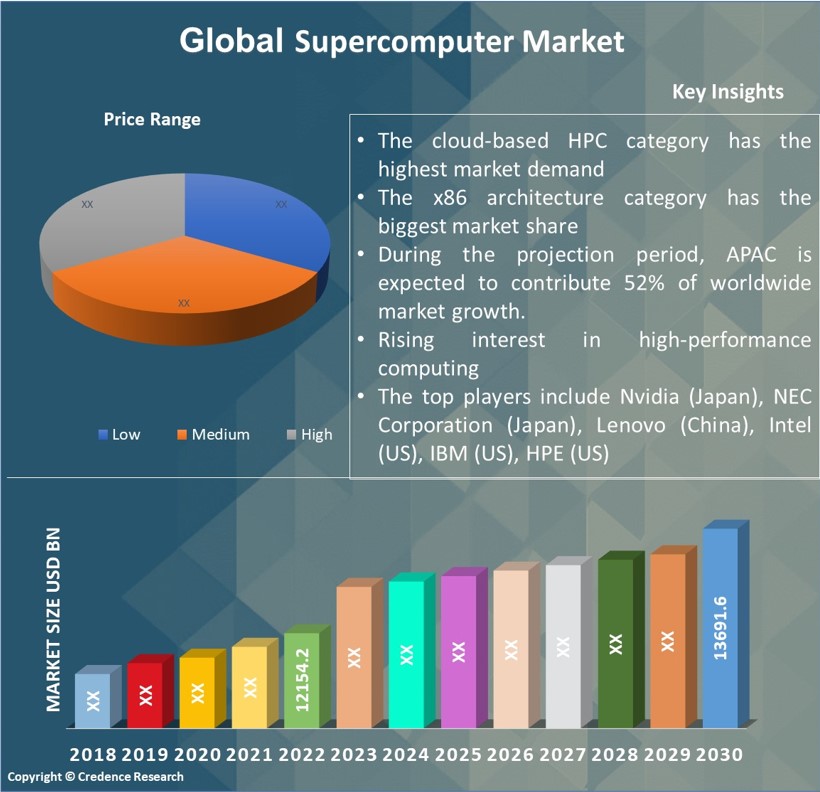
- The global demand for Supercomputer was valued at USD 12154.2 million in 2022 and is expected to reach USD 13691.6 Million in 2030, growing at a CAGR of 1.50% between 2023 and 2030.
- The market demand for cloud-based HPC is the highest. Another segment that adds to the supercomputer market is on-premises supercomputers.
- The x86 architecture category dominates the market. GPU-accelerated computing is another important subset of the supercomputer business.
- The revenue CAGR for research institutes is expected to be the highest, with commercial organizations having the largest revenue share in 2022.
- The leading areas are artificial intelligence (AI) and machine learning (ML), with life sciences being another important market category for supercomputers.
- NVIDIA is a well-known player in the supercomputer market, while Cray (now part of HPE) is another company that contributes to the market.
- InfiniBand is the fastest-growing segment of the supercomputer industry.
- Green computing is a significant component of supercomputers.
- The government controlled the supercomputer market.
- During the projected period, APAC is estimated to contribute 52% of global market growth, while the supercomputer market in North America is likely to develop at the fastest rate.
- The most significant impediment to market expansion is the high cost of ownership and excessive power consumption, which raises the total cost.
- Government investment in high-processing power is expected to fuel the future growth of the supercomputer industry.
Executive Summary
Market Definition
The supercomputer market refers to the industry that manufactures and sells high-performance computing systems. These technologies are built to solve complex issues and conduct complex calculations at breakneck rates. Supercomputers are utilized in a variety of applications, including scientific research, weather forecasting, and simulations. They have enormous processing power and can handle vast volumes of data.
Market Overview
It is anticipated that between 2023 and 2030, the worldwide Supercomputer Market will expand at a compound annual growth rate (CAGR) of 1.50%. From USD 12154.2 million in 2022, the market is projected to be worth USD 13691.6 million by 2030.
Government investment in high processing power is expected to drive future market expansion of supercomputers. The ability to organize and process data in order to analyze it and help decision-making is referred to as high processing power. Governments all across the world are investing in high-end projects that necessitate high-performance computing equipment, driving growing demand for supercomputers. Furthermore, the rapid expansion in access to and usage of open and massive data makes global digital transformation conceivable. As the economic potential of data becomes more evident, data-driven innovations are emerging as a critical driver - a platform of innovation - for the rapid spread of disruptive technologies and business model breakthroughs.
Segmentation by High-Performance Computing (HPC) Systems
- The cloud-based HPC category has the highest market demand. Cloud-based HPC provides enterprises with the benefit of scalability, flexibility, and cost-effectiveness by allowing them to access high-performance computing resources on-demand via the cloud. It removes the requirement for on-premises infrastructure and increases access to supercomputing capabilities.
- On-premises supercomputers are another category that contributes to the supercomputer market.
Segmentation by Processor Architectures
- The x86 architecture category has the biggest market share. The x86 architecture, which is based on the Intel x86 CPU, has gained popularity due to its compatibility, performance, and substantial software support. Because of its established track record and the availability of a large range of software tools and libraries, the x86 architecture is used in many supercomputers.
- GPU-accelerated computing is another major category in the supercomputer industry. GPUs (Graphics Processing Units) are high-performance computers that excel in parallel operations.
Segmentation by End-User Segments
- The revenue CAGR for research institutes is predicted to be the highest. This growth can be attributed to the increasing usage of supercomputers in scientific research and development activities such as drug discovery, genome sequencing, and climate modelling.
- The commercial entities segment had the biggest revenue share in 2022. Commercial businesses employ supercomputers because they are more cost effective. The use of supercomputers allows firms to manage operations more efficiently.
Segmentation by Application Areas
- Artificial Intelligence (AI) and Machine Learning (ML) are the dominant segments. AI and machine learning have transformed several sectors, including scientific research and weather forecasting. AI and ML-enabled supercomputers can process massive volumes of data, identify patterns, and make intelligent predictions, allowing improvements in industries such as healthcare, finance, and autonomous systems.
- Life Sciences is another prominent market category for supercomputers. Supercomputers are essential in life sciences research, enabling activities like genomics, drug development, and molecular simulations.
Segmentation by Supercomputer Vendors
- NVIDIA is a well-known player in the market for supercomputers. NVIDIA specializes in the design and production of high-performance graphics processing units (GPUs), which are frequently employed in supercomputing applications. GPUs excel at parallel processing, which makes them perfect for AI, machine learning, and scientific simulations.
- Cray (now part of HPE) is another company that contributes to the supercomputer market. Cray is a well-known supercomputing system vendor with a long history of offering strong and scalable solutions.
Segmentation by Interconnect Technologies
- InfiniBand is the fastest-growing supercomputer market sector. InfiniBand is a high-speed interconnect technology that enables low-latency and high-bandwidth communication across supercomputer computation nodes. It was developed primarily for high-performance computing (HPC) applications and has gained popularity because to its scalability, reliability, and performance advantages.
Segmentation by Energy Efficiency
- Green Computing is concerned with building energy-efficient hardware, optimizing power management, and optimizing software in supercomputers. These areas are critical in the supercomputer industry for decreasing power consumption, minimizing environmental impact, and fostering sustainability.
Segmentation by Exascale Computing
- The Race to Exascale refers to the continuing race among governments, organizations, and technological businesses to create and install exascale supercomputers. Exascale computing refers to a supercomputer's ability to complete a quintillion (1018) computations per second. It is a huge step forward in the realm of high-performance computing.
Segmentation by Partnerships and Collaborations
- The public sector dominated the supercomputer market. The demand for these computers is expected to rise as people become more aware of the importance of economic stability and competitiveness.
Segmentation by Region
- During the projection period, APAC is expected to contribute 52% of worldwide market growth.
- The supercomputer market in North America is predicted to grow at the quickest rate during the forecast period.
- The rest of the world, including Latin America, the Middle East, and Africa, supplies the remaining demand for Supercomputer.
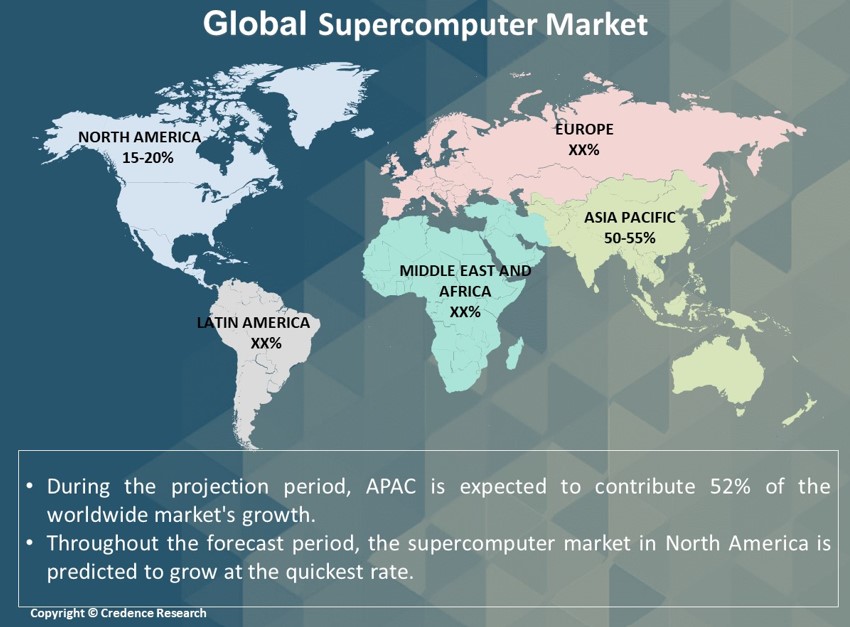
The Asia-Pacific supercomputer market has seen the most rapid expansion. The rapid proliferation of supercomputing systems in the region is mostly the result of countries such as China and Japan. China has well-developed supercomputing landscapes and huge investment as compared to other countries. According to Top500.org, China possesses approximately 173 of the world's 500 most powerful supercomputers as of June 2022. This is three times more than its closest competitor, the United States, which has an additional 128 supercomputers.
North America's supercomputer market is expected to develop at the fastest rate throughout the forecast period. With 122 of the 500 supercomputers already in operation worldwide, the United States ranks second in terms of supercomputer usage. Companies have recently made significant investments in R&D, which is expected to fuel market revenue growth. For instance, IBM and NVIDIA collaborated to create Summit, a new supercomputer that is faster than Titan, the fastest supercomputer in North America. Furthermore, the United States maintained the largest market share, while Canada's supercomputer market was the fastest expanding in the North American region.
Key Highlights of the Report
The global Supercomputer Market is segmented by High-Performance Computing (HPC) Systems, Processor Architectures, End-User Segments, Application Areas, Supercomputer Vendors, Interconnect Technologies, Energy Efficiency, Exascale Computing, Partnerships and Collaborations and region. In 2022, the public sector, machine learning (ML), and artificial intelligence (AI) are the two main market areas for supercomputers. Additionally, the market is most in demand for the cloud-based HPC category, and research institute revenue CAGRs are expected to be the greatest. Also NVIDIA is a well-known player in the supercomputer market, and the fastest-growing segment of the supercomputer market is InfiniBand, with Asia Pacific leading the market growth.
The primary drivers of the market include increasing demand for high-performance computing in sectors, technological advancements, and the growing adoption of artificial intelligence and big data analytics, which require significant processing power. Furthermore, market restrictions include high supercomputer costs, complex infrastructure and maintenance of supercomputers, and limited resource availability.
Nonetheless, In 2022, the Asia-Pacific supercomputer market has grown the fastest. The region's rapid expansion of supercomputing systems is mostly due to countries such as China and Japan. Furthermore, the North American supercomputer market is predicted to grow at the quickest rate during the forecast period.
What Elements Are Driving the Global Market for Supercomputer?
Several variables influence the Supercomputer Market. High-performance computing is in high demand in a variety of industries, including scientific research, weather forecasting, and simulations. These sectors necessitate massive computational capacity to process complicated data and solve complex challenges. Furthermore, technological developments such as faster processors and greater parallel computing capabilities have considerably boosted the performance of supercomputers. This enables faster processing and more efficient data analysis.
What Are The Main Obstacles That The Global Supercomputer Market Faces?
While the Supercomputer Market has enormous potential, several constraints must be recognized. Supercomputers' high cost can be a substantial barrier to entry, rendering them unavailable to smaller enterprises or poor countries with limited funds. Complex infrastructure needs, such as specialized facilities and significant power usage, provide additional obstacles.
What Market Development Prospects Are There For Supercomputer Globally?
The Supercomputer Market offers a number of exciting prospects for future growth and development. Supercomputing applications are expanding into new disciplines such as genomics, customized medicine, and driverless cars. These businesses may considerably benefit from supercomputers' computing capacity to analyze complicated genetic data, generate individualized treatment regimens, and improve autonomous systems. Collaboration between academia, business, and government may also fuel supercomputing innovation and research. Breakthroughs and developments can be made more efficiently by combining resources and expertise.
Market Drivers
The global Supercomputer Market is driven by several factors. The following are the key drivers of the global Supercomputer Market:
Increasing Use Of Big Data Analytics
The introduction of big data analytics has resulted in a large increase in the number of cluster supercomputers. The growing use of big data analytics across businesses has accelerated the deployment of supercomputers. Big data necessitates computing systems capable of handling data-intensive workloads. Businesses are attempting to shift their focus away from data administration and toward extracting value from data in order to make quick, informed choices. The extraction of insights from large data is becoming more popular. This necessitates the development of improved computing infrastructure.
Supercomputers are perfect for processing the vast amounts of data that are accessible on the market because of their massive storage capacities and powerful processing powers. This is evident in the financial services sector, where over the past two to three years, businesses like PayPal have turned to purchasing cluster supercomputers. The requirement for real-time advanced analytics is the primary driver behind the expansion of high-performance data analysis employing cluster supercomputers.
Market Restraints
The global Supercomputer Marketfaces some challenges that may hinder its growth. These include the following:
High Ownership Cost And Excessive Power Consumption
A supercomputer costs a lot of money to acquire and maintain (in the millions). The total cost comprises installation, electricity usage (megawatts), and maintenance. The cost of developing, building, and deploying a supercomputer can range between USD 100 million and USD 300 million. These systems consume approximately 6-7 megawatts of power on average, with peak demand nearing 9.5 megawatts.
Opportunities
The global Supercomputer Marketoffers significant growth opportunities. These include the following:
Government Investment in High-processing Power
High processing power refers to the processing that is used to manage and process data in order to analyze the data and aid decision-making.
Governments all around the world are investing in high-end projects that necessitate high-performance computing systems, resulting in an increase in supercomputer demand. For example, in January 2021, the National Centre for Atmospheric explore-USA announced a $35 million plan to create a powerful new supercomputer to explore phenomena such as solar storms, climate change, and extreme weather events that jeopardize humanity's home planet. The system was designed and deployed at a Wyoming government location by Hewlett Packard Enterprise.
Furthermore, the UK government announced in February 2020 a £1.2 billion ($1.26 billion) investment in the world's most powerful weather and climate supercomputer to improve severe weather and climate forecasts. The latest supercomputing technology will unlock the full potential of weather and climate data for the United Kingdom, with data from the supercomputer used to inform government policy as part of the United Kingdom's leadership role in the global fight against climate change and the achievement of net zero-emission targets. As a result, government investment in high-processing power is propelling the supercomputer market forward.
Competitive Landscape
Key Players
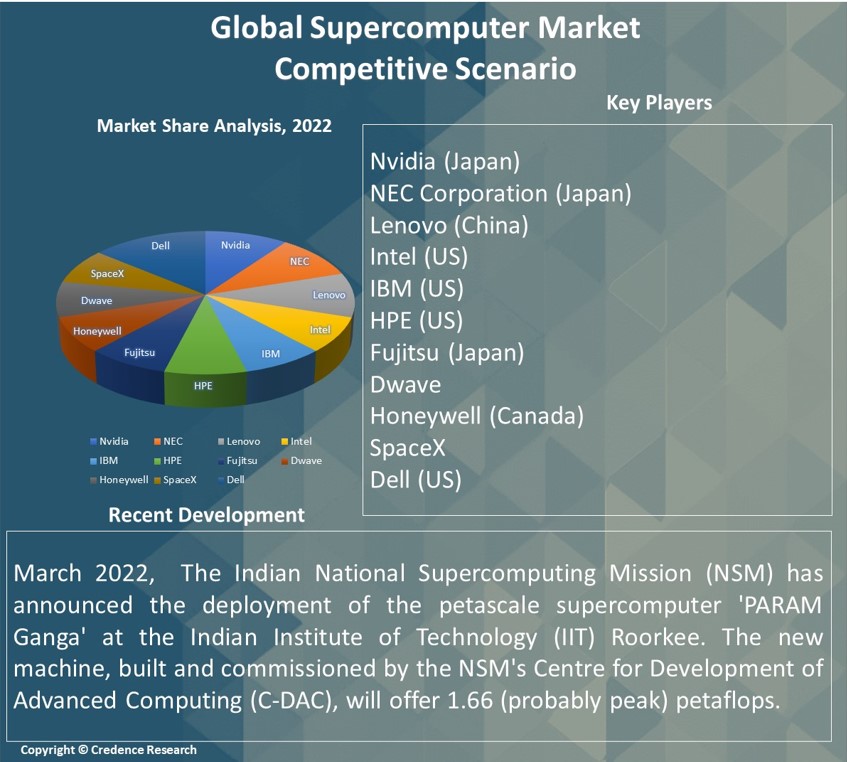
The global Supercomputer Market is highly competitive, with several key players. Some of the major players in the market and their market share are as follows:
- Nvidia (Japan)
- NEC Corporation (Japan)
- Lenovo (China)
- Intel (US)
- IBM (US)
- HPE (US)
- Fujitsu (Japan)
- Dwave
- Honeywell (Canada)
- SpaceX
- Dell (US)
- CISCO (US)
- Atos (France)
- Advanced Micro Devices (US)
These organizations prioritize High-Performance Computing (HPC) Systems innovation, Disease Area expansion, and mergers and acquisitions to stay competitive.
The global Supercomputer Market's key players continually seek to stay ahead by offering new High-Performance Computing (HPC) Systemss and developments.
May 2022, Hewlett Packard Enterprise (HPE) has announced the development of a powerful new AI supercomputer in collaboration with Cerebras Systems. The new system will be comprised of HPE Superdome Flex servers and Cerebras CS-2 accelerators driven by the massive Wafer-Scale Engine 2 (WSE-2) processor. This summer, the Leibniz Supercomputing Centre (LRZ) in Bavaria will go live with this supercomputer.
November 2021, Hewlett Packard Enterprise has announced the construction of one of Europe's most powerful supercomputers, which will be placed and operated at CINES (National Computing Centre for Higher Education), one of France's three HPC centres. GENCI, a French national organization that invests in and delivers HPC resources to France's academic and industrial research communities, purchased the new supercomputer.
Summary of Key Findings
- Government investment in high-processing power is expected to fuel the future growth of the supercomputer industry.
- Market segmented by High-Performance Computing (HPC) Systems, Processor Architectures, End-User Segments, Application Areas, Supercomputer Vendors, Interconnect Technologies, Energy Efficiency, Exascale Computing, Partnerships and Collaborations and region.
- The leading areas are artificial intelligence (AI) and machine learning (ML)
- Asia Pacific is leading market growth; the market is highly competitive with key players including Nvidia (Japan), NEC Corporation (Japan), Lenovo (China), Intel (US), IBM (US), HPE (US)
Future Outlook
- Continued technological progress
- Rising interest in high-performance computing
- Increased adoption of artificial intelligence and big data analytics
- Expansion of R&D operations
- Increased investment in supercomputing infrastructure
- The emergence of new actors and competition
- The emphasis on energy efficiency and sustainability
- The integration of cloud computing and supercomputers
Segmentation
- By High-Performance Computing (HPC) Systems:
- On-Premises Supercomputers
- Cloud-Based HPC
- By Processor Architectures:
- x86 Architecture
- GPU Accelerated
- Custom Architectures
- By End-User Segments:
- Research and Academic Institutions
- Government and Defense
- Commercial Entities
- By Application Areas:
- Scientific Research
- Artificial Intelligence (AI) and Machine Learning (ML)
- Weather Forecasting
- Life Sciences
- By Supercomputer Vendors:
- Cray (now part of HPE)
- IBM
- NVIDIA
- AMD
- By Interconnect Technologies:
- InfiniBand
- Ethernet
- Others
- By Energy Efficiency:
- Green Computing
- By Exascale Computing:
- Race to Exascale
- By Partnerships and Collaborations:
- Public-Private Partnerships
- By Region
- North America
- The U.S.
- Canada
- Mexico
- Europe
- Germany
- France
- The U.K.
- Italy
- Spain
- Rest of Europe
- Asia Pacific
- China
- Japan
- India
- South Korea
- South-east Asia
- Rest of Asia Pacific
- Latin America
- Brazil
- Argentina
- Rest of Latin America
- Middle East & Africa
- GCC Countries
- South Africa
- Rest of Middle East and Africa
- North America

Request a Free Sample
Fill in your details and we'll send you a free sample report.
- Sample data tables & charts
- Research methodology
Market Dynamics
Government Investment in High-Processing Power
Governments worldwide are funding high-end supercomputing projects for national security, scientific research, and climate modeling, directly increasing demand for advanced supercomputers.
Expansion of Artificial Intelligence and Machine Learning
The rapid adoption of AI and ML applications across industries requires immense computational power, driving organizations to invest in supercomputers capable of handling large-scale data processing and complex algorithms.
Growth in Big Data Analytics
The proliferation of big data in sectors such as finance, healthcare, and scientific research necessitates high-performance computing infrastructure, making supercomputers essential for extracting actionable insights from massive datasets.
Technological Advancements in Processor and Interconnect Technologies
Innovations such as GPU acceleration, x86 architecture improvements, and high-speed interconnects like InfiniBand are enhancing supercomputer performance, making them more attractive for a broader range of applications.
Rising Demand for Energy-Efficient and Sustainable Computing
With increasing awareness of power consumption and environmental impact, there is a strong push for green computing solutions in supercomputers, encouraging the development and adoption of energy-efficient systems.
Need a Custom Version of This Report?
Tailor the scope, geography, or segments to your exact requirements.
- Custom geography or segment scope
- Direct access to our analyst team
Frequently Asked Questions
What is the current End-User Segments of the worldwide Supercomputer Market?
What is the predicted growth rate of the Supercomputer Market between 2023 and 2030?
Which High-Performance Computing (HPC) Systems segment governs the market demand for Supercomputer?
Table of Content
Chapter 1 Market Segmentation
- 1.1 Segmentation Framework
- 1.1.1 Product and Service Classification
- 1.1.2 Application and End-Use Classification
- 1.1.3 Technology and Solution Classification
- 1.1.4 Customer and Distribution Channel Classification
- 1.1.5 Geographic Segmentation
- 1.1.6 Market Segment Definitions and Boundaries
- 1.2 By Application Areas
- 1.2.1 Artificial Intelligence (AI) and Machine Learning (ML)
- 1.2.2 Life Sciences
- 1.2.3 Weather Forecasting
- 1.2.4 Scientific Research
- 1.3 By End-User Segments
- 1.3.1 Research and Academic Institutions
- 1.3.2 Government and Defense
- 1.3.3 Commercial Entities
- 1.4 By Processor Architectures
- 1.4.1 x86 Architecture
- 1.4.2 GPU Accelerated
- 1.4.3 Custom Architectures
- 1.5 By High-Performance Computing (HPC) Systems
- 1.5.1 On-Premises Supercomputers
- 1.5.2 Cloud-Based HPC
Chapter 2 Introduction
- 2.1 Report Objectives and Scope
- 2.2 Product Definition and Industry Terminology
- 2.3 Market Inclusions and Exclusions
- 2.4 Research Process
- 2.4.1 Primary Research and Expert Interviews
- 2.4.2 Secondary Research and Source Review
- 2.4.3 Top-Down and Bottom-Up Estimation
- 2.4.4 Data Triangulation and Verification
- 2.5 Market Size Measurement Basis
- 2.5.1 2022: USD 12,154.2 million → 2030: USD 13,691.6 Million
- 2.6 Historical and Forecast Reference Periods
- 2.6.1 Base Year: 2022
- 2.6.2 Forecast Period: 2022-2030
- 2.7 Research Assumptions and Limitations
Chapter 3 Executive Summary
- 3.1 Market Snapshot and Key Findings
- 3.2 Base-Year Market Size, 2022
- 3.3 Forecast Market Size, 2030
- 3.4 Revenue and Volume Growth Outlook
- 3.5 Key Demand and Supply Indicators
- 3.6 Leading Market Segments
- 3.7 Fastest-Growing Market Opportunities
- 3.8 Regional Performance Highlights
- 3.9 Technology and Industry Transformation
- 3.10 Competitive Landscape Summary
- 3.11 Analyst View and Strategic Implications
Chapter 4 Global Supercomputer Market Trends and Developments
- 4.1 Historical Industry Development
- 4.2 Recent Market Trends and Developments
- 4.3 Demand and Customer Behavior Trends
- 4.4 Technology and Product Innovation
- 4.5 Artificial Intelligence, Automation and Digitalization
- 4.6 Local Manufacturing and Supply Chain Realignment
- 4.7 Industry Partnerships, Mergers and Acquisitions
- 4.8 Sustainability and Circular Economy Developments
- 4.9 Government and Private Sector Investment Trends
- 4.10 Emerging Business Models and Commercialization
- 4.11 Industry Developments and Announcements
Chapter 5 Global Supercomputer Market Production, Supply and Demand Analysis
- 5.1 Demand Trend and Consumption Analysis
- 5.2 Demand Forecast, 2022-2030
- 5.3 Production and Output Trend
- 5.4 Production and Output Forecast, 2022-2030
- 5.5 Installed Capacity and Capacity Utilization
- 5.6 Company-Wise Production Plants and Statistics
- 5.6.1 Installed Production Capacity
- 5.6.2 Actual Production
- 5.6.3 Planned Capacity and Expansion Targets
- 5.7 Supply Chain Structure and Procurement Trends
- 5.8 Supply-Demand Gap and Bottlenecks
- 5.9 Import Dependence and Sourcing Structure
- 5.10 Contract Manufacturing and Outsourcing
- 5.11 Regional Supply and Demand Concentration
Chapter 6 Global Supercomputer Market Pricing Analysis
- 6.1 Pricing Structure and Measurement
- 6.2 Historical Pricing Trends
- 6.3 Pricing Outlook, 2022-2030
- 6.4 Average Selling Price and Unit Economics
- 6.5 Pricing by Product and Market Segment
- 6.6 Geographic Pricing Differences
- 6.7 Key Input, Energy, Labor and Logistics Costs
- 6.8 Contract Pricing and Purchasing Models
- 6.9 Pricing Sensitivity and Competitive Positioning
- 6.10 Price, Margin and Profitability Implications
Chapter 7 Global Supercomputer Market Dynamics
- 7.1 Market Growth Drivers
- 7.1.1 Demand-Side Drivers
- 7.1.2 Technology and Innovation Drivers
- 7.1.3 Infrastructure and Investment Drivers
- 7.1.4 Regulatory and Policy Drivers
- 7.2 Market Restraints
- 7.2.1 Cost and Affordability Constraints
- 7.2.2 Technology and Adoption Barriers
- 7.2.3 Supply Chain and Operational Constraints
- 7.3 Market Challenges
- 7.3.1 Competitive Pressure and Margin Erosion
- 7.3.2 Skills, Infrastructure and Implementation Gaps
- 7.4 Emerging Market Opportunities
- 7.5 Market Dynamics Impact and Time-Horizon Assessment
Chapter 8 Global Supercomputer Value Chain Analysis
- 8.1 Industry Value Chain Overview
- 8.2 Upstream Suppliers and Critical Inputs
- 8.3 Technology and Component Providers
- 8.4 Manufacturing or Service Delivery
- 8.5 Distribution, Channel Partners and Integrators
- 8.6 Downstream Applications and End Users
- 8.7 Value Addition and Profit Pools
- 8.8 Vertical Integration and Outsourcing
- 8.9 Supplier Concentration and Risk
- 8.10 Supply Chain Localization and Resilience
Chapter 9 Global Supercomputer Market Regulations and Policies
- 9.1 Relevant Laws, Standards and Compliance Frameworks
- 9.2 Product, Service, Safety and Quality Requirements
- 9.3 Government Policies, Incentives and Subsidies
- 9.4 Imports, Exports and Trade Barriers
- 9.5 Public Procurement and Local Content Requirements
- 9.6 Environmental and Sustainability Compliance
- 9.7 Data Protection, AI and Cybersecurity Compliance
- 9.8 Upcoming Policy Changes and Market Implications
Chapter 10 Global Supercomputer Market Hotspots and Opportunities
- 10.1 Market Opportunity Mapping and Growth Hotspots
- 10.2 High-Growth Applications and Customer Groups
- 10.3 Underserved Markets and White-Space Opportunities
- 10.4 Emerging Technology and Product Opportunities
- 10.5 New Capacity and Investment Hotspots
- 10.6 Market Entry and Expansion Opportunities
- 10.7 Distribution and Partnership Opportunities
- 10.8 Near-Term and Long-Term Commercial Potential
- 10.9 Opportunity Attractiveness and Execution Risks
Chapter 11 Global Supercomputer Market Outlook, 2022-2030
- 11.1 Market Size and Analysis
- 11.1.1 Revenue (Market Measurement: 2022: USD 12,154.2 million → 2030: USD 13,691.6 Million)
- 11.1.2 Market Volume and Quantity Sold
- 11.1.3 Historical Market Size
- 11.1.4 Base-Year Market Size, 2022
- 11.2 Market Forecast, 2022-2030
- 11.2.1 Revenue Forecast to 2030
- 11.2.2 Volume Forecast to 2030
- 11.2.3 CAGR and Year-on-Year Growth
- 11.2.4 Incremental Revenue Opportunity
- 11.3 Forecast Assumptions and Scenario Analysis
- 11.3.1 Base-Case Forecast
- 11.3.2 Optimistic and Conservative Scenarios
- 11.3.3 Technology, Pricing and Policy Sensitivities
- 11.4 Market Attractiveness and Growth Outlook
Chapter 12 Global Supercomputer Market Segmentation and Outlook
- 12.1 Segmentation Summary and Market Shares, 2022
- 12.2 Largest and Fastest-Growing Segments
- 12.3 By Application Areas - Market Size and Forecast, 2022-2030
- 12.3.1 Segment Definition and Scope
- 12.3.2 Historical Market Size
- 12.3.3 Revenue Forecast, 2022-2030
- 12.3.4 Volume Forecast, 2022-2030
- 12.3.5 Base-Year Market Share, 2022
- 12.3.6 Segment CAGR and Growth Drivers
- 12.3.7 Subsegment Market Size and Forecast
- 12.3.7.1 Artificial Intelligence (AI) and Machine Learning (ML)
- 12.3.7.2 Life Sciences
- 12.3.7.3 Weather Forecasting
- 12.3.7.4 Scientific Research
- 12.3.8 Subsegment Pricing and Adoption Trends
- 12.3.9 Leading Suppliers and Competition
- 12.3.10 Regional Demand and Opportunities
- 12.4 By End-User Segments - Market Size and Forecast, 2022-2030
- 12.4.1 Segment Definition and Scope
- 12.4.2 Historical Market Size
- 12.4.3 Revenue Forecast, 2022-2030
- 12.4.4 Volume Forecast, 2022-2030
- 12.4.5 Base-Year Market Share, 2022
- 12.4.6 Segment CAGR and Growth Drivers
- 12.4.7 Subsegment Market Size and Forecast
- 12.4.7.1 Research and Academic Institutions
- 12.4.7.2 Government and Defense
- 12.4.7.3 Commercial Entities
- 12.4.8 Subsegment Pricing and Adoption Trends
- 12.4.9 Leading Suppliers and Competition
- 12.4.10 Regional Demand and Opportunities
- 12.5 By Processor Architectures - Market Size and Forecast, 2022-2030
- 12.5.1 Segment Definition and Scope
- 12.5.2 Historical Market Size
- 12.5.3 Revenue Forecast, 2022-2030
- 12.5.4 Volume Forecast, 2022-2030
- 12.5.5 Base-Year Market Share, 2022
- 12.5.6 Segment CAGR and Growth Drivers
- 12.5.7 Subsegment Market Size and Forecast
- 12.5.7.1 x86 Architecture
- 12.5.7.2 GPU Accelerated
- 12.5.7.3 Custom Architectures
- 12.5.8 Subsegment Pricing and Adoption Trends
- 12.5.9 Leading Suppliers and Competition
- 12.5.10 Regional Demand and Opportunities
- 12.6 By High-Performance Computing (HPC) Systems - Market Size and Forecast, 2022-2030
- 12.6.1 Segment Definition and Scope
- 12.6.2 Historical Market Size
- 12.6.3 Revenue Forecast, 2022-2030
- 12.6.4 Volume Forecast, 2022-2030
- 12.6.5 Base-Year Market Share, 2022
- 12.6.6 Segment CAGR and Growth Drivers
- 12.6.7 Subsegment Market Size and Forecast
- 12.6.7.1 On-Premises Supercomputers
- 12.6.7.2 Cloud-Based HPC
- 12.6.8 Subsegment Pricing and Adoption Trends
- 12.6.9 Leading Suppliers and Competition
- 12.6.10 Regional Demand and Opportunities
- 12.7 Segment Growth Comparison
- 12.8 Segment Attractiveness and Priority Matrix
Chapter 13 Global Supercomputer End-Use and Application Market Outlook
- 13.1 End-Use Industry and Customer Demand Structure
- 13.2 Leading Applications and Customer Groups
- 13.3 End-Use Market Size, Share and Forecast
- 13.4 Major End-Use Industry Deep Dives
- 13.4.1 Customer Requirements and Use Cases
- 13.4.2 Demand and Replacement Cycles
- 13.4.3 Technical and Regulatory Considerations
- 13.4.4 Purchasing and Procurement Models
- 13.4.5 Leading Vendors and Distribution Channels
- 13.4.6 Forecast and Commercial Opportunities
- 13.5 Emerging Applications and Cross-Segment Demand
- 13.6 End-Use Industry Investment Priorities
Chapter 14 Global Supercomputer Geographic Market Outlook, 2022-2030
- 14.1 Regional Market Size and Share, 2022
- 14.2 Regional Market Forecast, 2022-2030
- 14.3 Regional Pricing, Production and Demand Differences
- 14.4 North America
- 14.4.1 United States
- 14.4.2 Canada
- 14.4.3 Mexico
- 14.5 Europe
- 14.5.1 Germany
- 14.5.2 France
- 14.5.3 Italy
- 14.5.4 United Kingdom
- 14.5.5 Spain
- 14.5.6 Poland
- 14.5.7 Russia
- 14.5.8 Netherlands
- 14.5.9 Belgium
- 14.5.10 Sweden
- 14.5.11 Denmark
- 14.5.12 Norway
- 14.5.13 Rest of Europe
- 14.6 Asia Pacific
- 14.6.1 China
- 14.6.2 India
- 14.6.3 Japan
- 14.6.4 South Korea
- 14.6.5 Thailand
- 14.6.6 Indonesia
- 14.6.7 Vietnam
- 14.6.8 Malaysia
- 14.6.9 Australia
- 14.6.10 Rest of Asia Pacific
- 14.7 Latin America
- 14.7.1 Brazil
- 14.7.2 Argentina
- 14.7.3 Colombia
- 14.7.4 Chile
- 14.7.5 Rest of Latin America
- 14.8 Middle East
- 14.8.1 Saudi Arabia
- 14.8.2 United Arab Emirates
- 14.8.3 Turkey
- 14.8.4 Israel
- 14.8.5 Iran
- 14.8.6 Rest of the Middle East
- 14.9 Africa
- 14.9.1 South Africa
- 14.9.2 Egypt
- 14.9.3 Nigeria
- 14.9.4 Morocco
- 14.9.5 Rest of Africa
- 14.10 Regional Investment, Policy and Supply Chain Differences
- 14.11 Regional Competitive Landscape
- 14.12 Geographic Growth Hotspots
Chapter 15 Global Supercomputer Technology, Innovation and Sustainability Outlook
- 15.1 Technology Landscape and Maturity
- 15.2 Product, Process and Service Innovation
- 15.3 AI, Automation and Digital Tools in the Industry
- 15.4 Technology Adoption and Performance Benchmarking
- 15.5 Innovation Pipeline and R&D Investment
- 15.6 Patent and Intellectual Property Trends
- 15.7 Energy Efficiency and Resource Management
- 15.8 Sustainability, Recycling and Circularity
- 15.9 Technology Roadmap, 2022-2030
- 15.10 Risks of Obsolescence and Technology Substitution
Chapter 16 Global Supercomputer Market Key Strategic Imperatives
- 16.1 Growth and Market Entry Priorities
- 16.2 High-Return Products and Segments
- 16.3 Pricing, Profitability and Cost Optimization
- 16.4 Technology Investment and Product Differentiation
- 16.5 Supply Chain Localization and Resilience
- 16.6 Distribution and Customer Acquisition
- 16.7 Partnership, Acquisition and Capacity Strategy
- 16.8 Regional Expansion Priorities
- 16.9 Short-, Medium- and Long-Term Actions
Chapter 17 Competition Outlook
- 17.1 Industry Competition Characteristics
- 17.2 Market Structure and Concentration
- 17.3 Market Share and Competitive Positioning, 2022
- 17.4 Company-Wise Revenue and Product Benchmarking
- 17.5 Production and Service Capacity Benchmarking
- 17.6 Technology, Pricing and Differentiation
- 17.7 Regional Footprint and Distribution Strength
- 17.8 Mergers, Acquisitions and Strategic Alliances
- 17.9 New Entrants and Competitive Threats
- 17.10 Porter's Five Forces and Industry Attractiveness
- 17.11 Competitive Outlook, 2022-2030
Chapter 18 Company Profiles
- 18.1 Company Coverage and Selection Criteria
- 18.2 NVIDIA
- 18.2.1 Business Description
- 18.2.2 Company Ownership and Geographic Presence
- 18.2.3 Product and Service Portfolio
- 18.2.4 Manufacturing and Operating Footprint
- 18.2.5 Production Capacity and Expansion Plans
- 18.2.6 Financial Performance and Investment
- 18.2.7 Market Share and Competitive Position
- 18.2.8 Technology and Innovation Capabilities
- 18.2.9 Strategic Alliances or Partnerships
- 18.2.10 Recent Developments
- 18.2.11 Growth Strategy and Outlook
- 18.3 Hewlett Packard Enterprise (HPE)
- 18.4 IBM
- 18.5 Lenovo
- 18.6 Fujitsu
- 18.7 NEC Corporation
- 18.8 Intel
- 18.9 Atos
- 18.10 Dell
- 18.11 Advanced Micro Devices (AMD)
- 18.12 Other Relevant Market Participants
Note: Every listed company is profiled on the structure shown under the first company. The company list is preliminary and may change based on research findings, market developments, data availability and client requirements.
Chapter 19 Disclaimer
- 19.1 Research and Forecast Disclaimer
- 19.2 Data Source and Estimation Limitations
Note: The depth of individual sections depends on data availability for this market. Volume, capacity, trade and other unit-based metrics are included where applicable.

