
Market Insights
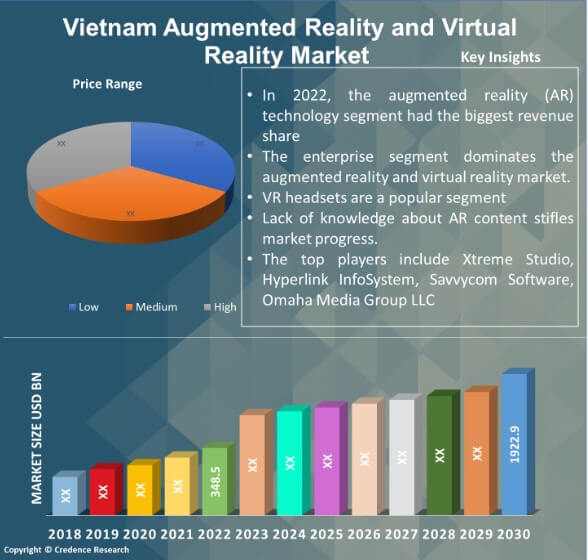
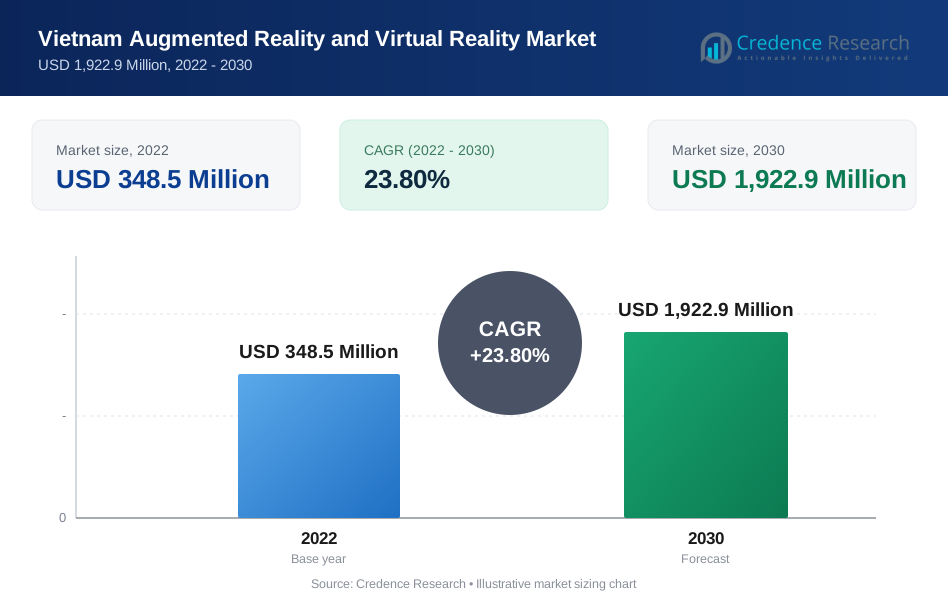
- The demand for Vietnam Augmented Reality and Virtual Reality was valued at USD 348.5 Million in 2022 and is expected to reach USD 1922.9 Million in 2030, growing at a CAGR of 23.80% between 2023 and 2030.
- The augmented reality (AR) technology segment had the largest revenue share of around 71.0 in 2022, while the virtual reality technology segment is predicted to increase at the quickest CAGR of approximately 31.0%.
- VR headsets are a major market niche.
- Both AR and VR rely on sophisticated software to create immersive experiences.
- The gaming and entertainment sector dominates the market, but the healthcare and medical sector has been recognized as having a higher CAGR, and retail and e-commerce is another quickly rising segment of the AR and VR company.
- The enterprise section dominates the augmented reality and virtual reality industry, while the healthcare institutions category has gained in prominence in contrast to other segments.
- Investment by rising market leaders stimulates market growth.
- Lack of understanding of AR content stifles market progress.
Executive Summary
Market Definition
The term augmented reality (AR) refers to the use of technology to augment the actual world with digital content while retaining all of its other properties. Augmented reality technology uses a CPU, sensors, and a display unit to blend digital information onto a physical surface. This combination is the foundation of the technology. People can interact in real-time while immersed in a synthetic, computer-generated environment using virtual reality (VR) technology. Through the immersive and engaging experience that virtual reality (VR) can provide, users can visualize and comprehend difficult concepts, mimic human interactions, and explore virtual worlds.
Market Overview
It is anticipated that between 2023 and 2030, the worldwide Vietnam Augmented Reality and Virtual Reality Market will expand at a compound annual growth rate (CAGR) of 23.80%. From USD 348.5 million in 2022, the market is projected to be worth USD 1922.9 million by 2030.
The AR and VR market in Vietnam is rising rapidly and is projected to rise further in the future years. The country's demand for AR and VR technologies is being driven by the increasing usage of smartphones, the availability of high-speed internet, and the growing interest in immersive experiences.
Gaming and entertainment are the key industry segments driving the AR and VR market in Vietnam. The gaming industry is embracing virtual reality (VR) technology to offer immersive gaming experiences, while entertainment venues are adding augmented reality (AR) to improve guest experiences.
Education and training are other important sectors for the adoption of AR and VR in Vietnam. These technologies are utilized to create interactive and engaging learning experiences for students, allowing them to explore virtual settings and visualize complex topics.
AR and VR are being used in the real estate and tourism industries to display homes and destinations, delivering virtual tours and immersive experiences to potential buyers and tourists.
Segmentation by Technology Type
- In 2022, the augmented reality (AR) technology segment had the biggest revenue share of roughly 71.0%. This growth is attributable to manufacturers' desire for AR technology, which allows them to access both human procedures and automated data at the same time.
- Moreover, From 2023 to 2030, the virtual reality technology segment is expected to develop at the fastest CAGR of roughly 31.0%. This expansion can be ascribed to the broad use of virtual reality as well as the increasing popularity of industrial IoT, industrial robots, and smart factories, which have served as a key platform for VR applications in the manufacturing industry.
Segmentation by Hardware
- VR headsets are a popular segment. They are commonly utilized to create immersive virtual experiences. While AR devices are becoming more popular, VR headsets now have a bigger market share. VR headsets offer a more immersive and participatory experience, making users feel as if they are in another planet.
Segmentation By Software
- The software segment drives demand. Both AR and VR rely on sophisticated software to generate immersive experiences. AR software is used to superimpose digital information on the real world, augmenting the user's experience.
Segmentation by Application
- The gaming and entertainment sector dominates the market. The combination of augmented reality and virtual reality may create immersive visual spectacles, obtain real-time analytics, and bring performers closer to the audience. AR and VR have had a significant impact on the gaming industry, allowing for the creation of new forms of interactive and location-based games.
- In the augmented reality and virtual reality market, the healthcare and medical sector has been highlighted as having a higher CAGR (Compound Annual Growth Rate). This indicates that the healthcare and medical industries have demonstrated substantial development and potential in embracing AR and VR technology for a variety of applications such as surgical training, patient education, and therapy.
- Retail and e-commerce is another rapidly developing section of the AR and VR business. With the advent of online shopping and the demand for immersive and interactive experiences, merchants are embracing AR and VR technologies to improve customer shopping experiences, display products in a virtual environment, and provide virtual try-on capabilities.
Segmentation by End User
- The enterprise segment dominates the augmented reality and virtual reality market. AR and VR technologies are being used by businesses in a variety of industries for training, simulations, product design, and collaboration. Because of their promise to improve productivity and efficiency, AR and VR technologies have been driving demand and growth in the enterprise sector.
- The healthcare institutions category is another that has grown in prominence in comparison to others. AR and VR are increasingly being used in healthcare settings for medical training, patient education, and therapy. These technologies enable immersive and interactive experiences that improve patient outcomes and medical education.
Key Highlights of the Report
The Vietnam Augmented Reality and Virtual Reality Market is segmented by Technology Type, Hardware, Software, Product Form, End User and region. In 2022, the augmented reality (AR) technology category had the highest revenue share. In addition, VR headsets are a popular market, and the healthcare and medical industry has been identified as having a greater CAGR. Furthermore, the enterprise segment controls the augmented reality and virtual reality markets.
The primary drivers of the market include increasing smartphone and internet penetration, rising demand for immersive experiences, and the adoption of advanced technology. In addition, there is a lack of knowledge and understanding of AR and VR technology. High costs associated with hardware and software implementation, as well as a scarcity of trained individuals in AR and VR development, are the primary market restraints.
What Elements Are Driving the Market for Vietnam Augmented Reality and Virtual Reality?
The increasing smartphone and internet penetration in the country is one of the primary drivers for the AR and VR business in Vietnam. With more people having smartphones and high-speed internet, the audience for AR and VR experiences is growing. Furthermore, the increasing desire for immersive experiences is propelling the adoption of AR and VR technology. People want more interactive and interesting content, whether in gaming, entertainment, or other industries. Furthermore, the use of new technology is supporting the expansion of Vietnam's AR and VR markets. As technology advances, more potential for unique and immersive experiences emerge.
What Are The Main Obstacles That The Vietnam Augmented Reality and Virtual Reality Market Faces?
One of the most significant issues is a lack of awareness and comprehension of AR and VR technologies. Many individuals are still unaware of these technologies' capabilities and possible applications. Furthermore, the high prices of hardware and software installation can be a deterrent for businesses and people wishing to deploy AR and VR solutions. The initial expenditure necessary for equipment and research can be prohibitively expensive. Furthermore, there is a scarcity of competent people in AR and VR development, which may impede industry growth. The scarcity of talent in this industry can make it difficult to create high-quality, unique AR and VR experiences.
What Market Development Prospects Are There For Vietnam Augmented Reality and Virtual Reality?
In Vietnam, there are numerous potential in the AR and VR markets. One of the most promising potential is the proliferation of AR and VR applications across multiple sectors. As more industries see the value of these technologies, there is a growing need for AR and VR solutions in fields such as education, healthcare, real estate, tourism, and others. Collaboration between local and international AR/VR firms is another possibility. By collaborating and exchanging expertise, there is an opportunity to accelerate market growth and introduce new ideas and technology.
Market Drivers
The Vietnam Augmented Reality and Virtual Reality Market is driven by several factors. The following are the key drivers of the Vietnam Augmented Reality and Virtual Reality Market:
Rising Market Leader Investment
The market for Augmented and Virtual Reality is expanding as a result of increased investment from market leaders. Facebook is incorporating augmented reality adverts into its app: Through adverts in the app, Facebook will provide users with an augmented reality experience. Users of the application can view fashion items such as eyeglasses and shoes and virtually try them on.
IKEA launched Place, an augmented reality app that allows Apple users to place IKEA furniture in their residences and preview an interior before purchasing things. This technique makes it easy for potential clients to choose furniture. eBay partnered with a local company to build virtual stores. When the industry began creating uses for this technology, eBay was one of the first movers in the market. Amazon is also providing virtual reality experiences in select cities. Amazon is testing virtual reality in order to increase Prime Day sales. eBay, another e-commerce behemoth, did the same in Vietnam in 2016. We may expect these major businesses to boost technology knowledge through such events prior to future app launches, so driving market awareness and ultimately the market.
Market Restraints
The Vietnam Augmented Reality and Virtual Reality Market faces some challenges that may hinder its growth. These include the following:
Lack of Knowledge About AR Content
Consumers' lack of awareness of AR material is the most difficult hurdle with AR. Augmented and virtual reality information can take many different forms, which might be confusing. It's unclear if consumers are aware these tools are available to them, or whether they recognize they're using AR or VR when they do. In a recent GWI research survey we discovered that over 90% of consumers in these countries are aware of VR, with approximately 65% aware of AR. AR awareness is high among the 16-44 age group (70-75%), but low among the 45-54 (56%) and 55-64 (44%). Males (71%) have a significantly higher level of awareness of AR than females (59%). As a result, there has been a limited focus on the AR sector, particularly for uses other than gaming.
Opportunities
The Vietnam Augmented Reality and Virtual Reality Market offers significant growth opportunities. These include the following:
Creating Engaging Customer Experiences And Marketing
Through the unique integration of Augmented Reality (AR), the world of advertising and marketing is undergoing a significant revolution. Brands are realizing the enormous potential of augmented reality (AR) to capture people and develop a lasting relationship. Brands may use AR technology to break through traditional advertising limitations, generating campaigns that are not only engaging but also memorable. Users interact with virtual components layered on their real-world surroundings to bring interactive commercials to life. AR helps consumers to perceive things in their own spaces before purchasing, demystifying the shopping process.
Personalization reaches new heights as AR tailors information to individual interests and surroundings, fostering deeper emotional relationships with customers. These AR-powered efforts not only raise brand awareness but also immerse customers in the brand narrative, changing them from passive observers to active players. The use of augmented reality in advertising heralds a new era in which consumer involvement becomes a multi-sensory, interactive adventure, altering how brands connect with their target audience in a technologically advanced world.
Innovative augmented reality allows for the creation of dynamic and immersive consumer experiences that engage and fascinate consumers in ways that traditional marketing tactics cannot. Marketing the product and improving the user experience via AR is a significant market growth opportunity.
Competitive Landscape
Key Players
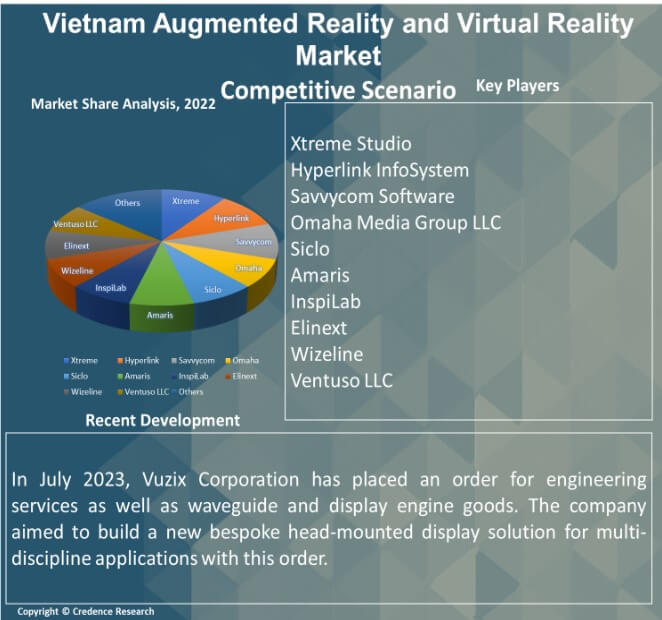
The Vietnam Augmented Reality and Virtual Reality Market is highly competitive, with several key players. Some of the major players in the market and their market share are as follows:
- Xtreme Studio
- Hyperlink InfoSystem
- Savvycom Software
- Omaha Media Group LLC
- Siclo
- Amaris
- InspiLab
- Elinext
- Wizeline
- Ventuso LLC.
These organizations prioritize product innovation, Disease Area expansion, and mergers and acquisitions to stay competitive.
The Vietnam Augmented Reality and Virtual Reality Market's key players continually seek to stay ahead by offering new Technology Types and developments.
In April 2021, Inpixon announced the acquisition of a suite of augmented reality (AR), computer vision, localization, navigation, mapping, and 3D reconstruction technologies from Visualix, as well as related patents, trademarks, software, and intellectual property.
In April 2021, Facebook has announced the acquisition of Downpour Interactive, the developer of the popular multiplayer military simulator Onward.
Summary of Key Findings
- Market opportunities include creating compelling customer experiences and marketing.
- Market segmented by Technology Type, Hardware, Software, Product Form, End User and region
- Virtual reality headsets are a significant market niche
- In 2022, the augmented reality (AR) technology segment is expected to have the most revenue share.
- The market is highly competitive with key players including Xtreme Studio, Hyperlink InfoSystem, Savvycom Software, Omaha Media Group LLC, Siclo, Amaris, InspiLab, Elinext, Wizeline, and Ventuso LLC.
Future Outlook
- Continued expansion and growth
- Expanding use in gaming and entertainment
- Expanding use in education and training
- Integration into real estate and tourist sectors
- Potential for innovation and progress
Segmentation
- By Technology Type:
- Augmented Reality (AR)
- Virtual Reality (VR)
- By Hardware:
- AR Devices
- VR Headsets
- Input Devices
- By Software:
- AR Software
- VR Software
- By Application:
- Gaming and Entertainment
- Education and Training
- Healthcare and Medical
- Architecture and Real Estate
- Retail and E-Commerce
- Marketing and Advertising
- Manufacturing and Industrial
- Tourism and Hospitality
- Sports and Fitness
- Automotive
- Art and Design
- Social and Communication
- Defense and Military
- By End User:
- Consumers
- Enterprises
- Government and Defense
- Healthcare Institutions
- Education Institutions
Request a Free Sample
Fill in your details and we'll send you a free sample report.
- Sample data tables & charts
- Research methodology
Need a Custom Version of This Report?
Tailor the scope, geography, or segments to your exact requirements.
- Custom geography or segment scope
- Direct access to our analyst team
Frequently Asked Questions
What is the current Technology Type of the worldwide Vietnam Augmented Reality and Virtual Reality Market?
What is the predicted growth rate of the Vietnam Augmented Reality and Virtual Reality Market between 2023 and 2030?
Which segment has the most market share in terms of Technology type ?
Which end-user segment governs the market demand for Vietnam Augmented Reality and Virtual Reality?
Who are the major players in the Vietnam Augmented Reality and Virtual Reality Market?
Table of Content
Chapter 1. Report Introduction
- 1.1 Report Description & Purpose
- 1.1.1 Report Title & Market Definition
- 1.1.2 Unique Selling Propositions (USP) & Key Differentiators
- 1.1.3 Value Proposition for Stakeholders
- 1.2 Research Objectives
- 1.2.1 Market Sizing Objectives (Volume & Revenue) (Volume Where Applicable)
- 1.2.2 Segmentation Objectives
- 1.2.3 Competitive Intelligence Objectives
- 1.2.4 Forecast & Scenario Objectives
- 1.3 Report Scope
- 1.3.1 Vietnam Augmented Reality and Virtual Reality Scope – Segments & Subsegments Covered
- 1.3.2 Geographic Scope – Selected Country & Subnational Markets Covered
- 1.3.3 Historical Period, Base Year & Forecast Period (2022; forecast to 2030)
- 1.3.4 Inclusions & Exclusions
- 1.4 Industry Classification & Applicable Codes
- 1.5 Currency, Measurement Units & Valuation Basis
- 1.6 Target Stakeholders
- 1.7 Limitations & Assumptions
Chapter 2. Executive Summary
- 2.1 Vietnam Augmented Reality and Virtual Reality Snapshot
- 2.1.1 Market Size – Historical (2022) & Forecast (2022-2030) (2022: USD 348.5 Million → 2030: USD 1,922.9 Million)
- 2.1.2 Volume & Revenue – National Totals (Volume Where Applicable)
- 2.1.3 Key Market Highlights – Top Five Facts
- 2.2 Vietnam Augmented Reality and Virtual Reality Segmentation Snapshot
- 2.2.1 Market Split by Subnational Area – 2022 vs. 2030
- 2.3 Competitive Snapshot
- 2.3.1 Top 10 Players by Revenue Share – 2022
- 2.3.2 Top 10 Players by Volume Share – 2022 (Volume Where Applicable)
- 2.3.3 Recent Strategic Developments (18-Month Summary)
- 2.4 Key Investment Highlights & Strategic Conclusions
Chapter 3. Vietnam Augmented Reality and Virtual Reality Dynamics & Industry Analysis
- 3.1 Market Overview & Context
- 3.1.1 Vietnam Augmented Reality and Virtual Reality Position in the Broader Industry Value Chain
- 3.1.2 Demand Structure & Purchasing Dynamics
- 3.1.3 Market Maturity & Development Stage Across Domestic Markets
- 3.2 Vietnam Augmented Reality and Virtual Reality Drivers
- 3.3 Vietnam Augmented Reality and Virtual Reality Restraints & Challenges
- 3.4 Vietnam Augmented Reality and Virtual Reality Opportunities
- 3.5 Porter's Five Forces Analysis
- 3.5.1 Threat of New Entrants
- 3.5.2 Bargaining Power of Suppliers
- 3.5.3 Bargaining Power of Buyers
- 3.5.4 Threat of Substitutes
- 3.5.5 Competitive Rivalry – Intensity Assessment
- 3.6 Vietnam Augmented Reality and Virtual Reality Value Chain Analysis
- 3.6.1 Upstream – Key Inputs, Resources & Suppliers
- 3.6.1.1 Key Input/Resource 1
- 3.6.1.2 Key Input/Resource 2
- 3.6.1.3 Key Input/Resource 3
- 3.6.2 Midstream – Core Operations & Value Creation
- 3.6.2.1 Operating Model & Process Overview
- 3.6.2.2 Key Operating Locations & Capabilities by Company
- 3.6.3 Downstream – Market Channels & End Users
- 3.6.3.1 Direct Sales & Customer Engagement Channels
- 3.6.3.2 Indirect Sales, Intermediaries & Partner Channels
- 3.6.4 Value Chain Profitability Analysis
- 3.6.1 Upstream – Key Inputs, Resources & Suppliers
- 3.7 PESTEL Analysis
- 3.7.1 Political Factors
- 3.7.2 Economic Factors
- 3.7.3 Social Factors
- 3.7.4 Technological Factors
- 3.7.5 Environmental Factors
- 3.7.6 Legal Factors
- 3.8 Vietnam Augmented Reality and Virtual Reality Supply Chain Analysis
- 3.8.1 Critical Input & Resource Availability Risk Assessment
- 3.8.2 Supplier & Operational Concentration Risk (Geographic Exposure)
- 3.8.3 Supply & Service Disruption Impact Analysis
- 3.9 National & Subnational Regulatory Landscape
Note: The regulatory and policy landscape section covers regulations based on their applicability to the market, Vietnam Augmented Reality and Virtual Reality category, geography, and scope of the study. Only regulatory frameworks with a material impact on operations, compliance, trade, sustainability, or market access are analyzed in detail.
Chapter 4. Key Investment Pockets & Opportunity Analysis
- 4.1 Vietnam Augmented Reality and Virtual Reality Attractiveness Analysis
- 4.1.1 By Subnational Area – Investment Attractiveness Matrix (Market Size × CAGR)
- 4.2 Absolute Revenue Growth Opportunity
- 4.2.1 By Subnational Area – Absolute Revenue Growth Through 2030
- 4.3 Incremental Demand Opportunity
- 4.3.1 By Subnational Area – Incremental Demand Through 2030
- 4.3.2 Segment – Incremental Demand
- 4.4 Emerging Submarket Opportunity Deep Dive (Subject to Applicability)
- 4.5 Priority Domestic Market Opportunity Scorecards
- 4.5.1 Priority Domestic Market 1
- 4.5.2 Priority Domestic Market 2
- 4.5.3 Priority Domestic Market 3
- 4.5.4 Priority Domestic Market 4
Note: Domestic market scorecards cover relevant states, provinces, territories, cities, or economic zones within the selected country. Numbered entries are populated with market names suited to the national administrative structure and research scope. Geographic share tables use one consistent, nonoverlapping set of areas.
Chapter 5. Vietnam Augmented Reality and Virtual Reality Cross-Border Trade & Market Access Analysis
- 5.1 National Trade & International Partner Overview
- 5.1.1 Export Value by Destination Country (2022)
- 5.1.2 Export Volume by Destination Country (2022) (Where Applicable)
- 5.1.3 Import Value by Source Country (2022)
- 5.1.4 Import Volume by Source Country (2022) (Where Applicable)
- 5.1.5 National & Partner-Country Trade Balances (2022)
- 5.2 Export Analysis – Segment
- 5.2.1 Category 1 (Applicable Classification Code)
- 5.2.2 Category 2 (Applicable Classification Code)
- 5.2.3 Category 3 (Applicable Classification Code)
- 5.2.4 Category 4 (Applicable Classification Code)
- 5.2.5 Category 5 (Applicable Classification Code)
- 5.3 Import Analysis – Segment
- 5.3.1 Category 1 (Applicable Classification Code)
- 5.3.2 Category 2 (Applicable Classification Code)
- 5.3.3 Category 3 (Applicable Classification Code)
- 5.3.4 Category 4 (Applicable Classification Code)
- 5.3.5 Category 5 (Applicable Classification Code)
- 5.4 Cross-Border Pricing & Transaction Benchmarks
- 5.4.1 Export Pricing – Segment & Destination Country
- 5.4.2 Import Pricing – Segment & Source Country
- 5.4.3 Price Trends (2022)
- 5.5 Key Cross-Border Trade & Delivery Routes
- 5.5.1 Cross-Border Trade/Delivery Route 1
- 5.5.2 Cross-Border Trade/Delivery Route 2
- 5.5.3 Cross-Border Trade/Delivery Route 3
- 5.5.4 Cross-Border Trade/Delivery Route 4
- 5.5.5 Cross-Border Trade/Delivery Route 5
- 5.6 Trade Policy & Market Access Impact Assessment
- 5.6.1 Tariff & Non-Tariff Barriers
- 5.6.2 National Participation in Regional Trade & Economic Frameworks
- 5.6.3 Bilateral & Multilateral Trade Agreements
- 5.6.4 Cross-Border Operating, Licensing & Localization Requirements
Note: This chapter covers international trade relevant to Vietnam Augmented Reality and Virtual Reality in the selected country. Exports are analyzed by destination and imports by source. Domestic interregional flows are excluded from international trade totals. Goods, services, and digital offerings use applicable classifications; volume and route analyses apply only where meaningful.
Chapter 6. Competitive Landscape & Company Benchmarking
- 6.1 Vietnam Augmented Reality and Virtual Reality Concentration & Structure
- 6.1.1 Herfindahl-Hirschman Index (HHI) – vs. 2022
- 6.1.2 Leading, Mid-Sized & Emerging Player Structure
- 6.1.3 Multinational, National & Local Player Dynamics
- 6.2 Vietnam Augmented Reality and Virtual Reality Share Analysis – 2022
- 6.2.1 National Revenue Share by Company
- 6.2.2 National Volume Share by Company (Volume Where Applicable)
- 6.2.3 Company Revenue Share by Subnational Area
- 6.2.4 Market Share Evolution ( vs. 2022)
- 6.2.5 Company Market Share by Key Segment
- 6.2.6 Company Market Share by Customer Group
- 6.3 Operating Scale, Capacity & Infrastructure Analysis
- 6.3.1 National Operating Scale & Supply Capacity
- 6.3.2 Resource Utilization & Operating Efficiency
- 6.3.3 Output, Service Delivery & Activity Metrics
- 6.3.4 Operating Footprint & Infrastructure Map
- 6.3.5 Planned Operational & Capacity Expansion
- 6.4 Vietnam Augmented Reality and Virtual Reality Competitive Benchmarking Matrix
- 6.4.1 Revenue, Growth, Profitability & Operating Metric Comparison
- 6.4.2 Channel Revenue Mix
- 6.4.3 Revenue Exposure Across Domestic Markets
- 6.4.4 R&D Intensity
- 6.4.5 Sustainability Maturity
- 6.5 Strategic Developments in Vietnam Augmented Reality and Virtual Reality (Last 24 Months)
- 6.5.1 Mergers, Acquisitions & Divestments
- 6.5.2 New Products, Services & Solutions in Vietnam Augmented Reality and Virtual Reality
- 6.5.3 Operational & Infrastructure Expansions
- 6.5.4 Strategic Alliances, Joint Ventures & Partnerships
- 6.5.5 Distribution Expansion & Market Entry
- 6.5.6 Sustainability & ESG Initiatives
- 6.6 Competitive Strategy Mapping
- 6.6.1 Leader, Challenger, Follower & Niche Classification
- 6.6.2 Pricing Strategy Comparison
- 6.6.3 Channel Strategy Matrix
Note: Strategic developments are included based on their materiality and the availability of reliable information.
Chapter 7. Vietnam Augmented Reality and Virtual Reality – By Sales & Delivery Channel
- 7.1 Segment Overview
- 7.1.1 Volume & Revenue Split by Channel (2022 & 2030) (Volume Where Applicable)
- 7.1.2 Channel Mix Evolution (2022-2030)
Chapter 8. Subnational Market Analysis – Country Overview
- 8.1 Domestic Geographic Market Overview
- 8.1.1 Subnational Volume Share (Where Applicable)
- 8.1.2 Subnational Revenue Share
- 8.1.3 Market Volume by Subnational Area (Where Applicable)
- 8.1.4 Market Revenue by Subnational Area
- 8.1.5 Subnational Forecasts Through 2030
- 8.2 Cross-Area Segment Analysis Within the Country
- 8.2.1 By Sales & Delivery Channel
- 8.2.2 By Competitive Positioning & Price Tier
Chapter 9. Vietnam Augmented Reality and Virtual Reality – Priority Domestic Market 1
Chapter 10. Vietnam Augmented Reality and Virtual Reality – Priority Domestic Market 2
Chapter 11. Vietnam Augmented Reality and Virtual Reality – Priority Domestic Market 3
Chapter 12. Vietnam Augmented Reality and Virtual Reality – Priority Domestic Market 4
Chapter 13. Vietnam Augmented Reality and Virtual Reality Company Profiles
- 13.1 [Company 01]
- 13.1.1 Company Overview
- 13.1.2 Key Management Personnel
- 13.1.3 Products & Services Portfolio
- 13.1.4 Financial Performance
- 13.1.5 Domestic Market Focus & Local Operating Presence
- 13.1.6 Recent Developments & Strategic Initiatives
Note: The company profile list is preliminary and may change based on research findings, market developments, data availability, and client requirements.
Chapter 14. Appendices
- Appendix A – List of Abbreviations & Acronyms
- Appendix B – Industry Classification Code Reference – Full Series
- Appendix C – Supply, Output & Operating Capacity Data Tables
- Appendix D – End-Use & Demand Base Tables
- Appendix E – Demand, Adoption & Usage Assumptions
- Appendix F – Pricing & Revenue Metric Reference Tables
- Appendix G – Company Operations & Infrastructure Database
- Appendix H – Cross-Border Trade & Activity Data Tables (Where Applicable)
- Appendix I – Regulatory Summary Tables
- Appendix J – Primary Research Participant List (Anonymized)
- Appendix K – Primary Research Questionnaire Framework
- Appendix L – Data Sources & Bibliography
- Appendix M – Market Size Divergence & Source Comparison
Chapter 15. Research Methodology
- 15.1 Research Framework & Philosophy
- 15.2 Secondary Research – Sources, Hierarchy & Data Extraction
- 15.3 Data Modeling – National Market Sizing & Subnational Allocation
- 15.4 Primary Research – Stakeholder Framework, LOI & Sample Sizes
- 15.5 Forecast Methodology – Regression, Scenario & Sensitivity Analysis
- 15.6 Quality Control – Four-Layer Validation Framework
- 15.7 Limitations & Standard Assumptions
- 15.8 Disclaimer
