
Market Overview:
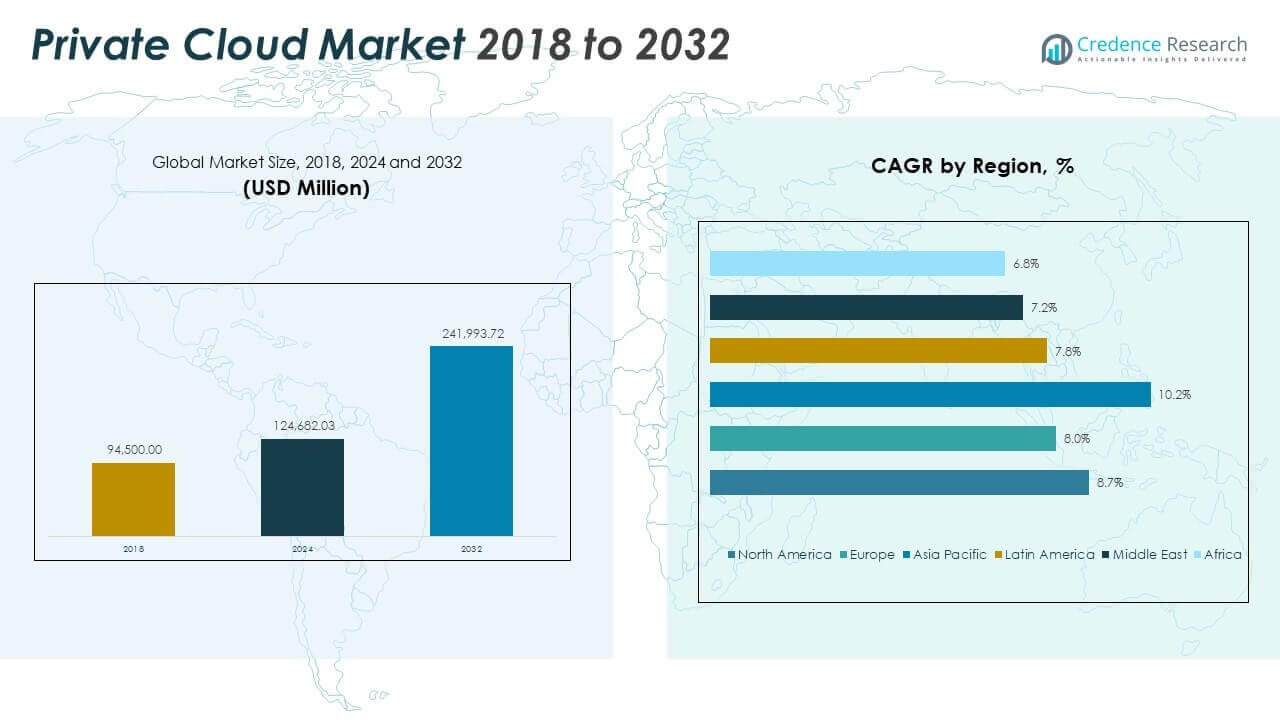
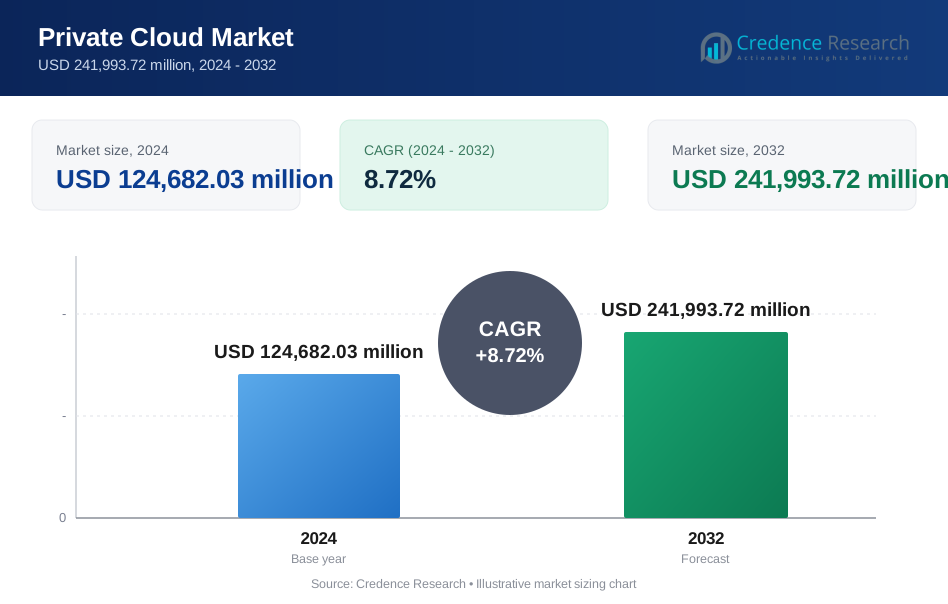
The Private Cloud Market size was valued at USD 94,500.00 million in 2018 to USD 1,24,682.03 million in 2024 and is anticipated to reach USD 2,41,993.72 million by 2032, at a CAGR of 8.72% during the forecast period.
| REPORT ATTRIBUTE | DETAILS |
|---|---|
| Historical Period | 2020-2023 |
| Base Year | 2024 |
| Forecast Period | 2025-2032 |
| Private Cloud Market Size 2024 | USD 1,24,682.03 Million |
| Private Cloud Market, CAGR | 8.72% |
| Private Cloud Market Size 2032 | USD 2,41,993.72 Million |
The market is expanding due to increasing enterprise demand for secure and compliant cloud environments. Organizations prefer private cloud setups to ensure full control over data, improve system performance, and meet internal compliance needs. Sectors such as healthcare, BFSI, and government drive adoption due to regulatory mandates and sensitive data workloads. Companies are also modernizing legacy infrastructure while retaining security and stability. Hybrid IT strategies further boost interest in private models that support gradual cloud transitions. The need for scalable infrastructure, combined with growing concerns around data sovereignty, positions the private cloud as a strategic investment.
North America leads the market due to early enterprise adoption and high cloud maturity. Europe follows with demand driven by GDPR and sovereign hosting requirements. Asia Pacific shows strong growth due to rapid digitization across India, China, and Southeast Asia. Latin America and the Middle East are building momentum, supported by public sector investments. Africa remains in the early growth phase but shows interest through localized cloud deployments. Regional dynamics reflect a mix of infrastructure readiness, policy enforcement, and vertical-specific needs.
Market Insights:
- The Private Cloud Market was valued at USD 94,500.00 million in 2018, reached USD 124,682.03 million in 2024, and is projected to hit USD 241,993.72 million by 2032, growing at a CAGR of 8.72%.
- North America led the market in 2024 with a 37.46% share, followed by Europe at 25.77%, and Asia Pacific at 23.48%, driven by advanced cloud maturity and strong compliance needs.
- Asia Pacific is the fastest-growing region with a 10.2% CAGR and a 23.48% share in 2024, supported by rapid enterprise digitization and localized infrastructure expansion.
- Enterprise applications held the largest workload share in 2024 at 38.4%, driven by demand for stable and secure hosting of critical business systems.
- Managed services accounted for 34.7% of the service offerings segment in 2024, reflecting growing reliance on third-party providers for private cloud operations.
Market Drivers:
Rising Enterprise Demand For Data Control And Security Assurance
Enterprises prioritize strong control over sensitive workloads and data assets. Private cloud environments offer dedicated infrastructure with defined access policies. Regulated industries value predictable governance structures and audit readiness. Security teams gain better visibility across applications and storage layers. Compliance mandates push firms toward isolated cloud architectures. The Private Cloud Market benefits from stricter internal risk frameworks. Enterprises reduce exposure from shared public environments. Business leaders seek stable performance for mission‑critical systems. These needs sustain long‑term private cloud adoption.
- For instance, IBM Cloud deployed its Container Registry with Notary for image signing across five regions, each with three highly available instances over two zones and end-to-end TLS to Cloudant storage.
Growing Need For Customizable And High‑Performance IT Infrastructure
Organizations require tailored infrastructure aligned with specific workloads. Private cloud platforms allow fine control over compute and storage design. Performance‑sensitive applications demand consistent latency and throughput. Enterprises avoid noisy neighbor risks common in shared environments. Custom network configurations support complex enterprise applications. IT teams align infrastructure with internal standards and policies. This flexibility improves workload efficiency across departments. Enterprises also maintain predictable capacity planning. Such advantages reinforce private cloud investment decisions.
Expansion Of Compliance‑Driven Sectors And Mission‑Critical Workloads
Healthcare, finance, and government sectors expand digital operations rapidly. These sectors face strict data residency and privacy obligations. Private cloud deployment supports internal compliance audits. Enterprises host sensitive applications without external exposure. Business continuity plans depend on stable private environments. Firms manage critical workloads with controlled update cycles. Risk mitigation strategies favor isolated infrastructure models. Compliance officers support long‑term private cloud usage. Sector expansion strengthens market demand.
- For instance, Oracle Cloud Infrastructure supports HIPAA compliance through secure deployment frameworks, including Security Zones and Oracle Cloud@Customer, enabling healthcare data processing with enforced residency and isolation controls.
Increasing Hybrid IT Adoption And Legacy System Modernization
Enterprises operate mixed IT environments across on‑premise and cloud systems. Private cloud bridges traditional infrastructure with modern platforms. Legacy applications require controlled migration paths. IT teams modernize systems without full public cloud exposure. Hybrid models support phased digital transformation strategies. Private infrastructure integrates smoothly with internal tools. Firms protect prior technology investments through gradual upgrades. Operational stability remains intact during transitions. This driver supports steady private cloud growth.
Market Trends:
Integration Of Automation And Software‑Defined Infrastructure Capabilities
Private cloud platforms adopt automation for resource management. Software‑defined models simplify compute and storage orchestration. IT teams reduce manual intervention across environments. Automation improves deployment speed and operational accuracy. Policy‑based controls enhance infrastructure consistency. Enterprises align private cloud with DevOps workflows. Self‑service portals improve internal user experience. Infrastructure agility becomes a competitive advantage. This trend reshapes private cloud operations.
- For instance, Cognizant used VMware vRealize Automation to reduce resource provisioning time from 10 days to a few hours. This enabled auto-scheduling of Day 2 operations, freeing IT admins from manual processes like VM releases and performance reports.
Rising Preference For Managed Private Cloud Service Models
Enterprises seek reduced operational complexity and staffing pressure. Managed private cloud services address internal skill gaps. Service providers handle maintenance and lifecycle management. Firms focus on core business functions. Predictable service levels support operational planning. Managed models improve uptime and compliance adherence. Enterprises gain access to advanced expertise. Cost visibility improves through service agreements. This shift changes buyer expectations.
Adoption Of Container Platforms Within Private Cloud Environments
Organizations deploy containerized applications for flexibility. Private cloud supports Kubernetes and orchestration tools. Containers improve application portability and scaling. Development teams accelerate release cycles. Infrastructure teams maintain control over environments. Private cloud aligns container security with enterprise policies. Workload isolation improves application reliability. Enterprises modernize application stacks efficiently. Container adoption reshapes private cloud design.
- For instance, a global payment processing firm used Red Hat OpenShift with vRealize to provision full app stacks from 40 hours to 40 minutes. This supported Kubernetes orchestration in private cloud environments.
Alignment With Sustainability And Energy Efficiency Objectives
Enterprises focus on efficient resource utilization. Private cloud allows optimized hardware usage. Data center consolidation reduces energy waste. IT teams monitor resource consumption closely. Sustainability goals influence infrastructure planning decisions. Private environments support green IT strategies. Hardware refresh cycles improve efficiency metrics. Organizations align cloud strategy with ESG targets. This trend gains strategic importance.
Market Challenges Analysis:
High Capital Investment And Infrastructure Management Complexity
Private cloud deployment requires significant upfront investment. EnterpQ``rises fund servers, storage, and networking equipment. Infrastructure planning demands skilled technical expertise. Smaller firms face budget constraints. IT teams manage hardware lifecycle and upgrades. Operational costs remain higher than public alternatives. Capacity planning errors increase inefficiencies. Vendor integration requires careful coordination. These factors challenge broader adoption in cost‑sensitive segments.
Limited Scalability Compared To Public Cloud Alternatives
Private cloud scaling depends on physical infrastructure availability. Rapid workload spikes strain internal capacity. Procurement cycles slow expansion timelines. Enterprises face delays during peak demand periods. Infrastructure overprovision increases idle resources. Underutilization affects cost efficiency. IT teams balance flexibility with budget control. Public cloud remains attractive for burst workloads. Scalability limits restrict some use cases.
Market Opportunities:
Growing Demand From Emerging Digital Economies And Enterprises
Emerging markets expand digital infrastructure investments. Enterprises strengthen internal IT control frameworks. Private cloud adoption rises with regulatory awareness. Local data residency needs drive private deployments. Telecom and financial firms invest heavily. Government digitization programs support private infrastructure. Enterprises modernize operations with controlled environments. Regional data centers expand private offerings. Growth potential remains strong across developing regions.
Expansion Of Industry‑Specific Private Cloud Solutions
Vendors develop sector‑focused private cloud platforms. Healthcare systems demand secure patient data environments. Financial institutions require low‑latency transaction processing. Manufacturing firms deploy private cloud for operational systems. Industry‑specific compliance drives tailored solutions. Providers differentiate through vertical expertise. Enterprises adopt customized architectures confidently. This specialization unlocks new revenue streams.
Market Segmentation Analysis:
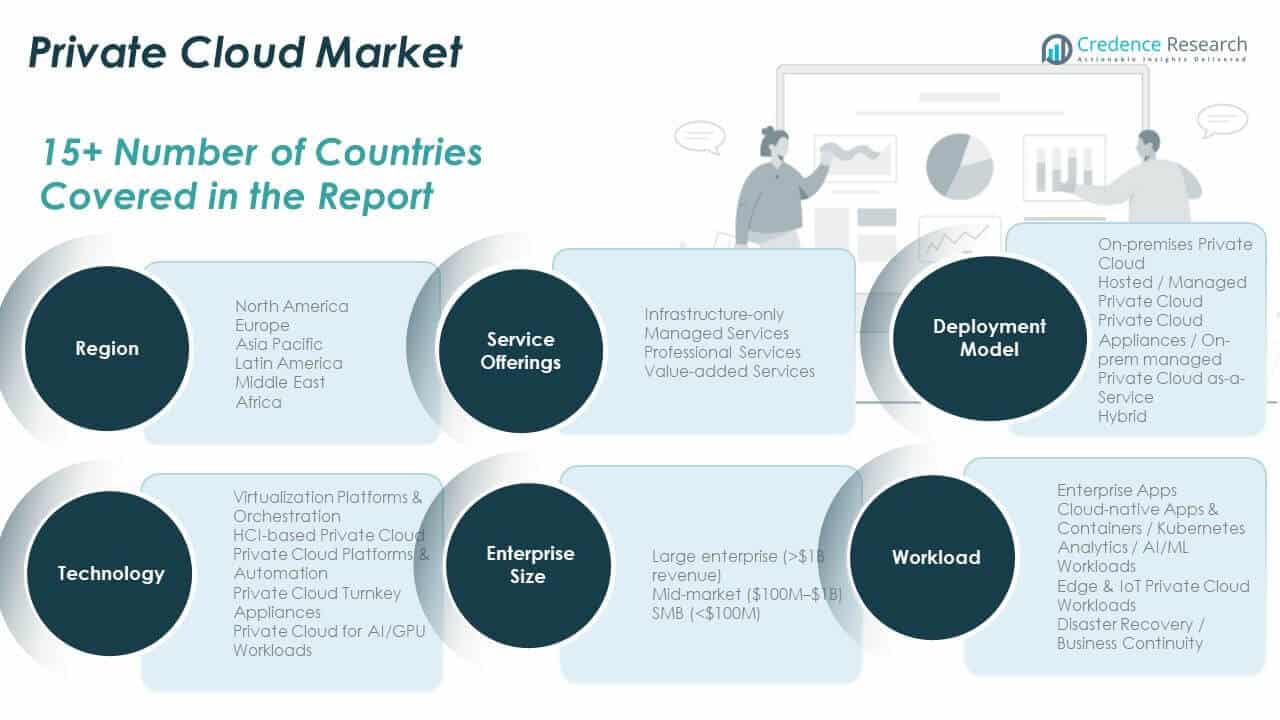
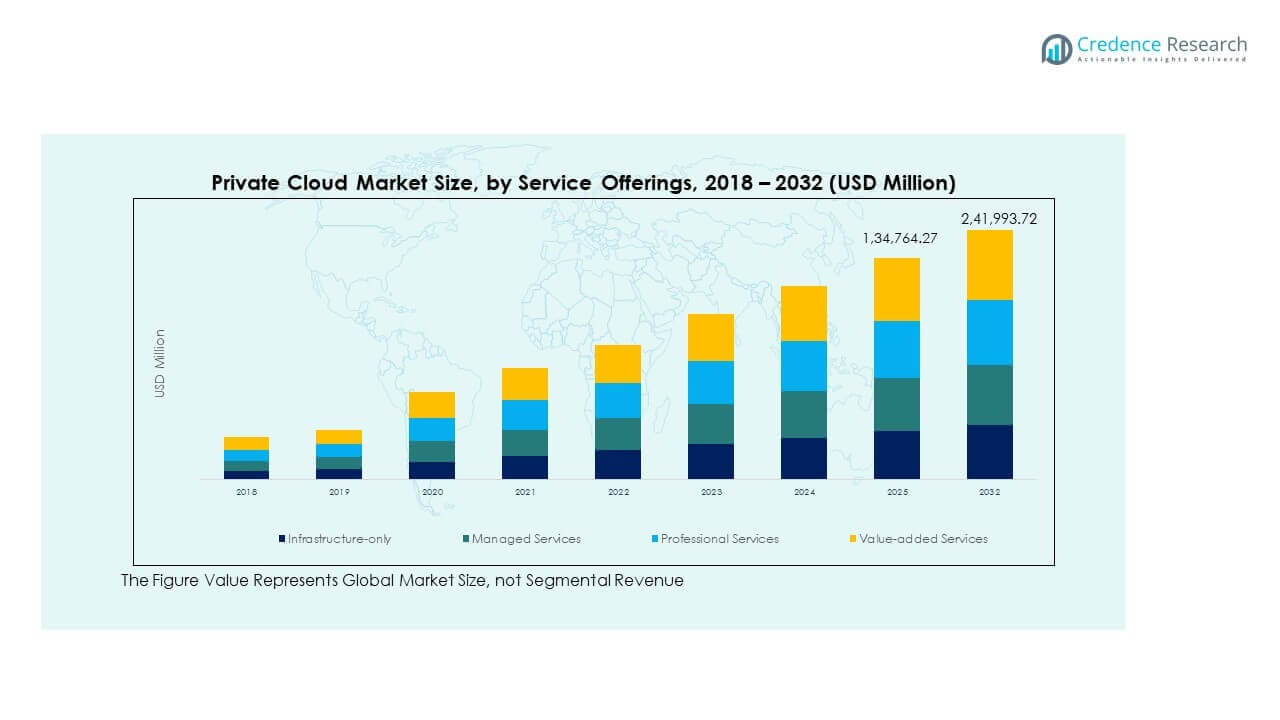
By service offerings, the Private Cloud Market offers diverse service models, with managed services leading due to enterprise demand for outsourced infrastructure expertise. Professional services and value-added offerings support complex deployments, while infrastructure-only models serve organizations with internal IT capabilities.
By deployment front, hybrid models dominate due to flexibility in workload management and integration. Hosted or managed private clouds gain traction among enterprises seeking control without in-house infrastructure. Private Cloud-as-a-Service supports scalable use cases for fast-growing businesses, while on-premises and appliance-based deployments serve compliance-driven sectors.
- For instance, Nutanix AHV hybrid private cloud deployments have demonstrated large-scale resilience with centralized management across thousands of nodes, supporting high availability and service continuity. Hosted or managed private clouds gain traction among enterprises seeking control without maintaining in-house infrastructure.
By technologically, virtualization platforms and orchestration tools remain foundational across enterprises. HCI-based private clouds enable simplified infrastructure management and scaling. AI/GPU-optimized private clouds show rapid growth, driven by analytics and model training needs. Turnkey appliance solutions appeal to mid-sized firms seeking fast deployment without extensive customization.
By enterprise size, large enterprises lead adoption due to high data volumes, security requirements, and IT budgets. Mid-market companies increasingly adopt private cloud for scalability and compliance. SMBs remain slower to invest due to cost and skill constraints but show growing interest in hosted models.
- For instance, HPE GreenLake for Private Cloud delivers 4× faster provisioning and up to 50% lower TCO for 1 PB-scale deployments. Mid-market companies increasingly adopt private cloud for scalability and compliance, while SMBs show rising interest in hosted models despite cost and skill limitations.
By workload, enterprise applications remain the largest segment, requiring stable environments and data control. Cloud-native apps and Kubernetes drive modernization trends. AI/ML and analytics workloads push demand for high-performance computing. Edge and IoT use cases expand in manufacturing and energy sectors. Disaster recovery and business continuity solutions see sustained demand, supporting resilience in IT operations.
Segmentation:
By Service Offerings
- Infrastructure-only
- Managed Services
- Professional Services
- Value-added Services
By Deployment Model
- On-premises Private Cloud
- Hosted / Managed Private Cloud
- Private Cloud Appliances / On-prem managed
- Private Cloud-as-a-Service
- Hybrid
By Technology
- Virtualization Platforms & Orchestration
- HCI-based Private Cloud
- Private Cloud Platforms & Automation
- Private Cloud Turnkey Appliances
- Private Cloud for AI/GPU Workloads
By Enterprise Size
- Large Enterprise (>$1B revenue)
- Mid-market ($100M–$1B)
- SMB (<$100M)
By Workload
- Enterprise Apps
- Cloud-native Apps & Containers / Kubernetes
- Analytics / AI/ML Workloads
- Edge & IoT Private Cloud Workloads
- Disaster Recovery / Business Continuity
By Region
- North America
- U.S.
- Canada
- Mexico
- Europe
- Germany
- France
- U.K.
- Italy
- Spain
- Rest of Europe
- Asia Pacific
- China
- Japan
- India
- South Korea
- South-east Asia
- Rest of Asia Pacific
- Latin America
- Brazil
- Argentina
- Rest of Latin America
- Middle East & Africa
- GCC Countries
- South Africa
- Rest of the Middle East and Africa
Regional Analysis:
North America
The North America Private Cloud Market size was valued at USD 35,815.50 million in 2018 to USD 46,705.14 million in 2024 and is anticipated to reach USD 90,530.29 million by 2032, at a CAGR of 8.7% during the forecast period. North America holds the largest market share at approximately 37.46% in 2024. The region benefits from mature IT infrastructure and high cloud adoption across banking, healthcare, and public sectors. Enterprises demand secure and high-performance cloud environments for regulated workloads. Hybrid and managed private cloud models are widely adopted due to flexibility and compliance. U.S.-based providers lead innovation in orchestration and AI-powered infrastructure. Cloud-native transformations continue across Fortune 500 firms. Canada also shows growth driven by public sector modernization. The market remains highly competitive with large-scale investments from hyperscale and enterprise IT vendors.
Europe
The Europe Private Cloud Market size was valued at USD 25,326.00 million in 2018 to USD 32,139.62 million in 2024 and is anticipated to reach USD 58,986.61 million by 2032, at a CAGR of 8.0% during the forecast period. Europe accounts for approximately 25.77% of the global share in 2024. Data protection laws such as GDPR push organizations toward private environments. Industries such as finance, healthcare, and manufacturing lead in adoption. Enterprises favor in-region hosting to meet sovereignty rules. Demand for value-added managed services is high across EU member states. Germany, the UK, and France dominate market activity. Digital transformation programs across public agencies support private cloud initiatives. Vendors localize offerings to meet country-specific compliance needs. Adoption expands steadily in both Western and Eastern Europe.
Asia Pacific
The Asia Pacific Private Cloud Market size was valued at USD 21,168.00 million in 2018 to USD 29,281.05 million in 2024 and is anticipated to reach USD 63,233.15 million by 2032, at a CAGR of 10.2% during the forecast period. It represents approximately 23.48% of the global share in 2024. Growth is driven by rising enterprise IT investment and data localization policies. Governments in China, India, and Southeast Asia encourage cloud-first strategies. Financial services, telecom, and retail firms shift to private models for control and reliability. Regional cloud service providers expand private offerings with localized support. HCI-based and turnkey private cloud platforms gain popularity. AI/ML and IoT use cases demand secure on-prem or hybrid environments. Multinational firms scale regional cloud operations to meet local compliance. Asia Pacific emerges as the fastest-growing private cloud region.
Latin America
The Latin America Private Cloud Market size was valued at USD 6,161.40 million in 2018 to USD 8,053.21 million in 2024 and is anticipated to reach USD 14,536.56 million by 2032, at a CAGR of 7.8% during the forecast period. It contributes around 6.46% of the global share in 2024. Adoption remains steady, with Brazil and Mexico leading regional uptake. Enterprises in telecom, finance, and government invest in secure infrastructure. Hosted private cloud and managed services models are preferred due to limited in-house IT skills. Cloud vendors partner with local firms to expand access. Regulatory discussions around data residency influence cloud planning. Cost-sensitive SMBs explore hybrid deployments to reduce risk. Digital transformation in healthcare and education supports infrastructure growth. Regional IT modernization continues to expand private cloud opportunities.
Middle East
The Middle East Private Cloud Market size was valued at USD 3,307.50 million in 2018 to USD 4,063.82 million in 2024 and is anticipated to reach USD 7,043.35 million by 2032, at a CAGR of 7.2% during the forecast period. It holds around 3.26% of the global share in 2024. Government-led digital agendas in UAE and Saudi Arabia boost private cloud investments. Large-scale smart city, defense, and healthcare projects demand secure infrastructure. Enterprises in oil and energy sectors adopt private cloud for data control. Regional data centers expand to support local hosting. Managed private cloud gains traction where in-house capabilities remain limited. Compliance with regional regulations guides infrastructure choices. Public-private partnerships drive cloud deployment in critical sectors. The market shows gradual maturity across GCC nations.
Africa
The Africa Private Cloud Market size was valued at USD 2,721.60 million in 2018 to USD 4,439.19 million in 2024 and is anticipated to reach USD 7,663.76 million by 2032, at a CAGR of 6.8% during the forecast period. It represents approximately 3.56% of the global market share in 2024. Adoption is rising in South Africa, Nigeria, and Kenya due to digital government and enterprise modernization. Cloud service providers introduce hosted and hybrid private cloud options for local firms. Telecom and banking sectors lead deployments, focusing on data privacy and uptime. Infrastructure gaps and limited regional data centers constrain expansion in some countries. International vendors invest in edge locations to enhance service reach. Private cloud helps support localized compliance and business continuity. Training and awareness programs help grow cloud maturity. The market is at an early stage but shows high potential.
Key Player Analysis:
- VMware
- IBM
- Hewlett Packard (HPE)
- Dell Technologies
- Nutanix
Competitive Analysis:
The Private Cloud Market features strong competition among global technology providers focused on secure and scalable cloud infrastructure. VMware leads with its enterprise virtualization and software-defined solutions tailored for private cloud environments. IBM expands its presence through hybrid cloud offerings integrated with Red Hat OpenShift. Hewlett Packard Enterprise leverages its GreenLake platform to deliver flexible infrastructure-as-a-service within private environments. Dell Technologies provides VxRail and private cloud-ready systems aligned with enterprise data center strategies. Nutanix strengthens its position with hyperconverged infrastructure and automation for cloud-native workloads. Players compete on service flexibility, workload performance, and cost efficiency. It shows steady innovation through partnerships and acquisitions to enhance orchestration, AI integration, and security. Vendors also differentiate by industry-specific capabilities and managed service offerings. Market competition intensifies as more mid-market enterprises demand customized and compliant private cloud deployments.
Recent Developments:
- In December 2025, Nutanix announced new capabilities in its Nutanix Cloud Platform (NCP) enhancing flexibility for deploying and governing infrastructure across distributed, sovereign environments, including partnerships with OVHcloud for sovereign cloud operations.
- In December 2025, IBM announced its acquisition of Confluent for $11 billion aiming to build a smart data platform for enterprise generative AI. This deal emphasizes hybrid Bring Your Own Cloud (BYOC) and Confluent Private Cloud deployments, enhancing data connectivity, processing, governance, and Kafka workloads for private cloud environments.
Report Coverage:
The research report offers an in-depth analysis based on Service Offerings, Deployment Model, Technology, Enterprise Size, Workload. It details leading market players, providing an overview of their business, product offerings, investments, revenue streams, and key applications. Additionally, the report includes insights into the competitive environment, SWOT analysis, current market trends, as well as the primary drivers and constraints. Furthermore, it discusses various factors that have driven market expansion in recent years. The report also explores market dynamics, regulatory scenarios, and technological advancements that are shaping the industry. It assesses the impact of external factors and global economic changes on market growth. Lastly, it provides strategic recommendations for new entrants and established companies to navigate the complexities of the market.
Future Outlook:
- Enterprises will expand private cloud usage for AI/ML workloads to meet data governance needs.
- Hosted and managed private cloud adoption will grow across mid-market firms with limited IT staff.
- HCI-based private cloud infrastructure will replace traditional architectures in performance-sensitive sectors.
- Private Cloud-as-a-Service models will attract more demand from SMBs and remote-first enterprises.
- Regulatory-driven industries will continue shifting toward compliant private cloud platforms.
- Edge and IoT deployments will integrate with private cloud to support real-time, local processing.
- Integration of automation and orchestration tools will enhance operational agility across deployments.
- Emerging markets will invest in private cloud infrastructure to strengthen digital sovereignty.
- Industry-specific solutions will gain traction, especially in healthcare, finance, and defense.
- Competition among vendors will intensify, with focus on vertical integration and value-added services.
Request a Free Sample
Fill in your details and we'll send you a free sample report.
- Sample data tables & charts
- Research methodology
Market Dynamics
Enterprise Demand for Data Control and Security Assurance
Organizations are increasingly prioritizing private cloud environments to maintain strict control over sensitive data and workloads, ensuring compliance with internal and external regulations. This is especially critical for regulated industries such as healthcare, BFSI, and government, where predictable governance and audit readiness are essential.
Growing Need for Customizable and High-Performance IT Infrastructure
Private cloud platforms allow enterprises to tailor compute, storage, and network resources to specific workload requirements, providing consistent performance and minimizing risks associated with shared environments. This flexibility is vital for performance-sensitive applications and supports predictable capacity planning.
Expansion of Compliance-Driven Sectors and Mission-Critical Workloads
Sectors with stringent data residency and privacy obligations, such as healthcare, finance, and government, are rapidly expanding their digital operations and require private cloud deployments to support compliance audits and business continuity. These sectors drive sustained demand for secure, isolated infrastructure.
Increasing Hybrid IT Adoption and Legacy System Modernization
Enterprises are adopting hybrid IT strategies that blend on-premises and cloud systems, using private cloud as a bridge for legacy application modernization. This approach enables controlled migration, operational stability, and protection of prior technology investments while supporting phased digital transformation.
Rising Preference for Managed Private Cloud Service Models
Many organizations, especially mid-market and SMBs, are turning to managed private cloud services to reduce operational complexity and address internal skill gaps. Service providers offer maintenance, lifecycle management, and compliance support, allowing enterprises to focus on core business functions and improve cost visibility.
Need a Custom Version of This Report?
Tailor the scope, geography, or segments to your exact requirements.
- Custom geography or segment scope
- Direct access to our analyst team
Frequently Asked Questions
What is the current market size for Private Cloud Market, and what is its projected size in 2032?
At what Compound Annual Growth Rate is the Private Cloud Market projected to grow between 2024 and 2032?
Which Private Cloud Market segment held the largest share in 2024?
What are the primary factors fueling the growth of the Private Cloud Market?
Who are the leading companies in the Private Cloud Market?
Which region commanded the largest share of the Private Cloud Market in 2024?
Table of Content
Chapter 1 Market Segmentation
- 1.1 Segmentation Framework
- 1.1.1 Product and Service Classification
- 1.1.2 Application and End-Use Classification
- 1.1.3 Technology and Solution Classification
- 1.1.4 Customer and Distribution Channel Classification
- 1.1.5 Geographic Segmentation
- 1.1.6 Market Segment Definitions and Boundaries
- 1.2 By Workload
- 1.2.1 Enterprise Apps
- 1.2.2 Cloud-native Apps & Containers / Kubernetes
- 1.2.3 Analytics / AI/ML Workloads
- 1.2.4 Edge & IoT Private Cloud Workloads
- 1.2.5 Disaster Recovery / Business Continuity
- 1.3 By Technology
- 1.3.1 Virtualization Platforms & Orchestration
- 1.3.2 HCI-based Private Cloud
- 1.3.3 Private Cloud Platforms & Automation
- 1.3.4 Private Cloud Turnkey Appliances
- 1.3.5 Private Cloud for AI/GPU Workloads
- 1.4 By Deployment Model
- 1.4.1 On-premises Private Cloud
- 1.4.2 Hosted / Managed Private Cloud
- 1.4.3 Private Cloud Appliances / On-prem managed
- 1.4.4 Private Cloud-as-a-Service
- 1.4.5 Hybrid
- 1.5 By Service Offerings
- 1.5.1 Infrastructure-only
- 1.5.2 Managed Services
- 1.5.3 Professional Services
- 1.5.4 Value-added Services
Chapter 2 Introduction
- 2.1 Report Objectives and Scope
- 2.2 Product Definition and Industry Terminology
- 2.3 Market Inclusions and Exclusions
- 2.4 Research Process
- 2.4.1 Primary Research and Expert Interviews
- 2.4.2 Secondary Research and Source Review
- 2.4.3 Top-Down and Bottom-Up Estimation
- 2.4.4 Data Triangulation and Verification
- 2.5 Market Size Measurement Basis
- 2.5.1 2024: USD 124,682.03 million → 2032: USD 241,993.72 million
- 2.6 Historical and Forecast Reference Periods
- 2.6.1 Base Year: 2024
- 2.6.2 Forecast Period: 2024-2032
- 2.7 Research Assumptions and Limitations
Chapter 3 Executive Summary
- 3.1 Market Snapshot and Key Findings
- 3.2 Base-Year Market Size, 2024
- 3.3 Forecast Market Size, 2032
- 3.4 Revenue and Volume Growth Outlook
- 3.5 Key Demand and Supply Indicators
- 3.6 Leading Market Segments
- 3.7 Fastest-Growing Market Opportunities
- 3.8 Regional Performance Highlights
- 3.9 Technology and Industry Transformation
- 3.10 Competitive Landscape Summary
- 3.11 Analyst View and Strategic Implications
Chapter 4 Global Private Cloud Market Trends and Developments
- 4.1 Historical Industry Development
- 4.2 Recent Market Trends and Developments
- 4.3 Demand and Customer Behavior Trends
- 4.4 Technology and Product Innovation
- 4.5 Artificial Intelligence, Automation and Digitalization
- 4.6 Local Manufacturing and Supply Chain Realignment
- 4.7 Industry Partnerships, Mergers and Acquisitions
- 4.8 Sustainability and Circular Economy Developments
- 4.9 Government and Private Sector Investment Trends
- 4.10 Emerging Business Models and Commercialization
- 4.11 Industry Developments and Announcements
Chapter 5 Global Private Cloud Market Production, Supply and Demand Analysis
- 5.1 Demand Trend and Consumption Analysis
- 5.2 Demand Forecast, 2024-2032
- 5.3 Production and Output Trend
- 5.4 Production and Output Forecast, 2024-2032
- 5.5 Installed Capacity and Capacity Utilization
- 5.6 Company-Wise Production Plants and Statistics
- 5.6.1 Installed Production Capacity
- 5.6.2 Actual Production
- 5.6.3 Planned Capacity and Expansion Targets
- 5.7 Supply Chain Structure and Procurement Trends
- 5.8 Supply-Demand Gap and Bottlenecks
- 5.9 Import Dependence and Sourcing Structure
- 5.10 Contract Manufacturing and Outsourcing
- 5.11 Regional Supply and Demand Concentration
Chapter 6 Global Private Cloud Market Pricing Analysis
- 6.1 Pricing Structure and Measurement
- 6.2 Historical Pricing Trends
- 6.3 Pricing Outlook, 2024-2032
- 6.4 Average Selling Price and Unit Economics
- 6.5 Pricing by Product and Market Segment
- 6.6 Geographic Pricing Differences
- 6.7 Key Input, Energy, Labor and Logistics Costs
- 6.8 Contract Pricing and Purchasing Models
- 6.9 Pricing Sensitivity and Competitive Positioning
- 6.10 Price, Margin and Profitability Implications
Chapter 7 Global Private Cloud Market Dynamics
- 7.1 Market Growth Drivers
- 7.1.1 Demand-Side Drivers
- 7.1.2 Technology and Innovation Drivers
- 7.1.3 Infrastructure and Investment Drivers
- 7.1.4 Regulatory and Policy Drivers
- 7.2 Market Restraints
- 7.2.1 Cost and Affordability Constraints
- 7.2.2 Technology and Adoption Barriers
- 7.2.3 Supply Chain and Operational Constraints
- 7.3 Market Challenges
- 7.3.1 Competitive Pressure and Margin Erosion
- 7.3.2 Skills, Infrastructure and Implementation Gaps
- 7.4 Emerging Market Opportunities
- 7.5 Market Dynamics Impact and Time-Horizon Assessment
Chapter 8 Global Private Cloud Value Chain Analysis
- 8.1 Industry Value Chain Overview
- 8.2 Upstream Suppliers and Critical Inputs
- 8.3 Technology and Component Providers
- 8.4 Manufacturing or Service Delivery
- 8.5 Distribution, Channel Partners and Integrators
- 8.6 Downstream Applications and End Users
- 8.7 Value Addition and Profit Pools
- 8.8 Vertical Integration and Outsourcing
- 8.9 Supplier Concentration and Risk
- 8.10 Supply Chain Localization and Resilience
Chapter 9 Global Private Cloud Market Regulations and Policies
- 9.1 Relevant Laws, Standards and Compliance Frameworks
- 9.2 Product, Service, Safety and Quality Requirements
- 9.3 Government Policies, Incentives and Subsidies
- 9.4 Imports, Exports and Trade Barriers
- 9.5 Public Procurement and Local Content Requirements
- 9.6 Environmental and Sustainability Compliance
- 9.7 Data Protection, AI and Cybersecurity Compliance
- 9.8 Upcoming Policy Changes and Market Implications
Chapter 10 Global Private Cloud Market Hotspots and Opportunities
- 10.1 Market Opportunity Mapping and Growth Hotspots
- 10.2 High-Growth Applications and Customer Groups
- 10.3 Underserved Markets and White-Space Opportunities
- 10.4 Emerging Technology and Product Opportunities
- 10.5 New Capacity and Investment Hotspots
- 10.6 Market Entry and Expansion Opportunities
- 10.7 Distribution and Partnership Opportunities
- 10.8 Near-Term and Long-Term Commercial Potential
- 10.9 Opportunity Attractiveness and Execution Risks
Chapter 11 Global Private Cloud Market Outlook, 2024-2032
- 11.1 Market Size and Analysis
- 11.1.1 Revenue (Market Measurement: 2024: USD 124,682.03 million → 2032: USD 241,993.72 million)
- 11.1.2 Market Volume and Quantity Sold
- 11.1.3 Historical Market Size
- 11.1.4 Base-Year Market Size, 2024
- 11.2 Market Forecast, 2024-2032
- 11.2.1 Revenue Forecast to 2032
- 11.2.2 Volume Forecast to 2032
- 11.2.3 CAGR and Year-on-Year Growth
- 11.2.4 Incremental Revenue Opportunity
- 11.3 Forecast Assumptions and Scenario Analysis
- 11.3.1 Base-Case Forecast
- 11.3.2 Optimistic and Conservative Scenarios
- 11.3.3 Technology, Pricing and Policy Sensitivities
- 11.4 Market Attractiveness and Growth Outlook
Chapter 12 Global Private Cloud Market Segmentation and Outlook
- 12.1 Segmentation Summary and Market Shares, 2024
- 12.2 Largest and Fastest-Growing Segments
- 12.3 By Workload - Market Size and Forecast, 2024-2032
- 12.3.1 Segment Definition and Scope
- 12.3.2 Historical Market Size
- 12.3.3 Revenue Forecast, 2024-2032
- 12.3.4 Volume Forecast, 2024-2032
- 12.3.5 Base-Year Market Share, 2024
- 12.3.6 Segment CAGR and Growth Drivers
- 12.3.7 Subsegment Market Size and Forecast
- 12.3.7.1 Enterprise Apps
- 12.3.7.2 Cloud-native Apps & Containers / Kubernetes
- 12.3.7.3 Analytics / AI/ML Workloads
- 12.3.7.4 Edge & IoT Private Cloud Workloads
- 12.3.7.5 Disaster Recovery / Business Continuity
- 12.3.8 Subsegment Pricing and Adoption Trends
- 12.3.9 Leading Suppliers and Competition
- 12.3.10 Regional Demand and Opportunities
- 12.4 By Technology - Market Size and Forecast, 2024-2032
- 12.4.1 Segment Definition and Scope
- 12.4.2 Historical Market Size
- 12.4.3 Revenue Forecast, 2024-2032
- 12.4.4 Volume Forecast, 2024-2032
- 12.4.5 Base-Year Market Share, 2024
- 12.4.6 Segment CAGR and Growth Drivers
- 12.4.7 Subsegment Market Size and Forecast
- 12.4.7.1 Virtualization Platforms & Orchestration
- 12.4.7.2 HCI-based Private Cloud
- 12.4.7.3 Private Cloud Platforms & Automation
- 12.4.7.4 Private Cloud Turnkey Appliances
- 12.4.7.5 Private Cloud for AI/GPU Workloads
- 12.4.8 Subsegment Pricing and Adoption Trends
- 12.4.9 Leading Suppliers and Competition
- 12.4.10 Regional Demand and Opportunities
- 12.5 By Deployment Model - Market Size and Forecast, 2024-2032
- 12.5.1 Segment Definition and Scope
- 12.5.2 Historical Market Size
- 12.5.3 Revenue Forecast, 2024-2032
- 12.5.4 Volume Forecast, 2024-2032
- 12.5.5 Base-Year Market Share, 2024
- 12.5.6 Segment CAGR and Growth Drivers
- 12.5.7 Subsegment Market Size and Forecast
- 12.5.7.1 On-premises Private Cloud
- 12.5.7.2 Hosted / Managed Private Cloud
- 12.5.7.3 Private Cloud Appliances / On-prem managed
- 12.5.7.4 Private Cloud-as-a-Service
- 12.5.7.5 Hybrid
- 12.5.8 Subsegment Pricing and Adoption Trends
- 12.5.9 Leading Suppliers and Competition
- 12.5.10 Regional Demand and Opportunities
- 12.6 By Service Offerings - Market Size and Forecast, 2024-2032
- 12.6.1 Segment Definition and Scope
- 12.6.2 Historical Market Size
- 12.6.3 Revenue Forecast, 2024-2032
- 12.6.4 Volume Forecast, 2024-2032
- 12.6.5 Base-Year Market Share, 2024
- 12.6.6 Segment CAGR and Growth Drivers
- 12.6.7 Subsegment Market Size and Forecast
- 12.6.7.1 Infrastructure-only
- 12.6.7.2 Managed Services
- 12.6.7.3 Professional Services
- 12.6.7.4 Value-added Services
- 12.6.8 Subsegment Pricing and Adoption Trends
- 12.6.9 Leading Suppliers and Competition
- 12.6.10 Regional Demand and Opportunities
- 12.7 Segment Growth Comparison
- 12.8 Segment Attractiveness and Priority Matrix
Chapter 13 Global Private Cloud Geographic Market Outlook, 2024-2032
- 13.1 Regional Market Size and Share, 2024
- 13.2 Regional Market Forecast, 2024-2032
- 13.3 Regional Pricing, Production and Demand Differences
- 13.4 North America
- 13.4.1 United States
- 13.4.2 Canada
- 13.4.3 Mexico
- 13.5 Europe
- 13.5.1 Germany
- 13.5.2 France
- 13.5.3 Italy
- 13.5.4 United Kingdom
- 13.5.5 Spain
- 13.5.6 Poland
- 13.5.7 Russia
- 13.5.8 Netherlands
- 13.5.9 Belgium
- 13.5.10 Sweden
- 13.5.11 Denmark
- 13.5.12 Norway
- 13.5.13 Rest of Europe
- 13.6 Asia Pacific
- 13.6.1 China
- 13.6.2 India
- 13.6.3 Japan
- 13.6.4 South Korea
- 13.6.5 Thailand
- 13.6.6 Indonesia
- 13.6.7 Vietnam
- 13.6.8 Malaysia
- 13.6.9 Australia
- 13.6.10 Rest of Asia Pacific
- 13.7 Latin America
- 13.7.1 Brazil
- 13.7.2 Argentina
- 13.7.3 Colombia
- 13.7.4 Chile
- 13.7.5 Rest of Latin America
- 13.8 Middle East
- 13.8.1 Saudi Arabia
- 13.8.2 United Arab Emirates
- 13.8.3 Turkey
- 13.8.4 Israel
- 13.8.5 Iran
- 13.8.6 Rest of the Middle East
- 13.9 Africa
- 13.9.1 South Africa
- 13.9.2 Egypt
- 13.9.3 Nigeria
- 13.9.4 Morocco
- 13.9.5 Rest of Africa
- 13.10 Regional Investment, Policy and Supply Chain Differences
- 13.11 Regional Competitive Landscape
- 13.12 Geographic Growth Hotspots
Chapter 14 Global Private Cloud Technology, Innovation and Sustainability Outlook
- 14.1 Technology Landscape and Maturity
- 14.2 Product, Process and Service Innovation
- 14.3 AI, Automation and Digital Tools in the Industry
- 14.4 Technology Adoption and Performance Benchmarking
- 14.5 Innovation Pipeline and R&D Investment
- 14.6 Patent and Intellectual Property Trends
- 14.7 Energy Efficiency and Resource Management
- 14.8 Sustainability, Recycling and Circularity
- 14.9 Technology Roadmap, 2024-2032
- 14.10 Risks of Obsolescence and Technology Substitution
Chapter 15 Global Private Cloud Market Key Strategic Imperatives
- 15.1 Growth and Market Entry Priorities
- 15.2 High-Return Products and Segments
- 15.3 Pricing, Profitability and Cost Optimization
- 15.4 Technology Investment and Product Differentiation
- 15.5 Supply Chain Localization and Resilience
- 15.6 Distribution and Customer Acquisition
- 15.7 Partnership, Acquisition and Capacity Strategy
- 15.8 Regional Expansion Priorities
- 15.9 Short-, Medium- and Long-Term Actions
Chapter 16 Competition Outlook
- 16.1 Industry Competition Characteristics
- 16.2 Market Structure and Concentration
- 16.3 Market Share and Competitive Positioning, 2024
- 16.4 Company-Wise Revenue and Product Benchmarking
- 16.5 Production and Service Capacity Benchmarking
- 16.6 Technology, Pricing and Differentiation
- 16.7 Regional Footprint and Distribution Strength
- 16.8 Mergers, Acquisitions and Strategic Alliances
- 16.9 New Entrants and Competitive Threats
- 16.10 Porter's Five Forces and Industry Attractiveness
- 16.11 Competitive Outlook, 2024-2032
Chapter 17 Company Profiles
- 17.1 Company Coverage and Selection Criteria
- 17.2 VMware
- 17.2.1 Business Description
- 17.2.2 Company Ownership and Geographic Presence
- 17.2.3 Product and Service Portfolio
- 17.2.4 Manufacturing and Operating Footprint
- 17.2.5 Production Capacity and Expansion Plans
- 17.2.6 Financial Performance and Investment
- 17.2.7 Market Share and Competitive Position
- 17.2.8 Technology and Innovation Capabilities
- 17.2.9 Strategic Alliances or Partnerships
- 17.2.10 Recent Developments
- 17.2.11 Growth Strategy and Outlook
- 17.3 IBM
- 17.4 Hewlett Packard Enterprise (HPE)
- 17.5 Dell Technologies
- 17.6 Nutanix
- 17.7 Oracle
- 17.8 Microsoft
- 17.9 Cisco
- 17.10 Huawei
- 17.11 Red Hat
- 17.12 Other Relevant Market Participants
Note: Every listed company is profiled on the structure shown under the first company. The company list is preliminary and may change based on research findings, market developments, data availability and client requirements.
Chapter 18 Disclaimer
- 18.1 Research and Forecast Disclaimer
- 18.2 Data Source and Estimation Limitations
Note: The depth of individual sections depends on data availability for this market. Volume, capacity, trade and other unit-based metrics are included where applicable.
