Market Overview:
The Commercial coffee machine market size was valued at USD 5832.6 million in 2024 and is anticipated to reach USD 9296.2 million by 2032, at a CAGR of 6 % during the forecast period (2024-2032).
| REPORT ATTRIBUTE | DETAILS |
|---|---|
| Historical Period | 2020-2023 |
| Base Year | 2024 |
| Forecast Period | 2025-2032 |
| Commercial Coffee Machine Market Size 2024 | USD 5832.6 million |
| Commercial Coffee Machine Market, CAGR | 6% |
| Commercial Coffee Machine Market Size 2032 | USD 9296.2 million |
Market growth is driven by shifting consumer preferences toward high-quality, barista-style coffee experiences and the need for consistent brewing performance in high-volume environments. The expansion of café chains, workplace coffee culture, and the integration of smart coffee machines with IoT-enabled features for remote monitoring and customization are fueling adoption. Sustainability trends, such as energy-efficient models and machines designed for minimal waste, are also influencing purchasing decisions.
Regionally, Europe holds a significant share of the commercial coffee machine market due to its established café culture and strong presence of premium coffee chains. North America follows closely, driven by high specialty coffee demand and advanced foodservice infrastructure. The Asia-Pacific region is expected to register the fastest growth, supported by urbanization, rising disposable incomes, and the rapid expansion of coffee outlets in emerging economies like China, India, and Southeast Asian countries.
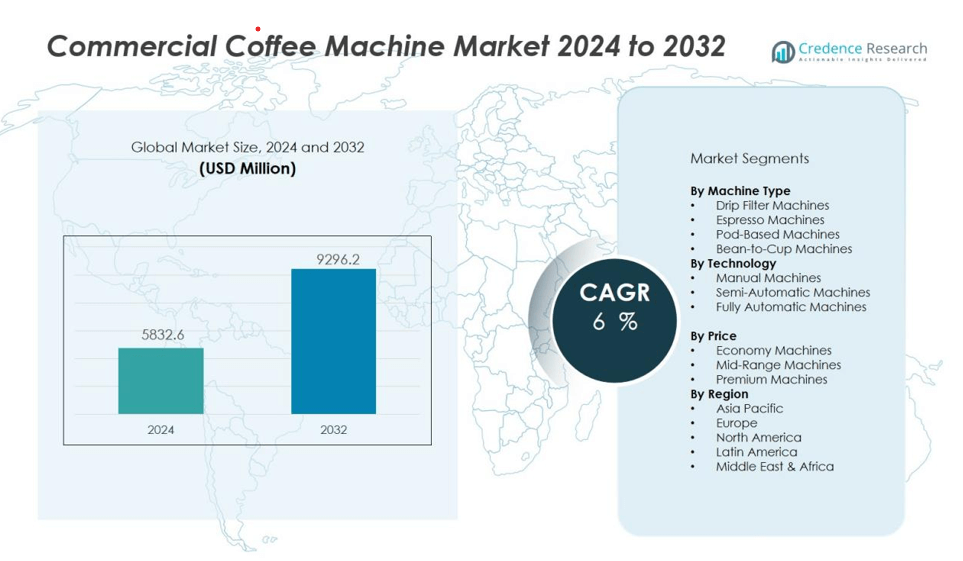
Market Insights:
- The commercial coffee machine market was valued at USD 5,832.6 million in 2024 and is projected to reach USD 9,296.2 million by 2032, growing at a CAGR of 6% during 2024–2032.
- Rising demand for specialty coffee and premium beverages is driving investments in advanced machines capable of delivering consistent quality across multiple coffee styles.
- Expansion of international and regional coffee chains, along with quick-service restaurants, is increasing the need for high-capacity, durable, and easy-to-operate machines.
- Integration of IoT, automated cleaning, and programmable brewing features is enhancing operational efficiency and beverage customization for cafés, hotels, and workplaces.
- Sustainability trends, including eco-modes, recyclable components, and water-saving technologies, are influencing equipment choices among eco-conscious businesses.
- High initial investment costs, technical complexity, and maintenance requirements remain key challenges for small and emerging operators.
- Europe leads with 38% market share due to its strong café culture, followed by North America at 31%, while Asia-Pacific holds 24% and is expected to grow fastest due to urbanization and rising disposable incomes.
Market Drivers:
Rising Demand for Specialty Coffee and Premium Beverages:
The growing global preference for specialty coffee and premium beverages is a major driver for the commercial coffee machine market. Consumers increasingly seek high-quality, barista-style coffee experiences in cafés, restaurants, and workplaces. This shift encourages businesses to invest in advanced brewing equipment capable of delivering consistent flavor and quality. It has also prompted manufacturers to develop machines that cater to diverse coffee styles, from espresso to cold brew, to meet evolving customer expectations.
- For instance, La Marzocco Linea PB’s dual PID technology allows electronic control over both coffee and steam boiler temperatures, with industry-leading temperature stability that keeps water temperature variance within ±2°F, ensuring every shot is consistent in flavor and quality in high-volume service.
Expansion of Coffee Chains and Foodservice Outlets:
The rapid expansion of international and regional coffee chains is significantly boosting demand for commercial coffee machines. Franchises and independent outlets require reliable, high-capacity machines to serve large customer volumes efficiently. It supports the need for durable, easy-to-operate equipment that maintains consistent output during peak hours. The growth of quick-service restaurants and specialty cafés worldwide continues to strengthen market opportunities for equipment suppliers.
Technological Advancements and Automation Features:
Integration of advanced technologies is reshaping the commercial coffee machine market. Smart features such as IoT connectivity, automated cleaning systems, and programmable brewing profiles improve operational efficiency and beverage consistency. It enables operators to monitor performance remotely, reduce downtime, and tailor offerings to customer preferences. Energy-efficient designs and user-friendly interfaces are also driving adoption among hospitality and corporate sectors.
Sustainability and Energy Efficiency Trends:
The industry is witnessing rising demand for environmentally friendly coffee machines that reduce energy consumption and waste. Businesses are increasingly adopting models with eco-modes, recyclable components, and water-saving technologies. It aligns with corporate sustainability initiatives and regulatory pressures for greener operations. Manufacturers focusing on sustainable design gain a competitive advantage in attracting eco-conscious customers and large enterprises seeking to enhance their environmental credentials.
- For instance, Animo coffee machines utilize stainless steel as a base material, which is 100% recyclable, and their machines consist on average of 300 different parts, with recyclability data tracked for each material type per device.
Market Trends:
Integration of Smart Technologies and Customization Features:
The commercial coffee machine market is experiencing a strong shift toward smart technologies that enhance efficiency and personalization. IoT-enabled machines allow operators to monitor usage, track maintenance needs, and adjust brewing parameters remotely. Touchscreen interfaces and programmable recipes are enabling cafés, hotels, and corporate offices to offer a wider variety of coffee beverages without extensive barista training. It is also driving consistency in flavor and quality across multiple locations. Demand for machines capable of adjusting grind size, water temperature, and brewing time to customer preferences is increasing. This trend reflects a broader move toward premiumization in the foodservice industry, where customization plays a key role in customer satisfaction.
- For example, the Café Affetto Automatic Espresso Machine integrates built-in WiFi for full app control, offers five precise grind settings, and extracts beans at the industry gold standard of 20 bars pressure, delivering a cup in 90 seconds.
Focus on Sustainability and Energy-Efficient Designs:
Sustainability is becoming a defining trend in the commercial coffee machine market, influencing product design and purchasing decisions. Manufacturers are introducing machines with reduced water consumption, lower energy usage, and recyclable components to meet both regulatory requirements and consumer expectations. It is encouraging foodservice operators to replace older models with eco-friendly alternatives that align with their environmental commitments. The market is also witnessing innovations such as low-carbon manufacturing processes and components designed for longer lifespans to minimize waste. Growing awareness among businesses about lifecycle costs, including energy bills and maintenance, is further promoting adoption of sustainable models. This focus on eco-efficiency is likely to remain a long-term competitive differentiator for brands.
- For instance, Nuova Simonelli’s Appia Life commercial espresso machine employs an insulated boiler that reduces energy consumption by 13% compared to its predecessor, the Appia II.
Market Challenges Analysis:
High Initial Investment and Maintenance Costs:
The commercial coffee machine market faces a challenge from the high upfront cost of advanced brewing equipment. Businesses, particularly small cafés and independent operators, often find it difficult to allocate significant capital for premium machines. It requires ongoing maintenance, periodic servicing, and replacement of parts to ensure consistent performance, which adds to operational expenses. Complex machines also demand skilled operators or training, increasing labor costs. This financial barrier can slow adoption rates in emerging markets and among smaller foodservice establishments.
Operational Downtime and Technical Complexity:
Frequent use in high-demand environments can lead to operational downtime, impacting service efficiency and customer satisfaction. The technical complexity of modern commercial coffee machines makes repairs time-consuming and dependent on specialized technicians. It can result in longer service interruptions, especially in regions with limited after-sales support. Integration of advanced features also increases the risk of software or system malfunctions. Limited availability of spare parts in certain markets further compounds the challenge, pushing businesses to seek more durable and easily serviceable solutions.
Market Opportunities:
Growing Demand in Emerging Markets and Non-Traditional Sectors:
The commercial coffee machine market has significant growth potential in emerging economies where café culture and premium coffee consumption are expanding rapidly. Rising disposable incomes and urbanization are creating new opportunities in countries across Asia-Pacific, Latin America, and the Middle East. It is also finding applications in non-traditional sectors such as healthcare facilities, educational institutions, and co-working spaces, where coffee service enhances customer and employee experiences. Expanding distribution networks and localized product offerings can help manufacturers penetrate these markets more effectively.
Product Innovation and Expansion of Sustainable Solutions:
Continuous product innovation offers opportunities to capture market share by addressing evolving customer preferences. Manufacturers introducing compact, energy-efficient, and multifunctional machines can appeal to both established and new operators. It can leverage the rising demand for eco-friendly models with features that minimize waste and optimize resource use. Customization options, integration with mobile ordering systems, and subscription-based equipment leasing models present additional revenue streams. Brands that align technological advancements with sustainability commitments are likely to gain a competitive edge in the global market.
Market Segmentation Analysis:
By Machine Type:
The commercial coffee machine market is segmented into drip filter, espresso, pod-based, and bean-to-cup machines. Espresso machines hold the largest share, driven by their ability to produce high-quality beverages quickly, catering to cafés, restaurants, and specialty outlets. Bean-to-cup machines are gaining traction in offices and hotels due to their convenience and consistent output. Pod-based machines appeal to small businesses seeking minimal maintenance and quick service, while drip filter models maintain relevance in high-volume, cost-sensitive environments.
- For instance, Philips 5500 Series Fully Automatic Espresso Machine can brew up to 20 different hot and iced coffee recipes with a single touch, perfectly aligning with the demand for variety and efficiency in office settings.
By Technology:
The market includes manual, semi-automatic, and fully automatic machines. Fully automatic machines lead demand due to their efficiency, ease of operation, and consistent brewing quality. Semi-automatic models remain popular among baristas and specialty coffee shops that prioritize craftsmanship and beverage control. Manual machines serve niche applications, particularly in premium hospitality venues where customization and traditional brewing techniques are valued.
- For instance, the Flair Pro 2 delivers up to 30 bar of manually generated pressure using a spring-loaded piston design, allowing baristas to tailor shot duration and pressure profiles in as little as 30 seconds.
By Price:
The market is divided into economy, mid-range, and premium segments. Mid-range machines dominate due to their balance of affordability, durability, and performance, making them suitable for most foodservice establishments. Premium machines, equipped with advanced features and customization options, attract high-end cafés, hotels, and corporate offices. Economy models find demand in small-scale operations and emerging markets where budget constraints shape purchasing decisions.
Segmentations:
By Machine Type:
- Drip Filter Machines
- Espresso Machines
- Pod-Based Machines
- Bean-to-Cup Machines
By Technology:
- Manual Machines
- Semi-Automatic Machines
- Fully Automatic Machines
By Price:
- Economy Machines
- Mid-Range Machines
- Premium Machines
By Region:
- North America
- U.S.
- Canada
- Mexico
- Europe
- Germany
- France
- U.K.
- Italy
- Spain
- Rest of Europe
- Asia Pacific
- China
- Japan
- India
- South Korea
- South-east Asia
- Rest of Asia Pacific
- Latin America
- Brazil
- Argentina
- Rest of Latin America
- Middle East & Africa
- GCC Countries
- South Africa
- Rest of the Middle East and Africa
Regional Analysis:
Europe :
Europe holds 38% market share in the commercial coffee machine market, supported by its deep-rooted café culture and high consumption of specialty coffee. Countries such as Italy, France, Germany, and the UK drive demand through a dense network of coffee shops, hotels, and restaurants. The presence of leading manufacturers and advanced foodservice infrastructure strengthens product availability and innovation. It benefits from strict quality standards and a mature consumer base that values consistent brewing performance. Growth is further supported by sustainability-focused procurement policies and the adoption of energy-efficient models in hospitality chains.
North America :
North America accounts for 31% market share, fueled by the growing preference for specialty beverages and a strong network of premium coffee chains. The United States dominates regional demand, supported by rapid adoption in quick-service restaurants, offices, and convenience stores. It is witnessing rising investment in smart coffee machines with IoT connectivity for performance monitoring and beverage customization. Canada contributes with a stable market driven by high per capita coffee consumption and emphasis on sustainable operations. The shift toward workplace coffee solutions and subscription-based machine leasing is boosting penetration in corporate sectors.
Asia-Pacific :
Asia-Pacific holds 24% market share and is expected to record the fastest growth during the forecast period. Rapid urbanization in China, India, and Southeast Asian countries is driving café expansion and premium coffee demand. It is benefiting from rising disposable incomes, lifestyle changes, and the influence of Western coffee culture. Local and international chains are aggressively expanding their presence, creating demand for high-capacity, versatile machines. Government initiatives promoting hospitality and tourism are further enhancing equipment adoption across the region.
Key Player Analysis:
Competitive Analysis:
The commercial coffee machine market is highly competitive, with global and regional players focusing on product innovation, technological integration, and brand differentiation. Key companies include Breville, Keurig, Philips, De’Longhi, Electrolux, Nestlé, and Melitta, each leveraging strong distribution networks and diverse product portfolios to strengthen market presence. It is characterized by continuous investment in R&D to introduce machines with advanced automation, energy efficiency, and customization features. Leading brands target both premium and mid-range segments, catering to cafés, restaurants, hotels, and corporate offices. Strategic partnerships with coffee chains, equipment leasing models, and after-sales service excellence are critical to retaining customer loyalty. Sustainability, compact designs, and smart technology integration remain central to competitive positioning, while expansion into emerging markets offers long-term growth opportunities.
Recent Developments:
- In May 2023, Philips acquired DiA Imaging Analysis, an AI-based ultrasound imaging company, for nearly $100 million to expand its AI capabilities in healthcare imaging.
- In February 2024, Keurig expanded its partnership with Lavazza to boost sales and distribution of Lavazza K-Cup pods and introduced Kicking Horse Coffee pods.
- In September 2024 Breville launched the Oracle Jet, its most advanced espresso machine with enhanced grinding and frothing technology.
Market Concentration & Characteristics:
The commercial coffee machine market exhibits a moderately concentrated structure, with a mix of global leaders and regional players competing through product innovation, technology integration, and brand reputation. It is characterized by high entry barriers due to the need for advanced manufacturing capabilities, quality certifications, and strong distribution networks. Leading companies focus on expanding product portfolios with energy-efficient, smart, and customizable models to meet evolving customer demands. Competition is influenced by service quality, after-sales support, and the ability to deliver consistent performance in high-volume environments. Sustainability, automation, and compact designs are shaping product development strategies, while partnerships with coffee chains and hospitality groups strengthen market positioning.
Report Coverage:
The research report offers an in-depth analysis based on Machine Type, Technology, Price and Region. It details leading Market players, providing an overview of their business, product offerings, investments, revenue streams, and key applications. Additionally, the report includes insights into the competitive environment, SWOT analysis, current Market trends, as well as the primary drivers and constraints. Furthermore, it discusses various factors that have driven Market expansion in recent years. The report also explores Market dynamics, regulatory scenarios, and technological advancements that are shaping the industry. It assesses the impact of external factors and global economic changes on Market growth. Lastly, it provides strategic recommendations for new entrants and established companies to navigate the complexities of the Market.
Future Outlook:
- Demand for specialty coffee equipment will continue to rise as consumer preferences shift toward premium, café-style beverages.
- Manufacturers will expand their product lines to include compact, multifunctional machines catering to small businesses and non-traditional sectors.
- Integration of IoT, AI, and automation will enhance operational efficiency, predictive maintenance, and beverage customization.
- Sustainability will remain a central focus, with growth in machines featuring energy-saving technologies and recyclable components.
- Corporate adoption will increase as workplaces invest in high-quality coffee solutions to improve employee satisfaction.
- The hospitality sector will drive substantial demand, particularly from hotels, restaurants, and quick-service outlets seeking consistent brewing quality.
- Subscription-based equipment leasing and coffee-as-a-service models will gain traction among cost-conscious operators.
- Emerging markets in Asia-Pacific, Latin America, and the Middle East will witness accelerated adoption due to urbanization and expanding coffee culture.
- Strategic partnerships between machine manufacturers and coffee brands will strengthen market penetration and brand loyalty.
- Continued investment in R&D will lead to innovative designs and features that improve user convenience, serviceability, and product lifespan

Request a Free Sample
Fill in your details and we'll send you a free sample report.
- Sample data tables & charts
- Research methodology
Market Dynamics
Shift Toward Specialty and Premium Coffee
Consumers are increasingly seeking high-quality, barista-style coffee experiences in cafés, restaurants, and workplaces, prompting businesses to invest in advanced commercial coffee machines capable of delivering consistent, premium beverages.
Expansion of Coffee Chains and Foodservice Outlets
The rapid growth of international and regional coffee chains, as well as quick-service restaurants, is driving demand for high-capacity, durable, and easy-to-operate commercial coffee machines to efficiently serve large customer volumes.
Integration of Smart Technologies and Automation
The adoption of IoT-enabled features, automated cleaning, and programmable brewing profiles is enhancing operational efficiency, beverage customization, and remote monitoring, making advanced machines more attractive to cafés, hotels, and workplaces.
Sustainability and Energy Efficiency
Growing emphasis on eco-friendly operations is leading businesses to choose commercial coffee machines with energy-saving modes, recyclable components, and water-saving technologies, aligning with corporate sustainability goals and regulatory requirements.
Rising Coffee Culture in Emerging Markets
Urbanization, rising disposable incomes, and the proliferation of café culture in emerging economies, especially in Asia-Pacific, are accelerating the adoption of commercial coffee machines in new and non-traditional sectors.
Need a Custom Version of This Report?
Tailor the scope, geography, or segments to your exact requirements.
- Custom geography or segment scope
- Direct access to our analyst team
Frequently Asked Questions
What is the current market size for the Commercial Coffee Machine Market, and what is its projected size in 2032?
At what Compound Annual Growth Rate is the Commercial Coffee Machine Market projected to grow between 2024 and 2032?
What are the primary factors fueling the growth of the Commercial Coffee Machine Market?
Who are the leading companies in the Commercial Coffee Machine Market?
Table of Content
Chapter 1 Market Segmentation
- 1.1 Segmentation Framework
- 1.1.1 Product and Service Classification
- 1.1.2 Application and End-Use Classification
- 1.1.3 Technology and Solution Classification
- 1.1.4 Customer and Distribution Channel Classification
- 1.1.5 Geographic Segmentation
- 1.1.6 Market Segment Definitions and Boundaries
- 1.2 By Price
- 1.2.1 Economy Machines
- 1.2.2 Mid-Range Machines
- 1.2.3 Premium Machines
- 1.3 By Technology
- 1.3.1 Manual Machines
- 1.3.2 Semi-Automatic Machines
- 1.3.3 Fully Automatic Machines
- 1.4 By Machine Type
- 1.4.1 Drip Filter Machines
- 1.4.2 Espresso Machines
- 1.4.3 Pod-Based Machines
- 1.4.4 Bean-to-Cup Machines
Chapter 2 Introduction
- 2.1 Report Objectives and Scope
- 2.2 Product Definition and Industry Terminology
- 2.3 Market Inclusions and Exclusions
- 2.4 Research Process
- 2.4.1 Primary Research and Expert Interviews
- 2.4.2 Secondary Research and Source Review
- 2.4.3 Top-Down and Bottom-Up Estimation
- 2.4.4 Data Triangulation and Verification
- 2.5 Market Size Measurement Basis
- 2.5.1 2024: USD 5,832.6 million → 2032: USD 9,296.2 million
- 2.6 Historical and Forecast Reference Periods
- 2.6.1 Base Year: 2024
- 2.6.2 Forecast Period: 2024-2032
- 2.7 Research Assumptions and Limitations
Chapter 3 Executive Summary
- 3.1 Market Snapshot and Key Findings
- 3.2 Base-Year Market Size, 2024
- 3.3 Forecast Market Size, 2032
- 3.4 Revenue and Volume Growth Outlook
- 3.5 Key Demand and Supply Indicators
- 3.6 Leading Market Segments
- 3.7 Fastest-Growing Market Opportunities
- 3.8 Regional Performance Highlights
- 3.9 Technology and Industry Transformation
- 3.10 Competitive Landscape Summary
- 3.11 Analyst View and Strategic Implications
Chapter 4 Global Commercial Coffee Machine Market Trends and Developments
- 4.1 Historical Industry Development
- 4.2 Recent Market Trends and Developments
- 4.3 Demand and Customer Behavior Trends
- 4.4 Technology and Product Innovation
- 4.5 Artificial Intelligence, Automation and Digitalization
- 4.6 Local Manufacturing and Supply Chain Realignment
- 4.7 Industry Partnerships, Mergers and Acquisitions
- 4.8 Sustainability and Circular Economy Developments
- 4.9 Government and Private Sector Investment Trends
- 4.10 Emerging Business Models and Commercialization
- 4.11 Industry Developments and Announcements
Chapter 5 Global Commercial Coffee Machine Market Production, Supply and Demand Analysis
- 5.1 Demand Trend and Consumption Analysis
- 5.2 Demand Forecast, 2024-2032
- 5.3 Production and Output Trend
- 5.4 Production and Output Forecast, 2024-2032
- 5.5 Installed Capacity and Capacity Utilization
- 5.6 Company-Wise Production Plants and Statistics
- 5.6.1 Installed Production Capacity
- 5.6.2 Actual Production
- 5.6.3 Planned Capacity and Expansion Targets
- 5.7 Supply Chain Structure and Procurement Trends
- 5.8 Supply-Demand Gap and Bottlenecks
- 5.9 Import Dependence and Sourcing Structure
- 5.10 Contract Manufacturing and Outsourcing
- 5.11 Regional Supply and Demand Concentration
Chapter 6 Global Commercial Coffee Machine Market Pricing Analysis
- 6.1 Pricing Structure and Measurement
- 6.2 Historical Pricing Trends
- 6.3 Pricing Outlook, 2024-2032
- 6.4 Average Selling Price and Unit Economics
- 6.5 Pricing by Product and Market Segment
- 6.6 Geographic Pricing Differences
- 6.7 Key Input, Energy, Labor and Logistics Costs
- 6.8 Contract Pricing and Purchasing Models
- 6.9 Pricing Sensitivity and Competitive Positioning
- 6.10 Price, Margin and Profitability Implications
Chapter 7 Global Commercial Coffee Machine Market Dynamics
- 7.1 Market Growth Drivers
- 7.1.1 Demand-Side Drivers
- 7.1.2 Technology and Innovation Drivers
- 7.1.3 Infrastructure and Investment Drivers
- 7.1.4 Regulatory and Policy Drivers
- 7.2 Market Restraints
- 7.2.1 Cost and Affordability Constraints
- 7.2.2 Technology and Adoption Barriers
- 7.2.3 Supply Chain and Operational Constraints
- 7.3 Market Challenges
- 7.3.1 Competitive Pressure and Margin Erosion
- 7.3.2 Skills, Infrastructure and Implementation Gaps
- 7.4 Emerging Market Opportunities
- 7.5 Market Dynamics Impact and Time-Horizon Assessment
Chapter 8 Global Commercial Coffee Machine Value Chain Analysis
- 8.1 Industry Value Chain Overview
- 8.2 Upstream Suppliers and Critical Inputs
- 8.3 Technology and Component Providers
- 8.4 Manufacturing or Service Delivery
- 8.5 Distribution, Channel Partners and Integrators
- 8.6 Downstream Applications and End Users
- 8.7 Value Addition and Profit Pools
- 8.8 Vertical Integration and Outsourcing
- 8.9 Supplier Concentration and Risk
- 8.10 Supply Chain Localization and Resilience
Chapter 9 Global Commercial Coffee Machine Market Regulations and Policies
- 9.1 Relevant Laws, Standards and Compliance Frameworks
- 9.2 Product, Service, Safety and Quality Requirements
- 9.3 Government Policies, Incentives and Subsidies
- 9.4 Imports, Exports and Trade Barriers
- 9.5 Public Procurement and Local Content Requirements
- 9.6 Environmental and Sustainability Compliance
- 9.7 Upcoming Policy Changes and Market Implications
Chapter 10 Global Commercial Coffee Machine Market Hotspots and Opportunities
- 10.1 Market Opportunity Mapping and Growth Hotspots
- 10.2 High-Growth Applications and Customer Groups
- 10.3 Underserved Markets and White-Space Opportunities
- 10.4 Emerging Technology and Product Opportunities
- 10.5 New Capacity and Investment Hotspots
- 10.6 Market Entry and Expansion Opportunities
- 10.7 Distribution and Partnership Opportunities
- 10.8 Near-Term and Long-Term Commercial Potential
- 10.9 Opportunity Attractiveness and Execution Risks
Chapter 11 Global Commercial Coffee Machine Market Outlook, 2024-2032
- 11.1 Market Size and Analysis
- 11.1.1 Revenue (Market Measurement: 2024: USD 5,832.6 million → 2032: USD 9,296.2 million)
- 11.1.2 Market Volume and Quantity Sold
- 11.1.3 Historical Market Size
- 11.1.4 Base-Year Market Size, 2024
- 11.2 Market Forecast, 2024-2032
- 11.2.1 Revenue Forecast to 2032
- 11.2.2 Volume Forecast to 2032
- 11.2.3 CAGR and Year-on-Year Growth
- 11.2.4 Incremental Revenue Opportunity
- 11.3 Forecast Assumptions and Scenario Analysis
- 11.3.1 Base-Case Forecast
- 11.3.2 Optimistic and Conservative Scenarios
- 11.3.3 Technology, Pricing and Policy Sensitivities
- 11.4 Market Attractiveness and Growth Outlook
Chapter 12 Global Commercial Coffee Machine Market Segmentation and Outlook
- 12.1 Segmentation Summary and Market Shares, 2024
- 12.2 Largest and Fastest-Growing Segments
- 12.3 By Price - Market Size and Forecast, 2024-2032
- 12.3.1 Segment Definition and Scope
- 12.3.2 Historical Market Size
- 12.3.3 Revenue Forecast, 2024-2032
- 12.3.4 Volume Forecast, 2024-2032
- 12.3.5 Base-Year Market Share, 2024
- 12.3.6 Segment CAGR and Growth Drivers
- 12.3.7 Subsegment Market Size and Forecast
- 12.3.7.1 Economy Machines
- 12.3.7.2 Mid-Range Machines
- 12.3.7.3 Premium Machines
- 12.3.8 Subsegment Pricing and Adoption Trends
- 12.3.9 Leading Suppliers and Competition
- 12.3.10 Regional Demand and Opportunities
- 12.4 By Technology - Market Size and Forecast, 2024-2032
- 12.4.1 Segment Definition and Scope
- 12.4.2 Historical Market Size
- 12.4.3 Revenue Forecast, 2024-2032
- 12.4.4 Volume Forecast, 2024-2032
- 12.4.5 Base-Year Market Share, 2024
- 12.4.6 Segment CAGR and Growth Drivers
- 12.4.7 Subsegment Market Size and Forecast
- 12.4.7.1 Manual Machines
- 12.4.7.2 Semi-Automatic Machines
- 12.4.7.3 Fully Automatic Machines
- 12.4.8 Subsegment Pricing and Adoption Trends
- 12.4.9 Leading Suppliers and Competition
- 12.4.10 Regional Demand and Opportunities
- 12.5 By Machine Type - Market Size and Forecast, 2024-2032
- 12.5.1 Segment Definition and Scope
- 12.5.2 Historical Market Size
- 12.5.3 Revenue Forecast, 2024-2032
- 12.5.4 Volume Forecast, 2024-2032
- 12.5.5 Base-Year Market Share, 2024
- 12.5.6 Segment CAGR and Growth Drivers
- 12.5.7 Subsegment Market Size and Forecast
- 12.5.7.1 Drip Filter Machines
- 12.5.7.2 Espresso Machines
- 12.5.7.3 Pod-Based Machines
- 12.5.7.4 Bean-to-Cup Machines
- 12.5.8 Subsegment Pricing and Adoption Trends
- 12.5.9 Leading Suppliers and Competition
- 12.5.10 Regional Demand and Opportunities
- 12.6 Segment Growth Comparison
- 12.7 Segment Attractiveness and Priority Matrix
Chapter 13 Global Commercial Coffee Machine Geographic Market Outlook, 2024-2032
- 13.1 Regional Market Size and Share, 2024
- 13.2 Regional Market Forecast, 2024-2032
- 13.3 Regional Pricing, Production and Demand Differences
- 13.4 North America
- 13.4.1 United States
- 13.4.2 Canada
- 13.4.3 Mexico
- 13.5 Europe
- 13.5.1 Germany
- 13.5.2 France
- 13.5.3 Italy
- 13.5.4 United Kingdom
- 13.5.5 Spain
- 13.5.6 Poland
- 13.5.7 Russia
- 13.5.8 Netherlands
- 13.5.9 Belgium
- 13.5.10 Sweden
- 13.5.11 Denmark
- 13.5.12 Norway
- 13.5.13 Rest of Europe
- 13.6 Asia Pacific
- 13.6.1 China
- 13.6.2 India
- 13.6.3 Japan
- 13.6.4 South Korea
- 13.6.5 Thailand
- 13.6.6 Indonesia
- 13.6.7 Vietnam
- 13.6.8 Malaysia
- 13.6.9 Australia
- 13.6.10 Rest of Asia Pacific
- 13.7 Latin America
- 13.7.1 Brazil
- 13.7.2 Argentina
- 13.7.3 Colombia
- 13.7.4 Chile
- 13.7.5 Rest of Latin America
- 13.8 Middle East
- 13.8.1 Saudi Arabia
- 13.8.2 United Arab Emirates
- 13.8.3 Turkey
- 13.8.4 Israel
- 13.8.5 Iran
- 13.8.6 Rest of the Middle East
- 13.9 Africa
- 13.9.1 South Africa
- 13.9.2 Egypt
- 13.9.3 Nigeria
- 13.9.4 Morocco
- 13.9.5 Rest of Africa
- 13.10 Regional Investment, Policy and Supply Chain Differences
- 13.11 Regional Competitive Landscape
- 13.12 Geographic Growth Hotspots
Chapter 14 Global Commercial Coffee Machine Technology, Innovation and Sustainability Outlook
- 14.1 Technology Landscape and Maturity
- 14.2 Product, Process and Service Innovation
- 14.3 AI, Automation and Digital Tools in the Industry
- 14.4 Technology Adoption and Performance Benchmarking
- 14.5 Innovation Pipeline and R&D Investment
- 14.6 Patent and Intellectual Property Trends
- 14.7 Energy Efficiency and Resource Management
- 14.8 Sustainability, Recycling and Circularity
- 14.9 Technology Roadmap, 2024-2032
- 14.10 Risks of Obsolescence and Technology Substitution
Chapter 15 Global Commercial Coffee Machine Market Key Strategic Imperatives
- 15.1 Growth and Market Entry Priorities
- 15.2 High-Return Products and Segments
- 15.3 Pricing, Profitability and Cost Optimization
- 15.4 Technology Investment and Product Differentiation
- 15.5 Supply Chain Localization and Resilience
- 15.6 Distribution and Customer Acquisition
- 15.7 Partnership, Acquisition and Capacity Strategy
- 15.8 Regional Expansion Priorities
- 15.9 Short-, Medium- and Long-Term Actions
Chapter 16 Competition Outlook
- 16.1 Industry Competition Characteristics
- 16.2 Market Structure and Concentration
- 16.3 Market Share and Competitive Positioning, 2024
- 16.4 Company-Wise Revenue and Product Benchmarking
- 16.5 Production and Service Capacity Benchmarking
- 16.6 Technology, Pricing and Differentiation
- 16.7 Regional Footprint and Distribution Strength
- 16.8 Mergers, Acquisitions and Strategic Alliances
- 16.9 New Entrants and Competitive Threats
- 16.10 Porter's Five Forces and Industry Attractiveness
- 16.11 Competitive Outlook, 2024-2032
Chapter 17 Company Profiles
- 17.1 Company Coverage and Selection Criteria
- 17.2 Breville
- 17.2.1 Business Description
- 17.2.2 Company Ownership and Geographic Presence
- 17.2.3 Product and Service Portfolio
- 17.2.4 Manufacturing and Operating Footprint
- 17.2.5 Production Capacity and Expansion Plans
- 17.2.6 Financial Performance and Investment
- 17.2.7 Market Share and Competitive Position
- 17.2.8 Technology and Innovation Capabilities
- 17.2.9 Strategic Alliances or Partnerships
- 17.2.10 Recent Developments
- 17.2.11 Growth Strategy and Outlook
- 17.3 Keurig
- 17.4 Philips
- 17.5 De'Longhi
- 17.6 Electrolux
- 17.7 Nestlé
- 17.8 Melitta
- 17.9 Morphy Richards
- 17.10 Bosch
- 17.11 Panasonic
- 17.12 Other Relevant Market Participants
Note: Every listed company is profiled on the structure shown under the first company. The company list is preliminary and may change based on research findings, market developments, data availability and client requirements.
Chapter 18 Disclaimer
- 18.1 Research and Forecast Disclaimer
- 18.2 Data Source and Estimation Limitations
Note: The depth of individual sections depends on data availability for this market. Volume, capacity, trade and other unit-based metrics are included where applicable.