Market Overview
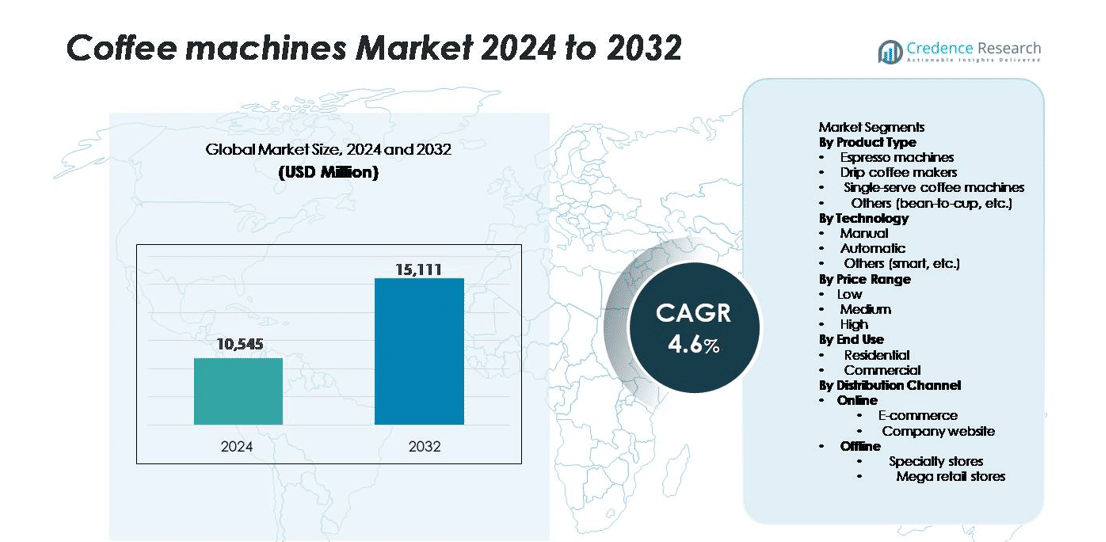
The Coffee Machines Market was valued at USD 10,545 million in 2024 and is projected to reach USD 15,111 million by 2032, growing at a CAGR of 4.6% during the forecast period.
| REPORT ATTRIBUTE | DETAILS |
|---|---|
| Historical Period | 2020-2023 |
| Base Year | 2024 |
| Forecast Period | 2025-2032 |
| Coffee Machines Market Size 2024 | USD 10,545 million |
| Coffee Machines Market, CAGR | 4.6% |
| Coffee Machines Market Size 2032 | USD 15,111 million |
The coffee machines market is led by major players such as De’Longhi, Breville, Keurig, Nespresso, and Philips, each competing across residential and commercial product lines. These companies focus on premium espresso systems, single-serve brewers, and bean-to-cup machines to match rising demand for café-style beverages at home. North America holds the highest market share at 34%, driven by strong adoption of automatic and single-serve systems, high consumer spending, and a well-established café network. Europe follows closely due to strong espresso culture and premium machine usage. Continuous product innovation, digital controls, and energy-efficient features help brands retain market presence and expand customer reach.
Market Insights
- The coffee machines market reached USD 10,545 million in 2024 and will grow to USD 15,111 million by 2032, recording a 4.6% CAGR during the forecast period.
- Rising at-home coffee consumption and remote working increase sales of single-serve and automatic machines, pushing manufacturers to offer convenient, fast-brewing systems with premium flavor.
- Smart, app-enabled and energy-efficient machines drive market trends as users demand customization, voice assistance, and recyclable or biodegradable pod options.
- Leading players such as De’Longhi, Breville, Keurig, Nespresso, and Philips compete through premium features, touchscreen controls, and strong e-commerce presence, while low-priced drip systems create pressure in cost-sensitive markets.
- North America holds the highest regional share at 34%, followed by Europe with strong espresso culture; espresso machines lead product type sales, while automatic models remain the dominant technology segment due to ease of use and consistent brewing.
Market Segmentation Analysis:
By Product Type
Espresso machines lead the market with the highest revenue share, supported by strong demand from cafés, restaurants, and premium home users. Consumers prefer espresso systems for rich taste, customization options, and fast brewing. Growing café culture, rising disposable income, and increasing preference for specialty beverages push adoption. Drip coffee makers remain popular in households due to easy use and low maintenance. Single-serve machines continue to grow as compact and convenient appliances for home and office settings. Bean-to-cup models gain traction among premium users who seek freshness and automated grinding.
- For instance, the Breville Barista Express BES870XL features a 54 mm stainless-steel portafilter, a 2-liter removable water tank, and a 15-bar Italian pump, allowing precise espresso extraction and integrated grinding within a footprint suitable for home users. Drip coffee makers remain popular due to ease of use and low maintenance.
By Technology
Automatic coffee machines hold the dominant share as consumers shift toward convenience, one-touch brewing, and consistent quality. Automatic models suit both home and commercial environments, leading to large-scale adoption across developed and emerging markets. Manual machines still attract users who enjoy traditional brewing and precise control over extraction. Smart coffee machines represent a rising segment, offering app control, voice assistance, and programmable recipes. Their growth is driven by smart home integration and tech-savvy buyers in premium price brackets.
- For instance, the JURA Z10 uses a 3D brewing technology that allows water to flow evenly through the ground coffee at multiple levels, paired with a 4.3-inch touch display and an automatic bean recognition system (called the Product Recognising Grinder or P.R.G.) that adjusts grinding in real time.
By Price Range
The medium price range dominates the market with strong acceptance among household buyers who seek balance between advanced features and affordability. These machines offer automatic brewing, temperature control, and user-friendly interfaces, boosting adoption. Low-priced machines remain attractive in price-sensitive regions and first-time buyers shifting from instant coffee. The high-end segment grows steadily due to demand for premium café-style drinks at home, touchscreen interfaces, and built-in grinders. Growing interest in at-home specialty brewing and rising premium coffee consumption supports expansion across mid and high-range categories.
Key Growth Drivers
Rise of Home Coffee Consumption
Home brewing has increased as more people prefer café-style drinks at home. Busy lifestyles support demand for quick brewing and consistent taste. Automatic machines and single-serve designs provide one-touch convenience and less cleanup. Growing remote work also keeps coffee consumption high during the day. Brands promote milk frothing, temperature control, and strength settings to match café beverages. Middle-income households buy mid-range machines with smart controls and digital displays. Rising interest in specialty beans encourages users to upgrade from manual brewing to premium espresso units. Easy availability through e-commerce and discount events boosts sales. Subscription models for pods and beans keep users tied to brands. Better grinder systems, silent motors, and energy efficiency also attract buyers. These factors steadily push domestic adoption and revenue growth for multiple product types.
- For instance, the Breville Bambino Plus heats to extraction temperature in 3 seconds using its ThermoJet system and delivers milk micro-foam with a 130-°C automatic steam wand, allowing café-grade latte preparation without manual skill.
Expansion of Café Culture and Commercial Demand
Café culture continues to rise in urban and semi-urban regions. Coffee chains expand in shopping malls, airports, colleges, and co-working spaces. Each location needs reliable machines that serve consistent espresso and milk drinks. Commercial users choose automatic or bean-to-cup devices for speed and efficiency. Demand for flavored beverages and premium blends increases footfall for coffee shops. Hotels and restaurants add espresso bars to meet guest expectations. Professional machines support temperature stability and high-volume output. Service contracts, maintenance packages, and training support long-term usage. Franchises invest in durable machines with digital controls and dosing accuracy. New cafés in emerging markets push the replacement cycle and boost unit sales.
- · For instance, the JURA GIGA X8c Gen II uses dual ceramic disc grinders, is recommended for a maximum daily output of up to 200 cups (or up to 138 espressos per hour), and features dual thermoblocks that allow it to brew two milk beverages simultaneously. The machine can use a 5-liter water tank or connect directly to a mains water supply.
Growth of Online Retail and Product Visibility
Online platforms make comparison easy for new buyers. Shoppers review features, ratings, and brewing styles before ordering. Fast delivery supports quick adoption and repeat purchases. Brand websites offer bundles, extended warranties, and accessories. Social media and influencer content promote premium brewing at home. Video tutorials build user confidence and reduce hesitation to buy expensive models. Subscription coffee and pod services also raise online engagement. E-commerce attracts small brands that cannot reach retail stores. Online discounts improve affordability for mid and premium ranges. These factors widen reach, shift buying patterns, and support strong digital sales.
Key Trends & Opportunities
Smart and Connected Coffee Machines
Smart machines are gaining traction as homes adopt connected devices. Users control brewing through apps, voice assistants, and timers. Personalized recipes create a premium experience at home. Cloud connectivity helps brands track usage patterns and improve features. Remote diagnostics reduce maintenance issues. Smart interfaces attract tech-savvy buyers who prefer automation. Growth of IoT appliances strengthens this trend. This segment creates opportunities for AI-based brewing, automatic bean detection, and cloud-stored taste profiles.
- For instance, the Keurig K-Supreme Plus SMART uses BrewID technology that reads digital signatures on K-cups and automatically configures 5 temperature levels and 6 strength settings through the Keurig app.
Shift to Sustainable and Energy-Efficient Brewing
Consumers now prefer sustainable appliances and eco-friendly designs. Energy-efficient heating systems reduce power use. Machines with reusable metal filters cut plastic waste from pods. Brands launch biodegradable and compostable capsules. Stainless steel bodies replace plastic in premium lines. Repairable parts and maintenance kits extend product life. Growing environmental awareness pushes brands to adopt greener supply chains and recyclable packaging. These changes open long-term opportunities for innovation in materials and waste reduction.
- For instance, the Breville Precision Brewer includes a gold-tone stainless-steel filter rated for over 3,000 brew cycles without replacement. Brands also launch biodegradable and compostable capsules.
Key Challenges
High Product and Maintenance Costs
Premium coffee machines have high upfront prices. Many users hesitate to purchase automatic espresso units because of cost. Maintenance and repair services also add extra spending. Commercial machines require skilled servicing, water filters, and part replacements. These expenses slow adoption in price-sensitive markets. Pod-based systems also require regular refills, raising long-term cost. Brands must balance affordability with advanced features. Lack of after-sales service in rural areas creates additional difficulty.
Competition from Low-Cost Alternatives
Low-cost drip makers and manual brewing tools remain popular. Many buyers continue using instant coffee because machines seem expensive. Small cafés sometimes choose cheaper semi-automatic units to avoid high investments. Local brands offer low-priced models that limit sales for global players. Pod compatibility issues also affect customer choices. Price wars in e-commerce reduce profit margins. Competing beverage trends, like tea and ready-to-drink coffee, slow machine adoption in some regions.
Regional Analysis
North America
North America holds the largest share of the coffee machines market, supported by strong café culture, high household adoption, and widespread consumption of specialty beverages. Many consumers purchase automatic espresso and single-serve machines to enjoy café-quality drinks at home. The U.S. drives most demand due to premium product preference and a well-established commercial café network. Online retail and subscription pod services remain key growth channels. Commercial buyers, including coffee chains, restaurants, and hotels, also invest in high-capacity machines for quick service and consistent taste. These factors maintain the region’s dominant share and steady product replacement cycles.
Europe
Europe accounts for a significant market share due to long-standing coffee traditions and high per-capita consumption. Countries such as Germany, Italy, and France lead sales of automatic and bean-to-cup machines. Consumers prefer rich espresso flavors, driving steady demand for premium models with grinding and milk frothing features. Cafés and restaurants maintain strong machine purchases to support specialty drink menus. Sustainability trends also influence demand, with brands focusing on energy-efficient machines and recyclable pods. Growing home brewing culture and mature commercial infrastructure sustain Europe’s considerable revenue contribution.
Asia Pacific
Asia Pacific represents the fastest-growing regional market, driven by rising disposable income, Western café culture, and urbanization. Countries like China, Japan, South Korea, and India experience rapid café expansion and strong adoption of single-serve and drip machines in households. Younger consumers prefer branded coffee and convenience beverages, which boosts sales of automatic and pod-based systems. E-commerce plays a major role in product accessibility and price comparison. Premium coffee chains and local café brands continue expanding across major cities, strengthening commercial machine demand. This growth supports a steadily increasing market share for the region.
Latin America
Latin America holds a moderate market share, supported by a strong coffee-producing culture and growing café consumption in urban regions. Brazil, Mexico, Colombia, and Argentina remain key contributors. Commercial demand is driven by cafés, bakeries, and restaurants adopting automatic equipment to improve brewing speed and consistency. Household adoption is rising as mid-range machines become more affordable through retail promotions. However, price sensitivity and preference for traditional brewing methods limit uptake in rural areas. Increasing tourism and premium coffee culture support gradual market expansion.
Middle East & Africa
The Middle East & Africa region holds a smaller yet growing market share, supported by rising hospitality investment, tourism, and premium café development. Countries like the UAE, Saudi Arabia, and South Africa adopt high-end espresso machines in hotels, restaurants, and specialty coffee shops. Home brewing demand grows among affluent consumers who purchase imported or branded machines. However, high product pricing and limited retail reach slow adoption in lower-income areas. Despite these challenges, modern retail expansion and growing urban lifestyles contribute to steady market growth across the region.
Market Segmentations:
By Product Type
- Espresso machines
- Drip coffee makers
- Single-serve coffee machines
- Others (bean-to-cup, etc.)
By Technology
- Manual
- Automatic
- Others (smart, etc.)
By Price Range
- Low
- Medium
- High
By End Use
- Residential
- Commercial
By Distribution Channel
- Online
- E-commerce
- Company website
- Offline
- Specialty stores
- Mega retail stores
By Geography
- North America
- U.S.
- Canada
- Mexico
- Europe
- Germany
- France
- U.K.
- Italy
- Spain
- Rest of Europe
- Asia Pacific
- China
- Japan
- India
- South Korea
- South-east Asia
- Rest of Asia Pacific
- Latin America
- Brazil
- Argentina
- Rest of Latin America
- Middle East & Africa
- GCC Countries
- South Africa
- Rest of the Middle East and Africa
Competitive Landscape
The coffee machines market features strong competition from global and regional manufacturers offering products across residential and commercial segments. Leading brands focus on product innovation, energy efficiency, smart connectivity, and durable components to increase customer loyalty. Premium players invest in automatic and bean-to-cup systems with built-in grinders, milk frothers, and touchscreen controls, while mid-range brands compete on affordability and maintenance ease. Commercial suppliers target cafés, hotels, and restaurants with high-capacity machines that deliver consistent flavor and fast brewing. Partnerships with retail chains, e-commerce platforms, and subscription services strengthen product reach. Marketing through social media, influencer content, and product demonstrations boosts brand visibility among home users. Growing demand for eco-friendly designs, recyclable pods, and energy-efficient heating systems pushes companies to adopt sustainable materials and improved manufacturing. As consumer preferences shift toward specialty beverages and at-home café experiences, brands compete on flavor consistency, brewing customization, and long-term reliability, driving ongoing portfolio upgrades and replacement cycles.
Key Player Analysis
- Hamilton Beach Brands
- Gaggia
- Keurig Dr Pepper
- JURA Elektroapparate
- Bosch
- Illycaffè
- Breville Group
- Koninklijke Philips N.V.
- De'Longhi
- AEG
Recent Development
- In April 2024, Gaggia launched the Espresso Evolution compact machine for North America, combining home-barista functions with space-saving design.
- In March 2024, Keurig Dr Pepper (Mar 13 2024) announced upcoming compostable coffee pods (“K-Rounds”) and a new brewer system for launch in 2025
Report Coverage
The research report offers an in-depth analysis based on Product type, Technology, Price range, End-Use, Distribution channel and Geography. It details leading market players, providing an overview of their business, product offerings, investments, revenue streams, and key applications. Additionally, the report includes insights into the competitive environment, SWOT analysis, current market trends, as well as the primary drivers and constraints. Furthermore, it discusses various factors that have driven market expansion in recent years. The report also explores market dynamics, regulatory scenarios, and technological advancements that are shaping the industry. It assesses the impact of external factors and global economic changes on market growth. Lastly, it provides strategic recommendations for new entrants and established companies to navigate the complexities of the market.
Future Outlook
- Demand for automatic and bean-to-cup machines will rise as home users seek café-style brewing.
- Smart and connected machines will gain adoption due to app control and voice-assistant functions.
- Energy-efficient designs and recyclable pod systems will attract environmentally conscious buyers.
- Commercial cafés, hotels, and restaurants will increase investments in high-capacity machines with durable components.
- Single-serve systems will expand in offices and homes due to fast brewing and portion control.
- E-commerce and subscription services for pods and beans will strengthen recurring sales.
- Premium brands will add advanced grinders, milk systems, and customized brewing profiles.
- Price-sensitive markets will adopt mid-range automatic machines with basic digital features.
- Replacement demand will rise as older models get upgraded to smart and efficient versions.
- New café chains and specialty coffee culture in emerging regions will boost commercial machine sales.

Request a Free Sample
Fill in your details and we'll send you a free sample report.
- Sample data tables & charts
- Research methodology
Market Dynamics
Rise of Home Coffee Consumption
Remote work and changing lifestyles have increased at-home coffee consumption, driving demand for automatic, single-serve, and premium espresso machines that offer café-style beverages with convenience and speed.
Expansion of Café Culture and Commercial Demand
The proliferation of cafés, coffee chains, and specialty beverage outlets in urban and semi-urban areas is fueling commercial demand for high-capacity, reliable coffee machines, supporting both replacement cycles and new installations.
Growth of Online Retail and Product Visibility
E-commerce platforms and brand websites make it easier for consumers to compare features, access discounts, and purchase coffee machines, expanding market reach and accelerating adoption, especially for mid and premium segments.
Smart and Connected Machine Adoption
Increasing consumer interest in smart home appliances is boosting demand for app-enabled, programmable, and voice-assisted coffee machines, particularly among tech-savvy and premium buyers seeking customization and convenience.
Shift to Sustainable and Energy-Efficient Brewing
Rising environmental awareness is pushing manufacturers to develop energy-efficient machines, recyclable pods, and sustainable materials, attracting eco-conscious consumers and supporting long-term market growth.
Need a Custom Version of This Report?
Tailor the scope, geography, or segments to your exact requirements.
- Custom geography or segment scope
- Direct access to our analyst team
Frequently Asked Questions
What is the current size of the Coffee Machine Market?
At what Compound Annual Growth Rate is the Coffee Machines Market projected to grow between 2025 and 2032?
What factors are driving the growth of the Coffee Machine Market?
What are the key segments within the Coffee Machine Market?
What are some challenges faced by the Coffee Machine Market?
Who are the major players in the Coffee Machine Market?
Which segment is leading the market share?
Table of Content
Chapter 1 Market Segmentation
- 1.1 Segmentation Framework
- 1.1.1 Product and Service Classification
- 1.1.2 Application and End-Use Classification
- 1.1.3 Technology and Solution Classification
- 1.1.4 Customer and Distribution Channel Classification
- 1.1.5 Geographic Segmentation
- 1.1.6 Market Segment Definitions and Boundaries
- 1.2 By End Use
- 1.2.1 Residential
- 1.2.2 Commercial
- 1.3 By Technology
- 1.3.1 Manual
- 1.3.2 Automatic
- 1.3.3 Others (smart, etc.)
- 1.4 By Price Range
- 1.4.1 Low
- 1.4.2 Medium
- 1.4.3 High
- 1.5 By Product Type
- 1.5.1 Espresso machines
- 1.5.2 Drip coffee makers
- 1.5.3 Single-serve coffee machines
- 1.5.4 Others (bean-to-cup, etc.)
Chapter 2 Introduction
- 2.1 Report Objectives and Scope
- 2.2 Product Definition and Industry Terminology
- 2.3 Market Inclusions and Exclusions
- 2.4 Research Process
- 2.4.1 Primary Research and Expert Interviews
- 2.4.2 Secondary Research and Source Review
- 2.4.3 Top-Down and Bottom-Up Estimation
- 2.4.4 Data Triangulation and Verification
- 2.5 Market Size Measurement Basis
- 2.5.1 2024: USD 10,545 million → 2032: USD 15,111 million
- 2.6 Historical and Forecast Reference Periods
- 2.6.1 Base Year: 2024
- 2.6.2 Forecast Period: 2024-2032
- 2.7 Research Assumptions and Limitations
Chapter 3 Executive Summary
- 3.1 Market Snapshot and Key Findings
- 3.2 Base-Year Market Size, 2024
- 3.3 Forecast Market Size, 2032
- 3.4 Revenue and Volume Growth Outlook
- 3.5 Key Demand and Supply Indicators
- 3.6 Leading Market Segments
- 3.7 Fastest-Growing Market Opportunities
- 3.8 Regional Performance Highlights
- 3.9 Technology and Industry Transformation
- 3.10 Competitive Landscape Summary
- 3.11 Analyst View and Strategic Implications
Chapter 4 Global Coffee Machine Market Trends and Developments
- 4.1 Historical Industry Development
- 4.2 Recent Market Trends and Developments
- 4.3 Demand and Customer Behavior Trends
- 4.4 Technology and Product Innovation
- 4.5 Artificial Intelligence, Automation and Digitalization
- 4.6 Local Manufacturing and Supply Chain Realignment
- 4.7 Industry Partnerships, Mergers and Acquisitions
- 4.8 Sustainability and Circular Economy Developments
- 4.9 Government and Private Sector Investment Trends
- 4.10 Emerging Business Models and Commercialization
- 4.11 Industry Developments and Announcements
Chapter 5 Global Coffee Machine Market Production, Supply and Demand Analysis
- 5.1 Demand Trend and Consumption Analysis
- 5.2 Demand Forecast, 2024-2032
- 5.3 Production and Output Trend
- 5.4 Production and Output Forecast, 2024-2032
- 5.5 Installed Capacity and Capacity Utilization
- 5.6 Company-Wise Production Plants and Statistics
- 5.6.1 Installed Production Capacity
- 5.6.2 Actual Production
- 5.6.3 Planned Capacity and Expansion Targets
- 5.7 Supply Chain Structure and Procurement Trends
- 5.8 Supply-Demand Gap and Bottlenecks
- 5.9 Import Dependence and Sourcing Structure
- 5.10 Contract Manufacturing and Outsourcing
- 5.11 Regional Supply and Demand Concentration
Chapter 6 Global Coffee Machine Market Pricing Analysis
- 6.1 Pricing Structure and Measurement
- 6.2 Historical Pricing Trends
- 6.3 Pricing Outlook, 2024-2032
- 6.4 Average Selling Price and Unit Economics
- 6.5 Pricing by Product and Market Segment
- 6.6 Geographic Pricing Differences
- 6.7 Key Input, Energy, Labor and Logistics Costs
- 6.8 Contract Pricing and Purchasing Models
- 6.9 Pricing Sensitivity and Competitive Positioning
- 6.10 Price, Margin and Profitability Implications
Chapter 7 Global Coffee Machine Market Dynamics
- 7.1 Market Growth Drivers
- 7.1.1 Demand-Side Drivers
- 7.1.2 Technology and Innovation Drivers
- 7.1.3 Infrastructure and Investment Drivers
- 7.1.4 Regulatory and Policy Drivers
- 7.2 Market Restraints
- 7.2.1 Cost and Affordability Constraints
- 7.2.2 Technology and Adoption Barriers
- 7.2.3 Supply Chain and Operational Constraints
- 7.3 Market Challenges
- 7.3.1 Competitive Pressure and Margin Erosion
- 7.3.2 Skills, Infrastructure and Implementation Gaps
- 7.4 Emerging Market Opportunities
- 7.5 Market Dynamics Impact and Time-Horizon Assessment
Chapter 8 Global Coffee Machine Value Chain Analysis
- 8.1 Industry Value Chain Overview
- 8.2 Upstream Suppliers and Critical Inputs
- 8.3 Technology and Component Providers
- 8.4 Manufacturing or Service Delivery
- 8.5 Distribution, Channel Partners and Integrators
- 8.6 Downstream Applications and End Users
- 8.7 Value Addition and Profit Pools
- 8.8 Vertical Integration and Outsourcing
- 8.9 Supplier Concentration and Risk
- 8.10 Supply Chain Localization and Resilience
Chapter 9 Global Coffee Machine Market Regulations and Policies
- 9.1 Relevant Laws, Standards and Compliance Frameworks
- 9.2 Product, Service, Safety and Quality Requirements
- 9.3 Government Policies, Incentives and Subsidies
- 9.4 Imports, Exports and Trade Barriers
- 9.5 Public Procurement and Local Content Requirements
- 9.6 Environmental and Sustainability Compliance
- 9.7 Upcoming Policy Changes and Market Implications
Chapter 10 Global Coffee Machine Market Hotspots and Opportunities
- 10.1 Market Opportunity Mapping and Growth Hotspots
- 10.2 High-Growth Applications and Customer Groups
- 10.3 Underserved Markets and White-Space Opportunities
- 10.4 Emerging Technology and Product Opportunities
- 10.5 New Capacity and Investment Hotspots
- 10.6 Market Entry and Expansion Opportunities
- 10.7 Distribution and Partnership Opportunities
- 10.8 Near-Term and Long-Term Commercial Potential
- 10.9 Opportunity Attractiveness and Execution Risks
Chapter 11 Global Coffee Machine Market Outlook, 2024-2032
- 11.1 Market Size and Analysis
- 11.1.1 Revenue (Market Measurement: 2024: USD 10,545 million → 2032: USD 15,111 million)
- 11.1.2 Market Volume and Quantity Sold
- 11.1.3 Historical Market Size
- 11.1.4 Base-Year Market Size, 2024
- 11.2 Market Forecast, 2024-2032
- 11.2.1 Revenue Forecast to 2032
- 11.2.2 Volume Forecast to 2032
- 11.2.3 CAGR and Year-on-Year Growth
- 11.2.4 Incremental Revenue Opportunity
- 11.3 Forecast Assumptions and Scenario Analysis
- 11.3.1 Base-Case Forecast
- 11.3.2 Optimistic and Conservative Scenarios
- 11.3.3 Technology, Pricing and Policy Sensitivities
- 11.4 Market Attractiveness and Growth Outlook
Chapter 12 Global Coffee Machine Market Segmentation and Outlook
- 12.1 Segmentation Summary and Market Shares, 2024
- 12.2 Largest and Fastest-Growing Segments
- 12.3 By End Use - Market Size and Forecast, 2024-2032
- 12.3.1 Segment Definition and Scope
- 12.3.2 Historical Market Size
- 12.3.3 Revenue Forecast, 2024-2032
- 12.3.4 Volume Forecast, 2024-2032
- 12.3.5 Base-Year Market Share, 2024
- 12.3.6 Segment CAGR and Growth Drivers
- 12.3.7 Subsegment Market Size and Forecast
- 12.3.7.1 Residential
- 12.3.7.2 Commercial
- 12.3.8 Subsegment Pricing and Adoption Trends
- 12.3.9 Leading Suppliers and Competition
- 12.3.10 Regional Demand and Opportunities
- 12.4 By Technology - Market Size and Forecast, 2024-2032
- 12.4.1 Segment Definition and Scope
- 12.4.2 Historical Market Size
- 12.4.3 Revenue Forecast, 2024-2032
- 12.4.4 Volume Forecast, 2024-2032
- 12.4.5 Base-Year Market Share, 2024
- 12.4.6 Segment CAGR and Growth Drivers
- 12.4.7 Subsegment Market Size and Forecast
- 12.4.7.1 Manual
- 12.4.7.2 Automatic
- 12.4.7.3 Others (smart, etc.)
- 12.4.8 Subsegment Pricing and Adoption Trends
- 12.4.9 Leading Suppliers and Competition
- 12.4.10 Regional Demand and Opportunities
- 12.5 By Price Range - Market Size and Forecast, 2024-2032
- 12.5.1 Segment Definition and Scope
- 12.5.2 Historical Market Size
- 12.5.3 Revenue Forecast, 2024-2032
- 12.5.4 Volume Forecast, 2024-2032
- 12.5.5 Base-Year Market Share, 2024
- 12.5.6 Segment CAGR and Growth Drivers
- 12.5.7 Subsegment Market Size and Forecast
- 12.5.7.1 Low
- 12.5.7.2 Medium
- 12.5.7.3 High
- 12.5.8 Subsegment Pricing and Adoption Trends
- 12.5.9 Leading Suppliers and Competition
- 12.5.10 Regional Demand and Opportunities
- 12.6 By Product Type - Market Size and Forecast, 2024-2032
- 12.6.1 Segment Definition and Scope
- 12.6.2 Historical Market Size
- 12.6.3 Revenue Forecast, 2024-2032
- 12.6.4 Volume Forecast, 2024-2032
- 12.6.5 Base-Year Market Share, 2024
- 12.6.6 Segment CAGR and Growth Drivers
- 12.6.7 Subsegment Market Size and Forecast
- 12.6.7.1 Espresso machines
- 12.6.7.2 Drip coffee makers
- 12.6.7.3 Single-serve coffee machines
- 12.6.7.4 Others (bean-to-cup, etc.)
- 12.6.8 Subsegment Pricing and Adoption Trends
- 12.6.9 Leading Suppliers and Competition
- 12.6.10 Regional Demand and Opportunities
- 12.7 Segment Growth Comparison
- 12.8 Segment Attractiveness and Priority Matrix
Chapter 13 Global Coffee Machine End-Use and Application Market Outlook
- 13.1 End-Use Industry and Customer Demand Structure
- 13.2 Leading Applications and Customer Groups
- 13.3 End-Use Market Size, Share and Forecast
- 13.4 Major End-Use Industry Deep Dives
- 13.4.1 Customer Requirements and Use Cases
- 13.4.2 Demand and Replacement Cycles
- 13.4.3 Technical and Regulatory Considerations
- 13.4.4 Purchasing and Procurement Models
- 13.4.5 Leading Vendors and Distribution Channels
- 13.4.6 Forecast and Commercial Opportunities
- 13.5 Emerging Applications and Cross-Segment Demand
- 13.6 End-Use Industry Investment Priorities
Chapter 14 Global Coffee Machine Geographic Market Outlook, 2024-2032
- 14.1 Regional Market Size and Share, 2024
- 14.2 Regional Market Forecast, 2024-2032
- 14.3 Regional Pricing, Production and Demand Differences
- 14.4 North America
- 14.4.1 United States
- 14.4.2 Canada
- 14.4.3 Mexico
- 14.5 Europe
- 14.5.1 Germany
- 14.5.2 France
- 14.5.3 Italy
- 14.5.4 United Kingdom
- 14.5.5 Spain
- 14.5.6 Poland
- 14.5.7 Russia
- 14.5.8 Netherlands
- 14.5.9 Belgium
- 14.5.10 Sweden
- 14.5.11 Denmark
- 14.5.12 Norway
- 14.5.13 Rest of Europe
- 14.6 Asia Pacific
- 14.6.1 China
- 14.6.2 India
- 14.6.3 Japan
- 14.6.4 South Korea
- 14.6.5 Thailand
- 14.6.6 Indonesia
- 14.6.7 Vietnam
- 14.6.8 Malaysia
- 14.6.9 Australia
- 14.6.10 Rest of Asia Pacific
- 14.7 Latin America
- 14.7.1 Brazil
- 14.7.2 Argentina
- 14.7.3 Colombia
- 14.7.4 Chile
- 14.7.5 Rest of Latin America
- 14.8 Middle East
- 14.8.1 Saudi Arabia
- 14.8.2 United Arab Emirates
- 14.8.3 Turkey
- 14.8.4 Israel
- 14.8.5 Iran
- 14.8.6 Rest of the Middle East
- 14.9 Africa
- 14.9.1 South Africa
- 14.9.2 Egypt
- 14.9.3 Nigeria
- 14.9.4 Morocco
- 14.9.5 Rest of Africa
- 14.10 Regional Investment, Policy and Supply Chain Differences
- 14.11 Regional Competitive Landscape
- 14.12 Geographic Growth Hotspots
Chapter 15 Global Coffee Machine Technology, Innovation and Sustainability Outlook
- 15.1 Technology Landscape and Maturity
- 15.2 Product, Process and Service Innovation
- 15.3 AI, Automation and Digital Tools in the Industry
- 15.4 Technology Adoption and Performance Benchmarking
- 15.5 Innovation Pipeline and R&D Investment
- 15.6 Patent and Intellectual Property Trends
- 15.7 Energy Efficiency and Resource Management
- 15.8 Sustainability, Recycling and Circularity
- 15.9 Technology Roadmap, 2024-2032
- 15.10 Risks of Obsolescence and Technology Substitution
Chapter 16 Global Coffee Machine Market Key Strategic Imperatives
- 16.1 Growth and Market Entry Priorities
- 16.2 High-Return Products and Segments
- 16.3 Pricing, Profitability and Cost Optimization
- 16.4 Technology Investment and Product Differentiation
- 16.5 Supply Chain Localization and Resilience
- 16.6 Distribution and Customer Acquisition
- 16.7 Partnership, Acquisition and Capacity Strategy
- 16.8 Regional Expansion Priorities
- 16.9 Short-, Medium- and Long-Term Actions
Chapter 17 Competition Outlook
- 17.1 Industry Competition Characteristics
- 17.2 Market Structure and Concentration
- 17.3 Market Share and Competitive Positioning, 2024
- 17.4 Company-Wise Revenue and Product Benchmarking
- 17.5 Production and Service Capacity Benchmarking
- 17.6 Technology, Pricing and Differentiation
- 17.7 Regional Footprint and Distribution Strength
- 17.8 Mergers, Acquisitions and Strategic Alliances
- 17.9 New Entrants and Competitive Threats
- 17.10 Porter's Five Forces and Industry Attractiveness
- 17.11 Competitive Outlook, 2024-2032
Chapter 18 Company Profiles
- 18.1 Company Coverage and Selection Criteria
- 18.2 De'Longhi
- 18.2.1 Business Description
- 18.2.2 Company Ownership and Geographic Presence
- 18.2.3 Product and Service Portfolio
- 18.2.4 Manufacturing and Operating Footprint
- 18.2.5 Production Capacity and Expansion Plans
- 18.2.6 Financial Performance and Investment
- 18.2.7 Market Share and Competitive Position
- 18.2.8 Technology and Innovation Capabilities
- 18.2.9 Strategic Alliances or Partnerships
- 18.2.10 Recent Developments
- 18.2.11 Growth Strategy and Outlook
- 18.3 Breville Group
- 18.4 Keurig Dr Pepper
- 18.5 Nespresso
- 18.6 Philips
- 18.7 JURA Elektroapparate
- 18.8 Hamilton Beach Brands
- 18.9 Gaggia
- 18.10 Bosch
- 18.11 Illycaffè
- 18.12 Other Relevant Market Participants
Note: Every listed company is profiled on the structure shown under the first company. The company list is preliminary and may change based on research findings, market developments, data availability and client requirements.
Chapter 19 Disclaimer
- 19.1 Research and Forecast Disclaimer
- 19.2 Data Source and Estimation Limitations
Note: The depth of individual sections depends on data availability for this market. Volume, capacity, trade and other unit-based metrics are included where applicable.