
Market Overview
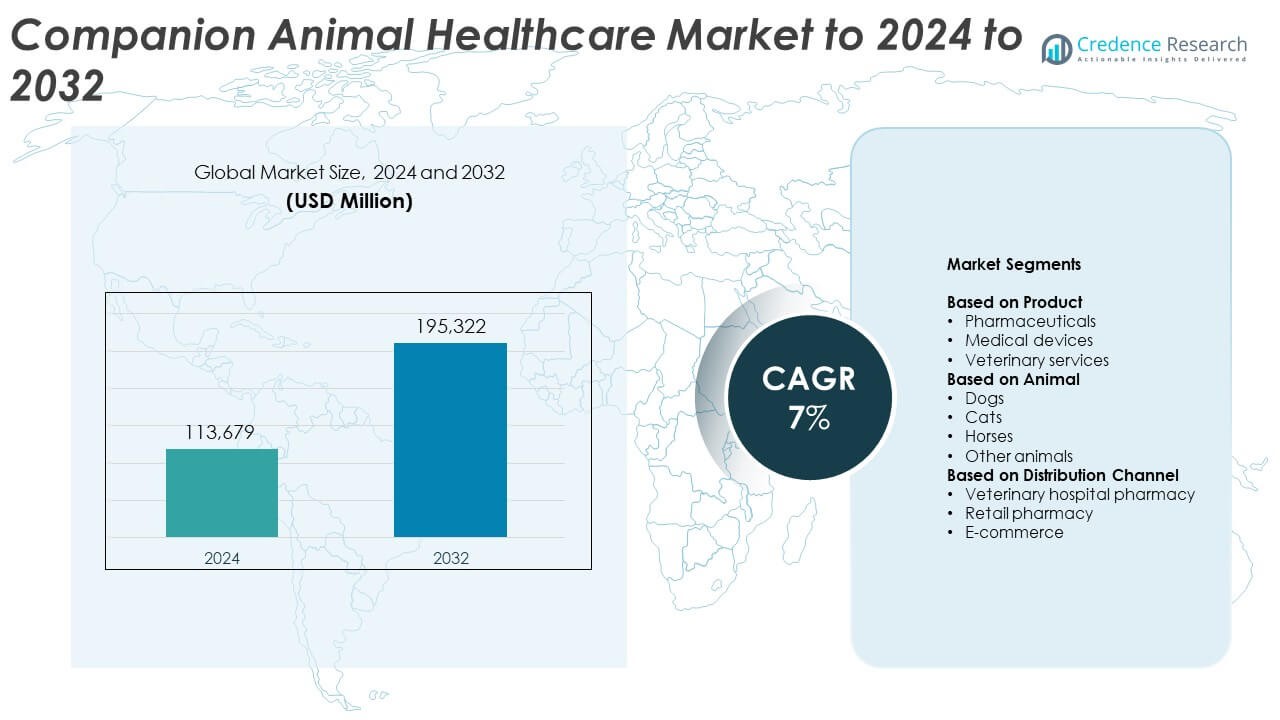
Companion Animal Healthcare Market size was valued at USD 113,679 million in 2024 and is anticipated to reach USD 195,322 million by 2032, at a CAGR of 7% during the forecast period.
| REPORT ATTRIBUTE | DETAILS |
|---|---|
| Historical Period | 2020-2023 |
| Base Year | 2024 |
| Forecast Period | 2025-2032 |
| Companion Animal Healthcare Market Size 2024 | USD 113,679 Million |
| Companion Animal Healthcare Market, CAGR | 7% |
| Companion Animal Healthcare Market Size 2032 | USD 195,322 Million |
The companion animal healthcare market is dominated by leading players such as Zoetis, Boehringer Ingelheim, Elanco, Merck, Ceva, and Virbac, along with IDEXX Laboratories, Dechra, and Mars Petcare. These companies focus on expanding their product portfolios across pharmaceuticals, diagnostics, and preventive care through innovation and strategic collaborations. North America led the global market in 2024 with a 41.2% share, supported by advanced veterinary infrastructure and high pet ownership rates. Europe followed with 27.4%, driven by strong regulatory frameworks and high insurance coverage, while Asia Pacific emerged as the fastest-growing region, holding a 19.3% share.
Market Insights
- The companion animal healthcare market was valued at USD 113,679 million in 2024 and is projected to reach USD 195,322 million by 2032, registering a CAGR of 7% during the forecast period.
- Growing pet ownership, rising awareness of preventive care, and increasing veterinary expenditure are driving market expansion across pharmaceuticals, medical devices, and veterinary services.
- Technological advancements such as telemedicine, wearable health trackers, and biologics are reshaping animal health management and boosting early diagnosis and personalized treatments.
- The market remains moderately consolidated, with major players focusing on innovation, product diversification, and partnerships to enhance distribution reach and customer engagement.
- North America led the market with a 41.2% share in 2024, followed by Europe at 27.4% and Asia Pacific at 19.3%, while the pharmaceuticals segment dominated globally with a 54.2% share due to rising demand for therapeutics and vaccines.
Market Segmentation Analysis:
By Product
Pharmaceuticals dominated the Companion Animal Healthcare Market in 2024, accounting for 54.2% of the total share. The segment’s leadership stems from rising incidences of infectious, parasitic, and chronic diseases among pets, driving demand for antibiotics, anti-parasitic drugs, and vaccines. Continuous innovation in veterinary therapeutics and the introduction of advanced biologics further enhance treatment efficiency. For instance, Zoetis expanded its monoclonal antibody portfolio for osteoarthritis pain management in dogs, reinforcing pharmaceutical dominance through precision-based therapies and increasing preventive healthcare awareness among pet owners.
- For instance, Zoetis’s monoclonal antibody therapy Librela® (bedinvetmab) has already been used to treat over 1 million dogs with osteoarthritis pain since its launch.
By Animal
Dogs held the largest market share of 58.6% in 2024, driven by their higher ownership rates and increasing healthcare expenditure per pet. Growing cases of arthritis, obesity, and dermatological conditions among dogs boost demand for regular veterinary visits and chronic disease management. Preventive care programs and rising insurance coverage also support the segment’s expansion. For instance, Elanco introduced chewable preventive solutions addressing flea, tick, and heartworm infestations in dogs, emphasizing convenience and compliance in pet medication routines.
- For instance, Elanco Animal Health’s chewable preventive product Credelio Quattro™ offers broad-spectrum protection (six parasite types) and is approved for dogs and puppies aged 8 weeks and older weighing at least 3.3 lb.
By Distribution Channel
Veterinary hospital pharmacies led the market with a 47.3% share in 2024, supported by the availability of professional diagnosis, on-site prescriptions, and immediate access to treatments. Pet owners increasingly prefer hospital-based pharmacies for reliability and expert consultation. The growing network of veterinary clinics and multi-specialty centers strengthens the segment’s dominance. For instance, VCA Animal Hospitals expanded its clinical network across North America, offering integrated pharmaceutical dispensing and wellness programs, ensuring improved accessibility and continuity of companion animal healthcare services.
Key Growth Drivers
Rising Pet Ownership and Humanization of Animals
Growing pet adoption rates and the humanization trend are driving the companion animal healthcare market. Pet owners increasingly view animals as family members, prioritizing preventive care, wellness services, and advanced treatments. This shift boosts demand for pharmaceuticals, diagnostics, and veterinary services. Expanding pet insurance coverage and growing disposable incomes in developed and emerging economies further stimulate spending on healthcare, grooming, and nutrition. The emotional bond between owners and pets continues to push investments in quality veterinary care and health management solutions.
- For instance, Chewy ended fiscal 2024 with 20.5 million active customers, up year over year. Autoship accounted for >80% of Q4 sales.
Advancements in Veterinary Diagnostics and Therapeutics
Technological innovation in diagnostics and therapeutics is a major growth driver for the market. Rapid diagnostic assays, molecular testing, and digital imaging improve disease detection accuracy and treatment outcomes. Veterinary pharmaceutical companies are developing biologics, gene therapies, and precision medicine to target specific conditions in dogs and cats. Growing demand for preventive and early-stage disease management strengthens the adoption of these technologies across veterinary hospitals and clinics. Continuous R&D investments ensure improved efficacy, safety, and accessibility of advanced veterinary care solutions.
- For instance, IDEXX reported installed bases of 74.1k Catalyst, 51.8k hematology, and 21.3k SediVue analyzers as of 2024.
Expansion of Veterinary Infrastructure and Services
The increasing establishment of veterinary hospitals, clinics, and mobile services supports the market’s long-term expansion. Urbanization and pet population growth have led to improved access to professional veterinary care, especially in emerging markets. The integration of modern equipment, telehealth platforms, and specialized services enhances treatment convenience and efficiency. Collaboration between veterinary service providers and pharmaceutical companies drives comprehensive healthcare delivery. Governments and private organizations are also promoting vaccination programs and preventive care, fostering a stronger ecosystem for animal health management.
Key Trends & Opportunities
Growth of Pet Telemedicine and Digital Health Platforms
The rise of digital healthcare is transforming companion animal treatment and monitoring. Telemedicine platforms enable remote consultations, prescription renewals, and follow-up care, reducing barriers to veterinary access. Wearable health trackers and smart monitoring devices support real-time tracking of pet activity, diet, and vital signs. These innovations enhance preventive healthcare, allowing veterinarians to detect early signs of illness. The growing acceptance of online veterinary services and connected healthcare solutions creates strong opportunities for digital expansion in the sector.
- For instance, Vetster promotes a network of thousands of licensed practitioners serving pet owners 24/7.
Rising Demand for Preventive and Nutritional Health Products
Preventive care, including vaccines, supplements, and wellness diets, is gaining traction in pet healthcare. Owners are increasingly investing in products that promote long-term health and reduce disease risks. Nutraceuticals, probiotics, and tailored diets designed for specific breeds or conditions are witnessing high adoption. The emphasis on holistic wellness and immunity-boosting formulations aligns with consumer preferences for natural and functional ingredients. This growing trend is opening opportunities for manufacturers to innovate within the preventive healthcare and nutritional segment.
- For instance, Boehringer Ingelheim sold over 6 million NexGard PLUS doses since its 2023 launch, and donated 1.9 million doses to shelters.
Increasing Focus on Sustainable and Ethical Veterinary Practices
Sustainability has emerged as a major opportunity within the veterinary industry. Companies are prioritizing eco-friendly manufacturing, ethical sourcing, and reduced antibiotic use in companion animal products. Regulatory initiatives promoting responsible medicine use and waste management are encouraging innovation in sustainable healthcare models. Pet owners are also becoming conscious of environmental impact, influencing product preferences. This growing awareness supports the development of green veterinary pharmaceuticals and recyclable packaging, positioning sustainability as a competitive advantage in animal healthcare.
Key Challenges
High Cost of Veterinary Care and Limited Insurance Coverage
The rising cost of advanced veterinary treatments and diagnostics poses a major barrier to market growth. Many pet owners, especially in developing regions, face affordability issues due to limited insurance coverage. Specialized surgeries, chronic disease management, and innovative therapies significantly increase expenditure. The uneven distribution of insurance services across regions further restricts access to quality care. Addressing cost disparities through broader insurance programs and affordable treatment packages remains essential to sustaining market expansion.
Shortage of Skilled Veterinary Professionals
The growing demand for animal healthcare services is outpacing the availability of qualified veterinary professionals. Many regions face a shortage of veterinarians, technicians, and diagnostic experts, leading to treatment delays and uneven care quality. The rising complexity of medical procedures and diagnostic technologies adds pressure to existing staff. Training programs and academic investments are needed to bridge the skill gap. Strengthening veterinary education and workforce capacity will be critical for meeting the healthcare needs of expanding companion animal populations.
Regional Analysis
North America
North America held the largest share of 41.2% in the companion animal healthcare market in 2024. The region’s dominance is supported by high pet ownership rates, strong veterinary infrastructure, and rising expenditure on advanced healthcare. The United States leads due to widespread pet insurance coverage and the presence of major pharmaceutical players. Continuous innovation in therapeutics, vaccines, and diagnostic solutions further enhances market maturity. Canada also shows strong growth through expanding veterinary networks and government-backed pet health initiatives promoting preventive and wellness care for household animals.
Europe
Europe accounted for a 27.4% share of the companion animal healthcare market in 2024, driven by increasing pet adoption and stringent animal welfare regulations. Countries such as Germany, the United Kingdom, and France exhibit high spending on veterinary services and pharmaceuticals. Preventive medicine and nutritional health products are widely adopted as part of regional wellness programs. The growth of veterinary clinics and pet insurance penetration strengthens access to quality care. Sustainability-focused practices and demand for ethical veterinary products are further shaping Europe’s market development and long-term healthcare innovation.
Asia Pacific
Asia Pacific captured a 19.3% share in 2024, emerging as the fastest-growing regional market. Rising disposable incomes and growing awareness of pet health in countries like China, India, and Japan are fueling demand for veterinary drugs and services. Expanding urban pet populations and the rise of e-commerce platforms have increased accessibility to medical products. Investments in modern veterinary facilities and digital healthcare platforms further accelerate growth. Government programs promoting vaccination and parasite control also contribute to expanding healthcare adoption across developing economies in the region.
Latin America
Latin America held a 7.1% share of the global companion animal healthcare market in 2024. The regional growth is supported by increasing pet adoption in Brazil, Mexico, and Argentina, along with improving veterinary service networks. The market benefits from growing awareness of preventive healthcare and the availability of affordable pharmaceuticals. Expanding distribution channels, including retail pharmacies and online platforms, are enhancing product reach. Ongoing partnerships between local clinics and global animal health companies are improving veterinary access and treatment standards across emerging urban centers.
Middle East & Africa
The Middle East & Africa accounted for a 5% share in 2024, reflecting steady expansion supported by rising awareness of pet care and growing veterinary investments. Countries such as the United Arab Emirates, South Africa, and Saudi Arabia are witnessing increasing pet ownership and establishment of specialized veterinary clinics. The growing availability of imported pharmaceuticals and vaccines strengthens healthcare access. However, limited local manufacturing and lower insurance coverage restrict faster growth. Gradual modernization of veterinary infrastructure and government-led welfare programs are expected to enhance market opportunities in the coming years.
Market Segmentations:
By Product
- Pharmaceuticals
- Medical devices
- Veterinary services
By Animal
- Dogs
- Cats
- Horses
- Other animals
By Distribution Channel
- Veterinary hospital pharmacy
- Retail pharmacy
- E-commerce
By Geography
- North America
- U.S.
- Canada
- Mexico
- Europe
- Germany
- France
- U.K.
- Italy
- Spain
- Rest of Europe
- Asia Pacific
- China
- Japan
- India
- South Korea
- South-east Asia
- Rest of Asia Pacific
- Latin America
- Brazil
- Argentina
- Rest of Latin America
- Middle East & Africa
- GCC Countries
- South Africa
- Rest of the Middle East and Africa
Competitive Landscape
The companion animal healthcare market features a highly competitive landscape, with leading companies such as Boehringer Ingelheim, Zoetis, Elanco, Merck, Ceva, Virbac, IDEXX Laboratories, Dechra, Vetoquinol, Mars, Phibro, PetIQ, HIPRA, Medtronic, B Braun, Neogen, Hester, Endovac, Hollard, Figo Pet Insurance, and Hartville shaping industry dynamics. Market competition is driven by innovation in biologics, vaccines, diagnostics, and digital veterinary solutions. Firms are expanding research pipelines and introducing targeted therapies for chronic and infectious diseases in pets. Strategic mergers, acquisitions, and partnerships are strengthening global distribution networks and improving regional market penetration. Technological advancements in molecular diagnostics, telemedicine, and wearable health devices are redefining animal care delivery. Additionally, increasing investment in sustainable production and regulatory compliance supports long-term growth. The emphasis on preventive healthcare, personalized treatment, and customer engagement continues to define the evolving competitive structure of the companion animal healthcare market worldwide.
Key Player Analysis
- Boehringer Ingelheim
- Zoetis
- Elanco
- Merck
- Ceva
- Virbac
- IDEXX Laboratories
- Dechra
- Vetoquinol
- Mars
- Phibro
- PetIQ
- HIPRA
- Medtronic
- B Braun
- Neogen
- Hester
- Endovac
- Hollard
- Figo Pet Insurance
- Hartville
Recent Developments
- In 2023, Boehringer Ingelheim received FDA approval and launched Senvelgo (velagliflozin oral liquid medication), the first oral liquid solution for treating cats with diabetes.
- In 2023, Elanco Launched AdTab (lotilaner), a non-prescription oral monthly flea and tick product for dogs and cats, in Europe.
- In 2022, Vetoquinol launched Simplera® (florfenicol, terbinafine, mometasone furoate) otic solution for dogs.
Report Coverage
The research report offers an in-depth analysis based on Product, Animal, Distribution Channel and Geography. It details leading market players, providing an overview of their business, product offerings, investments, revenue streams, and key applications. Additionally, the report includes insights into the competitive environment, SWOT analysis, current market trends, as well as the primary drivers and constraints. Furthermore, it discusses various factors that have driven market expansion in recent years. The report also explores market dynamics, regulatory scenarios, and technological advancements that are shaping the industry. It assesses the impact of external factors and global economic changes on market growth. Lastly, it provides strategic recommendations for new entrants and established companies to navigate the complexities of the market.
Future Outlook
- The companion animal healthcare market will continue expanding due to rising pet ownership worldwide.
- Preventive healthcare and wellness services will gain strong adoption across all major regions.
- Veterinary telemedicine platforms will see wider use for remote consultations and follow-up care.
- Biologics, gene therapies, and personalized veterinary medicines will transform treatment options.
- Increased pet insurance coverage will improve affordability and access to advanced care.
- Nutraceuticals and functional diets will experience strong growth in preventive health management.
- Digital monitoring devices and wearable trackers will enhance continuous health assessment.
- Sustainability and ethical sourcing will shape product development and corporate strategies.
- Veterinary service networks will expand through mergers, partnerships, and technological integration.
- Rising awareness of zoonotic diseases will drive investments in preventive diagnostics and vaccines.

Request a Free Sample
Fill in your details and we'll send you a free sample report.
- Sample data tables & charts
- Research methodology
Need a Custom Version of This Report?
Tailor the scope, geography, or segments to your exact requirements.
- Custom geography or segment scope
- Direct access to our analyst team
Frequently Asked Questions
What is the current market size for Companion Animal Healthcare Market, and what is its projected size in 2032?
At what Compound Annual Growth Rate is the Companion Animal Healthcare Market projected to grow between 2025 and 2032?
Which Companion Animal Healthcare Market segment held the largest share in 2024?
What are the primary factors fueling the growth of the Companion Animal Healthcare Market?
Who are the leading companies in the Companion Animal Healthcare Market?
Which region commanded the largest share of the Companion Animal Healthcare Market in 2024?
Table of Content
Chapter 1 Market Segmentation
- 1.1 Segmentation Framework
- 1.1.1 Product and Service Classification
- 1.1.2 Application and End-Use Classification
- 1.1.3 Technology and Solution Classification
- 1.1.4 Customer and Distribution Channel Classification
- 1.1.5 Geographic Segmentation
- 1.1.6 Market Segment Definitions and Boundaries
Chapter 2 Introduction
- 2.1 Report Objectives and Scope
- 2.2 Product Definition and Industry Terminology
- 2.3 Market Inclusions and Exclusions
- 2.4 Research Process
- 2.4.1 Primary Research and Expert Interviews
- 2.4.2 Secondary Research and Source Review
- 2.4.3 Top-Down and Bottom-Up Estimation
- 2.4.4 Data Triangulation and Verification
- 2.5 Market Size Measurement Basis
- 2.5.1 2024: USD 113,679 million → 2032: USD 195,322 million
- 2.6 Historical and Forecast Reference Periods
- 2.6.1 Base Year: 2024
- 2.6.2 Forecast Period: 2024-2032
- 2.7 Research Assumptions and Limitations
Chapter 3 Executive Summary
- 3.1 Market Snapshot and Key Findings
- 3.2 Base-Year Market Size, 2024
- 3.3 Forecast Market Size, 2032
- 3.4 Revenue and Volume Growth Outlook
- 3.5 Key Demand and Supply Indicators
- 3.6 Leading Market Segments
- 3.7 Fastest-Growing Market Opportunities
- 3.8 Regional Performance Highlights
- 3.9 Technology and Industry Transformation
- 3.10 Competitive Landscape Summary
- 3.11 Analyst View and Strategic Implications
Chapter 4 Global Companion Animal Healthcare Market Trends and Developments
- 4.1 Historical Industry Development
- 4.2 Recent Market Trends and Developments
- 4.3 Demand and Customer Behavior Trends
- 4.4 Technology and Product Innovation
- 4.5 Artificial Intelligence, Automation and Digitalization
- 4.6 Local Manufacturing and Supply Chain Realignment
- 4.7 Industry Partnerships, Mergers and Acquisitions
- 4.8 Sustainability and Circular Economy Developments
- 4.9 Government and Private Sector Investment Trends
- 4.10 Emerging Business Models and Commercialization
- 4.11 Industry Developments and Announcements
Chapter 5 Global Companion Animal Healthcare Market Production, Supply and Demand Analysis
- 5.1 Demand Trend and Consumption Analysis
- 5.2 Demand Forecast, 2024-2032
- 5.3 Production and Output Trend
- 5.4 Production and Output Forecast, 2024-2032
- 5.5 Installed Capacity and Capacity Utilization
- 5.6 Company-Wise Production Plants and Statistics
- 5.6.1 Installed Production Capacity
- 5.6.2 Actual Production
- 5.6.3 Planned Capacity and Expansion Targets
- 5.7 Supply Chain Structure and Procurement Trends
- 5.8 Supply-Demand Gap and Bottlenecks
- 5.9 Import Dependence and Sourcing Structure
- 5.10 Contract Manufacturing and Outsourcing
- 5.11 Regional Supply and Demand Concentration
Chapter 6 Global Companion Animal Healthcare Market Pricing Analysis
- 6.1 Pricing Structure and Measurement
- 6.2 Historical Pricing Trends
- 6.3 Pricing Outlook, 2024-2032
- 6.4 Average Selling Price and Unit Economics
- 6.5 Pricing by Product and Market Segment
- 6.6 Geographic Pricing Differences
- 6.7 Key Input, Energy, Labor and Logistics Costs
- 6.8 Contract Pricing and Purchasing Models
- 6.9 Pricing Sensitivity and Competitive Positioning
- 6.10 Price, Margin and Profitability Implications
Chapter 7 Global Companion Animal Healthcare Market Dynamics
- 7.1 Market Growth Drivers
- 7.1.1 Demand-Side Drivers
- 7.1.2 Technology and Innovation Drivers
- 7.1.3 Infrastructure and Investment Drivers
- 7.1.4 Regulatory and Policy Drivers
- 7.2 Market Restraints
- 7.2.1 Cost and Affordability Constraints
- 7.2.2 Technology and Adoption Barriers
- 7.2.3 Supply Chain and Operational Constraints
- 7.3 Market Challenges
- 7.3.1 Competitive Pressure and Margin Erosion
- 7.3.2 Skills, Infrastructure and Implementation Gaps
- 7.4 Emerging Market Opportunities
- 7.5 Market Dynamics Impact and Time-Horizon Assessment
Chapter 8 Global Companion Animal Healthcare Value Chain Analysis
- 8.1 Industry Value Chain Overview
- 8.2 Upstream Suppliers and Critical Inputs
- 8.3 Technology and Component Providers
- 8.4 Manufacturing or Service Delivery
- 8.5 Distribution, Channel Partners and Integrators
- 8.6 Downstream Applications and End Users
- 8.7 Value Addition and Profit Pools
- 8.8 Vertical Integration and Outsourcing
- 8.9 Supplier Concentration and Risk
- 8.10 Supply Chain Localization and Resilience
Chapter 9 Global Companion Animal Healthcare Market Regulations and Policies
- 9.1 Relevant Laws, Standards and Compliance Frameworks
- 9.2 Product, Service, Safety and Quality Requirements
- 9.3 Government Policies, Incentives and Subsidies
- 9.4 Imports, Exports and Trade Barriers
- 9.5 Public Procurement and Local Content Requirements
- 9.6 Environmental and Sustainability Compliance
- 9.7 Upcoming Policy Changes and Market Implications
Chapter 10 Global Companion Animal Healthcare Market Hotspots and Opportunities
- 10.1 Market Opportunity Mapping and Growth Hotspots
- 10.2 High-Growth Applications and Customer Groups
- 10.3 Underserved Markets and White-Space Opportunities
- 10.4 Emerging Technology and Product Opportunities
- 10.5 New Capacity and Investment Hotspots
- 10.6 Market Entry and Expansion Opportunities
- 10.7 Distribution and Partnership Opportunities
- 10.8 Near-Term and Long-Term Commercial Potential
- 10.9 Opportunity Attractiveness and Execution Risks
Chapter 11 Global Companion Animal Healthcare Market Outlook, 2024-2032
- 11.1 Market Size and Analysis
- 11.1.1 Revenue (Market Measurement: 2024: USD 113,679 million → 2032: USD 195,322 million)
- 11.1.2 Market Volume and Quantity Sold
- 11.1.3 Historical Market Size
- 11.1.4 Base-Year Market Size, 2024
- 11.2 Market Forecast, 2024-2032
- 11.2.1 Revenue Forecast to 2032
- 11.2.2 Volume Forecast to 2032
- 11.2.3 CAGR and Year-on-Year Growth
- 11.2.4 Incremental Revenue Opportunity
- 11.3 Forecast Assumptions and Scenario Analysis
- 11.3.1 Base-Case Forecast
- 11.3.2 Optimistic and Conservative Scenarios
- 11.3.3 Technology, Pricing and Policy Sensitivities
- 11.4 Market Attractiveness and Growth Outlook
Chapter 12 Global Companion Animal Healthcare Market Segmentation and Outlook
- 12.1 Segmentation Summary and Market Shares, 2024
- 12.2 Largest and Fastest-Growing Segments
- 12.3 Segment Growth Comparison
- 12.4 Segment Attractiveness and Priority Matrix
Chapter 13 Global Companion Animal Healthcare Geographic Market Outlook, 2024-2032
- 13.1 Regional Market Size and Share, 2024
- 13.2 Regional Market Forecast, 2024-2032
- 13.3 Regional Pricing, Production and Demand Differences
- 13.4 North America
- 13.4.1 United States
- 13.4.2 Canada
- 13.4.3 Mexico
- 13.5 Europe
- 13.5.1 Germany
- 13.5.2 France
- 13.5.3 Italy
- 13.5.4 United Kingdom
- 13.5.5 Spain
- 13.5.6 Poland
- 13.5.7 Russia
- 13.5.8 Netherlands
- 13.5.9 Belgium
- 13.5.10 Sweden
- 13.5.11 Denmark
- 13.5.12 Norway
- 13.5.13 Rest of Europe
- 13.6 Asia Pacific
- 13.6.1 China
- 13.6.2 India
- 13.6.3 Japan
- 13.6.4 South Korea
- 13.6.5 Thailand
- 13.6.6 Indonesia
- 13.6.7 Vietnam
- 13.6.8 Malaysia
- 13.6.9 Australia
- 13.6.10 Rest of Asia Pacific
- 13.7 Latin America
- 13.7.1 Brazil
- 13.7.2 Argentina
- 13.7.3 Colombia
- 13.7.4 Chile
- 13.7.5 Rest of Latin America
- 13.8 Middle East
- 13.8.1 Saudi Arabia
- 13.8.2 United Arab Emirates
- 13.8.3 Turkey
- 13.8.4 Israel
- 13.8.5 Iran
- 13.8.6 Rest of the Middle East
- 13.9 Africa
- 13.9.1 South Africa
- 13.9.2 Egypt
- 13.9.3 Nigeria
- 13.9.4 Morocco
- 13.9.5 Rest of Africa
- 13.10 Regional Investment, Policy and Supply Chain Differences
- 13.11 Regional Competitive Landscape
- 13.12 Geographic Growth Hotspots
Chapter 14 Global Companion Animal Healthcare Technology, Innovation and Sustainability Outlook
- 14.1 Technology Landscape and Maturity
- 14.2 Product, Process and Service Innovation
- 14.3 AI, Automation and Digital Tools in the Industry
- 14.4 Technology Adoption and Performance Benchmarking
- 14.5 Innovation Pipeline and R&D Investment
- 14.6 Patent and Intellectual Property Trends
- 14.7 Energy Efficiency and Resource Management
- 14.8 Sustainability, Recycling and Circularity
- 14.9 Technology Roadmap, 2024-2032
- 14.10 Risks of Obsolescence and Technology Substitution
Chapter 15 Global Companion Animal Healthcare Market Key Strategic Imperatives
- 15.1 Growth and Market Entry Priorities
- 15.2 High-Return Products and Segments
- 15.3 Pricing, Profitability and Cost Optimization
- 15.4 Technology Investment and Product Differentiation
- 15.5 Supply Chain Localization and Resilience
- 15.6 Distribution and Customer Acquisition
- 15.7 Partnership, Acquisition and Capacity Strategy
- 15.8 Regional Expansion Priorities
- 15.9 Short-, Medium- and Long-Term Actions
Chapter 16 Competition Outlook
- 16.1 Industry Competition Characteristics
- 16.2 Market Structure and Concentration
- 16.3 Market Share and Competitive Positioning, 2024
- 16.4 Company-Wise Revenue and Product Benchmarking
- 16.5 Production and Service Capacity Benchmarking
- 16.6 Technology, Pricing and Differentiation
- 16.7 Regional Footprint and Distribution Strength
- 16.8 Mergers, Acquisitions and Strategic Alliances
- 16.9 New Entrants and Competitive Threats
- 16.10 Porter's Five Forces and Industry Attractiveness
- 16.11 Competitive Outlook, 2024-2032
Chapter 17 Company Profiles
- 17.1 Company Coverage and Selection Criteria
- 17.2 Leading Market Participants – Standard Profile Structure
- 17.2.1 Business Description
- 17.2.2 Company Ownership and Geographic Presence
- 17.2.3 Product and Service Portfolio
- 17.2.4 Manufacturing and Operating Footprint
- 17.2.5 Production Capacity and Expansion Plans
- 17.2.6 Financial Performance and Investment
- 17.2.7 Market Share and Competitive Position
- 17.2.8 Technology and Innovation Capabilities
- 17.2.9 Strategic Alliances or Partnerships
- 17.2.10 Recent Developments
- 17.2.11 Growth Strategy and Outlook
- 17.3 Other Relevant Market Participants
Note: Every listed company is profiled on the structure shown under the first company. The company list is preliminary and may change based on research findings, market developments, data availability and client requirements.
Chapter 18 Disclaimer
- 18.1 Research and Forecast Disclaimer
- 18.2 Data Source and Estimation Limitations
Note: The depth of individual sections depends on data availability for this market. Volume, capacity, trade and other unit-based metrics are included where applicable.

