
Market Overview:
The veterinary services market is projected to grow from USD 119,165 million in 2024 to an estimated USD 210,480 million by 2032, with a compound annual growth rate (CAGR) of 7.37% from 2024 to 2032.
| REPORT ATTRIBUTE | DETAILS |
|---|---|
| Historical Period | 2020-2023 |
| Base Year | 2024 |
| Forecast Period | 2025-2032 |
| Veterinary Services Market Size 2024 | USD 119,165 million |
| Veterinary Services Market, CAGR | 7.73% |
| Veterinary Services Market Size 2032 | USD 210,480 million |
Growth in the veterinary services market is driven by rising pet ownership, increasing expenditure on animal healthcare, and advancements in diagnostic and treatment technologies. The demand for preventive care, including vaccinations, dental care, and wellness check-ups, is expanding alongside growing awareness of pet health and nutrition. In livestock management, improved animal husbandry practices and disease control measures are boosting the need for professional veterinary services.
North America leads the veterinary services market, supported by high pet adoption rates, advanced veterinary infrastructure, and strong consumer spending on animal health. Europe follows, driven by stringent animal welfare regulations and widespread insurance coverage for pets. Asia-Pacific is emerging as the fastest-growing region due to a rising middle class, growing awareness of animal health, and rapid urbanization, particularly in countries such as China, India, and Southeast Asian nations.
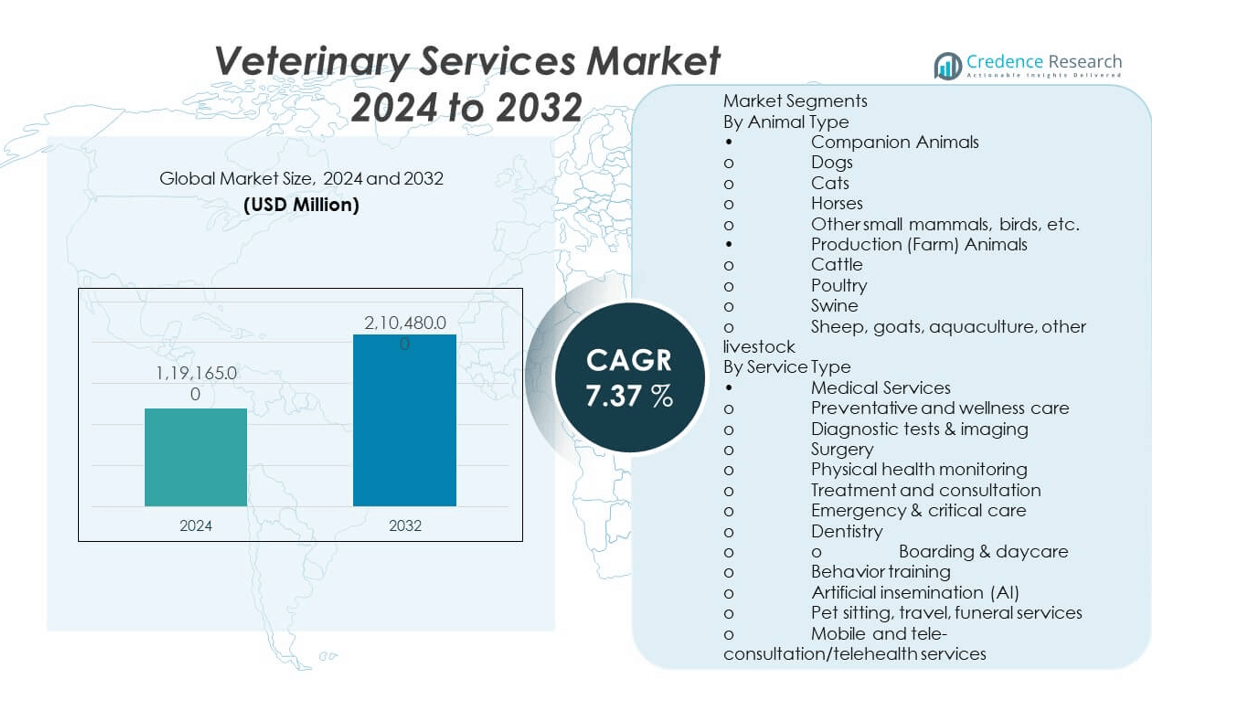
Market Insights:
- The veterinary services market was valued at USD 119,165 million in 2024 and is projected to reach USD 210,480 million by 2032, growing at a CAGR of 37% during the forecast period.
- Rising pet ownership, coupled with higher spending on preventive, specialty, and emergency care, is driving sustained demand for veterinary services globally.
- Technological advancements in diagnostics, imaging, and treatment are enabling faster, more accurate interventions and expanding the scope of specialty care.
- High service costs, limited access in rural areas, and veterinary workforce shortages remain key restraints affecting service availability and affordability.
- North America leads the market with a 37% share, supported by advanced infrastructure, high insurance penetration, and strong spending per visit.
- Europe holds around 30% share, benefiting from strict animal welfare regulations, high clinical standards, and consolidated multi-site networks.
- Asia-Pacific, with 24% share, is the fastest-growing region, driven by urbanization, rising incomes, and growing awareness of animal health in emerging economies.
Market Drivers:
Rising Pet Ownership and Increasing Demand for Preventive Care Services:
The veterinary services market is benefiting from a global rise in pet ownership, driven by changing lifestyles and the growing human-animal bond. Owners are seeking preventive services such as vaccinations, dental care, wellness examinations, and nutritional guidance to maintain long-term pet health. It is witnessing higher demand for early disease detection through advanced diagnostic tools, enabling timely treatment. Increased awareness campaigns by veterinary associations and pet care brands are also influencing service adoption. Urbanization and higher disposable incomes are allowing more households to invest in premium veterinary services. The sector is further supported by the expansion of pet insurance, making care more affordable. Rapid growth in companion animal adoption among younger generations is shaping service delivery models. Preventive care emphasis is reducing long-term treatment costs while boosting clinic visits.
- For instance, Royal Canin’s “Take Your Pet To The Vet” campaign has driven increased awareness and regular veterinary check-ups among pet owners, emphasizing the importance of preventive care and recommending a minimum of twice-yearly visits for improved pet health. This initiative includes educational outreach and a free consultation voucher for first-time clinic visits, helping to establish preventive healthcare habits in major urban centers like Mumbai.
Advancements in Veterinary Diagnostic and Treatment Technologies:
Technological progress in diagnostics, imaging, and treatment is a key driver for the veterinary services market. High-resolution imaging systems, advanced blood analysis equipment, and molecular diagnostics are enabling veterinarians to detect conditions with greater accuracy. It is experiencing rising integration of telemedicine for remote consultations, expanding accessibility to underserved areas. Minimally invasive surgeries and regenerative medicine are enhancing recovery outcomes for animals. AI-powered diagnostic platforms are improving decision-making and treatment efficiency. These innovations are not only improving patient outcomes but also increasing client trust in veterinary services. Adoption of wearable health monitoring devices for pets is providing real-time data to clinics. Technology adoption is also helping reduce operational costs while maintaining high-quality care standards.
- For instance, Zoetis has introduced the Vetscan OptiCell™, a cartridge-based, AI-powered hematology analyzer. This technology delivers advanced Complete Blood Count (CBC) analysis at the point of care, providing reference lab–quality accuracy in a compact format.
Growing Focus on Livestock Health and Food Safety Standards:
The veterinary services market is witnessing rising demand from livestock sectors due to the need for better disease management and food safety compliance. Governments are enforcing stringent regulations on livestock health monitoring to prevent disease outbreaks and ensure safe meat, milk, and egg production. It is benefiting from investments in herd health programs that focus on vaccination, parasite control, and reproductive management. Rising global consumption of animal protein is increasing the pressure on livestock producers to maintain healthy herds. International trade requirements are pushing farms to adopt certified veterinary health checks. Integrated farm health monitoring systems are gaining traction for real-time tracking of livestock well-being. Training programs for farmers in animal health practices are enhancing service demand. Veterinary services are becoming integral to sustainable livestock production.
Expansion of Pet Insurance and Increased Veterinary Spending:
Wider adoption of pet insurance is making high-quality veterinary care more accessible and affordable, driving the veterinary services market forward. Insurance coverage is encouraging owners to opt for comprehensive treatments, including surgeries and long-term therapies, without financial constraints. It is leading to increased demand for specialty services such as oncology, cardiology, and orthopedics in veterinary medicine. Rising disposable incomes in emerging economies are enabling owners to allocate more funds toward pet healthcare. Marketing initiatives by insurers are increasing awareness of coverage benefits. Clinics are forming partnerships with insurers to offer tailored plans and simplify claims processing. Higher spending on premium and specialized veterinary services is improving profitability for providers. This financial support structure is reshaping consumer behavior toward proactive animal healthcare.
Market Trends:
Integration of Telehealth and Virtual Veterinary Consultations:
The veterinary services market is adopting telehealth solutions to improve accessibility and convenience for pet owners. Remote consultations are becoming popular for follow-up visits, minor illnesses, and behavioral guidance. It is reducing the need for travel, especially in rural areas where veterinary access is limited. Digital platforms are integrating video consultations, prescription refills, and appointment scheduling in one interface. Clinics are leveraging telemedicine to expand client reach and provide 24/7 support. The trend is improving client engagement while optimizing clinic resource allocation. Data from wearable pet devices is being used to enhance virtual assessments. Telehealth adoption is expected to remain strong as technology costs decrease and regulatory frameworks evolve.
- For instance, VCA Animal Hospitals has implemented a virtual teletriage system connecting all clinics nationwide, which processes an average of 13,000–14,000 teletriage chats per month. Of these, roughly 25% of inquiries are resolved remotely, reducing unnecessary in-person visits, while about 17% are escalated to emergency care-demonstrating how digital consultations can optimize both resource allocation and client engagement across over 4.5 million unique annual visits.
Rising Demand for Specialty and Advanced Care Services:
Specialty veterinary services, including oncology, cardiology, neurology, and advanced surgical procedures, are gaining momentum in the veterinary services market. Pet owners are increasingly seeking specialists for complex conditions. It is leading to the establishment of referral centers with cutting-edge equipment and expert teams. The growth of companion animal lifespan due to better preventive care is increasing the need for age-related treatments. Training programs are equipping veterinarians with advanced clinical skills. Hospitals are expanding in-house diagnostic and surgical capabilities to retain more cases. Specialized rehabilitation and physiotherapy services are also becoming popular. This shift is elevating the overall standard of veterinary care.
Sustainable and Eco-Friendly Veterinary Practices:
Environmental responsibility is becoming an emerging trend in the veterinary services market. Clinics are adopting eco-friendly waste disposal systems and reducing the use of single-use plastics. It is influencing clinic design, with energy-efficient lighting and equipment becoming standard. Suppliers are offering biodegradable medical consumables to meet sustainability goals. Awareness among clients is pushing service providers to adopt greener practices. Veterinary schools are including sustainability modules in their curriculum. Clinics are also partnering with eco-conscious suppliers for pharmaceuticals and pet products. This trend is aligning veterinary services with broader global sustainability objectives.
Corporate Consolidation and Expansion of Veterinary Clinic Chains:
The veterinary services market is witnessing increased consolidation, with large corporations acquiring independent practices to form expansive networks. Corporate groups are leveraging economies of scale to invest in advanced technologies and training. It is enabling standardized care protocols across locations, improving service consistency. Mergers and acquisitions are also enhancing market penetration in underserved regions. Franchise models are expanding the reach of branded veterinary services. Centralized procurement is reducing costs for clinic chains. This consolidation trend is reshaping competition dynamics, with independent clinics adopting niche specialization to remain competitive.
Market Challenges Analysis:
Regulatory scrutiny, cost pressures, and workforce constraints that tighten operating levers across providers:
The veterinary services market faces heightened oversight on pricing transparency and medicine mark-ups. It must respond to inquiries from competition authorities and consumer bodies, which raises compliance costs. Practices are absorbing wage inflation for veterinarians, nurses, and support staff. It narrows margins when pay scales rise faster than fee increases. Staffing shortages create longer wait times and reduce appointment availability. Clinic owners struggle to balance capital spending with debt and cash flow needs. It limits expansion plans when interest rates elevate financing costs. Client sensitivity to price pushes clinics to justify value at every visit.
Fragmented systems, uneven access, and digital interoperability gaps that complicate care delivery and client experience:
The veterinary services market contends with disparate practice management systems and siloed medical records. It hinders continuity when referral hospitals and primary clinics cannot exchange data seamlessly. Rural areas still lack adequate specialty and emergency coverage. Mobile units help, yet coverage remains patchy on weekends and nights. Cybersecurity risks grow with telehealth and online payments. Insurance claim workflows vary by carrier and slow reimbursement. Inventory and pharmacy controls demand tighter stewardship to prevent shortages. It must align teams on protocols to reduce variability in diagnosis and care pathways.
Market Opportunities:
Preventive wellness, senior-pet care, and chronic disease programs that expand recurring revenue:
The veterinary services market can scale subscription wellness plans that bundle exams, vaccines, diagnostics, and dental care. It can design senior-care bundles for arthritis, cardiac health, and endocrinology. Home monitoring and nurse-led follow-ups raise adherence. Nutrition consults create add-on value. Rehab and physiotherapy strengthen recovery. Oncology and cardiology pathways deepen specialty lines. It lifts lifetime client value and steadies cash flows. Partnerships with insurers can boost plan uptake.
Digital expansion, data services, and integrated care networks that unlock operating leverage:
Telehealth triage smooths demand peaks. Remote Rx management streamlines refills. Interoperable records improve referrals. AI triage tools cut admin load. Centralized procurement lowers unit costs. Green clinic upgrades reduce utilities. Corporate networks can incubate training academies. It scales best practices across multi-site footprints.
Market Segmentation Analysis:
By Animal Type
In the veterinary services market, animal type segmentation includes companion animals and production (farm) animals. Companion animals-dogs, cats, horses, and other small mammals, birds, and exotic pets-account for the largest share, driven by high ownership rates and a strong focus on preventive, emergency, and specialty care. Dogs and cats dominate due to frequent wellness visits, vaccinations, and advanced treatments. Horses form a smaller but high-value niche, requiring orthopedic, reproductive, and performance-focused services. Production animals, including cattle, poultry, swine, sheep, goats, aquaculture, and other livestock, generate demand for herd health management, biosecurity programs, vaccination schedules, and compliance with food safety regulations to sustain productivity and meet market requirements.
- For instance, IDEXX Laboratories supports companion animal clinics with a global network of more than 160 board-certified telemedicine specialists. These experts deliver high-quality, actionable radiology and specialty reports in as little as 60 minutes, allowing rapid, expert diagnostics for both dogs and cats, while also providing veterinary solutions for horses and production animals through herd health management and regulatory compliance testing.
By Service Type
The veterinary services market is segmented into medical and non-medical services. Medical services include preventive and wellness care, diagnostic testing and imaging, surgeries, physical health monitoring, treatment and consultation, emergency and critical care, dentistry, pharmacy and prescription management, rehabilitation, and specialty disciplines such as cardiology, oncology, and ophthalmology. These services form the core of clinical operations and benefit from technology integration and growing specialization. Non-medical services-grooming, boarding, daycare, behavior training, artificial insemination, pet sitting, travel, funeral services, and mobile or telehealth consultations-supplement medical care and foster long-term client relationships. It gains strategic value when providers bundle medical and non-medical offerings, creating comprehensive solutions that improve animal well-being and customer retention.
- For instance, Hill’s Pet Nutrition-in partnership with AGL-launched Vetrax, a wearable pet monitoring system providing veterinarians with 24/7 behavioral and health data (including sleep quality, walking, running, scratching, and head shaking). This objective, quantifiable data feeds into treatment decisions and supports trend tracking, integrating with Hill’s SmartCare platform to improve compliance and long-term outcomes for both medical and non-medical veterinary service bundles.
Segmentation:
By Animal Type
- Companion Animals
- Dogs
- Cats
- Horses
- Other small mammals, birds, etc.
- Production (Farm) Animals
- Cattle
- Poultry
- Swine
- Sheep, goats, aquaculture, other livestock
By Service Type
- Medical Services
- Preventative and wellness care
- Diagnostic tests & imaging (including in-vitro/in-vivo diagnosis)
- Surgery
- Physical health monitoring
- Treatment and consultation
- Emergency & critical care
- Dentistry
- Pharmacy & prescription management
- Rehabilitation & physiotherapy
- Specialty (e.g., cardiology, oncology, ophthalmology)
- Non-Medical Services
- Grooming
- Boarding & daycare
- Behavior training
- Artificial insemination (AI)
- Pet sitting, travel, funeral services
- Mobile and tele-consultation/telehealth services
- North America
- U.S.
- Canada
- Mexico
- Europe
- Germany
- France
- U.K.
- Italy
- Spain
- Rest of Europe
- Asia Pacific
- China
- Japan
- India
- South Korea
- South-east Asia
- Rest of Asia Pacific
- Latin America
- Brazil
- Argentina
- Rest of Latin America
- Middle East & Africa
- GCC Countries
- South Africa
- Rest of the Middle East and Africa
Regional Analysis:
North America: Market Leadership Driven by High Spending and Advanced Infrastructure (37% share)
North America holds the largest share of the veterinary services market, accounting for around 37% of global revenue. The region benefits from high pet ownership rates, well-established veterinary networks, and strong spending on animal health. Pet insurance penetration supports access to advanced diagnostics, specialty surgeries, and emergency care. Corporate consolidators operate multi-site networks with standardized protocols, enhancing quality and consistency. It continues to see growth in telehealth adoption, e-pharmacy integration, and preventive wellness programs. Expansion into secondary cities is supported by suburban pet ownership growth and increasing demand for specialized services.
Europe: Strong Welfare Regulations and Consolidation Driving Growth (30% share)
Europe commands approximately 30% of the veterinary services market, supported by stringent animal welfare regulations and high clinical standards. Widespread pet insurance adoption in several countries enables comprehensive care and advanced treatment options. Large corporate groups are expanding through acquisitions and cross-border networks, allowing economies of scale and standardized care delivery. It benefits from robust specialty care infrastructure, particularly in oncology, orthopedics, and cardiology. Urban centers show high demand for premium veterinary services, while rural areas rely on mobile units and regional referral centers. Regulatory oversight on pricing and competition influences consolidation strategies and service models.
Asia-Pacific, Latin America, Middle East & Africa: Rapid Growth from Expanding Access (APAC 24%, LATAM 5%, MEA 4%)
Asia-Pacific holds around 24% of the veterinary services market, with rapid growth driven by urbanization, rising incomes, and increasing awareness of animal health. Modern clinics, grooming centers, and specialty hospitals are expanding in metropolitan areas. Latin America, with a 5% share, is seeing growth through franchise clinics, mobile services, and improved financing options for pet care. The Middle East & Africa region, representing 4% share, is developing referral hospitals and veterinary training programs to build capacity. It benefits from digital booking platforms, telehealth services, and growing partnerships with insurers. These regions remain key opportunities for global and regional operators aiming to expand service coverage and meet rising demand.
Key Player Analysis:
- Mars Inc. (including Banfield Pet Hospital, BluePearl, VCA, AniCura)
- National Veterinary Associates (NVA)
- IVC Evidensia
- CVS Group PLC
- Greencross Vets
- Fetch! Pet Care
- PetSmart LLC
- Petco
- VetPartners
- Pets at Home Group PLC
- Airpets International
- Abaxis
- IDEXX Laboratories, Inc.
Competitive Analysis:
The Veterinary services market features a mix of corporate consolidators, specialty hospitals, and independent clinics competing on access, capability, and client experience. Large groups such as Mars Veterinary Health (Banfield, VCA, BluePearl), IVC Evidensia, CVS Group, National Veterinary Associates, VetPartners, and Southern Veterinary Partners leverage scale for procurement, training, and technology. It pursues hub-and-spoke models that route complex cases to specialty centers while maintaining community practices for wellness and routine care. Independents defend share with personalized service, niche specialties, and community ties. Digital players extend reach through teletriage, e-pharmacy, and home-visit models. Competitive focus centers on clinician recruitment, insurer partnerships, transparent pricing, and consistent clinical pathways
Recent Developments:
- On 9 Jan 2025, Mars Petcare significantly expanded its European production capability by launching two new production lines at its French facility dedicated to Royal Canin wet food. This €120million investment increases the site's output capacity by 44,000 tons per year, nearly doubling prior potential and enabling the facility to produce up to 600,000 boxes and 1million pouches daily. This move is part of Mars’ broader global growth and innovation strategy for veterinary nutrition.
- In March 2025, IVC Evidensia announced the opening of two state-of-the-art veterinary training centers in the UK. These centers will deliver 20,000 hours of continuing professional development (CPD) for IVC Evidensia colleagues in 2025, featuring wet labs and classroom facilities for hands-on and theoretical training to enhance veterinary clinical skills. The centers will open to the broader veterinary community by late 2025.
Market Concentration & Characteristics:
The Veterinary services market shows rising concentration as multi-site corporates expand through acquisitions and de-novo builds. It blends hub-and-spoke referral models with standardized protocols, centralized procurement, and shared services to improve efficiency. Independent clinics remain numerous yet face wage inflation, equipment costs, and recruiting challenges. It displays steady demand anchored in preventive care, with cyclical resilience versus discretionary retail. Specialty and emergency hospitals capture higher acuity and margin. Digital access, telehealth, and e-pharmacy integrate into workflows. Regulatory focus on pricing and competition shapes M&A pacing and transparency standards.
Report Coverage:
The research report offers an in-depth analysis based on animal type and service type. It details leading market players, providing an overview of their business, product offerings, investments, revenue streams, and key applications. Additionally, the report includes insights into the competitive environment, SWOT analysis, current market trends, as well as the primary drivers and constraints. Furthermore, it discusses various factors that have driven market expansion in recent years. The report also explores market dynamics, regulatory scenarios, and technological advancements that are shaping the industry. It assesses the impact of external factors and global economic changes on market growth. Lastly, it provides strategic recommendations for new entrants and established companies to navigate the complexities of the market.
Future Outlook:
- Preventive wellness plans deepen recurring revenue.
- Specialty and emergency hubs expand regional coverage.
- Telehealth triage becomes an embedded front door.
- AI decision support accelerates diagnostics and case routing.
- Cross-border consolidators standardize protocols and training.
- Staffing pipelines improve via academies and flexible roles.
- Transparency tools and price menus enhance trust.
- Green clinic retrofits lower utilities and waste.
- Insurer partnerships broaden access to advanced care.
- Data interoperability lifts referral speed and outcomes.

Request a Free Sample
Fill in your details and we'll send you a free sample report.
- Sample data tables & charts
- Research methodology
Market Dynamics
Rising Pet Ownership and Preventive Care Demand
Increasing global pet ownership, especially among younger generations and urban households, is driving demand for preventive veterinary services such as vaccinations, wellness exams, and dental care. This trend is supported by greater awareness of pet health and the expansion of pet insurance, making regular veterinary visits more accessible.
Advancements in Veterinary Diagnostics and Treatment
Technological innovations such as high-resolution imaging, molecular diagnostics, telemedicine, and AI-powered platforms are enabling more accurate, timely, and specialized care. These advancements expand the scope of services clinics can offer and improve patient outcomes, attracting more clients to veterinary practices.
Growth in Livestock Health and Food Safety Standards
Stricter government regulations and rising global demand for animal protein are pushing livestock producers to invest in veterinary services for disease management, vaccination, and compliance with food safety standards. This is increasing the need for professional veterinary oversight in production animal sectors.
Expansion of Pet Insurance and Veterinary Spending
The wider adoption of pet insurance is making advanced and specialty veterinary care more affordable, encouraging owners to pursue comprehensive treatments. Rising disposable incomes, especially in emerging markets, are further boosting spending on both routine and specialized veterinary services.
Corporate Consolidation and Clinic Network Expansion
Large veterinary groups are acquiring independent practices and building multi-site networks, enabling standardized care, investment in advanced technologies, and broader regional coverage. This consolidation is improving service consistency and expanding access to specialty and emergency care.
Need a Custom Version of This Report?
Tailor the scope, geography, or segments to your exact requirements.
- Custom geography or segment scope
- Direct access to our analyst team
Frequently Asked Questions
What is the current market size for Veterinary services market, and what is its projected size in 2032?
Which Veterinary services market segment held the largest share in 2024?
What are the primary factors fueling the growth of the Veterinary services market?
Who are the leading companies in the Veterinary services market?
Table of Content
Chapter 1 Market Segmentation
- 1.1 Segmentation Framework
- 1.1.1 Product and Service Classification
- 1.1.2 Application and End-Use Classification
- 1.1.3 Technology and Solution Classification
- 1.1.4 Customer and Distribution Channel Classification
- 1.1.5 Geographic Segmentation
- 1.1.6 Market Segment Definitions and Boundaries
- 1.2 By Animal Type
- 1.2.1 Companion Animals (Dogs, Cats, Horses, Other Small Mammals/Birds)
- 1.2.2 Production (Farm) Animals (Cattle, Poultry, Swine, Sheep/Goats/Aquaculture/Other Livestock)
- 1.3 By Service Type
- 1.3.1 Medical Services (Preventive & Wellness Care, Diagnostics & Imaging, Surgery, Emergency & Critical Care, Dentistry, Pharmacy, Rehabilitation, Specialty Disciplines)
- 1.3.2 Non-Medical Services (Grooming, Boarding & Daycare, Behavior Training, Artificial Insemination, Pet Sitting/Travel/Funeral, Mobile & Telehealth Services)
Chapter 2 Introduction
- 2.1 Report Objectives and Scope
- 2.2 Product Definition and Industry Terminology
- 2.3 Market Inclusions and Exclusions
- 2.4 Research Process
- 2.4.1 Primary Research and Expert Interviews
- 2.4.2 Secondary Research and Source Review
- 2.4.3 Top-Down and Bottom-Up Estimation
- 2.4.4 Data Triangulation and Verification
- 2.5 Market Size Measurement Basis
- 2.5.1 2024: USD 119,165 million → 2032: USD 210,480 million
- 2.6 Historical and Forecast Reference Periods
- 2.6.1 Base Year: 2024
- 2.6.2 Forecast Period: 2024-2032
- 2.7 Research Assumptions and Limitations
Chapter 3 Executive Summary
- 3.1 Market Snapshot and Key Findings
- 3.2 Base-Year Market Size, 2024
- 3.3 Forecast Market Size, 2032
- 3.4 Revenue and Volume Growth Outlook
- 3.5 Key Demand and Supply Indicators
- 3.6 Leading Market Segments
- 3.7 Fastest-Growing Market Opportunities
- 3.8 Regional Performance Highlights
- 3.9 Technology and Industry Transformation
- 3.10 Competitive Landscape Summary
- 3.11 Analyst View and Strategic Implications
Chapter 4 Global Veterinary Services Market Trends and Developments
- 4.1 Historical Industry Development
- 4.2 Recent Market Trends and Developments
- 4.3 Demand and Customer Behavior Trends
- 4.4 Technology and Product Innovation
- 4.5 Artificial Intelligence, Automation and Digitalization
- 4.6 Local Manufacturing and Supply Chain Realignment
- 4.7 Industry Partnerships, Mergers and Acquisitions
- 4.8 Sustainability and Circular Economy Developments
- 4.9 Government and Private Sector Investment Trends
- 4.10 Emerging Business Models and Commercialization
- 4.11 Industry Developments and Announcements
Chapter 5 Global Veterinary Services Market Supply and Demand Analysis
- 5.1 Demand Trend and Consumption Analysis
- 5.2 Demand Forecast, 2024-2032
- 5.3 Supply Chain Structure and Procurement Trends
- 5.4 Supply-Demand Gap and Bottlenecks
- 5.5 Import Dependence and Sourcing Structure
- 5.6 Regional Supply and Demand Concentration
Chapter 6 Global Veterinary Services Market Pricing Analysis
- 6.1 Pricing Structure and Measurement
- 6.2 Historical Pricing Trends
- 6.3 Pricing Outlook, 2024-2032
- 6.4 Pricing by Product and Market Segment
- 6.5 Geographic Pricing Differences
- 6.6 Key Input, Energy, Labor and Logistics Costs
- 6.7 Contract Pricing and Purchasing Models
- 6.8 Pricing Sensitivity and Competitive Positioning
- 6.9 Price, Margin and Profitability Implications
Chapter 7 Global Veterinary Services Market Dynamics
- 7.1 Market Growth Drivers
- 7.1.1 Demand-Side Drivers
- 7.1.2 Technology and Innovation Drivers
- 7.1.3 Infrastructure and Investment Drivers
- 7.1.4 Regulatory and Policy Drivers
- 7.2 Market Restraints
- 7.2.1 Cost and Affordability Constraints
- 7.2.2 Technology and Adoption Barriers
- 7.2.3 Supply Chain and Operational Constraints
- 7.3 Market Challenges
- 7.3.1 Competitive Pressure and Margin Erosion
- 7.3.2 Skills, Infrastructure and Implementation Gaps
- 7.4 Emerging Market Opportunities
- 7.5 Market Dynamics Impact and Time-Horizon Assessment
Chapter 8 Global Veterinary Services Value Chain Analysis
- 8.1 Industry Value Chain Overview
- 8.2 Upstream Suppliers and Critical Inputs
- 8.3 Technology and Component Providers
- 8.4 Manufacturing or Service Delivery
- 8.5 Distribution, Channel Partners and Integrators
- 8.6 Downstream Applications and End Users
- 8.7 Value Addition and Profit Pools
- 8.8 Vertical Integration and Outsourcing
- 8.9 Supplier Concentration and Risk
- 8.10 Supply Chain Localization and Resilience
Chapter 9 Global Veterinary Services Market Regulations and Policies
- 9.1 Relevant Laws, Standards and Compliance Frameworks
- 9.2 Product, Service, Safety and Quality Requirements
- 9.3 Government Policies, Incentives and Subsidies
- 9.4 Imports, Exports and Trade Barriers
- 9.5 Public Procurement and Local Content Requirements
- 9.6 Data Protection, AI and Cybersecurity Compliance
- 9.7 Upcoming Policy Changes and Market Implications
Chapter 10 Global Veterinary Services Market Hotspots and Opportunities
- 10.1 Market Opportunity Mapping and Growth Hotspots
- 10.2 High-Growth Applications and Customer Groups
- 10.3 Underserved Markets and White-Space Opportunities
- 10.4 Emerging Technology and Product Opportunities
- 10.5 New Capacity and Investment Hotspots
- 10.6 Market Entry and Expansion Opportunities
- 10.7 Distribution and Partnership Opportunities
- 10.8 Near-Term and Long-Term Commercial Potential
- 10.9 Opportunity Attractiveness and Execution Risks
Chapter 11 Global Veterinary Services Market Outlook, 2024-2032
- 11.1 Market Size and Analysis
- 11.1.1 Revenue (Market Measurement: 2024: USD 119,165 million → 2032: USD 210,480 million)
- 11.1.2 Historical Market Size
- 11.1.3 Base-Year Market Size, 2024
- 11.2 Market Forecast, 2024-2032
- 11.2.1 Revenue Forecast to 2032
- 11.2.2 CAGR and Year-on-Year Growth
- 11.2.3 Incremental Revenue Opportunity
- 11.3 Forecast Assumptions and Scenario Analysis
- 11.3.1 Base-Case Forecast
- 11.3.2 Optimistic and Conservative Scenarios
- 11.3.3 Technology, Pricing and Policy Sensitivities
- 11.4 Market Attractiveness and Growth Outlook
Chapter 12 Global Veterinary Services Market Segmentation and Outlook
- 12.1 Segmentation Summary and Market Shares, 2024
- 12.2 Largest and Fastest-Growing Segments
- 12.3 By Animal Type - Market Size and Forecast, 2024-2032
- 12.3.1 Segment Definition and Scope
- 12.3.2 Historical Market Size
- 12.3.3 Revenue Forecast, 2024-2032
- 12.3.4 Base-Year Market Share, 2024
- 12.3.5 Segment CAGR and Growth Drivers
- 12.3.6 Subsegment Market Size and Forecast
- 12.3.6.1 Companion Animals (Dogs, Cats, Horses, Other Small Mammals/Birds)
- 12.3.6.2 Production (Farm) Animals (Cattle, Poultry, Swine, Sheep/Goats/Aquaculture/Other Livestock)
- 12.3.7 Subsegment Pricing and Adoption Trends
- 12.3.8 Leading Suppliers and Competition
- 12.3.9 Regional Demand and Opportunities
- 12.4 By Service Type - Market Size and Forecast, 2024-2032
- 12.4.1 Segment Definition and Scope
- 12.4.2 Historical Market Size
- 12.4.3 Revenue Forecast, 2024-2032
- 12.4.4 Base-Year Market Share, 2024
- 12.4.5 Segment CAGR and Growth Drivers
- 12.4.6 Subsegment Market Size and Forecast
- 12.4.6.1 Medical Services (Preventive & Wellness Care, Diagnostics & Imaging, Surgery, Emergency & Critical Care, Dentistry, Pharmacy, Rehabilitation, Specialty Disciplines)
- 12.4.6.2 Non-Medical Services (Grooming, Boarding & Daycare, Behavior Training, Artificial Insemination, Pet Sitting/Travel/Funeral, Mobile & Telehealth Services)
- 12.4.7 Subsegment Pricing and Adoption Trends
- 12.4.8 Leading Suppliers and Competition
- 12.4.9 Regional Demand and Opportunities
- 12.5 Segment Growth Comparison
- 12.6 Segment Attractiveness and Priority Matrix
Chapter 13 Global Veterinary Services Geographic Market Outlook, 2024-2032
- 13.1 Regional Market Size and Share, 2024
- 13.2 Regional Market Forecast, 2024-2032
- 13.3 Regional Pricing, Production and Demand Differences
- 13.4 North America
- 13.4.1 United States
- 13.4.2 Canada
- 13.4.3 Mexico
- 13.5 Europe
- 13.5.1 Germany
- 13.5.2 France
- 13.5.3 Italy
- 13.5.4 United Kingdom
- 13.5.5 Spain
- 13.5.6 Poland
- 13.5.7 Russia
- 13.5.8 Netherlands
- 13.5.9 Belgium
- 13.5.10 Sweden
- 13.5.11 Denmark
- 13.5.12 Norway
- 13.5.13 Rest of Europe
- 13.6 Asia Pacific
- 13.6.1 China
- 13.6.2 India
- 13.6.3 Japan
- 13.6.4 South Korea
- 13.6.5 Thailand
- 13.6.6 Indonesia
- 13.6.7 Vietnam
- 13.6.8 Malaysia
- 13.6.9 Australia
- 13.6.10 Rest of Asia Pacific
- 13.7 Latin America
- 13.7.1 Brazil
- 13.7.2 Argentina
- 13.7.3 Colombia
- 13.7.4 Chile
- 13.7.5 Rest of Latin America
- 13.8 Middle East
- 13.8.1 Saudi Arabia
- 13.8.2 United Arab Emirates
- 13.8.3 Turkey
- 13.8.4 Israel
- 13.8.5 Iran
- 13.8.6 Rest of the Middle East
- 13.9 Africa
- 13.9.1 South Africa
- 13.9.2 Egypt
- 13.9.3 Nigeria
- 13.9.4 Morocco
- 13.9.5 Rest of Africa
- 13.10 Regional Investment, Policy and Supply Chain Differences
- 13.11 Regional Competitive Landscape
- 13.12 Geographic Growth Hotspots
Chapter 14 Global Veterinary Services Technology, Innovation and Sustainability Outlook
- 14.1 Technology Landscape and Maturity
- 14.2 Product, Process and Service Innovation
- 14.3 AI, Automation and Digital Tools in the Industry
- 14.4 Technology Adoption and Performance Benchmarking
- 14.5 Innovation Pipeline and R&D Investment
- 14.6 Energy Efficiency and Resource Management
- 14.7 Sustainability, Recycling and Circularity
- 14.8 Technology Roadmap, 2024-2032
- 14.9 Risks of Obsolescence and Technology Substitution
Chapter 15 Global Veterinary Services Market Key Strategic Imperatives
- 15.1 Growth and Market Entry Priorities
- 15.2 High-Return Products and Segments
- 15.3 Pricing, Profitability and Cost Optimization
- 15.4 Technology Investment and Product Differentiation
- 15.5 Supply Chain Localization and Resilience
- 15.6 Distribution and Customer Acquisition
- 15.7 Partnership, Acquisition and Capacity Strategy
- 15.8 Regional Expansion Priorities
- 15.9 Short-, Medium- and Long-Term Actions
Chapter 16 Competition Outlook
- 16.1 Industry Competition Characteristics
- 16.2 Market Structure and Concentration
- 16.3 Market Share and Competitive Positioning, 2024
- 16.4 Company-Wise Revenue and Product Benchmarking
- 16.5 Production and Service Capacity Benchmarking
- 16.6 Technology, Pricing and Differentiation
- 16.7 Regional Footprint and Distribution Strength
- 16.8 Mergers, Acquisitions and Strategic Alliances
- 16.9 New Entrants and Competitive Threats
- 16.10 Porter's Five Forces and Industry Attractiveness
- 16.11 Competitive Outlook, 2024-2032
Chapter 17 Company Profiles
- 17.1 Company Coverage and Selection Criteria
- 17.2 Mars Inc. (Banfield Pet Hospital, BluePearl, VCA, AniCura)
- 17.2.1 Business Description
- 17.2.2 Company Ownership and Geographic Presence
- 17.2.3 Product and Service Portfolio
- 17.2.4 Manufacturing and Operating Footprint
- 17.2.5 Financial Performance and Investment
- 17.2.6 Market Share and Competitive Position
- 17.2.7 Technology and Innovation Capabilities
- 17.2.8 Strategic Alliances or Partnerships
- 17.2.9 Recent Developments
- 17.2.10 Growth Strategy and Outlook
- 17.3 National Veterinary Associates (NVA)
- 17.4 IVC Evidensia
- 17.5 CVS Group PLC
- 17.6 Greencross Vets
- 17.7 VetPartners
- 17.8 IDEXX Laboratories, Inc.
- 17.9 Pets at Home Group PLC
- 17.10 PetSmart LLC
- 17.11 Abaxis
- 17.12 Other Relevant Market Participants
Note: Every listed company is profiled on the structure shown under the first company. The company list is preliminary and may change based on research findings, market developments, data availability and client requirements.
Chapter 18 Disclaimer
- 18.1 Research and Forecast Disclaimer
- 18.2 Data Source and Estimation Limitations
Note: The depth of individual sections depends on data availability for this market. Volume, capacity, trade and other unit-based metrics are included where applicable.

