
Market Overview
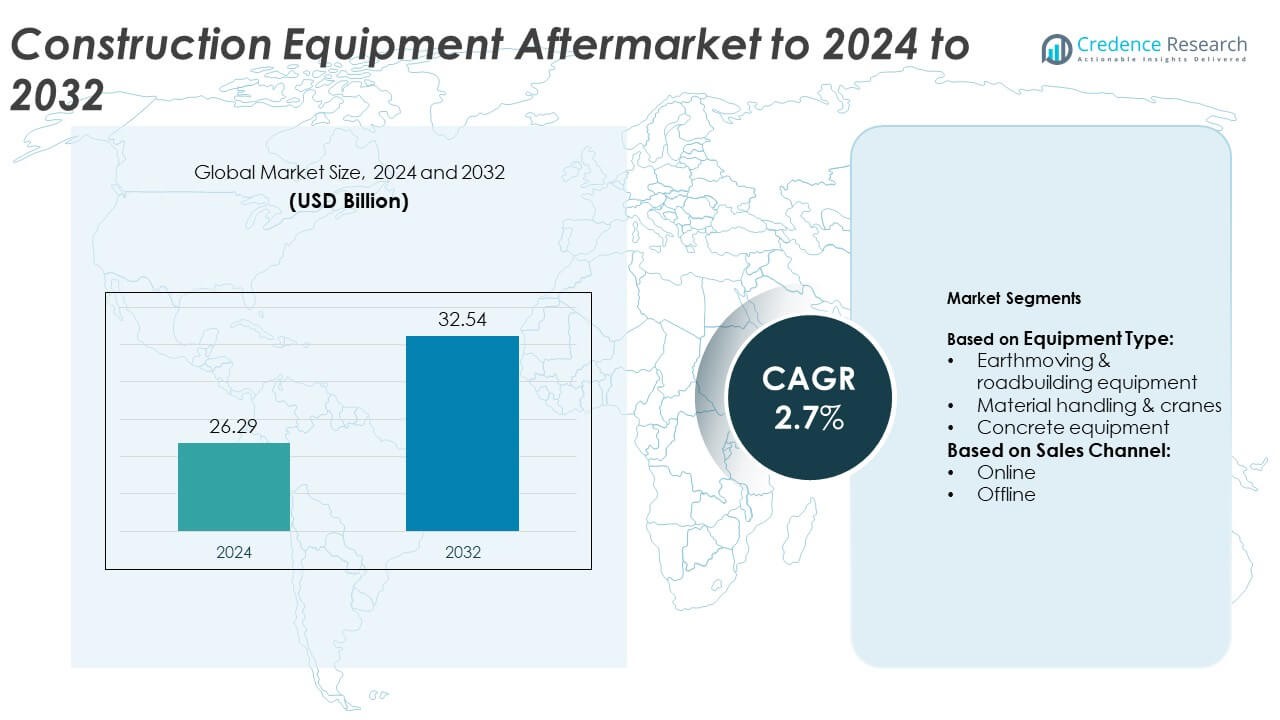
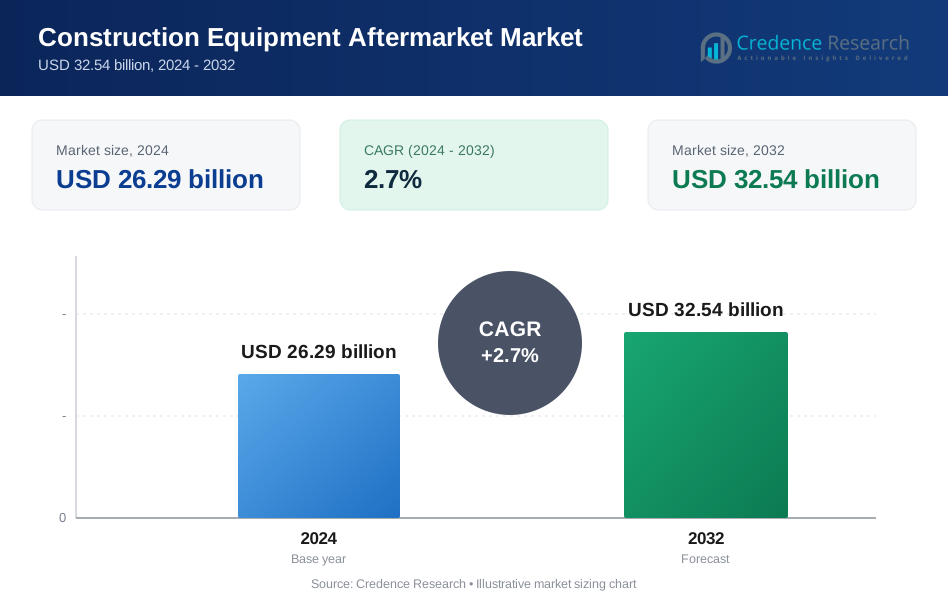
Construction Equipment Aftermarket size was valued at USD 26.29 Billion in 2024 and is anticipated to reach USD 32.54 Billion by 2032, at a CAGR of 2.7% during the forecast period.
| REPORT ATTRIBUTE | DETAILS |
|---|---|
| Historical Period | 2020-2023 |
| Base Year | 2024 |
| Forecast Period | 2025-2032 |
| Construction Equipment Aftermarket Market Size 2024 | USD 26.29 Billion |
| Construction Equipment Aftermarket Market , CAGR | 2.7% |
| Construction Equipment Aftermarket Market Size 2032 | USD 32.54 Billion |
The Construction Equipment Aftermarket Market is dominated by global leaders such as Caterpillar, Komatsu Ltd., Liebherr Group, Volvo Construction Equipment, SANY Group, Terex Corporation, Tadano Ltd., XCMG Group, The Manitowoc Company Inc., and Zoomlion Heavy Industry Science and Technology Co., Ltd. These companies focus on expanding service networks, digital aftermarket platforms, and predictive maintenance technologies to enhance equipment lifecycle performance. North America led the market with a 34% share in 2024, supported by aging machinery fleets and advanced telematics adoption. Europe and Asia-Pacific followed closely, driven by large-scale infrastructure projects, strong OEM presence, and increasing investments in component remanufacturing and sustainable maintenance practices.
Market Insights
- The Construction Equipment Aftermarket market was valued at USD 26.29 billion in 2024 and is expected to reach USD 32.54 billion by 2032, growing at a CAGR of 2.7%.
- Increasing equipment utilization and aging fleets are driving aftermarket demand, supported by infrastructure expansion and ongoing construction projects worldwide.
- Key trends include the adoption of predictive maintenance, telematics-based diagnostics, and growth in digital parts distribution platforms.
- The market is competitive, with major players focusing on service expansion, remanufacturing programs, and long-term maintenance contracts to strengthen brand loyalty.
- North America led the market with a 34% share, followed by Europe at 27% and Asia-Pacific at 28%, while the earthmoving and roadbuilding segment dominated the equipment type category in 2024.
Market Segmentation Analysis:
By Equipment Type
The earthmoving and roadbuilding equipment segment dominated the Construction Equipment Aftermarket in 2024, accounting for over 45% of the total share. This dominance is due to the high replacement demand for components in excavators, loaders, and graders used in mining and infrastructure projects. Continuous wear of hydraulic systems and undercarriage parts drives strong aftermarket sales, Caterpillar supplied replacement parts globally for its earthmoving line, supporting consistent service revenue through dealer networks and digital maintenance platforms.
- For instance, SENNEBOGEN supports over 180 sales partners and 300+ service stations worldwide, sustaining fast parts replacement for earthmoving fleets.
By Sales Channel
The offline sales channel held the largest market share in 2024, representing nearly 70% of total aftermarket revenue. This segment benefits from customers’ preference for authorized service centers and OEM-certified dealers for component reliability and warranty support. Heavy equipment users rely on in-person diagnostics and immediate part availability, Komatsu’s global dealer network operates authorized service outlets, ensuring rapid part replacement and technical assistance across key markets such as North America and Asia-Pacific.
- For instance, Manitou distributes its equipment and services through a certified network of 800 independent dealers across more than 140 countries.
Key Growth Drivers
Rising Equipment Utilization and Aging Fleet
The expanding global construction fleet and extended equipment lifecycles are driving aftermarket demand. Older machinery requires frequent component replacements, particularly hydraulic parts, filters, and drivetrain systems. Contractors prefer refurbishing equipment over new purchases to control operational costs, Volvo Construction Equipment in 2024 came from maintenance of machines over five years old, reflecting strong dependence on aftermarket solutions for aging fleets.
- For instance, Epiroc has a strong demand for its aftermarket support and services, with Epiroc's annual report for 2024 showing that the circular service offering grew strongly by 19%.In Q4 2024, Epiroc reported record-high revenues of 17,251 million SEK, with aftermarket support contributing significantly to the company's overall performance in 2024.
Infrastructure Development and Urbanization Projects
Massive public infrastructure and housing initiatives are boosting demand for construction equipment services. Governments in Asia-Pacific and North America are investing in roadbuilding, metro systems, and renewable projects, increasing the wear and tear on heavy machinery, Komatsu’s service division recorded growth in replacement part orders from infrastructure projects in India and the U.S., highlighting how ongoing urbanization directly supports aftermarket growth.
- For instance, SANY’s Africa business grew 44% in 2024, reflecting strong equipment use on regional infrastructure programs.
Adoption of Predictive Maintenance Technologies
Integration of telematics and IoT-based systems enhances equipment monitoring and predictive part replacement. Fleet owners use real-time data to identify wear patterns and schedule timely maintenance, improving uptime and reducing breakdowns, John Deere’s JDLink platform tracked connected machines in 2024, enabling automated alerts for component replacement and driving a steady rise in aftermarket service subscriptions.
Key Trends & Opportunities
Digitalization and E-Commerce Expansion
The rise of digital platforms is transforming aftermarket parts distribution. OEMs and independent suppliers are adopting online portals for easier ordering and faster delivery. E-commerce channels improve customer accessibility and enable direct-to-end-user sales. Caterpillar’s Parts.Cat.Com platform handled online orders in 2024, reducing procurement time and expanding its global aftermarket footprint through digital logistics.
- For instance, XCMG's Xrea platform manages over 700,000 connected 5G networking devices, supporting remote diagnostics and parts planning.
Sustainability and Component Re-Manufacturing
Growing environmental focus is driving adoption of remanufactured and recyclable components. Manufacturers are investing in circular economy models to reduce waste and lower repair costs. CNH Industrial’s Reman program recovered used components in 2024, cutting raw material consumption while offering cost-effective alternatives to new parts, thus creating new aftermarket opportunities in eco-efficient operations.
- For instance, Liebherr Reman cuts raw material and energy use by up to 75%, reducing lifecycle impacts for replacement components.
Key Challenges
Price Volatility of Raw Materials
Fluctuations in steel, aluminum, and rubber prices raise the cost of spare parts and repair components. OEMs struggle to maintain stable pricing amid supply chain disruptions and geopolitical tensions. Hitachi Construction Machinery r increase in production costs in 2024 due to steel price hikes, affecting aftermarket profitability and forcing customers to delay non-critical maintenance activities.
Competition from Unorganized Local Suppliers
The aftermarket faces growing pressure from low-cost regional suppliers offering non-OEM parts. These suppliers attract price-sensitive buyers, particularly in developing markets, undermining OEM revenue streams, local manufacturers in Southeast Asia captured the independent parts supply market in 2024, challenging major brands like Caterpillar and Komatsu to enhance warranty-based loyalty programs and value-added services.
Regional Analysis
North America
North America held the largest share of 34% in the Construction Equipment Aftermarket in 2024. The region benefits from a well-established infrastructure sector, aging machinery fleet, and high adoption of telematics-based maintenance systems. Strong presence of OEMs such as Caterpillar, John Deere, and CNH Industrial supports steady replacement part sales. Frequent road maintenance and commercial construction projects in the U.S. and Canada sustain aftermarket service demand. Additionally, digital parts distribution networks and authorized service centers enhance accessibility, driving consistent growth in preventive maintenance and component refurbishment services across the region.
Europe
Europe accounted for 27% of the Construction Equipment Aftermarket in 2024. The market growth is supported by advanced equipment technologies, strict emission standards, and rising demand for sustainable component remanufacturing. The presence of major OEMs like Volvo Construction Equipment, Liebherr, and Wirtgen Group strengthens regional service networks. Increasing investments in urban infrastructure modernization and green building projects promote equipment utilization, boosting part replacement cycles. Additionally, the European Union’s emphasis on circular economy practices encourages the reuse of engine components and hydraulic systems, helping OEMs maintain strong aftermarket revenues.
Asia-Pacific
Asia-Pacific captured a 28% share of the Construction Equipment Aftermarket in 2024, driven by rapid industrialization and large-scale infrastructure projects. Countries such as China, India, and Japan are investing heavily in transport, urban development, and energy sectors, leading to continuous equipment operation and higher maintenance demand. Local manufacturing bases and expanding dealer networks by Komatsu, Hitachi, and SANY support strong aftermarket accessibility. The growing use of connected service platforms enhances predictive maintenance efficiency, while competitive pricing strategies from regional suppliers further boost market expansion across construction-intensive economies.
Latin America
Latin America held an 8% share of the Construction Equipment Aftermarket in 2024. The region benefits from ongoing mining and road construction activities across Brazil, Chile, and Mexico. Demand for replacement components is increasing due to frequent wear in earthmoving and material handling machinery. However, supply chain inefficiencies and import dependency affect part availability. OEMs are investing in local service hubs and training centers to improve equipment uptime. Rising adoption of refurbished parts and fleet maintenance contracts contributes to steady aftermarket development in mid-sized construction firms.
Middle East & Africa
The Middle East & Africa region accounted for 6% of the Construction Equipment Aftermarket in 2024. Expanding construction projects, particularly in the Gulf Cooperation Council countries, drive consistent part replacement demand. Large infrastructure investments in Saudi Arabia’s Vision 2030 and the UAE’s transport initiatives sustain high fleet utilization. Meanwhile, African economies like South Africa and Nigeria are witnessing growing demand for road and mining equipment maintenance. OEMs are strengthening regional partnerships to improve service reach and ensure reliable aftermarket support, addressing logistical and technical challenges in remote project locations.
Market Segmentations:
By Equipment Type:
- Earthmoving & roadbuilding equipment
- Material handling & cranes
- Concrete equipment
By Sales Channel:
- Online
- Offline
By Geography:
- North America
- U.S.
- Canada
- Mexico
- Europe
- Germany
- France
- U.K.
- Italy
- Spain
- Rest of Europe
- Asia Pacific
- China
- Japan
- India
- South Korea
- South-east Asia
- Rest of Asia Pacific
- Latin America
- Brazil
- Argentina
- Rest of Latin America
- Middle East & Africa
- GCC Countries
- South Africa
- Rest of the Middle East and Africa
Competitive Landscape
The Construction Equipment Aftermarket features a competitive landscape led by Caterpillar, Inc., Liebherr Group, Komatsu Ltd., Terex Corporation, SANY Group, Volvo Construction Equipment, Tadano Ltd., XCMG Group, The Manitowoc Company Inc., and Zoomlion Heavy Industry Science and Technology Co., Ltd. Competition is driven by extensive service networks, advanced telematics integration, and growing focus on predictive maintenance solutions. Leading OEMs are investing in digital platforms and connected service technologies to enhance equipment lifecycle management and improve customer retention. The market also sees increasing adoption of remanufactured and eco-friendly components as sustainability becomes a key differentiator. Regional suppliers are expanding their aftermarket presence through competitive pricing and localized service hubs. Companies are focusing on long-term maintenance contracts, operator training programs, and remote diagnostics to strengthen aftermarket loyalty. Strategic collaborations and R&D investments in smart maintenance tools continue to shape the future competitiveness of the global construction equipment aftermarket.
Key Player Analysis
- Caterpillar, Inc.
- Liebherr Group
- Komatsu Ltd.
- Terex Corporation
- SANY Group
- Volvo Construction Equipment
- Tadano Ltd.
- XCMG Group
- The Manitowoc Company Inc.
- Zoomlion Heavy Industry Science and Technology Co., Ltd.
Recent Developments
- In 2025, Volvo Construction Equipment (Volvo CE) Investing approximately 2,500 MSEK (about $261 million) to expand global crawler excavator production across key sites, including Changwon (South Korea), Shippensburg (US), and Sweden, to meet growing customer demands and mitigate supply chain risks
- In 2025, SANY Group Inaugurated a state-of-the-art factory in Pune, India, to enhance production capacity and localize manufacturing. This expansion positions SANY to cater to increasing domestic and overseas demand while supporting its after-sales service network.
- In 2024, Komatsu celebrated enrolling over 10,000 units of its Machine Care Program (MCP) equipment in India. The MCP is part of Komatsu's aftermarket services strategy to ensure machine uptime and performance.
Report Coverage
The research report offers an in-depth analysis based on Equipment Type, Sales Channel and Geography. It details leading market players, providing an overview of their business, product offerings, investments, revenue streams, and key applications. Additionally, the report includes insights into the competitive environment, SWOT analysis, current market trends, as well as the primary drivers and constraints. Furthermore, it discusses various factors that have driven market expansion in recent years. The report also explores market dynamics, regulatory scenarios, and technological advancements that are shaping the industry. It assesses the impact of external factors and global economic changes on market growth. Lastly, it provides strategic recommendations for new entrants and established companies to navigate the complexities of the market.
Future Outlook
- The market will see steady growth due to rising demand for equipment maintenance and repair.
- Predictive maintenance solutions using IoT and AI will enhance equipment uptime.
- Digital sales platforms will continue replacing traditional dealer-based parts distribution.
- OEMs will expand global service networks to capture recurring aftermarket revenue.
- Remanufacturing and recycling of components will gain importance for sustainability goals.
- Fleet owners will increasingly prefer long-term service contracts for cost efficiency.
- Emerging economies will drive higher demand through rapid construction activity.
- Integration of telematics will improve monitoring and inventory planning.
- Partnerships between OEMs and local suppliers will strengthen supply chain resilience.
- Continuous innovation in material durability will reduce equipment downtime and boost productivity.
Request a Free Sample
Fill in your details and we'll send you a free sample report.
- Sample data tables & charts
- Research methodology
Need a Custom Version of This Report?
Tailor the scope, geography, or segments to your exact requirements.
- Custom geography or segment scope
- Direct access to our analyst team
Frequently Asked Questions
What is the current market size for Construction Equipment Aftermarket, and what is its projected size in 2032?
At what Compound Annual Growth Rate is the Construction Equipment Aftermarket projected to grow between 2025 and 2032?
Which Construction Equipment Aftermarket segment held the largest share in 2024?
What are the primary factors fueling the growth of the Construction Equipment Aftermarket?
Who are the leading companies in the Construction Equipment Aftermarket?
Which region commanded the largest share of the Construction Equipment Aftermarket in 2024?
Table of Content
Chapter 1. Report Introduction
- 1.1 Report Description & Purpose
- 1.1.1 Report Title & Market Definition
- 1.1.2 Unique Selling Propositions (USP) & Key Differentiators
- 1.1.3 Value Proposition for Stakeholders
- 1.2 Research Objectives
- 1.2.1 Market Sizing Objectives (Volume & Revenue)
- 1.2.2 Segmentation Objectives
- 1.2.3 Competitive Intelligence Objectives
- 1.2.4 Forecast & Scenario Objectives
- 1.3 Report Scope
- 1.3.1 Construction Equipment Aftermarket Scope – Types & Subtypes Covered
- 1.3.2 Geographic Scope – Regions & Countries Covered
- 1.3.3 Historical Period, Base Year & Forecast Period (2024; forecast to 2032)
- 1.3.4 Inclusions & Exclusions
- 1.4 HS Code & Classification Framework
- 1.5 Currency, Units & Pricing Basis
- 1.6 Target Stakeholders
- 1.7 Limitations & Assumptions
Chapter 2. Executive Summary
- 2.1 Global Construction Equipment Aftermarket Market Snapshot
- 2.1.1 Market Size – Historical (2024) & Forecast (2024-2032) (2024: USD 26.29 billion → 2032: USD 32.54 billion)
- 2.1.2 Volume & Revenue – Global Totals
- 2.1.3 Key Market Highlights – Top Five Facts
- 2.2 Construction Equipment Aftermarket Market Segmentation Snapshot
- 2.2.1 Market Split by Region – 2024 vs. 2032
- 2.3 Competitive Snapshot
- 2.3.1 Top 10 Players by Revenue Share – 2024
- 2.3.2 Top 10 Players by Volume Share – 2024
- 2.3.3 Recent Strategic Developments (18-Month Summary)
- 2.4 Key Investment Highlights & Strategic Conclusions
Chapter 3. Construction Equipment Aftermarket Market Dynamics & Industry Analysis
- 3.1 Market Overview & Context
- 3.1.1 Construction Equipment Aftermarket Market Position in the Broader Automotive Value Chain
- 3.1.2 OEM vs. Replacement Market Dynamics
- 3.1.3 Market Maturity & Development Stage by Region
- 3.2 Construction Equipment Aftermarket Market Drivers
- 3.3 Construction Equipment Aftermarket Market Restraints & Challenges
- 3.4 Construction Equipment Aftermarket Market Opportunities
- 3.5 Porter's Five Forces Analysis
- 3.5.1 Threat of New Entrants
- 3.5.2 Bargaining Power of Suppliers
- 3.5.3 Bargaining Power of Buyers
- 3.5.4 Threat of Substitutes
- 3.5.5 Competitive Rivalry – Intensity Assessment
- 3.6 Construction Equipment Aftermarket Value Chain Analysis
- 3.6.1 Upstream – Raw Material/Input Suppliers
- 3.6.1.1 Raw Material/Input 1
- 3.6.1.2 Raw Material/Input 2
- 3.6.1.3 Raw Material/Input 3
- 3.6.2 Midstream – Production/Manufacturing/Service Delivery
- 3.6.2.1 Production/Process Overview
- 3.6.2.2 Key Facility Locations & Capacity by Manufacturer
- 3.6.3 Downstream – Distribution & End Consumer
- 3.6.3.1 Primary Channel – B2B/OEM
- 3.6.3.2 Secondary Channels – Dealer, Retail, Online, Direct
- 3.6.4 Value Chain Profitability Analysis
- 3.6.1 Upstream – Raw Material/Input Suppliers
- 3.7 PESTEL Analysis
- 3.7.1 Political Factors
- 3.7.2 Economic Factors
- 3.7.3 Social Factors
- 3.7.4 Technological Factors
- 3.7.5 Environmental Factors
- 3.7.6 Legal Factors
- 3.8 Construction Equipment Aftermarket Supply Chain Analysis
- 3.8.1 Raw Material/Input Supply Risk Assessment
- 3.8.2 Manufacturing Concentration Risk (Geographic Exposure)
- 3.8.3 Trade Disruption Impact Analysis
- 3.9 Regulatory & Policy Landscape
Note: The regulatory and policy landscape section covers regulations based on their applicability to the market, Construction Equipment Aftermarket category, geography, and scope of the study. Only regulatory frameworks with a material impact on operations, compliance, trade, sustainability, or market access are analyzed in detail.
Chapter 4. Key Investment Pockets & Opportunity Analysis
- 4.1 Construction Equipment Aftermarket Market Attractiveness Analysis
- 4.1.1 By Region – Investment Attractiveness Matrix (Volume × CAGR)
- 4.2 Absolute Revenue Growth Opportunity
- 4.2.1 By Region – Absolute USD Growth Through 2032
- 4.3 Incremental Volume Opportunity
- 4.3.1 By Region – Incremental Volume Through 2032
- 4.3.2 Segment – Incremental Volume
- 4.4 Emerging Submarket Opportunity Deep Dive (Subject to Applicability)
- 4.5 Emerging Market Opportunity Scorecards
- 4.5.1 United States
- 4.5.2 Europe
- 4.5.3 Asia
- 4.5.4 Middle East & Africa
Note: Emerging Market Opportunity Scorecards will be included based on relevance and strategic importance. Regions listed are indicative and may vary depending on data availability and market dynamics.
Chapter 5. Construction Equipment Aftermarket Import-Export Analysis & Trade Flows
- 5.1 Global Trade Overview
- 5.1.1 Global Export Value by Country (2024)
- 5.1.2 Global Export Volume by Country (2024)
- 5.1.3 Global Import Value by Country (2024)
- 5.1.4 Global Import Volume by Country (2024)
- 5.1.5 Net Trade Balance by Country (2024)
- 5.2 Export Analysis – Segment
- 5.2.1 Type 1 (HS Code)
- 5.2.2 Type 2 (HS Code)
- 5.2.3 Type 3 (HS Code)
- 5.2.4 Type 4 (HS Code)
- 5.2.5 Type 5 (HS Code)
- 5.3 Import Analysis – Segment
- 5.3.1 Type 1 (HS Code)
- 5.3.2 Type 2 (HS Code)
- 5.3.3 Type 3 (HS Code)
- 5.3.4 Type 4 (HS Code)
- 5.3.5 Type 5 (HS Code)
- 5.4 Average Unit Trade Prices
- 5.4.1 Average Export Price – Segment & Country
- 5.4.2 Average Import Price – Segment & Source Country
- 5.4.3 Price Trends (2024)
- 5.5 Key Trade Route Analysis
- 5.5.1 Trade Route 1
- 5.5.2 Trade Route 2
- 5.5.3 Trade Route 3
- 5.5.4 Trade Route 4
- 5.5.5 Trade Route 5
- 5.6 Trade Policy Impact Assessment
- 5.6.1 US Anti-Dumping & Section 301 Tariffs
- 5.6.2 EU Customs Union Impact
- 5.6.3 Major Free Trade Agreements
- 5.6.4 USMCA Rules of Origin
Note: Trade policy analysis will be included only where relevant to the Construction Equipment Aftermarket market.
Chapter 6. Competitive Landscape & Company Benchmarking
- 6.1 Construction Equipment Aftermarket Market Concentration & Structure
- 6.1.1 Herfindahl-Hirschman Index (HHI) – vs. 2024
- 6.1.2 Tier 1, Tier 2 & Tier 3 Market Structure
- 6.1.3 Global, Regional & Local Player Dynamics
- 6.2 Construction Equipment Aftermarket Market Share Analysis – 2024
- 6.2.1 Global Revenue Share by Company
- 6.2.2 Global Volume Share by Company
- 6.2.3 Regional Revenue Share
- 6.2.4 Market Share Evolution ( vs. 2024)
- 6.2.5 OEM Segment Share by Company
- 6.2.6 Replacement Segment Share by Company
- 6.3 Production/Delivery Capacity & Facility Analysis
- 6.3.1 Global Installed Capacity
- 6.3.2 Capacity Utilization Rates
- 6.3.3 Production/Output Volume
- 6.3.4 Facility Locations & Capacity Map
- 6.3.5 Planned Capacity Additions
- 6.4 Construction Equipment Aftermarket Competitive Benchmarking Matrix
- 6.4.1 Revenue, Volume, CAGR & Profitability Comparison
- 6.4.2 Channel Revenue Mix
- 6.4.3 Geographic Revenue Exposure
- 6.4.4 R&D Intensity
- 6.4.5 Sustainability Maturity
- 6.5 Strategic Developments in Construction Equipment Aftermarket (Last 24 Months)
- 6.5.1 Mergers, Acquisitions & Divestments
- 6.5.2 New Construction Equipment Aftermarket Launches
- 6.5.3 Facility Expansions
- 6.5.4 Strategic Alliances, Joint Ventures & Partnerships
- 6.5.5 Distribution Expansion & Market Entry
- 6.5.6 Sustainability & ESG Initiatives
- 6.6 Competitive Strategy Mapping
- 6.6.1 Leader, Challenger, Follower & Niche Classification
- 6.6.2 Pricing Strategy Comparison
- 6.6.3 Channel Strategy Matrix
Note: Strategic developments are included based on their materiality and the availability of reliable information.
Chapter 7. Global Construction Equipment Aftermarket Market – By Distribution Channel
- 7.1 Segment Overview
- 7.1.1 Volume & Revenue Split by Channel (2024 & 2032)
- 7.1.2 Channel Mix Evolution (2024-2032)
Chapter 8. Regional Market Analysis – Global Overview
- 8.1 Global Regional Overview
- 8.1.1 Regional Volume Share
- 8.1.2 Regional Revenue Share
- 8.1.3 Regional Volume by Region
- 8.1.4 Regional Revenue by Region
- 8.1.5 Regional Forecast Through 2032
- 8.2 Cross-Regional Segment Analysis
- 8.2.1 By Distribution Channel
- 8.2.2 By Brand/Price Tier
Chapter 9. North America Construction Equipment Aftermarket Market
- 9.1 United States
- 9.2 Canada
- 9.3 Mexico
Chapter 10. Europe Construction Equipment Aftermarket Market
- 10.1 Germany
- 10.2 France
- 10.3 Italy
- 10.4 United Kingdom
- 10.5 Spain
- 10.6 Poland
- 10.7 Russia
- 10.8 Netherlands
- 10.9 Belgium
- 10.10 Sweden
- 10.11 Denmark
- 10.12 Norway
- 10.13 Rest of Europe
Chapter 11. Asia Pacific Construction Equipment Aftermarket Market
- 11.1 China
- 11.2 India
- 11.3 Japan
- 11.4 South Korea
- 11.5 Thailand
- 11.6 Indonesia
- 11.7 Vietnam
- 11.8 Malaysia
- 11.9 Australia
- 11.10 Rest of Asia Pacific
Chapter 12. Latin America Construction Equipment Aftermarket Market
- 12.1 Brazil
- 12.2 Argentina
- 12.3 Colombia
- 12.4 Chile
- 12.5 Rest of Latin America
Chapter 13. Middle East Construction Equipment Aftermarket Market
- 13.1 Saudi Arabia
- 13.2 United Arab Emirates
- 13.3 Turkey
- 13.4 Israel
- 13.5 Iran
- 13.6 Rest of the Middle East
Chapter 14. Africa Construction Equipment Aftermarket Market
- 14.1 South Africa
- 14.2 Egypt
- 14.3 Nigeria
- 14.4 Morocco
- 14.5 Rest of Africa
Chapter 15. Construction Equipment Aftermarket Company Profiles
- 15.1 [Company 01]
- 15.1.1 Company Overview
- 15.1.2 Key Management Personnel
- 15.1.3 Products & Services Portfolio
- 15.1.4 Financial Performance
- 15.1.5 Key Market Focus & Geographic Presence
- 15.1.6 Recent Developments & Strategic Initiatives
Note: The company profile list is preliminary and may change based on research findings, market developments, data availability, and client requirements.
Chapter 16. Appendices
- Appendix A – List of Abbreviations & Acronyms
- Appendix B – Industry Classification Code Reference – Full Series
- Appendix C – Production & Capacity Data Tables
- Appendix D – End-Use & Demand Base Tables
- Appendix E – Consumption & Replacement Rate Assumptions
- Appendix F – ASP Reference Tables
- Appendix G – Manufacturing & Facility Database
- Appendix H – Import-Export Data Tables
- Appendix I – Regulatory Summary Tables
- Appendix J – Primary Research Participant List (Anonymized)
- Appendix K – Primary Research Questionnaire Framework
- Appendix L – Data Sources & Bibliography
- Appendix M – Market Size Divergence & Source Comparison
Chapter 17. Research Methodology
- 17.1 Research Framework & Philosophy
- 17.2 Secondary Research – Sources, Hierarchy & Data Extraction
- 17.3 Data Modeling – Bottom-Up & Top-Down Market Sizing
- 17.4 Primary Research – Stakeholder Framework, LOI & Sample Sizes
- 17.5 Forecast Methodology – Regression, Scenario & Sensitivity Analysis
- 17.6 Quality Control – Four-Layer Validation Framework
- 17.7 Limitations & Standard Assumptions
- 17.8 Disclaimer
