
Market Overview:
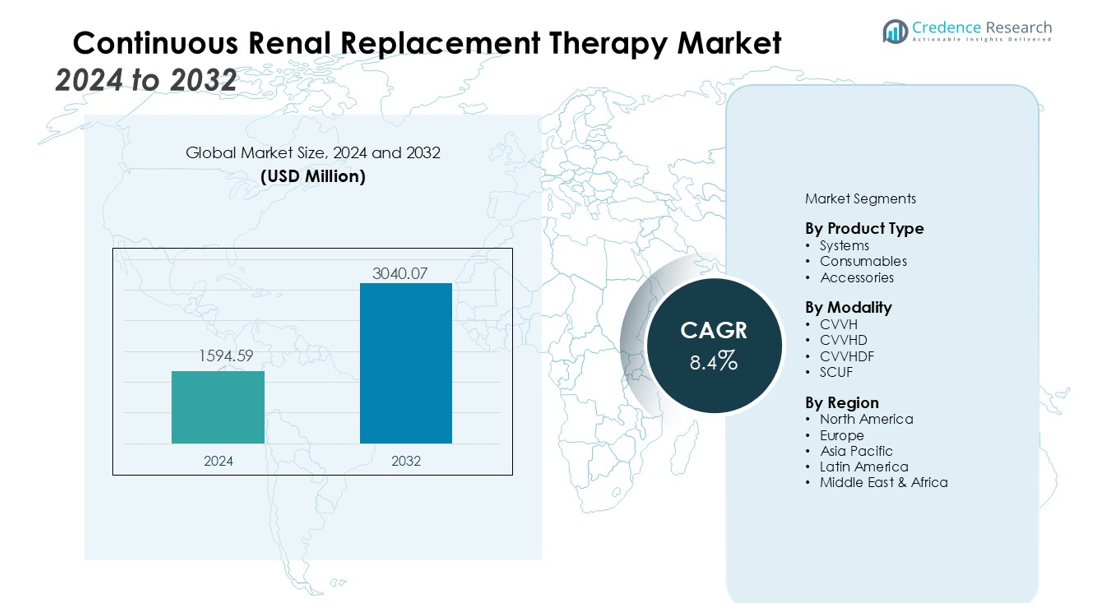
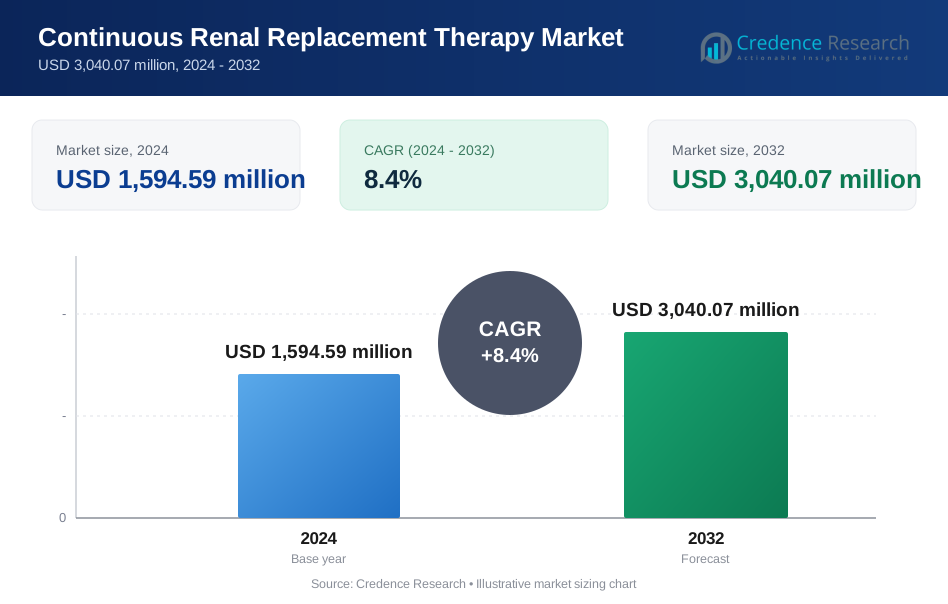
The Continuous Renal Replacement Therapy Market size was valued at USD 1594.59 million in 2024 and is anticipated to reach USD 3040.07 million by 2032, at a CAGR of 8.4% during the forecast period (2024-2032).
| REPORT ATTRIBUTE | DETAILS |
|---|---|
| Historical Period | 2020-2023 |
| Base Year | 2024 |
| Forecast Period | 2025-2032 |
| Continuous Renal Replacement Therapy Market Size 2024 | USD 1594.59 million |
| Continuous Renal Replacement Therapy Market, CAGR | 8.4% |
| Continuous Renal Replacement Therapy Market Size 2032 | USD 3040.07 million |
Key factors accelerating market growth include the rising incidence of sepsis, multi-organ failure, and chronic conditions that increase AKI risk. Advancements in CRRT devices-such as improved fluid management, enhanced filter technology, and automation-are strengthening clinical outcomes and improving treatment efficiency. Furthermore, the growing geriatric population and increasing ICU admissions are contributing to higher CRRT adoption globally. Favorable government initiatives, hospital infrastructure development, and the shift toward personalized critical care also support market expansion.
Regionally, North America dominates the CRRT market due to strong healthcare infrastructure, high ICU admission rates, and early adoption of advanced renal support systems. Europe follows closely, driven by rising critical care needs and technological advancements. Meanwhile, Asia-Pacific is expected to witness the fastest growth, supported by expanding healthcare investments, increasing AKI burden, and improving access to critical care services.Top of Form
Market Insights:
- The Continuous Renal Replacement Therapy Market was valued at USD 1,594.59 million in 2024 and is projected to reach USD 3,040.07 million by 2032, growing at a CAGR of 8.4%.
- Rising incidence of acute kidney injury (AKI), sepsis, and multi-organ failure is driving higher CRRT adoption in ICUs worldwide.
- Innovations in CRRT devices, including automated fluid management, advanced filters, and real-time monitoring, enhance treatment precision and clinical outcomes.
- The growing geriatric population and prevalence of chronic diseases like diabetes and cardiovascular conditions increase demand for continuous renal support.
- Expansion of ICU infrastructure, hospital modernization, and supportive government initiatives are accelerating CRRT implementation globally.
- High operational costs, device complexity, and shortages of trained critical care professionals remain key adoption challenges in several regions.
- North America leads with 40% market share, Europe holds 30%, and Asia-Pacific, with 25% share, is the fastest-growing region due to increasing healthcare investments and improving access to critical care.
Market Drivers:
Rising Incidence of Acute Kidney Injury and Critical Illnesses
The Continuous Renal Replacement Therapy Market benefits from the rising burden of acute kidney injury (AKI) linked to sepsis, trauma, and multi-organ dysfunction. It supports hemodynamically unstable patients who require continuous renal support in intensive care units. Growing ICU admissions and complex disease profiles create sustained demand for advanced renal replacement technologies. Healthcare systems prioritize timely intervention, which strengthens the uptake of CRRT devices. Hospitals integrate CRRT to improve survival outcomes and manage critical patients effectively.
- For Instance, Fresenius Medical Care’s multiFiltratePRO CRRT system is a leading device for continuous renal replacement therapy (CRRT) that assists staff through an intuitive interface and offers connectivity to hospital data systems, which can help support treatment precision and efficacy for ICU patients.
Advancements in CRRT Technologies and Treatment Precision
The market gains strong momentum from innovations that improve filtration efficiency, automate fluid management, and enhance real-time monitoring. It offers clinicians greater control over therapy parameters, which elevates treatment precision and consistency. New-generation machines reduce operational complexity and support personalized care in diverse clinical environments. Manufacturers invest in data-driven capabilities that optimize decision-making and workflow integration. Advanced CRRT systems expand the adoption scope in critical care units.
- For instance, Baxter’s PrisMax system integrates automated fluid management and citrate anticoagulation management, ensuring stable filtration fractions and reduced clotting risk, with demonstrated ultrafiltration precision reaching a cumulative net bias as low as -2.8 mL in clinical validation.
Growth in the Geriatric Population and Chronic Disease Burden
The Continuous Renal Replacement Therapy Market sees rising demand due to the expanding elderly population prone to cardiovascular disease, diabetes, and renal complications. It plays a vital role in managing acute renal stress in older patients with limited physiological resilience. Growth in chronic illnesses raises ICU occupancy rates and drives the need for reliable continuous renal support. Hospitals strengthen critical care capacity to address the rising treatment load. Healthcare providers adopt CRRT solutions to stabilize high-risk elderly patients.
Expansion of Critical Care Infrastructure and Healthcare Investment
The market expands with growing investment in hospital infrastructure and the modernization of intensive care units. It aligns with healthcare reforms that promote advanced life-support technologies in both developed and emerging regions. Governments and private organizations support training programs that improve therapy execution and patient monitoring. Rising awareness of CRRT’s clinical benefits encourages wider implementation in tertiary care settings. Strengthened healthcare capacity accelerates the global adoption of advanced CRRT systems.
Market Trends:
Integration of Automation, Digital Monitoring, and Advanced Filtration Technologies
The Continuous Renal Replacement Therapy Market observes a strong shift toward automated systems that reduce manual intervention and elevate treatment accuracy. It incorporates advanced sensing tools and digital consoles that support real-time fluid balance monitoring. Hospitals adopt high-efficiency filters that increase solute clearance and improve biocompatibility. Clinicians gain improved control through intuitive interfaces that streamline therapy adjustments. Manufacturers focus on developing compact systems that fit diverse ICU layouts without disrupting workflow. Data integration features support better clinical decision-making and enhance treatment consistency. The industry positions technology-driven CRRT platforms as a standard in modern critical care.
- For Instance, Terumo BCT's Continuous Renal Replacement Therapy (CRRT) platform, such as the PrisMax control unit, incorporates seamless Electronic Health Record (EHR) connectivity, facilitating real-time data sharing and potentially reducing manual documentation and transcription errors during therapy management
Growing Preference for Personalized Critical Care and Wider Utilization Across Emerging Markets
The Continuous Renal Replacement Therapy Market reflects a rising preference for personalized treatment protocols tailored to patient stability and disease severity. It enables flexible therapy modes that support targeted clinical outcomes. Healthcare providers prioritize customized fluid management strategies to improve organ support. Emerging markets expand adoption due to stronger healthcare investment and improved access to advanced renal care solutions. Hospitals in developing regions deploy CRRT to manage increasing rates of sepsis, AKI, and chronic illnesses. Training programs for critical care specialists strengthen capability and increase confidence in therapy execution. Broader adoption across new regions reshapes the global demand landscape for CRRT systems.
- For Instance, Pradhan Mantri National Dialysis Program (PMNDP) provides free standard haemodialysis and peritoneal dialysis services to eligible BPL (Below Poverty Line) patients in public district hospitals across the country, operating in over 751 districts as of June 2025.
Market Challenges Analysis:
High Operational Costs and Limited Access to Skilled Professionals
The Continuous Renal Replacement Therapy Market faces significant challenges due to the high costs of equipment, consumables, and maintenance. It strains budgets in hospitals with limited financial resources and restricts broad adoption. Skilled critical care professionals remain essential for therapy management, yet shortages persist in many regions. Training gaps reduce confidence in administering complex CRRT procedures. Hospitals in low-resource settings struggle to meet staffing and equipment requirements. Reimbursement limitations further constrain investment in advanced renal support technologies. These obstacles slow adoption despite rising clinical demand.
Technological Complexity, Device Limitations, and Risks of Treatment-Related Complications
The Continuous Renal Replacement Therapy Market encounters challenges linked to the technological complexity of CRRT machines and the need for continuous monitoring. It demands precise control of fluid balance and filtration settings, which increases operational risks. Device-related issues such as clotting, filter failure, and inconsistent flow rates disrupt therapy continuity. Clinicians must balance effectiveness with patient stability to avoid complications. Variability in device performance across manufacturers limits standardization. Hospitals work to reduce treatment errors through stricter protocols and enhanced training. Persistent clinical and technical hurdles influence overall therapy outcomes and adoption rates.
Market Opportunities:
Expansion of Advanced ICU Infrastructure and Adoption in Emerging Healthcare Markets
The Continuous Renal Replacement Therapy Market gains strong opportunities from the rapid expansion of advanced ICU infrastructure across developing regions. It benefits from growing healthcare investments that support high-acuity treatment capabilities. Hospitals aim to upgrade renal care technology to manage the rising burden of acute kidney injury. Governments prioritize critical care modernization, which strengthens access to CRRT systems. Manufacturers see significant potential in offering cost-optimized solutions tailored to resource-limited facilities. Rising awareness of CRRT’s clinical value encourages broader deployment. Strengthened healthcare capacity boosts long-term market penetration.
Technological Innovation, Portable Systems, and Integration of Data-Driven Capabilities
The Continuous Renal Replacement Therapy Market experiences new opportunities through innovations that enhance automation, portability, and clinical intelligence. It moves toward compact CRRT platforms that support flexible use in emergency units and transport settings. Integration of digital monitoring tools enhances therapy accuracy and supports predictive decision-making. AI-based analytics open avenues for personalized renal support and improved outcome tracking. Filter technology advancements increase efficiency and reduce complications, creating a stronger value proposition for hospitals. Remote training modules expand clinician capabilities and accelerate adoption. Continuous innovation positions CRRT as a core component of next-generation critical care delivery.Top of Form
Market Segmentation Analysis:
By Product Type
The Continuous Renal Replacement Therapy Market divides into systems, consumables, and accessories, each addressing specific clinical and operational needs. Systems hold the largest share because hospitals require platforms that deliver accurate fluid control, advanced monitoring, and strong safety integration. Consumables such as filters, tubing sets, and fluids sustain consistent demand due to routine replacement cycles in intensive care units. It gains competitive advantage through innovations that extend filter durability and improve material biocompatibility. Accessories that support connectivity, alarm management, and workflow automation reinforce operational efficiency and strengthen supplier positioning.
- For instance, Baxter’s PrisMax system incorporates automated fluid balancing technology with precision within ±10 milliliters per hour, enabling high accuracy in fluid management critical for patient safety.
By Modality
The market segments into CVVH, CVVHD, CVVHDF, and SCUF, with each modality meeting distinct therapeutic requirements. CVVHDF leads global usage due to its balanced approach to solute clearance and fluid management in high-acuity cases. CVVHD secures strong adoption where controlled diffusion-based clearance aligns with clinician protocols. CVVH plays a vital role in high-volume convection therapies for patients with severe renal impairment, and it supports treatment flexibility across ICU settings. SCUF retains relevance for fluid-overload management where slower ultrafiltration rates support hemodynamic stability.
- For instance, in clinical use, standard continuous venovenous hemodiafiltration (CVVHDF) delivers a typical target delivered dosage of 20 to 25 ml/kg per hour of effluent, showing effective convective and diffusive clearance suitable for acute kidney injury management.
Segmentations:
By Product Type
- Systems
- Consumables
- Accessories
By Modality
- CVVH
- CVVHD
- CVVHDF
- SCUF
By Region
- North America
- U.S.
- Canada
- Mexico
- Europe
- Germany
- France
- U.K.
- Italy
- Spain
- Rest of Europe
- Asia Pacific
- China
- Japan
- India
- South Korea
- South-east Asia
- Rest of Asia Pacific
- Latin America
- Brazil
- Argentina
- Rest of Latin America
- Middle East & Africa
- GCC Countries
- South Africa
- Rest of the Middle East and Africa
Regional Analysis:
North America - strong clinical adoption and advanced care networks driving demand
North America holds 40% market share, and it retains leadership due to high ICU capacity and sustained investment in critical care. The region benefits from established reimbursement structures that support Continuous Renal Replacement Therapy Market utilization. Hospitals operate trained critical care teams that improve treatment consistency. It benefits from strong R&D presence, rapid regulatory clearances, and reliable service networks. Rising kidney disease incidence and high patient acuity continue to strengthen procedural demand.
Europe - consolidated provider networks and regulation shape uptake
Europe accounts for 30% market share, and it maintains steady adoption through structured procurement systems and unified clinical guidelines. Health systems emphasize cost-effectiveness, so hospitals prioritize CRRT platforms with proven clinical outcomes. The Continuous Renal Replacement Therapy Market benefits from strong distributor networks that ensure device availability and maintenance. Centers of excellence influence regional treatment protocols and encourage standardization. It experiences sustained demand driven by aging populations and chronic disease trends.
Asia Pacific & Rest of World - capacity expansion and access challenges present opportunities
Asia Pacific holds 25% market share, and it records the fastest expansion as ICU infrastructure scales and kidney disease cases increase. Healthcare providers favor flexible CRRT systems that match varying resource levels, and the Continuous Renal Replacement Therapy Market supports this shift with adaptable platforms. Training partnerships help clinicians enhance operational confidence. It sees rapid adoption in urban tertiary centers, followed by diffusion to secondary hospitals. Localized manufacturing, service networks, and strategic collaborations strengthen long-term growth potential.
Key Player Analysis:
- Fresenius Medical Care AG & Co. KGaA (Germany)
- Asahi Kasei Medical Co., Ltd. (Asahi Kasei Corporation) (Japan)
- Baxter (U.S.)
- B Braun SE (Germany)
- Medtronic (Ireland)
- NIPRO (Japan)
- Nikkiso Co., Ltd. (Japan)
- TORAY MEDICAL CO, LTD. (TORAY INDUSTRIES, INC.) (Japan)
Competitive Analysis:
The Continuous Renal Replacement Therapy Market shows intense competition shaped by advanced technology, strong service models, and broad global distribution. Leading companies focus on integrated platforms that deliver accurate fluid control, improved filter efficiency, and real-time monitoring. It strengthens its position through software enhancements, intuitive interfaces, and safety upgrades that support clinical precision. Firms expand technical support and training programs to minimize downtime and reinforce customer loyalty. Mid-tier manufacturers compete with cost-efficient consumables, localized customization, and flexible procurement strategies, while new entrants introduce compact systems suited for resource-limited settings. Global players invest in regulatory compliance, regional manufacturing, and long-term hospital partnerships to secure contracts and maintain leadership in a market defined by clinical outcomes, device durability, and total lifecycle value.
Recent Developments:
- In August 2024, Baxter International, Inc. (U.S.) announced a definitive agreement to divest its Vantive Kidney Care segment, a significant strategic business transformation, to the Carlyle Group for $3.8 billion, signaling a focus shift in its portfolio.
- In September 2025, B. Braun SE (Germany) announced and completed the full acquisition of True Digital Surgery (TDS), a California-based company specializing in digital robotic-assisted 3D surgical microscopy.
Report Coverage:
The research report offers an in-depth analysis based on Product Type, Modality and Region. It details leading market players, providing an overview of their business, product offerings, investments, revenue streams, and key applications. Additionally, the report includes insights into the competitive environment, SWOT analysis, current market trends, as well as the primary drivers and constraints. Furthermore, it discusses various factors that have driven market expansion in recent years. The report also explores market dynamics, regulatory scenarios, and technological advancements that are shaping the industry. It assesses the impact of external factors and ITALY economic changes on market growth. Lastly, it provides strategic recommendations for new entrants and established companies to navigate the complexities of the market.
Future Outlook:
- The Continuous Renal Replacement Therapy Market will advance through next-generation systems that support higher precision in fluid and solute management.
- Demand will rise as ICU admissions for sepsis, acute kidney injury, and multi-organ failure increase worldwide.
- Manufacturers will adopt AI-enabled monitoring features that enhance clinical decision support and improve treatment consistency.
- Hospitals will integrate CRRT platforms with electronic health records to improve data accuracy and workflow efficiency.
- Compact and energy-efficient systems will gain traction in emerging markets with limited critical care resources.
- Consumable innovations will focus on longer filter life, reduced clotting risk, and improved biocompatibility.
- Training partnerships with healthcare institutions will expand to improve staff proficiency and reduce therapy interruptions.
- Companies will strengthen service networks to support uptime guarantees and enhance equipment reliability.
- Regulatory pathways will encourage development of safer devices with advanced alarm management and automated safeguards.
- Pricing strategies and value-based contracting will influence procurement decisions as hospitals seek lower lifecycle costs.
Request a Free Sample
Fill in your details and we'll send you a free sample report.
- Sample data tables & charts
- Research methodology
Need a Custom Version of This Report?
Tailor the scope, geography, or segments to your exact requirements.
- Custom geography or segment scope
- Direct access to our analyst team
Frequently Asked Questions
What is the current market size for the Continuous Renal Replacement Therapy Market, and what is its projected size in 2032?
At what Compound Annual Growth Rate (CAGR) is the Continuous Renal Replacement Therapy Market projected to grow between 2024 and 2032?
What are the primary factors fueling the growth of the Continuous Renal Replacement Therapy Market?
Who are the major players in the global Continuous renal replacement therapy market?
What is the major market driver of the Continuous renal replacement therapy industry?
What are the major market restraints of the Continuous renal replacement therapy industry?
What are the major market opportunities of the Continuous renal replacement therapy industry?
Which region commanded the largest share of the Continuous Renal Replacement Therapy Market in 2024?
Table of Content
Chapter 1. Report Introduction
- 1.1 Report Description & Purpose
- 1.1.1 Report Title & Market Definition
- 1.1.2 Unique Selling Propositions (USP) & Key Differentiators
- 1.1.3 Value Proposition for Stakeholders
- 1.2 Research Objectives
- 1.2.1 Market Sizing Objectives (Volume & Revenue)
- 1.2.2 Segmentation Objectives
- 1.2.3 Competitive Intelligence Objectives
- 1.2.4 Forecast & Scenario Objectives
- 1.3 Report Scope
- 1.3.1 Continuous Renal Replacement Therapy Scope – Types & Subtypes Covered
- 1.3.2 Geographic Scope – Regions & Countries Covered
- 1.3.3 Historical Period, Base Year & Forecast Period (2024; forecast to 2032)
- 1.3.4 Inclusions & Exclusions
- 1.4 HS Code & Classification Framework
- 1.5 Currency, Units & Pricing Basis
- 1.6 Target Stakeholders
- 1.7 Limitations & Assumptions
Chapter 2. Executive Summary
- 2.1 Global Continuous Renal Replacement Therapy Market Snapshot
- 2.1.1 Market Size – Historical (2024) & Forecast (2024-2032) (2024: USD 1,594.59 million → 2032: USD 3,040.07 million)
- 2.1.2 Volume & Revenue – Global Totals
- 2.1.3 Key Market Highlights – Top Five Facts
- 2.2 Continuous Renal Replacement Therapy Market Segmentation Snapshot
- 2.2.1 Market Split by Region – 2024 vs. 2032
- 2.3 Competitive Snapshot
- 2.3.1 Top 10 Players by Revenue Share – 2024
- 2.3.2 Top 10 Players by Volume Share – 2024
- 2.3.3 Recent Strategic Developments (18-Month Summary)
- 2.4 Key Investment Highlights & Strategic Conclusions
Chapter 3. Continuous Renal Replacement Therapy Market Dynamics & Industry Analysis
- 3.1 Market Overview & Context
- 3.1.1 Continuous Renal Replacement Therapy Market Position in the Broader Automotive Value Chain
- 3.1.2 OEM vs. Replacement Market Dynamics
- 3.1.3 Market Maturity & Development Stage by Region
- 3.2 Continuous Renal Replacement Therapy Market Drivers
- 3.3 Continuous Renal Replacement Therapy Market Restraints & Challenges
- 3.4 Continuous Renal Replacement Therapy Market Opportunities
- 3.5 Porter's Five Forces Analysis
- 3.5.1 Threat of New Entrants
- 3.5.2 Bargaining Power of Suppliers
- 3.5.3 Bargaining Power of Buyers
- 3.5.4 Threat of Substitutes
- 3.5.5 Competitive Rivalry – Intensity Assessment
- 3.6 Continuous Renal Replacement Therapy Value Chain Analysis
- 3.6.1 Upstream – Raw Material/Input Suppliers
- 3.6.1.1 Raw Material/Input 1
- 3.6.1.2 Raw Material/Input 2
- 3.6.1.3 Raw Material/Input 3
- 3.6.2 Midstream – Production/Manufacturing/Service Delivery
- 3.6.2.1 Production/Process Overview
- 3.6.2.2 Key Facility Locations & Capacity by Manufacturer
- 3.6.3 Downstream – Distribution & End Consumer
- 3.6.3.1 Primary Channel – B2B/OEM
- 3.6.3.2 Secondary Channels – Dealer, Retail, Online, Direct
- 3.6.4 Value Chain Profitability Analysis
- 3.6.1 Upstream – Raw Material/Input Suppliers
- 3.7 PESTEL Analysis
- 3.7.1 Political Factors
- 3.7.2 Economic Factors
- 3.7.3 Social Factors
- 3.7.4 Technological Factors
- 3.7.5 Environmental Factors
- 3.7.6 Legal Factors
- 3.8 Continuous Renal Replacement Therapy Supply Chain Analysis
- 3.8.1 Raw Material/Input Supply Risk Assessment
- 3.8.2 Manufacturing Concentration Risk (Geographic Exposure)
- 3.8.3 Trade Disruption Impact Analysis
- 3.9 Regulatory & Policy Landscape
Note: The regulatory and policy landscape section covers regulations based on their applicability to the market, Continuous Renal Replacement Therapy category, geography, and scope of the study. Only regulatory frameworks with a material impact on operations, compliance, trade, sustainability, or market access are analyzed in detail.
Chapter 4. Key Investment Pockets & Opportunity Analysis
- 4.1 Continuous Renal Replacement Therapy Market Attractiveness Analysis
- 4.1.1 By Region – Investment Attractiveness Matrix (Volume × CAGR)
- 4.2 Absolute Revenue Growth Opportunity
- 4.2.1 By Region – Absolute USD Growth Through 2032
- 4.3 Incremental Volume Opportunity
- 4.3.1 By Region – Incremental Volume Through 2032
- 4.3.2 Segment – Incremental Volume
- 4.4 Emerging Submarket Opportunity Deep Dive (Subject to Applicability)
- 4.5 Emerging Market Opportunity Scorecards
- 4.5.1 United States
- 4.5.2 Europe
- 4.5.3 Asia
- 4.5.4 Middle East & Africa
Note: Emerging Market Opportunity Scorecards will be included based on relevance and strategic importance. Regions listed are indicative and may vary depending on data availability and market dynamics.
Chapter 5. Continuous Renal Replacement Therapy Import-Export Analysis & Trade Flows
- 5.1 Global Trade Overview
- 5.1.1 Global Export Value by Country (2024)
- 5.1.2 Global Export Volume by Country (2024)
- 5.1.3 Global Import Value by Country (2024)
- 5.1.4 Global Import Volume by Country (2024)
- 5.1.5 Net Trade Balance by Country (2024)
- 5.2 Export Analysis – Segment
- 5.2.1 Type 1 (HS Code)
- 5.2.2 Type 2 (HS Code)
- 5.2.3 Type 3 (HS Code)
- 5.2.4 Type 4 (HS Code)
- 5.2.5 Type 5 (HS Code)
- 5.3 Import Analysis – Segment
- 5.3.1 Type 1 (HS Code)
- 5.3.2 Type 2 (HS Code)
- 5.3.3 Type 3 (HS Code)
- 5.3.4 Type 4 (HS Code)
- 5.3.5 Type 5 (HS Code)
- 5.4 Average Unit Trade Prices
- 5.4.1 Average Export Price – Segment & Country
- 5.4.2 Average Import Price – Segment & Source Country
- 5.4.3 Price Trends (2024)
- 5.5 Key Trade Route Analysis
- 5.5.1 Trade Route 1
- 5.5.2 Trade Route 2
- 5.5.3 Trade Route 3
- 5.5.4 Trade Route 4
- 5.5.5 Trade Route 5
- 5.6 Trade Policy Impact Assessment
- 5.6.1 US Anti-Dumping & Section 301 Tariffs
- 5.6.2 EU Customs Union Impact
- 5.6.3 Major Free Trade Agreements
- 5.6.4 USMCA Rules of Origin
Note: Trade policy analysis will be included only where relevant to the Continuous Renal Replacement Therapy market.
Chapter 6. Competitive Landscape & Company Benchmarking
- 6.1 Continuous Renal Replacement Therapy Market Concentration & Structure
- 6.1.1 Herfindahl-Hirschman Index (HHI) – vs. 2024
- 6.1.2 Tier 1, Tier 2 & Tier 3 Market Structure
- 6.1.3 Global, Regional & Local Player Dynamics
- 6.2 Continuous Renal Replacement Therapy Market Share Analysis – 2024
- 6.2.1 Global Revenue Share by Company
- 6.2.2 Global Volume Share by Company
- 6.2.3 Regional Revenue Share
- 6.2.4 Market Share Evolution ( vs. 2024)
- 6.2.5 OEM Segment Share by Company
- 6.2.6 Replacement Segment Share by Company
- 6.3 Production/Delivery Capacity & Facility Analysis
- 6.3.1 Global Installed Capacity
- 6.3.2 Capacity Utilization Rates
- 6.3.3 Production/Output Volume
- 6.3.4 Facility Locations & Capacity Map
- 6.3.5 Planned Capacity Additions
- 6.4 Continuous Renal Replacement Therapy Competitive Benchmarking Matrix
- 6.4.1 Revenue, Volume, CAGR & Profitability Comparison
- 6.4.2 Channel Revenue Mix
- 6.4.3 Geographic Revenue Exposure
- 6.4.4 R&D Intensity
- 6.4.5 Sustainability Maturity
- 6.5 Strategic Developments in Continuous Renal Replacement Therapy (Last 24 Months)
- 6.5.1 Mergers, Acquisitions & Divestments
- 6.5.2 New Continuous Renal Replacement Therapy Launches
- 6.5.3 Facility Expansions
- 6.5.4 Strategic Alliances, Joint Ventures & Partnerships
- 6.5.5 Distribution Expansion & Market Entry
- 6.5.6 Sustainability & ESG Initiatives
- 6.6 Competitive Strategy Mapping
- 6.6.1 Leader, Challenger, Follower & Niche Classification
- 6.6.2 Pricing Strategy Comparison
- 6.6.3 Channel Strategy Matrix
Note: Strategic developments are included based on their materiality and the availability of reliable information.
Chapter 7. Global Continuous Renal Replacement Therapy Market – By Distribution Channel
- 7.1 Segment Overview
- 7.1.1 Volume & Revenue Split by Channel (2024 & 2032)
- 7.1.2 Channel Mix Evolution (2024-2032)
Chapter 8. Regional Market Analysis – Global Overview
- 8.1 Global Regional Overview
- 8.1.1 Regional Volume Share
- 8.1.2 Regional Revenue Share
- 8.1.3 Regional Volume by Region
- 8.1.4 Regional Revenue by Region
- 8.1.5 Regional Forecast Through 2032
- 8.2 Cross-Regional Segment Analysis
- 8.2.1 By Distribution Channel
- 8.2.2 By Brand/Price Tier
Chapter 9. North America Continuous Renal Replacement Therapy Market
- 9.1 United States
- 9.2 Canada
- 9.3 Mexico
Chapter 10. Europe Continuous Renal Replacement Therapy Market
- 10.1 Germany
- 10.2 France
- 10.3 Italy
- 10.4 United Kingdom
- 10.5 Spain
- 10.6 Poland
- 10.7 Russia
- 10.8 Netherlands
- 10.9 Belgium
- 10.10 Sweden
- 10.11 Denmark
- 10.12 Norway
- 10.13 Rest of Europe
Chapter 11. Asia Pacific Continuous Renal Replacement Therapy Market
- 11.1 China
- 11.2 India
- 11.3 Japan
- 11.4 South Korea
- 11.5 Thailand
- 11.6 Indonesia
- 11.7 Vietnam
- 11.8 Malaysia
- 11.9 Australia
- 11.10 Rest of Asia Pacific
Chapter 12. Latin America Continuous Renal Replacement Therapy Market
- 12.1 Brazil
- 12.2 Argentina
- 12.3 Colombia
- 12.4 Chile
- 12.5 Rest of Latin America
Chapter 13. Middle East Continuous Renal Replacement Therapy Market
- 13.1 Saudi Arabia
- 13.2 United Arab Emirates
- 13.3 Turkey
- 13.4 Israel
- 13.5 Iran
- 13.6 Rest of the Middle East
Chapter 14. Africa Continuous Renal Replacement Therapy Market
- 14.1 South Africa
- 14.2 Egypt
- 14.3 Nigeria
- 14.4 Morocco
- 14.5 Rest of Africa
Chapter 15. Continuous Renal Replacement Therapy Company Profiles
- 15.1 [Company 01]
- 15.1.1 Company Overview
- 15.1.2 Key Management Personnel
- 15.1.3 Products & Services Portfolio
- 15.1.4 Financial Performance
- 15.1.5 Key Market Focus & Geographic Presence
- 15.1.6 Recent Developments & Strategic Initiatives
Note: The company profile list is preliminary and may change based on research findings, market developments, data availability, and client requirements.
Chapter 16. Appendices
- Appendix A – List of Abbreviations & Acronyms
- Appendix B – Industry Classification Code Reference – Full Series
- Appendix C – Production & Capacity Data Tables
- Appendix D – End-Use & Demand Base Tables
- Appendix E – Consumption & Replacement Rate Assumptions
- Appendix F – ASP Reference Tables
- Appendix G – Manufacturing & Facility Database
- Appendix H – Import-Export Data Tables
- Appendix I – Regulatory Summary Tables
- Appendix J – Primary Research Participant List (Anonymized)
- Appendix K – Primary Research Questionnaire Framework
- Appendix L – Data Sources & Bibliography
- Appendix M – Market Size Divergence & Source Comparison
Chapter 17. Research Methodology
- 17.1 Research Framework & Philosophy
- 17.2 Secondary Research – Sources, Hierarchy & Data Extraction
- 17.3 Data Modeling – Bottom-Up & Top-Down Market Sizing
- 17.4 Primary Research – Stakeholder Framework, LOI & Sample Sizes
- 17.5 Forecast Methodology – Regression, Scenario & Sensitivity Analysis
- 17.6 Quality Control – Four-Layer Validation Framework
- 17.7 Limitations & Standard Assumptions
- 17.8 Disclaimer
