
Clinic surgery and insured treatment set the demand base
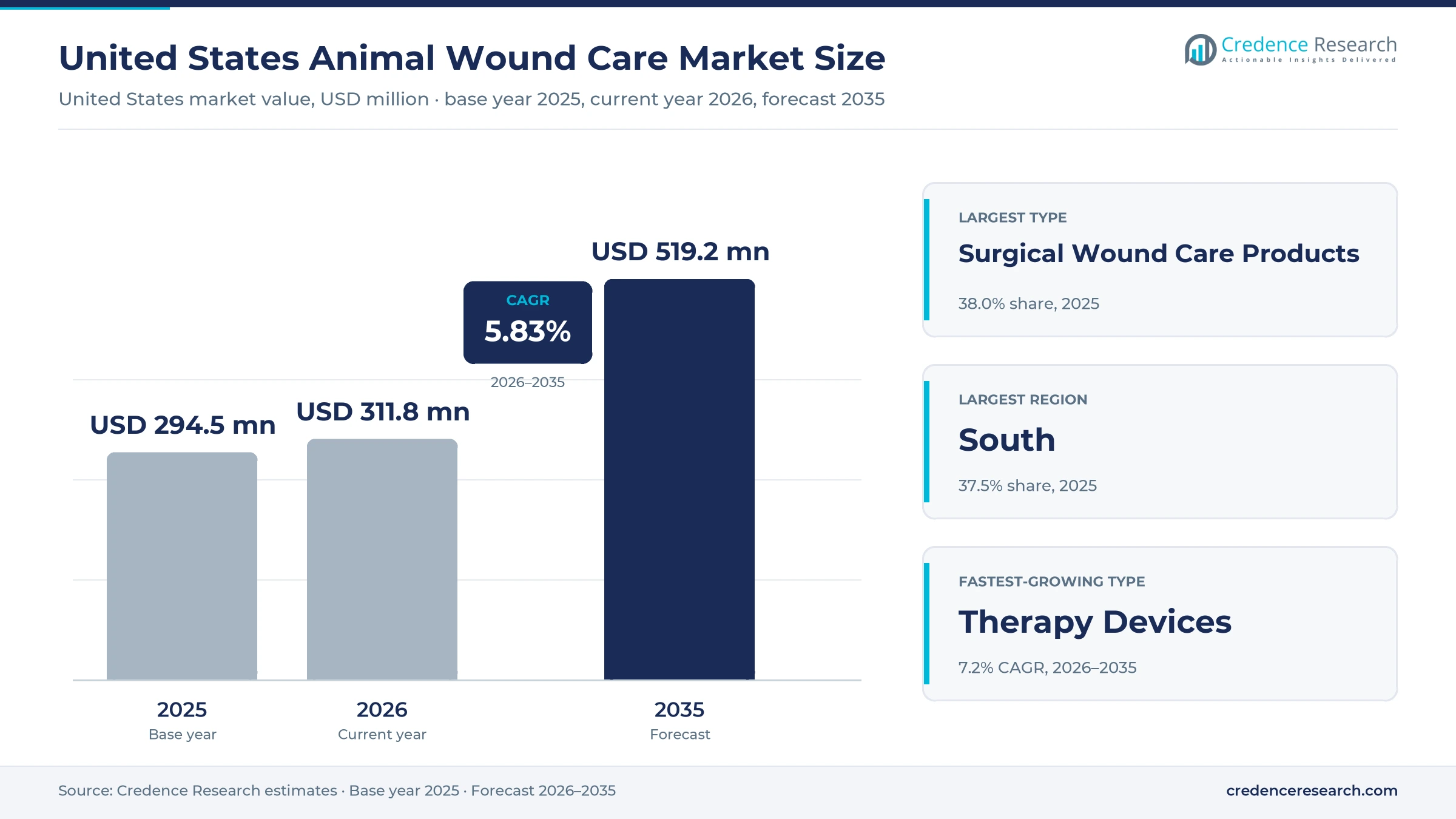
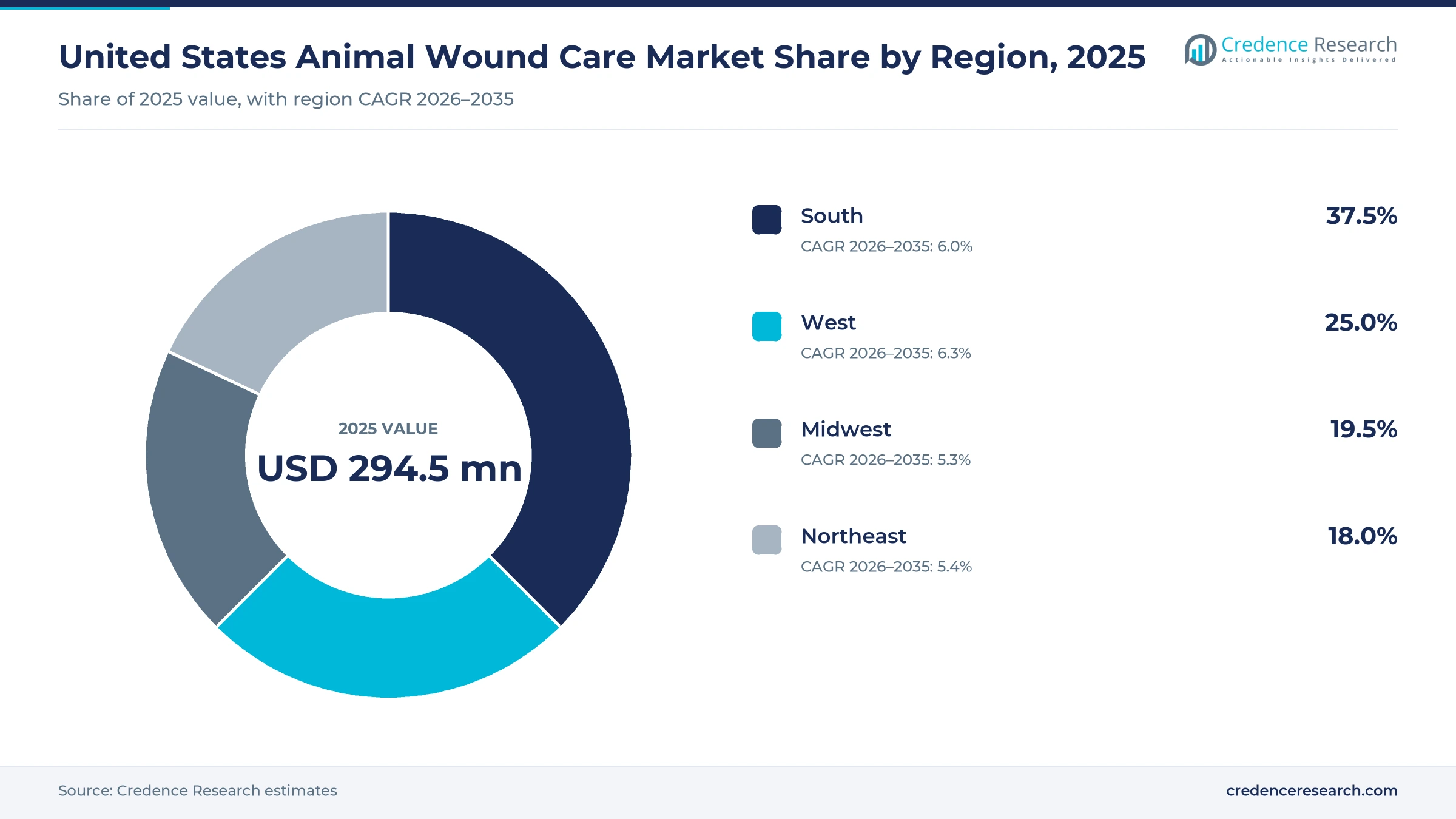
The United States animal wound care market was valued at USD 294.5 million in 2025 and is projected to increase from USD 311.8 million in 2026 to USD 519.2 million by 2035, registering a CAGR of 5.83% during 2026–2035. Demand comes from routine surgery in companion animal clinics, from trauma cases that pet insurance now helps owners pay for, and from cattle, horse and small ruminant operations that treat wounds on the farm. The South held the largest regional share, 37.5% in 2025, because it combines the largest cattle and horse populations with dense small animal practice networks, while the West is the fastest-growing region at 6.3% a year. Veterinary hospitals and clinics buy most sutures, dressings and therapy equipment through national distributors. The most important regulatory change is the return of New World screwworm to Texas in June 2026, which has turned wound inspection and treatment into a federal animal health priority for livestock and pet owners.
Clinic consumables carry most of the value in this market
The market counts products used to close, clean, cover and heal wounds in dogs, cats, small companion animals, livestock and horses, including sutures, staples and tissue glues, advanced dressings, gauze and cohesive bandages, antimicrobial sprays and gels, and therapy devices such as lasers. Most value is bought by veterinary practices, while farms, stables and pet owners buy over-the-counter products in farm stores, pet chains and online.
The count excludes systemic antibiotics, parasiticides given by mouth or injection, surgical instruments and the professional fees charged for wound treatment. Value sits with the device and consumable makers and with the distributors and retailers that move their products to clinics and owners.
United States Animal Wound Care Market Insights
- The United States animal wound care market rises from USD 294.5 million in 2025 to USD 519.2 million by 2035, growing at 5.83% a year as insured treatment and clinic surgery expand.
- The South held 37.5% of 2025 value, the largest share of any region, because it holds the biggest cattle and horse populations.
- Surgical wound care products held 38.0% of 2025 value, while therapy devices grow fastest at 7.2% a year.
- USDA confirmed the first domestic New World screwworm case in 60 years on June 3, 2026, in a calf in Zavala County, Texas.
- U.S. pet insurers covered 6.98 million pets in 2025, according to NAPHIA, yet more than 95% of dogs and cats remain uninsured.
Surgical closure leads while therapy devices gain
Surgical closure dominates spending while lasers add capital sales
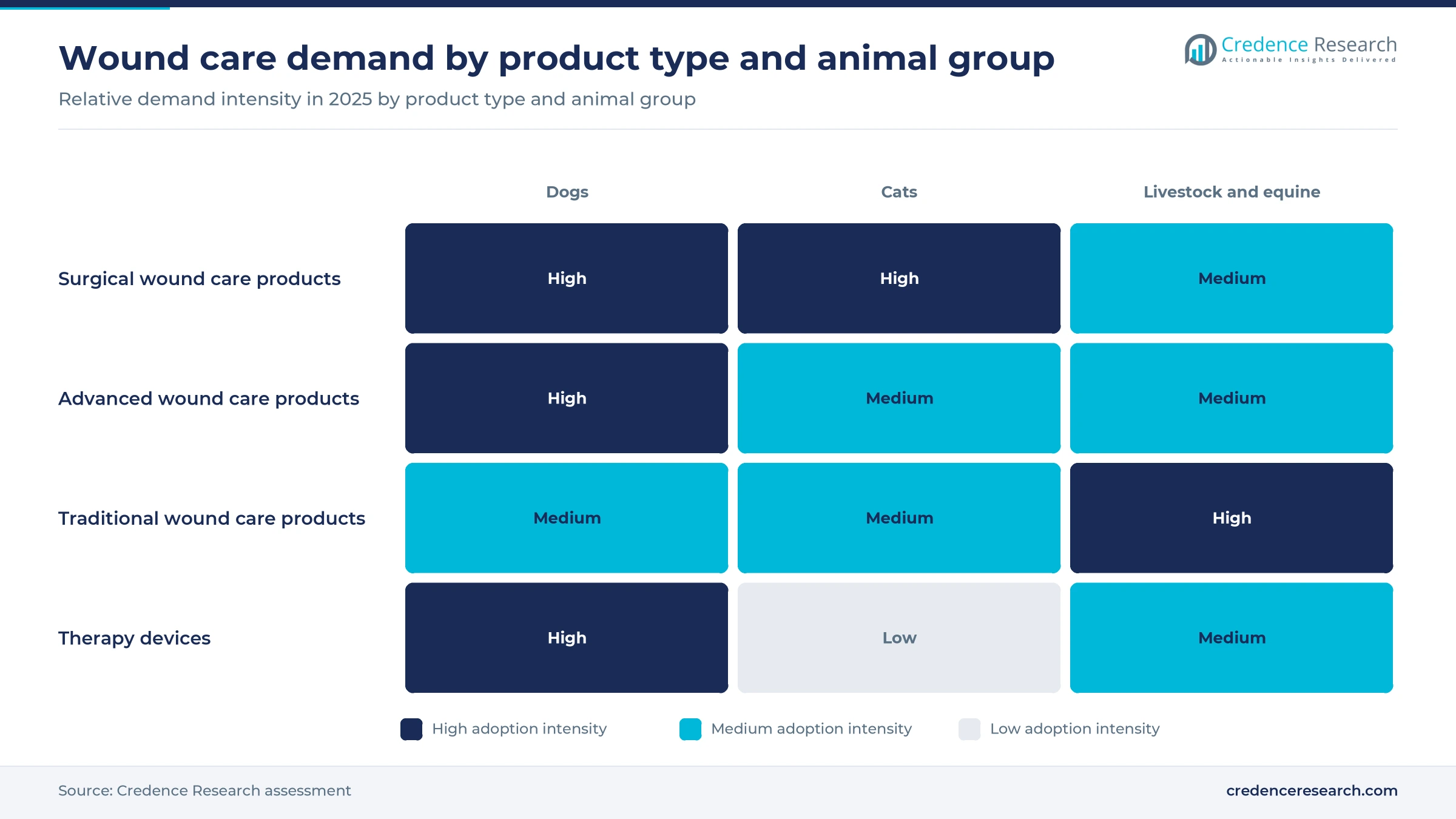
Based on product type, the market is categorized into surgical wound care products, advanced wound care products, traditional wound care products and therapy devices. Surgical wound care products led with 38.0% of 2025 value because nearly every spay, neuter and mass removal ends with sutures, across a dog population that the AVMA put at 87.3 million in 2025. Therapy devices grow fastest at 7.2% a year as clinics add Class IV therapy lasers, which Antech lists at $12,000 to $30,000. A laser is paid back through repeat sessions, so practices that buy one tend to push it into routine wound protocols.
Dogs lead the spend as the cat population grows fastest
Based on animal type, the market is categorized into dogs, cats, small companion animals and livestock and equine. Dogs led with 52.0% of 2025 value because dogs form the larger companion population and suffer more trauma, and Nationwide ranked trauma as the fifth most common dog condition in March 2025, with no trauma entry in the top ten for cats. Cats grow fastest at 6.7% a year as the AVMA's count of U.S. cats rose from 73.8 million in 2024 to 76.3 million in 2025, according to Pet Food Industry. Each additional cat adds spay, neuter and abscess cases to clinic caseloads.
Clinics buy most products as online autoship grows
Based on distribution channel, the market is categorized into veterinary hospitals and clinics, retail stores, e-commerce and direct to farm and institutional buyers. Veterinary Hospitals and Clinics led with 62.0% of 2025 value because sutures and advanced dressings are applied by staff, and Covetrus lists clinic products such as Vetericyn Plus Antimicrobial Hydrogel for post-surgical use. E-Commerce grows fastest at 8.2% a year as Chewy sells CoFlex Vet cohesive bandages with a 35% first-order autoship discount. Owners who change bandages at home reorder small items often, which suits subscription buying.
Surgical incisions lead as delayed-healing care gains
Based on application, the market is categorized into surgical incision management, traumatic wound management and delayed-healing wound management. Surgical Incision Management led with 42.0% of 2025 value because elective surgery is scheduled and repeated across about 77.5 million pet-owning households counted by the AVMA for 2025. Delayed-Healing Wound Management grows fastest at 7.0% a year as specialty surgeons adopt regenerative medicine options, after Michigan State University reported the first veterinary use of Kerecis cod-skin grafts on a burned dog in May 2019. These cases are few but expensive, so they lift value faster than volume.
| Segment Group | Leading Sub-segment | Share, 2025 | Fastest-growing Sub-segment | CAGR, 2026–2035 |
|---|---|---|---|---|
| By Product Type | Surgical Wound Care Products | 38.0% | Therapy Devices | 7.2% |
| By Animal Type | Dogs | 52.0% | Cats | 6.7% |
| By Distribution Channel | Veterinary Hospitals and Clinics | 62.0% | E-Commerce | 8.2% |
| By Application | Surgical Incision Management | 42.0% | Delayed-Healing Wound Management | 7.0% |
Consumables cost dollars while therapy lasers cost thousands
Pricing in this market follows two different models across product types. Consumables such as sutures, bandages and sprays are sold per box, roll or bottle and reordered every week, so distributors compete on contract price and delivery while clinics pass the cost into the treatment fee. Therapy devices are capital purchases that practices recover through session charges. Retail prices for owners are set by farm and pet chains, where a single bottle of antimicrobial spray costs less than one clinic visit. Rising veterinary fees push some owners toward these home products, which caps what clinics can charge for minor wounds and shifts margin to branded over-the-counter lines.
| Product or benchmark | Typical price or fee | Basis |
|---|---|---|
| Oasis PDO absorbable veterinary suture, size 0, box of 12 | USD 50.25 a box, about USD 4.19 a suture | Fisher Scientific listing, November 2026 |
| Vetericyn Plus antimicrobial wound spray, 8 oz | USD 23.99 a bottle | Tractor Supply listing, November 2026 |
| CoFlex Vet cohesive bandage, 4 in by 5 yd | USD 2.45 a roll, USD 1.59 on first autoship | Chewy listing, November 2026 |
| Class IV veterinary therapy laser | USD 12,000 to 30,000 a unit | Antech equipment guide, 2026 |
| Class III veterinary therapy laser | USD 6,000 to 12,000 a unit | Antech equipment guide, 2026 |
Request a Free Sample
Fill in your details and we'll send you a free sample report.
- Sample data tables & charts
- Research methodology
Insurance, routine surgery and screwworm lift demand
Insurance-supported clinical treatment widens care
Pet insurance lets owners approve surgery and repeat dressing changes that they would otherwise decline. NAPHIA's 2026 industry report, as reported by dvm360 in July 2026, counted 6.98 million insured U.S. pets in 2025, with premiums of about $5.68 billion. Its 2025 report showed U.S. premiums up 21.4% in 2024, so premium spending has grown at double-digit rates in two straight years. Because more than 95% of dogs and cats are still uninsured, the insured base can keep expanding for years. Insured trauma cases favor advanced dressings and laser sessions, and growth in pet insurance shifts the product mix toward higher-value items.
Recurring veterinary wound closure in clinic surgery
Routine surgery creates a steady base of incisions that must be closed, covered and checked. The AVMA estimated 87.3 million dogs in U.S. households for 2025, with 42.6% of households owning at least one dog. APPA put U.S. spending on veterinary care at $41 billion in 2025, up 3% from 2024, which funds a growing number of clinic visits. The AVMA also counted 77.5 million pet-owning households in 2025, or 58.6% of all U.S. households, and each one is a potential surgical client. Every spay, neuter, dental extraction and mass removal uses sutures, gauze and a bandage or cone, so caseload growth translates directly into consumable orders for distributors.
Absorbable and non-absorbable sutures anchor clinic buying
Sutures are the largest single purchase in wound closure, and clinics buy both absorbable and non-absorbable lines. Under a July 24, 2018 agreement, CP Medical, a Theragenics company, distributes the infusion sets, select wound therapy products and AESCULAP DS titanium ligation clips of B. Braun Vet Care, the German group's veterinary arm, in the United States and Canada, according to BioSpace. CP Medical, based in Norcross, Georgia, makes sutures for the animal health market. Med Vet International sells Oasis PDO absorbable sutures labeled for veterinary use only through Fisher Scientific at $50.25 for a box of 12. Because animal devices need no FDA premarket clearance, new lines keep the veterinary surgical sutures shelf crowded and push suppliers to compete on needle quality and price per box.
The screwworm response makes livestock wounds urgent
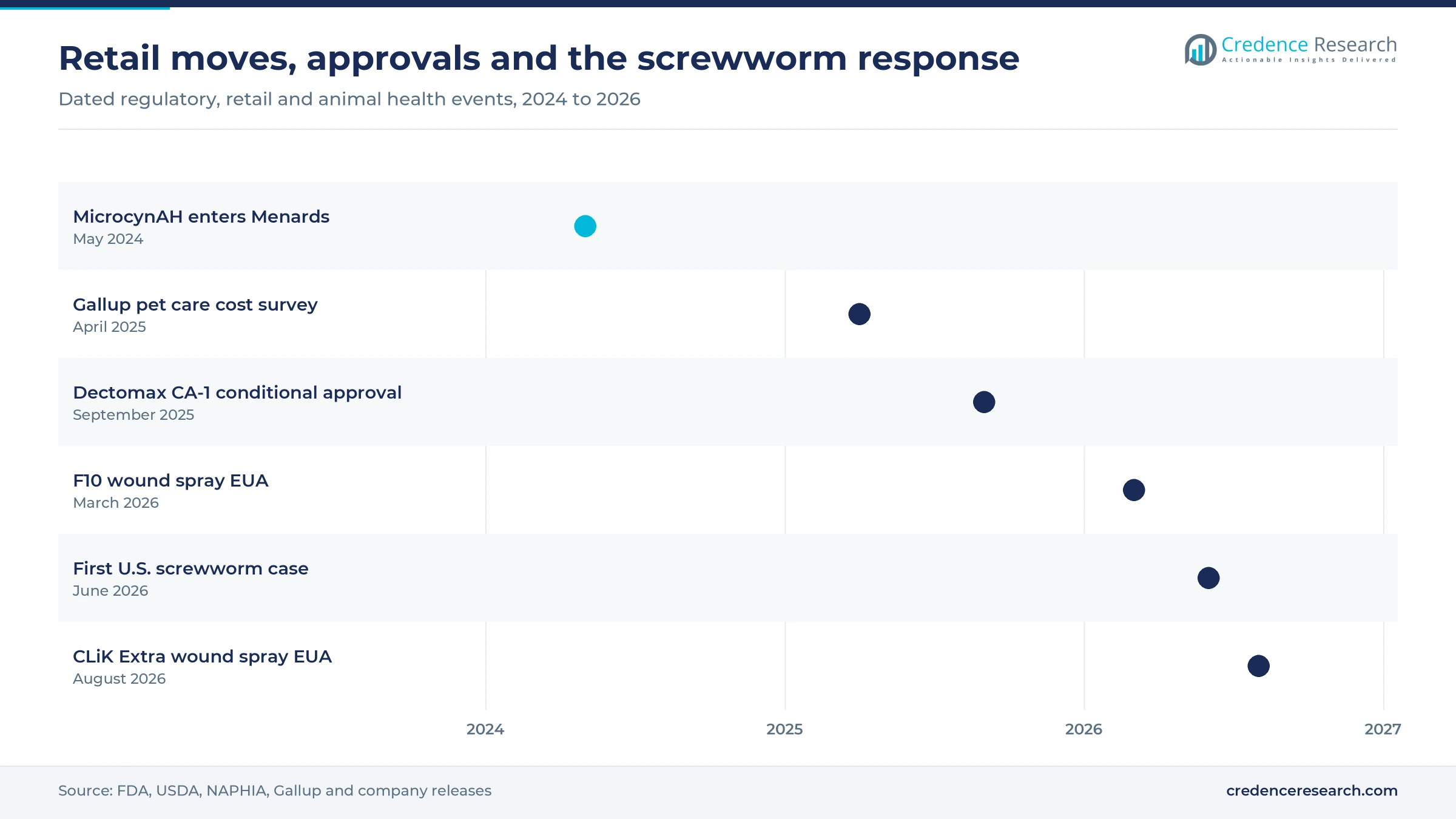
The return of New World screwworm has made every open wound on cattle, sheep, goats and pets a reportable risk. USDA confirmed the first domestic case in 60 years on June 3, 2026, and dvm360 counted 32 confirmed animal cases by July 3, 2026, 31 of them in Texas. The FDA authorized F10 Antiseptic Wound Spray with Insecticide for cattle, horses, sheep and goats in March 2026, KWTX reported, and issued an emergency use authorization for CLiK Extra wound spray on Aug. 7, 2026. Ranchers who once left minor cuts untreated now spray and inspect them, which raises over-the-counter volumes in farm stores across the South.
Retail antimicrobial sprays and biologic grafts gain
A shift to hypochlorous antimicrobial sprays in retail
Owners increasingly treat minor wounds at home with non-antibiotic hypochlorous sprays and gels. Sonoma Pharmaceuticals expanded its MicrocynAH line into more than 300 Menards stores in 15 states on May 9, 2024, and its September 2025 investor presentation lists PetSmart and Tractor Supply as national retail outlets. Innovacyn, based in Rialto, California, sells Vetericyn sprays through farm stores and the Covetrus clinic catalog. Retail stores rank second among channels by 2025 value in this market, because farm and pet chains stock these sprays next to feed and pet food. The shift keeps antibiotics out of first aid and gives brands that sell in both clinics and stores a recommendation advantage.
Rising use of biologic grafts and photobiomodulation
Specialty hospitals are adding biologic grafts and light therapy for wounds that fail standard dressings. Kerecis presented fish-skin graft cases in a horse and a dog at the European wound management conference in Barcelona in March 2025, and its veterinary guide is distributed through Jorgensen Laboratories of Loveland, Colorado. Michigan State University surgeons first used Kerecis cod-skin grafts on a burned dog in 2019, the first reported veterinary use of the product. Antech notes that Class III units output under 0.5 watt and mainly suit superficial wounds, which pushes buyers toward Class IV models. Laser sessions are often sold alongside veterinary pain management services, so one device serves two revenue lines and is easier to justify for a mid-sized practice with a steady surgical caseload.
Online autoship offers an opening for home bandage care
Online pet pharmacies can capture repeat purchases of bandages, sprays and wound kits for pets recovering at home. APPA reported that U.S. spending on supplies, medications and live animals reached $34.4 billion in 2025, up 4.4%, faster than spending on veterinary care. APPA also expects total U.S. pet industry spending to rise from $158 billion in 2025 to $165 billion in 2026. The Gallup survey cited below found that 15% of owners did not bring a pet in at all because of barriers such as cost, which leaves home treatment as the only care for many wounds. Suppliers that pack clinic-grade dressings into multi-item home kits, with clear instructions for owners, can win this channel without competing on clinic contracts, and they can collect reorder data that clinics rarely share.
Cat-specific products offer an opening as feline numbers rise
Cats are the fastest-growing animal group, yet most wound products are designed and sized for dogs and horses. The AVMA put the U.S. cat population at 76.3 million in 2025, close to the dog population noted above. NAPHIA found that cats made up 23.5% of insured U.S. pets in 2024, well below dogs at 75.6%, which leaves room for coverage to grow. Innovacyn sells a feline-specific Vetericyn hydrogel that can be applied with a cotton ball for cats that dislike sprays. Suppliers that add small-format, lick-safe dressings and collars for cats can win share in a group that general practices and feline-only clinics see more often each year.
Owner cost limits and a shrinking herd restrain spending
Owners decline recommended care because of cost
Cost keeps many injured pets in the United States from receiving the full treatment that veterinarians recommend. A PetSmart Charities and Gallup survey published April 15, 2025 found that 52% of U.S. pet owners skipped or declined veterinary care in the past year, and 71% of them cited cost. Veterinary service prices rose 7.1% in 2025, according to BLS consumer price data. Declined care shifts minor wounds to cheaper home products and lowers clinic dressing volumes, which hurts premium suppliers most.
Light device regulation leaves buyers with little evidence
Most veterinary wound products reach the market without an independent review of safety or performance. The FDA states that it does not require a 510(k), PMA or any premarket approval for animal devices, and makers of animal-only devices need not register them. Clinics therefore rely on supplier claims and small case reports when choosing dressings. This slows adoption of higher-priced advanced products and lets low-cost entrants compete on price alone.
A shrinking cattle herd caps livestock product volume
Livestock wound care depends on herd size, and the U.S. herd is not growing. USDA NASS counted 86.2 million cattle and calves on Jan. 1, 2026, down from 86.5 million a year earlier, and beef cows fell 1% to 27.6 million. Fewer calves mean fewer castrations, dehorning wounds and tagging injuries to treat. Livestock and equine products grow more slowly than companion animal lines, unless screwworm control keeps treatment rates high.
Clinic staffing limits time for dressing changes
Wound care is labor-heavy, because bandages must be changed and wounds rechecked several times. The BLS counted 131,400 veterinary technologist and technician jobs in 2025 and projects 9% growth to 2035, with a median pay of $47,380. Clinics short of technicians book fewer recheck visits and send more care home. That favors simple, long-wear dressings and limits demand for products that need frequent professional handling.
The South leads on herds, horses and screwworm risk
| Region | Value, 2025 (USD million) | Share, 2025 | CAGR, 2026–2035 |
|---|---|---|---|
| South | 110.4 | 37.5% | 6.0% |
| West | 73.6 | 25.0% | 6.3% |
| Midwest | 57.4 | 19.5% | 5.3% |
| Northeast | 53.0 | 18.0% | 5.4% |
The South leads on herds, horses and screwworm exposure
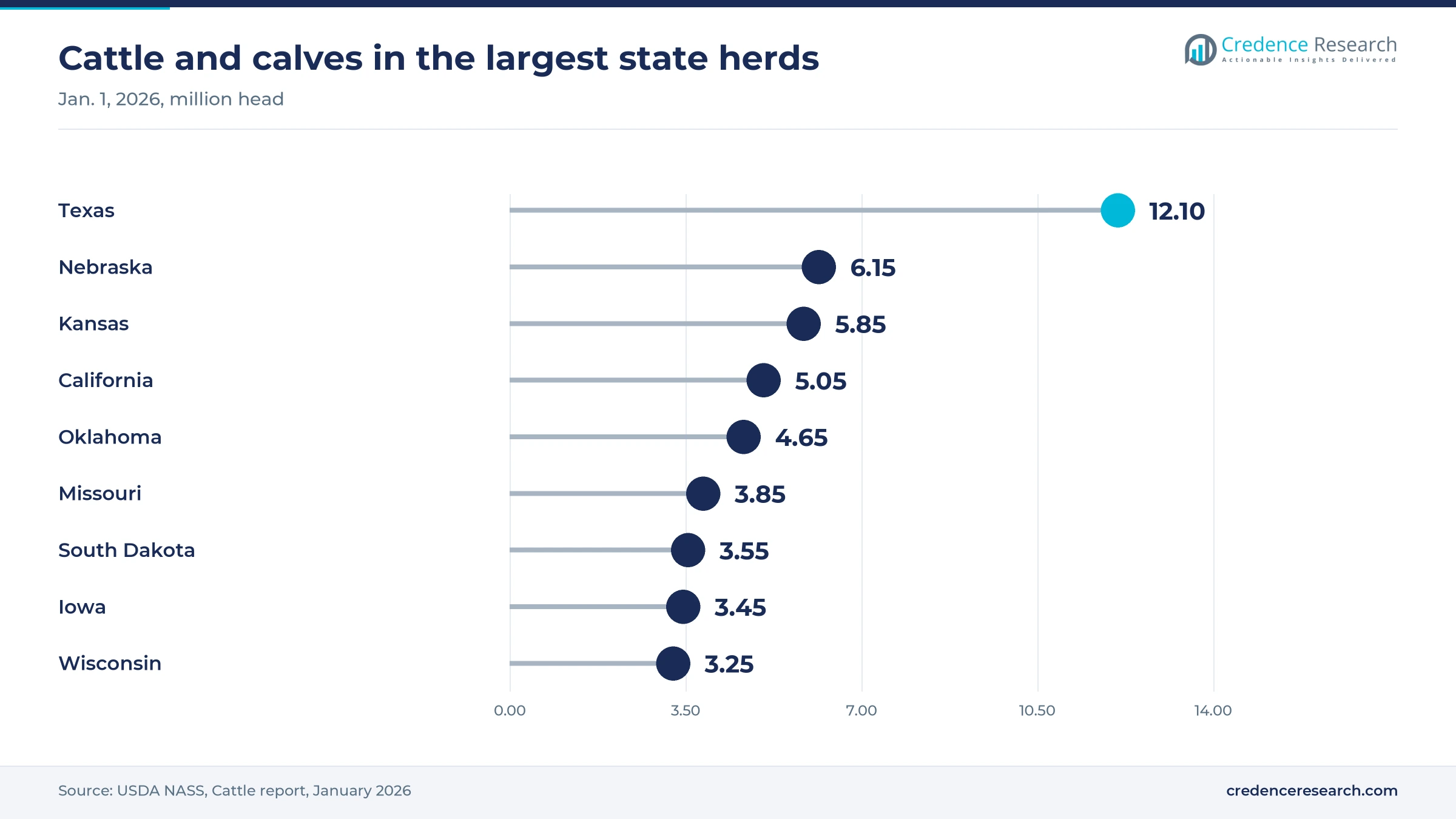
The South held 37.5% of 2025 value and grows at 6.0% a year, the largest regional share of U.S. demand. Texas alone counted 12.1 million cattle on Jan. 1, 2026, and about 748,829 horses in the American Horse Council's 2023 study, the most of any state. All but one of the screwworm cases confirmed by July 2026 were in Texas, and Gov. Greg Abbott and Agriculture Secretary Brooke Rollins opened a sterile fly dispersal site at Moore Air Base near Edinburg in February 2026, RFD-TV reported. Farm stores in the region carry the widest range of wound sprays.
The West grows fastest on insured pets and horse ownership
The West held 25.0% of 2025 value and is the fastest-growing region at 6.3% a year. California accounted for 18.3% of insured U.S. pets in 2024, according to NAPHIA, far ahead of any other state, and Washington and Colorado also rank in the top ten. California also counts about 477,400 horses, the second-largest state horse population in the country. High insurance coverage supports surgery, advanced dressings and laser therapy in specialty hospitals across the region.
The Midwest relies on cattle and farm store channels
The Midwest held 19.5% of 2025 value and grows at 5.3% a year, below the national CAGR for the market. Nebraska counted 6.15 million cattle and Kansas 5.85 million on Jan. 1, 2026, among the largest state herds, so livestock wound products carry more weight here than elsewhere. Missouri, South Dakota and Iowa each held between 3.45 million and 3.85 million head on the same date, which spreads demand across many farm supply counters. Slower herd and population growth keeps the pace below the national rate.
The Northeast leans on specialty hospitals and insured pets
The Northeast held 18.0% of 2025 value and grows at 5.4% a year, the second-slowest regional CAGR. New York held 7.2% of insured U.S. pets in 2024 and Pennsylvania and New Jersey 4.6% each, according to NAPHIA, which supports surgery and specialty wound care in dense urban markets. Milliken's Andover Healthcare unit in Portsmouth, New Hampshire, makes CoFlex Vet bandages in the region, after Milliken acquired the company in June 2019. Small farm herds in the region limit livestock wound care demand.
Emergency authorizations and retail moves, 2024 to 2026
| Development | Status and market relevance |
|---|---|
| In May 2024, Sonoma Pharmaceuticals placed its MicrocynAH wound and skin care line in more than 300 Menards stores in 15 states. | Launched; widens farm and home retail access |
| In September 2025, the FDA conditionally approved Dectomax CA-1 for prevention and treatment of New World screwworm in cattle. | Conditional approval; screwworm prevention and treatment in cattle |
| In March 2026, the FDA issued an emergency use authorization for F10 Antiseptic Wound Spray with Insecticide. | Authorized; topical wound spray for livestock and horses |
| In June 2026, USDA confirmed the first domestic New World screwworm case in 60 years in a Texas calf. | Active response; wound inspection now a priority |
| In August 2026, the FDA authorized CLiK Extra wound spray for emergency use in sheep, cattle, goats and swine. | Authorized; adds a preventive wound spray option |
Closure, cleansing and support products shape practice
- Absorbable monofilament sutures such as PDO close deep tissue layers without a removal visit, which suits owners who avoid rechecks.
- Cohesive bandages such as Vetrap stick to themselves without pins or tape and do not stick to hair, which makes limb wraps faster for staff.
- Hypochlorous acid sprays and gels clean wounds without antibiotics or alcohol and are safe if an animal licks the site.
- Class IV therapy lasers deliver higher power than Class III units, which mainly treat superficial wounds, and reach deeper tissue in fewer sessions.
Need a Custom Version of This Report?
Tailor the scope, geography, or segments to your exact requirements.
- Custom geography or segment scope
- Direct access to our analyst team
Human-care suppliers and pet brands share the market
Competition in U.S. animal wound care turns on clinician trust, distributor reach and retail shelf space rather than on regulatory approvals. Among the suppliers that bring human-grade closure and bandaging products to clinics are B. Braun Vet Care, 3M and Milliken, with 3M's Vetrap and Milliken's CoFlex Vet as familiar names in practice and on the farm. Innovacyn and Sonoma Pharmaceuticals compete for the over-the-counter antimicrobial spray shelf in farm stores and pet chains. Covetrus distributes many of these lines to practices, which gives it influence over which brands clinics try. Small suture makers win on price per box, while Kerecis targets specialty surgeons with biologic grafts. The screwworm emergency has added Health and Hygiene, the maker of F10 products, to the livestock shelf.
Human-care makers, pet brands and distributors share supply
Supply in this market is organized in three distinct layers of companies. Medical device groups that adapt products from human health care, such as B. Braun Vet Care, 3M and Milliken, supply sutures, cohesive bandages and dressings and reach clinics through distributors such as Covetrus. Specialist animal brands such as Innovacyn and Sonoma Pharmaceuticals sell antimicrobial sprays and gels through farm and pet chains as well as clinics. Small suture makers such as CP Medical and Med Vet International compete on price. Entry barriers are low because no premarket review is needed, so margins sit with brands that clinicians trust and that hold retail shelf space.
Wound care suppliers and their U.S. roles
| Company | Type | Role in the market |
|---|---|---|
| B. Braun Vet Care | Device maker | Veterinary wound therapy and AESCULAP clips sold in the U.S. through CP Medical since 2018 |
| Milliken & Company | Device maker | Owns Andover Healthcare, maker of CoFlex Vet cohesive bandages in the USA |
| 3M | Device maker | Vetrap bandaging tape for limb support and bandage securement |
| Innovacyn | Animal health brand | Vetericyn hypochlorous sprays and gels, based in Rialto, California |
| Sonoma Pharmaceuticals | Animal health brand | MicrocynAH retail line and MicrocynVS for clinics |
| CP Medical | Suture maker | Wound closure products for animal health, based in Norcross, Georgia |
| Covetrus | Distributor | Supplies clinics with wound sprays, hydrogels, sutures and dressings |
| Health and Hygiene | Animal health maker | F10 antiseptic wound spray and ointment authorized for screwworm emergency use |
Insurance depth and livestock threats decide growth
Credence Research's view is that clinic surgery will keep supplying most value to 2035, but the direction of growth will be set by insurance depth and by the livestock threat in the South. Each gain in insured pets supports advanced dressings and laser sessions, while the screwworm response keeps farm store sprays moving. Suppliers should build home care kits for owners who decline clinic rechecks, sell cat-sized products and stock screwworm-authorized topicals in Texas and neighboring states. Buyers can expect price competition in sutures and basic dressings to continue.
Values built from animal counts, events and prices
The report uses 2025 as the base year and forecasts to 2035. Market values come from the Credence Research model, built from animal counts, the share of animals with a surgical or wound event each year, products used per event and prices by product type. Regional, segment and channel splits are Credence Research estimates built from these public inputs. Inputs include USDA, FDA and BLS data, AVMA and APPA statistics, NAPHIA insurance data, company releases and filings, and published retail and distributor price listings. No interviews or primary surveys were conducted for this report.
Steady clinic demand with upside from new formats
The United States animal wound care market is set to grow steadily to USD 519.2 million by 2035, as clinic surgery provides a stable base and insured treatment adds higher-value care. Growth will be strongest in therapy devices, in e-commerce and in the West and South. Price competition in sutures and basic dressings will persist, so value growth will come mostly from advanced products. The key variables are the pace of pet insurance growth and how long screwworm control keeps livestock owners treating every wound.
Insurance depth and screwworm control decide the range
The range of outcomes depends on how fast insured pet numbers grow and on how long screwworm keeps livestock owners treating every wound. Faster insurance growth would lift advanced dressings and laser use, while a quick eradication and continued herd decline would slow livestock volumes. Clinic surgery is steady, so most of the spread comes from these two factors.
| Scenario | CAGR, 2026–2035 | Value, 2035 | What has to hold |
|---|---|---|---|
| Downside | 4.3% | USD 456.6 million | Insurance growth slows, owners keep declining care and the cattle herd keeps shrinking |
| Base | 5.83% | USD 519.2 million | Insured pets grow steadily and screwworm treatment stays elevated through 2027 |
| Upside | 7.0% | USD 574.6 million | Insurance coverage doubles and clinics adopt lasers and biologic grafts more widely |
Frequently Asked Questions
How big is the United States animal wound care market?
Which product type leads U.S. animal wound care?
Which region leads demand?
How does pet insurance affect wound care spending?
How has New World screwworm changed the market?
Do veterinary wound products need FDA approval?
Who are the main suppliers in the United States?
What could slow the U.S. animal wound care market?
Table of Content
Chapter 1 Market Segmentation
- 1.1 Segmentation Framework
- 1.1.1 Product and Service Classification
- 1.1.2 Application and End-Use Classification
- 1.1.3 Technology and Solution Classification
- 1.1.4 Customer and Distribution Channel Classification
- 1.1.5 Geographic Segmentation
- 1.1.6 Market Segment Definitions and Boundaries
- 1.2 By Product Type
- 1.2.1 Surgical Wound Care Products
- 1.2.2 Advanced Wound Care Products
- 1.2.3 Traditional Wound Care Products
- 1.2.4 Therapy Devices
- 1.3 By Animal Type
- 1.3.1 Dogs
- 1.3.2 Cats
- 1.3.3 Small Companion Animals
- 1.3.4 Livestock and Equine
- 1.4 By Application
- 1.4.1 Surgical Incision Management
- 1.4.2 Traumatic Wound Management
- 1.4.3 Delayed-Healing Wound Management
Chapter 2 Introduction
- 2.1 Report Objectives and Scope
- 2.2 Product Definition and Industry Terminology
- 2.3 Market Inclusions and Exclusions
- 2.4 Research Process
- 2.4.1 Primary Research and Expert Interviews
- 2.4.2 Secondary Research and Source Review
- 2.4.3 Top-Down and Bottom-Up Estimation
- 2.4.4 Data Triangulation and Verification
- 2.5 Market Size Measurement Basis
- 2.5.1 2025: USD 294.5 million → 2035: USD 519.2 million
- 2.6 Historical and Forecast Reference Periods
- 2.6.1 Historical Period: 2018-2025
- 2.6.2 Base Year: 2025
- 2.6.3 Forecast Period: 2025-2035
- 2.7 Research Assumptions and Limitations
Chapter 3 Executive Summary
- 3.1 Market Snapshot and Key Findings
- 3.2 Base-Year Market Size, 2025
- 3.3 Forecast Market Size, 2035
- 3.4 Revenue and Volume Growth Outlook
- 3.5 Key Demand and Supply Indicators
- 3.6 Leading Market Segments
- 3.7 Fastest-Growing Market Opportunities
- 3.8 Regional Performance Highlights
- 3.9 Technology and Industry Transformation
- 3.10 Competitive Landscape Summary
- 3.11 Analyst View and Strategic Implications
Chapter 4 United States Animal Wound Care Market Trends and Developments
- 4.1 Historical Industry Development, 2018-2025
- 4.2 Recent Market Trends and Developments
- 4.3 Demand and Customer Behavior Trends
- 4.4 Technology and Product Innovation
- 4.5 Artificial Intelligence, Automation and Digitalization
- 4.6 Local Manufacturing and Supply Chain Realignment
- 4.7 Industry Partnerships, Mergers and Acquisitions
- 4.8 Sustainability and Circular Economy Developments
- 4.9 Government and Private Sector Investment Trends
- 4.10 Emerging Business Models and Commercialization
- 4.11 Industry Developments and Announcements
Chapter 5 United States Animal Wound Care Market Production, Supply and Demand Analysis
- 5.1 Demand Trend and Consumption Analysis, 2018-2025
- 5.2 Demand Forecast, 2025-2035
- 5.3 Production and Output Trend, 2018-2025
- 5.4 Production and Output Forecast, 2025-2035
- 5.5 Installed Capacity and Capacity Utilization
- 5.6 Company-Wise Production Plants and Statistics
- 5.6.1 Installed Production Capacity
- 5.6.2 Actual Production
- 5.6.3 Planned Capacity and Expansion Targets
- 5.7 Supply Chain Structure and Procurement Trends
- 5.8 Supply-Demand Gap and Bottlenecks
- 5.9 Import Dependence and Sourcing Structure
- 5.10 Contract Manufacturing and Outsourcing
- 5.11 Regional Supply and Demand Concentration
Chapter 6 United States Animal Wound Care Market Pricing Analysis
- 6.1 Pricing Structure and Measurement
- 6.2 Historical Pricing Trends, 2018-2025
- 6.3 Pricing Outlook, 2025-2035
- 6.4 Average Selling Price and Unit Economics
- 6.5 Pricing by Product and Market Segment
- 6.6 Geographic Pricing Differences
- 6.7 Key Input, Energy, Labor and Logistics Costs
- 6.8 Contract Pricing and Purchasing Models
- 6.9 Pricing Sensitivity and Competitive Positioning
- 6.10 Price, Margin and Profitability Implications
Chapter 7 United States Animal Wound Care Market Dynamics
- 7.1 Market Growth Drivers
- 7.1.1 Demand-Side Drivers
- 7.1.2 Technology and Innovation Drivers
- 7.1.3 Infrastructure and Investment Drivers
- 7.1.4 Regulatory and Policy Drivers
- 7.2 Market Restraints
- 7.2.1 Cost and Affordability Constraints
- 7.2.2 Technology and Adoption Barriers
- 7.2.3 Supply Chain and Operational Constraints
- 7.3 Market Challenges
- 7.3.1 Competitive Pressure and Margin Erosion
- 7.3.2 Skills, Infrastructure and Implementation Gaps
- 7.4 Emerging Market Opportunities
- 7.5 Market Dynamics Impact and Time-Horizon Assessment
Chapter 8 United States Animal Wound Care Value Chain Analysis
- 8.1 Industry Value Chain Overview
- 8.2 Upstream Suppliers and Critical Inputs
- 8.3 Technology and Component Providers
- 8.4 Manufacturing or Service Delivery
- 8.5 Distribution, Channel Partners and Integrators
- 8.6 Downstream Applications and End Users
- 8.7 Value Addition and Profit Pools
- 8.8 Vertical Integration and Outsourcing
- 8.9 Supplier Concentration and Risk
- 8.10 Supply Chain Localization and Resilience
Chapter 9 United States Animal Wound Care Market Regulations and Policies
- 9.1 Relevant Laws, Standards and Compliance Frameworks
- 9.2 Product, Service, Safety and Quality Requirements
- 9.3 Government Policies, Incentives and Subsidies
- 9.4 Imports, Exports and Trade Barriers
- 9.5 Public Procurement and Local Content Requirements
- 9.6 Environmental and Sustainability Compliance
- 9.7 Upcoming Policy Changes and Market Implications
Chapter 10 United States Animal Wound Care Market Hotspots and Opportunities
- 10.1 Market Opportunity Mapping and Growth Hotspots
- 10.2 High-Growth Applications and Customer Groups
- 10.3 Underserved Markets and White-Space Opportunities
- 10.4 Emerging Technology and Product Opportunities
- 10.5 New Capacity and Investment Hotspots
- 10.6 Market Entry and Expansion Opportunities
- 10.7 Distribution and Partnership Opportunities
- 10.8 Near-Term and Long-Term Commercial Potential
- 10.9 Opportunity Attractiveness and Execution Risks
Chapter 11 United States Animal Wound Care Market Outlook, 2025-2035
- 11.1 Market Size and Analysis
- 11.1.1 Revenue (Market Measurement: 2025: USD 294.5 million → 2035: USD 519.2 million)
- 11.1.2 Market Volume and Quantity Sold
- 11.1.3 Historical Market Size, 2018-2025
- 11.1.4 Base-Year Market Size, 2025
- 11.2 Market Forecast, 2025-2035
- 11.2.1 Revenue Forecast to 2035
- 11.2.2 Volume Forecast to 2035
- 11.2.3 CAGR and Year-on-Year Growth
- 11.2.4 Incremental Revenue Opportunity
- 11.3 Forecast Assumptions and Scenario Analysis
- 11.3.1 Base-Case Forecast
- 11.3.2 Optimistic and Conservative Scenarios
- 11.3.3 Technology, Pricing and Policy Sensitivities
- 11.4 Market Attractiveness and Growth Outlook
Chapter 12 United States Animal Wound Care Market Segmentation and Outlook
- 12.1 Segmentation Summary and Market Shares, 2025
- 12.2 Largest and Fastest-Growing Segments
- 12.3 By Product Type - Market Size and Forecast, 2025-2035
- 12.3.1 Segment Definition and Scope
- 12.3.2 Historical Market Size, 2018-2025
- 12.3.3 Revenue Forecast, 2025-2035
- 12.3.4 Volume Forecast, 2025-2035
- 12.3.5 Base-Year Market Share, 2025
- 12.3.6 Segment CAGR and Growth Drivers
- 12.3.7 Subsegment Market Size and Forecast
- 12.3.7.1 Surgical Wound Care Products
- 12.3.7.2 Advanced Wound Care Products
- 12.3.7.3 Traditional Wound Care Products
- 12.3.7.4 Therapy Devices
- 12.3.8 Subsegment Pricing and Adoption Trends
- 12.3.9 Leading Suppliers and Competition
- 12.3.10 Regional Demand and Opportunities
- 12.4 By Animal Type - Market Size and Forecast, 2025-2035
- 12.4.1 Segment Definition and Scope
- 12.4.2 Historical Market Size, 2018-2025
- 12.4.3 Revenue Forecast, 2025-2035
- 12.4.4 Volume Forecast, 2025-2035
- 12.4.5 Base-Year Market Share, 2025
- 12.4.6 Segment CAGR and Growth Drivers
- 12.4.7 Subsegment Market Size and Forecast
- 12.4.7.1 Dogs
- 12.4.7.2 Cats
- 12.4.7.3 Small Companion Animals
- 12.4.7.4 Livestock and Equine
- 12.4.8 Subsegment Pricing and Adoption Trends
- 12.4.9 Leading Suppliers and Competition
- 12.4.10 Regional Demand and Opportunities
- 12.5 By Application - Market Size and Forecast, 2025-2035
- 12.5.1 Segment Definition and Scope
- 12.5.2 Historical Market Size, 2018-2025
- 12.5.3 Revenue Forecast, 2025-2035
- 12.5.4 Volume Forecast, 2025-2035
- 12.5.5 Base-Year Market Share, 2025
- 12.5.6 Segment CAGR and Growth Drivers
- 12.5.7 Subsegment Market Size and Forecast
- 12.5.7.1 Surgical Incision Management
- 12.5.7.2 Traumatic Wound Management
- 12.5.7.3 Delayed-Healing Wound Management
- 12.5.8 Subsegment Pricing and Adoption Trends
- 12.5.9 Leading Suppliers and Competition
- 12.5.10 Regional Demand and Opportunities
- 12.6 Segment Growth Comparison
- 12.7 Segment Attractiveness and Priority Matrix
Chapter 13 United States Animal Wound Care End-Use and Application Market Outlook
- 13.1 End-Use Industry and Customer Demand Structure
- 13.2 Leading Applications and Customer Groups
- 13.3 End-Use Market Size, Share and Forecast
- 13.4 Major End-Use Industry Deep Dives
- 13.4.1 Customer Requirements and Use Cases
- 13.4.2 Demand and Replacement Cycles
- 13.4.3 Technical and Regulatory Considerations
- 13.4.4 Purchasing and Procurement Models
- 13.4.5 Leading Vendors and Distribution Channels
- 13.4.6 Forecast and Commercial Opportunities
- 13.5 Emerging Applications and Cross-Segment Demand
- 13.6 End-Use Industry Investment Priorities
Chapter 14 United States Animal Wound Care Geographic Market Outlook, 2025-2035
- 14.1 Domestic Market Distribution and Demand Clusters
- 14.2 State- or Province-Wise Market Size and Forecast, 2025-2035
- 14.3 City and Metropolitan Market Outlook
- 14.4 Industrial, Manufacturing and Commercial Clusters
- 14.5 Geographic Concentration of Key End Users
- 14.6 Local Pricing and Purchasing Differences
- 14.7 Domestic Production Facilities and Capacity Map
- 14.8 Local Infrastructure and Project Pipeline
- 14.9 State-Level Policy and Incentive Differences
- 14.10 Subnational Investment Hotspots and Opportunities
- 14.11 Distribution and Logistics Networks
- 14.12 Domestic Competitive Footprint
Chapter 15 United States Animal Wound Care Technology, Innovation and Sustainability Outlook
- 15.1 Technology Landscape and Maturity
- 15.2 Product, Process and Service Innovation
- 15.3 AI, Automation and Digital Tools in the Industry
- 15.4 Technology Adoption and Performance Benchmarking
- 15.5 Innovation Pipeline and R&D Investment
- 15.6 Patent and Intellectual Property Trends
- 15.7 Energy Efficiency and Resource Management
- 15.8 Sustainability, Recycling and Circularity
- 15.9 Technology Roadmap, 2025-2035
- 15.10 Risks of Obsolescence and Technology Substitution
Chapter 16 United States Animal Wound Care Market Key Strategic Imperatives
- 16.1 Growth and Market Entry Priorities
- 16.2 High-Return Products and Segments
- 16.3 Pricing, Profitability and Cost Optimization
- 16.4 Technology Investment and Product Differentiation
- 16.5 Supply Chain Localization and Resilience
- 16.6 Distribution and Customer Acquisition
- 16.7 Partnership, Acquisition and Capacity Strategy
- 16.8 Regional Expansion Priorities
- 16.9 Short-, Medium- and Long-Term Actions
Chapter 17 Competition Outlook
- 17.1 Industry Competition Characteristics
- 17.2 Market Structure and Concentration
- 17.3 Market Share and Competitive Positioning, 2025
- 17.4 Company-Wise Revenue and Product Benchmarking
- 17.5 Production and Service Capacity Benchmarking
- 17.6 Technology, Pricing and Differentiation
- 17.7 Regional Footprint and Distribution Strength
- 17.8 Mergers, Acquisitions and Strategic Alliances
- 17.9 New Entrants and Competitive Threats
- 17.10 Porter's Five Forces and Industry Attractiveness
- 17.11 Competitive Outlook, 2025-2035
Chapter 18 Company Profiles
- 18.1 Company Coverage and Selection Criteria
- 18.2 B. Braun Vet Care
- 18.2.1 Business Description
- 18.2.2 Company Ownership and Geographic Presence
- 18.2.3 Product and Service Portfolio
- 18.2.4 Manufacturing and Operating Footprint
- 18.2.5 Production Capacity and Expansion Plans
- 18.2.6 Financial Performance and Investment
- 18.2.7 Market Share and Competitive Position
- 18.2.8 Technology and Innovation Capabilities
- 18.2.9 Strategic Alliances or Partnerships
- 18.2.10 Recent Developments
- 18.2.11 Growth Strategy and Outlook
- 18.3 Milliken & Company
- 18.4 3M
- 18.5 Innovacyn
- 18.6 Sonoma Pharmaceuticals
- 18.7 CP Medical
- 18.8 Med Vet International
- 18.9 Covetrus
- 18.10 Kerecis
- 18.11 Health and Hygiene
- 18.12 Other Relevant Market Participants
Note: Every listed company is profiled on the structure shown under the first company. The company list is preliminary and may change based on research findings, market developments, data availability and client requirements.
Chapter 19 Disclaimer
- 19.1 Research and Forecast Disclaimer
- 19.2 Data Source and Estimation Limitations
Note: The depth of individual sections depends on data availability for this market. Volume, capacity, trade and other unit-based metrics are included where applicable.

