
Foley avoidance turned a niche device into hospital routine
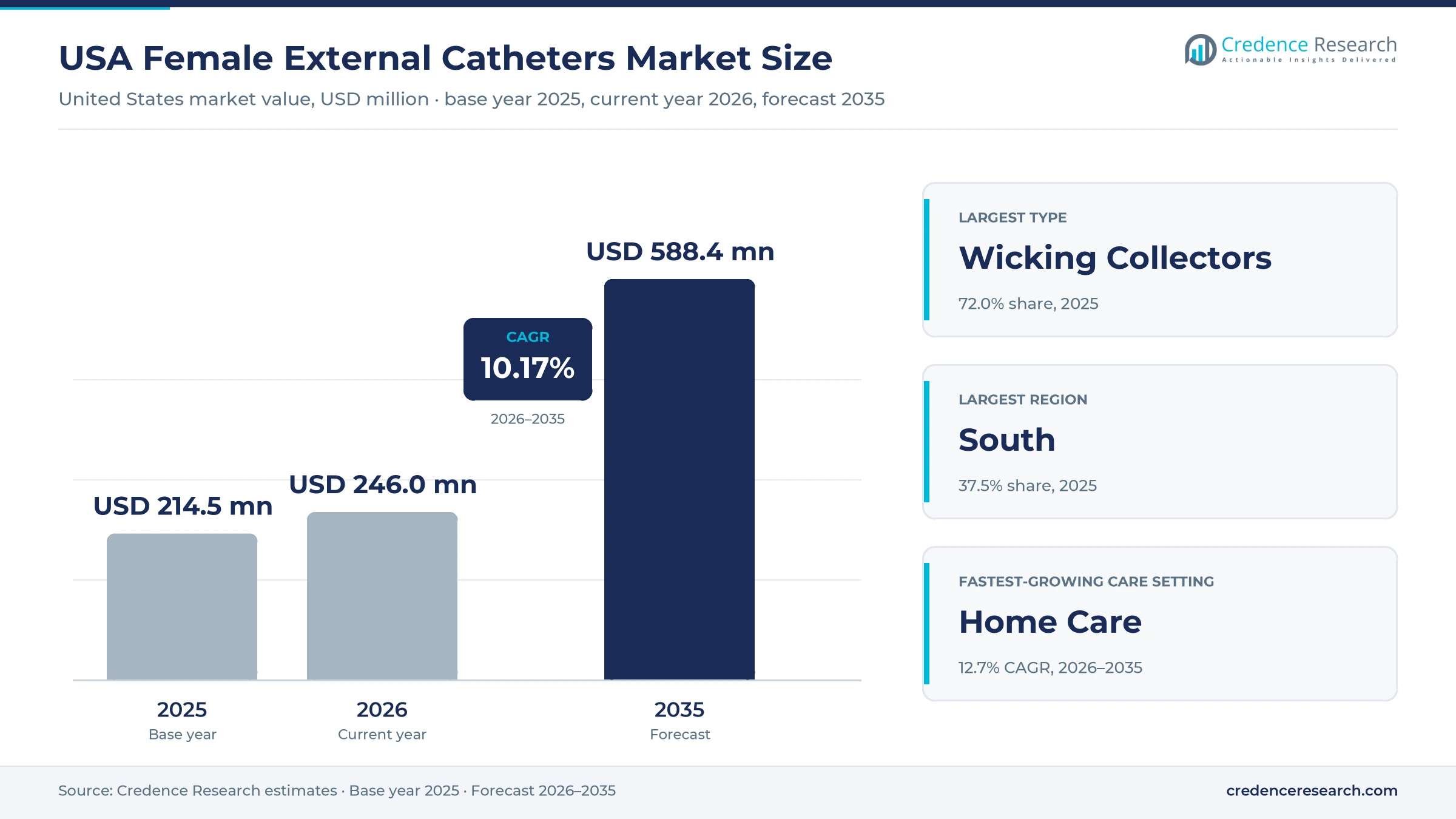
The USA female external catheters market was valued at USD 214.5 million in 2025 and is projected to increase from USD 246.0 million in 2026 to USD 588.4 million by 2035, registering a CAGR of 10.17% during 2026–2035. Demand comes from hospitals that replace indwelling Foley catheters with non-invasive collectors to lower infection risk, and from women with limited mobility who manage incontinence at home or in rehabilitation. The South held the largest regional share, 37.5% in 2025, and it is also the fastest-growing region at 10.6% a year because its older population is the largest and is growing quickest. Acute care hospitals buy most units through direct supplier contracts, while home use is the fastest-growing care setting. The most important commercial change is the move of suction-based systems from hospital wall outlets into battery and bedside pumps sold directly to patients, which brings monthly supply purchases into the home.
Single-use collectors placed against the body replace the Foley
The market counts single-use devices that sit outside the body against the female anatomy and draw urine away, either through a wicking pad connected to suction, through a suction cup without a wick, or by gravity into a bag. Hospitals, rehabilitation centers, nursing homes and patients at home buy the devices together with tubing, canisters and, for home use, a dedicated pump.
The count excludes indwelling Foley and intermittent catheters, male external catheters, absorbent briefs and pads, and the hospital wall suction systems themselves. Value sits with the device brands and with the distributors and home supply companies that deliver monthly refills.
USA Female External Catheters Market Insights
- The USA female external catheters market rises from USD 214.5 million in 2025 to USD 588.4 million by 2035, growing at 10.17% a year as hospitals and homes adopt them.
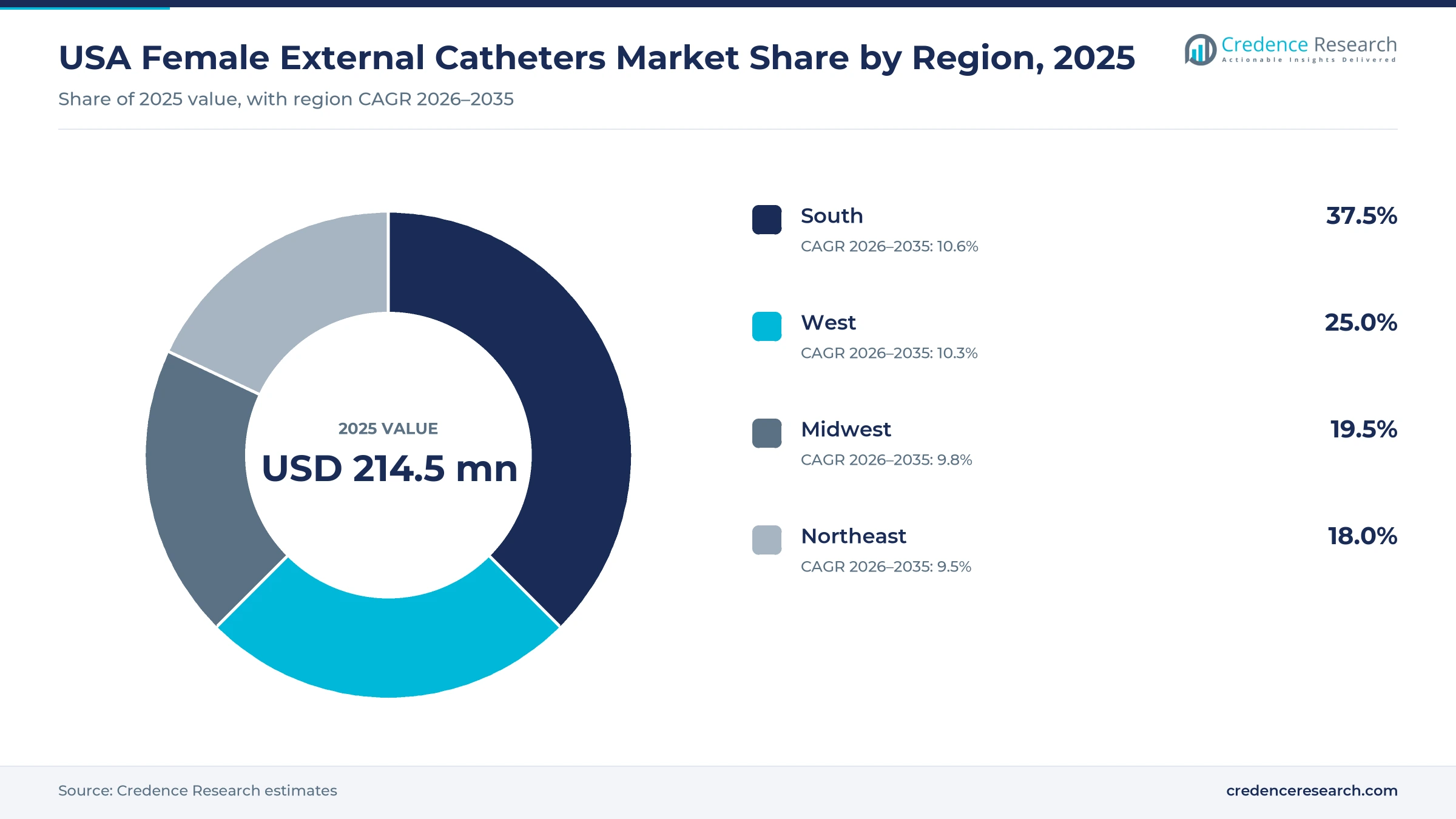
- The South held 37.5% of 2025 value, the largest share of any region, and also grows fastest at 10.6% a year.
- Wicking collectors held 72.0% of 2025 value because the leading hospital brands all use a wicking pad with low suction.
- BD launched a battery-powered PureWick Portable Collection System in November 2025 that mounts on a wheelchair for use outside the home.
- Wellspect HealthCare completed its U.S. Surity portfolio in August 2026 with a home urine collection device, adding a new home competitor.
Wicking collectors lead as home care grows fastest
Wicking collectors dominate because leading brands share the design
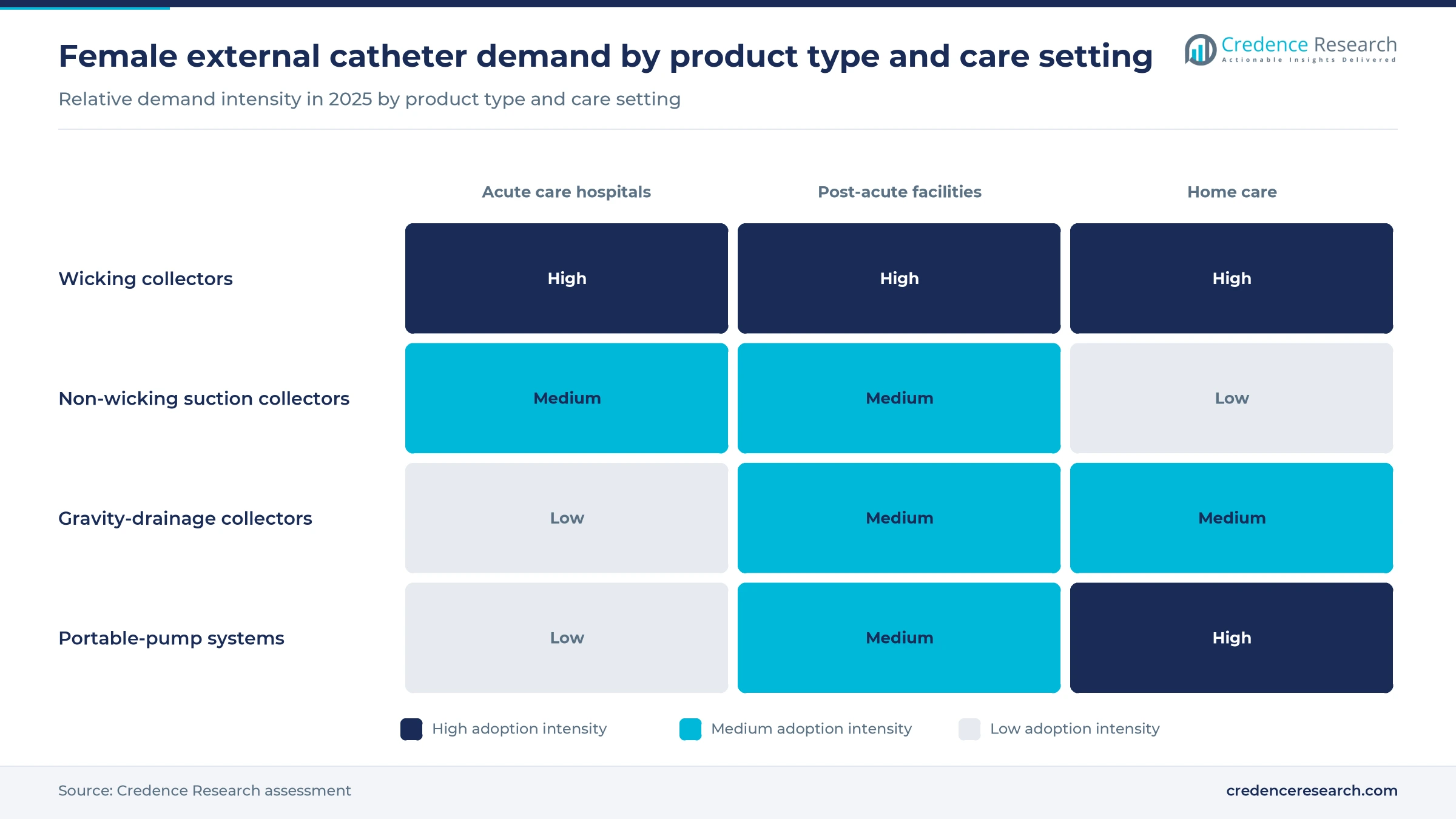
Based on product type, the market is categorized into wicking collectors, non-wicking suction collectors and gravity-drainage collectors. Wicking Collectors led with 72.0% of 2025 value and also grows fastest at 10.4% a year, because the three largest hospital brands, BD PureWick, Stryker's Sage PrimaFit and Medline Versette, all pair a fabric wick with low suction, and BD reported continued double-digit PureWick growth in its May 2026 earnings call. Gravity designs grow slowest because hospital protocols are written around suction, with Stryker specifying a minimum of 60 mmHg.
Acute hospitals buy most units while home care grows fastest
Based on care setting, the market is categorized into acute care hospitals, post-acute facilities and home care. Acute Care Hospitals led with 58.0% of 2025 value because intensive care and ward nurses use these collectors as the main alternative to the Foley. Home Care grows fastest at 12.7% a year as BD's home store now sells a starter set that pairs a pump with 30 catheters, listed in November 2026, alongside monthly refills. Such kits let home suppliers reach women discharged from hospital and rehabilitation stays, so the first pump placement sets up years of refills.
Direct hospital contracts lead as home supply channels expand
Based on channel, the market is categorized into direct institutional contracts, medical-surgical distribution and home medical supply channels. Direct Institutional Contracts led with 52.0% of 2025 value because BD sells its system directly to more than 4,500 U.S. hospitals and rehabilitation facilities, according to its November 2025 release. Home Medical Supply Channels grow fastest at 12.3% a year as BD's PureWick home store ships catheters, canisters and pumps to patients on monthly autoship. Distributors keep a large role in smaller hospitals and nursing homes that buy through group purchasing contracts.
Functional incontinence leads while neurological care grows fastest
Based on disease area, the market is categorized into neurological conditions, postoperative conditions and functional urinary incontinence. Functional Urinary Incontinence led with 40.0% of 2025 value because 63% of U.S. women aged 20 and older, about 79.5 million, reported urinary incontinence in NHANES data from 2021 to 2023, according to an International Continence Society abstract in 2025. Neurological Conditions grow fastest at 10.8% a year as the CDC counts more than 795,000 strokes a year, and stroke reduces mobility in more than half of survivors aged 65 and older.
| Segment Group | Leading Sub-segment | Share, 2025 | Fastest-growing Sub-segment | CAGR, 2026–2035 |
|---|---|---|---|---|
| By Product Type | Wicking Collectors | 72.0% | Wicking Collectors | 10.4% |
| By Care Setting | Acute Care Hospitals | 58.0% | Home Care | 12.7% |
| By Channel | Direct Institutional Contracts | 52.0% | Home Medical Supply Channels | 12.3% |
| By Disease Area | Functional Urinary Incontinence | 40.0% | Neurological Conditions | 10.8% |
Catheters cost about seven dollars each before pumps
Hospitals buy female external catheters per case under contract, while home users pay per box or through a monthly supply code, and most women change the device every 12 to 24 hours. That replacement rate makes the catheter a refill item, so the pump or wall outlet is a one-time cost and the wick is the recurring revenue. Cash buyers at home see list prices close to the BD store price in the table, while commercial plans pay a monthly supply rate for code A6590. Suppliers that win the first pump placement usually keep the monthly refill, which makes starter-kit discounts a common way to lock in home users.
| Offer or benchmark | Typical price or fee | Basis |
|---|---|---|
| PureWick Flex catheters, box of 30 | USD 209.70 a box, USD 199.21 on autoship, about USD 7 each | BD PureWick home store listing, November 2026 |
| PureWick starter set with pump and 30 catheters | USD 538.70 with a 10% first-order discount | BD PureWick home store listing, November 2026 |
| PureWick catheters, box of 30, third-party seller | USD 255.75 a box | Walmart marketplace listing, November 2026 |
| Medline Versette external catheter, single unit | USD 17.21 each, USD 12.05 on first autoship | Carewell listing, November 2026 |
| A6590 monthly supply, commercial payer averages | USD 272.87 (UnitedHealthcare) to USD 379.82 (Cigna) a month | PayerPrice rate summary, November 2026 |
Request a Free Sample
Fill in your details and we'll send you a free sample report.
- Sample data tables & charts
- Research methodology
Aging, CAUTI penalties and new designs lift demand
More older adults needing assisted care
Population aging enlarges the group of women who cannot reach a toilet unaided, and they are the core users of these collectors. The Census Bureau counted 64.6 million Americans aged 65 and older in July 2025, 16.2% more than in April 2020, while the total population grew only 3.1%. Many older women move between hospital, rehabilitation and home after a fall or surgery, and each move needs a new continence plan. The South, the largest regional market, also had the fastest growth in older residents at 17.5%. Home care is the fastest-growing setting, so the aging curve now feeds home refill demand as well as hospital use.
Institutional catheter-reduction protocols raise hospital use
Hospitals buy external collectors mainly to avoid indwelling catheters, the main source of infection in this patient group. The CDC says about 75% of urinary tract infections acquired in hospitals involve a urinary catheter, and 15% to 25% of inpatients receive one. Under the CMS Hospital-Acquired Condition Reduction Program, hospitals above the 75th percentile of the total score, which includes CAUTI, lose 1% of Medicare payments. A Cureus study published in October 2020 found that CAUTI rates among female intensive care patients fell from 3.14 to 1.42 per 1,000 catheter days after a female external device was introduced. These penalties and results keep collectors on nurse-driven protocols that replace indwelling urinary drainage devices.
Female-collector product development widens the user base
New designs move the device beyond the hospital bed, which opens care settings that earlier products could not serve. BD launched the PureWick Portable Collection System on Nov. 12, 2025, with up to eight hours of battery life and a mount for wheelchairs, and said more than 55 million PureWick external catheters had been sold. On April 9, 2026, BD reported a randomized trial of 165 women at 13 U.S. sites, published in the Journal of Clinical Medicine, in which about 70% wanted to keep using the Flex catheter. Better fit and mobility lift daytime use, which matters most for women with limited mobility who live at home.
Medicare coding gives home suction systems a payment path
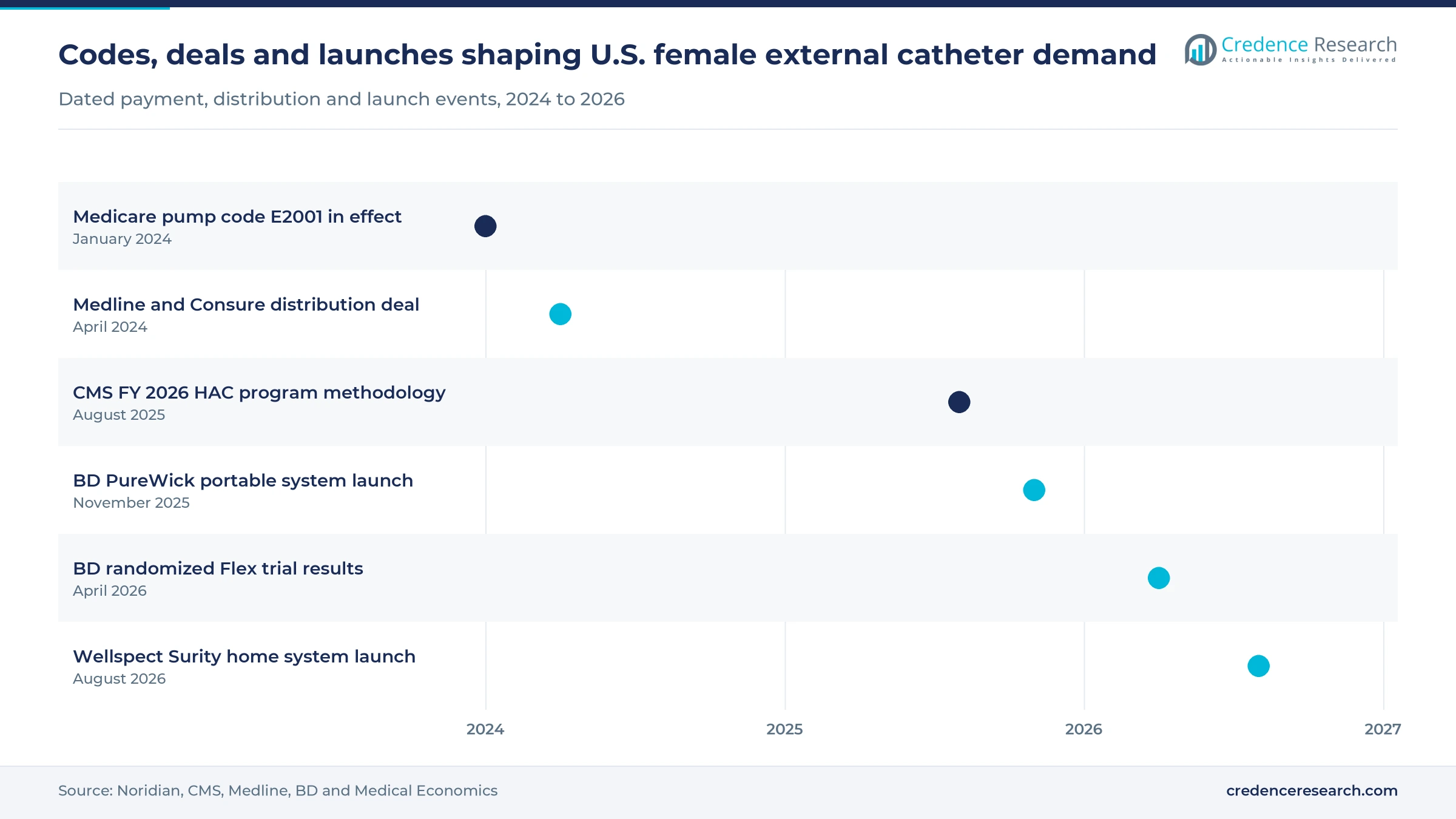
Home use depends on a clear way to bill pumps and monthly supplies, and Medicare has built one in stages. Noridian, the Medicare DME contractor, lists code A6590 for monthly external catheter supplies from April 1, 2023, with canisters and tubing under A7001 and A7002 from the same date. Suction pumps moved from a temporary code to E2001 on Jan. 1, 2024. Commercial plans also pay a monthly rate for the same supply code, as the pricing table shows, which gives suppliers a second payer base. Home medical supply channels grow at 12.3% a year as suppliers use these codes to serve women after hospital discharge.
Portable pumps and second-source brands reshape supply
A shift from wall suction to portable and bedside pumps
Suction-based collectors are moving away from hospital wall outlets toward dedicated pumps that patients can use at home. Medical Economics reported on Aug. 20, 2026, that Wellspect HealthCare had launched its Surity Urinary Management System in the United States, a home suction unit with an on-demand Boost button and carbon odor filters, and Wellspect cites more than 13 million Americans living with urinary incontinence. The launch completed Wellspect's U.S. Surity range of female and male external catheters. BD's wheelchair-mounted portable system, noted above, runs up to eight hours on battery and takes the same approach outside the home. Home care grows faster than acute care, at 12.7% a year, which shifts value toward suppliers that sell a pump with monthly refills.
Rising use of second-source brands in hospitals
Hospitals that once standardized on one brand now compare several, which strengthens distributors and challenger makers. Medline became the exclusive U.S. acute care distributor for Consure Medical's QiVi MEC male device on April 2, 2024, which puts Consure's external collection range in front of Medline's hospital accounts. Medline also sells its own Versette external catheter, which runs on 40 to 60 mmHg of suction. BD's own product page benchmarks the PureWick Flex against Sage PrimaFit, Medline Versette and Consure QiVi in bench tests at 18 and 24 mL a second, which confirms a four-brand contest. Medical-surgical distribution holds a large share of hospital buying, so value analysis committees can switch brands at contract renewal.
Post-acute and rehabilitation sites offer an infection-control opening
Post-acute facilities lag hospitals on urinary infection control, which creates room for external collectors outside acute care. The CDC's 2024 HAI progress report shows a 10% national drop in CAUTI in acute care hospitals, with a 15% drop in intensive care units. Inpatient rehabilitation facilities performed worse than the 2015 baseline in seven states, while only four states did better. BD already reports use in more than 4,500 hospitals and rehabilitation facilities, as noted above. Rehabilitation and long-term acute care sites are therefore a clear target, and suppliers that bundle training into hospital-acquired infection control programs can win these sites.
Overnight continence support at home is an underserved opening
Many women manage nighttime leakage with pads, which leaves a large group that an external collector can serve better at home. The NHANES-based prevalence of 63%, about 79.5 million women, implies a very large pool of potential users, yet only a small share uses a suction device. Large commercial payers pay USD 272.87 to USD 379.82 a month for the A6590 supply code, according to PayerPrice, which makes a refill program viable once a woman is covered. Women who now rely on adult incontinence products such as briefs are the main conversion target. Women requiring overnight continence support are therefore the clearest home growth group for suppliers with a pump and refill offer.
Skin injury, home costs and suction needs slow uptake
Skin and pressure injuries put device use under review
Device-related skin damage can lead nurses to remove collectors and return to pads or catheters. An FDA MAUDE report describes a June 3, 2025, event in which a PureWick catheter was linked to a stage III labial pressure ulcer and a deep tissue injury. BD's labeling bars use on broken skin and in urinary retention. Hospitals that track pressure injuries then add skin checks and pressure ulcer treatment products to protocols, which raises nursing time. Suppliers respond with softer materials, sizing guides and bedside staff training programs.
Cash costs at home deter women without coverage
Women who lack supply coverage pay full price for a device they change every day. A box of 30 PureWick Flex catheters lists at USD 209.70 on BD's home store, and the starter set with a pump lists at USD 538.70 after a first-order discount. That puts yearly catheter costs above USD 2,500 for daily users who pay cash. Many women therefore stay with cheaper pads, so wider Medicaid and commercial coverage of code A6590 would lift home demand.
Mixed evidence on lasting infection reductions
Hospitals need proof that infection savings last, and the published evidence is still uneven. The 2020 Cureus study notes that one earlier inpatient study found an initial CAUTI decrease that was not sustained after one year. CAUTI also fell 10% nationally in 2024, according to the CDC, so many hospitals now have less room to show further gains. Value analysis committees may then question renewals, and suppliers answer with outcome data from multisite trials.
Dependence on steady suction and correct placement
Most collectors work only with reliable low suction and correct placement, which ties results to equipment and nurse skill. Stryker instructs users to set continuous suction at a minimum of 60 mmHg for PrimaFit and to replace the device every 12 to 24 hours. Units that lack enough medical suction units or trained staff see more leaks and skin moisture. Suppliers mitigate this with dedicated pumps and bedside training programs.
The South leads on the largest and fastest-aging base
| Region | Value, 2025 (USD million) | Share, 2025 | CAGR, 2026–2035 |
|---|---|---|---|
| South | 80.4 | 37.5% | 10.6% |
| West | 53.6 | 25.0% | 10.3% |
| Midwest | 41.8 | 19.5% | 9.8% |
| Northeast | 38.6 | 18.0% | 9.5% |
The South leads on the largest and fastest-aging base
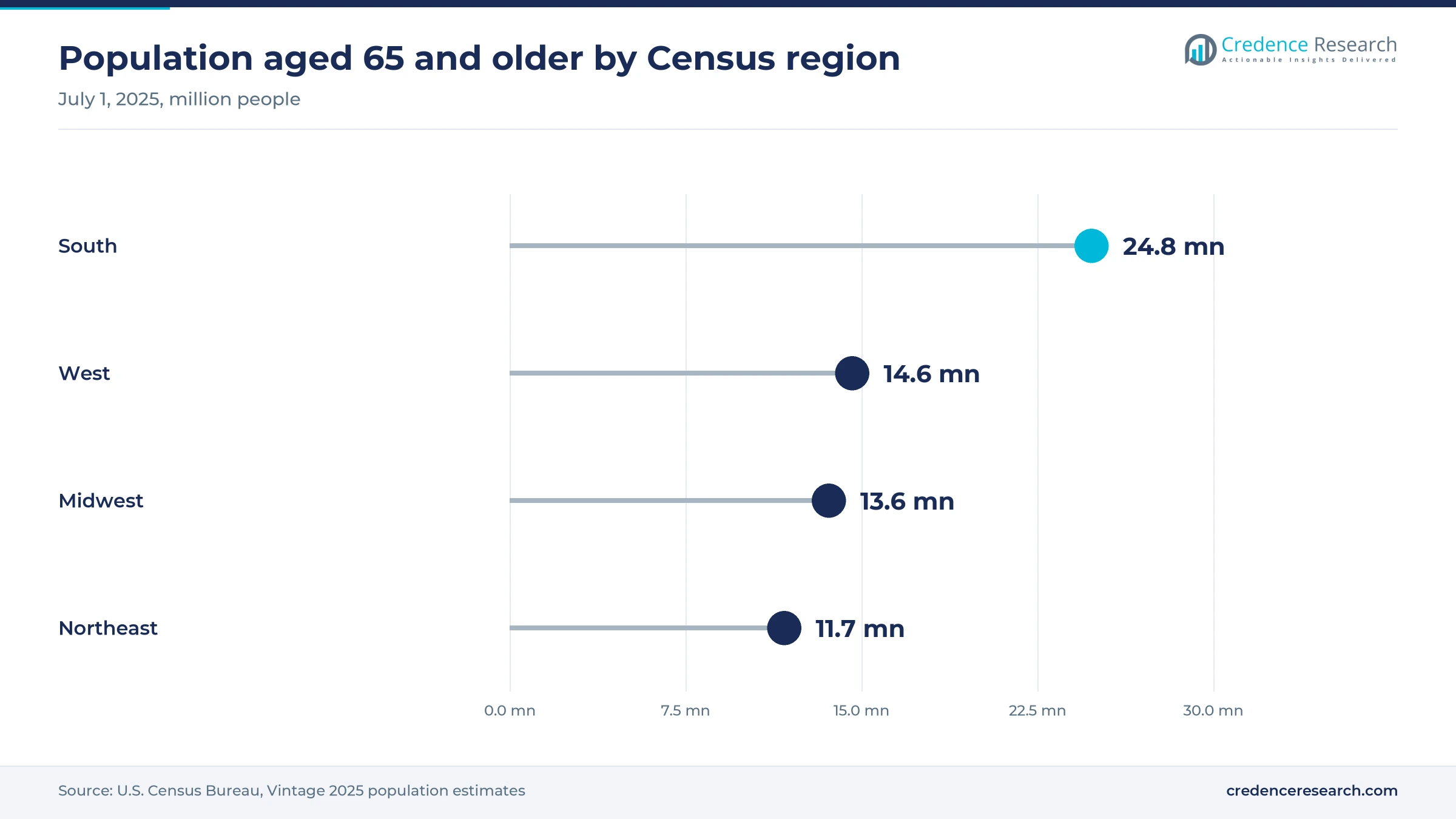
The South held 37.5% of 2025 value and grows at 10.6% a year, both the highest of the four regions. The Census Bureau counted 24.8 million residents aged 65 and older in the South in July 2025, up 17.5% since April 2020, the fastest gain of any region. Its total population also rose 6.0% over the same period, so both hospital admissions and the pool of older women who need home refills are growing faster than elsewhere.
The West grows on older residents and home supply reach
The West held 25.0% of 2025 value and grows at 10.3% a year. Its population aged 65 and older reached 14.6 million in July 2025, up 16.5% since April 2020, close to the South's pace. Long travel distances to clinics in Mountain states favor home supply programs that ship catheters and canisters on monthly schedules, which supports the region's home care growth.
The Midwest holds steady on hospital and post-acute demand
The Midwest held 19.5% of 2025 value and grows at 9.8% a year. The region had 13.6 million residents aged 65 and older in July 2025, up 14.7% since 2020, while its total population grew only 1.1%. Demand rests on academic medical centers and a dense network of rehabilitation and nursing facilities, which buy through group purchasing contracts and distributors rather than direct home programs.
The Northeast grows slowest from an older but stable base
The Northeast held 18.0% of 2025 value and grows at 9.5% a year, the slowest pace of the four regions. The region had 11.7 million residents aged 65 and older in July 2025, up 14.6% since 2020, while total population rose only 0.7%. High hospital density keeps acute care use strong, but slower population growth limits new home users, so suppliers focus on contract renewals and post-acute sites.
Launches and Medicare coding changes, 2024 to 2026
| Development | Status and market relevance |
|---|---|
| In January 2024, Medicare moved home suction pumps for external catheters to code E2001. | In force; gives home suppliers a separate billing path |
| In November 2025, BD launched the PureWick Portable Collection System, a battery-powered pump for wheelchair users. | Launched; extends suction collection outside the home |
| In August 2026, Wellspect HealthCare launched its Surity Urinary Management System in the United States. | Launched; completes a rival home suction range |
Suction source and wicking design decide product choice
- Wall-suction operation connects the collector to a hospital vacuum outlet through a regulator set to low continuous suction, which suits beds in acute care.
- Portable-pump operation uses a battery or bedside pump with its own canister, which lets women use the device at home or in a wheelchair.
- Passive gravity drainage routes urine into a bag without power, which costs less but depends on body position to avoid leaks.
- Wicking fabric pads pull urine away from the skin into the suction line, which lowers moisture exposure and the risk of incontinence-associated dermatitis.
Need a Custom Version of This Report?
Tailor the scope, geography, or segments to your exact requirements.
- Custom geography or segment scope
- Direct access to our analyst team
One brand leader faces hospital and home challengers
Competition in the U.S. market turns on hospital contracts, clinical evidence and home refill programs rather than on list price alone. BD leads with its PureWick system across hospitals, rehabilitation facilities and a direct home store that ships monthly refills. Stryker sells Sage PrimaFit as part of a wider patient-care range, which helps it bundle collectors into hospital contracts. Medline competes with its own Versette device, which runs on 40 to 60 mmHg of suction, backed by the reach of its hospital distribution network. Boehringer Laboratories brings suction regulation know-how and its CareDry collector. Wellspect HealthCare is the newest home challenger after its 2026 Surity launch. Buyers in value analysis committees compare capture rates, skin outcomes and cost per patient day before switching brands.
One brand leader, three hospital challengers and new home entrants
Supply is concentrated around a single reference brand in hospitals and homes. BD, through its PureWick line, is the reference brand in hospitals and the only supplier with a large direct-to-patient home program. Stryker's Sage PrimaFit, Medline's Versette and Consure Medical's QiVi form a challenger tier sold through hospital contracts and distribution, while Boehringer Laboratories adds suction regulation and its CareDry device. Wellspect HealthCare entered U.S. home care in 2026 with its Surity system. Entry barriers sit less in manufacturing than in clinical evidence, value analysis approval and Medicare DME billing, so margins sit with brands that hold hospital contracts and home refill subscriptions.
Companies profiled and their roles in this market
| Company | Type | Role in the market |
|---|---|---|
| BD | Full-line supplier | PureWick female external catheters, home and portable pumps, sold direct to hospitals and patients |
| Stryker (Sage) | Patient-care supplier | Sage PrimaFit female external urine management device for hospital wall suction |
| Medline | Manufacturer and distributor | Versette female external catheter sold to hospitals through its own distribution network |
| Consure Medical | Specialist | QiVi female and male external urine management devices for U.S. hospitals |
| Boehringer Laboratories | Suction specialist | CareDry female external catheter and suction regulators for hospital collectors |
| Wellspect HealthCare (Dentsply Sirona) | Continence specialist | Surity female external catheter and home suction system launched in 2026 |
Home use is the swing factor to 2035
Credence Research's view is that hospitals will keep using female external catheters as a standard Foley alternative, but the larger change to 2035 will come from home use. Each new home pump, such as BD's portable system and the Wellspect Surity unit, turns a hospital patient into a monthly refill customer. Suppliers should invest in home coverage, starter kits and skin-safety evidence, while hospital buyers can use the four-brand contest to negotiate contract prices. The key risk is a rise in skin injury reports that slows adoption in hospitals and nursing homes.
Market values built from device use and net prices
The report uses 2025 as the base year and forecasts to 2035. Market values come from the Credence Research model, built from device use per patient day in hospitals and post-acute sites, home users and their monthly supply use, and net prices per device and pump. Regional, segment and channel splits are Credence Research estimates built from these same public inputs. Inputs include Census Bureau and CDC statistics, CMS and Medicare contractor documents, FDA device records, peer-reviewed studies, company announcements and earnings calls, and published retail price listings. No interviews or primary surveys were conducted for this report.
Home growth outpaces hospital demand to 2035
The USA female external catheters market is set to grow to USD 588.4 million by 2035, as hospital Foley-avoidance protocols provide a steady base and home pumps add the faster-growing stream. Growth will be strongest in home care, home medical supply channels and the South. Hospital prices are likely to soften as challenger brands win contracts, so value growth in acute care will lag unit growth. The key variables are coverage of monthly home supplies and the safety record on skin injury, followed by any change to the CMS infection penalty programs.
Home coverage decides where the 2035 value lands
The range of outcomes depends mostly on how fast home use spreads beyond cash buyers and on whether hospitals keep expanding Foley-avoidance protocols. Broader commercial and Medicaid coverage of monthly supplies would lift home demand, while repeated skin injury reports or weaker CAUTI penalties would slow hospital adoption. Hospital demand is steadier, so most of the spread comes from home care.
| Scenario | CAGR, 2026–2035 | Value, 2035 | What has to hold |
|---|---|---|---|
| Downside | 8.2% | USD 498.8 million | Home coverage stays narrow and hospitals cap use after skin injury reviews |
| Base | 10.17% | USD 588.4 million | Hospital protocols keep expanding and home use grows through Medicare and cash buyers |
| Upside | 11.7% | USD 664.3 million | Commercial and Medicaid plans cover monthly supplies and portable pumps spread widely |
Frequently Asked Questions
How big is the USA female external catheters market?
Which product type leads the U.S. market?
Which region leads U.S. demand for female external catheters?
Why do hospitals use female external catheters?
Does Medicare pay for home female external catheter systems?
Which care setting grows fastest?
Who are the main suppliers in the United States?
What could slow the U.S. market?
Table of Content
Chapter 1 Market Segmentation
- 1.1 Segmentation Framework
- 1.1.1 Product and Service Classification
- 1.1.2 Application and End-Use Classification
- 1.1.3 Technology and Solution Classification
- 1.1.4 Customer and Distribution Channel Classification
- 1.1.5 Geographic Segmentation
- 1.1.6 Market Segment Definitions and Boundaries
- 1.2 By Product Type
- 1.2.1 Wicking Collectors
- 1.2.2 Non-Wicking Suction Collectors
- 1.2.3 Gravity-Drainage Collectors
- 1.3 By Care Setting
- 1.3.1 Acute Care Hospitals
- 1.3.2 Post-Acute Facilities
- 1.3.3 Home Care
- 1.4 By Channel
- 1.4.1 Direct Institutional Contracts
- 1.4.2 Medical-Surgical Distribution
- 1.4.3 Home Medical Supply Channels
- 1.5 By Disease Area
- 1.5.1 Functional Urinary Incontinence
- 1.5.2 Neurological Conditions
- 1.5.3 Postoperative Conditions
Chapter 2 Introduction
- 2.1 Report Objectives and Scope
- 2.2 Product Definition and Industry Terminology
- 2.3 Market Inclusions and Exclusions
- 2.4 Research Process
- 2.4.1 Primary Research and Expert Interviews
- 2.4.2 Secondary Research and Source Review
- 2.4.3 Top-Down and Bottom-Up Estimation
- 2.4.4 Data Triangulation and Verification
- 2.5 Market Size Measurement Basis
- 2.5.1 2025: USD 214.5 million → 2035: USD 588.4 million
- 2.6 Historical and Forecast Reference Periods
- 2.6.1 Historical Period: 2018-2025
- 2.6.2 Base Year: 2025
- 2.6.3 Forecast Period: 2025-2035
- 2.7 Research Assumptions and Limitations
Chapter 3 Executive Summary
- 3.1 Market Snapshot and Key Findings
- 3.2 Base-Year Market Size, 2025
- 3.3 Forecast Market Size, 2035
- 3.4 Revenue and Volume Growth Outlook
- 3.5 Key Demand and Supply Indicators
- 3.6 Leading Market Segments
- 3.7 Fastest-Growing Market Opportunities
- 3.8 Regional Performance Highlights
- 3.9 Technology and Industry Transformation
- 3.10 Competitive Landscape Summary
- 3.11 Analyst View and Strategic Implications
Chapter 4 USA Female External Catheters Market Trends and Developments
- 4.1 Historical Industry Development, 2018-2025
- 4.2 Recent Market Trends and Developments
- 4.3 Demand and Customer Behavior Trends
- 4.4 Technology and Product Innovation
- 4.5 Artificial Intelligence, Automation and Digitalization
- 4.6 Local Manufacturing and Supply Chain Realignment
- 4.7 Industry Partnerships, Mergers and Acquisitions
- 4.8 Sustainability and Circular Economy Developments
- 4.9 Government and Private Sector Investment Trends
- 4.10 Emerging Business Models and Commercialization
- 4.11 Industry Developments and Announcements
Chapter 5 USA Female External Catheters Market Production, Supply and Demand Analysis
- 5.1 Demand Trend and Consumption Analysis, 2018-2025
- 5.2 Demand Forecast, 2025-2035
- 5.3 Production and Output Trend, 2018-2025
- 5.4 Production and Output Forecast, 2025-2035
- 5.5 Installed Capacity and Capacity Utilization
- 5.6 Company-Wise Production Plants and Statistics
- 5.6.1 Installed Production Capacity
- 5.6.2 Actual Production
- 5.6.3 Planned Capacity and Expansion Targets
- 5.7 Supply Chain Structure and Procurement Trends
- 5.8 Supply-Demand Gap and Bottlenecks
- 5.9 Import Dependence and Sourcing Structure
- 5.10 Contract Manufacturing and Outsourcing
- 5.11 Regional Supply and Demand Concentration
Chapter 6 USA Female External Catheters Market Pricing Analysis
- 6.1 Pricing Structure and Measurement
- 6.2 Historical Pricing Trends, 2018-2025
- 6.3 Pricing Outlook, 2025-2035
- 6.4 Average Selling Price and Unit Economics
- 6.5 Pricing by Product and Market Segment
- 6.6 Geographic Pricing Differences
- 6.7 Key Input, Energy, Labor and Logistics Costs
- 6.8 Contract Pricing and Purchasing Models
- 6.9 Pricing Sensitivity and Competitive Positioning
- 6.10 Price, Margin and Profitability Implications
Chapter 7 USA Female External Catheters Market Dynamics
- 7.1 Market Growth Drivers
- 7.1.1 Demand-Side Drivers
- 7.1.2 Technology and Innovation Drivers
- 7.1.3 Infrastructure and Investment Drivers
- 7.1.4 Regulatory and Policy Drivers
- 7.2 Market Restraints
- 7.2.1 Cost and Affordability Constraints
- 7.2.2 Technology and Adoption Barriers
- 7.2.3 Supply Chain and Operational Constraints
- 7.3 Market Challenges
- 7.3.1 Competitive Pressure and Margin Erosion
- 7.3.2 Skills, Infrastructure and Implementation Gaps
- 7.4 Emerging Market Opportunities
- 7.5 Market Dynamics Impact and Time-Horizon Assessment
Chapter 8 USA Female External Catheters Value Chain Analysis
- 8.1 Industry Value Chain Overview
- 8.2 Upstream Suppliers and Critical Inputs
- 8.3 Technology and Component Providers
- 8.4 Manufacturing or Service Delivery
- 8.5 Distribution, Channel Partners and Integrators
- 8.6 Downstream Applications and End Users
- 8.7 Value Addition and Profit Pools
- 8.8 Vertical Integration and Outsourcing
- 8.9 Supplier Concentration and Risk
- 8.10 Supply Chain Localization and Resilience
Chapter 9 USA Female External Catheters Market Regulations and Policies
- 9.1 Relevant Laws, Standards and Compliance Frameworks
- 9.2 Product, Service, Safety and Quality Requirements
- 9.3 Government Policies, Incentives and Subsidies
- 9.4 Imports, Exports and Trade Barriers
- 9.5 Public Procurement and Local Content Requirements
- 9.6 Environmental and Sustainability Compliance
- 9.7 Upcoming Policy Changes and Market Implications
Chapter 10 USA Female External Catheters Market Hotspots and Opportunities
- 10.1 Market Opportunity Mapping and Growth Hotspots
- 10.2 High-Growth Applications and Customer Groups
- 10.3 Underserved Markets and White-Space Opportunities
- 10.4 Emerging Technology and Product Opportunities
- 10.5 New Capacity and Investment Hotspots
- 10.6 Market Entry and Expansion Opportunities
- 10.7 Distribution and Partnership Opportunities
- 10.8 Near-Term and Long-Term Commercial Potential
- 10.9 Opportunity Attractiveness and Execution Risks
Chapter 11 USA Female External Catheters Market Outlook, 2025-2035
- 11.1 Market Size and Analysis
- 11.1.1 Revenue (Market Measurement: 2025: USD 214.5 million → 2035: USD 588.4 million)
- 11.1.2 Market Volume and Quantity Sold
- 11.1.3 Historical Market Size, 2018-2025
- 11.1.4 Base-Year Market Size, 2025
- 11.2 Market Forecast, 2025-2035
- 11.2.1 Revenue Forecast to 2035
- 11.2.2 Volume Forecast to 2035
- 11.2.3 CAGR and Year-on-Year Growth
- 11.2.4 Incremental Revenue Opportunity
- 11.3 Forecast Assumptions and Scenario Analysis
- 11.3.1 Base-Case Forecast
- 11.3.2 Optimistic and Conservative Scenarios
- 11.3.3 Technology, Pricing and Policy Sensitivities
- 11.4 Market Attractiveness and Growth Outlook
Chapter 12 USA Female External Catheters Market Segmentation and Outlook
- 12.1 Segmentation Summary and Market Shares, 2025
- 12.2 Largest and Fastest-Growing Segments
- 12.3 By Product Type - Market Size and Forecast, 2025-2035
- 12.3.1 Segment Definition and Scope
- 12.3.2 Historical Market Size, 2018-2025
- 12.3.3 Revenue Forecast, 2025-2035
- 12.3.4 Volume Forecast, 2025-2035
- 12.3.5 Base-Year Market Share, 2025
- 12.3.6 Segment CAGR and Growth Drivers
- 12.3.7 Subsegment Market Size and Forecast
- 12.3.7.1 Wicking Collectors
- 12.3.7.2 Non-Wicking Suction Collectors
- 12.3.7.3 Gravity-Drainage Collectors
- 12.3.8 Subsegment Pricing and Adoption Trends
- 12.3.9 Leading Suppliers and Competition
- 12.3.10 Regional Demand and Opportunities
- 12.4 By Care Setting - Market Size and Forecast, 2025-2035
- 12.4.1 Segment Definition and Scope
- 12.4.2 Historical Market Size, 2018-2025
- 12.4.3 Revenue Forecast, 2025-2035
- 12.4.4 Volume Forecast, 2025-2035
- 12.4.5 Base-Year Market Share, 2025
- 12.4.6 Segment CAGR and Growth Drivers
- 12.4.7 Subsegment Market Size and Forecast
- 12.4.7.1 Acute Care Hospitals
- 12.4.7.2 Post-Acute Facilities
- 12.4.7.3 Home Care
- 12.4.8 Subsegment Pricing and Adoption Trends
- 12.4.9 Leading Suppliers and Competition
- 12.4.10 Regional Demand and Opportunities
- 12.5 By Channel - Market Size and Forecast, 2025-2035
- 12.5.1 Segment Definition and Scope
- 12.5.2 Historical Market Size, 2018-2025
- 12.5.3 Revenue Forecast, 2025-2035
- 12.5.4 Volume Forecast, 2025-2035
- 12.5.5 Base-Year Market Share, 2025
- 12.5.6 Segment CAGR and Growth Drivers
- 12.5.7 Subsegment Market Size and Forecast
- 12.5.7.1 Direct Institutional Contracts
- 12.5.7.2 Medical-Surgical Distribution
- 12.5.7.3 Home Medical Supply Channels
- 12.5.8 Subsegment Pricing and Adoption Trends
- 12.5.9 Leading Suppliers and Competition
- 12.5.10 Regional Demand and Opportunities
- 12.6 By Disease Area - Market Size and Forecast, 2025-2035
- 12.6.1 Segment Definition and Scope
- 12.6.2 Historical Market Size, 2018-2025
- 12.6.3 Revenue Forecast, 2025-2035
- 12.6.4 Volume Forecast, 2025-2035
- 12.6.5 Base-Year Market Share, 2025
- 12.6.6 Segment CAGR and Growth Drivers
- 12.6.7 Subsegment Market Size and Forecast
- 12.6.7.1 Functional Urinary Incontinence
- 12.6.7.2 Neurological Conditions
- 12.6.7.3 Postoperative Conditions
- 12.6.8 Subsegment Pricing and Adoption Trends
- 12.6.9 Leading Suppliers and Competition
- 12.6.10 Regional Demand and Opportunities
- 12.7 Segment Growth Comparison
- 12.8 Segment Attractiveness and Priority Matrix
Chapter 13 USA Female External Catheters Geographic Market Outlook, 2025-2035
- 13.1 Domestic Market Distribution and Demand Clusters
- 13.2 State- or Province-Wise Market Size and Forecast, 2025-2035
- 13.3 City and Metropolitan Market Outlook
- 13.4 Industrial, Manufacturing and Commercial Clusters
- 13.5 Geographic Concentration of Key End Users
- 13.6 Local Pricing and Purchasing Differences
- 13.7 Domestic Production Facilities and Capacity Map
- 13.8 Local Infrastructure and Project Pipeline
- 13.9 State-Level Policy and Incentive Differences
- 13.10 Subnational Investment Hotspots and Opportunities
- 13.11 Distribution and Logistics Networks
- 13.12 Domestic Competitive Footprint
Chapter 14 USA Female External Catheters Technology, Innovation and Sustainability Outlook
- 14.1 Technology Landscape and Maturity
- 14.2 Product, Process and Service Innovation
- 14.3 AI, Automation and Digital Tools in the Industry
- 14.4 Technology Adoption and Performance Benchmarking
- 14.5 Innovation Pipeline and R&D Investment
- 14.6 Patent and Intellectual Property Trends
- 14.7 Energy Efficiency and Resource Management
- 14.8 Sustainability, Recycling and Circularity
- 14.9 Technology Roadmap, 2025-2035
- 14.10 Risks of Obsolescence and Technology Substitution
Chapter 15 USA Female External Catheters Market Key Strategic Imperatives
- 15.1 Growth and Market Entry Priorities
- 15.2 High-Return Products and Segments
- 15.3 Pricing, Profitability and Cost Optimization
- 15.4 Technology Investment and Product Differentiation
- 15.5 Supply Chain Localization and Resilience
- 15.6 Distribution and Customer Acquisition
- 15.7 Partnership, Acquisition and Capacity Strategy
- 15.8 Regional Expansion Priorities
- 15.9 Short-, Medium- and Long-Term Actions
Chapter 16 Competition Outlook
- 16.1 Industry Competition Characteristics
- 16.2 Market Structure and Concentration
- 16.3 Market Share and Competitive Positioning, 2025
- 16.4 Company-Wise Revenue and Product Benchmarking
- 16.5 Production and Service Capacity Benchmarking
- 16.6 Technology, Pricing and Differentiation
- 16.7 Regional Footprint and Distribution Strength
- 16.8 Mergers, Acquisitions and Strategic Alliances
- 16.9 New Entrants and Competitive Threats
- 16.10 Porter's Five Forces and Industry Attractiveness
- 16.11 Competitive Outlook, 2025-2035
Chapter 17 Company Profiles
- 17.1 Company Coverage and Selection Criteria
- 17.2 BD
- 17.2.1 Business Description
- 17.2.2 Company Ownership and Geographic Presence
- 17.2.3 Product and Service Portfolio
- 17.2.4 Manufacturing and Operating Footprint
- 17.2.5 Production Capacity and Expansion Plans
- 17.2.6 Financial Performance and Investment
- 17.2.7 Market Share and Competitive Position
- 17.2.8 Technology and Innovation Capabilities
- 17.2.9 Strategic Alliances or Partnerships
- 17.2.10 Recent Developments
- 17.2.11 Growth Strategy and Outlook
- 17.3 Stryker (Sage)
- 17.4 Medline
- 17.5 Consure Medical
- 17.6 Boehringer Laboratories
- 17.7 Wellspect HealthCare (Dentsply Sirona)
- 17.8 Other Relevant Market Participants
Note: Every listed company is profiled on the structure shown under the first company. The company list is preliminary and may change based on research findings, market developments, data availability and client requirements.
Chapter 18 Disclaimer
- 18.1 Research and Forecast Disclaimer
- 18.2 Data Source and Estimation Limitations
Note: The depth of individual sections depends on data availability for this market. Volume, capacity, trade and other unit-based metrics are included where applicable.

