
Creators turn audiences into branded storefronts
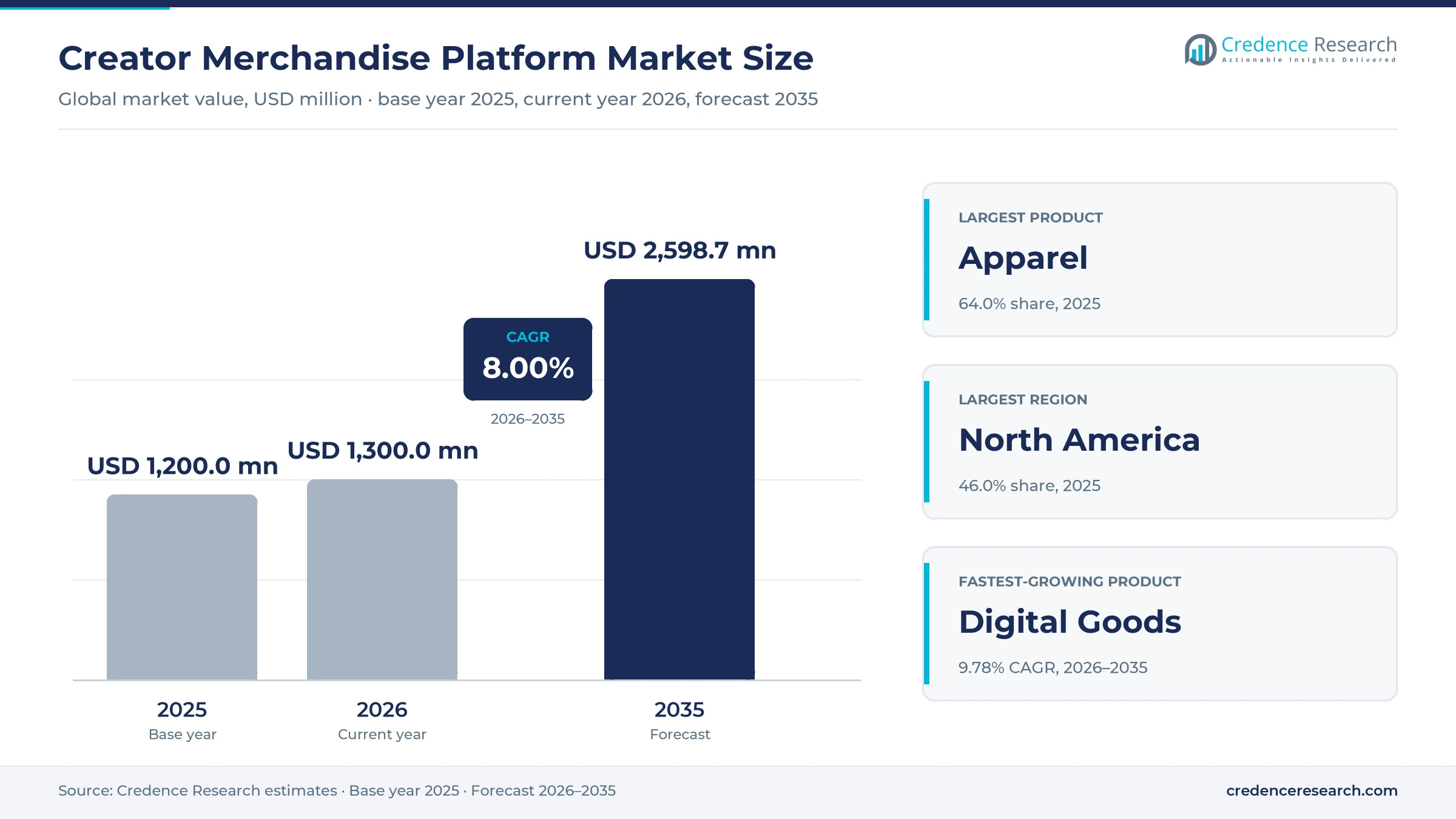
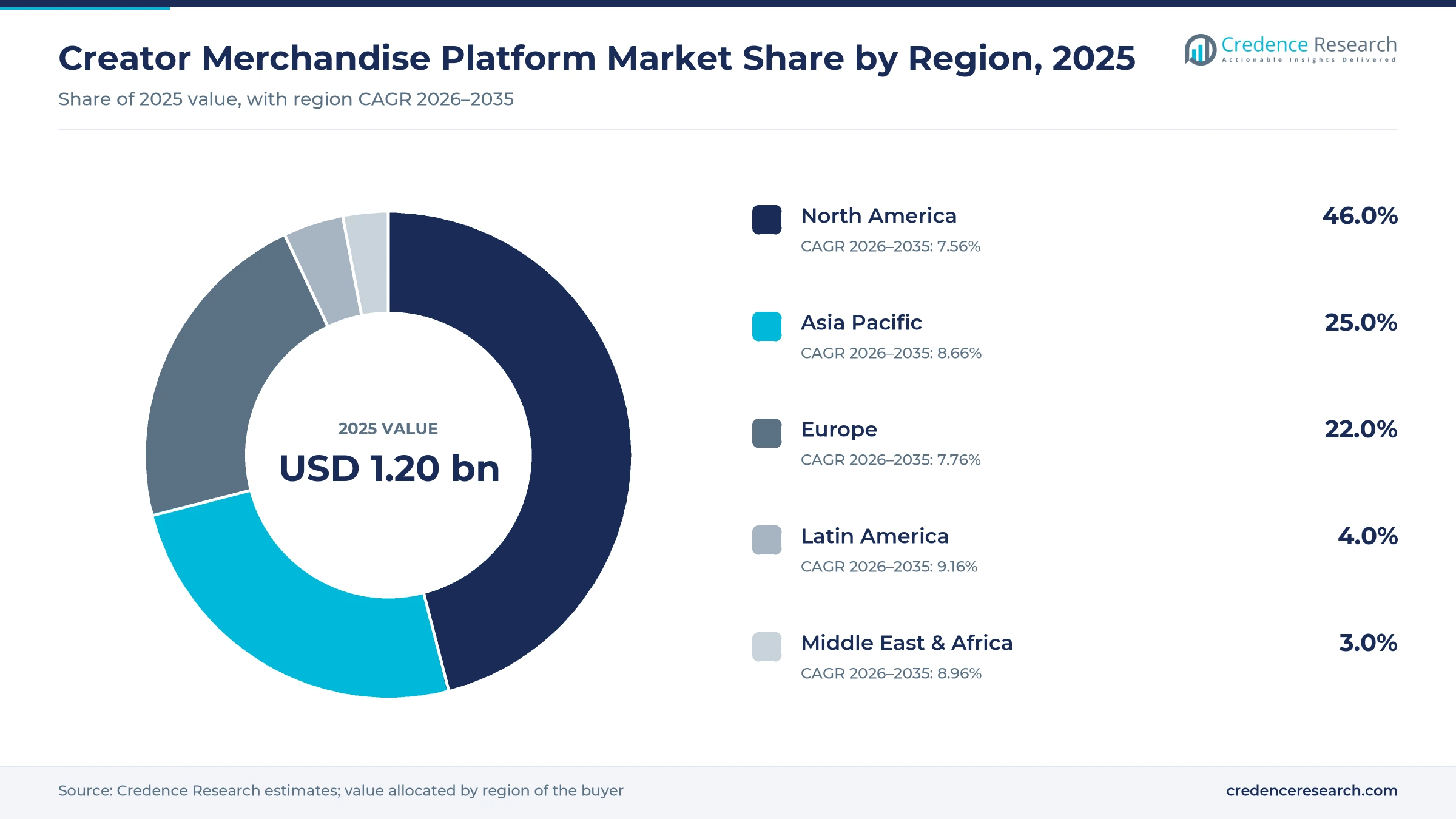
The global creator merchandise platform market was valued at USD 1.20 billion in 2025 and is projected to increase from USD 1.30 billion in 2026 to USD 2.60 billion by 2035, registering a CAGR of 8.00% during 2026–2035. Demand comes from video creators, streamers, podcasters and artists who want income they control, and who use hosted stores to sell branded apparel, accessories and digital files without holding stock. North America held the largest regional share, 46.0% in 2025, because YouTube, Twitch and TikTok creators there were early users of hosted merch stores and store links under videos. Latin America is the fastest-growing region at 9.16% a year, as video shopping tools reach Brazil, Mexico and Argentina. On the commercial side, platforms have shifted from simple print-on-demand shops toward full creator storefronts that bundle memberships, digital downloads and managed limited drops, while the end of duty-free low-value imports in the U.S. has pushed production closer to buyers.
Which products and sales models do hosted creator stores cover?
The market covers the value of merchandise sold through hosted platforms that let creators design, list and sell their own branded products, including print-on-demand stores, managed limited drops and campaigns run with a merch partner. Products include apparel, accessories such as mugs, stickers, caps and plush, and digital goods such as downloads, avatar files and wallpapers sold from the same storefront.
The scope excludes licensed sports and entertainment merchandise sold through general retail, affiliate commissions on third-party products and online courses. The value chain runs from creators and designers through storefront software, print and fulfillment networks and video platform integrations to fans, who buy mainly through links and shelves next to videos and livestreams.
Creator Merchandise Platform Market Insights
- The market grows from USD 1.20 billion in 2025 to USD 2.60 billion by 2035 at an 8.00% CAGR, as more creators add stores and sell to fans directly.
- North America held 46.0% of 2025 value, supported by the largest base of creator stores on platforms such as Fourthwall, Spring and Spreadshop.
- Apparel led with 64.0% of 2025 value, as hoodies and T-shirts remain the first product most creators launch for their fans.
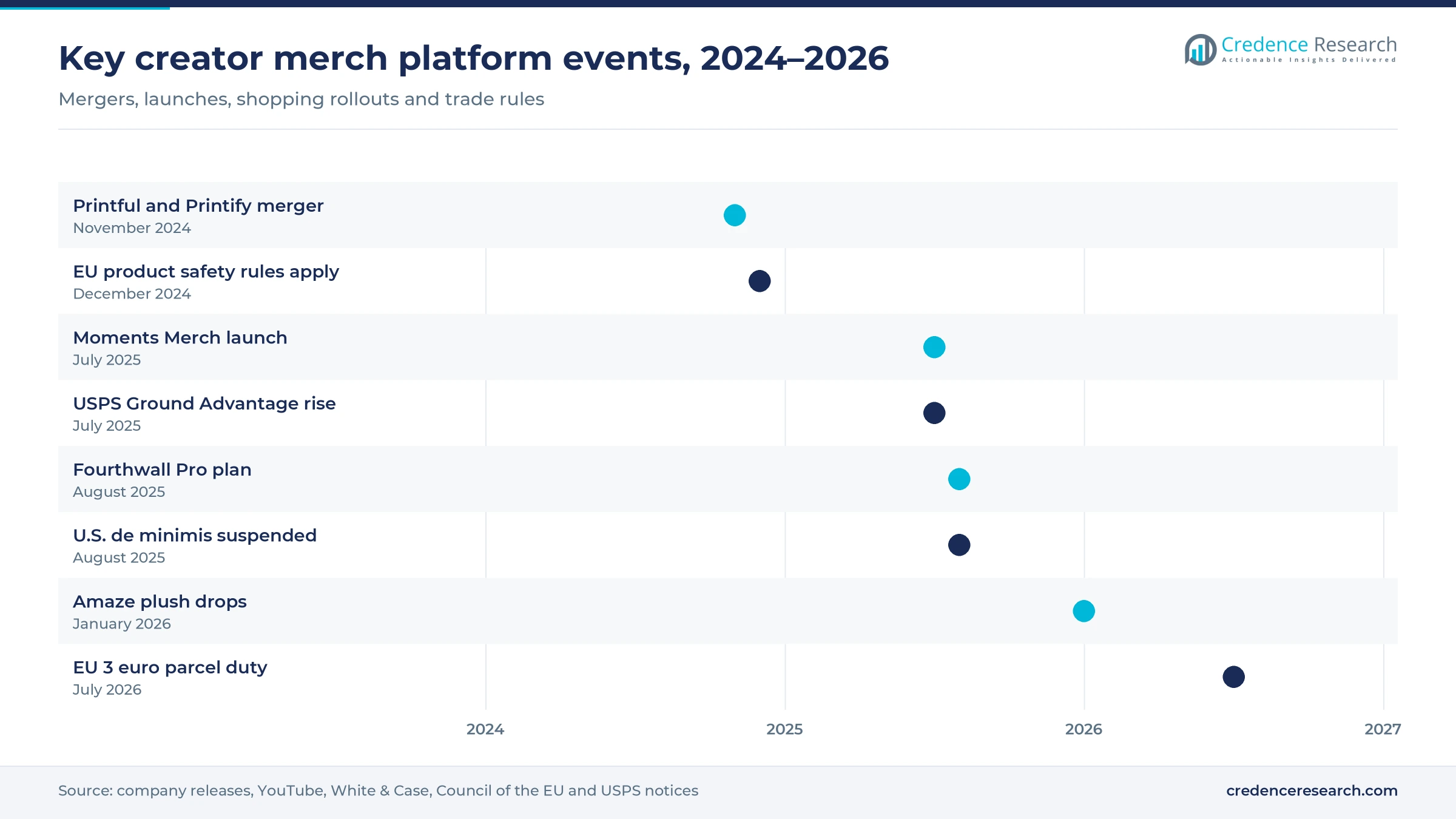
- On Aug. 29, 2025, the U.S. ended duty-free entry for low-value parcels, which favors print networks that produce close to buyers.
- Competition centers on fees, product range and video links, with Fourthwall, Spring, Spreadshop, Printful and Represent listed among YouTube Shopping store partners.
Apparel leads while digital goods grow fastest
Why does apparel still lead creator merch sales?
Based on product, the market is categorized into apparel, accessories and digital goods. Apparel led with 64.0% of 2025 value because hoodies and T-shirts are the default first drop, and Printful alone fulfills more than a million items a month, according to TechCrunch in November 2024. Digital Goods grow fastest at 9.78% a year, as fans buy avatar files, art packs and downloads, and 3D item sales on pixiv's BOOTH reached about 5.8 billion yen in 2024, up from 3.1 billion yen, according to the BOOTH white paper. Accessories gain as creators add plush, stickers, caps and mugs to their ranges.
How do print-on-demand and managed drops split the market?
Based on model, the market is categorized into print-on-demand and managed drops. Print-on-Demand led with 58.0% of 2025 value because creators can open a store without buying stock, and Gelato lists more than 130 production partners in 32 countries that print orders near buyers. Managed Drops grow fastest at 8.40% a year, as top creators move into limited plush and collectible runs, and Amaze said on Jan. 29, 2026, that plush drops were live for select managed creators. Makeship runs such products as 21-day crowdfunded campaigns, according to its Wikipedia company entry.
Which creator tiers account for most merch spending?
Based on creator size, the market is categorized into micro creators, mid-tier creators and top-tier creators. Top-Tier Creators led with 44.0% of 2025 value because large channels convert at scale, and Fourthwall first prioritized creators with at least 100,000 YouTube subscribers, according to Tubefilter in November 2021. Micro Creators grow fastest at 9.15% a year, as entry barriers fall, and YouTube cut its shopping eligibility floor to 500 subscribers on March 27, 2026, according to PPC Land. Fourthwall now offers a free plan for new shops alongside a $19 monthly Pro tier.
| Segment Group | Leading Sub-segment | Share, 2025 | Fastest-growing Sub-segment | CAGR, 2026–2035 |
|---|---|---|---|---|
| By Product | Apparel | 64.0% | Digital Goods | 9.78% |
| By Model | Print-on-Demand | 58.0% | Managed Drops | 8.40% |
| By Creator Size | Top-Tier Creators | 44.0% | Micro Creators | 9.15% |
Request a Free Sample
Fill in your details and we'll send you a free sample report.
- Sample data tables & charts
- Research methodology
Direct income, on-demand printing and shop links lift sales
Creators seek direct revenue from branded merchandise
Creators want income that does not depend on ad rates or brand deals, and a branded store is the simplest product they can own. YouTube said in September 2025 that it had paid more than $100 billion to creators, artists and media companies over four years, according to PPC Land, which shows the size of the audience economy that merch draws on. Kajabi said in August 2025 that more than 75% of its six-figure creators run more than one revenue stream, averaging five. Fourthwall reported that it powered more than 200,000 creator stores in August 2025. In the Credence Research model this adds about 3.2 percentage points to annual growth to 2035.
Print-on-demand reduces upfront inventory risk
Print-on-demand lets a creator list dozens of designs without paying for stock, because each item is printed only after a fan orders it. This model has gained scale through consolidation, as Printful and Printify agreed to merge in November 2024, combining networks that serve hundreds of thousands of customers. Printify had fulfilled more than 60 million orders through over 85 printing companies worldwide, according to LSM in January 2025. Gelato lists more than 130 production partners in 32 countries, which shortens delivery for creators selling abroad. The wider print-on-demand industry therefore supplies the backbone for most creator stores. In the Credence Research model this adds about 2.2 percentage points to annual growth.
Shop integrations and fulfillment services lift conversion
Conversion rises when fans can buy without leaving the video they are watching, so store integrations have become a core feature. YouTube Shopping lists 11 supported store platforms, including Fourthwall, Spreadshop, Spring and Shopify, plus about 58 merch retailers such as Represent, Fanjoy and DFTBA. Fourthwall said in January 2026 that its direct integration places products under videos through the YouTube merch shelf. YouTube Shopping gross merchandise volume grew fivefold from the prior year, according to Señal News in September 2025. Store builders that bundle e-commerce software, printing and customer service remove most setup work. In the Credence Research model this adds about 1.4 percentage points to annual growth.
Plush and collectible ranges widen what creators sell
Product ranges are widening beyond T-shirts, because plush toys and collectibles let fans own a physical version of a character or in-joke. Amaze added customizable plushies to creator stores on Jan. 29, 2026, with a print-on-demand phase planned for all its creators later in 2026. Makeship has distributed more than CAD 20 million to creators from limited campaigns, according to its Wikipedia company entry. Earlier, a Lucas the Spider plush sold through Teespring reached 40,000 units within ten days, according to Tubefilter in August 2020. These items sit close to the plush toys category and lift average order values. As a result, managed drops grow at 8.40% a year.
In-app shopping and real-time drops reshape creator stores
Shift toward in-app shopping inside video platforms
Purchases are shifting from external store links toward checkout inside the video app, which cuts the steps between a reveal and a sale. Fourthwall reported in January 2026 that YouTube was rolling out in-app purchasing more broadly, so viewers can buy without leaving the platform. YouTube Shopping affiliate participation rose from more than 500,000 creators in July 2025 to more than 1.3 million in September 2026, according to PPC Land. YouTube also said its affiliate program would reach 35 countries by the end of 2026, from 12 in March. As a result, creator stores that sync catalogs with video platforms gain share from stand-alone shops.
Rise of real-time trend merch and livestream drops
Merch is moving from planned seasonal collections to products launched within hours of a viral moment, which rewards fast on-demand printing. Spreadshirt and Kornit Digital launched Moments Merch on July 14, 2025, so brands can turn memes and trends into customizable products. TikTok creator Ashby Florence announced her Fourthwall store during a Sept. 16, 2025, livestream and had expected only about 100 orders, according to Fourthwall. Digital printing makes single-unit runs viable, which links creator drops to the custom T-shirt printing sector. In turn, platforms now compete on how quickly a new design goes live after a creator first shares the idea with fans.
Digital goods for avatars open an Asia Pacific opening
Asia Pacific offers a clear opening in digital goods, because avatar, VTuber and illustration fans already buy files from creator shops. 3D item transactions on pixiv's BOOTH reached about 5.8 billion yen in 2024, with about 218,000 buyers and 4.02 million items, according to the BOOTH white paper published Feb. 19, 2025. YouTube Shopping supports BASE and SUZURI in Japan and Cafe24 and Marpple Shop in South Korea. Reach is also wide, as ITU put internet use in Asia-Pacific at 77% in 2025. As a result, digital goods grow at 9.78% a year, the fastest product segment, with no printing or shipping cost per sale.
Shopping rollouts create an opening in Latin America and the Gulf
Latin America and the Gulf offer the newest opening, because video shopping tools are arriving there for the first time. YouTube announced its Shopping affiliate program for Brazil on Sept. 17, 2025, according to Señal News, and a Mercado Libre partnership added Mexico and Argentina on June 18, 2026, according to PPC Land. YouTube then launched the program in the UAE, Saudi Arabia and Egypt, where more than 40 million logged-in users made shopping searches in June 2026, according to Entrepreneur Middle East. Brazilian merch retailers Chico Rei and Lolja already appear on YouTube's supported list. As a result, Latin America becomes the fastest-growing region for creator stores to 2035.
Duties, safety rules and postage raise selling costs
End of U.S. duty-free parcels raises landed costs
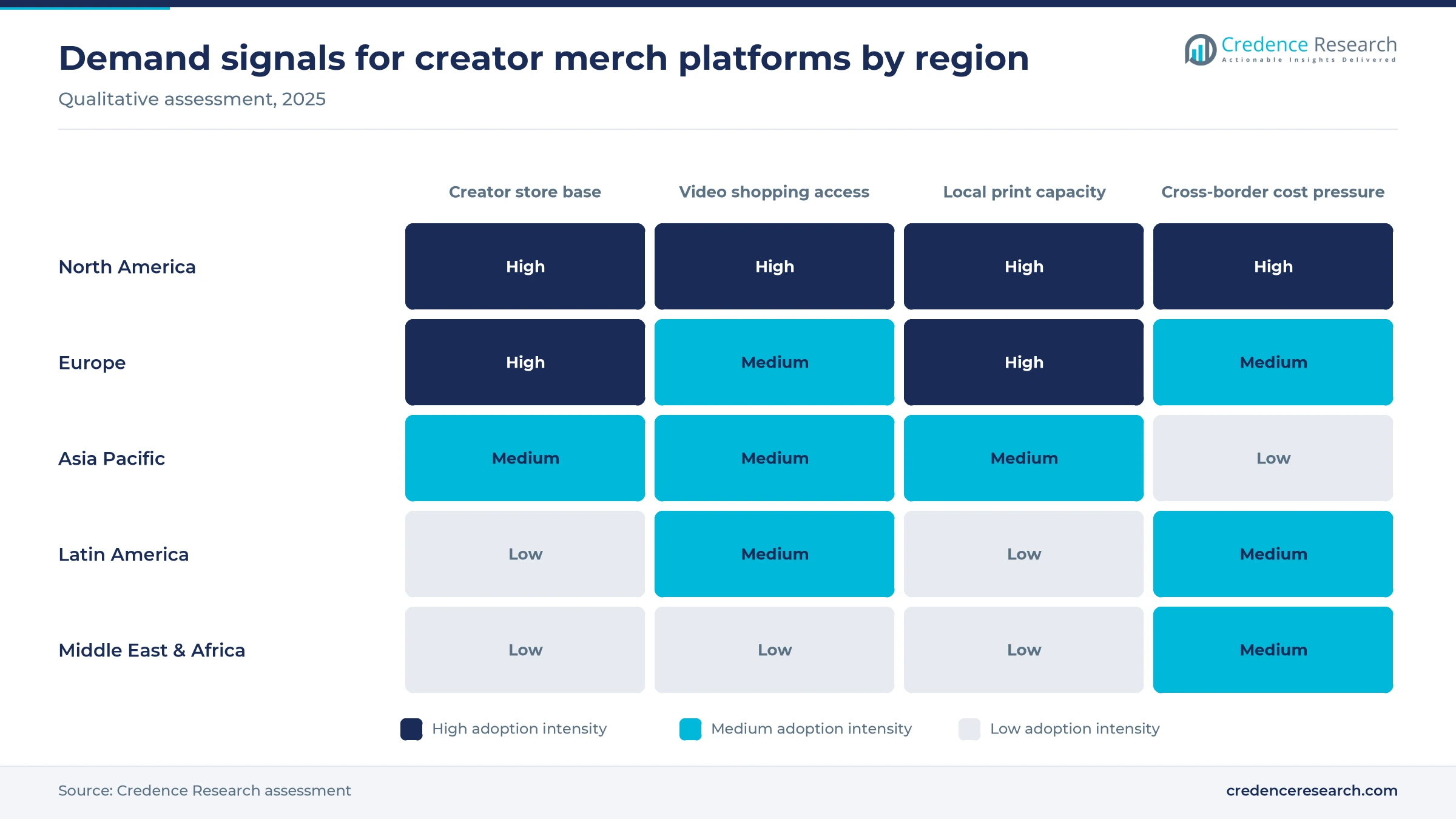
U.S. trade policy has raised the cost of shipping merch made abroad to American fans. The U.S. suspended duty-free de minimis entry for all countries on Aug. 29, 2025, ending the $800 exemption that many cross-border print networks relied on. Postal shipments faced specific duties of $80 to $200 per item for six months. In turn, platforms shift U.S. orders to domestic print partners, which protects delivery but can limit product ranges.
EU duty on small parcels adds cost pressure
Europe is closing its own low-value gap, which adds cost for creators who ship from outside the EU. The Council agreed on Dec. 12, 2025, to levy a fixed 3 euro customs duty on parcels worth under 150 euros from July 1, 2026, according to Spielwarenmesse. The duty applies per item type, and IOSS-registered sellers handle 93% of e-commerce flows into the EU. As a result, platforms with European print sites gain an advantage over overseas fulfillment.
EU product safety rules add compliance work
Product safety rules now reach small online sellers, which raises compliance work for creator stores selling into Europe. The EU General Product Safety Regulation has applied since Dec. 13, 2024, and requires operators outside the EU to appoint a responsible person based in the EU, according to Lewis Silkin. Marketplaces must also remove dangerous products when authorities ask, which adds a barrier for small stores. Platforms respond by holding safety files for each blank and printing plush and accessories through EU partners.
Rising postage squeezes margins on low-price items
Postage is a large share of the price of a T-shirt or sticker, so carrier rate rises hit creator margins quickly. The U.S. Postal Service raised Ground Advantage prices by 7.1% on average from July 13, 2025, with retail prices up 9.8%, according to Supply Chain Dive. Fans then face higher checkout totals on small orders, which is a risk to conversion. Platforms respond with bundles, free-shipping thresholds and regional printing that shortens parcel routes.
North America leads as Latin America grows fastest
| Region | Value, 2025 (USD billion) | Share, 2025 | CAGR, 2026–2035 |
|---|---|---|---|
| North America | 0.55 | 46.0% | 7.56% |
| Asia Pacific | 0.30 | 25.0% | 8.66% |
| Europe | 0.26 | 22.0% | 7.76% |
| Latin America | 0.05 | 4.0% | 9.16% |
| Middle East & Africa | 0.04 | 3.0% | 8.96% |
North America leads on the largest creator store base
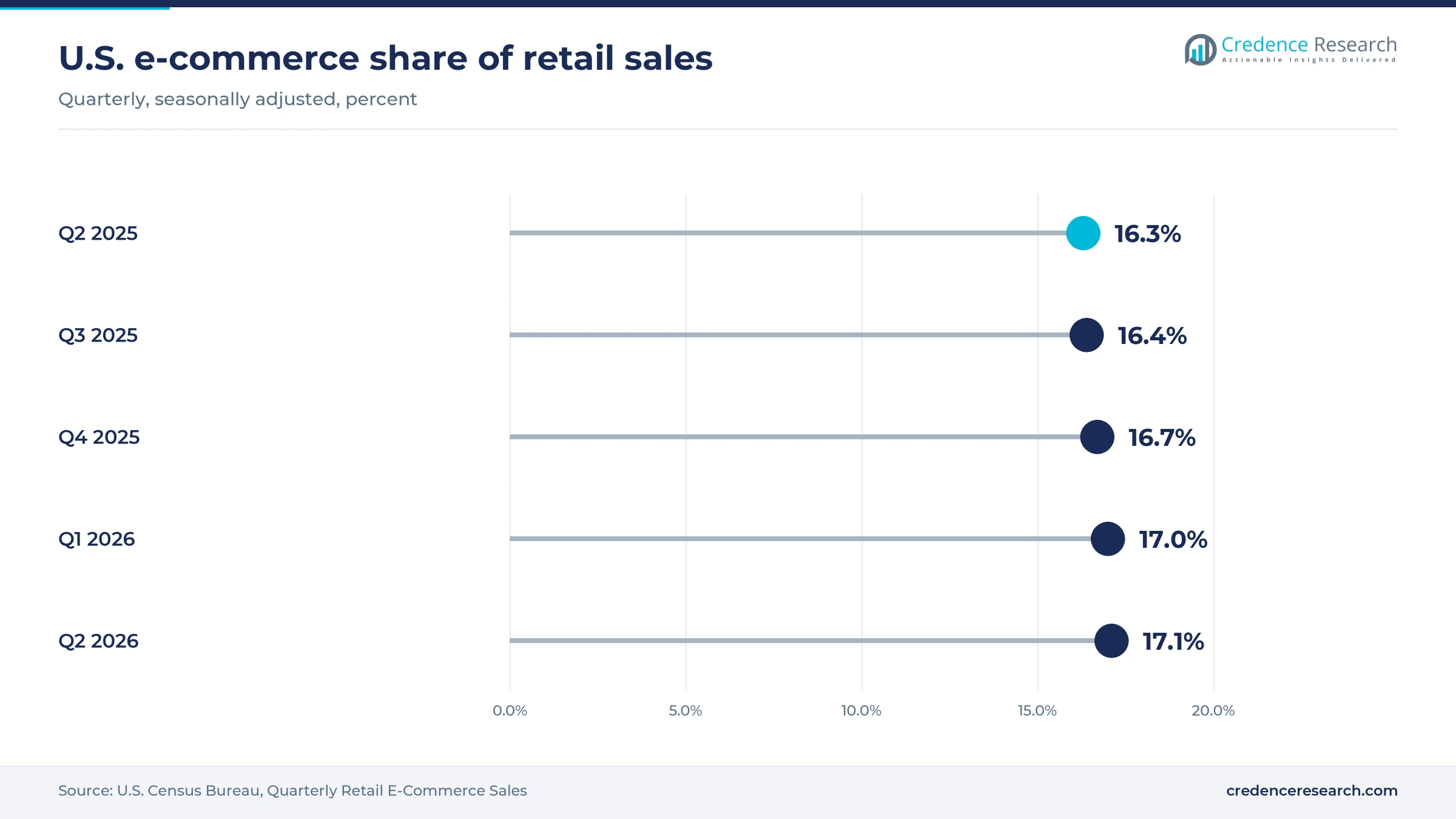
North America held 46.0% of 2025 value and grows at 7.56% a year, because the region hosts the largest base of creator stores and video shopping users. Spreadshop counted 3,419 live stores in the U.S. and 507 in Canada in October 2026, according to Store Leads. Online buying is deep, as the Census Bureau put e-commerce at 17.1% of U.S. retail sales in the second quarter of 2026. However, the end of duty-free parcels in August 2025 pushed platforms toward domestic printing.
Asia Pacific grows on digital goods and local shops
Asia Pacific held 25.0% of 2025 value and grows at 8.66% a year, as creators in Japan and South Korea sell through local shop builders and digital marketplaces. YouTube Shopping supports BASE and SUZURI in Japan and Cafe24 and Marpple Shop in South Korea. On pixiv's BOOTH, 3D item sales reached about 5.8 billion yen in 2024. Gelato lists production partners in eight Asia Pacific countries, which helps creators ship physical goods within the region.
Europe grows on local print sites and shop builders
Europe held 22.0% of 2025 value and grows at 7.76% a year, supported by German, British and French creator stores. Spreadshop counted 1,997 live stores in Germany, 400 in the U.K. and 370 in France in October 2026, according to Store Leads. Gelato lists production partners in 19 countries across Europe, the Middle East and Africa. However, the EU product safety rules of December 2024 and the 3 euro parcel duty from July 2026 favor platforms that print inside the EU.
Latin America is the fastest-growing region
Latin America held 4.0% of 2025 value and grows fastest at 9.16% a year, as video shopping tools reach the region. YouTube announced Shopping affiliate features for Brazil in September 2025, and a Mercado Libre partnership added Mexico and Argentina in June 2026. Brazilian merch retailers Chico Rei and Lolja appear on YouTube's list of supported stores. As a result, local creators gain checkout options that keep fans inside the video app.
Middle East & Africa gains from new shopping access
Middle East & Africa held 3.0% of 2025 value and grows at 8.96% a year, from a small base of creator stores. YouTube launched its Shopping affiliate program in the UAE, Saudi Arabia and Egypt in October 2026, according to Entrepreneur Middle East. ITU put internet use at 70% in the Arab States and 36% in Africa in 2025, which limits reach in much of Africa. Gulf creators therefore lead regional merch spending in the period to 2035.
Mergers, new fee plans and shopping rollouts in 2024–2026
| Development | Status and market relevance |
|---|---|
| In November 2024, Printful and Printify agreed to merge, keeping both brands under one company later named Fyul. | Announced Nov. 5, 2024; consolidates two large print-on-demand networks |
| In July 2025, Spreadshirt and Kornit Digital launched Moments Merch, an on-demand offer for products tied to viral trends. | Launched July 14, 2025; supports real-time creator drops |
| In August 2025, Fourthwall introduced a Pro plan at $19 a month with no fee on digital product sales. | Started Aug. 25, 2025; new free shops pay 5% on digital goods |
| In January 2026, Amaze added customizable plushies to creator stores through a partnership with OpenWav.AI. | Announced Jan. 29, 2026; managed drops first, print-on-demand later in 2026 |
| In June 2026, YouTube added Mexico and Argentina to its Shopping affiliate program through Mercado Libre. | Effective June 18, 2026; expands video shopping in Latin America |
Print networks, shelf integrations and drop tools
- Distributed print networks route each order to a partner near the buyer, and Gelato lists more than 130 such partners in 32 countries.
- Video shelf integrations sync a store catalog with YouTube, so products from Fourthwall, Spring or Spreadshop appear under videos and livestreams.
- Direct-to-garment printing produces single items from digital files, which lets a creator test many designs without minimum runs.
- Campaign and drop tools set time limits, stock caps and preorder windows, as in the 21-day plush campaigns that Makeship runs.
Need a Custom Version of This Report?
Tailor the scope, geography, or segments to your exact requirements.
- Custom geography or segment scope
- Direct access to our analyst team
Platforms compete on fees, fulfillment and video links
Competition centers on fees, product range, fulfillment speed and links to video platforms. Fourthwall competes with an all-in-one storefront that combines merch, memberships and digital products, and it added a $19 monthly Pro plan in August 2025. Spring, owned by Amaze since 2022, offers print-on-demand stores with YouTube, TikTok and Meta links and its owner is adding plush. Spreadshop, from Spreadshirt, serves creators with more than 11,000 live stores, mostly in the U.S. and Germany. Printful, now part of Fyul with Printify, supplies printing for creators who run their own stores. Represent builds managed campaigns and branded lines for celebrities and influencers and appears among YouTube merch retailers. Smaller platforms such as Makeship compete on niche products, so range and drop tools have become key differentiators.
Companies profiled and their roles in this market
| Company | Type | Role in the market |
|---|---|---|
| Fourthwall | Storefront platform | Runs creator stores with merch, memberships and digital goods; YouTube shelf partner |
| Spring (Teespring) | Print-on-demand platform | Hosts creator merch stores under Amaze, with social commerce links |
| Spreadshop | Print-on-demand platform | Spreadshirt service with more than 11,000 live creator and brand stores |
| Printful | Print and fulfillment network | Fulfills more than a million items a month; part of Fyul with Printify |
| Represent | Managed merch partner | Runs limited campaigns and branded lines for celebrities and influencers |
Growth depends on keeping fans buying after launch week
Credence Research's view is that the creator merchandise platform market will grow near its forecast pace only if platforms keep fans buying after the first launch week. Video shopping links have made the first sale easier, but repeat orders depend on new designs, plush and digital goods that refresh a store. Trade rules have also changed the cost base, as the U.S. ended duty-free parcels in August 2025 and the EU adds a 3 euro parcel duty from July 2026. Platforms with local print partners, low fees and strong video integrations will hold share by 2035.
Model built from platform, regulator and trade data
The report uses 2025 as the base year and forecasts to 2035. Market values come from the Credence Research model, which combines platform disclosures on store counts, fees, fulfillment volumes and creator payouts with official statistics from the U.S. Census Bureau and the International Telecommunication Union, and with trade and product rules from U.S. and EU authorities. Regional, product, model and creator size splits are Credence Research estimates based on store counts by country, video shopping availability and published product mix. No interviews or surveys were used for this edition of the report.
Video shopping and local printing carry growth to 2035
The market is projected to reach USD 2.60 billion by 2035, growing at an 8.00% CAGR from USD 1.30 billion in 2026. Apparel will remain the largest product, while digital goods and managed plush drops carry much of the gain. North America will stay the largest region, and Latin America will grow fastest as YouTube Shopping tools spread through Brazil, Mexico and Argentina. Local print partners in the U.S. and the EU will matter more after new parcel duties, and small creators will add stores as shopping eligibility thresholds fall.
Frequently Asked Questions
How big is the creator merchandise platform market?
Which region leads the market?
Which region grows fastest?
Which product leads creator merch sales?
Why are digital goods growing quickly?
How did U.S. trade rules affect creator merch?
What is the difference between print-on-demand and managed drops?
Who are the main companies in the creator merchandise platform market?
Table of Content
Chapter 1 Market Segmentation
- 1.1 Segmentation Framework
- 1.1.1 Product and Service Classification
- 1.1.2 Application and End-Use Classification
- 1.1.3 Technology and Solution Classification
- 1.1.4 Customer and Distribution Channel Classification
- 1.1.5 Geographic Segmentation
- 1.1.6 Market Segment Definitions and Boundaries
- 1.2 By Product
- 1.2.1 Apparel
- 1.2.2 Accessories
- 1.2.3 Digital Goods
- 1.3 By Model
- 1.3.1 Print-on-Demand
- 1.3.2 Managed Drops
- 1.4 By Creator Size
- 1.4.1 Micro Creators
- 1.4.2 Mid-Tier Creators
- 1.4.3 Top-Tier Creators
Chapter 2 Introduction
- 2.1 Report Objectives and Scope
- 2.2 Product Definition and Industry Terminology
- 2.3 Market Inclusions and Exclusions
- 2.4 Research Process
- 2.4.1 Primary Research and Expert Interviews
- 2.4.2 Secondary Research and Source Review
- 2.4.3 Top-Down and Bottom-Up Estimation
- 2.4.4 Data Triangulation and Verification
- 2.5 Market Size Measurement Basis
- 2.5.1 2025: USD 1.20 billion → 2035: USD 2.60 billion
- 2.6 Historical and Forecast Reference Periods
- 2.6.1 Historical Period: 2018-2025
- 2.6.2 Base Year: 2025
- 2.6.3 Forecast Period: 2025-2035
- 2.7 Research Assumptions and Limitations
Chapter 3 Executive Summary
- 3.1 Market Snapshot and Key Findings
- 3.2 Base-Year Market Size, 2025
- 3.3 Forecast Market Size, 2035
- 3.4 Revenue and Volume Growth Outlook
- 3.5 Key Demand and Supply Indicators
- 3.6 Leading Market Segments
- 3.7 Fastest-Growing Market Opportunities
- 3.8 Regional Performance Highlights
- 3.9 Technology and Industry Transformation
- 3.10 Competitive Landscape Summary
- 3.11 Analyst View and Strategic Implications
Chapter 4 Global Creator Merchandise Platform Market Trends and Developments
- 4.1 Historical Industry Development, 2018-2025
- 4.2 Recent Market Trends and Developments
- 4.3 Demand and Customer Behavior Trends
- 4.4 Technology and Product Innovation
- 4.5 Artificial Intelligence, Automation and Digitalization
- 4.6 Local Manufacturing and Supply Chain Realignment
- 4.7 Industry Partnerships, Mergers and Acquisitions
- 4.8 Sustainability and Circular Economy Developments
- 4.9 Government and Private Sector Investment Trends
- 4.10 Emerging Business Models and Commercialization
- 4.11 Industry Developments and Announcements
Chapter 5 Global Creator Merchandise Platform Market Production, Supply and Demand Analysis
- 5.1 Demand Trend and Consumption Analysis, 2018-2025
- 5.2 Demand Forecast, 2025-2035
- 5.3 Production and Output Trend, 2018-2025
- 5.4 Production and Output Forecast, 2025-2035
- 5.5 Installed Capacity and Capacity Utilization
- 5.6 Company-Wise Production Plants and Statistics
- 5.6.1 Installed Production Capacity
- 5.6.2 Actual Production
- 5.6.3 Planned Capacity and Expansion Targets
- 5.7 Supply Chain Structure and Procurement Trends
- 5.8 Supply-Demand Gap and Bottlenecks
- 5.9 Import Dependence and Sourcing Structure
- 5.10 Contract Manufacturing and Outsourcing
- 5.11 Regional Supply and Demand Concentration
Chapter 6 Global Creator Merchandise Platform Market Pricing Analysis
- 6.1 Pricing Structure and Measurement
- 6.2 Historical Pricing Trends, 2018-2025
- 6.3 Pricing Outlook, 2025-2035
- 6.4 Average Selling Price and Unit Economics
- 6.5 Pricing by Product and Market Segment
- 6.6 Geographic Pricing Differences
- 6.7 Key Input, Energy, Labor and Logistics Costs
- 6.8 Contract Pricing and Purchasing Models
- 6.9 Pricing Sensitivity and Competitive Positioning
- 6.10 Price, Margin and Profitability Implications
Chapter 7 Global Creator Merchandise Platform Market Dynamics
- 7.1 Market Growth Drivers
- 7.1.1 Demand-Side Drivers
- 7.1.2 Technology and Innovation Drivers
- 7.1.3 Infrastructure and Investment Drivers
- 7.1.4 Regulatory and Policy Drivers
- 7.2 Market Restraints
- 7.2.1 Cost and Affordability Constraints
- 7.2.2 Technology and Adoption Barriers
- 7.2.3 Supply Chain and Operational Constraints
- 7.3 Market Challenges
- 7.3.1 Competitive Pressure and Margin Erosion
- 7.3.2 Skills, Infrastructure and Implementation Gaps
- 7.4 Emerging Market Opportunities
- 7.5 Market Dynamics Impact and Time-Horizon Assessment
Chapter 8 Global Creator Merchandise Platform Value Chain Analysis
- 8.1 Industry Value Chain Overview
- 8.2 Upstream Suppliers and Critical Inputs
- 8.3 Technology and Component Providers
- 8.4 Manufacturing or Service Delivery
- 8.5 Distribution, Channel Partners and Integrators
- 8.6 Downstream Applications and End Users
- 8.7 Value Addition and Profit Pools
- 8.8 Vertical Integration and Outsourcing
- 8.9 Supplier Concentration and Risk
- 8.10 Supply Chain Localization and Resilience
Chapter 9 Global Creator Merchandise Platform Market Regulations and Policies
- 9.1 Relevant Laws, Standards and Compliance Frameworks
- 9.2 Product, Service, Safety and Quality Requirements
- 9.3 Government Policies, Incentives and Subsidies
- 9.4 Imports, Exports and Trade Barriers
- 9.5 Public Procurement and Local Content Requirements
- 9.6 Environmental and Sustainability Compliance
- 9.7 Data Protection, AI and Cybersecurity Compliance
- 9.8 Upcoming Policy Changes and Market Implications
Chapter 10 Global Creator Merchandise Platform Market Hotspots and Opportunities
- 10.1 Market Opportunity Mapping and Growth Hotspots
- 10.2 High-Growth Applications and Customer Groups
- 10.3 Underserved Markets and White-Space Opportunities
- 10.4 Emerging Technology and Product Opportunities
- 10.5 New Capacity and Investment Hotspots
- 10.6 Market Entry and Expansion Opportunities
- 10.7 Distribution and Partnership Opportunities
- 10.8 Near-Term and Long-Term Commercial Potential
- 10.9 Opportunity Attractiveness and Execution Risks
Chapter 11 Global Creator Merchandise Platform Market Outlook, 2025-2035
- 11.1 Market Size and Analysis
- 11.1.1 Revenue (Market Measurement: 2025: USD 1.20 billion → 2035: USD 2.60 billion)
- 11.1.2 Market Volume and Quantity Sold
- 11.1.3 Historical Market Size, 2018-2025
- 11.1.4 Base-Year Market Size, 2025
- 11.2 Market Forecast, 2025-2035
- 11.2.1 Revenue Forecast to 2035
- 11.2.2 Volume Forecast to 2035
- 11.2.3 CAGR and Year-on-Year Growth
- 11.2.4 Incremental Revenue Opportunity
- 11.3 Forecast Assumptions and Scenario Analysis
- 11.3.1 Base-Case Forecast
- 11.3.2 Optimistic and Conservative Scenarios
- 11.3.3 Technology, Pricing and Policy Sensitivities
- 11.4 Market Attractiveness and Growth Outlook
Chapter 12 Global Creator Merchandise Platform Market Segmentation and Outlook
- 12.1 Segmentation Summary and Market Shares, 2025
- 12.2 Largest and Fastest-Growing Segments
- 12.3 By Product - Market Size and Forecast, 2025-2035
- 12.3.1 Segment Definition and Scope
- 12.3.2 Historical Market Size, 2018-2025
- 12.3.3 Revenue Forecast, 2025-2035
- 12.3.4 Volume Forecast, 2025-2035
- 12.3.5 Base-Year Market Share, 2025
- 12.3.6 Segment CAGR and Growth Drivers
- 12.3.7 Subsegment Market Size and Forecast
- 12.3.7.1 Apparel
- 12.3.7.2 Accessories
- 12.3.7.3 Digital Goods
- 12.3.8 Subsegment Pricing and Adoption Trends
- 12.3.9 Leading Suppliers and Competition
- 12.3.10 Regional Demand and Opportunities
- 12.4 By Model - Market Size and Forecast, 2025-2035
- 12.4.1 Segment Definition and Scope
- 12.4.2 Historical Market Size, 2018-2025
- 12.4.3 Revenue Forecast, 2025-2035
- 12.4.4 Volume Forecast, 2025-2035
- 12.4.5 Base-Year Market Share, 2025
- 12.4.6 Segment CAGR and Growth Drivers
- 12.4.7 Subsegment Market Size and Forecast
- 12.4.7.1 Print-on-Demand
- 12.4.7.2 Managed Drops
- 12.4.8 Subsegment Pricing and Adoption Trends
- 12.4.9 Leading Suppliers and Competition
- 12.4.10 Regional Demand and Opportunities
- 12.5 By Creator Size - Market Size and Forecast, 2025-2035
- 12.5.1 Segment Definition and Scope
- 12.5.2 Historical Market Size, 2018-2025
- 12.5.3 Revenue Forecast, 2025-2035
- 12.5.4 Volume Forecast, 2025-2035
- 12.5.5 Base-Year Market Share, 2025
- 12.5.6 Segment CAGR and Growth Drivers
- 12.5.7 Subsegment Market Size and Forecast
- 12.5.7.1 Micro Creators
- 12.5.7.2 Mid-Tier Creators
- 12.5.7.3 Top-Tier Creators
- 12.5.8 Subsegment Pricing and Adoption Trends
- 12.5.9 Leading Suppliers and Competition
- 12.5.10 Regional Demand and Opportunities
- 12.6 Segment Growth Comparison
- 12.7 Segment Attractiveness and Priority Matrix
Chapter 13 Global Creator Merchandise Platform Geographic Market Outlook, 2025-2035
- 13.1 Regional Market Size and Share, 2025
- 13.2 Regional Market Forecast, 2025-2035
- 13.3 Regional Pricing, Production and Demand Differences
- 13.4 North America
- 13.4.1 United States
- 13.4.2 Canada
- 13.4.3 Mexico
- 13.5 Europe
- 13.5.1 Germany
- 13.5.2 France
- 13.5.3 Italy
- 13.5.4 United Kingdom
- 13.5.5 Spain
- 13.5.6 Poland
- 13.5.7 Russia
- 13.5.8 Netherlands
- 13.5.9 Belgium
- 13.5.10 Sweden
- 13.5.11 Denmark
- 13.5.12 Norway
- 13.5.13 Rest of Europe
- 13.6 Asia Pacific
- 13.6.1 China
- 13.6.2 India
- 13.6.3 Japan
- 13.6.4 South Korea
- 13.6.5 Thailand
- 13.6.6 Indonesia
- 13.6.7 Vietnam
- 13.6.8 Malaysia
- 13.6.9 Australia
- 13.6.10 Rest of Asia Pacific
- 13.7 Latin America
- 13.7.1 Brazil
- 13.7.2 Argentina
- 13.7.3 Colombia
- 13.7.4 Chile
- 13.7.5 Rest of Latin America
- 13.8 Middle East
- 13.8.1 Saudi Arabia
- 13.8.2 United Arab Emirates
- 13.8.3 Turkey
- 13.8.4 Israel
- 13.8.5 Iran
- 13.8.6 Rest of the Middle East
- 13.9 Africa
- 13.9.1 South Africa
- 13.9.2 Egypt
- 13.9.3 Nigeria
- 13.9.4 Morocco
- 13.9.5 Rest of Africa
- 13.10 Regional Investment, Policy and Supply Chain Differences
- 13.11 Regional Competitive Landscape
- 13.12 Geographic Growth Hotspots
Chapter 14 Global Creator Merchandise Platform Technology, Innovation and Sustainability Outlook
- 14.1 Technology Landscape and Maturity
- 14.2 Product, Process and Service Innovation
- 14.3 AI, Automation and Digital Tools in the Industry
- 14.4 Technology Adoption and Performance Benchmarking
- 14.5 Innovation Pipeline and R&D Investment
- 14.6 Patent and Intellectual Property Trends
- 14.7 Energy Efficiency and Resource Management
- 14.8 Sustainability, Recycling and Circularity
- 14.9 Technology Roadmap, 2025-2035
- 14.10 Risks of Obsolescence and Technology Substitution
Chapter 15 Global Creator Merchandise Platform Market Key Strategic Imperatives
- 15.1 Growth and Market Entry Priorities
- 15.2 High-Return Products and Segments
- 15.3 Pricing, Profitability and Cost Optimization
- 15.4 Technology Investment and Product Differentiation
- 15.5 Supply Chain Localization and Resilience
- 15.6 Distribution and Customer Acquisition
- 15.7 Partnership, Acquisition and Capacity Strategy
- 15.8 Regional Expansion Priorities
- 15.9 Short-, Medium- and Long-Term Actions
Chapter 16 Competition Outlook
- 16.1 Industry Competition Characteristics
- 16.2 Market Structure and Concentration
- 16.3 Market Share and Competitive Positioning, 2025
- 16.4 Company-Wise Revenue and Product Benchmarking
- 16.5 Production and Service Capacity Benchmarking
- 16.6 Technology, Pricing and Differentiation
- 16.7 Regional Footprint and Distribution Strength
- 16.8 Mergers, Acquisitions and Strategic Alliances
- 16.9 New Entrants and Competitive Threats
- 16.10 Porter's Five Forces and Industry Attractiveness
- 16.11 Competitive Outlook, 2025-2035
Chapter 17 Company Profiles
- 17.1 Company Coverage and Selection Criteria
- 17.2 Fourthwall
- 17.2.1 Business Description
- 17.2.2 Company Ownership and Geographic Presence
- 17.2.3 Product and Service Portfolio
- 17.2.4 Manufacturing and Operating Footprint
- 17.2.5 Production Capacity and Expansion Plans
- 17.2.6 Financial Performance and Investment
- 17.2.7 Market Share and Competitive Position
- 17.2.8 Technology and Innovation Capabilities
- 17.2.9 Strategic Alliances or Partnerships
- 17.2.10 Recent Developments
- 17.2.11 Growth Strategy and Outlook
- 17.3 Spring (Teespring)
- 17.4 Spreadshop
- 17.5 Printful
- 17.6 Represent
- 17.7 Other Relevant Market Participants
Note: Every listed company is profiled on the structure shown under the first company. The company list is preliminary and may change based on research findings, market developments, data availability and client requirements.
Chapter 18 Disclaimer
- 18.1 Research and Forecast Disclaimer
- 18.2 Data Source and Estimation Limitations
Note: The depth of individual sections depends on data availability for this market. Volume, capacity, trade and other unit-based metrics are included where applicable.

