
Market Overview
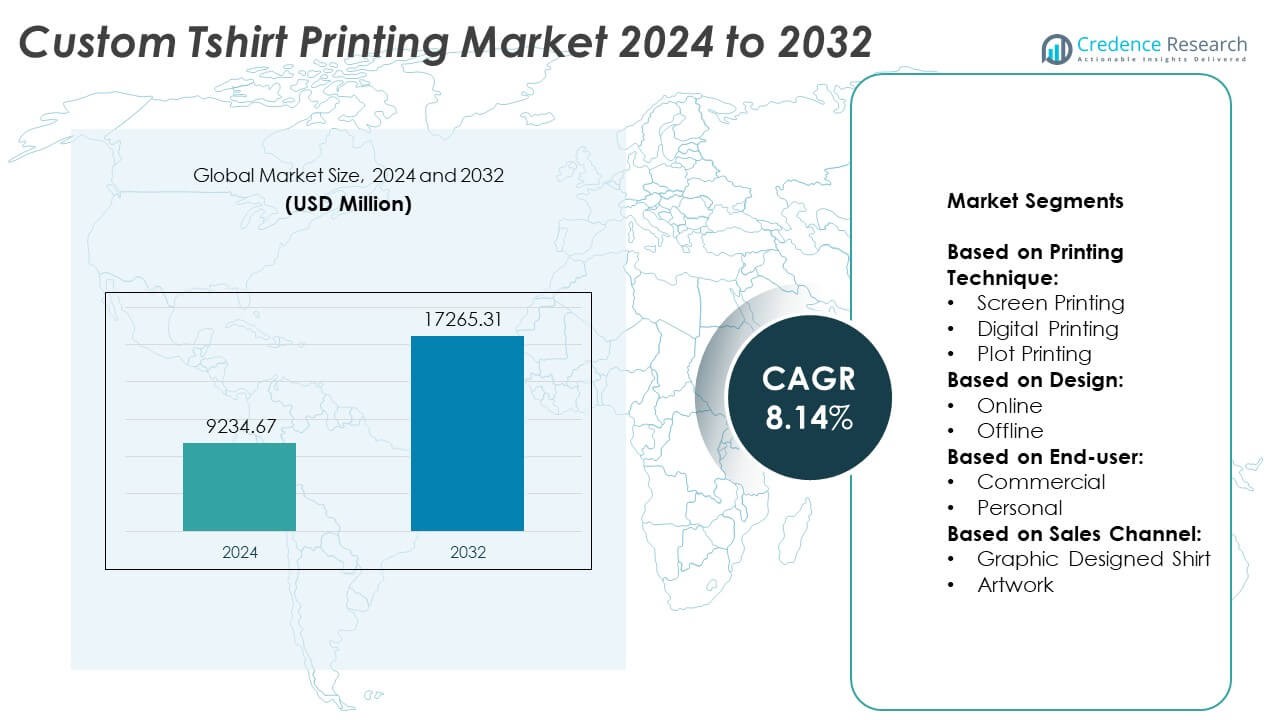
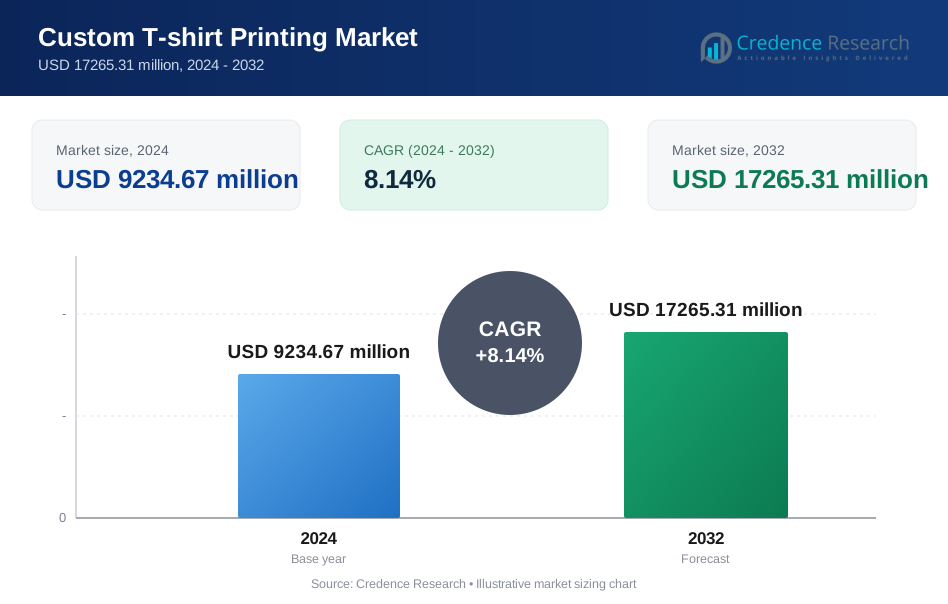
The Global Custom T-shirt Printing Market size was valued at USD 9234.67 million in 2024 and is anticipated to reach USD 17265.31 million by 2032, at a CAGR of 8.14% during the forecast period.
| REPORT ATTRIBUTE | DETAILS |
|---|---|
| Historical Period | 2020-2024 |
| Base Year | 2024 |
| Forecast Period | 2025-2032 |
| Custom T-shirt Printing Market Size 2024 | USD 9234.67 Million |
| Custom T-shirt Printing Market, CAGR | 8.14% |
| Custom T-shirt Printing Market Size 2032 | USD 17265.31 Million |
The custom T-shirt printing market is supported by demand for personalized apparel used in corporate branding, promotional merchandise, and individual self-expression. Growth is linked to expanded e-commerce access, mobile design tools, and on-demand production models that reduce ordering friction and support shorter production runs. Printing technology improvements, including digital printing, direct-to-garment (DTG) systems, and higher-resolution plot printing, enable more complex full-color designs and faster turnaround times. Sustainability preferences are also influencing product development, including greater use of eco-friendly inks and demand for more sustainable fabric options.
Adoption is described as strong in North America, Europe, and Asia-Pacific, reflecting high digital connectivity, purchasing power in key segments, and continued interest in customized apparel. North America is positioned as a leading region due to broader use of advanced printing equipment and higher capacity operators, while Europe is described as placing greater emphasis on sustainable product attributes. Asia-Pacific is characterized as a faster-growth region, supported by expanding middle-income consumers and social media-driven demand trends. Market participants such as CustomInk, Printful, Vistaprint, and THREADBIRD compete using regional production and fulfillment infrastructure and platform-driven ordering experiences.
Market Insights
- The custom T-shirt printing market was valued at USD 9,234.67 million in 2024 and is projected to reach USD 17,265.31 million by 2032, implying a CAGR of 8.14% over the forecast period.
- Demand is supported by personalization for corporate branding, promotional products, and personal use, with growth reinforced by e-commerce storefronts and mobile design tools that simplify customization.
- Technology adoption, including DTG, digital printing, and plot/vinyl methods, supports higher design complexity, shorter runs, and faster production, contributing to the shift toward on-demand ordering.
- Digital engagement channels, including interactive design platforms, influencer-led promotion, and limited-edition drops, are used to increase customer engagement and repeat purchasing, although outcomes depend on marketing efficiency and trend relevance.
- Key players such as CafePress, CustomInk, Printful, and Vistaprint invest in production technology, fulfillment capacity, and customer experience to improve lead times and service reliability.
- Key constraints include operational cost intensity, price competition, and logistics complexity, which can limit scaling and margin expansion, particularly for smaller operators.
- North America, Europe, and Asia-Pacific are described as the largest adoption regions, while additional growth potential exists in emerging markets where online channels expand reach and lower the cost of customer acquisition.
Market Drivers
Rising Consumer Demand for Personalization and Unique Apparel
Global demand for custom apparel is rising as consumers look for designs tied to identity, events, and community, while businesses order branded merchandise, uniforms, and promotional items. Online and mobile design tools lower the barrier to entry and shorten the path from idea to purchase, which raises expectations for accurate color, consistent sizing, precise placement, and dependable turnaround. A broader mix of fabrics and decoration methods is also widening adoption across price tiers and use cases.
Expansion of E-Commerce and Digital Platforms Supporting Market Accessibility
E-commerce is expanding access by letting customers order without geographic constraints and by enabling print-on-demand, creator-led merchandising, and automated proofing workflows that reduce errors and support repeat buying. For instance, the U.S. Census Bureau estimated U.S. retail e-commerce sales at 310.3 billion dollars in the third quarter of 2025, underscoring the scale of online ordering that pushes suppliers toward automation and standardized fulfillment during peak periods. As competition intensifies across marketplaces and social platforms, digital marketing visibility can lift demand, but it also increases customer acquisition costs and raises the value of retention and on-time delivery.
Technological Advancements in Printing Techniques Driving Efficiency and Quality
Printing innovation is improving resolution, color capability, and production speed, which supports short runs, multi-color personalization, and faster replenishment cycles. DTG and other digital methods fit low-volume and high-variation designs, while screen printing remains efficient for larger, repeatable runs, especially for corporate programs. Automation can reduce labor intensity and turnaround time, but equipment cost, maintenance, and operator skill requirements can be a barrier for smaller firms, particularly when they need to scale quality control across more SKUs. Sustainability-driven choices, including water-based inks and more sustainable textiles, are increasingly part of product positioning, though availability and cost can vary by region.
Corporate Branding and Promotional Activities Enhancing Market Demand
Corporate ordering supports repeat volumes tied to events, employee apparel, and promotional distribution, and it tends to prioritize reliability, bulk pricing discipline, and predictable fulfillment timelines. Agencies and event organizers often prefer vendors that can manage artwork governance, size runs, and reorders with consistent output, which increases the value of standardized workflows and quality assurance. Demand can move with macro conditions and marketing budgets, making flexible capacity planning and strong account management critical to retention.
Market Trends
Integration of Sustainable and Eco-Friendly Materials in Apparel Production
Sustainability preferences are pushing apparel brands and decorators toward organic cotton, recycled textiles, and water-based inks, while raising expectations for traceable sourcing and credible certifications that stand up to scrutiny in digital channels.
For instance, India’s telecom regulator reported 954.40 million internet subscribers as of March 31, 2024, a scale of always-on access that makes it easier for consumers to research sustainability claims and harder for brands to rely on vague messaging.
Rising Adoption of On-Demand and Limited-Edition Collections
On-demand and limited-edition models are expanding because they reduce inventory risk and support pre-order and drop-based merchandising that can be turned quickly from design proof to fulfillment. For instance, the U.S. Census Bureau estimated U.S. retail e-commerce sales at 310.3 billion dollars in the third quarter of 2025, underscoring the volume of online ordering that can sustain print-on-demand workflows and short-run launches.
Enhanced Role of AI and Digital Design Tools in Customization
AI and digital design tools are increasingly used to speed up customization through automated design assistance, placement guidance, color matching, and workflow steps that reduce manual errors and shorten job setup time.
For instance, the RBI annual report cited by ET CFO said UPI processed 185.8 billion transactions in FY25, reflecting the kind of high-frequency, automated digital commerce environment where customization platforms can scale fast and where operational automation becomes a competitive requirement.
Expansion of Niche Segments through Collaborative and Influencer Marketing
Niche segments such as fan merchandise, esports apparel, and cause-based campaigns are growing as creators and brands use collaborations to trigger focused demand and time-bound collections that reward speed and consistency.
For instance, Zomato reported Blinkit recorded 11.03 crore orders in Q3 FY25 and averaged 1.06 crore monthly transacting users, showing how large digital platforms can rapidly convert awareness into transactions, a dynamic that also supports creator-led, limited-run apparel drops when fulfillment is reliable.
Market Challenges Analysis
Intense Competition and Pricing Pressures Impacting Profitability
The market is competitive across local shops, regional printers, and online-first platforms, which increases price pressure and raises customer acquisition costs. Smaller operators can face disadvantages in equipment utilization and procurement scale, which can compress margins. Differentiation typically relies on quality consistency, service responsiveness, turnaround time, and design support, but these capabilities often require investment in technology and workflow.
Supply Chain Constraints and Operational Complexities Limiting Market Growth
Operators face variability in fabric availability, blank apparel pricing, ink and consumable supply, and logistics performance. Disruptions and raw material price changes can affect delivery timelines and profitability, while access to skilled labor can constrain throughput for more complex jobs. Seasonality adds forecasting risk and increases the need for flexible capacity planning and inventory controls.
Market Opportunities
Expansion into Corporate Branding and Promotional Merchandise Segments
Corporate and institutional buyers can provide larger order sizes and repeat demand. Opportunities include bundled services (design support, warehousing, reorder portals), volume pricing, and sustainability-aligned offerings for organizations with procurement requirements. Partnerships with agencies and event organizers can expand access to recurring demand, although buyer expectations around service levels and delivery performance are typically higher.
Growth Potential through E-Commerce Platforms and Social Media Integration
E-commerce integration supports growth by enabling creators, small businesses, and individuals to launch merchandise quickly using print-on-demand fulfillment. Social media and marketplace tools can accelerate niche targeting and drop-based demand. Scaling this opportunity depends on platform differentiation, advertising efficiency, and fulfillment reliability, especially during peak periods.
Market Segmentation Analysis:
By Printing Technique:
The Custom Tshirt Printing market offers diverse printing techniques to cater to varying design and volume requirements. Screen printing remains widely adopted due to its cost-effectiveness for bulk orders and its ability to produce vibrant, long-lasting colors on multiple fabric types. It supports high-volume commercial applications and promotional merchandise, making it a preferred choice for corporate clients and events.
Digital printing gains popularity for its flexibility, enabling intricate, full-color designs with short turnaround times. It encourages printers to adopt direct-to-garment (DTG) systems for on-demand production and personalized orders. Plot printing provides precise and durable vinyl designs, ideal for logos, names, and numbers on sportswear and custom uniforms. It complements other techniques by addressing niche requirements and premium product offerings.
By Design:
The market divides design approaches into online and offline channels, reflecting evolving consumer preferences. Online design platforms empower customers to create and visualize custom t-shirts in real time, promoting interactive engagement and immediate order placement. It allows printers to handle orders efficiently and reduce errors through digital proofs and automated workflows. Offline design services cater to customers seeking personalized consultations, bespoke artwork, or complex design adaptations. It drives local print shops to offer professional design support and high-quality printing solutions. The combination of online convenience and offline expertise strengthens market reach and supports diverse consumer demands.
By End-User:
The market serves both commercial and personal end-users, reflecting broad adoption across industries and individual segments. Commercial applications include corporate branding, promotional campaigns, team uniforms, and event merchandise. It encourages printers to offer bulk production, volume discounts, and specialized services tailored to business requirements. Personal end-users seek custom t-shirts for gifts, celebrations, hobbies, and self-expression. It drives innovation in unique designs, limited editions, and personalized collections for niche audiences. Catering to both segments ensures consistent demand and allows market players to diversify revenue streams. Printers that balance commercial efficiency with personal creativity gain a competitive advantage and strengthen customer loyalty within the Custom Tshirt Printing market.
Segments:
Based on Printing Technique:
- Screen Printing
- Digital Printing
- Plot Printing
Based on Design:
- Online
- Offline
Based on End-user:
- Commercial
- Personal
Based on Sales Channel:
- Graphic Designed Shirt
- Artwork
Based on the Geography:
- North America
- U.S.
- Canada
- Mexico
- Europe
- UK
- France
- Germany
- Italy
- Spain
- Russia
- Belgium
- Netherlands
- Austria
- Sweden
- Poland
- Denmark
- Switzerland
- Rest of Europe
- Asia Pacific
- China
- Japan
- South Korea
- India
- Australia
- Thailand
- Indonesia
- Vietnam
- Malaysia
- Philippines
- Taiwan
- Rest of Asia Pacific
- Latin America
- Brazil
- Argentina
- Peru
- Chile
- Colombia
- Rest of Latin America
- Middle East
- UAE
- KSA
- Israel
- Turkey
- Iran
- Rest of Middle East
- Africa
- Egypt
- Nigeria
- Algeria
- Morocco
- Rest of Africa
Regional Analysis
North America
North America leads custom T-shirt printing because consumers and businesses buy personalized apparel at scale and rely on fast, reliable fulfillment from mature online commerce and logistics networks. Corporate buyers continue to drive steady volumes for branding, team events, and promotional campaigns, which pushes printers to standardize quality control and hit predictable delivery windows. Digital and direct-to-garment printing adoption also rises as customers demand sharper detail, more color options, and short-run flexibility that traditional bulk processes do not always match. Mobile ordering and AI-assisted design tools further reduce design friction for end users, which increases the operational need for accurate color reproduction, consistent placement, and quick turnaround across a wider variety of garments.
Europe
Europe holds a significant share of 25% in the Custom Tshirt Printing market, propelled by fashion-conscious consumers and high penetration of digital printing technologies. It emphasizes eco-friendly and sustainable materials, attracting environmentally conscious customers. It encourages printers to integrate organic fabrics, water-based inks, and energy-efficient production practices. Regional players leverage collaborations with local designers, artists, and small businesses to offer unique, limited-edition collections. It demonstrates strong adoption in both personal and commercial segments, including sports teams, educational institutions, and corporate clients. The presence of well-established online design platforms strengthens market reach and customer engagement. Growing urbanization and disposable income support continued expansion in Western and Northern Europe.
Asia-Pacific
Asia-Pacific captures a market share of 28%, driven by rapid urbanization, expanding middle-class population, and growing digital connectivity. It supports a high demand for affordable and customizable apparel in countries like China, India, Japan, and South Korea. It motivates local and international printers to establish regional production facilities and leverage e-commerce platforms for on-demand printing. Personalization trends among youth and the rise of influencer-driven campaigns accelerate market growth. It encourages innovation in short-run production, unique designs, and seasonal collections to cater to diverse consumer preferences. Rapid adoption of smartphones and social media platforms enhances digital marketing opportunities. Increasing disposable income and interest in self-expression strengthen market penetration across urban centers.
Latin America
Latin America contributes 8% to the Custom Tshirt Printing market, with Brazil, Mexico, and Argentina leading adoption. It experiences growing demand from corporate branding, local events, and sports merchandise. It encourages regional printers to expand service offerings and implement digital printing technologies to reduce lead times. Urban population growth and rising awareness of personalization drive market interest. It reflects emerging opportunities for collaboration with local designers and small businesses. Expansion of e-commerce platforms further supports accessibility and customer engagement. Printers focus on cost-effective solutions to attract both commercial and personal end-users, enhancing market competitiveness.
Middle East & Africa
The Middle East & Africa holds a market share of 7%, with high adoption in the UAE, Saudi Arabia, and South Africa. It experiences growing interest from corporate clients, tourism, and hospitality sectors. It encourages printers to offer high-quality, premium designs for branding and promotional merchandise. Local cultural events and festivals further support seasonal demand for personalized apparel. It motivates integration of online design platforms and social media marketing to reach diverse audiences. Expansion of logistics and digital payment systems strengthens market access. Market players focus on balancing quality, affordability, and customization to capture emerging opportunities in the region.
Key Player Analysis
- THREADBIRD
- Vistaprint
- CustomThread
- Printful Inc.
- CafePress Inc.
- THEBLUEGECKOPRINTING
- UberPrints, Inc.
- CustomInk, LLC.
- Spreadshirt
Competitive Analysis
Key players in the Custom Tshirt Printing market include CafePress Inc., CustomInk, LLC., CustomThread, Printful Inc., Spreadshirt, THEBLUEGECKOPRINTING, THREADBIRD, UberPrints, Inc., and Vistaprint. These companies compete on technology adoption, production capacity, service quality, and product differentiation. Market leaders invest heavily in digital printing, AI-driven design tools, and on-demand production systems to enhance customization speed and accuracy. They leverage e-commerce platforms and mobile applications to expand reach and improve customer engagement, particularly among individual consumers and small businesses.
Operational efficiency, logistics optimization, and regional fulfillment centers provide a competitive edge in meeting short lead times. Strategic partnerships, collaborations with artists, and eco-friendly product offerings strengthen brand positioning and customer loyalty. Price competitiveness remains critical in attracting corporate clients and bulk orders, prompting companies to balance cost with quality. Continuous innovation in design capabilities and expansion into new geographic markets support sustained growth and market share retention. Overall, the competitive landscape reflects a mix of established players and agile entrants focused on technology, customization, and customer experience to maintain relevance in the evolving Custom Tshirt Printing market.
Recent Developments
- In December 2025, Printful, Printify, and Snow Commerce announced the launch of FYUL as a unified parent brand for the three businesses, positioning it as a single platform intended to power made-on-demand ecommerce merchandise globally while keeping the existing brands operating for customers and partners.
- In December 2025, FYUL also announced the start of a move into “FYUL House,” described as a 9,000 sq m dual-building workspace in Riga, with installation/furnishing work planned to be finalized by Q1 2026.
- In February 2026, Bregal Investments published an update stating that (with shareholder support and regulatory approval) Printful and Printify announced their merger, and that both brands would be maintained “for the foreseeable future,” with customers expected to see new offerings on both platforms.
Market Concentration & Characteristics
The Custom Tshirt Printing market demonstrates a moderately fragmented structure with a mix of established players and smaller, niche operators catering to diverse consumer needs. It is characterized by high competition in pricing, quality, and design innovation, prompting companies to continuously adopt advanced printing technologies and streamline production processes. Large players dominate through extensive online platforms, regional fulfillment centers, and bulk order capabilities, while smaller providers focus on personalized service, unique designs, and rapid turnaround for local clients.
It relies heavily on e-commerce integration, digital design tools, and efficient logistics networks to reach both commercial and individual customers. Customer preferences drive customization trends, including sustainable fabrics, eco-friendly inks, and limited-edition collections. It encourages differentiation through brand collaborations, interactive online experiences, and specialized printing techniques such as screen, digital, and plot printing. The market exhibits seasonal demand fluctuations linked to corporate campaigns, sports events, and personal gifting occasions, requiring flexible production planning.
Regional concentration varies, with North America, Europe, and Asia-Pacific representing major adoption hubs due to high digital literacy, disposable income, and fashion-conscious consumers. It maintains growth potential in emerging regions by leveraging online channels and targeted marketing. Overall, the market’s characteristics emphasize rapid innovation, diverse product offerings, and a balance between scale efficiency and personalized service to maintain competitiveness in the evolving Custom Tshirt Printing market.
Report Coverage
The research report offers an in-depth analysis based on Printing Technique, Design, End-User, Sales Channel and Geography. It details leading market players, providing an overview of their business, product offerings, investments, revenue streams, and key applications. Additionally, the report includes insights into the competitive environment, SWOT analysis, current market trends, as well as the primary drivers and constraints. Furthermore, it discusses various factors that have driven market expansion in recent years. The report also explores market dynamics, regulatory scenarios, and technological advancements that are shaping the industry. It assesses the impact of external factors and global economic changes on market growth. Lastly, it provides strategic recommendations for new entrants and established companies to navigate the complexities of the market.
Request a Free Sample
Fill in your details and we'll send you a free sample report.
- Sample data tables & charts
- Research methodology
Market Dynamics
Expansion of E-Commerce and Digital Platforms
The growth of e-commerce and digital design tools has made custom T-shirt printing more accessible, allowing customers to easily create, visualize, and order personalized apparel online. This reduces geographic barriers and supports on-demand production, driving higher order volumes and repeat purchases.
Technological Advancements in Printing Techniques
Innovations such as direct-to-garment (DTG) and high-resolution digital printing enable more complex, full-color designs and faster turnaround times. These advancements support short-run, personalized orders and improve production efficiency, making customization more attractive to both consumers and businesses.
Rising Demand for Personalization and Unique Apparel
Consumers and organizations increasingly seek custom T-shirts for self-expression, branding, events, and promotional activities. The ability to create unique designs tailored to specific identities, occasions, or marketing campaigns fuels market growth across both personal and commercial segments.
Integration of Sustainable and Eco-Friendly Materials
Growing consumer preference for sustainable products is pushing market players to adopt organic fabrics, recycled textiles, and water-based inks. This trend not only attracts environmentally conscious buyers but also differentiates brands in a competitive market.
Corporate Branding and Promotional Activities
Businesses and organizations are major buyers of custom T-shirts for branding, uniforms, and promotional merchandise. The need for reliable, bulk production with consistent quality and timely delivery drives steady demand from the commercial sector.
Need a Custom Version of This Report?
Tailor the scope, geography, or segments to your exact requirements.
- Custom geography or segment scope
- Direct access to our analyst team
Frequently Asked Questions
What is the current market size for Custom T-shirt Printing market, and what is its projected size in 2032?
At what Compound Annual Growth Rate is the Custom T-shirt Printing Market projected to grow between 2025 and 2032?
Which Custom Tshirt Printing market segment held the largest share in 2024?
What are the primary factors fueling the growth of the Custom T-shirt Printing market?
Who are the leading companies in the Custom T-shirt Printing Market?
Table of Content
Chapter 1 Market Segmentation
- 1.1 Segmentation Framework
- 1.1.1 Product and Service Classification
- 1.1.2 Application and End-Use Classification
- 1.1.3 Technology and Solution Classification
- 1.1.4 Customer and Distribution Channel Classification
- 1.1.5 Geographic Segmentation
- 1.1.6 Market Segment Definitions and Boundaries
- 1.2 By Design
- 1.2.1 Online
- 1.2.2 Offline
- 1.3 By End-User
- 1.3.1 Commercial
- 1.3.2 Personal
- 1.4 By Sales Channel
- 1.4.1 Graphic Designed Shirt
- 1.4.2 Artwork
- 1.5 By Printing Technique
- 1.5.1 Screen Printing
- 1.5.2 Digital Printing
- 1.5.3 Plot Printing
Chapter 2 Introduction
- 2.1 Report Objectives and Scope
- 2.2 Product Definition and Industry Terminology
- 2.3 Market Inclusions and Exclusions
- 2.4 Research Process
- 2.4.1 Primary Research and Expert Interviews
- 2.4.2 Secondary Research and Source Review
- 2.4.3 Top-Down and Bottom-Up Estimation
- 2.4.4 Data Triangulation and Verification
- 2.5 Market Size Measurement Basis
- 2.5.1 2024: USD 9234.67 million → 2032: USD 17265.31 million
- 2.6 Historical and Forecast Reference Periods
- 2.6.1 Base Year: 2024
- 2.6.2 Forecast Period: 2024-2032
- 2.7 Research Assumptions and Limitations
Chapter 3 Executive Summary
- 3.1 Market Snapshot and Key Findings
- 3.2 Base-Year Market Size, 2024
- 3.3 Forecast Market Size, 2032
- 3.4 Revenue and Volume Growth Outlook
- 3.5 Key Demand and Supply Indicators
- 3.6 Leading Market Segments
- 3.7 Fastest-Growing Market Opportunities
- 3.8 Regional Performance Highlights
- 3.9 Technology and Industry Transformation
- 3.10 Competitive Landscape Summary
- 3.11 Analyst View and Strategic Implications
Chapter 4 Global Custom T-shirt Printing Market Trends and Developments
- 4.1 Historical Industry Development
- 4.2 Recent Market Trends and Developments
- 4.3 Demand and Customer Behavior Trends
- 4.4 Technology and Product Innovation
- 4.5 Artificial Intelligence, Automation and Digitalization
- 4.6 Local Manufacturing and Supply Chain Realignment
- 4.7 Industry Partnerships, Mergers and Acquisitions
- 4.8 Sustainability and Circular Economy Developments
- 4.9 Government and Private Sector Investment Trends
- 4.10 Emerging Business Models and Commercialization
- 4.11 Industry Developments and Announcements
Chapter 5 Global Custom T-shirt Printing Market Production, Supply and Demand Analysis
- 5.1 Demand Trend and Consumption Analysis
- 5.2 Demand Forecast, 2024-2032
- 5.3 Production and Output Trend
- 5.4 Production and Output Forecast, 2024-2032
- 5.5 Installed Capacity and Capacity Utilization
- 5.6 Company-Wise Production Plants and Statistics
- 5.6.1 Installed Production Capacity
- 5.6.2 Actual Production
- 5.6.3 Planned Capacity and Expansion Targets
- 5.7 Supply Chain Structure and Procurement Trends
- 5.8 Supply-Demand Gap and Bottlenecks
- 5.9 Import Dependence and Sourcing Structure
- 5.10 Contract Manufacturing and Outsourcing
- 5.11 Regional Supply and Demand Concentration
Chapter 6 Global Custom T-shirt Printing Market Pricing Analysis
- 6.1 Pricing Structure and Measurement
- 6.2 Historical Pricing Trends
- 6.3 Pricing Outlook, 2024-2032
- 6.4 Average Selling Price and Unit Economics
- 6.5 Pricing by Product and Market Segment
- 6.6 Geographic Pricing Differences
- 6.7 Key Input, Energy, Labor and Logistics Costs
- 6.8 Contract Pricing and Purchasing Models
- 6.9 Pricing Sensitivity and Competitive Positioning
- 6.10 Price, Margin and Profitability Implications
Chapter 7 Global Custom T-shirt Printing Market Dynamics
- 7.1 Market Growth Drivers
- 7.1.1 Demand-Side Drivers
- 7.1.2 Technology and Innovation Drivers
- 7.1.3 Infrastructure and Investment Drivers
- 7.1.4 Regulatory and Policy Drivers
- 7.2 Market Restraints
- 7.2.1 Cost and Affordability Constraints
- 7.2.2 Technology and Adoption Barriers
- 7.2.3 Supply Chain and Operational Constraints
- 7.3 Market Challenges
- 7.3.1 Competitive Pressure and Margin Erosion
- 7.3.2 Skills, Infrastructure and Implementation Gaps
- 7.4 Emerging Market Opportunities
- 7.5 Market Dynamics Impact and Time-Horizon Assessment
Chapter 8 Global Custom T-shirt Printing Value Chain Analysis
- 8.1 Industry Value Chain Overview
- 8.2 Upstream Suppliers and Critical Inputs
- 8.3 Technology and Component Providers
- 8.4 Manufacturing or Service Delivery
- 8.5 Distribution, Channel Partners and Integrators
- 8.6 Downstream Applications and End Users
- 8.7 Value Addition and Profit Pools
- 8.8 Vertical Integration and Outsourcing
- 8.9 Supplier Concentration and Risk
- 8.10 Supply Chain Localization and Resilience
Chapter 9 Global Custom T-shirt Printing Market Regulations and Policies
- 9.1 Relevant Laws, Standards and Compliance Frameworks
- 9.2 Product, Service, Safety and Quality Requirements
- 9.3 Government Policies, Incentives and Subsidies
- 9.4 Imports, Exports and Trade Barriers
- 9.5 Public Procurement and Local Content Requirements
- 9.6 Environmental and Sustainability Compliance
- 9.7 Upcoming Policy Changes and Market Implications
Chapter 10 Global Custom T-shirt Printing Market Hotspots and Opportunities
- 10.1 Market Opportunity Mapping and Growth Hotspots
- 10.2 High-Growth Applications and Customer Groups
- 10.3 Underserved Markets and White-Space Opportunities
- 10.4 Emerging Technology and Product Opportunities
- 10.5 New Capacity and Investment Hotspots
- 10.6 Market Entry and Expansion Opportunities
- 10.7 Distribution and Partnership Opportunities
- 10.8 Near-Term and Long-Term Commercial Potential
- 10.9 Opportunity Attractiveness and Execution Risks
Chapter 11 Global Custom T-shirt Printing Market Outlook, 2024-2032
- 11.1 Market Size and Analysis
- 11.1.1 Revenue (Market Measurement: 2024: USD 9234.67 million → 2032: USD 17265.31 million)
- 11.1.2 Market Volume and Quantity Sold
- 11.1.3 Historical Market Size
- 11.1.4 Base-Year Market Size, 2024
- 11.2 Market Forecast, 2024-2032
- 11.2.1 Revenue Forecast to 2032
- 11.2.2 Volume Forecast to 2032
- 11.2.3 CAGR and Year-on-Year Growth
- 11.2.4 Incremental Revenue Opportunity
- 11.3 Forecast Assumptions and Scenario Analysis
- 11.3.1 Base-Case Forecast
- 11.3.2 Optimistic and Conservative Scenarios
- 11.3.3 Technology, Pricing and Policy Sensitivities
- 11.4 Market Attractiveness and Growth Outlook
Chapter 12 Global Custom T-shirt Printing Market Segmentation and Outlook
- 12.1 Segmentation Summary and Market Shares, 2024
- 12.2 Largest and Fastest-Growing Segments
- 12.3 By Design - Market Size and Forecast, 2024-2032
- 12.3.1 Segment Definition and Scope
- 12.3.2 Historical Market Size
- 12.3.3 Revenue Forecast, 2024-2032
- 12.3.4 Volume Forecast, 2024-2032
- 12.3.5 Base-Year Market Share, 2024
- 12.3.6 Segment CAGR and Growth Drivers
- 12.3.7 Subsegment Market Size and Forecast
- 12.3.7.1 Online
- 12.3.7.2 Offline
- 12.3.8 Subsegment Pricing and Adoption Trends
- 12.3.9 Leading Suppliers and Competition
- 12.3.10 Regional Demand and Opportunities
- 12.4 By End-User - Market Size and Forecast, 2024-2032
- 12.4.1 Segment Definition and Scope
- 12.4.2 Historical Market Size
- 12.4.3 Revenue Forecast, 2024-2032
- 12.4.4 Volume Forecast, 2024-2032
- 12.4.5 Base-Year Market Share, 2024
- 12.4.6 Segment CAGR and Growth Drivers
- 12.4.7 Subsegment Market Size and Forecast
- 12.4.7.1 Commercial
- 12.4.7.2 Personal
- 12.4.8 Subsegment Pricing and Adoption Trends
- 12.4.9 Leading Suppliers and Competition
- 12.4.10 Regional Demand and Opportunities
- 12.5 By Sales Channel - Market Size and Forecast, 2024-2032
- 12.5.1 Segment Definition and Scope
- 12.5.2 Historical Market Size
- 12.5.3 Revenue Forecast, 2024-2032
- 12.5.4 Volume Forecast, 2024-2032
- 12.5.5 Base-Year Market Share, 2024
- 12.5.6 Segment CAGR and Growth Drivers
- 12.5.7 Subsegment Market Size and Forecast
- 12.5.7.1 Graphic Designed Shirt
- 12.5.7.2 Artwork
- 12.5.8 Subsegment Pricing and Adoption Trends
- 12.5.9 Leading Suppliers and Competition
- 12.5.10 Regional Demand and Opportunities
- 12.6 By Printing Technique - Market Size and Forecast, 2024-2032
- 12.6.1 Segment Definition and Scope
- 12.6.2 Historical Market Size
- 12.6.3 Revenue Forecast, 2024-2032
- 12.6.4 Volume Forecast, 2024-2032
- 12.6.5 Base-Year Market Share, 2024
- 12.6.6 Segment CAGR and Growth Drivers
- 12.6.7 Subsegment Market Size and Forecast
- 12.6.7.1 Screen Printing
- 12.6.7.2 Digital Printing
- 12.6.7.3 Plot Printing
- 12.6.8 Subsegment Pricing and Adoption Trends
- 12.6.9 Leading Suppliers and Competition
- 12.6.10 Regional Demand and Opportunities
- 12.7 Segment Growth Comparison
- 12.8 Segment Attractiveness and Priority Matrix
Chapter 13 Global Custom T-shirt Printing End-Use and Application Market Outlook
- 13.1 End-Use Industry and Customer Demand Structure
- 13.2 Leading Applications and Customer Groups
- 13.3 End-Use Market Size, Share and Forecast
- 13.4 Major End-Use Industry Deep Dives
- 13.4.1 Customer Requirements and Use Cases
- 13.4.2 Demand and Replacement Cycles
- 13.4.3 Technical and Regulatory Considerations
- 13.4.4 Purchasing and Procurement Models
- 13.4.5 Leading Vendors and Distribution Channels
- 13.4.6 Forecast and Commercial Opportunities
- 13.5 Emerging Applications and Cross-Segment Demand
- 13.6 End-Use Industry Investment Priorities
Chapter 14 Global Custom T-shirt Printing Geographic Market Outlook, 2024-2032
- 14.1 Regional Market Size and Share, 2024
- 14.2 Regional Market Forecast, 2024-2032
- 14.3 Regional Pricing, Production and Demand Differences
- 14.4 North America
- 14.4.1 United States
- 14.4.2 Canada
- 14.4.3 Mexico
- 14.5 Europe
- 14.5.1 Germany
- 14.5.2 France
- 14.5.3 Italy
- 14.5.4 United Kingdom
- 14.5.5 Spain
- 14.5.6 Poland
- 14.5.7 Russia
- 14.5.8 Netherlands
- 14.5.9 Belgium
- 14.5.10 Sweden
- 14.5.11 Denmark
- 14.5.12 Norway
- 14.5.13 Rest of Europe
- 14.6 Asia Pacific
- 14.6.1 China
- 14.6.2 India
- 14.6.3 Japan
- 14.6.4 South Korea
- 14.6.5 Thailand
- 14.6.6 Indonesia
- 14.6.7 Vietnam
- 14.6.8 Malaysia
- 14.6.9 Australia
- 14.6.10 Rest of Asia Pacific
- 14.7 Latin America
- 14.7.1 Brazil
- 14.7.2 Argentina
- 14.7.3 Colombia
- 14.7.4 Chile
- 14.7.5 Rest of Latin America
- 14.8 Middle East
- 14.8.1 Saudi Arabia
- 14.8.2 United Arab Emirates
- 14.8.3 Turkey
- 14.8.4 Israel
- 14.8.5 Iran
- 14.8.6 Rest of the Middle East
- 14.9 Africa
- 14.9.1 South Africa
- 14.9.2 Egypt
- 14.9.3 Nigeria
- 14.9.4 Morocco
- 14.9.5 Rest of Africa
- 14.10 Regional Investment, Policy and Supply Chain Differences
- 14.11 Regional Competitive Landscape
- 14.12 Geographic Growth Hotspots
Chapter 15 Global Custom T-shirt Printing Technology, Innovation and Sustainability Outlook
- 15.1 Technology Landscape and Maturity
- 15.2 Product, Process and Service Innovation
- 15.3 AI, Automation and Digital Tools in the Industry
- 15.4 Technology Adoption and Performance Benchmarking
- 15.5 Innovation Pipeline and R&D Investment
- 15.6 Patent and Intellectual Property Trends
- 15.7 Energy Efficiency and Resource Management
- 15.8 Sustainability, Recycling and Circularity
- 15.9 Technology Roadmap, 2024-2032
- 15.10 Risks of Obsolescence and Technology Substitution
Chapter 16 Global Custom T-shirt Printing Market Key Strategic Imperatives
- 16.1 Growth and Market Entry Priorities
- 16.2 High-Return Products and Segments
- 16.3 Pricing, Profitability and Cost Optimization
- 16.4 Technology Investment and Product Differentiation
- 16.5 Supply Chain Localization and Resilience
- 16.6 Distribution and Customer Acquisition
- 16.7 Partnership, Acquisition and Capacity Strategy
- 16.8 Regional Expansion Priorities
- 16.9 Short-, Medium- and Long-Term Actions
Chapter 17 Competition Outlook
- 17.1 Industry Competition Characteristics
- 17.2 Market Structure and Concentration
- 17.3 Market Share and Competitive Positioning, 2024
- 17.4 Company-Wise Revenue and Product Benchmarking
- 17.5 Production and Service Capacity Benchmarking
- 17.6 Technology, Pricing and Differentiation
- 17.7 Regional Footprint and Distribution Strength
- 17.8 Mergers, Acquisitions and Strategic Alliances
- 17.9 New Entrants and Competitive Threats
- 17.10 Porter's Five Forces and Industry Attractiveness
- 17.11 Competitive Outlook, 2024-2032
Chapter 18 Company Profiles
- 18.1 Company Coverage and Selection Criteria
- 18.2 CustomInk, LLC.
- 18.2.1 Business Description
- 18.2.2 Company Ownership and Geographic Presence
- 18.2.3 Product and Service Portfolio
- 18.2.4 Manufacturing and Operating Footprint
- 18.2.5 Production Capacity and Expansion Plans
- 18.2.6 Financial Performance and Investment
- 18.2.7 Market Share and Competitive Position
- 18.2.8 Technology and Innovation Capabilities
- 18.2.9 Strategic Alliances or Partnerships
- 18.2.10 Recent Developments
- 18.2.11 Growth Strategy and Outlook
- 18.3 Printful Inc.
- 18.4 Vistaprint
- 18.5 CafePress Inc.
- 18.6 THREADBIRD
- 18.7 Spreadshirt
- 18.8 UberPrints, Inc.
- 18.9 CustomThread
- 18.10 THEBLUEGECKOPRINTING
- 18.11 Printify
- 18.12 Other Relevant Market Participants
Note: Every listed company is profiled on the structure shown under the first company. The company list is preliminary and may change based on research findings, market developments, data availability and client requirements.
Chapter 19 Disclaimer
- 19.1 Research and Forecast Disclaimer
- 19.2 Data Source and Estimation Limitations
Note: The depth of individual sections depends on data availability for this market. Volume, capacity, trade and other unit-based metrics are included where applicable.

