Market Overview:
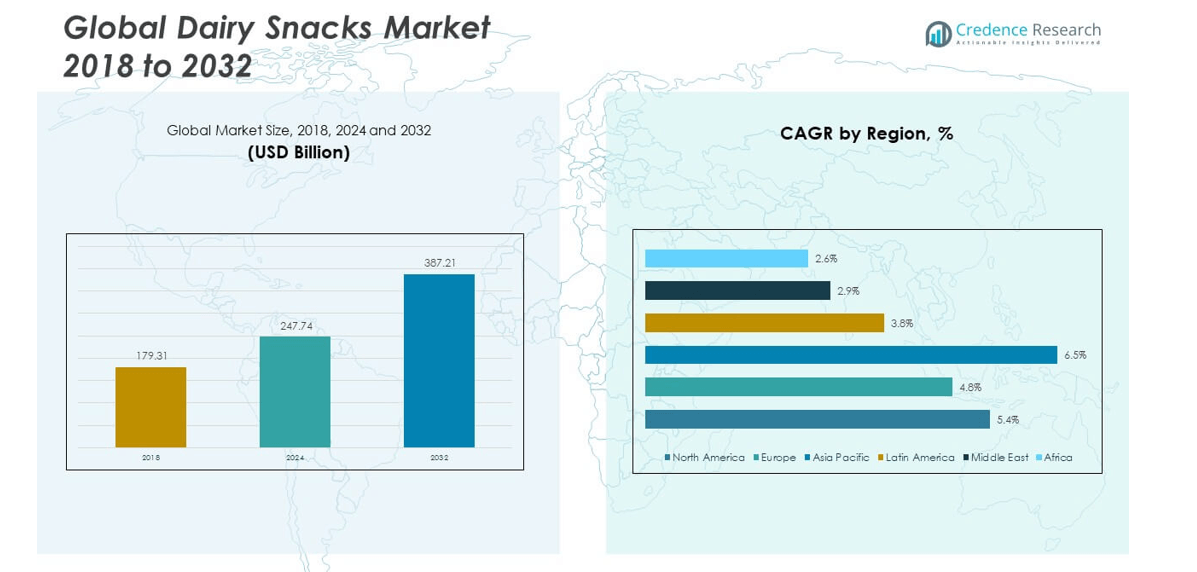
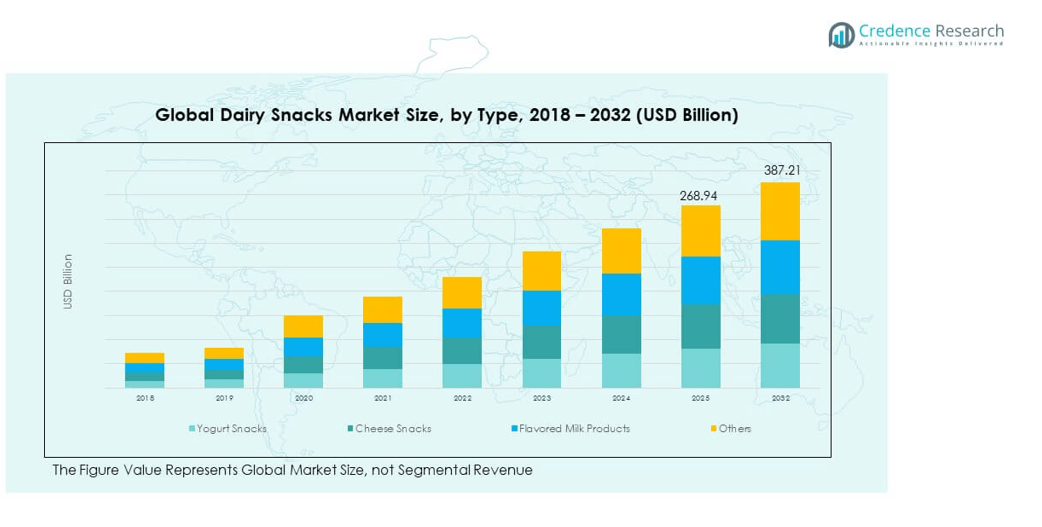
The Global Dairy Snacks Market size was valued at USD 179.31 million in 2018 to USD 247.74 million in 2024 and is anticipated to reach USD 387.21 million by 2032, at a CAGR of 5.34% during the forecast period. The market reflects consistent expansion as consumers increasingly prefer convenient, nutrient-rich snacks that balance indulgence with health benefits. Yogurt snacks, cheese-based products, and flavored milk are widely adopted across both developed and emerging regions.
| REPORT ATTRIBUTE | DETAILS |
|---|---|
| Historical Period | 2020-2023 |
| Base Year | 2024 |
| Forecast Period | 2025-2032 |
| Dairy Snacks Market Size 2024 | USD 247.74 million |
| Dairy Snacks Market, CAGR | 5.34% |
| Dairy Snacks Market Size 2032 | USD 387.21 million |
The market growth is primarily fueled by rising consumer awareness of dairy’s nutritional advantages, including protein, calcium, and probiotics that support immunity and bone health. Urbanization and busy lifestyles are encouraging demand for on-the-go dairy snacks, while innovations in packaging, flavors, and fortified variants strengthen appeal. Companies are focusing on product diversification, offering lactose-free, organic, and functional snacks to attract health-conscious and younger demographics. Expanding e-commerce and retail distribution is further boosting global penetration.
Regionally, North America and Europe dominate due to established dairy consumption patterns and strong demand for premium, fortified products. Asia Pacific stands out as the fastest-growing region, driven by rapid urbanization, rising disposable incomes, and a youthful population embracing modern snacking trends. Latin America and the Middle East show moderate growth, supported by expanding retail infrastructure, while Africa remains a smaller but steadily expanding market. These regional dynamics underline the global scope and evolving opportunities in dairy-based snacking.
Market Insights:
- The Global Dairy Snacks Market was valued at USD 247.74 million in 2024 and will reach USD 387.21 million by 2032, growing at 34% CAGR.
- Growing consumer preference for nutritious and protein-rich snacks drives market growth.
- Rising competition from plant-based alternatives poses challenges for dairy-based product adoption.
- Asia-Pacific leads growth due to urbanization, young demographics, and higher disposable income.
- North America and Europe dominate in premium and functional snack innovations.
- Latin America and the Middle East present niche opportunities but face slower growth.
- Supply chain pressures and price fluctuations remain significant restraints for producers.
Market Drivers:
Rising Demand for Nutritious and Convenient Food Options:
The Global Dairy Snacks Market is witnessing robust growth due to the increasing demand for healthier snacking alternatives. Consumers are becoming more health-conscious, and dairy-based snacks offer a balance of taste, nutrition, and convenience. Products such as yogurt snacks, cheese bites, and flavored milk appeal to individuals seeking quick, protein-rich options. The combination of high calcium, vitamins, and probiotics further enhances the value proposition. It continues to gain preference among busy working populations and young consumers. Global shifts in dietary patterns are making dairy snacks an everyday choice. This rising preference positions the market for sustained expansion over the forecast period.
- For instance,Danone’s Activia yogurt is a key player in the European probiotics market, containing strains like Bifidobacterium lactis that are clinically studied for gut health benefits. Danone held a significant share of the probiotic dairy segment in Europe as of 2024, reinforcing its leadership in nutritious dairy snacks.
Expanding Influence of Functional and Fortified Foods:
A major driver in the Global Dairy Snacks Market is the rising demand for functional and fortified dairy-based snacks. Products infused with probiotics, omega-3, or added vitamins are increasingly popular among consumers focusing on wellness. This trend has led to significant innovations in formulations, with companies investing in R&D to deliver differentiated offerings. It aligns with the growing preventive healthcare mindset, where consumers choose food that supports immunity, digestion, and overall health. Market leaders have responded with fortified cheese sticks, protein yogurt bars, and enhanced milk-based products. These developments ensure strong positioning in both developed and emerging regions. Growing consumer awareness ensures momentum for functional dairy snacks in global markets.
- For instance,Saputo is a global leader in cheese production and innovates across natural and processed cheese sticks popular in North America, focusing on protein content and clean ingredients, helping meet demand for functional protein snacks, as highlighted in their product range and market presence data.
Rising Urbanization and Busy Lifestyles Fueling Snack Culture:
Urbanization and time-constrained lifestyles are shaping consumption patterns in the Global Dairy Snacks Market. Consumers are increasingly substituting traditional meals with snacks that provide satiety and nutrition. Dairy snacks meet this demand effectively, offering a blend of indulgence and health benefits. Working professionals, students, and children drive significant consumption, boosting retail and online sales. It benefits further from the growth of convenience-driven packaging and portion-controlled formats. The shift toward on-the-go consumption strengthens the relevance of dairy-based snacks. These dynamics are fostering continuous growth in both mature and developing regions. Rising disposable incomes in emerging economies further accelerate the adoption of premium snack options.
Growing Investments and Innovations in Product Diversification:
The Global Dairy Snacks Market is expanding through strong investments in product innovation and portfolio diversification. Leading players are introducing novel flavors, organic variants, and lactose-free options to attract diverse consumer groups. Companies are also focusing on eco-friendly packaging to meet sustainability expectations. Strategic investments in advanced processing technologies ensure longer shelf life and improved taste. It is further supported by acquisitions and partnerships aimed at expanding global reach. With changing consumer preferences, such diversification is key to sustaining competitiveness. The continuous rollout of differentiated offerings helps brands secure stronger market positions. This wave of innovation ensures steady momentum in the long term.
Market Trends:
Surge in Plant-Dairy Hybrid Snack Development:
The Global Dairy Snacks Market is observing a rising trend of hybrid snacks blending dairy with plant-based ingredients. Manufacturers are targeting flexitarian consumers who seek balance between traditional dairy and plant-based nutrition. Such innovations cater to evolving dietary choices and sustainability-focused demands. It creates a bridge between conventional dairy lovers and plant-based adopters. The hybridization trend is gaining popularity in flavored yogurts and cheese snacks combined with nuts or seeds. It demonstrates how consumer inclusivity drives creative product lines. The industry is expected to witness greater traction in this segment during the forecast horizon. Companies adopting this approach gain a strategic edge in crowded markets.
- For instance,Nestlé has been publicly acknowledged as investing in hybrid dairy-plant-based product innovations, contributing to the expanding hybrid dairy products market projected to grow strongly, reflecting real industry shifts toward sustainable and inclusive snack options.
Digital Retail Expansion and Direct-to-Consumer Growth:
The growth of digital retail and D2C channels is shaping trends in the Global Dairy Snacks Market. E-commerce platforms, grocery delivery apps, and brand-owned stores are expanding access to dairy-based snacks. This allows producers to connect directly with health-conscious consumers. Companies benefit by gathering real-time data on preferences and adjusting offerings quickly. It enables targeted marketing campaigns and subscription-based models that enhance loyalty. Consumers increasingly value the convenience of home delivery and tailored assortments. The pandemic accelerated this digital shift, which has now become permanent. It positions online retail as a central driver of future dairy snack consumption patterns globally.
- For instance,Danone has embraced digital transformation in its distribution, using digital platforms worldwide to directly engage consumers, improve product assortment responsiveness, and build subscription models, as detailed in industry reports on evolving D2C strategies in 2024.
Premiumization of Dairy Snack Products:
Premiumization is an emerging trend in the Global Dairy Snacks Market, with consumers demanding high-quality, indulgent snack experiences. Products made from organic, grass-fed, or artisanal dairy sources are gaining attention. Flavors inspired by global cuisines, gourmet ingredients, and clean-label certifications appeal strongly. It reflects a willingness among consumers to pay more for unique offerings. Companies are responding with limited-edition lines and premium packaging to reinforce brand exclusivity. The trend is visible across yogurt, cheese, and milk-based beverages in developed regions. Premiumization is reshaping competitive strategies and positioning. It ensures long-term value growth by catering to affluent and discerning segments.
Sustainability-Driven Innovation in Packaging and Production:
A major trend in the Global Dairy Snacks Market is sustainability-focused innovation in both packaging and production practices. Companies are adopting recyclable, biodegradable, and minimal-plastic packaging to meet eco-conscious consumer expectations. It aligns with rising regulatory pressures and corporate commitments toward reducing carbon footprints. Manufacturers are also integrating renewable energy and resource-efficient processing systems. Transparency in sourcing and clean-label claims further strengthen brand trust. Consumers increasingly seek products that align with ethical and environmental values. This trend is redefining competitive advantage across the market. It is expected to influence long-term purchasing behaviors and product development strategies worldwide.
Market Challenges Analysis:
Fluctuating Raw Material Prices and Supply Chain Pressures:
The Global Dairy Snacks Market faces challenges due to fluctuating milk prices and raw material costs. Volatility in global dairy production and feed costs directly impacts manufacturing margins. Transportation delays, energy price surges, and supply chain disruptions add further strain. It creates difficulties for producers in maintaining stable pricing for consumers. Smaller players find it harder to absorb cost variations compared to large corporations. Growing demand can clash with uncertain supply, creating imbalances. Manufacturers must adopt strategic sourcing and contracts to manage these risks. Despite these issues, innovation and efficiency investments are helping mitigate operational pressures.
Rising Competition from Plant-Based Alternatives:
A significant challenge in the Global Dairy Snacks Market is competition from plant-based alternatives. Vegan and dairy-free snacks have gained rapid popularity, especially among younger demographics. It poses risks to traditional dairy segments such as cheese and yogurt snacks. Ethical concerns over animal welfare and sustainability accelerate this shift. Marketing strategies highlighting plant-based benefits are reshaping consumer perceptions. Dairy producers must respond with lactose-free or hybrid solutions to retain loyalty. The need for differentiation has grown critical in crowded snacking categories. The industry must adapt quickly to remain relevant amid changing dietary preferences and rising competition.
Market Opportunities:
Expansion into Emerging Economies with Untapped Potential:
The Global Dairy Snacks Market holds strong opportunities in emerging economies where rising incomes and urbanization are shaping consumption. Demand for convenient, nutrient-rich snacks is accelerating across Asia-Pacific, Latin America, and parts of Africa. Companies introducing affordable yet innovative products are likely to succeed. It can also benefit from growing retail networks and expanding online sales channels. Localized flavors and product customization are opening new avenues. Rising youth populations further strengthen market potential. Strategic investments in these regions can deliver long-term growth opportunities. This expansion wave is expected to significantly boost global market revenues.
Development of Specialized and Health-Oriented Snack Variants:
Specialized dairy snack variants present strong opportunities in the Global Dairy Snacks Market. Products targeting specific groups such as children, athletes, or elderly consumers are gaining attention. High-protein, low-sugar, and fortified snacks are being positioned as functional solutions. It aligns with preventive health practices and growing demand for tailored nutrition. Companies introducing lactose-free, probiotic-rich, or organic dairy snacks can capture new segments. Collaborations with health experts and influencers can support brand differentiation. The scope for innovation in niche product categories is substantial. This opportunity ensures continuous relevance of dairy-based snacks in competitive markets.
Market Segmentation Analysis:
By Type
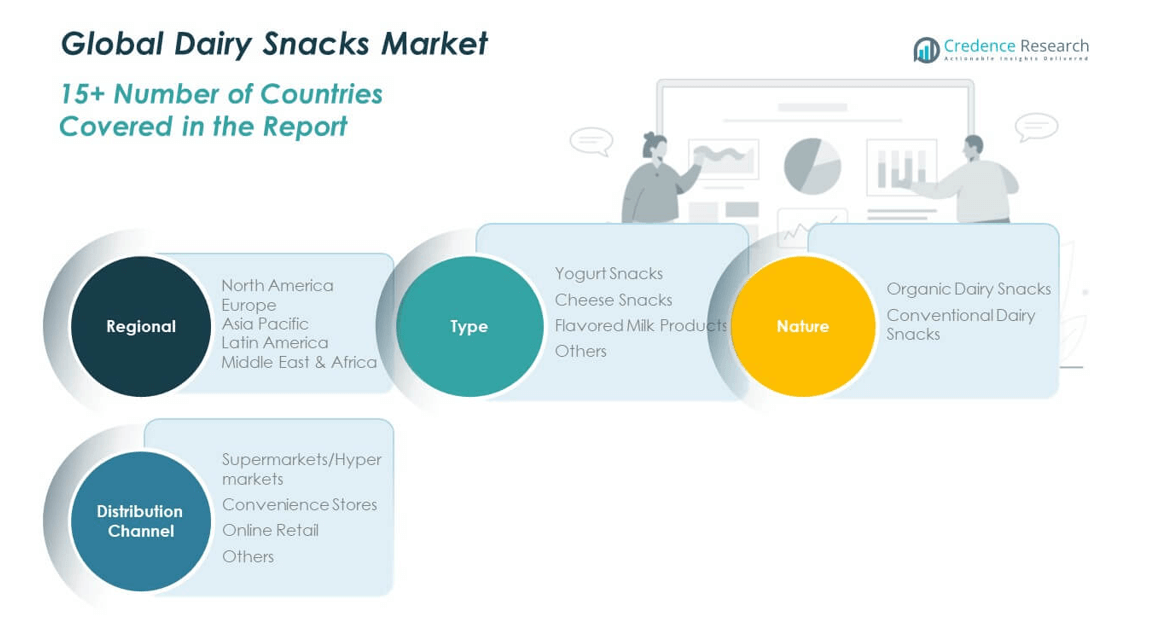
The Global Dairy Snacks Market is segmented into yogurt snacks, cheese snacks, flavored milk products, and others. Yogurt snacks hold a strong share due to their probiotic benefits and versatility in flavors. Cheese snacks are popular among both children and adults as a high-protein, savory option. Flavored milk products continue to expand with innovative variants such as lactose-free and fortified beverages. Other dairy-based snack innovations, including milk-based bars and frozen dairy treats, are gaining traction. This segment is driven by the balance of indulgence and nutrition that dairy-based snacks provide.
By Nature
The market is classified into organic and conventional dairy snacks. Conventional products dominate due to affordability and wider availability across retail formats. However, the organic segment is growing rapidly, supported by increasing consumer focus on clean-label products and sustainable farming. Premiumization and demand for chemical-free products are boosting organic snack adoption. Major players are investing in certifications and branding to strengthen trust. This segment reflects a growing divide between mass-market affordability and niche premium demand.
- For instance,Organic Valley is a recognized leader in organic dairy, with 100% USDA Organic certification across its farms and product lines, including cheese snacks. The cooperative’s transparency in certifications supports trust in organic dairy snacks with increased production capacity as demand grows.
By Distribution Channel
Distribution occurs through supermarkets/hypermarkets, convenience stores, online retail, and others. Supermarkets remain the primary sales channel due to extensive product variety and promotional offers. Convenience stores support impulse buying, particularly for cheese sticks and yogurt cups. Online retail is emerging as the fastest-growing channel, supported by home delivery and subscription models. Specialty health stores and vending machines also contribute to growth. E-commerce provides greater visibility for niche and premium dairy snack brands.
Segmentation:
- By Type
- Yogurt Snacks
- Cheese Snacks
- Flavored Milk Products
- Others
- By Nature
- Organic Dairy Snacks
- Conventional Dairy Snacks
- By Distribution Channel
- Supermarkets/Hypermarkets
- Convenience Stores
- Online Retail
- Others
- By Region
- North America
- U.S.
- Canada
- Mexico
- Europe
- UK
- France
- Germany
- Italy
- Spain
- Russia
- Belgium
- Netherlands
- Austria
- Sweden
- Poland
- Denmark
- Switzerland
- Rest of Europe
- Asia Pacific
- China
- Japan
- South Korea
- India
- Australia
- Thailand
- Indonesia
- Vietnam
- Malaysia
- Philippines
- Taiwan
- Rest of Asia Pacific
- Latin America
- Brazil
- Argentina
- Peru
- Chile
- Colombia
- Rest of Latin America
- Middle East
- UAE
- KSA
- Israel
- Turkey
- Iran
- Rest of Middle East
- Africa
- Egypt
- Nigeria
- Algeria
- Morocco
- Rest of Africa
- North America
Regional Analysis:
North America
The North America Global Dairy Snacks Market size was valued at USD 32.70 million in 2018 to USD 44.05 million in 2024 and is anticipated to reach USD 69.31 million by 2032, at a CAGR of 5.4% during the forecast period. North America accounts for nearly 18% share of the global market. The region is driven by strong consumer demand for premium, fortified, and clean-label dairy snacks. The U.S. leads with high yogurt and cheese snack consumption, supported by health-focused diets. Canada also shows strong demand for organic and sustainable variants. Growing obesity concerns are boosting demand for protein-rich dairy alternatives. Product innovation with functional ingredients is a key growth factor. E-commerce and retail expansion strengthen accessibility across all demographics.
Europe
The Europe Global Dairy Snacks Market size was valued at USD 79.12 million in 2018 to USD 106.78 million in 2024 and is anticipated to reach USD 160.70 million by 2032, at a CAGR of 4.8%. Europe represents the 43% share of the global market, making it the largest regional segment. Dairy consumption is deeply rooted in European food culture, particularly in Germany, France, and the UK. Cheese snacks dominate due to strong culinary traditions, while yogurt and flavored milk continue to expand. EU regulations on food safety and sustainability drive innovation in organic and clean-label products. Convenience-driven formats such as single-serve yogurt cups are widely popular. Premiumization trends are shaping consumer preferences, especially in Western Europe. Eastern Europe shows growing adoption as disposable incomes rise. The region will remain dominant but witness slower growth compared to Asia Pacific.
Asia Pacific
The Asia Pacific Global Dairy Snacks Market size was valued at USD 51.14 million in 2018 to USD 74.66 million in 2024 and is anticipated to reach USD 127.39 million by 2032, at a CAGR of 6.5%, the highest among all regions. Asia Pacific holds around 31% share of the global market. Rising disposable incomes, urbanization, and a young demographic base are fueling consumption. China and India lead the market, with Japan and South Korea showing strong preferences for functional dairy snacks. Flavored milk and yogurt-based products are gaining popularity among school-going children and working professionals. Expanding retail infrastructure and e-commerce penetration enhance product availability. Localized flavors and culturally tailored products strengthen brand loyalty. Increasing awareness of nutrition is driving growth in premium and organic categories. The region is set to remain the fastest-growing market.
Latin America
The Latin America Global Dairy Snacks Market size was valued at USD 8.65 million in 2018 to USD 11.80 million in 2024 and is anticipated to reach USD 16.37 million by 2032, at a CAGR of 3.8% during the forecast period. Latin America contributes about 4% share of the global market. Brazil is the largest contributor, with Argentina following closely due to strong dairy traditions. Cheese-based snacks and flavored milk dominate sales, with yogurt slowly gaining traction. Economic fluctuations in the region can affect purchasing power, limiting premium product adoption. Retail chains and supermarkets are critical distribution channels, especially in urban areas. Growth is moderate but supported by rising middle-class demand. Online channels are beginning to expand, particularly in Brazil and Mexico. Focused marketing on health and convenience will enhance penetration.
Middle East
The Middle East Global Dairy Snacks Market size was valued at USD 4.70 million in 2018 to USD 5.90 million in 2024 and is anticipated to reach USD 7.68 million by 2032, at a CAGR of 2.9%. The region holds about 2% share of the global market. Dairy products are widely consumed in traditional diets, but processed dairy snacks are growing slowly. GCC countries such as Saudi Arabia and the UAE show rising demand for premium and fortified products. Expanding retail infrastructure and urban population growth support adoption. Import dependency remains high, which impacts pricing stability. Multinational brands dominate, but local companies are entering niche organic categories. Consumer awareness about health is increasing, creating opportunities for functional dairy snacks. Growth remains steady but constrained by high competition from traditional alternatives.
Africa
The Africa Global Dairy Snacks Market size was valued at USD 3.00 million in 2018 to USD 4.54 million in 2024 and is anticipated to reach USD 5.76 million by 2032, at a CAGR of 2.6%. Africa contributes just 1% share of the global market. The region shows slow growth due to affordability challenges and limited cold chain infrastructure. South Africa leads consumption, followed by Egypt. Dairy snacks are primarily consumed in urban centers with higher purchasing power. Growth in supermarkets and modern retail formats supports market expansion. Increasing awareness of health benefits is slowly boosting demand for yogurt and cheese snacks. However, local competition from traditional food habits limits widespread adoption. Long-term growth depends on investments in infrastructure and localized product innovation.
Key Player Analysis:
- Danone S.A.
- Arla Foods Ingredients Group
- Friesland Campina
- Lactalis International
- Fonterra Co-operative Group Limited
- Nestlé S.A.
- The Kraft Heinz Company
- Megmilk Snow Brand Co. Ltd
- Meiji Holdings Co. Ltd.
- Organic Valley
Competitive Analysis:
The Global Dairy Snacks Market is moderately fragmented, with leading companies holding strong positions through diversified product portfolios and global distribution networks. It is characterized by constant innovation, with companies introducing fortified, organic, and lactose-free variants to attract different consumer groups. Competition is intense in mature markets like Europe and North America, where premiumization and sustainability are key differentiators. In Asia Pacific, local players compete with multinational brands by offering affordable and culturally tailored products. Strategic alliances, product launches, and retail partnerships are common strategies to expand market share. Companies with strong supply chains and branding capabilities maintain an edge.
Recent Developments:
- In April 2024, Danone S.A. launched a new yogurt and dairy snack line called Remix in North America. The portfolio features yogurt or dairy bases with mix-in toppings across multiple Danone brands, including Oikos Remix, Too Good & Co. Remix, and Light + Fit Remix, aiming to meet the rising demand for convenient and flavorful snacks among consumers.
- In September 2024, Arla Foods Ingredients launched a new high-protein dairy campaign promoting their Nutrilac ProteinBoost range. This campaign supports manufacturers in creating high-protein dairy products without compromising taste or texture, including concepts like high-protein yogurts and ice cream.
- In May 2024, Lactalis International's Canadian arm introduced Enjoy, a new plant-based milk brand featuring oat, almond, and hazelnut milks with high protein content. This launch follows their conversion to a fully vegan production hub, reflecting an expansion in their dairy alternative portfolio.
- In November 2023, Nestlé launched N3 milk in China, a first-to-market milk product containing prebiotic fibers derived from intrinsic lactose, reduced lactose content, and fewer calories. The range supports healthy aging with fortified versions to improve bone health, muscle strength, and immunity, showcasing Nestlé’s innovation in nutritional dairy products.
Report Coverage:
The research report offers an in-depth analysis based on type, nature, and distribution channel. It details leading market players, providing an overview of their business, product offerings, investments, revenue streams, and key applications. Additionally, the report includes insights into the competitive environment, SWOT analysis, current market trends, as well as the primary drivers and constraints. Furthermore, it discusses various factors that have driven market expansion in recent years. The report also explores market dynamics, regulatory scenarios, and technological advancements that are shaping the industry. It assesses the impact of external factors and global economic changes on market growth. Lastly, it provides strategic recommendations for new entrants and established companies to navigate the complexities of the market.
Future Outlook:
- Rising demand for fortified and functional dairy snacks will shape innovation.
- Asia Pacific will remain the fastest-growing region due to demographics and urbanization.
- Premiumization will dominate Europe and North America markets.
- Sustainability-driven packaging will become a key differentiator.
- Online and direct-to-consumer channels will expand globally.
- Lactose-free and organic product lines will capture health-focused consumers.
- Partnerships with retailers and e-commerce platforms will strengthen distribution.
- Emerging economies will provide long-term growth opportunities.
- Innovation in hybrid dairy-plant snacks will gain popularity.
- Global leaders will continue acquisitions to consolidate market presence.

Request a Free Sample
Fill in your details and we'll send you a free sample report.
- Sample data tables & charts
- Research methodology
Market Dynamics
Rising Demand for Nutritious and Convenient Food Options
Consumers are increasingly seeking snacks that offer both health benefits and convenience, making dairy snacks - rich in protein, calcium, and probiotics - an attractive choice for busy lifestyles and health-conscious individuals.
Expanding Influence of Functional and Fortified Foods
The popularity of dairy snacks fortified with probiotics, vitamins, and added protein is driving market growth, as consumers look for products that support immunity, digestion, and overall wellness.
Urbanization and Busy Lifestyles Fueling Snack Culture
Rapid urbanization and time-constrained routines are leading consumers to replace traditional meals with on-the-go snacks, boosting demand for dairy-based options that provide satiety and nutrition.
Product Diversification and Innovation
Manufacturers are investing in new flavors, organic and lactose-free variants, and eco-friendly packaging to attract diverse consumer groups, ensuring sustained market expansion and competitiveness.
Digital Retail Expansion and Direct-to-Consumer Growth
The rise of e-commerce and direct-to-consumer channels is making dairy snacks more accessible, enabling brands to reach health-focused consumers directly and respond quickly to changing preferences.
Need a Custom Version of This Report?
Tailor the scope, geography, or segments to your exact requirements.
- Custom geography or segment scope
- Direct access to our analyst team
Frequently Asked Questions
What is the current market size for Global Dairy Snacks Market, and what is its projected size in 2032?
Which Global Dairy Snacks Market segment held the largest share in 2024?
Who are the leading companies in the Global Dairy Snacks Market?
Which region commanded the largest share of the Global Dairy Snacks Market in 2024?
Table of Content
Chapter 1 Market Segmentation
- 1.1 Segmentation Framework
- 1.1.1 Product and Service Classification
- 1.1.2 Application and End-Use Classification
- 1.1.3 Technology and Solution Classification
- 1.1.4 Customer and Distribution Channel Classification
- 1.1.5 Geographic Segmentation
- 1.1.6 Market Segment Definitions and Boundaries
- 1.2 By Type
- 1.2.1 Yogurt Snacks
- 1.2.2 Cheese Snacks
- 1.2.3 Flavored Milk Products
- 1.2.4 Others
- 1.3 By Nature
- 1.3.1 Organic Dairy Snacks
- 1.3.2 Conventional Dairy Snacks
Chapter 2 Introduction
- 2.1 Report Objectives and Scope
- 2.2 Product Definition and Industry Terminology
- 2.3 Market Inclusions and Exclusions
- 2.4 Research Process
- 2.4.1 Primary Research and Expert Interviews
- 2.4.2 Secondary Research and Source Review
- 2.4.3 Top-Down and Bottom-Up Estimation
- 2.4.4 Data Triangulation and Verification
- 2.5 Market Size Measurement Basis
- 2.5.1 2024: USD 247.74 million → 2032: USD 387.21 million
- 2.6 Historical and Forecast Reference Periods
- 2.6.1 Base Year: 2024
- 2.6.2 Forecast Period: 2024-2032
- 2.7 Research Assumptions and Limitations
Chapter 3 Executive Summary
- 3.1 Market Snapshot and Key Findings
- 3.2 Base-Year Market Size, 2024
- 3.3 Forecast Market Size, 2032
- 3.4 Revenue and Volume Growth Outlook
- 3.5 Key Demand and Supply Indicators
- 3.6 Leading Market Segments
- 3.7 Fastest-Growing Market Opportunities
- 3.8 Regional Performance Highlights
- 3.9 Technology and Industry Transformation
- 3.10 Competitive Landscape Summary
- 3.11 Analyst View and Strategic Implications
Chapter 4 Global Dairy Snacks Market Trends and Developments
- 4.1 Historical Industry Development
- 4.2 Recent Market Trends and Developments
- 4.3 Demand and Customer Behavior Trends
- 4.4 Technology and Product Innovation
- 4.5 Artificial Intelligence, Automation and Digitalization
- 4.6 Local Manufacturing and Supply Chain Realignment
- 4.7 Industry Partnerships, Mergers and Acquisitions
- 4.8 Sustainability and Circular Economy Developments
- 4.9 Government and Private Sector Investment Trends
- 4.10 Emerging Business Models and Commercialization
- 4.11 Industry Developments and Announcements
Chapter 5 Global Dairy Snacks Market Production, Supply and Demand Analysis
- 5.1 Demand Trend and Consumption Analysis
- 5.2 Demand Forecast, 2024-2032
- 5.3 Production and Output Trend
- 5.4 Production and Output Forecast, 2024-2032
- 5.5 Installed Capacity and Capacity Utilization
- 5.6 Company-Wise Production Plants and Statistics
- 5.6.1 Installed Production Capacity
- 5.6.2 Actual Production
- 5.6.3 Planned Capacity and Expansion Targets
- 5.7 Supply Chain Structure and Procurement Trends
- 5.8 Supply-Demand Gap and Bottlenecks
- 5.9 Import Dependence and Sourcing Structure
- 5.10 Contract Manufacturing and Outsourcing
- 5.11 Regional Supply and Demand Concentration
Chapter 6 Global Dairy Snacks Market Pricing Analysis
- 6.1 Pricing Structure and Measurement
- 6.2 Historical Pricing Trends
- 6.3 Pricing Outlook, 2024-2032
- 6.4 Average Selling Price and Unit Economics
- 6.5 Pricing by Product and Market Segment
- 6.6 Geographic Pricing Differences
- 6.7 Key Input, Energy, Labor and Logistics Costs
- 6.8 Contract Pricing and Purchasing Models
- 6.9 Pricing Sensitivity and Competitive Positioning
- 6.10 Price, Margin and Profitability Implications
Chapter 7 Global Dairy Snacks Market Dynamics
- 7.1 Market Growth Drivers
- 7.1.1 Demand-Side Drivers
- 7.1.2 Technology and Innovation Drivers
- 7.1.3 Infrastructure and Investment Drivers
- 7.1.4 Regulatory and Policy Drivers
- 7.2 Market Restraints
- 7.2.1 Cost and Affordability Constraints
- 7.2.2 Technology and Adoption Barriers
- 7.2.3 Supply Chain and Operational Constraints
- 7.3 Market Challenges
- 7.3.1 Competitive Pressure and Margin Erosion
- 7.3.2 Skills, Infrastructure and Implementation Gaps
- 7.4 Emerging Market Opportunities
- 7.5 Market Dynamics Impact and Time-Horizon Assessment
Chapter 8 Global Dairy Snacks Value Chain Analysis
- 8.1 Industry Value Chain Overview
- 8.2 Upstream Suppliers and Critical Inputs
- 8.3 Technology and Component Providers
- 8.4 Manufacturing or Service Delivery
- 8.5 Distribution, Channel Partners and Integrators
- 8.6 Downstream Applications and End Users
- 8.7 Value Addition and Profit Pools
- 8.8 Vertical Integration and Outsourcing
- 8.9 Supplier Concentration and Risk
- 8.10 Supply Chain Localization and Resilience
Chapter 9 Global Dairy Snacks Market Regulations and Policies
- 9.1 Relevant Laws, Standards and Compliance Frameworks
- 9.2 Product, Service, Safety and Quality Requirements
- 9.3 Government Policies, Incentives and Subsidies
- 9.4 Imports, Exports and Trade Barriers
- 9.5 Public Procurement and Local Content Requirements
- 9.6 Environmental and Sustainability Compliance
- 9.7 Upcoming Policy Changes and Market Implications
Chapter 10 Global Dairy Snacks Market Hotspots and Opportunities
- 10.1 Market Opportunity Mapping and Growth Hotspots
- 10.2 High-Growth Applications and Customer Groups
- 10.3 Underserved Markets and White-Space Opportunities
- 10.4 Emerging Technology and Product Opportunities
- 10.5 New Capacity and Investment Hotspots
- 10.6 Market Entry and Expansion Opportunities
- 10.7 Distribution and Partnership Opportunities
- 10.8 Near-Term and Long-Term Commercial Potential
- 10.9 Opportunity Attractiveness and Execution Risks
Chapter 11 Global Dairy Snacks Market Outlook, 2024-2032
- 11.1 Market Size and Analysis
- 11.1.1 Revenue (Market Measurement: 2024: USD 247.74 million → 2032: USD 387.21 million)
- 11.1.2 Market Volume and Quantity Sold
- 11.1.3 Historical Market Size
- 11.1.4 Base-Year Market Size, 2024
- 11.2 Market Forecast, 2024-2032
- 11.2.1 Revenue Forecast to 2032
- 11.2.2 Volume Forecast to 2032
- 11.2.3 CAGR and Year-on-Year Growth
- 11.2.4 Incremental Revenue Opportunity
- 11.3 Forecast Assumptions and Scenario Analysis
- 11.3.1 Base-Case Forecast
- 11.3.2 Optimistic and Conservative Scenarios
- 11.3.3 Technology, Pricing and Policy Sensitivities
- 11.4 Market Attractiveness and Growth Outlook
Chapter 12 Global Dairy Snacks Market Segmentation and Outlook
- 12.1 Segmentation Summary and Market Shares, 2024
- 12.2 Largest and Fastest-Growing Segments
- 12.3 By Type - Market Size and Forecast, 2024-2032
- 12.3.1 Segment Definition and Scope
- 12.3.2 Historical Market Size
- 12.3.3 Revenue Forecast, 2024-2032
- 12.3.4 Volume Forecast, 2024-2032
- 12.3.5 Base-Year Market Share, 2024
- 12.3.6 Segment CAGR and Growth Drivers
- 12.3.7 Subsegment Market Size and Forecast
- 12.3.7.1 Yogurt Snacks
- 12.3.7.2 Cheese Snacks
- 12.3.7.3 Flavored Milk Products
- 12.3.7.4 Others
- 12.3.8 Subsegment Pricing and Adoption Trends
- 12.3.9 Leading Suppliers and Competition
- 12.3.10 Regional Demand and Opportunities
- 12.4 By Nature - Market Size and Forecast, 2024-2032
- 12.4.1 Segment Definition and Scope
- 12.4.2 Historical Market Size
- 12.4.3 Revenue Forecast, 2024-2032
- 12.4.4 Volume Forecast, 2024-2032
- 12.4.5 Base-Year Market Share, 2024
- 12.4.6 Segment CAGR and Growth Drivers
- 12.4.7 Subsegment Market Size and Forecast
- 12.4.7.1 Organic Dairy Snacks
- 12.4.7.2 Conventional Dairy Snacks
- 12.4.8 Subsegment Pricing and Adoption Trends
- 12.4.9 Leading Suppliers and Competition
- 12.4.10 Regional Demand and Opportunities
- 12.5 Segment Growth Comparison
- 12.6 Segment Attractiveness and Priority Matrix
Chapter 13 Global Dairy Snacks Geographic Market Outlook, 2024-2032
- 13.1 Regional Market Size and Share, 2024
- 13.2 Regional Market Forecast, 2024-2032
- 13.3 Regional Pricing, Production and Demand Differences
- 13.4 North America
- 13.4.1 United States
- 13.4.2 Canada
- 13.4.3 Mexico
- 13.5 Europe
- 13.5.1 Germany
- 13.5.2 France
- 13.5.3 Italy
- 13.5.4 United Kingdom
- 13.5.5 Spain
- 13.5.6 Poland
- 13.5.7 Russia
- 13.5.8 Netherlands
- 13.5.9 Belgium
- 13.5.10 Sweden
- 13.5.11 Denmark
- 13.5.12 Norway
- 13.5.13 Rest of Europe
- 13.6 Asia Pacific
- 13.6.1 China
- 13.6.2 India
- 13.6.3 Japan
- 13.6.4 South Korea
- 13.6.5 Thailand
- 13.6.6 Indonesia
- 13.6.7 Vietnam
- 13.6.8 Malaysia
- 13.6.9 Australia
- 13.6.10 Rest of Asia Pacific
- 13.7 Latin America
- 13.7.1 Brazil
- 13.7.2 Argentina
- 13.7.3 Colombia
- 13.7.4 Chile
- 13.7.5 Rest of Latin America
- 13.8 Middle East
- 13.8.1 Saudi Arabia
- 13.8.2 United Arab Emirates
- 13.8.3 Turkey
- 13.8.4 Israel
- 13.8.5 Iran
- 13.8.6 Rest of the Middle East
- 13.9 Africa
- 13.9.1 South Africa
- 13.9.2 Egypt
- 13.9.3 Nigeria
- 13.9.4 Morocco
- 13.9.5 Rest of Africa
- 13.10 Regional Investment, Policy and Supply Chain Differences
- 13.11 Regional Competitive Landscape
- 13.12 Geographic Growth Hotspots
Chapter 14 Global Dairy Snacks Technology, Innovation and Sustainability Outlook
- 14.1 Technology Landscape and Maturity
- 14.2 Product, Process and Service Innovation
- 14.3 AI, Automation and Digital Tools in the Industry
- 14.4 Technology Adoption and Performance Benchmarking
- 14.5 Innovation Pipeline and R&D Investment
- 14.6 Patent and Intellectual Property Trends
- 14.7 Energy Efficiency and Resource Management
- 14.8 Sustainability, Recycling and Circularity
- 14.9 Technology Roadmap, 2024-2032
- 14.10 Risks of Obsolescence and Technology Substitution
Chapter 15 Global Dairy Snacks Market Key Strategic Imperatives
- 15.1 Growth and Market Entry Priorities
- 15.2 High-Return Products and Segments
- 15.3 Pricing, Profitability and Cost Optimization
- 15.4 Technology Investment and Product Differentiation
- 15.5 Supply Chain Localization and Resilience
- 15.6 Distribution and Customer Acquisition
- 15.7 Partnership, Acquisition and Capacity Strategy
- 15.8 Regional Expansion Priorities
- 15.9 Short-, Medium- and Long-Term Actions
Chapter 16 Competition Outlook
- 16.1 Industry Competition Characteristics
- 16.2 Market Structure and Concentration
- 16.3 Market Share and Competitive Positioning, 2024
- 16.4 Company-Wise Revenue and Product Benchmarking
- 16.5 Production and Service Capacity Benchmarking
- 16.6 Technology, Pricing and Differentiation
- 16.7 Regional Footprint and Distribution Strength
- 16.8 Mergers, Acquisitions and Strategic Alliances
- 16.9 New Entrants and Competitive Threats
- 16.10 Porter's Five Forces and Industry Attractiveness
- 16.11 Competitive Outlook, 2024-2032
Chapter 17 Company Profiles
- 17.1 Company Coverage and Selection Criteria
- 17.2 Danone S.A.
- 17.2.1 Business Description
- 17.2.2 Company Ownership and Geographic Presence
- 17.2.3 Product and Service Portfolio
- 17.2.4 Manufacturing and Operating Footprint
- 17.2.5 Production Capacity and Expansion Plans
- 17.2.6 Financial Performance and Investment
- 17.2.7 Market Share and Competitive Position
- 17.2.8 Technology and Innovation Capabilities
- 17.2.9 Strategic Alliances or Partnerships
- 17.2.10 Recent Developments
- 17.2.11 Growth Strategy and Outlook
- 17.3 Arla Foods Ingredients Group
- 17.4 Friesland Campina
- 17.5 Lactalis International
- 17.6 Fonterra Co-operative Group Limited
- 17.7 Nestlé S.A.
- 17.8 The Kraft Heinz Company
- 17.9 Megmilk Snow Brand Co. Ltd
- 17.10 Meiji Holdings Co. Ltd.
- 17.11 Organic Valley
- 17.12 Other Relevant Market Participants
Note: Every listed company is profiled on the structure shown under the first company. The company list is preliminary and may change based on research findings, market developments, data availability and client requirements.
Chapter 18 Disclaimer
- 18.1 Research and Forecast Disclaimer
- 18.2 Data Source and Estimation Limitations
Note: The depth of individual sections depends on data availability for this market. Volume, capacity, trade and other unit-based metrics are included where applicable.