Market Overview:
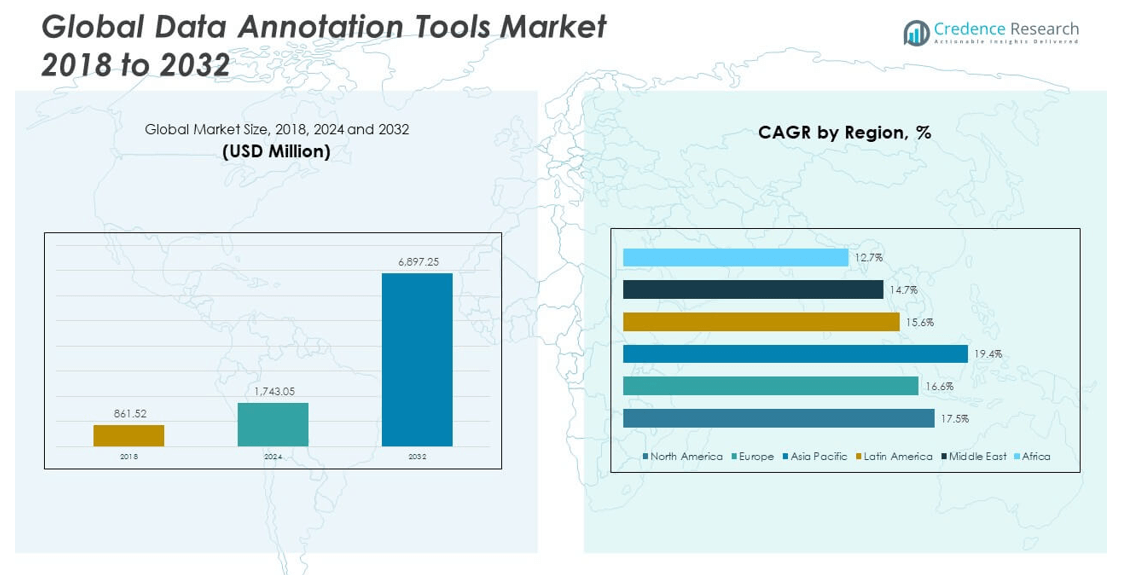
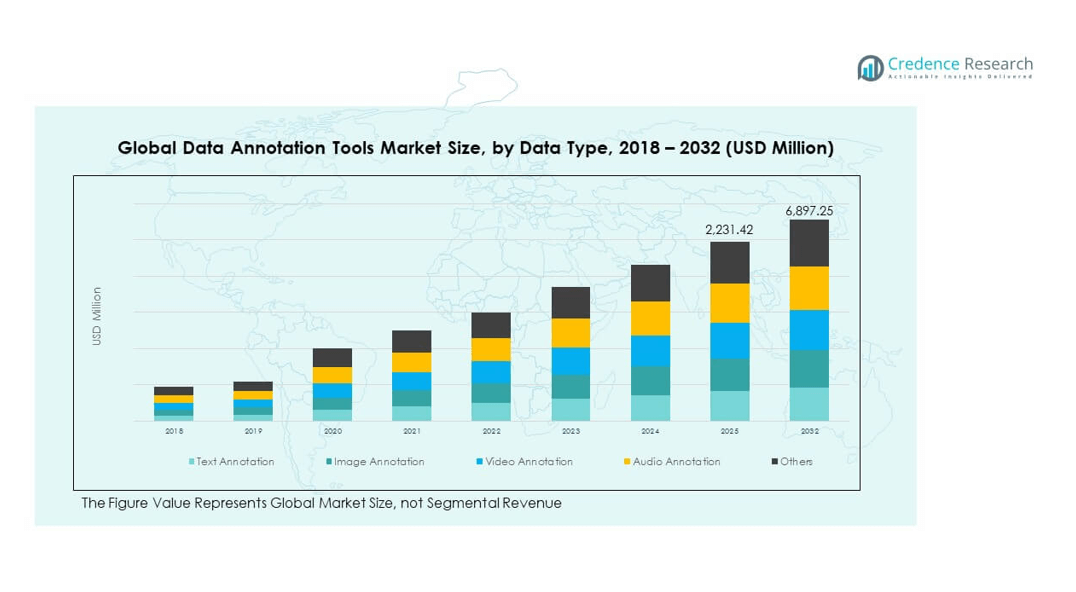
The Global Data Annotation Tools Market size was valued at USD 861.52 million in 2018 to USD 1,743.05 million in 2024 and is anticipated to reach USD 6,897.25 million by 2032, at a CAGR of 17.49% during the forecast period
| REPORT ATTRIBUTE | DETAILS |
|---|---|
| Historical Period | 2020-2023 |
| Base Year | 2024 |
| Forecast Period | 2025-2032 |
| Data Annotation Tools Market Size 2024 | USD 1,743.05 million |
| Data Annotation Tools Market, CAGR | 17.49% |
| Data Annotation Tools Market Size 2032 | USD 6,897.25 million |
The Global Data Annotation Tools Market is being driven by increasing adoption of AI technologies in sectors like healthcare, automotive, retail, and finance. Companies are investing heavily in structured training datasets to improve the performance of AI models. Growing applications of computer vision, NLP, and voice recognition also contribute to rising demand. With the expansion of autonomous vehicles, virtual assistants, and predictive analytics, organizations are integrating annotation tools to enhance accuracy, reduce time, and ensure scalable training models.
Regional growth varies significantly. North America dominates due to strong AI adoption, mature technology infrastructure, and major tool providers. Europe is showing robust demand, particularly in automotive and healthcare applications. Asia Pacific is the fastest-growing region, supported by government-backed AI projects and increasing tech innovation in China, India, and Japan. Emerging regions like Latin America, the Middle East, and Africa are witnessing gradual adoption, largely driven by rising digitalization and enterprise-level AI deployments.
Market Insights:
- Global Data Annotation Tools Market grew from USD 861.52 million in 2018 to USD 1,743.05 million in 2024, and is projected to reach USD 6,897.25 million by 2032 at 17.49% CAGR.
- North America led with 34.4% share in 2024, followed by Europe at 22.4% and Asia Pacific at 20%.
- Asia Pacific is the fastest-growing region, driven by AI investments, outsourcing, and expanding innovation hubs.
- Image annotation dominated with ~35% share in 2024, fueled by healthcare imaging and autonomous vehicles.
- Video annotation held ~26% share, boosted by surveillance, navigation, and retail analytics applications.
Market Drivers:
Rising Dependence on Labeled Data for AI Model Training:
The Global Data Annotation Tools Market benefits from the surging demand for labeled datasets across industries. AI algorithms rely on high-quality annotations for accurate learning outcomes. It is witnessing strong adoption in healthcare for diagnostic imaging, autonomous driving systems, and e-commerce personalization. Organizations are increasingly prioritizing accurate data tagging to strengthen predictive models and decision-making. Businesses realize that raw data without annotations holds limited utility in AI training, which accelerates the need for advanced tools. Vendors are introducing platforms that reduce human error and improve consistency. Growing complexity of AI projects underscores the irreplaceable role of annotation tools.
- For instance, in healthcare, expert annotators label medical images such as MRIs and X-rays to detect abnormalities, enhancing diagnostic accuracy and speeding disease identification. Similarly, the autonomous driving sector employs annotated images and videos to train systems for real-time road condition analysis, obstacle recognition, and traffic sign detection, reducing accidents and improving vehicle safety.
Expanding Applications of Computer Vision in Multiple Industries:
The Global Data Annotation Tools Market gains momentum from rapid deployment of computer vision technologies. It is being applied in industries such as retail, security, agriculture, and healthcare. Facial recognition, quality inspection, medical imaging, and automated surveillance are major use cases driving the need for annotated image datasets. Organizations invest in annotation platforms to enhance detection accuracy and improve automation reliability. The rise of smart city projects and surveillance systems also accelerates adoption. Developers seek scalable solutions that support image, video, and 3D annotations for diverse AI systems. Tools are evolving to handle complex, high-volume visual datasets.
- For instance, Quality inspection systems in manufacturing use visual annotations to identify defects early, reducing waste. In agriculture, annotated satellite and drone imagery enable crop monitoring and disease detection. The growing complexity and volume of visual data necessitate scalable annotation tools supporting images, videos, and 3D data, which contemporary platforms increasingly provide.
Accelerating Growth of Autonomous and Connected Vehicles:
The Global Data Annotation Tools Market is strongly influenced by demand from the automotive sector. It is enabling development of self-driving cars through precise annotation of road, traffic, and object datasets. Annotated video and sensor data are critical for training autonomous vehicle systems in navigation and safety. Automakers and technology firms collaborate with service providers to manage large-scale annotation projects. Safety requirements encourage accurate and bias-free labeling practices. Growing investment in advanced driver assistance systems (ADAS) further expands use cases. The global push toward mobility automation ensures continued reliance on annotation platforms.
Increasing Adoption of NLP and Voice Recognition Systems:
The Global Data Annotation Tools Market is growing with the expansion of NLP, chatbots, and speech recognition technologies. It plays a key role in preparing datasets for sentiment analysis, translation, and conversational AI. Enterprises integrate annotation platforms to improve customer experience and streamline digital interactions. The rapid spread of voice-enabled devices and assistants creates strong demand for labeled audio data. Sectors such as customer service, banking, and healthcare benefit from high-quality voice annotations. Vendors are enhancing tools with multilingual capabilities to support global markets. Continuous improvements in NLP models sustain the demand for robust annotation frameworks.
Market Trends:
Shift Toward AI-Assisted and Automated Annotation Solutions:
The Global Data Annotation Tools Market is transitioning toward automation for efficiency and scale. AI-assisted platforms reduce human workload by pre-labeling data, which is then fine-tuned by human reviewers. This hybrid model balances accuracy with speed, driving cost savings for enterprises. It is gaining traction in industries managing massive datasets like autonomous driving and retail analytics. Vendors integrate deep learning to improve automated labeling outcomes. The trend addresses rising project complexities and deadlines. Hybrid solutions are expected to dominate as businesses prioritize both precision and efficiency.
- For instance, Vendors incorporate deep learning to improve automated labelling precision, allowing enterprises to meet tight deadlines without compromising quality.
Growing Demand for Domain-Specific Annotation Platforms:
The Global Data Annotation Tools Market is witnessing a surge in industry-specific solutions. Healthcare platforms now focus on annotating medical imaging with advanced features supporting radiology and pathology. Retail-focused platforms integrate with product tagging and recommendation systems. Financial services demand tools capable of handling sensitive transactional datasets with compliance safeguards. It is evolving beyond generic solutions to customized platforms tailored to niche industries. This domain-specific focus enhances model training relevance. Vendors offering vertical-specialized solutions gain competitive differentiation in the market.
- For instance, Retail annotation platforms integrate product tagging and recommendation systems, directly supporting personalized shopping experiences. Financial services require platforms able to securely annotate sensitive transactional data under strict compliance regulations, aiding fraud detection and risk assessment.
Integration of Annotation Tools with Cloud and Collaborative Platforms:
The Global Data Annotation Tools Market is influenced by the growing shift toward cloud-based solutions. Enterprises prefer cloud platforms for scalability, real-time collaboration, and cost efficiency. It allows global annotation teams to contribute seamlessly. Collaborative features support distributed workforce models, which are common in large annotation projects. Cloud integration also improves data security and centralized monitoring. Vendors invest in SaaS-based models to expand reach among small and mid-sized firms. The move toward collaborative ecosystems is enhancing project efficiency and transparency.
Emphasis on Quality Assurance and Bias Mitigation in Annotation:
The Global Data Annotation Tools Market is aligning with the increasing focus on quality and fairness. It faces scrutiny regarding potential bias in labeled datasets, which can lead to inaccurate AI decisions. Vendors now integrate quality control mechanisms, multi-layer reviews, and fairness checks in platforms. Enterprises prioritize ethical AI by adopting annotation systems with robust auditing features. Regulatory guidelines around AI use encourage firms to strengthen annotation integrity. The emphasis on transparency enhances trust in AI systems across industries. Quality assurance has become central to vendor differentiation in competitive markets.
Market Challenges Analysis:
High Cost and Labor-Intensive Nature of Annotation Projects:
The Global Data Annotation Tools Market is challenged by high costs linked to manual and semi-automated labeling. It requires significant human effort, which drives expenses for large-scale projects. Enterprises often struggle to balance quality with affordability, especially when outsourcing tasks. Annotation for complex datasets like medical imaging or autonomous driving increases costs further. Vendors attempt to address this through automation, but full-scale accuracy is not yet achievable without human validation. The challenge of labor dependency remains central to scalability concerns.
Data Security, Privacy, and Compliance Risks:
The Global Data Annotation Tools Market faces critical risks related to data privacy and security. Sensitive datasets in healthcare, finance, and government demand strict compliance with regulations like GDPR and HIPAA. It requires secure platforms that prevent unauthorized access and breaches. Outsourced annotation services increase vulnerability when data moves across geographies. Companies hesitate to share proprietary datasets with third parties due to competitive risks. Vendors must continually invest in encryption, secure infrastructure, and compliance frameworks. The challenge of managing sensitive data limits adoption in regulated sectors.
Market Opportunities:
Expansion into Emerging Economies with AI Adoption Programs:
The Global Data Annotation Tools Market has opportunities in regions investing in AI ecosystems. It benefits from government-backed digitalization and AI innovation hubs in Asia Pacific, Middle East, and Latin America. Enterprises in these markets seek affordable annotation platforms to accelerate AI deployment. Vendors offering localized, cost-effective solutions can establish strong footholds.
Growth Potential in Specialized Annotation Segments:
The Global Data Annotation Tools Market also finds opportunities in niche areas like 3D data annotation, augmented reality, and robotics. It enables advanced applications requiring spatial datasets and high-dimensional labeling. Vendors that develop cutting-edge tools for such segments gain competitive advantage and long-term growth.
Market Segmentation Analysis:
By Data Type
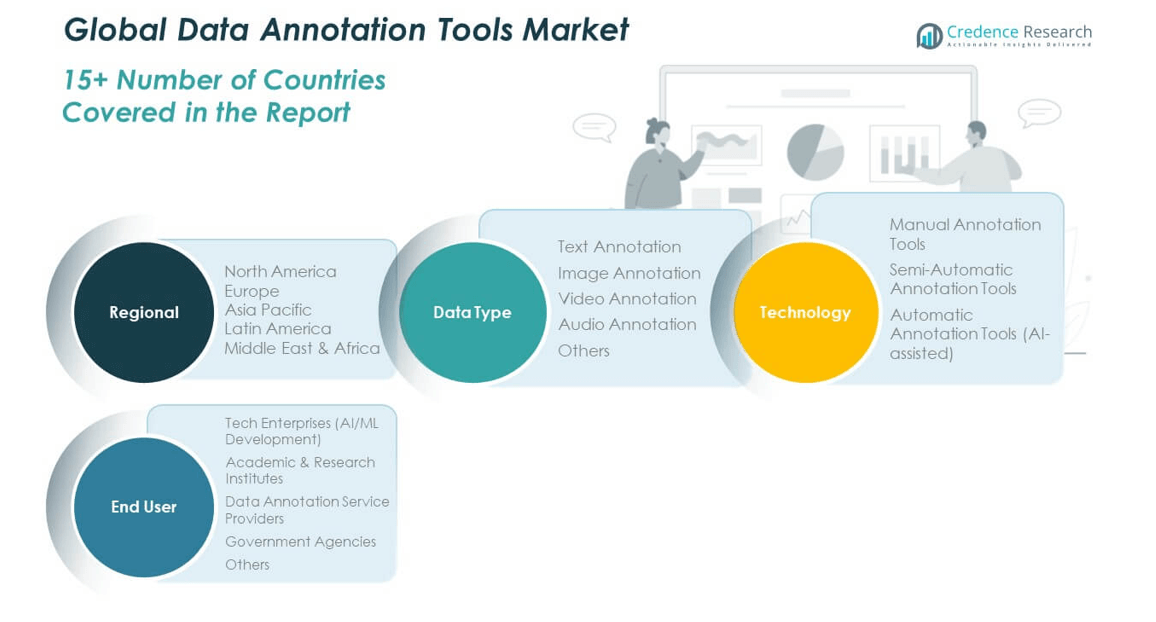
The Global Data Annotation Tools Market is structured into text, image, video, audio, and other annotation categories. Text annotation remains essential for natural language processing applications such as chatbots and sentiment analysis. Image and video annotation drive adoption in autonomous vehicles, security, and healthcare diagnostics. Audio annotation supports the expansion of voice recognition and translation technologies. Together, these segments ensure coverage across diverse AI use cases.
- For instance, Semi-automatic tools balance speed and oversight, ideal for mid-scale operations. AI-assisted automatic platforms are rapidly growing due to their scalability and cost efficiency, enabling management of large datasets with consistent quality.
By Technology
The market is segmented into manual, semi-automatic, and AI-assisted automatic tools. Manual annotation remains important for complex and sensitive projects requiring accuracy. Semi-automatic tools balance speed with oversight, making them popular in mid-scale deployments. Automatic, AI-assisted platforms are rapidly gaining share, enabling enterprises to manage large datasets efficiently while reducing reliance on manual labor.
By End User
Key end users include technology enterprises, research institutes, annotation service providers, government agencies, and others. Technology firms dominate demand, as they lead in developing AI and machine learning applications. Academic institutions contribute through R&D, while government agencies use annotation tools for defense, surveillance, and regulatory applications. Service providers cater to outsourcing needs across industries.
Segmentation:
By Data Type
- Text Annotation
- Image Annotation
- Video Annotation
- Audio Annotation
- Others
By Technology
- Manual Annotation Tools
- Semi-Automatic Annotation Tools
- Automatic Annotation Tools (AI-assisted)
By End User
- Tech Enterprises (AI/ML Development)
- Academic & Research Institutes
- Data Annotation Service Providers
- Government Agencies
- Others
By Region
- North America
- U.S.
- Canada
- Mexico
- Europe
- Germany
- France
- U.K.
- Italy
- Spain
- Rest of Europe
- Asia Pacific
- China
- Japan
- India
- South Korea
- South-east Asia
- Rest of Asia Pacific
- Latin America
- Brazil
- Argentina
- Rest of Latin America
- Middle East & Africa
- GCC Countries
- South Africa
- Rest of the Middle East and Africa
Regional Analysis:
North America
The North America Global Data Annotation Tools Market size was valued at USD 380.13 million in 2018 to USD 761.19 million in 2024 and is anticipated to reach USD 3,020.30 million by 2032, at a CAGR of 17.5% during the forecast period. North America accounted for the largest market share in 2024 due to strong AI adoption across industries. The presence of major technology firms and established annotation vendors strengthens its position. The U.S. leads demand with large-scale investment in autonomous vehicles, healthcare imaging, and voice-enabled systems. Canada also contributes significantly, with a focus on AI research and innovation hubs. Mexico is gradually expanding its role with increasing digital transformation. High demand from e-commerce and financial sectors further drives adoption. Data security regulations encourage firms to adopt compliant annotation platforms. The region’s dominance is expected to persist with strong R&D and government support.
Europe
The Europe Global Data Annotation Tools Market size was valued at USD 253.58 million in 2018 to USD 495.22 million in 2024 and is anticipated to reach USD 1,849.24 million by 2032, at a CAGR of 16.6% during the forecast period. Europe holds a significant market share, with key demand from automotive, manufacturing, and healthcare. Germany, the UK, and France are leaders in technology deployment. The automotive sector drives growth through autonomous and electric vehicle projects. Healthcare applications also expand with increased reliance on diagnostic imaging and NLP. Strong data protection regulations encourage adoption of secure platforms. Startups across Europe are developing domain-specific solutions tailored to regional industries. Eastern European nations are emerging players, contributing to cost-effective outsourcing. Europe’s position is reinforced by robust compliance frameworks. Ongoing innovation in AI ensures steady long-term growth.
Asia Pacific
The Asia Pacific Global Data Annotation Tools Market size was valued at USD 158.72 million in 2018 to USD 349.25 million in 2024 and is anticipated to reach USD 1,572.61 million by 2032, at a CAGR of 19.4% during the forecast period. Asia Pacific is the fastest-growing region in this market. China dominates with massive investments in AI and data infrastructure. India is a leading hub for outsourcing annotation services, providing scalability at cost efficiency. Japan and South Korea contribute significantly through robotics, electronics, and healthcare adoption. Southeast Asia is emerging with government-driven AI strategies and smart city projects. Enterprises in the region benefit from supportive regulations and rapid digitalization. Global vendors are expanding their presence to tap this growth. The region’s trajectory is fueled by rising AI research and expanding enterprise AI adoption. This makes Asia Pacific a critical growth frontier.
Latin America
The Latin America Global Data Annotation Tools Market size was valued at USD 38.11 million in 2018 to USD 76.08 million in 2024 and is anticipated to reach USD 264.07 million by 2032, at a CAGR of 15.6% during the forecast period. Latin America is an emerging market with growing interest in AI-based applications. Brazil leads with strong demand in healthcare, retail, and financial services. Argentina is developing local AI ecosystems with support from startups. Governments in the region are focusing on digital inclusion programs. Outsourcing opportunities are expanding due to the availability of skilled labor. Multinational companies are setting up annotation operations in Latin America to reduce costs. Limited infrastructure remains a restraint but is improving gradually. Regional adoption is expanding in NLP-based applications for customer service. Latin America is expected to remain a supportive growth region.
Middle East
The Middle East Global Data Annotation Tools Market size was valued at USD 21.64 million in 2018 to USD 39.60 million in 2024 and is anticipated to reach USD 129.09 million by 2032, at a CAGR of 14.7% during the forecast period. The Middle East shows growing demand for annotation tools across industries. GCC countries, particularly Saudi Arabia and the UAE, lead adoption with smart city and AI initiatives. Israel also plays a major role, driven by its innovation ecosystem. Turkey is an emerging player with rising investment in AI technologies. Healthcare, retail, and defense are major application areas. Enterprises in the Middle East adopt tools to enhance analytics and decision-making. Data security compliance remains an important factor in tool selection. The region’s governments are integrating AI into national transformation agendas. Growing enterprise investments strengthen long-term growth prospects.
Africa
The Africa Global Data Annotation Tools Market size was valued at USD 9.34 million in 2018 to USD 21.72 million in 2024 and is anticipated to reach USD 61.94 million by 2032, at a CAGR of 12.7% during the forecast period. Africa represents an early-stage market with gradual adoption. South Africa is the leader, driven by its advanced IT infrastructure. Egypt is expanding adoption with digitalization strategies. Nigeria and Kenya are showing potential with increasing investment in AI startups. Limited resources and infrastructure remain key challenges. Outsourcing opportunities are emerging with growing technical expertise. Governments are promoting AI in education and healthcare systems. International vendors explore Africa as a long-term market. Gradual expansion of AI ecosystems will support consistent growth.
Key Player Analysis:
- Appen Limited
- Amazon Web Services Inc.
- Alegion
- Labelbox Inc.
- Scale AI Inc.
- CloudFactory Limited
- clickworker GmbH
- Cogito Tech LLC
- TELUS International
- Lionbridge Technologies LLC
- Tagtog Sp. z o.o.
- Deep Systems
Competitive Analysis:
The Global Data Annotation Tools Market is highly competitive with the presence of established players and emerging startups. It is characterized by continuous innovation, partnerships, and acquisitions aimed at enhancing platform capabilities. Major vendors like Appen, AWS, Scale AI, and Labelbox dominate through comprehensive portfolios. Regional firms and niche startups add competitiveness with domain-specific solutions. Vendors focus on automation, data security, and scalability as differentiating factors. Cloud-based offerings are expanding market accessibility for enterprises of all sizes. Service providers also play a crucial role in outsourcing annotation tasks. The competitive landscape is expected to intensify with growing demand across multiple industries.
Recent Developments:
- In March 2024, Appen Limited launched new platform capabilities to support enterprises in customizing large language models (LLMs). This platform enables enterprises to move from use case to production by connecting model selection, data preparation, prompt creation, model optimization, and safety assurance within a single platform, which can be deployed on-premises, in the cloud, or hybrid environments.
- In 2025, Amazon Web Services Inc. introduced several innovative products including Amazon Transform, a revolutionary service using agentic AI to accelerate infrastructure modernization; Amazon Nova Premier, their most capable AI model for complex tasks with extensive input processing abilities; and a new AWS pricing calculator enhancing cost estimate accuracy for workloads and overall AWS bills.
- Scale AI announced in June 2025 a significant new investment from Meta Platforms, which valued the company at over $29 billion. This partnership expands Scale's commercial relationship with Meta to accelerate deployment of data solutions, along with leadership changes including the founder joining Meta and appointment of a new interim CEO.
- Deep Cogito emerged from stealth in April 2025 with a family of hybrid AI models that toggle between reasoning and non-reasoning modes, claiming superior performance over comparable open models. The models are based on Meta’s Llama and Alibaba’s Qwen architectures and incorporate novel training approaches to improve performance and efficiency.
Report Coverage:
The research report offers an in-depth analysis based on data type, technology, end user, and regional segments. It details leading market players, providing an overview of their business, product offerings, investments, revenue streams, and key applications. Additionally, the report includes insights into the competitive environment, SWOT analysis, current market trends, as well as the primary drivers and constraints. Furthermore, it discusses various factors that have driven market expansion in recent years. The report also explores market dynamics, regulatory scenarios, and technological advancements that are shaping the industry. It assesses the impact of external factors and global economic changes on market growth. Lastly, it provides strategic recommendations for new entrants and established companies to navigate the complexities of the market.
Future Outlook:
- Strong growth in AI adoption will sustain demand for annotation platforms.
- Automation will dominate, reducing reliance on manual labeling.
- NLP and voice recognition will remain strong growth drivers.
- Healthcare imaging annotation will expand rapidly.
- Autonomous vehicle demand will strengthen video annotation needs.
- Bias mitigation and fairness checks will be central to adoption.
- Asia Pacific will emerge as the fastest-growing region.
- Cloud-based solutions will dominate delivery models.
- Domain-specific platforms will become more common.
- Outsourcing opportunities will grow in emerging markets.

Request a Free Sample
Fill in your details and we'll send you a free sample report.
- Sample data tables & charts
- Research methodology
Market Dynamics
Rising Dependence on Labeled Data for AI Model Training
AI models require high-quality, accurately labeled datasets for effective learning and performance. As organizations across sectors like healthcare, automotive, and retail invest in AI, the need for robust data annotation tools to create these datasets is accelerating.
Expanding Applications of Computer Vision
Industries such as healthcare, manufacturing, agriculture, and security are rapidly deploying computer vision solutions, which rely on annotated images and videos. This drives demand for annotation tools that can handle large-scale, complex visual data efficiently.
Accelerating Growth of Autonomous and Connected Vehicles
The development of self-driving and connected vehicles depends on precisely annotated video, image, and sensor data for training navigation and safety systems. The automotive sector's investment in autonomous technologies is a major growth engine for data annotation tools.
Increasing Adoption of NLP and Voice Recognition Systems
With the proliferation of chatbots, virtual assistants, and voice-enabled devices, there is a growing need for annotated text and audio data. This trend is fueling demand for annotation platforms that support NLP and speech recognition applications.
Shift Toward AI-Assisted and Automated Annotation Solutions
To manage the scale and complexity of modern AI projects, organizations are adopting AI-assisted annotation tools that automate much of the labeling process, reducing costs and speeding up project timelines while maintaining accuracy through human-in-the-loop validation.
Need a Custom Version of This Report?
Tailor the scope, geography, or segments to your exact requirements.
- Custom geography or segment scope
- Direct access to our analyst team
Frequently Asked Questions
What is the current market size for Global Data Annotation Tools Market, and what is its projected size in 2032?
Which Global Data Annotation Tools Market segment held the largest share in 2024?
What are the primary factors fueling the growth of the Global Data Annotation Tools Market?
Who are the leading companies in the Global Data Annotation Tools Market?
Table of Content
Chapter 1 Market Segmentation
- 1.1 Segmentation Framework
- 1.1.1 Product and Service Classification
- 1.1.2 Application and End-Use Classification
- 1.1.3 Technology and Solution Classification
- 1.1.4 Customer and Distribution Channel Classification
- 1.1.5 Geographic Segmentation
- 1.1.6 Market Segment Definitions and Boundaries
- 1.2 By End User
- 1.2.1 Tech Enterprises (AI/ML Development)
- 1.2.2 Academic & Research Institutes
- 1.2.3 Data Annotation Service Providers
- 1.2.4 Government Agencies
- 1.2.5 Others
- 1.3 By Data Type
- 1.3.1 Text Annotation
- 1.3.2 Image Annotation
- 1.3.3 Video Annotation
- 1.3.4 Audio Annotation
- 1.3.5 Others
- 1.4 By Technology
- 1.4.1 Manual Annotation Tools
- 1.4.2 Semi-Automatic Annotation Tools
- 1.4.3 Automatic Annotation Tools (AI-assisted)
Chapter 2 Introduction
- 2.1 Report Objectives and Scope
- 2.2 Product Definition and Industry Terminology
- 2.3 Market Inclusions and Exclusions
- 2.4 Research Process
- 2.4.1 Primary Research and Expert Interviews
- 2.4.2 Secondary Research and Source Review
- 2.4.3 Top-Down and Bottom-Up Estimation
- 2.4.4 Data Triangulation and Verification
- 2.5 Market Size Measurement Basis
- 2.5.1 2024: USD 1,743.05 million → 2032: USD 6,897.25 million
- 2.6 Historical and Forecast Reference Periods
- 2.6.1 Base Year: 2024
- 2.6.2 Forecast Period: 2024-2032
- 2.7 Research Assumptions and Limitations
Chapter 3 Executive Summary
- 3.1 Market Snapshot and Key Findings
- 3.2 Base-Year Market Size, 2024
- 3.3 Forecast Market Size, 2032
- 3.4 Revenue and Volume Growth Outlook
- 3.5 Key Demand and Supply Indicators
- 3.6 Leading Market Segments
- 3.7 Fastest-Growing Market Opportunities
- 3.8 Regional Performance Highlights
- 3.9 Technology and Industry Transformation
- 3.10 Competitive Landscape Summary
- 3.11 Analyst View and Strategic Implications
Chapter 4 Global Data Annotation Tools Market Trends and Developments
- 4.1 Historical Industry Development
- 4.2 Recent Market Trends and Developments
- 4.3 Demand and Customer Behavior Trends
- 4.4 Technology and Product Innovation
- 4.5 Artificial Intelligence, Automation and Digitalization
- 4.6 Local Manufacturing and Supply Chain Realignment
- 4.7 Industry Partnerships, Mergers and Acquisitions
- 4.8 Sustainability and Circular Economy Developments
- 4.9 Government and Private Sector Investment Trends
- 4.10 Emerging Business Models and Commercialization
- 4.11 Industry Developments and Announcements
Chapter 5 Global Data Annotation Tools Market Production, Supply and Demand Analysis
- 5.1 Demand Trend and Consumption Analysis
- 5.2 Demand Forecast, 2024-2032
- 5.3 Production and Output Trend
- 5.4 Production and Output Forecast, 2024-2032
- 5.5 Installed Capacity and Capacity Utilization
- 5.6 Company-Wise Production Plants and Statistics
- 5.6.1 Installed Production Capacity
- 5.6.2 Actual Production
- 5.6.3 Planned Capacity and Expansion Targets
- 5.7 Supply Chain Structure and Procurement Trends
- 5.8 Supply-Demand Gap and Bottlenecks
- 5.9 Import Dependence and Sourcing Structure
- 5.10 Contract Manufacturing and Outsourcing
- 5.11 Regional Supply and Demand Concentration
Chapter 6 Global Data Annotation Tools Market Pricing Analysis
- 6.1 Pricing Structure and Measurement
- 6.2 Historical Pricing Trends
- 6.3 Pricing Outlook, 2024-2032
- 6.4 Average Selling Price and Unit Economics
- 6.5 Pricing by Product and Market Segment
- 6.6 Geographic Pricing Differences
- 6.7 Key Input, Energy, Labor and Logistics Costs
- 6.8 Contract Pricing and Purchasing Models
- 6.9 Pricing Sensitivity and Competitive Positioning
- 6.10 Price, Margin and Profitability Implications
Chapter 7 Global Data Annotation Tools Market Dynamics
- 7.1 Market Growth Drivers
- 7.1.1 Demand-Side Drivers
- 7.1.2 Technology and Innovation Drivers
- 7.1.3 Infrastructure and Investment Drivers
- 7.1.4 Regulatory and Policy Drivers
- 7.2 Market Restraints
- 7.2.1 Cost and Affordability Constraints
- 7.2.2 Technology and Adoption Barriers
- 7.2.3 Supply Chain and Operational Constraints
- 7.3 Market Challenges
- 7.3.1 Competitive Pressure and Margin Erosion
- 7.3.2 Skills, Infrastructure and Implementation Gaps
- 7.4 Emerging Market Opportunities
- 7.5 Market Dynamics Impact and Time-Horizon Assessment
Chapter 8 Global Data Annotation Tools Value Chain Analysis
- 8.1 Industry Value Chain Overview
- 8.2 Upstream Suppliers and Critical Inputs
- 8.3 Technology and Component Providers
- 8.4 Manufacturing or Service Delivery
- 8.5 Distribution, Channel Partners and Integrators
- 8.6 Downstream Applications and End Users
- 8.7 Value Addition and Profit Pools
- 8.8 Vertical Integration and Outsourcing
- 8.9 Supplier Concentration and Risk
- 8.10 Supply Chain Localization and Resilience
Chapter 9 Global Data Annotation Tools Market Regulations and Policies
- 9.1 Relevant Laws, Standards and Compliance Frameworks
- 9.2 Product, Service, Safety and Quality Requirements
- 9.3 Government Policies, Incentives and Subsidies
- 9.4 Imports, Exports and Trade Barriers
- 9.5 Public Procurement and Local Content Requirements
- 9.6 Environmental and Sustainability Compliance
- 9.7 Data Protection, AI and Cybersecurity Compliance
- 9.8 Upcoming Policy Changes and Market Implications
Chapter 10 Global Data Annotation Tools Market Hotspots and Opportunities
- 10.1 Market Opportunity Mapping and Growth Hotspots
- 10.2 High-Growth Applications and Customer Groups
- 10.3 Underserved Markets and White-Space Opportunities
- 10.4 Emerging Technology and Product Opportunities
- 10.5 New Capacity and Investment Hotspots
- 10.6 Market Entry and Expansion Opportunities
- 10.7 Distribution and Partnership Opportunities
- 10.8 Near-Term and Long-Term Commercial Potential
- 10.9 Opportunity Attractiveness and Execution Risks
Chapter 11 Global Data Annotation Tools Market Outlook, 2024-2032
- 11.1 Market Size and Analysis
- 11.1.1 Revenue (Market Measurement: 2024: USD 1,743.05 million → 2032: USD 6,897.25 million)
- 11.1.2 Market Volume and Quantity Sold
- 11.1.3 Historical Market Size
- 11.1.4 Base-Year Market Size, 2024
- 11.2 Market Forecast, 2024-2032
- 11.2.1 Revenue Forecast to 2032
- 11.2.2 Volume Forecast to 2032
- 11.2.3 CAGR and Year-on-Year Growth
- 11.2.4 Incremental Revenue Opportunity
- 11.3 Forecast Assumptions and Scenario Analysis
- 11.3.1 Base-Case Forecast
- 11.3.2 Optimistic and Conservative Scenarios
- 11.3.3 Technology, Pricing and Policy Sensitivities
- 11.4 Market Attractiveness and Growth Outlook
Chapter 12 Global Data Annotation Tools Market Segmentation and Outlook
- 12.1 Segmentation Summary and Market Shares, 2024
- 12.2 Largest and Fastest-Growing Segments
- 12.3 By End User - Market Size and Forecast, 2024-2032
- 12.3.1 Segment Definition and Scope
- 12.3.2 Historical Market Size
- 12.3.3 Revenue Forecast, 2024-2032
- 12.3.4 Volume Forecast, 2024-2032
- 12.3.5 Base-Year Market Share, 2024
- 12.3.6 Segment CAGR and Growth Drivers
- 12.3.7 Subsegment Market Size and Forecast
- 12.3.7.1 Tech Enterprises (AI/ML Development)
- 12.3.7.2 Academic & Research Institutes
- 12.3.7.3 Data Annotation Service Providers
- 12.3.7.4 Government Agencies
- 12.3.7.5 Others
- 12.3.8 Subsegment Pricing and Adoption Trends
- 12.3.9 Leading Suppliers and Competition
- 12.3.10 Regional Demand and Opportunities
- 12.4 By Data Type - Market Size and Forecast, 2024-2032
- 12.4.1 Segment Definition and Scope
- 12.4.2 Historical Market Size
- 12.4.3 Revenue Forecast, 2024-2032
- 12.4.4 Volume Forecast, 2024-2032
- 12.4.5 Base-Year Market Share, 2024
- 12.4.6 Segment CAGR and Growth Drivers
- 12.4.7 Subsegment Market Size and Forecast
- 12.4.7.1 Text Annotation
- 12.4.7.2 Image Annotation
- 12.4.7.3 Video Annotation
- 12.4.7.4 Audio Annotation
- 12.4.7.5 Others
- 12.4.8 Subsegment Pricing and Adoption Trends
- 12.4.9 Leading Suppliers and Competition
- 12.4.10 Regional Demand and Opportunities
- 12.5 By Technology - Market Size and Forecast, 2024-2032
- 12.5.1 Segment Definition and Scope
- 12.5.2 Historical Market Size
- 12.5.3 Revenue Forecast, 2024-2032
- 12.5.4 Volume Forecast, 2024-2032
- 12.5.5 Base-Year Market Share, 2024
- 12.5.6 Segment CAGR and Growth Drivers
- 12.5.7 Subsegment Market Size and Forecast
- 12.5.7.1 Manual Annotation Tools
- 12.5.7.2 Semi-Automatic Annotation Tools
- 12.5.7.3 Automatic Annotation Tools (AI-assisted)
- 12.5.8 Subsegment Pricing and Adoption Trends
- 12.5.9 Leading Suppliers and Competition
- 12.5.10 Regional Demand and Opportunities
- 12.6 Segment Growth Comparison
- 12.7 Segment Attractiveness and Priority Matrix
Chapter 13 Global Data Annotation Tools End-Use and Application Market Outlook
- 13.1 End-Use Industry and Customer Demand Structure
- 13.2 Leading Applications and Customer Groups
- 13.3 End-Use Market Size, Share and Forecast
- 13.4 Major End-Use Industry Deep Dives
- 13.4.1 Customer Requirements and Use Cases
- 13.4.2 Demand and Replacement Cycles
- 13.4.3 Technical and Regulatory Considerations
- 13.4.4 Purchasing and Procurement Models
- 13.4.5 Leading Vendors and Distribution Channels
- 13.4.6 Forecast and Commercial Opportunities
- 13.5 Emerging Applications and Cross-Segment Demand
- 13.6 End-Use Industry Investment Priorities
Chapter 14 Global Data Annotation Tools Geographic Market Outlook, 2024-2032
- 14.1 Regional Market Size and Share, 2024
- 14.2 Regional Market Forecast, 2024-2032
- 14.3 Regional Pricing, Production and Demand Differences
- 14.4 North America
- 14.4.1 United States
- 14.4.2 Canada
- 14.4.3 Mexico
- 14.5 Europe
- 14.5.1 Germany
- 14.5.2 France
- 14.5.3 Italy
- 14.5.4 United Kingdom
- 14.5.5 Spain
- 14.5.6 Poland
- 14.5.7 Russia
- 14.5.8 Netherlands
- 14.5.9 Belgium
- 14.5.10 Sweden
- 14.5.11 Denmark
- 14.5.12 Norway
- 14.5.13 Rest of Europe
- 14.6 Asia Pacific
- 14.6.1 China
- 14.6.2 India
- 14.6.3 Japan
- 14.6.4 South Korea
- 14.6.5 Thailand
- 14.6.6 Indonesia
- 14.6.7 Vietnam
- 14.6.8 Malaysia
- 14.6.9 Australia
- 14.6.10 Rest of Asia Pacific
- 14.7 Latin America
- 14.7.1 Brazil
- 14.7.2 Argentina
- 14.7.3 Colombia
- 14.7.4 Chile
- 14.7.5 Rest of Latin America
- 14.8 Middle East
- 14.8.1 Saudi Arabia
- 14.8.2 United Arab Emirates
- 14.8.3 Turkey
- 14.8.4 Israel
- 14.8.5 Iran
- 14.8.6 Rest of the Middle East
- 14.9 Africa
- 14.9.1 South Africa
- 14.9.2 Egypt
- 14.9.3 Nigeria
- 14.9.4 Morocco
- 14.9.5 Rest of Africa
- 14.10 Regional Investment, Policy and Supply Chain Differences
- 14.11 Regional Competitive Landscape
- 14.12 Geographic Growth Hotspots
Chapter 15 Global Data Annotation Tools Technology, Innovation and Sustainability Outlook
- 15.1 Technology Landscape and Maturity
- 15.2 Product, Process and Service Innovation
- 15.3 AI, Automation and Digital Tools in the Industry
- 15.4 Technology Adoption and Performance Benchmarking
- 15.5 Innovation Pipeline and R&D Investment
- 15.6 Patent and Intellectual Property Trends
- 15.7 Energy Efficiency and Resource Management
- 15.8 Sustainability, Recycling and Circularity
- 15.9 Technology Roadmap, 2024-2032
- 15.10 Risks of Obsolescence and Technology Substitution
Chapter 16 Global Data Annotation Tools Market Key Strategic Imperatives
- 16.1 Growth and Market Entry Priorities
- 16.2 High-Return Products and Segments
- 16.3 Pricing, Profitability and Cost Optimization
- 16.4 Technology Investment and Product Differentiation
- 16.5 Supply Chain Localization and Resilience
- 16.6 Distribution and Customer Acquisition
- 16.7 Partnership, Acquisition and Capacity Strategy
- 16.8 Regional Expansion Priorities
- 16.9 Short-, Medium- and Long-Term Actions
Chapter 17 Competition Outlook
- 17.1 Industry Competition Characteristics
- 17.2 Market Structure and Concentration
- 17.3 Market Share and Competitive Positioning, 2024
- 17.4 Company-Wise Revenue and Product Benchmarking
- 17.5 Production and Service Capacity Benchmarking
- 17.6 Technology, Pricing and Differentiation
- 17.7 Regional Footprint and Distribution Strength
- 17.8 Mergers, Acquisitions and Strategic Alliances
- 17.9 New Entrants and Competitive Threats
- 17.10 Porter's Five Forces and Industry Attractiveness
- 17.11 Competitive Outlook, 2024-2032
Chapter 18 Company Profiles
- 18.1 Company Coverage and Selection Criteria
- 18.2 Appen Limited
- 18.2.1 Business Description
- 18.2.2 Company Ownership and Geographic Presence
- 18.2.3 Product and Service Portfolio
- 18.2.4 Manufacturing and Operating Footprint
- 18.2.5 Production Capacity and Expansion Plans
- 18.2.6 Financial Performance and Investment
- 18.2.7 Market Share and Competitive Position
- 18.2.8 Technology and Innovation Capabilities
- 18.2.9 Strategic Alliances or Partnerships
- 18.2.10 Recent Developments
- 18.2.11 Growth Strategy and Outlook
- 18.3 Amazon Web Services Inc.
- 18.4 Alegion
- 18.5 Labelbox Inc.
- 18.6 Scale AI Inc.
- 18.7 CloudFactory Limited
- 18.8 clickworker GmbH
- 18.9 Cogito Tech LLC
- 18.10 TELUS International
- 18.11 Lionbridge Technologies LLC
- 18.12 Other Relevant Market Participants
Note: Every listed company is profiled on the structure shown under the first company. The company list is preliminary and may change based on research findings, market developments, data availability and client requirements.
Chapter 19 Disclaimer
- 19.1 Research and Forecast Disclaimer
- 19.2 Data Source and Estimation Limitations
Note: The depth of individual sections depends on data availability for this market. Volume, capacity, trade and other unit-based metrics are included where applicable.