
Market Overview:
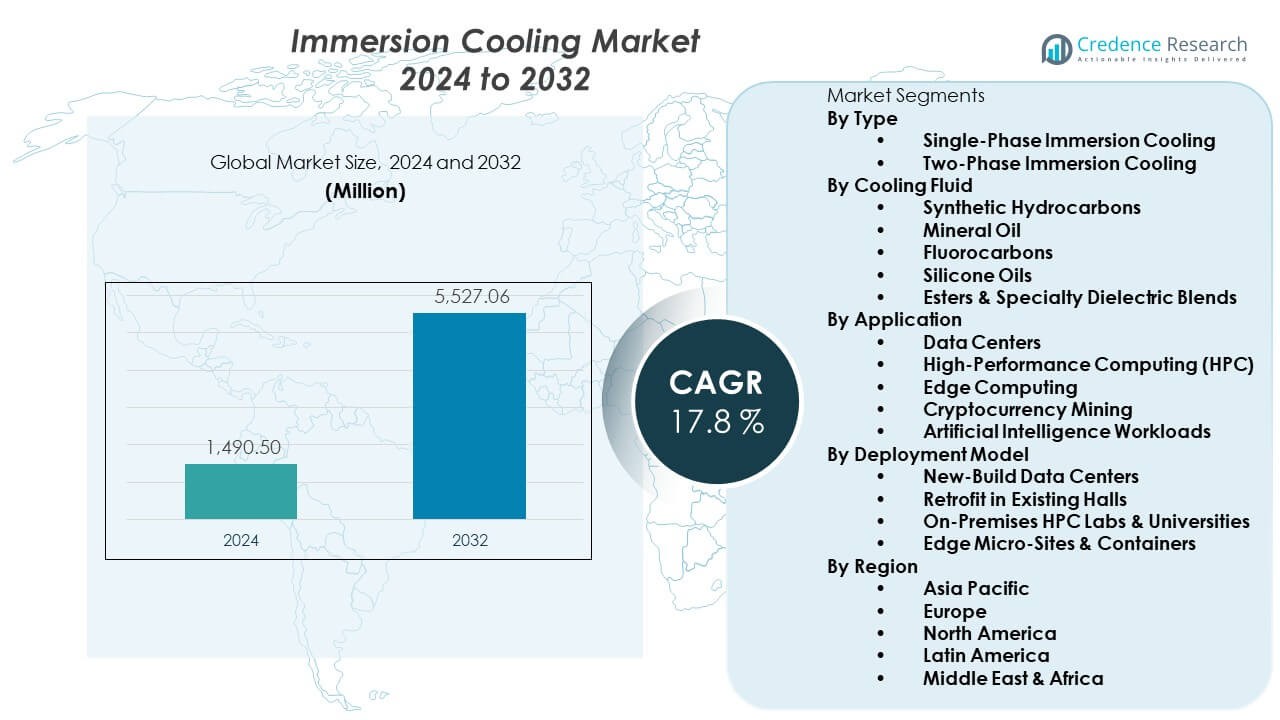
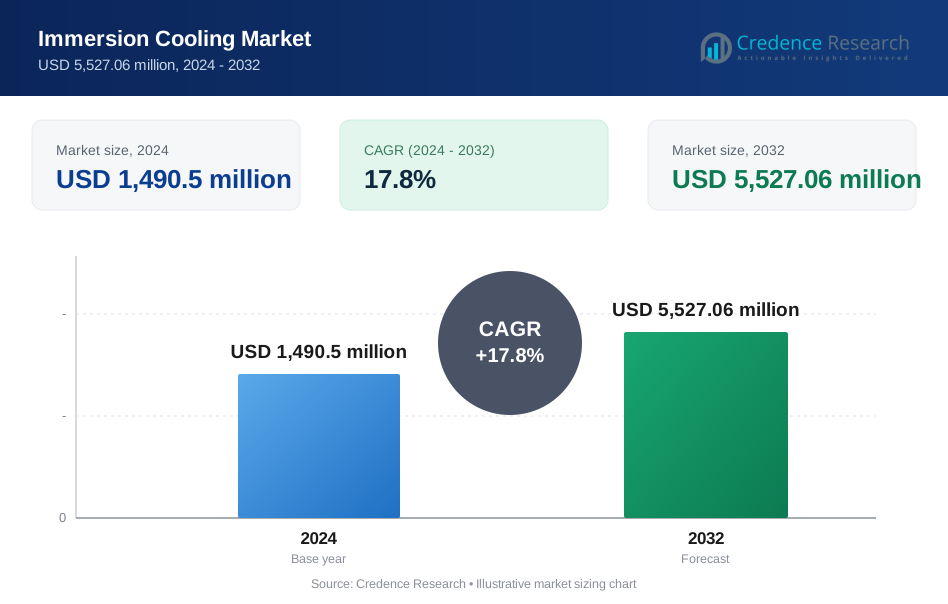
The Immersion Cooling Market is projected to grow from USD 1,490.5 million in 2024 to USD 5,527.06 million by 2032, with a CAGR of 17.8% from 2024 to 2032.
| REPORT ATTRIBUTE | DETAILS |
|---|---|
| Historical Period | 2020-2023 |
| Base Year | 2024 |
| Forecast Period | 2025-2032 |
| Immersion Cooling Market Size 2024 | USD 1,490.5 Million |
| Immersion Cooling Market, CAGR | 17.8% |
| Immersion Cooling Market Size 2032 | USD 5,527.06 Million |
Growing use of high-density data systems drives stronger interest in immersion cooling. Buyers choose this method because it lowers heat stress in compact racks. Data centers adopt liquid systems to handle faster chips and rising workloads. Operators prefer these designs due to steady temperature control. Cloud platforms expand capacity and push demand for efficient cooling. Firms select immersion methods to reduce energy loss across peak loads. Sustainability goals also increase attention toward cleaner and safer cooling setups.
North America leads due to strong data center growth and active tech investments. Europe follows as firms push greener cooling practices across developed regions. Asia Pacific grows fast because cloud adoption expands within major countries. China and India show rapid uptake due to rising digital activity. Japan and South Korea adopt new cooling due to advanced semiconductor use. Emerging regions gain interest as new facilities look for efficient solutions. Adoption spreads as global firms upgrade infrastructure across wider networks.
Market Insights:
- The Immersion cooling market grows from USD 1,490.5 million in 2024 to USD 5,527.06 million by 2032, supported by a 8% CAGR driven by dense computing, AI workloads, and energy-efficient cooling demand.
- North America holds ~35%, Asia Pacific ~30%, and Europe ~25% due to strong hyperscale expansion, rapid cloud adoption, and strict energy-efficiency rules that increase immersion system deployment.
- Asia Pacific is the fastest-growing region, supported by rising cloud investments, AI adoption, semiconductor activity, and large data center construction across China, India, Japan, and Singapore.
- Data centers lead with the largest segment share, supported by heavy rack density and sustainability-driven upgrades across hyperscale facilities.
- Single-phase systems hold a higher share than two-phase designs, driven by simpler integration, lower maintenance needs, and broader acceptance across global data center projects.
Market Drivers:
Rising Demand for High-Density Computing
The Immersion cooling market gains strength from rapid growth in high-density servers. Enterprises deploy compact racks that generate heavy heat loads under peak activity. Operators choose liquid systems to stabilize thermal conditions across critical workloads. Cloud providers expand hyperscale structures that need steady cooling performance. Buyers value consistent temperatures that support stronger hardware life cycles. Firms adopt these systems to reduce downtime in data-heavy environments. Sustainability goals guide many upgrades toward more efficient cooling choices. Investments rise as organizations target lower operational costs across digital infrastructure.
- For instance, GRC's ICEraQ Series 10 supports racks up to 200 kilowatts of server capacity.
Shift Toward Energy-Efficient Data Center Operations
Data centers move toward designs that cut power use across core systems. Businesses rely on immersion setups to reduce electricity consumption in dense racks. Operators aim to meet strict efficiency standards in advanced facilities. Immersion systems help reduce cooling overhead through direct liquid contact. Enterprises value predictable performance during intensive workloads and long duty cycles. Many facilities use these installations to lower resource waste. Global pressure to reduce carbon impact pushes firms toward cleaner alternatives. Adoption expands as companies seek greener cooling paths.
- For instance, NTT Data saw LiquidStack two-phase immersion cut cooling energy use by 97 percent.
Growth in AI, ML, and HPC Workloads
AI and HPC platforms demand powerful systems that generate intense heat loads. Immersion designs support advanced processors with greater thermal stability. Firms use these methods to maintain speed across complex computing cycles. Operators adopt optimized liquids to manage rapid workload fluctuations. Many institutions rely on strong cooling to handle dense chip architectures. Businesses upgrade environments that support continuous training tasks. These deployments push rapid expansion across innovation-led sectors. Favorable performance outcomes create wider interest among global users.
Rising Adoption Across Cryptocurrency Infrastructure
Crypto mining operations use immersion cooling to handle energy-intensive rigs. Miners seek temperature stability to protect hardware during long cycles. Direct liquid contact helps reduce heat spikes in stacked modules. Demand rises as miners shift from air setups to liquid systems. Many operators increase interest due to stronger uptime across mining farms. Competitive mining conditions push faster adoption of advanced cooling. Firms also explore immersion designs to control electricity waste. Scaling of mining hubs strengthens industry demand.
Market Trends:
Expansion of Two-Phase Cooling Architectures
The Immersion cooling market observes wider adoption of two-phase systems. Operators use these designs to support rising rack densities. Facilities apply evaporative behavior to stabilize high-load equipment. Demand increases across next-generation processor deployments. Data centers test new fluids for improved heat performance. Adoption rises in advanced digital hubs with complex workloads. Interest strengthens due to predictable thermal control in constrained spaces. Vendors refine designs that address rising global installations.
- For instance, Chemours cites LiquidStack two-phase designs eliminating 90 percent of server cooling energy.
New Fluid Formulations for Safer Operation
Manufacturers develop fluids with stronger fire resistance and chemical safety. Data centers prefer liquids that support longer operational cycles. Firms seek stable formulas that reduce degradation during heavy use. Many organizations request improved material compatibility across hardware. Engineers test liquids that lower failure risks in high-heat regions. Buyers expect stronger thermal properties as rack power rises. New formulations support faster adoption in emerging zones. Product upgrades expand choices for large-scale facilities.
- For instance, Shell cites immersion fluids reducing cooling water consumption 99 percent in case evaluations.
Growing Integration into Modular Data Centers
Modular sites adopt immersion setups for flexible infrastructure needs. Many operators choose these systems for rapid deployment. Compact structures benefit from direct liquid cooling efficiency. Demand grows where firms expand edge computing footprints. Users rely on immersion designs to stabilize mixed workloads. Scalable blocks support faster site expansion across varied regions. Interest rises among companies seeking efficient on-site cooling. Modular growth enables broader industry penetration.
Adoption of Immersion Cooling for Semiconductor Testing
Semiconductor facilities use immersion systems to manage chip test heat loads. Firms adopt cooling setups to stabilize advanced wafer processes. High-power devices require predictable control during stress cycles. Operators integrate liquid systems for consistent quality checks. Testing environments shift toward designs that reduce equipment strain. Demand rises where chip complexity expands across fabrication units. Vendors supply specialized tanks for testing labs. Wider semiconductor growth supports stronger industry momentum.
Market Challenges Analysis:
High Transition Costs and Complex Infrastructure Needs
The Immersion cooling market faces high cost barriers during initial deployment. Many facilities require major redesigns to support liquid systems. Operators invest in tanks, fluids, and structural upgrades. Skilled teams are essential to manage installation timelines. Firms hesitate where budgets limit large capital shifts. Technical complexity restricts adoption across older facilities. Many organizations require long planning cycles for infrastructure change. Slow transition rates reduce faster market penetration.
Limited Industry Standards and Vendor Alignment
Data centers struggle due to limited global standards for immersion systems. Vendors supply varied components with limited cross-compatibility. Many buyers hesitate due to inconsistent certification processes. Operators face risks during long-term maintenance planning. Technical teams demand clear guidelines for safe deployment. The market needs unified benchmarks for fluid quality and system safety. Fragmentation slows confident adoption across regions. Lack of alignment affects procurement decisions in many facilities.
Market Opportunities:
Rising Build-Out of Green Data Center Infrastructure
The Immersion cooling market benefits from strong interest in green facilities. Operators pursue systems that reduce power waste across dense racks. Many regions support cleaner cooling through policy incentives. Enterprises invest in designs that cut carbon output in digital hubs. Demand grows as firms shift toward long-term sustainability goals. Wider adoption in new sites creates strong commercial opportunities. Vendors gain traction by offering efficient turnkey solutions. Global environmental focus supports faster market advancement.
Expanding Edge and Remote Data Deployment Potential
Edge sites need compact cooling for limited-space environments. Immersion systems offer stable control for fast-moving workloads. Remote zones prefer low-maintenance cooling with predictable efficiency. Many industries explore immersion setups for industrial edge tasks. Energy savings create interest among logistics and automation hubs. Small sites benefit from reduced mechanical complexity. Growth in distributed computing supports wider deployment. Vendors gain access to new markets through targeted solutions.
Market Segmentation Analysis:
By Type
The Immersion cooling market includes single-phase and two-phase designs that support rising thermal needs across high-density infrastructure. Single-phase systems gain traction due to lower maintenance demands and simpler installation processes. Many operators choose these models to stabilize rack temperatures in compact environments. Two-phase systems attract interest where extreme heat loads require rapid heat transfer. These setups deliver strong performance for next-generation processors and advanced compute clusters. Enterprises evaluate type selection based on power density targets and operational risk. Data-heavy sectors rely on both formats to maintain uptime. Demand for both segments continues to rise across global deployments.
- For instance, GRC reports single-phase immersion cutting cooling power use by up to 95 percent.
By Cooling Fluid
Cooling fluid options influence system efficiency and long-term equipment protection. Synthetic hydrocarbons support broad adoption due to stable dielectric properties. Mineral oil remains a cost-effective choice across many facilities. Fluorocarbons offer strong heat transfer for demanding workloads. Silicone oils provide wide temperature resistance in specialized setups. Esters and specialty blends attract interest where low environmental impact is important. Buyers compare fluid longevity and hardware compatibility before final selection. Each fluid category supports different performance goals across digital operations. Fluid innovation strengthens adoption in new builds and retrofit programs.
- For instance, Shell's S3 X immersion fluid lists a 198-degree-Celsius flash point for safety.
By Application
Key applications include data centers, HPC, edge computing, mining, and AI systems. Data centers lead adoption due to rapid growth in dense racks. HPC facilities use immersion setups to manage heat from high-load tasks. Edge environments value compact cooling that fits limited space. Cryptocurrency mining sites adopt immersion to stabilize hardware under continuous cycles. AI workloads depend on thermal consistency for model training tasks. Sector diversity helps expand market reach across global regions. Workload intensity shapes design choices in each application group. Broader digitalization drives steady interest across all segments.
By Deployment Model
Deployment models influence integration speed and structural planning. New-build sites adopt immersion systems to support long-term capacity goals. Retrofit projects upgrade existing halls with liquid-based designs to improve efficiency. On-premises HPC labs and universities use these installations to support research workloads. Edge micro-sites rely on immersion cooling to manage heat in constrained locations. Each model aligns with different infrastructure lifecycles. Operators choose deployment paths based on budget, facility age, and workload needs. Immersion setups offer flexibility for varied project scopes. Growing build-out across regions strengthens demand in all deployment categories.
Segmentation:
By Type
- Single-Phase Immersion Cooling
- Two-Phase Immersion Cooling
By Cooling Fluid
- Synthetic Hydrocarbons
- Mineral Oil
- Fluorocarbons
- Silicone Oils
- Esters & Specialty Dielectric Blends
By Application
- Data Centers
- High-Performance Computing (HPC)
- Edge Computing
- Cryptocurrency Mining
- Artificial Intelligence Workloads
By Deployment Model
- New-Build Data Centers
- Retrofit in Existing Halls
- On-Premises HPC Labs & Universities
- Edge Micro-Sites & Containers
By Region
- North America
- U.S.
- Canada
- Mexico
- Europe
- Germany
- France
- U.K.
- Italy
- Spain
- Rest of Europe
- Asia Pacific
- China
- Japan
- India
- South Korea
- South-east Asia
- Rest of Asia Pacific
- Latin America
- Brazil
- Argentina
- Rest of Latin America
- Middle East & Africa
- GCC Countries
- South Africa
- Rest of the Middle East and Africa
Regional Analysis:
North America
North America holds the largest share of the Immersion cooling market at nearly 35%, driven by strong demand from hyperscale data centers and advanced cloud infrastructure. Firms in the region deploy immersion systems to improve efficiency across high-density racks. Operators in the U.S. lead integration due to rapid AI and HPC expansion. Canada supports adoption through investment in sustainable cooling technologies. Vendors strengthen regional presence through pilot programs and commercial rollouts. Adoption grows as enterprises target lower operational energy use. The market maintains momentum through ongoing digital expansion across major industries.
Asia Pacific
Asia Pacific accounts for about 30% of the global share and expands rapidly due to strong data center build-outs across China, India, Japan, and Singapore. The Immersion cooling market gains traction as regional operators add capacity to support cloud and AI workloads. China accelerates deployments through large-scale facility expansion. India increases interest through government-backed digital programs and rising computing loads. Japan and South Korea adopt immersion designs to manage advanced semiconductor and HPC tasks. High regional growth reflects the shift toward efficient cooling in dense environments. Strong investments support wider deployment across emerging zones.
Europe, Latin America, and Middle East & Africa
Europe holds roughly 25% of the global share, supported by strict energy-efficiency rules and steady growth in sustainable data centers. Firms in Germany, the Netherlands, and the Nordics adopt immersion systems for greener operations. Latin America represents nearly 5%, with interest rising across Brazil and Mexico as digital infrastructure expands. Middle East & Africa contribute about 5% through emerging deployments in the UAE, Saudi Arabia, and South Africa. Europe drives demand for low-impact cooling solutions that align with environmental standards. Latin America and MEA adopt immersion cooling slowly but show clear long-term potential. Growing regional investments support broader adoption across diverse climate conditions.
Key Player Analysis:
- Green Revolution Cooling (GRC)
- Submer
- Asperitas
- Iceotope Technologies
- Fujitsu
- LiquidStack
- Midas Green Technologies
- Shell plc
Competitive Analysis:
The Immersion cooling market shows strong competition driven by technology innovation and rapid workload expansion. Leading vendors focus on fluid development, optimized tank architecture, and high-density support systems. Companies refine solutions that improve thermal performance for AI, HPC, and hyperscale environments. Many players invest in modular designs that enhance deployment flexibility across new facilities. Partnerships with data center operators strengthen product validation and global reach. Firms expand portfolios to address growing demand for sustainable cooling models. Competitors target differentiation through efficiency gains and long-life dielectric fluids. The market advances as vendors pursue wider adoption across digital infrastructure.
Recent Developments:
- In October 2025, Green Revolution Cooling (GRC), headquartered in Texas, signed a memorandum of understanding with LG Electronics and SK Enmove to jointly develop and expand next-generation liquid immersion cooling solutions optimized for artificial intelligence data centers. The collaboration will focus on integrating data center cooling systems, providing advanced thermal fluids, and enhancing system design and deployment, aimed at addressing the escalating demands of AI workloads with high energy efficiency and sustainability.
- In October 2025, Submer introduced a smart immersion cooling system featuring AI-powered thermal management and predictive maintenance capabilities. This innovation enhances operational efficiency and system reliability, marking a significant enhancement in immersion cooling technology for data centers.
Report Coverage:
The research report offers an in-depth analysis based on By Type and By Cooling Fluid. It details leading market players, providing an overview of their business, product offerings, investments, revenue streams, and key applications. Additionally, the report includes insights into the competitive environment, SWOT analysis, current market trends, as well as the primary drivers and constraints. Furthermore, it discusses various factors that have driven market expansion in recent years. The report also explores market dynamics, regulatory scenarios, and technological advancements that are shaping the industry. It assesses the impact of external factors and global economic changes on market growth. Lastly, it provides strategic recommendations for new entrants and established companies to navigate the complexities of the market.
Future Outlook:
- Adoption rises across AI and HPC workloads due to strong thermal demands.
- Vendors expand fluid innovation to support longer system life cycles.
- New-build data centers integrate immersion systems to meet sustainability goals.
- Retrofit projects grow where operators upgrade aging air-based cooling.
- Edge facilities adopt compact immersion setups for space-limited sites.
- Semiconductor testing labs continue shifting toward liquid-based cooling.
- Partnerships increase to validate hardware compatibility with immersion systems.
- Regions with strong cloud growth accelerate deployment of liquid cooling.
- Cost optimization improves through scalable tank designs and optimized fluids.
- Market penetration strengthens as enterprises aim for lower operational energy use.
Request a Free Sample
Fill in your details and we'll send you a free sample report.
- Sample data tables & charts
- Research methodology
Need a Custom Version of This Report?
Tailor the scope, geography, or segments to your exact requirements.
- Custom geography or segment scope
- Direct access to our analyst team
Frequently Asked Questions
What is the current market size for the Immersion cooling market, and what is its projected size in 2032?
At what Compound Annual Growth Rate is the Immersion cooling market projected to grow between 2024 and 2032?
Which Immersion cooling market segment held the largest share in 2024?
What are the primary factors fueling the growth of the Immersion cooling market?
Who are the leading companies in the Immersion cooling market?
Which region commanded the largest share of the Immersion cooling market in 2024?
Table of Content
Chapter 1 Market Segmentation
- 1.1 Segmentation Framework
- 1.1.1 Product and Service Classification
- 1.1.2 Application and End-Use Classification
- 1.1.3 Technology and Solution Classification
- 1.1.4 Customer and Distribution Channel Classification
- 1.1.5 Geographic Segmentation
- 1.1.6 Market Segment Definitions and Boundaries
Chapter 2 Introduction
- 2.1 Report Objectives and Scope
- 2.2 Product Definition and Industry Terminology
- 2.3 Market Inclusions and Exclusions
- 2.4 Research Process
- 2.4.1 Primary Research and Expert Interviews
- 2.4.2 Secondary Research and Source Review
- 2.4.3 Top-Down and Bottom-Up Estimation
- 2.4.4 Data Triangulation and Verification
- 2.5 Market Size Measurement Basis
- 2.5.1 2024: USD 1,490.5 million → 2032: USD 5,527.06 million
- 2.6 Historical and Forecast Reference Periods
- 2.6.1 Base Year: 2024
- 2.6.2 Forecast Period: 2024-2032
- 2.7 Research Assumptions and Limitations
Chapter 3 Executive Summary
- 3.1 Market Snapshot and Key Findings
- 3.2 Base-Year Market Size, 2024
- 3.3 Forecast Market Size, 2032
- 3.4 Revenue and Volume Growth Outlook
- 3.5 Key Demand and Supply Indicators
- 3.6 Leading Market Segments
- 3.7 Fastest-Growing Market Opportunities
- 3.8 Regional Performance Highlights
- 3.9 Technology and Industry Transformation
- 3.10 Competitive Landscape Summary
- 3.11 Analyst View and Strategic Implications
Chapter 4 Global Immersion Cooling Market Trends and Developments
- 4.1 Historical Industry Development
- 4.2 Recent Market Trends and Developments
- 4.3 Demand and Customer Behavior Trends
- 4.4 Technology and Product Innovation
- 4.5 Artificial Intelligence, Automation and Digitalization
- 4.6 Local Manufacturing and Supply Chain Realignment
- 4.7 Industry Partnerships, Mergers and Acquisitions
- 4.8 Sustainability and Circular Economy Developments
- 4.9 Government and Private Sector Investment Trends
- 4.10 Emerging Business Models and Commercialization
- 4.11 Industry Developments and Announcements
Chapter 5 Global Immersion Cooling Market Production, Supply and Demand Analysis
- 5.1 Demand Trend and Consumption Analysis
- 5.2 Demand Forecast, 2024-2032
- 5.3 Production and Output Trend
- 5.4 Production and Output Forecast, 2024-2032
- 5.5 Installed Capacity and Capacity Utilization
- 5.6 Company-Wise Production Plants and Statistics
- 5.6.1 Installed Production Capacity
- 5.6.2 Actual Production
- 5.6.3 Planned Capacity and Expansion Targets
- 5.7 Supply Chain Structure and Procurement Trends
- 5.8 Supply-Demand Gap and Bottlenecks
- 5.9 Import Dependence and Sourcing Structure
- 5.10 Contract Manufacturing and Outsourcing
- 5.11 Regional Supply and Demand Concentration
Chapter 6 Global Immersion Cooling Market Pricing Analysis
- 6.1 Pricing Structure and Measurement
- 6.2 Historical Pricing Trends
- 6.3 Pricing Outlook, 2024-2032
- 6.4 Average Selling Price and Unit Economics
- 6.5 Pricing by Product and Market Segment
- 6.6 Geographic Pricing Differences
- 6.7 Key Input, Energy, Labor and Logistics Costs
- 6.8 Contract Pricing and Purchasing Models
- 6.9 Pricing Sensitivity and Competitive Positioning
- 6.10 Price, Margin and Profitability Implications
Chapter 7 Global Immersion Cooling Market Dynamics
- 7.1 Market Growth Drivers
- 7.1.1 Demand-Side Drivers
- 7.1.2 Technology and Innovation Drivers
- 7.1.3 Infrastructure and Investment Drivers
- 7.1.4 Regulatory and Policy Drivers
- 7.2 Market Restraints
- 7.2.1 Cost and Affordability Constraints
- 7.2.2 Technology and Adoption Barriers
- 7.2.3 Supply Chain and Operational Constraints
- 7.3 Market Challenges
- 7.3.1 Competitive Pressure and Margin Erosion
- 7.3.2 Skills, Infrastructure and Implementation Gaps
- 7.4 Emerging Market Opportunities
- 7.5 Market Dynamics Impact and Time-Horizon Assessment
Chapter 8 Global Immersion Cooling Value Chain Analysis
- 8.1 Industry Value Chain Overview
- 8.2 Upstream Suppliers and Critical Inputs
- 8.3 Technology and Component Providers
- 8.4 Manufacturing or Service Delivery
- 8.5 Distribution, Channel Partners and Integrators
- 8.6 Downstream Applications and End Users
- 8.7 Value Addition and Profit Pools
- 8.8 Vertical Integration and Outsourcing
- 8.9 Supplier Concentration and Risk
- 8.10 Supply Chain Localization and Resilience
Chapter 9 Global Immersion Cooling Market Regulations and Policies
- 9.1 Relevant Laws, Standards and Compliance Frameworks
- 9.2 Product, Service, Safety and Quality Requirements
- 9.3 Government Policies, Incentives and Subsidies
- 9.4 Imports, Exports and Trade Barriers
- 9.5 Public Procurement and Local Content Requirements
- 9.6 Environmental and Sustainability Compliance
- 9.7 Upcoming Policy Changes and Market Implications
Chapter 10 Global Immersion Cooling Market Hotspots and Opportunities
- 10.1 Market Opportunity Mapping and Growth Hotspots
- 10.2 High-Growth Applications and Customer Groups
- 10.3 Underserved Markets and White-Space Opportunities
- 10.4 Emerging Technology and Product Opportunities
- 10.5 New Capacity and Investment Hotspots
- 10.6 Market Entry and Expansion Opportunities
- 10.7 Distribution and Partnership Opportunities
- 10.8 Near-Term and Long-Term Commercial Potential
- 10.9 Opportunity Attractiveness and Execution Risks
Chapter 11 Global Immersion Cooling Market Outlook, 2024-2032
- 11.1 Market Size and Analysis
- 11.1.1 Revenue (Market Measurement: 2024: USD 1,490.5 million → 2032: USD 5,527.06 million)
- 11.1.2 Market Volume and Quantity Sold
- 11.1.3 Historical Market Size
- 11.1.4 Base-Year Market Size, 2024
- 11.2 Market Forecast, 2024-2032
- 11.2.1 Revenue Forecast to 2032
- 11.2.2 Volume Forecast to 2032
- 11.2.3 CAGR and Year-on-Year Growth
- 11.2.4 Incremental Revenue Opportunity
- 11.3 Forecast Assumptions and Scenario Analysis
- 11.3.1 Base-Case Forecast
- 11.3.2 Optimistic and Conservative Scenarios
- 11.3.3 Technology, Pricing and Policy Sensitivities
- 11.4 Market Attractiveness and Growth Outlook
Chapter 12 Global Immersion Cooling Market Segmentation and Outlook
- 12.1 Segmentation Summary and Market Shares, 2024
- 12.2 Largest and Fastest-Growing Segments
- 12.3 Segment Growth Comparison
- 12.4 Segment Attractiveness and Priority Matrix
Chapter 13 Global Immersion Cooling Geographic Market Outlook, 2024-2032
- 13.1 Regional Market Size and Share, 2024
- 13.2 Regional Market Forecast, 2024-2032
- 13.3 Regional Pricing, Production and Demand Differences
- 13.4 North America
- 13.4.1 United States
- 13.4.2 Canada
- 13.4.3 Mexico
- 13.5 Europe
- 13.5.1 Germany
- 13.5.2 France
- 13.5.3 Italy
- 13.5.4 United Kingdom
- 13.5.5 Spain
- 13.5.6 Poland
- 13.5.7 Russia
- 13.5.8 Netherlands
- 13.5.9 Belgium
- 13.5.10 Sweden
- 13.5.11 Denmark
- 13.5.12 Norway
- 13.5.13 Rest of Europe
- 13.6 Asia Pacific
- 13.6.1 China
- 13.6.2 India
- 13.6.3 Japan
- 13.6.4 South Korea
- 13.6.5 Thailand
- 13.6.6 Indonesia
- 13.6.7 Vietnam
- 13.6.8 Malaysia
- 13.6.9 Australia
- 13.6.10 Rest of Asia Pacific
- 13.7 Latin America
- 13.7.1 Brazil
- 13.7.2 Argentina
- 13.7.3 Colombia
- 13.7.4 Chile
- 13.7.5 Rest of Latin America
- 13.8 Middle East
- 13.8.1 Saudi Arabia
- 13.8.2 United Arab Emirates
- 13.8.3 Turkey
- 13.8.4 Israel
- 13.8.5 Iran
- 13.8.6 Rest of the Middle East
- 13.9 Africa
- 13.9.1 South Africa
- 13.9.2 Egypt
- 13.9.3 Nigeria
- 13.9.4 Morocco
- 13.9.5 Rest of Africa
- 13.10 Regional Investment, Policy and Supply Chain Differences
- 13.11 Regional Competitive Landscape
- 13.12 Geographic Growth Hotspots
Chapter 14 Global Immersion Cooling Technology, Innovation and Sustainability Outlook
- 14.1 Technology Landscape and Maturity
- 14.2 Product, Process and Service Innovation
- 14.3 AI, Automation and Digital Tools in the Industry
- 14.4 Technology Adoption and Performance Benchmarking
- 14.5 Innovation Pipeline and R&D Investment
- 14.6 Patent and Intellectual Property Trends
- 14.7 Energy Efficiency and Resource Management
- 14.8 Sustainability, Recycling and Circularity
- 14.9 Technology Roadmap, 2024-2032
- 14.10 Risks of Obsolescence and Technology Substitution
Chapter 15 Global Immersion Cooling Market Key Strategic Imperatives
- 15.1 Growth and Market Entry Priorities
- 15.2 High-Return Products and Segments
- 15.3 Pricing, Profitability and Cost Optimization
- 15.4 Technology Investment and Product Differentiation
- 15.5 Supply Chain Localization and Resilience
- 15.6 Distribution and Customer Acquisition
- 15.7 Partnership, Acquisition and Capacity Strategy
- 15.8 Regional Expansion Priorities
- 15.9 Short-, Medium- and Long-Term Actions
Chapter 16 Competition Outlook
- 16.1 Industry Competition Characteristics
- 16.2 Market Structure and Concentration
- 16.3 Market Share and Competitive Positioning, 2024
- 16.4 Company-Wise Revenue and Product Benchmarking
- 16.5 Production and Service Capacity Benchmarking
- 16.6 Technology, Pricing and Differentiation
- 16.7 Regional Footprint and Distribution Strength
- 16.8 Mergers, Acquisitions and Strategic Alliances
- 16.9 New Entrants and Competitive Threats
- 16.10 Porter's Five Forces and Industry Attractiveness
- 16.11 Competitive Outlook, 2024-2032
Chapter 17 Company Profiles
- 17.1 Company Coverage and Selection Criteria
- 17.2 Leading Market Participants – Standard Profile Structure
- 17.2.1 Business Description
- 17.2.2 Company Ownership and Geographic Presence
- 17.2.3 Product and Service Portfolio
- 17.2.4 Manufacturing and Operating Footprint
- 17.2.5 Production Capacity and Expansion Plans
- 17.2.6 Financial Performance and Investment
- 17.2.7 Market Share and Competitive Position
- 17.2.8 Technology and Innovation Capabilities
- 17.2.9 Strategic Alliances or Partnerships
- 17.2.10 Recent Developments
- 17.2.11 Growth Strategy and Outlook
- 17.3 Other Relevant Market Participants
Note: Every listed company is profiled on the structure shown under the first company. The company list is preliminary and may change based on research findings, market developments, data availability and client requirements.
Chapter 18 Disclaimer
- 18.1 Research and Forecast Disclaimer
- 18.2 Data Source and Estimation Limitations
Note: The depth of individual sections depends on data availability for this market. Volume, capacity, trade and other unit-based metrics are included where applicable.
