
Market overview
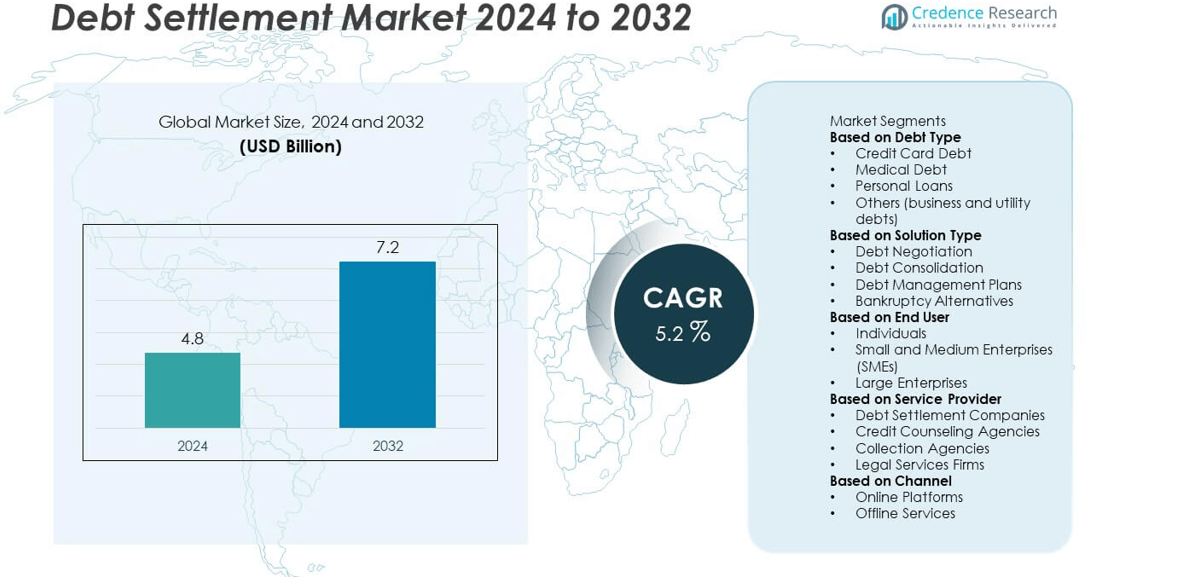
The Debt Settlement market was valued at USD 4.8 billion in 2024 and is projected to reach USD 7.2 billion by 2032, growing at a CAGR of 5.2% during the forecast period.
| REPORT ATTRIBUTE | DETAILS |
|---|---|
| Historical Period | 2020-2023 |
| Base Year | 2024 |
| Forecast Period | 2025-2032 |
| Debt Settlement Market Size 2024 | USD 4.8 billion |
| Debt Settlement Market, CAGR | 5.2% |
| Debt Settlement Market Size 2032 | USD 7.2 billion |
The debt settlement market is led by key players such as Freedom Debt Relief, National Debt Relief, CuraDebt Systems, Pacific Debt Inc., New Era Debt Solutions, Accredited Debt Relief, ClearOne Advantage, Guardian Debt Relief, Debt Negotiators, and Century Support Services. These companies emphasize customer-centric programs, digital platforms, and transparent negotiation processes to enhance credit rehabilitation outcomes. North America dominated the market with a 41% share in 2024, driven by high consumer debt levels and a strong regulatory environment. Europe followed with 28% share, supported by growing financial awareness, while Asia Pacific accounted for 22%, emerging as the fastest-growing region due to increasing adoption of digital debt management services and expanding middle-class consumer base.
Market Insights
- The debt settlement market was valued at USD 4.8 billion in 2024 and is projected to reach USD 7.2 billion by 2032, growing at a CAGR of 5.2%.
- Rising consumer debt, increasing financial stress, and growing demand for structured repayment programs are driving market expansion globally.
- The market is witnessing trends such as the adoption of AI-based negotiation tools, online settlement platforms, and personalized financial advisory services.
- Key players including Freedom Debt Relief, National Debt Relief, and Accredited Debt Relief focus on digital integration, transparency, and customer-centric approaches to strengthen competitiveness.
- North America led with 41% share in 2024, followed by Europe with 28% and Asia Pacific with 22%, while the credit card debt segment dominated with 46% share; however, high service fees and inconsistent regulatory frameworks continue to limit faster market penetration.
Market Segmentation Analysis:
By Debt Type
The credit card debt segment dominated the debt settlement market in 2024 with a 46% share, driven by rising consumer borrowing and high-interest revolving credit balances. Increasing dependency on credit cards for daily expenses and online purchases has led to mounting unsecured debt levels. Financial institutions and settlement firms are offering tailored repayment programs to help individuals reduce outstanding balances. Growing awareness of credit rehabilitation and the need for structured repayment plans further support segment growth. The demand for professional negotiation services continues to rise, especially among middle-income consumers facing financial strain.
- For instance, Freedom Debt Relief assisted over 1 million clients in resolving over $20 billion in unsecured debt through structured negotiation programs.
By Solution Type
The debt negotiation segment held the largest market share of 39% in 2024, supported by growing preference for direct negotiation between debtors and creditors to lower principal amounts. Consumers choose negotiation-based programs to avoid bankruptcy and maintain partial credit stability. This approach provides faster resolution and more flexibility than traditional repayment options. Advancements in digital platforms now allow automated communication and settlement tracking, enhancing transparency. The convenience and success rate of negotiated settlements make this solution type the preferred choice among financially distressed individuals and small enterprises.
- For instance, National Debt Relief helps clients settle debts for a reduced amount, which is often a multi-year process. The company recently invested in and formed a strategic partnership with Relief, an AI-enabled debt resolution app, to accelerate its digital services.
By End User
The individuals segment led the debt settlement market in 2024 with a 57% share, driven by rising household debt and financial instability among middle-income populations. Increasing medical expenses, job losses, and high-interest personal loans are key contributors to consumer debt accumulation. Individuals are turning to settlement programs for structured repayment options and relief from mounting penalties. Growing awareness about credit repair and the benefits of managed debt reduction programs has encouraged higher participation. The widespread availability of online financial advisory platforms also supports the strong adoption of debt settlement services among individuals worldwide.
Key Growth Drivers
Rising Consumer Debt Levels
The growing burden of consumer debt, particularly from credit cards, personal loans, and medical expenses, is driving the debt settlement market. Economic uncertainty and inflation have increased reliance on credit-based spending, resulting in higher default risks. Debt settlement programs provide structured solutions that help consumers negotiate manageable repayment terms. As financial distress becomes more widespread, individuals increasingly turn to professional settlement firms to avoid bankruptcy and regain financial stability, fueling steady growth in the global debt settlement market.
- For instance, Pacific Debt Inc. has settled over $500 million in consumer debt since 2002 by negotiating with creditors on behalf of clients. The company offers a client-centric approach and free consultations for individuals with unsecured debts.
Increasing Awareness of Debt Management Solutions
Rising financial literacy and improved access to information are boosting demand for debt settlement services. Consumers are becoming more aware of their options for negotiating with creditors and reducing debt obligations without legal proceedings. Educational campaigns and digital financial advisory platforms have made debt resolution strategies more transparent and accessible. This growing awareness encourages responsible financial behavior and drives the adoption of settlement programs that support long-term credit recovery and financial rehabilitation.
- For instance, Accredited Debt Relief, a financial services company operating as a DBA of Beyond Finance, LLC, has served clients with financial solutions since 2011. These services may include interactive debt analysis tools and repayment simulations that help users track settlement progress and navigate financial recovery pathways.
Growth of Digital and Automated Settlement Platforms
Technological advancements are reshaping the debt settlement industry, making services more efficient and accessible. Online platforms equipped with AI-driven negotiation tools and automated payment systems streamline communication between debtors and creditors. These platforms offer real-time status tracking and personalized settlement plans, improving user experience and trust. The shift toward digital debt resolution reduces manual errors, shortens settlement timelines, and lowers operational costs for service providers. This digital transformation continues to expand the reach of debt settlement services to a wider global customer base.
Key Trends and Opportunities
Expansion of Online and Mobile Debt Resolution Services
The increasing penetration of internet and smartphone use is fueling demand for online debt settlement platforms. Mobile applications now allow users to monitor balances, negotiate settlements, and receive financial counseling in real time. The convenience of digital access encourages younger, tech-savvy consumers to manage debt proactively. Financial institutions are partnering with fintech firms to provide secure, automated settlement solutions. This trend opens new opportunities for scalability, particularly in emerging markets where digital adoption is accelerating.
- For instance, ClearOne Advantage is a debt settlement company that uses AWS services to streamline its operations and helps clients with unsecured debts such as credit cards and personal loans. The company has been recognized as a "Top Workplace" by The Baltimore Sun and a "Best Place to Work" finalist by The Baltimore Business Journal.
Integration of AI and Predictive Analytics
Artificial intelligence is transforming debt settlement by improving credit assessment and negotiation outcomes. Predictive analytics enables service providers to forecast repayment potential, assess debtor risk, and design customized settlement offers. AI-powered chatbots enhance customer communication and reduce response time. These innovations increase settlement success rates and operational efficiency. As financial institutions adopt AI-driven risk modeling, data analytics will continue to play a key role in modernizing the debt settlement process and strengthening creditor-debtor relationships.
- For instance, companies such as Attunely, CollectWise, and TrueAccord have developed AI-based platforms that analyze large datasets of debtor information and interaction records to optimize debt settlement strategies. These platforms use predictive modeling to automate collections, personalize communication, and increase recovery rates through data-backed negotiation scoring.
Key Challenges
Regulatory and Compliance Constraints
Debt settlement companies face complex and varying regulations across regions, impacting operational flexibility. Strict consumer protection laws and licensing requirements often limit fee structures and negotiation practices. Non-compliance can lead to penalties and loss of trust among consumers. Maintaining transparency and adhering to ethical standards is essential for long-term credibility. As governments tighten financial regulations, companies must invest in compliance frameworks and legal expertise to operate effectively while ensuring fair and secure settlement procedures.
High Risk of Consumer Fraud and Mismanagement
The growing demand for debt settlement has led to an increase in fraudulent operators promising unrealistic outcomes. Unscrupulous firms exploit financially distressed consumers, leading to financial loss and reputational damage for the industry. Lack of awareness and proper verification mechanisms aggravate this challenge. To mitigate risks, regulatory bodies and industry leaders are emphasizing certification programs and strict oversight. Building trust through transparent pricing, verified service providers, and consumer education remains crucial to sustaining confidence in legitimate debt settlement services.
Regional Analysis
North America
North America held a 41% share of the debt settlement market in 2024, driven by high consumer borrowing levels and strong demand for structured financial recovery programs. The United States dominates due to rising credit card and personal loan debts, along with increased awareness of debt relief options. Supportive regulations and the presence of established settlement companies further boost market expansion. Canada also contributes steadily, supported by government initiatives promoting responsible lending and financial literacy. The region’s mature financial ecosystem and digital adoption strengthen the growth of technology-driven debt settlement services.
Europe
Europe accounted for 28% share of the debt settlement market in 2024, supported by growing financial stress among consumers and tightening economic conditions. The United Kingdom, Germany, and France lead the region, driven by high household debt levels and demand for transparent repayment frameworks. Regulatory reforms promoting fair debt collection and consumer protection are encouraging greater adoption of settlement services. Expanding fintech collaborations and digital advisory platforms are helping individuals manage debt more efficiently. Rising living costs and inflationary pressures continue to drive European consumers toward professional debt relief solutions.
Asia Pacific
Asia Pacific captured 22% share of the debt settlement market in 2024, emerging as the fastest-growing region. The rapid increase in personal and consumer lending, coupled with economic volatility, has heightened the need for debt resolution programs. China, India, and Japan lead adoption, supported by growing fintech penetration and financial inclusion initiatives. Consumers are becoming more aware of structured repayment and credit recovery solutions. Government-backed financial literacy campaigns and expansion of digital payment systems further accelerate market development. The region’s growing middle-class population and urbanization trends continue to create significant opportunities for settlement service providers.
Latin America
Latin America held 6% share of the debt settlement market in 2024, driven by rising personal debt levels and increasing financial instability in emerging economies. Brazil and Mexico are key contributors, supported by the growing number of credit users and fintech-driven debt recovery solutions. Economic fluctuations and currency devaluation have led consumers to seek structured repayment plans. However, limited financial literacy and inconsistent regulations across countries hinder faster adoption. Ongoing partnerships between financial institutions and digital service providers are expected to expand access to affordable and transparent debt settlement services in the region.
Middle East & Africa
The Middle East and Africa accounted for 3% share of the debt settlement market in 2024. The region’s growth is supported by increasing consumer debt and rising financial awareness among individuals and businesses. The United Arab Emirates and Saudi Arabia lead market adoption due to expanding credit markets and improved financial regulation. In Africa, South Africa and Kenya are witnessing gradual growth through mobile-based financial services that support structured debt repayment. Although adoption remains limited, growing digital infrastructure and financial inclusion initiatives are expected to enhance market penetration in the coming years.
Market Segmentations:
By Debt Type
- Credit Card Debt
- Medical Debt
- Personal Loans
- Others (business and utility debts)
By Solution Type
- Debt Negotiation
- Debt Consolidation
- Debt Management Plans
- Bankruptcy Alternatives
By End User
- Individuals
- Small and Medium Enterprises (SMEs)
- Large Enterprises
By Service Provider
- Debt Settlement Companies
- Credit Counseling Agencies
- Collection Agencies
- Legal Services Firms
By Channel
- Online Platforms
- Offline Services
By Geography
- North America
- U.S.
- Canada
- Mexico
- Europe
- Germany
- France
- U.K.
- Italy
- Spain
- Rest of Europe
- Asia Pacific
- China
- Japan
- India
- South Korea
- South-east Asia
- Rest of Asia Pacific
- Latin America
- Brazil
- Argentina
- Rest of Latin America
- Middle East & Africa
- GCC Countries
- South Africa
- Rest of the Middle East and Afric
Competitive Landscape
The competitive landscape of the debt settlement market is defined by the presence of leading players such as Freedom Debt Relief, National Debt Relief, CuraDebt Systems, Pacific Debt Inc., New Era Debt Solutions, Accredited Debt Relief, ClearOne Advantage, Guardian Debt Relief, Debt Negotiators, and Century Support Services. These companies focus on providing customized debt resolution programs that balance affordability, transparency, and credit recovery. Strategic partnerships with financial institutions, technology integration, and regulatory compliance are key factors shaping their competitiveness. Many firms are adopting digital platforms and AI-driven tools to enhance communication, automate settlement tracking, and improve customer experience. The growing emphasis on consumer trust, ethical practices, and certified financial counseling is also driving differentiation among players. Intense market competition encourages providers to expand service offerings, optimize negotiation success rates, and explore cross-border operations, particularly in emerging economies with rising household debt levels.
Key Player Analysis
- Freedom Debt Relief
- National Debt Relief
- CuraDebt Systems
- Pacific Debt Inc.
- New Era Debt Solutions
- Accredited Debt Relief
- ClearOne Advantage
- Guardian Debt Relief
- Debt Negotiators
- Century Support Services
Recent Developments
- In July 2025, National Debt Relief topped Forbes Advisor’s Best Debt Relief & Settlement Companies of 2025 list for the third straight year.
- In May 2025, Accredited Debt Relief earned a 2025 Buyer’s Choice Award from ConsumerAffairs for Best Value, Customer Service, and Process.
- In January 2025, Century Support Services was listed by ConsumerAffairs as a top debt settlement company
- In 2025, Pacific Debt Relief reportedly adopted new technology to enhance client-team communication for smoother case management
Report Coverage
The research report offers an in-depth analysis based on Debt Type, Solution Type, End User, Service Provider, Channel and Geography. It details leading market players, providing an overview of their business, product offerings, investments, revenue streams, and key applications. Additionally, the report includes insights into the competitive environment, SWOT analysis, current market trends, as well as the primary drivers and constraints. Furthermore, it discusses various factors that have driven market expansion in recent years. The report also explores market dynamics, regulatory scenarios, and technological advancements that are shaping the industry. It assesses the impact of external factors and global economic changes on market growth. Lastly, it provides strategic recommendations for new entrants and established companies to navigate the complexities of the market.
Future Outlook
- Adoption of AI-based negotiation and analytics tools will enhance settlement efficiency.
- Digital debt management platforms will expand accessibility and improve transparency.
- Demand for personalized and automated repayment solutions will continue to rise.
- Collaboration between fintech companies and financial institutions will increase service reach.
- Regulatory frameworks will strengthen to ensure ethical and transparent settlement practices.
- Financial literacy programs will boost awareness of professional debt relief options.
- Integration of mobile applications will simplify user engagement and payment tracking.
- Growth in unsecured consumer lending will sustain market demand for settlement services.
- Expansion into emerging economies will open new opportunities for service providers.
- Technology-driven solutions will improve negotiation success rates and customer satisfaction.

Request a Free Sample
Fill in your details and we'll send you a free sample report.
- Sample data tables & charts
- Research methodology
Need a Custom Version of This Report?
Tailor the scope, geography, or segments to your exact requirements.
- Custom geography or segment scope
- Direct access to our analyst team
Frequently Asked Questions
What is the current market size for Debt Settlement market, and what is its projected size in 2032?
At what Compound Annual Growth Rate is the Debt Settlement market projected to grow between 2025 and 2032?
Which Debt Settlement market segment held the largest share in 2024?
What are the primary factors fueling the growth of the Debt Settlement market?
Who are the leading companies in the Debt Settlement market?
Table of Content
Chapter 1 Market Segmentation
- 1.1 Segmentation Framework
- 1.1.1 Product and Service Classification
- 1.1.2 Application and End-Use Classification
- 1.1.3 Technology and Solution Classification
- 1.1.4 Customer and Distribution Channel Classification
- 1.1.5 Geographic Segmentation
- 1.1.6 Market Segment Definitions and Boundaries
Chapter 2 Introduction
- 2.1 Report Objectives and Scope
- 2.2 Product Definition and Industry Terminology
- 2.3 Market Inclusions and Exclusions
- 2.4 Research Process
- 2.4.1 Primary Research and Expert Interviews
- 2.4.2 Secondary Research and Source Review
- 2.4.3 Top-Down and Bottom-Up Estimation
- 2.4.4 Data Triangulation and Verification
- 2.5 Market Size Measurement Basis
- 2.5.1 2024: USD 4.8 billion → 2032: USD 7.2 billion
- 2.6 Historical and Forecast Reference Periods
- 2.6.1 Base Year: 2024
- 2.6.2 Forecast Period: 2024-2032
- 2.7 Research Assumptions and Limitations
Chapter 3 Executive Summary
- 3.1 Market Snapshot and Key Findings
- 3.2 Base-Year Market Size, 2024
- 3.3 Forecast Market Size, 2032
- 3.4 Revenue and Volume Growth Outlook
- 3.5 Key Demand and Supply Indicators
- 3.6 Leading Market Segments
- 3.7 Fastest-Growing Market Opportunities
- 3.8 Regional Performance Highlights
- 3.9 Technology and Industry Transformation
- 3.10 Competitive Landscape Summary
- 3.11 Analyst View and Strategic Implications
Chapter 4 Global Debt Settlement Market Trends and Developments
- 4.1 Historical Industry Development
- 4.2 Recent Market Trends and Developments
- 4.3 Demand and Customer Behavior Trends
- 4.4 Technology and Product Innovation
- 4.5 Artificial Intelligence, Automation and Digitalization
- 4.6 Local Manufacturing and Supply Chain Realignment
- 4.7 Industry Partnerships, Mergers and Acquisitions
- 4.8 Sustainability and Circular Economy Developments
- 4.9 Government and Private Sector Investment Trends
- 4.10 Emerging Business Models and Commercialization
- 4.11 Industry Developments and Announcements
Chapter 5 Global Debt Settlement Market Production, Supply and Demand Analysis
- 5.1 Demand Trend and Consumption Analysis
- 5.2 Demand Forecast, 2024-2032
- 5.3 Production and Output Trend
- 5.4 Production and Output Forecast, 2024-2032
- 5.5 Installed Capacity and Capacity Utilization
- 5.6 Company-Wise Production Plants and Statistics
- 5.6.1 Installed Production Capacity
- 5.6.2 Actual Production
- 5.6.3 Planned Capacity and Expansion Targets
- 5.7 Supply Chain Structure and Procurement Trends
- 5.8 Supply-Demand Gap and Bottlenecks
- 5.9 Import Dependence and Sourcing Structure
- 5.10 Contract Manufacturing and Outsourcing
- 5.11 Regional Supply and Demand Concentration
Chapter 6 Global Debt Settlement Market Pricing Analysis
- 6.1 Pricing Structure and Measurement
- 6.2 Historical Pricing Trends
- 6.3 Pricing Outlook, 2024-2032
- 6.4 Average Selling Price and Unit Economics
- 6.5 Pricing by Product and Market Segment
- 6.6 Geographic Pricing Differences
- 6.7 Key Input, Energy, Labor and Logistics Costs
- 6.8 Contract Pricing and Purchasing Models
- 6.9 Pricing Sensitivity and Competitive Positioning
- 6.10 Price, Margin and Profitability Implications
Chapter 7 Global Debt Settlement Market Dynamics
- 7.1 Market Growth Drivers
- 7.1.1 Demand-Side Drivers
- 7.1.2 Technology and Innovation Drivers
- 7.1.3 Infrastructure and Investment Drivers
- 7.1.4 Regulatory and Policy Drivers
- 7.2 Market Restraints
- 7.2.1 Cost and Affordability Constraints
- 7.2.2 Technology and Adoption Barriers
- 7.2.3 Supply Chain and Operational Constraints
- 7.3 Market Challenges
- 7.3.1 Competitive Pressure and Margin Erosion
- 7.3.2 Skills, Infrastructure and Implementation Gaps
- 7.4 Emerging Market Opportunities
- 7.5 Market Dynamics Impact and Time-Horizon Assessment
Chapter 8 Global Debt Settlement Value Chain Analysis
- 8.1 Industry Value Chain Overview
- 8.2 Upstream Suppliers and Critical Inputs
- 8.3 Technology and Component Providers
- 8.4 Manufacturing or Service Delivery
- 8.5 Distribution, Channel Partners and Integrators
- 8.6 Downstream Applications and End Users
- 8.7 Value Addition and Profit Pools
- 8.8 Vertical Integration and Outsourcing
- 8.9 Supplier Concentration and Risk
- 8.10 Supply Chain Localization and Resilience
Chapter 9 Global Debt Settlement Market Regulations and Policies
- 9.1 Relevant Laws, Standards and Compliance Frameworks
- 9.2 Product, Service, Safety and Quality Requirements
- 9.3 Government Policies, Incentives and Subsidies
- 9.4 Imports, Exports and Trade Barriers
- 9.5 Public Procurement and Local Content Requirements
- 9.6 Environmental and Sustainability Compliance
- 9.7 Upcoming Policy Changes and Market Implications
Chapter 10 Global Debt Settlement Market Hotspots and Opportunities
- 10.1 Market Opportunity Mapping and Growth Hotspots
- 10.2 High-Growth Applications and Customer Groups
- 10.3 Underserved Markets and White-Space Opportunities
- 10.4 Emerging Technology and Product Opportunities
- 10.5 New Capacity and Investment Hotspots
- 10.6 Market Entry and Expansion Opportunities
- 10.7 Distribution and Partnership Opportunities
- 10.8 Near-Term and Long-Term Commercial Potential
- 10.9 Opportunity Attractiveness and Execution Risks
Chapter 11 Global Debt Settlement Market Outlook, 2024-2032
- 11.1 Market Size and Analysis
- 11.1.1 Revenue (Market Measurement: 2024: USD 4.8 billion → 2032: USD 7.2 billion)
- 11.1.2 Market Volume and Quantity Sold
- 11.1.3 Historical Market Size
- 11.1.4 Base-Year Market Size, 2024
- 11.2 Market Forecast, 2024-2032
- 11.2.1 Revenue Forecast to 2032
- 11.2.2 Volume Forecast to 2032
- 11.2.3 CAGR and Year-on-Year Growth
- 11.2.4 Incremental Revenue Opportunity
- 11.3 Forecast Assumptions and Scenario Analysis
- 11.3.1 Base-Case Forecast
- 11.3.2 Optimistic and Conservative Scenarios
- 11.3.3 Technology, Pricing and Policy Sensitivities
- 11.4 Market Attractiveness and Growth Outlook
Chapter 12 Global Debt Settlement Market Segmentation and Outlook
- 12.1 Segmentation Summary and Market Shares, 2024
- 12.2 Largest and Fastest-Growing Segments
- 12.3 Segment Growth Comparison
- 12.4 Segment Attractiveness and Priority Matrix
Chapter 13 Global Debt Settlement Geographic Market Outlook, 2024-2032
- 13.1 Regional Market Size and Share, 2024
- 13.2 Regional Market Forecast, 2024-2032
- 13.3 Regional Pricing, Production and Demand Differences
- 13.4 North America
- 13.4.1 United States
- 13.4.2 Canada
- 13.4.3 Mexico
- 13.5 Europe
- 13.5.1 Germany
- 13.5.2 France
- 13.5.3 Italy
- 13.5.4 United Kingdom
- 13.5.5 Spain
- 13.5.6 Poland
- 13.5.7 Russia
- 13.5.8 Netherlands
- 13.5.9 Belgium
- 13.5.10 Sweden
- 13.5.11 Denmark
- 13.5.12 Norway
- 13.5.13 Rest of Europe
- 13.6 Asia Pacific
- 13.6.1 China
- 13.6.2 India
- 13.6.3 Japan
- 13.6.4 South Korea
- 13.6.5 Thailand
- 13.6.6 Indonesia
- 13.6.7 Vietnam
- 13.6.8 Malaysia
- 13.6.9 Australia
- 13.6.10 Rest of Asia Pacific
- 13.7 Latin America
- 13.7.1 Brazil
- 13.7.2 Argentina
- 13.7.3 Colombia
- 13.7.4 Chile
- 13.7.5 Rest of Latin America
- 13.8 Middle East
- 13.8.1 Saudi Arabia
- 13.8.2 United Arab Emirates
- 13.8.3 Turkey
- 13.8.4 Israel
- 13.8.5 Iran
- 13.8.6 Rest of the Middle East
- 13.9 Africa
- 13.9.1 South Africa
- 13.9.2 Egypt
- 13.9.3 Nigeria
- 13.9.4 Morocco
- 13.9.5 Rest of Africa
- 13.10 Regional Investment, Policy and Supply Chain Differences
- 13.11 Regional Competitive Landscape
- 13.12 Geographic Growth Hotspots
Chapter 14 Global Debt Settlement Technology, Innovation and Sustainability Outlook
- 14.1 Technology Landscape and Maturity
- 14.2 Product, Process and Service Innovation
- 14.3 AI, Automation and Digital Tools in the Industry
- 14.4 Technology Adoption and Performance Benchmarking
- 14.5 Innovation Pipeline and R&D Investment
- 14.6 Patent and Intellectual Property Trends
- 14.7 Energy Efficiency and Resource Management
- 14.8 Sustainability, Recycling and Circularity
- 14.9 Technology Roadmap, 2024-2032
- 14.10 Risks of Obsolescence and Technology Substitution
Chapter 15 Global Debt Settlement Market Key Strategic Imperatives
- 15.1 Growth and Market Entry Priorities
- 15.2 High-Return Products and Segments
- 15.3 Pricing, Profitability and Cost Optimization
- 15.4 Technology Investment and Product Differentiation
- 15.5 Supply Chain Localization and Resilience
- 15.6 Distribution and Customer Acquisition
- 15.7 Partnership, Acquisition and Capacity Strategy
- 15.8 Regional Expansion Priorities
- 15.9 Short-, Medium- and Long-Term Actions
Chapter 16 Competition Outlook
- 16.1 Industry Competition Characteristics
- 16.2 Market Structure and Concentration
- 16.3 Market Share and Competitive Positioning, 2024
- 16.4 Company-Wise Revenue and Product Benchmarking
- 16.5 Production and Service Capacity Benchmarking
- 16.6 Technology, Pricing and Differentiation
- 16.7 Regional Footprint and Distribution Strength
- 16.8 Mergers, Acquisitions and Strategic Alliances
- 16.9 New Entrants and Competitive Threats
- 16.10 Porter's Five Forces and Industry Attractiveness
- 16.11 Competitive Outlook, 2024-2032
Chapter 17 Company Profiles
- 17.1 Company Coverage and Selection Criteria
- 17.2 Leading Market Participants – Standard Profile Structure
- 17.2.1 Business Description
- 17.2.2 Company Ownership and Geographic Presence
- 17.2.3 Product and Service Portfolio
- 17.2.4 Manufacturing and Operating Footprint
- 17.2.5 Production Capacity and Expansion Plans
- 17.2.6 Financial Performance and Investment
- 17.2.7 Market Share and Competitive Position
- 17.2.8 Technology and Innovation Capabilities
- 17.2.9 Strategic Alliances or Partnerships
- 17.2.10 Recent Developments
- 17.2.11 Growth Strategy and Outlook
- 17.3 Other Relevant Market Participants
Note: Every listed company is profiled on the structure shown under the first company. The company list is preliminary and may change based on research findings, market developments, data availability and client requirements.
Chapter 18 Disclaimer
- 18.1 Research and Forecast Disclaimer
- 18.2 Data Source and Estimation Limitations
Note: The depth of individual sections depends on data availability for this market. Volume, capacity, trade and other unit-based metrics are included where applicable.

