| REPORT ATTRIBUTE | DETAILS |
|---|---|
| Historical Period | 2020-2023 |
| Base Year | 2024 |
| Forecast Period | 2025-2032 |
| Dental Delivery System Market Size 2024 | USD 11950 Million |
| Dental Delivery System Market, CAGR | 6.14% |
| Dental Delivery System Market, Size 2032 | USD 19248.6 Million |
Market Overview:
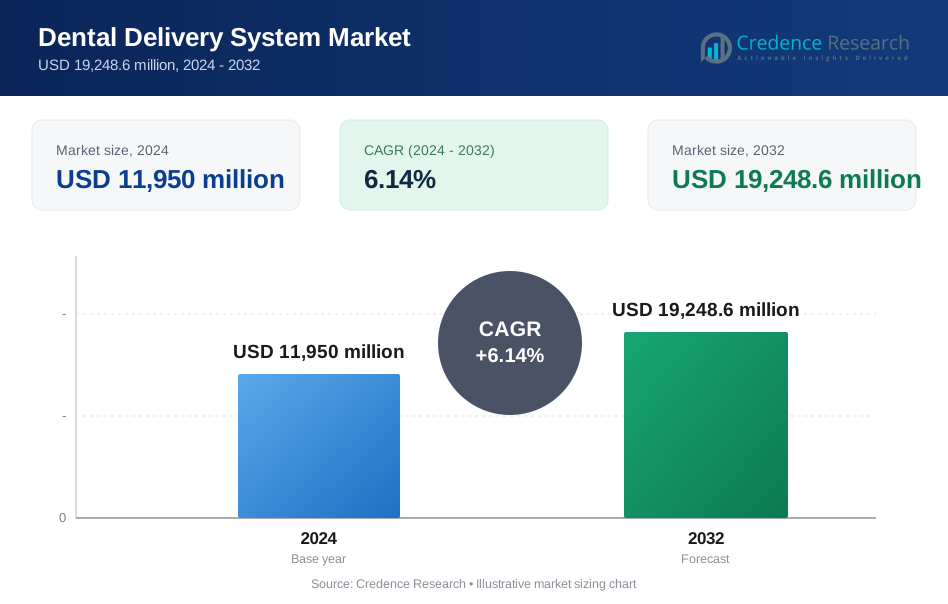
Dental Delivery System Market size was valued at USD 11950 million in 2024 and is anticipated to reach USD 19248.6 million by 2032, at a CAGR of 6.14% during the forecast period (2024-2032).
Key drivers contributing to the growth of the Dental Delivery System Market include the rising prevalence of dental disorders, the growing geriatric population, and advancements in dental technology. The demand for enhanced dental equipment, particularly systems that integrate advanced technology for precision and efficiency, is elevating the overall dental care experience. Additionally, the rising emphasis on aesthetic dental treatments is pushing the demand for systems that facilitate complex procedures. With increasing consumer preference for minimally invasive treatments, the need for more sophisticated systems is intensifying. Increased healthcare spending, especially in emerging economies, and the expansion of dental services are further boosting the market, with more dental clinics adopting state-of-the-art delivery systems to meet the evolving needs of patients.
Regionally, North America dominates the Dental Delivery System Market, with the United States holding the largest market share due to the high adoption rate of advanced dental technologies and the presence of leading dental equipment manufacturers. The region’s healthcare infrastructure and high per capita healthcare spending contribute significantly to the market's growth. Europe follows closely, driven by an aging population and increased focus on dental aesthetics. Moreover, governmental initiatives to improve dental care standards and preventive measures are fostering market growth in the region. The Asia Pacific region is expected to witness the highest growth during the forecast period, owing to the increasing dental awareness, improving healthcare infrastructure, and growing disposable income. In particular, countries like India and China are emerging as key markets for dental delivery systems, with expanding middle-class populations and greater access to advanced dental technologies.
Market Insights:
- The Dental Delivery System Market was valued at USD 11,950 million in 2024 and is expected to reach USD 19,248.6 million by 2032, growing at a CAGR of 6.14% during the forecast period (2024-2032).
- The rising prevalence of dental disorders, growing geriatric population, and advancements in dental technology are key drivers propelling market growth.
- The demand for systems that incorporate advanced technologies for precision, efficiency, and improved patient comfort is elevating the overall dental care experience.
- Technological advancements such as electronic controls, touchscreens, wireless systems, and AI-enabled devices are driving innovation and enhancing clinical outcomes.
- Emerging markets in regions like Asia Pacific, Latin America, and the Middle East are experiencing strong growth due to urbanization, higher disposable incomes, and expanding healthcare infrastructure.
- The increasing popularity of dental tourism is fueling demand for advanced dental delivery systems, especially in countries like India and China.
- High initial costs, maintenance requirements, and complex regulatory environments present challenges to widespread adoption, particularly for small and mid-sized practices.
Market Drivers:
Technological Advancements and Innovation Accelerate Market Growth
Rapid technological progress acts as a primary catalyst in the Dental Delivery System Market. Manufacturers introduce electronic controls, touchscreens, and ergonomic features that streamline dental workflows and improve both practitioner efficiency and patient comfort. These innovations address the evolving demands of dental professionals, encouraging the adoption of advanced systems that offer greater accuracy and user-friendliness. Competitive pressure among leading companies intensifies product differentiation and continuous improvement, ensuring that dental delivery systems remain central to modern dental practice. Investment in research and development supports the launch of wireless, cordless, and AI-enabled systems. These advancements not only enhance clinical outcomes but also facilitate infection control and regulatory compliance, making them highly desirable for clinics and hospitals.
Increasing Prevalence of Dental Diseases and Procedure Volume
The rising incidence of dental diseases, including caries, periodontal conditions, and oral cancers, significantly increases the demand for dental procedures and, by extension, dental delivery systems. Growing public awareness of oral health prompts more individuals to seek preventive and corrective care, which raises the global volume of dental procedures. The Dental Delivery System Market addresses this demand by providing solutions that support high-throughput environments and optimize clinical productivity. The expanding elderly population, which requires more frequent dental services, further amplifies this trend. Improved insurance coverage and reimbursement policies make dental treatments more accessible, expanding the patient base and supporting ongoing market growth.
- For instance, A-dec’s 500 Pro delivery system, introduced in 2023, is fully enabled with the A-dec+ platform, supporting digital connectivity for up to 50 operatories in a single clinic.
Emerging Markets and Dental Tourism Fuel Market Opportunities
Emerging economies present significant growth opportunities for the Dental Delivery System Market, driven by urbanization, higher disposable incomes, and expanding healthcare infrastructure. Government programs and public-private partnerships modernize dental facilities, especially in Asia Pacific and Latin America, where dental tourism is increasing. Patients from developed countries seek affordable, high-quality dental care in these regions, boosting demand for advanced delivery systems. The shift toward multispecialty dental practices and investments in teaching hospitals stimulate equipment upgrades and the adoption of integrated, flexible delivery solutions. These factors position emerging regions as important contributors to future market expansion.
Ergonomics, Patient Comfort, and Infection Control Shape Market Demand
Ergonomics and patient comfort are now central to the design and adoption of dental delivery systems. Clinics and hospitals prioritize equipment that reduces practitioner fatigue, streamlines workflow, and improves patient satisfaction. The market experiences strong demand for systems that are easy to clean, offer advanced control features, and support rigorous infection control protocols. This focus intensifies in the wake of heightened infection prevention measures, leading to a preference for sealed, simplified units. The Dental Delivery System Market continues to evolve to meet these needs, ensuring that new products comply with regulatory standards and align with the expectations of modern dental practices.
- For instance, A-dec’s digitally connected delivery systems, including the 500 Pro and 300 Pro, are engineered with fully sealed surfaces and simplified, crevice-free designs that facilitate thorough cleaning and disinfection.
Market Trends:
Integration of Digital Technologies and Smart Features Shapes Market Evolution
The adoption of digital technologies and smart features stands out as a defining trend in the Dental Delivery System Market. It incorporates digital touchscreens, integrated imaging, and real-time data connectivity to enhance clinical precision and workflow efficiency. Dental professionals increasingly prefer systems that support seamless integration with practice management software and diagnostic devices. This trend reflects a broader movement toward digital dentistry, where connectivity and data-driven decision-making play a crucial role. Manufacturers respond by developing delivery systems with wireless controls, automated maintenance alerts, and customizable settings. These advancements improve patient outcomes and practice productivity, reinforcing the market’s shift toward intelligent, connected solutions.
- For instance, DentalMonitoring’s DM Intelligent Platform enables remote treatment monitoring by tracking over 60 parameters from weekly patient scans, 21 of which are FDA-cleared medical indications, demonstrating the platform’s robust technical capabilities and regulatory compliance.
Focus on Compact, Ergonomic Designs and Enhanced Infection Control Drives Product Innovation
A strong emphasis on compact, ergonomic designs and advanced infection control measures guides product innovation in the Dental Delivery System Market. It prioritizes equipment that maximizes space efficiency and reduces physical strain for dental practitioners. The market sees rising demand for delivery units that are easy to disinfect, feature sealed surfaces, and support touchless operation. Infection control remains a top priority, especially in the post-pandemic environment, prompting manufacturers to introduce systems with antimicrobial materials and simplified cleaning protocols. Ergonomically designed units also contribute to practitioner well-being and patient comfort, making them highly attractive to clinics and hospitals. This trend supports the ongoing modernization of dental practices and aligns with evolving regulatory standards.
- For example, KaVo DEKASEPTOL Gel enables complete suction system disinfection in just 80 seconds, as documented in company technical data, providing a rapid and reliable infection control solution for dental practices.
Market Challenges Analysis:
High Initial Costs and Maintenance Requirements Limit Widespread Adoption
The Dental Delivery System Market faces significant challenges due to high initial investment and ongoing maintenance costs. It often requires substantial capital outlay for advanced units equipped with digital and ergonomic features. Many small and mid-sized dental practices struggle to justify these expenses, which can slow market penetration. Maintenance and repair costs further add to the financial burden, especially when specialized technicians or proprietary parts are necessary. Budget constraints in public healthcare facilities also limit procurement of state-of-the-art systems. These financial barriers restrict access to advanced dental delivery solutions, particularly in developing regions.
Complex Regulatory Landscape and Integration Issues Hinder Market Growth
Navigating a complex regulatory environment presents another challenge for the Dental Delivery System Market. It must comply with stringent safety, quality, and infection control standards, which vary across regions and often evolve over time. Achieving regulatory approval can delay product launches and increase development costs. Integration with existing dental practice management systems and diagnostic equipment also poses difficulties, especially for older clinics with legacy infrastructure. Inconsistent compatibility and interoperability issues can disrupt workflow and deter adoption of new delivery systems. These challenges collectively slow the pace of market expansion and innovation.
Market Opportunities:
Expansion into Emerging Markets and Untapped Regions Presents Significant Growth Potential
The Dental Delivery System Market finds strong opportunities in emerging economies and underserved regions. It benefits from rising healthcare investments, urbanization, and growing awareness of oral health in Asia Pacific, Latin America, and parts of Africa. Governments and private entities continue to upgrade dental infrastructure, creating demand for modern delivery systems. Dental tourism also contributes to this trend, with patients seeking affordable, high-quality care in these regions. Companies that establish local partnerships and adapt products to regional needs can capture new market share. These factors position emerging markets as key drivers of future growth.
Development of Customizable and Smart Solutions Meets Evolving Clinical Needs
The shift toward customizable and smart dental delivery systems creates new avenues for innovation. The Dental Delivery System Market responds by offering modular units, wireless connectivity, and integration with digital diagnostics. It aligns with the needs of multispecialty practices and teaching hospitals that require flexible, scalable solutions. Demand for systems supporting infection control, ergonomic design, and real-time data management remains strong. Manufacturers that invest in research and tailor products to specific clinical environments gain a competitive edge. This focus on customization and technology integration supports long-term market expansion.
Market Segmentation Analysis:
By Type:
By type, the Dental Delivery System Market divides into chair-mounted, cart-mounted, and portable systems. Chair-mounted systems hold the largest share, favored for their seamless integration with dental chairs and efficient workflow management. Cart-mounted units appeal to practices that require flexibility and mobility within clinical settings. Portable systems see rising adoption in outreach programs and mobile dental clinics, supporting access to care in remote areas. The market maintains steady demand across all segments, but chair-mounted solutions remain the top choice for established dental practices due to their reliability and comprehensive functionality.
- For instance, the A-dec 300 Pro Cart supports 120 VAC power for tabletop accessories, enabling seamless integration of essential clinical devices.
By Application:
By application, the market segments into diagnostic, therapeutic, and surgical uses. Diagnostic applications dominate, reflecting the growing emphasis on early detection and preventive dental care. It supports a broad range of procedures, from routine examinations to advanced imaging and screening. Therapeutic and surgical segments follow, with increasing demand for restorative and cosmetic dental treatments. The market continues to develop specialized delivery systems that address the unique requirements of each application, ensuring versatility and clinical precision.
- For instance, Carestream Dental’s CS 8200 3D system can produce a fully traced cephalometric image in as little as 10 seconds, directly supporting rapid and reliable diagnostic workflows.
By End-User:
By end-user, dental clinics account for the majority of installations, making them the primary driver of market demand. Hospitals and academic institutions also play significant roles, particularly in regions investing in healthcare modernization and dental education. It adapts product offerings to suit the workflow, regulatory, and training needs of each end-user segment. The diverse end-user landscape supports ongoing innovation and creates opportunities for targeted market expansion.
Segmentations:
By Type
- Traditional Dental Delivery Systems
- Advanced Dental Delivery Systems
- Digital Dental Delivery Systems
- Hybrid Dental Delivery Systems
By Application
- Preventive Dentistry
- Restorative Dentistry
- Orthodontics
- Periodontics
- Aesthetic Dentistry
By End-User
- Dental Clinics
- Hospitals
- Dental Laboratories
- Academic and Research Institutes
- Public Health Centers
By Region
- North America
- Europe
- Asia Pacific
- Latin America
- Middle East & Africa
Regional Analysis:
North America Maintains Market Leadership with Advanced Infrastructure and High Adoption Rates
North America holds 38% market share in the Dental Delivery System Market, making it the leading regional segment. The region benefits from advanced healthcare infrastructure and a strong focus on technological innovation. It enjoys a high concentration of dental clinics, well-established reimbursement frameworks, and significant investments in research and development. Dental professionals in the United States and Canada show a strong preference for state-of-the-art delivery systems that improve workflow and patient outcomes. The presence of major manufacturers and a robust distribution network further strengthen the region’s market dominance. Regulatory standards and infection control protocols drive continuous upgrades in dental equipment. High patient awareness and demand for cosmetic dentistry also contribute to sustained market growth.
Europe Demonstrates Steady Growth Driven by Public Health Initiatives and Modernization Efforts
Europe captures 27% market share in the Dental Delivery System Market, reflecting its significant role in the global landscape. The region’s steady growth is fueled by public health initiatives and modernization of dental practices. It benefits from government-funded healthcare systems, which facilitate access to advanced dental technologies across both Western and Eastern Europe. Countries such as Germany, the United Kingdom, and France invest in upgrading dental infrastructure and expanding preventive care programs. The market sees rising demand for ergonomic and digitally integrated systems, reflecting a broader trend toward digital transformation in healthcare. Strict regulatory requirements ensure high product quality and safety standards. Increasing focus on elderly care and oral health awareness further support market expansion in the region.
Asia Pacific Emerges as a Key Growth Engine with Rapid Urbanization and Expanding Healthcare Access
Asia Pacific holds 22% market share in the Dental Delivery System Market, positioning it as a rapidly growing regional segment. The region experiences strong demand for dental services in countries such as China, India, and Japan, where government and private sector investments upgrade dental infrastructure. Dental tourism flourishes in the region, attracting international patients and increasing the need for advanced delivery systems. Local manufacturers and international players compete to address diverse market needs, offering both cost-effective and premium solutions. The region’s youthful population and growing awareness of oral health contribute to long-term market potential. Strategic partnerships and localization strategies enhance market penetration and support ongoing growth.
Key Player Analysis:
- DENTALEZ
- Aseptico Inc.
- MGI Healthcare
- ADS Dental System
- A-dec Inc.
- Midmark
- Dental International
- Olsen
Competitive Analysis:
The Dental Delivery System Market is highly competitive, with several prominent players dominating the landscape. Companies like A-dec Inc., Danaher Corporation, and Planmeca Group lead with their comprehensive product portfolios, offering advanced dental delivery systems that integrate cutting-edge technologies for improved efficiency and patient comfort. These manufacturers focus on continuous innovation, emphasizing ergonomic design, digital controls, and infection control features. Smaller companies are entering the market, offering cost-effective solutions, but face significant challenges in competing with industry leaders’ established reputations and technological advancements. The market is marked by intense rivalry, with companies striving to differentiate themselves through superior product quality, customer service, and technological differentiation. The increasing demand for integrated, user-friendly systems further intensifies competition. Market players are also investing in research and development to enhance their product offerings and expand their global reach. The competitive environment is expected to remain strong throughout the forecast period.
Recent Developments:
- In September 2024, DENTALEZ introduced the Forest 6400 dental chair, which features advanced ergonomics, customization, and smart technology, and is capable of accommodating stand-up dentistry.
- In June 2025, MGI Tech announced a strategic co-marketing partnership with GenePoweRx to accelerate AI-driven genomic solutions in personalized medicine, combining MGI’s sequencing platforms with GenePoweRx’s AI analytics.
- In May 2025, MGI launched the DNBSEQ-E25 sequencer for the European and African markets and announced a partnership with ABL Diagnostics to ensure compatibility of DeepChek® assays with MGI’s sequencing platforms.
Market Concentration & Characteristics:
The Dental Delivery System Market is highly competitive, with several prominent players dominating the landscape. Companies like A-dec Inc., Danaher Corporation, and Planmeca Group lead with their comprehensive product portfolios, offering advanced dental delivery systems that integrate cutting-edge technologies for improved efficiency and patient comfort. These manufacturers focus on continuous innovation, emphasizing ergonomic design, digital controls, and infection control features. Smaller companies are entering the market, offering cost-effective solutions, but face significant challenges in competing with industry leaders’ established reputations and technological advancements. The market is marked by intense rivalry, with companies striving to differentiate themselves through superior product quality, customer service, and technological differentiation. The increasing demand for integrated, user-friendly systems further intensifies competition. Market players are also investing in research and development to enhance their product offerings and expand their global reach. The competitive environment is expected to remain strong throughout the forecast period.
Report Coverage:
The research report offers an in-depth analysis based on Type, Application, End-User and Region. It details leading market players, providing an overview of their business, product offerings, investments, revenue streams, and key applications. Additionally, the report includes insights into the competitive environment, SWOT analysis, current market trends, as well as the primary drivers and constraints. Furthermore, it discusses various factors that have driven market expansion in recent years. The report also explores market dynamics, regulatory scenarios, and technological advancements that are shaping the industry. It assesses the impact of external factors and global economic changes on market growth. Lastly, it provides strategic recommendations for new entrants and established companies to navigate the complexities of the market.
Future Outlook:
- The Dental Delivery System Market is experiencing robust growth, driven by technological advancements and increasing demand for efficient dental care.
- Integration of artificial intelligence (AI) and machine learning is enhancing diagnostic accuracy and treatment planning in dental practices.
- The rise of mobile dental units is improving access to dental care in underserved and remote areas.
- Ergonomic designs in dental delivery systems are gaining importance to reduce practitioner fatigue and improve patient comfort.
- Advancements in infection control technologies are leading to the development of systems that are easier to disinfect and maintain.
- The shift towards minimally invasive procedures is influencing the design and functionality of dental delivery systems.
- There is a growing emphasis on sustainability, with manufacturers focusing on eco-friendly materials and energy-efficient designs.
- The expansion of dental services in emerging markets is creating new opportunities for growth in the dental delivery system sector.
- Collaborations between dental equipment manufacturers and healthcare providers are fostering innovation and improving service delivery.
The ongoing evolution of dental education and training is driving demand for advanced dental delivery systems in academic institutions.
Request a Free Sample
Fill in your details and we'll send you a free sample report.
- Sample data tables & charts
- Research methodology
Market Dynamics
Technological Advancements and Innovation
Rapid progress in digital controls, touchscreens, wireless connectivity, and AI-enabled features is transforming dental delivery systems, making them more precise, efficient, and user-friendly. These innovations drive adoption among dental professionals seeking to improve workflow and patient outcomes.
Rising Prevalence of Dental Disorders and Aging Population
Increasing rates of dental diseases and a growing geriatric population are boosting the volume of dental procedures, thereby elevating demand for advanced dental delivery systems that can support high-throughput clinical environments.
Expansion of Dental Services and Infrastructure in Emerging Markets
Urbanization, higher disposable incomes, and government investments in healthcare infrastructure across Asia Pacific, Latin America, and the Middle East are expanding access to dental care and driving the adoption of modern delivery systems.
Emphasis on Aesthetic and Minimally Invasive Dental Treatments
Growing consumer preference for aesthetic dental procedures and minimally invasive treatments is pushing clinics to invest in sophisticated delivery systems that enable complex, precise, and comfortable interventions.
Stringent Infection Control and Ergonomic Requirements
Heightened focus on infection prevention and practitioner ergonomics is leading to strong demand for delivery systems with sealed, easy-to-clean surfaces and ergonomic designs, supporting both regulatory compliance and improved patient/practitioner safety.
Need a Custom Version of This Report?
Tailor the scope, geography, or segments to your exact requirements.
- Custom geography or segment scope
- Direct access to our analyst team
Frequently Asked Questions
What is the current size of the Dental Delivery System Market?
What factors are driving the growth of the Dental Delivery System Market?
What are the key segments within the Dental Delivery System Market?
What are some challenges faced by the Dental Delivery System Market?
Who are the major players in the Dental Delivery System Market?
Which segment is leading the market share?
Table of Content
Chapter 1 Market Segmentation
- 1.1 Segmentation Framework
- 1.1.1 Product and Service Classification
- 1.1.2 Application and End-Use Classification
- 1.1.3 Technology and Solution Classification
- 1.1.4 Customer and Distribution Channel Classification
- 1.1.5 Geographic Segmentation
- 1.1.6 Market Segment Definitions and Boundaries
- 1.2 By Type
- 1.2.1 Traditional Dental Delivery Systems
- 1.2.2 Advanced Dental Delivery Systems
- 1.2.3 Digital Dental Delivery Systems
- 1.2.4 Hybrid Dental Delivery Systems
- 1.3 By End-User
- 1.3.1 Dental Clinics
- 1.3.2 Hospitals
- 1.3.3 Dental Laboratories
- 1.3.4 Academic and Research Institutes
- 1.3.5 Public Health Centers
- 1.4 By Application
- 1.4.1 Preventive Dentistry
- 1.4.2 Restorative Dentistry
- 1.4.3 Orthodontics
- 1.4.4 Periodontics
- 1.4.5 Aesthetic Dentistry
Chapter 2 Introduction
- 2.1 Report Objectives and Scope
- 2.2 Product Definition and Industry Terminology
- 2.3 Market Inclusions and Exclusions
- 2.4 Research Process
- 2.4.1 Primary Research and Expert Interviews
- 2.4.2 Secondary Research and Source Review
- 2.4.3 Top-Down and Bottom-Up Estimation
- 2.4.4 Data Triangulation and Verification
- 2.5 Market Size Measurement Basis
- 2.5.1 2024: USD 11,950 million → 2032: USD 19,248.6 million
- 2.6 Historical and Forecast Reference Periods
- 2.6.1 Base Year: 2024
- 2.6.2 Forecast Period: 2024-2032
- 2.7 Research Assumptions and Limitations
Chapter 3 Executive Summary
- 3.1 Market Snapshot and Key Findings
- 3.2 Base-Year Market Size, 2024
- 3.3 Forecast Market Size, 2032
- 3.4 Revenue and Volume Growth Outlook
- 3.5 Key Demand and Supply Indicators
- 3.6 Leading Market Segments
- 3.7 Fastest-Growing Market Opportunities
- 3.8 Regional Performance Highlights
- 3.9 Technology and Industry Transformation
- 3.10 Competitive Landscape Summary
- 3.11 Analyst View and Strategic Implications
Chapter 4 Global Dental Delivery System Market Trends and Developments
- 4.1 Historical Industry Development
- 4.2 Recent Market Trends and Developments
- 4.3 Demand and Customer Behavior Trends
- 4.4 Technology and Product Innovation
- 4.5 Artificial Intelligence, Automation and Digitalization
- 4.6 Local Manufacturing and Supply Chain Realignment
- 4.7 Industry Partnerships, Mergers and Acquisitions
- 4.8 Sustainability and Circular Economy Developments
- 4.9 Government and Private Sector Investment Trends
- 4.10 Emerging Business Models and Commercialization
- 4.11 Industry Developments and Announcements
Chapter 5 Global Dental Delivery System Market Production, Supply and Demand Analysis
- 5.1 Demand Trend and Consumption Analysis
- 5.2 Demand Forecast, 2024-2032
- 5.3 Production and Output Trend
- 5.4 Production and Output Forecast, 2024-2032
- 5.5 Installed Capacity and Capacity Utilization
- 5.6 Company-Wise Production Plants and Statistics
- 5.6.1 Installed Production Capacity
- 5.6.2 Actual Production
- 5.6.3 Planned Capacity and Expansion Targets
- 5.7 Supply Chain Structure and Procurement Trends
- 5.8 Supply-Demand Gap and Bottlenecks
- 5.9 Import Dependence and Sourcing Structure
- 5.10 Contract Manufacturing and Outsourcing
- 5.11 Regional Supply and Demand Concentration
Chapter 6 Global Dental Delivery System Market Pricing Analysis
- 6.1 Pricing Structure and Measurement
- 6.2 Historical Pricing Trends
- 6.3 Pricing Outlook, 2024-2032
- 6.4 Average Selling Price and Unit Economics
- 6.5 Pricing by Product and Market Segment
- 6.6 Geographic Pricing Differences
- 6.7 Key Input, Energy, Labor and Logistics Costs
- 6.8 Contract Pricing and Purchasing Models
- 6.9 Pricing Sensitivity and Competitive Positioning
- 6.10 Price, Margin and Profitability Implications
Chapter 7 Global Dental Delivery System Market Dynamics
- 7.1 Market Growth Drivers
- 7.1.1 Demand-Side Drivers
- 7.1.2 Technology and Innovation Drivers
- 7.1.3 Infrastructure and Investment Drivers
- 7.1.4 Regulatory and Policy Drivers
- 7.2 Market Restraints
- 7.2.1 Cost and Affordability Constraints
- 7.2.2 Technology and Adoption Barriers
- 7.2.3 Supply Chain and Operational Constraints
- 7.3 Market Challenges
- 7.3.1 Competitive Pressure and Margin Erosion
- 7.3.2 Skills, Infrastructure and Implementation Gaps
- 7.4 Emerging Market Opportunities
- 7.5 Market Dynamics Impact and Time-Horizon Assessment
Chapter 8 Global Dental Delivery System Value Chain Analysis
- 8.1 Industry Value Chain Overview
- 8.2 Upstream Suppliers and Critical Inputs
- 8.3 Technology and Component Providers
- 8.4 Manufacturing or Service Delivery
- 8.5 Distribution, Channel Partners and Integrators
- 8.6 Downstream Applications and End Users
- 8.7 Value Addition and Profit Pools
- 8.8 Vertical Integration and Outsourcing
- 8.9 Supplier Concentration and Risk
- 8.10 Supply Chain Localization and Resilience
Chapter 9 Global Dental Delivery System Market Regulations and Policies
- 9.1 Relevant Laws, Standards and Compliance Frameworks
- 9.2 Product, Service, Safety and Quality Requirements
- 9.3 Government Policies, Incentives and Subsidies
- 9.4 Imports, Exports and Trade Barriers
- 9.5 Public Procurement and Local Content Requirements
- 9.6 Environmental and Sustainability Compliance
- 9.7 Upcoming Policy Changes and Market Implications
Chapter 10 Global Dental Delivery System Market Hotspots and Opportunities
- 10.1 Market Opportunity Mapping and Growth Hotspots
- 10.2 High-Growth Applications and Customer Groups
- 10.3 Underserved Markets and White-Space Opportunities
- 10.4 Emerging Technology and Product Opportunities
- 10.5 New Capacity and Investment Hotspots
- 10.6 Market Entry and Expansion Opportunities
- 10.7 Distribution and Partnership Opportunities
- 10.8 Near-Term and Long-Term Commercial Potential
- 10.9 Opportunity Attractiveness and Execution Risks
Chapter 11 Global Dental Delivery System Market Outlook, 2024-2032
- 11.1 Market Size and Analysis
- 11.1.1 Revenue (Market Measurement: 2024: USD 11,950 million → 2032: USD 19,248.6 million)
- 11.1.2 Market Volume and Quantity Sold
- 11.1.3 Historical Market Size
- 11.1.4 Base-Year Market Size, 2024
- 11.2 Market Forecast, 2024-2032
- 11.2.1 Revenue Forecast to 2032
- 11.2.2 Volume Forecast to 2032
- 11.2.3 CAGR and Year-on-Year Growth
- 11.2.4 Incremental Revenue Opportunity
- 11.3 Forecast Assumptions and Scenario Analysis
- 11.3.1 Base-Case Forecast
- 11.3.2 Optimistic and Conservative Scenarios
- 11.3.3 Technology, Pricing and Policy Sensitivities
- 11.4 Market Attractiveness and Growth Outlook
Chapter 12 Global Dental Delivery System Market Segmentation and Outlook
- 12.1 Segmentation Summary and Market Shares, 2024
- 12.2 Largest and Fastest-Growing Segments
- 12.3 By Type - Market Size and Forecast, 2024-2032
- 12.3.1 Segment Definition and Scope
- 12.3.2 Historical Market Size
- 12.3.3 Revenue Forecast, 2024-2032
- 12.3.4 Volume Forecast, 2024-2032
- 12.3.5 Base-Year Market Share, 2024
- 12.3.6 Segment CAGR and Growth Drivers
- 12.3.7 Subsegment Market Size and Forecast
- 12.3.7.1 Traditional Dental Delivery Systems
- 12.3.7.2 Advanced Dental Delivery Systems
- 12.3.7.3 Digital Dental Delivery Systems
- 12.3.7.4 Hybrid Dental Delivery Systems
- 12.3.8 Subsegment Pricing and Adoption Trends
- 12.3.9 Leading Suppliers and Competition
- 12.3.10 Regional Demand and Opportunities
- 12.4 By End-User - Market Size and Forecast, 2024-2032
- 12.4.1 Segment Definition and Scope
- 12.4.2 Historical Market Size
- 12.4.3 Revenue Forecast, 2024-2032
- 12.4.4 Volume Forecast, 2024-2032
- 12.4.5 Base-Year Market Share, 2024
- 12.4.6 Segment CAGR and Growth Drivers
- 12.4.7 Subsegment Market Size and Forecast
- 12.4.7.1 Dental Clinics
- 12.4.7.2 Hospitals
- 12.4.7.3 Dental Laboratories
- 12.4.7.4 Academic and Research Institutes
- 12.4.7.5 Public Health Centers
- 12.4.8 Subsegment Pricing and Adoption Trends
- 12.4.9 Leading Suppliers and Competition
- 12.4.10 Regional Demand and Opportunities
- 12.5 By Application - Market Size and Forecast, 2024-2032
- 12.5.1 Segment Definition and Scope
- 12.5.2 Historical Market Size
- 12.5.3 Revenue Forecast, 2024-2032
- 12.5.4 Volume Forecast, 2024-2032
- 12.5.5 Base-Year Market Share, 2024
- 12.5.6 Segment CAGR and Growth Drivers
- 12.5.7 Subsegment Market Size and Forecast
- 12.5.7.1 Preventive Dentistry
- 12.5.7.2 Restorative Dentistry
- 12.5.7.3 Orthodontics
- 12.5.7.4 Periodontics
- 12.5.7.5 Aesthetic Dentistry
- 12.5.8 Subsegment Pricing and Adoption Trends
- 12.5.9 Leading Suppliers and Competition
- 12.5.10 Regional Demand and Opportunities
- 12.6 Segment Growth Comparison
- 12.7 Segment Attractiveness and Priority Matrix
Chapter 13 Global Dental Delivery System End-Use and Application Market Outlook
- 13.1 End-Use Industry and Customer Demand Structure
- 13.2 Leading Applications and Customer Groups
- 13.3 End-Use Market Size, Share and Forecast
- 13.4 Major End-Use Industry Deep Dives
- 13.4.1 Customer Requirements and Use Cases
- 13.4.2 Demand and Replacement Cycles
- 13.4.3 Technical and Regulatory Considerations
- 13.4.4 Purchasing and Procurement Models
- 13.4.5 Leading Vendors and Distribution Channels
- 13.4.6 Forecast and Commercial Opportunities
- 13.5 Emerging Applications and Cross-Segment Demand
- 13.6 End-Use Industry Investment Priorities
Chapter 14 Global Dental Delivery System Geographic Market Outlook, 2024-2032
- 14.1 Regional Market Size and Share, 2024
- 14.2 Regional Market Forecast, 2024-2032
- 14.3 Regional Pricing, Production and Demand Differences
- 14.4 North America
- 14.4.1 United States
- 14.4.2 Canada
- 14.4.3 Mexico
- 14.5 Europe
- 14.5.1 Germany
- 14.5.2 France
- 14.5.3 Italy
- 14.5.4 United Kingdom
- 14.5.5 Spain
- 14.5.6 Poland
- 14.5.7 Russia
- 14.5.8 Netherlands
- 14.5.9 Belgium
- 14.5.10 Sweden
- 14.5.11 Denmark
- 14.5.12 Norway
- 14.5.13 Rest of Europe
- 14.6 Asia Pacific
- 14.6.1 China
- 14.6.2 India
- 14.6.3 Japan
- 14.6.4 South Korea
- 14.6.5 Thailand
- 14.6.6 Indonesia
- 14.6.7 Vietnam
- 14.6.8 Malaysia
- 14.6.9 Australia
- 14.6.10 Rest of Asia Pacific
- 14.7 Latin America
- 14.7.1 Brazil
- 14.7.2 Argentina
- 14.7.3 Colombia
- 14.7.4 Chile
- 14.7.5 Rest of Latin America
- 14.8 Middle East
- 14.8.1 Saudi Arabia
- 14.8.2 United Arab Emirates
- 14.8.3 Turkey
- 14.8.4 Israel
- 14.8.5 Iran
- 14.8.6 Rest of the Middle East
- 14.9 Africa
- 14.9.1 South Africa
- 14.9.2 Egypt
- 14.9.3 Nigeria
- 14.9.4 Morocco
- 14.9.5 Rest of Africa
- 14.10 Regional Investment, Policy and Supply Chain Differences
- 14.11 Regional Competitive Landscape
- 14.12 Geographic Growth Hotspots
Chapter 15 Global Dental Delivery System Technology, Innovation and Sustainability Outlook
- 15.1 Technology Landscape and Maturity
- 15.2 Product, Process and Service Innovation
- 15.3 AI, Automation and Digital Tools in the Industry
- 15.4 Technology Adoption and Performance Benchmarking
- 15.5 Innovation Pipeline and R&D Investment
- 15.6 Patent and Intellectual Property Trends
- 15.7 Energy Efficiency and Resource Management
- 15.8 Sustainability, Recycling and Circularity
- 15.9 Technology Roadmap, 2024-2032
- 15.10 Risks of Obsolescence and Technology Substitution
Chapter 16 Global Dental Delivery System Market Key Strategic Imperatives
- 16.1 Growth and Market Entry Priorities
- 16.2 High-Return Products and Segments
- 16.3 Pricing, Profitability and Cost Optimization
- 16.4 Technology Investment and Product Differentiation
- 16.5 Supply Chain Localization and Resilience
- 16.6 Distribution and Customer Acquisition
- 16.7 Partnership, Acquisition and Capacity Strategy
- 16.8 Regional Expansion Priorities
- 16.9 Short-, Medium- and Long-Term Actions
Chapter 17 Competition Outlook
- 17.1 Industry Competition Characteristics
- 17.2 Market Structure and Concentration
- 17.3 Market Share and Competitive Positioning, 2024
- 17.4 Company-Wise Revenue and Product Benchmarking
- 17.5 Production and Service Capacity Benchmarking
- 17.6 Technology, Pricing and Differentiation
- 17.7 Regional Footprint and Distribution Strength
- 17.8 Mergers, Acquisitions and Strategic Alliances
- 17.9 New Entrants and Competitive Threats
- 17.10 Porter's Five Forces and Industry Attractiveness
- 17.11 Competitive Outlook, 2024-2032
Chapter 18 Company Profiles
- 18.1 Company Coverage and Selection Criteria
- 18.2 A-dec Inc.
- 18.2.1 Business Description
- 18.2.2 Company Ownership and Geographic Presence
- 18.2.3 Product and Service Portfolio
- 18.2.4 Manufacturing and Operating Footprint
- 18.2.5 Production Capacity and Expansion Plans
- 18.2.6 Financial Performance and Investment
- 18.2.7 Market Share and Competitive Position
- 18.2.8 Technology and Innovation Capabilities
- 18.2.9 Strategic Alliances or Partnerships
- 18.2.10 Recent Developments
- 18.2.11 Growth Strategy and Outlook
- 18.3 DENTALEZ
- 18.4 Midmark
- 18.5 Planmeca Group
- 18.6 Danaher Corporation
- 18.7 Aseptico Inc.
- 18.8 MGI Healthcare
- 18.9 ADS Dental System
- 18.10 Dental International
- 18.11 Olsen
- 18.12 Other Relevant Market Participants
Note: Every listed company is profiled on the structure shown under the first company. The company list is preliminary and may change based on research findings, market developments, data availability and client requirements.
Chapter 19 Disclaimer
- 19.1 Research and Forecast Disclaimer
- 19.2 Data Source and Estimation Limitations
Note: The depth of individual sections depends on data availability for this market. Volume, capacity, trade and other unit-based metrics are included where applicable.