Dental Laboratories Market Overview:
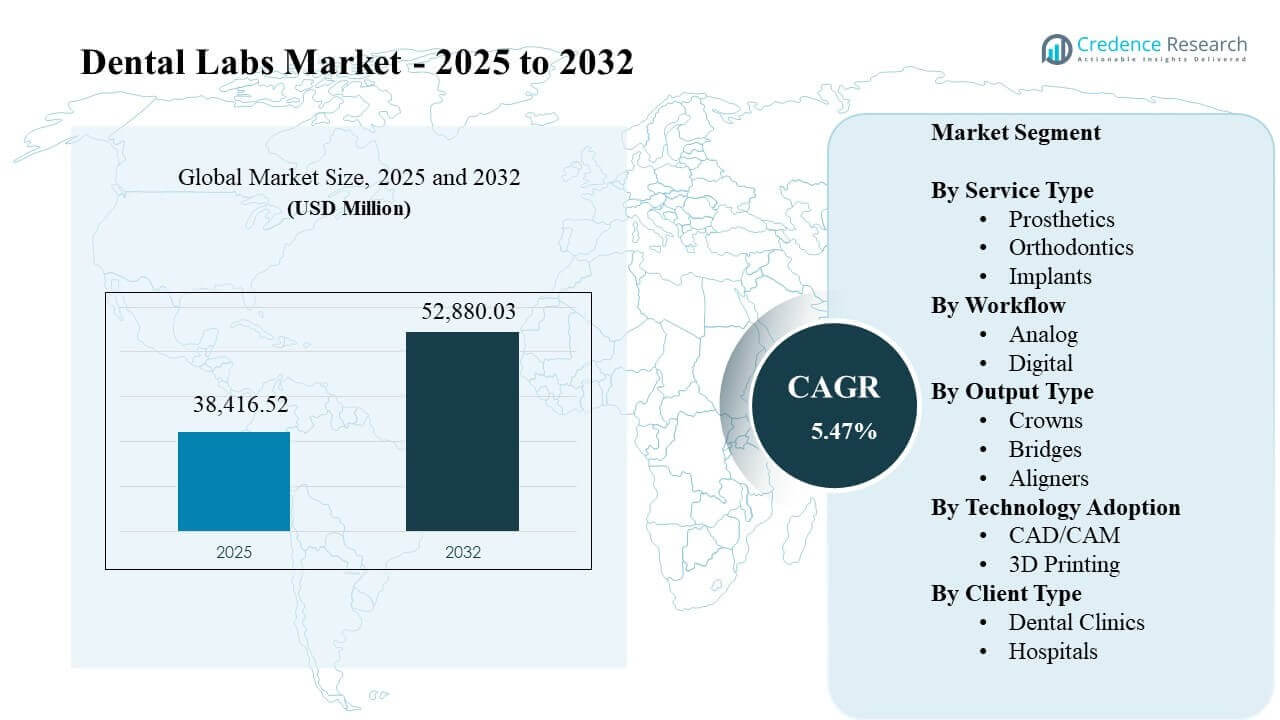
The global Dental Laboratories Market size was estimated at USD 38,416.52 million in 2025 and is expected to reach USD 52,880.03 million by 2032, growing at a CAGR of 5.47% from 2025 to 2032. Growth is anchored in rising restorative and esthetic procedure volumes that increase demand for lab-fabricated crowns, bridges, implant restorations, and orthodontic appliances. The Dental Laboratories Market is also benefiting from the rapid normalization of scan-to-design-to-manufacture workflows, which improves case turnaround time and quality consistency across high-volume clinic networks.
| REPORT ATTRIBUTE | DETAILS |
|---|---|
| Historical Period | 2020-2024 |
| Base Year | 2025 |
| Forecast Period | 2026-2032 |
| Dental Laboratories Market Size 2025 | USD 38,416.52 million |
| Dental Laboratories Market, CAGR | 5.47% |
| Dental Laboratories Market Size 2032 | USD 52,880.03 million |
Key Market Trends & Insights
- The Dental Laboratories Market is projected to expand at a CAGR of 5.47% from 2025 to 2032, supported by scaled outsourcing and workflow standardization across provider networks.
- Digital accounted for the largest share of 63.7% in 2025, reflecting increasing intraoral scan submissions and integrated case management between clinics and labs.
- Crowns represented 52.9% of 2025 output, sustained by routine restorative demand and high-throughput fabrication economics in core categories.
- CAD/CAM held 58.4% in 2025 as labs prioritized repeatable precision, higher utilization of milling platforms, and consistent fit outcomes across materials.
- North America led with a 36.8% share in 2025, supported by mature reimbursement environments, consolidated purchasing, and high adoption of digital dentistry.
Segment Analysis
The Dental Laboratories Market is shifting toward scalable digital production as clinics push for predictable turnaround times, standardized outcomes, and fewer remakes. Digital case intake improves design collaboration and reduces variability in impressions, supporting higher throughput in crowns, bridges, and implant restorations. The Dental Laboratories Market also benefits from growing demand for cosmetic dentistry and higher expectations for esthetics, which increases the use of ceramics and digitally designed restorations that require lab expertise.
Buyer behavior in the Dental Laboratories Market is increasingly shaped by service reliability, turnaround time, and the ability to support complete workflows from scan validation to delivery. Dental clinic groups tend to concentrate volumes with preferred labs that can offer consistent quality, traceability, and streamlined communication. Technology adoption is strengthening competitive differentiation, as CAD/CAM and 3D printing improve unit economics for standardized restorations and aligner-related production.
By Service Type Insights
Prosthetics accounted for the largest share of 46.2% in 2025. Prosthetics leads because crowns and bridges remain the baseline restorative workload for general dentistry and prosthodontics. The Dental Laboratories Market also sees prosthetics reinforced by materials progress in zirconia and high-strength ceramics that pairs well with standardized CAD workflows. Prosthetics demand is supported by repeat restorative cycles, predictable clinical protocols, and high-volume case routing from dental clinic networks.
By Workflow Insights
Digital accounted for the largest share of 63.7% in 2025. Digital leads because intraoral scanning reduces impression distortions and improves case consistency across locations and clinicians. Digital workflows enable faster approvals, clearer communication, and better tracking across production steps, improving delivery reliability. The Dental Laboratories Market benefits from digital integration because digitally mature labs can scale staffing efficiency and reduce remakes through standardized design libraries.
By Output Type Insights
Crowns accounted for the largest share of 52.9% in 2025. Crowns lead because single-unit restorations represent a high-frequency procedure across routine restorative care. Crown production aligns well with repeatable manufacturing methods, enabling labs to run efficient, high-utilization CAD/CAM pipelines. The Dental Laboratories Market also sees crowns supported by growing esthetic demand and a steady mix shift toward ceramic restorations that require consistent finishing and fit quality.
By Technology Adoption Insights
CAD/CAM accounted for the largest share of 58.4% in 2025. CAD/CAM leads because milling-based production delivers predictable precision and repeatability for crowns, bridges, and implant components. CAD/CAM workflows are widely embedded in lab operations through standardized nesting, tool paths, and quality checks that reduce variability. The Dental Laboratories Market benefits from CAD/CAM leadership because scaled labs can balance throughput, material utilization, and consistent delivery performance.
By Client Type Insights
Dental Clinics accounted for the largest share of 78.6% in 2025. Dental Clinics lead because the majority of restorative and esthetic procedures originate in outpatient settings that routinely outsource fabrication to labs. Dental clinic networks push protocol standardization and consolidate lab purchasing to improve unit economics and turnaround performance. The Dental Laboratories Market is strengthened by clinic demand because recurring case flow supports investment in automation, digital intake, and capacity expansion.
Dental Laboratories Market Drivers
Rising restorative and esthetic procedure volumes
The Dental Laboratories Market is supported by sustained restorative needs across aging populations and routine repair cycles for crowns, bridges, and implant restorations. Higher expectations for esthetics increase demand for ceramic materials and lab-grade finishing, which favors professional fabrication. Dental clinics are expanding services that rely on predictable restorative outcomes, reinforcing regular lab utilization. The Dental Laboratories Market benefits as labs operate as the production backbone for high-frequency restorative procedures.
- For instance, Ivoclar states that dental professionals have used IPS e.max for over 170 million restorations globally, while IPS e.max CAD offers 530 MPa flexural strength and IPS e.max Press offers 470 MPa flexural strength, reflecting the performance and esthetic standards increasingly associated with lab-fabricated restorations.
Digital dentistry adoption and scan-based case intake
The Dental Laboratories Market is being accelerated by broader adoption of intraoral scanners and digital case submission. Digital intake improves accuracy, reduces shipping friction, and enables faster case reviews and design approvals. Digital connectivity strengthens clinic-lab collaboration through iterative design, clear documentation, and traceable manufacturing. The Dental Laboratories Market gains momentum as digital workflows reduce remakes and support consistent results across multi-site dental organizations.
- For instance, Align Technology’s iTero Scan Report can be shared chairside through QR code and is available on the iTero Lumina and iTero Element 5D Plus platforms, while the related comprehensive service plan is included in the scanner purchase price for the first 12 months, supporting more structured digital intake and documentation workflows.
Scale effects from clinic consolidation and standardized procurement
The Dental Laboratories Market is supported by consolidation of dental clinics into larger groups that centralize procurement and standardize clinical protocols. Standardization increases predictable case volumes and favors labs that can meet defined turnaround times and quality metrics. Preferred-provider relationships raise switching costs and stabilize demand for labs with integrated workflows. The Dental Laboratories Market expands as scale-based purchasing supports sustained outsourcing and repeatable production pipelines.
Technology-driven productivity and quality consistency
The Dental Laboratories Market is strengthened by investments in CAD/CAM and 3D printing that increase throughput and reduce manual variability. Automation improves unit economics for standardized restorations, especially crowns and implant-supported components. Digitally enabled quality checks and repeatable processes reduce rework and improve delivery reliability. The Dental Laboratories Market grows as productivity gains allow labs to handle higher case volumes without proportional increases in labor intensity.
Dental Laboratories Market Challenges
The Dental Laboratories Market faces ongoing labor constraints tied to skilled dental technician availability and training throughput. Complex cases require specialized craftsmanship, and staffing gaps can pressure turnaround performance during demand spikes. Input cost volatility for ceramics, metals, and resins can compress margins when labs operate under contracted pricing or fixed fee schedules. The Dental Laboratories Market also contends with increasing compliance and quality documentation requirements that raise operational overhead.
The Dental Laboratories Market must manage competitive pricing pressure as scaled labs and clinic networks negotiate tighter rates and service-level commitments. Smaller labs can struggle to fund digital upgrades, maintain competitive turnaround times, and meet standardized quality expectations. Technology transitions can also create temporary inefficiencies from workflow reconfiguration, staff retraining, and equipment utilization learning curves. The Dental Laboratories Market remains exposed to remake risk when upstream clinical preparation or scanning quality is inconsistent.
- For instance, 3Shape reports that its E4 lab scanner delivers 4 microns of ISO 12836 accuracy, a 9-second full-arch scan speed, and a 45-second full-arch impression scan speed, while also citing a 20% scan-speed increase versus the previous E scanner generation, which illustrates how labs are investing in measurable digital performance gains to improve throughput and reduce precision-related remake risk.
Dental Laboratories Market Trends and Opportunities
The Dental Laboratories Market is seeing a stronger tilt toward end-to-end digital workflows that connect scanning, design, manufacturing, and delivery tracking. Integrated case management improves predictability and enables performance benchmarking for turnaround, remakes, and material utilization. Labs that combine digital intake validation with standardized design libraries can scale efficiently across high-volume clinic customers. The Dental Laboratories Market is positioned to benefit as digital maturity becomes a procurement requirement for many multi-site providers.
The Dental Laboratories Market is also gaining opportunity from expanding applications of 3D printing, particularly for aligner model production, surgical guides, and provisional components. Printing supports faster iteration and flexible production scheduling for customization-heavy categories. Technology-enabled specialization in implants, esthetics, and complex full-arch cases can differentiate labs and support premium service positioning. The Dental Laboratories Market can capture incremental value through integrated service bundles that include design support and workflow training for clinics.
- For instance, Carbon says its M2 produces about 100 solid aligner models in a 10-hour shift, its L1 delivers 800–1,000 models per day, and AO Stack boosts unattended output by up to 3x; in a Byrnes Dental Lab validation, the C6 Cassette cut print time from 1 hour 59 minutes to 1 hour 12 minutes and increased output by about 68%.
Regional Insights
North America
North America held a 36.8% share in 2025, supported by high adoption of digital dentistry and strong demand for restorative and cosmetic procedures. The Dental Laboratories Market in North America benefits from consolidated clinic networks that standardize lab partnerships and route repeat volumes through preferred providers. Technology investment levels remain high, enabling scaled CAD/CAM production and consistent quality systems. Service expectations emphasize turnaround reliability, traceability, and predictable fit outcomes.
Europe
Europe represented 28.9% in 2025, supported by broad access to restorative dentistry and steady utilization of prosthodontic procedures across major markets. The Dental Laboratories Market in Europe is shaped by a mix of cost discipline and quality emphasis that favors standardized workflows and efficient production. Digital adoption continues to expand, especially for ceramics-based restorations and implant-supported work. Lab differentiation is increasingly linked to precision manufacturing and consistent esthetic outcomes.
Asia Pacific
Asia Pacific reached 24.7% in 2025 as private dental chains expand and demand for esthetic dentistry rises in large urban centers. The Dental Laboratories Market in Asia Pacific is supported by increasing scan-based workflows and growing investment in digital production capacity, though average pricing remains lower than in mature markets. Distribution scale and training support influence adoption speed across diverse care settings. Capacity growth is concentrated around digitally mature hubs that can serve large clinic networks.
Latin America
Latin America accounted for 6.1% in 2025, supported by growth in private dentistry and increasing interest in cosmetic procedures in select markets. The Dental Laboratories Market in Latin America remains constrained by uneven access to advanced equipment and variability in clinical purchasing power. Labs that offer dependable turnaround and stable quality can win share with expanding private clinic groups. Digital transition is progressing but remains concentrated in higher-income corridors and destination cities.
Middle East & Africa
Middle East & Africa represented 3.5% in 2025, with demand concentrated in higher-income markets and premium restorative segments. The Dental Laboratories Market in the region benefits from modern clinic development and rising expectations for esthetic restorations in select geographies. Limited scale and uneven technician availability can restrict capacity growth outside major hubs. Partnerships with digitally capable labs and standardized workflows can improve service consistency for growing clinic networks.
Competitive Landscape
The Dental Laboratories Market is moderately consolidated, with scaled laboratory groups competing on turnaround performance, digital connectivity, and consistent quality systems. Competitive positioning is increasingly determined by technology depth, capacity utilization, and the ability to support multi-site clinic networks with standardized production. Differentiation is strongest in digital design capabilities, material expertise, and service reliability for high-volume crown and implant workflows. Strategic partnerships with scanner, implant, and materials ecosystems strengthen switching costs and improve case capture.
Aspen Dental Laboratories emphasizes scale-aligned service models designed to support standardized clinical protocols across distributed clinic footprints. The Dental Laboratories Market benefits when large lab operations align case intake, design standards, and production scheduling to reduce delivery variability. Aspen Dental Laboratories can strengthen positioning through integrated digital workflows that streamline communication, reduce remake rates, and improve turnaround time consistency. Service integration with clinic operations supports predictable volume routing and long-term customer retention.
The industry research and growth report includes detailed analyses of the competitive landscape of the market and information about key companies, including:
- Aspen Dental Laboratories
- Glidewell
- Modern Dental Group
- Straumann Group
- Dentsply Sirona Labs
- Ivoclar Services
- Argen
- 3Shape Labs
- Nobel Biocare Labs
- National Dentex
Qualitative and quantitative analysis of companies has been conducted to help clients understand the wider business environment as well as the strengths and weaknesses of key industry players. Data is qualitatively analyzed to categorize companies as pure play, category-focused, industry-focused, and diversified; it is quantitatively analyzed to categorize companies as dominant, leading, strong, tentative, and weak.
Recent Developments
- In March 2026, Standard Dental Laboratories Inc. announced a partnership with EMAC Capital LLC, which will provide strategic advisory support and introductions to potential funding sources to help advance Standard Dental Laboratories’ ongoing acquisition strategy in the dental laboratory sector.
- In February 2026, Standard Dental Laboratories announced the acquisition of BRLIT Laboratory, a Sarasota-based, third-generation dental lab known for crowns, bridges, implants, dentures, partials, and appliance repairs, strengthening the company’s Florida expansion plan.
- In December 2025, Dandy announced its acquisition of Neem, a dental practice management software company, to strengthen product development, user experience, and engineering capabilities and accelerate digital innovation across the chair-to-lab workflow.
- In June 2025, Catalis Dental Lab Partners announced the acquisition of Revolution Dental Lab in Sandy, Utah, and also launched a new East Coast Digital Design Center in Jacksonville, Florida, to expand capacity and improve service for customers across the U.S.
Report Scope
| Report Attribute | Details |
| Market size value in 2025 | USD 38,416.52 million |
| Revenue forecast in 2032 | USD 52,880.03 million |
| Growth rate (CAGR) | 5.47% (2025–2032) |
| Base year | 2025 |
| Forecast period | 2026-2032 |
| Quantitative units | USD million |
| Segments covered | By Service Type; By Workflow; By Output Type; By Technology Adoption; By Client Type |
| Regional scope | North America, Europe, Asia Pacific, Latin America, Middle East & Africa |
| Key companies profiled | Aspen Dental Laboratories; Glidewell; Modern Dental Group; Straumann Group; Dentsply Sirona Labs; Ivoclar Services; Argen; 3Shape Labs; Nobel Biocare Labs; National Dentex |
| No. of Pages | 326 |
Segmentation
By Service Type
- Prosthetics
- Orthodontics
- Implants
By Workflow
- Analog
- Digital
By Output Type
- Crowns
- Bridges
- Aligners
By Technology Adoption
- CAD/CAM
- 3D Printing
By Client Type
- Dental Clinics
- Hospitals
By Region
- North America
- U.S.
- Canada
- Mexico
- Europe
- Germany
- France
- U.K.
- Italy
- Spain
- Rest of Europe
- Asia Pacific
- China
- Japan
- India
- South Korea
- South-east Asia
- Rest of Asia Pacific
- Latin America
- Brazil
- Argentina
- Rest of Latin America
- Middle East & Africa
- GCC Countries
- South Africa
- Rest of the Middle East and Africa

Request a Free Sample
Fill in your details and we'll send you a free sample report.
- Sample data tables & charts
- Research methodology
Market Dynamics
Rising restorative and esthetic procedure volumes
Increasing demand for crowns, bridges, and implant restorations, driven by aging populations and higher esthetic expectations, is fueling the need for lab-fabricated dental solutions and supporting steady market growth.
Digital dentistry adoption and scan-based case intake
Widespread adoption of intraoral scanners and digital workflows is improving accuracy, reducing turnaround times, and enabling better collaboration between clinics and labs, which accelerates market expansion.
Scale effects from clinic consolidation and standardized procurement
The consolidation of dental clinics into larger groups is centralizing procurement and standardizing protocols, resulting in predictable case volumes and favoring labs that can deliver consistent quality and turnaround, thus expanding the market.
Technology-driven productivity and quality consistency
Investments in CAD/CAM and 3D printing technologies are enhancing throughput, reducing manual variability, and enabling labs to efficiently handle higher case volumes, which strengthens market growth and competitiveness.
Need a Custom Version of This Report?
Tailor the scope, geography, or segments to your exact requirements.
- Custom geography or segment scope
- Direct access to our analyst team
Frequently Asked Questions
What is the current size and forecast value of the Dental Laboratories Market?
What is the growth rate of the Dental Laboratories Market?
What is the largest segment in the Dental Laboratories Market?
What factors are driving growth in the Dental Laboratories Market?
Which companies are leading in the Dental Laboratories Market?
Which region leads the Dental Laboratories Market?
Table of Content
Chapter 1 Market Segmentation
- 1.1 Segmentation Framework
- 1.1.1 Product and Service Classification
- 1.1.2 Application and End-Use Classification
- 1.1.3 Technology and Solution Classification
- 1.1.4 Customer and Distribution Channel Classification
- 1.1.5 Geographic Segmentation
- 1.1.6 Market Segment Definitions and Boundaries
- 1.2 By Workflow
- 1.2.1 Analog
- 1.2.2 Digital
- 1.3 By Output Type
- 1.3.1 Crowns
- 1.3.2 Bridges
- 1.3.3 Aligners
- 1.4 By Service Type
- 1.4.1 Prosthetics
- 1.4.2 Orthodontics
- 1.4.3 Implants
- 1.5 By Technology Adoption
- 1.5.1 CAD/CAM
- 1.5.2 3D Printing
Chapter 2 Introduction
- 2.1 Report Objectives and Scope
- 2.2 Product Definition and Industry Terminology
- 2.3 Market Inclusions and Exclusions
- 2.4 Research Process
- 2.4.1 Primary Research and Expert Interviews
- 2.4.2 Secondary Research and Source Review
- 2.4.3 Top-Down and Bottom-Up Estimation
- 2.4.4 Data Triangulation and Verification
- 2.5 Market Size Measurement Basis
- 2.5.1 2025: USD 38,416.52 million → 2032: USD 52,880.03 million
- 2.6 Historical and Forecast Reference Periods
- 2.6.1 Base Year: 2025
- 2.6.2 Forecast Period: 2025-2032
- 2.7 Research Assumptions and Limitations
Chapter 3 Executive Summary
- 3.1 Market Snapshot and Key Findings
- 3.2 Base-Year Market Size, 2025
- 3.3 Forecast Market Size, 2032
- 3.4 Revenue and Volume Growth Outlook
- 3.5 Key Demand and Supply Indicators
- 3.6 Leading Market Segments
- 3.7 Fastest-Growing Market Opportunities
- 3.8 Regional Performance Highlights
- 3.9 Technology and Industry Transformation
- 3.10 Competitive Landscape Summary
- 3.11 Analyst View and Strategic Implications
Chapter 4 Global Dental Laboratories Market Trends and Developments
- 4.1 Historical Industry Development
- 4.2 Recent Market Trends and Developments
- 4.3 Demand and Customer Behavior Trends
- 4.4 Technology and Product Innovation
- 4.5 Artificial Intelligence, Automation and Digitalization
- 4.6 Local Manufacturing and Supply Chain Realignment
- 4.7 Industry Partnerships, Mergers and Acquisitions
- 4.8 Sustainability and Circular Economy Developments
- 4.9 Government and Private Sector Investment Trends
- 4.10 Emerging Business Models and Commercialization
- 4.11 Industry Developments and Announcements
Chapter 5 Global Dental Laboratories Market Production, Supply and Demand Analysis
- 5.1 Demand Trend and Consumption Analysis
- 5.2 Demand Forecast, 2025-2032
- 5.3 Production and Output Trend
- 5.4 Production and Output Forecast, 2025-2032
- 5.5 Installed Capacity and Capacity Utilization
- 5.6 Company-Wise Production Plants and Statistics
- 5.6.1 Installed Production Capacity
- 5.6.2 Actual Production
- 5.6.3 Planned Capacity and Expansion Targets
- 5.7 Supply Chain Structure and Procurement Trends
- 5.8 Supply-Demand Gap and Bottlenecks
- 5.9 Import Dependence and Sourcing Structure
- 5.10 Contract Manufacturing and Outsourcing
- 5.11 Regional Supply and Demand Concentration
Chapter 6 Global Dental Laboratories Market Pricing Analysis
- 6.1 Pricing Structure and Measurement
- 6.2 Historical Pricing Trends
- 6.3 Pricing Outlook, 2025-2032
- 6.4 Average Selling Price and Unit Economics
- 6.5 Pricing by Product and Market Segment
- 6.6 Geographic Pricing Differences
- 6.7 Key Input, Energy, Labor and Logistics Costs
- 6.8 Contract Pricing and Purchasing Models
- 6.9 Pricing Sensitivity and Competitive Positioning
- 6.10 Price, Margin and Profitability Implications
Chapter 7 Global Dental Laboratories Market Dynamics
- 7.1 Market Growth Drivers
- 7.1.1 Demand-Side Drivers
- 7.1.2 Technology and Innovation Drivers
- 7.1.3 Infrastructure and Investment Drivers
- 7.1.4 Regulatory and Policy Drivers
- 7.2 Market Restraints
- 7.2.1 Cost and Affordability Constraints
- 7.2.2 Technology and Adoption Barriers
- 7.2.3 Supply Chain and Operational Constraints
- 7.3 Market Challenges
- 7.3.1 Competitive Pressure and Margin Erosion
- 7.3.2 Skills, Infrastructure and Implementation Gaps
- 7.4 Emerging Market Opportunities
- 7.5 Market Dynamics Impact and Time-Horizon Assessment
Chapter 8 Global Dental Laboratories Value Chain Analysis
- 8.1 Industry Value Chain Overview
- 8.2 Upstream Suppliers and Critical Inputs
- 8.3 Technology and Component Providers
- 8.4 Manufacturing or Service Delivery
- 8.5 Distribution, Channel Partners and Integrators
- 8.6 Downstream Applications and End Users
- 8.7 Value Addition and Profit Pools
- 8.8 Vertical Integration and Outsourcing
- 8.9 Supplier Concentration and Risk
- 8.10 Supply Chain Localization and Resilience
Chapter 9 Global Dental Laboratories Market Regulations and Policies
- 9.1 Relevant Laws, Standards and Compliance Frameworks
- 9.2 Product, Service, Safety and Quality Requirements
- 9.3 Government Policies, Incentives and Subsidies
- 9.4 Imports, Exports and Trade Barriers
- 9.5 Public Procurement and Local Content Requirements
- 9.6 Environmental and Sustainability Compliance
- 9.7 Upcoming Policy Changes and Market Implications
Chapter 10 Global Dental Laboratories Market Hotspots and Opportunities
- 10.1 Market Opportunity Mapping and Growth Hotspots
- 10.2 High-Growth Applications and Customer Groups
- 10.3 Underserved Markets and White-Space Opportunities
- 10.4 Emerging Technology and Product Opportunities
- 10.5 New Capacity and Investment Hotspots
- 10.6 Market Entry and Expansion Opportunities
- 10.7 Distribution and Partnership Opportunities
- 10.8 Near-Term and Long-Term Commercial Potential
- 10.9 Opportunity Attractiveness and Execution Risks
Chapter 11 Global Dental Laboratories Market Outlook, 2025-2032
- 11.1 Market Size and Analysis
- 11.1.1 Revenue (Market Measurement: 2025: USD 38,416.52 million → 2032: USD 52,880.03 million)
- 11.1.2 Market Volume and Quantity Sold
- 11.1.3 Historical Market Size
- 11.1.4 Base-Year Market Size, 2025
- 11.2 Market Forecast, 2025-2032
- 11.2.1 Revenue Forecast to 2032
- 11.2.2 Volume Forecast to 2032
- 11.2.3 CAGR and Year-on-Year Growth
- 11.2.4 Incremental Revenue Opportunity
- 11.3 Forecast Assumptions and Scenario Analysis
- 11.3.1 Base-Case Forecast
- 11.3.2 Optimistic and Conservative Scenarios
- 11.3.3 Technology, Pricing and Policy Sensitivities
- 11.4 Market Attractiveness and Growth Outlook
Chapter 12 Global Dental Laboratories Market Segmentation and Outlook
- 12.1 Segmentation Summary and Market Shares, 2025
- 12.2 Largest and Fastest-Growing Segments
- 12.3 By Workflow - Market Size and Forecast, 2025-2032
- 12.3.1 Segment Definition and Scope
- 12.3.2 Historical Market Size
- 12.3.3 Revenue Forecast, 2025-2032
- 12.3.4 Volume Forecast, 2025-2032
- 12.3.5 Base-Year Market Share, 2025
- 12.3.6 Segment CAGR and Growth Drivers
- 12.3.7 Subsegment Market Size and Forecast
- 12.3.7.1 Analog
- 12.3.7.2 Digital
- 12.3.8 Subsegment Pricing and Adoption Trends
- 12.3.9 Leading Suppliers and Competition
- 12.3.10 Regional Demand and Opportunities
- 12.4 By Output Type - Market Size and Forecast, 2025-2032
- 12.4.1 Segment Definition and Scope
- 12.4.2 Historical Market Size
- 12.4.3 Revenue Forecast, 2025-2032
- 12.4.4 Volume Forecast, 2025-2032
- 12.4.5 Base-Year Market Share, 2025
- 12.4.6 Segment CAGR and Growth Drivers
- 12.4.7 Subsegment Market Size and Forecast
- 12.4.7.1 Crowns
- 12.4.7.2 Bridges
- 12.4.7.3 Aligners
- 12.4.8 Subsegment Pricing and Adoption Trends
- 12.4.9 Leading Suppliers and Competition
- 12.4.10 Regional Demand and Opportunities
- 12.5 By Service Type - Market Size and Forecast, 2025-2032
- 12.5.1 Segment Definition and Scope
- 12.5.2 Historical Market Size
- 12.5.3 Revenue Forecast, 2025-2032
- 12.5.4 Volume Forecast, 2025-2032
- 12.5.5 Base-Year Market Share, 2025
- 12.5.6 Segment CAGR and Growth Drivers
- 12.5.7 Subsegment Market Size and Forecast
- 12.5.7.1 Prosthetics
- 12.5.7.2 Orthodontics
- 12.5.7.3 Implants
- 12.5.8 Subsegment Pricing and Adoption Trends
- 12.5.9 Leading Suppliers and Competition
- 12.5.10 Regional Demand and Opportunities
- 12.6 By Technology Adoption - Market Size and Forecast, 2025-2032
- 12.6.1 Segment Definition and Scope
- 12.6.2 Historical Market Size
- 12.6.3 Revenue Forecast, 2025-2032
- 12.6.4 Volume Forecast, 2025-2032
- 12.6.5 Base-Year Market Share, 2025
- 12.6.6 Segment CAGR and Growth Drivers
- 12.6.7 Subsegment Market Size and Forecast
- 12.6.7.1 CAD/CAM
- 12.6.7.2 3D Printing
- 12.6.8 Subsegment Pricing and Adoption Trends
- 12.6.9 Leading Suppliers and Competition
- 12.6.10 Regional Demand and Opportunities
- 12.7 Segment Growth Comparison
- 12.8 Segment Attractiveness and Priority Matrix
Chapter 13 Global Dental Laboratories Geographic Market Outlook, 2025-2032
- 13.1 Regional Market Size and Share, 2025
- 13.2 Regional Market Forecast, 2025-2032
- 13.3 Regional Pricing, Production and Demand Differences
- 13.4 North America
- 13.4.1 United States
- 13.4.2 Canada
- 13.4.3 Mexico
- 13.5 Europe
- 13.5.1 Germany
- 13.5.2 France
- 13.5.3 Italy
- 13.5.4 United Kingdom
- 13.5.5 Spain
- 13.5.6 Poland
- 13.5.7 Russia
- 13.5.8 Netherlands
- 13.5.9 Belgium
- 13.5.10 Sweden
- 13.5.11 Denmark
- 13.5.12 Norway
- 13.5.13 Rest of Europe
- 13.6 Asia Pacific
- 13.6.1 China
- 13.6.2 India
- 13.6.3 Japan
- 13.6.4 South Korea
- 13.6.5 Thailand
- 13.6.6 Indonesia
- 13.6.7 Vietnam
- 13.6.8 Malaysia
- 13.6.9 Australia
- 13.6.10 Rest of Asia Pacific
- 13.7 Latin America
- 13.7.1 Brazil
- 13.7.2 Argentina
- 13.7.3 Colombia
- 13.7.4 Chile
- 13.7.5 Rest of Latin America
- 13.8 Middle East
- 13.8.1 Saudi Arabia
- 13.8.2 United Arab Emirates
- 13.8.3 Turkey
- 13.8.4 Israel
- 13.8.5 Iran
- 13.8.6 Rest of the Middle East
- 13.9 Africa
- 13.9.1 South Africa
- 13.9.2 Egypt
- 13.9.3 Nigeria
- 13.9.4 Morocco
- 13.9.5 Rest of Africa
- 13.10 Regional Investment, Policy and Supply Chain Differences
- 13.11 Regional Competitive Landscape
- 13.12 Geographic Growth Hotspots
Chapter 14 Global Dental Laboratories Technology, Innovation and Sustainability Outlook
- 14.1 Technology Landscape and Maturity
- 14.2 Product, Process and Service Innovation
- 14.3 AI, Automation and Digital Tools in the Industry
- 14.4 Technology Adoption and Performance Benchmarking
- 14.5 Innovation Pipeline and R&D Investment
- 14.6 Patent and Intellectual Property Trends
- 14.7 Energy Efficiency and Resource Management
- 14.8 Sustainability, Recycling and Circularity
- 14.9 Technology Roadmap, 2025-2032
- 14.10 Risks of Obsolescence and Technology Substitution
Chapter 15 Global Dental Laboratories Market Key Strategic Imperatives
- 15.1 Growth and Market Entry Priorities
- 15.2 High-Return Products and Segments
- 15.3 Pricing, Profitability and Cost Optimization
- 15.4 Technology Investment and Product Differentiation
- 15.5 Supply Chain Localization and Resilience
- 15.6 Distribution and Customer Acquisition
- 15.7 Partnership, Acquisition and Capacity Strategy
- 15.8 Regional Expansion Priorities
- 15.9 Short-, Medium- and Long-Term Actions
Chapter 16 Competition Outlook
- 16.1 Industry Competition Characteristics
- 16.2 Market Structure and Concentration
- 16.3 Market Share and Competitive Positioning, 2025
- 16.4 Company-Wise Revenue and Product Benchmarking
- 16.5 Production and Service Capacity Benchmarking
- 16.6 Technology, Pricing and Differentiation
- 16.7 Regional Footprint and Distribution Strength
- 16.8 Mergers, Acquisitions and Strategic Alliances
- 16.9 New Entrants and Competitive Threats
- 16.10 Porter's Five Forces and Industry Attractiveness
- 16.11 Competitive Outlook, 2025-2032
Chapter 17 Company Profiles
- 17.1 Company Coverage and Selection Criteria
- 17.2 Aspen Dental Laboratories
- 17.2.1 Business Description
- 17.2.2 Company Ownership and Geographic Presence
- 17.2.3 Product and Service Portfolio
- 17.2.4 Manufacturing and Operating Footprint
- 17.2.5 Production Capacity and Expansion Plans
- 17.2.6 Financial Performance and Investment
- 17.2.7 Market Share and Competitive Position
- 17.2.8 Technology and Innovation Capabilities
- 17.2.9 Strategic Alliances or Partnerships
- 17.2.10 Recent Developments
- 17.2.11 Growth Strategy and Outlook
- 17.3 Glidewell
- 17.4 Modern Dental Group
- 17.5 Straumann Group
- 17.6 Dentsply Sirona Labs
- 17.7 Ivoclar Services
- 17.8 Argen
- 17.9 3Shape Labs
- 17.10 Nobel Biocare Labs
- 17.11 National Dentex
- 17.12 Other Relevant Market Participants
Note: Every listed company is profiled on the structure shown under the first company. The company list is preliminary and may change based on research findings, market developments, data availability and client requirements.
Chapter 18 Disclaimer
- 18.1 Research and Forecast Disclaimer
- 18.2 Data Source and Estimation Limitations
Note: The depth of individual sections depends on data availability for this market. Volume, capacity, trade and other unit-based metrics are included where applicable.