Market Insights
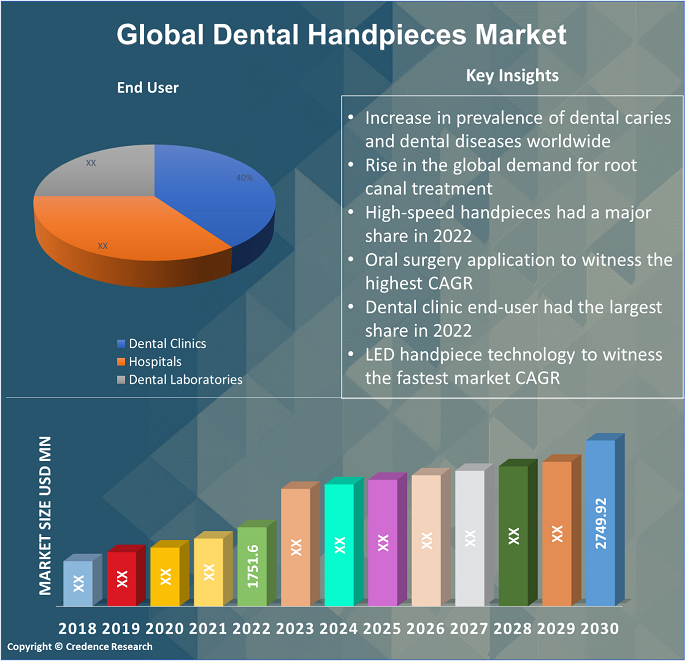
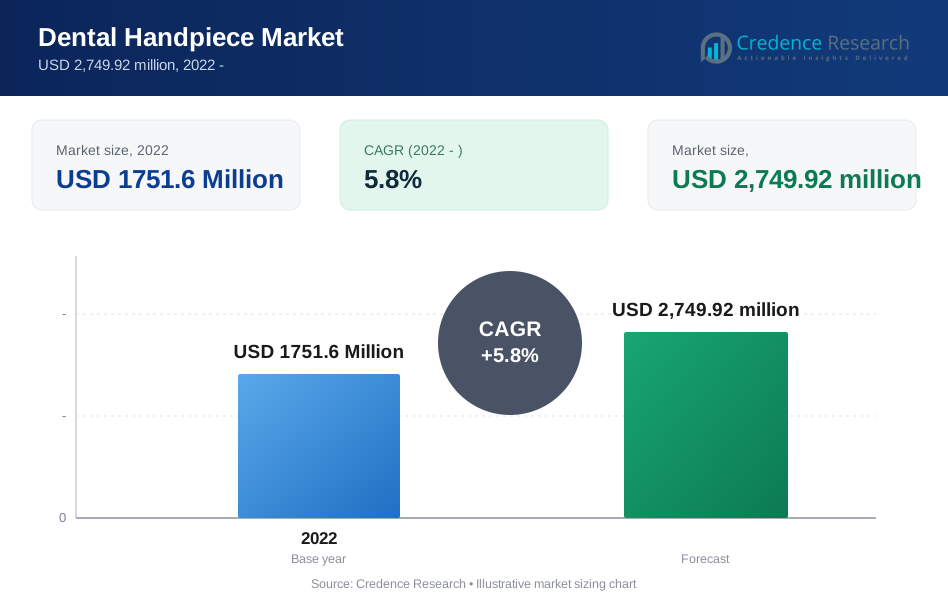
- The global demand for dental handpieces was valued at USD 1751.6 Million in 2022 and is expected to reach USD 2749.92 Million in 2030, growing at a CAGR of 5.8% between 2023 and 2030.
- The high-speed handpieces segment is the market leader by the type of handpiece, accounting for more than 30% of total value in 2022, while the surgical handpieces segment is expected to grow rapidly throughout the projection period.
- The dental clinic end-user segment dominates the global need for dental handpieces, accounting for more than 40% in 2022 and is predicted to expand at a high CAGR.
- The restorative dentistry category dominated the market with 28% of the total revenue share by application segment. In contrast, the oral surgery category will expand fastest over the projected period.
- The cordless handpiece operation mode category will likely continue to lead the global demand for dental handpieces, with a market share of over 55% in 2022 and estimates of high CAGR growth.
- The LED handpiece technology category is expected to expand quickly over the forecast period, while the fiber-optic handpieces segment has the largest market share in 2022.
- The dental supply distributors category dominated the market with 44% of the total revenue share by the distribution channels segment.
- With a significant market share of over 45% in 2022 and projections of high CAGR growth, the budget-friendly handpieces category will likely continue to dominate the need for dental handpieces globally.
- North America is fueling the growth of the dental handpieces industry with over one-third share in 2022, while Asia Pacific and Europe collectively account for just under 54% share in 2022. Europe held over 22% share in 2022.
- The key drivers of the dental handpiece market are increased dental disease occurrences and demand for cosmetic dentistry.
- The market's potential is to improve existing equipment by introducing new technical improvements to improve dental surgical operations and allow for more effective and efficient treatment.
Executive Summary
Market Definition
The dental handpiece market refers to the segment of the medical device sector that involves the manufacturing, distribution, and sale of hand-held mechanical instruments used by dental professionals during various dental procedures. Dental handpieces are precision tools designed to perform tasks such as cutting, polishing, drilling, and shaping dental materials, including teeth and restorative materials. Air-driven mechanisms, electric motors, or a combination can power these handpieces. The market encompasses a range of products, including high-speed and low-speed handpieces, surgical handpieces, and hygiene handpieces.
Market Overview
The global dental handpiece market has witnessed rapid growth in recent years and is anticipated to grow at a CAGR of 5.8% between 2023 and 2030. The market was valued at USD 1751.6 million in 2022 and is expected to reach USD 2749.92 million in 2030.
The global rise in the prevalence of oral issues will likely be a major driver of the dental handpiece market growth throughout the projected period. Moreover, the trend is transitioning from traditional to modern dental services. Traditional dental services are being surpassed by modern dental care services like cosmetic and laser dentistry, which are not viable without dental handpieces. Dental handpieces are becoming more popular among oral health specialists and practitioners. As per the Ontario Academy of General Dentistry, the overall global dental visits will rise from 294 million in 2017 to 319 million in 2040. The increased number of dental appointments demonstrates people's importance and awareness of dental health. This is projected to open up major prospects in the dental handpiece industry in the coming years.
However, the higher initial cost of some modern dental handpieces is a major market limitation. These handpieces will become more affordable in the upcoming years as technology advances.
Segmentation by Type of Handpiece
- The high-speed handpieces remain the leading segment by the type of handpiece, holding over 30% share in value in 2022.
- The surgical handpieces segment is expected to exhibit a significant CAGR in the forecast period, indicating potential growth. Surgical handpieces are increasingly utilized for precision and control procedures, contributing to their rising demand.
- Electric handpieces contribute to the market but hold a smaller share than other segments. These advanced handpieces offer enhanced control and efficiency, although their adoption rate gradually increases.
Segmentation by Application
- The restorative dentistry segment continues to dominate the demand for dental handpieces globally, with a substantial share of over 28% in 2022. The significance of these procedures ensures sustained demand for precision tools like dental handpieces.
- The oral surgery application category significantly contributes to the demand for dental handpieces. The requirement for specialized tools in surgical settings underscores the importance of this segment in the dental handpieces market.
Segmentation by End-User
- Dental clinics remain the primary drivers of demand for dental handpieces, accounting for more than 40% in 2022, owing to the high frequency of dental procedures performed in these settings.
- Hospitals also contribute to the demand for dental handpieces, catering to dental procedures within hospital facilities. Although their share is smaller than dental clinics, hospitals are crucial in addressing more complex dental cases.
Segmentation by Operation Mode
- Anticipated to register the highest CAGR during the projection period, corded handpieces demonstrate adaptability across various dental procedures. Their consistent power supply and reliability enhance their attractiveness.
- Cordless handpieces are leading with almost 55% market share in 2022, reflecting the market's preference for mobility and convenience. The freedom of movement they provide resonates well with modern dental practices.
Segmentation by Technology
- Dominating the global dental handpieces market with over 42% share in 2022, fiber-optic handpieces set the benchmark for advanced technology. Their superior illumination and precision make them a preferred choice among dental professionals, promising high growth potential.
- Serving a substantial portion of the demand, traditional and LED handpieces cater to a diverse audience. While fiber-optic handpieces lead, these segments contribute to meeting varied dental requirements.
Segmentation by Distribution Channels
- Leading the distribution channels, the dental supply distributors category captured a 44% share in 2022. These distributors play a pivotal role in bridging the gap between manufacturers and end-users, facilitating the availability of dental handpieces.
- The direct sales segment is poised for rapid growth during the forecast period. This channel enables manufacturers to establish a direct relationship with dental professionals, ensuring customized solutions and efficient service.
Segmentation by Price Range
- Dominating the market with over 45% of the global demand for dental handpieces in 2022, budget-friendly handpieces cater to a wide range of dental practices. Their affordability and functional reliability position them as a staple choice.
- Serving as an alternative, mid-range handpieces address varying preferences within the market. The balance between features and cost makes them viable for dental professionals seeking quality tools.
Segmentation by Region
- North America continues to fuel the growth of the dental handpiece industry, holding over one-third of its share in 2022, driven by a combination of advanced dental practices, high healthcare spending, and technological innovations in the region.
- Asia Pacific and Europe collectively account for just under 54% share in 2022. Europe, with its over 22% share, reflects a mature market with established dental practices and a strong emphasis on oral healthcare.
- The rest of the world, including Latin America, the Middle East, and Africa, contributes to the remaining demand for dental handpieces, benefiting from increasing awareness about oral health and dental care across these regions.
The global dental handpiece market is growing rapidly due to the incidence of dental caries and dental illnesses, a rise in the demand for root canal treatment, and an increase in geriatric populations.
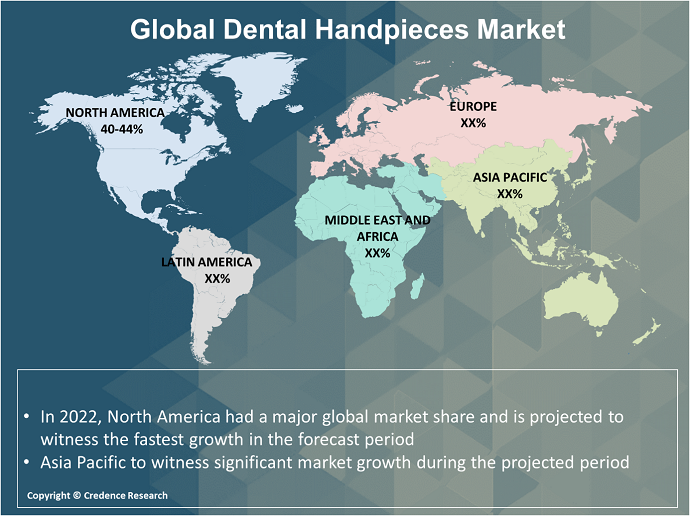
In 2022, North America dominated the global dental handpieces market. This is due to a growing senior population, a solid medical infrastructure, well-established reimbursement regulations, the presence of important players, and advancements in preventative and restorative dental treatments. Moreover, as per the American Dental Association, 85% of Americans prioritize dental health and regard oral health as an important component of total health care. These factors will make North America the most promising regional market throughout the projection period.
The Asia Pacific is estimated to be the fastest-growing region over the estimated period. China, Japan, and India are growing economies with well-developed medical infrastructure and facilities increasingly focused on leading through R&D efforts. Attributes such as favorable government policies, an increasing senior population, the presence of major players, and increased demand for dental procedures are paving the way for market expansion in the Asia Pacific region. Besides, medical tourism in the region is rapidly growing owing to shorter patient wait times, low-cost treatment, the availability of a big pool of experienced dental practitioners and cutting-edge equipment, and tourist spots and quality hotels.
Dental handpieces are instruments used in root canal procedures. The increased prevalence of dental disorders, such as tooth decay, gum disease, dental cracks, and dental cavities, raises the demand for dental handpieces to fill gaps between root canal walls. This is expected to propel the global dental handpiece market forward.
According to the AAE (American Association of Endodontists), in 2021, around 25 million root canals were performed annually, with over 41,000 root canals performed daily in the United States. As per the same source, general dentists do around 72% of root canal treatments, whereas endodontists perform approximately 28% of root canal procedures. As a result, the frequency of root canal surgeries is increasing worldwide, driving up demand for dental handpieces.
Key Highlights of the Report
The global dental handpiece market is segmented by the type of handpiece, application, end-user, operation mode, technology, distribution channels, price range, and region. Electric handpieces are gaining prominence within dental practices, driven by their precision and enhanced efficiency. Across applications, restorative dentistry maintains its prominence, while oral surgery applications contribute notably. Dental clinics and hospitals remain the primary users of dental handpieces, catering to various dental procedures. Corded handpieces project a promising future, driven by their operational versatility, while cordless handpieces lead with mobility and convenience.
The global dental handpiece market is propelled by the continual advancement of dental procedures and materials and the expanding demand for aesthetic dentistry and cosmetic procedures. Technological innovations are driving the adoption of electric and hybrid handpieces, offering enhanced precision and control. The growth of dental tourism in emerging economies further fuels market expansion. In addition, the trend toward patient-centric care and integrating smart features into dental handpieces present opportunities for enhanced clinical outcomes and improved patient experiences.
Nonetheless, North America is expected to maintain a significant share of the global dental handpiece market due to ongoing technological advancements in dental handpiece technology and the region's well-established healthcare infrastructure. Moreover, the Asia-Pacific region is anticipated to experience the highest market growth rate. This growth is attributed to the presence of numerous electronics manufacturing firms, promoting a culture of innovation and propelling the demand for efficient dental handpieces.
What Are The Main Drivers Of The Global Dental Handpieces Market?
The global dental handpieces market is primarily driven by factors such as the emerging prevalence of oral diseases, a growing aging population leading to higher demand for dental procedures, advancements in dental technology enhancing handpiece precision and functionality, rising dental tourism in emerging economies, expansion of dental clinics and practices, and a shift towards electric handpieces due to improved control and precision. Additionally, the ongoing emphasis on oral health and aesthetic dentistry, coupled with innovations in dental materials and procedures, contributes to the market's sustained growth.
What Are The Major Challenges Faced By The Global Dental Handpieces Market?
The major challenges in the global dental handpiece market include navigating stringent regulatory requirements, coping with competitive pressures affecting pricing and innovation, and adapting to the shift from traditional to advanced technologies while ensuring infection control measures. Economic uncertainties, resistance to technology transitions, and potential disruptions due to global health events further contribute to the market's complexity.
What Are The Growth Opportunities In The Global Dental Handpieces Market?
The growth opportunities in the global dental handpiece market lie in leveraging advancements in precision engineering and technology to develop innovative electric and hybrid handpieces that enhance procedural accuracy and patient comfort. Capitalizing on the rising demand for cosmetic dentistry and orthodontic procedures offers a chance to expand market reach. Moreover, targeting emerging economies with expanding dental care infrastructure and investing in value-added services like maintenance and training further drive growth in this evolving market.
Growing Demand for Dental Procedures and Aesthetic Dentistry
The primary drivers for the market include an aging population, an increase in the frequency of dental disorders, an increase in demand for aesthetic dentistry, and the development of dental products. According to a March 2022 update from the World Health Organisation (WHO), oral disorders impact approximately 3.5 billion people globally, and severe periodontal (gum) disease, which can lead to tooth loss, is also frequent, affecting about 10% of the global population. The increasing demand for dental procedures, ranging from routine check-ups to complex restorative and cosmetic treatments, drives the need for dental handpieces.
Aesthetic dentistry, in particular, has gained prominence as patients seek solutions for teeth whitening, veneers, and orthodontic treatments. The desire for improved oral aesthetics and the rising awareness of oral health contribute to the growing number of dental visits and procedures, ultimately boosting the demand for dental handpieces that enable accurate and efficient treatment delivery.
High Initial Investment Costs
Adopting advanced dental handpiece technologies, such as electric or hybrid models, often involves higher upfront costs for dental professionals and clinics. This can pose a significant barrier, particularly for smaller practices with limited budgets. The initial investment required for new equipment, training, and potential workflow adjustments can deter some practitioners from transitioning to more advanced handpieces, impacting the adoption rate and market growth.
Integration of Digital Dentistry and Connectivity
Integrating digital dentistry technologies, such as intraoral scanners, CAD/CAM systems, and 3D imaging, offers a significant opportunity for dental handpiece manufacturers. Handpieces with connectivity features can seamlessly interact with digital systems, enabling real-time data sharing, precise treatment planning, and improved patient records management. This integration enhances the dental workflow, enabling more efficient and accurate procedures while advancing digital dentistry practices. The increased need for prosthodontics is also driving up demand for dental radiology equipment such as cone beam computed tomography (CBCT), recognized as a unique imaging solution for a prosthodontist's diverse treatment demands.
Major market players are also developing unique and technologically improved CBCTs. For example, Carestream Dental released CBCT imaging with the Neo Edition of the CS 8200 3D Family in April 2022. The Neo Edition is an upgrade of the CS 8200 3D and optional Scan CEPH module that increases usability, adds to a better clinical experience, and results in better patient outcomes.
Competitive Landscape
Key Players
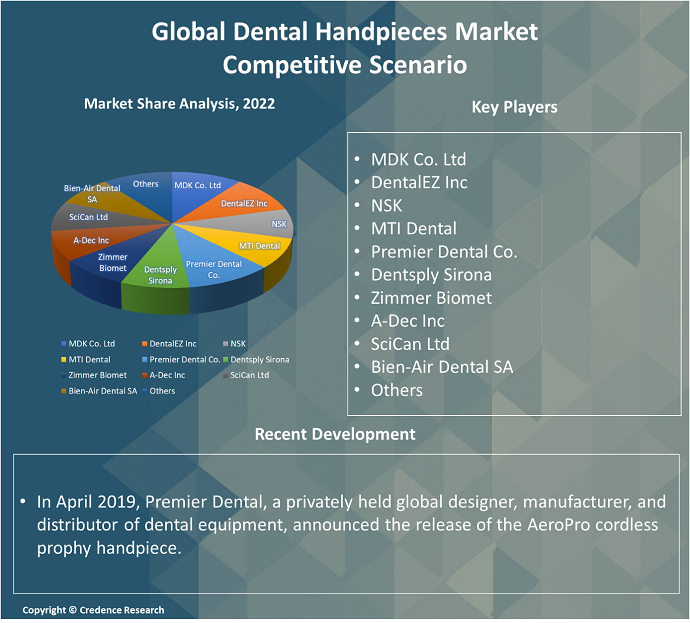
The global dental handpiece market is highly competitive, with several key players. Some of the major players in the market and their market share are as follows:
- MDK Co. Ltd
- DentalEZ Inc
- NSK
- MTI Dental
- Premier Dental Co.
- Dentsply Sirona
- Zimmer Biomet
- A-Dec Inc
- SciCan Ltd
- Bien-Air Dental SA
These key players leverage their extensive distribution networks, research and development capabilities, and strategic partnerships to maintain a competitive edge. Leading manufacturers in the industry offer a diverse range of air-driven, electric, and hybrid handpieces, often focusing on innovation, precision, and ergonomic design.
As technological advancements continue to shape the market, companies are investing in digital integration, infection control solutions, and customer-centric services to cater to the evolving needs of dental professionals and patients worldwide.
In June 2022, Ivoclar introduced the new VivaScan for dentists. It is a simple and portable intraoral scanning solution. The device's stand-alone design makes it easy to incorporate into routine practice tasks, offering remarkable scanning results and enabling a more efficient workflow.
In January 2021, Dentsply Sirona purchased Byte, a teledentistry firm, to expand its digital dentistry products and provide access to orthodontic care.
Summary of Key Findings
- The global dental handpiece market is witnessing a surge in demand for high-precision instruments driven by the need for precise dental procedures. Factors such as the growing popularity of aesthetic dentistry and the expanding aging population are propelling the market's growth.
- Market segmented by type of handpiece, application, end-user, operation mode, technology, distribution channels, price range, and region.
- Electric handpieces are gaining preference in dental practices due to their precision and enhanced efficiency. This trend is fueled by the rising demand for accurate and comfortable dental procedures, influencing the adoption of innovative technologies.
- Restorative dentistry applications continue to dominate the global demand for dental handpieces.
- Dental clinics and hospitals primarily use dental handpieces, catering to various dental procedures. This diverse user base underscores the broad applicability of the market, presenting growth opportunities.
- Direct sales are expected to grow rapidly, establishing direct manufacturer-professional relationships.
- Budget-friendly handpieces are the preferred choice for a substantial market share.
- High initial costs and resistance to technology transition hinder wider dental handpiece adoption.
Future Outlook
- North America is at the forefront of driving dental handpiece market growth, with established dental practices and high healthcare spending.
- Integration with digital dentistry, including CAD/CAM systems and intraoral scanners, is projected to rise, streamlining treatment planning and enhancing patient outcomes.
- Patient preferences for minimally invasive procedures and aesthetic treatments will shape the demand for specialized dental handpieces designed for these evolving trends.
- The market will likely witness more collaborations between dental equipment manufacturers and dental clinics, fostering innovation and tailored solutions.
Segmentation
- By Type of Handpiece
- High-speed Handpieces
- Low-speed Handpieces
- Electric Handpieces
- Air-Driven Handpieces
- Surgical Handpieces
- By Application
- Restorative Dentistry
- Endodontics
- Prosthodontics
- Orthodontics
- Periodontics
- Oral Surgery
- By End User
- Dental Clinics
- Hospitals
- Dental Laboratories
- By Operation Mode
- Corded Handpieces
- Cordless Handpieces
- By Technology
- Traditional Handpieces
- Fiber-Optic Handpieces
- LED Handpieces
- By Distribution Channels
- Dental Supply Distributors
- Online Retailers
- Direct Sales
- By Price Range
- Premium Handpieces
- Mid-Range Handpieces
- Budget-Friendly Handpieces
- By Region
- North America
- U.S.
- Canada
- Mexico
- Europe
- Germany
- France
- U.K.
- Italy
- Spain
- Rest of Europe
- Asia Pacific
- China
- Japan
- India
- South Korea
- South-east Asia
- Rest of Asia Pacific
- Latin America
- Brazil
- Argentina
- Rest of Latin America
- Middle East & Africa
- GCC Countries
- South Africa
- Rest of the Middle East and Africa
- North America
Adjacent Markets
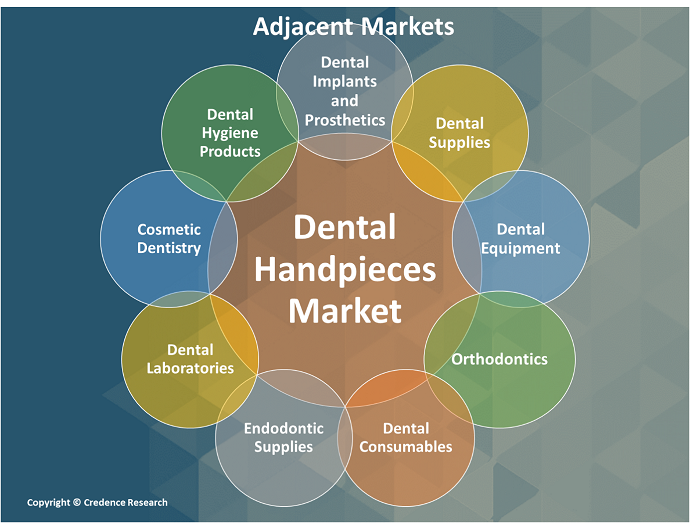
Several adjacent markets have high revenue growth opportunities in the dental handpieces market. The key adjacent markets for dental handpieces market -
Request a Free Sample
Fill in your details and we'll send you a free sample report.
- Sample data tables & charts
- Research methodology
Market Dynamics
Rising Prevalence of Oral Diseases
The increasing incidence of dental caries, periodontal disease, and other oral health issues globally is driving the demand for dental handpieces, as more dental procedures are required for treatment and restoration.
Growth in Cosmetic and Aesthetic Dentistry
The surge in demand for cosmetic dental procedures such as teeth whitening, veneers, and orthodontics is fueling the need for advanced dental handpieces that enable precise and efficient treatments.
Technological Advancements in Handpiece Design
Innovations such as fiber-optic illumination, cordless operation, and integration with digital dentistry systems are making dental handpieces more efficient, user-friendly, and attractive to dental professionals.
Expansion of Dental Clinics and Dental Tourism
The proliferation of dental clinics, especially in emerging markets, and the rise of dental tourism due to affordable and high-quality care are increasing the global demand for dental handpieces.
Aging Population and Increased Dental Visits
An expanding elderly population, who are more prone to dental issues, combined with a general rise in dental awareness and frequency of dental visits, is boosting the need for dental handpieces worldwide.
Need a Custom Version of This Report?
Tailor the scope, geography, or segments to your exact requirements.
- Custom geography or segment scope
- Direct access to our analyst team
Frequently Asked Questions
What is the current size of the global dental handpiece market?
What is the expected growth rate of the dental handpiece market between 2023 and 2030?
Which segment is leading the market share in terms of type of handpiece?
Which end-user segment governs the demand for dental handpieces in the world?
Which technology segment is expected to post the highest CAGR during the forecast period?
Which region is fueling the growth of the dental handpiece industry?
Who are the major players in the global dental handpiece market?
What are the major market drivers of the dental handpiece industry?
What are the major market restraints of the dental handpiece industry?
What are the major market opportunities of the dental handpiece industry?
Table of Content
Chapter 1 Market Segmentation
- 1.1 Segmentation Framework
- 1.1.1 Product and Service Classification
- 1.1.2 Application and End-Use Classification
- 1.1.3 Technology and Solution Classification
- 1.1.4 Customer and Distribution Channel Classification
- 1.1.5 Geographic Segmentation
- 1.1.6 Market Segment Definitions and Boundaries
- 1.2 By Technology
- 1.2.1 Traditional Handpieces
- 1.2.2 Fiber-Optic Handpieces
- 1.2.3 LED Handpieces
- 1.3 By Application
- 1.3.1 Restorative Dentistry
- 1.3.2 Endodontics
- 1.3.3 Prosthodontics
- 1.3.4 Orthodontics
- 1.3.5 Periodontics
- 1.3.6 Oral Surgery
- 1.4 By Operation Mode
- 1.4.1 Corded Handpieces
- 1.4.2 Cordless Handpieces
- 1.5 By Type of Handpiece
- 1.5.1 High-speed Handpieces
- 1.5.2 Low-speed Handpieces
- 1.5.3 Electric Handpieces
- 1.5.4 Air-Driven Handpieces
- 1.5.5 Surgical Handpieces
Chapter 2 Introduction
- 2.1 Report Objectives and Scope
- 2.2 Product Definition and Industry Terminology
- 2.3 Market Inclusions and Exclusions
- 2.4 Research Process
- 2.4.1 Primary Research and Expert Interviews
- 2.4.2 Secondary Research and Source Review
- 2.4.3 Top-Down and Bottom-Up Estimation
- 2.4.4 Data Triangulation and Verification
- 2.5 Market Size Measurement Basis
- 2.5.1 2022: USD 1751.6 Million → 2030: USD 2,749.92 million
- 2.6 Historical and Forecast Reference Periods
- 2.6.1 Base Year: 2022
- 2.6.2 Forecast Period: 2022-2030
- 2.7 Research Assumptions and Limitations
Chapter 3 Executive Summary
- 3.1 Market Snapshot and Key Findings
- 3.2 Base-Year Market Size, 2022
- 3.3 Forecast Market Size, 2030
- 3.4 Revenue and Volume Growth Outlook
- 3.5 Key Demand and Supply Indicators
- 3.6 Leading Market Segments
- 3.7 Fastest-Growing Market Opportunities
- 3.8 Regional Performance Highlights
- 3.9 Technology and Industry Transformation
- 3.10 Competitive Landscape Summary
- 3.11 Analyst View and Strategic Implications
Chapter 4 Global Dental Handpiece Market Trends and Developments
- 4.1 Historical Industry Development
- 4.2 Recent Market Trends and Developments
- 4.3 Demand and Customer Behavior Trends
- 4.4 Technology and Product Innovation
- 4.5 Artificial Intelligence, Automation and Digitalization
- 4.6 Local Manufacturing and Supply Chain Realignment
- 4.7 Industry Partnerships, Mergers and Acquisitions
- 4.8 Sustainability and Circular Economy Developments
- 4.9 Government and Private Sector Investment Trends
- 4.10 Emerging Business Models and Commercialization
- 4.11 Industry Developments and Announcements
Chapter 5 Global Dental Handpiece Market Production, Supply and Demand Analysis
- 5.1 Demand Trend and Consumption Analysis
- 5.2 Demand Forecast, 2022-2030
- 5.3 Production and Output Trend
- 5.4 Production and Output Forecast, 2022-2030
- 5.5 Installed Capacity and Capacity Utilization
- 5.6 Company-Wise Production Plants and Statistics
- 5.6.1 Installed Production Capacity
- 5.6.2 Actual Production
- 5.6.3 Planned Capacity and Expansion Targets
- 5.7 Supply Chain Structure and Procurement Trends
- 5.8 Supply-Demand Gap and Bottlenecks
- 5.9 Import Dependence and Sourcing Structure
- 5.10 Contract Manufacturing and Outsourcing
- 5.11 Regional Supply and Demand Concentration
Chapter 6 Global Dental Handpiece Market Pricing Analysis
- 6.1 Pricing Structure and Measurement
- 6.2 Historical Pricing Trends
- 6.3 Pricing Outlook, 2022-2030
- 6.4 Average Selling Price and Unit Economics
- 6.5 Pricing by Product and Market Segment
- 6.6 Geographic Pricing Differences
- 6.7 Key Input, Energy, Labor and Logistics Costs
- 6.8 Contract Pricing and Purchasing Models
- 6.9 Pricing Sensitivity and Competitive Positioning
- 6.10 Price, Margin and Profitability Implications
Chapter 7 Global Dental Handpiece Market Dynamics
- 7.1 Market Growth Drivers
- 7.1.1 Demand-Side Drivers
- 7.1.2 Technology and Innovation Drivers
- 7.1.3 Infrastructure and Investment Drivers
- 7.1.4 Regulatory and Policy Drivers
- 7.2 Market Restraints
- 7.2.1 Cost and Affordability Constraints
- 7.2.2 Technology and Adoption Barriers
- 7.2.3 Supply Chain and Operational Constraints
- 7.3 Market Challenges
- 7.3.1 Competitive Pressure and Margin Erosion
- 7.3.2 Skills, Infrastructure and Implementation Gaps
- 7.4 Emerging Market Opportunities
- 7.5 Market Dynamics Impact and Time-Horizon Assessment
Chapter 8 Global Dental Handpiece Value Chain Analysis
- 8.1 Industry Value Chain Overview
- 8.2 Upstream Suppliers and Critical Inputs
- 8.3 Technology and Component Providers
- 8.4 Manufacturing or Service Delivery
- 8.5 Distribution, Channel Partners and Integrators
- 8.6 Downstream Applications and End Users
- 8.7 Value Addition and Profit Pools
- 8.8 Vertical Integration and Outsourcing
- 8.9 Supplier Concentration and Risk
- 8.10 Supply Chain Localization and Resilience
Chapter 9 Global Dental Handpiece Market Regulations and Policies
- 9.1 Relevant Laws, Standards and Compliance Frameworks
- 9.2 Product, Service, Safety and Quality Requirements
- 9.3 Government Policies, Incentives and Subsidies
- 9.4 Imports, Exports and Trade Barriers
- 9.5 Public Procurement and Local Content Requirements
- 9.6 Environmental and Sustainability Compliance
- 9.7 Upcoming Policy Changes and Market Implications
Chapter 10 Global Dental Handpiece Market Hotspots and Opportunities
- 10.1 Market Opportunity Mapping and Growth Hotspots
- 10.2 High-Growth Applications and Customer Groups
- 10.3 Underserved Markets and White-Space Opportunities
- 10.4 Emerging Technology and Product Opportunities
- 10.5 New Capacity and Investment Hotspots
- 10.6 Market Entry and Expansion Opportunities
- 10.7 Distribution and Partnership Opportunities
- 10.8 Near-Term and Long-Term Commercial Potential
- 10.9 Opportunity Attractiveness and Execution Risks
Chapter 11 Global Dental Handpiece Market Outlook, 2022-2030
- 11.1 Market Size and Analysis
- 11.1.1 Revenue (Market Measurement: 2022: USD 1751.6 Million → 2030: USD 2,749.92 million)
- 11.1.2 Market Volume and Quantity Sold
- 11.1.3 Historical Market Size
- 11.1.4 Base-Year Market Size, 2022
- 11.2 Market Forecast, 2022-2030
- 11.2.1 Revenue Forecast to 2030
- 11.2.2 Volume Forecast to 2030
- 11.2.3 CAGR and Year-on-Year Growth
- 11.2.4 Incremental Revenue Opportunity
- 11.3 Forecast Assumptions and Scenario Analysis
- 11.3.1 Base-Case Forecast
- 11.3.2 Optimistic and Conservative Scenarios
- 11.3.3 Technology, Pricing and Policy Sensitivities
- 11.4 Market Attractiveness and Growth Outlook
Chapter 12 Global Dental Handpiece Market Segmentation and Outlook
- 12.1 Segmentation Summary and Market Shares, 2022
- 12.2 Largest and Fastest-Growing Segments
- 12.3 By Technology - Market Size and Forecast, 2022-2030
- 12.3.1 Segment Definition and Scope
- 12.3.2 Historical Market Size
- 12.3.3 Revenue Forecast, 2022-2030
- 12.3.4 Volume Forecast, 2022-2030
- 12.3.5 Base-Year Market Share, 2022
- 12.3.6 Segment CAGR and Growth Drivers
- 12.3.7 Subsegment Market Size and Forecast
- 12.3.7.1 Traditional Handpieces
- 12.3.7.2 Fiber-Optic Handpieces
- 12.3.7.3 LED Handpieces
- 12.3.8 Subsegment Pricing and Adoption Trends
- 12.3.9 Leading Suppliers and Competition
- 12.3.10 Regional Demand and Opportunities
- 12.4 By Application - Market Size and Forecast, 2022-2030
- 12.4.1 Segment Definition and Scope
- 12.4.2 Historical Market Size
- 12.4.3 Revenue Forecast, 2022-2030
- 12.4.4 Volume Forecast, 2022-2030
- 12.4.5 Base-Year Market Share, 2022
- 12.4.6 Segment CAGR and Growth Drivers
- 12.4.7 Subsegment Market Size and Forecast
- 12.4.7.1 Restorative Dentistry
- 12.4.7.2 Endodontics
- 12.4.7.3 Prosthodontics
- 12.4.7.4 Orthodontics
- 12.4.7.5 Periodontics
- 12.4.7.6 Oral Surgery
- 12.4.8 Subsegment Pricing and Adoption Trends
- 12.4.9 Leading Suppliers and Competition
- 12.4.10 Regional Demand and Opportunities
- 12.5 By Operation Mode - Market Size and Forecast, 2022-2030
- 12.5.1 Segment Definition and Scope
- 12.5.2 Historical Market Size
- 12.5.3 Revenue Forecast, 2022-2030
- 12.5.4 Volume Forecast, 2022-2030
- 12.5.5 Base-Year Market Share, 2022
- 12.5.6 Segment CAGR and Growth Drivers
- 12.5.7 Subsegment Market Size and Forecast
- 12.5.7.1 Corded Handpieces
- 12.5.7.2 Cordless Handpieces
- 12.5.8 Subsegment Pricing and Adoption Trends
- 12.5.9 Leading Suppliers and Competition
- 12.5.10 Regional Demand and Opportunities
- 12.6 By Type of Handpiece - Market Size and Forecast, 2022-2030
- 12.6.1 Segment Definition and Scope
- 12.6.2 Historical Market Size
- 12.6.3 Revenue Forecast, 2022-2030
- 12.6.4 Volume Forecast, 2022-2030
- 12.6.5 Base-Year Market Share, 2022
- 12.6.6 Segment CAGR and Growth Drivers
- 12.6.7 Subsegment Market Size and Forecast
- 12.6.7.1 High-speed Handpieces
- 12.6.7.2 Low-speed Handpieces
- 12.6.7.3 Electric Handpieces
- 12.6.7.4 Air-Driven Handpieces
- 12.6.7.5 Surgical Handpieces
- 12.6.8 Subsegment Pricing and Adoption Trends
- 12.6.9 Leading Suppliers and Competition
- 12.6.10 Regional Demand and Opportunities
- 12.7 Segment Growth Comparison
- 12.8 Segment Attractiveness and Priority Matrix
Chapter 13 Global Dental Handpiece End-Use and Application Market Outlook
- 13.1 End-Use Industry and Customer Demand Structure
- 13.2 Leading Applications and Customer Groups
- 13.3 End-Use Market Size, Share and Forecast
- 13.4 Major End-Use Industry Deep Dives
- 13.4.1 Customer Requirements and Use Cases
- 13.4.2 Demand and Replacement Cycles
- 13.4.3 Technical and Regulatory Considerations
- 13.4.4 Purchasing and Procurement Models
- 13.4.5 Leading Vendors and Distribution Channels
- 13.4.6 Forecast and Commercial Opportunities
- 13.5 Emerging Applications and Cross-Segment Demand
- 13.6 End-Use Industry Investment Priorities
Chapter 14 Global Dental Handpiece Geographic Market Outlook, 2022-2030
- 14.1 Regional Market Size and Share, 2022
- 14.2 Regional Market Forecast, 2022-2030
- 14.3 Regional Pricing, Production and Demand Differences
- 14.4 North America
- 14.4.1 United States
- 14.4.2 Canada
- 14.4.3 Mexico
- 14.5 Europe
- 14.5.1 Germany
- 14.5.2 France
- 14.5.3 Italy
- 14.5.4 United Kingdom
- 14.5.5 Spain
- 14.5.6 Poland
- 14.5.7 Russia
- 14.5.8 Netherlands
- 14.5.9 Belgium
- 14.5.10 Sweden
- 14.5.11 Denmark
- 14.5.12 Norway
- 14.5.13 Rest of Europe
- 14.6 Asia Pacific
- 14.6.1 China
- 14.6.2 India
- 14.6.3 Japan
- 14.6.4 South Korea
- 14.6.5 Thailand
- 14.6.6 Indonesia
- 14.6.7 Vietnam
- 14.6.8 Malaysia
- 14.6.9 Australia
- 14.6.10 Rest of Asia Pacific
- 14.7 Latin America
- 14.7.1 Brazil
- 14.7.2 Argentina
- 14.7.3 Colombia
- 14.7.4 Chile
- 14.7.5 Rest of Latin America
- 14.8 Middle East
- 14.8.1 Saudi Arabia
- 14.8.2 United Arab Emirates
- 14.8.3 Turkey
- 14.8.4 Israel
- 14.8.5 Iran
- 14.8.6 Rest of the Middle East
- 14.9 Africa
- 14.9.1 South Africa
- 14.9.2 Egypt
- 14.9.3 Nigeria
- 14.9.4 Morocco
- 14.9.5 Rest of Africa
- 14.10 Regional Investment, Policy and Supply Chain Differences
- 14.11 Regional Competitive Landscape
- 14.12 Geographic Growth Hotspots
Chapter 15 Global Dental Handpiece Technology, Innovation and Sustainability Outlook
- 15.1 Technology Landscape and Maturity
- 15.2 Product, Process and Service Innovation
- 15.3 AI, Automation and Digital Tools in the Industry
- 15.4 Technology Adoption and Performance Benchmarking
- 15.5 Innovation Pipeline and R&D Investment
- 15.6 Patent and Intellectual Property Trends
- 15.7 Energy Efficiency and Resource Management
- 15.8 Sustainability, Recycling and Circularity
- 15.9 Technology Roadmap, 2022-2030
- 15.10 Risks of Obsolescence and Technology Substitution
Chapter 16 Global Dental Handpiece Market Key Strategic Imperatives
- 16.1 Growth and Market Entry Priorities
- 16.2 High-Return Products and Segments
- 16.3 Pricing, Profitability and Cost Optimization
- 16.4 Technology Investment and Product Differentiation
- 16.5 Supply Chain Localization and Resilience
- 16.6 Distribution and Customer Acquisition
- 16.7 Partnership, Acquisition and Capacity Strategy
- 16.8 Regional Expansion Priorities
- 16.9 Short-, Medium- and Long-Term Actions
Chapter 17 Competition Outlook
- 17.1 Industry Competition Characteristics
- 17.2 Market Structure and Concentration
- 17.3 Market Share and Competitive Positioning, 2022
- 17.4 Company-Wise Revenue and Product Benchmarking
- 17.5 Production and Service Capacity Benchmarking
- 17.6 Technology, Pricing and Differentiation
- 17.7 Regional Footprint and Distribution Strength
- 17.8 Mergers, Acquisitions and Strategic Alliances
- 17.9 New Entrants and Competitive Threats
- 17.10 Porter's Five Forces and Industry Attractiveness
- 17.11 Competitive Outlook, 2022-2030
Chapter 18 Company Profiles
- 18.1 Company Coverage and Selection Criteria
- 18.2 Dentsply Sirona
- 18.2.1 Business Description
- 18.2.2 Company Ownership and Geographic Presence
- 18.2.3 Product and Service Portfolio
- 18.2.4 Manufacturing and Operating Footprint
- 18.2.5 Production Capacity and Expansion Plans
- 18.2.6 Financial Performance and Investment
- 18.2.7 Market Share and Competitive Position
- 18.2.8 Technology and Innovation Capabilities
- 18.2.9 Strategic Alliances or Partnerships
- 18.2.10 Recent Developments
- 18.2.11 Growth Strategy and Outlook
- 18.3 NSK
- 18.4 Bien-Air Dental SA
- 18.5 A-Dec Inc
- 18.6 DentalEZ Inc
- 18.7 Zimmer Biomet
- 18.8 MTI Dental
- 18.9 Premier Dental Co.
- 18.10 SciCan Ltd
- 18.11 MDK Co. Ltd
- 18.12 Other Relevant Market Participants
Note: Every listed company is profiled on the structure shown under the first company. The company list is preliminary and may change based on research findings, market developments, data availability and client requirements.
Chapter 19 Disclaimer
- 19.1 Research and Forecast Disclaimer
- 19.2 Data Source and Estimation Limitations
Note: The depth of individual sections depends on data availability for this market. Volume, capacity, trade and other unit-based metrics are included where applicable.