
Market Overview:
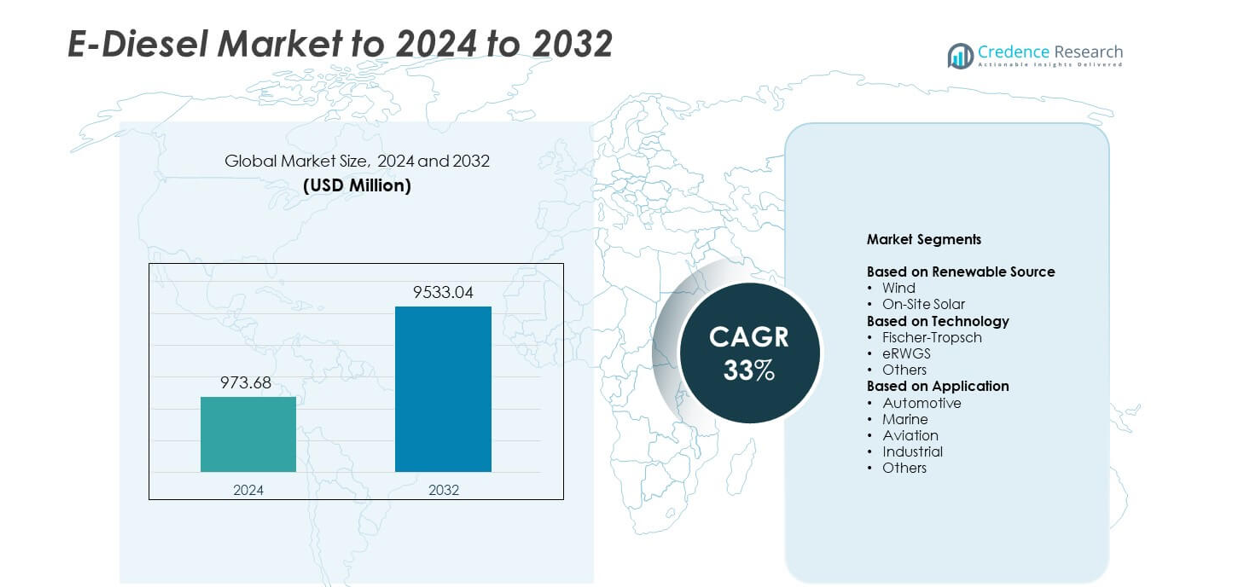
The E-Diesel Market was valued at USD 973.68 million in 2024 and is anticipated to reach USD 9533.04 million by 2032, growing at a CAGR of 33% during the forecast period.
| REPORT ATTRIBUTE | DETAILS |
|---|---|
| Historical Period | 2020-2023 |
| Base Year | 2024 |
| Forecast Period | 2025-2032 |
| E-Diesel Market Size 2024 | USD 973.68 million |
| E-Diesel Market, CAGR | 33% |
| E-Diesel Market Size 2032 | USD 9533.04 million |
The E-Diesel Market includes key players such as FuelCellEnergyInc., ArcadiaeFuels, LanzaJet, MANEnergySolutions, Porsche, CleanFuelsAllianceAmerica, SunfireGmbH, LiquidWind, ClimeworksAG, CeresPowerHoldingPlc, NorskE-FuelAS, BallardPowerSystemsInc., eFuelPacificLimited, ElectrochaeaGmbH, ExxonMobil, and HIFGlobal, each working to expand synthetic fuel production and accelerate large-scale commercialization. These companies invest in power-to-liquid plants, renewable hydrogen systems, and carbon-capture technologies to enhance fuel efficiency and reduce emissions. Europe leads the market with a 38% share in 2024 due to strong policy support and large renewable energy assets, followed by North America at 34% and Asia Pacific at 22%, driven by growing decarbonization commitments across transport and industry.
Market Insights
- The E-Diesel Market reached USD 973.68 million in 2024 and USD 9533.04 million in 2032 and will grow at a 33% CAGR to 2032, driven by rising adoption of renewable synthetic fuels across transport and industry.
- Demand growth comes from strict emission rules, rapid adoption of wind-powered production (60% share), and strong use of Fischer-Tropsch technology (45% share), which supports high-quality fuel output.
- Key trends include expansion of power-to-liquid plants, rising integration of renewable hydrogen, and increasing adoption in the automotive segment, which holds a 40% share.
- Competitive activity focuses on scaling commercial plants, improving catalyst efficiency, and strengthening renewable electricity partnerships to support large-volume E-Diesel production.
- Europe leads regional demand with a 38% share, followed by North America at 34% and Asia Pacific at 22%, while Latin America and the Middle East & Africa hold 4% and 2% respectively as emerging growth regions.
Market Segmentation Analysis:
By Renewable Source
The E-Diesel Market is segmented by renewable sources, with wind and on-site solar being the key contributors. The wind sub-segment holds the dominant market share of approximately 60% due to its scalability and efficiency in harnessing energy for E-Diesel production. Wind energy is widely adopted for its low environmental impact and high capacity factor, making it an ideal source for renewable E-Diesel production. The increasing shift toward cleaner energy sources and advancements in wind turbine technology are key drivers of growth in this segment.
- For instance, Siemens Gamesa secured an Engineering, Procurement, and Construction (EPC) contract in early 2021 to build the 100 MW Assela wind farm in Ethiopia for the state-owned utility Ethiopian Electric Power (EEP).
By Technology
The E-Diesel Market is driven by various technologies, with Fischer-Tropsch technology leading the market, holding around 45% of the market share. This technology dominates the segment due to its maturity and ability to produce high-quality synthetic fuels from renewable feedstocks. Fischer-Tropsch synthesis offers significant advantages in terms of efficiency and scalability, which supports its widespread adoption in commercial E-Diesel production. The demand for cleaner fuels, coupled with advancements in catalyst technologies, further strengthens the dominance of Fischer-Tropsch in this segment.
- For instance, Sasol’s Secunda CTL plant in South Africa uses the Fischer-Tropsch process and has a capacity of 160,000 barrels per day.
By Application
The application segment of the E-Diesel Market includes automotive, marine, aviation, industrial, and others, with the automotive sub-segment holding the largest market share of approximately 40%. The growing demand for clean and sustainable fuel solutions in the transportation sector drives the automotive sub-segment's dominance. E-Diesel offers a low-carbon alternative for internal combustion engines, making it a preferred choice for automakers looking to reduce emissions. The increasing adoption of electric vehicles (EVs) and hybrid vehicles also contributes to the growing demand for E-Diesel in the automotive sector.
Key Growth Drivers
Growing Demand for Sustainable Energy Solutions
The global move toward low-carbon fuels drives strong demand for E-Diesel. Many countries enforce strict emission rules, which push industries to adopt renewable synthetic fuels. The rise of net-zero targets also increases interest in carbon-neutral diesel alternatives that work in existing engines. Transportation, industrial operations, and heavy-duty sectors use E-Diesel to reduce greenhouse gases without major equipment changes. This shift in energy policy creates steady long-term growth for the market.
- For instance, Neste increased its renewable products refinery capacity by 1.3 million tons per year at its Singapore site, helping meet rising low-carbon fuel demand.
Technological Advancements in E-Diesel Production
Advances in Fischer-Tropsch, eRWGS, and renewable hydrogen systems improve efficiency and reduce energy loss in E-Diesel production. These developments support large-scale fuel output while lowering operating costs and improving fuel purity. Better catalysts and high-temperature reactors also make the process more reliable and faster. As these technologies mature, commercial E-Diesel plants gain higher productivity, making renewable synthetic diesel more competitive. These improvements strengthen industry confidence and support wider market expansion.
- For instance, Topsoe and Sasol demonstrated conversion of biogas and CO₂ into synthetic crude (syncrude) in their FrontFuel SynFuels project in Denmark in late 2024.
Government Regulations Supporting Clean Fuel Adoption
Government climate policies and emission rules are major growth drivers for the E-Diesel Market. Many nations provide tax benefits, carbon credit programs, and incentives for renewable fuel production. Mandates for low-carbon fuels in transportation and aviation also increase demand. These policies push industries to replace fossil diesel with cleaner synthetic alternatives. As regulatory pressure continues to rise, companies accelerate investments in E-Diesel projects, supporting strong market growth across multiple sectors.
Key Trends & Opportunities
Expansion Across Automotive, Marine, and Aviation Applications
Growing decarbonization needs in automotive fleets, shipping, and aviation generate strong opportunities for E-Diesel adoption. The fuel works with existing engines, making it easier for operators to cut emissions without redesigning equipment. Aviation and marine sectors face global emission laws, driving interest in renewable synthetic fuels. Hybrid vehicle fleets and commercial transport firms also seek low-carbon fuel blends. These expanding applications position E-Diesel as a versatile replacement for conventional diesel.
- For instance, Emirates (from above) used 100 % SAF in one engine of its A380, confirming the possibility of drop-in synthetic fuels in aviation – a major segment beyond automotive.
Rising Integration of Wind and Solar in E-Diesel Production
Wind and solar are becoming primary energy sources for renewable diesel production due to falling equipment costs and wider grid integration. Wind holds a strong advantage with high output stability, while solar supports decentralized on-site generation. This trend increases production reliability and reduces carbon intensity. As renewable installations grow worldwide, E-Diesel producers gain access to cheaper and cleaner electricity, creating major opportunities for plant expansion in suitable regions.
- For instance, Siemens Gamesa’s SG 14-222 DD offshore wind turbine (14 MW class) enters series production in 2024, enabling larger renewable electricity supply for synthetic fuel plants.
Key Challenges
High Production and Infrastructure Costs
E-Diesel production remains expensive due to energy-intensive processes, advanced catalysts, and the high cost of renewable hydrogen. These costs make E-Diesel less competitive compared to fossil diesel in many regions. Large investments are also required for synthetic fuel plants, pipelines, and storage systems. Limited refueling points slow market adoption in transportation and aviation. Reducing production cost and improving infrastructure availability remain the main barriers to large-scale deployment.
Limited Large-Scale Commercial Availability
The market faces challenges due to the small number of commercial-scale E-Diesel facilities. Most projects remain in pilot or early expansion stages, which restricts supply and raises fuel prices. Industries with high fuel demand, such as marine and aviation, struggle to secure stable volumes. Limited availability also slows long-term supply contracts that many operators require. Expanding production capacity is essential for improving market stability and driving broader adoption.
Regional Analysis
North America
North America holds a market share of about 34% in 2024 in the E-Diesel Market, driven by strong adoption of low-carbon fuels and expanding renewable energy capacity. The United States leads with new synthetic fuel projects supported by clean fuel standards and rapid wind and solar growth. Canada adds demand through strict emission-reduction plans and interest in renewable diesel for transportation and industry. The region benefits from advanced technology, strong R&D activity, and early commercial pilots that improve market readiness through 2032 as decarbonization policies strengthen.
Europe
Europe accounts for roughly 38% of the E-Diesel Market in 2024, making it the leading region. Growth comes from strict emission rules, national net-zero targets for 2030 and 2050, and high demand for renewable synthetic fuels in transport, marine, and aviation sectors. Countries such as Germany, Denmark, and the Netherlands expand offshore wind and power-to-liquid projects. Carbon pricing systems and renewable fuel mandates accelerate the move away from fossil diesel. Europe’s strong regulatory framework supports commercial plant deployment through 2032.
Asia Pacific
Asia Pacific holds a market share of around 22% in 2024, supported by rising energy needs and increasing interest in low-carbon fuels. China and Japan advance synthetic fuel technologies, while South Korea and Australia invest deeply in renewable hydrogen and solar-wind capacity. Strong industrial fuel demand and rapid urbanization push governments to adopt cleaner diesel alternatives. Manufacturing strength and large renewable projects position the region for high expansion through 2032 as decarbonization policies intensify.
Latin America
Latin America represents about 4% of the E-Diesel Market in 2024, driven by expanding renewable power capacity and interest in sustainable transport fuels. Brazil leads due to its long biofuel experience and rising focus on synthetic fuel pathways. Chile and Uruguay continue to build strong wind and solar projects that support future power-to-liquid production. Commercial production remains limited in 2024, yet investment in green hydrogen improves long-term prospects through 2032. The region aims to lower fossil fuel dependence, creating future demand.
Middle East and Africa
Middle East and Africa account for nearly 2% of the E-Diesel Market in 2024, supported by early renewable hydrogen projects and growing solar investments. The United Arab Emirates and Saudi Arabia expand large-scale green energy zones that may support synthetic diesel production by 2030. Africa’s adoption remains low, although South Africa explores opportunities tied to industrial use and solar capacity. Infrastructure gaps and high project costs slow progress in 2024, but long-term diversification plans create emerging opportunities through 2032.
Market Segmentations:
By Renewable Source
- Wind
- On-Site Solar
By Technology
- Fischer-Tropsch
- eRWGS
- Others
By Application
- Automotive
- Marine
- Aviation
- Industrial
- Others
By Geography
- North America
- U.S.
- Canada
- Mexico
- Europe
- Germany
- France
- U.K.
- Italy
- Spain
- Rest of Europe
- Asia Pacific
- China
- Japan
- India
- South Korea
- South-east Asia
- Rest of Asia Pacific
- Latin America
- Brazil
- Argentina
- Rest of Latin America
- Middle East & Africa
- GCC Countries
- South Africa
- Rest of the Middle East and Africa
Competitive Landscape
The competitive landscape of the E-Diesel Market features key players such as FuelCellEnergyInc., ArcadiaeFuels, LanzaJet, MANEnergySolutions, Porsche, CleanFuelsAllianceAmerica, SunfireGmbH, LiquidWind, ClimeworksAG, CeresPowerHoldingPlc, NorskE-FuelAS, BallardPowerSystemsInc., eFuelPacificLimited, ElectrochaeaGmbH, ExxonMobil, and HIFGlobal. Companies in this market focus on expanding renewable diesel production capacity, improving conversion efficiency, and reducing overall production costs. Many firms invest in power-to-liquid technologies and renewable hydrogen projects to strengthen supply chains for large-scale synthetic fuel output. Strategic partnerships with energy producers, technology developers, and transportation sectors support faster commercialization of E-Diesel. Several participants also work on integrating wind and solar power into production systems to lower carbon intensity. Continuous innovation in reactors, catalysts, and carbon-capture systems helps improve fuel quality and operational reliability. Expansion into aviation, marine, and heavy-duty transport markets strengthens long-term growth as global decarbonization policies accelerate demand.
Key Player Analysis
- ArcadiaeFuels
- LanzaJet
- MANEnergySolutions
- Porsche
- CleanFuelsAllianceAmerica
- SunfireGmbH
- LiquidWind
- ClimeworksAG
- CeresPowerHoldingPlc
- NorskE-FuelAS
- eFuelPacificLimited
- ElectrochaeaGmbH
- ExxonMobil
- HIFGlobal
Recent Developments
- In 2025, Arcadia eFuels received an environmental permit from the Danish Environmental Protection Agency for the operation of full-scale production of electro-sustainable aviation fuel (eSAF), including eDiesel, at their facility in Vordingborg, Denmark.
- In 2025, Climeworks AG continued to lead in Direct Air Capture (DAC) technology, supplying captured CO2 for producing carbon-neutral fuels including E-Diesel.
- In 2024, Ballard announced a 15 MW order for fuel cell modules for European stationary power, supporting a shift from diesel generators toward hydrogen-based systems that complement future e-fuel use.
Report Coverage
The research report offers an in-depth analysis based on Renewable Source, Technology, Application and Geography. It details leading market players, providing an overview of their business, product offerings, investments, revenue streams, and key applications. Additionally, the report includes insights into the competitive environment, SWOT analysis, current market trends, as well as the primary drivers and constraints. Furthermore, it discusses various factors that have driven market expansion in recent years. The report also explores market dynamics, regulatory scenarios, and technological advancements that are shaping the industry. It assesses the impact of external factors and global economic changes on market growth. Lastly, it provides strategic recommendations for new entrants and established companies to navigate the complexities of the market.
Future Outlook
- The market will expand rapidly as more countries adopt strict emission rules.
- Production capacity will rise as large power-to-liquid plants move from pilot to commercial scale.
- Renewable hydrogen development will strengthen the cost efficiency of E-Diesel.
- Automotive, marine, and aviation sectors will accelerate the shift toward low-carbon synthetic fuels.
- Wind and solar integration will improve production stability and reduce overall fuel emissions.
- Technology upgrades will lower operational costs and boost large-scale fuel output.
- Government incentives will attract new investments into synthetic diesel projects.
- Fuel blending regulations will encourage wider use of E-Diesel in transport fleets.
- Corporate net-zero commitments will increase long-term demand for renewable diesel solutions.
- Global energy diversification strategies will position E-Diesel as a key component of future clean-fuel systems.

Request a Free Sample
Fill in your details and we'll send you a free sample report.
- Sample data tables & charts
- Research methodology
Need a Custom Version of This Report?
Tailor the scope, geography, or segments to your exact requirements.
- Custom geography or segment scope
- Direct access to our analyst team
Frequently Asked Questions
What is the current market size for E-Diesel Market, and what is its projected size in 2032?
At what Compound Annual Growth Rate is the E-Diesel Market projected to grow between 2025 and 2032?
Which E-Diesel Market segment held the largest share in 2024?
What are the primary factors fueling the growth of the E-Diesel Market?
Who are the leading companies in the E-Diesel Market?
Which region commanded the largest share of the E-Diesel Market in 2024?
Table of Content
Chapter 1 Market Segmentation
- 1.1 Segmentation Framework
- 1.1.1 Product and Service Classification
- 1.1.2 Application and End-Use Classification
- 1.1.3 Technology and Solution Classification
- 1.1.4 Customer and Distribution Channel Classification
- 1.1.5 Geographic Segmentation
- 1.1.6 Market Segment Definitions and Boundaries
Chapter 2 Introduction
- 2.1 Report Objectives and Scope
- 2.2 Product Definition and Industry Terminology
- 2.3 Market Inclusions and Exclusions
- 2.4 Research Process
- 2.4.1 Primary Research and Expert Interviews
- 2.4.2 Secondary Research and Source Review
- 2.4.3 Top-Down and Bottom-Up Estimation
- 2.4.4 Data Triangulation and Verification
- 2.5 Market Size Measurement Basis
- 2.5.1 2024: USD 973.68 million → 2032: USD 9533.04 million
- 2.6 Historical and Forecast Reference Periods
- 2.6.1 Base Year: 2024
- 2.6.2 Forecast Period: 2024-2032
- 2.7 Research Assumptions and Limitations
Chapter 3 Executive Summary
- 3.1 Market Snapshot and Key Findings
- 3.2 Base-Year Market Size, 2024
- 3.3 Forecast Market Size, 2032
- 3.4 Revenue and Volume Growth Outlook
- 3.5 Key Demand and Supply Indicators
- 3.6 Leading Market Segments
- 3.7 Fastest-Growing Market Opportunities
- 3.8 Regional Performance Highlights
- 3.9 Technology and Industry Transformation
- 3.10 Competitive Landscape Summary
- 3.11 Analyst View and Strategic Implications
Chapter 4 Global E-Diesel Market Trends and Developments
- 4.1 Historical Industry Development
- 4.2 Recent Market Trends and Developments
- 4.3 Demand and Customer Behavior Trends
- 4.4 Technology and Product Innovation
- 4.5 Artificial Intelligence, Automation and Digitalization
- 4.6 Local Manufacturing and Supply Chain Realignment
- 4.7 Industry Partnerships, Mergers and Acquisitions
- 4.8 Sustainability and Circular Economy Developments
- 4.9 Government and Private Sector Investment Trends
- 4.10 Emerging Business Models and Commercialization
- 4.11 Industry Developments and Announcements
Chapter 5 Global E-Diesel Market Production, Supply and Demand Analysis
- 5.1 Demand Trend and Consumption Analysis
- 5.2 Demand Forecast, 2024-2032
- 5.3 Production and Output Trend
- 5.4 Production and Output Forecast, 2024-2032
- 5.5 Installed Capacity and Capacity Utilization
- 5.6 Company-Wise Production Plants and Statistics
- 5.6.1 Installed Production Capacity
- 5.6.2 Actual Production
- 5.6.3 Planned Capacity and Expansion Targets
- 5.7 Supply Chain Structure and Procurement Trends
- 5.8 Supply-Demand Gap and Bottlenecks
- 5.9 Import Dependence and Sourcing Structure
- 5.10 Contract Manufacturing and Outsourcing
- 5.11 Regional Supply and Demand Concentration
Chapter 6 Global E-Diesel Market Pricing Analysis
- 6.1 Pricing Structure and Measurement
- 6.2 Historical Pricing Trends
- 6.3 Pricing Outlook, 2024-2032
- 6.4 Average Selling Price and Unit Economics
- 6.5 Pricing by Product and Market Segment
- 6.6 Geographic Pricing Differences
- 6.7 Key Input, Energy, Labor and Logistics Costs
- 6.8 Contract Pricing and Purchasing Models
- 6.9 Pricing Sensitivity and Competitive Positioning
- 6.10 Price, Margin and Profitability Implications
Chapter 7 Global E-Diesel Market Dynamics
- 7.1 Market Growth Drivers
- 7.1.1 Demand-Side Drivers
- 7.1.2 Technology and Innovation Drivers
- 7.1.3 Infrastructure and Investment Drivers
- 7.1.4 Regulatory and Policy Drivers
- 7.2 Market Restraints
- 7.2.1 Cost and Affordability Constraints
- 7.2.2 Technology and Adoption Barriers
- 7.2.3 Supply Chain and Operational Constraints
- 7.3 Market Challenges
- 7.3.1 Competitive Pressure and Margin Erosion
- 7.3.2 Skills, Infrastructure and Implementation Gaps
- 7.4 Emerging Market Opportunities
- 7.5 Market Dynamics Impact and Time-Horizon Assessment
Chapter 8 Global E-Diesel Value Chain Analysis
- 8.1 Industry Value Chain Overview
- 8.2 Upstream Suppliers and Critical Inputs
- 8.3 Technology and Component Providers
- 8.4 Manufacturing or Service Delivery
- 8.5 Distribution, Channel Partners and Integrators
- 8.6 Downstream Applications and End Users
- 8.7 Value Addition and Profit Pools
- 8.8 Vertical Integration and Outsourcing
- 8.9 Supplier Concentration and Risk
- 8.10 Supply Chain Localization and Resilience
Chapter 9 Global E-Diesel Market Regulations and Policies
- 9.1 Relevant Laws, Standards and Compliance Frameworks
- 9.2 Product, Service, Safety and Quality Requirements
- 9.3 Government Policies, Incentives and Subsidies
- 9.4 Imports, Exports and Trade Barriers
- 9.5 Public Procurement and Local Content Requirements
- 9.6 Environmental and Sustainability Compliance
- 9.7 Upcoming Policy Changes and Market Implications
Chapter 10 Global E-Diesel Market Hotspots and Opportunities
- 10.1 Market Opportunity Mapping and Growth Hotspots
- 10.2 High-Growth Applications and Customer Groups
- 10.3 Underserved Markets and White-Space Opportunities
- 10.4 Emerging Technology and Product Opportunities
- 10.5 New Capacity and Investment Hotspots
- 10.6 Market Entry and Expansion Opportunities
- 10.7 Distribution and Partnership Opportunities
- 10.8 Near-Term and Long-Term Commercial Potential
- 10.9 Opportunity Attractiveness and Execution Risks
Chapter 11 Global E-Diesel Market Outlook, 2024-2032
- 11.1 Market Size and Analysis
- 11.1.1 Revenue (Market Measurement: 2024: USD 973.68 million → 2032: USD 9533.04 million)
- 11.1.2 Market Volume and Quantity Sold
- 11.1.3 Historical Market Size
- 11.1.4 Base-Year Market Size, 2024
- 11.2 Market Forecast, 2024-2032
- 11.2.1 Revenue Forecast to 2032
- 11.2.2 Volume Forecast to 2032
- 11.2.3 CAGR and Year-on-Year Growth
- 11.2.4 Incremental Revenue Opportunity
- 11.3 Forecast Assumptions and Scenario Analysis
- 11.3.1 Base-Case Forecast
- 11.3.2 Optimistic and Conservative Scenarios
- 11.3.3 Technology, Pricing and Policy Sensitivities
- 11.4 Market Attractiveness and Growth Outlook
Chapter 12 Global E-Diesel Market Segmentation and Outlook
- 12.1 Segmentation Summary and Market Shares, 2024
- 12.2 Largest and Fastest-Growing Segments
- 12.3 Segment Growth Comparison
- 12.4 Segment Attractiveness and Priority Matrix
Chapter 13 Global E-Diesel Geographic Market Outlook, 2024-2032
- 13.1 Regional Market Size and Share, 2024
- 13.2 Regional Market Forecast, 2024-2032
- 13.3 Regional Pricing, Production and Demand Differences
- 13.4 North America
- 13.4.1 United States
- 13.4.2 Canada
- 13.4.3 Mexico
- 13.5 Europe
- 13.5.1 Germany
- 13.5.2 France
- 13.5.3 Italy
- 13.5.4 United Kingdom
- 13.5.5 Spain
- 13.5.6 Poland
- 13.5.7 Russia
- 13.5.8 Netherlands
- 13.5.9 Belgium
- 13.5.10 Sweden
- 13.5.11 Denmark
- 13.5.12 Norway
- 13.5.13 Rest of Europe
- 13.6 Asia Pacific
- 13.6.1 China
- 13.6.2 India
- 13.6.3 Japan
- 13.6.4 South Korea
- 13.6.5 Thailand
- 13.6.6 Indonesia
- 13.6.7 Vietnam
- 13.6.8 Malaysia
- 13.6.9 Australia
- 13.6.10 Rest of Asia Pacific
- 13.7 Latin America
- 13.7.1 Brazil
- 13.7.2 Argentina
- 13.7.3 Colombia
- 13.7.4 Chile
- 13.7.5 Rest of Latin America
- 13.8 Middle East
- 13.8.1 Saudi Arabia
- 13.8.2 United Arab Emirates
- 13.8.3 Turkey
- 13.8.4 Israel
- 13.8.5 Iran
- 13.8.6 Rest of the Middle East
- 13.9 Africa
- 13.9.1 South Africa
- 13.9.2 Egypt
- 13.9.3 Nigeria
- 13.9.4 Morocco
- 13.9.5 Rest of Africa
- 13.10 Regional Investment, Policy and Supply Chain Differences
- 13.11 Regional Competitive Landscape
- 13.12 Geographic Growth Hotspots
Chapter 14 Global E-Diesel Technology, Innovation and Sustainability Outlook
- 14.1 Technology Landscape and Maturity
- 14.2 Product, Process and Service Innovation
- 14.3 AI, Automation and Digital Tools in the Industry
- 14.4 Technology Adoption and Performance Benchmarking
- 14.5 Innovation Pipeline and R&D Investment
- 14.6 Patent and Intellectual Property Trends
- 14.7 Energy Efficiency and Resource Management
- 14.8 Sustainability, Recycling and Circularity
- 14.9 Technology Roadmap, 2024-2032
- 14.10 Risks of Obsolescence and Technology Substitution
Chapter 15 Global E-Diesel Market Key Strategic Imperatives
- 15.1 Growth and Market Entry Priorities
- 15.2 High-Return Products and Segments
- 15.3 Pricing, Profitability and Cost Optimization
- 15.4 Technology Investment and Product Differentiation
- 15.5 Supply Chain Localization and Resilience
- 15.6 Distribution and Customer Acquisition
- 15.7 Partnership, Acquisition and Capacity Strategy
- 15.8 Regional Expansion Priorities
- 15.9 Short-, Medium- and Long-Term Actions
Chapter 16 Competition Outlook
- 16.1 Industry Competition Characteristics
- 16.2 Market Structure and Concentration
- 16.3 Market Share and Competitive Positioning, 2024
- 16.4 Company-Wise Revenue and Product Benchmarking
- 16.5 Production and Service Capacity Benchmarking
- 16.6 Technology, Pricing and Differentiation
- 16.7 Regional Footprint and Distribution Strength
- 16.8 Mergers, Acquisitions and Strategic Alliances
- 16.9 New Entrants and Competitive Threats
- 16.10 Porter's Five Forces and Industry Attractiveness
- 16.11 Competitive Outlook, 2024-2032
Chapter 17 Company Profiles
- 17.1 Company Coverage and Selection Criteria
- 17.2 Leading Market Participants – Standard Profile Structure
- 17.2.1 Business Description
- 17.2.2 Company Ownership and Geographic Presence
- 17.2.3 Product and Service Portfolio
- 17.2.4 Manufacturing and Operating Footprint
- 17.2.5 Production Capacity and Expansion Plans
- 17.2.6 Financial Performance and Investment
- 17.2.7 Market Share and Competitive Position
- 17.2.8 Technology and Innovation Capabilities
- 17.2.9 Strategic Alliances or Partnerships
- 17.2.10 Recent Developments
- 17.2.11 Growth Strategy and Outlook
- 17.3 Other Relevant Market Participants
Note: Every listed company is profiled on the structure shown under the first company. The company list is preliminary and may change based on research findings, market developments, data availability and client requirements.
Chapter 18 Disclaimer
- 18.1 Research and Forecast Disclaimer
- 18.2 Data Source and Estimation Limitations
Note: The depth of individual sections depends on data availability for this market. Volume, capacity, trade and other unit-based metrics are included where applicable.

