Executive Summary & Core Metrics
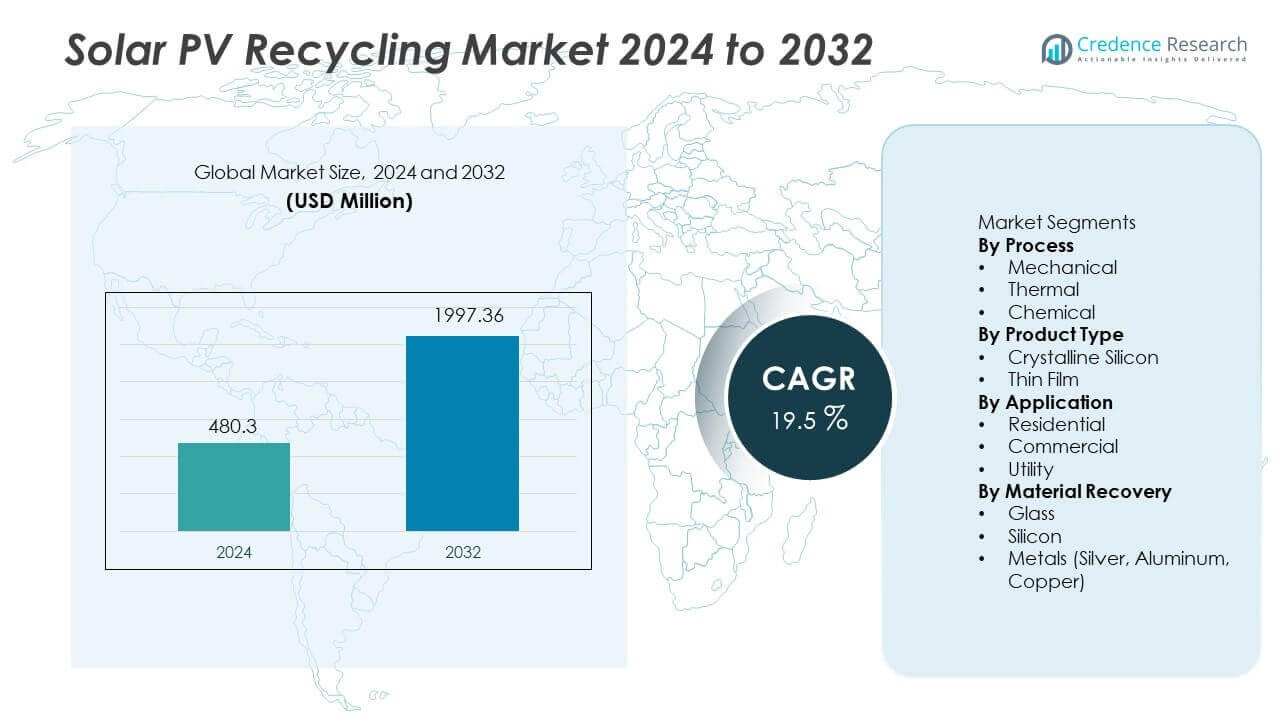
The global solar PV recycling market was valued at USD 480.3 million in 2024 and is projected to reach USD 1,997.36 million by 2032, expanding at a compound annual growth rate (CAGR) of 19.5% during the forecast period, according to Credence Research. This growth reflects rising end-of-life solar module volumes, expanding solar installations, increasing material recovery demand and stronger regulatory focus on sustainable disposal of photovoltaic waste.
| REPORT ATTRIBUTE | DETAILS |
|---|---|
| Historical Period | 2020-2023 |
| Base Year | 2024 |
| Forecast Period | 2025-2032 |
| Solar PV Recycling Market Size 2024 | USD 480.3 million |
| Solar PV Recycling Market, CAGR | 19.5% |
| Solar PV Recycling Market Size 2032 | USD 1,997.36 million |
1The global solar PV recycling market is characterized by the presence of specialized recyclers, solar manufacturers, circular economy solution providers and material recovery companies competing on recovery efficiency, processing cost, recycling capacity and technology depth. Leading players focus on mechanical, thermal and chemical recycling methods designed to recover glass, aluminum, silicon, silver, copper and other valuable materials from crystalline silicon and thin-film modules. Strategic priorities across the sector include automated dismantling, high-value metal extraction, circular material use, producer responsibility compliance, collection networks and partnerships with solar developers, utilities and government waste programs.
Strategic Market Insights
- Market growth is primarily driven by rising end-of-life solar module volumes, rapid expansion of global PV installations and increasing demand for recovered glass, aluminum, silicon and valuable metals.
- Dominant industry trends highlight advanced recovery methods, circular economy adoption, automated dismantling and higher-value recycling processes that improve silicon and metal extraction across crystalline and thin-film modules.
- The competitive landscape is defined by leading companies expanding mechanical, thermal and chemical recycling technologies while forming partnerships with solar manufacturers, utilities and government waste programs.
- According to Credence Research regional mapping, Europe represents the largest market, accounting for a definitive 33.4% share due to strict recycling regulations, extended producer responsibility policies and mature PV waste management frameworks.
Market Segmentation Analysis
By Process
- Mechanical
- Thermal
- Chemical
Mechanical recycling dominates the solar PV recycling market with near 68% share in 2024. Its leadership is supported by lower processing cost, scalable operation and wider applicability across high-volume crystalline silicon panel waste. Mechanical recycling uses shredding, separation, delamination and material sorting techniques to recover glass, aluminum frames and selected semiconductor materials. Recyclers prefer this process because it requires lower energy input than thermal and chemical methods and can handle large module volumes cost-effectively.
Thermal recycling accounts for near 21% share and is used where heat-based treatment helps separate encapsulants and recover embedded materials. Chemical recycling holds near 11% share, supported by increasing interest in advanced recovery of silicon, silver and rare metals. Although chemical methods remain more expensive, they offer higher-value recovery potential and are expected to gain adoption as recycling economics improve.
First Solar operates a dedicated recycling line that recovers the majority of glass and semiconductor material through controlled shredding and separation.
By Product Type
- Crystalline Silicon
- Thin Film
Crystalline silicon panels lead the product type segment with near 82% share in 2024. This dominance reflects their widespread use across global solar installations and their large contribution to future end-of-life module waste. Recycling companies prioritize crystalline modules because recovered glass, aluminum and silicon can enter established supply chains and support circular production models. Rising utility, commercial and residential solar installations continue to increase crystalline waste volumes.
Thin-film panels account for near 18% share and are gaining interest due to the presence of valuable metals. However, thin-film recycling remains more technically complex and less standardized than crystalline silicon recycling. Specialized facilities are required to recover materials safely and efficiently from thin-film structures. Despite this complexity, rising attention to high-value material recovery is expected to support gradual growth in thin-film recycling.
Veolia’s crystalline module recycling line in Rousset, France, is designed to process end-of-life crystalline silicon panels and recover materials including glass and aluminum through multi-stage delamination and mechanical stripping.
By Application
- Residential
- Commercial
- Utility
Utility applications lead the solar PV recycling market with near 57% share in 2024. Large-scale solar farms are beginning to approach replacement and repowering cycles, creating rising demand for organized recycling channels. Utility operators invest in recycling partnerships to comply with sustainability goals, reduce landfill waste and recover valuable materials from decommissioned panels. Utility-scale projects generate concentrated waste volumes, making collection and processing more economically viable.
Commercial applications account for near 28% share, supported by replacement cycles, facility upgrades and industrial solar project repowering. Residential applications hold near 15% share, driven by rooftop panel replacements and growing awareness of responsible solar waste disposal. Government regulations, extended producer responsibility policies and formal take-back systems support recycling adoption across all application segments.
By Material Recovery
- Residential
- Commercial
- Utility
Glass represents one of the largest recovered material streams because it forms the majority of PV module weight and can be routed into established glass supply chains. Aluminum recovery is also commercially attractive due to its use in panel frames and strong secondary market demand. Silicon recovery is gaining importance as manufacturers seek circular input streams and cost-efficient alternatives to virgin materials.
Metals such as silver, aluminum and copper create higher-value recovery opportunities. Advanced thermal and chemical methods are increasingly used to improve extraction of these materials from complex module structures. As recycling technologies mature, recovered silicon and metals are expected to become more important to the economics of PV recycling and circular solar manufacturing.
Key Market Dynamics
Primary Market Drivers
Increasing End-of-Life Solar Modules from Expanding PV Installations
Global solar installations continue to grow across utility, commercial and residential sectors, creating rising future end-of-life module volumes. Aging crystalline silicon modules represent the largest recycling stream due to their dominant share in installed solar capacity. Waste accumulation pushes recyclers to expand capacity and invest in advanced separation and material recovery systems. National policies and recycling mandates further encourage sustainable disposal of solar waste. Recycle PV Solar operates a Nevada facility that processes 7,500 modules per day through automated breaking and laminated glass separation, recovering aluminum and glass using precision shredders and vacuum extraction lines.
Rising Demand for Secondary Raw Materials and Circular Economy Adoption
Solar PV recycling recovers valuable materials such as glass, aluminum and silicon that can be reused in solar components and broader industrial supply chains. Manufacturers increasingly adopt recycled materials to support circular economy initiatives, reduce material dependency and manage cost pressures. Growing awareness of material scarcity and price volatility strengthens recycling activity. NPC Incorporated operates a silicon recovery line in Japan that uses heated blade technology to separate glass and cells for downstream material recovery.
Government Regulations and Extended Producer Responsibility Policies
Regional authorities are enforcing waste management rules that require sustainable collection and processing of solar panels. Extended producer responsibility schemes encourage manufacturers to participate in recycling frameworks and fund formal take-back programs. Environmental regulations and landfill restrictions increase demand for compliant recycling services. These policies create long-term market certainty, especially in developed regions where PV waste volumes are rising and regulatory enforcement is stronger.
Key Trends & Structural Opportunities
Advancement in Recovery Methods for High-Value Materials
Thermal and chemical recycling methods are improving recovery of silicon, silver and rare metals from photovoltaic modules. These technologies support high-value recycling solutions for thin-film and advanced PV modules, where material composition is more complex. Research and industrial collaboration are improving process efficiency and expanding recycling potential. ENVARIS GmbH operates recovery processes for valuable materials such as silver and high-purity silicon from processed crystalline modules, supporting resource conservation and circular material use.
Growing Investment in Recycling Infrastructure and Large-Scale Collection Programs
Governments and private players are investing in recycling facilities, automated systems and waste collection networks. National solar replacement programs and utility-scale decommissioning projects are expanding end-of-life panel collection. Organized collection improves material flow and supports better recycling economics. Rinovasol Group operates a cross-border collection and refurbishment network that handles used panels across Europe and international markets, routing reusable panels to refurbishment and damaged panels to certified recycling partners.
Automated Dismantling and Sorting Technologies
Automated dismantling is becoming a key opportunity as recyclers seek higher throughput, lower labor cost and better recovery consistency. Automation improves separation of frames, glass, cells, junction boxes and other module components. Smart sorting systems also help distinguish panels suitable for reuse from those requiring full recycling. Credence Research identifies automated processing as a major enabler of commercial-scale PV recycling as waste volumes rise.
Industry Challenges
High Processing Cost for Advanced Recovery Technologies
Thermal and chemical recycling require high capital expenditure, energy input and technical expertise. These methods face commercial scalability challenges due to complex waste handling and higher operating costs. Smaller recyclers may struggle with limited profitability when panel volumes are inconsistent or collection costs are high. These barriers slow adoption of advanced high-value material recovery technologies, especially in developing solar markets.
Limited Standardization and Collection Infrastructure in Emerging Markets
Many emerging countries lack organized recycling frameworks, collection programs and regulated disposal channels for solar panels. This limits material recovery and increases the risk of landfill disposal. Fragmented collection systems reduce economies of scale and discourage recycler investment. Lack of standards also affects panel handling, transport, refurbishment and certified recycling processes. Stronger policies and formal take-back systems are needed to accelerate market development in emerging regions.
Detailed Regional Analysis
| Region | Market Share (%) | Strategic Regional Catalysts & Insights |
| Europe | 33.4% | Global leader. Driven by strict waste management regulations, extended producer responsibility policies, mature solar markets and advanced recycling infrastructure. |
| North America | 28.6% | Strong demand market. Supported by utility solar retirement, state-level sustainability programs, landfill restrictions and recycling partnerships. |
| Asia Pacific | 26.1% | High-growth regional market. Driven by rapid solar expansion in China, India, Japan and Australia, along with rising PV waste volumes and recycling infrastructure development. |
| Latin America | 6.4% | Developing regional market. Supported by solar growth in Brazil, Chile and Mexico, utility project replacement cycles and evolving sustainability frameworks. |
| Middle East & Africa | 5.5% | Emerging territory. Driven by expanding solar deployment across GCC nations, South Africa and North Africa, with long-term recycling opportunities from utility-scale projects. |
Europe leads the global solar PV recycling market with a 33.4% share, according to Credence Research. The region benefits from strict waste management regulations and extended producer responsibility requirements under environmental directives. Recycling mandates for photovoltaic modules encourage manufacturers to establish collection systems and recycling agreements. Large installed solar bases in Germany, Italy and Spain support continuous waste inflow over the forecast period. European recyclers are also developing advanced mechanical and chemical recovery solutions that support circular material use and high-value extraction.
North America holds 28.6% share of the global market, supported by rising retirement of early-installed utility solar projects and active recycling initiatives across the United States. State-level sustainability programs and landfill restrictions encourage collection and reuse of crystalline silicon modules. Growing focus on circular economy models encourages recyclers to expand capacity and invest in advanced processing technologies. Commercial solar adoption and replacement cycles also increase waste volume. Partnerships between utilities, recyclers and technology developers continue shaping end-of-life solar management.
Asia Pacific accounts for 26.1% share, driven by rapid solar expansion in China, India, Japan and Australia. The region generates increasing end-of-life volumes as early utility plants approach replacement cycles. Governments support recycling infrastructure development and promote sustainable disposal standards for large solar fleets. Rapid industrial growth strengthens demand for recovered glass, aluminum and silicon across manufacturing sectors. Investment in recycling capacity and technology partnerships is expected to accelerate as the region becomes a major contributor to global PV waste generation.
Competitive Landscape & Recent Developments
The solar PV recycling market includes key participants such as:
- First Solar Inc.,
- Recycle PV Solar,
- Silcontel,
- Veolia Group,
- Canadian Solar Inc.,
- SunPower Corporation,
- NPC Incorporated,
- Rinovasol Group,
- Reiling GmbH
- ENVARIS GmbH.
These companies compete through high-value recovery technologies that extract silicon, aluminum, glass, silver and copper from aging photovoltaic modules.
Market leaders expand mechanical, thermal and chemical recycling processes to improve circular material use and reduce disposal impact. Partnerships with solar manufacturers and government waste programs help recyclers secure long-term supply of end-of-life panels. Leading firms also invest in automated dismantling, advanced separation and recovery efficiency improvements to support large-scale processing. Stronger regulatory enforcement in developed regions encourages facility modernization, certified recycling networks and cross-border material recovery initiatives.
Recent Industry Developments (2024–2025)
- In November 2025, NPC, with AGC, announced collaboration to recycle solar cover glass into architectural glass using NPC’s disassembly technology.
- In September 2024, Canadian Solar partnered with Solarcycle to provide full recycling options for panels in the U.S. market.
- In September 2024, First Solar’s 2024 Sustainability Report showed it reached approximately 88,000 tonnes of annual recycling capacity by the end of 2023, with an average global recovery rate of 95% across glass, aluminum, steel, laminate and semiconductor materials.

Request a Free Sample
Fill in your details and we'll send you a free sample report.
- Sample data tables & charts
- Research methodology
Need a Custom Version of This Report?
Tailor the scope, geography, or segments to your exact requirements.
- Custom geography or segment scope
- Direct access to our analyst team
Frequently Asked Questions
What is the current and projected size of the global solar PV recycling market?
What is the projected growth rate of the solar PV recycling industry over the forecast period?
Which process segment holds the maximum market share within the solar PV recycling industry?
Which product type dominates the solar PV recycling market?
Which application segment leads the solar PV recycling market?
Which region commands the highest market share in the global solar PV recycling space?
Table of Content
Chapter 1 Market Segmentation
- 1.1 Segmentation Framework
- 1.1.1 Product and Service Classification
- 1.1.2 Application and End-Use Classification
- 1.1.3 Technology and Solution Classification
- 1.1.4 Customer and Distribution Channel Classification
- 1.1.5 Geographic Segmentation
- 1.1.6 Market Segment Definitions and Boundaries
Chapter 2 Introduction
- 2.1 Report Objectives and Scope
- 2.2 Product Definition and Industry Terminology
- 2.3 Market Inclusions and Exclusions
- 2.4 Research Process
- 2.4.1 Primary Research and Expert Interviews
- 2.4.2 Secondary Research and Source Review
- 2.4.3 Top-Down and Bottom-Up Estimation
- 2.4.4 Data Triangulation and Verification
- 2.5 Market Size Measurement Basis
- 2.5.1 2024: USD 480.3 million → 2032: USD 1,997.36 million
- 2.6 Historical and Forecast Reference Periods
- 2.6.1 Base Year: 2024
- 2.6.2 Forecast Period: 2024-2032
- 2.7 Research Assumptions and Limitations
Chapter 3 Executive Summary
- 3.1 Market Snapshot and Key Findings
- 3.2 Base-Year Market Size, 2024
- 3.3 Forecast Market Size, 2032
- 3.4 Revenue and Volume Growth Outlook
- 3.5 Key Demand and Supply Indicators
- 3.6 Leading Market Segments
- 3.7 Fastest-Growing Market Opportunities
- 3.8 Regional Performance Highlights
- 3.9 Technology and Industry Transformation
- 3.10 Competitive Landscape Summary
- 3.11 Analyst View and Strategic Implications
Chapter 4 Global Solar PV Recycling Market Trends and Developments
- 4.1 Historical Industry Development
- 4.2 Recent Market Trends and Developments
- 4.3 Demand and Customer Behavior Trends
- 4.4 Technology and Product Innovation
- 4.5 Artificial Intelligence, Automation and Digitalization
- 4.6 Local Manufacturing and Supply Chain Realignment
- 4.7 Industry Partnerships, Mergers and Acquisitions
- 4.8 Sustainability and Circular Economy Developments
- 4.9 Government and Private Sector Investment Trends
- 4.10 Emerging Business Models and Commercialization
- 4.11 Industry Developments and Announcements
Chapter 5 Global Solar PV Recycling Market Production, Supply and Demand Analysis
- 5.1 Demand Trend and Consumption Analysis
- 5.2 Demand Forecast, 2024-2032
- 5.3 Production and Output Trend
- 5.4 Production and Output Forecast, 2024-2032
- 5.5 Installed Capacity and Capacity Utilization
- 5.6 Company-Wise Production Plants and Statistics
- 5.6.1 Installed Production Capacity
- 5.6.2 Actual Production
- 5.6.3 Planned Capacity and Expansion Targets
- 5.7 Supply Chain Structure and Procurement Trends
- 5.8 Supply-Demand Gap and Bottlenecks
- 5.9 Import Dependence and Sourcing Structure
- 5.10 Contract Manufacturing and Outsourcing
- 5.11 Regional Supply and Demand Concentration
Chapter 6 Global Solar PV Recycling Market Pricing Analysis
- 6.1 Pricing Structure and Measurement
- 6.2 Historical Pricing Trends
- 6.3 Pricing Outlook, 2024-2032
- 6.4 Average Selling Price and Unit Economics
- 6.5 Pricing by Product and Market Segment
- 6.6 Geographic Pricing Differences
- 6.7 Key Input, Energy, Labor and Logistics Costs
- 6.8 Contract Pricing and Purchasing Models
- 6.9 Pricing Sensitivity and Competitive Positioning
- 6.10 Price, Margin and Profitability Implications
Chapter 7 Global Solar PV Recycling Market Dynamics
- 7.1 Market Growth Drivers
- 7.1.1 Demand-Side Drivers
- 7.1.2 Technology and Innovation Drivers
- 7.1.3 Infrastructure and Investment Drivers
- 7.1.4 Regulatory and Policy Drivers
- 7.2 Market Restraints
- 7.2.1 Cost and Affordability Constraints
- 7.2.2 Technology and Adoption Barriers
- 7.2.3 Supply Chain and Operational Constraints
- 7.3 Market Challenges
- 7.3.1 Competitive Pressure and Margin Erosion
- 7.3.2 Skills, Infrastructure and Implementation Gaps
- 7.4 Emerging Market Opportunities
- 7.5 Market Dynamics Impact and Time-Horizon Assessment
Chapter 8 Global Solar PV Recycling Value Chain Analysis
- 8.1 Industry Value Chain Overview
- 8.2 Upstream Suppliers and Critical Inputs
- 8.3 Technology and Component Providers
- 8.4 Manufacturing or Service Delivery
- 8.5 Distribution, Channel Partners and Integrators
- 8.6 Downstream Applications and End Users
- 8.7 Value Addition and Profit Pools
- 8.8 Vertical Integration and Outsourcing
- 8.9 Supplier Concentration and Risk
- 8.10 Supply Chain Localization and Resilience
Chapter 9 Global Solar PV Recycling Market Regulations and Policies
- 9.1 Relevant Laws, Standards and Compliance Frameworks
- 9.2 Product, Service, Safety and Quality Requirements
- 9.3 Government Policies, Incentives and Subsidies
- 9.4 Imports, Exports and Trade Barriers
- 9.5 Public Procurement and Local Content Requirements
- 9.6 Environmental and Sustainability Compliance
- 9.7 Upcoming Policy Changes and Market Implications
Chapter 10 Global Solar PV Recycling Market Hotspots and Opportunities
- 10.1 Market Opportunity Mapping and Growth Hotspots
- 10.2 High-Growth Applications and Customer Groups
- 10.3 Underserved Markets and White-Space Opportunities
- 10.4 Emerging Technology and Product Opportunities
- 10.5 New Capacity and Investment Hotspots
- 10.6 Market Entry and Expansion Opportunities
- 10.7 Distribution and Partnership Opportunities
- 10.8 Near-Term and Long-Term Commercial Potential
- 10.9 Opportunity Attractiveness and Execution Risks
Chapter 11 Global Solar PV Recycling Market Outlook, 2024-2032
- 11.1 Market Size and Analysis
- 11.1.1 Revenue (Market Measurement: 2024: USD 480.3 million → 2032: USD 1,997.36 million)
- 11.1.2 Market Volume and Quantity Sold
- 11.1.3 Historical Market Size
- 11.1.4 Base-Year Market Size, 2024
- 11.2 Market Forecast, 2024-2032
- 11.2.1 Revenue Forecast to 2032
- 11.2.2 Volume Forecast to 2032
- 11.2.3 CAGR and Year-on-Year Growth
- 11.2.4 Incremental Revenue Opportunity
- 11.3 Forecast Assumptions and Scenario Analysis
- 11.3.1 Base-Case Forecast
- 11.3.2 Optimistic and Conservative Scenarios
- 11.3.3 Technology, Pricing and Policy Sensitivities
- 11.4 Market Attractiveness and Growth Outlook
Chapter 12 Global Solar PV Recycling Market Segmentation and Outlook
- 12.1 Segmentation Summary and Market Shares, 2024
- 12.2 Largest and Fastest-Growing Segments
- 12.3 Segment Growth Comparison
- 12.4 Segment Attractiveness and Priority Matrix
Chapter 13 Global Solar PV Recycling Geographic Market Outlook, 2024-2032
- 13.1 Regional Market Size and Share, 2024
- 13.2 Regional Market Forecast, 2024-2032
- 13.3 Regional Pricing, Production and Demand Differences
- 13.4 North America
- 13.4.1 United States
- 13.4.2 Canada
- 13.4.3 Mexico
- 13.5 Europe
- 13.5.1 Germany
- 13.5.2 France
- 13.5.3 Italy
- 13.5.4 United Kingdom
- 13.5.5 Spain
- 13.5.6 Poland
- 13.5.7 Russia
- 13.5.8 Netherlands
- 13.5.9 Belgium
- 13.5.10 Sweden
- 13.5.11 Denmark
- 13.5.12 Norway
- 13.5.13 Rest of Europe
- 13.6 Asia Pacific
- 13.6.1 China
- 13.6.2 India
- 13.6.3 Japan
- 13.6.4 South Korea
- 13.6.5 Thailand
- 13.6.6 Indonesia
- 13.6.7 Vietnam
- 13.6.8 Malaysia
- 13.6.9 Australia
- 13.6.10 Rest of Asia Pacific
- 13.7 Latin America
- 13.7.1 Brazil
- 13.7.2 Argentina
- 13.7.3 Colombia
- 13.7.4 Chile
- 13.7.5 Rest of Latin America
- 13.8 Middle East
- 13.8.1 Saudi Arabia
- 13.8.2 United Arab Emirates
- 13.8.3 Turkey
- 13.8.4 Israel
- 13.8.5 Iran
- 13.8.6 Rest of the Middle East
- 13.9 Africa
- 13.9.1 South Africa
- 13.9.2 Egypt
- 13.9.3 Nigeria
- 13.9.4 Morocco
- 13.9.5 Rest of Africa
- 13.10 Regional Investment, Policy and Supply Chain Differences
- 13.11 Regional Competitive Landscape
- 13.12 Geographic Growth Hotspots
Chapter 14 Global Solar PV Recycling Technology, Innovation and Sustainability Outlook
- 14.1 Technology Landscape and Maturity
- 14.2 Product, Process and Service Innovation
- 14.3 AI, Automation and Digital Tools in the Industry
- 14.4 Technology Adoption and Performance Benchmarking
- 14.5 Innovation Pipeline and R&D Investment
- 14.6 Patent and Intellectual Property Trends
- 14.7 Energy Efficiency and Resource Management
- 14.8 Sustainability, Recycling and Circularity
- 14.9 Technology Roadmap, 2024-2032
- 14.10 Risks of Obsolescence and Technology Substitution
Chapter 15 Global Solar PV Recycling Market Key Strategic Imperatives
- 15.1 Growth and Market Entry Priorities
- 15.2 High-Return Products and Segments
- 15.3 Pricing, Profitability and Cost Optimization
- 15.4 Technology Investment and Product Differentiation
- 15.5 Supply Chain Localization and Resilience
- 15.6 Distribution and Customer Acquisition
- 15.7 Partnership, Acquisition and Capacity Strategy
- 15.8 Regional Expansion Priorities
- 15.9 Short-, Medium- and Long-Term Actions
Chapter 16 Competition Outlook
- 16.1 Industry Competition Characteristics
- 16.2 Market Structure and Concentration
- 16.3 Market Share and Competitive Positioning, 2024
- 16.4 Company-Wise Revenue and Product Benchmarking
- 16.5 Production and Service Capacity Benchmarking
- 16.6 Technology, Pricing and Differentiation
- 16.7 Regional Footprint and Distribution Strength
- 16.8 Mergers, Acquisitions and Strategic Alliances
- 16.9 New Entrants and Competitive Threats
- 16.10 Porter's Five Forces and Industry Attractiveness
- 16.11 Competitive Outlook, 2024-2032
Chapter 17 Company Profiles
- 17.1 Company Coverage and Selection Criteria
- 17.2 Leading Market Participants – Standard Profile Structure
- 17.2.1 Business Description
- 17.2.2 Company Ownership and Geographic Presence
- 17.2.3 Product and Service Portfolio
- 17.2.4 Manufacturing and Operating Footprint
- 17.2.5 Production Capacity and Expansion Plans
- 17.2.6 Financial Performance and Investment
- 17.2.7 Market Share and Competitive Position
- 17.2.8 Technology and Innovation Capabilities
- 17.2.9 Strategic Alliances or Partnerships
- 17.2.10 Recent Developments
- 17.2.11 Growth Strategy and Outlook
- 17.3 Other Relevant Market Participants
Note: Every listed company is profiled on the structure shown under the first company. The company list is preliminary and may change based on research findings, market developments, data availability and client requirements.
Chapter 18 Disclaimer
- 18.1 Research and Forecast Disclaimer
- 18.2 Data Source and Estimation Limitations
Note: The depth of individual sections depends on data availability for this market. Volume, capacity, trade and other unit-based metrics are included where applicable.