
Market Overview:
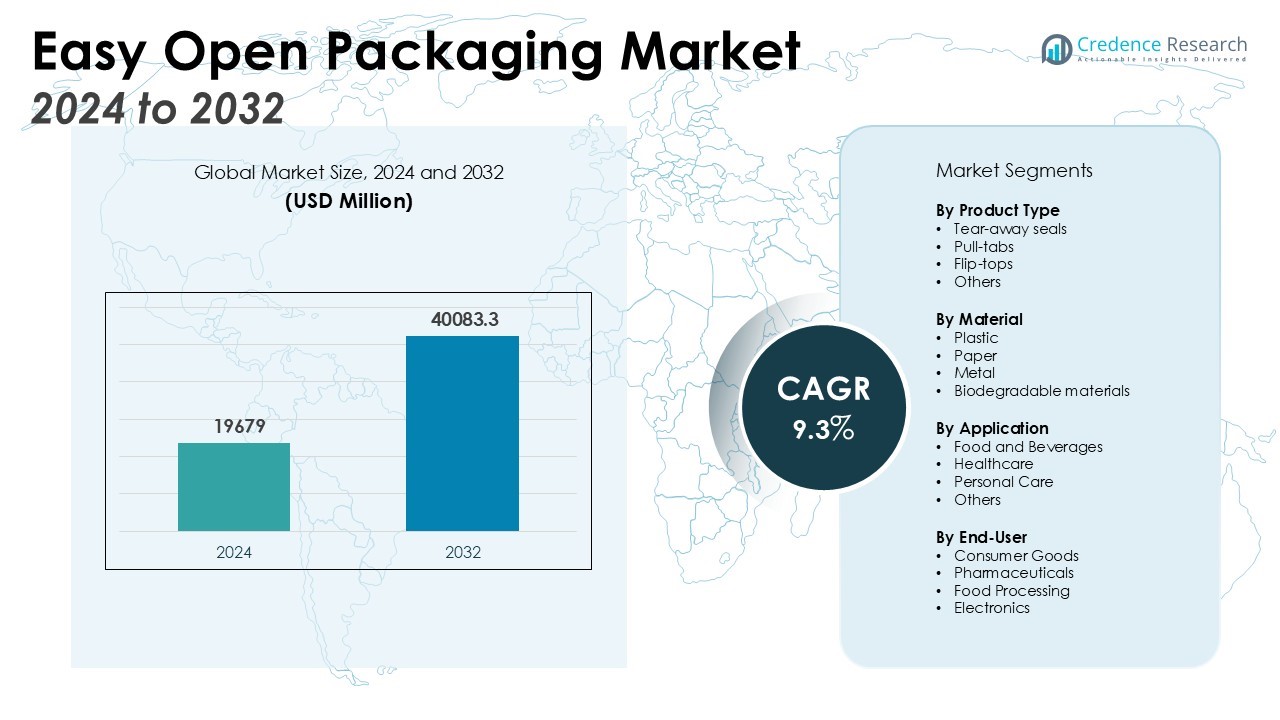
The Easy Open Packaging Market size was valued at USD 19679 million in 2024 and is anticipated to reach USD 40083.3 million by 2032, at a CAGR of 9.3% during the forecast period (2024-2032).
| REPORT ATTRIBUTE | DETAILS |
|---|---|
| Historical Period | 2020-2024 |
| Base Year | 2024 |
| Forecast Period | 2025-2032 |
| Easy Open Packaging Market Size 2024 | USD 19679 Million |
| Easy Open Packaging Market, CAGR | 9.3% |
| Easy Open Packaging Market Size 2032 | USD 40083.3 Million |
The primary drivers of this market include the rising consumer preference for convenience, especially in the fast-paced lifestyle of urban areas. The growing focus on sustainability, along with innovations in packaging materials such as biodegradable and recyclable solutions, is further fueling market growth. Additionally, advancements in technology, such as tamper-proof features and easy-to-open seals, are contributing to the demand for easy open packaging. Companies are investing in packaging innovations that improve consumer experience and align with eco-friendly trends. Furthermore, the increased demand for e-commerce packaging solutions is driving the adoption of easy open packaging.
Regionally, North America holds a significant share in the Easy Open Packaging Market, driven by high demand for convenience packaging in the U.S. and Canada. The Asia Pacific region is expected to witness the highest growth, attributed to increasing urbanization and changing consumer lifestyles in emerging economies such as China and India.
Market Insights:
- The Easy Open Packaging Market size was valued at USD 19,679 million in 2024 and is expected to reach USD 40,083.3 million by 2032, growing at a CAGR of 9.3%.
- Rising consumer demand for convenience drives the market, with packaging solutions like tear-away seals and pull-tabs becoming essential in various industries.
- Sustainability is a key driver, with companies adopting biodegradable and recyclable materials to meet growing environmental concerns.
- Technological innovations, such as tamper-proof seals and smart packaging, are enhancing both product security and consumer engagement.
- The e-commerce boom is increasing demand for easy-to-open packaging solutions that improve customer satisfaction and convenience.
- Balancing ease of use with packaging durability remains a challenge, as packaging must ensure product protection while offering convenience.
- North America holds a 35% market share, driven by consumer preference for convenience packaging, while Asia Pacific (30%) and Europe (25%) follow with strong growth prospects.
Market Drivers:
Rising Consumer Demand for Convenience
The increasing demand for convenience plays a central role in the growth of the Easy Open Packaging Market. Consumers are looking for packaging that allows easy access to products, particularly in fast-paced environments. Products that require minimal effort to open, such as tear-away seals or pull-tabs, cater to the busy lifestyle of modern consumers. This trend is evident across various industries, including food, beverages, and healthcare, where user-friendly packaging is becoming essential. Packaging that simplifies the consumer experience not only boosts satisfaction but also promotes brand loyalty. The ease of use becomes an important purchasing factor, especially in competitive markets.
- For instance, Keystone Folding Box’s Ecoslide Series blister packs feature recyclable materials and a safety feature eliminating the need for difficult peel/push foil, making it easier for consumers and supporting over-the-counter medicine brands to boost production capacity by 20,000 packs daily.
Focus on Sustainability in Packaging Materials
Sustainability has become a key factor driving the Easy Open Packaging Market. Packaging manufacturers are under increasing pressure to adopt environmentally friendly practices, including the use of biodegradable and recyclable materials. Consumers and businesses alike are increasingly prioritizing sustainability, encouraging the development of packaging solutions that minimize environmental impact. Bioplastics and other eco-friendly materials are gaining popularity, aligning with global sustainability goals. With environmental concerns rising, sustainable packaging solutions are expected to play a significant role in the market's future growth.
- For instance, Danimer Scientific has optimized production at its Winchester, Kentucky facility to an annual output of 20 million pounds of Nodax PHA biopolymer, which is certified to biodegrade in industrial composting, backyard compost, soil, and marine environments.
Advancements in Packaging Technology
Technological advancements are significantly shaping the Easy Open Packaging Market. Companies are introducing innovative features, such as tamper-proof seals, that enhance the safety and convenience of packaging. Packaging that offers secure yet effortless opening experiences is particularly important in sectors like pharmaceuticals and food. The integration of smart packaging technologies, which may include QR codes or RFID, is expanding consumer engagement and improving functionality. These innovations help meet growing consumer expectations for both security and convenience in product packaging.
Increased Demand from E-commerce
The rapid growth of e-commerce is contributing to the rise of easy open packaging solutions. With online shopping, packaging needs to be both protective and convenient for consumers who may open and dispose of packages quickly. Easy-to-open packaging solutions reduce frustration and enhance the customer experience. Retailers and e-commerce businesses are increasingly investing in packaging that improves efficiency and customer satisfaction. This shift is encouraging packaging manufacturers to adapt their designs, ensuring products are delivered safely and are easy to open for end users.
Market Trends:
Shift Towards Eco-friendly and Sustainable Packaging
The Easy Open Packaging Market is witnessing a growing shift towards eco-friendly and sustainable solutions. Consumers and businesses alike are increasingly concerned about the environmental impact of packaging materials, leading to the adoption of biodegradable, recyclable, and compostable materials. Many packaging manufacturers are innovating with renewable resources, such as plant-based plastics and paper alternatives, to reduce carbon footprints. This trend is not only driven by regulatory pressures but also by consumer demand for sustainable products. Packaging solutions that combine ease of use with environmental benefits are gaining traction across industries like food, cosmetics, and pharmaceuticals. Companies are focusing on reducing the environmental footprint of their packaging while maintaining functionality and ease of opening.
- For instance, Nestlé has committed to making all its packaging recyclable or reusable by the end of 2025 and launched the first Maggi bouillon cubes packaged in recyclable paper in France.
Integration of Smart Packaging Solutions
Smart packaging is emerging as a key trend in the Easy Open Packaging Market, with companies integrating advanced features to enhance user experience. Technologies like tamper-proof seals, QR codes, and NFC (Near Field Communication) chips are being embedded into packaging to provide added value for both brands and consumers. These features offer increased security, real-time product information, and improved interactivity. Packaging manufacturers are also exploring the integration of sensors that track the freshness of products, particularly in the food and beverage sector. This trend reflects a broader move towards enhancing convenience, safety, and connectivity in packaging. It highlights the industry's commitment to improving consumer engagement and satisfaction through innovative packaging solutions.
- For instance, Fresh Detect’s Insignia Freshness Sensor has been demonstrated to maintain fresh-cut fruit freshness for up to 14 days, effectively extending shelf life beyond traditional packaging.
Market Challenges Analysis:
Balancing Convenience with Packaging Durability
One of the key challenges in the Easy Open Packaging Market is balancing convenience with packaging durability. While easy-to-open features are increasingly popular, they must not compromise the protective qualities of the packaging. Products, especially in sectors like food, pharmaceuticals, and electronics, require packaging that ensures product safety during transit and storage. Achieving the right balance between ease of use and maintaining integrity can be difficult, as thinner materials used for easier opening may not offer the same protection as more rigid packaging. This challenge often leads to higher costs and design complexities for manufacturers seeking to meet both convenience and durability demands.
Rising Costs of Sustainable Packaging Materials
The rising cost of sustainable packaging materials is another significant challenge in the Easy Open Packaging Market. While there is a growing demand for eco-friendly solutions, the materials required to meet sustainability standards can be more expensive than traditional options. Biodegradable and recyclable materials often come at a premium, impacting the overall cost of production. For many companies, the higher costs of sourcing and manufacturing these materials can be a barrier to adopting sustainable packaging. This cost pressure may hinder the widespread adoption of easy-to-open, environmentally friendly packaging, particularly for smaller businesses with limited budgets.
Market Opportunities:
Growth in the E-commerce and Online Retail Sectors
The continued expansion of the e-commerce and online retail sectors presents significant opportunities for the Easy Open Packaging Market. As online shopping continues to rise globally, there is an increasing demand for packaging solutions that are both secure and convenient for consumers. Easy-to-open packaging enhances the customer experience, especially for products delivered directly to consumers. Retailers are looking for packaging that allows easy access while ensuring product safety during shipping. This trend opens opportunities for manufacturers to innovate and provide packaging solutions tailored to the needs of e-commerce businesses, fostering long-term growth in the market.
Rising Demand for Sustainable and Eco-friendly Packaging Solutions
With the growing emphasis on sustainability, the Easy Open Packaging Market has a notable opportunity to expand by offering environmentally friendly solutions. Consumer preference for sustainable packaging continues to rise, driving demand for biodegradable, recyclable, and compostable packaging materials. Companies that can effectively integrate ease of use with sustainable practices will be well-positioned to capture market share. This opportunity extends across multiple industries, including food, personal care, and consumer electronics, where consumers prioritize eco-conscious choices. Packaging manufacturers that invest in these solutions will tap into a broad consumer base seeking environmentally responsible products.
Market Segmentation Analysis:
By Product Type
The Easy Open Packaging Market is segmented into tear-away seals, pull-tabs, flip-tops, and other product types. Tear-away seals and pull-tabs are particularly popular in the food and beverage industry due to their ease of use and efficiency. These products cater to the growing consumer preference for packaging that requires minimal effort to open, enhancing the overall user experience.
By Material
The market is divided into plastic, paper, metal, and biodegradable materials. Plastic remains the dominant material due to its flexibility and cost-effectiveness. However, biodegradable materials are gaining traction as consumers and businesses become more focused on sustainability. The increasing use of recyclable and eco-friendly materials reflects the rising environmental awareness and regulatory pressures driving the market.
- For instance, Amcor, in partnership with Nestlé, introduced the world’s first recyclable flexible retort pouch using AmLite HeatFlex technology for wet pet food; this innovation supports Amcor’s pledge to make all packaging recyclable or reusable by 2025.
By Application
The Easy Open Packaging Market is applied across several industries, including food and beverages, healthcare, personal care, and others. The food and beverage sector holds the largest share, as easy-to-open packaging solutions are highly demanded for packaged food products. The healthcare sector also contributes significantly, with packaging solutions designed to improve safety and convenience for pharmaceutical products. The personal care industry is evolving similarly, seeking packaging solutions that combine convenience with sustainability.
- For instance, Beiersdorf, together with partners in the Design4Circularity initiative, developed colorless polyolefin bottles made of 100% post-consumer recycled content for cosmetic products, enabling the creation of bottles that are fully recyclable and reusable across multiple product cycles.
Segmentations:
By Product Type
- Tear-away seals
- Pull-tabs
- Flip-tops
- Others
By Material
- Plastic
- Paper
- Metal
- Biodegradable materials
By Application
- Food and Beverages
- Healthcare
- Personal Care
- Others
By End-User
- Consumer Goods
- Pharmaceuticals
- Food Processing
- Electronics
By Region
- North America
- U.S.
- Canada
- Mexico
- Europe
- Germany
- France
- U.K.
- Italy
- Spain
- Rest of Europe
- Asia Pacific
- China
- Japan
- India
- South Korea
- South-east Asia
- Rest of Asia Pacific
- Latin America
- Brazil
- Argentina
- Rest of Latin America
- Middle East & Africa
- GCC Countries
- South Africa
- Rest of the Middle East and Africa
Regional Analysis:
North America: Leading the Market
North America holds a dominant share of 35% in the Easy Open Packaging Market. This region’s growth is primarily driven by high demand in the United States and Canada, where consumer preferences for convenience and sustainability are on the rise. The increasing demand for packaging that offers ease of use without compromising security fuels market expansion across sectors such as food, pharmaceuticals, and personal care. Manufacturers in North America are also adopting new technologies, such as tamper-proof seals and recyclable materials, to meet consumer expectations for both functionality and safety. The presence of major packaging companies in the region further accelerates innovation and market growth.
Asia Pacific: Experiencing Rapid Growth
Asia Pacific accounts for a 30% share in the Easy Open Packaging Market and is expected to experience the highest growth rate during the forecast period. The region's rapid urbanization, coupled with an expanding middle class in countries like China, India, and Japan, is driving increased demand for convenient packaging solutions. Rising disposable incomes are influencing consumer spending on packaged goods, with a preference for packaging that provides ease of access. The market is further propelled by packaging manufacturers’ efforts to offer cost-efficient solutions while maintaining convenience and security. The growing popularity of ready-to-use products in the food and beverage, healthcare, and personal care industries contributes to this growth.
Europe: Steady Market Growth
Europe holds a 25% share in the Easy Open Packaging Market, with steady growth driven by sustainability efforts and consumer awareness. Countries such as Germany, the UK, and France lead the market, where eco-friendly packaging solutions are increasingly in demand. Regulatory pressures, such as the European Union's directives on plastic waste reduction, are encouraging companies to invest in sustainable materials and innovative designs. The region’s focus on health and safety standards also drives demand for tamper-proof and easy-to-open packaging, particularly in food and pharmaceuticals. The combination of convenience and environmental consciousness is shaping market trends in Europe.
Key Player Analysis:
- Huhtamaki Oyj
- Smurfit Kappa Group
- Amcor Limited
- AptarGroup, Inc.
- WestRock Company
- Sonoco Products Company
- DS Smith Plc
- Crown Holdings, Inc.
- Mondi Group
- Sealed Air Corporation
- Berry Global Inc.
- Reynolds Group Holdings Limited
- Bemis Company, Inc.
Competitive Analysis:
The Easy Open Packaging Market is highly competitive, with numerous players focusing on innovation, sustainability, and convenience. Key companies in the market include Amcor plc, Berry Global Inc., Sealed Air Corporation, and Smurfit Kappa Group. These companies lead by offering advanced packaging solutions, including easy-to-open features like pull-tabs and tear-away seals, while also emphasizing eco-friendly materials such as biodegradable plastics and recyclable options. They are continually investing in research and development to enhance product functionality and reduce environmental impact. The market is also seeing the emergence of new players offering niche solutions and sustainable packaging alternatives, driving further competition. Companies are expanding their product portfolios to meet the growing demand from industries like food and beverages, healthcare, and personal care. As sustainability becomes a key concern, market leaders are working to balance convenience with environmental responsibility, aiming for long-term growth and market dominance.
Recent Developments:
- In March 2025, Amcor launched an industry-first 2oz retort bottle for nutritional shots using StormPanel™ technology, in partnership with Insymmetry.
- In May 2025, Crown Holdings partnered with San Juan Beverage Company to become the exclusive packaging provider for SAN JUAN BAMMARITA, a premium ready-to-drink cocktail.
Market Concentration & Characteristics:
The Easy Open Packaging Market is moderately concentrated, with a few dominant players holding significant market share, such as Amcor plc, Berry Global Inc., and Sealed Air Corporation. These companies lead by offering innovative, user-friendly packaging solutions that meet consumer demand for convenience and sustainability. The market is characterized by strong competition among established players, focusing on technological advancements and eco-friendly materials. New entrants are also emerging, especially in the sustainable packaging space, creating a dynamic market landscape. Companies in the market emphasize research and development to improve product performance, reduce costs, and enhance environmental impact. The growing demand for easy-to-open solutions in industries like food and beverages, healthcare, and personal care further intensifies competition, encouraging continuous innovation and expansion of product portfolios.
Report Coverage:
The research report offers an in-depth analysis based on Product Type, Material, Application, End-User and Region. It details leading market players, providing an overview of their business, product offerings, investments, revenue streams, and key applications. Additionally, the report includes insights into the competitive environment, SWOT analysis, current market trends, as well as the primary drivers and constraints. Furthermore, it discusses various factors that have driven market expansion in recent years. The report also explores market dynamics, regulatory scenarios, and technological advancements that are shaping the industry. It assesses the impact of external factors and global economic changes on market growth. Lastly, it provides strategic recommendations for new entrants and established companies to navigate the complexities of the market.
Future Outlook:
- The Easy Open Packaging Market is experiencing significant growth, driven by increasing consumer demand for convenience and user-friendly packaging solutions.
- Technological advancements are enhancing packaging functionality, with innovations like tamper-evident seals and smart packaging features improving product safety and consumer engagement.
- The shift towards sustainability is evident, as companies adopt biodegradable and recyclable materials to meet environmental standards and consumer preferences.
- E-commerce expansion is influencing packaging design, with a focus on lightweight, protective, and easy-to-open solutions to enhance the online shopping experience.
- Consumer preference is shifting towards minimalistic and functional packaging designs, emphasizing ease of use and environmental responsibility.
- Regulatory pressures are encouraging the adoption of sustainable packaging practices, prompting companies to innovate and comply with environmental guidelines.
- The food and beverage industry remains a significant driver, with increasing demand for convenient and safe packaging solutions to meet consumer needs.
- Emerging markets are contributing to market growth, with rising disposable incomes and urbanization leading to increased demand for packaged goods.
- Competitive strategies include mergers and acquisitions, as companies seek to expand their product portfolios and technological capabilities.
- The market's future is poised for continued growth, with ongoing innovations and shifts in consumer behavior shaping the packaging industry's landscape.

Request a Free Sample
Fill in your details and we'll send you a free sample report.
- Sample data tables & charts
- Research methodology
Market Dynamics
Rising Consumer Demand for Convenience
Consumers increasingly seek packaging that is easy to open and use, especially in fast-paced urban environments. Features like tear-away seals and pull-tabs enhance user experience and drive brand loyalty, making convenience a key purchasing factor.
Focus on Sustainability in Packaging Materials
Growing environmental concerns and regulatory pressures are pushing manufacturers to adopt biodegradable and recyclable materials. This shift aligns with consumer preferences for eco-friendly products and is accelerating the adoption of sustainable easy open packaging solutions.
Advancements in Packaging Technology
Innovations such as tamper-proof seals, smart packaging, and improved opening mechanisms are enhancing both product security and consumer engagement. These technological advancements make packaging safer and more user-friendly, supporting market growth.
Increased Demand from E-commerce
The rapid expansion of e-commerce requires packaging that is both protective and easy to open, improving customer satisfaction and reducing frustration. Retailers and brands are investing in easy open packaging to enhance the unboxing experience and streamline returns.
Growth in Food and Beverage Industry
The food and beverage sector is a major adopter of easy open packaging, as consumers demand convenient, safe, and hygienic solutions for packaged foods. This industry's growth directly fuels the need for innovative packaging formats that balance ease of use with product protection.
Need a Custom Version of This Report?
Tailor the scope, geography, or segments to your exact requirements.
- Custom geography or segment scope
- Direct access to our analyst team
Frequently Asked Questions
What is the current size of the Easy Open Packaging Market?
What factors are driving the growth of the Easy Open Packaging Market?
What are the key segments within the Easy Open Packaging Market?
What are some challenges faced by the Easy Open Packaging Market?
Who are the major players in the Easy Open Packaging Market?
Which segment is leading the market share?
Table of Content
Chapter 1 Market Segmentation
- 1.1 Segmentation Framework
- 1.1.1 Product and Service Classification
- 1.1.2 Application and End-Use Classification
- 1.1.3 Technology and Solution Classification
- 1.1.4 Customer and Distribution Channel Classification
- 1.1.5 Geographic Segmentation
- 1.1.6 Market Segment Definitions and Boundaries
- 1.2 By End-User
- 1.2.1 Consumer Goods
- 1.2.2 Pharmaceuticals
- 1.2.3 Food Processing
- 1.2.4 Electronics
- 1.3 By Material
- 1.3.1 Plastic
- 1.3.2 Paper
- 1.3.3 Metal
- 1.3.4 Biodegradable materials
- 1.4 By Application
- 1.4.1 Food and Beverages
- 1.4.2 Healthcare
- 1.4.3 Personal Care
- 1.4.4 Others
- 1.5 By Product Type
- 1.5.1 Tear-away seals
- 1.5.2 Pull-tabs
- 1.5.3 Flip-tops
- 1.5.4 Others
Chapter 2 Introduction
- 2.1 Report Objectives and Scope
- 2.2 Product Definition and Industry Terminology
- 2.3 Market Inclusions and Exclusions
- 2.4 Research Process
- 2.4.1 Primary Research and Expert Interviews
- 2.4.2 Secondary Research and Source Review
- 2.4.3 Top-Down and Bottom-Up Estimation
- 2.4.4 Data Triangulation and Verification
- 2.5 Market Size Measurement Basis
- 2.5.1 2024: USD 19,679 million → 2032: USD 40,083.3 million
- 2.6 Historical and Forecast Reference Periods
- 2.6.1 Base Year: 2024
- 2.6.2 Forecast Period: 2024-2032
- 2.7 Research Assumptions and Limitations
Chapter 3 Executive Summary
- 3.1 Market Snapshot and Key Findings
- 3.2 Base-Year Market Size, 2024
- 3.3 Forecast Market Size, 2032
- 3.4 Revenue and Volume Growth Outlook
- 3.5 Key Demand and Supply Indicators
- 3.6 Leading Market Segments
- 3.7 Fastest-Growing Market Opportunities
- 3.8 Regional Performance Highlights
- 3.9 Technology and Industry Transformation
- 3.10 Competitive Landscape Summary
- 3.11 Analyst View and Strategic Implications
Chapter 4 Global Easy Open Packaging Market Trends and Developments
- 4.1 Historical Industry Development
- 4.2 Recent Market Trends and Developments
- 4.3 Demand and Customer Behavior Trends
- 4.4 Technology and Product Innovation
- 4.5 Artificial Intelligence, Automation and Digitalization
- 4.6 Local Manufacturing and Supply Chain Realignment
- 4.7 Industry Partnerships, Mergers and Acquisitions
- 4.8 Sustainability and Circular Economy Developments
- 4.9 Government and Private Sector Investment Trends
- 4.10 Emerging Business Models and Commercialization
- 4.11 Industry Developments and Announcements
Chapter 5 Global Easy Open Packaging Market Production, Supply and Demand Analysis
- 5.1 Demand Trend and Consumption Analysis
- 5.2 Demand Forecast, 2024-2032
- 5.3 Production and Output Trend
- 5.4 Production and Output Forecast, 2024-2032
- 5.5 Installed Capacity and Capacity Utilization
- 5.6 Company-Wise Production Plants and Statistics
- 5.6.1 Installed Production Capacity
- 5.6.2 Actual Production
- 5.6.3 Planned Capacity and Expansion Targets
- 5.7 Supply Chain Structure and Procurement Trends
- 5.8 Supply-Demand Gap and Bottlenecks
- 5.9 Import Dependence and Sourcing Structure
- 5.10 Contract Manufacturing and Outsourcing
- 5.11 Regional Supply and Demand Concentration
Chapter 6 Global Easy Open Packaging Market Pricing Analysis
- 6.1 Pricing Structure and Measurement
- 6.2 Historical Pricing Trends
- 6.3 Pricing Outlook, 2024-2032
- 6.4 Average Selling Price and Unit Economics
- 6.5 Pricing by Product and Market Segment
- 6.6 Geographic Pricing Differences
- 6.7 Key Input, Energy, Labor and Logistics Costs
- 6.8 Contract Pricing and Purchasing Models
- 6.9 Pricing Sensitivity and Competitive Positioning
- 6.10 Price, Margin and Profitability Implications
Chapter 7 Global Easy Open Packaging Market Dynamics
- 7.1 Market Growth Drivers
- 7.1.1 Demand-Side Drivers
- 7.1.2 Technology and Innovation Drivers
- 7.1.3 Infrastructure and Investment Drivers
- 7.1.4 Regulatory and Policy Drivers
- 7.2 Market Restraints
- 7.2.1 Cost and Affordability Constraints
- 7.2.2 Technology and Adoption Barriers
- 7.2.3 Supply Chain and Operational Constraints
- 7.3 Market Challenges
- 7.3.1 Competitive Pressure and Margin Erosion
- 7.3.2 Skills, Infrastructure and Implementation Gaps
- 7.4 Emerging Market Opportunities
- 7.5 Market Dynamics Impact and Time-Horizon Assessment
Chapter 8 Global Easy Open Packaging Value Chain Analysis
- 8.1 Industry Value Chain Overview
- 8.2 Upstream Suppliers and Critical Inputs
- 8.3 Technology and Component Providers
- 8.4 Manufacturing or Service Delivery
- 8.5 Distribution, Channel Partners and Integrators
- 8.6 Downstream Applications and End Users
- 8.7 Value Addition and Profit Pools
- 8.8 Vertical Integration and Outsourcing
- 8.9 Supplier Concentration and Risk
- 8.10 Supply Chain Localization and Resilience
Chapter 9 Global Easy Open Packaging Market Regulations and Policies
- 9.1 Relevant Laws, Standards and Compliance Frameworks
- 9.2 Product, Service, Safety and Quality Requirements
- 9.3 Government Policies, Incentives and Subsidies
- 9.4 Imports, Exports and Trade Barriers
- 9.5 Public Procurement and Local Content Requirements
- 9.6 Environmental and Sustainability Compliance
- 9.7 Upcoming Policy Changes and Market Implications
Chapter 10 Global Easy Open Packaging Market Hotspots and Opportunities
- 10.1 Market Opportunity Mapping and Growth Hotspots
- 10.2 High-Growth Applications and Customer Groups
- 10.3 Underserved Markets and White-Space Opportunities
- 10.4 Emerging Technology and Product Opportunities
- 10.5 New Capacity and Investment Hotspots
- 10.6 Market Entry and Expansion Opportunities
- 10.7 Distribution and Partnership Opportunities
- 10.8 Near-Term and Long-Term Commercial Potential
- 10.9 Opportunity Attractiveness and Execution Risks
Chapter 11 Global Easy Open Packaging Market Outlook, 2024-2032
- 11.1 Market Size and Analysis
- 11.1.1 Revenue (Market Measurement: 2024: USD 19,679 million → 2032: USD 40,083.3 million)
- 11.1.2 Market Volume and Quantity Sold
- 11.1.3 Historical Market Size
- 11.1.4 Base-Year Market Size, 2024
- 11.2 Market Forecast, 2024-2032
- 11.2.1 Revenue Forecast to 2032
- 11.2.2 Volume Forecast to 2032
- 11.2.3 CAGR and Year-on-Year Growth
- 11.2.4 Incremental Revenue Opportunity
- 11.3 Forecast Assumptions and Scenario Analysis
- 11.3.1 Base-Case Forecast
- 11.3.2 Optimistic and Conservative Scenarios
- 11.3.3 Technology, Pricing and Policy Sensitivities
- 11.4 Market Attractiveness and Growth Outlook
Chapter 12 Global Easy Open Packaging Market Segmentation and Outlook
- 12.1 Segmentation Summary and Market Shares, 2024
- 12.2 Largest and Fastest-Growing Segments
- 12.3 By End-User - Market Size and Forecast, 2024-2032
- 12.3.1 Segment Definition and Scope
- 12.3.2 Historical Market Size
- 12.3.3 Revenue Forecast, 2024-2032
- 12.3.4 Volume Forecast, 2024-2032
- 12.3.5 Base-Year Market Share, 2024
- 12.3.6 Segment CAGR and Growth Drivers
- 12.3.7 Subsegment Market Size and Forecast
- 12.3.7.1 Consumer Goods
- 12.3.7.2 Pharmaceuticals
- 12.3.7.3 Food Processing
- 12.3.7.4 Electronics
- 12.3.8 Subsegment Pricing and Adoption Trends
- 12.3.9 Leading Suppliers and Competition
- 12.3.10 Regional Demand and Opportunities
- 12.4 By Material - Market Size and Forecast, 2024-2032
- 12.4.1 Segment Definition and Scope
- 12.4.2 Historical Market Size
- 12.4.3 Revenue Forecast, 2024-2032
- 12.4.4 Volume Forecast, 2024-2032
- 12.4.5 Base-Year Market Share, 2024
- 12.4.6 Segment CAGR and Growth Drivers
- 12.4.7 Subsegment Market Size and Forecast
- 12.4.7.1 Plastic
- 12.4.7.2 Paper
- 12.4.7.3 Metal
- 12.4.7.4 Biodegradable materials
- 12.4.8 Subsegment Pricing and Adoption Trends
- 12.4.9 Leading Suppliers and Competition
- 12.4.10 Regional Demand and Opportunities
- 12.5 By Application - Market Size and Forecast, 2024-2032
- 12.5.1 Segment Definition and Scope
- 12.5.2 Historical Market Size
- 12.5.3 Revenue Forecast, 2024-2032
- 12.5.4 Volume Forecast, 2024-2032
- 12.5.5 Base-Year Market Share, 2024
- 12.5.6 Segment CAGR and Growth Drivers
- 12.5.7 Subsegment Market Size and Forecast
- 12.5.7.1 Food and Beverages
- 12.5.7.2 Healthcare
- 12.5.7.3 Personal Care
- 12.5.7.4 Others
- 12.5.8 Subsegment Pricing and Adoption Trends
- 12.5.9 Leading Suppliers and Competition
- 12.5.10 Regional Demand and Opportunities
- 12.6 By Product Type - Market Size and Forecast, 2024-2032
- 12.6.1 Segment Definition and Scope
- 12.6.2 Historical Market Size
- 12.6.3 Revenue Forecast, 2024-2032
- 12.6.4 Volume Forecast, 2024-2032
- 12.6.5 Base-Year Market Share, 2024
- 12.6.6 Segment CAGR and Growth Drivers
- 12.6.7 Subsegment Market Size and Forecast
- 12.6.7.1 Tear-away seals
- 12.6.7.2 Pull-tabs
- 12.6.7.3 Flip-tops
- 12.6.7.4 Others
- 12.6.8 Subsegment Pricing and Adoption Trends
- 12.6.9 Leading Suppliers and Competition
- 12.6.10 Regional Demand and Opportunities
- 12.7 Segment Growth Comparison
- 12.8 Segment Attractiveness and Priority Matrix
Chapter 13 Global Easy Open Packaging End-Use and Application Market Outlook
- 13.1 End-Use Industry and Customer Demand Structure
- 13.2 Leading Applications and Customer Groups
- 13.3 End-Use Market Size, Share and Forecast
- 13.4 Major End-Use Industry Deep Dives
- 13.4.1 Customer Requirements and Use Cases
- 13.4.2 Demand and Replacement Cycles
- 13.4.3 Technical and Regulatory Considerations
- 13.4.4 Purchasing and Procurement Models
- 13.4.5 Leading Vendors and Distribution Channels
- 13.4.6 Forecast and Commercial Opportunities
- 13.5 Emerging Applications and Cross-Segment Demand
- 13.6 End-Use Industry Investment Priorities
Chapter 14 Global Easy Open Packaging Geographic Market Outlook, 2024-2032
- 14.1 Regional Market Size and Share, 2024
- 14.2 Regional Market Forecast, 2024-2032
- 14.3 Regional Pricing, Production and Demand Differences
- 14.4 North America
- 14.4.1 United States
- 14.4.2 Canada
- 14.4.3 Mexico
- 14.5 Europe
- 14.5.1 Germany
- 14.5.2 France
- 14.5.3 Italy
- 14.5.4 United Kingdom
- 14.5.5 Spain
- 14.5.6 Poland
- 14.5.7 Russia
- 14.5.8 Netherlands
- 14.5.9 Belgium
- 14.5.10 Sweden
- 14.5.11 Denmark
- 14.5.12 Norway
- 14.5.13 Rest of Europe
- 14.6 Asia Pacific
- 14.6.1 China
- 14.6.2 India
- 14.6.3 Japan
- 14.6.4 South Korea
- 14.6.5 Thailand
- 14.6.6 Indonesia
- 14.6.7 Vietnam
- 14.6.8 Malaysia
- 14.6.9 Australia
- 14.6.10 Rest of Asia Pacific
- 14.7 Latin America
- 14.7.1 Brazil
- 14.7.2 Argentina
- 14.7.3 Colombia
- 14.7.4 Chile
- 14.7.5 Rest of Latin America
- 14.8 Middle East
- 14.8.1 Saudi Arabia
- 14.8.2 United Arab Emirates
- 14.8.3 Turkey
- 14.8.4 Israel
- 14.8.5 Iran
- 14.8.6 Rest of the Middle East
- 14.9 Africa
- 14.9.1 South Africa
- 14.9.2 Egypt
- 14.9.3 Nigeria
- 14.9.4 Morocco
- 14.9.5 Rest of Africa
- 14.10 Regional Investment, Policy and Supply Chain Differences
- 14.11 Regional Competitive Landscape
- 14.12 Geographic Growth Hotspots
Chapter 15 Global Easy Open Packaging Technology, Innovation and Sustainability Outlook
- 15.1 Technology Landscape and Maturity
- 15.2 Product, Process and Service Innovation
- 15.3 AI, Automation and Digital Tools in the Industry
- 15.4 Technology Adoption and Performance Benchmarking
- 15.5 Innovation Pipeline and R&D Investment
- 15.6 Patent and Intellectual Property Trends
- 15.7 Energy Efficiency and Resource Management
- 15.8 Sustainability, Recycling and Circularity
- 15.9 Technology Roadmap, 2024-2032
- 15.10 Risks of Obsolescence and Technology Substitution
Chapter 16 Global Easy Open Packaging Market Key Strategic Imperatives
- 16.1 Growth and Market Entry Priorities
- 16.2 High-Return Products and Segments
- 16.3 Pricing, Profitability and Cost Optimization
- 16.4 Technology Investment and Product Differentiation
- 16.5 Supply Chain Localization and Resilience
- 16.6 Distribution and Customer Acquisition
- 16.7 Partnership, Acquisition and Capacity Strategy
- 16.8 Regional Expansion Priorities
- 16.9 Short-, Medium- and Long-Term Actions
Chapter 17 Competition Outlook
- 17.1 Industry Competition Characteristics
- 17.2 Market Structure and Concentration
- 17.3 Market Share and Competitive Positioning, 2024
- 17.4 Company-Wise Revenue and Product Benchmarking
- 17.5 Production and Service Capacity Benchmarking
- 17.6 Technology, Pricing and Differentiation
- 17.7 Regional Footprint and Distribution Strength
- 17.8 Mergers, Acquisitions and Strategic Alliances
- 17.9 New Entrants and Competitive Threats
- 17.10 Porter's Five Forces and Industry Attractiveness
- 17.11 Competitive Outlook, 2024-2032
Chapter 18 Company Profiles
- 18.1 Company Coverage and Selection Criteria
- 18.2 Amcor Limited
- 18.2.1 Business Description
- 18.2.2 Company Ownership and Geographic Presence
- 18.2.3 Product and Service Portfolio
- 18.2.4 Manufacturing and Operating Footprint
- 18.2.5 Production Capacity and Expansion Plans
- 18.2.6 Financial Performance and Investment
- 18.2.7 Market Share and Competitive Position
- 18.2.8 Technology and Innovation Capabilities
- 18.2.9 Strategic Alliances or Partnerships
- 18.2.10 Recent Developments
- 18.2.11 Growth Strategy and Outlook
- 18.3 Huhtamaki Oyj
- 18.4 Smurfit Kappa Group
- 18.5 AptarGroup, Inc.
- 18.6 WestRock Company
- 18.7 Sonoco Products Company
- 18.8 DS Smith Plc
- 18.9 Crown Holdings, Inc.
- 18.10 Mondi Group
- 18.11 Sealed Air Corporation
- 18.12 Other Relevant Market Participants
Note: Every listed company is profiled on the structure shown under the first company. The company list is preliminary and may change based on research findings, market developments, data availability and client requirements.
Chapter 19 Disclaimer
- 19.1 Research and Forecast Disclaimer
- 19.2 Data Source and Estimation Limitations
Note: The depth of individual sections depends on data availability for this market. Volume, capacity, trade and other unit-based metrics are included where applicable.

