
Market Overview:
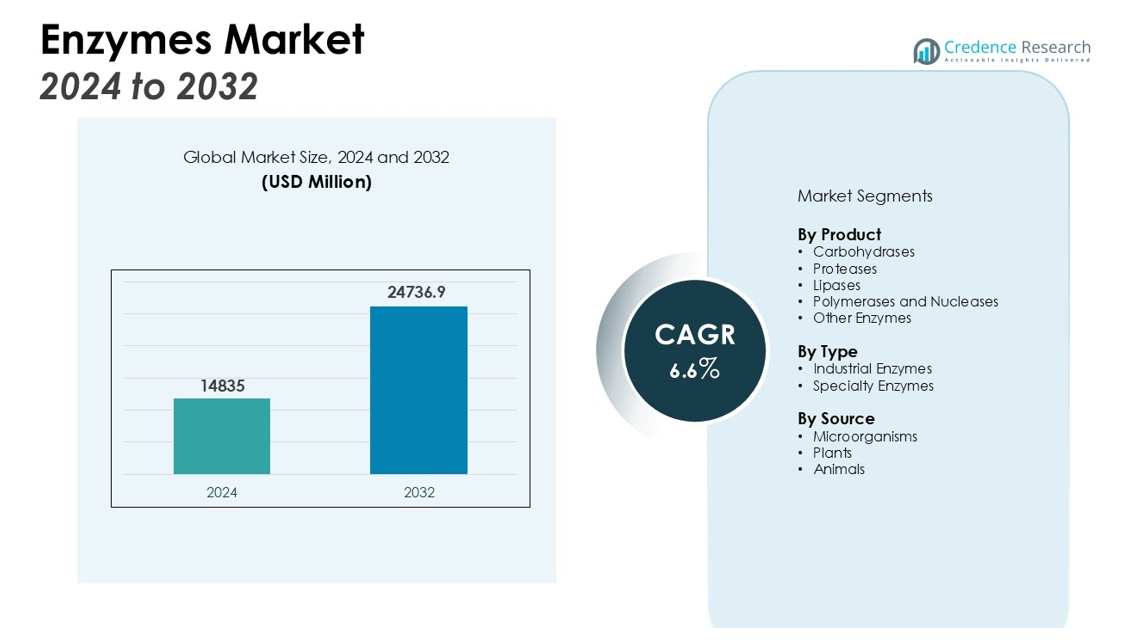
The Enzymes Market size was valued at USD 14835 million in 2024 and is anticipated to reach USD 24736.9 million by 2032, at a CAGR of 6.6% during the forecast period (2024-2032).
| REPORT ATTRIBUTE | DETAILS |
|---|---|
| Historical Period | 2020-2023 |
| Base Year | 2024 |
| Forecast Period | 2025-2032 |
| Enzymes Market Size 2024 | USD 14835 million |
| Enzymes Market, CAGR | 6.6% |
| Enzymes Market Size 2032 | USD 24736.9 million |
Market growth is driven by the rising demand for sustainable and eco-friendly solutions in manufacturing and processing industries. The adoption of enzymes in food processing enhances product quality and shelf life, while in pharmaceuticals, they enable efficient drug formulation and targeted therapies. The biofuel sector also benefits from enzymes’ capability to improve conversion efficiency and reduce environmental impact. Ongoing research into enzyme stability, specificity, and cost-effective production is further fueling adoption across sectors. Additionally, the integration of advanced enzyme technologies in emerging sectors such as bioplastics and waste management is opening new avenues for market expansion.
Regionally, North America holds a significant share of the global market, supported by strong demand from the food, pharmaceutical, and biofuel industries. Europe follows closely, driven by strict environmental regulations and technological advancements in enzyme applications. The Asia-Pacific region is expected to witness the fastest growth, attributed to industrial expansion, rising healthcare demand, and increasing investment in biotechnology research.
Market Insights:
- The Enzymes Market is valued at USD 14,835 million and is projected to reach USD 24,736.9 million, growing at a CAGR of 6.6% during the forecast period, supported by diversified industrial applications.
- Rising demand for sustainable and eco-friendly solutions in manufacturing drives the replacement of synthetic chemicals with enzymes, reducing environmental impact and improving efficiency.
- Expanding use in food and beverage processing improves product quality, taste, and shelf life while supporting the clean-label product trend.
- In pharmaceuticals, enzymes enable precise drug formulation, targeted therapies, and biocatalytic processes, enhancing yield and reducing production timelines.
- High production costs and complex manufacturing processes remain key restraints, impacting adoption in price-sensitive industries and regions.
- North America holds 37% of the market, driven by strong demand from food processing, pharmaceuticals, and biofuels, supported by advanced R&D infrastructure.
- Asia-Pacific, with a 24% share, is the fastest-growing region, fueled by industrial expansion, healthcare demand, and biotechnology investment.
Market Drivers:
Rising Demand for Sustainable and Eco-Friendly Industrial Solutions
The Enzymes Market benefits from the global shift toward sustainable manufacturing practices. Industries are increasingly adopting enzymes to replace synthetic chemicals, reducing environmental impact and enhancing operational safety. It enables processes that consume less energy and generate fewer byproducts, aligning with regulatory and consumer expectations. This focus on eco-friendly solutions drives adoption in sectors such as food processing, textiles, and detergents, where sustainability standards are becoming more stringent.
- For instance, Novozymes' Fiberlife® biopolishing solution utilizes enzymes to treat man-made cellulosic fibers like viscose and modal, ensuring the fabric maintains a new-looking, clean surface for at least 60 washes.
Expanding Applications in Food and Beverage Processing
The food and beverage sector remains a key driver for the Enzymes Market, supported by its ability to improve product quality, taste, and shelf life. It facilitates efficient production processes, from baking and brewing to dairy and meat processing. Enzymes help manufacturers meet growing demand for clean-label and minimally processed products without compromising performance. Increasing consumer awareness of health benefits linked to enzyme-based processing further strengthens its position in this sector.
Critical Role in Pharmaceutical and Biotechnology Advancements
In pharmaceuticals, the Enzymes Market plays a crucial role in enabling precise drug formulation and therapeutic applications. It supports the development of biocatalytic processes that enhance yield and reduce production time in drug manufacturing. Enzymes are vital for creating targeted treatments, enzyme replacement therapies, and advanced diagnostic tools. The rising demand for cost-effective, high-purity pharmaceuticals reinforces the importance of enzyme integration in biotech research and development.
- For instance, in the synthesis of the oncology drug belzutifan, Merck's scientists engineered an enzyme that showed a greater than 400,000-fold improvement in efficiency compared to the wild type enzyme.
Contribution to Renewable Energy and Biofuel Efficiency
The biofuel industry relies on the Enzymes Market to improve conversion efficiency and reduce production costs. It enhances the breakdown of biomass into fermentable sugars, leading to higher yields of ethanol and other biofuels. Enzyme-based processes help meet emission reduction targets while enabling sustainable fuel alternatives. Growing government support for renewable energy projects continues to drive investment in advanced enzyme technologies for bioenergy applications.
Market Trends:
Advancements in Enzyme Engineering and Customization
The Enzymes Market is witnessing significant progress in enzyme engineering, enabling tailored solutions for specific industrial needs. It benefits from protein engineering, directed evolution, and computational modeling to enhance enzyme stability, activity, and specificity. These advancements allow manufacturers to design enzymes capable of functioning under extreme conditions, such as high temperatures or varying pH levels. Customized enzyme formulations are gaining traction in sectors like pharmaceuticals, food processing, and textiles, where performance requirements vary widely. Companies are investing heavily in R&D to develop novel enzymes that reduce costs and improve process efficiency. The growing demand for application-specific enzymes is accelerating innovation pipelines across multiple industries.
- For instance, Ginkgo Bioworks utilized its AI platform, Owl, to engineer enzymes for a customer, resulting in a 10-fold improvement in enzyme function over four generations of development.
Integration of Enzymes in Emerging and High-Growth Sectors
The Enzymes Market is expanding its footprint into new applications such as bioplastics, waste management, and precision medicine. It is playing a critical role in supporting the transition toward a circular economy by enabling efficient biodegradation of plastics and organic waste. In healthcare, enzymes are increasingly used in diagnostic kits, gene editing tools, and personalized therapies. The biofuel sector continues to integrate advanced enzyme systems to improve feedstock conversion and reduce carbon emissions. These developments are supported by favorable government policies promoting renewable and sustainable technologies. The convergence of biotechnology, industrial processing, and environmental stewardship is driving broader adoption of enzyme-based solutions across both established and emerging markets.
- For instance, DuPont Industrial Biosciences initiated a program for the agricultural land application of solid waste from its enzyme recovery processes. This project led to the successful annual diversion of 7,200 tons from landfills.
Market Challenges Analysis:
High Production Costs and Complex Manufacturing Processes
The Enzymes Market faces the challenge of high production costs driven by complex extraction, purification, and stabilization requirements. It demands advanced biotechnological infrastructure and skilled expertise, which increase operational expenses. Fluctuating raw material availability further impacts production efficiency and pricing. Manufacturers must invest in precision-controlled environments to maintain enzyme activity and shelf life, adding to cost pressures. Smaller companies often struggle to compete with established players due to these capital-intensive requirements. This cost barrier can limit adoption in price-sensitive industries and regions.
Regulatory Constraints and Stability Concerns in Diverse Applications
Strict regulatory frameworks across pharmaceuticals, food, and environmental applications pose a significant challenge for the Enzymes Market. It must comply with varying global standards, leading to longer approval timelines and increased compliance costs. Enzyme stability during storage, transport, and use remains a technical hurdle, especially in extreme temperature or pH environments. Inconsistent performance under varying industrial conditions can deter widespread adoption. Intellectual property protection complexities also slow innovation and market entry for new products. Addressing these challenges requires continued investment in research, process optimization, and compliance strategies.
Market Opportunities:
Expansion into Renewable Energy and Sustainable Manufacturing
The Enzymes Market holds strong potential in renewable energy and sustainable industrial practices. It supports the production of advanced biofuels by improving biomass conversion efficiency and reducing reliance on fossil fuels. Demand for eco-friendly manufacturing in textiles, paper, and detergents creates new opportunities for enzyme-based solutions. Governments are promoting green technologies through incentives and regulations, which strengthens market prospects. Industrial players are exploring customized enzyme applications to enhance process yields and lower environmental impact. These factors position enzymes as a key enabler in the global transition toward low-carbon economies.
Growth in Healthcare, Biotechnology, and Emerging Applications
The Enzymes Market is set to benefit from rising adoption in pharmaceuticals, diagnostics, and biotechnology research. It enables advancements in enzyme replacement therapies, targeted drug delivery, and precision diagnostics. Increasing investments in healthcare infrastructure and personalized medicine are expanding the scope for enzyme applications. New opportunities are emerging in bioplastics production and waste management, where enzymes improve biodegradation and recycling processes. Collaboration between biotech firms and academic research institutions is driving innovation in next-generation enzyme formulations. These developments are expected to expand market reach into both established and high-growth sectors.
Market Segmentation Analysis:
By Product
The Enzymes Market is segmented by product into carbohydrases, proteases, lipases, polymerases and nucleases, and other specialized enzymes. Carbohydrases hold a dominant share due to their extensive use in food and beverage processing, biofuel production, and textiles. Proteases follow closely, driven by demand in detergents, pharmaceuticals, and leather processing. Lipases are gaining traction in biodiesel production and food processing for their ability to catalyze fat breakdown efficiently. Polymerases and nucleases remain critical in biotechnology, diagnostics, and research applications, supporting advancements in molecular biology.
- For instance, the use of Biolipasa-R, a commercially available lipase, achieved high-yield biodiesel production from low-quality acid oil by utilizing an optimized methanol to oil molar ratio of 3 to 1.
By Type
The market by type includes industrial enzymes and specialty enzymes. Industrial enzymes account for a larger share, supported by high consumption in food processing, biofuels, textiles, and detergents. It enables cost-efficient and sustainable manufacturing processes across these industries. Specialty enzymes, although representing a smaller share, are witnessing rapid growth due to their role in pharmaceuticals, diagnostics, and advanced biotechnology research. Increasing demand for precision-driven applications is expanding the scope for specialty enzymes in healthcare and environmental sectors.
- For instance, the company Rubi Laboratories has developed advanced carbon-to-material platforms using cell-free biocatalysis that report up to 10 times lower energy requirements compared to conventional methods for producing essential products like cellulose.
By Source
Based on source, the market is divided into microorganisms, plants, and animals. Microorganisms dominate due to their ease of cultivation, scalability, and high yield in enzyme production. Plant-derived enzymes hold steady demand in food processing and nutraceuticals, where natural sourcing is valued. Animal-derived enzymes remain relevant in specific medical and industrial uses, although microbial alternatives are increasingly preferred for cost and ethical considerations.
Segmentations:
By Product
- Carbohydrases
- Proteases
- Lipases
- Polymerases and Nucleases
- Other Enzymes
By Type
- Industrial Enzymes
- Specialty Enzymes
By Source
- Microorganisms
- Plants
- Animals
By Region
- North America
- U.S.
- Canada
- Mexico
- Europe
- UK
- France
- Germany
- Italy
- Spain
- Russia
- Belgium
- Netherlands
- Austria
- Sweden
- Poland
- Denmark
- Switzerland
- Rest of Europe
- Asia Pacific
- China
- Japan
- South Korea
- India
- Australia
- Thailand
- Indonesia
- Vietnam
- Malaysia
- Philippines
- Taiwan
- Rest of Asia Pacific
- Latin America
- Brazil
- Argentina
- Peru
- Chile
- Colombia
- Rest of Latin America
- Middle East
- UAE
- KSA
- Israel
- Turkey
- Iran
- Rest of Middle East
- Africa
- Egypt
- Nigeria
- Algeria
- Morocco
- Rest of Africa
Regional Analysis:
North America’s Strong Market Position Driven by Industrial and Healthcare Demand
North America accounted for 37% of the Enzymes Market, supported by strong demand from food processing, pharmaceuticals, and biofuel industries. It benefits from advanced R&D infrastructure, strong biotechnology capabilities, and favorable regulatory frameworks promoting enzyme applications. The presence of major industry players and innovation-driven startups accelerates product development and commercialization. Government incentives for renewable energy and sustainability initiatives further boost enzyme adoption in industrial processes. The region’s well-established healthcare sector also drives demand for therapeutic and diagnostic enzyme applications.
Europe’s Growth Supported by Environmental Regulations and Technological Advancements
Europe held 29% of the Enzymes Market, driven by stringent environmental policies and strong sustainability goals. It has witnessed extensive adoption in food processing, detergents, and textile industries, where regulatory compliance and eco-friendly production methods are essential. European companies are at the forefront of enzyme engineering, leveraging advanced biotechnology to enhance performance and reduce production costs. Supportive policies for renewable energy and waste reduction create further market opportunities. The demand for clean-label food products and pharmaceutical innovation strengthens enzyme utilization across multiple sectors.
Asia-Pacific Emerging as the Fastest-Growing Regional Market
Asia-Pacific captured 24% of the Enzymes Market and is projected to record the highest growth rate during the forecast period. It benefits from increasing demand in food and beverage manufacturing, biofuels, and pharmaceuticals, particularly in China, India, and Japan. Government support for renewable energy projects and sustainable industrial practices enhances market penetration. Local manufacturers are investing in capacity expansion to meet domestic and export demand. The region’s large consumer base and evolving regulatory frameworks position it as a major growth hub for enzyme applications across diverse industries.
Key Player Analysis:
- Chr. Hansen A/S
- Advanced Enzyme Technologies
- BASF
- Lesaffre
- Adisseo
- Novozymes A/S
- DuPont Danisco
- DSM
- Novus International, Inc.
- Associated British Foods plc
Competitive Analysis:
The Enzymes Market is characterized by intense competition, with global and regional players focusing on innovation, capacity expansion, and strategic partnerships. It features leading companies such as Novozymes, DuPont, BASF SE, DSM, and Chr. Hansen, which maintain strong market positions through diversified product portfolios and advanced R&D capabilities. These companies invest heavily in enzyme engineering to enhance performance, stability, and cost efficiency. Emerging players are targeting niche applications in pharmaceuticals, diagnostics, and bio-based industries to gain a competitive edge. Strategic alliances with biotechnology firms, research institutions, and industrial end users are common to accelerate product development and market penetration. The competitive landscape is influenced by regulatory compliance, intellectual property rights, and technological advancements, making continuous innovation a key factor for sustaining market leadership.
Recent Developments:
- In June 2025, BASF announced it would showcase a reduced Product Carbon Footprint (rPCF) product range for its Engineering Plastics and Thermoplastic Polyurethanes at the K 2025 trade fair.
- In February 2025, Novonesis announced an agreement to acquire dsm-firmenich's share of their joint Feed Enzyme Alliance for a cash consideration of €1.5 billion, a move to take full control of the alliance's sales and distribution.
- In June 2025, Novus International announced a strategic business realignment, creating two separate business units: one for liquid methionine and another for specialty feed ingredients.
Market Concentration & Characteristics:
The Enzymes Market exhibits moderate to high concentration, with a few multinational corporations holding significant shares through extensive product portfolios and global distribution networks. It is characterized by continuous innovation, driven by advancements in biotechnology, protein engineering, and sustainable manufacturing processes. Market leaders focus on R&D to develop application-specific enzymes that deliver higher efficiency and stability across diverse industrial conditions. The sector demonstrates high entry barriers due to capital-intensive production, stringent regulatory requirements, and the need for specialized expertise. Demand diversity across food processing, pharmaceuticals, biofuels, and specialty applications ensures steady growth potential. Competitive differentiation is achieved through technological innovation, strategic collaborations, and the ability to meet evolving industry standards for quality and environmental compliance.
Report Coverage:
The research report offers an in-depth analysis based on Product, Type, Source and Region. It details leading market players, providing an overview of their business, product offerings, investments, revenue streams, and key applications. Additionally, the report includes insights into the competitive environment, SWOT analysis, current market trends, as well as the primary drivers and constraints. Furthermore, it discusses various factors that have driven market expansion in recent years. The report also explores market dynamics, regulatory scenarios, and technological advancements that are shaping the industry. It assesses the impact of external factors and global economic changes on market growth. Lastly, it provides strategic recommendations for new entrants and established companies to navigate the complexities of the market.
Future Outlook:
- The Enzymes Market will experience sustained growth driven by rising demand for eco-friendly and sustainable industrial processes.
- Technological advancements in enzyme engineering will enable higher efficiency, stability, and application versatility.
- Expansion in the food and beverage sector will continue, supported by clean-label trends and consumer preference for minimally processed products.
- The pharmaceutical industry will increase enzyme adoption for drug formulation, diagnostics, and targeted therapies.
- Biofuel production will gain from advanced enzyme technologies that enhance biomass conversion and reduce production costs.
- Emerging applications in bioplastics and waste management will open new revenue streams for market players.
- Strategic collaborations between biotechnology firms and industrial manufacturers will accelerate innovation and commercialization.
- Asia-Pacific will strengthen its position as the fastest-growing regional market due to industrial expansion and healthcare advancements.
- Regulatory frameworks promoting sustainability and environmental compliance will encourage broader enzyme integration.
- Continuous investment in R&D and process optimization will remain essential for maintaining competitive advantage and market relevance.

Request a Free Sample
Fill in your details and we'll send you a free sample report.
- Sample data tables & charts
- Research methodology
Market Dynamics
Sustainable and Eco-Friendly Industrial Solutions
Industries are increasingly replacing synthetic chemicals with enzymes to reduce environmental impact and improve operational safety, aligning with regulatory and consumer expectations for greener manufacturing processes.
Expanding Applications in Food and Beverage Processing
Enzymes are widely adopted in food and beverage manufacturing to enhance product quality, taste, and shelf life, supporting the clean-label trend and meeting consumer demand for minimally processed foods.
Critical Role in Pharmaceutical and Biotechnology Advancements
Enzymes enable precise drug formulation, targeted therapies, and efficient biocatalytic processes in pharmaceuticals, driving adoption as the industry seeks higher yields and reduced production timelines.
Contribution to Renewable Energy and Biofuel Efficiency
The biofuel sector leverages enzymes to improve biomass conversion efficiency and reduce production costs, helping meet emission reduction targets and supporting the shift toward sustainable energy sources.
Advancements in Enzyme Engineering and Customization
Progress in protein engineering and computational modeling allows for the development of highly stable and specific enzymes, enabling tailored solutions for diverse industrial applications and driving broader market adoption.
Need a Custom Version of This Report?
Tailor the scope, geography, or segments to your exact requirements.
- Custom geography or segment scope
- Direct access to our analyst team
Frequently Asked Questions
What is the current market size for Enzymes, and what is its projected size in 2032?
At what Compound Annual Growth Rate is the Enzymes market projected to grow between 2024 and 2032?
Which Enzymes market segment held the largest share in 2024?
Who are the leading companies in the Enzymes market?
Table of Content
Chapter 1 Market Segmentation
- 1.1 Segmentation Framework
- 1.1.1 Product and Service Classification
- 1.1.2 Application and End-Use Classification
- 1.1.3 Technology and Solution Classification
- 1.1.4 Customer and Distribution Channel Classification
- 1.1.5 Geographic Segmentation
- 1.1.6 Market Segment Definitions and Boundaries
- 1.2 By Type
- 1.2.1 Industrial Enzymes
- 1.2.2 Specialty Enzymes
- 1.3 By Source
- 1.3.1 Microorganisms
- 1.3.2 Plants
- 1.3.3 Animals
- 1.4 By Product
- 1.4.1 Carbohydrases
- 1.4.2 Proteases
- 1.4.3 Lipases
- 1.4.4 Polymerases and Nucleases
- 1.4.5 Other Enzymes
Chapter 2 Introduction
- 2.1 Report Objectives and Scope
- 2.2 Product Definition and Industry Terminology
- 2.3 Market Inclusions and Exclusions
- 2.4 Research Process
- 2.4.1 Primary Research and Expert Interviews
- 2.4.2 Secondary Research and Source Review
- 2.4.3 Top-Down and Bottom-Up Estimation
- 2.4.4 Data Triangulation and Verification
- 2.5 Market Size Measurement Basis
- 2.5.1 2024: USD 14,835 million → 2032: USD 24,736.9 million
- 2.6 Historical and Forecast Reference Periods
- 2.6.1 Base Year: 2024
- 2.6.2 Forecast Period: 2024-2032
- 2.7 Research Assumptions and Limitations
Chapter 3 Executive Summary
- 3.1 Market Snapshot and Key Findings
- 3.2 Base-Year Market Size, 2024
- 3.3 Forecast Market Size, 2032
- 3.4 Revenue and Volume Growth Outlook
- 3.5 Key Demand and Supply Indicators
- 3.6 Leading Market Segments
- 3.7 Fastest-Growing Market Opportunities
- 3.8 Regional Performance Highlights
- 3.9 Technology and Industry Transformation
- 3.10 Competitive Landscape Summary
- 3.11 Analyst View and Strategic Implications
Chapter 4 Global Enzymes Market Trends and Developments
- 4.1 Historical Industry Development
- 4.2 Recent Market Trends and Developments
- 4.3 Demand and Customer Behavior Trends
- 4.4 Technology and Product Innovation
- 4.5 Artificial Intelligence, Automation and Digitalization
- 4.6 Local Manufacturing and Supply Chain Realignment
- 4.7 Industry Partnerships, Mergers and Acquisitions
- 4.8 Sustainability and Circular Economy Developments
- 4.9 Government and Private Sector Investment Trends
- 4.10 Emerging Business Models and Commercialization
- 4.11 Industry Developments and Announcements
Chapter 5 Global Enzymes Market Production, Supply and Demand Analysis
- 5.1 Demand Trend and Consumption Analysis
- 5.2 Demand Forecast, 2024-2032
- 5.3 Production and Output Trend
- 5.4 Production and Output Forecast, 2024-2032
- 5.5 Installed Capacity and Capacity Utilization
- 5.6 Company-Wise Production Plants and Statistics
- 5.6.1 Installed Production Capacity
- 5.6.2 Actual Production
- 5.6.3 Planned Capacity and Expansion Targets
- 5.7 Supply Chain Structure and Procurement Trends
- 5.8 Supply-Demand Gap and Bottlenecks
- 5.9 Import Dependence and Sourcing Structure
- 5.10 Contract Manufacturing and Outsourcing
- 5.11 Regional Supply and Demand Concentration
Chapter 6 Global Enzymes Market Pricing Analysis
- 6.1 Pricing Structure and Measurement
- 6.2 Historical Pricing Trends
- 6.3 Pricing Outlook, 2024-2032
- 6.4 Average Selling Price and Unit Economics
- 6.5 Pricing by Product and Market Segment
- 6.6 Geographic Pricing Differences
- 6.7 Key Input, Energy, Labor and Logistics Costs
- 6.8 Contract Pricing and Purchasing Models
- 6.9 Pricing Sensitivity and Competitive Positioning
- 6.10 Price, Margin and Profitability Implications
Chapter 7 Global Enzymes Market Dynamics
- 7.1 Market Growth Drivers
- 7.1.1 Demand-Side Drivers
- 7.1.2 Technology and Innovation Drivers
- 7.1.3 Infrastructure and Investment Drivers
- 7.1.4 Regulatory and Policy Drivers
- 7.2 Market Restraints
- 7.2.1 Cost and Affordability Constraints
- 7.2.2 Technology and Adoption Barriers
- 7.2.3 Supply Chain and Operational Constraints
- 7.3 Market Challenges
- 7.3.1 Competitive Pressure and Margin Erosion
- 7.3.2 Skills, Infrastructure and Implementation Gaps
- 7.4 Emerging Market Opportunities
- 7.5 Market Dynamics Impact and Time-Horizon Assessment
Chapter 8 Global Enzymes Value Chain Analysis
- 8.1 Industry Value Chain Overview
- 8.2 Upstream Suppliers and Critical Inputs
- 8.3 Technology and Component Providers
- 8.4 Manufacturing or Service Delivery
- 8.5 Distribution, Channel Partners and Integrators
- 8.6 Downstream Applications and End Users
- 8.7 Value Addition and Profit Pools
- 8.8 Vertical Integration and Outsourcing
- 8.9 Supplier Concentration and Risk
- 8.10 Supply Chain Localization and Resilience
Chapter 9 Global Enzymes Market Regulations and Policies
- 9.1 Relevant Laws, Standards and Compliance Frameworks
- 9.2 Product, Service, Safety and Quality Requirements
- 9.3 Government Policies, Incentives and Subsidies
- 9.4 Imports, Exports and Trade Barriers
- 9.5 Public Procurement and Local Content Requirements
- 9.6 Environmental and Sustainability Compliance
- 9.7 Upcoming Policy Changes and Market Implications
Chapter 10 Global Enzymes Market Hotspots and Opportunities
- 10.1 Market Opportunity Mapping and Growth Hotspots
- 10.2 High-Growth Applications and Customer Groups
- 10.3 Underserved Markets and White-Space Opportunities
- 10.4 Emerging Technology and Product Opportunities
- 10.5 New Capacity and Investment Hotspots
- 10.6 Market Entry and Expansion Opportunities
- 10.7 Distribution and Partnership Opportunities
- 10.8 Near-Term and Long-Term Commercial Potential
- 10.9 Opportunity Attractiveness and Execution Risks
Chapter 11 Global Enzymes Market Outlook, 2024-2032
- 11.1 Market Size and Analysis
- 11.1.1 Revenue (Market Measurement: 2024: USD 14,835 million → 2032: USD 24,736.9 million)
- 11.1.2 Market Volume and Quantity Sold
- 11.1.3 Historical Market Size
- 11.1.4 Base-Year Market Size, 2024
- 11.2 Market Forecast, 2024-2032
- 11.2.1 Revenue Forecast to 2032
- 11.2.2 Volume Forecast to 2032
- 11.2.3 CAGR and Year-on-Year Growth
- 11.2.4 Incremental Revenue Opportunity
- 11.3 Forecast Assumptions and Scenario Analysis
- 11.3.1 Base-Case Forecast
- 11.3.2 Optimistic and Conservative Scenarios
- 11.3.3 Technology, Pricing and Policy Sensitivities
- 11.4 Market Attractiveness and Growth Outlook
Chapter 12 Global Enzymes Market Segmentation and Outlook
- 12.1 Segmentation Summary and Market Shares, 2024
- 12.2 Largest and Fastest-Growing Segments
- 12.3 By Type - Market Size and Forecast, 2024-2032
- 12.3.1 Segment Definition and Scope
- 12.3.2 Historical Market Size
- 12.3.3 Revenue Forecast, 2024-2032
- 12.3.4 Volume Forecast, 2024-2032
- 12.3.5 Base-Year Market Share, 2024
- 12.3.6 Segment CAGR and Growth Drivers
- 12.3.7 Subsegment Market Size and Forecast
- 12.3.7.1 Industrial Enzymes
- 12.3.7.2 Specialty Enzymes
- 12.3.8 Subsegment Pricing and Adoption Trends
- 12.3.9 Leading Suppliers and Competition
- 12.3.10 Regional Demand and Opportunities
- 12.4 By Source - Market Size and Forecast, 2024-2032
- 12.4.1 Segment Definition and Scope
- 12.4.2 Historical Market Size
- 12.4.3 Revenue Forecast, 2024-2032
- 12.4.4 Volume Forecast, 2024-2032
- 12.4.5 Base-Year Market Share, 2024
- 12.4.6 Segment CAGR and Growth Drivers
- 12.4.7 Subsegment Market Size and Forecast
- 12.4.7.1 Microorganisms
- 12.4.7.2 Plants
- 12.4.7.3 Animals
- 12.4.8 Subsegment Pricing and Adoption Trends
- 12.4.9 Leading Suppliers and Competition
- 12.4.10 Regional Demand and Opportunities
- 12.5 By Product - Market Size and Forecast, 2024-2032
- 12.5.1 Segment Definition and Scope
- 12.5.2 Historical Market Size
- 12.5.3 Revenue Forecast, 2024-2032
- 12.5.4 Volume Forecast, 2024-2032
- 12.5.5 Base-Year Market Share, 2024
- 12.5.6 Segment CAGR and Growth Drivers
- 12.5.7 Subsegment Market Size and Forecast
- 12.5.7.1 Carbohydrases
- 12.5.7.2 Proteases
- 12.5.7.3 Lipases
- 12.5.7.4 Polymerases and Nucleases
- 12.5.7.5 Other Enzymes
- 12.5.8 Subsegment Pricing and Adoption Trends
- 12.5.9 Leading Suppliers and Competition
- 12.5.10 Regional Demand and Opportunities
- 12.6 Segment Growth Comparison
- 12.7 Segment Attractiveness and Priority Matrix
Chapter 13 Global Enzymes Geographic Market Outlook, 2024-2032
- 13.1 Regional Market Size and Share, 2024
- 13.2 Regional Market Forecast, 2024-2032
- 13.3 Regional Pricing, Production and Demand Differences
- 13.4 North America
- 13.4.1 United States
- 13.4.2 Canada
- 13.4.3 Mexico
- 13.5 Europe
- 13.5.1 Germany
- 13.5.2 France
- 13.5.3 Italy
- 13.5.4 United Kingdom
- 13.5.5 Spain
- 13.5.6 Poland
- 13.5.7 Russia
- 13.5.8 Netherlands
- 13.5.9 Belgium
- 13.5.10 Sweden
- 13.5.11 Denmark
- 13.5.12 Norway
- 13.5.13 Rest of Europe
- 13.6 Asia Pacific
- 13.6.1 China
- 13.6.2 India
- 13.6.3 Japan
- 13.6.4 South Korea
- 13.6.5 Thailand
- 13.6.6 Indonesia
- 13.6.7 Vietnam
- 13.6.8 Malaysia
- 13.6.9 Australia
- 13.6.10 Rest of Asia Pacific
- 13.7 Latin America
- 13.7.1 Brazil
- 13.7.2 Argentina
- 13.7.3 Colombia
- 13.7.4 Chile
- 13.7.5 Rest of Latin America
- 13.8 Middle East
- 13.8.1 Saudi Arabia
- 13.8.2 United Arab Emirates
- 13.8.3 Turkey
- 13.8.4 Israel
- 13.8.5 Iran
- 13.8.6 Rest of the Middle East
- 13.9 Africa
- 13.9.1 South Africa
- 13.9.2 Egypt
- 13.9.3 Nigeria
- 13.9.4 Morocco
- 13.9.5 Rest of Africa
- 13.10 Regional Investment, Policy and Supply Chain Differences
- 13.11 Regional Competitive Landscape
- 13.12 Geographic Growth Hotspots
Chapter 14 Global Enzymes Technology, Innovation and Sustainability Outlook
- 14.1 Technology Landscape and Maturity
- 14.2 Product, Process and Service Innovation
- 14.3 AI, Automation and Digital Tools in the Industry
- 14.4 Technology Adoption and Performance Benchmarking
- 14.5 Innovation Pipeline and R&D Investment
- 14.6 Patent and Intellectual Property Trends
- 14.7 Energy Efficiency and Resource Management
- 14.8 Sustainability, Recycling and Circularity
- 14.9 Technology Roadmap, 2024-2032
- 14.10 Risks of Obsolescence and Technology Substitution
Chapter 15 Global Enzymes Market Key Strategic Imperatives
- 15.1 Growth and Market Entry Priorities
- 15.2 High-Return Products and Segments
- 15.3 Pricing, Profitability and Cost Optimization
- 15.4 Technology Investment and Product Differentiation
- 15.5 Supply Chain Localization and Resilience
- 15.6 Distribution and Customer Acquisition
- 15.7 Partnership, Acquisition and Capacity Strategy
- 15.8 Regional Expansion Priorities
- 15.9 Short-, Medium- and Long-Term Actions
Chapter 16 Competition Outlook
- 16.1 Industry Competition Characteristics
- 16.2 Market Structure and Concentration
- 16.3 Market Share and Competitive Positioning, 2024
- 16.4 Company-Wise Revenue and Product Benchmarking
- 16.5 Production and Service Capacity Benchmarking
- 16.6 Technology, Pricing and Differentiation
- 16.7 Regional Footprint and Distribution Strength
- 16.8 Mergers, Acquisitions and Strategic Alliances
- 16.9 New Entrants and Competitive Threats
- 16.10 Porter's Five Forces and Industry Attractiveness
- 16.11 Competitive Outlook, 2024-2032
Chapter 17 Company Profiles
- 17.1 Company Coverage and Selection Criteria
- 17.2 Novozymes A/S
- 17.2.1 Business Description
- 17.2.2 Company Ownership and Geographic Presence
- 17.2.3 Product and Service Portfolio
- 17.2.4 Manufacturing and Operating Footprint
- 17.2.5 Production Capacity and Expansion Plans
- 17.2.6 Financial Performance and Investment
- 17.2.7 Market Share and Competitive Position
- 17.2.8 Technology and Innovation Capabilities
- 17.2.9 Strategic Alliances or Partnerships
- 17.2.10 Recent Developments
- 17.2.11 Growth Strategy and Outlook
- 17.3 DuPont Danisco
- 17.4 BASF
- 17.5 DSM
- 17.6 Chr. Hansen A/S
- 17.7 Advanced Enzyme Technologies
- 17.8 Lesaffre
- 17.9 Adisseo
- 17.10 Novus International, Inc.
- 17.11 Associated British Foods plc
- 17.12 Other Relevant Market Participants
Note: Every listed company is profiled on the structure shown under the first company. The company list is preliminary and may change based on research findings, market developments, data availability and client requirements.
Chapter 18 Disclaimer
- 18.1 Research and Forecast Disclaimer
- 18.2 Data Source and Estimation Limitations
Note: The depth of individual sections depends on data availability for this market. Volume, capacity, trade and other unit-based metrics are included where applicable.

