
| REPORT ATTRIBUTE | DETAILS |
|---|---|
| Historical Period | 2019-2022 |
| Base Year | 2023 |
| Forecast Period | 2024-2032 |
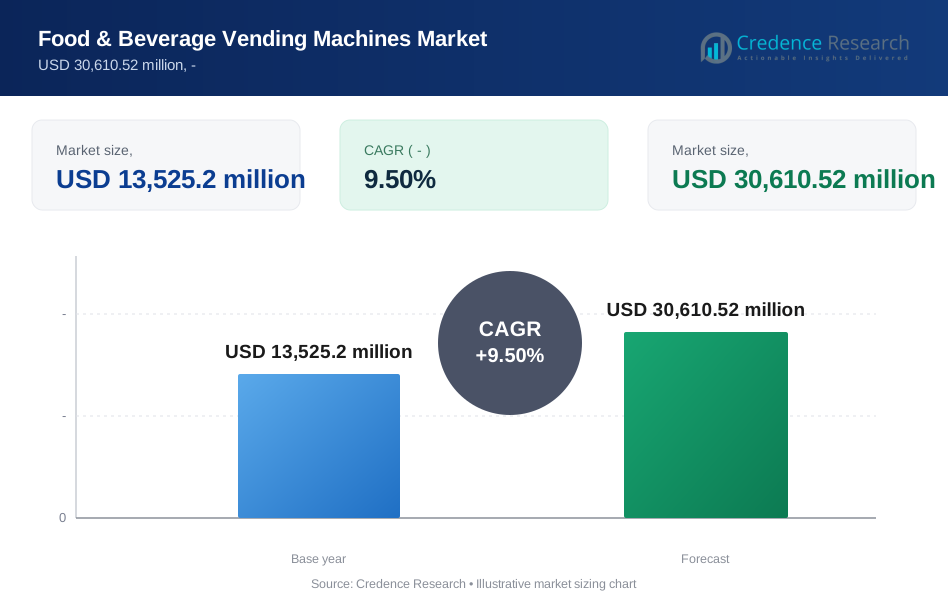
| Food & Beverage Vending Machines Market 2023 | USD 13525.2 Million |
| Food & Beverage Vending Machines Market, CAGR | 9.50% |
| Food & Beverage Vending Machines Market Size 2032 | USD 30610.52 Million |
Market Insights
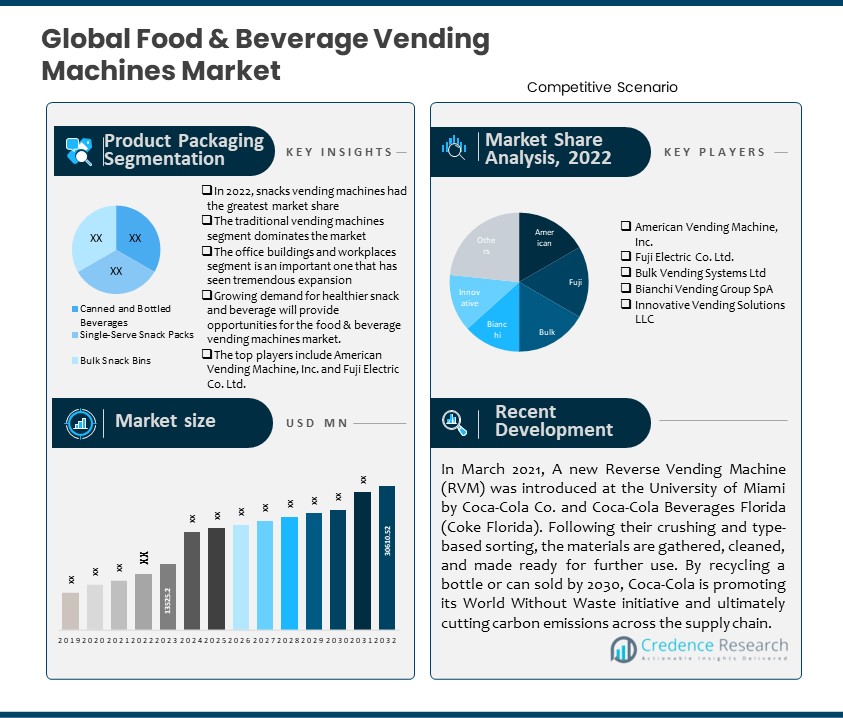
- The global market for food & beverage vending machines is expected to develop at a compound annual growth rate (CAGR) of 9.50% between 2024 and 2032, from its estimated USD 13525.2 million in 2023 to USD 30610.52 million by 2032.
- The largest category is snack vending machines. Beverage vending machines, on the other hand, are expected to grow at a strong CAGR.
- Traditional vending machines are the top technology category.
- The CAGR for office buildings and workplaces is expected to be the highest during the projection period.
- The canned and bottled beverages will have the highest CAGR throughout the prediction period.
- Branded vending machines are estimated to have the greatest CAGR during the forecast period.
- North America dominated the food & beverage vending machines market.
- Regarding the market share of food & beverage vending machines, Europe is expected to come second.
- In the food & beverage vending machines market, Asia Pacific is anticipated to grow fastest.
- The global market for food and beverage vending machines is being influenced by factors such as rising consumer demand for healthier snack and beverage options, technological advancements in vending machines, and the integration of touch interfaces and digital screens to create interactive user experiences.
- Customizable vending machine interfaces that let customers customize their food and drink selections to suit their preferences and the adoption of eco-friendly packaging materials and practices to appeal to environmentally conscious consumers are some of the factors influencing the potential of the global food & beverage vending machines industry.
Executive Summary
Market Definition
The food & beverage vending machines market refers to the sector within the vending industry that focuses specifically on vending machines designed to dispense a variety of food and beverage products. These vending machines can be found in a wide range of locations, including office buildings, schools, hospitals, airports, train stations, shopping malls, and other public spaces. They offer convenience to consumers by providing quick access to snacks, beverages, and sometimes even fresh food items without the need for traditional retail interactions.
Market Overview
The food & beverage vending machines sector is estimated to develop at a 9.50% compound annual growth rate (CAGR) between 2024 and 2032, maintaining its current upward trend. The market will continue to develop, rising from its estimated USD 13525.2 million in 2023 to USD 30610.52 million in 2032.
A portable method for people to get food and drink on the go is through vending machines. Quick and simple access to snacks and beverages is highly desirable in today's fast-paced world, where time is frequently limited. These vending machines are conveniently accessible to people who are on the go or don't have the time to visit traditional food establishments because they are frequently found in busy places like malls, office buildings, train stations, airports, and schools. Vending machines, in contrast to conventional restaurants with set hours of operation, are always open, so customers can sate their hunger or grab a quick bite at whatever time of day.
Modern vending machines cater to diverse dietary needs and preferences by offering a wide range of food and drink choices. Whether customers crave a tasty treat, need a quick energy boost, or seek a healthy snack, vending machines can satisfy various demands. With technological advancements, vending machines now commonly feature cashless payment options, including credit/debit card readers, mobile payment systems, and contactless methods like NFC and QR codes. These enhancements make vending machine transactions quicker and more convenient, benefiting those with busy lifestyles. Additionally, vending machines offer a contactless method of obtaining food and beverages, bypassing the need for cashier interaction or surface contact—advantages that have become particularly valuable during the COVID-19 pandemic.
Segmentation by Product Type
- Snack vending machines are the market leader by product type. They provide consumers with a quick and easy option to satisfy their hunger or cravings, which makes them more convenient. Customers may purchase food anytime they want, without having to talk to anyone, because of the 24/7 accessibility.
- The beverage vending machine category will exhibit a sizable CAGR during the projected period. Machines that vend beverages are made to accommodate customers' different tastes by providing a large selection of beverages. These could include fruit juices or flavored water, which are healthier options, as well as cold beverages like soda and bottled water and hot beverages like coffee and tea.
- Other product types, including combination vending machines, healthy options vending machines, and frozen food vending machines, support the need for food & beverage vending machines.
Segmentation by Technology
- The best technology category is traditional vending machines. When a customer inserts money or chooses an item using a user interface like buttons or touchscreens, traditional vending machines in the food and beverage vending machine market refer to the conventional machines that dispense snacks, beverages, or other food items.
- The cashless payment vending machines category will likely register a significant CAGR during forecasting. Vending machines that accept cashless payments provide more payment choices than just cash. This includes NFC (Near Field Communication) technology for contactless payments, mobile wallet integration (such as Google Pay and Apple Pay), credit/debit card readers, and QR code scanning for payments made through smartphone apps.
- Other technologies, such as smart and touchless vending machines, also contribute to the demand for food and beverage vending machines.
Segmentation by Location
- The office buildings and workplaces category is projected to grow faster over the projection period. During the workday, many office workers have little time for breaks. They can easily get snacks and drinks without leaving the property due to the food and beverage vending machines that are located there. Demand and usage have grown as a result of this convenience factor.
- Other locations influence the need for food & beverage vending machines, including educational institutions, retail locations, transportation hubs, and healthcare facilities.
Segmentation by Product Packaging
- The canned and bottled beverages category will likely have the highest CAGR during the projection period. These are drinks that come in cans made of aluminum or tin. Because they are convenient and long-lasting, canned beverages are a common choice for vending machines.
- Other product packaging, such as single-serve snack packs and bulk snack bins, also contributes to the demand for food and beverage vending machines.
Segmentation by Customization
- Branded vending machines are expected to have the foremost CAGR during the prediction period. Companies can use branded vending machines as a direct marketing tool to advertise their goods. These devices frequently have noticeable branding components like colors, slogans, and logos, which aid in improving consumer recall and brand recognition.
- Other customizations, such as customizable product selection and interactive displays and promotions, also contribute to the demand for food & beverage vending machines.
Segmentation by Region
- The North America leads the food & beverage vending machines industry. Vending machines in North America serve a wide range of products, including fresh food, wholesome options, and specialty items, in addition to drinks and snacks.
- Europe is estimated to rank second in market size for food & beverage vending machines.
- The food & beverage vending machines industry is predicted to flourish rapidly in Asia Pacific.
- Regions such as Africa, the Middle East, and Latin America cover the remaining requirement for food & beverage vending machines.
Vending machines for food and drinks are becoming more and more popular these days because they are convenient and help cut down on the time needed to buy a small quantity of food items. Reducing hiring costs, offering round-the-clock support, being easily manageable, and more are some benefits of using the product. The product's increasing placement in educational settings like colleges and schools is contributing to the rise in demand. Additionally, there is a chance for market expansion due to the increasing innovation of different kinds of vending machines that can provide customers with fast food.
Based on projections, the food & beverage vending machines market is anticipated to be controlled by North America. One of the driving forces behind the market's expansion is the increasing practice of placing vending machines for users on interstate highways. The state of North Carolina announced in October 2019 that it would be placing 76.7% of its vending machines on its interstate highway in 2018. This information comes from data released by the Centers for Disease Control and Prevention. The popularity of food and drink vending machines in baseball, American football, basketball, and other sports stadiums is also contributing to the increase in the product's usage.
The food & beverage vending machines market in Asia Pacific is anticipated to expand fastest throughout the forecast. Consumers in Asia Pacific are becoming more and more demanding in terms of convenience. To satisfy the needs of busy customers looking for quick and simple meal solutions, vending machines provide a range of food and beverage options that are accessible around the clock. A growing number of people are living in cities as a result of the fast urbanization occurring in the Asia Pacific region. Vending machines are a handy way to grab quick meals or snacks for urbanites who frequently lead busy lives and don't have much time to prepare meals. A number of notable technological developments have affected the Asia Pacific vending machine sector, such as touchscreen interfaces, cashless payment systems, and smart vending machines with sensors and data analytics built in. With these advancements, vending machines become more appealing to users and improve their overall experience.
Key Highlights of the Report
The global food & beverage vending machines market is segmented by Product Type, Technology, Location, Product Packaging, Customization, and region. As far as the Product Type is concerned, snack vending machines are the market spearhead. The best type is traditional vending machines. The office buildings and workplaces category is anticipated to increase at the highest CAGR throughout the projection period. The canned and bottled beverages category will experience the highest CAGR during the forecast period. The food & beverage vending machines market is expanding mostly in North America.
Market expansion is being aided by the growing willingness of the world's population to adopt novel products that may make people's lives easier. Demand for the product is expected to increase as more and more fitness clubs across the globe are embracing vending machines to provide their patrons with supplements like protein bars, soft drinks, energy drinks, and others. The International Health, Racquet & Sportsclub Association 2019 Report's data states that the fitness industry saw a 183 million increase in membership and generated an estimated USD 94 billion in revenue globally in 2019. Furthermore, the increasing prevalence of food and drink vending machines in public transportation hubs like train and bus stations is contributing to an increase in the rate of consumption.
North America is expected to account for the largest food & beverage vending machine market globally. In North America, food safety standards and hygiene practices are given top priority by vending machine operators due to strict regulations and consumer preferences for safe and high-quality food products. In the industry, a focus on quality assurance fosters consumer loyalty and trust. The Asia Pacific region is also assumed to have the market's sharpest growth. Across the Asia Pacific, a number of countries have experienced economic growth that has raised levels of disposable income. Customers can now indulge in the convenient food and beverage options provided by vending machines because they have greater purchasing power.
Which Key Factors Are Driving The Global Food & Beverage Vending Machines Market?
The market for food and beverage vending machines is growing for several reasons, including the incorporation of mobile apps for personalized recommendations and pre-ordering and an increased emphasis on environmentally friendly packaging and energy-efficient vending machines.
What Are The Main Challenges Confronting The Food & Beverage Vending Machines Market Globally?
Growing public awareness of the health risks associated with processed foods and sugary beverages, along with ongoing maintenance costs for vending machine repair and servicing, are the two biggest obstacles to the growth of the food and beverage vending machine industry.
What Market Opportunities Exist For Food & Beverage Vending Machines Globally?
The market for food and beverage vending machines may expand due to various factors, including the adoption of geolocation data to strategically place vending machines in high-traffic areas like transportation hubs and tourist destinations and the expansion of cashless payment options to accommodate consumers' growing preference for digital transactions.
Market Drivers
Multiple factors propel the food & beverage vending machines industry across the globe. The primary factors propelling the global food & beverage vending machines market are as follows:
Technology Advancements Utilized in Vending Machines
Technology advancements that have enhanced customer satisfaction and operational effectiveness have revolutionized the food and beverage vending machine industry. Mobile payment options and credit/debit card scanners are becoming indispensable parts of cashless payment systems as more and more transactions go cashless. Due to real-time access to inventory levels and machine health data, operators can now optimize restocking and maintenance procedures with the introduction of smart vending machines, which are powered by IoT technology. Touchscreen interfaces have taken the place of traditional buttons because they provide a more interesting and user-friendly interface. Additionally, the integration of artificial intelligence (AI) and machine learning enables predictive analytics for inventory management and customer preferences, ensuring that machines are stocked with in-demand goods.
Market Restraints
There are several obstacles that the global food & beverage vending machines market must overcome to continue growing. Among them are the following:
Expensive Initial Outlay Needed to Install and Maintain Vending Machines
Investing in vending machines can be expensive at first, particularly if they are high-end models with cutting-edge features like touchscreens, cashless payment systems, or refrigeration. The cost of installation is included in this investment in addition to the machine costs. To guarantee smooth operation, vending machines need to receive routine maintenance. This includes fixing technical problems, replenishing inventory, and fixing mechanical parts. Over time, these upkeep expenses may mount up and have a substantial effect on the vending machine business's profitability. It can be expensive to locate and acquire acceptable spaces for vending machines. Leasing or renting is usually more expensive in high-traffic areas or places where there is a strong demand for food and drink. Furthermore, acquiring licenses or permits to place vending machines in specific areas could come with costs.
Opportunities
There are plenty of potential prospects in the global food & beverage vending machines industry. Among these are the following:
The Retail Industry's Shift Toward Automation
The growing use of food and beverage vending machines is largely due to the trend toward automation in retail. Automation lowers the requirement for human labor in retail operations, saving companies funds. Traditional brick-and-mortar establishments are superseded by vending machines, which lowers overhead expenses, including rent, utilities, and employee salaries. Vending machines maximize operating efficiency by running continuously without the need for breaks or rest periods. They might be positioned where there is a lot of foot traffic to guarantee that customers can always reach them. Optimizing the quantity of stock and lowering the possibility of overstocking or stockouts are achieved by automated inventory tracking and management systems connected to vending machines. Customer satisfaction increases as a result of ensuring that items are always available when customers need them. Generally, vending machines' intrinsic qualities complement the retail industry's drive toward automation, making them a desirable and effective way to distribute food and beverages. Future vending machine operations and their integration into retail environments will probably be shaped by automation, which is expected to become more and more prevalent as technology develops.
Competitive Landscape
Key Players
Several major competitors exist in the fiercely competitive global food & beverage vending machines market. The following are a few of the leading market participants and their market shares:
- American Vending Machine, Inc.
- Fuji Electric Co. Ltd.
- Bulk Vending Systems Ltd
- Bianchi Vending Group SpA
- Innovative Vending Solutions LLC
- Others
These companies prioritize product innovation, distribution channel expansion, mergers, and acquisitions to remain competitive.
The largest suppliers in the global food & beverage vending machines market continuously work to stay one step ahead of the competition by developing innovative concepts and products.
In March 2023, Refillable Koko Krunch and Milo vending machines were tested by Nestlé as part of their endeavor to find creative solutions to reduce the need for single-use packaging. The state-of-the-art gadgets, created in collaboration with the Indonesian startup Qyos by Algramo, were available for four to six months at two local Indonesian retailers for trial.
In February 2022, The Dalit Indian Chamber of Commerce and Industries (DICCI) and the Small Industries Development Bank of India (SIDBI) jointly announced the installation of 1,000 Plastic Reverse Vending Machines (RVMSs) as part of the CSR initiative to reduce carbon footprint. Under the "Swachh Delhi, Swavalambi Delhi" initiative, the launch was publicized. As many public locations as possible, including malls, metro stations, and parks, will have the RVMs installed.
Summary of Key Findings
- Integration of Internet of Things (IoT) technology to enable monitoring in real-time. This will likely encourage innovation in the market for food and beverage vending machines.
- The market is segmented by Product Type, Technology, Location, Product Packaging, Customization, and region.
- The most popular product type in the market is snack vending machines.
- Traditional vending machines are the foremost technology category.
- Office buildings and workplaces are expected to grow fastest in terms of CAGR during the forecast period.
- The branded vending machines category will likely see the highest CAGR during the anticipated time frame.
- North America is leading market development; the market is highly competitive with key players including American Vending Machine, Inc., Fuji Electric Co. Ltd., Bulk Vending Systems Ltd, Bianchi Vending Group SpA, Innovative Vending Solutions LLC, and Others.
Future Outlook
- The food & beverage vending machines industry is expected to increase significantly in North America, and its outlook is positive worldwide.
- Contactless delivery solutions are being introduced for purchases made from vending machines through the use of smartphone apps or QR code scanning. This will probably lead to an increase in the demand for upscale food and beverage vending machines.
- The market for food and beverage vending machines is being negatively impacted by criticism about the environmental effects of single-use packaging and energy consumption.
- To stay ahead of the competition, key enterprises must develop new products, expand their market reach, and keep their prices competitive.
How CXOs Can Benefit from the Credence Research Food & Beverage Vending Machines Market Report
CXOs may get a detailed picture of the market in the Credence Research Food & beverage Vending Machines Market Report, which includes:
- Market size and growth forecast: The report provides detailed estimates of the global food & beverage vending machines market size, segmented by Product Type, Technology, Location, Product Packaging, Customization, and region. It also includes forecasts for the market through 2032 based on key trends and drivers.
- Market segmentation: The research report breaks down the market for food & beverage vending machines into segments based on Product Type, Technology, Location, Product Packaging, Customization, and region. This segmentation provides CXOs with a granular understanding of the market and the opportunities in each segment.
- Competitive landscape: The research report offers a detailed analysis of the major companies in the food & beverage vending machines industry, including information on their business plans, product lines, and earnings. CXOs can use this information to evaluate and identify their competitors.
- Key trends and drivers: The research report identifies and evaluates the main trends and factors influencing the food & beverage vending machines market. CXOs can use this information to make well-informed choices regarding their plans and investments.
CXOs can use the insights from the Credence Research Food & beverage Vending Machines Market Report to:
- Identify growth opportunities: This analysis may help CXOs identify new growth opportunities in the food & beverage vending machines sector. For example, the report identifies the growing demand for food & beverage vending machines from the food & beverage industry as a key opportunity.
- Make informed investment decisions: The report helps CXOs wisely choose food and beverage vending machines. For example, the research study provides information on the critical factors to consider when selecting solutions and evaluating suppliers.
- Develop competitive strategies: CXOs can use the research report to develop competitive strategies for their food and beverage vending machine businesses. For example, the research paper outlines the main strategies that food and beverage vending machine suppliers utilize to differentiate themselves from competitors.
- Track market developments: This research report may help CXOs stay ahead of the curve by tracking market developments. For instance, it offers insights into the most recent developments and trends in the food & beverage vending machines market.
CXOs seeking to expand their industry knowledge and spot growth prospects will find the Credence Research Food & beverage Vending Machines Market Report useful.
Segmentation
- By Product Type
- Snacks Vending Machines
- Beverages Vending Machines
- Combination Vending Machines
- Healthy Options Vending Machines
- Frozen Food Vending Machines
- By Technology
- Traditional Vending Machines
- Cashless Payment Vending Machines
- Smart Vending Machines
- Touchless Vending Machines
- By Location
- Office Buildings and Workplaces
- Educational Institutions
- Retail Locations
- Transportation Hubs
- Healthcare Facilities
- By Product Packaging
- Canned and Bottled Beverages
- Single-Serve Snack Packs
- Bulk Snack Bins
- By Customization
- Branded Vending Machines
- Customizable Product Selection
- Interactive Displays and Promotions
- By Region
- North America
- The U.S.
- Canada
- Mexico
- Europe
- Germany
- France
- The U.K.
- Italy
- Spain
- Rest of Europe
- Asia Pacific
- China
- Japan
- India
- South Korea
- South-east Asia
- Rest of Asia Pacific
- Latin America
- Brazil
- Argentina
- Rest of Latin America
- Middle East & Africa
- GCC Countries
- South Africa
- The Rest of the Middle East and Africa
- North America
Request a Free Sample
Fill in your details and we'll send you a free sample report.
- Sample data tables & charts
- Research methodology
Need a Custom Version of This Report?
Tailor the scope, geography, or segments to your exact requirements.
- Custom geography or segment scope
- Direct access to our analyst team
Frequently Asked Questions
How much does the global market currently hold for food & beverage vending machines?
What is the food & beverage vending machines market's projected growth rate between 2024 and 2032?
In terms of product types, which market category is leading?
Regarding technology, which market category is in the lead?
Who are the main players in the food & beverage vending machines industry globally?
Table of Content
Chapter 1. Report Introduction
- 1.1 Report Description & Purpose
- 1.1.1 Report Title & Market Definition
- 1.1.2 Unique Selling Propositions (USP) & Key Differentiators
- 1.1.3 Value Proposition for Stakeholders
- 1.2 Research Objectives
- 1.2.1 Market Sizing Objectives (Volume & Revenue)
- 1.2.2 Segmentation Objectives
- 1.2.3 Competitive Intelligence Objectives
- 1.2.4 Forecast & Scenario Objectives
- 1.3 Report Scope
- 1.3.1 Food & Beverage Vending Machines Scope – Types & Subtypes Covered
- 1.3.2 Geographic Scope – Regions & Countries Covered
- 1.3.3 Historical Period, Base Year & Forecast Period (the historical period; forecast to the forecast period)
- 1.3.4 Inclusions & Exclusions
- 1.4 HS Code & Classification Framework
- 1.5 Currency, Units & Pricing Basis
- 1.6 Target Stakeholders
- 1.7 Limitations & Assumptions
Chapter 2. Executive Summary
- 2.1 Global Food & Beverage Vending Machines Market Snapshot
- 2.1.1 Market Size – Historical (the historical period) & Forecast (the forecast period) (base year: USD 13,525.2 million → forecast year: USD 30,610.52 million)
- 2.1.2 Volume & Revenue – Global Totals
- 2.1.3 Key Market Highlights – Top Five Facts
- 2.2 Food & Beverage Vending Machines Market Segmentation Snapshot
- 2.2.1 Market Split by Region – vs.
- 2.3 Competitive Snapshot
- 2.3.1 Top 10 Players by Revenue Share –
- 2.3.2 Top 10 Players by Volume Share –
- 2.3.3 Recent Strategic Developments (18-Month Summary)
- 2.4 Key Investment Highlights & Strategic Conclusions
Chapter 3. Food & Beverage Vending Machines Market Dynamics & Industry Analysis
- 3.1 Market Overview & Context
- 3.1.1 Food & Beverage Vending Machines Market Position in the Broader Automotive Value Chain
- 3.1.2 OEM vs. Replacement Market Dynamics
- 3.1.3 Market Maturity & Development Stage by Region
- 3.2 Food & Beverage Vending Machines Market Drivers
- 3.3 Food & Beverage Vending Machines Market Restraints & Challenges
- 3.4 Food & Beverage Vending Machines Market Opportunities
- 3.5 Porter's Five Forces Analysis
- 3.5.1 Threat of New Entrants
- 3.5.2 Bargaining Power of Suppliers
- 3.5.3 Bargaining Power of Buyers
- 3.5.4 Threat of Substitutes
- 3.5.5 Competitive Rivalry – Intensity Assessment
- 3.6 Food & Beverage Vending Machines Value Chain Analysis
- 3.6.1 Upstream – Raw Material/Input Suppliers
- 3.6.1.1 Raw Material/Input 1
- 3.6.1.2 Raw Material/Input 2
- 3.6.1.3 Raw Material/Input 3
- 3.6.2 Midstream – Production/Manufacturing/Service Delivery
- 3.6.2.1 Production/Process Overview
- 3.6.2.2 Key Facility Locations & Capacity by Manufacturer
- 3.6.3 Downstream – Distribution & End Consumer
- 3.6.3.1 Primary Channel – B2B/OEM
- 3.6.3.2 Secondary Channels – Dealer, Retail, Online, Direct
- 3.6.4 Value Chain Profitability Analysis
- 3.6.1 Upstream – Raw Material/Input Suppliers
- 3.7 PESTEL Analysis
- 3.7.1 Political Factors
- 3.7.2 Economic Factors
- 3.7.3 Social Factors
- 3.7.4 Technological Factors
- 3.7.5 Environmental Factors
- 3.7.6 Legal Factors
- 3.8 Food & Beverage Vending Machines Supply Chain Analysis
- 3.8.1 Raw Material/Input Supply Risk Assessment
- 3.8.2 Manufacturing Concentration Risk (Geographic Exposure)
- 3.8.3 Trade Disruption Impact Analysis
- 3.9 Regulatory & Policy Landscape
Note: The regulatory and policy landscape section covers regulations based on their applicability to the market, Food & Beverage Vending Machines category, geography, and scope of the study. Only regulatory frameworks with a material impact on operations, compliance, trade, sustainability, or market access are analyzed in detail.
Chapter 4. Key Investment Pockets & Opportunity Analysis
- 4.1 Food & Beverage Vending Machines Market Attractiveness Analysis
- 4.1.1 By Region – Investment Attractiveness Matrix (Volume × CAGR)
- 4.2 Absolute Revenue Growth Opportunity
- 4.2.1 By Region – Absolute USD Growth Through the forecast period
- 4.3 Incremental Volume Opportunity
- 4.3.1 By Region – Incremental Volume Through the forecast period
- 4.3.2 Segment – Incremental Volume
- 4.4 Emerging Submarket Opportunity Deep Dive (Subject to Applicability)
- 4.5 Emerging Market Opportunity Scorecards
- 4.5.1 United States
- 4.5.2 Europe
- 4.5.3 Asia
- 4.5.4 Middle East & Africa
Note: Emerging Market Opportunity Scorecards will be included based on relevance and strategic importance. Regions listed are indicative and may vary depending on data availability and market dynamics.
Chapter 5. Food & Beverage Vending Machines Import-Export Analysis & Trade Flows
- 5.1 Global Trade Overview
- 5.1.1 Global Export Value by Country (the historical period)
- 5.1.2 Global Export Volume by Country (the historical period)
- 5.1.3 Global Import Value by Country (the historical period)
- 5.1.4 Global Import Volume by Country (the historical period)
- 5.1.5 Net Trade Balance by Country (the historical period)
- 5.2 Export Analysis – Segment
- 5.2.1 Type 1 (HS Code)
- 5.2.2 Type 2 (HS Code)
- 5.2.3 Type 3 (HS Code)
- 5.2.4 Type 4 (HS Code)
- 5.2.5 Type 5 (HS Code)
- 5.3 Import Analysis – Segment
- 5.3.1 Type 1 (HS Code)
- 5.3.2 Type 2 (HS Code)
- 5.3.3 Type 3 (HS Code)
- 5.3.4 Type 4 (HS Code)
- 5.3.5 Type 5 (HS Code)
- 5.4 Average Unit Trade Prices
- 5.4.1 Average Export Price – Segment & Country
- 5.4.2 Average Import Price – Segment & Source Country
- 5.4.3 Price Trends (the historical period)
- 5.5 Key Trade Route Analysis
- 5.5.1 Trade Route 1
- 5.5.2 Trade Route 2
- 5.5.3 Trade Route 3
- 5.5.4 Trade Route 4
- 5.5.5 Trade Route 5
- 5.6 Trade Policy Impact Assessment
- 5.6.1 US Anti-Dumping & Section 301 Tariffs
- 5.6.2 EU Customs Union Impact
- 5.6.3 Major Free Trade Agreements
- 5.6.4 USMCA Rules of Origin
Note: Trade policy analysis will be included only where relevant to the Food & Beverage Vending Machines market.
Chapter 6. Competitive Landscape & Company Benchmarking
- 6.1 Food & Beverage Vending Machines Market Concentration & Structure
- 6.1.1 Herfindahl-Hirschman Index (HHI) – vs.
- 6.1.2 Tier 1, Tier 2 & Tier 3 Market Structure
- 6.1.3 Global, Regional & Local Player Dynamics
- 6.2 Food & Beverage Vending Machines Market Share Analysis –
- 6.2.1 Global Revenue Share by Company
- 6.2.2 Global Volume Share by Company
- 6.2.3 Regional Revenue Share
- 6.2.4 Market Share Evolution ( vs. )
- 6.2.5 OEM Segment Share by Company
- 6.2.6 Replacement Segment Share by Company
- 6.3 Production/Delivery Capacity & Facility Analysis
- 6.3.1 Global Installed Capacity
- 6.3.2 Capacity Utilization Rates
- 6.3.3 Production/Output Volume
- 6.3.4 Facility Locations & Capacity Map
- 6.3.5 Planned Capacity Additions
- 6.4 Food & Beverage Vending Machines Competitive Benchmarking Matrix
- 6.4.1 Revenue, Volume, CAGR & Profitability Comparison
- 6.4.2 Channel Revenue Mix
- 6.4.3 Geographic Revenue Exposure
- 6.4.4 R&D Intensity
- 6.4.5 Sustainability Maturity
- 6.5 Strategic Developments in Food & Beverage Vending Machines (Last 24 Months)
- 6.5.1 Mergers, Acquisitions & Divestments
- 6.5.2 New Food & Beverage Vending Machines Launches
- 6.5.3 Facility Expansions
- 6.5.4 Strategic Alliances, Joint Ventures & Partnerships
- 6.5.5 Distribution Expansion & Market Entry
- 6.5.6 Sustainability & ESG Initiatives
- 6.6 Competitive Strategy Mapping
- 6.6.1 Leader, Challenger, Follower & Niche Classification
- 6.6.2 Pricing Strategy Comparison
- 6.6.3 Channel Strategy Matrix
Note: Strategic developments are included based on their materiality and the availability of reliable information.
Chapter 7. Global Food & Beverage Vending Machines Market – By Distribution Channel
- 7.1 Segment Overview
- 7.1.1 Volume & Revenue Split by Channel ( & )
- 7.1.2 Channel Mix Evolution (the forecast period)
Chapter 8. Regional Market Analysis – Global Overview
- 8.1 Global Regional Overview
- 8.1.1 Regional Volume Share
- 8.1.2 Regional Revenue Share
- 8.1.3 Regional Volume by Region
- 8.1.4 Regional Revenue by Region
- 8.1.5 Regional Forecast Through the forecast period
- 8.2 Cross-Regional Segment Analysis
- 8.2.1 By Distribution Channel
- 8.2.2 By Brand/Price Tier
Chapter 9. North America Food & Beverage Vending Machines Market
- 9.1 United States
- 9.2 Canada
- 9.3 Mexico
Chapter 10. Europe Food & Beverage Vending Machines Market
- 10.1 Germany
- 10.2 France
- 10.3 Italy
- 10.4 United Kingdom
- 10.5 Spain
- 10.6 Poland
- 10.7 Russia
- 10.8 Netherlands
- 10.9 Belgium
- 10.10 Sweden
- 10.11 Denmark
- 10.12 Norway
- 10.13 Rest of Europe
Chapter 11. Asia Pacific Food & Beverage Vending Machines Market
- 11.1 China
- 11.2 India
- 11.3 Japan
- 11.4 South Korea
- 11.5 Thailand
- 11.6 Indonesia
- 11.7 Vietnam
- 11.8 Malaysia
- 11.9 Australia
- 11.10 Rest of Asia Pacific
Chapter 12. Latin America Food & Beverage Vending Machines Market
- 12.1 Brazil
- 12.2 Argentina
- 12.3 Colombia
- 12.4 Chile
- 12.5 Rest of Latin America
Chapter 13. Middle East Food & Beverage Vending Machines Market
- 13.1 Saudi Arabia
- 13.2 United Arab Emirates
- 13.3 Turkey
- 13.4 Israel
- 13.5 Iran
- 13.6 Rest of the Middle East
Chapter 14. Africa Food & Beverage Vending Machines Market
- 14.1 South Africa
- 14.2 Egypt
- 14.3 Nigeria
- 14.4 Morocco
- 14.5 Rest of Africa
Chapter 15. Food & Beverage Vending Machines Company Profiles
- 15.1 [Company 01]
- 15.1.1 Company Overview
- 15.1.2 Key Management Personnel
- 15.1.3 Products & Services Portfolio
- 15.1.4 Financial Performance
- 15.1.5 Key Market Focus & Geographic Presence
- 15.1.6 Recent Developments & Strategic Initiatives
Note: The company profile list is preliminary and may change based on research findings, market developments, data availability, and client requirements.
Chapter 16. Appendices
- Appendix A – List of Abbreviations & Acronyms
- Appendix B – Industry Classification Code Reference – Full Series
- Appendix C – Production & Capacity Data Tables
- Appendix D – End-Use & Demand Base Tables
- Appendix E – Consumption & Replacement Rate Assumptions
- Appendix F – ASP Reference Tables
- Appendix G – Manufacturing & Facility Database
- Appendix H – Import-Export Data Tables
- Appendix I – Regulatory Summary Tables
- Appendix J – Primary Research Participant List (Anonymized)
- Appendix K – Primary Research Questionnaire Framework
- Appendix L – Data Sources & Bibliography
- Appendix M – Market Size Divergence & Source Comparison
Chapter 17. Research Methodology
- 17.1 Research Framework & Philosophy
- 17.2 Secondary Research – Sources, Hierarchy & Data Extraction
- 17.3 Data Modeling – Bottom-Up & Top-Down Market Sizing
- 17.4 Primary Research – Stakeholder Framework, LOI & Sample Sizes
- 17.5 Forecast Methodology – Regression, Scenario & Sensitivity Analysis
- 17.6 Quality Control – Four-Layer Validation Framework
- 17.7 Limitations & Standard Assumptions
- 17.8 Disclaimer
