
Market Overview
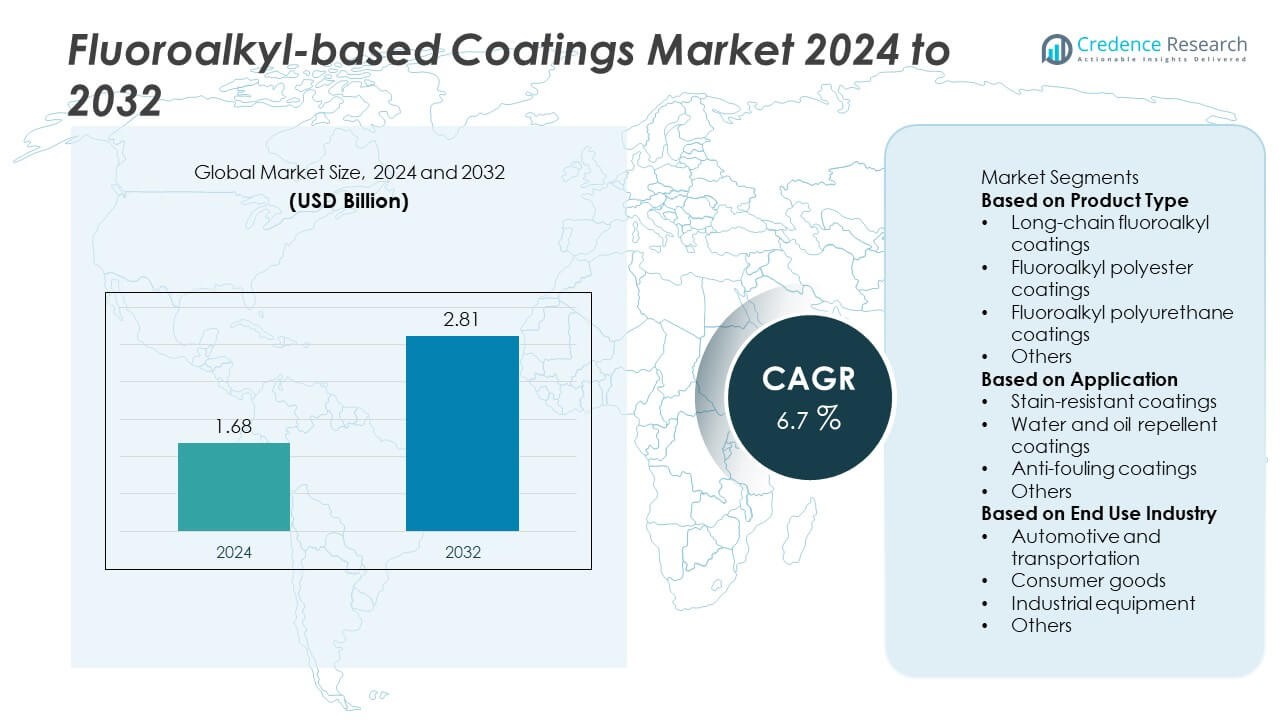
The Fluoroalkyl-based Coatings market was valued at USD 1.68 billion in 2024 and is projected to reach USD 2.81 billion by 2032, growing at a CAGR of 6.7% during the forecast period.
| REPORT ATTRIBUTE | DETAILS |
|---|---|
| Historical Period | 2020-2023 |
| Base Year | 2024 |
| Forecast Period | 2025-2032 |
| Fluoroalkyl-based Coatings market Size 2024 | USD 1.68 Billion |
| Fluoroalkyl-based Coatings market, CAGR | 6.7% |
| Fluoroalkyl-based Coatings market Size 2032 | USD 2.81 Billion |
The Fluoroalkyl-based Coatings market is led by major players including Daikin Industries, Ltd., The Chemours Company, 3M Company, AGC Inc., Solvay S.A., Dongyue Group Limited, Asahi Glass Co., Ltd., Gujarat Fluorochemicals Limited, BASF SE, and Arkema S.A. These companies dominate through innovation in fluoropolymer chemistry and sustainable coating technologies. North America held a 38% market share in 2024, driven by strong demand in the automotive and consumer goods sectors. Europe followed with 28%, supported by strict environmental regulations and advanced coating technologies. Asia Pacific accounted for 25%, fueled by rapid industrialization and expanding manufacturing bases in China, Japan, and South Korea.
Market Insights
- The Fluoroalkyl-based Coatings market was valued at USD 1.68 billion in 2024 and is projected to reach USD 2.81 billion by 2032, growing at a CAGR of 6.7%.
- Rising demand for stain-resistant, water-repellent, and anti-fouling coatings across automotive, consumer goods, and industrial sectors is driving market growth.
- The long-chain fluoroalkyl coatings segment held a 42% share in 2024, driven by superior durability and chemical resistance in harsh environments.
- Leading players such as Daikin Industries, Chemours, and Solvay are focusing on eco-friendly formulations to meet global sustainability standards.
- North America led with 38% share, followed by Europe at 28% and Asia Pacific at 25%, reflecting strong manufacturing growth and technological advancements in surface protection applications.
Market Segmentation Analysis:
By Product Type
The fluoroalkyl polyurethane coatings segment dominated the Fluoroalkyl-based Coatings market in 2024 with a 46% share. These coatings are widely used due to their superior abrasion resistance, chemical stability, and hydrophobic properties. They provide strong adhesion to metals, plastics, and composites, making them ideal for automotive and industrial applications. Demand for long-lasting and weather-resistant coatings continues to rise, especially in high-performance sectors. Meanwhile, fluoroalkyl polyester coatings are gaining traction in consumer goods and electronics due to their flexibility and glossy finish, supporting moderate growth within the overall product category.
- For instance, Chemours introduced Teflon™ EcoElite, a 60% bio-based, renewably sourced water-repellent finish that is noted for being up to three times more durable than other non-fluorinated finishes. Fabrics treated with Teflon™ EcoElite can withstand multiple washings while maintaining their water repellency and breathability.
By Application
The water and oil repellent coatings segment held the leading 52% share of the Fluoroalkyl-based Coatings market in 2024. These coatings provide exceptional barrier performance, preventing liquid absorption and contamination on various surfaces. They are increasingly adopted in textiles, electronics, and construction materials to enhance durability and cleanliness. Rapid urbanization and growing demand for self-cleaning and anti-stain surfaces are driving the adoption of these coatings globally. The stain-resistant coatings segment is also expanding steadily, supported by rising usage in household appliances and interior decorative materials.
- For instance, AGC Inc. introduced the Lumiflon® FEVE coating system, known for its superior weatherability and gloss retention over decades in real-world architectural and industrial applications. 3M produces various Scotchgard™ products designed to repel spills and block stains on fabrics, though it generally needs to be reapplied after washing to maintain its protective effects.
By End Use Industry
The automotive and transportation segment accounted for the largest 44% share of the Fluoroalkyl-based Coatings market in 2024. These coatings are essential for protecting vehicle components from corrosion, moisture, and chemical exposure. Their ability to reduce surface friction and improve fuel efficiency further enhances their value in automotive design. Expanding electric vehicle production and the need for lightweight, durable materials are boosting market growth. The industrial equipment segment is also witnessing significant adoption due to the need for anti-fouling and low-maintenance coatings in machinery, pipelines, and manufacturing components.
Key Growth Drivers
Rising Demand for Water and Oil Repellent Surfaces
The growing need for advanced surface protection in automotive, electronics, and construction industries is driving demand for fluoroalkyl-based coatings. These coatings provide superior hydrophobic and oleophobic performance, reducing maintenance costs and extending product life. Their ability to resist staining, corrosion, and chemical degradation enhances durability across applications. Increasing consumer preference for easy-to-clean and self-healing surfaces further supports adoption in both industrial and consumer goods sectors.
- For instance, Arkema's Kynar® 500 PVDF coatings demonstrate superior long-term weatherability, including gloss retention and resistance to degradation from UV rays, based on decades of real-world performance and laboratory testing.
Expansion in Automotive and Transportation Applications
Automotive manufacturers are increasingly using fluoroalkyl-based coatings to improve surface protection and performance. These coatings reduce friction, prevent corrosion, and enhance vehicle aesthetics while maintaining fuel efficiency. As electric and hybrid vehicle production rises, manufacturers seek lightweight, durable coatings that extend component lifespan. The coatings’ compatibility with metals, composites, and polymers strengthens their use in underbody, exterior, and interior applications, boosting market growth across developed and emerging economies.
- For instance, Dongyue Group, a producer of battery-grade PVDF resin, supports the automotive battery market with its materials, which are used to enhance corrosion resistance and electrochemical stability.
Growth in Consumer and Industrial Coatings Demand
Fluoroalkyl-based coatings are gaining traction in consumer goods and industrial machinery for their chemical and thermal resistance. They provide non-stick and easy-clean properties that enhance product quality and user convenience. Increasing use in cookware, electronics, and home furnishings reflects growing awareness of performance and hygiene benefits. In industrial settings, these coatings are applied to pipelines, turbines, and tools to improve efficiency and longevity, driving sustained growth across diverse end-use sectors.
Key Trends and Opportunities
Adoption of Environmentally Friendly and Short-Chain Formulations
Environmental regulations restricting long-chain fluorochemicals are accelerating the shift toward eco-friendly alternatives. Manufacturers are investing in short-chain fluoroalkyl and hybrid coatings that offer similar performance with lower environmental impact. This trend aligns with global sustainability initiatives and corporate commitments to reduce fluorocarbon emissions. The growing preference for non-toxic, regulatory-compliant coatings presents an opportunity for innovation in next-generation fluorinated materials tailored for industrial and consumer use.
- For instance, The Chemours Company launched its Zelan™ R3 water-repellent coating, a non-fluorinated finish made from renewably sourced, plant-based materials. It is marketed as a sustainable and durable alternative to older, fluorine-based chemicals and is featured in the Teflon EcoElite™ brand.
Integration with Nanotechnology for Enhanced Performance
The integration of nanomaterials is enhancing the efficiency and durability of fluoroalkyl-based coatings. Nanostructured formulations improve scratch resistance, self-cleaning ability, and surface uniformity, making them ideal for high-end industrial and electronic applications. Companies are developing multifunctional coatings that combine hydrophobicity with UV, microbial, and abrasion resistance. This trend is creating opportunities for advanced coatings in aerospace, medical devices, and renewable energy sectors, where performance and reliability are critical.
- For instance, coatings with Syensqo's (formerly Solvay's) Hylar® PVDF are used for their long-term durability in sectors like construction and chemical processing, offering high resistance to weather, corrosion, and abrasion. These coatings are valued for providing a long-lasting, protective finish for components, including those used in demanding conditions.
Key Challenges
Environmental and Regulatory Concerns
Stringent environmental regulations regarding per- and polyfluoroalkyl substances (PFAS) pose a major challenge to the market. Long-chain fluorochemicals have been linked to persistence and toxicity concerns, prompting restrictions across North America and Europe. Manufacturers face pressure to reformulate products and invest in sustainable alternatives without compromising performance. Regulatory compliance adds to production costs and may slow product commercialization. Transitioning toward greener chemistry remains essential for long-term market growth.
High Production Costs and Raw Material Constraints
Fluoroalkyl-based coatings involve complex synthesis processes and high-cost raw materials, increasing overall production expenses. Limited availability of fluorinated intermediates and rising prices of specialty chemicals affect profitability. Small and medium-sized manufacturers often face scalability issues due to high capital requirements for R&D and manufacturing. Supply chain disruptions and dependence on a few fluorochemical suppliers further challenge consistent material availability, constraining large-scale adoption in cost-sensitive applications.
Regional Analysis
North America
North America led the Fluoroalkyl-based Coatings market in 2024 with a 38% share. The region’s dominance is driven by strong demand from automotive, aerospace, and construction industries seeking durable and weather-resistant coatings. The United States leads adoption due to advanced R&D, regulatory compliance, and growing applications in consumer electronics and industrial equipment. Increasing awareness of stain- and water-resistant surfaces across residential and commercial sectors supports continuous product innovation. Major manufacturers are focusing on short-chain and eco-friendly formulations to meet environmental standards and strengthen market presence.
Europe
Europe accounted for a 30% share of the Fluoroalkyl-based Coatings market in 2024. Growth is supported by stringent environmental regulations encouraging the use of sustainable and low-VOC coating technologies. Countries such as Germany, France, and the United Kingdom are major contributors due to robust automotive production and growing use in industrial coatings. Demand for long-lasting, corrosion-resistant materials in manufacturing and construction sectors continues to expand. European companies are leading R&D investments to develop next-generation short-chain fluorinated coatings that maintain performance while reducing environmental impact.
Asia Pacific
Asia Pacific held a 25% share of the Fluoroalkyl-based Coatings market in 2024 and is the fastest-growing region. Rapid industrialization, infrastructure expansion, and increasing automobile production in China, Japan, and India are key drivers. The region’s electronics and textile industries also use these coatings for surface protection and water repellency. Government support for sustainable manufacturing and rising investments in advanced material technologies contribute to growth. The expanding middle class and demand for high-performance consumer goods further boost adoption across the region.
Latin America
Latin America captured a 4% share of the Fluoroalkyl-based Coatings market in 2024. Market growth is supported by gradual industrial development and increasing use in automotive refinishing and construction applications. Brazil and Mexico dominate regional demand, driven by rising investments in manufacturing infrastructure. The coatings’ ability to resist corrosion and chemical exposure is attracting adoption in energy and industrial equipment sectors. However, limited technological access and higher costs constrain widespread usage. International companies are expanding distribution networks to improve market penetration and support local demand.
Middle East and Africa
The Middle East and Africa together accounted for a 3% share of the Fluoroalkyl-based Coatings market in 2024. The region’s demand is primarily driven by infrastructure projects, oil and gas applications, and the adoption of protective coatings in harsh environmental conditions. Gulf countries such as Saudi Arabia and the UAE lead due to rapid construction and industrial expansion. Growing awareness of coating performance benefits is encouraging adoption across energy and transportation sectors. However, limited local manufacturing and high import dependency continue to restrict faster market growth.
Market Segmentations:
By Product Type
- Long-chain fluoroalkyl coatings
- Fluoroalkyl polyester coatings
- Fluoroalkyl polyurethane coatings
- Others
By Application
- Stain-resistant coatings
- Water and oil repellent coatings
- Anti-fouling coatings
- Others
By End Use Industry
- Automotive and transportation
- Consumer goods
- Industrial equipment
- Others
By Geography
- North America
- U.S.
- Canada
- Mexico
- Europe
- Germany
- France
- U.K.
- Italy
- Spain
- Rest of Europe
- Asia Pacific
- China
- Japan
- India
- South Korea
- South-east Asia
- Rest of Asia Pacific
- Latin America
- Brazil
- Argentina
- Rest of Latin America
- Middle East & Africa
- GCC Countries
- South Africa
- Rest of the Middle East and Africa
Competitive Landscape
Competitive landscape of the Fluoroalkyl-based Coatings market features leading players such as Daikin Industries, Ltd., The Chemours Company, 3M Company, AGC Inc., Solvay S.A., Dongyue Group Limited, Asahi Glass Co., Ltd., Gujarat Fluorochemicals Limited, BASF SE, and Arkema S.A. These companies focus on expanding their product portfolios with high-performance, low-VOC, and environmentally compliant coating formulations. Strategic initiatives include mergers, joint ventures, and capacity expansions to strengthen global presence. For instance, major players are investing in PFAS-free alternatives and advanced surface-modification technologies to meet sustainability standards. Continuous R&D efforts target improved durability, stain resistance, and hydrophobic performance for use in automotive, consumer goods, and industrial applications. Collaborations with OEMs and coating formulators also enhance market competitiveness, driving long-term growth through product innovation and regulatory compliance.
Key Player Analysis
- Daikin Industries, Ltd.
- The Chemours Company
- 3M Company
- AGC Inc.
- Solvay S.A.
- Dongyue Group Limited
- Asahi Glass Co., Ltd.
- Gujarat Fluorochemicals Limited
- BASF SE
- Arkema S.A.
Recent Developments
- In August 2025, The Chemours Company signed strategic agreements with SRF Limited in India. The deal supports regional fluoropolymer supply and application development by 2026. It strengthens Chemours’ downstream access for coatings and linings.
- In August 2025, 3M Company reiterated its plan to exit all PFAS production by end-2025. The company continued customer transition work and portfolio changes. A Kentucky regulator also subpoenaed PFAS records for a 3M plant.
- In July 2025, Daikin Industries, Ltd. hosted a large-scale PFAS-destruction pilot with Claros Technologies at its Decatur, Alabama site.
- In July 2024, NOF Metal Coatings will introduce a new PFAS-free PLUS topcoat series, fulfilling global OEM requirements with improved tribological characteristics, silver appearance, and fluorescent readability to replace PTFE-based coatings before prospective European PFAS regulations.
Report Coverage
The research report offers an in-depth analysis based on Product Type, Application, End Use Industry and Geography. It details leading market players, providing an overview of their business, product offerings, investments, revenue streams, and key applications. Additionally, the report includes insights into the competitive environment, SWOT analysis, current market trends, as well as the primary drivers and constraints. Furthermore, it discusses various factors that have driven market expansion in recent years. The report also explores market dynamics, regulatory scenarios, and technological advancements that are shaping the industry. It assesses the impact of external factors and global economic changes on market growth. Lastly, it provides strategic recommendations for new entrants and established companies to navigate the complexities of the market.
Future Outlook
- Demand for eco-friendly and PFAS-free fluoroalkyl coatings will rise across industries.
- Automotive and transportation sectors will continue to drive large-scale adoption.
- Advanced R&D will focus on bio-based and low-VOC formulations.
- Asia Pacific will emerge as the fastest-growing regional market.
- Integration of nanotechnology will enhance coating performance and durability.
- Manufacturers will invest in sustainable production processes to meet environmental standards.
- Industrial equipment and consumer goods applications will expand due to performance benefits.
- Strategic partnerships will strengthen product innovation and market presence.
- Regulations on long-chain fluorochemicals will accelerate the shift toward safer alternatives.
- Continuous technological upgrades will improve adhesion, repellency, and lifecycle efficiency.

Request a Free Sample
Fill in your details and we'll send you a free sample report.
- Sample data tables & charts
- Research methodology
Need a Custom Version of This Report?
Tailor the scope, geography, or segments to your exact requirements.
- Custom geography or segment scope
- Direct access to our analyst team
Frequently Asked Questions
What is the current market size for Fluoroalkyl-based Coatings market, and what is its projected size in 2032?
At what Compound Annual Growth Rate is the Fluoroalkyl-based Coatings market projected to grow between 2025 and 2032?
Which Fluoroalkyl-based Coatings market segment held the largest share in 2024?
What are the primary factors fueling the growth of the Fluoroalkyl-based Coatings market?
Who are the leading companies in the Fluoroalkyl-based Coatings market?
Which region commanded the largest share of the Fluoroalkyl-based Coatings market in 2024?
Table of Content
Chapter 1 Market Segmentation
- 1.1 Segmentation Framework
- 1.1.1 Product and Service Classification
- 1.1.2 Application and End-Use Classification
- 1.1.3 Technology and Solution Classification
- 1.1.4 Customer and Distribution Channel Classification
- 1.1.5 Geographic Segmentation
- 1.1.6 Market Segment Definitions and Boundaries
Chapter 2 Introduction
- 2.1 Report Objectives and Scope
- 2.2 Product Definition and Industry Terminology
- 2.3 Market Inclusions and Exclusions
- 2.4 Research Process
- 2.4.1 Primary Research and Expert Interviews
- 2.4.2 Secondary Research and Source Review
- 2.4.3 Top-Down and Bottom-Up Estimation
- 2.4.4 Data Triangulation and Verification
- 2.5 Market Size Measurement Basis
- 2.5.1 2024: USD 1.68 billion → 2032: USD 2.81 billion
- 2.6 Historical and Forecast Reference Periods
- 2.6.1 Base Year: 2024
- 2.6.2 Forecast Period: 2024-2032
- 2.7 Research Assumptions and Limitations
Chapter 3 Executive Summary
- 3.1 Market Snapshot and Key Findings
- 3.2 Base-Year Market Size, 2024
- 3.3 Forecast Market Size, 2032
- 3.4 Revenue and Volume Growth Outlook
- 3.5 Key Demand and Supply Indicators
- 3.6 Leading Market Segments
- 3.7 Fastest-Growing Market Opportunities
- 3.8 Regional Performance Highlights
- 3.9 Technology and Industry Transformation
- 3.10 Competitive Landscape Summary
- 3.11 Analyst View and Strategic Implications
Chapter 4 Global Fluoroalkyl-Based Coatings Market Trends and Developments
- 4.1 Historical Industry Development
- 4.2 Recent Market Trends and Developments
- 4.3 Demand and Customer Behavior Trends
- 4.4 Technology and Product Innovation
- 4.5 Artificial Intelligence, Automation and Digitalization
- 4.6 Local Manufacturing and Supply Chain Realignment
- 4.7 Industry Partnerships, Mergers and Acquisitions
- 4.8 Sustainability and Circular Economy Developments
- 4.9 Government and Private Sector Investment Trends
- 4.10 Emerging Business Models and Commercialization
- 4.11 Industry Developments and Announcements
Chapter 5 Global Fluoroalkyl-Based Coatings Market Production, Supply and Demand Analysis
- 5.1 Demand Trend and Consumption Analysis
- 5.2 Demand Forecast, 2024-2032
- 5.3 Production and Output Trend
- 5.4 Production and Output Forecast, 2024-2032
- 5.5 Installed Capacity and Capacity Utilization
- 5.6 Company-Wise Production Plants and Statistics
- 5.6.1 Installed Production Capacity
- 5.6.2 Actual Production
- 5.6.3 Planned Capacity and Expansion Targets
- 5.7 Supply Chain Structure and Procurement Trends
- 5.8 Supply-Demand Gap and Bottlenecks
- 5.9 Import Dependence and Sourcing Structure
- 5.10 Contract Manufacturing and Outsourcing
- 5.11 Regional Supply and Demand Concentration
Chapter 6 Global Fluoroalkyl-Based Coatings Market Pricing Analysis
- 6.1 Pricing Structure and Measurement
- 6.2 Historical Pricing Trends
- 6.3 Pricing Outlook, 2024-2032
- 6.4 Average Selling Price and Unit Economics
- 6.5 Pricing by Product and Market Segment
- 6.6 Geographic Pricing Differences
- 6.7 Key Input, Energy, Labor and Logistics Costs
- 6.8 Contract Pricing and Purchasing Models
- 6.9 Pricing Sensitivity and Competitive Positioning
- 6.10 Price, Margin and Profitability Implications
Chapter 7 Global Fluoroalkyl-Based Coatings Market Dynamics
- 7.1 Market Growth Drivers
- 7.1.1 Demand-Side Drivers
- 7.1.2 Technology and Innovation Drivers
- 7.1.3 Infrastructure and Investment Drivers
- 7.1.4 Regulatory and Policy Drivers
- 7.2 Market Restraints
- 7.2.1 Cost and Affordability Constraints
- 7.2.2 Technology and Adoption Barriers
- 7.2.3 Supply Chain and Operational Constraints
- 7.3 Market Challenges
- 7.3.1 Competitive Pressure and Margin Erosion
- 7.3.2 Skills, Infrastructure and Implementation Gaps
- 7.4 Emerging Market Opportunities
- 7.5 Market Dynamics Impact and Time-Horizon Assessment
Chapter 8 Global Fluoroalkyl-Based Coatings Value Chain Analysis
- 8.1 Industry Value Chain Overview
- 8.2 Upstream Suppliers and Critical Inputs
- 8.3 Technology and Component Providers
- 8.4 Manufacturing or Service Delivery
- 8.5 Distribution, Channel Partners and Integrators
- 8.6 Downstream Applications and End Users
- 8.7 Value Addition and Profit Pools
- 8.8 Vertical Integration and Outsourcing
- 8.9 Supplier Concentration and Risk
- 8.10 Supply Chain Localization and Resilience
Chapter 9 Global Fluoroalkyl-Based Coatings Market Regulations and Policies
- 9.1 Relevant Laws, Standards and Compliance Frameworks
- 9.2 Product, Service, Safety and Quality Requirements
- 9.3 Government Policies, Incentives and Subsidies
- 9.4 Imports, Exports and Trade Barriers
- 9.5 Public Procurement and Local Content Requirements
- 9.6 Environmental and Sustainability Compliance
- 9.7 Upcoming Policy Changes and Market Implications
Chapter 10 Global Fluoroalkyl-Based Coatings Market Hotspots and Opportunities
- 10.1 Market Opportunity Mapping and Growth Hotspots
- 10.2 High-Growth Applications and Customer Groups
- 10.3 Underserved Markets and White-Space Opportunities
- 10.4 Emerging Technology and Product Opportunities
- 10.5 New Capacity and Investment Hotspots
- 10.6 Market Entry and Expansion Opportunities
- 10.7 Distribution and Partnership Opportunities
- 10.8 Near-Term and Long-Term Commercial Potential
- 10.9 Opportunity Attractiveness and Execution Risks
Chapter 11 Global Fluoroalkyl-Based Coatings Market Outlook, 2024-2032
- 11.1 Market Size and Analysis
- 11.1.1 Revenue (Market Measurement: 2024: USD 1.68 billion → 2032: USD 2.81 billion)
- 11.1.2 Market Volume and Quantity Sold
- 11.1.3 Historical Market Size
- 11.1.4 Base-Year Market Size, 2024
- 11.2 Market Forecast, 2024-2032
- 11.2.1 Revenue Forecast to 2032
- 11.2.2 Volume Forecast to 2032
- 11.2.3 CAGR and Year-on-Year Growth
- 11.2.4 Incremental Revenue Opportunity
- 11.3 Forecast Assumptions and Scenario Analysis
- 11.3.1 Base-Case Forecast
- 11.3.2 Optimistic and Conservative Scenarios
- 11.3.3 Technology, Pricing and Policy Sensitivities
- 11.4 Market Attractiveness and Growth Outlook
Chapter 12 Global Fluoroalkyl-Based Coatings Market Segmentation and Outlook
- 12.1 Segmentation Summary and Market Shares, 2024
- 12.2 Largest and Fastest-Growing Segments
- 12.3 Segment Growth Comparison
- 12.4 Segment Attractiveness and Priority Matrix
Chapter 13 Global Fluoroalkyl-Based Coatings Geographic Market Outlook, 2024-2032
- 13.1 Regional Market Size and Share, 2024
- 13.2 Regional Market Forecast, 2024-2032
- 13.3 Regional Pricing, Production and Demand Differences
- 13.4 North America
- 13.4.1 United States
- 13.4.2 Canada
- 13.4.3 Mexico
- 13.5 Europe
- 13.5.1 Germany
- 13.5.2 France
- 13.5.3 Italy
- 13.5.4 United Kingdom
- 13.5.5 Spain
- 13.5.6 Poland
- 13.5.7 Russia
- 13.5.8 Netherlands
- 13.5.9 Belgium
- 13.5.10 Sweden
- 13.5.11 Denmark
- 13.5.12 Norway
- 13.5.13 Rest of Europe
- 13.6 Asia Pacific
- 13.6.1 China
- 13.6.2 India
- 13.6.3 Japan
- 13.6.4 South Korea
- 13.6.5 Thailand
- 13.6.6 Indonesia
- 13.6.7 Vietnam
- 13.6.8 Malaysia
- 13.6.9 Australia
- 13.6.10 Rest of Asia Pacific
- 13.7 Latin America
- 13.7.1 Brazil
- 13.7.2 Argentina
- 13.7.3 Colombia
- 13.7.4 Chile
- 13.7.5 Rest of Latin America
- 13.8 Middle East
- 13.8.1 Saudi Arabia
- 13.8.2 United Arab Emirates
- 13.8.3 Turkey
- 13.8.4 Israel
- 13.8.5 Iran
- 13.8.6 Rest of the Middle East
- 13.9 Africa
- 13.9.1 South Africa
- 13.9.2 Egypt
- 13.9.3 Nigeria
- 13.9.4 Morocco
- 13.9.5 Rest of Africa
- 13.10 Regional Investment, Policy and Supply Chain Differences
- 13.11 Regional Competitive Landscape
- 13.12 Geographic Growth Hotspots
Chapter 14 Global Fluoroalkyl-Based Coatings Technology, Innovation and Sustainability Outlook
- 14.1 Technology Landscape and Maturity
- 14.2 Product, Process and Service Innovation
- 14.3 AI, Automation and Digital Tools in the Industry
- 14.4 Technology Adoption and Performance Benchmarking
- 14.5 Innovation Pipeline and R&D Investment
- 14.6 Patent and Intellectual Property Trends
- 14.7 Energy Efficiency and Resource Management
- 14.8 Sustainability, Recycling and Circularity
- 14.9 Technology Roadmap, 2024-2032
- 14.10 Risks of Obsolescence and Technology Substitution
Chapter 15 Global Fluoroalkyl-Based Coatings Market Key Strategic Imperatives
- 15.1 Growth and Market Entry Priorities
- 15.2 High-Return Products and Segments
- 15.3 Pricing, Profitability and Cost Optimization
- 15.4 Technology Investment and Product Differentiation
- 15.5 Supply Chain Localization and Resilience
- 15.6 Distribution and Customer Acquisition
- 15.7 Partnership, Acquisition and Capacity Strategy
- 15.8 Regional Expansion Priorities
- 15.9 Short-, Medium- and Long-Term Actions
Chapter 16 Competition Outlook
- 16.1 Industry Competition Characteristics
- 16.2 Market Structure and Concentration
- 16.3 Market Share and Competitive Positioning, 2024
- 16.4 Company-Wise Revenue and Product Benchmarking
- 16.5 Production and Service Capacity Benchmarking
- 16.6 Technology, Pricing and Differentiation
- 16.7 Regional Footprint and Distribution Strength
- 16.8 Mergers, Acquisitions and Strategic Alliances
- 16.9 New Entrants and Competitive Threats
- 16.10 Porter's Five Forces and Industry Attractiveness
- 16.11 Competitive Outlook, 2024-2032
Chapter 17 Company Profiles
- 17.1 Company Coverage and Selection Criteria
- 17.2 Leading Market Participants – Standard Profile Structure
- 17.2.1 Business Description
- 17.2.2 Company Ownership and Geographic Presence
- 17.2.3 Product and Service Portfolio
- 17.2.4 Manufacturing and Operating Footprint
- 17.2.5 Production Capacity and Expansion Plans
- 17.2.6 Financial Performance and Investment
- 17.2.7 Market Share and Competitive Position
- 17.2.8 Technology and Innovation Capabilities
- 17.2.9 Strategic Alliances or Partnerships
- 17.2.10 Recent Developments
- 17.2.11 Growth Strategy and Outlook
- 17.3 Other Relevant Market Participants
Note: Every listed company is profiled on the structure shown under the first company. The company list is preliminary and may change based on research findings, market developments, data availability and client requirements.
Chapter 18 Disclaimer
- 18.1 Research and Forecast Disclaimer
- 18.2 Data Source and Estimation Limitations
Note: The depth of individual sections depends on data availability for this market. Volume, capacity, trade and other unit-based metrics are included where applicable.

