Household Appliances Market Overview:
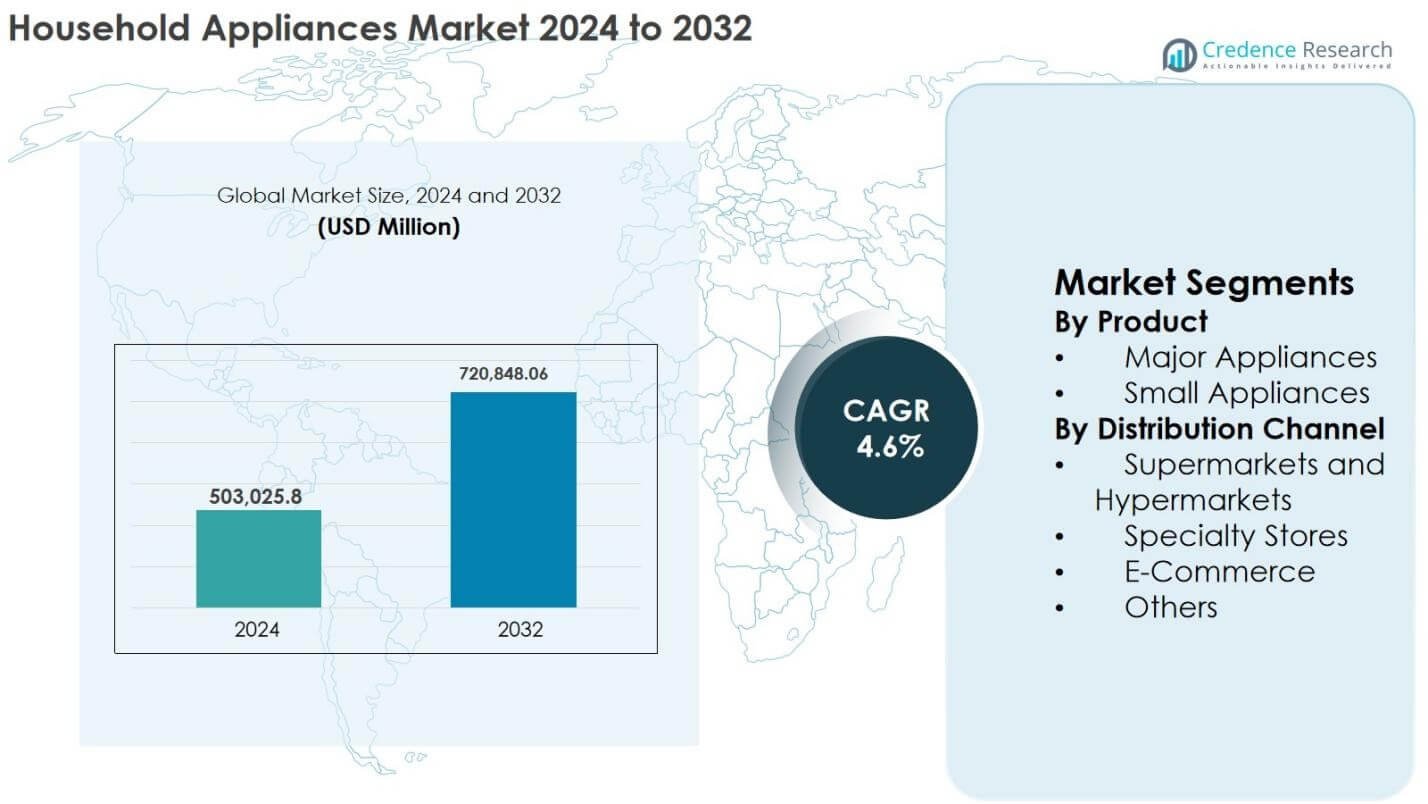
Household Appliances market size was valued at USD 503,025.8 Million in 2024 and is anticipated to reach USD 720,848.06 Million by 2032, at a CAGR of 4.6% during the forecast period.
| REPORT ATTRIBUTE | DETAILS |
|---|---|
| Historical Period | 2020-2023 |
| Base Year | 2024 |
| Forecast Period | 2025-2032 |
| Household Appliances Market Size 2024 | USD 503,025.8 million |
| Household Appliances Market, CAGR | 4.6% |
| Household Appliances Market Size 2032 | USD 720,848.06 million |
Household Appliances Market Insights
- Market growth is driven by rising urbanization, increasing disposable incomes, expanding nuclear households, and strong demand for energy-efficient and smart home appliances across major and small appliance categories.
- Key market trends include rapid adoption of IoT-enabled and inverter-based appliances, growing premiumization, integration of connected home ecosystems, and increasing consumer preference for compact, multifunctional, and design-centric products.
- The competitive landscape is characterized by leading players such as Samsung, LG, Whirlpool, Haier, Panasonic, Midea, AB Electrolux, Bosch, Sharp, and Hitachi, focusing on innovation, sustainability, regional manufacturing expansion, and omni-channel distribution strategies.
- Asia Pacific leads the market with a 35.6% share, followed by North America at 27.4% and Europe at 24.1%, while Latin America and the Middle East & Africa collectively represent emerging growth regions; major appliances account for the dominant product segment share in 2024.
Household Appliances Market Segmentation Analysis:
By Product
The By Product segment in the Household Appliances market is led by Major Appliances, which accounted for 64.2% of the market share in 2024. This dominance is driven by strong demand for essential household equipment such as refrigerators, washing machines, and air conditioners, supported by rising urbanization, expanding nuclear families, and ongoing replacement cycles in developed and developing markets. Increasing consumer preference for energy-efficient and smart connected appliances, along with government incentives for efficient home electronics, further strengthens the outlook for the Major Appliances segment during the forecast period.
- For instance, Samsung Electronics has expanded its range of Wi‑Fi enabled “Bespoke” refrigerators and AI-powered washing machines, reporting double‑digit growth in connected home appliance sales in 2023.
By Distribution Channel
In the Distribution Channel segment, Supermarkets and Hypermarkets remained the dominant sub-segment, accounting for 46.3% of the market share in 2024, driven by wider product assortments, strong brand presence, and in-store promotional programs that influence purchase decisions. However, the E-Commerce channel is expanding rapidly due to competitive pricing, doorstep delivery, and rising consumer reliance on digital retail platforms. Specialty Stores continue to attract premium buyers seeking product demonstration and after-sales support, while the Others category benefits from regional retail formats and emerging omni-channel strategies across major appliance and small appliance brands.
- For instance, Croma stores conducted live demonstrations of their 23L and 30L convection microwaves in 2024, showcasing multi-stage cooking, auto-defrost, and convection modes to help premium buyers test features like uniform heating via glass turntables.
Key Growth Drivers
Rising Urbanization, Household Income Growth, and Lifestyle Modernization
The Household Appliances market is experiencing strong expansion driven by rapid urbanization, rising disposable incomes, and evolving consumer lifestyles across both developed and emerging economies. Growing middle-class populations and increasing household formation rates are accelerating demand for essential appliances such as refrigerators, washing machines, and air conditioners, particularly in urban and semi-urban regions. Consumers are increasingly prioritizing convenience, time-saving functionality, and comfort-oriented living, which supports higher adoption of multifunctional and premium home appliances. Parallelly, the replacement cycle is strengthening as households shift from conventional devices to technologically advanced, energy-efficient, and smart-connected models. Government-led electrification programs, infrastructure development, and improved retail access in rural markets further expand penetration. Together, these structural socioeconomic shifts create a sustained growth environment for both major and small household appliances across residential and small commercial segments during the forecast period.
- For instance, LG Electronics reported that premium products (including InstaView refrigerators and high-capacity washing machines) made up over 60% of its home appliance sales mix in key markets such as North America and Europe in 2023.
Technological Advancements, Smart Connectivity, and Energy-Efficient Product Innovation
Technology-driven innovation remains a key catalyst for market growth, as manufacturers increasingly integrate IoT connectivity, AI-enabled automation, and sensor-driven performance optimization into modern household appliances. Smart refrigerators, Wi-Fi-enabled washing machines, robotic vacuum cleaners, and voice-assisted kitchen appliances are gaining strong traction among tech-savvy consumers seeking enhanced functionality and remote operability. At the same time, rising environmental awareness and regulatory emphasis on carbon reduction are accelerating the adoption of energy-efficient appliances featuring inverter technology, eco-modes, and optimized power consumption. These features reduce lifecycle operating costs and appeal to sustainability-focused households. Product miniaturization, ergonomic design, and modular aesthetics are also shaping purchase preferences, particularly in space-constrained urban homes. Continuous R&D investments, digital user interfaces, and predictive maintenance capabilities reinforce premiumization trends, enabling brands to expand value-added product portfolios and strengthen long-term consumer engagement.
- For instance, iRobot disclosed that it had sold more than 50 million robotic vacuum and floor-cleaning units globally by 2023, reflecting the mainstream adoption of automated cleaning solutions.
Expansion of Organized Retail, E-Commerce Penetration, and Omni-Channel Distribution
Market growth is further supported by the rapid expansion of organized retail networks and accelerating penetration of e-commerce platforms, which enhance product accessibility and price transparency for consumers. Large retail chains, specialty appliance showrooms, and brand-exclusive stores enable in-store product demonstrations, financing schemes, and bundled service offerings that influence high-value appliance purchases. Meanwhile, online marketplaces provide a strong growth avenue through competitive pricing, doorstep delivery, extensive product comparisons, and wider regional reach. The rise of digital-first consumer behavior, accelerated by smartphone adoption and secure payment ecosystems, strengthens online demand for both major and small appliances. Leading manufacturers are increasingly adopting omni-channel distribution strategies that integrate online and offline touchpoints, supporting flexible purchase journeys and post-sales service models. These ecosystem-level retail developments significantly enhance market penetration, particularly in Tier-2 and Tier-3 cities, and contribute to sustained demand growth across product categories.
Key Trends & Opportunities
Growth of Smart Homes, Connected Living Ecosystems, and Premiumization Opportunities
A major trend shaping the Household Appliances market is the rapid emergence of smart home ecosystems, where connected appliances integrate seamlessly with cloud platforms, mobile applications, and digital assistants. Consumers are increasingly adopting intelligent devices capable of remote monitoring, usage analytics, and predictive diagnostics, creating opportunities for subscription-based services and value-added digital features. Premiumization is gaining momentum as households shift toward high-end, design-centric, and technologically sophisticated appliances that enhance convenience and user experience. Built-in kitchen appliances, modular storage solutions, and luxury lifestyle products are witnessing strong uptake among urban professionals and high-income consumers. This trend also opens avenues for brand differentiation through innovation-led marketing, customized product lines, and upgrade-driven replacement cycles, strengthening long-term revenue growth prospects for manufacturers.
- For instance, Bosch and Siemens have expanded their built-in appliance lines in Europe and North America, emphasizing seamless kitchen integration, premium finishes, and smart functions that appeal to design-conscious buyers.
Sustainability, Energy-Efficiency Transition, and Circular Economy Opportunities
Sustainability-oriented consumption is emerging as a key opportunity area, as governments, regulators, and consumers increasingly emphasize energy-efficiency norms and environmentally responsible product lifecycles. Demand is rising for appliances featuring recyclable materials, eco-friendly refrigerants, reduced energy footprints, and optimized water consumption technologies. Manufacturers are exploring circular economy models, including refurbishment programs, modular repairable designs, and product take-back initiatives that extend asset lifespans and reduce waste. Green labeling standards and incentive programs further encourage adoption of high-efficiency appliance models across residential markets. These sustainability-driven transitions not only align with climate-responsibility objectives but also create opportunities for product repositioning, premium branding, and differentiation in highly competitive market segments.
- For instance, Beko reports that its recycling partners can refurbish between 7–20% of returned appliances, giving them a second life before remaining units are stripped for reusable parts and recycled materials.
Key Challenges
High Energy Costs, Affordability Barriers, and Demand Sensitivity in Price-Driven Markets
Despite positive growth momentum, the Household Appliances market faces affordability-related challenges, particularly in price-sensitive developing economies where high upfront costs limit adoption of premium and smart appliances. Rising electricity tariffs and operating expenses influence consumer purchasing decisions, discouraging frequent replacements or upgrades among lower-income households. Economic volatility, inflationary pressures, and fluctuating raw material costs also affect pricing structures and margin stability for manufacturers. In rural and underserved regions, limited financing access and lower awareness of energy-efficient benefits further constrain penetration levels. These affordability and cost-sensitivity factors create demand imbalances across regions and income groups, posing a structural challenge to uniform market expansion.
Supply Chain Volatility, Intense Competition, and After-Sales Service Complexity
The market also contends with supply chain disruptions, fluctuating component availability, and logistics-related risks that impact manufacturing continuity and delivery reliability. Intense competition among global and regional players exerts strong pricing pressure, driving aggressive discounting strategies and limiting differentiation in certain product categories. Maintaining consistent quality standards, extensive distribution coverage, and reliable after-sales service networks adds operational complexity, particularly for large-format and connected appliances requiring technical support. Rapid technology evolution shortens product lifecycles, increasing R&D and inventory management challenges for manufacturers. These competitive and operational headwinds require strategic optimization of production, sourcing, and customer-support frameworks to sustain profitability and long-term market positioning.
Regional Analysis
North America
North America accounted for 27.4% of the Household Appliances market share in 2024, driven by high penetration of premium and smart appliances across residential households. The region benefits from strong consumer purchasing power, well-established replacement cycles, and rapid adoption of energy-efficient and IoT-enabled devices. Growth is further supported by increasing demand for built-in kitchen appliances, modular home solutions, and connected living ecosystems. The U.S. remains the leading contributor due to large-scale urban housing projects and strong retail infrastructure, while Canada is witnessing rising adoption of eco-friendly and compact appliances, particularly among urban and multi-family housing consumers.
Europe
Europe held 24.1% of the market share in 2024, supported by strong regulatory emphasis on energy efficiency, sustainability standards, and eco-label compliance across major appliance categories. The market is shaped by high consumer preference for durable, premium-quality products and growing adoption of next-generation smart home appliances in Western European economies. Demand is also increasing for compact, space-saving appliances in urban apartments, along with rising replacement of conventional devices with low-carbon and inverter-based models. Germany, the U.K., and France remain the key revenue-generating markets, while Eastern Europe is emerging as a fast-growing manufacturing and consumption hub.
Asia Pacific
Asia Pacific dominated the Household Appliances market with a 35.6% share in 2024, driven by rapid urbanization, expanding middle-class populations, and rising household income levels across China, India, Japan, and Southeast Asia. The region benefits from large-scale residential construction, electrification initiatives, and increasing adoption of affordable smart and energy-efficient appliances. Local manufacturing strength and competitive pricing strategies also support mass-market penetration. China remains the largest market due to strong domestic production and consumption, while India and ASEAN countries represent high-growth zones, supported by ongoing lifestyle modernization, retail expansion, and growing demand for compact and multifunctional household appliances.
Latin America
Latin America represented 7.8% of the global market share in 2024, with growth primarily driven by rising urban household formation, expanding access to financing plans, and increasing awareness of energy-efficient home appliances. Brazil and Mexico lead the regional demand, supported by improving retail infrastructure and growing adoption of mid-range and entry-level appliance models. The market is also benefiting from gradual modernization of housing infrastructure and expanding e-commerce penetration, which enhances product availability across secondary cities. However, economic fluctuations and price sensitivity influence purchase cycles, leading to stronger demand for value-driven and durable appliance offerings across key product categories.
Middle East & Africa
The Middle East & Africa region accounted for 5.1% of the market share in 2024, supported by improving electrification rates, urban development projects, and increasing appliance adoption among emerging middle-income households. Demand is rising for air conditioners, refrigerators, and washing machines, particularly in Gulf Cooperation Council (GCC) economies driven by premium home development and expatriate population growth. Africa is witnessing gradual market expansion through affordable product ranges and growing distribution reach in urban centers. However, price sensitivity and infrastructure constraints continue to shape purchasing patterns, leading to stronger demand for durable, energy-efficient, and entry-level household appliance solutions.
Household Appliances Market Segmentations:
By Product
- Major Appliances
- Small Appliances
By Distribution Channel
- Supermarkets and Hypermarkets
- Specialty Stores
- E-Commerce
- Others
By Geography
- North America
- U.S.
- Canada
- Mexico
- Europe
- Germany
- France
- U.K.
- Italy
- Spain
- Rest of Europe
- Asia Pacific
- China
- Japan
- India
- South Korea
- South-east Asia
- Rest of Asia Pacific
- Latin America
- Brazil
- Argentina
- Rest of Latin America
- Middle East & Africa
- GCC Countries
- South Africa
- Rest of the Middle East and Africa
Competitive Landscape
The Household Appliances market features an intensely dynamic and innovation-driven competitive landscape, with global leaders competing alongside strong regional manufacturers and emerging smart-appliance brands. Major players such as Samsung Electronics Co., Ltd., LG Electronics Inc., Whirlpool Corporation, Panasonic Corporation, Midea Group Co., Ltd., Qingdao Haier Co., Ltd. (Haier), AB Electrolux, Robert Bosch GmbH, Sharp Corporation, and Hitachi, Ltd. focus on product innovation, energy-efficient technologies, and smart connectivity to strengthen their market presence. Companies are increasingly investing in IoT-enabled appliances, inverter technology, modular designs, and premium lifestyle-oriented product lines to capture evolving consumer preferences. Strategic initiatives include mergers and acquisitions, localized manufacturing expansion, and partnerships with e-commerce and omni-channel retail platforms to enhance distribution reach. Many players are also prioritizing sustainability through eco-friendly materials, recyclable components, and circular-economy initiatives, while simultaneously strengthening after-sales networks and service-based value offerings to build long-term consumer loyalty in both mature and high-growth markets.
Key Player Analysis
- Panasonic Corporation
- Whirlpool Corporation
- Hitachi, Ltd.
- Samsung Electronics Co., Ltd.
- Robert Bosch GmbH
- Midea Group Co., Ltd.
- Sharp Corporation
- LG Electronics Inc.
- Qingdao Haier Co., Ltd.
- AB Electrolux
Recent Developments
- In December 2025, Samsung Electronics announced it will showcase next-generation AI-powered household appliances at CES 2026 in Las Vegas, highlighting smart functionality and personalized experiences for consumers.
- In September 2025, BSH Home Appliances Group entered into a strategic partnership with ECOVACS Group to co-develop and launch the world’s first built-in vacuum and mopping robot integrated into kitchen furniture, available in Europe from Spring 2026.
- In July 2025, Reliance Retail acquired the home appliances brand Kelvinator from Electrolux for the Indian market to strengthen its consumer durables portfolio
Report Coverage
The research report offers an in-depth analysis based on Product, Distribution Channel and Geography. It details leading market players, providing an overview of their business, product offerings, investments, revenue streams, and key applications. Additionally, the report includes insights into the competitive environment, SWOT analysis, current market trends, as well as the primary drivers and constraints. Furthermore, it discusses various factors that have driven market expansion in recent years. The report also explores market dynamics, regulatory scenarios, and technological advancements that are shaping the industry. It assesses the impact of external factors and global economic changes on market growth. Lastly, it provides strategic recommendations for new entrants and established companies to navigate the complexities of the market.
Future Outlook
- The market will witness steady demand growth as households increasingly adopt energy-efficient and smart-connected appliances across major urban and semi-urban regions.
- Manufacturers will continue to invest in IoT integration, AI-driven automation, and sensor-based performance features to enhance user experience and product differentiation.
- Premiumization will gain momentum as consumers shift toward high-end, design-centric, and multifunctional appliances that support modern lifestyle preferences.
- E-commerce and omni-channel retail expansion will play a critical role in widening product accessibility and strengthening brand penetration in emerging markets.
- Sustainability and circular-economy initiatives will influence product design, material selection, and after-sales service strategies across leading manufacturers.
- Demand for compact, space-saving, and modular appliance formats will increase in response to urban housing constraints and smaller living spaces.
- Localized manufacturing and regional supply-chain optimization will strengthen cost competitiveness and market responsiveness for global brands.
- Replacement demand will accelerate as consumers upgrade from conventional devices to smart, inverter-based and energy-efficient models.
- Strategic partnerships, mergers, and technology collaborations will intensify as companies seek to expand innovation capabilities and market presence.
- Emerging markets in Asia, Latin America, and Africa will offer strong growth opportunities driven by electrification, urbanization, and rising middle-income households.

Request a Free Sample
Fill in your details and we'll send you a free sample report.
- Sample data tables & charts
- Research methodology
Market Dynamics
Rising Urbanization and Household Income Growth
Rapid urbanization and increasing disposable incomes are fueling demand for essential and premium household appliances, especially in emerging economies. Expanding nuclear households and lifestyle modernization are accelerating the adoption of both major and small appliances.
Technological Advancements and Smart Connectivity
Manufacturers are integrating IoT, AI, and sensor-driven technologies into appliances, enabling smart features, remote operability, and energy efficiency. This innovation attracts tech-savvy consumers and drives replacement cycles as households upgrade to connected, multifunctional devices.
Expansion of Organized Retail and E-Commerce
The growth of organized retail chains and e-commerce platforms has improved product accessibility, price transparency, and regional reach. Omni-channel strategies and digital-first consumer behavior are making it easier for consumers to purchase and compare appliances, supporting market expansion.
Sustainability and Energy-Efficiency Initiatives
Increasing environmental awareness and regulatory emphasis on energy efficiency are driving demand for appliances with eco-friendly materials, inverter technology, and optimized power consumption. Manufacturers are responding with sustainable product lines and circular economy initiatives, appealing to environmentally conscious consumers.
Premiumization and Design-Centric Preferences
Consumers are increasingly seeking high-end, design-centric, and multifunctional appliances that enhance convenience and fit modern lifestyles. This trend is boosting demand for premium products, built-in solutions, and modular designs, especially in urban and high-income segments.
Need a Custom Version of This Report?
Tailor the scope, geography, or segments to your exact requirements.
- Custom geography or segment scope
- Direct access to our analyst team
Frequently Asked Questions
What is the current market size for Household Appliances Market, and what is its projected size in 2032?
At what Compound Annual Growth Rate is the Household Appliances Market projected to grow between 2024 and 2032?
Which Household Appliances Market segment held the largest share in 2024?
What are the primary factors fueling the growth of the Household Appliances Market?
Who are the leading companies in the Household Appliances Market?
Which region commanded the largest share of the Household Appliances Market in 2024?
Table of Content
Chapter 1 Market Segmentation
- 1.1 Segmentation Framework
- 1.1.1 Product and Service Classification
- 1.1.2 Application and End-Use Classification
- 1.1.3 Technology and Solution Classification
- 1.1.4 Customer and Distribution Channel Classification
- 1.1.5 Geographic Segmentation
- 1.1.6 Market Segment Definitions and Boundaries
- 1.2 By Product
- 1.2.1 Major Appliances
- 1.2.2 Small Appliances
Chapter 2 Introduction
- 2.1 Report Objectives and Scope
- 2.2 Product Definition and Industry Terminology
- 2.3 Market Inclusions and Exclusions
- 2.4 Research Process
- 2.4.1 Primary Research and Expert Interviews
- 2.4.2 Secondary Research and Source Review
- 2.4.3 Top-Down and Bottom-Up Estimation
- 2.4.4 Data Triangulation and Verification
- 2.5 Market Size Measurement Basis
- 2.5.1 2024: USD 503,025.8 Million → 2032: USD 720,848.06 Million
- 2.6 Historical and Forecast Reference Periods
- 2.6.1 Base Year: 2024
- 2.6.2 Forecast Period: 2024-2032
- 2.7 Research Assumptions and Limitations
Chapter 3 Executive Summary
- 3.1 Market Snapshot and Key Findings
- 3.2 Base-Year Market Size, 2024
- 3.3 Forecast Market Size, 2032
- 3.4 Revenue and Volume Growth Outlook
- 3.5 Key Demand and Supply Indicators
- 3.6 Leading Market Segments
- 3.7 Fastest-Growing Market Opportunities
- 3.8 Regional Performance Highlights
- 3.9 Technology and Industry Transformation
- 3.10 Competitive Landscape Summary
- 3.11 Analyst View and Strategic Implications
Chapter 4 Global Household Appliances Market Trends and Developments
- 4.1 Historical Industry Development
- 4.2 Recent Market Trends and Developments
- 4.3 Demand and Customer Behavior Trends
- 4.4 Technology and Product Innovation
- 4.5 Artificial Intelligence, Automation and Digitalization
- 4.6 Local Manufacturing and Supply Chain Realignment
- 4.7 Industry Partnerships, Mergers and Acquisitions
- 4.8 Sustainability and Circular Economy Developments
- 4.9 Government and Private Sector Investment Trends
- 4.10 Emerging Business Models and Commercialization
- 4.11 Industry Developments and Announcements
Chapter 5 Global Household Appliances Market Production, Supply and Demand Analysis
- 5.1 Demand Trend and Consumption Analysis
- 5.2 Demand Forecast, 2024-2032
- 5.3 Production and Output Trend
- 5.4 Production and Output Forecast, 2024-2032
- 5.5 Installed Capacity and Capacity Utilization
- 5.6 Company-Wise Production Plants and Statistics
- 5.6.1 Installed Production Capacity
- 5.6.2 Actual Production
- 5.6.3 Planned Capacity and Expansion Targets
- 5.7 Supply Chain Structure and Procurement Trends
- 5.8 Supply-Demand Gap and Bottlenecks
- 5.9 Import Dependence and Sourcing Structure
- 5.10 Contract Manufacturing and Outsourcing
- 5.11 Regional Supply and Demand Concentration
Chapter 6 Global Household Appliances Market Pricing Analysis
- 6.1 Pricing Structure and Measurement
- 6.2 Historical Pricing Trends
- 6.3 Pricing Outlook, 2024-2032
- 6.4 Average Selling Price and Unit Economics
- 6.5 Pricing by Product and Market Segment
- 6.6 Geographic Pricing Differences
- 6.7 Key Input, Energy, Labor and Logistics Costs
- 6.8 Contract Pricing and Purchasing Models
- 6.9 Pricing Sensitivity and Competitive Positioning
- 6.10 Price, Margin and Profitability Implications
Chapter 7 Global Household Appliances Market Dynamics
- 7.1 Market Growth Drivers
- 7.1.1 Demand-Side Drivers
- 7.1.2 Technology and Innovation Drivers
- 7.1.3 Infrastructure and Investment Drivers
- 7.1.4 Regulatory and Policy Drivers
- 7.2 Market Restraints
- 7.2.1 Cost and Affordability Constraints
- 7.2.2 Technology and Adoption Barriers
- 7.2.3 Supply Chain and Operational Constraints
- 7.3 Market Challenges
- 7.3.1 Competitive Pressure and Margin Erosion
- 7.3.2 Skills, Infrastructure and Implementation Gaps
- 7.4 Emerging Market Opportunities
- 7.5 Market Dynamics Impact and Time-Horizon Assessment
Chapter 8 Global Household Appliances Value Chain Analysis
- 8.1 Industry Value Chain Overview
- 8.2 Upstream Suppliers and Critical Inputs
- 8.3 Technology and Component Providers
- 8.4 Manufacturing or Service Delivery
- 8.5 Distribution, Channel Partners and Integrators
- 8.6 Downstream Applications and End Users
- 8.7 Value Addition and Profit Pools
- 8.8 Vertical Integration and Outsourcing
- 8.9 Supplier Concentration and Risk
- 8.10 Supply Chain Localization and Resilience
Chapter 9 Global Household Appliances Market Regulations and Policies
- 9.1 Relevant Laws, Standards and Compliance Frameworks
- 9.2 Product, Service, Safety and Quality Requirements
- 9.3 Government Policies, Incentives and Subsidies
- 9.4 Imports, Exports and Trade Barriers
- 9.5 Public Procurement and Local Content Requirements
- 9.6 Environmental and Sustainability Compliance
- 9.7 Upcoming Policy Changes and Market Implications
Chapter 10 Global Household Appliances Market Hotspots and Opportunities
- 10.1 Market Opportunity Mapping and Growth Hotspots
- 10.2 High-Growth Applications and Customer Groups
- 10.3 Underserved Markets and White-Space Opportunities
- 10.4 Emerging Technology and Product Opportunities
- 10.5 New Capacity and Investment Hotspots
- 10.6 Market Entry and Expansion Opportunities
- 10.7 Distribution and Partnership Opportunities
- 10.8 Near-Term and Long-Term Commercial Potential
- 10.9 Opportunity Attractiveness and Execution Risks
Chapter 11 Global Household Appliances Market Outlook, 2024-2032
- 11.1 Market Size and Analysis
- 11.1.1 Revenue (Market Measurement: 2024: USD 503,025.8 Million → 2032: USD 720,848.06 Million)
- 11.1.2 Market Volume and Quantity Sold
- 11.1.3 Historical Market Size
- 11.1.4 Base-Year Market Size, 2024
- 11.2 Market Forecast, 2024-2032
- 11.2.1 Revenue Forecast to 2032
- 11.2.2 Volume Forecast to 2032
- 11.2.3 CAGR and Year-on-Year Growth
- 11.2.4 Incremental Revenue Opportunity
- 11.3 Forecast Assumptions and Scenario Analysis
- 11.3.1 Base-Case Forecast
- 11.3.2 Optimistic and Conservative Scenarios
- 11.3.3 Technology, Pricing and Policy Sensitivities
- 11.4 Market Attractiveness and Growth Outlook
Chapter 12 Global Household Appliances Market Segmentation and Outlook
- 12.1 Segmentation Summary and Market Shares, 2024
- 12.2 Largest and Fastest-Growing Segments
- 12.3 By Product - Market Size and Forecast, 2024-2032
- 12.3.1 Segment Definition and Scope
- 12.3.2 Historical Market Size
- 12.3.3 Revenue Forecast, 2024-2032
- 12.3.4 Volume Forecast, 2024-2032
- 12.3.5 Base-Year Market Share, 2024
- 12.3.6 Segment CAGR and Growth Drivers
- 12.3.7 Subsegment Market Size and Forecast
- 12.3.7.1 Major Appliances
- 12.3.7.2 Small Appliances
- 12.3.8 Subsegment Pricing and Adoption Trends
- 12.3.9 Leading Suppliers and Competition
- 12.3.10 Regional Demand and Opportunities
- 12.4 Segment Growth Comparison
- 12.5 Segment Attractiveness and Priority Matrix
Chapter 13 Global Household Appliances Geographic Market Outlook, 2024-2032
- 13.1 Regional Market Size and Share, 2024
- 13.2 Regional Market Forecast, 2024-2032
- 13.3 Regional Pricing, Production and Demand Differences
- 13.4 North America
- 13.4.1 United States
- 13.4.2 Canada
- 13.4.3 Mexico
- 13.5 Europe
- 13.5.1 Germany
- 13.5.2 France
- 13.5.3 Italy
- 13.5.4 United Kingdom
- 13.5.5 Spain
- 13.5.6 Poland
- 13.5.7 Russia
- 13.5.8 Netherlands
- 13.5.9 Belgium
- 13.5.10 Sweden
- 13.5.11 Denmark
- 13.5.12 Norway
- 13.5.13 Rest of Europe
- 13.6 Asia Pacific
- 13.6.1 China
- 13.6.2 India
- 13.6.3 Japan
- 13.6.4 South Korea
- 13.6.5 Thailand
- 13.6.6 Indonesia
- 13.6.7 Vietnam
- 13.6.8 Malaysia
- 13.6.9 Australia
- 13.6.10 Rest of Asia Pacific
- 13.7 Latin America
- 13.7.1 Brazil
- 13.7.2 Argentina
- 13.7.3 Colombia
- 13.7.4 Chile
- 13.7.5 Rest of Latin America
- 13.8 Middle East
- 13.8.1 Saudi Arabia
- 13.8.2 United Arab Emirates
- 13.8.3 Turkey
- 13.8.4 Israel
- 13.8.5 Iran
- 13.8.6 Rest of the Middle East
- 13.9 Africa
- 13.9.1 South Africa
- 13.9.2 Egypt
- 13.9.3 Nigeria
- 13.9.4 Morocco
- 13.9.5 Rest of Africa
- 13.10 Regional Investment, Policy and Supply Chain Differences
- 13.11 Regional Competitive Landscape
- 13.12 Geographic Growth Hotspots
Chapter 14 Global Household Appliances Technology, Innovation and Sustainability Outlook
- 14.1 Technology Landscape and Maturity
- 14.2 Product, Process and Service Innovation
- 14.3 AI, Automation and Digital Tools in the Industry
- 14.4 Technology Adoption and Performance Benchmarking
- 14.5 Innovation Pipeline and R&D Investment
- 14.6 Patent and Intellectual Property Trends
- 14.7 Energy Efficiency and Resource Management
- 14.8 Sustainability, Recycling and Circularity
- 14.9 Technology Roadmap, 2024-2032
- 14.10 Risks of Obsolescence and Technology Substitution
Chapter 15 Global Household Appliances Market Key Strategic Imperatives
- 15.1 Growth and Market Entry Priorities
- 15.2 High-Return Products and Segments
- 15.3 Pricing, Profitability and Cost Optimization
- 15.4 Technology Investment and Product Differentiation
- 15.5 Supply Chain Localization and Resilience
- 15.6 Distribution and Customer Acquisition
- 15.7 Partnership, Acquisition and Capacity Strategy
- 15.8 Regional Expansion Priorities
- 15.9 Short-, Medium- and Long-Term Actions
Chapter 16 Competition Outlook
- 16.1 Industry Competition Characteristics
- 16.2 Market Structure and Concentration
- 16.3 Market Share and Competitive Positioning, 2024
- 16.4 Company-Wise Revenue and Product Benchmarking
- 16.5 Production and Service Capacity Benchmarking
- 16.6 Technology, Pricing and Differentiation
- 16.7 Regional Footprint and Distribution Strength
- 16.8 Mergers, Acquisitions and Strategic Alliances
- 16.9 New Entrants and Competitive Threats
- 16.10 Porter's Five Forces and Industry Attractiveness
- 16.11 Competitive Outlook, 2024-2032
Chapter 17 Company Profiles
- 17.1 Company Coverage and Selection Criteria
- 17.2 Samsung Electronics Co., Ltd.
- 17.2.1 Business Description
- 17.2.2 Company Ownership and Geographic Presence
- 17.2.3 Product and Service Portfolio
- 17.2.4 Manufacturing and Operating Footprint
- 17.2.5 Production Capacity and Expansion Plans
- 17.2.6 Financial Performance and Investment
- 17.2.7 Market Share and Competitive Position
- 17.2.8 Technology and Innovation Capabilities
- 17.2.9 Strategic Alliances or Partnerships
- 17.2.10 Recent Developments
- 17.2.11 Growth Strategy and Outlook
- 17.3 LG Electronics Inc.
- 17.4 Whirlpool Corporation
- 17.5 Haier (Qingdao Haier Co., Ltd.)
- 17.6 Panasonic Corporation
- 17.7 Midea Group Co., Ltd.
- 17.8 AB Electrolux
- 17.9 Robert Bosch GmbH
- 17.10 Sharp Corporation
- 17.11 Hitachi, Ltd.
- 17.12 Other Relevant Market Participants
Note: Every listed company is profiled on the structure shown under the first company. The company list is preliminary and may change based on research findings, market developments, data availability and client requirements.
Chapter 18 Disclaimer
- 18.1 Research and Forecast Disclaimer
- 18.2 Data Source and Estimation Limitations
Note: The depth of individual sections depends on data availability for this market. Volume, capacity, trade and other unit-based metrics are included where applicable.