Market overview
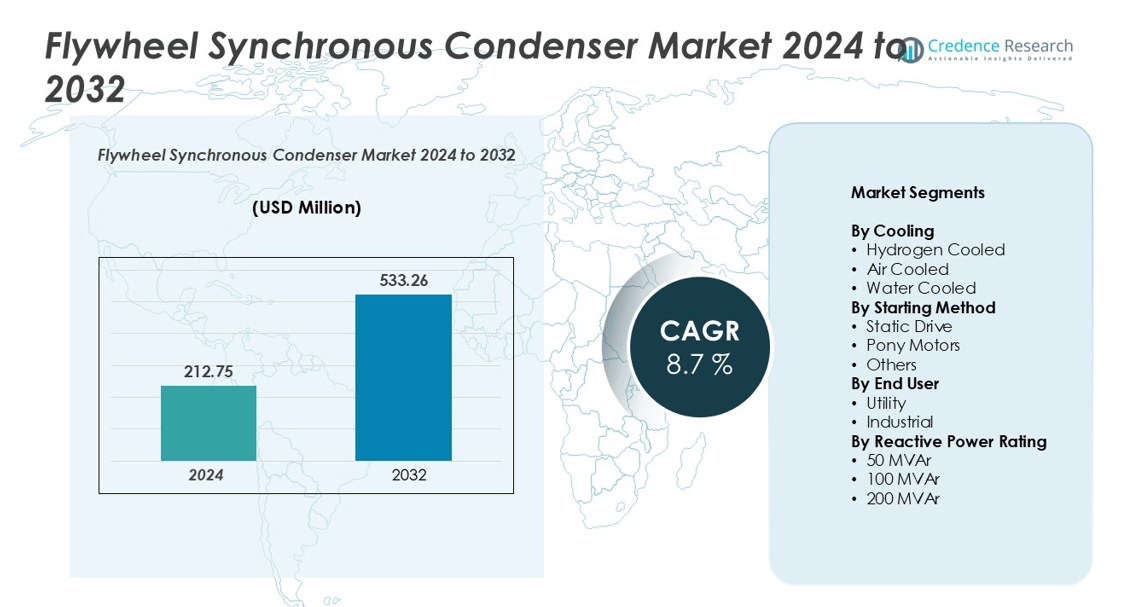
The flywheel synchronous condenser market size was valued at USD 212.75 million in 2024 and is anticipated to reach USD 533.26 million by 2032, at a CAGR of 8.7% during the forecast period.
| REPORT ATTRIBUTE | DETAILS |
|---|---|
| Historical Period | 2020-2023 |
| Base Year | 2024 |
| Forecast Period | 2025-2032 |
| Flywheel Synchronous Condenser Market Size 2024 | USD 212.75 million |
| Flywheel Synchronous Condenser Market, CAGR | 8.7% |
| Flywheel Synchronous Condenser Market Size 2032 | USD 533.26 million |
The flywheel synchronous condenser market is led by prominent players including ABB, Siemens Energy, General Electric, Mitsubishi Electric Power Products, ANDRITZ, Ansaldo Energia, Baker Hughes, Doosan Škoda Power, and Ingeteam. These companies focus on technological innovation, high-efficiency hydrogen-cooled systems, and digital monitoring solutions to strengthen their competitive positions. North America emerges as the leading region, capturing approximately 35% of the global market, driven by extensive grid modernization and renewable energy integration. Europe follows with a 25% share, supported by decarbonization initiatives and stringent grid codes, while Asia-Pacific holds around 20%, fueled by rapid industrialization and expanding renewable capacity. Middle East & Africa and Latin America account for 15% and 5%, respectively, with growth driven by infrastructure development and utility modernization. Together, these regions and top players shape the dynamic global market landscape.
Market Insights
- The flywheel synchronous condenser market was valued at USD 212.75 million in 2024 and is projected to reach USD 533.26 million by 2032, growing at a CAGR of 8.7% during the forecast period.
- Increasing renewable energy integration, grid modernization, and demand for voltage stabilization are driving market growth, particularly for hydrogen-cooled and high-capacity static drive systems.
- Key trends include adoption of digital monitoring and smart grid integration, expansion in industrial and utility applications, and growing preference for hydrogen-cooled condensers over air- and water-cooled systems.
- The market is highly competitive, led by ABB, Siemens Energy, General Electric, Mitsubishi Electric Power Products, ANDRITZ, Ansaldo Energia, Baker Hughes, Doosan Škoda Power, and Ingeteam, focusing on innovation, partnerships, and advanced technology.
- North America dominates with a 35% share, Europe holds 25%, Asia-Pacific 20%, Middle East & Africa 15%, and Latin America 5%; hydrogen-cooled condensers lead segment share due to efficiency and high-capacity applications.
Market Segmentation Analysis:
By Cooling
The hydrogen-cooled segment dominates the flywheel synchronous condenser market, holding the largest share due to its superior thermal efficiency and ability to handle high-capacity operations. Hydrogen cooling reduces energy losses and enables higher reliability in continuous operations, making it the preferred choice for large-scale utility installations. Air-cooled and water-cooled subsegments are witnessing steady growth, driven by smaller industrial applications and cost-sensitive projects. Increasing adoption of hydrogen-cooled condensers in renewable integration and grid stabilization projects further fuels the segment’s expansion.
- For instance, Siemens Energy supplied synchronous condensers for a major project at the Intermountain Power Project (IPP) in Delta, Utah, to enhance grid stability in regions with high renewable energy penetration.
By Starting Method
Static drive systems lead the market by a significant margin, offering precise control, reduced mechanical stress, and faster synchronization with the grid. Their adoption is particularly strong in industrial setups requiring frequent start-stop cycles and high operational stability. Pony motors and other starting methods serve niche applications, mainly in legacy installations and smaller-scale units, but are gradually being replaced due to limitations in efficiency and maintenance demands. Investments in automation and advanced control technologies further boost the static drive segment’s market penetration.
- For instance, the statement that Siemens Energy's integration of advanced control systems in their static drive synchronous condensers has enhanced operational stability and reduced maintenance.
By End User
Utility companies represent the dominant end-user segment, accounting for the majority of flywheel synchronous condenser installations. The segment’s growth is driven by increasing grid modernization, renewable energy integration, and the need for voltage regulation and reactive power support at scale. Industrial applications, though smaller in share, are expanding due to rising energy-intensive operations and the adoption of advanced energy storage solutions. The utility segment benefits from long-term contracts and higher-capacity installations, positioning it as the key driver of overall market growth.
Key Growth Drivers
Increasing Renewable Energy Integration
The growing deployment of renewable energy sources, such as solar and wind, is a primary driver for the flywheel synchronous condenser market. Grid operators require advanced reactive power support and voltage stabilization to manage the intermittent nature of renewable generation. Flywheel synchronous condensers provide rapid response capabilities, enabling efficient frequency regulation and system balancing. Utilities increasingly invest in high-capacity condensers to ensure grid reliability, particularly in regions with high renewable penetration. Moreover, government incentives and regulatory mandates for renewable adoption are accelerating the deployment of energy storage and power conditioning technologies, further boosting demand for flywheel synchronous condensers across both utility-scale and industrial applications.
- For instance, In Ireland, Siemens Energy's supplied a synchronous condenser system to the Moneypoint power station. This system, which incorporates the world's largest flywheel, strengthens grid stability by providing inertia, short-circuit power, and reactive power, which is critical for regions with high renewable energy integration.
Technological Advancements in Flywheel Systems
Innovations in high-speed flywheel technology and magnetic bearing systems are enhancing efficiency, durability, and operational lifespan of synchronous condensers. These advancements allow condensers to handle higher reactive power loads while reducing maintenance requirements and energy losses. The integration of digital monitoring and predictive maintenance systems ensures real-time performance optimization, increasing reliability for grid operators. Companies investing in research and development to improve rotor design, cooling methods, and energy density are expanding the market by making flywheel synchronous condensers more suitable for diverse applications, including urban grids, industrial facilities, and renewable energy integration projects.
- For instance, GE Vernova's air-cooled synchronous condenser, rated up to 300 MVAR, is utilized for reactive power compensation and voltage support in various installations.
Rising Demand for Grid Stability and Voltage Regulation
The need for stable and reliable electricity supply is intensifying as grids become more complex due to distributed generation and electrification trends. Flywheel synchronous condensers help maintain voltage stability, support reactive power compensation, and prevent blackouts or system disturbances. Utilities and industrial operators are increasingly adopting these condensers to comply with stringent grid codes and enhance system resilience. The technology’s ability to provide rapid reactive power support and seamless integration with existing infrastructure positions it as a preferred solution for modern power networks, driving widespread adoption and market growth.
Key Trends & Opportunities
Shift Toward Hydrogen and Advanced Cooling Technologies
The flywheel synchronous condenser market is witnessing a trend toward hydrogen-cooled systems and innovative cooling solutions to enhance efficiency and capacity. Hydrogen cooling allows higher thermal management capabilities, supporting larger units with lower energy losses. Air-cooled and water-cooled systems are being optimized for smaller industrial applications, offering cost-effective alternatives. This trend provides opportunities for manufacturers to develop customized solutions targeting both utility and industrial segments, leveraging technological differentiation to capture market share while addressing sustainability requirements.
- For instance, Siemens Energy has installed synchronous condensers in Ireland, including at the Moneypoint and Shannonbridge sites, to enhance grid stability and enable higher penetration of renewables. These systems provide inertia, short-circuit power, and reactive power for voltage support, but their specific cooling method and reactive power rating differ from the initial claim.
Expansion in Industrial and Utility Applications
Industrial facilities and utilities are increasingly adopting flywheel synchronous condensers to manage reactive power, stabilize voltage, and improve energy efficiency. Opportunities exist in industrial sectors such as manufacturing, mining, and data centers, where high-load operations require reliable grid support. Additionally, urban grid modernization projects in emerging economies create significant potential for market expansion. Companies that develop scalable, modular condensers can capitalize on these opportunities by offering tailored solutions that meet both large-scale and distributed grid requirements.
- For instance, GE Vernova's air-cooled synchronous condenser, rated up to 300 MVAR, is utilized for reactive power compensation and voltage support in various installations.
Integration with Smart Grid and Digital Monitoring Solutions
The integration of flywheel synchronous condensers with smart grid technologies and digital monitoring platforms is creating new avenues for market growth. Real-time performance tracking, predictive maintenance, and automated control systems enhance operational efficiency and reduce downtime. These solutions enable utilities to optimize reactive power management and improve grid resilience. Companies that leverage IoT and AI-enabled platforms for flywheel monitoring are well-positioned to differentiate themselves and capture opportunities in the evolving energy ecosystem.
Key Challenges
High Capital Investment and Installation Costs
One of the main challenges limiting the adoption of flywheel synchronous condensers is the high upfront cost associated with manufacturing, installation, and integration. Advanced rotor systems, high-speed bearings, and hydrogen-cooling infrastructure contribute to substantial capital expenditure. This can deter small-scale industrial users and utilities in cost-sensitive regions from adopting the technology. Additionally, project financing and ROI considerations require long-term planning, which may slow market expansion despite clear operational benefits.
Technical Complexity and Maintenance Requirements
Flywheel synchronous condensers require specialized expertise for installation, operation, and maintenance due to their high-speed rotating components and advanced control systems. Improper handling or insufficient technical knowledge can result in operational inefficiencies or safety hazards. While modern designs reduce maintenance frequency, ongoing monitoring and skilled personnel remain essential. The technical complexity can challenge adoption, particularly in emerging markets where local expertise is limited, creating a barrier to rapid market penetration.
Regional Analysis
North America:
North America dominates the flywheel synchronous condenser market, holding approximately 35% of global share. Strong investments in grid modernization, renewable energy integration, and voltage regulation drive demand. The U.S. and Canada are leading adopters of hydrogen-cooled condensers and high-capacity static drive systems for reactive power management. Industrial sectors also deploy these condensers to handle large reactive loads efficiently. Regulatory frameworks, government incentives, and technological advancements reinforce the region’s market leadership. Early adoption of smart grid initiatives and reliability-focused infrastructure projects continue to sustain North America’s dominance in global market share.
Europe:
Europe accounts for around 25% of the global flywheel synchronous condenser market, led by Germany, France, and the U.K. Demand is fueled by renewable energy integration, decarbonization targets, and stringent grid codes requiring voltage stabilization. The region favors hydrogen-cooled systems and digital monitoring technologies to improve operational efficiency. Industrial sectors, including manufacturing and heavy industries, increasingly adopt these condensers for reactive power support. Strong R&D investment, government incentives, and early adoption of advanced technology help Europe maintain its position as a key regional contributor with a significant share of the market.
Asia-Pacific:
Asia-Pacific captures roughly 20% of the flywheel synchronous condenser market, driven by rapid industrialization, urbanization, and renewable energy expansion in China, India, and Japan. Utilities are investing in high-capacity condensers to stabilize grids under fluctuating renewable generation. Industrial facilities adopt condensers to enhance energy efficiency and reactive power support for heavy machinery. Government initiatives, infrastructure modernization projects, and increasing electricity demand bolster adoption. Asia-Pacific’s market share is expected to grow further as both utility and industrial sectors prioritize reliability, efficiency, and integration of advanced condenser technologies.
Middle East & Africa:
The Middle East & Africa region holds approximately 15% of the global market. Growth is driven by grid expansion, industrialization, and large-scale energy projects in Gulf countries and South Africa. Utilities and industrial operators deploy hydrogen-cooled and static drive condensers to ensure reactive power compensation and voltage stability. Investments in modern energy infrastructure, electrification initiatives, and renewable energy integration support market expansion. Although smaller than North America or Europe, MEA’s share is rising due to strategic government policies and increasing adoption in industrial and utility applications.
Latin America:
Latin America represents around 5% of the global flywheel synchronous condenser market, with Brazil, Mexico, and Chile as leading countries. Utilities focus on grid upgrades to support growing renewable energy capacity, while industrial sectors in mining and manufacturing adopt condensers for reactive power management. Infrastructure modernization projects, government incentives, and renewable energy initiatives are driving gradual adoption. Although the regional market share is smaller, Latin America offers growth opportunities for manufacturers and service providers to expand installations in both utility and industrial applications.
Market Segmentations:
By Cooling
- Hydrogen Cooled
- Air Cooled
- Water Cooled
By Starting Method
- Static Drive
- Pony Motors
- Others
By End User
- Utility
- Industrial
By Reactive Power Rating
- 50 MVAr
- 100 MVAr
- 200 MVAr
By Geography
- North America
- U.S.
- Canada
- Mexico
- Europe
- Germany
- France
- U.K.
- Italy
- Spain
- Rest of Europe
- Asia Pacific
- China
- Japan
- India
- South Korea
- South-east Asia
- Rest of Asia Pacific
- Latin America
- Brazil
- Argentina
- Rest of Latin America
- Middle East & Africa
- GCC Countries
- South Africa
- Rest of the Middle East and Africa
Competitive Landscape
The flywheel synchronous condenser market is highly competitive, dominated by global energy and power equipment manufacturers such as ABB, Siemens Energy, General Electric, Mitsubishi Electric Power Products, ANDRITZ, Ansaldo Energia, Baker Hughes, Doosan Škoda Power, and Ingeteam. These players focus on technological innovation, product differentiation, and strategic partnerships to strengthen their market position. Companies are investing in advanced hydrogen-cooled systems, high-speed flywheels, and digital monitoring solutions to enhance efficiency, reliability, and grid integration capabilities. Mergers, acquisitions, and collaborations with utility providers and industrial firms are common strategies to expand regional presence and service offerings. Continuous R&D efforts and customization for specific industrial and utility applications enable companies to meet diverse customer requirements, maintain competitive advantage, and capture growing opportunities in emerging and mature markets globally.
Key Player Analysis
- ABB
- ANDRITZ
- Ansaldo Energia
- Baker Hughes
- Doosan Škoda Power
- General Electric
- Ingeteam
- Mitsubishi Electric Power Products, Inc.
- Siemens Energy
Recent Developments
- In March 2023, ABB executed a significant turnkey project in collaboration with Statkraft, Europe's largest renewable power producer. The project's objective was to reinstate crucial system inertia, necessary for ensuring the stable operation of the UK power grid. This has become increasingly vital as the country transitions from traditional fossil fuels to renewable energy sources including wind & solar power.
- In August 2022, Siemens Energy was awarded a contract by TenneT, the German-Dutch grid operator, to deliver three grid stabilization system solutions for the German power grid. Two of the three systems supplied by Siemens Energy were synchronous condensers. Siemens Energy constructed the synchronous condensers in Würgassen & Großkrotzenburg.
Report Coverage
The research report offers an in-depth analysis based on Cooling, Starting Method, End-User, Reactive Power Rating and Geography. It details leading market players, providing an overview of their business, product offerings, investments, revenue streams, and key applications. Additionally, the report includes insights into the competitive environment, SWOT analysis, current market trends, as well as the primary drivers and constraints. Furthermore, it discusses various factors that have driven market expansion in recent years. The report also explores market dynamics, regulatory scenarios, and technological advancements that are shaping the industry. It assesses the impact of external factors and global economic changes on market growth. Lastly, it provides strategic recommendations for new entrants and established companies to navigate the complexities of the market.
Future Outlook
- The market is expected to grow steadily due to rising renewable energy integration worldwide.
- Adoption of hydrogen-cooled and high-capacity static drive systems will expand across utilities and industrial sectors.
- Digital monitoring and predictive maintenance solutions will enhance operational efficiency and reliability.
- Utilities will increasingly deploy condensers for voltage stabilization and reactive power management.
- Industrial facilities will adopt condensers to improve energy efficiency and manage high reactive loads.
- Emerging economies will present growth opportunities through grid modernization and infrastructure development.
- Research and development will focus on improving rotor design, cooling technologies, and energy density.
- Smart grid and IoT-enabled integration will create new operational and service opportunities.
- Strategic partnerships and collaborations will drive market expansion and regional penetration.
- Continuous innovation will position flywheel synchronous condensers as a key solution for modern power networks.

Request a Free Sample
Fill in your details and we'll send you a free sample report.
- Sample data tables & charts
- Research methodology
Need a Custom Version of This Report?
Tailor the scope, geography, or segments to your exact requirements.
- Custom geography or segment scope
- Direct access to our analyst team
Frequently Asked Questions
What is the current market size for Flywheel synchronous condenser market, and what is its projected size in 2032?
At what Compound Annual Growth Rate is the Flywheel synchronous condenser market projected to grow between 2025 and 2032?
Which Flywheel synchronous condenser market segment held the largest share in 2024?
What are the primary factors fueling the growth of the Flywheel synchronous condenser market?
Who are the leading companies in the Flywheel synchronous condenser market?
Table of Content
Chapter 1 Market Segmentation
- 1.1 Segmentation Framework
- 1.1.1 Product and Service Classification
- 1.1.2 Application and End-Use Classification
- 1.1.3 Technology and Solution Classification
- 1.1.4 Customer and Distribution Channel Classification
- 1.1.5 Geographic Segmentation
- 1.1.6 Market Segment Definitions and Boundaries
Chapter 2 Introduction
- 2.1 Report Objectives and Scope
- 2.2 Product Definition and Industry Terminology
- 2.3 Market Inclusions and Exclusions
- 2.4 Research Process
- 2.4.1 Primary Research and Expert Interviews
- 2.4.2 Secondary Research and Source Review
- 2.4.3 Top-Down and Bottom-Up Estimation
- 2.4.4 Data Triangulation and Verification
- 2.5 Market Size Measurement Basis
- 2.5.1 2024: USD 212.75 million → 2032: USD 533.26 million
- 2.6 Historical and Forecast Reference Periods
- 2.6.1 Base Year: 2024
- 2.6.2 Forecast Period: 2024-2032
- 2.7 Research Assumptions and Limitations
Chapter 3 Executive Summary
- 3.1 Market Snapshot and Key Findings
- 3.2 Base-Year Market Size, 2024
- 3.3 Forecast Market Size, 2032
- 3.4 Revenue and Volume Growth Outlook
- 3.5 Key Demand and Supply Indicators
- 3.6 Leading Market Segments
- 3.7 Fastest-Growing Market Opportunities
- 3.8 Regional Performance Highlights
- 3.9 Technology and Industry Transformation
- 3.10 Competitive Landscape Summary
- 3.11 Analyst View and Strategic Implications
Chapter 4 Global Flywheel Synchronous Condenser Market Trends and Developments
- 4.1 Historical Industry Development
- 4.2 Recent Market Trends and Developments
- 4.3 Demand and Customer Behavior Trends
- 4.4 Technology and Product Innovation
- 4.5 Artificial Intelligence, Automation and Digitalization
- 4.6 Local Manufacturing and Supply Chain Realignment
- 4.7 Industry Partnerships, Mergers and Acquisitions
- 4.8 Sustainability and Circular Economy Developments
- 4.9 Government and Private Sector Investment Trends
- 4.10 Emerging Business Models and Commercialization
- 4.11 Industry Developments and Announcements
Chapter 5 Global Flywheel Synchronous Condenser Market Production, Supply and Demand Analysis
- 5.1 Demand Trend and Consumption Analysis
- 5.2 Demand Forecast, 2024-2032
- 5.3 Production and Output Trend
- 5.4 Production and Output Forecast, 2024-2032
- 5.5 Installed Capacity and Capacity Utilization
- 5.6 Company-Wise Production Plants and Statistics
- 5.6.1 Installed Production Capacity
- 5.6.2 Actual Production
- 5.6.3 Planned Capacity and Expansion Targets
- 5.7 Supply Chain Structure and Procurement Trends
- 5.8 Supply-Demand Gap and Bottlenecks
- 5.9 Import Dependence and Sourcing Structure
- 5.10 Contract Manufacturing and Outsourcing
- 5.11 Regional Supply and Demand Concentration
Chapter 6 Global Flywheel Synchronous Condenser Market Pricing Analysis
- 6.1 Pricing Structure and Measurement
- 6.2 Historical Pricing Trends
- 6.3 Pricing Outlook, 2024-2032
- 6.4 Average Selling Price and Unit Economics
- 6.5 Pricing by Product and Market Segment
- 6.6 Geographic Pricing Differences
- 6.7 Key Input, Energy, Labor and Logistics Costs
- 6.8 Contract Pricing and Purchasing Models
- 6.9 Pricing Sensitivity and Competitive Positioning
- 6.10 Price, Margin and Profitability Implications
Chapter 7 Global Flywheel Synchronous Condenser Market Dynamics
- 7.1 Market Growth Drivers
- 7.1.1 Demand-Side Drivers
- 7.1.2 Technology and Innovation Drivers
- 7.1.3 Infrastructure and Investment Drivers
- 7.1.4 Regulatory and Policy Drivers
- 7.2 Market Restraints
- 7.2.1 Cost and Affordability Constraints
- 7.2.2 Technology and Adoption Barriers
- 7.2.3 Supply Chain and Operational Constraints
- 7.3 Market Challenges
- 7.3.1 Competitive Pressure and Margin Erosion
- 7.3.2 Skills, Infrastructure and Implementation Gaps
- 7.4 Emerging Market Opportunities
- 7.5 Market Dynamics Impact and Time-Horizon Assessment
Chapter 8 Global Flywheel Synchronous Condenser Value Chain Analysis
- 8.1 Industry Value Chain Overview
- 8.2 Upstream Suppliers and Critical Inputs
- 8.3 Technology and Component Providers
- 8.4 Manufacturing or Service Delivery
- 8.5 Distribution, Channel Partners and Integrators
- 8.6 Downstream Applications and End Users
- 8.7 Value Addition and Profit Pools
- 8.8 Vertical Integration and Outsourcing
- 8.9 Supplier Concentration and Risk
- 8.10 Supply Chain Localization and Resilience
Chapter 9 Global Flywheel Synchronous Condenser Market Regulations and Policies
- 9.1 Relevant Laws, Standards and Compliance Frameworks
- 9.2 Product, Service, Safety and Quality Requirements
- 9.3 Government Policies, Incentives and Subsidies
- 9.4 Imports, Exports and Trade Barriers
- 9.5 Public Procurement and Local Content Requirements
- 9.6 Environmental and Sustainability Compliance
- 9.7 Upcoming Policy Changes and Market Implications
Chapter 10 Global Flywheel Synchronous Condenser Market Hotspots and Opportunities
- 10.1 Market Opportunity Mapping and Growth Hotspots
- 10.2 High-Growth Applications and Customer Groups
- 10.3 Underserved Markets and White-Space Opportunities
- 10.4 Emerging Technology and Product Opportunities
- 10.5 New Capacity and Investment Hotspots
- 10.6 Market Entry and Expansion Opportunities
- 10.7 Distribution and Partnership Opportunities
- 10.8 Near-Term and Long-Term Commercial Potential
- 10.9 Opportunity Attractiveness and Execution Risks
Chapter 11 Global Flywheel Synchronous Condenser Market Outlook, 2024-2032
- 11.1 Market Size and Analysis
- 11.1.1 Revenue (Market Measurement: 2024: USD 212.75 million → 2032: USD 533.26 million)
- 11.1.2 Market Volume and Quantity Sold
- 11.1.3 Historical Market Size
- 11.1.4 Base-Year Market Size, 2024
- 11.2 Market Forecast, 2024-2032
- 11.2.1 Revenue Forecast to 2032
- 11.2.2 Volume Forecast to 2032
- 11.2.3 CAGR and Year-on-Year Growth
- 11.2.4 Incremental Revenue Opportunity
- 11.3 Forecast Assumptions and Scenario Analysis
- 11.3.1 Base-Case Forecast
- 11.3.2 Optimistic and Conservative Scenarios
- 11.3.3 Technology, Pricing and Policy Sensitivities
- 11.4 Market Attractiveness and Growth Outlook
Chapter 12 Global Flywheel Synchronous Condenser Market Segmentation and Outlook
- 12.1 Segmentation Summary and Market Shares, 2024
- 12.2 Largest and Fastest-Growing Segments
- 12.3 Segment Growth Comparison
- 12.4 Segment Attractiveness and Priority Matrix
Chapter 13 Global Flywheel Synchronous Condenser Geographic Market Outlook, 2024-2032
- 13.1 Regional Market Size and Share, 2024
- 13.2 Regional Market Forecast, 2024-2032
- 13.3 Regional Pricing, Production and Demand Differences
- 13.4 North America
- 13.4.1 United States
- 13.4.2 Canada
- 13.4.3 Mexico
- 13.5 Europe
- 13.5.1 Germany
- 13.5.2 France
- 13.5.3 Italy
- 13.5.4 United Kingdom
- 13.5.5 Spain
- 13.5.6 Poland
- 13.5.7 Russia
- 13.5.8 Netherlands
- 13.5.9 Belgium
- 13.5.10 Sweden
- 13.5.11 Denmark
- 13.5.12 Norway
- 13.5.13 Rest of Europe
- 13.6 Asia Pacific
- 13.6.1 China
- 13.6.2 India
- 13.6.3 Japan
- 13.6.4 South Korea
- 13.6.5 Thailand
- 13.6.6 Indonesia
- 13.6.7 Vietnam
- 13.6.8 Malaysia
- 13.6.9 Australia
- 13.6.10 Rest of Asia Pacific
- 13.7 Latin America
- 13.7.1 Brazil
- 13.7.2 Argentina
- 13.7.3 Colombia
- 13.7.4 Chile
- 13.7.5 Rest of Latin America
- 13.8 Middle East
- 13.8.1 Saudi Arabia
- 13.8.2 United Arab Emirates
- 13.8.3 Turkey
- 13.8.4 Israel
- 13.8.5 Iran
- 13.8.6 Rest of the Middle East
- 13.9 Africa
- 13.9.1 South Africa
- 13.9.2 Egypt
- 13.9.3 Nigeria
- 13.9.4 Morocco
- 13.9.5 Rest of Africa
- 13.10 Regional Investment, Policy and Supply Chain Differences
- 13.11 Regional Competitive Landscape
- 13.12 Geographic Growth Hotspots
Chapter 14 Global Flywheel Synchronous Condenser Technology, Innovation and Sustainability Outlook
- 14.1 Technology Landscape and Maturity
- 14.2 Product, Process and Service Innovation
- 14.3 AI, Automation and Digital Tools in the Industry
- 14.4 Technology Adoption and Performance Benchmarking
- 14.5 Innovation Pipeline and R&D Investment
- 14.6 Patent and Intellectual Property Trends
- 14.7 Energy Efficiency and Resource Management
- 14.8 Sustainability, Recycling and Circularity
- 14.9 Technology Roadmap, 2024-2032
- 14.10 Risks of Obsolescence and Technology Substitution
Chapter 15 Global Flywheel Synchronous Condenser Market Key Strategic Imperatives
- 15.1 Growth and Market Entry Priorities
- 15.2 High-Return Products and Segments
- 15.3 Pricing, Profitability and Cost Optimization
- 15.4 Technology Investment and Product Differentiation
- 15.5 Supply Chain Localization and Resilience
- 15.6 Distribution and Customer Acquisition
- 15.7 Partnership, Acquisition and Capacity Strategy
- 15.8 Regional Expansion Priorities
- 15.9 Short-, Medium- and Long-Term Actions
Chapter 16 Competition Outlook
- 16.1 Industry Competition Characteristics
- 16.2 Market Structure and Concentration
- 16.3 Market Share and Competitive Positioning, 2024
- 16.4 Company-Wise Revenue and Product Benchmarking
- 16.5 Production and Service Capacity Benchmarking
- 16.6 Technology, Pricing and Differentiation
- 16.7 Regional Footprint and Distribution Strength
- 16.8 Mergers, Acquisitions and Strategic Alliances
- 16.9 New Entrants and Competitive Threats
- 16.10 Porter's Five Forces and Industry Attractiveness
- 16.11 Competitive Outlook, 2024-2032
Chapter 17 Company Profiles
- 17.1 Company Coverage and Selection Criteria
- 17.2 Leading Market Participants – Standard Profile Structure
- 17.2.1 Business Description
- 17.2.2 Company Ownership and Geographic Presence
- 17.2.3 Product and Service Portfolio
- 17.2.4 Manufacturing and Operating Footprint
- 17.2.5 Production Capacity and Expansion Plans
- 17.2.6 Financial Performance and Investment
- 17.2.7 Market Share and Competitive Position
- 17.2.8 Technology and Innovation Capabilities
- 17.2.9 Strategic Alliances or Partnerships
- 17.2.10 Recent Developments
- 17.2.11 Growth Strategy and Outlook
- 17.3 Other Relevant Market Participants
Note: Every listed company is profiled on the structure shown under the first company. The company list is preliminary and may change based on research findings, market developments, data availability and client requirements.
Chapter 18 Disclaimer
- 18.1 Research and Forecast Disclaimer
- 18.2 Data Source and Estimation Limitations
Note: The depth of individual sections depends on data availability for this market. Volume, capacity, trade and other unit-based metrics are included where applicable.