
Market Overview:
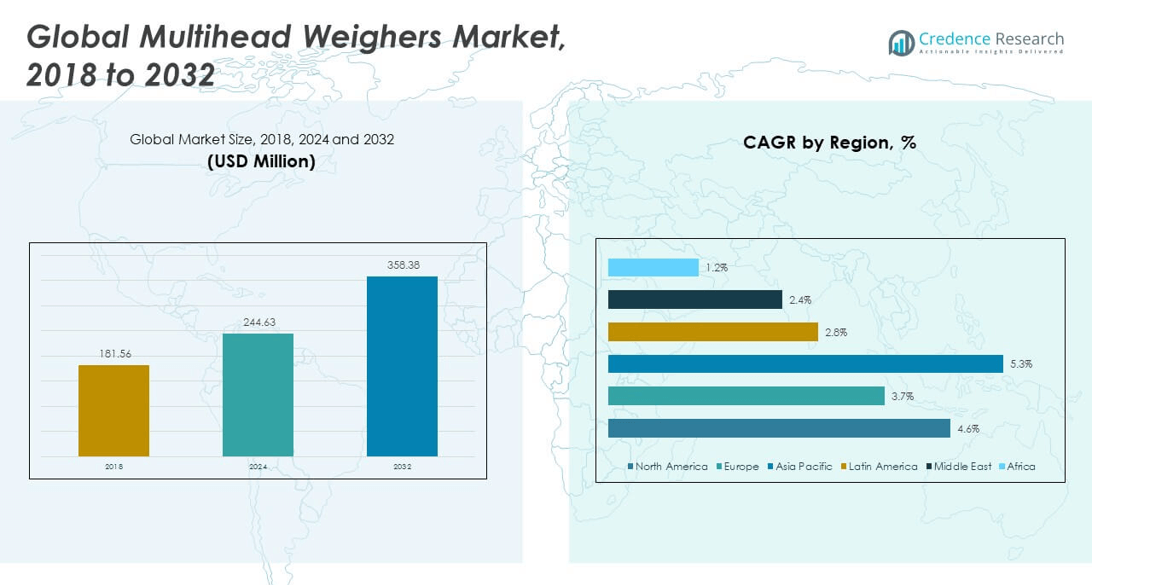
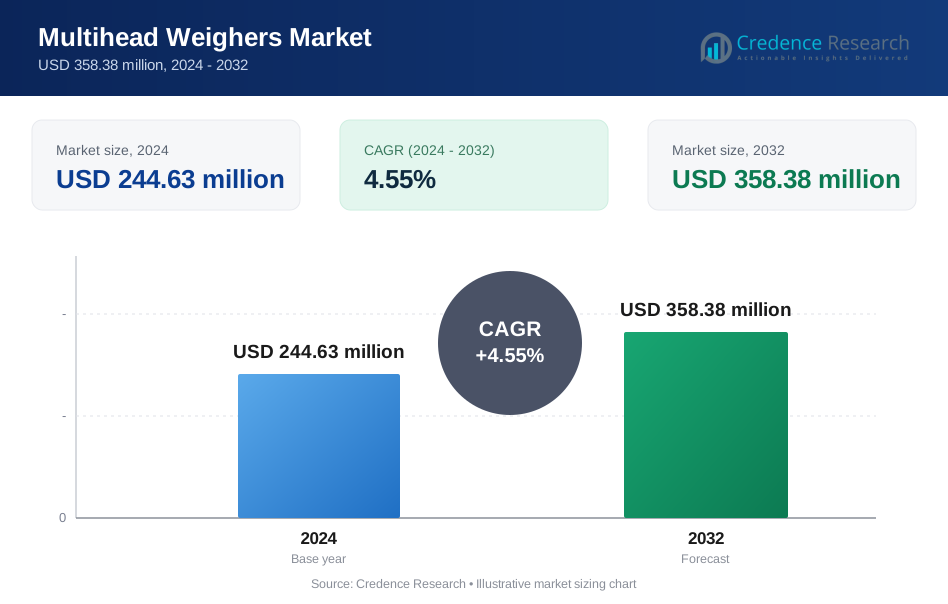
The Global Multihead Weighers Market size was valued at USD 181.56 million in 2018 to USD 244.63 million in 2024 and is anticipated to reach USD 358.38 million by 2032, at a CAGR of 4.55% during the forecast period.
| REPORT ATTRIBUTE | DETAILS |
|---|---|
| Historical Period | 2020-2023 |
| Base Year | 2024 |
| Forecast Period | 2025-2032 |
| Multihead Weighers Market Size 2024 | USD 244.63 million |
| Multihead Weighers Market, CAGR | 4.55% |
| Multihead Weighers Market Size 2032 | USD 358.38 million |
Market growth comes from rising demand for fast and accurate packaging. Food processors seek speed, portion control, and waste reduction. Snack, frozen food, and ready meal makers drive adoption. Automation improves output and lowers labor dependence. Multihead weighers support high throughput with steady accuracy. Hygienic designs meet strict food safety rules. Producers upgrade lines to handle varied product sizes. Flexible machines suit frequent product changes. Integration with packing systems improves efficiency. Cost savings over time support purchase decisions.
Asia Pacific leads due to large food processing bases. China and Japan drive demand through automation focus. Strong packaged food growth supports regional use. Europe follows with strict quality and safety rules. Germany and Italy lead in advanced machinery adoption. North America shows steady demand from snack and meat processors. The United States supports upgrades in existing plants. Emerging markets include Southeast Asia and Latin America. Urban diets increase packaged food consumption there. Local manufacturing expansion improves access.
Market Insights:
- The Global Multihead Weighers Market was valued at USD 181.56 million in 2018, reached USD 244.63 million in 2024, and is projected to reach USD 358.38 million by 2032, expanding at a CAGR of 4.55% driven by automation and packaged food growth.
- Asia Pacific led with about 44.4% share in 2024 due to large-scale food processing, followed by Europe at nearly 26.5% supported by strict quality norms, and North America at around 20.7% driven by automation upgrades and labor cost pressure.
- Asia Pacific also stands as the fastest-growing region, supported by rapid urbanization, rising packaged food demand, expanding manufacturing bases, and strong investment in automated packaging lines across China and Japan.
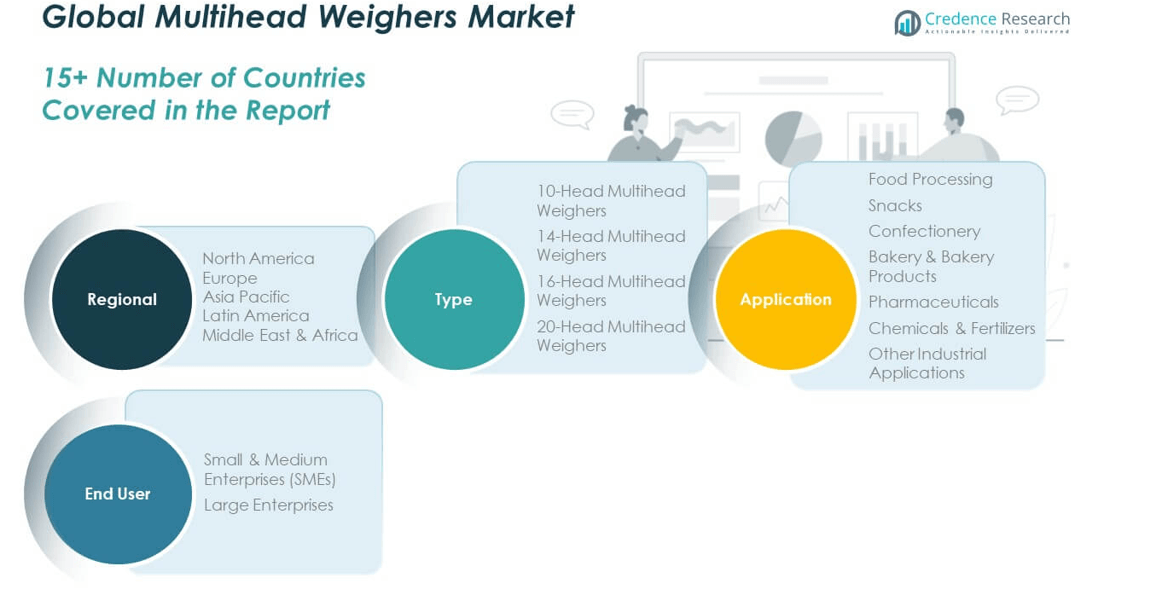
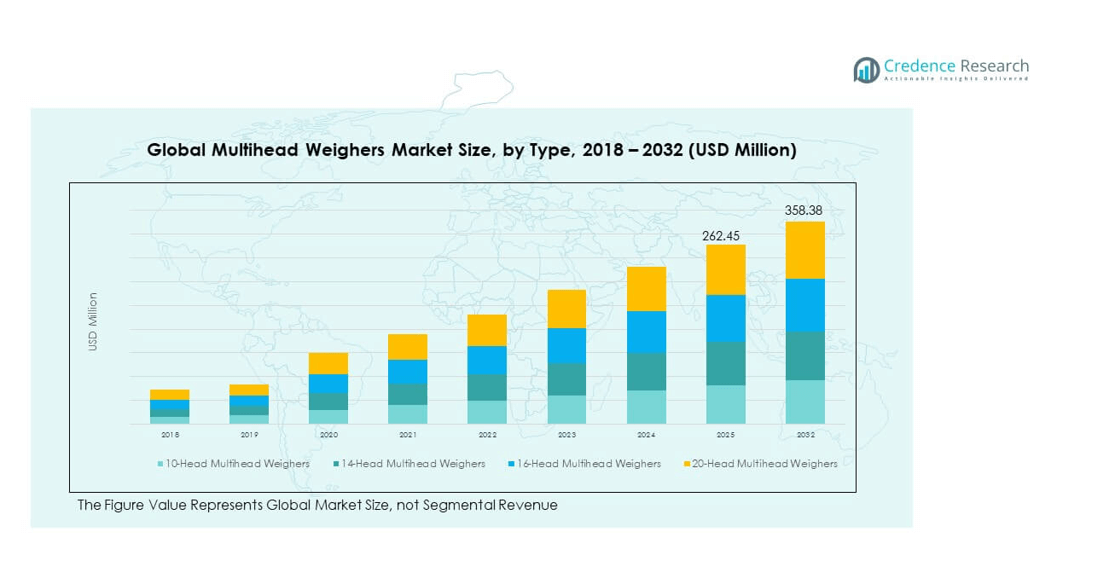
- By type, 20-head multihead weighers held the largest share at roughly 35%, reflecting strong demand from high-speed snack and ready-meal production lines requiring high throughput.
- 16-head multihead weighers accounted for about 30% share, while 14-head and 10-head systems together contributed close to 35%, supported by balanced use across mid-scale food, non-food, and diversified packaging applications.
Market Drivers:
Rising Automation Demand Across Food Processing Lines
The Global Multihead Weighers Market gains strength from rapid factory automation. Food producers seek faster output with consistent weight accuracy. Automation reduces labor reliance and human error. High-speed packing supports large batch production needs. Snack and frozen food makers push adoption. Producers prefer machines with quick setup changes. Reliability supports continuous plant operations. Automation improves cost control across shifts.
- Automation improves cost control across shifts, for instance, Ishida’s CCW-RV series supports up to 240 weighments per minute with typical accuracy within ±0.1 grams, enabling continuous high-speed snack production with minimal operator input.
Need For Precision And Waste Reduction In Packaging
Packaged food brands demand strict portion control. Precise weighing lowers raw material loss. Waste reduction improves profit margins. Accurate fills support brand trust and compliance. Producers face pressure to cut giveaway rates. Multihead systems deliver repeatable accuracy. Stable performance supports long production runs. Quality control teams value dependable weight checks.
- Quality control teams value dependable weight checks, for instance, Yamato Scale’s Alpha Advance Series achieves target weight accuracy above 99% consistency while reducing product giveaway through combination algorithms across multi-head configurations.
Growth Of Packaged And Convenience Food Consumption
Urban lifestyles drive packaged food demand worldwide. Ready meals need fast and accurate packing. High product variety requires flexible weighing solutions. Manufacturers upgrade lines to handle frequent changes. Multihead weighers manage mixed textures well. Compact designs fit modern plants. Speed supports peak demand cycles. Consumption growth sustains equipment investment.
Strict Hygiene And Food Safety Compliance Requirements
Food safety rules push equipment upgrades. Producers adopt easy-to-clean machine designs. Stainless steel builds resist corrosion and wear. Hygienic layouts reduce contamination risk. Regulatory audits require consistent process control. Equipment supports traceability and quality logs. Compliance improves export readiness. Safety focus sustains replacement demand.
Market Trends:
Integration With Smart Factory And Digital Control Systems
Producers link weighers with digital controls. Smart interfaces support real-time monitoring. Data logging improves process visibility. Integration supports predictive maintenance planning. Plants reduce unplanned downtime through alerts. Digital dashboards guide operator decisions. System links improve line coordination. Connectivity shapes modern equipment demand.
- Connectivity shapes modern equipment demand, for instance, MULTIPOND’s MP-series weighers integrate Ethernet-based control systems that track hopper performance in real time and support preventive maintenance cycles based on measured load cell deviations.
Customization For Diverse Product Shapes And Textures
Manufacturers seek tailored weighing solutions. Products vary in size and flow behavior. Modular designs allow easy configuration changes. Custom hoppers handle sticky or fragile items. Flexibility supports short production runs. Equipment adapts to private label needs. Custom builds increase supplier value. Versatility becomes a key buying factor.
- Versatility becomes a key buying factor, for instance, Ishida’s bespoke hopper designs for fresh produce and frozen foods use surface-treated contact parts that reduce product adhesion while maintaining consistent discharge flow.
Shift Toward Compact And Energy-Efficient Equipment Designs
Space limits push demand for compact machines. Energy efficiency lowers operating costs. Modern motors reduce power use. Lightweight designs ease installation. Plants favor low-noise operation. Energy goals influence purchase decisions. Compact layouts support retrofit projects. Efficiency aligns with sustainability goals.
Rising Adoption Outside Traditional Food Applications
Non-food sectors expand usage scope. Pharma firms use precise dosing systems. Hardware packaging needs accurate counts. Pet food producers demand consistency. Chemical blends require reliable portioning. Equipment meets varied compliance needs. Diversification reduces market dependence. Broader use strengthens demand stability.
Market Challenges Analysis:
High Initial Capital Cost And Return Concerns
Equipment costs remain a key barrier. Small producers delay automation plans. Budget limits restrict advanced model adoption. Decision makers seek fast payback periods. Maintenance expenses raise ownership concerns. Training needs add indirect costs. Price sensitivity affects emerging markets. Cost pressure slows replacement cycles.
Technical Complexity And Skilled Workforce Dependency
Advanced systems require trained operators. Skill gaps affect optimal machine use. Setup errors reduce efficiency gains. Maintenance needs technical expertise. Spare part access varies by region. Downtime risk concerns buyers. Integration issues affect older lines. Support quality influences brand choice.
Market Opportunities:
Expansion In Emerging Food Manufacturing Economies
Emerging regions expand food processing capacity. New plants adopt modern packing lines. Local brands invest in automation upgrades. Urban demand supports packaged food growth. Export focus raises quality standards. Equipment suppliers enter untapped markets. Service networks improve regional reach. Growth potential remains strong.
Innovation In Software, Sensors, And Machine Flexibility
Technology upgrades create new value paths. Improved sensors raise weighing accuracy. Software enhances speed control. User-friendly interfaces reduce training time. Flexible designs support multi-product lines. Innovation attracts premium buyers. Upgrades extend machine life cycles. Technology leadership drives competitive edge.
Market Segmentation Analysis:
By Type
The Global Multihead Weighers Market shows clear differentiation across type segments. Linear multihead weighers serve small-scale operations that require simple layouts and lower throughput. Standard multihead weighers dominate due to balanced speed, accuracy, and cost efficiency. These systems support most packaged food applications. High-speed multihead weighers gain traction in large plants with continuous production lines. Manufacturers prefer high-speed models for snack foods and ready meals. Precision and output consistency drive demand across all type categories.
- Precision and output consistency drive demand across all type categories, for instance, Yamato’s 16-head configurations support production lines exceeding 180 packs per minute in snack food facilities.
By Application
Food packaging represents the leading application due to strict portion control needs. Snack foods, frozen products, and fresh produce rely on accurate weighing. Non-food packaging uses multihead weighers for hardware and pet food products. Pharmaceutical products require precise dosing and contamination control. Chemical products use these systems for controlled batching and safe handling. Application diversity supports steady equipment demand. Reliability across varied materials strengthens market adoption.
- Reliability across varied materials strengthens market adoption, for instance, Ishida multihead weighers used in pharmaceutical solid-dose packaging achieve precise tablet counts while meeting cleanroom and contamination control requirements through sealed load cell designs.
By End User
Food and beverage manufacturers remain the primary end users. High production volumes and hygiene rules shape purchase decisions. Pharmaceutical companies adopt multihead weighers for dosing accuracy and compliance. The chemical industry uses them for controlled material distribution. Consumer goods manufacturers apply the systems for uniform packaging. End-user demand reflects the need for automation and consistency. Equipment flexibility supports cross-industry use cases.
Segmentation:
By Type- Linear Multihead Weighers
- Standard Multihead Weighers
- High-Speed Multihead Weighers
- Food Packaging
- Non-Food Packaging
- Pharmaceutical Products
- Chemical Products
- Food & Beverage Manufacturers
- Pharmaceutical Companies
- Chemical Industry
- Consumer Goods Manufacturers
- North America
- Europe
- Asia Pacific
- Latin America
- Middle East
- Africa
- United States
- Canada
- Germany
- United Kingdom
- France
- China
- Japan
- India
- Brazil
- Mexico
- Saudi Arabia
- South Africa
Regional Analysis:
North America
The North America Global Multihead Weighers Market size was valued at USD 38.35 million in 2018 to USD 50.56 million in 2024 and is anticipated to reach USD 74.51 million by 2032, at a CAGR of 4.6 during the forecast period. North America accounts for about 20.7% market share in 2024. The region benefits from strong food processing automation. Large snack and meat processors drive steady equipment upgrades. Manufacturers focus on precision and waste control. Strict food safety standards support advanced systems. High labor costs encourage automation adoption. The United States leads regional demand. Canada supports growth through packaged food exports. Stable investment keeps regional demand consistent.
Europe
The Europe Global Multihead Weighers Market size was valued at USD 49.97 million in 2018 to USD 64.83 million in 2024 and is anticipated to reach USD 89.24 million by 2032, at a CAGR of 3.7 during the forecast period. Europe holds nearly 26.5% market share in 2024. Strong regulations shape equipment design needs. Food quality compliance drives replacement demand. Germany and Italy lead machinery adoption. Processed food exports support system upgrades. Sustainability goals influence buying decisions. Energy-efficient machines gain preference. Mature manufacturing keeps growth moderate. Regional suppliers maintain strong presence.
Asia Pacific
The Asia Pacific Global Multihead Weighers Market size was valued at USD 77.59 million in 2018 to USD 108.49 million in 2024 and is anticipated to reach USD 168.84 million by 2032, at a CAGR of 5.3 during the forecast period. Asia Pacific commands around 44.4% market share in 2024. Rapid urbanization boosts packaged food demand. China and Japan lead regional consumption. Automation investments rise across food plants. Diverse product ranges require flexible systems. Export-oriented processing supports quality upgrades. Cost-effective production encourages adoption. The region shows the fastest expansion pace.
Latin America
The Latin America Global Multihead Weighers Market size was valued at USD 8.01 million in 2018 to USD 10.65 million in 2024 and is anticipated to reach USD 13.68 million by 2032, at a CAGR of 2.8 during the forecast period. Latin America represents about 4.4% market share in 2024. Food processing capacity expands steadily. Brazil and Mexico lead regional demand. Local brands invest in automation gradually. Cost sensitivity affects purchase cycles. Import dependence limits rapid upgrades. Processed food exports support growth. Market expansion remains moderate.
Middle East
The Middle East Global Multihead Weighers Market size was valued at USD 5.13 million in 2018 to USD 6.32 million in 2024 and is anticipated to reach USD 7.82 million by 2032, at a CAGR of 2.4 during the forecast period. The region holds nearly 2.6% market share in 2024. Food security initiatives support processing growth. Gulf countries invest in packaged food plants. Import substitution drives local production. Automation adoption remains selective. High equipment costs limit penetration. Demand centers around urban hubs. Growth stays gradual.
Africa
The Africa Global Multihead Weighers Market size was valued at USD 2.51 million in 2018 to USD 3.78 million in 2024 and is anticipated to reach USD 4.29 million by 2032, at a CAGR of 1.2 during the forecast period. Africa accounts for about 1.5% market share in 2024. Processing infrastructure remains limited. South Africa leads regional adoption. Food packaging demand rises slowly. Budget constraints affect automation plans. Imports dominate equipment supply. Skill gaps restrict advanced use. Long-term potential exists with industrial growth.
Key Player Analysis:
- Ishida Co., Ltd.
- Yamato Scale Co., Ltd.
- MULTIPOND Waagen GmbH
- Fujiwara Co., Ltd.
- Ronchi Mario S.p.A.
Competitive Analysis:
The Global Multihead Weighers Market remains moderately consolidated with strong global and regional players. Leading manufacturers compete on accuracy, speed, and system reliability. Product differentiation focuses on throughput performance and hygiene design. Companies invest in automation-friendly features to support integrated packaging lines. Service capability and aftersales support influence buyer preference. Long-standing brands benefit from installed base advantages. New entrants face high technical and capital barriers. Competitive intensity increases through customization and application-specific solutions. Strategic partnerships support geographic reach. Innovation and brand trust define long-term positioning.
Recent Developments:
- In December 2025, Ishida Co., Ltd. announced the strategic acquisition of RobotGrader AB, a Swedish robotics automation specialist based in Mölndal. This acquisition marks a significant expansion of Ishida's automation capabilities in the global multihead weighers market, specifically targeting the protein packing automation segment. The two companies had maintained a successful partnership since 2014, during which Ishida served as the exclusive European distributor of RobotGrader's systems across 13 countries. The acquisition integrates RobotGrader's innovative robotic grading systems directly into Ishida's portfolio. RobotGrader's technology can handle up to 320 pieces per minute, depending on the machine and product type, while reducing labor dependency and minimizing product waste. Following the acquisition, Ishida plans to expand the RobotGrader team to strengthen service capabilities and system optimization. New product development is already underway to address evolving industry needs, reinforcing Ishida's competitive position in the protein packing automation sector globally.
- MULTIPOND Waagen GmbH, a German manufacturer headquartered in Waldkraiburg, achieved a significant milestone in April 2024 by delivering its 5000th multihead weigher to a long-standing customer in the confectionery industry. This achievement represents 78 years of success as a reliable partner to food and non-food manufacturers. The company emphasizes high manufacturing standards and maintains all production exclusively in Germany with more than 450 employees worldwide. MULTIPOND's commitment to vertical integration and in-house production ensures that customers receive optimized solutions tailored to their specific weighing requirements. The delivery of the 5000th unit reflects both the trust customers place in MULTIPOND's products and the dedication of its workforce to engineering excellence and quality assurance. This milestone underscores the company's established position as a global pioneer in developing and manufacturing industrial multihead weighers with precision and reliability.
Report Coverage:
The research report offers an in-depth analysis based on Type, Application, and End User segments. It details leading market players, providing an overview of their business, product offerings, investments, revenue streams, and key applications. Additionally, the report includes insights into the competitive environment, SWOT analysis, current market trends, as well as the primary drivers and constraints. Furthermore, it discusses various factors that have driven market expansion in recent years. The report also explores market dynamics, regulatory scenarios, and technological advancements that are shaping the industry. It assesses the impact of external factors and global economic changes on market growth. Lastly, it provides strategic recommendations for new entrants and established companies to navigate the complexities of the market.
Future Outlook:
- Automation adoption will rise across food processing plants
- Demand will increase for high-speed and accurate weighing systems
- Customization will gain importance for diverse product formats
- Smart interfaces will improve operational visibility
- Integration with full packaging lines will strengthen value
- Emerging markets will drive incremental demand
- Hygiene-focused designs will shape equipment upgrades
- Service and support networks will influence buyer decisions
- Energy efficiency will affect purchase criteria
- Competition will intensify through innovation and partnerships
Request a Free Sample
Fill in your details and we'll send you a free sample report.
- Sample data tables & charts
- Research methodology
Need a Custom Version of This Report?
Tailor the scope, geography, or segments to your exact requirements.
- Custom geography or segment scope
- Direct access to our analyst team
Frequently Asked Questions
What is the current market size for Global Multihead Weighers Market, and what is its projected size in 2032?
At what Compound Annual Growth Rate is the Global Multihead Weighers Market projected to grow between 2025 and 2032?
How is North America positioned in the multihead weighers market?
Which application industry segment dominates the multihead weighers market?
How does the market structure compare among the top-tier and emerging players?
Who are the leading companies in the Global Multihead Weighers Market?
Table of Content
Chapter 1. Report Introduction
- 1.1 Report Description & Purpose
- 1.1.1 Report Title & Market Definition
- 1.1.2 Unique Selling Propositions (USP) & Key Differentiators
- 1.1.3 Value Proposition for Stakeholders
- 1.2 Research Objectives
- 1.2.1 Market Sizing Objectives (Volume & Revenue)
- 1.2.2 Segmentation Objectives
- 1.2.3 Competitive Intelligence Objectives
- 1.2.4 Forecast & Scenario Objectives
- 1.3 Report Scope
- 1.3.1 Multihead Weighers Scope – Types & Subtypes Covered
- 1.3.2 Geographic Scope – Regions & Countries Covered
- 1.3.3 Historical Period, Base Year & Forecast Period (2024; forecast to 2032)
- 1.3.4 Inclusions & Exclusions
- 1.4 HS Code & Classification Framework
- 1.5 Currency, Units & Pricing Basis
- 1.6 Target Stakeholders
- 1.7 Limitations & Assumptions
Chapter 2. Executive Summary
- 2.1 Global Multihead Weighers Market Snapshot
- 2.1.1 Market Size – Historical (2024) & Forecast (2024-2032) (2024: USD 244.63 million → 2032: USD 358.38 million)
- 2.1.2 Volume & Revenue – Global Totals
- 2.1.3 Key Market Highlights – Top Five Facts
- 2.2 Multihead Weighers Market Segmentation Snapshot
- 2.2.1 Market Split by Region – 2024 vs. 2032
- 2.3 Competitive Snapshot
- 2.3.1 Top 10 Players by Revenue Share – 2024
- 2.3.2 Top 10 Players by Volume Share – 2024
- 2.3.3 Recent Strategic Developments (18-Month Summary)
- 2.4 Key Investment Highlights & Strategic Conclusions
Chapter 3. Multihead Weighers Market Dynamics & Industry Analysis
- 3.1 Market Overview & Context
- 3.1.1 Multihead Weighers Market Position in the Broader Automotive Value Chain
- 3.1.2 OEM vs. Replacement Market Dynamics
- 3.1.3 Market Maturity & Development Stage by Region
- 3.2 Multihead Weighers Market Drivers
- 3.3 Multihead Weighers Market Restraints & Challenges
- 3.4 Multihead Weighers Market Opportunities
- 3.5 Porter's Five Forces Analysis
- 3.5.1 Threat of New Entrants
- 3.5.2 Bargaining Power of Suppliers
- 3.5.3 Bargaining Power of Buyers
- 3.5.4 Threat of Substitutes
- 3.5.5 Competitive Rivalry – Intensity Assessment
- 3.6 Multihead Weighers Value Chain Analysis
- 3.6.1 Upstream – Raw Material/Input Suppliers
- 3.6.1.1 Raw Material/Input 1
- 3.6.1.2 Raw Material/Input 2
- 3.6.1.3 Raw Material/Input 3
- 3.6.2 Midstream – Production/Manufacturing/Service Delivery
- 3.6.2.1 Production/Process Overview
- 3.6.2.2 Key Facility Locations & Capacity by Manufacturer
- 3.6.3 Downstream – Distribution & End Consumer
- 3.6.3.1 Primary Channel – B2B/OEM
- 3.6.3.2 Secondary Channels – Dealer, Retail, Online, Direct
- 3.6.4 Value Chain Profitability Analysis
- 3.6.1 Upstream – Raw Material/Input Suppliers
- 3.7 PESTEL Analysis
- 3.7.1 Political Factors
- 3.7.2 Economic Factors
- 3.7.3 Social Factors
- 3.7.4 Technological Factors
- 3.7.5 Environmental Factors
- 3.7.6 Legal Factors
- 3.8 Multihead Weighers Supply Chain Analysis
- 3.8.1 Raw Material/Input Supply Risk Assessment
- 3.8.2 Manufacturing Concentration Risk (Geographic Exposure)
- 3.8.3 Trade Disruption Impact Analysis
- 3.9 Regulatory & Policy Landscape
Note: The regulatory and policy landscape section covers regulations based on their applicability to the market, Multihead Weighers category, geography, and scope of the study. Only regulatory frameworks with a material impact on operations, compliance, trade, sustainability, or market access are analyzed in detail.
Chapter 4. Key Investment Pockets & Opportunity Analysis
- 4.1 Multihead Weighers Market Attractiveness Analysis
- 4.1.1 By Region – Investment Attractiveness Matrix (Volume × CAGR)
- 4.2 Absolute Revenue Growth Opportunity
- 4.2.1 By Region – Absolute USD Growth Through 2032
- 4.3 Incremental Volume Opportunity
- 4.3.1 By Region – Incremental Volume Through 2032
- 4.3.2 Segment – Incremental Volume
- 4.4 Emerging Submarket Opportunity Deep Dive (Subject to Applicability)
- 4.5 Emerging Market Opportunity Scorecards
- 4.5.1 United States
- 4.5.2 Europe
- 4.5.3 Asia
- 4.5.4 Middle East & Africa
Note: Emerging Market Opportunity Scorecards will be included based on relevance and strategic importance. Regions listed are indicative and may vary depending on data availability and market dynamics.
Chapter 5. Multihead Weighers Import-Export Analysis & Trade Flows
- 5.1 Global Trade Overview
- 5.1.1 Global Export Value by Country (2024)
- 5.1.2 Global Export Volume by Country (2024)
- 5.1.3 Global Import Value by Country (2024)
- 5.1.4 Global Import Volume by Country (2024)
- 5.1.5 Net Trade Balance by Country (2024)
- 5.2 Export Analysis – Segment
- 5.2.1 Type 1 (HS Code)
- 5.2.2 Type 2 (HS Code)
- 5.2.3 Type 3 (HS Code)
- 5.2.4 Type 4 (HS Code)
- 5.2.5 Type 5 (HS Code)
- 5.3 Import Analysis – Segment
- 5.3.1 Type 1 (HS Code)
- 5.3.2 Type 2 (HS Code)
- 5.3.3 Type 3 (HS Code)
- 5.3.4 Type 4 (HS Code)
- 5.3.5 Type 5 (HS Code)
- 5.4 Average Unit Trade Prices
- 5.4.1 Average Export Price – Segment & Country
- 5.4.2 Average Import Price – Segment & Source Country
- 5.4.3 Price Trends (2024)
- 5.5 Key Trade Route Analysis
- 5.5.1 Trade Route 1
- 5.5.2 Trade Route 2
- 5.5.3 Trade Route 3
- 5.5.4 Trade Route 4
- 5.5.5 Trade Route 5
- 5.6 Trade Policy Impact Assessment
- 5.6.1 US Anti-Dumping & Section 301 Tariffs
- 5.6.2 EU Customs Union Impact
- 5.6.3 Major Free Trade Agreements
- 5.6.4 USMCA Rules of Origin
Note: Trade policy analysis will be included only where relevant to the Multihead Weighers market.
Chapter 6. Competitive Landscape & Company Benchmarking
- 6.1 Multihead Weighers Market Concentration & Structure
- 6.1.1 Herfindahl-Hirschman Index (HHI) – vs. 2024
- 6.1.2 Tier 1, Tier 2 & Tier 3 Market Structure
- 6.1.3 Global, Regional & Local Player Dynamics
- 6.2 Multihead Weighers Market Share Analysis – 2024
- 6.2.1 Global Revenue Share by Company
- 6.2.2 Global Volume Share by Company
- 6.2.3 Regional Revenue Share
- 6.2.4 Market Share Evolution ( vs. 2024)
- 6.2.5 OEM Segment Share by Company
- 6.2.6 Replacement Segment Share by Company
- 6.3 Production/Delivery Capacity & Facility Analysis
- 6.3.1 Global Installed Capacity
- 6.3.2 Capacity Utilization Rates
- 6.3.3 Production/Output Volume
- 6.3.4 Facility Locations & Capacity Map
- 6.3.5 Planned Capacity Additions
- 6.4 Multihead Weighers Competitive Benchmarking Matrix
- 6.4.1 Revenue, Volume, CAGR & Profitability Comparison
- 6.4.2 Channel Revenue Mix
- 6.4.3 Geographic Revenue Exposure
- 6.4.4 R&D Intensity
- 6.4.5 Sustainability Maturity
- 6.5 Strategic Developments in Multihead Weighers (Last 24 Months)
- 6.5.1 Mergers, Acquisitions & Divestments
- 6.5.2 New Multihead Weighers Launches
- 6.5.3 Facility Expansions
- 6.5.4 Strategic Alliances, Joint Ventures & Partnerships
- 6.5.5 Distribution Expansion & Market Entry
- 6.5.6 Sustainability & ESG Initiatives
- 6.6 Competitive Strategy Mapping
- 6.6.1 Leader, Challenger, Follower & Niche Classification
- 6.6.2 Pricing Strategy Comparison
- 6.6.3 Channel Strategy Matrix
Note: Strategic developments are included based on their materiality and the availability of reliable information.
Chapter 7. Global Multihead Weighers Market – By Distribution Channel
- 7.1 Segment Overview
- 7.1.1 Volume & Revenue Split by Channel (2024 & 2032)
- 7.1.2 Channel Mix Evolution (2024-2032)
Chapter 8. Regional Market Analysis – Global Overview
- 8.1 Global Regional Overview
- 8.1.1 Regional Volume Share
- 8.1.2 Regional Revenue Share
- 8.1.3 Regional Volume by Region
- 8.1.4 Regional Revenue by Region
- 8.1.5 Regional Forecast Through 2032
- 8.2 Cross-Regional Segment Analysis
- 8.2.1 By Distribution Channel
- 8.2.2 By Brand/Price Tier
Chapter 9. North America Multihead Weighers Market
- 9.1 United States
- 9.2 Canada
- 9.3 Mexico
Chapter 10. Europe Multihead Weighers Market
- 10.1 Germany
- 10.2 France
- 10.3 Italy
- 10.4 United Kingdom
- 10.5 Spain
- 10.6 Poland
- 10.7 Russia
- 10.8 Netherlands
- 10.9 Belgium
- 10.10 Sweden
- 10.11 Denmark
- 10.12 Norway
- 10.13 Rest of Europe
Chapter 11. Asia Pacific Multihead Weighers Market
- 11.1 China
- 11.2 India
- 11.3 Japan
- 11.4 South Korea
- 11.5 Thailand
- 11.6 Indonesia
- 11.7 Vietnam
- 11.8 Malaysia
- 11.9 Australia
- 11.10 Rest of Asia Pacific
Chapter 12. Latin America Multihead Weighers Market
- 12.1 Brazil
- 12.2 Argentina
- 12.3 Colombia
- 12.4 Chile
- 12.5 Rest of Latin America
Chapter 13. Middle East Multihead Weighers Market
- 13.1 Saudi Arabia
- 13.2 United Arab Emirates
- 13.3 Turkey
- 13.4 Israel
- 13.5 Iran
- 13.6 Rest of the Middle East
Chapter 14. Africa Multihead Weighers Market
- 14.1 South Africa
- 14.2 Egypt
- 14.3 Nigeria
- 14.4 Morocco
- 14.5 Rest of Africa
Chapter 15. Multihead Weighers Company Profiles
- 15.1 [Company 01]
- 15.1.1 Company Overview
- 15.1.2 Key Management Personnel
- 15.1.3 Products & Services Portfolio
- 15.1.4 Financial Performance
- 15.1.5 Key Market Focus & Geographic Presence
- 15.1.6 Recent Developments & Strategic Initiatives
Note: The company profile list is preliminary and may change based on research findings, market developments, data availability, and client requirements.
Chapter 16. Appendices
- Appendix A – List of Abbreviations & Acronyms
- Appendix B – Industry Classification Code Reference – Full Series
- Appendix C – Production & Capacity Data Tables
- Appendix D – End-Use & Demand Base Tables
- Appendix E – Consumption & Replacement Rate Assumptions
- Appendix F – ASP Reference Tables
- Appendix G – Manufacturing & Facility Database
- Appendix H – Import-Export Data Tables
- Appendix I – Regulatory Summary Tables
- Appendix J – Primary Research Participant List (Anonymized)
- Appendix K – Primary Research Questionnaire Framework
- Appendix L – Data Sources & Bibliography
- Appendix M – Market Size Divergence & Source Comparison
Chapter 17. Research Methodology
- 17.1 Research Framework & Philosophy
- 17.2 Secondary Research – Sources, Hierarchy & Data Extraction
- 17.3 Data Modeling – Bottom-Up & Top-Down Market Sizing
- 17.4 Primary Research – Stakeholder Framework, LOI & Sample Sizes
- 17.5 Forecast Methodology – Regression, Scenario & Sensitivity Analysis
- 17.6 Quality Control – Four-Layer Validation Framework
- 17.7 Limitations & Standard Assumptions
- 17.8 Disclaimer
