
| REPORT ATTRIBUTE | DETAILS |
|---|---|
| Historical Period | 2020-2023 |
| Base Year | 2024 |
| Forecast Period | 2025-2032 |
| Global Games and Puzzles Market Size 2024 | USD 14,830.22 million |
| Global Games and Puzzles Market, CAGR | 15.75% |
| Global Games and Puzzles Market, Size 2032 | USD 47,802.11 million |
Market Overview
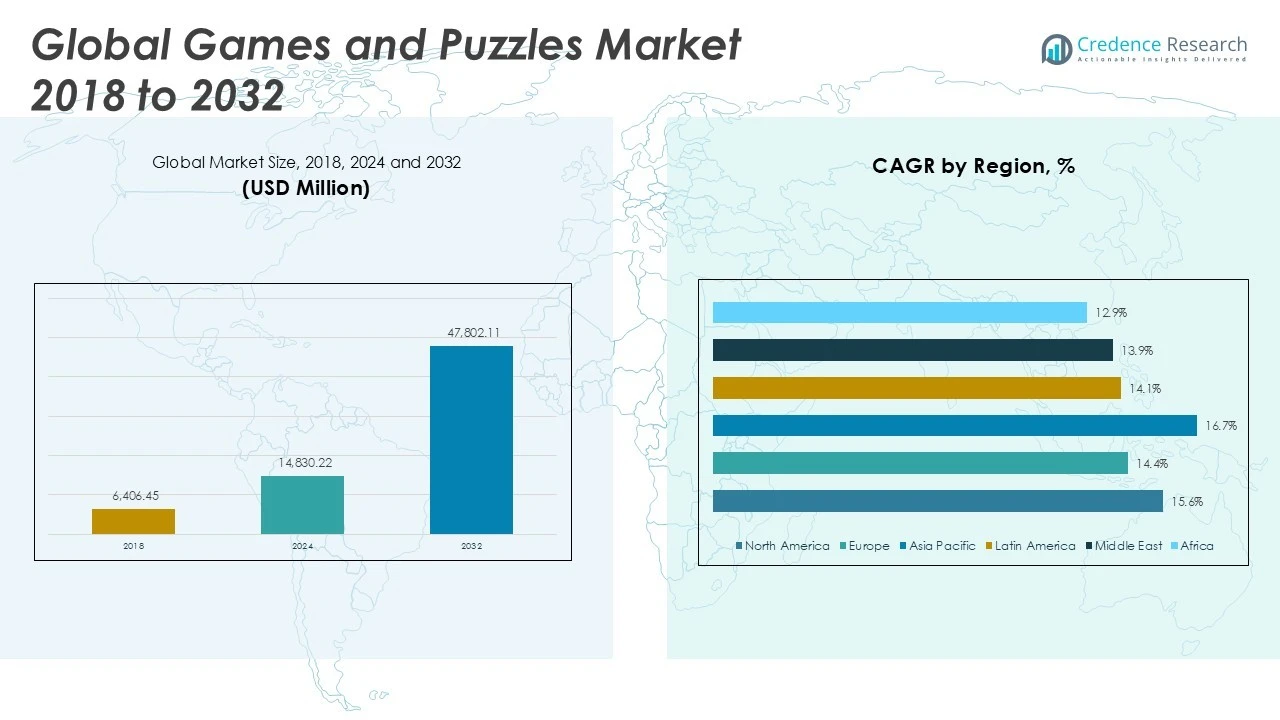
Global Games and Puzzles Market size was valued at USD 6,406.45 million in 2018 to USD 14,830.22 million in 2024 and is anticipated to reach USD 47,802.11 million by 2032, at a CAGR of 15.75% during the forecast period.
The Global Games and Puzzles Market is experiencing robust growth driven by rising consumer interest in educational and recreational activities that promote cognitive development and family bonding. Increasing demand for screen-free entertainment, especially among parents seeking to limit children’s digital exposure, continues to fuel market expansion. The popularity of strategy games, brainteasers, and collaborative puzzles is further reinforced by a growing culture of social gaming and gifting trends during holidays and special occasions. Manufacturers are innovating with eco-friendly materials, digital integration, and customizable products, catering to evolving consumer preferences and sustainability concerns. The expansion of e-commerce platforms and omnichannel retailing enhances accessibility and product variety, supporting higher sales volumes worldwide. Ongoing collaborations with licensed brands and popular franchises help attract new customer segments, while marketing efforts focused on nostalgia and mental wellness further strengthen market positioning. Collectively, these drivers and trends position games and puzzles as a dynamic, resilient segment in the global entertainment industry.
The Global Games and Puzzles Market demonstrates strong growth across North America, Europe, Asia Pacific, Latin America, the Middle East, and Africa, with each region contributing to rising consumer demand for educational and recreational entertainment. North America and Europe benefit from established gaming traditions and robust retail infrastructure, while Asia Pacific drives expansion through rapid urbanization, a large youth population, and increasing digital integration. Latin America, the Middle East, and Africa present emerging opportunities, supported by urban growth and evolving consumer preferences. Leading players in the market include Buffalo Games, Hasbro, Inc., Mattel, Inc., Ravensburger AG, and Cobble Hill. These companies focus on product innovation, strategic licensing partnerships, and expanding their distribution networks to reach diverse audiences worldwide. The competitive landscape is defined by continuous innovation and adaptation to regional tastes and trends.
Market Insights
- The Global Games and Puzzles Market size was valued at USD 6,406.45 million in 2018 to USD 14,830.22 million in 2024 and is anticipated to reach USD 47,802.11 million by 2032, at a CAGR of 15.75% during the forecast period.
- Rising demand for educational and cognitive development tools, especially among families and schools, fuels robust market expansion.
- Key market trends include the growing popularity of licensed products, digital integration, and a shift toward sustainable and customizable games and puzzles.
- Leading players such as Buffalo Games, Hasbro, Mattel, Ravensburger, and Schmidt Spiele focus on product innovation, strategic partnerships, and expanding distribution channels to maintain competitiveness.
- Market growth faces challenges from intense competition, counterfeit products, and changing consumer preferences due to the rise of digital entertainment options.
- Asia Pacific drives significant growth with rapid urbanization, increased disposable incomes, and strong demand from youthful and tech-savvy consumers; North America and Europe maintain high engagement through tradition and retail strength, while Latin America, the Middle East, and Africa represent emerging opportunities.
- Despite restraints, ongoing innovation and adaptation to regional trends ensure the Global Games and Puzzles Market remains dynamic and resilient, with companies focusing on meeting evolving consumer needs and expanding their global presence.
Market Drivers
Rising Demand for Educational and Cognitive Development Tools
The Global Games and Puzzles Market benefits from increasing parental focus on products that support cognitive development and learning. Parents and educators seek engaging, hands-on tools to boost memory, problem-solving skills, and critical thinking in children. Games and puzzles serve as effective educational aids, supplementing traditional learning methods in classrooms and at home. Schools and educational institutions integrate these products into curricula to foster collaborative learning and social interaction. The emphasis on early childhood development and the growing awareness of the long-term benefits of educational play contribute to sustained demand. These factors collectively reinforce the market’s expansion among young learners and families prioritizing holistic development.
- For instance, manufacturers are incorporating STEAM (Science, Technology, Engineering, Arts, and Mathematics) principles into product design to align with global educational frameworks.
Innovation in Product Design and Sustainability Initiatives
Innovation remains a core driver in the Global Games and Puzzles Market, with manufacturers launching products that incorporate eco-friendly materials, digital enhancements, and customizable features. Companies respond to environmental concerns by adopting recyclable packaging, biodegradable components, and sustainable sourcing practices. Product differentiation through unique themes, licensed collaborations, and interactive technology enhances consumer appeal. The integration of augmented reality and app-based features bridges physical and digital play, attracting tech-savvy users while retaining traditional audiences. Strong investment in research and development ensures continuous pipeline of novel offerings that cater to evolving consumer preferences. Sustainability and innovation together position the market for long-term resilience and growth.
- For instance, major toy manufacturers are committing to using 100% recycled or bio-based plastics by 2030 to reduce environmental impact.
Shift Toward Screen-Free and Family-Oriented Entertainment
The Global Games and Puzzles Market thrives on consumer preference for screen-free entertainment alternatives that foster family bonding and shared experiences. Many parents actively seek ways to reduce screen time for children, turning to board games and puzzles that encourage face-to-face interaction. Family-oriented products help create meaningful memories and nurture social skills, increasing their popularity during holidays and gatherings. This trend aligns with a renewed appreciation for tactile, unplugged play that offers relaxation and stress relief for all age groups. The growing interest in group activities supports higher sales volumes, particularly for collaborative and strategy-based games. Retailers and manufacturers capitalize on this demand by offering themed collections and limited-edition sets.
Expansion of E-commerce and Omnichannel Distribution
The rapid growth of e-commerce platforms and omnichannel strategies strengthens the reach and accessibility of games and puzzles worldwide. Consumers enjoy a wider variety of choices, seamless ordering, and convenient delivery, supporting strong market penetration in both developed and emerging regions. Online reviews, influencer marketing, and interactive digital catalogs drive purchase decisions and expand consumer engagement. Traditional brick-and-mortar retailers also integrate online platforms to offer click-and-collect services and exclusive digital promotions. This evolving retail landscape helps brands connect with diverse audiences, leading to increased product visibility and sales. Market players invest in digital transformation to maintain competitiveness and adapt to shifting purchasing behaviors.
Market Trends
Growing Popularity of Licensed and Themed Products
The Global Games and Puzzles Market demonstrates a clear trend toward licensed and themed products that appeal to fans of popular movies, TV shows, and comic franchises. Collaborations with leading entertainment brands help manufacturers attract a broader customer base and tap into established fan communities. Consumers show high engagement with puzzles and games featuring familiar characters, iconic scenes, or limited-edition releases tied to major cultural events. These partnerships boost both sales volume and brand loyalty, with exclusive releases driving demand during holidays and special occasions. Retailers often highlight licensed products in marketing campaigns to capture the attention of collectors and gift shoppers. This trend strengthens the market’s connection to mainstream entertainment and pop culture, supporting ongoing innovation and differentiation.
- For instance, licensed toys accounted for 34% of the total toy market in 2024, with sales increasing by 8% due to collaborations with blockbuster movies, television series, and digital content creators.
Integration of Technology and Hybrid Gameplay
Technology integration continues to shape the Global Games and Puzzles Market, with manufacturers introducing products that blend physical and digital experiences. Augmented reality features, companion mobile apps, and interactive online components enrich traditional gameplay and expand audience appeal. Tech-driven innovations attract younger consumers and enhance replay value by offering dynamic challenges and new content. Hybrid gameplay allows users to switch between tactile activities and digital engagement, catering to diverse preferences within households. Manufacturers invest in research to develop cross-platform products that maintain the social and educational value of traditional games while leveraging digital trends.
Focus on Sustainability and Eco-Friendly Materials
Sustainability remains a leading trend in the Global Games and Puzzles Market, with industry players embracing eco-friendly practices in production and packaging. Companies increasingly adopt recycled materials, biodegradable packaging, and ethical sourcing to address environmental concerns and meet regulatory requirements. Consumers show strong preference for products with clear sustainability credentials, supporting premium pricing and brand differentiation. Retailers respond to this trend by curating sustainable collections and highlighting eco-conscious brands in both physical and digital stores. The market’s move toward greener alternatives strengthens brand reputations and appeals to environmentally aware buyers.
Sustainability initiatives contribute to long-term industry resilience and encourage further innovation.
- For instance, the market is witnessing increased demand for sustainable games and puzzles due to growing consumer awareness and concern about environmental issues.
Personalization and Customization of Products
Personalization has emerged as a significant trend in the Global Games and Puzzles Market, with brands offering customizable products tailored to individual preferences. Advances in digital printing and flexible manufacturing enable the creation of unique puzzles, photo-based games, and bespoke designs for special occasions. Consumers value the ability to incorporate personal photos, messages, or themes, turning games and puzzles into memorable gifts and keepsakes. Retailers leverage online platforms to streamline the ordering process and showcase customization options. This trend not only enhances user engagement but also fosters emotional connections with the product, increasing repeat purchases and word-of-mouth referrals. Personalization strategies drive brand loyalty and distinguish market leaders from competitors.
Market Challenges Analysis
Intense Competition and Market Saturation
The Global Games and Puzzles Market faces significant challenges from intense competition and market saturation. A large number of established brands and new entrants consistently launch similar products, making it difficult for individual companies to maintain strong market share. This crowded landscape forces brands to compete aggressively on pricing, which can erode profit margins and stifle innovation. Counterfeit and low-quality products further complicate the competitive environment, undermining consumer trust and impacting the reputation of legitimate manufacturers. Companies must continuously invest in branding, product differentiation, and marketing to capture and retain customer attention. These challenges place pressure on resources and slow the pace of sustainable growth in a mature market.
- For instance, counterfeit and low-cost alternatives have impacted consumer trust, prompting manufacturers to invest in brand protection and quality assurance.
Changing Consumer Preferences and Digital Disruption
The Global Games and Puzzles Market must adapt to rapidly changing consumer preferences and the ongoing digital disruption within the entertainment industry. The rise of mobile gaming, streaming platforms, and digital entertainment options reduces demand for traditional games and puzzles, particularly among younger demographics. Companies struggle to keep pace with shifting trends, such as demand for digital integration and hybrid experiences, while maintaining the appeal of physical products. Evolving lifestyles and time constraints also influence purchasing behavior, with consumers seeking more convenient and instantly gratifying entertainment options. Market players must balance innovation with tradition to remain relevant, while managing the risks associated with technological advancement and consumer fragmentation.
Market Opportunities
Expansion into Emerging Markets and Untapped Demographics
The Global Games and Puzzles Market holds significant growth potential by expanding into emerging markets and targeting untapped demographics. Rising disposable incomes and improving retail infrastructure in regions such as Asia Pacific, Latin America, and Africa create new opportunities for market penetration. Brands can develop culturally relevant products and adapt marketing strategies to resonate with local preferences and traditions. Urbanization and a growing middle class fuel interest in family-oriented and educational entertainment, increasing the appeal of games and puzzles among younger and first-time buyers. Partnerships with local distributors and e-commerce platforms can streamline market entry and improve distribution reach. Targeting senior citizens and adult consumers with brain-training puzzles and strategy games can also broaden the customer base and drive incremental sales.
Innovation through Digital Integration and Product Personalization
The Global Games and Puzzles Market can leverage digital integration and product personalization to unlock new revenue streams and enhance consumer engagement. Integrating augmented reality, mobile apps, and interactive online features into traditional products can attract tech-savvy audiences and address the evolving preferences of digital-native consumers. Personalization options, such as custom designs and photo puzzles, create unique gifting opportunities and foster deeper connections with the brand. Companies that invest in research and development to launch hybrid and customizable products stand to differentiate themselves in a crowded marketplace. Expanding these offerings through e-commerce and direct-to-consumer channels can further accelerate growth and brand loyalty. This focus on innovation positions market leaders to capture shifting demand and sustain long-term success.
Market Segmentation Analysis:
By Type:
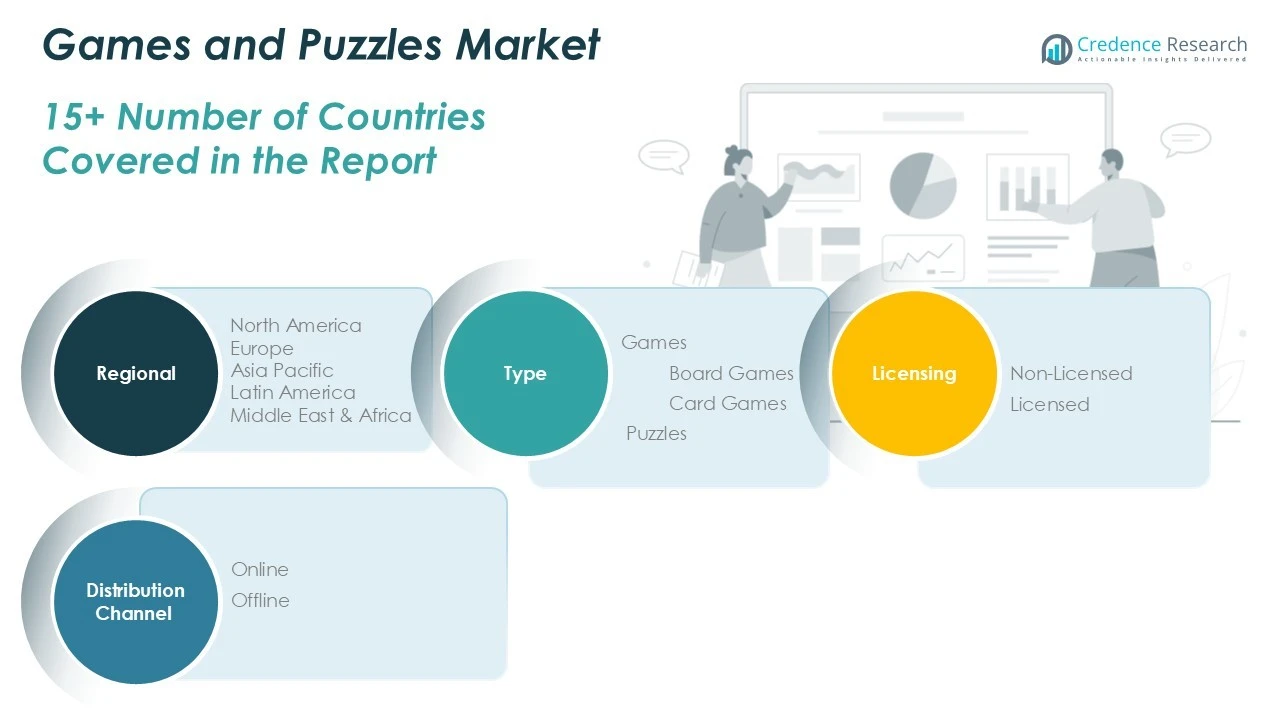
The Global Games and Puzzles Market demonstrates robust segmentation by type, licensing, and distribution channel, allowing industry participants to address diverse consumer demands and maximize growth opportunities. By type, the market includes games-primarily board games and card games-and puzzles. Board games lead family and group entertainment, supported by new thematic releases and classic titles that appeal across generations. Card games attract a wide spectrum of players, from casual users seeking quick entertainment to enthusiasts engaged in strategic gameplay and tournaments. Puzzles remain a key segment due to their benefits in cognitive development, relaxation, and solo or collaborative play. Their appeal spans various demographics, including children, adults, and older populations seeking mental stimulation.
By Licensing:
In terms of licensing, the market splits into non-licensed and licensed products. Licensed offerings leverage well-known characters, movie franchises, and media properties, drawing attention during holidays and special promotions. These products benefit from strong brand associations and marketing tie-ins, leading to increased shelf visibility and higher sales volumes. Non-licensed games and puzzles maintain stable demand through their universal designs and educational value, often favored by parents and institutions for their adaptability in both home and learning environments.
By Distribution Channel:
Distribution channels further segment the market into online and offline sales. Online channels have experienced rapid expansion, driven by consumer preference for convenience, diverse product selection, and direct-to-door delivery. Digital platforms enable brands to reach international audiences, run targeted promotions, and gather consumer insights. Offline retail-encompassing specialty stores, supermarkets, and toy shops-remains significant for hands-on experiences, impulse buying, and personalized customer service. The coexistence of online and offline strategies ensures broad market access and resilience to shifting shopping behaviors. This multidimensional segmentation framework enables companies to tailor their offerings, marketing, and distribution strategies, strengthening their competitive positioning in the Global Games and Puzzles Market.
Segments:
Based on Type:
- Games
- Board Games
- Card Games
- Puzzles
Based on Licensing:
- Non-Licensed
- Licensed
Based on Distribution Channel:
- Online
- Offline
Based on the Geography:
- North America
- U.S.
- Canada
- Mexico
- Europe
- UK
- France
- Germany
- Italy
- Spain
- Russia
- Belgium
- Netherlands
- Austria
- Sweden
- Poland
- Denmark
- Switzerland
- Rest of Europe
- Asia Pacific
- China
- Japan
- South Korea
- India
- Australia
- Thailand
- Indonesia
- Vietnam
- Malaysia
- Philippines
- Taiwan
- Rest of Asia Pacific
- Latin America
- Brazil
- Argentina
- Peru
- Chile
- Colombia
- Rest of Latin America
- Middle East
- UAE
- KSA
- Israel
- Turkey
- Iran
- Rest of Middle East
- Africa
- Egypt
- Nigeria
- Algeria
- Morocco
- Rest of Africa
Regional Analysis
North America Games and Puzzles Market:
North America games and puzzles market grew from USD 2,366.68 million in 2018 to USD 5,411.35 million in 2024 and is projected to reach USD 17,499.73 million by 2032, reflecting a compound annual growth rate (CAGR) of 15.6%. North America is holding a 29% market share. The United States and Canada drive regional performance with a strong tradition of family gaming and emphasis on educational products. Frequent launches of innovative board games, card games, and licensed items sustain high consumer engagement, particularly around holidays and special occasions. The market in North America benefits from robust e-commerce networks and established specialty retailers, enabling broad product access and fast distribution. High household spending, a mature retail landscape, and a growing community of adult hobbyists support continued growth. Companies invest in targeted marketing campaigns aimed at both families and millennials, reinforcing North America’s leadership in the global market.
Asia Pacific Games and Puzzles Market:
Asia Pacific games and puzzles market grew from USD 1,867.98 million in 2018 to USD 4,563.45 million in 2024 and is projected to reach USD 16,030.56 million by 2032, reflecting a compound annual growth rate (CAGR) of 16.7%. Asia Pacific is holding a 35% market share. China, Japan, and India anchor regional growth with strong consumer demand for both traditional and digital-integrated games and puzzles. The rapid rise in urbanization and disposable income, coupled with a youthful demographic, accelerates sales of educational and recreational products. E-commerce platforms such as Alibaba and Flipkart broaden access to global brands and popular licensed merchandise. Partnerships with regional celebrities and media franchises enhance product appeal in Asia Pacific’s diverse markets. Educational institutions and parents increasingly seek puzzles and strategy games for cognitive development and social skills, securing the region’s leadership.
Europe Games and Puzzles Market:
Europe games and puzzles market grew from USD 1,419.50 million in 2018 to USD 3,134.32 million in 2024 and is projected to reach USD 9,337.99 million by 2032, reflecting a compound annual growth rate (CAGR) of 14.4%. Europe is holding a 22% market share, led by key countries such as Germany, the United Kingdom, and France. The region’s long-standing tradition of tabletop gaming and its vibrant enthusiast community drive consistent demand for both classic and modern products. Licensing collaborations with well-known European and international franchises diversify offerings and attract a wide customer base. European consumers place growing value on sustainable and premium materials, prompting brands to develop eco-friendly and sophisticated designs. Offline retail channels remain influential, while e-commerce continues to expand year over year. Europe’s dual-channel approach and culturally diverse market landscape underpin its stable position in the global market.
Latin America Games and Puzzles Market:
Latin America games and puzzles market grew from USD 374.46 million in 2018 to USD 858.12 million in 2024 and is projected to reach USD 2,509.74 million by 2032, reflecting a compound annual growth rate (CAGR) of 14.1%. Latin America is holding a 8% market share, with Brazil and Mexico at the forefront. Regional growth is driven by an expanding middle class and greater availability of family entertainment options in urban areas. Consumers in Latin America show preference for colorful, themed, and bilingual games and puzzles that reflect local cultures and traditions. E-commerce is gaining traction, supported by improving digital infrastructure and a growing selection of payment methods. Retailers focus marketing efforts around major holidays and family gatherings to stimulate demand. Latin America remains a target market for global brands and local manufacturers aiming to broaden their reach and connect with young families.
Middle East Games and Puzzles Market:
The Middle East games and puzzles market grew from USD 252.03 million in 2018 to USD 547.73 million in 2024 and is projected to reach USD 1,574.29 million by 2032, reflecting a compound annual growth rate (CAGR) of 13.9%. Middle East is holding a 4% market share, with the United Arab Emirates and Saudi Arabia leading regional consumption and distribution. Urbanization and increasing disposable incomes, combined with cultural values that emphasize family activities, drive demand for board games and puzzles. Premium retail outlets and specialty stores in key Middle Eastern cities offer a broad product range, while offline channels continue to dominate. E-commerce is growing, particularly among younger and tech-savvy consumers. Strategic partnerships with local distributors help brands extend their reach and visibility. The Middle East represents a promising growth market, particularly where educational and family-oriented products are in focus.
Africa Games and Puzzles Market:
Africa games and puzzles market grew from USD 125.80 million in 2018 to USD 315.25 million in 2024 and is projected to reach USD 849.79 million by 2032, reflecting a compound annual growth rate (CAGR) of 12.9%. Africa is holding a 2% market share, with South Africa emerging as the leading country. The region’s market continues to grow gradually as disposable incomes rise and urbanization spreads across the continent. Family-centric values support sales of board games and puzzles in Africa, especially within metropolitan centers. Offline retail remains the primary channel, but mobile-based e-commerce is expanding thanks to improved connectivity and payment systems. Manufacturers and brands catering to affordability and cultural relevance are well-positioned to capture opportunities. Africa offers untapped growth potential for the Global Games and Puzzles Market, particularly in education-focused and youth-driven segments.
Key Player Analysis
- Buffalo Games
- Hasbro, Inc.
- Mattel, Inc.
- Ceaco, Inc.
- Ravensburger AG
- Schmidt Spiele
- Cubicfun 3D Puzzle
- Educa Borras
- Castorland
- Cobble Hill
Competitive Analysis
The competitive landscape of the Global Games and Puzzles Market is shaped by the presence of leading players such as Buffalo Games, Hasbro, Inc., Mattel, Inc., Ceaco, Inc., Ravensburger AG, Schmidt Spiele, Cubicfun 3D Puzzle, Educa Borras, Castorland, and Cobble Hill. These companies consistently focus on product innovation, strategic licensing agreements, and expanding their portfolios to meet diverse consumer preferences. They leverage collaborations with entertainment franchises and popular intellectual properties to boost product visibility and attract both children and adults. Investments in research and development enable these key players to launch unique, high-quality games and puzzles that resonate with modern trends, including digital integration and sustainability. Leading brands maintain strong distribution networks, balancing online and offline channels to maximize market reach across different regions. Their robust marketing strategies emphasize educational value, family engagement, and nostalgia to drive consumer loyalty. The market’s competitive intensity encourages continuous improvement in design, packaging, and customer experience. While established players benefit from brand recognition and extensive resources, they face ongoing challenges from new entrants, price competition, and the proliferation of counterfeit products. To sustain growth and leadership, top companies adapt quickly to regional trends and evolving consumer expectations, ensuring the Global Games and Puzzles Market remains vibrant and innovative.
Recent Developments
- In March 2025, Buffalo Games acquired Boogie Board, a leading provider of reusable drawing and writing tablets, to expand its product portfolio into creative play and learning technologies.
- In March 2025, Hasbro unveiled a variety of new products and announcements at the New York Toy Fair, including: Nano-mals, a new PLAY-DOH Barbie collection (in collaboration with Mattel), Monopoly App Banking, and a refreshed Monopoly classic board. They also announced new product lines for Transformers, Nerf, and Marvel.
- In March 2025, Mattel renewed its global licensing agreement with Disney for Toy Story, with new 30th-anniversary products and Toy Story 5 releases planned for 2026.
- In November 2024, Schmidt Spiele entered a long-term partnership with gomazing Games & Licensing to produce customized editions of classic games, including city-themed versions of "Mensch ärgere Dich nicht" starting in 2025.
Market Concentration & Characteristics
The Global Games and Puzzles Market exhibits moderate concentration, with a mix of well-established multinational corporations and a broad array of regional and niche players. Leading companies command significant market presence through strong brand portfolios, extensive distribution networks, and strategic licensing partnerships. It features a dynamic product landscape marked by frequent innovation, collaboration with entertainment franchises, and rapid adaptation to consumer trends. The market’s characteristics include high product differentiation, emphasis on educational and cognitive benefits, and growing integration of digital elements and sustainable materials. It supports a wide customer base, ranging from families and educational institutions to collectors and hobbyists. The competitive environment encourages continuous enhancement in design, packaging, and user experience, ensuring ongoing consumer engagement and brand loyalty within the Global Games and Puzzles Market.
Report Coverage
The research report offers an in-depth analysis based on Type, Licensing, Distribution Channel and Geography. It details leading market players, providing an overview of their business, product offerings, investments, revenue streams, and key applications. Additionally, the report includes insights into the competitive environment, SWOT analysis, current market trends, as well as the primary drivers and constraints. Furthermore, it discusses various factors that have driven market expansion in recent years. The report also explores market dynamics, regulatory scenarios, and technological advancements that are shaping the industry. It assesses the impact of external factors and global economic changes on market growth. Lastly, it provides strategic recommendations for new entrants and established companies to navigate the complexities of the market.
Future Outlook
- The market will continue to witness strong demand for educational and cognitive development products across age groups.
- Companies will invest in new product innovation, integrating technology and interactive features into traditional games and puzzles.
- Digital transformation will accelerate, with more hybrid and app-connected products entering the market.
- Sustainability and the use of eco-friendly materials will become standard practice, shaping purchasing decisions and brand reputation.
- Personalization and customization options will grow, allowing consumers to create unique, tailored products.
- Leading players will expand their presence in emerging markets, targeting rising middle-class populations and urban consumers.
- Collaborations with entertainment franchises and popular intellectual properties will drive brand visibility and customer engagement.
- E-commerce will remain a dominant distribution channel, supported by enhanced online marketing and global logistics.
- The adult and senior segments will become more prominent, with demand for brain-training, relaxation, and nostalgia-driven products.
- Companies will respond quickly to changing consumer preferences, focusing on flexible strategies and localized offerings to sustain growth.

Request a Free Sample
Fill in your details and we'll send you a free sample report.
- Sample data tables & charts
- Research methodology
Market Dynamics
Educational and Cognitive Development Focus
Parents and educators are increasingly seeking games and puzzles that support cognitive skills, memory, and problem-solving, integrating these products into both home and classroom environments to supplement traditional learning.
Innovation in Product Design and Sustainability
Manufacturers are differentiating their offerings through eco-friendly materials, digital enhancements, and customizable features, responding to consumer demand for sustainable and innovative products that align with environmental values.
Screen-Free and Family-Oriented Entertainment
A growing preference for screen-free activities is driving families to choose games and puzzles that foster face-to-face interaction, social bonding, and relaxation, especially during holidays and gatherings.
Expansion of E-commerce and Omnichannel Retail
The proliferation of e-commerce platforms and omnichannel strategies has made games and puzzles more accessible globally, enabling brands to reach wider audiences and offer greater product variety with convenient delivery options.
Popularity of Licensed and Themed Products
Collaborations with popular entertainment franchises and the introduction of themed games and puzzles are attracting new customer segments, boosting sales during special occasions, and enhancing brand loyalty through exclusive and collectible offerings.
Need a Custom Version of This Report?
Tailor the scope, geography, or segments to your exact requirements.
- Custom geography or segment scope
- Direct access to our analyst team
Frequently Asked Questions
What is the current size of the Global Games and Puzzles Market?
What factors are driving the growth of the Global Games and Puzzles Market?
What are some challenges faced by the Global Games and Puzzles Market?
Who are the major players in the Global Games and Puzzles Market?
Table of Content
Chapter 1 Market Segmentation
- 1.1 Segmentation Framework
- 1.1.1 Product and Service Classification
- 1.1.2 Application and End-Use Classification
- 1.1.3 Technology and Solution Classification
- 1.1.4 Customer and Distribution Channel Classification
- 1.1.5 Geographic Segmentation
- 1.1.6 Market Segment Definitions and Boundaries
- 1.2 By Type
- 1.2.1 Board Games
- 1.2.2 Card Games
- 1.2.3 Puzzles
- 1.3 By Licensing
- 1.3.1 Licensed
- 1.3.2 Non-Licensed
Chapter 2 Introduction
- 2.1 Report Objectives and Scope
- 2.2 Product Definition and Industry Terminology
- 2.3 Market Inclusions and Exclusions
- 2.4 Research Process
- 2.4.1 Primary Research and Expert Interviews
- 2.4.2 Secondary Research and Source Review
- 2.4.3 Top-Down and Bottom-Up Estimation
- 2.4.4 Data Triangulation and Verification
- 2.5 Market Size Measurement Basis
- 2.5.1 2024: USD 14,830.22 million → 2032: USD 47,802.11 million
- 2.6 Historical and Forecast Reference Periods
- 2.6.1 Base Year: 2024
- 2.6.2 Forecast Period: 2024-2032
- 2.7 Research Assumptions and Limitations
Chapter 3 Executive Summary
- 3.1 Market Snapshot and Key Findings
- 3.2 Base-Year Market Size, 2024
- 3.3 Forecast Market Size, 2032
- 3.4 Revenue and Volume Growth Outlook
- 3.5 Key Demand and Supply Indicators
- 3.6 Leading Market Segments
- 3.7 Fastest-Growing Market Opportunities
- 3.8 Regional Performance Highlights
- 3.9 Technology and Industry Transformation
- 3.10 Competitive Landscape Summary
- 3.11 Analyst View and Strategic Implications
Chapter 4 Global Games and Puzzles Market Trends and Developments
- 4.1 Historical Industry Development
- 4.2 Recent Market Trends and Developments
- 4.3 Demand and Customer Behavior Trends
- 4.4 Technology and Product Innovation
- 4.5 Artificial Intelligence, Automation and Digitalization
- 4.6 Local Manufacturing and Supply Chain Realignment
- 4.7 Industry Partnerships, Mergers and Acquisitions
- 4.8 Sustainability and Circular Economy Developments
- 4.9 Government and Private Sector Investment Trends
- 4.10 Emerging Business Models and Commercialization
- 4.11 Industry Developments and Announcements
Chapter 5 Global Games and Puzzles Market Production, Supply and Demand Analysis
- 5.1 Demand Trend and Consumption Analysis
- 5.2 Demand Forecast, 2024-2032
- 5.3 Production and Output Trend
- 5.4 Production and Output Forecast, 2024-2032
- 5.5 Installed Capacity and Capacity Utilization
- 5.6 Company-Wise Production Plants and Statistics
- 5.6.1 Installed Production Capacity
- 5.6.2 Actual Production
- 5.6.3 Planned Capacity and Expansion Targets
- 5.7 Supply Chain Structure and Procurement Trends
- 5.8 Supply-Demand Gap and Bottlenecks
- 5.9 Import Dependence and Sourcing Structure
- 5.10 Contract Manufacturing and Outsourcing
- 5.11 Regional Supply and Demand Concentration
Chapter 6 Global Games and Puzzles Market Pricing Analysis
- 6.1 Pricing Structure and Measurement
- 6.2 Historical Pricing Trends
- 6.3 Pricing Outlook, 2024-2032
- 6.4 Average Selling Price and Unit Economics
- 6.5 Pricing by Product and Market Segment
- 6.6 Geographic Pricing Differences
- 6.7 Key Input, Energy, Labor and Logistics Costs
- 6.8 Contract Pricing and Purchasing Models
- 6.9 Pricing Sensitivity and Competitive Positioning
- 6.10 Price, Margin and Profitability Implications
Chapter 7 Global Games and Puzzles Market Dynamics
- 7.1 Market Growth Drivers
- 7.1.1 Demand-Side Drivers
- 7.1.2 Technology and Innovation Drivers
- 7.1.3 Infrastructure and Investment Drivers
- 7.1.4 Regulatory and Policy Drivers
- 7.2 Market Restraints
- 7.2.1 Cost and Affordability Constraints
- 7.2.2 Technology and Adoption Barriers
- 7.2.3 Supply Chain and Operational Constraints
- 7.3 Market Challenges
- 7.3.1 Competitive Pressure and Margin Erosion
- 7.3.2 Skills, Infrastructure and Implementation Gaps
- 7.4 Emerging Market Opportunities
- 7.5 Market Dynamics Impact and Time-Horizon Assessment
Chapter 8 Global Games and Puzzles Value Chain Analysis
- 8.1 Industry Value Chain Overview
- 8.2 Upstream Suppliers and Critical Inputs
- 8.3 Technology and Component Providers
- 8.4 Manufacturing or Service Delivery
- 8.5 Distribution, Channel Partners and Integrators
- 8.6 Downstream Applications and End Users
- 8.7 Value Addition and Profit Pools
- 8.8 Vertical Integration and Outsourcing
- 8.9 Supplier Concentration and Risk
- 8.10 Supply Chain Localization and Resilience
Chapter 9 Global Games and Puzzles Market Regulations and Policies
- 9.1 Relevant Laws, Standards and Compliance Frameworks
- 9.2 Product, Service, Safety and Quality Requirements
- 9.3 Government Policies, Incentives and Subsidies
- 9.4 Imports, Exports and Trade Barriers
- 9.5 Public Procurement and Local Content Requirements
- 9.6 Environmental and Sustainability Compliance
- 9.7 Upcoming Policy Changes and Market Implications
Chapter 10 Global Games and Puzzles Market Hotspots and Opportunities
- 10.1 Market Opportunity Mapping and Growth Hotspots
- 10.2 High-Growth Applications and Customer Groups
- 10.3 Underserved Markets and White-Space Opportunities
- 10.4 Emerging Technology and Product Opportunities
- 10.5 New Capacity and Investment Hotspots
- 10.6 Market Entry and Expansion Opportunities
- 10.7 Distribution and Partnership Opportunities
- 10.8 Near-Term and Long-Term Commercial Potential
- 10.9 Opportunity Attractiveness and Execution Risks
Chapter 11 Global Games and Puzzles Market Outlook, 2024-2032
- 11.1 Market Size and Analysis
- 11.1.1 Revenue (Market Measurement: 2024: USD 14,830.22 million → 2032: USD 47,802.11 million)
- 11.1.2 Market Volume and Quantity Sold
- 11.1.3 Historical Market Size
- 11.1.4 Base-Year Market Size, 2024
- 11.2 Market Forecast, 2024-2032
- 11.2.1 Revenue Forecast to 2032
- 11.2.2 Volume Forecast to 2032
- 11.2.3 CAGR and Year-on-Year Growth
- 11.2.4 Incremental Revenue Opportunity
- 11.3 Forecast Assumptions and Scenario Analysis
- 11.3.1 Base-Case Forecast
- 11.3.2 Optimistic and Conservative Scenarios
- 11.3.3 Technology, Pricing and Policy Sensitivities
- 11.4 Market Attractiveness and Growth Outlook
Chapter 12 Global Games and Puzzles Market Segmentation and Outlook
- 12.1 Segmentation Summary and Market Shares, 2024
- 12.2 Largest and Fastest-Growing Segments
- 12.3 By Type - Market Size and Forecast, 2024-2032
- 12.3.1 Segment Definition and Scope
- 12.3.2 Historical Market Size
- 12.3.3 Revenue Forecast, 2024-2032
- 12.3.4 Volume Forecast, 2024-2032
- 12.3.5 Base-Year Market Share, 2024
- 12.3.6 Segment CAGR and Growth Drivers
- 12.3.7 Subsegment Market Size and Forecast
- 12.3.7.1 Board Games
- 12.3.7.2 Card Games
- 12.3.7.3 Puzzles
- 12.3.8 Subsegment Pricing and Adoption Trends
- 12.3.9 Leading Suppliers and Competition
- 12.3.10 Regional Demand and Opportunities
- 12.4 By Licensing - Market Size and Forecast, 2024-2032
- 12.4.1 Segment Definition and Scope
- 12.4.2 Historical Market Size
- 12.4.3 Revenue Forecast, 2024-2032
- 12.4.4 Volume Forecast, 2024-2032
- 12.4.5 Base-Year Market Share, 2024
- 12.4.6 Segment CAGR and Growth Drivers
- 12.4.7 Subsegment Market Size and Forecast
- 12.4.7.1 Licensed
- 12.4.7.2 Non-Licensed
- 12.4.8 Subsegment Pricing and Adoption Trends
- 12.4.9 Leading Suppliers and Competition
- 12.4.10 Regional Demand and Opportunities
- 12.5 Segment Growth Comparison
- 12.6 Segment Attractiveness and Priority Matrix
Chapter 13 Global Games and Puzzles Geographic Market Outlook, 2024-2032
- 13.1 Regional Market Size and Share, 2024
- 13.2 Regional Market Forecast, 2024-2032
- 13.3 Regional Pricing, Production and Demand Differences
- 13.4 North America
- 13.4.1 United States
- 13.4.2 Canada
- 13.4.3 Mexico
- 13.5 Europe
- 13.5.1 Germany
- 13.5.2 France
- 13.5.3 Italy
- 13.5.4 United Kingdom
- 13.5.5 Spain
- 13.5.6 Poland
- 13.5.7 Russia
- 13.5.8 Netherlands
- 13.5.9 Belgium
- 13.5.10 Sweden
- 13.5.11 Denmark
- 13.5.12 Norway
- 13.5.13 Rest of Europe
- 13.6 Asia Pacific
- 13.6.1 China
- 13.6.2 India
- 13.6.3 Japan
- 13.6.4 South Korea
- 13.6.5 Thailand
- 13.6.6 Indonesia
- 13.6.7 Vietnam
- 13.6.8 Malaysia
- 13.6.9 Australia
- 13.6.10 Rest of Asia Pacific
- 13.7 Latin America
- 13.7.1 Brazil
- 13.7.2 Argentina
- 13.7.3 Colombia
- 13.7.4 Chile
- 13.7.5 Rest of Latin America
- 13.8 Middle East
- 13.8.1 Saudi Arabia
- 13.8.2 United Arab Emirates
- 13.8.3 Turkey
- 13.8.4 Israel
- 13.8.5 Iran
- 13.8.6 Rest of the Middle East
- 13.9 Africa
- 13.9.1 South Africa
- 13.9.2 Egypt
- 13.9.3 Nigeria
- 13.9.4 Morocco
- 13.9.5 Rest of Africa
- 13.10 Regional Investment, Policy and Supply Chain Differences
- 13.11 Regional Competitive Landscape
- 13.12 Geographic Growth Hotspots
Chapter 14 Global Games and Puzzles Technology, Innovation and Sustainability Outlook
- 14.1 Technology Landscape and Maturity
- 14.2 Product, Process and Service Innovation
- 14.3 AI, Automation and Digital Tools in the Industry
- 14.4 Technology Adoption and Performance Benchmarking
- 14.5 Innovation Pipeline and R&D Investment
- 14.6 Patent and Intellectual Property Trends
- 14.7 Energy Efficiency and Resource Management
- 14.8 Sustainability, Recycling and Circularity
- 14.9 Technology Roadmap, 2024-2032
- 14.10 Risks of Obsolescence and Technology Substitution
Chapter 15 Global Games and Puzzles Market Key Strategic Imperatives
- 15.1 Growth and Market Entry Priorities
- 15.2 High-Return Products and Segments
- 15.3 Pricing, Profitability and Cost Optimization
- 15.4 Technology Investment and Product Differentiation
- 15.5 Supply Chain Localization and Resilience
- 15.6 Distribution and Customer Acquisition
- 15.7 Partnership, Acquisition and Capacity Strategy
- 15.8 Regional Expansion Priorities
- 15.9 Short-, Medium- and Long-Term Actions
Chapter 16 Competition Outlook
- 16.1 Industry Competition Characteristics
- 16.2 Market Structure and Concentration
- 16.3 Market Share and Competitive Positioning, 2024
- 16.4 Company-Wise Revenue and Product Benchmarking
- 16.5 Production and Service Capacity Benchmarking
- 16.6 Technology, Pricing and Differentiation
- 16.7 Regional Footprint and Distribution Strength
- 16.8 Mergers, Acquisitions and Strategic Alliances
- 16.9 New Entrants and Competitive Threats
- 16.10 Porter's Five Forces and Industry Attractiveness
- 16.11 Competitive Outlook, 2024-2032
Chapter 17 Company Profiles
- 17.1 Company Coverage and Selection Criteria
- 17.2 Buffalo Games
- 17.2.1 Business Description
- 17.2.2 Company Ownership and Geographic Presence
- 17.2.3 Product and Service Portfolio
- 17.2.4 Manufacturing and Operating Footprint
- 17.2.5 Production Capacity and Expansion Plans
- 17.2.6 Financial Performance and Investment
- 17.2.7 Market Share and Competitive Position
- 17.2.8 Technology and Innovation Capabilities
- 17.2.9 Strategic Alliances or Partnerships
- 17.2.10 Recent Developments
- 17.2.11 Growth Strategy and Outlook
- 17.3 Hasbro, Inc.
- 17.4 Mattel, Inc.
- 17.5 Ravensburger AG
- 17.6 Schmidt Spiele
- 17.7 Ceaco, Inc.
- 17.8 Cubicfun 3D Puzzle
- 17.9 Educa Borras
- 17.10 Castorland
- 17.11 Cobble Hill
- 17.12 Other Relevant Market Participants
Note: Every listed company is profiled on the structure shown under the first company. The company list is preliminary and may change based on research findings, market developments, data availability and client requirements.
Chapter 18 Disclaimer
- 18.1 Research and Forecast Disclaimer
- 18.2 Data Source and Estimation Limitations
Note: The depth of individual sections depends on data availability for this market. Volume, capacity, trade and other unit-based metrics are included where applicable.

