
Market Overview
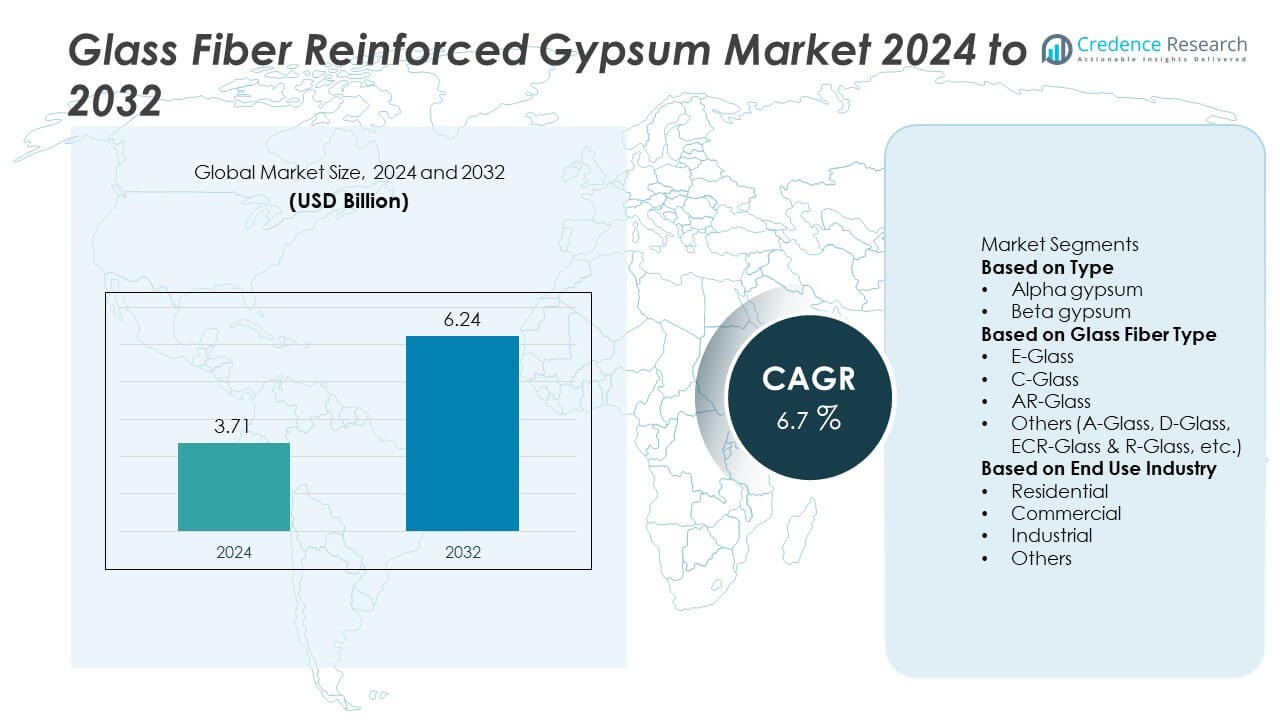
The Glass Fiber Reinforced Gypsum (GFRG) Market was valued at USD 3.71 billion in 2024 and is projected to reach USD 6.24 billion by 2032, expanding at a CAGR of 6.7% during the forecast period.
| REPORT ATTRIBUTE | DETAILS |
|---|---|
| Historical Period | 2020-2023 |
| Base Year | 2024 |
| Forecast Period | 2025-2032 |
| Glass Fiber Reinforced Gypsum Market Size 2024 | USD 3.71 Billion |
| Glass Fiber Reinforced Gypsum Market, CAGR | 6.7% |
| Glass Fiber Reinforced Gypsum Market Size 2032 | USD 6.24 Billion |
The top players in the Glass Fiber Reinforced Gypsum (GFRG) market include Stromberg Architectural, GC Products, Inc., Saint-Gobain Formula GmbH, Formglas Products Ltd, Yingchuang Building Technique Co. Ltd., USG Corporation, AWI Licensing LLC, Knauf Danoline A/S, Georgia-Pacific LLC, and BACE India. These companies strengthen their market presence through innovative product designs, sustainable GFRG panels, and prefabricated construction solutions. Regionally, Asia-Pacific led with a 30% share in 2024, supported by rapid urbanization and large-scale infrastructure projects, while North America held 32% share, driven by strong adoption in commercial and residential sectors. Europe accounted for 28% share, driven by strict environmental standards and sustainable building practices. Latin America and the Middle East & Africa contributed 6% and 4% shares, respectively, reflecting steady but growing adoption.
Market Insights
- The Glass Fiber Reinforced Gypsum (GFRG) market was valued at USD 3.71 billion in 2024 and is projected to reach USD 6.24 billion by 2032, growing at a CAGR of 6.7% during the forecast period.
- Growth is driven by rising demand for lightweight, sustainable, and fire-resistant construction materials, with alpha gypsum leading the market by type at 58% share in 2024 due to its strength and durability.
- Key trends include the adoption of prefabricated and modular construction methods, along with increasing innovation in GFRG-based decorative and specialty applications.
- The competitive landscape features players such as Stromberg Architectural, Saint-Gobain Formula GmbH, Formglas Products Ltd, USG Corporation, Knauf Danoline A/S, and Georgia-Pacific LLC, focusing on sustainable solutions, R&D investments, and expansion in emerging economies.
- Regionally, North America held 32% share, followed by Asia-Pacific at 30% and Europe at 28%, while Latin America and Middle East & Africa accounted for 6% and 4% shares, respectively.
Market Segmentation Analysis:
By Type
Alpha gypsum dominated the GFRG market in 2024 with a 58% share, driven by its superior strength, density, and durability compared to beta gypsum. Its higher mechanical properties make it the preferred choice for construction applications, particularly in high-strength panels, ceilings, and decorative interiors. Beta gypsum continues to serve cost-sensitive applications but lacks the strength required for structural components. Growing demand for lightweight, sustainable, and fire-resistant building materials ensures strong adoption of alpha gypsum, positioning it as the leading product type across residential and commercial construction projects worldwide.
- For instance, Saint-Gobain Formula produces high-purity alpha gypsum from its European plants, supplying reinforced gypsum panels and interior architectural components for global construction projects.
By Glass Fiber Type
E-glass held the largest share of the GFRG market in 2024, accounting for 46% share, owing to its excellent tensile strength, cost-effectiveness, and resistance to moisture. E-glass is widely used in panels, partitions, and ceiling applications due to its high compatibility with gypsum. AR-glass follows with growing adoption in construction projects requiring alkali resistance, especially in harsh environments. C-glass and other specialty glass types serve niche applications but contribute a smaller portion of demand. The strength-to-cost ratio of E-glass ensures its continued dominance across large-scale building projects.
- For instance, Owens Corning uses its specialized, corrosion-resistant Advantex® glass non-woven solutions to reinforce gypsum boards, ensuring increased durability and moisture resistance in commercial installations.
By End Use Industry
The commercial sector led the GFRG market in 2024 with a 41% share, driven by rising demand in office complexes, shopping malls, hospitals, and hotels. The sector benefits from the material’s aesthetic flexibility, fire resistance, and cost efficiency in large construction projects. Residential usage also grew steadily, supported by lightweight panels and modular construction trends. Industrial and other applications, though smaller in share, utilize GFRG for partitions and non-load-bearing walls. The commercial sector’s emphasis on sustainability and modern design ensures its leadership, reinforcing GFRG as a preferred material in global urban development projects.
Key Growth Drivers
Rising Demand for Lightweight and Sustainable Materials
The GFRG market is expanding as construction industries prioritize lightweight and eco-friendly alternatives to traditional building materials. GFRG panels offer superior strength-to-weight ratios, reduced carbon footprint, and faster installation times, making them highly suitable for sustainable building projects. Increasing government initiatives promoting green construction and energy-efficient infrastructure support adoption. Demand is further strengthened by the material’s recyclability and lower environmental impact compared to conventional options. These factors position GFRG as a key material in achieving sustainability goals across global residential and commercial projects.
- For instance, Yingchuang Building Technique (Winsun) has used 3D printing with a special "ink" composed of recycled construction and industrial waste, along with cement, for large-scale projects, including multi-story buildings. This process has been noted to significantly reduce waste and construction time.
Expansion of Commercial and Urban Infrastructure
Rapid growth in commercial infrastructure, including offices, hotels, malls, and healthcare facilities, is a major driver for the GFRG market. Developers prefer GFRG due to its flexibility, fire resistance, and cost-effectiveness for large-scale projects. The material’s ability to deliver superior surface finish and complex architectural designs enhances its adoption in modern urban developments. With expanding urban populations and increasing investments in smart cities, GFRG continues to play a critical role in meeting design, safety, and efficiency requirements across global construction markets.
- For instance, Glass Fibre Reinforced Gypsum (GFRG) panels are a modern, rapid building technology suitable for mass housing. They are known for their scalability and are used for load-bearing and non-load-bearing applications in residential and multi-story buildings.
Technological Advancements in Manufacturing
Innovation in gypsum processing and glass fiber technology is enhancing the performance and versatility of GFRG products. Advances in automated production systems and improved fiber reinforcement techniques have increased durability, fire resistance, and thermal insulation properties. Manufacturers are investing in R&D to create panels suitable for both structural and non-structural applications. These innovations enable broader application across diverse industries, including residential, commercial, and industrial sectors. Technological improvements reduce costs and strengthen market competitiveness, positioning GFRG as a high-performance alternative in modern construction practices.
Key Trends & Opportunities
Shift Toward Prefabricated and Modular Construction
The growing trend of prefabricated and modular construction is creating significant opportunities for GFRG adoption. GFRG panels are lightweight, easy to transport, and quick to install, making them highly compatible with off-site construction methods. This aligns with rising demand for faster, cost-effective, and sustainable building solutions in urban areas. Developers are increasingly integrating GFRG in modular housing, educational buildings, and commercial facilities, driving strong market potential.
- For instance, BACE India has been involved in projects using GFRG wall panels, which are prefabricated and can significantly reduce construction time. BACE India focuses on various types of construction, including affordable housing.
Innovation in Specialty GFRG Applications
Manufacturers are exploring specialty applications such as GFRG-based false ceilings, partitions, and architectural elements to expand market scope. The versatility of GFRG allows intricate designs while maintaining fire resistance and durability, meeting both functional and aesthetic requirements. Opportunities exist in luxury residential projects and high-end commercial spaces where modern design and sustainability are equally valued. This innovation-driven expansion creates new revenue streams and strengthens the role of GFRG in advanced construction.
- For instance, Stromberg Architectural has delivered custom GFRG domes, columns, and ornate ceilings for luxury hotels and casinos in Las Vegas, including Caesars Palace and the Orleans Casino, demonstrating the scalability of GFRG in specialty architectural applications.
Key Challenges
High Installation and Labor Costs
Despite its benefits, GFRG adoption faces challenges due to relatively high installation and skilled labor costs. Handling and installing large panels often require specialized training and equipment, increasing project expenses compared to conventional materials. In cost-sensitive markets, these factors limit widespread usage, particularly in smaller residential projects. Reducing installation complexity and labor costs remains a critical area for improvement.
Limited Awareness in Emerging Markets
Awareness of GFRG’s benefits remains limited in several developing regions, where traditional construction materials dominate. Lack of familiarity among contractors, architects, and builders hinders adoption despite the material’s advantages. Additionally, inconsistent supply chains and limited local manufacturing facilities restrict availability. Overcoming these challenges requires education campaigns, regional production expansion, and stronger distribution networks to boost market penetration in emerging economies.
Regional Analysis
North America
North America accounted for a 32% share of the GFRG market in 2024, supported by strong demand in commercial construction, including office complexes, malls, and institutional buildings. The region benefits from advanced manufacturing technologies, high awareness of sustainable construction, and government-backed initiatives promoting eco-friendly building materials. The United States leads adoption, driven by modern infrastructure projects and preference for prefabricated solutions. Canada also contributes significantly, with demand for lightweight and energy-efficient materials in residential and public sector projects. North America’s strong regulatory environment and innovation in modular construction sustain its leadership.
Europe
Europe held a 28% share of the GFRG market in 2024, driven by stringent environmental regulations and strong emphasis on sustainable construction practices. Countries such as Germany, France, and the UK are leading adopters, particularly in commercial and residential projects that demand fire resistance and durability. The region also shows significant growth in modular and prefabricated construction, aligning with EU sustainability targets. Rising investments in urban housing and green building certifications continue to support demand. Europe’s mature construction industry and focus on high-quality architectural finishes position it as a strong market for GFRG adoption.
Asia-Pacific
Asia-Pacific captured a 30% share of the GFRG market in 2024, making it the fastest-growing region. Rapid urbanization, industrialization, and population growth in countries such as China, India, and Japan are driving large-scale demand. Government-backed initiatives to promote sustainable housing and infrastructure development further support adoption. Prefabricated construction methods are gaining traction in urban centers, where GFRG panels are favored for cost efficiency, durability, and quick installation. The rising middle class and demand for affordable, energy-efficient housing ensure continuous growth. Asia-Pacific’s expanding construction industry positions it as a critical engine for GFRG market expansion.
Latin America
Latin America accounted for a 6% share of the GFRG market in 2024, with Brazil and Mexico serving as the largest contributors. Growth is supported by urban development projects, rising investments in commercial construction, and demand for cost-effective building materials. However, limited local manufacturing capacity and lower awareness among builders pose challenges. Adoption is growing in high-rise residential and public sector projects where GFRG’s lightweight and fire-resistant qualities provide added benefits. With increasing foreign investment in infrastructure and gradual adoption of sustainable building practices, Latin America presents steady growth potential for GFRG applications.
Middle East & Africa
The Middle East & Africa region held a 4% share of the GFRG market in 2024, supported by ongoing construction booms in the UAE, Saudi Arabia, and South Africa. Rapid infrastructure development, including hotels, commercial complexes, and residential towers, fuels demand for modern, lightweight, and fire-resistant materials. The region also shows rising interest in sustainable construction, aligning with government initiatives for energy-efficient buildings. Limited local production and high import reliance pose challenges but also create opportunities for global suppliers. With increasing investments in urban projects, the region is set to offer long-term growth prospects for GFRG adoption.
Market Segmentations:
By Type
- Alpha gypsum
- Beta gypsum
By Glass Fiber Type
- E-Glass
- C-Glass
- AR-Glass
- Others (A-Glass, D-Glass, ECR-Glass & R-Glass, etc.)
By End Use Industry
- Residential
- Commercial
- Industrial
- Others
By Geography
- North America
- U.S.
- Canada
- Mexico
- Europe
- Germany
- France
- U.K.
- Italy
- Spain
- Rest of Europe
- Asia Pacific
- China
- Japan
- India
- South Korea
- South-east Asia
- Rest of Asia Pacific
- Latin America
- Brazil
- Argentina
- Rest of Latin America
- Middle East & Africa
- GCC Countries
- South Africa
- Rest of the Middle East and Africa
Competitive Landscape
The competitive landscape of the Glass Fiber Reinforced Gypsum (GFRG) market is shaped by key players such as Stromberg Architectural, GC Products, Inc., Saint-Gobain Formula GmbH, Formglas Products Ltd, Yingchuang Building Technique Co. Ltd., USG Corporation, AWI Licensing LLC, Knauf Danoline A/S, Georgia-Pacific LLC, and BACE India. These companies focus on strengthening their portfolios with advanced GFRG panels, prefabricated solutions, and decorative architectural products to meet growing demand in residential and commercial construction. Strategic investments in R&D and manufacturing technologies enable them to enhance durability, fire resistance, and sustainability of GFRG offerings. Global expansion through partnerships, acquisitions, and local production facilities helps improve supply chains and address demand in emerging economies. Sustainability initiatives and compliance with green building certifications are becoming central to competition, as players align with stricter regulations and consumer demand for eco-friendly materials. Intense competition fosters continuous innovation, positioning these companies to capture growth opportunities in modern construction markets.
Key Player Analysis
- Stromberg Architectural
- GC Products, Inc.
- Saint-Gobain Formula GmbH
- Formglas Products Ltd
- Yingchuang Building Technique Co. Ltd.
- USG Corporation
- AWI Licensing LLC
- Knauf Danoline A/S
- Georgia-Pacific LLC
- BACE India
Recent Developments
- In May 2023, USG Corporation (via its Canadian arm, CGC) announced a CAD 104 million investment to relaunch a gypsum quarry in Nova Scotia, aiming to strengthen raw gypsum supply capabilities for its wallboard and related products.
- In May 2023, Formglas Products Ltd. highlighted that its large GFRG panels weigh only 2–3 pounds per square foot (10–15 kg/m²), enabling easier installation.
- In 2023, GC Products, Inc. specified that its standard GFRG panels achieve a flexural strength of at least 2,500 psi, ensuring high structural reliability.
Report Coverage
The research report offers an in-depth analysis based on Type, Glass Fiber Type, End Use Industry and Geography. It details leading market players, providing an overview of their business, product offerings, investments, revenue streams, and key applications. Additionally, the report includes insights into the competitive environment, SWOT analysis, current market trends, as well as the primary drivers and constraints. Furthermore, it discusses various factors that have driven market expansion in recent years. The report also explores market dynamics, regulatory scenarios, and technological advancements that are shaping the industry. It assesses the impact of external factors and global economic changes on market growth. Lastly, it provides strategic recommendations for new entrants and established companies to navigate the complexities of the market.
Future Outlook
- Demand for GFRG will increase with growing adoption of sustainable and lightweight construction materials.
- Alpha gypsum will continue to dominate due to its strength and durability in structural applications.
- Prefabricated and modular construction will create strong opportunities for GFRG panel adoption.
- Innovation in decorative and specialty GFRG products will expand applications in commercial projects.
- Asia-Pacific will emerge as the fastest-growing region driven by urbanization and infrastructure development.
- North America and Europe will sustain strong demand supported by strict environmental regulations.
- Companies will invest in R&D to improve durability, fire resistance, and design flexibility of GFRG.
- Green building certifications will encourage higher adoption of eco-friendly GFRG solutions.
- Strategic partnerships and regional manufacturing expansions will enhance supply chain efficiency.
- Rising demand in residential and commercial sectors will ensure long-term market growth.

Request a Free Sample
Fill in your details and we'll send you a free sample report.
- Sample data tables & charts
- Research methodology
Market Dynamics
Rising Demand for Lightweight and Sustainable Materials
Construction industries are increasingly prioritizing lightweight, eco-friendly alternatives to traditional materials. GFRG panels offer superior strength-to-weight ratios, reduced carbon footprint, and faster installation, making them highly suitable for sustainable building projects and supporting green construction initiatives.
Expansion of Commercial and Urban Infrastructure
Rapid growth in commercial infrastructure such as offices, hotels, malls, and healthcare facilities is driving demand for GFRG due to its flexibility, fire resistance, and cost-effectiveness. Urbanization and investments in smart cities further boost the adoption of GFRG in large-scale projects.
Technological Advancements in Manufacturing
Innovations in gypsum processing and glass fiber technology are enhancing the performance, durability, and fire resistance of GFRG products. Automated production and improved reinforcement techniques enable broader application and cost reductions, strengthening GFRG’s competitiveness.
Shift Toward Prefabricated and Modular Construction
The trend toward prefabricated and modular construction methods is increasing the use of GFRG panels, which are lightweight, easy to transport, and quick to install. This supports faster, more cost-effective building solutions, especially in urban and affordable housing projects.
Innovation in Specialty GFRG Applications
Manufacturers are developing specialty GFRG products such as false ceilings, partitions, and decorative architectural elements, expanding the market into luxury residential and high-end commercial spaces where design flexibility and sustainability are valued.
Need a Custom Version of This Report?
Tailor the scope, geography, or segments to your exact requirements.
- Custom geography or segment scope
- Direct access to our analyst team
Frequently Asked Questions
What is the current market size for the Glass Fiber Reinforced Gypsum market, and what is its projected size in 2032?
At what Compound Annual Growth Rate is the Glass Fiber Reinforced Gypsum market projected to grow between 2025 and 2032?
Which Glass Fiber Reinforced Gypsum market segment held the largest share in 2024?
What are the primary factors fueling the growth of the Glass Fiber Reinforced Gypsum market?
Who are the leading companies in the Glass Fiber Reinforced Gypsum market?
Which region commanded the largest share of the Glass Fiber Reinforced Gypsum market in 2024?
Table of Content
Chapter 1 Market Segmentation
- 1.1 Segmentation Framework
- 1.1.1 Product and Service Classification
- 1.1.2 Application and End-Use Classification
- 1.1.3 Technology and Solution Classification
- 1.1.4 Customer and Distribution Channel Classification
- 1.1.5 Geographic Segmentation
- 1.1.6 Market Segment Definitions and Boundaries
- 1.2 By Type
- 1.2.1 Alpha gypsum
- 1.2.2 Beta gypsum
- 1.3 By End Use Industry
- 1.3.1 Residential
- 1.3.2 Commercial
- 1.3.3 Industrial
- 1.3.4 Others
- 1.4 By Glass Fiber Type
- 1.4.1 E-Glass
- 1.4.2 C-Glass
- 1.4.3 AR-Glass
- 1.4.4 Others (A-Glass, D-Glass, ECR-Glass & R-Glass, etc.)
Chapter 2 Introduction
- 2.1 Report Objectives and Scope
- 2.2 Product Definition and Industry Terminology
- 2.3 Market Inclusions and Exclusions
- 2.4 Research Process
- 2.4.1 Primary Research and Expert Interviews
- 2.4.2 Secondary Research and Source Review
- 2.4.3 Top-Down and Bottom-Up Estimation
- 2.4.4 Data Triangulation and Verification
- 2.5 Market Size Measurement Basis
- 2.5.1 2024: USD 3.71 billion → 2032: USD 6.24 billion
- 2.6 Historical and Forecast Reference Periods
- 2.6.1 Base Year: 2024
- 2.6.2 Forecast Period: 2024-2032
- 2.7 Research Assumptions and Limitations
Chapter 3 Executive Summary
- 3.1 Market Snapshot and Key Findings
- 3.2 Base-Year Market Size, 2024
- 3.3 Forecast Market Size, 2032
- 3.4 Revenue and Volume Growth Outlook
- 3.5 Key Demand and Supply Indicators
- 3.6 Leading Market Segments
- 3.7 Fastest-Growing Market Opportunities
- 3.8 Regional Performance Highlights
- 3.9 Technology and Industry Transformation
- 3.10 Competitive Landscape Summary
- 3.11 Analyst View and Strategic Implications
Chapter 4 Global Glass Fiber Reinforced Gypsum Market Trends and Developments
- 4.1 Historical Industry Development
- 4.2 Recent Market Trends and Developments
- 4.3 Demand and Customer Behavior Trends
- 4.4 Technology and Product Innovation
- 4.5 Artificial Intelligence, Automation and Digitalization
- 4.6 Local Manufacturing and Supply Chain Realignment
- 4.7 Industry Partnerships, Mergers and Acquisitions
- 4.8 Sustainability and Circular Economy Developments
- 4.9 Government and Private Sector Investment Trends
- 4.10 Emerging Business Models and Commercialization
- 4.11 Industry Developments and Announcements
Chapter 5 Global Glass Fiber Reinforced Gypsum Market Production, Supply and Demand Analysis
- 5.1 Demand Trend and Consumption Analysis
- 5.2 Demand Forecast, 2024-2032
- 5.3 Production and Output Trend
- 5.4 Production and Output Forecast, 2024-2032
- 5.5 Installed Capacity and Capacity Utilization
- 5.6 Company-Wise Production Plants and Statistics
- 5.6.1 Installed Production Capacity
- 5.6.2 Actual Production
- 5.6.3 Planned Capacity and Expansion Targets
- 5.7 Supply Chain Structure and Procurement Trends
- 5.8 Supply-Demand Gap and Bottlenecks
- 5.9 Import Dependence and Sourcing Structure
- 5.10 Contract Manufacturing and Outsourcing
- 5.11 Regional Supply and Demand Concentration
Chapter 6 Global Glass Fiber Reinforced Gypsum Market Pricing Analysis
- 6.1 Pricing Structure and Measurement
- 6.2 Historical Pricing Trends
- 6.3 Pricing Outlook, 2024-2032
- 6.4 Average Selling Price and Unit Economics
- 6.5 Pricing by Product and Market Segment
- 6.6 Geographic Pricing Differences
- 6.7 Key Input, Energy, Labor and Logistics Costs
- 6.8 Contract Pricing and Purchasing Models
- 6.9 Pricing Sensitivity and Competitive Positioning
- 6.10 Price, Margin and Profitability Implications
Chapter 7 Global Glass Fiber Reinforced Gypsum Market Dynamics
- 7.1 Market Growth Drivers
- 7.1.1 Demand-Side Drivers
- 7.1.2 Technology and Innovation Drivers
- 7.1.3 Infrastructure and Investment Drivers
- 7.1.4 Regulatory and Policy Drivers
- 7.2 Market Restraints
- 7.2.1 Cost and Affordability Constraints
- 7.2.2 Technology and Adoption Barriers
- 7.2.3 Supply Chain and Operational Constraints
- 7.3 Market Challenges
- 7.3.1 Competitive Pressure and Margin Erosion
- 7.3.2 Skills, Infrastructure and Implementation Gaps
- 7.4 Emerging Market Opportunities
- 7.5 Market Dynamics Impact and Time-Horizon Assessment
Chapter 8 Global Glass Fiber Reinforced Gypsum Value Chain Analysis
- 8.1 Industry Value Chain Overview
- 8.2 Upstream Suppliers and Critical Inputs
- 8.3 Technology and Component Providers
- 8.4 Manufacturing or Service Delivery
- 8.5 Distribution, Channel Partners and Integrators
- 8.6 Downstream Applications and End Users
- 8.7 Value Addition and Profit Pools
- 8.8 Vertical Integration and Outsourcing
- 8.9 Supplier Concentration and Risk
- 8.10 Supply Chain Localization and Resilience
Chapter 9 Global Glass Fiber Reinforced Gypsum Market Regulations and Policies
- 9.1 Relevant Laws, Standards and Compliance Frameworks
- 9.2 Product, Service, Safety and Quality Requirements
- 9.3 Government Policies, Incentives and Subsidies
- 9.4 Imports, Exports and Trade Barriers
- 9.5 Public Procurement and Local Content Requirements
- 9.6 Environmental and Sustainability Compliance
- 9.7 Upcoming Policy Changes and Market Implications
Chapter 10 Global Glass Fiber Reinforced Gypsum Market Hotspots and Opportunities
- 10.1 Market Opportunity Mapping and Growth Hotspots
- 10.2 High-Growth Applications and Customer Groups
- 10.3 Underserved Markets and White-Space Opportunities
- 10.4 Emerging Technology and Product Opportunities
- 10.5 New Capacity and Investment Hotspots
- 10.6 Market Entry and Expansion Opportunities
- 10.7 Distribution and Partnership Opportunities
- 10.8 Near-Term and Long-Term Commercial Potential
- 10.9 Opportunity Attractiveness and Execution Risks
Chapter 11 Global Glass Fiber Reinforced Gypsum Market Outlook, 2024-2032
- 11.1 Market Size and Analysis
- 11.1.1 Revenue (Market Measurement: 2024: USD 3.71 billion → 2032: USD 6.24 billion)
- 11.1.2 Market Volume and Quantity Sold
- 11.1.3 Historical Market Size
- 11.1.4 Base-Year Market Size, 2024
- 11.2 Market Forecast, 2024-2032
- 11.2.1 Revenue Forecast to 2032
- 11.2.2 Volume Forecast to 2032
- 11.2.3 CAGR and Year-on-Year Growth
- 11.2.4 Incremental Revenue Opportunity
- 11.3 Forecast Assumptions and Scenario Analysis
- 11.3.1 Base-Case Forecast
- 11.3.2 Optimistic and Conservative Scenarios
- 11.3.3 Technology, Pricing and Policy Sensitivities
- 11.4 Market Attractiveness and Growth Outlook
Chapter 12 Global Glass Fiber Reinforced Gypsum Market Segmentation and Outlook
- 12.1 Segmentation Summary and Market Shares, 2024
- 12.2 Largest and Fastest-Growing Segments
- 12.3 By Type - Market Size and Forecast, 2024-2032
- 12.3.1 Segment Definition and Scope
- 12.3.2 Historical Market Size
- 12.3.3 Revenue Forecast, 2024-2032
- 12.3.4 Volume Forecast, 2024-2032
- 12.3.5 Base-Year Market Share, 2024
- 12.3.6 Segment CAGR and Growth Drivers
- 12.3.7 Subsegment Market Size and Forecast
- 12.3.7.1 Alpha gypsum
- 12.3.7.2 Beta gypsum
- 12.3.8 Subsegment Pricing and Adoption Trends
- 12.3.9 Leading Suppliers and Competition
- 12.3.10 Regional Demand and Opportunities
- 12.4 By End Use Industry - Market Size and Forecast, 2024-2032
- 12.4.1 Segment Definition and Scope
- 12.4.2 Historical Market Size
- 12.4.3 Revenue Forecast, 2024-2032
- 12.4.4 Volume Forecast, 2024-2032
- 12.4.5 Base-Year Market Share, 2024
- 12.4.6 Segment CAGR and Growth Drivers
- 12.4.7 Subsegment Market Size and Forecast
- 12.4.7.1 Residential
- 12.4.7.2 Commercial
- 12.4.7.3 Industrial
- 12.4.7.4 Others
- 12.4.8 Subsegment Pricing and Adoption Trends
- 12.4.9 Leading Suppliers and Competition
- 12.4.10 Regional Demand and Opportunities
- 12.5 By Glass Fiber Type - Market Size and Forecast, 2024-2032
- 12.5.1 Segment Definition and Scope
- 12.5.2 Historical Market Size
- 12.5.3 Revenue Forecast, 2024-2032
- 12.5.4 Volume Forecast, 2024-2032
- 12.5.5 Base-Year Market Share, 2024
- 12.5.6 Segment CAGR and Growth Drivers
- 12.5.7 Subsegment Market Size and Forecast
- 12.5.7.1 E-Glass
- 12.5.7.2 C-Glass
- 12.5.7.3 AR-Glass
- 12.5.7.4 Others (A-Glass, D-Glass, ECR-Glass & R-Glass, etc.)
- 12.5.8 Subsegment Pricing and Adoption Trends
- 12.5.9 Leading Suppliers and Competition
- 12.5.10 Regional Demand and Opportunities
- 12.6 Segment Growth Comparison
- 12.7 Segment Attractiveness and Priority Matrix
Chapter 13 Global Glass Fiber Reinforced Gypsum End-Use and Application Market Outlook
- 13.1 End-Use Industry and Customer Demand Structure
- 13.2 Leading Applications and Customer Groups
- 13.3 End-Use Market Size, Share and Forecast
- 13.4 Major End-Use Industry Deep Dives
- 13.4.1 Customer Requirements and Use Cases
- 13.4.2 Demand and Replacement Cycles
- 13.4.3 Technical and Regulatory Considerations
- 13.4.4 Purchasing and Procurement Models
- 13.4.5 Leading Vendors and Distribution Channels
- 13.4.6 Forecast and Commercial Opportunities
- 13.5 Emerging Applications and Cross-Segment Demand
- 13.6 End-Use Industry Investment Priorities
Chapter 14 Global Glass Fiber Reinforced Gypsum Geographic Market Outlook, 2024-2032
- 14.1 Regional Market Size and Share, 2024
- 14.2 Regional Market Forecast, 2024-2032
- 14.3 Regional Pricing, Production and Demand Differences
- 14.4 North America
- 14.4.1 United States
- 14.4.2 Canada
- 14.4.3 Mexico
- 14.5 Europe
- 14.5.1 Germany
- 14.5.2 France
- 14.5.3 Italy
- 14.5.4 United Kingdom
- 14.5.5 Spain
- 14.5.6 Poland
- 14.5.7 Russia
- 14.5.8 Netherlands
- 14.5.9 Belgium
- 14.5.10 Sweden
- 14.5.11 Denmark
- 14.5.12 Norway
- 14.5.13 Rest of Europe
- 14.6 Asia Pacific
- 14.6.1 China
- 14.6.2 India
- 14.6.3 Japan
- 14.6.4 South Korea
- 14.6.5 Thailand
- 14.6.6 Indonesia
- 14.6.7 Vietnam
- 14.6.8 Malaysia
- 14.6.9 Australia
- 14.6.10 Rest of Asia Pacific
- 14.7 Latin America
- 14.7.1 Brazil
- 14.7.2 Argentina
- 14.7.3 Colombia
- 14.7.4 Chile
- 14.7.5 Rest of Latin America
- 14.8 Middle East
- 14.8.1 Saudi Arabia
- 14.8.2 United Arab Emirates
- 14.8.3 Turkey
- 14.8.4 Israel
- 14.8.5 Iran
- 14.8.6 Rest of the Middle East
- 14.9 Africa
- 14.9.1 South Africa
- 14.9.2 Egypt
- 14.9.3 Nigeria
- 14.9.4 Morocco
- 14.9.5 Rest of Africa
- 14.10 Regional Investment, Policy and Supply Chain Differences
- 14.11 Regional Competitive Landscape
- 14.12 Geographic Growth Hotspots
Chapter 15 Global Glass Fiber Reinforced Gypsum Technology, Innovation and Sustainability Outlook
- 15.1 Technology Landscape and Maturity
- 15.2 Product, Process and Service Innovation
- 15.3 AI, Automation and Digital Tools in the Industry
- 15.4 Technology Adoption and Performance Benchmarking
- 15.5 Innovation Pipeline and R&D Investment
- 15.6 Patent and Intellectual Property Trends
- 15.7 Energy Efficiency and Resource Management
- 15.8 Sustainability, Recycling and Circularity
- 15.9 Technology Roadmap, 2024-2032
- 15.10 Risks of Obsolescence and Technology Substitution
Chapter 16 Global Glass Fiber Reinforced Gypsum Market Key Strategic Imperatives
- 16.1 Growth and Market Entry Priorities
- 16.2 High-Return Products and Segments
- 16.3 Pricing, Profitability and Cost Optimization
- 16.4 Technology Investment and Product Differentiation
- 16.5 Supply Chain Localization and Resilience
- 16.6 Distribution and Customer Acquisition
- 16.7 Partnership, Acquisition and Capacity Strategy
- 16.8 Regional Expansion Priorities
- 16.9 Short-, Medium- and Long-Term Actions
Chapter 17 Competition Outlook
- 17.1 Industry Competition Characteristics
- 17.2 Market Structure and Concentration
- 17.3 Market Share and Competitive Positioning, 2024
- 17.4 Company-Wise Revenue and Product Benchmarking
- 17.5 Production and Service Capacity Benchmarking
- 17.6 Technology, Pricing and Differentiation
- 17.7 Regional Footprint and Distribution Strength
- 17.8 Mergers, Acquisitions and Strategic Alliances
- 17.9 New Entrants and Competitive Threats
- 17.10 Porter's Five Forces and Industry Attractiveness
- 17.11 Competitive Outlook, 2024-2032
Chapter 18 Company Profiles
- 18.1 Company Coverage and Selection Criteria
- 18.2 Stromberg Architectural
- 18.2.1 Business Description
- 18.2.2 Company Ownership and Geographic Presence
- 18.2.3 Product and Service Portfolio
- 18.2.4 Manufacturing and Operating Footprint
- 18.2.5 Production Capacity and Expansion Plans
- 18.2.6 Financial Performance and Investment
- 18.2.7 Market Share and Competitive Position
- 18.2.8 Technology and Innovation Capabilities
- 18.2.9 Strategic Alliances or Partnerships
- 18.2.10 Recent Developments
- 18.2.11 Growth Strategy and Outlook
- 18.3 GC Products, Inc.
- 18.4 Saint-Gobain Formula GmbH
- 18.5 Formglas Products Ltd
- 18.6 Yingchuang Building Technique Co. Ltd.
- 18.7 USG Corporation
- 18.8 AWI Licensing LLC
- 18.9 Knauf Danoline A/S
- 18.10 Georgia-Pacific LLC
- 18.11 BACE India
- 18.12 Other Relevant Market Participants
Note: Every listed company is profiled on the structure shown under the first company. The company list is preliminary and may change based on research findings, market developments, data availability and client requirements.
Chapter 19 Disclaimer
- 19.1 Research and Forecast Disclaimer
- 19.2 Data Source and Estimation Limitations
Note: The depth of individual sections depends on data availability for this market. Volume, capacity, trade and other unit-based metrics are included where applicable.

