
Market Overview:
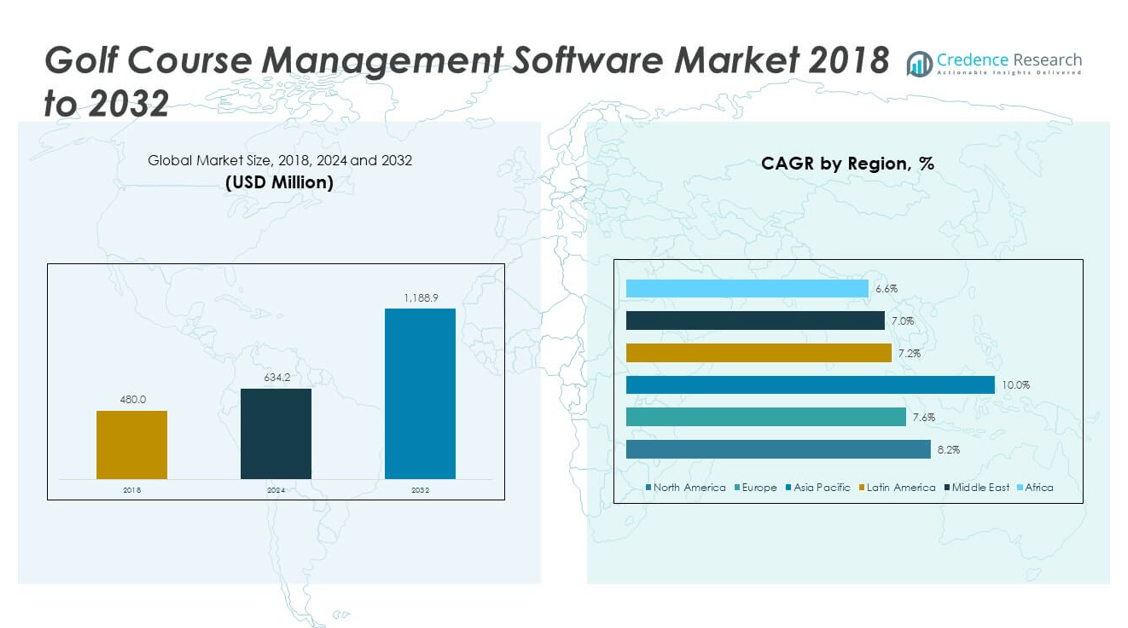
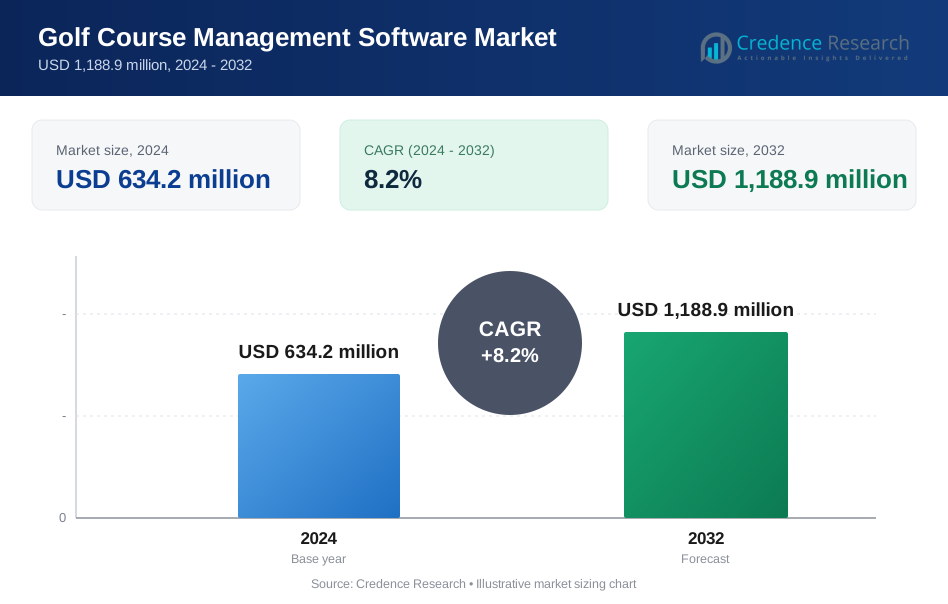
The Golf Course Management Software Market size was valued at USD 480.0 million in 2018 to USD 634.2 million in 2024 and is anticipated to reach USD 1,188.9 million by 2032, at a CAGR of 8.2% during the forecast period.
| REPORT ATTRIBUTE | DETAILS |
|---|---|
| Historical Period | 2020-2023 |
| Base Year | 2024 |
| Forecast Period | 2025-2032 |
| Golf Course Management Software Market Size 2024 | USD 634.2 million |
| Golf Course Management Software Market, CAGR | 8.2% |
| Golf Course Management Software Market Size 2032 | USD 1,188.9 million |
The market growth is primarily driven by the increasing adoption of digital platforms that streamline tee-time scheduling, membership management, and payment systems, enhancing operational efficiency for golf course operators. Rising demand for real-time data analytics and cloud-based solutions supports better decision-making and customer engagement. Furthermore, the integration of mobile applications and IoT technologies is fostering personalized experiences, improving customer satisfaction, and driving wider adoption among golf facilities.
From a regional perspective, North America holds a leading position in the golf course management software market due to its mature golfing infrastructure, high digital adoption rates, and large number of golf facilities. Europe is also experiencing steady growth, supported by strong investments in sports tourism and digital modernization. Meanwhile, Asia-Pacific is emerging as a high-growth region, fueled by rising disposable incomes, increasing golf participation, and the rapid expansion of premium resorts and golf courses, particularly in countries like China, Japan, and South Korea.
Market Insights:
- The Golf Course Management Software Market was valued at USD 634.2 million in 2024 and is projected to reach USD 1,188.9 million by 2032, growing at a CAGR of 8.2%.
- Rising adoption of cloud-based platforms and mobile applications is driving operational efficiency and scalability across golf courses.
- Demand for real-time data analytics and CRM solutions is enhancing customer engagement and improving revenue optimization.
- High implementation costs and resistance to digital transition remain key restraints for smaller and municipal golf facilities.
- North America held the largest share in 2024, supported by strong golfing culture and advanced digital adoption.
- Asia Pacific is the fastest-growing region, with a CAGR of 10.0%, driven by golf tourism, rising incomes, and new infrastructure development.
- Europe maintains steady growth as sports tourism and modernization of private and resort courses fuel consistent demand.
Market Drivers
Rising Focus on Streamlined Golf Course Operations and Digital Transformation
The Golf Course Management Software Market is advancing due to strong demand for streamlined operations that reduce manual tasks and improve efficiency. Operators are adopting centralized systems that handle scheduling, reservations, and membership management with greater accuracy. It supports automation of administrative work, which reduces human error and saves operational costs. Advanced billing features help clubs maintain transparent financial records and strengthen accountability. Cloud-based platforms enable remote access, empowering managers to make faster and more informed decisions. It also allows scalability, making the software suitable for courses of varying sizes. Growing emphasis on cost optimization encourages adoption across both premium and mid-tier golf facilities. Operators are aligning digital transformation strategies with customer satisfaction goals.
Increasing Need for Data Analytics and Customer Insights to Drive Performance
The Golf Course Management Software Market benefits from rising reliance on advanced data analytics to enhance customer experiences. It helps operators track playing patterns, usage statistics, and revenue streams in real time. Predictive insights guide pricing strategies, which maximize profits during peak and off-peak hours. Player behavior analysis enables managers to offer tailored promotions, loyalty rewards, and exclusive packages. It strengthens customer relationships by personalizing service delivery at every stage of interaction. Operators use data-driven insights to optimize staffing and resource allocation. The shift toward evidence-based decision-making is creating new benchmarks for operational efficiency. It continues to encourage broader adoption across established and emerging golf destinations.
- For example, Teesnap’s transition from Tableau to the Sigma Computing analytics platform, integrated with Snowflake, boosted report performance by over 90% on its most complex dashboards. This improvement enabled management teams to access faster, data-driven insights and streamline operational decision-making.
Expanding Integration of Mobile Applications and IoT for Member Engagement
The Golf Course Management Software Market is supported by the rising integration of mobile apps and IoT devices that transform customer engagement. Mobile platforms simplify tee-time booking, event registration, and payment processes. It enables members to access personalized dashboards, track performance, and receive instant notifications. IoT-enabled systems monitor turf conditions, equipment health, and energy consumption. These innovations improve overall facility management and resource utilization. It allows golfers to experience seamless connectivity while enjoying personalized services. Clubs benefit from improved operational control through smart sensors and automated alerts. Enhanced connectivity strengthens trust and retention within member communities. It contributes to long-term loyalty among both casual and professional players.
- For example, Askara Technology’s Golf Master 360 system is designed to support golf course digitization by integrating IoT devices that enable real-time monitoring, resource optimization, and smarter maintenance management. The platform focuses on improving operational efficiency and enhancing overall course performance through digital infrastructure.
Growing Investments in Sports Tourism and Golf Infrastructure Development
The Golf Course Management Software Market is gaining momentum with investments in golf infrastructure and sports tourism worldwide. Governments and private investors are funding the development of new courses and upgrading existing facilities. It encourages widespread adoption of software that manages diverse operations across larger properties. Golf resorts integrate digital solutions to attract international visitors seeking premium experiences. Rising participation from younger demographics boosts demand for efficient systems that enhance convenience. It also supports large-scale event organization, including tournaments and training programs. High-profile golfing destinations are adopting advanced technology to maintain global competitiveness. Strong alignment between tourism growth and digital adoption drives continued expansion of the market.
Market Trends
Adoption of Cloud-Based Platforms for Scalability and Long-Term Flexibility
The Golf Course Management Software Market is witnessing increased adoption of cloud-based platforms that offer scalability and flexibility. It reduces dependency on local infrastructure, cutting upfront costs for operators. Cloud models ensure secure data storage with advanced backup and recovery systems. It enables real-time synchronization across multiple devices and teams. Managers use centralized dashboards to monitor facility activities efficiently. Subscription-based pricing models attract smaller clubs seeking affordable solutions. It provides continuous updates and technical support, keeping operations modernized. Rising preference for cloud systems reflects a long-term commitment to digital transformation strategies.
Rising Popularity of AI-Powered Solutions for Predictive Planning and Automation
The Golf Course Management Software Market is advancing with AI-powered tools that improve predictive planning and automate processes. AI-driven scheduling engines optimize tee times and reduce waiting periods. It analyzes customer preferences to recommend personalized experiences. Advanced algorithms predict seasonal demand shifts, supporting better inventory and workforce planning. Automation reduces administrative workload, ensuring smoother operations at busy facilities. It also enhances fraud detection and payment security. Golf operators leverage AI to maximize efficiency and elevate member satisfaction. Integration of AI is shifting market focus toward intelligent, adaptive platforms.
Expanding Role of Digital Marketing and Virtual Engagement Tools in Customer Retention
The Golf Course Management Software Market is shaped by the growing role of digital marketing tools and virtual engagement platforms. Operators use integrated CRM modules to launch targeted campaigns across multiple channels. It enables courses to strengthen communication with members through personalized emails and mobile notifications. Social media integration promotes events and drives wider community participation. Virtual tours and online booking portals increase convenience for both new and returning players. It fosters higher engagement levels by bridging physical and digital experiences. Clubs are adopting loyalty programs and referral systems that retain customers. The expansion of virtual engagement is redefining customer outreach strategies.
- For example, Jonas Club Software, a key player in the Golf Course Management Software Market, provides integrated email marketing tools within its platform. It enables golf clubs to automate campaigns, segment member lists, and track engagement metrics such as delivery, open, and click-through rates, supporting stronger communication and member retention.
Growing Integration of Wearable Devices and Performance Tracking Applications
The Golf Course Management Software Market is embracing the integration of wearable devices and performance-tracking apps. It empowers players to monitor swing analysis, fitness levels, and game statistics. Managers use integrated data to design training programs and personalized coaching sessions. Wearable devices provide seamless connectivity with software dashboards, creating a holistic ecosystem. It also enhances engagement by gamifying user experiences. Clubs offering data-driven feedback attract a broader range of players seeking performance improvement. Integration with health-monitoring features builds stronger appeal among fitness-conscious members. It reflects the market’s move toward smarter, more immersive golfing experiences.
- For example, Arccos Golf’s performance tracking system exceeded 650 million shots logged across 13.5 million rounds by early 2023, and by mid-2025 that total surpassed 1.2 billion shots. This vast dataset enables granular analysis for both players and course managers.
Market Challenges Analysis
High Implementation Costs and Resistance to Digital Transition
The Golf Course Management Software Market faces challenges linked to high implementation costs and reluctance toward digital transition. Smaller golf clubs often hesitate to invest in advanced platforms due to budget constraints. It creates disparities in adoption between premium resorts and mid-sized facilities. Managers with limited technical expertise resist changes that replace manual operations. Training staff to adapt to new systems adds to operational expenses. It also extends deployment timelines for many facilities. Uncertainty regarding return on investment remains a barrier for decision-makers. Overcoming these challenges requires affordable solutions and stronger awareness campaigns.
Concerns Over Data Security, Connectivity, and Integration Limitations
The Golf Course Management Software Market is constrained by rising concerns over data privacy, connectivity, and integration barriers. Operators handle sensitive financial and customer information, making cybersecurity critical. It exposes facilities to risks if robust safeguards are not in place. Poor internet connectivity in rural or emerging golf regions creates adoption hurdles. Limited interoperability between legacy systems and new platforms complicates seamless integration. It restricts efficiency gains that the software is expected to deliver. Technical downtime also disrupts services, impacting customer satisfaction. Addressing these challenges demands strong compliance frameworks and reliable IT support systems.
Market Opportunities
Expansion into Emerging Golf Destinations with Rising Participation
The Golf Course Management Software Market has opportunities to expand into emerging golf destinations experiencing rising participation rates. Countries in Asia-Pacific and Latin America are building new courses to meet growing demand. It presents significant potential for software providers to supply scalable solutions tailored to different facility sizes. Golf tourism is also expanding in these regions, creating a broader customer base. Operators seek advanced systems that strengthen service quality and event management. It gives vendors a pathway to establish long-term partnerships. Tailored solutions for developing markets can create strong adoption momentum.
Innovation in Integrated Solutions and Diversified Service Offerings
The Golf Course Management Software Market presents opportunities for innovation in integrated solutions and diverse offerings. Vendors can design systems combining management, analytics, and customer engagement tools into unified platforms. It strengthens operational visibility and increases efficiency across clubs of varying capacities. Growth in demand for mobile-first experiences creates scope for advanced app-based solutions. Integration with performance tracking, marketing automation, and payment gateways enhances user value. It builds stronger loyalty and supports premium pricing models. Strategic innovation in solutions helps vendors secure a competitive advantage.
Market Segmentation Analysis:
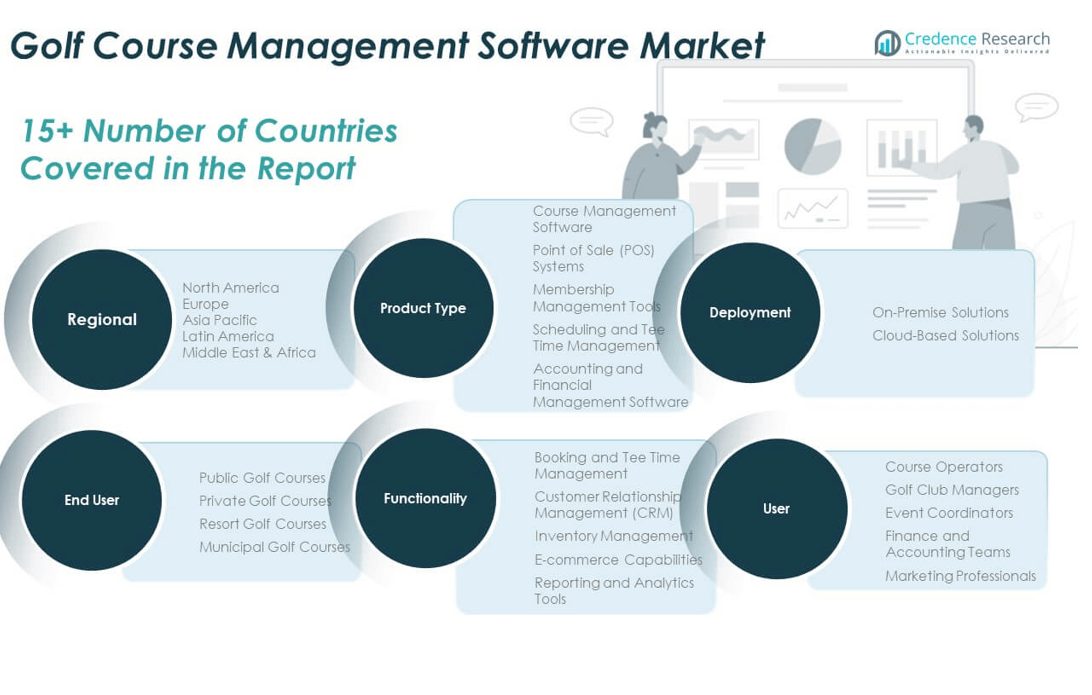
The Golf Course Management Software Market demonstrates a diverse structure shaped by product type, deployment, end-user, functionality, and user categories.
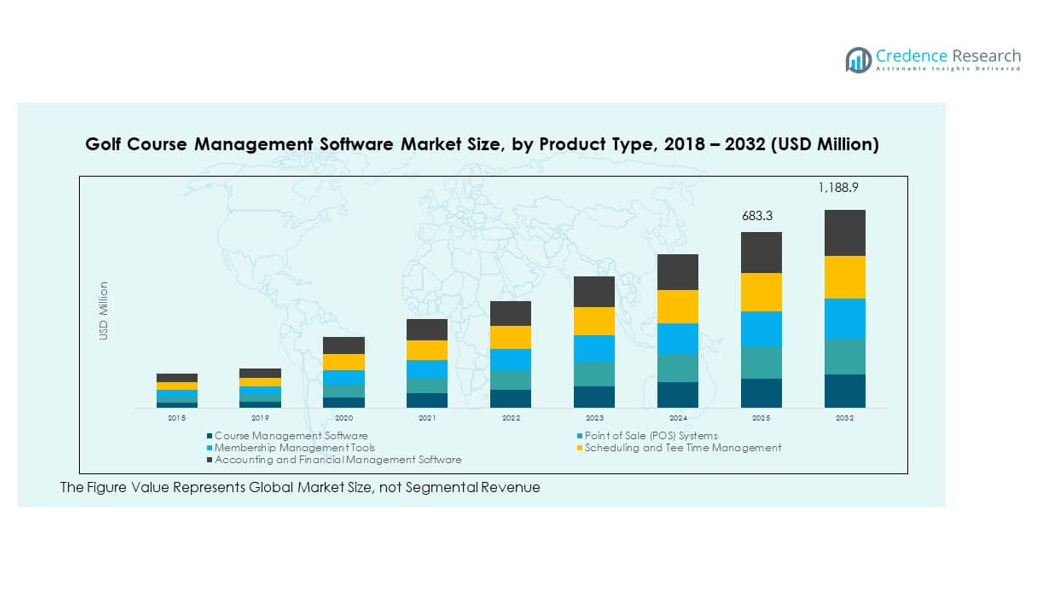
By product type, course management software dominates due to its ability to centralize operations, followed by POS systems and membership management tools that enhance revenue tracking and customer retention. Scheduling and tee time management solutions hold strong demand for their role in optimizing player flow, while accounting and financial software strengthens compliance and transparency.
- For example, Lightspeed Golf expanded its customer base by nearly 7% during early 2025 the strongest volume growth among tee-sheet and booking engine providers demonstrating robust demand for its integrated digital platform.
By deployment, cloud-based solutions are experiencing faster adoption due to scalability and lower upfront costs, while on-premise systems retain relevance in facilities preferring controlled environments.
By end-user, private and resort golf courses lead adoption, driven by higher investment capacity and customer expectations for premium services. Public and municipal golf courses are gradually increasing uptake to improve efficiency and expand accessibility.
- For example, in the first four months of 2025, more than 175 golf courses in North America adopted a new tee-sheet or booking engine vendor—often transitioning to cloud-based platforms—highlighting a clear shift toward digital and remotely accessible systems.
By functionality, booking and tee time management stands out as the most widely adopted, followed by CRM systems that personalize engagement. Inventory management, e-commerce capabilities, and reporting tools add value by enhancing operational oversight and revenue generation.
By user, course operators and golf club managers represent the largest group, as they oversee daily operations and strategic planning. Event coordinators leverage the software for seamless event execution, while finance teams focus on accurate billing and accounting functions. Marketing professionals use integrated tools to improve campaigns and strengthen member loyalty. It reflects a market that continues to evolve with rising digital adoption across all segments.
Segmentation:
By Product Type
- Course Management Software
- Point of Sale (POS) Systems
- Membership Management Tools
- Scheduling and Tee Time Management
- Accounting and Financial Management Software
By Deployment
- On-Premise Solutions
- Cloud-Based Solutions
By End-User
- Public Golf Courses
- Private Golf Courses
- Resort Golf Courses
- Municipal Golf Courses
By Functionality
- Booking and Tee Time Management
- Customer Relationship Management (CRM)
- Inventory Management
- E-commerce Capabilities
- Reporting and Analytics Tools
By User
- Course Operators
- Golf Club Managers
- Event Coordinators
- Finance and Accounting Teams
- Marketing Professionals
By Region
- North America
- U.S.
- Canada
- Mexico
- Europe
- UK
- France
- Germany
- Italy
- Spain
- Russia
- Belgium
- Netherlands
- Austria
- Sweden
- Poland
- Denmark
- Switzerland
- Rest of Europe
- Asia Pacific
- China
- Japan
- South Korea
- India
- Australia
- Thailand
- Indonesia
- Vietnam
- Malaysia
- Philippines
- Taiwan
- Rest of Asia Pacific
- Latin America
- Brazil
- Argentina
- Peru
- Chile
- Colombia
- Rest of Latin America
- Middle East
- UAE
- KSA
- Israel
- Turkey
- Iran
- Rest of Middle East
- Africa
- Egypt
- Nigeria
- Algeria
- Morocco
- Rest of Africa
Regional Analysis:
North America
The North America Golf Course Management Software Market size was valued at USD 194.2 million in 2018 to USD 253.7 million in 2024 and is anticipated to reach USD 475.0 million by 2032, at a CAGR of 8.2% during the forecast period. North America holds 40.0% share of the global market in 2024, driven by its strong golf culture and advanced digital adoption. The region benefits from a large base of private and resort golf courses that prioritize operational efficiency and premium customer experiences. It supports innovation with high demand for cloud-based platforms, mobile integration, and data analytics tools. The U.S. remains the leading contributor, with Canada and Mexico following due to increasing interest in modernized golf infrastructure. It reflects a mature market where technology adoption aligns with established golfing traditions. High penetration of POS systems and CRM tools strengthens revenue optimization and member loyalty. The region continues to lead in shaping digital innovation in golf operations globally.
Europe
The Europe Golf Course Management Software Market size was valued at USD 142.6 million in 2018 to USD 181.9 million in 2024 and is anticipated to reach USD 324.3 million by 2032, at a CAGR of 7.6% during the forecast period. Europe accounts for 28.7% of the global market in 2024, supported by steady demand across key countries such as the UK, Germany, France, and Spain. It benefits from government-backed investments in sports tourism and modernization of golf facilities. Private and resort courses lead software adoption, while municipal courses are gradually upgrading to improve service delivery. It reflects a balanced market where tradition meets modernization. CRM integration and digital marketing solutions are gaining traction to attract international players and visitors. The European golf ecosystem is diverse, with wide variations in course size and service requirements. It highlights a market growing steadily with technology integration aligned with tourism-driven goals.
Asia Pacific
The Asia Pacific Golf Course Management Software Market size was valued at USD 83.1 million in 2018 to USD 116.7 million in 2024 and is anticipated to reach USD 249.2 million by 2032, at a CAGR of 10.0% during the forecast period. Asia Pacific holds 18.4% market share in 2024, emerging as the fastest-growing regional market. Rising disposable incomes and urban development are fueling investments in golf resorts and private courses. It benefits from the growing popularity of golf in China, Japan, South Korea, and India. Cloud-based and mobile-first platforms are preferred due to their scalability and affordability. It reflects a dynamic market where demand for membership tools and booking solutions is accelerating. Golf tourism in Southeast Asia adds momentum, creating opportunities for software providers. Rapid expansion of premium golf destinations strengthens the region’s growth outlook.
Latin America
The Latin America Golf Course Management Software Market size was valued at USD 28.5 million in 2018 to USD 37.2 million in 2024 and is anticipated to reach USD 64.4 million by 2032, at a CAGR of 7.2% during the forecast period. Latin America accounts for 5.9% market share in 2024, led by countries such as Brazil, Argentina, and Mexico. The market is expanding gradually, supported by rising middle-class participation and growth in golf tourism. It benefits from resort development and international event hosting, which encourage adoption of digital solutions. Public and municipal courses are showing increasing interest in affordable management tools. It reflects a region where demand is driven by modernization rather than tradition. Operators prefer scalable cloud-based systems to minimize infrastructure costs. It provides long-term potential, especially as sports tourism gains momentum.
Middle East
The Middle East Golf Course Management Software Market size was valued at USD 19.8 million in 2018 to USD 24.6 million in 2024 and is anticipated to reach USD 42.0 million by 2032, at a CAGR of 7.0% during the forecast period. The Middle East holds 3.9% share of the global market in 2024, with growth anchored by the UAE, Saudi Arabia, and Qatar. The region benefits from luxury golf resorts and premium course development linked with tourism strategies. It reflects demand for high-end digital solutions that enhance visitor experience. Operators invest in integrated platforms for event management and membership personalization. It also benefits from international tournaments hosted in world-class facilities. Cloud solutions are gaining adoption due to their flexibility and mobile integration. It highlights a market where premium positioning drives technological adoption.
Africa
The Africa Golf Course Management Software Market size was valued at USD 11.9 million in 2018 to USD 20.0 million in 2024 and is anticipated to reach USD 34.0 million by 2032, at a CAGR of 6.6% during the forecast period. Africa contributes 3.1% share of the global market in 2024, with growth led by South Africa, Egypt, and emerging tourism destinations. The market is characterized by gradual modernization and infrastructure expansion. It benefits from increasing participation in golf tourism supported by international visitors. Public and municipal courses adopt affordable software to strengthen efficiency. It reflects early-stage digital adoption compared to other regions. Cloud-based platforms are preferred for scalability across diverse geographies. Growing demand for scheduling and POS systems signals steady progress in digital transformation.
Key Player Analysis:
- GOLF Business Solutions
- Lightspeed
- EZLinks Golf
- Jonas Club Software
- Supreme Golf Solutions
- ForeUP
- Teesnap
- Club Prophet Systems
- Tri-Technical Systems
- Bookitlive
- TeeQuest Solutions
- GolfSmash
- Teebook
- WayPoint Golf
- G24 Group
Competitive Analysis:
The Golf Course Management Software Market is defined by strong competition among global and regional players offering specialized digital solutions. Leading companies such as GOLF Business Solutions, Lightspeed, Jonas Club Software, and EZLinks Golf focus on expanding portfolios with integrated management, POS, and CRM platforms. It emphasizes innovation through mobile-first solutions, cloud adoption, and analytics-driven features to attract diverse customer segments. Vendors pursue mergers, acquisitions, and strategic alliances to strengthen market presence and broaden client bases. It demonstrates increasing investment in user-friendly platforms that improve efficiency, engagement, and revenue optimization. Competitors are also targeting emerging regions where golf tourism is growing rapidly. It creates opportunities for vendors to expand their influence through tailored, cost-effective platforms.
Recent Developments:
- In August 2025, Revelyst, a major player in performance gear and golf technology, acquired GolfLogix, a leading GPS golf course mapping and 3D virtual reality golf app provider. The deal, which closed on July 9, 2025, adds GolfLogix’s expansive software capabilities and more than 40,000 mapped courses to Revelyst’s growing ecosystem of golf tech brands.
Market Concentration & Characteristics:
The Golf Course Management Software Market reflects moderate concentration with a mix of established global providers and niche regional vendors. It shows strong growth potential driven by rising demand for cloud platforms, mobile solutions, and data-driven decision support. Competitive intensity remains high as companies differentiate through pricing flexibility, customization, and advanced functionality. It highlights a market characterized by continuous innovation, recurring revenue models, and a strong shift toward scalable digital ecosystems. Market leaders maintain dominance through brand credibility and expansive service networks. It indicates a structure where both consolidation and innovation are shaping future growth.
Report Coverage:
The research report offers an in-depth analysis based on product type, deployment, end-user, functionality, and user categories. It details leading market players, providing an overview of their business, product offerings, investments, revenue streams, and key applications. Additionally, the report includes insights into the competitive environment, SWOT analysis, current market trends, as well as the primary drivers and constraints. Furthermore, it discusses various factors that have driven market expansion in recent years. The report also explores market dynamics, regulatory scenarios, and technological advancements that are shaping the industry. It assesses the impact of external factors and global economic changes on market growth. Lastly, it provides strategic recommendations for new entrants and established companies to navigate the complexities of the market.
Future Outlook:
- The Golf Course Management Software Market will expand with broader adoption of cloud-based platforms that deliver scalability and cost efficiency.
- Mobile-first applications will gain traction as members demand seamless booking, payments, and personalized services.
- AI and predictive analytics will play a larger role in optimizing scheduling, pricing strategies, and customer engagement.
- Integration of IoT and smart sensors will enhance course maintenance, energy efficiency, and equipment monitoring.
- Digital marketing and CRM solutions will become central to attracting younger demographics and international golfers.
- Vendors will prioritize cybersecurity and data protection to address rising concerns over sensitive financial and personal data.
- The growth of golf tourism will drive higher investments in software adoption across resort and premium courses.
- Partnerships between technology firms and golf associations will accelerate innovation and standardization.
- Emerging markets in Asia Pacific, Latin America, and Africa will provide new revenue streams for providers.
- Continuous product innovation will foster greater loyalty and enable vendors to maintain a competitive edge.
Request a Free Sample
Fill in your details and we'll send you a free sample report.
- Sample data tables & charts
- Research methodology
Need a Custom Version of This Report?
Tailor the scope, geography, or segments to your exact requirements.
- Custom geography or segment scope
- Direct access to our analyst team
Frequently Asked Questions
What is the current market size for Golf Course Management Software Market, and what is its projected size in 2032?
At what Compound Annual Growth Rate is the Golf Course Management Software Market projected to grow between 2024 and 2032?
What are the primary factors fueling the growth of the Golf Course Management Software Market?
Who are the leading companies in the Golf Course Management Software Market?
Table of Content
Chapter 1. Report Introduction
- 1.1 Report Description & Purpose
- 1.1.1 Report Title & Market Definition
- 1.1.2 Unique Selling Propositions (USP) & Key Differentiators
- 1.1.3 Value Proposition for Stakeholders
- 1.2 Research Objectives
- 1.2.1 Market Sizing Objectives (Volume & Revenue)
- 1.2.2 Segmentation Objectives
- 1.2.3 Competitive Intelligence Objectives
- 1.2.4 Forecast & Scenario Objectives
- 1.3 Report Scope
- 1.3.1 Golf Course Management Software Scope – Types & Subtypes Covered
- 1.3.2 Geographic Scope – Regions & Countries Covered
- 1.3.3 Historical Period, Base Year & Forecast Period (2024; forecast to 2032)
- 1.3.4 Inclusions & Exclusions
- 1.4 HS Code & Classification Framework
- 1.5 Currency, Units & Pricing Basis
- 1.6 Target Stakeholders
- 1.7 Limitations & Assumptions
Chapter 2. Executive Summary
- 2.1 Global Golf Course Management Software Market Snapshot
- 2.1.1 Market Size – Historical (2024) & Forecast (2024-2032) (2024: USD 634.2 million → 2032: USD 1,188.9 million)
- 2.1.2 Volume & Revenue – Global Totals
- 2.1.3 Key Market Highlights – Top Five Facts
- 2.2 Golf Course Management Software Market Segmentation Snapshot
- 2.2.1 Market Split by Region – 2024 vs. 2032
- 2.3 Competitive Snapshot
- 2.3.1 Top 10 Players by Revenue Share – 2024
- 2.3.2 Top 10 Players by Volume Share – 2024
- 2.3.3 Recent Strategic Developments (18-Month Summary)
- 2.4 Key Investment Highlights & Strategic Conclusions
Chapter 3. Golf Course Management Software Market Dynamics & Industry Analysis
- 3.1 Market Overview & Context
- 3.1.1 Golf Course Management Software Market Position in the Broader Automotive Value Chain
- 3.1.2 OEM vs. Replacement Market Dynamics
- 3.1.3 Market Maturity & Development Stage by Region
- 3.2 Golf Course Management Software Market Drivers
- 3.3 Golf Course Management Software Market Restraints & Challenges
- 3.4 Golf Course Management Software Market Opportunities
- 3.5 Porter's Five Forces Analysis
- 3.5.1 Threat of New Entrants
- 3.5.2 Bargaining Power of Suppliers
- 3.5.3 Bargaining Power of Buyers
- 3.5.4 Threat of Substitutes
- 3.5.5 Competitive Rivalry – Intensity Assessment
- 3.6 Golf Course Management Software Value Chain Analysis
- 3.6.1 Upstream – Raw Material/Input Suppliers
- 3.6.1.1 Raw Material/Input 1
- 3.6.1.2 Raw Material/Input 2
- 3.6.1.3 Raw Material/Input 3
- 3.6.2 Midstream – Production/Manufacturing/Service Delivery
- 3.6.2.1 Production/Process Overview
- 3.6.2.2 Key Facility Locations & Capacity by Manufacturer
- 3.6.3 Downstream – Distribution & End Consumer
- 3.6.3.1 Primary Channel – B2B/OEM
- 3.6.3.2 Secondary Channels – Dealer, Retail, Online, Direct
- 3.6.4 Value Chain Profitability Analysis
- 3.6.1 Upstream – Raw Material/Input Suppliers
- 3.7 PESTEL Analysis
- 3.7.1 Political Factors
- 3.7.2 Economic Factors
- 3.7.3 Social Factors
- 3.7.4 Technological Factors
- 3.7.5 Environmental Factors
- 3.7.6 Legal Factors
- 3.8 Golf Course Management Software Supply Chain Analysis
- 3.8.1 Raw Material/Input Supply Risk Assessment
- 3.8.2 Manufacturing Concentration Risk (Geographic Exposure)
- 3.8.3 Trade Disruption Impact Analysis
- 3.9 Regulatory & Policy Landscape
Note: The regulatory and policy landscape section covers regulations based on their applicability to the market, Golf Course Management Software category, geography, and scope of the study. Only regulatory frameworks with a material impact on operations, compliance, trade, sustainability, or market access are analyzed in detail.
Chapter 4. Key Investment Pockets & Opportunity Analysis
- 4.1 Golf Course Management Software Market Attractiveness Analysis
- 4.1.1 By Region – Investment Attractiveness Matrix (Volume × CAGR)
- 4.2 Absolute Revenue Growth Opportunity
- 4.2.1 By Region – Absolute USD Growth Through 2032
- 4.3 Incremental Volume Opportunity
- 4.3.1 By Region – Incremental Volume Through 2032
- 4.3.2 Segment – Incremental Volume
- 4.4 Emerging Submarket Opportunity Deep Dive (Subject to Applicability)
- 4.5 Emerging Market Opportunity Scorecards
- 4.5.1 United States
- 4.5.2 Europe
- 4.5.3 Asia
- 4.5.4 Middle East & Africa
Note: Emerging Market Opportunity Scorecards will be included based on relevance and strategic importance. Regions listed are indicative and may vary depending on data availability and market dynamics.
Chapter 5. Golf Course Management Software Import-Export Analysis & Trade Flows
- 5.1 Global Trade Overview
- 5.1.1 Global Export Value by Country (2024)
- 5.1.2 Global Export Volume by Country (2024)
- 5.1.3 Global Import Value by Country (2024)
- 5.1.4 Global Import Volume by Country (2024)
- 5.1.5 Net Trade Balance by Country (2024)
- 5.2 Export Analysis – Segment
- 5.2.1 Type 1 (HS Code)
- 5.2.2 Type 2 (HS Code)
- 5.2.3 Type 3 (HS Code)
- 5.2.4 Type 4 (HS Code)
- 5.2.5 Type 5 (HS Code)
- 5.3 Import Analysis – Segment
- 5.3.1 Type 1 (HS Code)
- 5.3.2 Type 2 (HS Code)
- 5.3.3 Type 3 (HS Code)
- 5.3.4 Type 4 (HS Code)
- 5.3.5 Type 5 (HS Code)
- 5.4 Average Unit Trade Prices
- 5.4.1 Average Export Price – Segment & Country
- 5.4.2 Average Import Price – Segment & Source Country
- 5.4.3 Price Trends (2024)
- 5.5 Key Trade Route Analysis
- 5.5.1 Trade Route 1
- 5.5.2 Trade Route 2
- 5.5.3 Trade Route 3
- 5.5.4 Trade Route 4
- 5.5.5 Trade Route 5
- 5.6 Trade Policy Impact Assessment
- 5.6.1 US Anti-Dumping & Section 301 Tariffs
- 5.6.2 EU Customs Union Impact
- 5.6.3 Major Free Trade Agreements
- 5.6.4 USMCA Rules of Origin
Note: Trade policy analysis will be included only where relevant to the Golf Course Management Software market.
Chapter 6. Competitive Landscape & Company Benchmarking
- 6.1 Golf Course Management Software Market Concentration & Structure
- 6.1.1 Herfindahl-Hirschman Index (HHI) – vs. 2024
- 6.1.2 Tier 1, Tier 2 & Tier 3 Market Structure
- 6.1.3 Global, Regional & Local Player Dynamics
- 6.2 Golf Course Management Software Market Share Analysis – 2024
- 6.2.1 Global Revenue Share by Company
- 6.2.2 Global Volume Share by Company
- 6.2.3 Regional Revenue Share
- 6.2.4 Market Share Evolution ( vs. 2024)
- 6.2.5 OEM Segment Share by Company
- 6.2.6 Replacement Segment Share by Company
- 6.3 Production/Delivery Capacity & Facility Analysis
- 6.3.1 Global Installed Capacity
- 6.3.2 Capacity Utilization Rates
- 6.3.3 Production/Output Volume
- 6.3.4 Facility Locations & Capacity Map
- 6.3.5 Planned Capacity Additions
- 6.4 Golf Course Management Software Competitive Benchmarking Matrix
- 6.4.1 Revenue, Volume, CAGR & Profitability Comparison
- 6.4.2 Channel Revenue Mix
- 6.4.3 Geographic Revenue Exposure
- 6.4.4 R&D Intensity
- 6.4.5 Sustainability Maturity
- 6.5 Strategic Developments in Golf Course Management Software (Last 24 Months)
- 6.5.1 Mergers, Acquisitions & Divestments
- 6.5.2 New Golf Course Management Software Launches
- 6.5.3 Facility Expansions
- 6.5.4 Strategic Alliances, Joint Ventures & Partnerships
- 6.5.5 Distribution Expansion & Market Entry
- 6.5.6 Sustainability & ESG Initiatives
- 6.6 Competitive Strategy Mapping
- 6.6.1 Leader, Challenger, Follower & Niche Classification
- 6.6.2 Pricing Strategy Comparison
- 6.6.3 Channel Strategy Matrix
Note: Strategic developments are included based on their materiality and the availability of reliable information.
Chapter 7. Global Golf Course Management Software Market – By Distribution Channel
- 7.1 Segment Overview
- 7.1.1 Volume & Revenue Split by Channel (2024 & 2032)
- 7.1.2 Channel Mix Evolution (2024-2032)
Chapter 8. Regional Market Analysis – Global Overview
- 8.1 Global Regional Overview
- 8.1.1 Regional Volume Share
- 8.1.2 Regional Revenue Share
- 8.1.3 Regional Volume by Region
- 8.1.4 Regional Revenue by Region
- 8.1.5 Regional Forecast Through 2032
- 8.2 Cross-Regional Segment Analysis
- 8.2.1 By Distribution Channel
- 8.2.2 By Brand/Price Tier
Chapter 9. North America Golf Course Management Software Market
- 9.1 United States
- 9.2 Canada
- 9.3 Mexico
Chapter 10. Europe Golf Course Management Software Market
- 10.1 Germany
- 10.2 France
- 10.3 Italy
- 10.4 United Kingdom
- 10.5 Spain
- 10.6 Poland
- 10.7 Russia
- 10.8 Netherlands
- 10.9 Belgium
- 10.10 Sweden
- 10.11 Denmark
- 10.12 Norway
- 10.13 Rest of Europe
Chapter 11. Asia Pacific Golf Course Management Software Market
- 11.1 China
- 11.2 India
- 11.3 Japan
- 11.4 South Korea
- 11.5 Thailand
- 11.6 Indonesia
- 11.7 Vietnam
- 11.8 Malaysia
- 11.9 Australia
- 11.10 Rest of Asia Pacific
Chapter 12. Latin America Golf Course Management Software Market
- 12.1 Brazil
- 12.2 Argentina
- 12.3 Colombia
- 12.4 Chile
- 12.5 Rest of Latin America
Chapter 13. Middle East Golf Course Management Software Market
- 13.1 Saudi Arabia
- 13.2 United Arab Emirates
- 13.3 Turkey
- 13.4 Israel
- 13.5 Iran
- 13.6 Rest of the Middle East
Chapter 14. Africa Golf Course Management Software Market
- 14.1 South Africa
- 14.2 Egypt
- 14.3 Nigeria
- 14.4 Morocco
- 14.5 Rest of Africa
Chapter 15. Golf Course Management Software Company Profiles
- 15.1 [Company 01]
- 15.1.1 Company Overview
- 15.1.2 Key Management Personnel
- 15.1.3 Products & Services Portfolio
- 15.1.4 Financial Performance
- 15.1.5 Key Market Focus & Geographic Presence
- 15.1.6 Recent Developments & Strategic Initiatives
Note: The company profile list is preliminary and may change based on research findings, market developments, data availability, and client requirements.
Chapter 16. Appendices
- Appendix A – List of Abbreviations & Acronyms
- Appendix B – Industry Classification Code Reference – Full Series
- Appendix C – Production & Capacity Data Tables
- Appendix D – End-Use & Demand Base Tables
- Appendix E – Consumption & Replacement Rate Assumptions
- Appendix F – ASP Reference Tables
- Appendix G – Manufacturing & Facility Database
- Appendix H – Import-Export Data Tables
- Appendix I – Regulatory Summary Tables
- Appendix J – Primary Research Participant List (Anonymized)
- Appendix K – Primary Research Questionnaire Framework
- Appendix L – Data Sources & Bibliography
- Appendix M – Market Size Divergence & Source Comparison
Chapter 17. Research Methodology
- 17.1 Research Framework & Philosophy
- 17.2 Secondary Research – Sources, Hierarchy & Data Extraction
- 17.3 Data Modeling – Bottom-Up & Top-Down Market Sizing
- 17.4 Primary Research – Stakeholder Framework, LOI & Sample Sizes
- 17.5 Forecast Methodology – Regression, Scenario & Sensitivity Analysis
- 17.6 Quality Control – Four-Layer Validation Framework
- 17.7 Limitations & Standard Assumptions
- 17.8 Disclaimer
