
Market Overview:
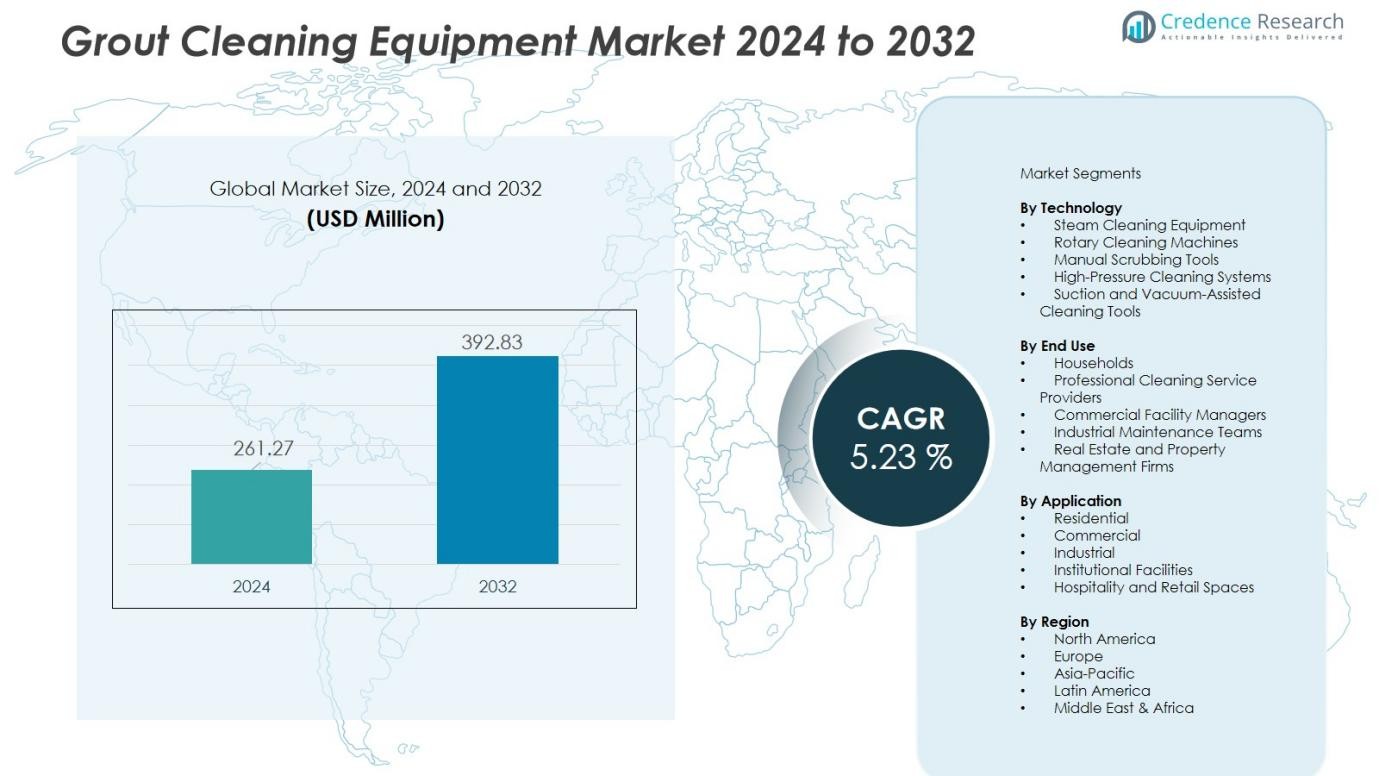
The grout cleaning equipment market size was valued at USD 261.27 Million in 2024 and is anticipated to reach USD 392.83 Million by 2032, at a CAGR of 5.23 % during the forecast period.
| REPORT ATTRIBUTE | DETAILS |
|---|---|
| Historical Period | 2020-2023 |
| Base Year | 2024 |
| Forecast Period | 2025-2032 |
| Grout Cleaning Equipment Market Size 2024 | USD 261.27 Million |
| Grout Cleaning Equipment Market, CAGR | 5.23 % |
| Grout Cleaning Equipment Market Size 2032 | USD 392.83 Million |
Market growth is primarily fueled by the rising need for effective tile and grout maintenance, particularly in hospitality, healthcare, and retail environments where sanitation standards are critical. Technological advancements-such as steam-based systems, ergonomic handheld tools, and commercial-grade rotary machines-are further enhancing cleaning efficiency while reducing operational labor costs. Additionally, the shift toward sustainable and chemical-free cleaning solutions is encouraging manufacturers to introduce eco-friendly equipment that aligns with green-cleaning trends.
Regionally, North America leads due to widespread use of professional cleaning services and increased investments in facility maintenance. Europe follows with strong demand from the hospitality and commercial sectors. Meanwhile, Asia-Pacific is emerging as the fastest-growing region, driven by rapid urbanization, expanding construction activities, and increasing consumer spending on home improvement.
Market Insights:
- The grout cleaning equipment market grows from USD 261.27 million in 2024 to USD 392.83 million by 2032, supported by a CAGR of 5.23% during the forecast period.
- Construction, renovation, and remodeling activities globally fuel the need for efficient grout maintenance tools that support long-term floor durability and aesthetics.
- Users increasingly prefer time-saving, ergonomic, and performance-driven technologies such as steam systems, rotary machines, and portable units that reduce labor intensity.
- Sustainability trends accelerate the shift toward chemical-free and water-efficient cleaning equipment, encouraging manufacturers to innovate eco-friendly solutions.
- High equipment costs and operational complexity remain key barriers, particularly among price-sensitive users and regions with limited access to affordable, easy-to-use models.
Market Drivers:
Rising Demand for High-Standard Floor Hygiene Across Residential and Commercial Facilities
Growing focus on maintaining spotless and hygienic floor surfaces strengthens the grout cleaning equipment market. Consumers and businesses seek tools that deliver deeper cleaning on tiled floors with minimal effort. Facility managers prefer equipment that improves sanitation levels in high-traffic areas. The industry benefits from increasing awareness of long-term grout preservation. Product adoption grows as users prioritize effective solutions that support routine maintenance.
- For instance, Kaivac's No-Touch Cleaning® system in commercial restrooms uses a powerful built-in indoor pressure washer and a wet/dry vacuum to blast and suck out soils from grout lines, improving hygiene while minimizing water usage and slip hazards.
Expansion of Construction, Renovation, and Remodeling Activities Worldwide
Global construction growth stimulates demand for grout maintenance tools. Newly installed floors require proper cleaning equipment to maintain appearance and durability. The grout cleaning equipment market benefits from rising renovation projects across homes, hotels, and commercial complexes. Manufacturers introduce models that support heavy-duty cleaning for new and refurbished surfaces. Market momentum strengthens through rising investments in modern infrastructure.
- For instance, Kärcher offers its BR 30/4 C scrubber dryer, which supports heavy-duty grout cleaning and provides significantly enhanced cleaning performance compared to manual methods, exerting ten times more contact pressure than mopping by hand
Shift Toward Efficient, Time-Saving, and Ergonomic Cleaning Technologies
Users prefer advanced equipment that reduces manual effort and enhances performance. The grout cleaning equipment market moves toward machines that deliver consistent results with reduced operator fatigue. Steam cleaners, rotary systems, and portable units support demanding cleaning operations across industries. It improves productivity for professional cleaning service providers. Demand increases as businesses adopt tools that reduce labor intensity.
Increasing Focus on Sustainable and Chemical-Free Cleaning Methods
Consumers and organizations pursue eco-friendly solutions that lower chemical usage. The grout cleaning equipment market supports this shift through steam-based and water-efficient technologies. It aligns with global sustainability goals and facility maintenance standards. Manufacturers design equipment that ensures strong cleaning power without harmful residues. Market expansion strengthens through rising commitment to environmentally responsible cleaning practices.
Market Trends:
Increasing Preference for Advanced, Automated, and High-Performance Cleaning Solutions
The grout cleaning equipment market reflects a shift toward automated tools that enhance cleaning precision and speed. Demand rises for steam-driven systems, motorized scrubbers, and cordless handheld devices that support efficient grout restoration. It helps users maintain consistent performance across residential, commercial, and industrial floor surfaces. Manufacturers introduce models with stronger suction, improved heat output, and refined brush technology. Smart features such as adjustable pressure controls and multiple cleaning modes gain attention. Consumers seek solutions that reduce manual effort while delivering professional-grade results. Product innovation expands as companies compete to enhance durability and overall usability.
- For instance, Kärcher's SC 5 EasyFix steam cleaner delivers steam at a maximum pressure of 4.2 bar using a 2200 W heating output for deep grout penetration, and includes a VapoHydro function which adds hot water to the steam to help remove stubborn dirt.
Growing Emphasis on Sustainable, Low-Chemical, and Eco-Friendly Cleaning Practices
The grout cleaning equipment market shows increasing adoption of solutions that minimize harsh chemical use. It aligns with global sustainability objectives and stricter facility maintenance standards. Eco-focused steam systems gain traction for their ability to sanitize surfaces with minimal environmental impact. Manufacturers respond with energy-efficient motors, water-efficient mechanisms, and recyclable components. End users prioritize equipment that supports cleaner indoor environments without prolonged chemical exposure. Commercial entities integrate safe cleaning methods into routine operations to meet internal compliance requirements. Demand strengthens for tools that combine environmental responsibility with high cleaning performance.
- For instance, the Hydro-Force SX-15 hard surface cleaning tool uses high-pressure hot water to achieve deep cleaning, and is designed to handle operating pressures from 700 to 2,600 PSI.
Market Challenges Analysis:
High Equipment Costs and Limited Adoption Among Price-Sensitive Users
The grout cleaning equipment market faces challenges due to the relatively high cost of advanced cleaning machines. Many residential users hesitate to invest in professional-grade tools, which slows wider adoption. It creates a gap between consumer expectations and budget limitations. Commercial buyers often delay upgrades when existing equipment still performs adequately. Manufacturers struggle to balance performance enhancements with affordability. Limited access to cost-effective options restricts market penetration in developing regions. Users continue to search for durable solutions that fit constrained spending capacities.
Technical Complexity, Maintenance Requirements, and Skill Gaps in Operation
The grout cleaning equipment market encounters obstacles linked to operational complexity and frequent maintenance needs. It often requires skilled handling to achieve consistent cleaning outcomes. Operators experience difficulty when adapting to new features, especially in automated or steam-based systems. Businesses face downtime when equipment demands repairs or routine servicing. Limited training resources slow user proficiency and reduce equipment efficiency. Commercial facilities prefer tools that minimize interruptions and simplify maintenance tasks. Market growth depends on solutions that reduce operational burdens and improve overall ease of use.
Market Opportunities:
Expansion of Product Lines with Smart, Automated, and High-Efficiency Technologies
The grout cleaning equipment market holds significant opportunity for manufacturers that introduce smart and automated solutions. Demand grows for equipment that integrates sensor technology, digital controls, and precision cleaning modes. It supports consistent performance for both residential and commercial applications. Companies can strengthen their position by offering tools that reduce manual effort and improve surface restoration. Energy-efficient motors and enhanced brush systems provide strong differentiation potential. Consumers show interest in compact, lightweight models that deliver professional results. New product launches can capture rising demand for advanced cleaning convenience.
Rising Demand for Eco-Friendly and Low-Chemical Cleaning Solutions Across Global Markets
The grout cleaning equipment market benefits from widening preference for sustainable and chemical-free cleaning practices. It aligns with green building standards and corporate sustainability goals across multiple sectors. Manufacturers can expand portfolios with steam-focused systems and water-efficient technologies. Growth opportunities emerge in regions that accelerate investment in environmentally responsible facility maintenance. Commercial users seek tools that support safe and hygienic indoor environments. Homes and businesses value equipment that limits chemical exposure without reducing effectiveness. Companies that emphasize eco-friendly designs can expand reach in both mature and emerging markets.
Market Segmentation Analysis:
By Technology
The grout cleaning equipment market shows strong differentiation across steam-based, rotary, and manual technologies. Steam systems gain significant traction due to their ability to sanitize surfaces without harsh chemicals. It appeals to users that prioritize efficiency, safety, and deeper cleaning performance. Rotary machines maintain steady demand within commercial environments that require rapid coverage and consistent results. Manual tools continue to serve the residential sector where budgets remain limited. Technological upgrades that enhance durability, pressure control, and portability support broader market adoption. Manufacturers focus on innovations that strengthen performance while reducing operational effort.
- For instance, Daimer’s KleenJet Supreme 3000CVP steam cleaner reaches temperatures up to 364°F to dissolve grout dirt effectively. It appeals to users that prioritize efficiency, safety, and deeper cleaning performance, eliminating over 99.99% of common bacteria via ATIS® technology, a claim supported by independent laboratory tests commissioned by Daimer.
By Application
The grout cleaning equipment market supports varied applications across residential floors, commercial tiles, and industrial facilities. Residential users seek compact tools that help restore bathroom, kitchen, and patio grout lines. It encourages the development of lightweight and easy-to-use devices with reliable cleaning output. Commercial applications such as hotels, malls, restaurants, and offices require high-capacity equipment that handles frequent use. Industrial environments demand robust machines that perform effectively under strict hygiene requirements. Growth in remodeling and facility makeover projects strengthens demand across all application segments. Each segment benefits from tailored solutions that align with cleaning intensity and surface conditions.
- For instance, Kärcher's handheld steam cleaner for residential use effectively cleans grout lines with steam temperatures around 100°C (212°F) exiting the nozzle, allowing homeowners to tackle bathroom grout hygiene with significant effort over a more realistic timeframe than 15 minutes per entire room.
By End-User
The grout cleaning equipment market serves households, professional cleaning contractors, and commercial facility managers. Households prioritize affordability and user-friendly designs that simplify routine maintenance. It increases interest in handheld steam tools and compact scrubbers. Professional contractors depend on advanced equipment that supports high-frequency tasks and reduces labor hours. Commercial facility managers invest in durable machines that ensure sanitary environments across large floor areas. The end-user landscape grows more diverse as cleaning expectations rise across sectors. Market expansion strengthens as manufacturers deliver models that match performance, cost, and operational needs across user categories.
Segmentations:
By Technology
- Steam Cleaning Equipment
- Rotary Cleaning Machines
- Manual Scrubbing Tools
- High-Pressure Cleaning Systems
- Suction and Vacuum-Assisted Cleaning Tools
By Application
- Residential
- Commercial
- Industrial
- Institutional Facilities
- Hospitality and Retail Spaces
By End-User
- Households
- Professional Cleaning Service Providers
- Commercial Facility Managers
- Industrial Maintenance Teams
- Real Estate and Property Management Firms
By Region
- North America
- U.S.
- Canada
- Mexico
- Europe
- Germany
- France
- U.K.
- Italy
- Spain
- Rest of Europe
- Asia Pacific
- China
- Japan
- India
- South Korea
- South-east Asia
- Rest of Asia Pacific
- Latin America
- Brazil
- Argentina
- Rest of Latin America
- Middle East & Africa
- GCC Countries
- South Africa
- Rest of the Middle East and Africa
Regional Analysis:
Strong Market Maturity in North America Driven by Professional Cleaning Standards
The grout cleaning equipment market maintains a strong presence in North America due to high adoption of professional cleaning services and advanced maintenance practices. Demand remains strong across commercial facilities, including hospitality, healthcare, and retail sectors. It benefits from a well-established cleaning industry that prioritizes floor hygiene and long-term surface preservation. Consumers show strong interest in automated and steam-based technologies that reduce manual effort. Manufacturers in the region introduce high-performance models with improved durability and efficiency. Growth in home renovation projects strengthens residential demand. The region continues to lead in premium equipment adoption.
Expanding Growth Potential Across Asia-Pacific Supported by Urbanization and Construction Activity
The grout cleaning equipment market grows rapidly in Asia-Pacific due to rising urban development and expanding residential and commercial construction. Demand increases as new households and commercial spaces seek efficient tools for grout maintenance. It gains momentum as consumers and businesses raise expectations for hygiene and aesthetic appeal. The region shows strong interest in cost-effective steam cleaners and compact equipment suitable for smaller homes. Local manufacturers introduce affordable models that enhance accessibility. Increased investment in hospitality and retail sectors supports long-term market expansion. The region emerges as the fastest-growing contributor to global demand.
Steady Adoption in Europe Supported by Facility Maintenance Norms and Sustainable Cleaning Practices
The grout cleaning equipment market in Europe benefits from strict cleanliness regulations and strong awareness of sustainable cleaning methods. Commercial facilities adopt high-efficiency tools that help maintain hygienic floor environments. It supports market growth through increased preference for low-chemical and eco-friendly technologies. Residential demand rises as consumers focus on long-term tile maintenance. Manufacturers introduce innovative equipment that aligns with environmental standards and energy efficiency goals. Renovation activities across older European properties create ongoing need for effective grout restoration tools. The region maintains stable and consistent growth across both residential and commercial segments.
Key Player Analysis:
- Einhell Group
- Stanley Black & Decker
- Husqvarna AB
- Karcher Group
- Pergo Equipment Manufacturing GmbH
- Tennant
- Grout Groovy
- Prolux Cleaners
- Square Scrub
- Vapamore
- Dremel
- Daimer Industries Inc.
- TILE EZE INC.
- John Don LLC
- EDIC
- Tornado Industries
Competitive Analysis:
The grout cleaning equipment market features a competitive landscape shaped by global brands and emerging regional manufacturers. Key companies include Einhell Group, Stanley Black & Decker, Husqvarna AB, and Karcher Group, each strengthening their portfolios with advanced cleaning technologies and durable product designs. It drives innovation across steam systems, rotary tools, and ergonomic handheld devices that support residential and commercial maintenance needs. Leading players focus on performance enhancement, energy efficiency, and user-friendly features to secure stronger market positions. Market competition increases as companies invest in R&D, product differentiation, and expanded distribution channels. Regional manufacturers capture demand through affordable and compact solutions that appeal to price-sensitive buyers. The competitive environment remains dynamic, supported by continuous upgrades that enhance cleaning output, reduce manual effort, and align with sustainability trends.
Recent Developments:
- In April 2025, Husqvarna AB reported strong 16% growth in robotic mower sales during Q1 amid economic uncertainty, alongside plans to prioritize professional products and adopt an asset-light model starting 2026.
- In February 2024, Acquired M&F Management and Financing GmbH, parent of TCS EMEA GmbH, to strengthen market presence and services in Central and Eastern Europe.
Report Coverage:
The research report offers an in-depth analysis based on Technology, Application, End-User and Region. It details leading Market players, providing an overview of their business, product offerings, investments, revenue streams, and key applications. Additionally, the report includes insights into the competitive environment, SWOT analysis, current Market trends, as well as the primary drivers and constraints. Furthermore, it discusses various factors that have driven Market expansion in recent years. The report also explores Market dynamics, regulatory scenarios, and technological advancements that are shaping the industry. It assesses the impact of external factors and global economic changes on Market growth. Lastly, it provides strategic recommendations for new entrants and established companies to navigate the complexities of the Market.
Future Outlook:
- The grout cleaning equipment market will advance through wider adoption of automated and high-efficiency cleaning technologies.
- The market will benefit from stronger demand for steam-based and low-chemical solutions across residential and commercial spaces.
- Manufacturers will focus on ergonomic designs that reduce user fatigue and support consistent performance.
- The industry will see increased integration of smart features, including pressure control, digital monitoring, and adaptive cleaning modes.
- Sustainability will influence product development, with greater emphasis on energy-efficient motors and water-saving mechanisms.
- Commercial facility managers will invest in durable equipment that improves hygiene compliance and reduces maintenance cycles.
- Residential users will drive growth for compact, lightweight tools that simplify routine floor and grout care.
- Product affordability will gain importance in emerging regions, encouraging expansion of cost-effective models.
- Professional cleaning service providers will adopt advanced machines that improve throughput and reduce labor requirements.
- Global competition will intensify, leading companies to enhance distribution networks and strengthen after-sales support.

Request a Free Sample
Fill in your details and we'll send you a free sample report.
- Sample data tables & charts
- Research methodology
Market Dynamics
Stringent Hygiene Standards in Commercial and Institutional Facilities
The need to maintain high sanitation levels in sectors such as hospitality, healthcare, and retail is driving demand for advanced grout cleaning equipment that ensures deep cleaning and compliance with hygiene regulations.
Technological Advancements in Cleaning Equipment
Innovations such as steam-based systems, ergonomic handheld tools, and commercial-grade rotary machines are improving cleaning efficiency, reducing labor costs, and making grout cleaning more accessible and effective for both commercial and residential users.
Growth in Construction, Renovation, and Remodeling Activities
The global increase in new construction and renovation projects is fueling demand for grout cleaning equipment to maintain the appearance and durability of newly installed tiled surfaces in homes, hotels, and commercial complexes.
Shift Toward Sustainable and Chemical-Free Cleaning Solutions
Rising environmental awareness and regulatory pressures are encouraging the adoption of eco-friendly, water-efficient, and chemical-free grout cleaning technologies, prompting manufacturers to innovate and expand their green product lines.
Expansion of Professional Cleaning Services
The growing use of outsourced cleaning services, especially in North America and Europe, is boosting demand for high-performance, durable grout cleaning equipment that can handle frequent, large-scale operations efficiently.
Need a Custom Version of This Report?
Tailor the scope, geography, or segments to your exact requirements.
- Custom geography or segment scope
- Direct access to our analyst team
Frequently Asked Questions
What is the current market size for the Grout Cleaning Equipment Market, and what is its projected size in 2032?
At what Compound Annual Growth Rate is the Grout Cleaning Equipment Market expected to grow between 2024 and 2032?
Which segment held the largest share of the Grout Cleaning Equipment Market in 2024?
What are the primary factors fueling the growth of the Grout Cleaning Equipment Market?
Who are the leading companies in the Grout Cleaning Equipment Market?
Which region commanded the largest share of the Grout Cleaning Equipment Market in 2024?
Table of Content
Chapter 1 Market Segmentation
- 1.1 Segmentation Framework
- 1.1.1 Product and Service Classification
- 1.1.2 Application and End-Use Classification
- 1.1.3 Technology and Solution Classification
- 1.1.4 Customer and Distribution Channel Classification
- 1.1.5 Geographic Segmentation
- 1.1.6 Market Segment Definitions and Boundaries
- 1.2 By End-User
- 1.2.1 Households
- 1.2.2 Professional Cleaning Service Providers
- 1.2.3 Commercial Facility Managers
- 1.2.4 Industrial Maintenance Teams
- 1.2.5 Real Estate and Property Management Firms
- 1.3 By Technology
- 1.3.1 Steam Cleaning Equipment
- 1.3.2 Rotary Cleaning Machines
- 1.3.3 Manual Scrubbing Tools
- 1.3.4 High-Pressure Cleaning Systems
- 1.3.5 Suction and Vacuum-Assisted Cleaning Tools
- 1.4 By Application
- 1.4.1 Residential
- 1.4.2 Commercial
- 1.4.3 Industrial
- 1.4.4 Institutional Facilities
- 1.4.5 Hospitality and Retail Spaces
Chapter 2 Introduction
- 2.1 Report Objectives and Scope
- 2.2 Product Definition and Industry Terminology
- 2.3 Market Inclusions and Exclusions
- 2.4 Research Process
- 2.4.1 Primary Research and Expert Interviews
- 2.4.2 Secondary Research and Source Review
- 2.4.3 Top-Down and Bottom-Up Estimation
- 2.4.4 Data Triangulation and Verification
- 2.5 Market Size Measurement Basis
- 2.5.1 2024: USD 261.27 billion → 2032: USD 392.83 billion
- 2.6 Historical and Forecast Reference Periods
- 2.6.1 Base Year: 2024
- 2.6.2 Forecast Period: 2024-2032
- 2.7 Research Assumptions and Limitations
Chapter 3 Executive Summary
- 3.1 Market Snapshot and Key Findings
- 3.2 Base-Year Market Size, 2024
- 3.3 Forecast Market Size, 2032
- 3.4 Revenue and Volume Growth Outlook
- 3.5 Key Demand and Supply Indicators
- 3.6 Leading Market Segments
- 3.7 Fastest-Growing Market Opportunities
- 3.8 Regional Performance Highlights
- 3.9 Technology and Industry Transformation
- 3.10 Competitive Landscape Summary
- 3.11 Analyst View and Strategic Implications
Chapter 4 Global Grout Cleaning Equipment Market Trends and Developments
- 4.1 Historical Industry Development
- 4.2 Recent Market Trends and Developments
- 4.3 Demand and Customer Behavior Trends
- 4.4 Technology and Product Innovation
- 4.5 Artificial Intelligence, Automation and Digitalization
- 4.6 Local Manufacturing and Supply Chain Realignment
- 4.7 Industry Partnerships, Mergers and Acquisitions
- 4.8 Sustainability and Circular Economy Developments
- 4.9 Government and Private Sector Investment Trends
- 4.10 Emerging Business Models and Commercialization
- 4.11 Industry Developments and Announcements
Chapter 5 Global Grout Cleaning Equipment Market Production, Supply and Demand Analysis
- 5.1 Demand Trend and Consumption Analysis
- 5.2 Demand Forecast, 2024-2032
- 5.3 Production and Output Trend
- 5.4 Production and Output Forecast, 2024-2032
- 5.5 Installed Capacity and Capacity Utilization
- 5.6 Company-Wise Production Plants and Statistics
- 5.6.1 Installed Production Capacity
- 5.6.2 Actual Production
- 5.6.3 Planned Capacity and Expansion Targets
- 5.7 Supply Chain Structure and Procurement Trends
- 5.8 Supply-Demand Gap and Bottlenecks
- 5.9 Import Dependence and Sourcing Structure
- 5.10 Contract Manufacturing and Outsourcing
- 5.11 Regional Supply and Demand Concentration
Chapter 6 Global Grout Cleaning Equipment Market Pricing Analysis
- 6.1 Pricing Structure and Measurement
- 6.2 Historical Pricing Trends
- 6.3 Pricing Outlook, 2024-2032
- 6.4 Average Selling Price and Unit Economics
- 6.5 Pricing by Product and Market Segment
- 6.6 Geographic Pricing Differences
- 6.7 Key Input, Energy, Labor and Logistics Costs
- 6.8 Contract Pricing and Purchasing Models
- 6.9 Pricing Sensitivity and Competitive Positioning
- 6.10 Price, Margin and Profitability Implications
Chapter 7 Global Grout Cleaning Equipment Market Dynamics
- 7.1 Market Growth Drivers
- 7.1.1 Demand-Side Drivers
- 7.1.2 Technology and Innovation Drivers
- 7.1.3 Infrastructure and Investment Drivers
- 7.1.4 Regulatory and Policy Drivers
- 7.2 Market Restraints
- 7.2.1 Cost and Affordability Constraints
- 7.2.2 Technology and Adoption Barriers
- 7.2.3 Supply Chain and Operational Constraints
- 7.3 Market Challenges
- 7.3.1 Competitive Pressure and Margin Erosion
- 7.3.2 Skills, Infrastructure and Implementation Gaps
- 7.4 Emerging Market Opportunities
- 7.5 Market Dynamics Impact and Time-Horizon Assessment
Chapter 8 Global Grout Cleaning Equipment Value Chain Analysis
- 8.1 Industry Value Chain Overview
- 8.2 Upstream Suppliers and Critical Inputs
- 8.3 Technology and Component Providers
- 8.4 Manufacturing or Service Delivery
- 8.5 Distribution, Channel Partners and Integrators
- 8.6 Downstream Applications and End Users
- 8.7 Value Addition and Profit Pools
- 8.8 Vertical Integration and Outsourcing
- 8.9 Supplier Concentration and Risk
- 8.10 Supply Chain Localization and Resilience
Chapter 9 Global Grout Cleaning Equipment Market Regulations and Policies
- 9.1 Relevant Laws, Standards and Compliance Frameworks
- 9.2 Product, Service, Safety and Quality Requirements
- 9.3 Government Policies, Incentives and Subsidies
- 9.4 Imports, Exports and Trade Barriers
- 9.5 Public Procurement and Local Content Requirements
- 9.6 Environmental and Sustainability Compliance
- 9.7 Upcoming Policy Changes and Market Implications
Chapter 10 Global Grout Cleaning Equipment Market Hotspots and Opportunities
- 10.1 Market Opportunity Mapping and Growth Hotspots
- 10.2 High-Growth Applications and Customer Groups
- 10.3 Underserved Markets and White-Space Opportunities
- 10.4 Emerging Technology and Product Opportunities
- 10.5 New Capacity and Investment Hotspots
- 10.6 Market Entry and Expansion Opportunities
- 10.7 Distribution and Partnership Opportunities
- 10.8 Near-Term and Long-Term Commercial Potential
- 10.9 Opportunity Attractiveness and Execution Risks
Chapter 11 Global Grout Cleaning Equipment Market Outlook, 2024-2032
- 11.1 Market Size and Analysis
- 11.1.1 Revenue (Market Measurement: 2024: USD 261.27 billion → 2032: USD 392.83 billion)
- 11.1.2 Market Volume and Quantity Sold
- 11.1.3 Historical Market Size
- 11.1.4 Base-Year Market Size, 2024
- 11.2 Market Forecast, 2024-2032
- 11.2.1 Revenue Forecast to 2032
- 11.2.2 Volume Forecast to 2032
- 11.2.3 CAGR and Year-on-Year Growth
- 11.2.4 Incremental Revenue Opportunity
- 11.3 Forecast Assumptions and Scenario Analysis
- 11.3.1 Base-Case Forecast
- 11.3.2 Optimistic and Conservative Scenarios
- 11.3.3 Technology, Pricing and Policy Sensitivities
- 11.4 Market Attractiveness and Growth Outlook
Chapter 12 Global Grout Cleaning Equipment Market Segmentation and Outlook
- 12.1 Segmentation Summary and Market Shares, 2024
- 12.2 Largest and Fastest-Growing Segments
- 12.3 By End-User - Market Size and Forecast, 2024-2032
- 12.3.1 Segment Definition and Scope
- 12.3.2 Historical Market Size
- 12.3.3 Revenue Forecast, 2024-2032
- 12.3.4 Volume Forecast, 2024-2032
- 12.3.5 Base-Year Market Share, 2024
- 12.3.6 Segment CAGR and Growth Drivers
- 12.3.7 Subsegment Market Size and Forecast
- 12.3.7.1 Households
- 12.3.7.2 Professional Cleaning Service Providers
- 12.3.7.3 Commercial Facility Managers
- 12.3.7.4 Industrial Maintenance Teams
- 12.3.7.5 Real Estate and Property Management Firms
- 12.3.8 Subsegment Pricing and Adoption Trends
- 12.3.9 Leading Suppliers and Competition
- 12.3.10 Regional Demand and Opportunities
- 12.4 By Technology - Market Size and Forecast, 2024-2032
- 12.4.1 Segment Definition and Scope
- 12.4.2 Historical Market Size
- 12.4.3 Revenue Forecast, 2024-2032
- 12.4.4 Volume Forecast, 2024-2032
- 12.4.5 Base-Year Market Share, 2024
- 12.4.6 Segment CAGR and Growth Drivers
- 12.4.7 Subsegment Market Size and Forecast
- 12.4.7.1 Steam Cleaning Equipment
- 12.4.7.2 Rotary Cleaning Machines
- 12.4.7.3 Manual Scrubbing Tools
- 12.4.7.4 High-Pressure Cleaning Systems
- 12.4.7.5 Suction and Vacuum-Assisted Cleaning Tools
- 12.4.8 Subsegment Pricing and Adoption Trends
- 12.4.9 Leading Suppliers and Competition
- 12.4.10 Regional Demand and Opportunities
- 12.5 By Application - Market Size and Forecast, 2024-2032
- 12.5.1 Segment Definition and Scope
- 12.5.2 Historical Market Size
- 12.5.3 Revenue Forecast, 2024-2032
- 12.5.4 Volume Forecast, 2024-2032
- 12.5.5 Base-Year Market Share, 2024
- 12.5.6 Segment CAGR and Growth Drivers
- 12.5.7 Subsegment Market Size and Forecast
- 12.5.7.1 Residential
- 12.5.7.2 Commercial
- 12.5.7.3 Industrial
- 12.5.7.4 Institutional Facilities
- 12.5.7.5 Hospitality and Retail Spaces
- 12.5.8 Subsegment Pricing and Adoption Trends
- 12.5.9 Leading Suppliers and Competition
- 12.5.10 Regional Demand and Opportunities
- 12.6 Segment Growth Comparison
- 12.7 Segment Attractiveness and Priority Matrix
Chapter 13 Global Grout Cleaning Equipment End-Use and Application Market Outlook
- 13.1 End-Use Industry and Customer Demand Structure
- 13.2 Leading Applications and Customer Groups
- 13.3 End-Use Market Size, Share and Forecast
- 13.4 Major End-Use Industry Deep Dives
- 13.4.1 Customer Requirements and Use Cases
- 13.4.2 Demand and Replacement Cycles
- 13.4.3 Technical and Regulatory Considerations
- 13.4.4 Purchasing and Procurement Models
- 13.4.5 Leading Vendors and Distribution Channels
- 13.4.6 Forecast and Commercial Opportunities
- 13.5 Emerging Applications and Cross-Segment Demand
- 13.6 End-Use Industry Investment Priorities
Chapter 14 Global Grout Cleaning Equipment Geographic Market Outlook, 2024-2032
- 14.1 Regional Market Size and Share, 2024
- 14.2 Regional Market Forecast, 2024-2032
- 14.3 Regional Pricing, Production and Demand Differences
- 14.4 North America
- 14.4.1 United States
- 14.4.2 Canada
- 14.4.3 Mexico
- 14.5 Europe
- 14.5.1 Germany
- 14.5.2 France
- 14.5.3 Italy
- 14.5.4 United Kingdom
- 14.5.5 Spain
- 14.5.6 Poland
- 14.5.7 Russia
- 14.5.8 Netherlands
- 14.5.9 Belgium
- 14.5.10 Sweden
- 14.5.11 Denmark
- 14.5.12 Norway
- 14.5.13 Rest of Europe
- 14.6 Asia Pacific
- 14.6.1 China
- 14.6.2 India
- 14.6.3 Japan
- 14.6.4 South Korea
- 14.6.5 Thailand
- 14.6.6 Indonesia
- 14.6.7 Vietnam
- 14.6.8 Malaysia
- 14.6.9 Australia
- 14.6.10 Rest of Asia Pacific
- 14.7 Latin America
- 14.7.1 Brazil
- 14.7.2 Argentina
- 14.7.3 Colombia
- 14.7.4 Chile
- 14.7.5 Rest of Latin America
- 14.8 Middle East
- 14.8.1 Saudi Arabia
- 14.8.2 United Arab Emirates
- 14.8.3 Turkey
- 14.8.4 Israel
- 14.8.5 Iran
- 14.8.6 Rest of the Middle East
- 14.9 Africa
- 14.9.1 South Africa
- 14.9.2 Egypt
- 14.9.3 Nigeria
- 14.9.4 Morocco
- 14.9.5 Rest of Africa
- 14.10 Regional Investment, Policy and Supply Chain Differences
- 14.11 Regional Competitive Landscape
- 14.12 Geographic Growth Hotspots
Chapter 15 Global Grout Cleaning Equipment Technology, Innovation and Sustainability Outlook
- 15.1 Technology Landscape and Maturity
- 15.2 Product, Process and Service Innovation
- 15.3 AI, Automation and Digital Tools in the Industry
- 15.4 Technology Adoption and Performance Benchmarking
- 15.5 Innovation Pipeline and R&D Investment
- 15.6 Patent and Intellectual Property Trends
- 15.7 Energy Efficiency and Resource Management
- 15.8 Sustainability, Recycling and Circularity
- 15.9 Technology Roadmap, 2024-2032
- 15.10 Risks of Obsolescence and Technology Substitution
Chapter 16 Global Grout Cleaning Equipment Market Key Strategic Imperatives
- 16.1 Growth and Market Entry Priorities
- 16.2 High-Return Products and Segments
- 16.3 Pricing, Profitability and Cost Optimization
- 16.4 Technology Investment and Product Differentiation
- 16.5 Supply Chain Localization and Resilience
- 16.6 Distribution and Customer Acquisition
- 16.7 Partnership, Acquisition and Capacity Strategy
- 16.8 Regional Expansion Priorities
- 16.9 Short-, Medium- and Long-Term Actions
Chapter 17 Competition Outlook
- 17.1 Industry Competition Characteristics
- 17.2 Market Structure and Concentration
- 17.3 Market Share and Competitive Positioning, 2024
- 17.4 Company-Wise Revenue and Product Benchmarking
- 17.5 Production and Service Capacity Benchmarking
- 17.6 Technology, Pricing and Differentiation
- 17.7 Regional Footprint and Distribution Strength
- 17.8 Mergers, Acquisitions and Strategic Alliances
- 17.9 New Entrants and Competitive Threats
- 17.10 Porter's Five Forces and Industry Attractiveness
- 17.11 Competitive Outlook, 2024-2032
Chapter 18 Company Profiles
- 18.1 Company Coverage and Selection Criteria
- 18.2 Karcher Group
- 18.2.1 Business Description
- 18.2.2 Company Ownership and Geographic Presence
- 18.2.3 Product and Service Portfolio
- 18.2.4 Manufacturing and Operating Footprint
- 18.2.5 Production Capacity and Expansion Plans
- 18.2.6 Financial Performance and Investment
- 18.2.7 Market Share and Competitive Position
- 18.2.8 Technology and Innovation Capabilities
- 18.2.9 Strategic Alliances or Partnerships
- 18.2.10 Recent Developments
- 18.2.11 Growth Strategy and Outlook
- 18.3 Stanley Black & Decker
- 18.4 Husqvarna AB
- 18.5 Einhell Group
- 18.6 Daimer Industries Inc.
- 18.7 Tennant
- 18.8 Grout Groovy
- 18.9 Dremel
- 18.10 Vapamore
- 18.11 Prolux Cleaners
- 18.12 Other Relevant Market Participants
Note: Every listed company is profiled on the structure shown under the first company. The company list is preliminary and may change based on research findings, market developments, data availability and client requirements.
Chapter 19 Disclaimer
- 19.1 Research and Forecast Disclaimer
- 19.2 Data Source and Estimation Limitations
Note: The depth of individual sections depends on data availability for this market. Volume, capacity, trade and other unit-based metrics are included where applicable.

