Market Overview:
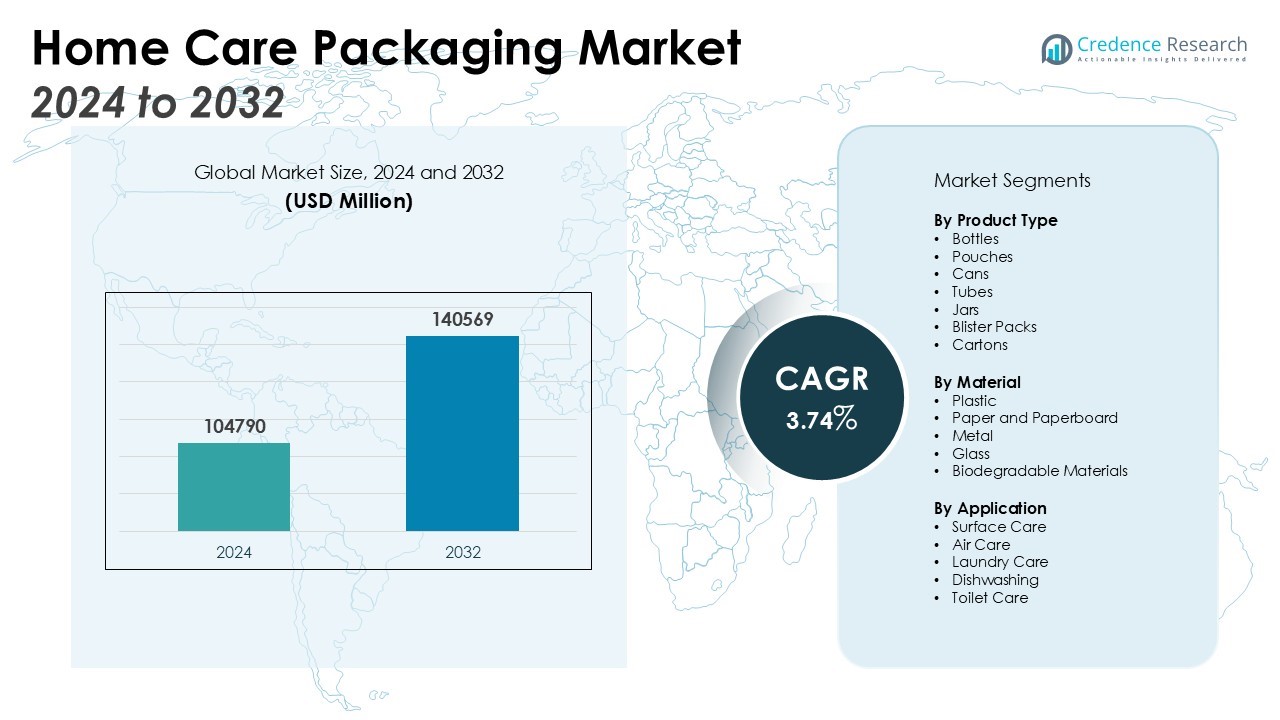
The Home Care Packaging Market size was valued at USD 104790 million in 2024 and is anticipated to reach USD 140569 million by 2032, at a CAGR of 3.74% during the forecast period (2024-2032).
| REPORT ATTRIBUTE | DETAILS |
|---|---|
| Historical Period | 2020-2024 |
| Base Year | 2024 |
| Forecast Period | 2025-2032 |
| Home Care Packaging Market Size 2024 | USD 104790 Million |
| Home Care Packaging Market, CAGR | 3.74% |
| Home Care Packaging Market Size 2032 | USD 140569 Million |
Market drivers include the ongoing shift toward smaller, portion-controlled packs and a strong emphasis on recyclable, biodegradable, and reusable materials as manufacturers respond to environmental concerns and regulatory mandates. Innovations in packaging-such as child-resistant closures, enhanced dispensing systems, and digital labeling-are also supporting brand differentiation and consumer engagement. In addition, the expansion of e-commerce and direct-to-consumer models is driving demand for packaging that is durable, lightweight, and compatible with online retail logistics.
Regionally, Asia Pacific leads the Home Care Packaging Market, accounting for the largest revenue share due to rapid urbanization and a growing middle-class population. North America and Europe follow, supported by high adoption of premium and sustainable packaging, while Latin America and the Middle East & Africa show promising growth due to rising living standards and increased hygiene awareness. Major manufacturers are actively investing in localized production and advanced packaging technologies to capture emerging market opportunities and address evolving consumer preferences.
Market Insights:
- The Home Care Packaging Market was valued at USD 104,790 million in 2024 and is projected to reach USD 140,569 million by 2032, reflecting a CAGR of 3.74% from 2024 to 2032.
- Market growth is fueled by strong consumer demand for portion-controlled, recyclable, and biodegradable packaging, as well as heightened hygiene awareness and evolving household structures.
- Ongoing innovation in child-resistant closures, enhanced dispensing systems, and digital labeling supports brand differentiation and addresses the needs of modern consumers.
- The rapid rise of e-commerce and direct-to-consumer models drives demand for packaging that is durable, lightweight, and optimized for online retail logistics.
- The market faces challenges from complex global regulations and volatile raw material costs, which impact profitability and require ongoing investment in compliance and supply chain management.
- Asia Pacific leads the market, supported by robust urbanization, a growing middle class, and major investments in local production and advanced packaging technologies.
- North America and Europe emphasize sustainability and premiumization, while Latin America and the Middle East & Africa present growth opportunities through rising living standards and increased hygiene awareness.
Market Drivers:
Rising Hygiene Awareness and Evolving Consumer Preferences Propel Market Growth
The Home Care Packaging Market benefits from a global emphasis on hygiene and cleanliness, driving demand for packaging that enhances product safety and convenience. Consumers increasingly expect tamper-evident seals, secure closures, and user-friendly dispensers in their household products. Urbanization and the growth of nuclear families have led to rising preference for single-use, portion-controlled, and travel-sized packs. Dual-income households value ergonomic and visually appealing designs that simplify daily cleaning routines, prompting brands to focus on both function and style.
Stringent Environmental Policies and Adoption of Sustainable Materials
Evolving environmental regulations and sustainability mandates are shaping product development in the market. Governments enforce bans on single-use plastics and require use of recyclable or biodegradable materials. Leading manufacturers invest in bio-based, compostable, and reusable packaging to meet compliance and rising consumer expectations for green solutions. Sustainability now drives brand loyalty, making eco-friendly innovation central to maintaining market relevance.
Expansion of E-Commerce Drives Demand for Advanced Packaging Solutions
Growth in e-commerce and direct-to-consumer models has intensified the need for durable, lightweight, and protective packaging. Products must withstand shipping, handling, and storage while maintaining their appeal and safety. Brands are introducing smart packaging features like QR codes and tamper-proof closures to build trust and facilitate interactive engagement. The shift to online retail has made packaging optimization essential for logistics and customer satisfaction.
- For instance, in 2023, Amazon avoided more than 446,000 metric tons of packaging through material innovation and reduced the average per-shipment packaging weight by 43% since 2015.
Innovative Packaging Technologies Foster Market Differentiation
The market sees rapid adoption of advanced technologies, including digital labeling, interactive packaging, and improved dispensing systems. These innovations enhance user experience, enable greater transparency, and allow for increased customization. Leading brands use technology to stand out and strengthen consumer loyalty. Investment in R&D and production automation positions companies for long-term growth and leadership in the evolving Home Care Packaging Market.
- For instance, Procter & Gamble implemented Digimarc digital watermarks on Dawn and Fairy dish soap bottles, allowing real-time quality control in 3 production facilities operating at full line speeds, and achieving consistently high read rates for label inspection across international sites.
Market Trends:
Rapid Adoption of Sustainable and Smart Packaging Solutions Defines Industry Direction
The Home Care Packaging Market demonstrates a pronounced shift toward sustainability, with manufacturers adopting recyclable, biodegradable, and refillable packaging options. It supports corporate environmental commitments and regulatory compliance by phasing out single-use plastics and integrating eco-friendly materials, including post-consumer recycled content and bio-based resins. Major brands invest in lightweight packaging designs and mono-material solutions to simplify recycling and reduce environmental impact. The demand for refill pouches, concentrates, and bulk-pack formats continues to rise among environmentally conscious consumers. Packaging producers leverage advanced labeling techniques, such as digital and smart labels, to communicate sustainability credentials and enable traceability. Brand owners recognize that sustainable packaging now directly influences consumer purchasing decisions and brand loyalty.
- For instance, Straus Family Creamery uses 640,000 reusable red milk crates to transport its products, representing a substantial operational commitment to waste reduction.
Consumer-Centric Designs and Digital Innovations Enhance Brand Engagement
A key trend in the Home Care Packaging Market centers on the evolution of packaging aesthetics and functionality to meet modern consumer expectations. It drives the introduction of ergonomic, easy-to-handle containers, along with innovative dispensing systems that maximize convenience and minimize waste. The integration of digital features, such as QR codes and NFC tags, enables brands to engage consumers with product information, usage tips, and loyalty programs through smartphones. Personalization and customization of packaging, whether through limited editions or interactive design elements, help brands build stronger connections with target audiences. Packaging that enhances shelf appeal and elevates user experience supports premiumization trends and fosters customer retention. The market continues to embrace new technologies that enable brands to differentiate in a competitive landscape.
- For instance, Coca-Cola’s “Share a Coke” campaign, which printed over 1,000 unique names on bottles, resulted in more than 500,000 user-generated photos on Twitter and boosted sales in the U.S. by 2% during the campaign period.
Market Challenges Analysis:
Regulatory Complexity and Rising Compliance Costs Impact Industry Profitability
The Home Care Packaging Market faces challenges stemming from the evolving global regulatory landscape and increasing compliance requirements. It must adhere to strict guidelines on material safety, recyclability, and labeling, which vary across regions and countries. Complex certification processes and continuous updates to environmental regulations raise operational costs for manufacturers. Smaller market participants often struggle to keep pace with shifting mandates, putting pressure on margins and innovation. The need for ongoing investments in testing and documentation creates financial barriers to entry. The market navigates an environment where regulatory compliance is both a necessity and a persistent challenge for sustained growth.
Supply Chain Disruptions and Volatile Raw Material Prices Constrain Market Growth
Fluctuating raw material costs and supply chain disruptions present ongoing obstacles for the Home Care Packaging Market. It relies on a steady supply of plastics, paper, and specialty additives, which are subject to price volatility due to geopolitical tensions and shifting global demand. Transportation bottlenecks and labor shortages further exacerbate supply chain inefficiencies, affecting production schedules and delivery timelines. Manufacturers often face difficulty in passing increased costs to end-users without impacting competitiveness. Sustaining profitability requires robust risk management strategies and investment in local sourcing and supply chain resilience. The market continues to seek solutions that mitigate the impact of global uncertainties on operations and growth.
Market Opportunities:
Expansion into Emerging Markets and Untapped Consumer Segments Fuels Growth Potential
The Home Care Packaging Market finds significant opportunities in rapidly developing economies and underserved regions. It benefits from rising urbanization, a growing middle-class population, and increasing awareness of hygiene standards. Manufacturers can capture new demand by introducing affordable, convenient, and culturally relevant packaging formats tailored to local preferences. Market entry strategies that leverage local partnerships and distribution networks accelerate brand penetration. Targeting smaller cities and rural areas opens new revenue streams for global and regional players. The market’s ability to adapt products for diverse demographics supports sustainable long-term expansion.
Advancement in Smart and Eco-Friendly Packaging Technologies Drives Value Creation
Innovation in smart and sustainable packaging solutions creates strong opportunities for differentiation in the Home Care Packaging Market. It enables the integration of digital features such as QR codes, interactive labels, and anti-counterfeit measures to enhance consumer trust and engagement. Investment in biodegradable, compostable, and reusable materials positions brands as leaders in environmental stewardship. Companies that prioritize research and development in new materials and automated production processes gain a competitive edge. The demand for premium, functional, and eco-conscious packaging continues to rise across all customer segments. The market stands poised to capture value by addressing evolving consumer and regulatory expectations.
Market Segmentation Analysis:
By Product Type
The Home Care Packaging Market segments its offerings into bottles, pouches, cans, tubes, jars, blister packs, and cartons. Bottles and pouches lead market demand due to their practicality, ease of use, and reusability, serving as the preferred choice for most cleaning and personal care products. The adaptability of these formats supports both single-use and refill applications, meeting consumer expectations for convenience and sustainability.
- For instance, Amcor and Mespack jointly launched a recycle-ready stand-up pouch with an exact 2-liter capacity, specifically engineered for home care liquids such as soaps, cleaners, and laundry detergent-the first of its kind above the previous limit of 1–1.5 liters and now in-market since late 2024.
By Material
The market covers plastic, paper and paperboard, metal, glass, and biodegradable materials. Plastic remains widely used for its durability and lightweight nature, although environmental concerns are accelerating the shift toward paperboard and biodegradable alternatives. Manufacturers prioritize eco-friendly innovations and invest in recyclable and compostable solutions to align with regulatory trends and evolving consumer values.
By Application
Key application areas include surface care, air care, laundry care, dishwashing, and toilet care. Surface care and laundry care dominate due to high usage rates and a persistent focus on home hygiene. Air care and dishwashing segments show steady growth as consumers increasingly prefer specialized packaging for ease of use, fragrance protection, and portion control. The diversity in applications allows manufacturers to develop targeted solutions that address varied needs across global markets.
- For instance, Reckitt’s Finish brand launched a new stand-up pouch for dishwasher tablets that reduces plastic by 2,000 tonnes annually by replacing 75% of previous pouch plastic with responsibly sourced paper, translating to the elimination of material equivalent to 50 million 1-litre bottles each year.
Segmentations:
By Product Type:
- Bottles
- Pouches
- Cans
- Tubes
- Jars
- Blister Packs
- Cartons
By Material:
- Plastic
- Paper and Paperboard
- Metal
- Glass
- Biodegradable Materials
By Application:
- Surface Care
- Air Care
- Laundry Care
- Dishwashing
- Toilet Care
By Region:
- North America
- U.S.
- Canada
- Mexico
- Europe
- Germany
- France
- U.K.
- Italy
- Spain
- Rest of Europe
- Asia Pacific
- China
- Japan
- India
- South Korea
- South-east Asia
- Rest of Asia Pacific
- Latin America
- Brazil
- Argentina
- Rest of Latin America
- Middle East & Africa
- GCC Countries
- South Africa
- Rest of the Middle East and Africa
Regional Analysis:
Asia Pacific Maintains Market Leadership through Urbanization and Middle-Class Growth
Asia Pacific holds a 46% share of the global Home Care Packaging Market, generating the highest revenue among all regions. Rapid urbanization and a fast-growing middle-class population drive this region’s dominance, especially in countries such as China, India, and Southeast Asia. Manufacturers meet surging demand by investing in local production, developing affordable and innovative packaging formats, and enhancing supply chain networks. Government initiatives promoting hygiene and sustainable packaging, alongside the expansion of e-commerce, further accelerate the region’s growth and market reach. Leading international brands are increasing investments in advanced packaging technologies and expanding product portfolios to secure long-term growth in Asia Pacific.
North America and Europe Prioritize Sustainability and Premiumization
North America represents 28% and Europe accounts for 18% of the global Home Care Packaging Market. Both regions are characterized by advanced manufacturing infrastructure and strict environmental regulations, which propel the adoption of sustainable and recyclable packaging. Brands consistently introduce premium products using post-consumer recycled content, biodegradable films, and mono-material solutions to align with consumer and regulatory demands. Investments in smart packaging and innovative design differentiate brands and address growing needs for convenience and safety, ensuring these mature markets remain highly competitive. High consumer expectations for quality, safety, and sustainability continue to shape product development strategies in North America and Europe.
Latin America and Middle East & Africa Expand with Emerging Opportunities
Latin America and the Middle East & Africa together contribute 8% of the global Home Care Packaging Market. Growth in these regions results from improving living standards, increased hygiene awareness, and rising urbanization. Market participants leverage local partnerships, adapt packaging to cultural preferences, and expand distribution networks to capture new demand. Both local and international brands recognize these regions as strategic growth frontiers, responding with targeted solutions for evolving consumer needs and retail landscapes. Rising investments in retail infrastructure and home care awareness campaigns further support market expansion in these emerging economies.
Key Player Analysis:
- Graham Packaging Company (U.S.)
- EPL (India)
- ProAmpac (U.S.)
- Huhtamaki (Finland)
- AptarGroup Inc. (U.S.)
- Constantia Flexibles (Austria)
- Amcor Plc (Switzerland)
- Ball Corporation (U.S.)
- DS Smith (U.K.)
- WestRock (U.S.)
- Greiner Packaging (Austria)
- ALPLA (Austria)
- Mondi (U.K.)
- Silgan Holdings (U.S.)
- Sonoco Products Company(U.S.)
Competitive Analysis:
The Home Care Packaging Market is characterized by intense competition among global and regional players who focus on product innovation, sustainability, and cost efficiency. Leading companies such as Amcor plc, Berry Global Inc., Mondi Group, Sonoco Products Company, and Huhtamaki Oyj leverage advanced materials, eco-friendly solutions, and smart packaging technologies to gain market share. It sees established brands investing in R&D to introduce recyclable, biodegradable, and refillable packaging formats that align with evolving consumer preferences and regulatory standards. Strategic partnerships, mergers, and acquisitions help key players expand their geographic presence and diversify product portfolios. Regional manufacturers compete by offering localized designs, flexible production capabilities, and quick response to changing market trends. The Home Care Packaging Market rewards companies that excel in supply chain management, regulatory compliance, and consumer engagement, driving a continuous cycle of innovation and differentiation.
Recent Developments:
- In July 2025, AptarGroup announced the acquisition of clinical trial materials manufacturing capabilities from Mod3 Pharma, further enhancing its pharmaceutical services and drug delivery business.
- In June 2025, Mondi launched the re/cycle PaperPlus Bag Advanced, a high-barrier, sustainable paper bag, which won Bronze at the Eurosac Grand Prix 2025.
- In June 2025, ProAmpac partnered with Western Michigan University to advance the development of fiber-based sustainable packaging solutions.
Market Concentration & Characteristics:
The Home Care Packaging Market demonstrates moderate concentration, with several large multinational companies and numerous regional manufacturers competing for market share. It is defined by high product innovation, strong focus on sustainability, and rapid response to changing regulatory requirements. Leading players invest in advanced materials, automation, and eco-friendly solutions to meet evolving consumer demands and environmental mandates. The market’s competitive landscape is shaped by frequent product launches, strategic partnerships, and a relentless pursuit of supply chain efficiency. It requires participants to balance cost competitiveness, compliance, and continuous development to secure long-term growth and relevance.
Report Coverage:
The research report offers an in-depth analysis based on Product Type, Material, Application and Region. It details leading market players, providing an overview of their business, product offerings, investments, revenue streams, and key applications. Additionally, the report includes insights into the competitive environment, SWOT analysis, current market trends, as well as the primary drivers and constraints. Furthermore, it discusses various factors that have driven market expansion in recent years. The report also explores market dynamics, regulatory scenarios, and technological advancements that are shaping the industry. It assesses the impact of external factors and global economic changes on market growth. Lastly, it provides strategic recommendations for new entrants and established companies to navigate the complexities of the market.
Future Outlook:
- Manufacturers will adopt advanced eco-friendly materials, including compostable films and recycled polymers.
- Smart packaging will become more prevalent, with QR codes, NFC tags, and anti-counterfeit features enhancing user engagement.
- Demand for portion-controlled and refill formats will continue rising in response to consumer preference for convenience and waste reduction.
- E-commerce logistics will drive design innovation in lightweight, robust, and tamper-proof packaging solutions.
- Regional players will gain influence through localized production, flexible packaging platforms, and tailored offerings.
- Regulatory pressure on single-use plastics will accelerate transition toward mono-material and circular packaging systems.
- Manufacturers will install automation and AI‑driven production lines to boost efficiency, quality, and customization capabilities.
- Brand owners will leverage packaging design as a key differentiator, integrating aesthetics, ergonomics, and sustainability messaging.
- Partnerships between packaging firms and chemical producers will foster development of next-generation barrier coatings and anti-microbials.
- Consumer demand for transparency and traceability will encourage deployment of blockchain-enabled labeling and interactive consumer touchpoints.

Request a Free Sample
Fill in your details and we'll send you a free sample report.
- Sample data tables & charts
- Research methodology
Market Dynamics
Shift Toward Sustainable and Recyclable Packaging
Stringent environmental regulations and consumer demand for eco-friendly solutions are pushing manufacturers to adopt recyclable, biodegradable, and reusable materials, driving innovation and market growth.
Expansion of E-Commerce and Direct-to-Consumer Channels
The rapid rise of online retail requires packaging that is durable, lightweight, and optimized for shipping, increasing demand for advanced packaging solutions tailored to e-commerce logistics.
Innovations in Packaging Technology
Developments such as child-resistant closures, enhanced dispensing systems, and digital labeling are enabling brand differentiation, improving user convenience, and supporting compliance with safety standards.
Rising Hygiene Awareness and Changing Household Structures
Heightened focus on hygiene and the prevalence of smaller, nuclear families are increasing demand for portion-controlled, tamper-evident, and easy-to-use packaging formats in home care products.
Urbanization and Middle-Class Growth in Emerging Markets
Rapid urbanization and a growing middle class, especially in Asia Pacific, are boosting consumption of home care products and driving demand for innovative and affordable packaging solutions.
Need a Custom Version of This Report?
Tailor the scope, geography, or segments to your exact requirements.
- Custom geography or segment scope
- Direct access to our analyst team
Frequently Asked Questions
What is the current size of the Home Care Packaging Market?
What factors are driving the growth of the Home Care Packaging Market?
What are the key segments within the Home Care Packaging Market?
What are some challenges faced by the Home Care Packaging Market?
Who are the major players in the Home Care Packaging Market?
Table of Content
Chapter 1 Market Segmentation
- 1.1 Segmentation Framework
- 1.1.1 Product and Service Classification
- 1.1.2 Application and End-Use Classification
- 1.1.3 Technology and Solution Classification
- 1.1.4 Customer and Distribution Channel Classification
- 1.1.5 Geographic Segmentation
- 1.1.6 Market Segment Definitions and Boundaries
- 1.2 By Material
- 1.2.1 Plastic
- 1.2.2 Paper and Paperboard
- 1.2.3 Metal
- 1.2.4 Glass
- 1.2.5 Biodegradable Materials
- 1.3 By Application
- 1.3.1 Surface Care
- 1.3.2 Air Care
- 1.3.3 Laundry Care
- 1.3.4 Dishwashing
- 1.3.5 Toilet Care
- 1.4 By Product Type
- 1.4.1 Bottles
- 1.4.2 Pouches
- 1.4.3 Cans
- 1.4.4 Tubes
- 1.4.5 Jars
- 1.4.6 Blister Packs
- 1.4.7 Cartons
Chapter 2 Introduction
- 2.1 Report Objectives and Scope
- 2.2 Product Definition and Industry Terminology
- 2.3 Market Inclusions and Exclusions
- 2.4 Research Process
- 2.4.1 Primary Research and Expert Interviews
- 2.4.2 Secondary Research and Source Review
- 2.4.3 Top-Down and Bottom-Up Estimation
- 2.4.4 Data Triangulation and Verification
- 2.5 Market Size Measurement Basis
- 2.5.1 2024: USD 104,790 million → 2032: USD 140,569 million
- 2.6 Historical and Forecast Reference Periods
- 2.6.1 Base Year: 2024
- 2.6.2 Forecast Period: 2024-2032
- 2.7 Research Assumptions and Limitations
Chapter 3 Executive Summary
- 3.1 Market Snapshot and Key Findings
- 3.2 Base-Year Market Size, 2024
- 3.3 Forecast Market Size, 2032
- 3.4 Revenue and Volume Growth Outlook
- 3.5 Key Demand and Supply Indicators
- 3.6 Leading Market Segments
- 3.7 Fastest-Growing Market Opportunities
- 3.8 Regional Performance Highlights
- 3.9 Technology and Industry Transformation
- 3.10 Competitive Landscape Summary
- 3.11 Analyst View and Strategic Implications
Chapter 4 Global Home Care Packaging Market Trends and Developments
- 4.1 Historical Industry Development
- 4.2 Recent Market Trends and Developments
- 4.3 Demand and Customer Behavior Trends
- 4.4 Technology and Product Innovation
- 4.5 Artificial Intelligence, Automation and Digitalization
- 4.6 Local Manufacturing and Supply Chain Realignment
- 4.7 Industry Partnerships, Mergers and Acquisitions
- 4.8 Sustainability and Circular Economy Developments
- 4.9 Government and Private Sector Investment Trends
- 4.10 Emerging Business Models and Commercialization
- 4.11 Industry Developments and Announcements
Chapter 5 Global Home Care Packaging Market Production, Supply and Demand Analysis
- 5.1 Demand Trend and Consumption Analysis
- 5.2 Demand Forecast, 2024-2032
- 5.3 Production and Output Trend
- 5.4 Production and Output Forecast, 2024-2032
- 5.5 Installed Capacity and Capacity Utilization
- 5.6 Company-Wise Production Plants and Statistics
- 5.6.1 Installed Production Capacity
- 5.6.2 Actual Production
- 5.6.3 Planned Capacity and Expansion Targets
- 5.7 Supply Chain Structure and Procurement Trends
- 5.8 Supply-Demand Gap and Bottlenecks
- 5.9 Import Dependence and Sourcing Structure
- 5.10 Contract Manufacturing and Outsourcing
- 5.11 Regional Supply and Demand Concentration
Chapter 6 Global Home Care Packaging Market Pricing Analysis
- 6.1 Pricing Structure and Measurement
- 6.2 Historical Pricing Trends
- 6.3 Pricing Outlook, 2024-2032
- 6.4 Average Selling Price and Unit Economics
- 6.5 Pricing by Product and Market Segment
- 6.6 Geographic Pricing Differences
- 6.7 Key Input, Energy, Labor and Logistics Costs
- 6.8 Contract Pricing and Purchasing Models
- 6.9 Pricing Sensitivity and Competitive Positioning
- 6.10 Price, Margin and Profitability Implications
Chapter 7 Global Home Care Packaging Market Dynamics
- 7.1 Market Growth Drivers
- 7.1.1 Demand-Side Drivers
- 7.1.2 Technology and Innovation Drivers
- 7.1.3 Infrastructure and Investment Drivers
- 7.1.4 Regulatory and Policy Drivers
- 7.2 Market Restraints
- 7.2.1 Cost and Affordability Constraints
- 7.2.2 Technology and Adoption Barriers
- 7.2.3 Supply Chain and Operational Constraints
- 7.3 Market Challenges
- 7.3.1 Competitive Pressure and Margin Erosion
- 7.3.2 Skills, Infrastructure and Implementation Gaps
- 7.4 Emerging Market Opportunities
- 7.5 Market Dynamics Impact and Time-Horizon Assessment
Chapter 8 Global Home Care Packaging Value Chain Analysis
- 8.1 Industry Value Chain Overview
- 8.2 Upstream Suppliers and Critical Inputs
- 8.3 Technology and Component Providers
- 8.4 Manufacturing or Service Delivery
- 8.5 Distribution, Channel Partners and Integrators
- 8.6 Downstream Applications and End Users
- 8.7 Value Addition and Profit Pools
- 8.8 Vertical Integration and Outsourcing
- 8.9 Supplier Concentration and Risk
- 8.10 Supply Chain Localization and Resilience
Chapter 9 Global Home Care Packaging Market Regulations and Policies
- 9.1 Relevant Laws, Standards and Compliance Frameworks
- 9.2 Product, Service, Safety and Quality Requirements
- 9.3 Government Policies, Incentives and Subsidies
- 9.4 Imports, Exports and Trade Barriers
- 9.5 Public Procurement and Local Content Requirements
- 9.6 Environmental and Sustainability Compliance
- 9.7 Upcoming Policy Changes and Market Implications
Chapter 10 Global Home Care Packaging Market Hotspots and Opportunities
- 10.1 Market Opportunity Mapping and Growth Hotspots
- 10.2 High-Growth Applications and Customer Groups
- 10.3 Underserved Markets and White-Space Opportunities
- 10.4 Emerging Technology and Product Opportunities
- 10.5 New Capacity and Investment Hotspots
- 10.6 Market Entry and Expansion Opportunities
- 10.7 Distribution and Partnership Opportunities
- 10.8 Near-Term and Long-Term Commercial Potential
- 10.9 Opportunity Attractiveness and Execution Risks
Chapter 11 Global Home Care Packaging Market Outlook, 2024-2032
- 11.1 Market Size and Analysis
- 11.1.1 Revenue (Market Measurement: 2024: USD 104,790 million → 2032: USD 140,569 million)
- 11.1.2 Market Volume and Quantity Sold
- 11.1.3 Historical Market Size
- 11.1.4 Base-Year Market Size, 2024
- 11.2 Market Forecast, 2024-2032
- 11.2.1 Revenue Forecast to 2032
- 11.2.2 Volume Forecast to 2032
- 11.2.3 CAGR and Year-on-Year Growth
- 11.2.4 Incremental Revenue Opportunity
- 11.3 Forecast Assumptions and Scenario Analysis
- 11.3.1 Base-Case Forecast
- 11.3.2 Optimistic and Conservative Scenarios
- 11.3.3 Technology, Pricing and Policy Sensitivities
- 11.4 Market Attractiveness and Growth Outlook
Chapter 12 Global Home Care Packaging Market Segmentation and Outlook
- 12.1 Segmentation Summary and Market Shares, 2024
- 12.2 Largest and Fastest-Growing Segments
- 12.3 By Material - Market Size and Forecast, 2024-2032
- 12.3.1 Segment Definition and Scope
- 12.3.2 Historical Market Size
- 12.3.3 Revenue Forecast, 2024-2032
- 12.3.4 Volume Forecast, 2024-2032
- 12.3.5 Base-Year Market Share, 2024
- 12.3.6 Segment CAGR and Growth Drivers
- 12.3.7 Subsegment Market Size and Forecast
- 12.3.7.1 Plastic
- 12.3.7.2 Paper and Paperboard
- 12.3.7.3 Metal
- 12.3.7.4 Glass
- 12.3.7.5 Biodegradable Materials
- 12.3.8 Subsegment Pricing and Adoption Trends
- 12.3.9 Leading Suppliers and Competition
- 12.3.10 Regional Demand and Opportunities
- 12.4 By Application - Market Size and Forecast, 2024-2032
- 12.4.1 Segment Definition and Scope
- 12.4.2 Historical Market Size
- 12.4.3 Revenue Forecast, 2024-2032
- 12.4.4 Volume Forecast, 2024-2032
- 12.4.5 Base-Year Market Share, 2024
- 12.4.6 Segment CAGR and Growth Drivers
- 12.4.7 Subsegment Market Size and Forecast
- 12.4.7.1 Surface Care
- 12.4.7.2 Air Care
- 12.4.7.3 Laundry Care
- 12.4.7.4 Dishwashing
- 12.4.7.5 Toilet Care
- 12.4.8 Subsegment Pricing and Adoption Trends
- 12.4.9 Leading Suppliers and Competition
- 12.4.10 Regional Demand and Opportunities
- 12.5 By Product Type - Market Size and Forecast, 2024-2032
- 12.5.1 Segment Definition and Scope
- 12.5.2 Historical Market Size
- 12.5.3 Revenue Forecast, 2024-2032
- 12.5.4 Volume Forecast, 2024-2032
- 12.5.5 Base-Year Market Share, 2024
- 12.5.6 Segment CAGR and Growth Drivers
- 12.5.7 Subsegment Market Size and Forecast
- 12.5.7.1 Bottles
- 12.5.7.2 Pouches
- 12.5.7.3 Cans
- 12.5.7.4 Tubes
- 12.5.7.5 Jars
- 12.5.7.6 Blister Packs
- 12.5.7.7 Cartons
- 12.5.8 Subsegment Pricing and Adoption Trends
- 12.5.9 Leading Suppliers and Competition
- 12.5.10 Regional Demand and Opportunities
- 12.6 Segment Growth Comparison
- 12.7 Segment Attractiveness and Priority Matrix
Chapter 13 Global Home Care Packaging End-Use and Application Market Outlook
- 13.1 End-Use Industry and Customer Demand Structure
- 13.2 Leading Applications and Customer Groups
- 13.3 End-Use Market Size, Share and Forecast
- 13.4 Major End-Use Industry Deep Dives
- 13.4.1 Customer Requirements and Use Cases
- 13.4.2 Demand and Replacement Cycles
- 13.4.3 Technical and Regulatory Considerations
- 13.4.4 Purchasing and Procurement Models
- 13.4.5 Leading Vendors and Distribution Channels
- 13.4.6 Forecast and Commercial Opportunities
- 13.5 Emerging Applications and Cross-Segment Demand
- 13.6 End-Use Industry Investment Priorities
Chapter 14 Global Home Care Packaging Geographic Market Outlook, 2024-2032
- 14.1 Regional Market Size and Share, 2024
- 14.2 Regional Market Forecast, 2024-2032
- 14.3 Regional Pricing, Production and Demand Differences
- 14.4 North America
- 14.4.1 United States
- 14.4.2 Canada
- 14.4.3 Mexico
- 14.5 Europe
- 14.5.1 Germany
- 14.5.2 France
- 14.5.3 Italy
- 14.5.4 United Kingdom
- 14.5.5 Spain
- 14.5.6 Poland
- 14.5.7 Russia
- 14.5.8 Netherlands
- 14.5.9 Belgium
- 14.5.10 Sweden
- 14.5.11 Denmark
- 14.5.12 Norway
- 14.5.13 Rest of Europe
- 14.6 Asia Pacific
- 14.6.1 China
- 14.6.2 India
- 14.6.3 Japan
- 14.6.4 South Korea
- 14.6.5 Thailand
- 14.6.6 Indonesia
- 14.6.7 Vietnam
- 14.6.8 Malaysia
- 14.6.9 Australia
- 14.6.10 Rest of Asia Pacific
- 14.7 Latin America
- 14.7.1 Brazil
- 14.7.2 Argentina
- 14.7.3 Colombia
- 14.7.4 Chile
- 14.7.5 Rest of Latin America
- 14.8 Middle East
- 14.8.1 Saudi Arabia
- 14.8.2 United Arab Emirates
- 14.8.3 Turkey
- 14.8.4 Israel
- 14.8.5 Iran
- 14.8.6 Rest of the Middle East
- 14.9 Africa
- 14.9.1 South Africa
- 14.9.2 Egypt
- 14.9.3 Nigeria
- 14.9.4 Morocco
- 14.9.5 Rest of Africa
- 14.10 Regional Investment, Policy and Supply Chain Differences
- 14.11 Regional Competitive Landscape
- 14.12 Geographic Growth Hotspots
Chapter 15 Global Home Care Packaging Technology, Innovation and Sustainability Outlook
- 15.1 Technology Landscape and Maturity
- 15.2 Product, Process and Service Innovation
- 15.3 AI, Automation and Digital Tools in the Industry
- 15.4 Technology Adoption and Performance Benchmarking
- 15.5 Innovation Pipeline and R&D Investment
- 15.6 Patent and Intellectual Property Trends
- 15.7 Energy Efficiency and Resource Management
- 15.8 Sustainability, Recycling and Circularity
- 15.9 Technology Roadmap, 2024-2032
- 15.10 Risks of Obsolescence and Technology Substitution
Chapter 16 Global Home Care Packaging Market Key Strategic Imperatives
- 16.1 Growth and Market Entry Priorities
- 16.2 High-Return Products and Segments
- 16.3 Pricing, Profitability and Cost Optimization
- 16.4 Technology Investment and Product Differentiation
- 16.5 Supply Chain Localization and Resilience
- 16.6 Distribution and Customer Acquisition
- 16.7 Partnership, Acquisition and Capacity Strategy
- 16.8 Regional Expansion Priorities
- 16.9 Short-, Medium- and Long-Term Actions
Chapter 17 Competition Outlook
- 17.1 Industry Competition Characteristics
- 17.2 Market Structure and Concentration
- 17.3 Market Share and Competitive Positioning, 2024
- 17.4 Company-Wise Revenue and Product Benchmarking
- 17.5 Production and Service Capacity Benchmarking
- 17.6 Technology, Pricing and Differentiation
- 17.7 Regional Footprint and Distribution Strength
- 17.8 Mergers, Acquisitions and Strategic Alliances
- 17.9 New Entrants and Competitive Threats
- 17.10 Porter's Five Forces and Industry Attractiveness
- 17.11 Competitive Outlook, 2024-2032
Chapter 18 Company Profiles
- 18.1 Company Coverage and Selection Criteria
- 18.2 Amcor Plc
- 18.2.1 Business Description
- 18.2.2 Company Ownership and Geographic Presence
- 18.2.3 Product and Service Portfolio
- 18.2.4 Manufacturing and Operating Footprint
- 18.2.5 Production Capacity and Expansion Plans
- 18.2.6 Financial Performance and Investment
- 18.2.7 Market Share and Competitive Position
- 18.2.8 Technology and Innovation Capabilities
- 18.2.9 Strategic Alliances or Partnerships
- 18.2.10 Recent Developments
- 18.2.11 Growth Strategy and Outlook
- 18.3 Huhtamaki
- 18.4 AptarGroup Inc.
- 18.5 ProAmpac
- 18.6 Mondi
- 18.7 Sonoco Products Company
- 18.8 Graham Packaging Company
- 18.9 DS Smith
- 18.10 ALPLA
- 18.11 Constantia Flexibles
- 18.12 Other Relevant Market Participants
Note: Every listed company is profiled on the structure shown under the first company. The company list is preliminary and may change based on research findings, market developments, data availability and client requirements.
Chapter 19 Disclaimer
- 19.1 Research and Forecast Disclaimer
- 19.2 Data Source and Estimation Limitations
Note: The depth of individual sections depends on data availability for this market. Volume, capacity, trade and other unit-based metrics are included where applicable.