
| REPORT ATTRIBUTE | DETAILS |
|---|---|
| Historical Period | 2019-2022 |
| Base Year | 2023 |
| Forecast Period | 2024-2032 |
| Toilet Care Market Size 2023 | USD 9851.2 Million |
| Toilet Care Market, CAGR | 3.80% |
| Toilet Care Market Size 2032 | USD 13780.51 Million |
Market Insights
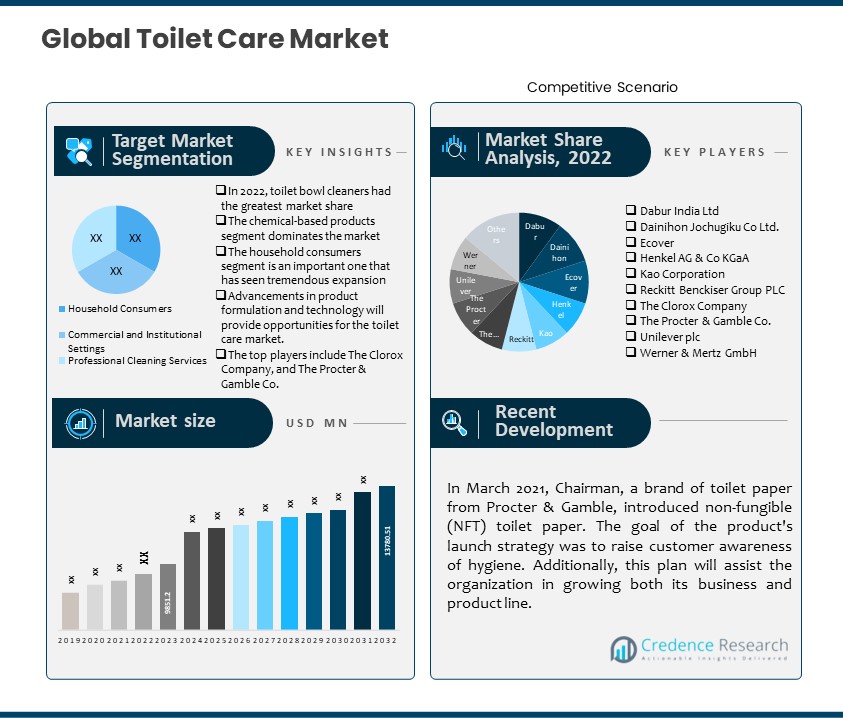
- The global market for toilet care is expected to develop at a compound annual growth rate (CAGR) of 3.80% between 2024 and 2032, from its estimated USD 9851.2 million in 2023 to USD 13780.51 million in 2032.
- The largest category is toilet bowl cleaners. Toilet fresheners, on the other hand, are expected to grow at a strong CAGR.
- Cleaning and disinfection are the top functionality segment.
- The CAGR for chemical-based products is expected to be the highest during the projection period.
- The bottles and spray containers will have the highest CAGR throughout the prediction period.
- Household consumers are estimated to have the greatest CAGR during the forecast period.
- Asia Pacific dominated the toilet care market.
- Regarding the market share of toilet care, Europe is expected to come second.
- In the toilet care market, North America is anticipated to grow fastest.
- Increasing urbanization rates, changing lifestyles and busier schedules, and growing awareness of the importance of hygiene and sanitation are driving the global market for toilet care.
- The requirement for convenient cleaning solutions, the trend toward premium and value-added goods, and advancements in product formulation and technology contribute to the potential for the global toilet care industry.
Executive Summary
Market Definition
The cleaning and hygiene industry segment that specializes in goods made especially for the upkeep and hygienic conditions of toilets and other bathroom facilities is known as the Toilet Care Market. Cleaning, disinfecting, deodorizing, and maintaining toilet bowls, surrounding regions, and surfaces are the wide variety of items that fall into this sector.
Market Overview
The toilet care sector is estimated to develop at a 3.80% compound annual growth rate (CAGR) between 2024 and 2032, maintaining its current upward trend. The market will continue to develop, rising from its estimated USD 9851.2 million in 2023 to USD 13780.51 million in 2032.
Rising per capita spending on toilet care products can be attributed to the increased importance of leading a healthier lifestyle and people's concerns about living in a dust- and dirt-free environment. This has led to vendors launching cutting-edge surface and toilet cleaners with regard to quality, cost, packaging, product bundling, and aroma. The development of new toilet care products has been aided by rising consumer demand for convenient, easily applied toilet cleaning solutions. For the past few years, toilet cleaning solutions' aroma has been a key component. Vendors must differentiate their items since consumers are searching for products with a pleasant scent more and more. Toilet care products are becoming more and more popular as more people realize how vital it is to keep proper hygiene in the bathroom.
Furthermore, millennials are spending more money each month on hygiene and personal care items. The Bureau of Labor Statistics reports that in the United States in 2021, the average annual consumer expenditure for personal care services was USD 385, an increase over 2020. As per the latest data released by AdEx India, a division of TAM Media Research, there was a 16% rise in television advertising for the personal care and hygiene industry in 2021 as compared to 2019. The study found that over half of the television commercials for the personal care and hygiene sector fell into one of the top three categories. Hindustan Unilever remained the largest advertiser, with a nearly one-fourth share of the TV advertising volumes. These factors are anticipated to support the growth of the toilet care market.
Segmentation by Product Type
- Toilet bowl cleaners are the market leader by product type. With its potent acidic formula, Toilet Bowl Cleaner effectively eliminates grime, rust, and slime from grout, tiles, urinals, and toilet bowls. With each use, this cleaner can eliminate microorganisms and leave behind a clean, fresh scent.
- The toilet fresheners category will exhibit a sizable CAGR during the projected period. People are more conscious about cleanliness and hygiene, especially in restroom settings. In order to maintain a clean and welcoming space, customers place a high value on keeping their toilets smelling nice and fresh.
- Other product types, including toilet rim blocks and clip-ons, toilet brushes and holders, automatic toilet bowl cleaners, and toilet seat sanitizers, support the need for toilet care.
Segmentation by Functionality
- The main functionality is cleaning and disinfection. Household hygiene and cleanliness are top priorities for consumers, especially in areas like restrooms where bacteria and germs can thrive. To keep living spaces healthy, there is a constant need for items that clean and sanitize surfaces, along with toilet bowls.
- The odor control and freshness category will likely register a significant CAGR during forecasting. Toilet care products are becoming more and more equipped with smart technology to improve freshness and odor control. In order to provide customized freshness solutions based on usage patterns and environmental factors, automatic dispensers, motion-activated air fresheners, and smart sensors identify and neutralize smells.
- Other functionalities, such as stain prevention and maintenance, ease of use, and convenience, also contribute to the demand for toilet care.
Segmentation by Formulation and Ingredient
- The chemical-based products category is projected to grow faster over the projection period. Chemical-based toilet care products are effective and versatile for a range of cleaning applications, such as surface disinfection, odor control, and toilet bowl cleaning. To address a variety of stains, bacteria, and odors, manufacturers develop products with particular active ingredients and chemical compositions to meet the demands of a wide range of customers.
- Other formulations and ingredients influence the need for toilet care, including natural and eco-friendly products, antibacterial and antimicrobial formulations, and fragranced and scented products.
Segmentation by Packaging and Delivery
- The bottles and spray containers category will likely have the highest CAGR during the projection period. Dispensing air fresheners, disinfectants, and cleansers straight onto surfaces or into toilet bowls is made easier by bottles and spray containers. Customers can easily apply the appropriate amount of product due to their user-friendly design, which makes cleaning and maintenance routines more efficient.
- Other packaging and delivery, such as pouches and refills, disposable wipes and pads, and bulk packaging, also contribute to the demand for toilet care.
Segmentation by Target Market
- Household consumers are expected to have the foremost CAGR during the prediction period. There is a wide range of needs and preferences among household consumers regarding toilet care products. To accommodate a variety of household tastes, surfaces, and cleaning issues, manufacturers provide a broad selection of formulas, fragrances, container options, and specialist products.
- Other target markets, such as commercial and institutional settings and professional cleaning services, also contribute to the demand for toilet care.
Segmentation by Region
- The Asia Pacific leads the toilet care industry. Enormous development prospects exist for the Toilet Care Market in the Asia Pacific region's emerging economies. The need for toilet care products in the residential and commercial sectors is driven by the huge populations, increased disposable incomes, and increasing rates of urbanization found in countries like China, India, Indonesia, and Vietnam.
- Europe is estimated to rank second in market size for toilet care.
- The toilet care industry is predicted to flourish rapidly in North America.
- Regions such as Africa, the Middle East, and Latin America cover the remaining requirement for toilet care.
The toilet care market is growing as a result of consumers' changing attitudes about hygiene goods. Growing consumer use of social media has sparked progressive discussions on health and hygiene goods, improving people's lives in the process. For example, 72% of US adults used at least one social media site in 2021, according to the World Economic Forum.
Based on projections, the toilet care market is anticipated to be controlled by Asia Pacific. The increasing sales of toilet care products in the region can be attributed to customers' growing health concerns over the prevalence of hazardous diseases that can be transmitted through uncleaned toilets. Customers in the area have a preference for natural and energizing scents in their eco-friendly toilet care products. People's increasing awareness of the advantages of living a healthy lifestyle for a clean and sanitary lifestyle is the reason behind the rise in per capita spending on home goods (including personal care items) in emerging nations like China. The People's Republic of China Ministry of Finance estimates that China would spend CNY 1.92 trillion on healthcare, personal care, and hygiene in total in 2021. Due to its large population and rising awareness of hygiene, India presents a promising market for toilet care products.
The toilet care market in North America is anticipated to expand fastest throughout the forecast. Manufacturers can gain entry into the commercial toilet care sector in North America by partnering with janitorial services, facility management firms, and commercial cleaning suppliers. By forming partnerships with service providers, manufacturers can sell toilet care goods to places of business, healthcare facilities, educational institutions, and hospitality venues where there is a significant demand for sanitation and hygiene solutions.
Key Highlights of the Report
The global toilet care market is segmented by product type segmentation, functionality segmentation, formulation and ingredient segmentation, packaging and delivery segmentation, target market segmentation, and region. As far as the product type segmentation is concerned, automatic toilet bowl cleaners are the market spearhead. Cleaning and disinfection are the top segments. The bottles and spray containers category is anticipated to increase at the highest CAGR throughout the projection period. The household consumers category will experience the highest CAGR during the forecast period. The toilet care market is expanding mostly in Asia Pacific.
The growing popularity of intimate hygiene programs, product premiumization, consumer buying power, urbanization, and improved middle-class lifestyles are among the factors driving the market for toilet care. For example, Dettol (Reckitt Benckiser Group PLC) Nigeria, an SDG 6 initiative under the Dettol Clean Naija campaign, revealed plans to launch the Dettol School Hygiene Education Programme in 2021. The program's objectives are to increase awareness of hygienic practices, impart knowledge, and inspire primary school pupils to adopt them into their daily lives.
Asia Pacific is expected to account for the largest toilet care market globally. Throughout the projection period, the market's sales will increase due to the many steps that governments of different nations are taking to provide clean toilets. For example, the Indian government has constructed nearly 80 million toilets as part of the 'Clean India, Green India' (Swachh Bharat) sanitation initiative. Demand for organic ingredients is growing as people become more conscious of the hazards posed by the chemicals used in personal hygiene products. As a result of increased awareness, big players are creating fresh, inventive, and more comfortable solutions. Better India, for example, introduced India's first subscription kits in 2020, which included a variety of non-toxic household cleaners, including toilet cleaners. The North American region is also assumed to have the market's sharpest growth. In North America, educating customers about the value of good product usage and bathroom hygiene gives chances to promote market acceptance and brand loyalty.
Which Key Factors Are Driving The Global Toilet Care Market?
The main factors influencing the growth of the toilet care market include the advent of smart toilet care products, expanding worries about environmental sustainability, more attention to indoor air quality, and increasing consumer demand for formulations that are both eco-friendly and biodegradable.
What are The Main Challenges Confronting The Toilet Care Market Globally?
Some of the obstacles impeding the industry's growth include a lack of adequate distribution channels, dropping birth rates, and an aging population, which may influence household demographics and cleaning habits and affect the need for toilet care goods and services.
What Market Opportunities Exist For Toilet Care Globally?
Some of the factors that could boost the toilet care market include an aging population and a greater emphasis on cleanliness for older people, the development of multifunctional and all-in-one goods, and the integration of aroma and aesthetics in product design.
Market Drivers
Multiple factors propel the toilet care industry across the globe. The primary factors propelling the global toilet care market are as follows:
Continuous Innovation in Technology and Product Formulations
Advances in formulation technology allow manufacturers to create toilet care products with better cleaning capabilities. Customers may enjoy cleaner and more hygienic toilet surfaces due to the efficient removal of stubborn stains, mineral deposits, and bacterial buildup made possible by advanced components and formulas. Fragrances and odor-controlling technology are used in creative combinations to give restrooms a persistent freshness. In order to improve the user experience, consumers look for products that clean well and also leave behind a pleasant, refreshing aroma. Environmentally friendly toilet care solutions can be developed because of innovations in product formulation. In response to consumer demands for sustainable and environmentally friendly products, manufacturers are putting more of an emphasis on using biodegradable components, cutting down on packaging waste, and using less hazardous chemicals. Toilet care products are now more convenient and user-friendly due to technological advancements in product design and packaging. Product usability and customer satisfaction are increased by features including creative dispensing systems, ergonomic bottle designs, and simple applicators.
Market Restraints
There are several obstacles that the global toilet care market must overcome to continue growing. Among them are the following:
Strict Guidelines for Health and Safety
A large investment in testing, research, and regulatory compliance is frequently needed to comply with health and safety requirements. Producing goods that meet stringent safety regulations may come at a significant cost to manufacturers, potentially affecting their overall competitiveness and profit margins. Since certain chemicals or substances in toilet care products may pose health risks or have an adverse effect on the environment, some health and safety standards prohibit their usage. Due to manufacturers' need to adhere to regulatory regulations, this restriction on formulation alternatives may impede innovation and product development. Manufacturers of toilet care products may find it difficult to conduct business internationally due to differences in health and safety laws between nations or regions. To access global markets, companies must traverse complicated regulatory systems and secure certifications or approvals, which may be expensive and time-consuming.
Opportunities
There are plenty of potential prospects in the global toilet care industry. Among these are the following:
Growing Consumer Need for Eco-Friendly Products
The market for toilet care has a lot of potential due to consumers' increasing need for eco-friendly goods. By providing environmentally friendly toilet care options that complement customer beliefs and interests, manufacturers may set themselves apart from the competition. Companies can appeal to consumers who are looking for greener options by highlighting sustainable sourcing, biodegradable formulas, and eco-conscious packaging. The demand for toilet care products is reaching a wider range of consumers due to the growing desire for environmentally friendly products. Customers who care about the environment, such as millennials and Generation Z, actively look for goods that reduce their influence on the environment and encourage sustainability. Manufacturers can access a burgeoning market segment and boost revenue by serving this group. Providing environmentally friendly toilet care products improves brand recognition and fosters customer confidence. Businesses that put a high priority on sustainability projects show environmental care and business responsibility, which appeals to customers. In a crowded market, a strong commitment to environmental friendliness can increase brand loyalty and set firms apart.
Competitive Landscape
Key Players
Several major competitors exist in the fiercely competitive global toilet care market. The following are a few of the leading market participants and their market shares:
- Dabur India Ltd
- Dainihon Jochugiku Co Ltd.
- Ecover
- Henkel AG & Co KGaA
- Kao Corporation
- Reckitt Benckiser Group PLC
- The Clorox Company
- The Procter & Gamble Co.
- Unilever plc
- Werner & Mertz GmbH
- Others
These companies prioritize product innovation, distribution channel expansion, mergers, and acquisitions to remain competitive.
The largest suppliers in the global toilet care market continuously work to stay one step ahead of the competition by developing innovative concepts and products.
In February 2022, Reckitt Benckiser Group PLC introduced a revised Harpic toilet care product. Customers will be able to track the product's manufacturing process by scanning the QR code on the packaging of Harpic. The primary goal of this introduction is to keep people loyal to the brand because many fake items have a similar appearance to Harpic. By providing customers with original products, the plan will also assist the business in recording sales growth. Additionally, it will support the business in keeping its global uniformity.
In February 2021, Henkel AG & Co. KGaA introduced redesigned toilet cleaner packaging. The business is reaffirming its dedication to encouraging a circular economy and sustainable packaging. The company reports that for toilet cleansers in the regular range, the percentage of recycled polyethylene (PE) in the packaging has increased dramatically to 50%.
Summary of Key Findings
- The significant technological improvements in cleaning equipment drive the toilet care sector.
- The market is segmented by product type segmentation, functionality segmentation, formulation and ingredient segmentation, packaging and delivery segmentation, target market segmentation, and region.
- The most popular product type in the market is toilet bowl cleaners.
- Chemical-based products are the foremost formulation and ingredient category.
- Bottles and spray containers are expected to grow fastest in terms of CAGR during the forecast period.
- The household consumers category will likely see the highest CAGR during the anticipated time frame.
- Asia Pacific is leading market development; the market is highly competitive with key players including Dabur India Ltd, Dainihon Jochugiku Co Ltd., Ecover, Henkel AG & Co KGaA, Kao Corporation, Reckitt Benckiser Group PLC, The Clorox Company, The Procter & Gamble Co., Unilever plc, Werner & Mertz GmbH, and Others.
Future Outlook
- The toilet care industry is expected to increase significantly in Asia Pacific and has a positive outlook worldwide.
- The expansion of the global market can be attributed to government initiatives that promote sanitation and hygiene.
- The demand for toilet care products can fluctuate seasonally, with manufacturers and distributors facing challenges in managing their inventories during peak cleaning seasons or holiday periods and lesser demand during other times of the year.
- To stay ahead of the competition, key enterprises must develop new products, expand their market reach, and keep their prices competitive.
How CXOs Can Benefit from the Credence Research Toilet Care Market Report
CXOs may get a detailed picture of the market in the Credence Research Toilet Care Market Report, which includes:
- Market size and growth forecast: The report provides detailed estimates of the global toilet care market size, segmented by product type segmentation, functionality segmentation, formulation and ingredient segmentation, packaging and delivery segmentation, target market segmentation, and region. It also includes forecasts for the market through 2032 based on key trends and drivers.
- Market segmentation: The research report breaks down the market for toilet care into segments based on product type segmentation, functionality segmentation, formulation and ingredient segmentation, packaging and delivery segmentation, target market segmentation, and region. This segmentation provides CXOs with a granular understanding of the market and the opportunities in each segment.
- Competitive landscape: The research report offers a detailed analysis of the major companies in the toilet care industry, including information on their business plans, product lines, and earnings. CXOs can use this information to evaluate and identify their competitors.
- Key trends and drivers: The research report identifies and evaluates the main trends and factors influencing the toilet care market. CXOs can use this information to make well-informed choices regarding their plans and investments.
CXOs can use the insights from the Credence Research Toilet Care Market Report to:
- Identify growth opportunities: This analysis may help CXOs identify new growth opportunities in the toilet care sector. For example, the report identifies the growing demand for toilet care from household consumers as a key opportunity.
- Make informed investment decisions: The report helps CXOs choose toilet care wisely. For example, the research study provides information on the critical factors to consider while selecting toilet care solutions and evaluating suppliers.
- Develop competitive strategies: CXOs can use the research report to develop competitive strategies for their toilet care businesses. For example, the research paper outlines the main strategies that toilet care suppliers utilize to differentiate themselves from competitors.
- Track market developments: This research report may help CXOs stay ahead of the curve by tracking market developments. For instance, it offers insights into the most recent developments and trends in the toilet care market.
CXOs seeking to expand their industry knowledge and spot growth prospects will find the Credence Research Toilet Care Market Report useful.
Segmentation
- By Product Type Segmentation
- Toilet Bowl Cleaners
- Toilet Rim Blocks and Clip-Ons
- Toilet Fresheners
- Toilet Brushes and Holders
- Automatic Toilet Bowl Cleaners
- Toilet Seat Sanitizers
- By Functionality Segmentation
- Cleaning and Disinfection
- Odor Control and Freshness
- Stain Prevention and Maintenance
- Ease of Use and Convenience
- By Formulation and Ingredient Segmentation
- Chemical-Based Products
- Natural and Eco-Friendly Products
- Antibacterial and Antimicrobial Formulations
- Fragranced and Scented Products
- By Packaging and Delivery Segmentation
- Bottles and Spray Containers
- Pouches and Refills
- Disposable Wipes and Pads
- Bulk Packaging
- By Target Market Segmentation
- Household Consumers
- Commercial and Institutional Settings
- Professional Cleaning Services
- By Region
- North America
- The U.S.
- Canada
- Mexico
- Europe
- Germany
- France
- The U.K.
- Italy
- Spain
- Rest of Europe
- Asia Pacific
- China
- Japan
- India
- South Korea
- South-east Asia
- Rest of Asia Pacific
- Latin America
- Brazil
- Argentina
- Rest of Latin America
- Middle East & Africa
- GCC Countries
- South Africa
- Rest of Middle East and Africa
- North America

Request a Free Sample
Fill in your details and we'll send you a free sample report.
- Sample data tables & charts
- Research methodology
Market Dynamics
Urbanization and Changing Lifestyles
Rapid urbanization and increasingly busy lifestyles, especially in emerging economies, are driving demand for convenient and effective toilet care solutions as consumers prioritize hygiene and time-saving cleaning products.
Rising Hygiene and Health Awareness
Growing awareness of the importance of sanitation and hygiene, fueled by public health campaigns and concerns about disease transmission, is increasing per capita spending on toilet care products globally.
Product Innovation and Premiumization
Manufacturers are introducing advanced formulations, smart dispensing systems, and premium features such as long-lasting fragrances and eco-friendly ingredients, attracting consumers seeking enhanced performance and value-added benefits.
Government Initiatives and Infrastructure Development
Sanitation-focused government programs, particularly in Asia Pacific (e.g., India's Swachh Bharat initiative), are expanding access to toilets and driving demand for toilet care products in both residential and institutional settings.
Environmental Sustainability Trends
Consumer demand for eco-friendly, biodegradable, and less chemically intensive toilet care products is encouraging manufacturers to innovate with greener formulations and sustainable packaging, opening new market segments.
Need a Custom Version of This Report?
Tailor the scope, geography, or segments to your exact requirements.
- Custom geography or segment scope
- Direct access to our analyst team
Frequently Asked Questions
How much does the global market currently hold for toilet care?
What is the toilet care market's projected growth rate between 2024 and 2032?
In terms of product type, which market category is leading?
Regarding functionality, which market category is in the lead?
Who are the main players in the toilet care industry globally?
Table of Content
Chapter 1 Market Segmentation
- 1.1 Segmentation Framework
- 1.1.1 Product and Service Classification
- 1.1.2 Application and End-Use Classification
- 1.1.3 Technology and Solution Classification
- 1.1.4 Customer and Distribution Channel Classification
- 1.1.5 Geographic Segmentation
- 1.1.6 Market Segment Definitions and Boundaries
- 1.2 By Product Type
- 1.2.1 Toilet Bowl Cleaners
- 1.2.2 Toilet Rim Blocks and Clip-Ons
- 1.2.3 Toilet Fresheners
- 1.2.4 Toilet Brushes and Holders
- 1.2.5 Automatic Toilet Bowl Cleaners
- 1.2.6 Toilet Seat Sanitizers
- 1.3 By Functionality
- 1.3.1 Cleaning and Disinfection
- 1.3.2 Odor Control and Freshness
- 1.3.3 Stain Prevention and Maintenance
- 1.3.4 Ease of Use and Convenience
- 1.4 By Packaging and Delivery
- 1.4.1 Bottles and Spray Containers
- 1.4.2 Pouches and Refills
- 1.4.3 Disposable Wipes and Pads
- 1.4.4 Bulk Packaging
- 1.5 By Formulation and Ingredient
- 1.5.1 Chemical-Based Products
- 1.5.2 Natural and Eco-Friendly Products
- 1.5.3 Antibacterial and Antimicrobial Formulations
- 1.5.4 Fragranced and Scented Products
Chapter 2 Introduction
- 2.1 Report Objectives and Scope
- 2.2 Product Definition and Industry Terminology
- 2.3 Market Inclusions and Exclusions
- 2.4 Research Process
- 2.4.1 Primary Research and Expert Interviews
- 2.4.2 Secondary Research and Source Review
- 2.4.3 Top-Down and Bottom-Up Estimation
- 2.4.4 Data Triangulation and Verification
- 2.5 Market Size Measurement Basis
- 2.5.1 2023: USD 9,851.2 million → 2032: USD 13,780.51 million
- 2.6 Historical and Forecast Reference Periods
- 2.6.1 Base Year: 2023
- 2.6.2 Forecast Period: 2023-2032
- 2.7 Research Assumptions and Limitations
Chapter 3 Executive Summary
- 3.1 Market Snapshot and Key Findings
- 3.2 Base-Year Market Size, 2023
- 3.3 Forecast Market Size, 2032
- 3.4 Revenue and Volume Growth Outlook
- 3.5 Key Demand and Supply Indicators
- 3.6 Leading Market Segments
- 3.7 Fastest-Growing Market Opportunities
- 3.8 Regional Performance Highlights
- 3.9 Technology and Industry Transformation
- 3.10 Competitive Landscape Summary
- 3.11 Analyst View and Strategic Implications
Chapter 4 Global Toilet Care Market Trends and Developments
- 4.1 Historical Industry Development
- 4.2 Recent Market Trends and Developments
- 4.3 Demand and Customer Behavior Trends
- 4.4 Technology and Product Innovation
- 4.5 Artificial Intelligence, Automation and Digitalization
- 4.6 Local Manufacturing and Supply Chain Realignment
- 4.7 Industry Partnerships, Mergers and Acquisitions
- 4.8 Sustainability and Circular Economy Developments
- 4.9 Government and Private Sector Investment Trends
- 4.10 Emerging Business Models and Commercialization
- 4.11 Industry Developments and Announcements
Chapter 5 Global Toilet Care Market Production, Supply and Demand Analysis
- 5.1 Demand Trend and Consumption Analysis
- 5.2 Demand Forecast, 2023-2032
- 5.3 Production and Output Trend
- 5.4 Production and Output Forecast, 2023-2032
- 5.5 Installed Capacity and Capacity Utilization
- 5.6 Company-Wise Production Plants and Statistics
- 5.6.1 Installed Production Capacity
- 5.6.2 Actual Production
- 5.6.3 Planned Capacity and Expansion Targets
- 5.7 Supply Chain Structure and Procurement Trends
- 5.8 Supply-Demand Gap and Bottlenecks
- 5.9 Import Dependence and Sourcing Structure
- 5.10 Contract Manufacturing and Outsourcing
- 5.11 Regional Supply and Demand Concentration
Chapter 6 Global Toilet Care Market Pricing Analysis
- 6.1 Pricing Structure and Measurement
- 6.2 Historical Pricing Trends
- 6.3 Pricing Outlook, 2023-2032
- 6.4 Average Selling Price and Unit Economics
- 6.5 Pricing by Product and Market Segment
- 6.6 Geographic Pricing Differences
- 6.7 Key Input, Energy, Labor and Logistics Costs
- 6.8 Contract Pricing and Purchasing Models
- 6.9 Pricing Sensitivity and Competitive Positioning
- 6.10 Price, Margin and Profitability Implications
Chapter 7 Global Toilet Care Market Dynamics
- 7.1 Market Growth Drivers
- 7.1.1 Demand-Side Drivers
- 7.1.2 Technology and Innovation Drivers
- 7.1.3 Infrastructure and Investment Drivers
- 7.1.4 Regulatory and Policy Drivers
- 7.2 Market Restraints
- 7.2.1 Cost and Affordability Constraints
- 7.2.2 Technology and Adoption Barriers
- 7.2.3 Supply Chain and Operational Constraints
- 7.3 Market Challenges
- 7.3.1 Competitive Pressure and Margin Erosion
- 7.3.2 Skills, Infrastructure and Implementation Gaps
- 7.4 Emerging Market Opportunities
- 7.5 Market Dynamics Impact and Time-Horizon Assessment
Chapter 8 Global Toilet Care Value Chain Analysis
- 8.1 Industry Value Chain Overview
- 8.2 Upstream Suppliers and Critical Inputs
- 8.3 Technology and Component Providers
- 8.4 Manufacturing or Service Delivery
- 8.5 Distribution, Channel Partners and Integrators
- 8.6 Downstream Applications and End Users
- 8.7 Value Addition and Profit Pools
- 8.8 Vertical Integration and Outsourcing
- 8.9 Supplier Concentration and Risk
- 8.10 Supply Chain Localization and Resilience
Chapter 9 Global Toilet Care Market Regulations and Policies
- 9.1 Relevant Laws, Standards and Compliance Frameworks
- 9.2 Product, Service, Safety and Quality Requirements
- 9.3 Government Policies, Incentives and Subsidies
- 9.4 Imports, Exports and Trade Barriers
- 9.5 Public Procurement and Local Content Requirements
- 9.6 Environmental and Sustainability Compliance
- 9.7 Upcoming Policy Changes and Market Implications
Chapter 10 Global Toilet Care Market Hotspots and Opportunities
- 10.1 Market Opportunity Mapping and Growth Hotspots
- 10.2 High-Growth Applications and Customer Groups
- 10.3 Underserved Markets and White-Space Opportunities
- 10.4 Emerging Technology and Product Opportunities
- 10.5 New Capacity and Investment Hotspots
- 10.6 Market Entry and Expansion Opportunities
- 10.7 Distribution and Partnership Opportunities
- 10.8 Near-Term and Long-Term Commercial Potential
- 10.9 Opportunity Attractiveness and Execution Risks
Chapter 11 Global Toilet Care Market Outlook, 2023-2032
- 11.1 Market Size and Analysis
- 11.1.1 Revenue (Market Measurement: 2023: USD 9,851.2 million → 2032: USD 13,780.51 million)
- 11.1.2 Market Volume and Quantity Sold
- 11.1.3 Historical Market Size
- 11.1.4 Base-Year Market Size, 2023
- 11.2 Market Forecast, 2023-2032
- 11.2.1 Revenue Forecast to 2032
- 11.2.2 Volume Forecast to 2032
- 11.2.3 CAGR and Year-on-Year Growth
- 11.2.4 Incremental Revenue Opportunity
- 11.3 Forecast Assumptions and Scenario Analysis
- 11.3.1 Base-Case Forecast
- 11.3.2 Optimistic and Conservative Scenarios
- 11.3.3 Technology, Pricing and Policy Sensitivities
- 11.4 Market Attractiveness and Growth Outlook
Chapter 12 Global Toilet Care Market Segmentation and Outlook
- 12.1 Segmentation Summary and Market Shares, 2023
- 12.2 Largest and Fastest-Growing Segments
- 12.3 By Product Type - Market Size and Forecast, 2023-2032
- 12.3.1 Segment Definition and Scope
- 12.3.2 Historical Market Size
- 12.3.3 Revenue Forecast, 2023-2032
- 12.3.4 Volume Forecast, 2023-2032
- 12.3.5 Base-Year Market Share, 2023
- 12.3.6 Segment CAGR and Growth Drivers
- 12.3.7 Subsegment Market Size and Forecast
- 12.3.7.1 Toilet Bowl Cleaners
- 12.3.7.2 Toilet Rim Blocks and Clip-Ons
- 12.3.7.3 Toilet Fresheners
- 12.3.7.4 Toilet Brushes and Holders
- 12.3.7.5 Automatic Toilet Bowl Cleaners
- 12.3.7.6 Toilet Seat Sanitizers
- 12.3.8 Subsegment Pricing and Adoption Trends
- 12.3.9 Leading Suppliers and Competition
- 12.3.10 Regional Demand and Opportunities
- 12.4 By Functionality - Market Size and Forecast, 2023-2032
- 12.4.1 Segment Definition and Scope
- 12.4.2 Historical Market Size
- 12.4.3 Revenue Forecast, 2023-2032
- 12.4.4 Volume Forecast, 2023-2032
- 12.4.5 Base-Year Market Share, 2023
- 12.4.6 Segment CAGR and Growth Drivers
- 12.4.7 Subsegment Market Size and Forecast
- 12.4.7.1 Cleaning and Disinfection
- 12.4.7.2 Odor Control and Freshness
- 12.4.7.3 Stain Prevention and Maintenance
- 12.4.7.4 Ease of Use and Convenience
- 12.4.8 Subsegment Pricing and Adoption Trends
- 12.4.9 Leading Suppliers and Competition
- 12.4.10 Regional Demand and Opportunities
- 12.5 By Packaging and Delivery - Market Size and Forecast, 2023-2032
- 12.5.1 Segment Definition and Scope
- 12.5.2 Historical Market Size
- 12.5.3 Revenue Forecast, 2023-2032
- 12.5.4 Volume Forecast, 2023-2032
- 12.5.5 Base-Year Market Share, 2023
- 12.5.6 Segment CAGR and Growth Drivers
- 12.5.7 Subsegment Market Size and Forecast
- 12.5.7.1 Bottles and Spray Containers
- 12.5.7.2 Pouches and Refills
- 12.5.7.3 Disposable Wipes and Pads
- 12.5.7.4 Bulk Packaging
- 12.5.8 Subsegment Pricing and Adoption Trends
- 12.5.9 Leading Suppliers and Competition
- 12.5.10 Regional Demand and Opportunities
- 12.6 By Formulation and Ingredient - Market Size and Forecast, 2023-2032
- 12.6.1 Segment Definition and Scope
- 12.6.2 Historical Market Size
- 12.6.3 Revenue Forecast, 2023-2032
- 12.6.4 Volume Forecast, 2023-2032
- 12.6.5 Base-Year Market Share, 2023
- 12.6.6 Segment CAGR and Growth Drivers
- 12.6.7 Subsegment Market Size and Forecast
- 12.6.7.1 Chemical-Based Products
- 12.6.7.2 Natural and Eco-Friendly Products
- 12.6.7.3 Antibacterial and Antimicrobial Formulations
- 12.6.7.4 Fragranced and Scented Products
- 12.6.8 Subsegment Pricing and Adoption Trends
- 12.6.9 Leading Suppliers and Competition
- 12.6.10 Regional Demand and Opportunities
- 12.7 Segment Growth Comparison
- 12.8 Segment Attractiveness and Priority Matrix
Chapter 13 Global Toilet Care Geographic Market Outlook, 2023-2032
- 13.1 Regional Market Size and Share, 2023
- 13.2 Regional Market Forecast, 2023-2032
- 13.3 Regional Pricing, Production and Demand Differences
- 13.4 North America
- 13.4.1 United States
- 13.4.2 Canada
- 13.4.3 Mexico
- 13.5 Europe
- 13.5.1 Germany
- 13.5.2 France
- 13.5.3 Italy
- 13.5.4 United Kingdom
- 13.5.5 Spain
- 13.5.6 Poland
- 13.5.7 Russia
- 13.5.8 Netherlands
- 13.5.9 Belgium
- 13.5.10 Sweden
- 13.5.11 Denmark
- 13.5.12 Norway
- 13.5.13 Rest of Europe
- 13.6 Asia Pacific
- 13.6.1 China
- 13.6.2 India
- 13.6.3 Japan
- 13.6.4 South Korea
- 13.6.5 Thailand
- 13.6.6 Indonesia
- 13.6.7 Vietnam
- 13.6.8 Malaysia
- 13.6.9 Australia
- 13.6.10 Rest of Asia Pacific
- 13.7 Latin America
- 13.7.1 Brazil
- 13.7.2 Argentina
- 13.7.3 Colombia
- 13.7.4 Chile
- 13.7.5 Rest of Latin America
- 13.8 Middle East
- 13.8.1 Saudi Arabia
- 13.8.2 United Arab Emirates
- 13.8.3 Turkey
- 13.8.4 Israel
- 13.8.5 Iran
- 13.8.6 Rest of the Middle East
- 13.9 Africa
- 13.9.1 South Africa
- 13.9.2 Egypt
- 13.9.3 Nigeria
- 13.9.4 Morocco
- 13.9.5 Rest of Africa
- 13.10 Regional Investment, Policy and Supply Chain Differences
- 13.11 Regional Competitive Landscape
- 13.12 Geographic Growth Hotspots
Chapter 14 Global Toilet Care Technology, Innovation and Sustainability Outlook
- 14.1 Technology Landscape and Maturity
- 14.2 Product, Process and Service Innovation
- 14.3 AI, Automation and Digital Tools in the Industry
- 14.4 Technology Adoption and Performance Benchmarking
- 14.5 Innovation Pipeline and R&D Investment
- 14.6 Patent and Intellectual Property Trends
- 14.7 Energy Efficiency and Resource Management
- 14.8 Sustainability, Recycling and Circularity
- 14.9 Technology Roadmap, 2023-2032
- 14.10 Risks of Obsolescence and Technology Substitution
Chapter 15 Global Toilet Care Market Key Strategic Imperatives
- 15.1 Growth and Market Entry Priorities
- 15.2 High-Return Products and Segments
- 15.3 Pricing, Profitability and Cost Optimization
- 15.4 Technology Investment and Product Differentiation
- 15.5 Supply Chain Localization and Resilience
- 15.6 Distribution and Customer Acquisition
- 15.7 Partnership, Acquisition and Capacity Strategy
- 15.8 Regional Expansion Priorities
- 15.9 Short-, Medium- and Long-Term Actions
Chapter 16 Competition Outlook
- 16.1 Industry Competition Characteristics
- 16.2 Market Structure and Concentration
- 16.3 Market Share and Competitive Positioning, 2023
- 16.4 Company-Wise Revenue and Product Benchmarking
- 16.5 Production and Service Capacity Benchmarking
- 16.6 Technology, Pricing and Differentiation
- 16.7 Regional Footprint and Distribution Strength
- 16.8 Mergers, Acquisitions and Strategic Alliances
- 16.9 New Entrants and Competitive Threats
- 16.10 Porter's Five Forces and Industry Attractiveness
- 16.11 Competitive Outlook, 2023-2032
Chapter 17 Company Profiles
- 17.1 Company Coverage and Selection Criteria
- 17.2 Reckitt Benckiser Group PLC
- 17.2.1 Business Description
- 17.2.2 Company Ownership and Geographic Presence
- 17.2.3 Product and Service Portfolio
- 17.2.4 Manufacturing and Operating Footprint
- 17.2.5 Production Capacity and Expansion Plans
- 17.2.6 Financial Performance and Investment
- 17.2.7 Market Share and Competitive Position
- 17.2.8 Technology and Innovation Capabilities
- 17.2.9 Strategic Alliances or Partnerships
- 17.2.10 Recent Developments
- 17.2.11 Growth Strategy and Outlook
- 17.3 The Procter & Gamble Co.
- 17.4 Unilever plc
- 17.5 Henkel AG & Co KGaA
- 17.6 Kao Corporation
- 17.7 The Clorox Company
- 17.8 Dabur India Ltd
- 17.9 Werner & Mertz GmbH
- 17.10 Ecover
- 17.11 Dainihon Jochugiku Co Ltd.
- 17.12 Other Relevant Market Participants
Note: Every listed company is profiled on the structure shown under the first company. The company list is preliminary and may change based on research findings, market developments, data availability and client requirements.
Chapter 18 Disclaimer
- 18.1 Research and Forecast Disclaimer
- 18.2 Data Source and Estimation Limitations
Note: The depth of individual sections depends on data availability for this market. Volume, capacity, trade and other unit-based metrics are included where applicable.

