
Seat scarcity keeps paid NEET preparation in demand
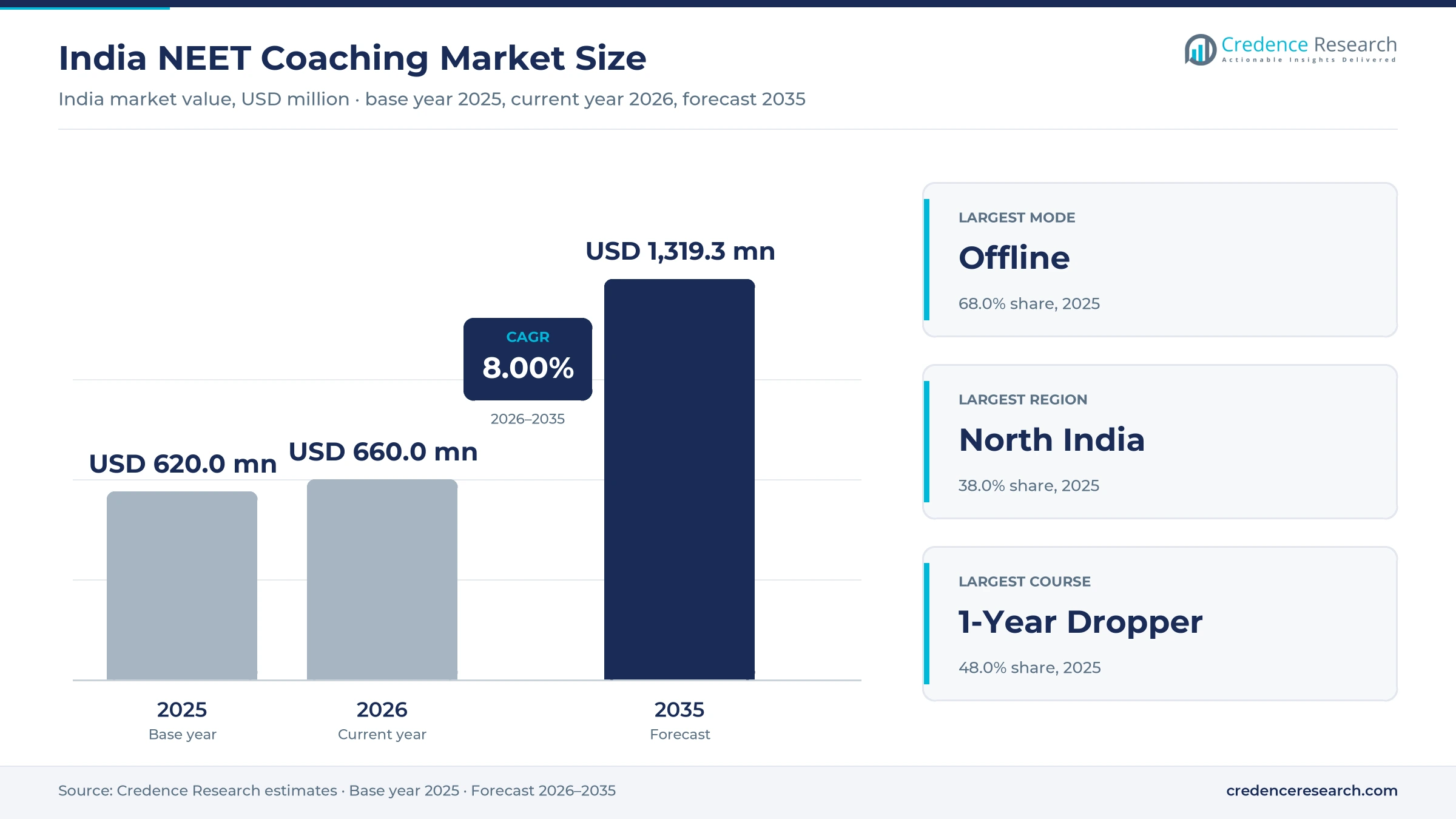
The India NEET coaching market was valued at USD 620.0 million in 2025 and is projected to increase from USD 660.0 million in 2026 to USD 1.32 billion by 2035, registering a CAGR of 8.00% during 2026–2035. Demand comes from families paying for classroom, online and hybrid preparation for an exam that decides entry to MBBS and other medical programs, and 2,209,318 candidates sat it in 2025. North India held the largest regional share, 38.0% in 2025, because Uttar Pradesh and Rajasthan send the most candidates and Kota remains the best-known residential hub. East India is the fastest-growing region at 8.95% a year, as national institutes open centers in Bihar cities. The commercial picture also changed in 2026, when the May 3 paper was canceled and a June 21 retest pushed institutes to run short revision batches, while the education minister confirmed that the exam moves to computer-based testing from 2027.
What does NEET coaching spending cover in India?
The market counts fees paid to institutes and platforms for NEET UG preparation, including classroom batches, live and recorded online courses, hybrid centers, one-year dropper programs, two-year integrated programs and crash courses. Families usually buy a full course at admission, often in installments and scholarship tests set the final price.
The estimate excludes hostel, food and travel costs, school fees, NEET PG preparation, general tuition and engineering batches. The value chain runs from faculty and study material through centers and apps to parents, who make most decisions, while free state programs sit outside the paid total.
India NEET Coaching Market Insights
- Spending rises from USD 620.0 million in 2025 to USD 1.32 billion by 2035, an 8.00% CAGR, as paid enrollment widens beyond a few residential hubs.
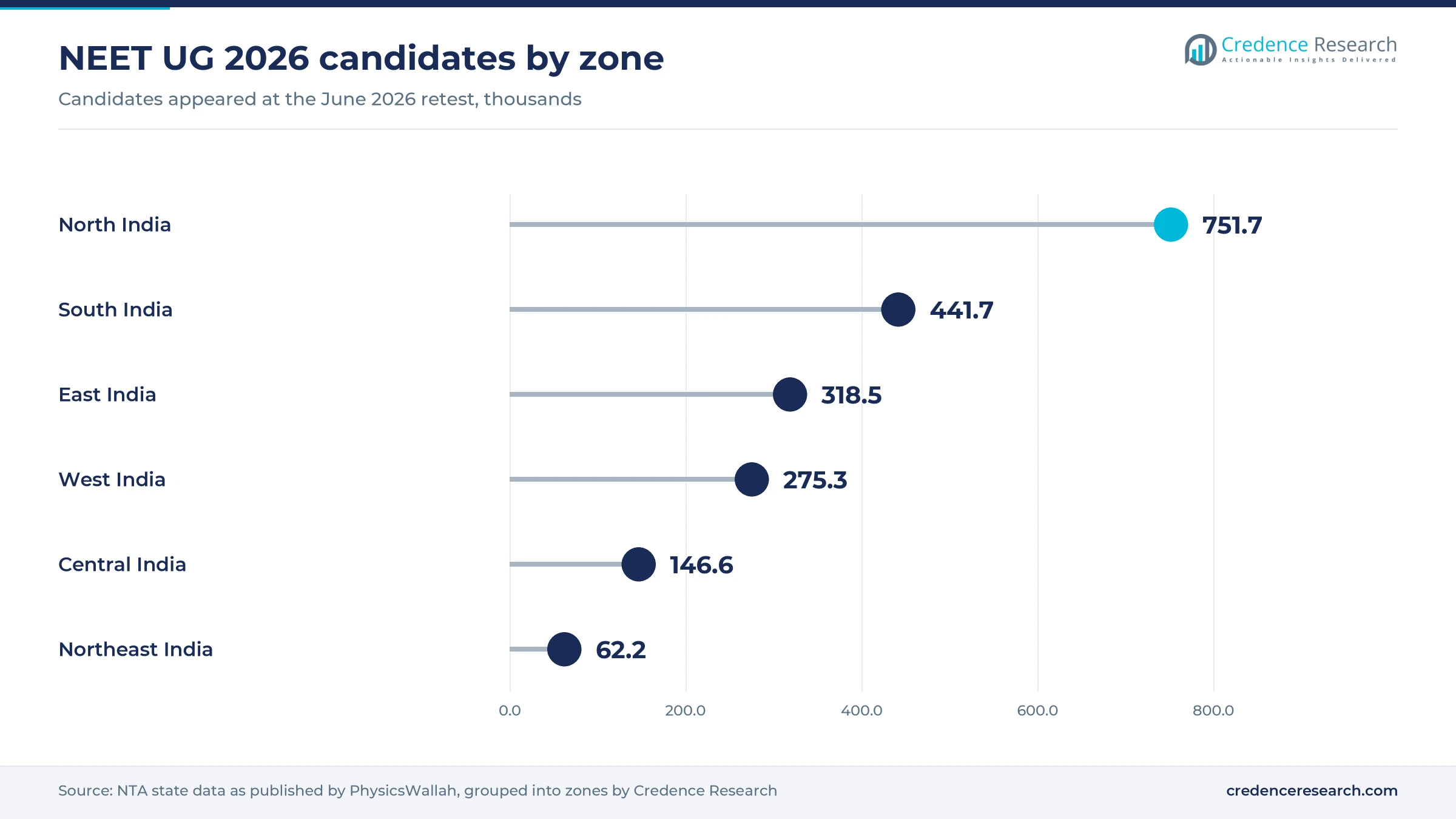
- North India held 38.0% of 2025 value, supported by 751,730 candidates across its states in the 2026 NEET retest.
- Offline teaching held 68.0% of 2025 value, though PhysicsWallah alone reported 353 offline centers including the UAE by March 2026, showing online brands moving into classrooms.
- The May 3, 2026 paper cancellation and the planned 2027 move to computer-based testing are changing batch calendars and test practice.
- Competition is consolidating, with upGrad completing its all-stock purchase of Unacademy in September 2026 and Manipal Group adding capital to Aakash.
Classroom dropper batches still carry the most value
Classrooms hold value as hybrid centers grow fastest
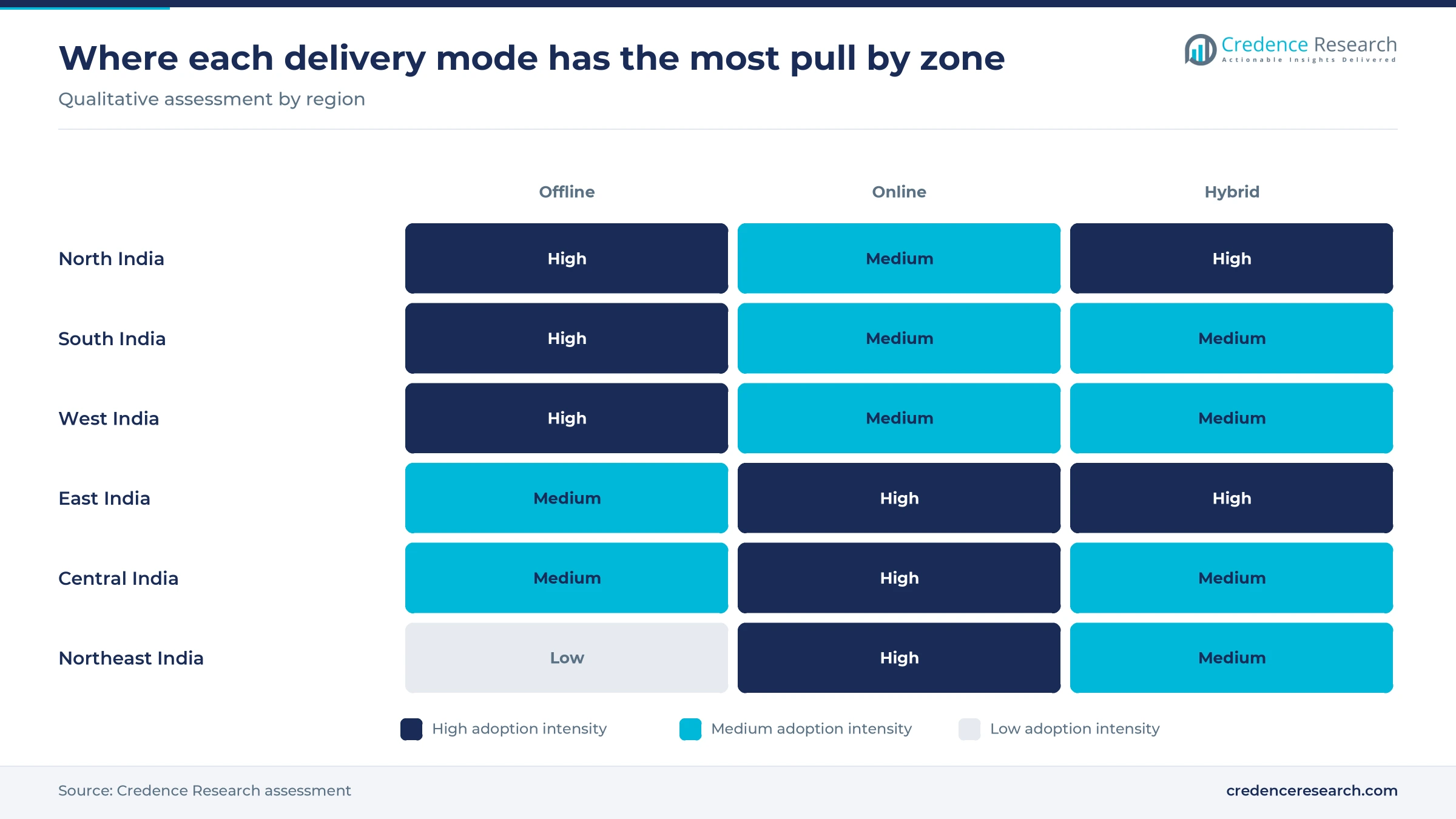
Based on mode, the market is categorized into offline, online and hybrid. Offline led with 68.0% of 2025 value because classroom fees sit far above app prices, and ThePrint put average annual fees for medical or engineering coaching in Kota at Rs 1.5 lakh to Rs 2 lakh in October 2024. Hybrid grows fastest at 9.77% a year as PhysicsWallah earmarked Rs 49.89 crore of its 2025 share sale for Pathshala centers, which pair live-streamed classes with on-site faculty, according to Business Today. Online batches remain the entry point for price-sensitive households in smaller towns.
Dropper batches lead while integrated programs gain
Based on course, the market is categorized into 1-year dropper, 2-year integrated and crash course programs. 1-Year Dropper batches led with 48.0% of 2025 value because repeat attempts dominate seat outcomes, and the Justice Rajan committee found repeaters took 71.42% of Tamil Nadu MBBS admissions in 2020–21. 2-Year Integrated programs grow fastest at 8.52% a year as parents commit earlier, and The Core reported in August 2026 on one family paying Rs 4.5 lakh for a two-year course. Crash courses stay smaller, at Rs 10,000 to Rs 38,000 a month in the Justice Rajan committee review.
Metros lead as tier-2 and tier-3 centers gain share
Based on city tier, the market is categorized into Kota, metros and tier-2/3 cities. Metros led with 44.0% of 2025 value because large city populations support many centers, and Delhi alone sent 53,846 candidates to the 2026 retest. Tier-2/3 locations grow fastest at 9.13% a year as PhysicsWallah listed Muzaffarpur, Dhanbad, Akola, Latur and Rajkot among possible new sites in its 2025 offer document, according to Business Today. Kota still matters, with about 120,000 students a year and nearly half preparing for NEET, according to Careers360 in May 2026.
| Segment Group | Leading Sub-segment | Share, 2025 | Fastest-growing Sub-segment | CAGR, 2026–2035 |
|---|---|---|---|---|
| By Mode | Offline | 68.0% | Hybrid | 9.77% |
| By Course | 1-Year Dropper | 48.0% | 2-Year Integrated | 8.52% |
| By City Tier | Metros | 44.0% | Tier-2/3 | 9.13% |
Request a Free Sample
Fill in your details and we'll send you a free sample report.
- Sample data tables & charts
- Research methodology
Seat competition and wider access drive enrollment
Medical-entrance competition sustains preparation spending
NEET UG decides admission to MBBS, BDS, AYUSH and allied programs, the medical end of higher education, so competition converts directly into paid preparation. According to Careers360 data for 2026, 2,279,743 candidates registered and 1,121,185 qualified that year. An Allen summary of the July 2026 seat matrix lists 139,439 MBBS seats for 2026–27, or one seat for about every 16 registrants. That scarcity sits against a thin doctor base, since World Bank data show 0.72 physicians per 1,000 people in India in 2020. Private colleges hold 73,643 of those seats, and Business Today noted high private college fees in September 2025, so a better rank carries real financial value for a family. In the Credence Research model this adds about 3.04 percentage points to annual growth to 2035.
Online and hybrid classes reach smaller Indian cities
Online and hybrid delivery lets national faculty reach towns that cannot support a large residential institute, which adds paying students rather than only moving them. YourStory reported in May 2026 that PhysicsWallah, an education technology company, counted 4.87 million online transacting users across its exams in the year to March 2026. Its offline enrollment also rose to about 467,500 from about 325,600, which shows the two channels growing together. A company update reported 70 Pathshala hybrid centers by June 2026, according to Entrepreneur India. In the Credence Research model this adds about 2.24 percentage points to annual growth to 2035, and Hybrid delivery captures the largest part of that gain.
Repeater and integrated batches expand paid enrollment
Longer and repeated preparation raises the amount a single family spends before a student wins a seat. The Justice Rajan committee in Tamil Nadu found the repeater share of MBBS admissions rose from 12.47% in 2016–17 to 71.42% in 2020–21, according to The News Minute. Allen has tied this demand to pricing, offering repeaters concessions of up to 90% based on NEET scores and starting several batches between Aug. 6 and Aug. 22 in 2024. Aakash sells one-year integrated classroom courses for students who have passed Class 12, and scholarship tests shape the final fee. In the Credence Research model these batches add about 1.44 percentage points to annual growth to 2035.
Household coaching habits widen the paying base
Coaching is already a normal household expense at the stage when students prepare for NEET, so institutes do not need to create the habit. The Comprehensive Modular Survey on Education, released by the statistics ministry on Aug. 26, 2025, found 27.0% of all students took private coaching during the academic year. Average spending at the higher secondary level reached Rs 9,950 per student in urban areas against Rs 4,548 in rural areas, which leaves room for rural spending to rise. Careers360 reported that more than a third of higher secondary students were enrolled. The Justice Rajan committee also found that 99% of Tamil Nadu NEET candidates in 2019–20 had taken coaching before the exam.
Computer-based exams and offline pivots reshape batches
Shift to computer-based NEET reshapes test practice
The move away from pen and paper is the biggest format change facing institutes, because mock tests and revision timetables must now follow a new exam design. Education Minister Dharmendra Pradhan said on May 15, 2026 that NEET UG will be computer based from 2027, according to The Week. The Daily Pioneer reported on July 8, 2026 that the exam would run over at least six days at more than 1,000 centers, with a detailed roadmap still in preparation. The change follows recommendations from the Radhakrishnan committee, which the government formed in June 2024 under a former ISRO chairman. As a result, institutes with their own testing platforms should gain an edge, since multi-day exams place more weight on practice under real screen conditions.
Rise of offline expansion and sector consolidation
Scale is concentrating as online brands add classrooms and weaker balance sheets look for partners. PhysicsWallah, counting sites in the Gulf, grew from 198 centers in March 2025 to 353 in March 2026, then to 366 by June 2026, according to Entrepreneur India. Unacademy, known for test preparation for IIT-JEE and NEET, passed to upGrad in an all-stock deal completed in September 2026 and is moving company-run sites to franchise partners, according to YourStory. Aakash completed a Rs 100 crore rights issue in November 2025, with Manipal Group allotted Rs 58 crore, according to Business Standard. In turn, independent local institutes face better-funded rivals in their own cities.
Opening for branded centers in Bihar and tier-2 hubs
The clearest opening lies in cities where students once left home for Kota and can now stay near family. Allen said on Oct. 4, 2025 that it would start NEET classes in Darbhanga in January 2026, after a first year in Patna. Careers360 reported in May 2024 that Allen opened in Akola in December 2023 and that Motion followed in 2024. The same report put Sikar at about 100,000 students a year, with annual fees of Rs 1 lakh to Rs 1.5 lakh. Bihar alone sent 140,079 candidates to the 2026 retest, which supports more centers there. Local branches also save families the hostel cost, which ThePrint put at Rs 8,000 to Rs 12,000 a month in Kota.
Opportunity in low-price batches supported by AI tools
Lower-priced batches offer a path to students whom classroom fees exclude, provided institutes can hold down support costs. PhysicsWallah listed an offline Vidyapeeth dropper batch at Rs 40,000 for the 2026 exam on its website, well below the Kota range. The company also reported more than 100 million cumulative AI interactions in the year to March 2026, and voice bots that cut counseling costs by about 75%, according to YourStory. This kind of e-learning tooling can spread doubt-solving to more students per teacher. However, free options set a price floor, since the government-backed SATHEE platform from IIT Kanpur and IISc Bengaluru was expected to serve around 1 million students, according to its own news page.
Exam disruption and tighter rules test coaching models
Exam cancellation disrupts batch calendars
Exam disruption creates cost and uncertainty for institutes and families alike. The May 3, 2026 paper was canceled after a confirmed leak and the Central Bureau of Investigation took over the case, according to The Week. Absentees then rose to 279,848 at the June 21 retest from 66,751 in 2025, according to Careers360. Institutes faced extra teaching at short notice, and Allen offered free online revision classes in May. Clearer exam security would reduce this calendar risk for all operators.
State rules raise compliance costs for centers
State regulation is adding compliance work, especially for centers in Rajasthan. Rajasthan's coaching Act, which received assent on Sept. 23, 2025, requires branch-level registration for centers with more than 100 students, four fee installments and pro-rata refunds. Penalties start at Rs 50,000 and reach Rs 2 lakh before registration can be canceled. The central government guidelines of January 2024 also bar enrolling students under 16, which limits early foundation batches. Larger chains can absorb these costs more easily than small institutes.
Refund disputes and misleading claims draw penalties
Consumer enforcement is raising the risk of aggressive selling and strict refund terms. The Central Consumer Protection Authority fined Motion Education Rs 10 lakh on April 8, 2026 over a claimed 91.2% NEET 2025 qualification rate, according to Punekar News. ThePrint reported that the National Consumer Helpline logged 16,276 coaching complaints in 2023–24, mostly about refunds. Families lose trust when results claims and refund terms are unclear, so audited results and published refund rules are the practical response for operators.
Kota slump and free state programs squeeze pricing
Residential hubs and paid batches face pressure from both weaker demand and free alternatives. Kota District Collector Ravindra Goswami cited a 30% to 40% fall in coaching enrollment in 2024, and many hostels ran at half capacity, according to ThePrint in October 2024. Tamil Nadu planned about 230 free NEET centers for government school students in August 2025, according to DT Next. Fee-dependent local institutes are most exposed, and they may need to add scholarships or lower-priced hybrid batches to hold enrollment.
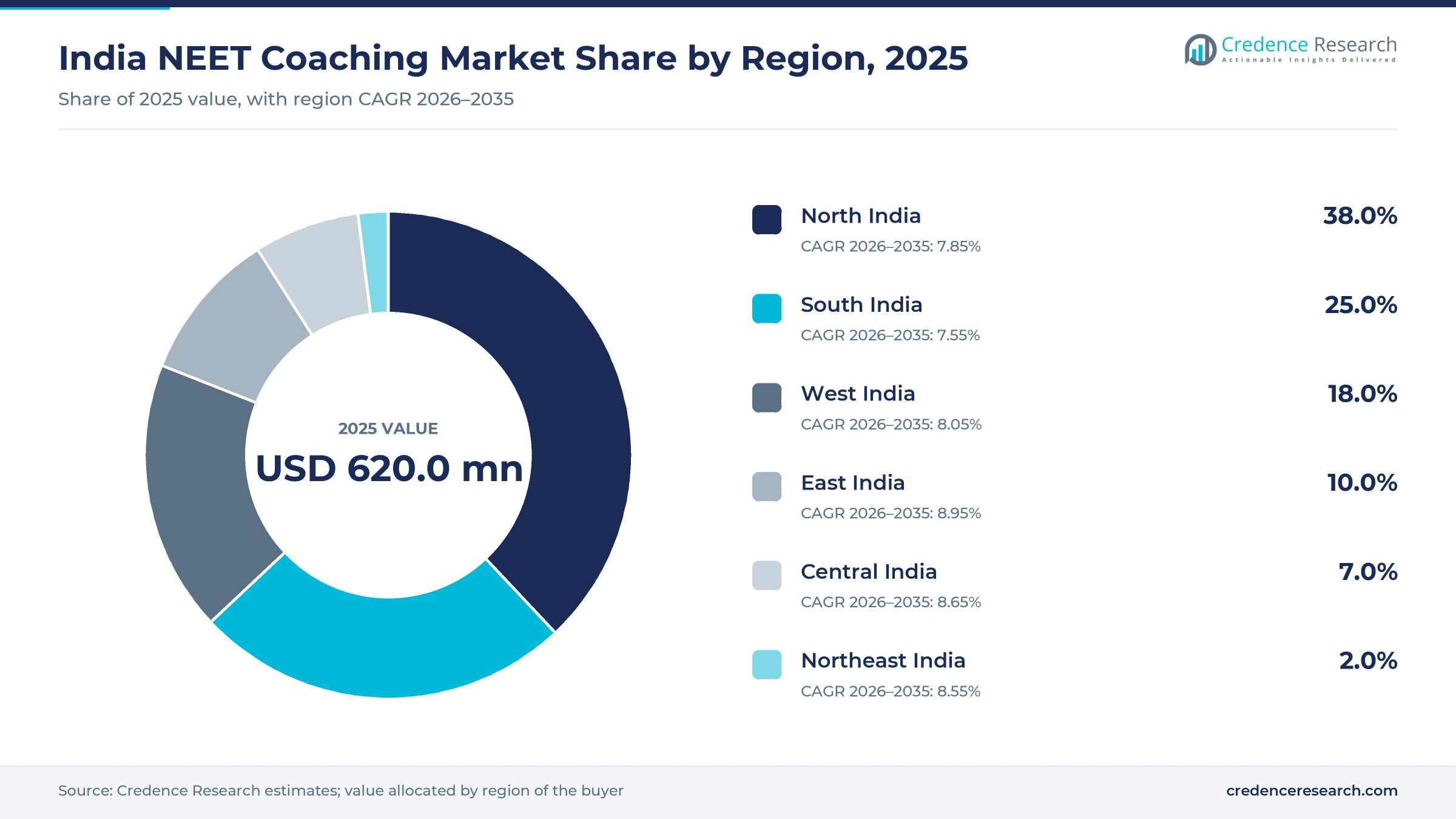
North India leads while East India grows fastest
| Region | Value, 2025 (USD million) | Share, 2025 | CAGR, 2026–2035 |
|---|---|---|---|
| North India | 235.6 | 38.0% | 7.85% |
| South India | 155.0 | 25.0% | 7.55% |
| West India | 111.6 | 18.0% | 8.05% |
| East India | 62.0 | 10.0% | 8.95% |
| Central India | 43.4 | 7.0% | 8.65% |
| Northeast India | 12.4 | 2.0% | 8.55% |
North India leads on candidates and residential hubs
North India held 38.0% of 2025 value and grows at 7.85% a year, supported by the country's largest candidate pool and its best-known hubs. Uttar Pradesh sent 328,847 candidates to the 2026 retest and Rajasthan sent 192,023, according to state data published by PhysicsWallah. Rajasthan was among the few large states to record a rise from 176,181 in 2025. Kota and Sikar draw students from neighboring states, which adds residential batches at high fees, though the Rajasthan Act will raise compliance work.
South India shows strong demand but softer candidate counts
South India held 25.0% of 2025 value and grows at 7.55% a year, the slowest pace among the six zones. Karnataka sent 117,564 candidates to the 2026 retest and Tamil Nadu sent 108,601. However, Kerala fell to 84,664 from 121,516 in 2025, one of the sharpest drops among large states. Free programs in Tamil Nadu, with about 230 planned centers, also limit price growth, although Telangana and Andhra Pradesh together added 125,307 candidates.
West India earns value from Maharashtra and new hubs
West India held 18.0% of 2025 value and grows at 8.05% a year, with Maharashtra as its anchor. The state sent 201,100 candidates to the 2026 retest and produced 107,304 qualifiers, the third-highest total in the country, according to Careers360. Gujarat added 68,833 candidates, and Rajkot appears on the PhysicsWallah list of possible new sites. Akola and Latur also give national brands new locations outside Mumbai and Pune, which spreads classroom supply across the zone.
East India grows fastest as Bihar draws new centers
East India held 10.0% of 2025 value and grows at 8.95% a year, the fastest pace among the zones. Bihar sent 140,079 candidates to the 2026 retest, West Bengal sent 93,381 and Odisha sent 50,009. Value remains below candidate share because Credence Research assumes lower average fees here and some students travel to Kota. That gap should narrow, since Allen has moved into Patna and Darbhanga, and PhysicsWallah named Muzaffarpur and Dhanbad among possible new sites in its 2025 offer document.
Central India gains from new medical colleges
Central India held 7.0% of 2025 value and grows at 8.65% a year, supported by rising local seat supply. Madhya Pradesh sent 105,514 candidates to the 2026 retest and Chhattisgarh sent 41,111. Chhattisgarh also received five of the seven new government medical colleges approved for 2026–27, according to the Allen seat matrix summary, which gives local students a clearer goal. Ujjain appears among possible PhysicsWallah sites, though students from Madhya Pradesh were among those returning to Kota in May 2026, according to Careers360.
Northeast India stays small as online batches fill gaps
Northeast India held 2.0% of 2025 value and grows at 8.55% a year from a small base. Assam sent 36,283 of the 62,170 candidates from the eight northeastern states in the 2026 retest, according to state data published by PhysicsWallah. Allen opened its Guwahati study center in November 2018, and PhysicsWallah named Jorhat among possible new sites in 2025. Limited local center supply and travel costs still make online and hybrid batches the practical option for many students.
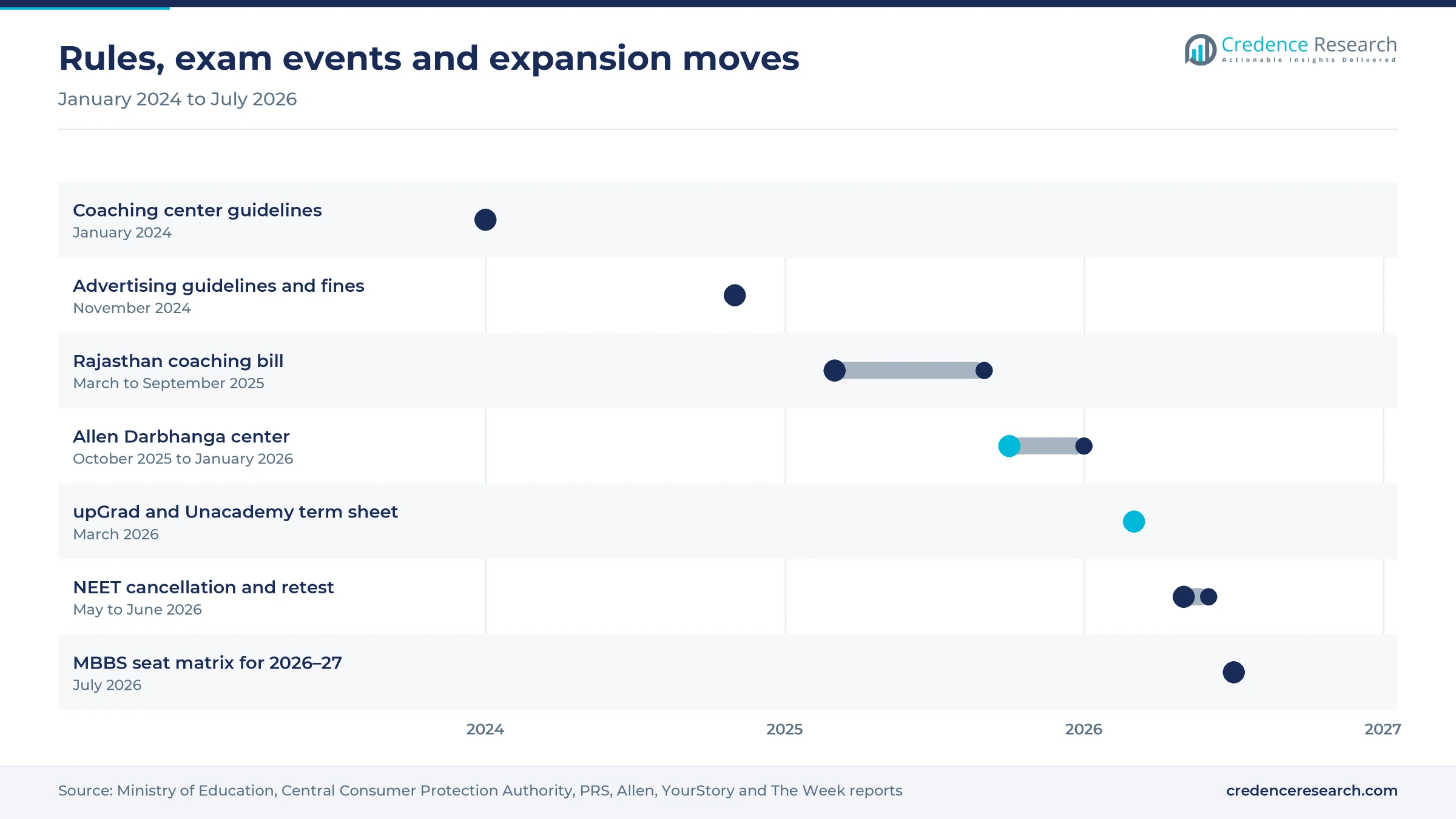
Exam reform and expansion marked 2024 to 2026
| Development | Status and market relevance |
|---|---|
| In January 2024, the Ministry of Education issued coaching center guidelines covering registration, a minimum enrollment age of 16 and refunds. | Issued; states carry out enforcement, and they shape foundation batches. |
| In October 2025, Allen announced a Darbhanga center with NEET classes starting in January 2026. | Announced; extends its Bihar network after Patna. |
| In September 2026, upGrad completed its all-stock acquisition of Unacademy. | Completed; the deal combines test preparation with higher education and skilling. |
| In May 2026, the National Testing Agency set a June 21 retest after canceling the May 3 NEET paper. | Completed; result declared on July 16, 2026. |
| In July 2026, the National Medical Commission seat matrix showed 139,439 MBBS seats for 2026–27. | Published; further approvals were pending at the time. |
Test platforms and AI tools change how batches run
- Computer-based mock platforms matter more after the decision to hold NEET UG on screen from 2027, since students will need practice in that format.
- Hybrid classroom streaming lets a central teacher reach several towns, as PhysicsWallah Pathshala centers combine streamed lectures with on-site faculty.
- AI doubt and grading tools such as Ask AI, AI Guru and AI Grader at PhysicsWallah extend support without a matching rise in teaching staff.
- Free public learning platforms such as SATHEE offer live lectures and practice material, which pressures paid apps to justify their prices.
Need a Custom Version of This Report?
Tailor the scope, geography, or segments to your exact requirements.
- Custom geography or segment scope
- Direct access to our analyst team
National brands compete through centers and price
Competition among the main brands turns on results, faculty, center reach and price. Allen and Aakash rest on classroom networks and scholarship tests, while PhysicsWallah entered from low-priced online courses and now runs 165 Vidyapeeth centers, according to Entrepreneur India. Motion is an institute that has added branches such as Akola, and its 2026 penalty shows how closely results advertising is now watched. Unacademy is moving company-run sites toward franchise operators under upGrad ownership, a sign that online brands find classroom costs difficult to carry alone. Aakash also raised fresh capital in November 2025, when a share allotment to Think & Learn was under review at the National Company Law Tribunal. Regional institutes such as Goal Institute and CLC remain strong in their home areas, because local teaching language matters to parents, and Careers360 noted that most Sikar teaching is in Hindi. As a result, national brands tend to compete on reach, and local rivals compete on attention and affordability.
Companies profiled and their roles in this market
| Company | Type | Role in the market |
|---|---|---|
| Allen | Classroom network | Kota-origin institute expanding in Bihar, with repeater batches and online courses |
| Aakash Educational Services | Classroom network | One-year repeater and integrated courses, backed by Manipal Group capital |
| PhysicsWallah | Online and hybrid platform | Low-priced online courses, Vidyapeeth centers and Pathshala hybrid centers |
| Motion | Classroom institute | Institute with NEET and JEE branches, fined over 2025 result claims |
| Unacademy | Online platform | NEET and JEE courses, shifting company-run centers to franchise partners |
Value shifts from Kota toward local branded centers
Credence Research's view is that value will move gradually from one residential hub toward branded local centers, not toward apps alone. Classroom fees still dwarf online prices, so a modest shift in students into hybrid batches adds more value than a large gain in app users. The 2026 cancellation also showed that families need flexible revision support at short notice, which favors operators with both channels. Buyers should look at audited results and refund terms before fee promises, because enforcement against weak claims has become more frequent since November 2024.
How the NEET coaching estimates were built
The report uses 2025 as the base year and 2026–2035 as the forecast period. Market values come from the Credence Research model, and regional and segment splits are Credence Research estimates informed by candidate counts, published fees and center data. Sources include National Testing Agency data as published by Careers360 and PhysicsWallah, the National Medical Commission seat matrix as summarized by Allen, the Comprehensive Modular Survey on Education, PRS Legislative Research, company disclosures and named press reports. No interviews or primary surveys were conducted for this edition of the report.
Spending doubles as hubs spread by 2035
The market reaches USD 1.32 billion by 2035 at an 8.00% CAGR, and the path should be steadier if computer-based testing reduces the risk of another mass cancellation. Hybrid centers and Tier-2/3 locations will likely take a larger part of spending, while Kota keeps its reputation but a smaller share. New MBBS seats under the national plan to add 75,000 medical places in five years, announced in the budget, should ease some pressure, although candidates will still far outnumber seats. Regulation should favor larger chains, which leaves regional institutes to compete through teaching language, attention and lower total cost.
Frequently Asked Questions
How big is the India NEET coaching market?
Which mode of NEET coaching holds the largest share?
Which region leads India NEET coaching spending?
Which region is growing fastest?
What drives demand for NEET coaching?
How will computer-based NEET affect coaching institutes?
What rules affect NEET coaching centers?
Who are the main companies in this market?
Table of Content
Chapter 1 Market Segmentation
- 1.1 Segmentation Framework
- 1.1.1 Product and Service Classification
- 1.1.2 Application and End-Use Classification
- 1.1.3 Technology and Solution Classification
- 1.1.4 Customer and Distribution Channel Classification
- 1.1.5 Geographic Segmentation
- 1.1.6 Market Segment Definitions and Boundaries
- 1.2 By Mode
- 1.2.1 Offline
- 1.2.2 Online
- 1.2.3 Hybrid
- 1.3 By Course
- 1.3.1 1-Year Dropper
- 1.3.2 2-Year Integrated
- 1.3.3 Crash Course
- 1.4 By City Tier
- 1.4.1 Kota
- 1.4.2 Metros
- 1.4.3 Tier-2/3
Chapter 2 Introduction
- 2.1 Report Objectives and Scope
- 2.2 Product Definition and Industry Terminology
- 2.3 Market Inclusions and Exclusions
- 2.4 Research Process
- 2.4.1 Primary Research and Expert Interviews
- 2.4.2 Secondary Research and Source Review
- 2.4.3 Top-Down and Bottom-Up Estimation
- 2.4.4 Data Triangulation and Verification
- 2.5 Market Size Measurement Basis
- 2.5.1 2025: USD 620.0 million → 2035: USD 1.32 billion
- 2.6 Historical and Forecast Reference Periods
- 2.6.1 Historical Period: 2018-2025
- 2.6.2 Base Year: 2025
- 2.6.3 Forecast Period: 2025-2035
- 2.7 Research Assumptions and Limitations
Chapter 3 Executive Summary
- 3.1 Market Snapshot and Key Findings
- 3.2 Base-Year Market Size, 2025
- 3.3 Forecast Market Size, 2035
- 3.4 Revenue and Volume Growth Outlook
- 3.5 Key Demand and Supply Indicators
- 3.6 Leading Market Segments
- 3.7 Fastest-Growing Market Opportunities
- 3.8 Regional Performance Highlights
- 3.9 Technology and Industry Transformation
- 3.10 Competitive Landscape Summary
- 3.11 Analyst View and Strategic Implications
Chapter 4 India NEET Coaching Market Trends and Developments
- 4.1 Historical Industry Development, 2018-2025
- 4.2 Recent Market Trends and Developments
- 4.3 Demand and Customer Behavior Trends
- 4.4 Technology and Product Innovation
- 4.5 Artificial Intelligence, Automation and Digitalization
- 4.6 Local Manufacturing and Supply Chain Realignment
- 4.7 Industry Partnerships, Mergers and Acquisitions
- 4.8 Sustainability and Circular Economy Developments
- 4.9 Government and Private Sector Investment Trends
- 4.10 Emerging Business Models and Commercialization
- 4.11 Industry Developments and Announcements
Chapter 5 India NEET Coaching Market Production, Supply and Demand Analysis
- 5.1 Demand Trend and Consumption Analysis, 2018-2025
- 5.2 Demand Forecast, 2025-2035
- 5.3 Production and Output Trend, 2018-2025
- 5.4 Production and Output Forecast, 2025-2035
- 5.5 Installed Capacity and Capacity Utilization
- 5.6 Company-Wise Production Plants and Statistics
- 5.6.1 Installed Production Capacity
- 5.6.2 Actual Production
- 5.6.3 Planned Capacity and Expansion Targets
- 5.7 Supply Chain Structure and Procurement Trends
- 5.8 Supply-Demand Gap and Bottlenecks
- 5.9 Import Dependence and Sourcing Structure
- 5.10 Contract Manufacturing and Outsourcing
- 5.11 Regional Supply and Demand Concentration
Chapter 6 India NEET Coaching Market Pricing Analysis
- 6.1 Pricing Structure and Measurement
- 6.2 Historical Pricing Trends, 2018-2025
- 6.3 Pricing Outlook, 2025-2035
- 6.4 Average Selling Price and Unit Economics
- 6.5 Pricing by Product and Market Segment
- 6.6 Geographic Pricing Differences
- 6.7 Key Input, Energy, Labor and Logistics Costs
- 6.8 Contract Pricing and Purchasing Models
- 6.9 Pricing Sensitivity and Competitive Positioning
- 6.10 Price, Margin and Profitability Implications
Chapter 7 India NEET Coaching Market Dynamics
- 7.1 Market Growth Drivers
- 7.1.1 Demand-Side Drivers
- 7.1.2 Technology and Innovation Drivers
- 7.1.3 Infrastructure and Investment Drivers
- 7.1.4 Regulatory and Policy Drivers
- 7.2 Market Restraints
- 7.2.1 Cost and Affordability Constraints
- 7.2.2 Technology and Adoption Barriers
- 7.2.3 Supply Chain and Operational Constraints
- 7.3 Market Challenges
- 7.3.1 Competitive Pressure and Margin Erosion
- 7.3.2 Skills, Infrastructure and Implementation Gaps
- 7.4 Emerging Market Opportunities
- 7.5 Market Dynamics Impact and Time-Horizon Assessment
Chapter 8 India NEET Coaching Value Chain Analysis
- 8.1 Industry Value Chain Overview
- 8.2 Upstream Suppliers and Critical Inputs
- 8.3 Technology and Component Providers
- 8.4 Manufacturing or Service Delivery
- 8.5 Distribution, Channel Partners and Integrators
- 8.6 Downstream Applications and End Users
- 8.7 Value Addition and Profit Pools
- 8.8 Vertical Integration and Outsourcing
- 8.9 Supplier Concentration and Risk
- 8.10 Supply Chain Localization and Resilience
Chapter 9 India NEET Coaching Market Regulations and Policies
- 9.1 Relevant Laws, Standards and Compliance Frameworks
- 9.2 Product, Service, Safety and Quality Requirements
- 9.3 Government Policies, Incentives and Subsidies
- 9.4 Imports, Exports and Trade Barriers
- 9.5 Public Procurement and Local Content Requirements
- 9.6 Environmental and Sustainability Compliance
- 9.7 Upcoming Policy Changes and Market Implications
Chapter 10 India NEET Coaching Market Hotspots and Opportunities
- 10.1 Market Opportunity Mapping and Growth Hotspots
- 10.2 High-Growth Applications and Customer Groups
- 10.3 Underserved Markets and White-Space Opportunities
- 10.4 Emerging Technology and Product Opportunities
- 10.5 New Capacity and Investment Hotspots
- 10.6 Market Entry and Expansion Opportunities
- 10.7 Distribution and Partnership Opportunities
- 10.8 Near-Term and Long-Term Commercial Potential
- 10.9 Opportunity Attractiveness and Execution Risks
Chapter 11 India NEET Coaching Market Outlook, 2025-2035
- 11.1 Market Size and Analysis
- 11.1.1 Revenue (Market Measurement: 2025: USD 620.0 million → 2035: USD 1.32 billion)
- 11.1.2 Market Volume and Quantity Sold
- 11.1.3 Historical Market Size, 2018-2025
- 11.1.4 Base-Year Market Size, 2025
- 11.2 Market Forecast, 2025-2035
- 11.2.1 Revenue Forecast to 2035
- 11.2.2 Volume Forecast to 2035
- 11.2.3 CAGR and Year-on-Year Growth
- 11.2.4 Incremental Revenue Opportunity
- 11.3 Forecast Assumptions and Scenario Analysis
- 11.3.1 Base-Case Forecast
- 11.3.2 Optimistic and Conservative Scenarios
- 11.3.3 Technology, Pricing and Policy Sensitivities
- 11.4 Market Attractiveness and Growth Outlook
Chapter 12 India NEET Coaching Market Segmentation and Outlook
- 12.1 Segmentation Summary and Market Shares, 2025
- 12.2 Largest and Fastest-Growing Segments
- 12.3 By Mode - Market Size and Forecast, 2025-2035
- 12.3.1 Segment Definition and Scope
- 12.3.2 Historical Market Size, 2018-2025
- 12.3.3 Revenue Forecast, 2025-2035
- 12.3.4 Volume Forecast, 2025-2035
- 12.3.5 Base-Year Market Share, 2025
- 12.3.6 Segment CAGR and Growth Drivers
- 12.3.7 Subsegment Market Size and Forecast
- 12.3.7.1 Offline
- 12.3.7.2 Online
- 12.3.7.3 Hybrid
- 12.3.8 Subsegment Pricing and Adoption Trends
- 12.3.9 Leading Suppliers and Competition
- 12.3.10 Regional Demand and Opportunities
- 12.4 By Course - Market Size and Forecast, 2025-2035
- 12.4.1 Segment Definition and Scope
- 12.4.2 Historical Market Size, 2018-2025
- 12.4.3 Revenue Forecast, 2025-2035
- 12.4.4 Volume Forecast, 2025-2035
- 12.4.5 Base-Year Market Share, 2025
- 12.4.6 Segment CAGR and Growth Drivers
- 12.4.7 Subsegment Market Size and Forecast
- 12.4.7.1 1-Year Dropper
- 12.4.7.2 2-Year Integrated
- 12.4.7.3 Crash Course
- 12.4.8 Subsegment Pricing and Adoption Trends
- 12.4.9 Leading Suppliers and Competition
- 12.4.10 Regional Demand and Opportunities
- 12.5 By City Tier - Market Size and Forecast, 2025-2035
- 12.5.1 Segment Definition and Scope
- 12.5.2 Historical Market Size, 2018-2025
- 12.5.3 Revenue Forecast, 2025-2035
- 12.5.4 Volume Forecast, 2025-2035
- 12.5.5 Base-Year Market Share, 2025
- 12.5.6 Segment CAGR and Growth Drivers
- 12.5.7 Subsegment Market Size and Forecast
- 12.5.7.1 Kota
- 12.5.7.2 Metros
- 12.5.7.3 Tier-2/3
- 12.5.8 Subsegment Pricing and Adoption Trends
- 12.5.9 Leading Suppliers and Competition
- 12.5.10 Regional Demand and Opportunities
- 12.6 Segment Growth Comparison
- 12.7 Segment Attractiveness and Priority Matrix
Chapter 13 India NEET Coaching Geographic Market Outlook, 2025-2035
- 13.1 Domestic Market Distribution and Demand Clusters
- 13.2 State- or Province-Wise Market Size and Forecast, 2025-2035
- 13.3 City and Metropolitan Market Outlook
- 13.4 Industrial, Manufacturing and Commercial Clusters
- 13.5 Geographic Concentration of Key End Users
- 13.6 Local Pricing and Purchasing Differences
- 13.7 Domestic Production Facilities and Capacity Map
- 13.8 Local Infrastructure and Project Pipeline
- 13.9 State-Level Policy and Incentive Differences
- 13.10 Subnational Investment Hotspots and Opportunities
- 13.11 Distribution and Logistics Networks
- 13.12 Domestic Competitive Footprint
Chapter 14 India NEET Coaching Technology, Innovation and Sustainability Outlook
- 14.1 Technology Landscape and Maturity
- 14.2 Product, Process and Service Innovation
- 14.3 AI, Automation and Digital Tools in the Industry
- 14.4 Technology Adoption and Performance Benchmarking
- 14.5 Innovation Pipeline and R&D Investment
- 14.6 Patent and Intellectual Property Trends
- 14.7 Energy Efficiency and Resource Management
- 14.8 Sustainability, Recycling and Circularity
- 14.9 Technology Roadmap, 2025-2035
- 14.10 Risks of Obsolescence and Technology Substitution
Chapter 15 India NEET Coaching Market Key Strategic Imperatives
- 15.1 Growth and Market Entry Priorities
- 15.2 High-Return Products and Segments
- 15.3 Pricing, Profitability and Cost Optimization
- 15.4 Technology Investment and Product Differentiation
- 15.5 Supply Chain Localization and Resilience
- 15.6 Distribution and Customer Acquisition
- 15.7 Partnership, Acquisition and Capacity Strategy
- 15.8 Regional Expansion Priorities
- 15.9 Short-, Medium- and Long-Term Actions
Chapter 16 Competition Outlook
- 16.1 Industry Competition Characteristics
- 16.2 Market Structure and Concentration
- 16.3 Market Share and Competitive Positioning, 2025
- 16.4 Company-Wise Revenue and Product Benchmarking
- 16.5 Production and Service Capacity Benchmarking
- 16.6 Technology, Pricing and Differentiation
- 16.7 Regional Footprint and Distribution Strength
- 16.8 Mergers, Acquisitions and Strategic Alliances
- 16.9 New Entrants and Competitive Threats
- 16.10 Porter's Five Forces and Industry Attractiveness
- 16.11 Competitive Outlook, 2025-2035
Chapter 17 Company Profiles
- 17.1 Company Coverage and Selection Criteria
- 17.2 Allen
- 17.2.1 Business Description
- 17.2.2 Company Ownership and Geographic Presence
- 17.2.3 Product and Service Portfolio
- 17.2.4 Manufacturing and Operating Footprint
- 17.2.5 Production Capacity and Expansion Plans
- 17.2.6 Financial Performance and Investment
- 17.2.7 Market Share and Competitive Position
- 17.2.8 Technology and Innovation Capabilities
- 17.2.9 Strategic Alliances or Partnerships
- 17.2.10 Recent Developments
- 17.2.11 Growth Strategy and Outlook
- 17.3 Aakash Educational Services
- 17.4 PhysicsWallah
- 17.5 Motion
- 17.6 Unacademy
- 17.7 Other Relevant Market Participants
Note: Every listed company is profiled on the structure shown under the first company. The company list is preliminary and may change based on research findings, market developments, data availability and client requirements.
Chapter 18 Disclaimer
- 18.1 Research and Forecast Disclaimer
- 18.2 Data Source and Estimation Limitations
Note: The depth of individual sections depends on data availability for this market. Volume, capacity, trade and other unit-based metrics are included where applicable.

